Search Results: "az"

17 October 2012

Martin Pitt: Running a Samba server as normal user for testing

For writing tests for GVFS (current tests, proposed improvements) I want to run Samba as normal user, so that we can test gvfs smb backend without root privileges and thus can run them safely and conveniently in a make check environment for developers and in JHBuild for continuous integration testing. Before these tests could only run under gvfs-testbed, which needs root. Unlike other servers such as ssh or ftp, this turned out surprisingly non-obvious and hard, so I want to document it in this blog post for posterity s benefit. Running the server Running smbd itself is mainly an exercise of figuring out all the options that you need to set; Alex Larsson and I had some fun figuring out all the quirks and hiccups that happen between Ubuntu s and Fedora s packaging and 3.6 vs. 4.0, but finally arrived at something working. First, you need to create an empty directory where smbd can put all its databases and state files in. For tests you would use mkdtemp(), but for easier reading I just assume mkdir /tmp/samba here. The main knowledge is in the Samba configuration file, let s call it /tmp/smb.conf:
[global]
workgroup = TESTGROUP
interfaces = lo 127.0.0.0/8
smb ports = 1445
log level = 2
map to guest = Bad User
passdb backend = smbpasswd
smb passwd file = /tmp/smbpasswd
lock directory = /tmp/samba
state directory = /tmp/samba
cache directory = /tmp/samba
pid directory = /tmp/samba
private dir = /tmp/samba
ncalrpc dir = /tmp/samba
[public]
path = /tmp/public
guest ok = yes
[private]
path = /tmp/private
read only = no
For running this as a normal user you need to set a port > 1024, so this uses 1445 to resemble the original (privileged) port 445. The map to guest line makes anonymous logins work on Fedora/Samba 4.0 (I m not sure whether it s a distribution or a version issue). Don t ask about dir vs. directory , that s an inconsistency in Samba; with above names it works on both 3.6 and 4.0. We use the old smbpasswd backend as shipping large tdb files is usually too inconvenient and brittle for test suites. I created an smbpasswd file by running smbpasswd on a real Samba installation, and then using pdbedit to convert it to a smbpasswd file:
sudo smbpasswd -a martin
sudo pdbedit -i tdbsam:/var/lib/samba/passdb.tdb -e smbpasswd:/tmp/smbpasswd
The result for password foo is
myuser:0:XXXXXXXXXXXXXXXXXXXXXXXXXXXXXXXX:AC8E657F83DF82BEEA5D43BDAF7800CC:[U          ]:LCT-507C14C7:
which you are welcome to copy&paste (you can replace myuser with any valid user name, of course). This also defines two shares, one public, one authenticated. You need to create the directories and populate them a bit:
mkdir /tmp/public /tmp/private
echo hello > /tmp/public/hello.txt
echo secret > /tmp/private/myfile.txt
Now you can run the server with
smbd -iFS -s /tmp/smb.conf
The main problem with this approach is that smbd exits ( Server exit (failed to receive smb request) ) after a client terminates, so you need to write your tests in a way to only run one connection/request per test, or to start smbd in a loop. Running the client If you merely use the smbclient command line tool, this is rather simple: It has a -p option for specifying the port:
$ smbclient -p 1445 //localhost/private
Enter martin's password: [enter "foo" here]
Domain=[TESTGROUP] OS=[Unix] Server=[Samba 3.6.6]
smb: \> dir
  .                                   D        0  Wed Oct 17 08:28:23 2012
  ..                                  D        0  Wed Oct 17 08:31:24 2012
  myfile.txt                                   7  Wed Oct 17 08:28:23 2012
In the case of gvfs it wasn t so simple, however. Surprisingly, libsmbclient does not have an API to set the port, it always assumes 445. smbclient itself uses some internal libcli API which does have a way to change the port, but it s not exposed through libsmbclient. However, Alex and I found some mailing list posts ([1], [2]) that mention $LIBSMB_PROG, and it s also mentioned in smbclient s manpage. It doesn t quite work as advertised in the second ML post (you can t set it to smbd, smbd apparently doesn t speak the socket protocol over stdin/stdout), and it s not being used anywhere in the current Samba sources, but what does work is to use good old netcat:
export LIBSMB_PROG="nc localhost 1445"
with that, you can use smbclient or any program using libsmbclient to talk to our test smb server running as user.

16 October 2012

David Welton: The Dreaded Google Lockdown

It's one of those things that you read about, but are never really sure about: you think "maybe he was doing something fishy, and isn't tellling it straight in the public account of the incident". So I'll try to stick to "just the facts". A few weeks ago, I dug up some old book reviews I'd done, and posted to Facebook, and opened a site here: http://davids-book-reviews.blogspot.com/ as a way of collecting them. Naturally, I also added Amazon referral links, because, hey, it helps feed my reading habit! Last month I got enough to buy two whole Kindle books, so we're not exactly talking about "get rich quick" territory here. We're not even talking about anything remotely close to my day job, for that matter. But hey, if I can get a little bit extra to spend on books, it's nice. The reviews were basically quick notes on books I read. Nothing that I or the rest of humanity can't get along without, but I felt like writing up a little something for myself and people I know on the internet - maybe it'll help someone else find an interesting book to read. Several days later, I believe on October 8th, I woke up to find my phone was 'not signed in to Google', and, after repeated attempts, wouldn't sign in. Same thing with my Nexus 7. Logging in to my computer, in something of a cold sweat at this point, I find I can't get into Gmail or anything else, either. Luckily, on the computer, Google's system did redirect me to a page where they mentioned suspicious activity, and gave me the chance to reactivate things by sending an SMS to my phone. This did work quickly, and did a little bit to alleviate some of my stress. I understand that locking things down quickly is probably to my benefit as well as theirs in the event of an actual security breach of someone's account: it keeps the attacker from doing any more damage. However, it was sure a bad way to start a Monday morning. However, the actual 'blog' (sorry, I hate the word!) was still blocked. It too has a form to fill out to prove that you're human. Although: as a computer guy, you'd think that with all the clever people at Google, they would be able to tell from my access patterns to the site, browser footprint, IP addresses and so forth, that...well, I am me. In any event though, they promised to review the blog within two days. So, I waited patiently. A week later, still nothing. Then, the next day, I went back to check on the status, and they had reset the review request: it no longer said anything about October 8th, when I had originally made the reinstatement request. So I filled in their form again, asking to have my blog back. That was yesterday, we'll see what happens next. As far as I can tell, I did not violate their actual terms of conditions, which say nothing about referral links: http://www.blogger.com/content.g Since the people at Google are loth to speak with their users directly, it seems as if one of the best ways of getting support is to complain loudly and publicly about this kind of shennanigan. And to forestall the somewhat inevitable comments on anything related to Google: 1) Yes, I know I signed an agreement where they say they can do whatever the hell they want and I can f**k off if I don't like it. Try and do anything on line with a major company and not get a contract like that, or for even more entertainment value, try and negotiate the contract with t he company. Good luck. If you don't say yes, you're pretty much on your own; there doesn't seem to be much of a market for "more humane terms and conditions" out there. 2) I know, I know, relying on the Google beast is a great way to set yourself up for a big fall if anything ever goes wrong, because it's impossible to appeal, or pretty much even to talk with a human. But with a limited amount of time in my life, to date, Google has been a pretty good deal. I suppose it's something of a "black swan" situation: everything seems fine until one day WHACK, and Google pulls the carpet from under your legs. Conclusions? Well, I hope someone out there can help me recover my content. I wrote it myself, and I would like to save my book reviews somewhere. What alternatives are there to the Google colossus? Not too many that I can see that are anywhere at all as convenient. Edit: 2012-10-17: I don't know what did it, but they have reinstated the site. Strange and disconcerting, but I guess things are ok for the time being. Thanks to whoever it was at Google that finally had a look.

15 October 2012

Andrea Veri: Some statistics about GNOME.org

The GNOME infrastructure runs a Piwik s istance and it s been amazing seeing some of the statistics published there. A few details: Traffic during the 27/09/2012 GNOME 3.6 Launch Visits: 23063 Page views: 50352 Traffic during the last month. (from 15/09/2012 to 15/10/2012) Visits: 187598 Page views: 454313 Traffic during the last six months. (from 15/05/2012 to 15/10/2012) Visits: 773153 Page views: 1867200 GNOME is growing really fast and a great thank you goes to its great community and contributors! Let s keep rocking!

13 October 2012

Vasudev Kamath: Weekly Log - 06/13-102012

Update for 06/10/2012 Well I had not written the weekly work log for the last week that is because the week was short (oh yeah thanks to all these bandhs our week got fluctuated and to be frank the week was only 4 days long) and second was my lazyness. Here goes the update * After a long discussion with Aravinda on "why productivity is reducing these days." We concluded the social network is eating up most of time. So decision was made and I closed all pinned tabs for Twitter Gmail Identi.ca and Friendica on my browser * After the above resolution I finished almost 4 chapters of Moder Perl within 2 hours!. Indeed Social networks kill the productivity. Update for 13/10/2012 I've really fallen in love with computerised bots, thanks to the wonderful KGB bot :-). So majority of my work on this week is on bots. Jabber Dictionary Redesign After thinking for a while I decided to re-write the dictionary bot which when release got an overwhelming response as see in the comments of above link. Few reason for re-write
  1. Generalise the bot framework so single bot can handle multiple languages
  2. Improve the data collection on bot side
  3. Current code base was not very well organised and trying to add more feature it had become messy.
  4. Provide XEP support to help in data collections
Few changes which are already implemented include
  1. New code is now using pyxmpp2 library instead of GPLed xmppy used by current code.
  2. Implemented XEP-0071 extension to properly format the meaning display by the bot
  3. Current implementation was displaying all words in one set without distinguishing between adjectives,verbs proverbs etc. even though wiktionary displays meaning based on this. New implementation gives out meaning in same format as it is displayed on wiktionary.
Things remaining todo
  1. Separating wiktionary parsing logic from bot code by providing some sort of intermediate interface between bot and wiktionary parsers.
  2. Adding more language wiktionary parsers and teaching the bot to become multilingual :-)
  3. Integrating XEP-0004 (Data Forms) for taking the meaning input from user. Current code requires user to enter data in particular format
suckless-tools fix for Wheezy Jakub Wilk suggested me to prepare a minimal version of suckless-tools for Wheezy which includes a patch to the bug #685611. And few minor changes which involve taking over the package and fixes in copyright file other than above mentioned bug. Hopefully release-team will be okay with these changes. I'm waiting for the upload to file an unblock-request. I did face a problem I was halfway through wit suckless-tools_39-1 when Jakub asked me about this change and current repository was fresh one prepared for 39-1 and didn't have history for 38 version. First I thought of preparing separate repository for 38 version which was not an correct option, but I even couldn't play with current repository. So finally I renamed current version of repository to suckless-tools-39.git on collab-maint and prepared fresh repository suckless-tools.git basing it on 38-1 version. From 39 version suckless-tools will be following 3.0 (quilt) source format and will not be working with git-buildpackage as the tool can't handle multi-tarball packages. Yes every tool involved in the package will have separate tarball from 39. More work on Bots Well today I again worked on Jabber bot, but not the dictionary bot. This time its an SMS Gateway bot for Jonas Smedegard and the coding was done in Perl. Thanks to jonas I finally could apply what I learnt in Perl. Code may not be very elegant but it works :-). And after hacking one full day in Perl now I'm not feeling very much interested to go back and hack on my own Python based dictionary bot :-). But I will anyway. Misc So that's it folks. Quite longish post hope you are not bored reading it :-). Well time for movie C'ya all with next weeks log.

Steve Kemp: Software and hardware..

Software
I've been using redis for a while now. It is a fast in-memory storage system which offers persistence (unlike memcached), as well as several primitive data-types such as lists & hashes. Anyway it crossed my mind that I don't have a backup of the data it contains, so I knocked up a simple script to dump the contents in plain-text: In other software-news I've had some interesting and useful feedback and made two new releases of my slaughter sysadmin tool - it now contains a wee test suite and more robustness.
Hardware
I received an email last night to say that my Raspberry PI has shipped. Ordered 24/05/2012, and dispatched 12/10/2012 - I'd almost forgotten about it. My plan is to make it a media-serving machine, SNES emulator, or similar. Not 100% decided yet. Finally I've taken the time to repaint my office. When I last wrote about working from home I didn't include pictures - I just described the process of using a "work computer" and a "personal computer". So this is what my office used to look like. As you can see there are two machines and a huge desk. With a few changes I now have an office which looks like this - the two machines are glued-together with a KVM. and I have much more room behind it for another desk, more books, and similar toys. Additionally my dedication is now enforced - I simply cannot play with both computer as the same time. The chair was used to mount the picture - usually I sit on a kneeling chair, which is almost visible. What inspired the painting? Partly the need for more space, but mostly water damage. I had a leaking ceiling. (Local people will know all about my horrible leaking roof situation).
The end?

12 October 2012

Julien Danjou: Ceilometer 0.1 released

After 6 months of development, we are proud to release the first release of Ceilometer, the OpenStack Metering project. Ceilometer. This is a first and amazing milestone for us: we follow all other projects by releasing a version for Folsom! Using Ceilometer, you should now be able to meter your OpenStack cloud and retrieve its usage to build statistics or bill your customer! You can read our announcement on the OpenStack mailing list. Architecture We spent a good amount of time defining and refining our architecture. One of its important point, is that it has been designed to work without modifying any of the existing core components. Patching OpenStack components in an intrusive way to meter them was not an option for now, simply because we had no legitimacy to do so. This may change in the future, and this will likely be discussed next week during the OpenStack Summit. Meters Initially, we defined a bunch of meters we'd like to have for a first release, and in the end, most of them are available. Some of them are still missing, like OpenStack Object Storage (Swift) ones, mainly due to lack of interest from the involved parties so far. Anyhow, with this first release, you should be able to meter your instances, their network usage, memory, CPU. Images, networks and volumes and their CRUD operations are metered too. For more detail, you can read the complete list of implemented meters. REST API The HTTP REST API has been partially implemented. The provided methods should allow basic integration with a billing system. DreamHost is using Ceilometer in their deployment architecture and coupling it with their billing system! Towards Grizzly We don't have a clear and established road-map for Grizzly yet. We already have a couple of patches waiting in the queue to be merged, like the use of Keystone to authenticate API request and the removal of Nova DB access. On my side, these last days I've been working on a small debug user interface for the API. Ceilometer API server will return this interface if your do an API request from a browser (i.e. requesting text/html instead of application/json). I hope this will help to discover Ceilometer API more easily for new comers and leverage it to build powerful tools! Anyhow, we have tons of idea and work to do, and I'm sure the upcoming weeks will be very interesting. Also, we hope to be able to become an OpenStack incubated project soon. So stay tuned!

Russell Coker: Cheap Bulk Storage

The Problem Some of my clients need systems that store reasonable amounts of data. This is enough data that we can expect some data corruption on disk such that traditional RAID doesn t work, that old fashioned filesystems like Ext3/4 will have unreasonable fsck fimes, and that the number of disks in a small server isn t enough. NetApp is a really good option for bulk reliable storage, but their products are very expensive. BTRFS has a lot of potential, but the currently released versions (as supported in distributions such as Debian/Wheezy) lack significant features. One significant lack in current BTRFS releases is something equivalent to the ZFS send/receive functionality for remote backups, this was a major factor when I analysed the options for hard drive based backup [1], and you should always think about backup before deploying a new system. Currently ZFS is the best choice for bulk storage which is reliable if you can t afford NetApp. Any storage system needs a minimum level of reliability if only to protect it s own metadata and a basic RAID array doesn t protect against media corruption with current data volumes. The combination of performance, lack of fsck (which is a performance feature), large storage support, backup, and significant real-world use makes ZFS a really good option. Now I need to get some servers for more than 8.1TiB of storage (the capacity of a RAID-Z array of 4*3TB disks). One of my clients needs significantly more, probably at least 10 disks in a RAID-Z array so none of the cheaper servers will do. Basically the issue that some of my clients are dealing with (and which I have to solve) is how to provide a relatively cheap ZFS system for storing reasonable amounts of data. For some systems I need to start with about 10 disks and be able to scale to 24 disks or more without excessive expense. Also to make things a little easier and cheaper 24*7 operation is not required, so instead of paying for hot-swap disks we can just schedule down-time outside business hours. The Problem with Dell Dell is really good for small systems, the PowerEdge tower servers that support 2*3.5 or 4*3.5 disks and which have space for an SSD or two are really affordable and easy to order. But even in the mid-size Dell tower servers (which are small by server standards) you have problems with just getting a few disks operating outside a RAID array [2]. The Dell online store is really great for small servers, any time I m buying a server for less than $2500 I check the Dell online store first and usually their price is good enough that there is no need to get a quote from another company. Unfortunately all the servers with bigger storage involve disks that are unreasonably expensive (it seems that Dell makes their profit on the parts) and prices are not available online. I gave my email address and phone number to the Dell web site on Wednesday and they haven t cared to get back to me yet. This is the type of service that makes me avoid IBM and HP for any server deployment where the Dell online store sells something suitable! BackBlaze For some time BackBlaze have been getting interest by describing how they store lots of data in a small amount of space by tightly stacking SATA disks. They don t think that ZFS on Linux is ready for production, but their hardware ideas are useful. They have recently described their latest architecture [3]. They describe it as 135TB for $7,384. Of course the 135TB number is based on the idea of getting the full 3TB capacity out of each disk which they can do as they have redundancy over multiple storage pods. But anyone who wants a single fileserver needs some internal redundancy to cover disk failure. One option might be to have three RAID-Z2 arrays of 15 disks which gives a usable capacity of 42*3TB==126TB==113TiB. Note that while the ZFS documentation recommends between 3 and 9 disks per zpool for performance I don t expect performance problems, when you only have a gigabit Ethernet connection there shouldn t be a problem with three ZFS zpools making the network the bottleneck. For this option the way to go would be to start with an array of 15 disks and then buy a second set of 15 disks when the first storage pool becomes full. It seems likely that 4TB disks will become cheap before a 35TiB array is filled so we can get more efficiency by delaying purchases. The BackBlaze pod isn t cheap, they are sold as a complete system without storage disks for $US5,395 by Protocase [4]. That gives a markup of $US3,411 over the BackBlaze cost which isn t too bad given that BackBlaze are quoting the insane bulk discount hardware prices that I could never get. Protocase also offer the case on it s own for anyone who wants to build a system around it. It seems like the better option is to buy the system from Protocase, but that would end up being over $6,000 when Australian import duty is added and probably close to $7,000 when shipping etc is included. Norco Norco offers a case that takes 24 hot-swap SATA/SAS disks and a regular PC motherboard for $US399 [5]. It s similar to the BackBlaze pod but smaller, cheaper, and there s no obvious option to buy a configured and tested system. 24 disks would allow two RAID-Z2 arrays of 12 disks, the first array could provide 27TiB and the second array could provide something bigger when new disks are released. SuperMicro SuperMicro has a range of storage servers that support from 12 to 36 disks [6]. They seem good, but I d have to deal with a reseller to buy them which would involve pain at best and at worst they wouldn t bother getting me a quote because I only want one server at a time. Conclusion Does anyone know of any other options for affordable systems suitable for running ZFS on SATA disks? Preferably ones that don t involve dealing with resellers. At the moment it seems that the best option is to get a Norco case and build my own system as I don t think that any of my clients needs the capacity of a BackBlaze pod at the moment. Supermicro seems good but I d have to deal with a reseller. In my experience the difference between the resellers of such computer systems and used car dealers is that used car dealers are happy to sell one car at a time and that every used car dealer at least knows how to drive. Also if you are an Australian reader of my blog and you want to build such storage servers to sell to my clients in Melbourne then I d be interested to see an offer. But please make sure that any such offer includes a reference to your contributions to the Linux community if you think I won t recognise your name. If you don t contribute then I probably don t want to do business with you. As an aside, I was recently at a camera store helping a client test a new DSLR when one of the store employees started telling me how good ZFS is for storing RAW images. I totally agree that ZFS is the best filesystem for storing large RAW files and this is what I am working on right now. But it s not the sort of advice I expect to receive at a camera store, not even one that caters to professional photographers. Related posts:
  1. Cheap SATA Disks in a Dell PowerEdge T410 A non-profit organisation I support has just bought a Dell...
  2. ZFS vs BTRFS on Cheap Dell Servers I previously wrote about my first experiences with BTRFS [1]....
  3. Flash Storage and Servers In the comments on my post about the Dell PowerEdge...

10 October 2012

Jonathan Carter: LTSP By The Sea 2012


Last weekend I was in Southwest Harbour, Maine again for the annual LTSP hackfest (called By The Sea). It s a fun and productive event and as always it s been good catching up with LTSP folk, even though we were missing Oliver, Alkis and Vagrant. Here is a summary of what I can recall from the discussions of the weekend Recent Happenings in LTSP Going Forward
  • Libpamssh - This has been ongoing work in the LTSP project that will allow you to authenticate against another machine using SSH with local PAM. This will make it somewhat trivial to adapt LightDM (Light Display Manager) as a remote login manager and we can then do away with LDM (LTSP Display Manager) which currently has several big limitations. Scott Balneaves and St phane Graber made big progress on this over the weekend and it s close to an initial release.
  • New LTSP Cluster Control Center - Simon Poirier has been working on a new LTSP Cluster Control Center, the old one has been rusting away and other attempts at rewriting it didn t quite work out. He did a demonstration of the proof-of-concept code and it s looking quite nice already.
  • Squashed Bugs - Marc Gari py took some time to squash some bugs: LP: #996533, LP: #1048689 and LP: #1062947
  • Documentation - I m taking it upon myself to fix some problems we have with documentation. The lts.conf documentation is incomplete and difficult to maintain, so I will be going through the client/server code and tag all the possible settings that there are so that we can auto-generate documentation from it. David Trask will be helping out there and will be writing some nice descriptions for the config settings.
  • LTSP 6.0 and the Future of LTSP - There was a good opening discussion about the future of LTSP. The combination of all the recent partial rewrites that Alkis has been doing combined with the deprecation of LDM will culminate in what will be called LTSP 6.0. There was also some interest in having an LTSP standalone distribution again (that can be installed on none-integrated distributions) and things like an LTSP live client disc. We were also wondering about the future of pure thin clients, many upstreams are writing software that aren t at all thin client friendly (Clutter-based software like Gnome Shell and Totem, Unity, etc) and at the same time, thin client hardware is becoming increasingly powerful. It s possible that there may be a focus on making diskless fat clients working even better with LTSP and make it easier to use remote-apps for running only certain applications the application servers. We re also quite interested in projects like FreeRDP for users who would still require pure thin clients.
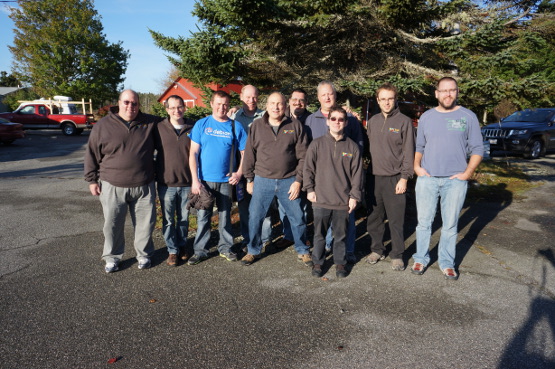
Social It was great seeing everyone again. I first started using LTSP around 9 years ago and never imagined back then that I d get to meet the people behind it. Ron Colcernian sourced us some really cool LTSP tops that you can see us wearing in the group photo. I hope to get to BTS again next year!

9 October 2012

David Welton: Fast, Light and Asynchronous

I am a big fan of Ruby on Rails: it does a lot of things, and it does most of them pretty well. When starting a new web project, it's the first thing I would reach for: most of the time, your problem is going to be figuring out a good product/market fit, or whipping up some internal tool without wasting a lot of programmer time. Once you've got a firm grasp of the problem, then maybe you can consider optimizing. Who cares if you do something that no one wants really really fast? However, Ruby on Rails is not beautiful in terms of being particularly fast or lightweight. No complaints from me: most of the time, I'm happy to have something that does so much for me, leaving me to work on the actual problem at hand. Once in a while, though, you do need fast and relatively lightweight, and that space has been getting more interesting over the past few years, at least in terms of the web. First of all, technologies like "Comet", utilizing web sockets or some other always-on connection are becoming more common, where a socket with the server remains open in order to quickly exchange data from the server to the client - and back. That seems to be a poor fit for something like Rails, where it can tie up a lot of resources if one isn't careful. And while computing costs continue to decline, no one minds getting more for less in terms of what their server can do. Furthermore, with frameworks like Backbone.js, pushing more and more code to the client, the server can afford to be a bit simpler and do less, so it may as well be snappy to boot. Java has long been fairly popular for "heavy lifting" types of applications, partially because it does end up being reasonably fast. But it's not something I've ever had much fun using and is usually kind of wordy, and makes you feel like you need a crew of people in Palo Alto, one in Bangalore, and one in Stockholm just to churn out all the code. And it certainly is no lightweight in terms of memory either. So... while it can certainly do pretty much anything you need, I don't see it as being the strongest player when someone needs "real time web" code, and needs it to be reasonably light weight. Ruby, outside of standard Rails stuff like Passenger, seems to offer some interesting possibilities for this kind of work, like Reel but they don't seem to have the traction other solutions do. Python is in a similar situation: the Twisted framework has been around for a while, and while it has some success stories, never seems to have really 'caught fire'. Neither of these languages was built for "concurrency" from the ground up, and that seems to have, to date, inhibited people from using them extensively for this kind of job. My gut feeling is that the need for speed and "concurrency" (or at least handling a lot of concurrent users) will drive adoption of languages heretofore not so popular on the server. Let's have a look at them. Erlang: This is by no means a new language, having been developed in Ericsson in the late 1980ies; and it implements several interesting concepts. First and foremost, concurrency is handled in the form of many small "processes", which are not actually Unix processes at all, but processes internal to the Erlang VM. The Erlang system contains a scheduler that allocates resources to all of these processes, so even if one of them dies or behaves badly, it's not a problem: the system as a whole can continue to function well. The way Erlang is built, the scheduler is preemptive: the internal "processes" don't need to yield to let other processes run. Beyond the scheduler and simple processes, Erlang gives you the tools to create elaborate trees of supervisors and workers that are quite robust to failures in any one portion of the system, as well as giving you the tools to set up a system to run on multiple, distributed computers. This kind of thinking is necessary when you write applications, such as phone switches, where downtime is really, really not ok. Erlang processes comunicate almost exclusively via message passing, meaning that state is not shared. Altogether, this makes for a fast, rock solid system that can easily handle thousands of concurrent connections without breaking a sweat. The computing world being what it is though, Erlang is likely to be more of a Lisp or Smalltalk: it's a trailblazer that did many things years before their time in other languages, but I don't see it as ever quite catching on amongst 'the masses'. It has a wonky syntax, it's a functional programming language, and because it is used in environments where too much experimentation is not good, it does not have a lot of room to break with its own past and innovate in terms of the language itself: it's slow to change and improve, even where the need to is clearly perceived. Node.js: is the opposite, in some ways: being based on Javascript, it draws on a huge number of potential programmers - orders of magnitude more than Erlang. And thanks to design decisions enforcing the use of asynchronous code and callbacks for anything that could block, it deals quite well with concurrent connections, even if the language and libraries don't really give you much in terms of "true" concurrency. This is a simple model that works pretty well, even if, theoretically, all it would take is one "while (1)" loop in a callback to block the entire system. In practice, this doesn't seem to be a big problem, though. More of a problem is writing maintainable code, when everything is a callback. Keeping the network of callbacks straight can be a bit of a chore, and is probably not an optimal model in terms of programmer productivity. That said, people seem to do make due with it, although Node is young enough that we haven't seem projects that are 5 or 6 years old and maintained by people who didn't write them. One of the advantages of being such a popular language is that lots of people have a strong interest in seeing Javascript being very, very performant. That need begat the V8 Javascript engine, from Google, which they were kind enough to release as free software. So one of the advantages that Node has is that the underlying implementation is extremely fast for a dynamic language. For many people who know Javascript, picking up Node.js is also an easy choice, even though people used to browser side programming with Javascript will have to adjust their way of thinking to succesfully tackle server projects. Go language: this is an interesting one, written by some luminaries who work at Google. It can best be described as something akin to C with some updated features, such as garbage collection, that make it more suitable for working on large projects, where things like memory leaks are going to make life very frustrating. It has the feel of a "real language, for real programmers" in that it doesn't stray far too far from what people are used to - it's not going to cause the "what the hell is this?!" reactions that Erlang might in more close-minded circles. Between the big company backing it, and the approachable syntax and concepts, Go looks like it has a good shot at the mainstream. Where it gets interesting is their concurrency model, which is apparently based on something called "communicating sequential processes" which, superficially at least, looks like it has some things in common with Erlang's "actor model" of concurrency. Under the hood, Go apparently hives off its "goroutines" to different OS level threads, but does not have a preemptive scheduler like Erlang: http://code.google.com/p/go/issues/detail?id=543 - although according to this, they may change that in the future. I'm not enough of a computer science guy to comment much on the details of CSP vs Actors, but both seem like valid models with strengths compared to trying to keep threads straight, which always seems to be a source of problems for programmers. Conclusions So, what's actually going to happen? I see Node.js as the clear front runner. It takes a worse-is-better approach that seems to work well enough as people get started. If they encounter difficulties later, they can always rewrite in something else, if needs be, but by "luring people in", Node.js has gathered a large group of users who continue, in turn, to churn out more code for use with the system, making it more attractive to new users. Programming languages are not winner-take-all markets though, so perhaps there is room for a few more languages to have decent followings in this space. Hopefully the competition will lead to ever better tools for those of us utilizing them! What do you think?

7 October 2012

Sune Vuorela: Playing with webstuff

So, the other day, I wrote a blog post asking people to make sure their private hacks become published somehow. So in the sprit of that, I should also publish my recent hacks. I have been toying around as a web dude and created two nice pieces of oldschool webby software. So. Time to introductions: Dodoma is a simple online note taking application. I have created a boring homepage for it on http://sune.vuorela.dk/dodoma and I have a screenshot here:
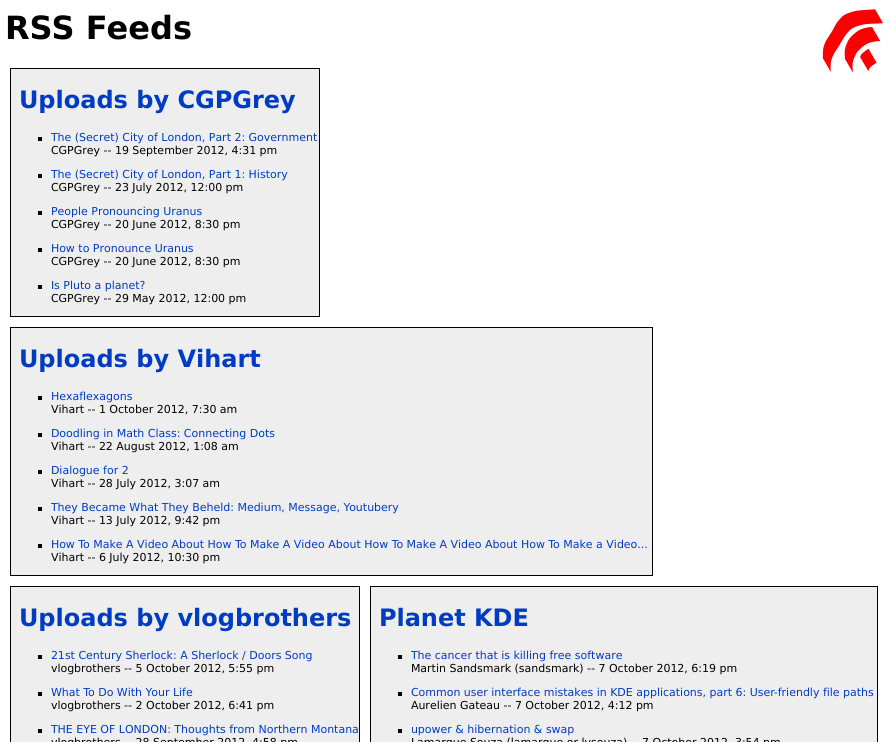
Screenshot of webapp Kadaka is a simple rss reader showing the five newest items from various rss feeds. Has special support for youtube channels.
I have created a boring homepage for it on http://sune.vuorela.dk/kadaka and I have a screenshot here:
Screenshot of kadaka Have fun with those two apps. Patches always welcome. Some of you might wonder where does he get those crazy names from . Well. One of them I found on a map. Thats actually a way I name quite many of my projects. Even those that don t even leave my harddrive. And the other one actually also is on a map, but I saw it on a frequently used bus in Tallin, Estonia. And. I am considering naming my next fancy projects after some of the cool words found on the join the game member page. If you want to be part of that, feel free to Join the game!

6 October 2012

Tim Retout: Wedding

Today, Kate and I got married! Thank you to everyone who sent best wishes. A big wedding party will follow in the next 18 months or so (when we've saved some money!), to which many more people will be invited. This was the minimum viable subset of wedding - we got the product to market early, and both stakeholders are very satisfied. We had dinner at the Caribbean restaurant in town which is always busy - turns out there's a reason for that. They do these one-pot meals in enamel dishes, which tasted amazing. It is a strange new feeling to be a husband. :)

Christian Perrier: [life] Running update

It's been some time since I didn't write in this blog about my running activities. So let's make an update for my international friends. If you don't care about running, you can move to the next post in your feed reader..:-) After a quite busy running activity during DebConf 12 in Nicaragua, as well as during the touristic trip we did afterwards, I went back to my "regular" schedule. Main objectives in September-December are roughly the following: During August, I broke my monthly distance record by running nearly 300km in one month, even achieving 100km in only 5 days, around 24th. That was one of my goals: improve my overall resistance to run repetitions, which is one of the keys for ultra-running. These were achieved with many runs to/back work, with up to 13km in the morning and the same in the evening. Yes, running 26km at about 11km/h (and with some ups and downs in the woods to make it even worse) on a day where one has a normal work activity is quite a challenge. September has been more focused on marathon preparation. This time, no complicated plan with interval running as the month was also a very busy work month, where fitting training sessions during the day would be hard. So, I made an easy plan : run a half-marathon every Sunday and run part of my work-home commute every day (So, 3km run to the train station, 30mn train ride, then 4km run to my work place, then shower....and the same back after work). Out of the 5 half-marathons I ran during these 5 Sundays, two of them were official ones. On the first one, I finally managed to break my personal best on half, with 1h37'14". Only a 14 seconds improvement, but that one is certainly one of my best among personal bests....even better than 3h38'45" on marathon.. All other half-marathons were run at marathon speed, so targeting 5'06"/km, which will be my planned pace on October 21st. The one I ran on Sept. 16th, which was the other official race I ran was finally done quite significantly faster than this. First of all, because I had hard times to run "only" at 5'06"/km because of other runners emulation. And also, because I ran the last 3 kilometers up to nearly 14km/h (so, down to 4'15"/km), just for fun, because I could do it..:-) With all this preparation, I think that I now manage to very well manage my marathon speed. I'll probably do a final test tomorrow by trying to keep running at this speed for 3 rounds of my favourite "Maurepas Marathon" circuit, which is just exactly 1/4 of a marathon. More "funnily", I also did something I never did before during this really crazy month : simply said, I came back from work by running. All the way long. Through woods, forests, along some lakes and finally in the country. 42 kilometers (yes, a marathon). After a work day. Starting at 5:45pm and arriving home after 4h50 minutes. With 2 hours of heavy rain. With 2.5 hours running in the dark (with my headlamp of course). All alone. That was a crazy bet to do....but really great fun achieving this : the GPS trace is here. Really something I have to do again..:-) So, well, now I'm more or less prepared and having fun is just a matter for time..:-). I'll keep you guys posted with those and, guess what? I'm already picking my target races for next year..:-)

4 October 2012

Raphaël Hertzog: My Debian Activities in September 2012

This is my monthly summary of my Debian related activities. If you re among the people who made a donation to support my work (1086.48 , thanks everybody!), then you can learn how I spent your money. Otherwise it s just an interesting status update on my various projects. Dpkg I am subscribed to Launchpad s dpkg bug tracker and I was getting annoyed with the amount of noise I got under the form of bug reports that look like package foo failed to install/upgrade: package foo is already installed and configured . Those reports are a combination of a bug in APT and of random other failures (often hardware related like corrupted .deb files, or I/O errors, but sometimes also real problems in other packages) but they always end up assigned on dpkg (because dpkg is outputting an error message complaining about APT s decision to configure something that doesn t have to be configured). I simply don t have the time required to manually process and inspect all those reports, so I decided to filter them at the apport level with a new Ubuntu bug pattern that indicates that those reports are a duplicate of LP#541595. Thanks to this, the dpkg bug count quickly went down from 130 to about 80. Packaging I sponsored a new upstream version of ledgersmb. I quickly updated WordPress to version 3.4.2 since it contains security relevant fixes. I also pushed a small update of nautilus-dropbox fixing #686863 because upstream renamed the binary package that they hand out on their website from nautilus-dropbox to dropbox. Their dropbox package only conflicts with old versions of nautilus-dropbox and not with the version that Debian is shipping and thus I had to add a Conflicts on our side to forbid co-installation of both packages. Testing wheezy s installation I bought a new laptop (Lenovo Thinkpad X230) and used this as an excuse to test Wheezy s installation process. It worked mostly fine except for two things:
  1. First I noticed that it would not accept my passphrase for my encrypted partition during early boot this turned out to be already reported as #619711 but was no longer getting any attention from the package maintainer. After some IRC discussion with Julien Cristau, we prodded Michael Prokop who had apparently already offered to take care of this issue. I tested his updated package and the result got quickly uploaded.
  2. I had weird networking problems that turned out to be related to the lack of the loopback network (i.e. on localhost). This was the result of a broken /etc/network/interfaces: it had been incorrectly modified by NetworkManager. I reported this in #688355. This issue affects people with IPv6 enabled networks.
Debian France There s a resurgence of activity in Debian France. Sylvestre Ledru is leading the organization of a mini-debconf in Paris on November 24-25th. And Tanguy Ortolo is now taking care of some merchandising (Polo shirts, to change from the usual T-Shirt). I might give a talk during this mini-debconf, possibly about multi-arch. Misc It s been a few months that I noticed a 2 second lag of gnome-shell everytime that smuxi (my IRC client) sent a notification. It s very annoying, you have the impression that the entire machine freezes. So I contacted Mirco Bauer on #smuxi and we investigated a bit. It turns out that smuxi is using an old version of the notification protocol where the picture is sent as a bytestream leading to huge dbus messages. This is clearly sub-optimal so smuxi will be fixed to be able to send the path of the picture instead of the picture itself. On the other hand, it s really a bug of gnome-shell that it freezes during the time it takes to handle the bigger-than-usual dbus message. So I also filed a bug on GNOME Shell (Bugzilla #683829) to get this fixed. Librement: funding free software work I started a new project with the goal of helping free software developers to fund their free software work. It s still mostly vaporware for now but I have a public code repository, a nice logo and lots of ideas. If the topic is of interest to you, and you d like to be involved, feel free to get in touch. Otherwise stay tuned. Thanks See you next month for a new summary of my activities.

4 comments Liked this article? Click here. My blog is Flattr-enabled.

2 October 2012

Joachim Breitner: Dennis Felsing s thesis on ghc-vis submitted

Last week, my first student ever submitted his bachelor thesis Visualization of Lazy Evaluation and Sharing about a tool he created that allows you to investigate the heap of a running Haskell program, including unevaluated values and their sharing properties, in a visual and interactive manner. You can see it in action at the end of the video of my lightning talk about ghc-dup at the Haskell Implementors Workshop this year, and read more about it on Dennis ghc-vis web page. I m quite happy about the result and I think I can get used to have other people implement my ideas and needs :-) Dennis said he is willing to continue the maintenance of the tool, so give it a shot and bombard him with bug reports and feature requests!

1 October 2012

Martin Pitt: Announcing D-Bus mocker library

I was working on writing tests for gnome-settings-daemon a week or so ago, and finally got blocked on being unable to set up upower/ConsoleKit/etc. the way I need them. Also, doing so needs root privileges, I don t want my test suite to actually suspend my machine, and using the real service is generally not suitable for test suites that are supposed to run during make check , in jhbuild, and the like these do not have the polkit privileges to do all that, and may not even have a system D-Bus running in the first place. So I wrote a little test_upower.py helper, then realized that I need another one for systemd/ConsoleKit (for the system idle property), also looked at the mock polkit in udisks and finally sat down for two days to generalize this and do this properly. The result is python-dbusmock, I just released the first tarball. With this you can easily create mock objects on D-Bus from any programming language with a D-Bus binding, or even from the shell. The mock objects look like the real API (or at least the parts that you actually need), but they do not actually do anything (or only some action that you specify yourself). You can configure their state, behaviour and responses as you like in your test, without making any assumptions about the real system status. When using a local system/session bus, you can do unit or integration testing without needing root privileges or disturbing a running system. The Python API offers some convenience functions like start_session_bus() and start_system_bus() for this, in a DBusTestCase class (subclass of the standard unittest.TestCase ). Surprisingly I found very little precedence here. There is a Perl module, but that s not particuarly helpful for test suites in C/Vala/Python. And there is Phil s excellent Bendy Bus, but this has a different goal: If you want to thoroughly test a particular D-BUS service, such as ensuring that it does the right thing, doesn t crash on bad input, etc., then Bendy Bus is for you (and python-dbusmock isn t). However, it is too much overhead and rather inconvenient if you want to test a client-side program and just need a few system services around it which you want to set up in different states for each test. You can use python-dbusmock with any programming language, as you can run the mocker as a normal program. The actual setup of the mock (adding objects, methods, properties, etc.) all happen via D-Bus methods on the org.freedesktop.DBus.Mock interface. You just don t have the convenience D-Bus launch API. The simplest possible example is to create a mock upower with a single Suspend() method, which you can set up like this from Python:
import dbus
import dbusmock
class TestMyProgram(dbusmock.DBusTestCase):
[...]
    def setUp(self):
        self.p_mock = self.spawn_server('org.freedesktop.UPower',
                                        '/org/freedesktop/UPower',
                                        'org.freedesktop.UPower',
                                        system_bus=True,
                                        stdout=subprocess.PIPE)
        # Get a proxy for the UPower object's Mock interface
        self.dbus_upower_mock = dbus.Interface(self.dbus_con.get_object(
            'org.freedesktop.UPower', '/org/freedesktop/UPower'),
            'org.freedesktop.DBus.Mock')
        self.dbus_upower_mock.AddMethod('', 'Suspend', '', '', '')
[...]
    def test_suspend_on_idle(self):
        # run your program in a way that should trigger one suspend call
        # now check the log that we got one Suspend() call
        self.assertRegex(self.p_mock.stdout.readline(), b'^[0-9.]+ Suspend$')
This doesn t depend on Python, you can just as well run the mocker like this:
python3 -m dbusmock org.freedesktop.UPower /org/freedesktop/UPower org.freedesktop.UPower
and then set up the mocks through D-Bus like
gdbus call --system -d org.freedesktop.UPower -o /org/freedesktop/UPower \
      -m org.freedesktop.DBus.Mock.AddMethod '' Suspend '' '' ''
If you use it with Python, you get access to the dbusmock.DBusTestCase class which provides some convenience functions to set up and tear down local private session and system buses. If you use it from another language, you have to call dbus-launch yourself. Please see the README for some more details, pointers to documentation and examples. Update: You can now install this via pip from PyPI or from the daily builds PPA. Update 2: Adjusted blog entry for version 0.0.3 API, to avoid spreading now false information too far.

28 September 2012

Joachim Breitner: The might applicative left fold

Just about three years ago, I created the automatic rule-based time tracker (arbtt), a tool that quietly runs in the background, records your current windows and their titles, and allows you to later process this data using, well, rules. By now, I have almost half a million records, spanning 317 days of me working at the computer. Processing this amount of data has become very memory-hungry: It takes 1G of RAM to process my data. Other users, with a presumably higher sampling rate, report even worse performance, which finally made me approach the problem again. Naturally, one wonders why it is such a memory hog, after all it takes just one run over the data to produce a report. The data itself is a lazy list so the garbage collector should the be able to drop the seen elements immediately. But arbtt is able to print several reports in one run; there is even an option (--each-category) that creates a number of reports based on the data itself. The code was structured that first a number of values that are possibly used by several reports are first created one and then re-used by the reports. And then there is the issue of the filters: The user specifies a what predicates are interesting (e.g., those where he was active) and some reports need to know not only which samples were matched, but also distinguish the consecutive runs of selected samples. Lots of reasons that made it hard to not use the list of of samples several times, which causes it to be completely retained in memory. The idea of completely rewriting everything in a much more imperative way was not appealing. But luckily Haskell s good abstraction possibilities can help here. What is the correct way to traverse a lazy list and calculate some information about it? It is a strict left fold, i.e. an algorithm that can be represented as arguments to
foldl' :: (s -> x -> s) -> s -> [x] -> s
For those who are new to folds: The first argument is a function that processes one element from the list, returning the new state of the processing. The second argument is the initial state. And foldl' can apply such an algorithm to a list to return a final state. So obviously I had to express my reports as left folds. To think clearer about it, I gave them a name. I also added a finishing step to the mix, which is handy:
data LeftFold x a = forall s. LeftFold  
  start :: s,
  process :: s -> x -> s,
  finish :: s -> a
   
A value of type LeftFold x a is then an algorithm that traverses a list of xes and returns something of type a. The forall s. means that the user of such a processor must not make any assumptions about the type of the state. I also have a function that runs such a list processor, simply by invoking foldl' with the arguments stored in the LeftFold constructor:
runLeftFold :: LeftFold x a -> [x] -> a
runLeftFold (LeftFold st1 p1 f1) xs = f1 (foldl' p1 st1 xs)
Now, as a Haskell programmer, I am searching for monads everywhere, and it really would have been nice if this were a monad, as they are very easy to compose. But unfortunately, they do not form a monad. If they did then I could decide after running one processor and looking at the result how I would want to process the list now, but this obviously contradicts with the desire to traverse the list only once. But there is the monad s smaller ugly sibling, the applicative functor. One can still somewhat nicely compose them to form more complex algorithms, just with more restrictions. Here is my instance:
instance Functor (LeftFold x) where
  fmap f (LeftFold st1 p1 f2) = LeftFold st1 p1 (f . f2)
instance Applicative (LeftFold x) where
  pure x = LeftFold () const (const x)
  LeftFold st1 p1 f1 <*> LeftFold st2 p2 f2 = LeftFold  
  start  =  st1 :!: st2,
  process = \(s1 :!: s2) x -> p1 s1 x :!: p2 s2 x,
  finish  = \(s1 :!: s2)  -> f1 s1 (f2 s2)
   
The :!: operator is a strict tuple constructor. This is important, as otherwise the fold would be come a lazy one, I would be building up huge numbers of thunks and performance would be very bad. For the same reason every list processor should make sure that its state does not build thunks once it is in weak head normal form. Now I am at a abstraction level that I feel comfortable working in, by writing functions that combine the list processors in various ways. Probably the most important one for me is already present in the libraries (here with a specialized type):
sequenceA :: [LeftFold x a] -> LeftFold x [a]
This is the whole trick: Now I can, based on the user input, run any number and selection of reports in one single list traversal. I find it very elegant that under the hood , the strict tuples are nested at precisely the right depth depending on the length of the list. As hinted at before, I do some interesting stuff that was previously represented as lists of lists of values. Expressing these as left folds was a bit tricky, but again, the complexity is contained in the combinators that I wrote (although it still gets confusing, check out processIntervalReport in Stats.hs):
monoidFold :: Monoid m => LeftFold m m
mapElems :: LeftFold y a -> (x -> y) -> LeftFold x a 
filterWith :: (x -> Bool) -> LeftFold (Bool :!: x) a -> LeftFold x a
onSelected :: LeftFold x a -> LeftFold (Bool :!: x) a
onJusts :: LeftFold x a -> LeftFold (Maybe x) a
onAll :: LeftFold x a -> LeftFold (Bool :!: x) a
runOnGroups :: (x -> x -> Bool) -> LeftFold x y -> LeftFold y z -> LeftFold x z
runOnIntervals :: LeftFold x y -> LeftFold y z -> LeftFold (Bool :!: x) z
lfLength :: LeftFold x Int
lfFirst :: LeftFold x (Maybe x)
lfLast :: LeftFold x (Maybe x)
toList :: LeftFold x [x]
concatFold :: LeftFold [x] [x]
As a result, the program now only requires 10MB and runs 18% faster. If you wonder why, in the definition of runLeftFold, I do not apply the finish function strictly: That is intentional; I am actually passing the result of a processor that calculates some often required data (e.g. total time recorded) as an argument to all the list processors. (Near the end of the main function in stats-main.hs) This loop works fine as long as I am using these only in the finish functions.
There is one downside to this approach: I cannot easily calculate stuff on demand and share it between two reports. Previously, I could just bind this to a variable, pass it to all reports, only if at least one is interested it would be evaluated and if several are interested, the result would be shared. I do not have a good solution for this yet. The code above is in the self-contained module LeftFold.hs in the arbtt sources.
Several People have had this idea before, here is one blog post by Max Rabkin.
Flattr this post

27 September 2012

Michal &#268;iha&#345;: Think twice before making your private data public

Data, once put on the internet, are quite hard to delete. You can most likely delete (or ask for deleting) them from place where it has been originally distributed, but you can be never sure where else it has appeared. Recently, I've seen several requests to remove some data from Gammu testsuite. This testsuite was created using public data available in our bug tracker, simply to be able to verify that we won't break stuff which was earlier fixed. It turns out that some people did make public some very private stuff, which was included in the testsuite in the end. None of the developers had clue about content of these messages, being in language which nobody of us understands (and being too lazy to run them through Google translator to understand them). Of course we've removed the data on request, but it's probably already copied in dozen other places on the internet...

Filed under: English Gammu 0 comments Flattr this!

26 September 2012

Russell Coker: Server Use Per Person

I ve just read Diego s response to an ill-informed NYT article about data-center power efficiency [1]. This makes me wonder, how much server use does each person have? Google Almost everyone uses Google, most of us use it a lot. The main Google product is also probably the most demanding, their search engine. In a typical day I probably do about 50 to 100 Google searches, that sounds like a lot, but half of them would probably be for one topic that is difficult to find. I don t think that I do that many Google searches because I generally know what I m doing and when I find what I need I spend a lot of time reading it. I m sure that many people do a lot more. Each Google search takes a few seconds to complete (or maybe more if it s an image search and I m on a slow link), but I think it s safe to assume that more than a few seconds of CPU time are involved. How much work would each Google search take if performed on a single system? Presumably Google uses the RAM of many systems as cache which gives a result more similar to a NUMA system than one regular server working for a longer time so there is no way of asking how long it would take to do a Google search with a single server. But I m sure that Google has some ratio of servers to the rate of requests coming in, it s almost certainly a great secret, but we can make some guesses. If the main Google user base comprises people who collectively do an average of 100 searches per day then we can probably guess at the amount of server use required for each search based on the number of servers Google would run. I think it s safe to assume that Google doesn t plan to buy one server for every person on the planet and that they want to have users significantly outnumbering servers. So even for core users they should be aiming to have each user only take a fraction of the resources that one server adds to the pool. So 100 searches probably each take more than 1 second of server use. But they almost certainly take a lot less than 864 seconds (the server use if Google had one server for every 100 daily requests which would imply one server for each of the heavier users). Maybe it takes 10 seconds of server use (CPU, disk, or network whichever is the bottleneck) to complete one search request. That would mean that if the Google network was at 50% utilisation on average then they would have 86400*.5/10/100 == 43 users per server for the core user base who average 100 daily requests. If there are 80M core users that would be about 2M servers, and then maybe something like another 4M servers for the rest of the world. So I could be using 1000 seconds of server time per day on Google searches. I also have a Gmail account which probably uses a few seconds for storing email and giving it to Fetchmail, and I have a bunch of Android devices which use Google calendars, play store, etc. The total Google server use on my behalf for everything other than search is probably a rounding error. But I could be out by an order of magnitude, if it only took 1 second of server use for a Google search then I would be at 100 server seconds per day and Google would only need one server for every 430 users like me. Google also serves lots of adverts on web sites that I visit, I presume that serving the adverts doesn t take much resources by Google standards. But accounting for it, paying the people who host content, and detecting fraud probably takes some significant resources. Other Big Services There are many people who spend hours per day using services such as Facebook. No matter how I try to estimate the server requirements it s probably going to be fairly wrong. But I ll make a guess at a minute of server time per hour. So someone who averages 3 hours of social networking per day (which probably isn t that uncommon) would be using 180 seconds of server time. Personal Servers The server that hosts my blog is reasonably powerful and has two other people as core users. So that could count as 33% of a fairly powerful server in my name. But if we are counting server use per USER then most of the resources of my blog server would be divided among the readers. My blog has about 10,000 people casually reading it through Planet syndication, that could mean that each person who casually reads my blog has 1/30,000 of a server allocated to them for that. Another way of considering it is that 10% of a server (8640 seconds) is covered by me maintaining my blog and writing posts, 20% is for users who visit my blog directly, and 3% is for the users who just see a Planet feed. That would mean that a Planet reader gets 1/330,000 of a server (250ms per day) and someone who reads directly gets 1/50,000 of a server (1.72s per day) as I have about 10,000 people visiting my blog directly in a month. My mail server which is also shared by a dozen or so people (maybe that counts as 5% of a server for me or 4320 seconds per day). Then there s the server I use for SE Linux development (including my Play Machine) and a server I use as a DNS secondary and a shell server for various testing and proxying. Other People s Servers If every reader of a Planet instance like Planet Debian and Planet Linux Australia counts as 1/330,000 of a server for their usage of my blog, then how would that count for my own use of blogs? I tend to read blogs written by the type of people who like to run things themselves, so there would be a lot of fairly under-utilised servers that run blogs. Through Planet Debian and Planet Linux Australia I could be reading 100 or more blogs which are run in the same manner as mine, and in a typical day I probably directly visit a dozen blogs that are run in such a manner. This could give me 50 seconds of server time for blog reading. Home Servers I have a file server at home which is also a desktop system for my wife. In terms of buying and running systems that doesn t count as an extra server as she needs to have a desktop system anyway and using bigger disks doesn t make much difference to the power use (7W is the difference between a RAID-1 server and a single disk desktop system). I also have a PC running as an Internet gateway and firewall. Running servers at home isn t making that much of an impact on my computer power use as there is only one dedicated 24*7 server and that is reasonably low power. But having two desktop systems on 24*7 is a significant factor. Where Power is Used/Wasted No matter how things are counted or what numbers we make up it seems clear that having a desktop system running 24*7 is the biggest use of power that will be assigned to one person. Making PCs more energy efficient through better hardware design and better OS support for suspending would be the best way of saving energy. Nothing that can be done at the server side can compare. Running a server that is only really used by three people is a significant waste by the standards of the NYT article. Of course the thing is that Hetzner is really cheap (and I m not contributing any money) so there isn t a great incentive to be more efficient in this regard. Even if I allocate some portion of the server use to blog readers then there s still a significant portion that has to be assigned to me for my choice to not use a managed service. Running a mail server for a small number of users and running a DNS server and a SE Linux development server are all ways of wasting more power. But the vast majority of the population don t have the skills to run their own server directly, so this sort of use doesn t affect the average power use for the population. Nothing else really matters. No matter what Google does in terms of power use it just doesn t matter when compared to all the desktop systems running 24*7. Small companies may be less efficient, but that will be due to issues of how to share servers among more people and the fact that below a certain limit you can t save money by using less resources particularly if you pay people to develop software. Conclusion I blame Intel for most of the power waste. Android phones and tablets can do some amazing things, which is hardly surprising as by almost every measure they are more powerful than the desktop systems we were all using 10 years ago and by many measures they beat desktop systems from 5 years ago. The same technology should be available in affordable desktop systems. I d like to have a desktop system running Debian based on a multi-core ARM CPU that can drive a monitor at better than FullHD resolution and which uses so little power that it is passively cooled almost all the time. A 64bit ARM system with 8G of RAM a GPU that can decode video (with full Linux driver support) and a fast SSD should compete well enough with typical desktop systems on performance while being quiet, reliable, and energy efficient. Finally please note that most of this post relies on just making stuff up. I don t think that this is wrong given the NYT article that started this. I also think that my estimates are good enough to draw some sensible conclusions. Related posts:
  1. Name Server IP and a Dead Server About 24 hours ago I rebooted the system that runs...
  2. Google Custom Search Engine I ve just been experimenting with Google Custom Search [1]. Below...
  3. Google Server Design Cnet has an article on the design of the Google...

25 September 2012

Antoine Beaupr : Improvements to spam filtering after a year of tests

It seems I am still having problems with spam on this site now. Instead of getting tons of spam comments posted, I get false positive, that is legitimate content marked as spam. First off, I wish to apologize for the people that haven't seen their comments published immediately. Next, I will work on improving this and explaining the current situation. Here are the statistics that the spam module gives me: Another way to put it: In other words, the filter works very well at marking spam, so well in fact that it also marks non-spammy comments as spam... Which is a shame because it breaks the interactivity of the site. Basically, you have one chance out of 3 of not seeing your content posted online, which leads people to try to submit it three times, which actually gets them blocked even more. And this is only the spam module filters: the CAPTCHA module tells me it's blocked 26535 attempts (26 thousand) - amazing. So overall, the solutions I put in place a year ago work, somehow, but are too aggressive. I have therefore bumped the threshold from 65% to 80%, hopefully that will help with this. I have also updated the Honeypot module since they have done lots of releases since 1.5, fixed the issue I reported and it's now in use on Drupal.org after some tweaking by our venerable webmaster killes. If this fails, I will look again at other solutions, like the blogspam plugin that relies on the communnity-run blogspam.net site which powers, amongst other things, Debian Administration and Ikiwiki sites. Back then, I also was considering the Bad Behavior and Block Anonymous links modules. (Note to self: I have also removed around 150 comments sitting in the spam module moderation queue, that it didn't seem to remove as it should have done.)

19 September 2012

Stefano Zacchiroli: bits from the DPL for August 2012

DPL August report, posted on d-d-a a while ago (yep, I forgot to blog it up to now!, sorry for the oldies).
Dear project members, August has been a month with a good deal of vacations for many of us, including yours truly. Therefore the monthly report of DPL activities will be briefer than usual. Which is good, as it'll leave all my readers more time to do NMUs and fix RC bugs! Ongoing discussions Assets Core teams Legal and RC fun Hardware See? It's been quick(er)! Talk to you here next month, with a much lower count of Wheezy RC Bugs on the horizon, hopefully.
Cheers.
PS the boring day-to-day activity log for August 2012 is available at master:/srv/leader/news/bits-from-the-DPL.txt.201208

Next.

Previous.