On 2017-08-06 I have a talk at
DebConf17 in
Montreal titled
"Consensually doing things together?"
(
video).
Here are the talk notes.
Abstract
At DebConf Heidelberg I talked about how Free Software has a lot to do about
consensually doing things together. Is that always true, at least in Debian?
I d like to explore what motivates one to start a project and what motivates
one to keep maintaining it. What are the energy levels required to manage bits
of Debian as the project keeps growing. How easy it is to say no. Whether we
have roles in Debian that require irreplaceable heroes to keep them going. What
could be done to make life easier for heroes, easy enough that mere mortals can
help, or take their place.
Unhappy is the community that needs heroes, and unhappy is the community that
needs martyrs.
I d like to try and make sure that now, or in the very near future, Debian is
not such an unhappy community.
Consensually doing things together
I gave
a talk in Heidelberg.
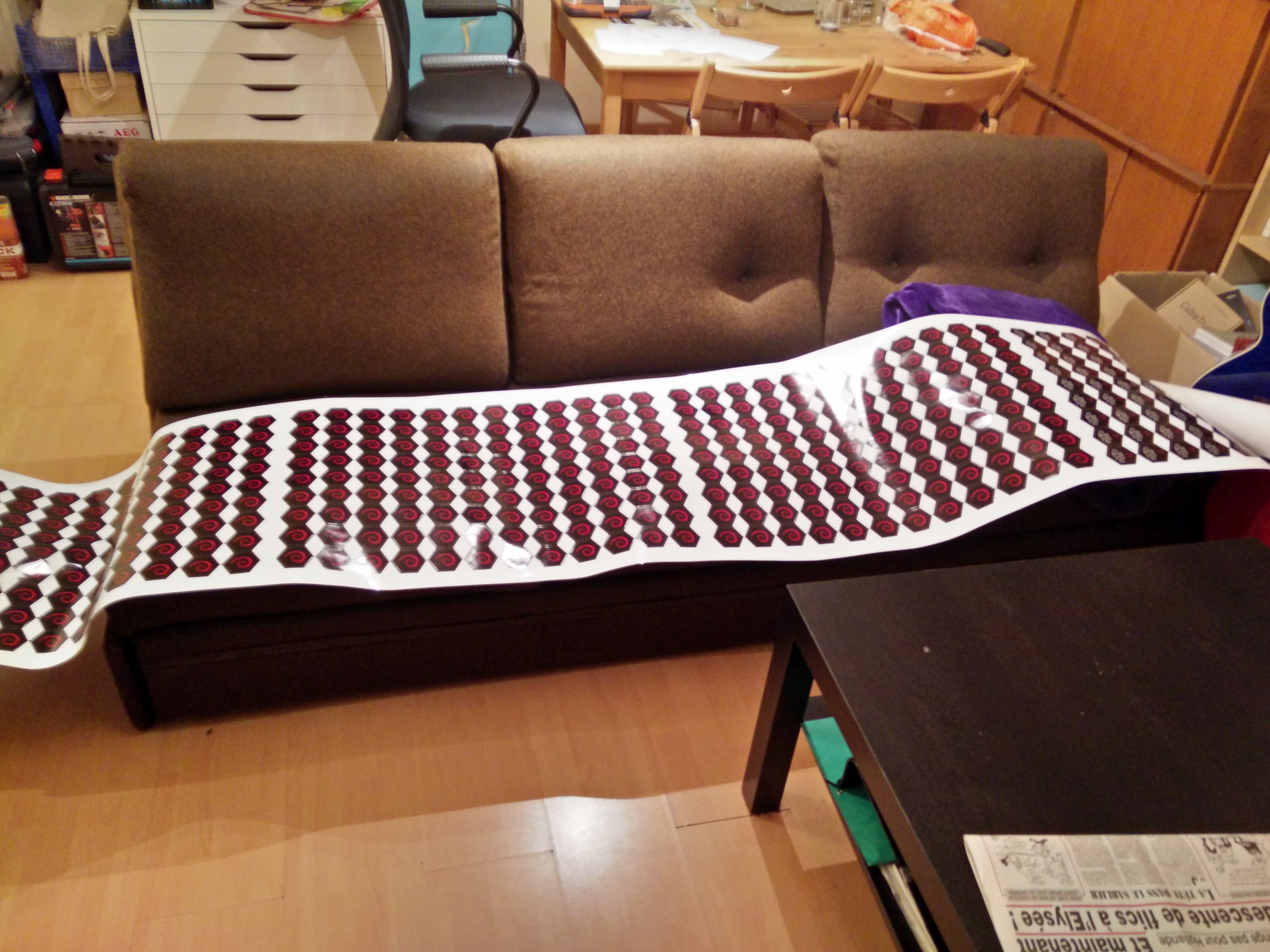
Valhalla
made
stickers
Debian France
distributed
many of them.
There's one on my laptop.
Which reminds me of what we
ought to be doing.
Of what we have a chance to do, if we play our cards right.
I'm going to talk about relationships. Consensual relationships.
Relationships in short.
Nonconsensual relationships are usually called abuse.
I like to see Debian as a relationship between multiple people.
And I'd like it to be a consensual one.
I'd like it not to be abuse.
Consent
From
wikpedia:
In Canada "consent means the voluntary agreement of the complainant to engage
in sexual activity" without abuse or exploitation of "trust, power or
authority", coercion or threats.[7] Consent can also be revoked at any
moment.[8]
There are 3 pillars often included in the description of sexual consent, or
"the way we let others know what we're up for, be it a good-night kiss or the
moments leading up to sex."
They are:
- Knowing exactly what and how much I'm agreeing to
- Expressing my intent to participate
- Deciding freely and voluntarily to participate[20]
Saying "I've decided I won't do laundry anymore" when the other partner is
tired, or busy doing things.
Is different than saying "I've decided I won't do laundry anymore" when the
other partner has a chance to say "why? tell me more" and take part in
negotiation.
Resources:
Relationships
Debian is the Universal Operating System.
Debian is made and maintained by people.
The long term health of debian is a consequence of the long term health of the
relationship between Debian contributors.
Debian doesn't need to be technically perfect, it needs to be socially healthy.
Technical problems can be fixed by a healty community.
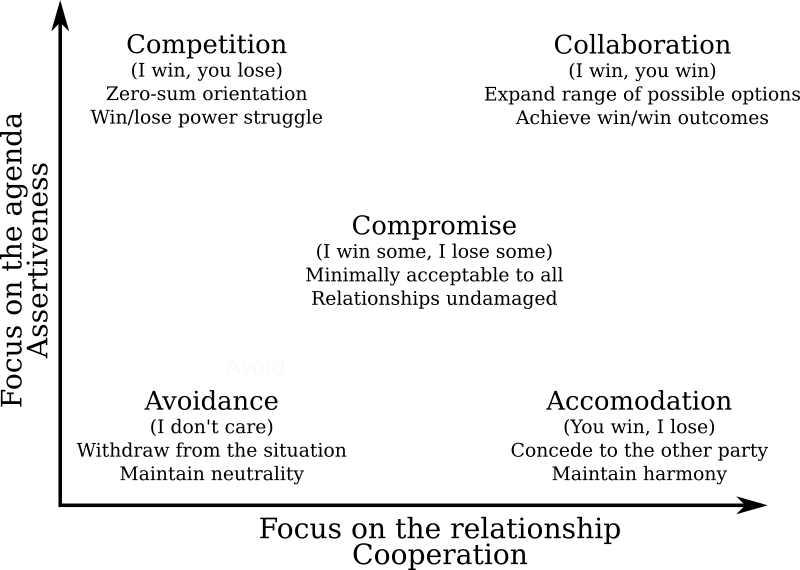
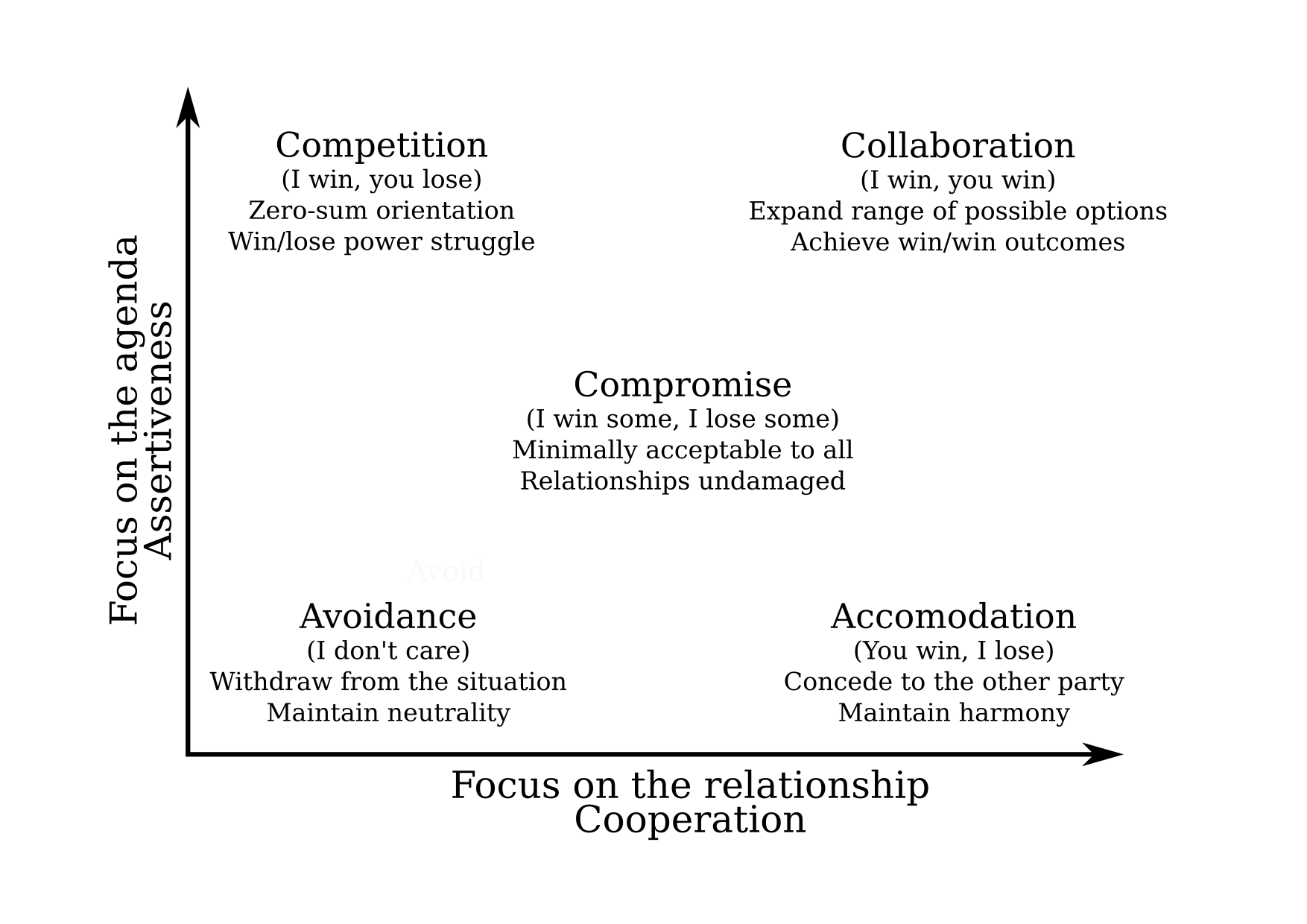
The
Thomas-Kilmann Conflict Mode Instrument:
source png.
Motivations
Quick poll:
- how many of you do things in Debian because you want to?
- how many of you do things in Debian because you have to?
- how many of you do both?
What are your motivations to be in a relationship?
Which of those motivations are healthy/unhealthy?
- healthy sustain the relationship
- unhealthy may explode spectacularly at some point
"Galadriel" (noun, by Francesca Ciceri):
a task you have to do otherwise Sauron takes over Middle Earth
See:
http://blog.zouish.org/nonupdd/#/22/1
What motivates me to start a project or pick one up?
- I have an idea for for something fun or useful
- I see something broken and I have an idea how to fix it
What motivates me to keep maintaning a project?
- Nobody else can do it
- Nobody else can be trusted to do it
- Nobody else who can and can be trusted to do it is doing it
- Somebody is paying me to do it
What motivates you?
What's an example of a sustainable motivation?
- it takes me little time?
- it's useful for me
- It's fun
- It saves me time to keep something running that if it breaks when I or somebody else needs it
- it makes me feel useful? (then if I stop, I become useless, then I can't afford to stop?)
- Getting positive feedback (more "you're good" than "i use it") ?
Is it really all consensual in Debian?
- what tasks are done by people motivated by guilt / motivated by Galadriel?
- if I volunteer to help team X that is in trouble, will I get stuck doing
all the work as soon as people realise things move fine again and finally
feel free to step back?
Energy
Energy that thing which is measured in
spoons. The metaphore comes from people suffering with chronic health issues:
"Spoons" are a visual representation used as a unit of measure used to
quantify how much energy a person has throughout a given day. Each activity
requires a given number of spoons, which will only be replaced as the person
"recharges" through rest. A person who runs out of spoons has no choice but
to rest until their spoons are replenished.
For example, in Debian, I could spend:
- Routine task: 1 spoon
- Context switch: 2 spoons
- New corner case: 5 spoons
- Well written bug report: -1 spoon
- Interesting thread: -1 spoon
- New flamewar: 3 spoons
What is one person capable of doing?
- are the things that we expect a person to do the things that one person can
do?
- having a history of people who can do it anyway is no excuse: show
compassion to those people, take some of their work, thank them, but don't
glorify them
Have reasonable expectations, on others:
- If someone is out of spoons, they're out of spoons; they don't get more
spoons if you insist; if you insist, you probably take even more spoons from
them
- If someone needs their spoons for something else, they are entitled to
- If someone gets out of spoons for something important, and nobody else can
do it, it's not their fault but a shared responsibility
Have reasonable expectations, on yourself:
- If you are out of spoons, you are out of spoons
- If you need spoons for something else, use them for something else
- If you are out of spoons for something important, and nobody else can do it,
it's not your problem, it's a problem in the community
Debian is a shared responsibility
- Don't expect few people to take care of everything
- Leave space for more people to take responsibility for things
- Turnover empowers
- Humans are a renewable resource, but only if you think of them that way
When spoons are limited, what takes more energy tends not to get done
- routine is ok
- non-routine tends to get stuck in the mailbox waiting for a day with more
free time
- are we able to listen when tricky cases happen?
- are we able to respond when tricky cases happen?
- are we able to listen/respond when socially tricky cases happen?
- are we able to listen/respond when harassment happens?
- can we tell people raising valid issues from troublemakers?
- in NM
- it's easier to accept a new maintainer than to reject them
- it's hard or impossible to make a call on a controversial candidate when
one doesn't know that side of Debian
- I'm tired, why you report a bug? I don't want to deal with your bug.
Maybe you are wrong and your bug is invalid? It would be good if you were
wrong and your bug was invalid.
- even politeness goes when out of spoons because it's too much effort
As the project grows, project-wide tasks become harder
Are they still humanly achievable?
- release team
- DAM (amount of energy to deal with when things go wrong; only dealing with
when things go spectacularly wrong?)
- DPL (how many people candidate to this year elections?)
I don't want Debian to have positions that require hero-types to fill them
- heroes are rare
- heroes are hard to replace
- heroes burn out
- heroes can become martyrs
- heroes can become villains
- heroes tend to be accidents waiting to happen
Dictatorship of who has more spoons:
- Someone who has a lot of energy can take more and more tasks out of people
who have less, and slowly drive all the others away
- Good for results, bad for the team
- Then we have another person who is too big to fail, and another accident
waiting to happen
Perfectionism
You are in a relationship that is just perfect. All your friends look up to
you. You give people relationship advice. You are safe in knowing that You Are
Doing It Right.
Then one day you have an argument in public.
You don't just have to deal with the argument, but also with your reputation
and self-perception shattering.
One things I hate about Debian:
consistent technical excellence.
I don't want to be required to always be right.
One of my favourite moments in the history of Debian is
the openssl bug
Debian doesn't need to be technically perfect, it needs to be socially healthy,
technical problems can be fixed.
I want to remove perfectionism from Debian: if we discover we've been wrong all
the time in something important, it's not the end of Debian, it's the beginning
of an improved Debian.
Too good to be true
There comes a point in most people's dating experience where one learns that
when some things feel too good to be true, they might indeed be.
There are people who cannot say no:
- you think everything is fine, and you discover they've been suffering all
the time and you never had a clue
There are people who cannot take a no:
- They depend on a constant supply of achievement or admiration to have a
sense of worth, therefore have a lot of spoons to invest into getting it
- However, when something they do is challenged, such as by pointing out a
mistake one has made, or a problem with their behaviour, all hell breaks
loose, beacuse they see their whole sense of worth challenged, too
Note the diversity statement: it's not a problem to have one of those (and many
other) tendencies, as long as one manages to keep interacting constructively
with the rest of the community
Also, it is important to be aware of these patterns, to be able to compensate
for one's own tendencies. What happens when an avoidant person meets a
narcissistic person, and they are both unaware of the risks?
Resources:
Note: there are problems with the way these resources are framed:
- These topics are often very medicalised, and targeted at people who are
victims of abuse and domestic violence.
- I find them useful to develop regular expressions for pattern matching of
behaviours, and I consider them dangerous if they are used for pattern
matching of people.
Red flag / green flag
http://pervocracy.blogspot.ca/2012/07/green-flags.html
Ask for examples of red/green flags in Debian.
Green flags:
- you heard someone say no
- you had an argument with someone and the outcome was positive for both
Red flags:
- you feel demeaned
- you feel invalidated
Apologies / Dealing with issues
I don't see the usefulness of apologies that are about accepting blame, or
making a person stop complaining.
I see apologies as opportunities to understand the problem I caused, help fix
it, and possibly find ways of avoiding causing that problem again in the
future.
A Better Way to Say Sorry
lists a 4 step process, which is basically what we do when in bug reports
already:
1, Try to understand and reproduce the exact problem the person had.
2. Try to find the cause of the issue.
3. Try to find a solution for the issue.
4. Verify with the reporter that the solution does indeed fix the issue.
This is just to say
My software ate
the files
that where in
your home directory
and which
you were probably
needing
for work
Forgive me
it was so quick to write
without tests
and it worked so well for me
(inspired by a 1934 poem by William Carlos Williams)
Don't be afraid to fail
Don't be afraid to fail or drop the ball.
I think that anything that has a label attached of "if you don't do it, nobody
will", shouldn't fall on anybody's shoulders and should be shared no matter
what.
Shared or dropped.
Share the responsibility for a healthy relationship
Don't expect that the more experienced mates will take care of everything.
In a project with active people counted by the thousand, it's
unlikely that
harassment isn't happening. Is anyone writing anti-harassment? Do we have
stats? Is having an email address and a CoC giving us a false sense of
security?
When you get involved in a new community, such as Debian, find out early
where, if that happens, you can find support, understanding, and help to make
it stop.
If you cannot find any, or if the only thing you can find is people who say
"it never happens here", consider whether you really want to be in that
community.
(from http://www.enricozini.org/blog/2016/debian/you-ll-thank-me-later/)
There are some nice people in the world. I mean nice people, the sort I couldn t describe myself as. People who are friends with everyone, who are somehow never involved in any argument, who seem content to spend their time drawing pictures of bumblebees on flowers that make everyone happy.
Those people are great to have around. You want to hold onto them as much as you can.
But people only have so much tolerance for jerkiness, and really nice people often have less tolerance than the rest of us.
The trouble with not ejecting a jerk whether their shenanigans are deliberate or incidental is that you allow the average jerkiness of the community to rise slightly. The higher it goes, the more likely it is that those really nice people will come around less often, or stop coming around at all. That, in turn, makes the average jerkiness rise even more, which teaches the original jerk that their behavior is acceptable and makes your community more appealing to other jerks. Meanwhile, more people at the nice end of the scale are drifting away.
(from https://eev.ee/blog/2016/07/22/on-a-technicality/)
Give people freedom
If someone tries something in Debian, try to acknowledge and accept their work.
You can give feedback on what they are doing, and try not to stand in their
way, unless what they are doing is actually hurting you. In that case, try to
collaborate, so that you all can get what you need.
It's ok if you don't like everything that they are doing.
I personally don't care if people tell me I'm good when I do something, I
perceive it a bit like "good boy" or "good dog". I rather prefer if people show
an interest, say "that looks useful" or "how does it work?" or "what do you
need to deploy this?"
Acknowledge that I've done something. I don't care if it's especially liked,
give me the freedom to keep doing it.
Don't give me rewards, give me space and dignity.
Rather than feeding my ego, feed by freedom, and feed my possibility to create.


 Update Some youtube links are not viewable or even seen on planet.debian.org. Seems p.d.o. tries its best to remove external links, sorry for the breakage.
Beware some youtube-links would be shared in this entry, sorry couldn t find a better/easier media platform to work with. If anyone knows any other platform or wants to suggest, feel free to either mail me or let me know in comments.
I want to start today s sharing with a picture of Ganesha I saw today. It is and was public art hence sharing it without an issue.
 This is starting of festivities time in India and Ganesha or Ganpati is looked up as a good omen in India.
The festival of Ganesh Chaturthi would be starting on the 25th of August and is a sight to behold. Just like Rio has its carnival, Ganesh Chaturthi is also a carnival. We also have parades where people come with Pandals (or temporary structures)
The mythology says he has a sweet tooth (hence lot of distribution of sweets, especially modak) and anything which might be troubling people, he creates solutions for them.
Here is one video of how people celebrate his immersion in India. This is from my home-town few years ago, every year the madness and the celebrations are becoming more and more. People from far off come to see how we celebrate and see how different people make their Pandals. While some are with music, others are with social messages. Usually people start going to see these structures after dusk and return home way after midnight or early morning. I hope to do this endeavour after many years. One is drunk from hearing all sorts of different kids of music, decoration, messages, a feast and a strain to all the senses.
Ganesha immersion celebrations https://www.youtube.com/watch?v=hjWfpGUryho
If one is interested one can find more info. at https://en.wikipedia.org/wiki/Ganesh_Chaturthi
After quite a bit of time, I wrote an article about various foss internships which I knew besides GSOC over the years. I finally penned them down at https://itsfoss.com/best-open-source-internships/
Interestingly, I was amazed to see that all FOSS U.S. projects (outside of GSOC) are for students who are either living or studying in U.S. and have a student work visa (which from private discussions I came to know is lot harder to get nowadays than before). Except for the National Science Foundation (NSF) which probably has U.S. defence relations and hence they might be sensitive, I fail to understand other institutes preferences for only getting people from the U.S. and hence having a lesser talent pool of people. This also affects the growth of the projects themselves. Just think how limited Debian would have been if it had decided to only have people from only any one community develop it. Dunno if this is due to the present President Trump or these policies had been there before. It would be nice and interesting if people in the know can share.
What has also been interesting to watch is Mr. Trump blaming low-cost manufacturing centres like India and China when as far as I recall, lot of manufacturing, specifically auto-mobiles manufacturing was shifted out of the U.S. to Ireland and other places years before which are relatively high-cost places (at least compared to India). I *believe* the change was as early as in 1980 s itself where India was insulated and had a limited market for everything (similar to Russian communism as shown in popular media but not so bad.)
Interestingly, it took almost a month for the perl 2.56 to make the transition smoothly. It took quite a bit of time for all the components to work together and be installable.
Also saw this few days back http://fortune.com/2017/04/12/auto-industry-decline/
While Tesla is expensive even by American standards the idea of lesser parts, lesser complexity and hence lower costs to use, maintain is good. I do hope that he and his team or any of the competitors do overcome the significant challenges. Any significant improvement in battery technology is bound to have huge impact in almost everything that is used in 21st century.
Two recent articles tell me the future may become present very quickly.
https://www.purdue.edu/newsroom/releases/2017/Q2/instantly-rechargeable-battery-could-change-the-future-of-electric-and-hybrid-automobiles.html
Toyota could finally start mass producing electric cars thanks to China
I do hope to see EV being prevalent before the next decade is over otherwise we don t have any hope due to climate change.
As for my health, I am much better than before. Just to share some stats, before my illness for lack of better word, I was 120 kgs. , when I was kept in the hospital for about 2-2.5 weeks I came down to 95 kgs. and now back upto 108 kgs. Do go for exercising every other day and trying to get back the strength, stamina and increasing a bit of both. Doctors have given me another 4-5 months after which a brain scan will reveal if there are any remaining blood clots in the brain or not.
Lastly, while it has become somewhat of a sensitive issue to love Muslims or to talk about their work in any field in the current political climate, there are 4-5 music pieces I listen whenever I can, especially before going to bed. While almost all the pieces have been sung and written by Muslims, sadly I don t know who the composers of these beautiful songs are.
While it is much easier to get the names of the singer and the lyricist, one of the more important roles in my view is the composer or/and music arranger. Without them, the songs would not have the same haunting quality that the songs have. While I have been lucky to find the names of the composer/music arranger for the pieces below but this is not the case if and when the songs comes on television. I do remember in old times at least on Radio they used to mention about who has given the music as well, dunno in modern times.
I am sharing the songs, and hopefully will also share the translations if I find on the web, please see the lyrics. The numbering is for convenience only and am torn in these 4-5 songs which is the best. Just to share these are all sufi love songs except the last one which I am sharing.
1.
Lyrical song https://www.youtube.com/watch?v=ehqN6oTpmb8
Translation with video of song http://www.bollynook.com/en/lyrics/6443/aaj-din-chadheya/
While there probably are stories with each song, I was lucky to find the story about this one. The lyrics of the song are actually a love lost Punjabi poet who writes in the memory of his beloved to which he could not marry and he pens those when standing in line for his liquor. The story goes on that he marries a girl later in life who bears a resemblance to his beloved whom he couldn t forget till his dying day.
2.
Lyrical song https://www.youtube.com/watch?v=uTC_2c83qn0
The same song has been sung by different people and I love them all the more for it.
Another video https://www.youtube.com/watch?v=3G7Qg4LJ7WE
Another video https://www.youtube.com/watch?v=kOsvNuR3m5Y
Translation http://www.bollynook.com/en/lyrics/10703/o-re-piya/
3.
Lyrical song https://www.youtube.com/watch?v=qG7Kms_YA5Q
The translation http://www.filmyquotes.com/songs/885
The translation of the song is a bit crude but then translations are supposed to be crude
 Anyways, the above song is what would be called a perfect Sufi song. I hope people enjoy the longing and the silence which follows this piece.
Another classic one
4.
Lyrical song https://www.youtube.com/watch?v=Ube5XhN_lpM
English translation http://www.ardhamy.com/song/aye-dil-e-naadan
While the song is from the movie Razia Sultana and was a flop as the movie was about Race and controversial then as it probably would be now. As seen in the other songs of the same genre, it has strands of longing, loneliness as seen of the above.
5.
Lyrical song https://www.youtube.com/watch?v=tv242qOnHJA
This one is not a sufi song but I love all the women and the girls and the way they enhanced the song. I dunno how much they must have practised as it s a very fast and peppy song and doesn t give time to the singer to breathe except for that one section which has a bit of Carnatic music.
At the very end I would like to share http://www.globalrhythm.net/ I have found some interesting sounds on the site. Hope the site enriches you as well. FWIW I have no links with the site except as somebody who likes to diversify his music listening.
Lastly, for a long period of time, I had been hearing the criticism, especially for FOSS games that they don t have AAA quality assets. Recently I came across a game called Starship Theory (sadly its only for MS-Windows)
Game video https://www.youtube.com/watch?v=imaL2pjNURg
You look at the game and see the number of videos the guy has made. What FOSS game developers can learn from this, you don t need high-end 2.5/3d models, clipart will do but need depth in gameplay which can make FOSS games be popular and also earn a pretty bundle. I do hope some FOSS game upstream developers take note and use that game s inspiration to bring more depth.
That doesn t mean games like 0ad are not liked by people but it takes huge amount of time and resources.
0ad video https://www.youtube.com/watch?v=DHx5XBtypcQ
Hope you have a good time with all the ideas, anecdotes and videos I shared above.


 The photo (click to enlarge) shows all four devices, together with a
Nokia N900, which was the
first Linux-based smartphone by Nokia, running Debian-based Maemo and
a completely unrelated
Gnuk cryptographic token,
which just sneaked into the setting.
If you like to participate, please



 If you also like graphics design, or design in general, have a look at
https://wiki.debian.org/Design and join
the team! Or you can visit the general list of Debian Teams
for many other opportunities to participate in Debian development.
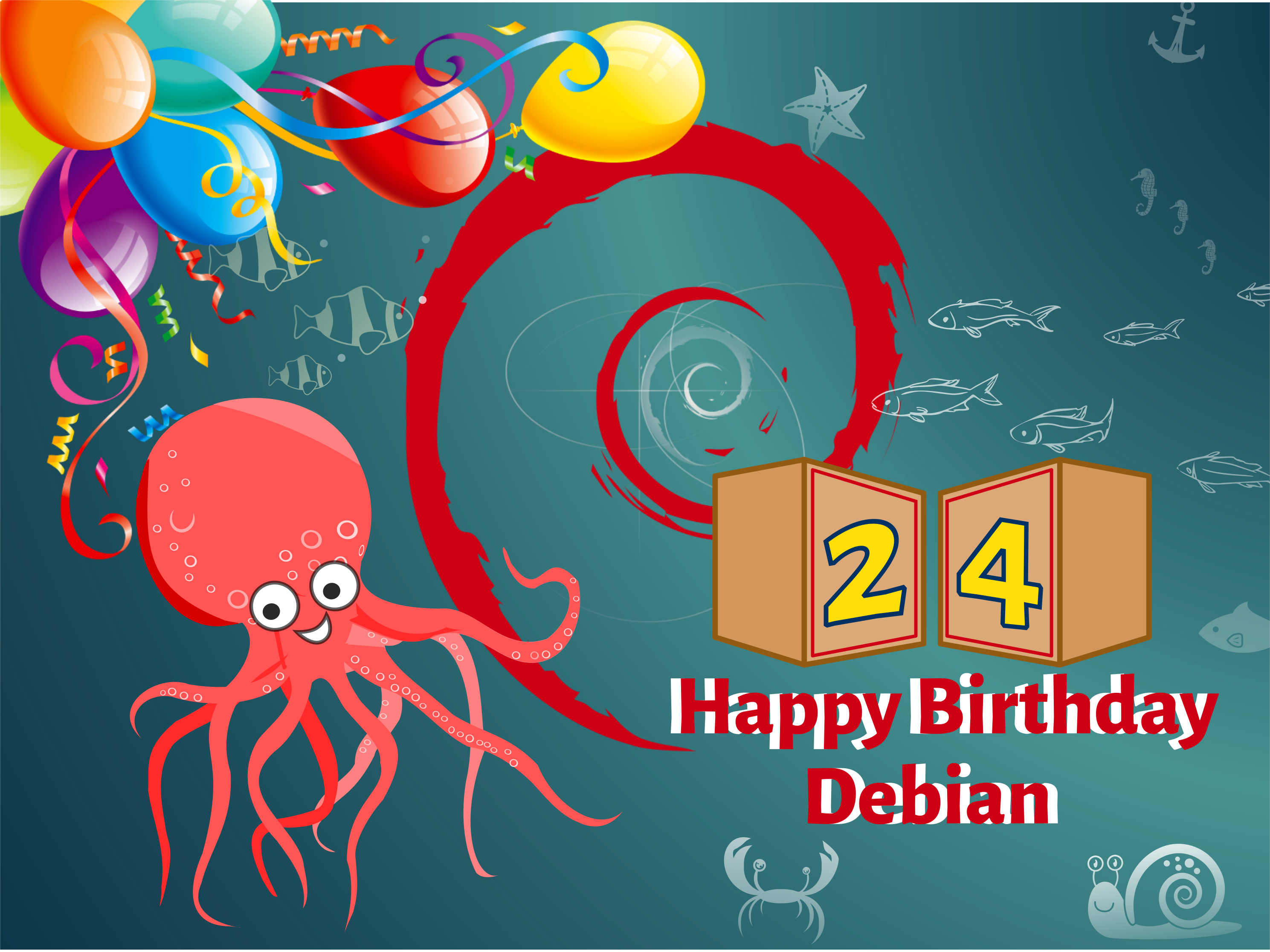
Thanks to everybody who has contributed to develop our beloved operating system
in these 24 years, and happy birthday Debian!
 Hosted Weblate provides also free hosting for free software projects. The hosting requests queue was over one month long, so it's time to process it and include new project.
This time, the newly hosted projects include:
 I ve been increasingly using systemd timers as a replacement for cron jobs. The fact that you get free logging is great, and also the fact that you don t have to care about multiple instances running simultaneously.
However, sometimes I would be interested in more complex scenarios, such as:
 This is a talk which I presented on August 10th, 2017 at Debconf 17 in
Montreal, Canada.
 Three years ago, I realized that propellor (my configuration
management system that is configured using haskell) could be used as an
installer for Debian (or other versions of Linux). In
propellor is d-i 2.0, I guessed it would take "a month and adding a few
thousand lines of code".
I've now taken that month, and written
that code, and I
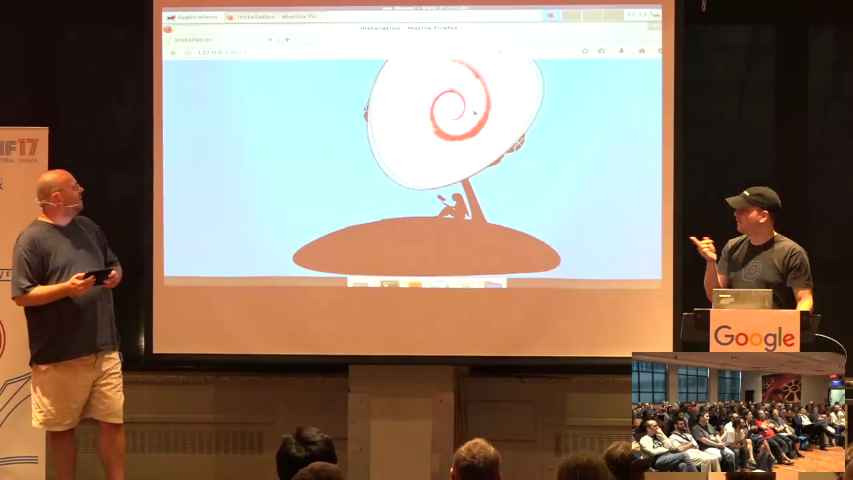
presented the result at DebConf yesterday. I demoed propellor building
a live Debian installation image, and then handed it off to a volenteer
from the audience to
play with its visual user interface
and perform the installation. The whole demo took around 20 minutes,
and ended with a standard Debian desktop installation.
(Video)
 The core idea is to reuse the same configuration management system
for several different purposes.

 Cover for The Rise Of The Meritocracy

 My monthly report covers a large part of what I have been doing in the free software world. I write it for my donors (thanks to them!) but also for the wider Debian community because it can give ideas to newcomers and it s one of the best ways to find volunteers to work with me on projects that matter to me.
Debian LTS
This month I was allocated 12 hours but I only managed to work for 7 hours (due to vacation and unanticipated customer work). I gave back the remaining hours to the pool as I didn t want to carry them over for August which will be also short due to vacation (BTW I m not attending Debconf). I spent my 7 hours doing CVE triaging during the week where I was in charge of the LTS frontdesk (I committed 22 updates to the security tracker). I did publish DLA-1010-1 on vorbis-tools but the package update had been prepared by Petter Reinholdtsen.
Misc Debian work
zim. I published an updated package in experimental (0.67~rc2-2) with the upstream bug fixes on the current release candidate. The final version has been released during my vacation and I will soon upload it to unstable.
Debian Handbook. I worked with Petter Reinholdtsen to finalize the paperback version of the Norwegian translation of the Debian Administrator s Handbook (still covering Debian 8 Jessie). It s now available.
Bug reports. I filed a few bugs related to my Kali work. #868678: autopkgtest s setup-testbed script is not friendly to derivatives. #868749: aideinit fails with syntax errors when /etc/debian_version contains spaces.
debian-installer. I submitted a few d-i patches that I prepared for a customer who had some specific needs (using the hd-media image to boot the installer from an ISO stored in an LVM logical volume). I made changes to debian-installer-utils (#868848), debian-installer (#868852), and iso-scan (#868859, #868900).
Thanks
See you next month for a new summary of my activities.
 I am writing this post from Montreal, where I have traveled in order to attend the 18th DebConf and present my Outreachy project to the Debian community. My mentor and I are giving a joined presentation titled: LTSP Manager: how 1000+ Greek schools switched to Debian-based distributions.
Last but not least, I would like to mention that today, t my great surprise, when I logged in to the launchpad translating environment, I saw that a Czech translation to the LTSP Manager software had started! The internationalization of the LTSP Manager software progresses well: it is already available in English and very soon in Greek and Czech!

 DebConf17, the 18th annual
Debian Conference, is taking place in Montreal, Canada
from August 6 to August 12, 2017.
Debian contributors from all over the world have come together at
Coll ge Maisonneuve
during the preceding week for DebCamp (focused on individual work
and team sprints for in-person collaboration developing Debian),
and the Open Day on August 5th (with presentations and workshops
of interest to a wide audience).
Today the main conference starts with nearly 400 attendants
and over 120 activities scheduled,
including 45- and 20-minute talks and team meetings,
workshops, a job fair, talks from invited speakers,
as well as a variety of other events.
The full schedule at
https://debconf17.debconf.org/schedule/
is updated every day, including activities planned ad-hoc
by attendees during the whole conference.
If you want to engage remotely, you can follow the
video streaming
of the events happening in the three talk rooms:
Buzz (the main auditorium), Rex, and Bo,
or join the conversation about what is happening
in the talk rooms:
#debconf17-buzz,
#debconf17-rex and
#debconf17-bo,
and the BoF (discussions) rooms: #debconf17-potato
and #debconf17-woody
(all those channels in the OFTC IRC network).
DebConf is committed to a safe and welcome environment for all participants.
See the DebConf Code of Conduct
and the Debian Code of Conduct for more details on this.
Debian thanks the commitment of numerous sponsors
to support DebConf17, particularly our Platinum Sponsors
Savoir-Faire Linux,
Hewlett Packard Enterprise,
and Google.
 Previously we talked about all the different kinds of
descriptors which USB devices use to communicate their capability. This is
important stuff because to write any useful USB device firmware we need to
be able to determine how to populate our descriptors. However, having that
data on the device is entirely worthless without an understanding of how it
gets from the device to the host so that it can be acted upon. To understand
that, let's look at the USB wire protocol.