Search Results: "ag"

23 December 2008

Biella Coleman: The Prosaics of Micro-writing

Recently much ink has been spilled on the forms of micro-writing (Twitter, Facebook status updates, micro-blogging) that have captivated the hearts, minds, and especially keyboards of those, like me, who spend a lot of time in front of the blue screen (whether a computer or a phone). Lately, perhaps in part because I was home bound for days, I went on a status-update frenzy, updating my Facebook feed like there was no tomorrow and checking in as often to read the short nuggets left by friends. Despite this recent bonanza, I don t admit to all my friends of this addiction as some of them seem to really dislike no the more accurate term is detest this linguistic genre. Generally, it seems to me, there are those that love these messages, and then there are those who disparage them for being inane, short blasts of egotistical information that reflect and worse, reinforce the rampant, raw, unfiltered American love with self, performing the individual, and all that related jazz. I am sympathetic with the haters and at times, I admit I feel nothing but the hate (and perhaps this is why I have yet to Twit) but after thinking about it I have decided I am not really in their camp. Why? Well, something I do when I am thinking through phenomenon is ask: What Would Bakhtin Think (WWBT) as he is a theorist that I adore for he avoids so many of the traps, mostly of binary thinking, that befall most academic theorists. The answer to WWBT, at least from the way I read him, would be that he would dig and find something quite significant about these linguistic ephemera. Bakhtin, who was a Russian literary critic and thinker , thought highly of the novel as a genre for, unlike poetry, it provides a window into everyday life, into the depths and heights of the prosaic, which, however prosaic, is actually where all the extraordinary stuff of life resides. For in the humdrum of life is where he locates wonder, magic, suffering, laughter, mystery, love, oppression, and joy even if its significance often slips right on by our awareness, our perceptual world, until it is unearthed by such genres as the novel (and I would add film). You really can t get more mundane than these micro-statements, though albeit they can be fantastically funny, frustratingly opaque, devilishly satiric, and in rare occasions, poetic; and it is for all these reasons that I find them personally enjoyable and analytically valuable. So much of our life is seeped and steeped in the mundane and yet it is whizzes by us without much reflection. We certainly don t have much of a window into the mundane lives of others, especially in any real time sense. These updates are short pauses, like a temporal parenthesis (which any reader of this blog can I tell I am fond of) or a pleasant hiccup. While many say that they are egotistical blasts, I experience them otherwise, especially when I find myself smiling, laughing, wondering not at what I say but what others throw out there. For with the short update, I am transported, however ephemerally and momentarily, to your mundane world and share in the pleasures of life as is. And for those that remain unconvinced, at least take my word that Bakhtin is worth paying attention to (that is, if you pay attention to academic theory), here is a review essay that might convince you (subscription required but I will try to post a full copy later)

MJ Ray: Results of Which Social Bookmarking?

I asked Which Social Bookmarking? almost a month ago. I was looking for a service which:-
  1. is run on free software
  2. provides RSS feeds of new additions (pref. RSS-1, but any RSS is OK)
  3. provides all my bookmarks for download/backup in some easy format (even an HTML page would be fine)
  4. at least lets me view without javascript, so I can use my bookmarks from my smartphone easily
And the winner is Rubric, which was recommended by Mark A Hershberger. For the moment, I ve put my bookmarks on GotNoBlog.com. Honourable mention to Magnolia, which is probably the best major hosted service. An anonymous comment linked me to ma.gnolia.org for the source code and I ll believe them, although I couldn t see the source code myself. I was very cross with Connotea, which is Nature s one - I d heard about this before but forgotten it and didn t find it on my search. GNU GPL, OpenID login it looked really good, but then, after I d saved a few bookmarks on it, it sent me one of those flaming eyetests. There were many other suggestions, which you can find in the comments on the previous post. I didn t test everything, so I d still welcome feedback on other bookmarking tools.

Patrick Schoenfeld: How to NOT improve relationships to your peer projects

I don't know if Aaron is an Ubuntu Developer. I hope not. And I hope that no one of the commenters is one. But this post and especially the comments to it (because the article may have some justification) is certainly not a way to improve the relationship between projects like Ubuntu and the projects its based on.

Yes, it is true, that we have a rough tone in our mailing lists and yes it is sad that every now and then topics pop up that need to be discussed till somebody is hurt and leaves (the project). I certainly hope that this can be improved over the time, but most likely this is not something which breaks the project. Who knows what its worth. We have a large community, very much different opinions and therefore conflicts. Possibly it enhances the quality of our distribution, because things that certainly would make our product worse (e.g. lowering quality standards) won't get done, because they'll get a strong opposition.

But whats the point with the innovations, Aaron? Is it the job of a distribution to serve with innovations? A distribution that serves as a base for more then 10 other distributions? A distribution that is known to care a lot about freedom and is known (and appreciated) for a high quality standard. I don't think we need to serve innovations. We served innovations back in a time where it was needed. Where things were missing. Like a good package management, like conf.d directories. Apart from this I think there were enough innovations in the past years. Possibly not that user-visible and trendy as a graphical virtualization frontend. What about xen-tools for example?
Now its all about reinventing the wheel or developing frontends. Launchpad for example is just reinventing the wheel. Savannah exists, GForge exists. Bazaar is just reinventing the wheel. Git exists. So does Mercurial.

But whats most sad about your posts and the comments is that you (and your commentors) seem to share the opinion that all Debian does is packaging software and nothing more. According to you Debian developers do not fix bugs, forward patches, file (important) wishlist bugs, encourage upstreams to remove horribly broken licensed software, improve their own software and tools (dpkg, aptitude, apt-get, the devscripts, ....), do integration work (alternatives, $EDITOR usage, ...), documentation work (writing manpages). The reality is that there are many small and greater things driven by Debian Developers that serve the whole community. Additional to the ground work that your favorite operating system is based on and without which it could not exist.
Its just not beeing doped like it is done by companies with their marketing departments that actually earn money with what they do. Take the projects you named. They all have one. They all have paid developers.

In any way such a ranting (with no real
constructiveness) will not serve the relationships between other projects and Debian.

22 December 2008

Riccardo Setti: new metacity package

Steve Kemp: What can you do? Sparta will need sons.

Since I've ranted a little recently lets do another public bugfix. The last few times people seemed to like them, and writing things down helps me keep track of where I am, what I'm doing, and how soon it will be "beer o'clock". So I looked over the release critical bug list, looking for things that might be easy to fix. One bug jumped out at me: I installed the package:
skx@gold:~$ apt-get install gnomad2
..
The following NEW packages will be installed
  gnomad2 libmtp7 libnjb5 libtagc0
..
Once I copied an .mp3 file to my home directory, with the .ogg suffix I got a segfault on startup:
skx@gold:~$ cp /home/music/Audio/RedDwarf-back-to-reality.mp3 ~/foo.ogg
skx@gold:~$ gnomad2
..
LIBMTP_Get_First_Device: No Devices Attached
PDE device NULL.
TagLib: Ogg::File::packet() -- Could not find the requested packet.
TagLib: Vorbis::File::read() - Could not find the Vorbis comment header.
[segfault]
skx@gold:~$
So I downloaded the source ("apt-get source gnomad2"), and the dependencies for rebuilding ("apt-get build-dep gnomad2"). This allowed me to rebuild it locally:
skx@gold:/tmp/gnomad2-2.9.1$ ./configure --enable-debug && make
skx@gold:/tmp/gnomad2-2.9.1$ cd src/
And now it can be run under GDB.
skx@gold:/tmp/gnomad2-2.9.1/src$ gdb ./gnomad2
GNU gdb 6.8-debian
...
(gdb) run
Starting program: /tmp/gnomad2-2.9.1/src/gnomad2
...
LIBMTP_Get_First_Device: No Devices Attached
PDE device NULL.
[New Thread 0x41dcd950 (LWP 23593)]
TagLib: Ogg::File::packet() -- Could not find the requested packet.
TagLib: Vorbis::File::read() - Could not find the Vorbis comment header.
Program received signal SIGSEGV, Segmentation fault.
[Switching to Thread 0x41dcd950 (LWP 23593)]
0x00007fc89e0340b0 in taglib_tag_artist () from /usr/lib/libtag_c.so.0
(gdb)
Interestingly the crash comes from a library, libtag_c.so.0. So either: Time to guess which that is. Charitably we'll assume any library that segfaults will be quickly fixed, because it will have more users than a single program.. Moving on we can look at the gnomad2 source for mentions of taglib. Several mentions are found, but src/tagfile.c is clearly the correct place to look. That file contains the following code:
void
get_tag_for_file (metadata_t *meta)
 
  gchar *tmppath = filename_fromutf8(meta->path);
  TagLib_Tag *tag;
  const TagLib_AudioProperties *properties;
  TagLib_File *file = taglib_file_new(tmppath);
  if(file == NULL)  
    g_printf("could not open file %s", tmppath);
    g_free(tmppath);
    return;
   
  g_free(tmppath);
  tag = taglib_file_tag(file);
  properties = taglib_file_audioproperties(file);
  gchar* artist = taglib_tag_artist(tag);
  ..
This looks like a great place to explore because opening a file to read the tags is most likely where the crash is going to be coming from. Interestingly we see the code: Let us guess that the file opening is succeeding but that the tag structure fetched via taglib_file_tag is NULL - and this causes the crash. A quick edit:
  g_free(tmppath);
  tag = taglib_file_tag(file);
  if(tag == NULL)  
    g_printf("tag was null");
    return;
   
  properties = taglib_file_audioproperties(file);
  gchar* artist = taglib_tag_artist(tag);
Rebuild, and the segfault is gone. We have a winner. Now we just need to file a patch... ObFilm: 300

David Welton: Hecl on the G1

Thanks to Neal McBurnett, Hecl for Android finally got to run wild and free on a real phone. There were some glitches, but by and large, things seem to work, which is always exciting, and something of a relief. Neil says it runs fairly quickly, and looks good. Once again, a big thanks to Neil, and now on to fixing the bugs! Android itself continues to evolve: http://fredstechblog.blogspot.com/2008/12/big-updates-ahead-for-android.html Now, if only I could get ahold of one of those dev phones! Although, truth be told, I think the "G2" or whatever it is, will probably be a significant improvement in terms of fixing up some of what needs improvement over the first generation, so I'll probably wait until sometime next year and get one of those.

Mike Hommey: Debian becoming loony again

As every time a release is approaching, Debian is turning into a loony. There must be some combination of stress, accumulated tensions between people, whatever, but the net result is that Debian turns crazy and tries all its best not to release. So, instead of trying to fix some of the symptoms by implementing crazy stuff such as pseudo moderated mailing lists or code of conducts, let s just fix the root cause: have Debian never release again.

Steve Kemp: They look like big, good, strong hands, don't they?

Russ Allbery recently commented that it is really nice to receive patches for trivial scripts posted online. I agree. More than once I've posted a trivial script and had it be improved by people, or later included elsewhere. So in the spirit of sharing here is my latest toy script: This is a trivial script which searches a Maildir hierarchy and outputs a list of each email address which you've ever sent mail to. Why would you want that? In my case my (personal) spam filtering makes use of whitelisting, and the assumption is that if I've ever mailed you in the past then I want to see your replies, and you get a break. These days my (personal) mail filtering has a couple of broad rules: After that then I see your message only if CRM119 decides I should.
#
# remove potentially spoofed header
#
:0 fhw
* ^X-whitelist:
  $FORMAIL -I "X-whitelist"
#
#  GPG-signed messages are OK and will be whitelisted
#
:0fW
* < 1024000
 /home/steve/bin/isgpged
:0e
  $FORMAIL -A "X-whitelist: yes" -A "X-GPG-Signed: Yes"
#
#  Get the sender of the message.
#
FROM= formail -x From:  sed 's/^\([^@]*[ <]\)//'   sed 's/\([ >]\).*$//' 
#
# Add a whitelist tag if appropriate
#
:0 fhw
* !^X-whitelist: yes
* ? test -s $HOME/.procmail_whitelist
* ? echo $FROM  fgrep -qisf $HOME/.procmail_whitelist
  $FORMAIL -A "X-whitelist: yes" -A "X-Whitelist-Test: $FROM"
The net result of these tests is that I can now run the spam filter on non-whitelisted mails:
#
# Run CRM114 mailreaver
#
:0fw: .msgid.lock
* !^X-whitelist: yes
  /usr/bin/crm -u /home/steve/.crm /usr/share/crm114/mailreaver.crm
#
#  Spam.
#
:0:
* ^X-CRM114-Status: SPAM.*
* !^X-whitelist: yes
.CRM.Spam/
#
#  Unsure.
#
:0
* ^X-CRM114-Status:.*UNSURE
* !^X-whitelist: yes
.CRM.Unsure/
There is more to my setup than that, but that's the minimum you'd need to see. Of course this is a reminder, once more, that the kind of filtering that you carry out for yourself is different from that that other people will do. ObFilm: The NeverEnding Story

David Bremner: A topgit testimonial

I wanted to report a success story with topgit which is a rather new patch queue managment extension for git. If that sounds like gibberish to you, this is probably not the blog entry you are looking for. Some time ago I decided to migrate the debian packaging of bibutils to topgit. This is not a very complicated package, with 7 quilt patches applied to upstream source. Since I don't have any experience to go on, I decided to follow Martin 'madduck' Krafft's suggestion for workflow. It all looks a bit complicated (madduck will be the first to agree), but it forced me to think about which patches were intended to go upstream and which were not. At the end of the conversion I had 4 patches that were cleanly based on upstream, and (perhaps most importantly for lazy people like me), I could send them upstream with tg mail. I did that, and a few days later, Chris Putnam sent me a new upstream release incorporating all of those patches. Of course, now I have to package this new upstream release :-). The astute reader might complain that this is more about me developing half-decent workflow, and Chris being a great guy, than about any specific tool. That may be true, but one thing I have discovered since I started using git is that tools that encourage good workflow are very nice. Actually, before I started using git, I didn't even use the word workflow. So I just wanted to give a public thank you to pasky for writing topgit and to madduck for pushing it into debian, and thinking about debian packaging with topgit.

Ian Wienand: Streaming various radio streams to FStream on the iPhone

FStream is a really neat streaming radio program for the iPhone. Although it supports various WMA streams, I found that it did not successfully work with some of the Australian ABC WMA streaming radio services. The most reliable method seems to simply use a low-bandwidth MP3 stream over HTTP (24 kbps sounds fine and works great even over Edge). I could find a number of other blogs, etc. with static methods for streaming, but nothing that reliably did on-the-fly conversion of an incoming stream. My solution is simple Python HTTP server I'm calling stream2mp3. It uses mplayer, lame and a few pipes to take the incoming stream (which is pretty much anything mplayer can handle, which is pretty much anything unencrypted) and spit it out as a low-bandwidth MP3 stream over HTTP. It seems to reliably handle dropped and closed connections, and clean-up after itself. I'd certainly be interested in any bug fixes or suggestions. I guess the major disadvantages is you need a dedicated server (get yourself a linode!), it only handles one connection at a time, and if you want multiple stations I guess you run multiple instances on different ports. With this, you can be sitting in traffic on the 101 heading to San Francisco and, with some local radio, it's just like you're sitting in traffic on the M2 in Sydney! Here's a screenshot:
~/bin$ python stream2mp3.py
Creating WAV fifo /tmp/incoming.wav
Creating MP3 fifo /tmp/output.mp3
Serving <mms://media3.abc.net.au/702Sydney> on port XXXX
mplayer running as 8524
lame running as 8525
mobile-XXX-XXX-130-107.mycingular.net - - [23/Dec/2008 18:59:22] "GET / HTTP/1.1" 200 -
[radio plays until I stop it...]
connection lost
cleanup complete, ready

Josselin Mouette: Dear friendly people,

during the ongoing avalanche of posts on Planet and on Debian mailing lists where you ask everyone to be friendly and considerate, you have so far: Pretty please. What you mean is Go fuck yourself , but the way you are saying it is no more friendly and actually much more rude. If you meant Go fuck yourself , why not just say it? You are just lying to yourselves if you think your contributions to a flamewar are more friendly than others. As for those starting discussions on the community and on the code of conduct: do you want a community like Ubuntu where everyone can be scornful and prepare lousy tricks, but always preserving the appearances (thanks to a mandatory broomstick), or a community like the Linux kernel, where people say frankly what they think, even if what they think is I hope you were on crack while writing that ? I know which one I choose. I may disagree with their technical development model, but at least they know that a software community is not a group of friends. And that is a sign of maturity.

Wouter Verhelst: Shopping for a new laptop

So my current Apple PowerBook is now 4 years old, and starting to show its age. Some parts of it have been replaced (keyboard, hard disk, bottom cover, and battery), and now it's starting to have issues again. It's not breaking down completely just yet, but seen its age, I might as well start looking for something new rather than having it fixed. I bought this PowerBook because I wanted a laptop that did not have an Intel or AMD processor at its core, which at the time meant either apple or tadpole; since, however, tadpole is only for the rich and famous (seriously well, perhaps being famous is not a requirement), and apple now also only has intel-based laptops, I guess I'm stuck with intel stuff. Besides, a 1.2Ghz SPARC is slower than my current 1.3Ghz PowerPC. So, dear lazyweb, I'd appreciate any suggestions about good laptops. What 'good' means, in my eyes, is the following: I guess the above list is quite long, and realize that my ideal laptop might just not exist; but hey, it never hurts to try, right? If it does not come preloaded with Windows, that's a plus; but OTOH, wiping a hard disk is not hard. I should also note that I'm not really interested in the low-price laptops that are available everywhere these days. Those usually have much lower performance, too small a screen, and other cutbacks that make the laptop be less than interesting for me. This is for work, not play.

Jaldhar Vyas: LOLNM

Attention Tiago. In the future please follow standard Debian Planet protocols. I can haz sponzer?

21 December 2008

Adam Rosi-Kessel: Czar Thought

When did it become so fashionable for the United States to have czars for everything? Apparently, the first drug czar was appointed at the height of the cold war. Do we have nostalgia for the good old days in pre-communist Russia? Technorati Tags: , , , ,

Russ Allbery: backport 1.15

This revision of my quick script for backporting Debian packages fixes the parsing of the *.dsc file name to work properly with native packages and relaxes the restriction on the paths for cowbuilder chroots. In and of itself, this probably isn't worth another announcement on Debian Planet, but both are patches from Eddy Petri or that he sent me shortly after my first Debian Planet post after trying the script out, improving the script both for me and for anyone else who might happen to stumble across it and find it useful for their problem. I've worked on enough free software that this doesn't surprise me, but it's a pure delight every time it happens. And it amazes me how much it happens with little convenience scripts where I doubted that anyone other than me would care. After reading too many flamewars and arguments, it's a bright spot of joy to get that sort of mail. So thank you. It's what this free software thing is all about, to me. You can get the latest version from my scripts page.

Tiago Bortoletto Vaz: Uploading request for apticron


Hey, I m looking for a DD who could push apticron 1.1.26 to Debian - once my usual sponsor otavio@d.o is on vacation. thanks! Posted in english

Adam Rosi-Kessel: It s still falling

Still Falling

Still Falling

Technorati Tags: , ,

Steve Langasek: First snowfall of the next ice age

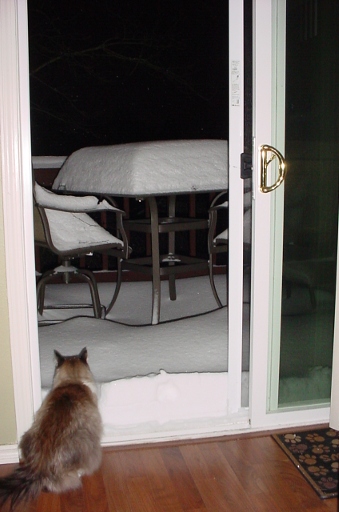
Pita looks at the snow skeptically Pshaw, and they say it only ever rains in Portland.

David Welton: OpenSSL::SSL::SSLError (hostname was not match with the server certificate)

I got this error in one of my Rails apps that I migrated to 2.2. It occurs when you try and send mail with ActionMailer, which makes it especially annoying because the exception notifications I normally receive when there is a problem weren't being sent! I wasn't able to track down the root cause of the problem - apparently something about an SSL certificate not being there or not being right, but here's the change that causes ActionMailer to fool around with SSL mail: http://github.com/rails/rails/commit/732c724df61bc8b780dc42817625b25a321908e4 I was able to "correct" the problem (or at least get things working again) by commenting out this line of code:
smtp.enable_starttls_auto if smtp.respond_to?(:enable_starttls_auto)
Perhaps it should be a configuration option, or there should be better error detection with regards to the certificate. If anyone comes up with a nicer answer, leave a comment, but in the meantime, I thought I'd post my quick and dirty fix. Update I fixed the problem by running this as root:
make-ssl-cert generate-default-snakeoil --force-overwrite
Which regenerates the SSL certificates.

Next.

Previous.