Search Results: "ag"

29 December 2008

Neil Williams: When firmware is not software

So the failings of the GR result in just what everyone didn't need - a restarted discussion about the firmware issue without first releasing Lenny. Come on people, leave it alone and get Lenny done. Anthony, Thomas and Theodore (also in his blog) all seem to be missing the point(s):


To me, it's more like data for the chips - it's saying "this is who you are, this is what you do and this is how to understand all subsequent instructions". Software is what follows - the instructions themselves.

We have a very good understanding of the separation between software and data in userspace - we all recognise that unless the output of a program consists to a large extent of modified versions of already licensed code (e.g. code generators), then the data created by your free software GPL-3+ text editor (or blogging client) cannot be deemed to be under the GPL-3+ or any other licence until such a statement is made by the copyright holder and that the copyright holder is the user of the software, not the author of the software. I could quite easily put this blog under a Microsoft-style EULA or even NDA if I wanted to be obtuse, despite it being created using a free software stack. The point remains - I am the copyright holder of the content created using the free software on my machines and I am free to publish that data as I see fit. The authors of the software itself have no rights to dictate what I do with the content I create using the software, just as I - as a user - cannot dictate whether the authors of my editor choose to migrate from GPL-2+ to GPL-3+ or even BSD.

Where firmware can have source code, let it have source code - we have such packages in Debian already. Even then, much of the code may be simply calculations or conditionals to select the right combination of binary flags for specific situations. This isn't about Nvidia kernel drivers that do real runtime calculations during the entire runtime of the machine, this is about tiny bits of initialisation data that are set once and not touched again. Can we not accept that some firmware is derived from a process that does not involve source code? How about experimentation and calculation? We know the voltage on pins 5 and 19, we know the state of register A and that for this specific case, it needs to be toggled to match the state of register E because otherwise another chip on the same board gets confused, so setup the chip to do that by setting a firmware datum point to initialise A? Where's the source code in that process? There is none - it is a piece of data, an item in the design notes (or more likely the errata). Yes, maybe the chip should know how to set this datum itself but for whatever reason (probably financial), it doesn't.

Source code could be used to calculate the datum point for a range of chips and chipsets according to a range of data inputs but the creative effort is then in the calculation not the data. The chip doesn't want the calculation, it cannot perform a calculation in this uninitialised state, it needs the datum point. Once it has the registers set, it can then understand subsequent instructions - the software itself. The datum point itself is just a raw piece of initialisation junk for the chip, it has no source code, it is determined by a physical process. It is a reference point - a fixed value that is determined during the design of the chip and/or chipset.

It's like saying you want the source code that determines whether there are one hundred cents in a Euro so that you could modify it to create a thousand or just ten or maybe turn the Euro into a hexadecimal currency. Weird. The fact that the Euro has one hundred sub-divisions is not up for negotiation, it isn't a modifiable value - changing the value unilaterally is not going to magically make everyone use the new value. It is a fixed reference point - a single datum point that initialises all subsequent behaviour of all software utilising such a currency. Even if there was source code (gee, what could that be, do you think? "%.2i" ?) it would be meaningless to insist on being able to modify it.

Few people can make the judgement about whether particular firmware can or cannot have source code - in most cases it comes down to the hardware design of either just the chip or how the chip is utilised for a particular board.

At some point, Debian has to accept that we cannot know if source code was used to create a particular blob. We simply have to ensure that maintainers ask upstream, elucidate as much information as possible about how the firmware was created and document that in debian/copyright. If that information is proved to be incorrect, then we have to deal with it as best we can - on a package-by-package basis. The assumption has to be that firmware does not necessarily have any source code.

In the end, I think the GR came up with the right result, despite all the failings - Option 5, assume that firmware is compliant with the GPL unless there is evidence to the contrary.

Sometimes, there simply is no source code - sometimes all you have is data.

Debian cannot insist on source code for data that is not generated from source code and it is the difficulty in deciding whether one set of figures is initialisation data or a set of compiled instructions that will defeat all debate on a general solution for the firmware debate. It is comparing apples and oranges - we can insist on source code where source code was used but we also have to accept that some firmware is identified, not programmed. In the end, Debian will have to trust the maintainer and the maintainer will have to trust upstream. Documenting that in debian/copyright seems to be the only sane option.

Now can we all just shut up and release Lenny? Please?

MJ Ray: Looking Back: 2008 Part 3

This is the final part of my review of popular articles on my news websites during 2008. It follows part 1 and part 2, but it can be enjoyed on its own, like an nice ripe cheese. Unlike one friend, I do not like cheese for breakfast.
September
  • Are Your Free Software T-Shirts Ethical? This question got a lot of views, but no answers yet. Again, those statistics surprised me.
  • Away From Keyboard was a listing of events I attended in early September, with some links to summaries in the article and the comments. (I can t find my Bristol Knowledge Unconference report just now. Did I post it to another site?)
October
  • The Trouble With Big Webmail built on my past comments about Yahoo and broadens them to Hotmail/Live and GoogleMail. I m still convinced those sites remain popular because they are good at marketing, rather than being good at email. In fact, they re so bad at email, almost no-one should use them.
  • Pulling One File From a Plesk Backup - It seems I wasn t the only person not to know about that.
  • Nestle Boycott 20th Anniversary seems to be the only time I wrote about boycotts this year, surprisingly (I know I m pretty militant and direct-action-y), but what more deserving target?
November
  • Which Social Bookmarking? was by far the most popular article in November and it also got lots of helpful comments. I posted my review and choices (such as they are) a few days ago.
December
  • Bristol Alternative Christmas Quiz. Everyone loves a good seasonal quiz, it seems. I didn t get to it (arrrrrrrrrgh busy!) but I hope it went well for BWCC.
  • Smart Tricks with ssh was only the second meme-like post to make the most popular list this year.
  • and it s still a bit early to evaluate articles from late December! I may add a few to this list later.
Happy New Year 2009, in case I don t see you before then!

Adrian von Bidder: KDE vs. GNOME

No, I don't claim KDE is perfect. Especially the way the transition to KDE 4 is (not) being handled. (I don't mean within Debian, this is a KDE problem.) But beyond dumbing down the UI as even a very prominent Linux developer repeatedly commented on, Josselin Mouette just confirmed my decision to stay away from GNOME. Yes, there are other desktop environments and window managers, and I haven't done more than look at XFCE very briefly, but just now I'm quite happy with KDE 3.5, and am waiting for KDE 4 to become actually useable.

28 December 2008

Rudy Godoy: back with the crowd

Last night I ve been recalling how many debconfs I ve already missed and this got me thinking about how long I ve been a bit off the records on my Debian involvement. Many things have happened in the last couple of years, many for the good. I ve started a business and learned a lot about entrepreneurship, resumed my computer science career, started a pretty awesome (yet to be released) personal project involving music and computers, and most important: discovered what I want from life, who I want to be and who I d love to be with :) Latest weeks I ve progresivily started to get back on track with my Debian duties. Took care of my packages, update some information, kept track on current issues and hanged on IRC. While doing that I ve found some issues I d like to elaborate on later, so we could improve things. So, expect me to be more active and post updates about my findings. It s good to be back! I ve missed you guys :)

Cyril Brulebois: All your package are belong to experimental

In experimental you can find: Some of those packages have been there for quite some time already, but experimental being what it is, a bit of advertisement is always welcome I guess.

Andrew Pollock: [life/americania] The Civic Musical Road and Other Adventures

It's not a holiday without a road trip, especially with petrol prices being lower now than they were three years ago when we arrived here. So we headed off on Christmas Day for San Simeon, with the general plan to tour Hearst Castle on Boxing Day (which isn't a public holiday in the US, but is a company holiday), and then head to Thousand Oaks, to visit a friend of Sarah's who also had heart surgery this year, and then head home. We'd hatched this plan a few months ago, and afterwards, saw a news piece on the "Civic Musical Road", and when we discovered it wasn't too far from Thousand Oaks in the grand scheme of things, we decided to throw that on the itinerary as well. I found a five-part "making of" documentary on YouTube, along with what I presume is the original commercial, and of course, we had to record the experience. Making of, part 1 Making of, part 2 Making of, part 3 Making of, part 4 Making of, part 5 Presumably the final commercial Our experience (on the relocated version)

Theodore Ts'o: Debian, Philosophy, and People

Given the recent brouhaha in Debian, and General Resolution regarding Lenny s Release policy as it relates to Firmware and Debian s Social Contract, which has led to the resignation of Manoj Srivastava from the position of Secretary for the Debian Project, I m reminded of the following passage from Gordon Dickson s Tactics of Mistakes (part of Dickson s Childe Cycle, in which he tells the story of the rise of the Dorsai):
No, said Cletus. I m trying to explain to you why I d never make an Exotic. In your calmness in the face of possible torture and the need to kill yourself, you were showing a particular form of ruthlessness. It was ruthlessness toward yourself but that s only the back side of the coin. You Exotics are essentially ruthless toward all men, because you re philosophers, and by and large, philosophers are ruthless people. Cletus! Mondar shook his head. Do you realize what you re saying? Of course, said Cletus, quietly. And you realize it as well as I do. The immediate teaching of philosophers may be gentle, but the theory behind their teaching is without compunction and that s why so much bloodshed and misery has always attended the paths of their followers, who claim to live by those teachings. More blood s been spilled by the militant adherents of prophets of change than by any other group of people down through the history of man.
The conflict between idealism and pragmatism is a very old one in the Free and Open Source Software Movement. At one end of the spectrum stands Richard Stallman, who has never compromised on issues regarding his vision of Software Freedom. Standing at various distances from this idealistic pole are various members of the Open Source Community. For example, in the mid-1990 s, I used to give presentations about Linux using Microsoft Powerpoint. There were those in the audience that would give me grief about using a non-free program such as MS Powerpoint, but my response was that I saw no difference between driving a car which had non-free firmware and using a non-free slide presentation program. I would prefer to use free office suite, but at the time, nothing approached the usability of Powerpoint, and while dual-booting into Windows was a pain, I could do a better job using Powerpoint than other tools, and I refused to handcap myself just to salve the sensibilities of those who felt very strongly about Free Software and who viewed the use of all non-Free Software as an ultimate evil that must be stamped out at all costs. It is the notion of Free Software as a philosophy, with no compromises, which has been the source of many of the disputes inside Debian. Consider, if you will, the first clause of the Debian Social Contract:
Debian will remain 100% free We provide the guidelines that we use to determine if a work is free in the document entitled The Debian Free Software Guidelines. We promise that the Debian system and all its components will be free according to these guidelines. We will support people who create or use both free and non-free works on Debian. We will never make the system require the use of a non-free component.
This clause has in it no room for compromise. Note the use of words such as 100% free and never make the system require the use of a non-free component (emphasis mine). In addition, the Debian Social Contract tends to be interpreted by Computer Programmers, who view such imperatives as constraints that must never be violated, under any circumstances. Unfortunately, the real world is rarely so cut-and-dried. Even the most basic injunctions, such as Thou shalt not kill have exceptions. Few people might agree with claims made by the U.S. Republican Party that the war in Iraq qualified as a Just War as defined by Thomas Aquinas, but rather more people might agree that the July 20, 1944 plot to assassinate Hitler would be considered justifiable. And most people would probably agree most of the actions undertaken by the Allied Soldiers on World War II battlefields that involved killing other soldiers would be considered a valid exception to the moral (and for those in the Judeo-Christian tradition, biblical) injunction, Thou shalt not kill . As another example, consider the novel and musical Les Mis rables, by Victor Hugo. One of the key themes of this story is whether or not Thou shalt not steal is an absolute or not. Ultimately, the police inspector Javert, who lived his whole life asserting that law (untempered by mercy, or any other human considerations) was more important than all else, drowns himself in the Seine when he realizes that his life s fundamental organizing principle was at odds with what was ultimately the Right Thing To Do. So if even the sixth and eighth commandments admit to exceptions, why is it that some Debian developers approach the first clause of the Debian Social Contract with a take-no-prisoners, no-exceptions policy? Especially given the fourth clause of the Debian Social contract:
Our priorities are our users and free software We will be guided by the needs of our users and the free software community. We will place their interests first in our priorities. We will support the needs of our users for operation in many different kinds of computing environments. We will not object to non-free works that are intended to be used on Debian systems, or attempt to charge a fee to people who create or use such works. We will allow others to create distributions containing both the Debian system and other works, without any fee from us. In furtherance of these goals, we will provide an integrated system of high-quality materials with no legal restrictions that would prevent such uses of the system.
This clause does not have the same sort of absolutist words as the first clause, so many Debian Developers have held that the needs of the users is defined by 100% free software . Others have not agreed with this interpretation but regardless of how needs of the users should be interpreted, the fact of the matter is, injuctions such as Thou shalt not kill are just as absolute and yet in the real world, we recognize that there are exceptions to such absolutes, apparently unyielding claims on our behavior. I personally believe that 100% free software is a wonderful aspirational goal, but in particular with regards to standards documents and firmware, there are other considerations that should be taken into account. People of good will may disagree about what those exceptions should be, but I think one thing that we should consider as even higher priority and with a greater claim on how we behave is the needs of our users and fellow developers as people. For those who claim Christianity as their religious tradition, Jesus once stated,
Thou shalt love the Lord thy God with all thy heart, and with all thy soul, and with all thy mind. This is the first and great commandment. And the second is like unto it: Thou shalt love thy neighbour as thyself. On these two commandments hang all the law and the prophets.
Even for those who do not claim Christianity as their religious tradition, most moral and ethical frameworks have some variant on the Golden Rule: Do unto others as you would have them do unto you . I would consider, for example, that the Golden Rule is at least a high priority claim on my behavior as the notion of free speech, and in many cases, it would be a higher priority claim. The recent controversy surrounding Josselin Mouette was started precisely because Joss has taken a something which is a good thing, namely Free Speech, and relegated it to a principle more important than all else, and claiming that any restraint on such a notion was equivalent to censorship. I think the same thing is true for free software, although it is a subtler trap. Philosophical claims than 100% free software as most important consideration is dangerously close to treating Free Software as the Object of Ultimate Concern or in religious terms, idolotry. For those who are religious, it s clear why this is a bad thing; for those who aren t if you are unwilling to worship a supernatural being, you may want to very carefully consider whether you are willing to take a philosophical construct and raise it to a position of commanding your highest allegiance to all else, including how you treat other people. Ultimately, I consider people to be more important than computers, hardware or software. So over time, while I may have had some disagreements with how Mark Shuttleworth has run Canonical Software and Ubuntu (but hey, he s the multimillionaire, and I m not), I have to give him props for Ubuntu s Code of Conduct. If Debian Developer took the some kind of Code of Conduct at least as seriously as the Social Contract, I think interactions between Debian Developers would be far more efficient, and in the end the project would be far more successful. This may, however, require lessening the importance of philosophical constructs such as Free Speech and Free Software, and perhaps becoming more pragmatic and more considerate towards one another.

Joey Hess: the OpenID logo and free software

Suppose you have a free software package that includes an OpenID login form. Such forms are supposed to include a little OpenID logo . But as hard as you look, you can't find a license for the OpenID logo. Though there seem to be indications that it might get one in 2009, it seems like it will not be free enough to be included in a free software package. Due to this problem, all the ikiwiki sites out there have not used the OpenID logo, or indeed any logo, in their login form for the 2+ years that ikiwiki has proudly supported OpenID. That was so suboptimal that I spent some donations to commision an unofficial OpenID logo openidlogin-bg.gif. It's freely licensed for use in whatever. Putting the little OpenID logo in the login form is a nice touch, it helps spread awareness about OpenID and users learn to look for it. The fact that free software packages can't include it weakens that. Having an alternative logo that evokes the "real" logo and the concept of a login is better than no logo at all. But it is also needlessly confusing. I encourage the new OpenID board to reconsider plans for logo licensing, and bear in mind that many free software packages can have native OpenID support, and should be able to include a copy of the logo, without worrying about it conflicting with their license, or not being free enough to be included in a free software distribution.

Joey Hess: Southern borscht

I was asked for my borscht recipe. This is loosely derived from a recipe that is really weird -- it says to throw away the beets! Both that recipe and mine are probably very unauthentic. But good. 6 cups water
3 medium size beets
2 medium size potatoes, quartered
1/2 cup chopped carrots
1 stalk celery, chopped -- optional
1/2 a bell pepper, chopped (red or green) -- optional
1/3 cup butter
1/2 to 1 cup chopped onion
1/2 cup tomatoes (fresh are best, canned or tomato paste + water is ok)
1/4 cup milk
2 cups finely chopped cabbage
1 tablespoon vinegar
1 teaspoon dried dill weed
sour cream Put water in a large pot on high heat. Add beets, potatoes, carrots, celery, and bell pepper. Cover and boil until potatoes are tender. Meanwhile, melt butter in a skillet. Saute onion in butter until tender, about 5 minutes. Stir in tomatoes, reduce heat to medium low, cover, and simmer for 15 minutes. Remove half of sauce from skillet into a medium size bowl. Add cabbage to remainder of sauce in skillet and cook coverted on medium low heat, stirring occasionally for ten minutes, or until tender. Reduce heat on pot to a simmer. Remove beets from pot and set aside to cool. Remove quartered potatoes and add to bowl with sauce. Mash potatoes, adding milk, until creamy. Stir mashed potato mixture into soup in pot. Grate beets, removing skin if desired, or grating it in. Combine grated beets and cabbage into pot. Add vinegar to taste (optional but recommended with sweet beets). Add salt and pepper to taste. Stir in a teaspoon of dill. Cover and cook for at least another 5 minutes on low heat, then let it cook in its residual heat for as long as desired. Serve hot, garnished with sour cream and dill.

Steve Kemp: He said he'd think about it.

Back a while I created an updated mutt package which builds upon the previous work with mutt-ng. The package which I had constructed had two new features, well if you're generous. I guess there was only technically one new feature: I still hate quilt with a passion, but I've synced my patches with the current unstable Mutt - and there are now source & binary packages (x86 + amd64) in my apt-get repository for Etch. I can rebuild for Lenny if there is any interest. But it might take me a while to setup lenny chroots. As a graphical example this is what you will end up with: OK I've tweaked the settings a little, but only a little:
# set up the sidebar, default to being visible
set sidebar_width=45
set sidebar_visible=yes
set sidebar_delim=' '
color sidebar_new red default
# ctrl-n, ctrl-p to select next, prev folder
# ctrl-o to open selected folder
bind index \CJ sidebar-scroll-down
bind index \CK sidebar-scroll-up
bind index \CP sidebar-prev
bind index \CN sidebar-next
bind pager \CO sidebar-open
bind index \CO sidebar-open
# Remap bounce-message function to "B"
bind index B bounce-message
#
#  Toggle visability of the sidebar.
#
macro index b '<enter-command>toggle sidebar_visible<enter><refresh>'
macro pager b '<enter-command>toggle sidebar_visible<enter><redraw-screen>'
#
#  Show folders with new mail only
#
macro index E '<enter-command>toggle sidebar_newmail_only<enter>'
macro pager E '<enter-command>toggle sidebar_newmail_only<enter>'
ObFilm: Joan of Arc

Sandro Tosi: aptitude remove wmaker

After having orphaned (and QA uploaded) the last group of WM dockapps I was maintaining, time has come to remove even that old friend of mine.

How many adventures we've passed together? Will we ever meet again?

But the past is past, so let's move forward, with no regrets.

Aigars Mahinovs: How to survive a coffee cup - guide for laptop (and cat) owners

Yesterday my cat spilled a full cup of hot coffee on my 2k$+ laptop. Today, there is no trace of the incident and the laptop is working perfectly again. This is partially thanks to luck, partially to Dell laptop engineering and partially to my instinctive actions within first 10 seconds of the incident. I will recap it here so that if you happen to have a mishap of such kind you would know what to do to save your laptop. The first thing I did is pick up the laptop (so that extra coffee from the table would not go into the vents at the bottom of the laptop) keeping the corner that was soaked with coffee downwards. With one hand I held the notebook and pressed and held the Power button to turn the laptop off as soon as possible. With the other hand I removed the power cord and tried to remove the battery as well. It took a couple seconds, but when that was done and the laptop was placed on a towel on the floor the time sensitive part was over. After that was the clean-up. Coffee from the table and floor (so that other things don t get soaked), coffee form the outside of the laptop (with a damp cloth), After that I disassembled my laptop down to removing the motherboard and checking it for damage. Where ever I found traces of coffee, I cleaned them up with cotton swabs and spirit (clean water would also work, but would require more drying time). After I cleaned and dried every part off with a fan, I put the laptop back together. It took around 2 hours (more like 4 because I had to ask my girlfriend to pick up a new screwdriver on her way home as I lost mine). Everything was working, except the keyboard. Bits of coffee got inside the keyboard and were shortening the wires so some lines of buttons were not working and some were activating other keys when pressed. On an advice from a fried, I took out the keyboard and washed it. I simply put the keyboard under a stream on running water and made sure that the water got into every possible and impossible opening. After 5 minutes of washing I got the hairdryer and proceeded to dry the keyboard. After an hour I put it in, but it still did not work, so I left it on a heating radiator overnight. After around 18 hours of drying the keyboard started working again. Oh and it was cleaner than it ever was :D Summary: Do not panic! Get water out of you laptop, get it turned off, disconnect power and remove the battery. If you manage to do all that in 10 seconds or less, you might have a chance of seeing your laptop boot up again.

Christian Perrier: Bug #510000

Nicola Benaglia reported bug #510000 on Sunday December 28th. As bug #500000 was reported as of Sep 24th 2008, this marks a considerable slowdown of our bug reporting rate: between bugs 400000 and 500000, it always took us nearly exactly two months to have 10000 bugs reported. Here, we needed more than 3 months! This is a 50% drop in the bug reporting speed. I think we can conclude this is a very good illustration of the considerable drop in the development of Debian, while everybody is awaiting for the release of Lenny. You still have a few days to correct your bet for bug 600000 date. Ah, and the very same day, the result for the very controversial vote about firmwares has been published. Even though it is very hard to interprete, I think that the very very low rating of option 1 (worded as "Reaffirm the Social Contract" but indeed meaning "let's be Free Software Zealots and nitpick every single bit of firmwares so that we can be sure to never release Lenny") clearly shows that Debian developers still have their feet in reality. So, now let's release the bloody thing...and prove the world we still exist...

Nacho Barrientos Arias: Free 1Password Licenses!

1Password is a very powerful application for OSX to keep safe your passwords and identities. It works as a standalone application and as a series of plugins for several Internet browsers. It is capable of, among other things, autofill registration forms and save you a lot of time filling in the same personal information again and again. To autofill a login form, just click the 1P browser menu bar icon, choose a previously recorded identity and voila, 1Password logins in automagically with no further interaction. All the harvested information is stored in a different keychain unlocked by a master key placed in the login keychain (See Keychain access.app for more information). Macheist, in collaboration with Agile Web Solutions, is offering free licenses as a Christmas present here. You only have to create and account and click in the links below the tree to get your free license.

Joachim Breitner: MuMer relaunch preview online

A few years ago, I had some ideas about a real-world trading game. In short, a combination of the game play of Settlers of Catan , the cute pseudo-medieval world of The Settlers (the computer game), which you can play in your every day live along, without having to sit in front of the computer for a long time. I then started some code, lost motivation and let it sit there for a while.Recently, I re-developed interest in the idea and started from scratch, using Haskell and HAppS. To avoid losing interest again, I m now putting the code online and set up the server. I invite everyone to play around with it, maybe have a look at the code, send me patches or comments. As you can see, the web user interface is plain ugly HTML and could need some love. Some CSS is definitely needed, some AJAX would be nice. Also, the resource tree is very small at the moment there are a lot of things to work on, even if you don t want to touch Haskell!You can register at http://mumer.net/. You will be either given a forest (a source for wood) or a source of stone. You can reap your source, and trade on the Free Market , which is where you can always trade online, at bad prices. The idea is that you find real trade partners, to get better prices.For now, trading without physical contact is possible. You can create so-called issue ids, which represent stips of paper. You can then load resources on them, and give the paper (i.e. the number) to other players, who can then redeem them. Eventually, it is planned that these pieces of paper are provided centrally and (sufficiently) unforgeable, so that it is clear who owns a resource.You can also bid on certain stuff, such as a sawmil, which allows you to turn wood into boards. It will regularily be re-leased to the highest bidder.You can get the code (in a darcs repository) from http://darcs.nomeata.de/mumer2 and also browse the code.If you happen to be at the CCC right now and would like to talk about it, please do so!

Adeodato Sim : Ooh, irssi's activity_hide_targets

A while ago I dropped from a number of IRC channels, in a quest for a more productive work environment. The problem was that I look at my IRC window often, and if I see any windows with activity, I will go and read them. Recently I ve wanted to hang around in #git, because I was writing some (minor) patches and thought it d be nice to be available there. This is a fairly active channel, and whenever there was activity, I couldn t help go and look, knowing in advance it d be (mostly) uninteresting for me. So I concluded that what I really needed was to tell irssi: don t tell me there s activity in #git, unless somebody highlights me. And this is precisely what the activity_hide_targets option does. Just set it to a list of channels you want to ignore. This has also allowed me to return to a couple Debian channels that I had dropped, and maybe I ll add an extra two back.

Josselin Mouette: The session non-manager

For various reasons (which in the end boil down to lack of manpower), we are quite late in the process of packaging GNOME 2.24. (This is almost finished now, I ll keep you informed.) Which is why I may sound coming a bit late on noticing this one, but I was really speechless. The problem: session management has flaws Currently, a session manager uses XSMP (the X Session Management Protocol) to talk to applications. What it means is that for applications supporting this protocol, it is able to do more than simply starting and killing them: it will also remember their state, and offer them a way to shut down gracefully. However, XSMP is really a shitty protocol I won t explain why here, you will find tons of better explanations on the intarweb. The gnome-session developers, being quite aware of this issue, did what anyone interested enough would have done: they designed a new protocol, based on D-Bus, and implemented it. The new protocol is not considered stable yet, but it is simple, efficient and above all, reliable that s a giant leap forward. For this reason, I was very excited to see what gnome-session 2.24 would look like, since it brings major cleanups in the code. The solution: remove session management! When I first started it, it did not restore my saved session. I simply supposed that the format of the saved session had changed, and that writing a conversion tool would be in order. Wrong. Let s bring the session preferences:
The UI of this dialog hasn t changed since 2.22. However, I do not resist the urge to show you the code behind the Remember Currently Running Applications button:
static void
on_save_session_clicked (GtkWidget           *widget,
                         GsmPropertiesDialog *dialog)
 
        g_debug ("Session saving is not implemented yet!");
 
As for the check box on top of it, it sets a GConf value that is never read anywhere. If you know the long term plans for GNOME, it makes sense: when gnome-shell replaces the panel and the window manager, it will also be responsible for starting the visible applications, while gnome-session will deal with what s happening behind the scenes. But gnome-shell is still far from ready, and you need something in the meantime for the basic requirements of a session manager! Backwards compawhat? The surprises don t stop here. I also noticed that logout was much faster instantaneous instead of the usual 2-3 seconds. The reason why logging out is this long currently is not because it takes long to kill applications; it s because the session manager kindly requests applications supporting XSMP to shut down before killing them. If a document isn t saved, an application will be able to prevent the logout process. Guess what? Now gnome-session completely ignores XSMP applications. Since it doesn t need them to register for saving the session, it also saves the time to ask them to close cleanly. The result is that you will see a lot of such dialogs:
It s very nice to replace a flawed protocol ; and really, the new protocol goes in the correct direction. But let s be realistic, it s impossible to immediately port hundreds of applications to a new protocol without having a transition time during which both protocols are supported. You also need to consider your protocol as stable before asking other developers to port their applications. And to get it accepted, you need to standardize it; freedesktop.org would have been the correct body. (Currently, the protocol lies in the org.gnome namespace, not org.freedesktop.) Release management at its best Wait aren t there some distributions out there which already released stable versions with GNOME 2.24? The answer is yes. At least Ubuntu Intrepid and Fedora Core 10 ship with a session manager that: It s good to see such improvements on the session manager coming, and I m really thankful to the gnome-session developers to work on it. What I wonder is: It definitely looks like we re not the only ones who could improve our release management processes. So what? This is a very good example of a lack of big picture thinking. On one side, there is a brilliant design and its good implementation. On the other side, two major regressions from the user s point of view the kind of regressions that make people fly away. If there s one thing that I ve learned from working in IT, it s that you must often keep your brilliant designs as long-term goals. In the short term, you will run a bastardized version of your brilliant design that will make you cry; but it will work. When you need to talk to shitty applications or with shitty protocols, you need to write shitty code.

Russ Allbery: Lintian 2.1.3

Over the last couple of days, I've found some time to work on Lintian for the first time in quite a while. It's been a good feeling both for getting back to a project that I've done very little on for several months and finally feeling energized about a coding project. I think after a week of vacation, I'm starting to recover my energy. I uploaded Lintian 2.1.3 earlier today and am currently doing a fresh archive-wide run for lintian.debian.org. This version has several new checks for watch files from Raphael Geissert, several fixes for the lintian.d.o output, a few other random bug fixes, and an attempt to tackle unversioned shared libraries in a more comprehensive fashion. Shared libraries with an SONAME that doesn't contain a version number can't be represented in the shlibs system (but can in the symbols system), so Lintian always reports them as missing from shlibs when they're installed in public directories. That's not really the right tag, since they don't belong in shlibs. The more basic problem is that, except for a few special cases mostly coming from libc, they really don't belong in public directories. With no versioning in the SONAME, we can't handle changes to the ABI without completely changing the library name and can't use the shlibs system to manage them. Most of the libraries in this situation are actually private libraries for one particular application. As Policy already says, those libraries shouidn't be installed in public directories like /usr/lib; they should be installed in private subdirectories of /usr/lib for that application. The biggest group of offenders here currently seems to be KDE; for some reason, unless I'm missing something, this seems to be a semi-standard KDE way of doing things. This version of Lintian will hopefully handle this better. Such libraries won't be expected to be in shlibs files and won't get erroneous tags about not being listed there. We'll also do a better job of distinguishing between versioned shared libraries and shared library names that just contain a hyphen. Such unversioned libraries will get a separate tag pointing at the portion of Policy that says to put private libraries and plugins in a subdirectory instead of /usr/lib. Thanks as always to Frank Lichtenheld, Adam D. Barratt, and Jord Polo for all the hard work they've been putting into Lintian. It's gotten much better over the few months that I've not been able to work on it, which is making me more excited to get back to it and do more.

27 December 2008

Muammar El Khatib: 25

Today, I am turning 25. Now what?! It's a quarter of a century!. Now, I have friends who I have met for more than 15 years... How fast the time pass by... Now, I am not the one making fun of those who were 25 years old... (If I remember it well, I used to do it when I was 20).

It's time to redefine some stuff in my life. I confess this age has had an impact on me. My next goals, in a short time, are :

1) Finish my NM process.
2) Write my thesis.
3) Make a publication of a paper about DNA in a Journal of Chemistry.

There is a phrase of John Randolph which I'd like to share: Time is at once the most valuable and the most perishable of all our possessions.

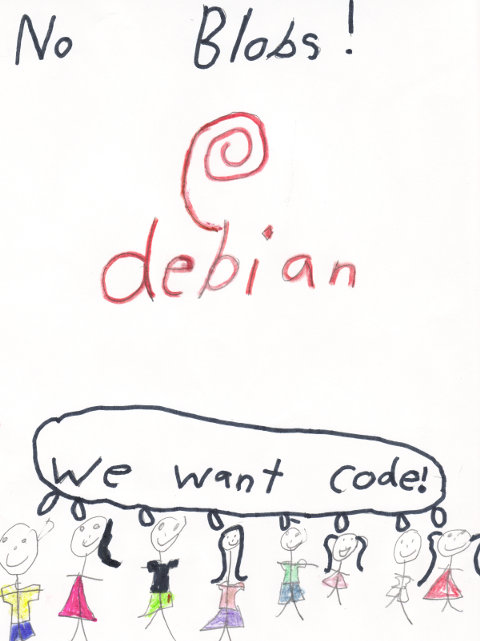
Jaldhar Vyas: No Blobs!

So in the end I decided to vote in the Lenny/DFSG violations GR despite lingering apathy. Option 5 won so hopefully we can get on with releasing the next stable version of Debian. For giggles, I explained all the issues to my daughter Shailaja and asked for her opinion. Her advice is that we should not worry about firmware being non-free because it could take a long time to sort out and in the mean time people would get fed up of waiting for Debian and go somewhere else. However we should make a big list of all the devices that require the binary blobs and tell everyone not to use them. To this end she has made the following sign you can copy and send to recalcitrant hardware manufacturers. no blobs
Next.

Previous.