Search Results: "reg"

3 July 2017

Antoine Beaupr : My free software activities, June 2017

Debian Long Term Support (LTS) This is my monthly Debian LTS report. This time I worked on Mercurial, sudo and Puppet.

Mercurial remote code execution I issued DLA-1005-1 to resolve problems with the hg server --stdio command that could be abused by "remote authenticated users to launch the Python debugger, and consequently execute arbitrary code, by using --debugger as a repository name" (CVE-2017-9462). Backporting the patch was already a little tricky because, as is often the case in our line of work, the code had changed significantly in newer version. In particular, the commandline dispatcher had been refactored which made the patch non-trivial to port. On the other hand, mercurial has an extensive test suite which allowed me to make those patches in all confidence. I also backported a part of the test suite to detect certain failures better and to fix the output so that it matches the backported code. The test suite is slow, however, which meant slow progress when working on this package. I also noticed a strange issue with the test suite: all hardlink operations would fail. Somehow it seems that my new sbuild setup doesn't support doing hardlinks. I ended up building a tarball schroot to build those types of packages, as it seems the issue is related to the use of overlayfs in sbuild. The odd part is my tests of overlayfs, following those instructions, show that it does support hardlinks, so there maybe something fishy here that I misunderstand. This, however, allowed me to get a little more familiar with sbuild and the schroots. I also took this opportunity to optimize the builds by installing an apt-cacher-ng proxy to speed up builds, which will also be useful for regular system updates.

Puppet remote code execution I have issued DLA-1012-1 to resolve a remote code execution attack against puppetmaster servers, from authenticated clients. To quote the advisory: "Versions of Puppet prior to 4.10.1 will deserialize data off the wire (from the agent to the server, in this case) with a attacker-specified format. This could be used to force YAML deserialization in an unsafe manner, which would lead to remote code execution." The fix was non-trivial. Normally, this would have involved fixing the YAML parsing, but this was considered problematic because the ruby libraries themselves were vulnerable and it wasn't clear we could fix the problem completely by fixing YAML parsing. The update I proposed took the bold step of switching all clients to PSON and simply deny YAML parsing from the server. This means all clients need to be updated before the server can be updated, but thankfully, updated clients will run against an older server as well. Thanks to LeLutin at Koumbit for helping in testing patches to solve this issue.

Sudo privilege escalation I have issued DLA-1011-1 to resolve an incomplete fix for a privilege escalation issue (CVE-2017-1000368 from CVE-2017-1000367). The backport was not quite trivial as the code had changed quite a lot since wheezy as well. Whereas mercurial's code was more complex, it's nice to see that sudo's code was actually simpler and more straightforward in newer versions, which is reassuring. I uploaded the packages for testing and uploaded them a year later. I also took extra time to share the patch in the Debian bugtracker, so that people working on the issue in stable may benefit from the backported patch, if needed. One issue that came up during that work is that sudo doesn't have a test suite at all, so it is quite difficult to test changes and make sure they do not break anything.

Should we upload on fridays? I brought up a discussion on the mailing list regarding uploads on fridays. With the sudo and puppet uploads pending, it felt really ... daring to upload both packages, on a friday. Years of sysadmin work hardwired me to be careful on fridays; as the saying goes: "don't deploy on a friday if you don't want to work on the weekend!" Feedback was great, but I was surprised to find that most people are not worried worried about those issues. I have tried to counter some of the arguments that were brought up: I wonder if there could be a disconnection here between the package maintainer / programmer work and the sysadmin work that is at the receiving end of that work. Having myself to deal with broken updates in the past, I'm surprised this has never come up in the discussions yet, or that the response is so underwhelming. So far, I'll try to balance the need for prompt security updates and the need for stable infrastructure. One does not, after all, go without the other...

Triage I also did small fry triage: Hopefully some of those will come to fruitition shortly.

Other work My other work this month was a little all over the place.

Stressant Uploaded a new release (0.4.1) of stressant to split up the documentation from the main package, as the main package was taking up too much space according to grml developers. The release also introduces limited anonymity option, by blocking serial numbers display in the smartctl output.

Debiman Also did some small followup on the debiman project to fix the FAQ links.

Local server maintenance I upgraded my main server to Debian stretch. This generally went well, althought the upgrade itself took way more time than I would have liked (4 hours!). This is partly because I have a lot of cruft installed on the server, but also because of what I consider to be issues in the automation of major Debian upgrades. For example, I was prompted for changes in configuration files at seemingly random moments during the upgrade, and got different debconf prompts to answer. This should really be batched together, and unfortunately I had forgotten to use the home-made script I established when i was working at Koumbit which shortens the upgrade a bit. I wish we would improve on our major upgrade mechanism. I documented possible solutions for this in the AutomatedUpgrade wiki page, but I'm not sure I see exactly where to go from here. I had a few regressions after the upgrade:
  • the infrared remote control stopped working: still need to investigate
  • my home-grown full-disk encryption remote unlocking script broke, but upstream has a nice workaround, see Debian bug #866786
  • gdm3 breaks bluetooth support (Debian bug #805414 - to be fair, this is not a regression in stretch, it's just that I switched my workstation from lightdm to gdm3 after learning that the latter can do rootless X11!)

Docker and Subsonic I did my first (and late?) foray into Docker and containers. My rationale was that I wanted to try out Subsonic, an impressive audio server which some friends have shown me. Since Subsonic is proprietary, I didn't want it to contaminate the rest of my server and it seemed like a great occasion to try out containers to keep things tidy. Containers may also allow me to transparently switch to the FLOSS fork LibreSonic once the trial period is over. I have learned a lot and may write more about the details of that experience soon, for now you can look at the contributions I made to the unofficial Subsonic docker image, but also the LibreSonic one. Since Subsonic also promotes album covers as first-class citizens, I used beets to download a lot of album covers, which was really nice. I look forward to using beets more, but first I'll need to implement two plugins.

Wallabako I did a small release of wallabako to fix the build with the latest changes in the underlying wallabago library, which led me to ask upstream to make versionned releases. I also looked into creating a separate documentation site but it looks like mkdocs doesn't like me very much: the table of contents is really ugly...

Small fry That's about it! And that was supposed to be a slow month...

Ben Hutchings: Debian LTS work, June 2017

I was assigned 15 hours of work by Freexian's Debian LTS initiative and carried over 5 hours. I worked all 20 hours. I spent most of my time working - together with other Linux kernel developers - on backporting and testing several versions of the fix for CVE-2017-1000364, part of the "Stack Clash" problem. I uploaded two updates to linux and issued DLA-993-1 and DLA-993-2. Unfortunately the latest version still causes regressions for some applications, which I will be investigating this month. I also released a stable update on the Linux 3.2 longterm stable branch (3.2.89) and prepared another (3.2.90) which I released today.

Vincent Bernat: Performance progression of IPv4 route lookup on Linux

TL;DR: Each of Linux 2.6.39, 3.6 and 4.0 brings notable performance improvements for the IPv4 route lookup process.
In a previous article, I explained how Linux implements an IPv4 routing table with compressed tries to offer excellent lookup times. The following graph shows the performance progression of Linux through history: IPv4 route lookup performance Two scenarios are tested: All kernels are compiled with GCC 4.9 (from Debian Jessie). This version is able to compile older kernels1 as well as current ones. The kernel configuration used is the default one with CONFIG_SMP and CONFIG_IP_MULTIPLE_TABLES options enabled (however, no IP rules are used). Some other unrelated options are enabled to be able to boot them in a virtual machine and run the benchmark. The measurements are done in a virtual machine with one vCPU2. The host is an Intel Core i5-4670K and the CPU governor was set to performance . The benchmark is single-threaded. Implemented as a kernel module, it calls fib_lookup() with various destinations in 100,000 timed iterations and keeps the median. Timings of individual runs are computed from the TSC (and converted to nanoseconds by assuming a constant clock). The following kernel versions bring a notable performance improvement:

  1. Compiling old kernels with an updated userland may still require some small patches.
  2. The kernels are compiled with the CONFIG_SMP option to use the hierarchical RCU and activate more of the same code paths as actual routers. However, progress on parallelism are left unnoticed.

1 July 2017

Keith Packard: DRM-lease-4

DRM leasing part three (vblank) The last couple of weeks have been consumed by getting frame sequence numbers and events handled within the leasing environment (and Vulkan) correctly. Vulkan EXT_display_control extension This little extension provides the bits necessary for applications to track the display of frames to the user.
VkResult
vkGetSwapchainCounterEXT(VkDevice           device,
             VkSwapchainKHR         swapchain,
             VkSurfaceCounterFlagBitsEXT    counter,
             uint64_t           *pCounterValue);
This function just retrieves the current frame count from the display associated with swapchain.
VkResult
vkRegisterDisplayEventEXT(VkDevice          device,
              VkDisplayKHR          display,
              const VkDisplayEventInfoEXT   *pDisplayEventInfo,
              const VkAllocationCallbacks   *pAllocator,
              VkFence           *pFence);
This function creates a fence that will be signaled when the specified event happens. Right now, the only event supported is when the first pixel of the next display refresh cycle leaves the display engine for the display. If you want something fancier (like two frames from now), you get to do that on your own using this basic function. drmWaitVBlank drmWaitVBlank is the existing interface for all things sequence related and has three modes (always nice to have one function do three things, I think). It can:
  1. Query the current vblank number
  2. Block until a specified vblank number
  3. Queue an event to be delivered at a specific vblank number
This interface has a few issues: For leases, figuring out the index into the kernel list of crtcs is pretty tricky -- our lease has a subset of those crtcs, so we can't actually compute the global crtc index. drmCrtcGetSequence
int drmCrtcGetSequence(int fd, uint32_t crtcId,
               uint64_t *sequence, uint64_t *ns);
Here's a simple new function hand it a crtc ID and it provides the current frame sequence number and the time when that frame started (in nanoseconds). drmCrtcQueueSequence
int drmCrtcQueueSequence(int fd, uint32_t crtcId,
                 uint32_t flags, uint64_t sequence,
             uint64_t user_data);
struct drm_event_crtc_sequence  
    struct drm_event    base;
    __u64           user_data;
    __u64           time_ns;
    __u64           sequence;
 ;
This will cause a CRTC_SEQUENCE event to be delivered at the start of the specified frame sequence. That event will include the frame when the event was actually generated (in case it's late), along with the time (in nanoseconds) when that frame was started. The event also includes a 64-bit user_data value, which can be used to hold a pointer to whatever data the application wants to see in the event handler. The 'flags' argument contains a combination of:
#define DRM_CRTC_SEQUENCE_RELATIVE      0x00000001  /* sequence is relative to current */
#define DRM_CRTC_SEQUENCE_NEXT_ON_MISS      0x00000002  /* Use next sequence if we've missed */
#define DRM_CRTC_SEQUENCE_FIRST_PIXEL_OUT   0x00000004  /* Signal when first pixel is displayed */
These are similar to the values provided for the drmWaitVBlank function, except I've added a selector for when the event should be delivered to align with potential future additions to Vulkan. Right now, the only time you can ask for is first-pixel-out, which says that the event should correspond to the display of the first pixel on the screen. DRM events Vulkan fences With the kernel able to deliver a suitable event at the next frame, all the Vulkan code needed was a to create a fence and hook it up to such an event. The existing fence code only deals with rendering fences, so I added window system interface (WSI) fencing infrastructure and extended the radv driver to be able to handle both kinds of fences within that code. Multiple waiting threads I've now got three places which can be waiting for a DRM event to appear:
  1. Frame sequence fences.
  2. Wait for an idle image. Necessary when you want an image to draw the next frame to.
  3. Wait for the previous flip to complete. The kernel can only queue one flip at a time, so we have to make sure the previous flip is complete before queuing another one.
Vulkan allows these to be run from separate threads, so I needed to deal with multiple threads waiting for a specific DRM event at the same time. XCB has the same problem and goes to great lengths to manage this with a set of locking and signaling primitives so that only one thread is ever doing poll or read from the socket at time. If another thread wants to read at the same time, it will block on a condition variable which is then signaled by the original reader thread at the appropriate time. It's all very complicated, and it didn't work reliably for a number of years. I decided to punt and just create a separate thread for processing all DRM events. It blocks using poll(2) until some events are readable, processes those and then broadcasts to a condition variable to notify any waiting threads that 'something' has happened. Each waiting thread simply checks for the desired condition and if not satisfied, blocks on that condition variable. It's all very simple looking, and seems to work just fine. Code Complete, Validation Remains At this point, all of the necessary pieces are in place for the VR application to take advantage of an HMD using only existing Vulkan extensions. Those will be automatically mapped into DRM leases and DRM events as appropriate. The VR compositor application is working pretty well; tests with Dota 2 show occasional jerky behavior in complex scenes, so there's clearly more work to be done somewhere. I need to go write a pile of tests to independently verify that my code is working. I wonder if I'll need to wire up some kind of light sensor so I can actually tell when frames get displayed as it's pretty easy to get consistent-but-wrong answers in this environment. Source Code

30 June 2017

Michal Čihař: Weblate 2.15

Weblate 2.15 has been released today. It is slightly behind schedule what was mostly caused by my vacation. As with 2.14, there are quite a lot of security improvements based on reports we got from HackerOne program and various new features. Full list of changes: If you are upgrading from older version, please follow our upgrading instructions. You can find more information about Weblate on https://weblate.org, the code is hosted on Github. If you are curious how it looks, you can try it out on demo server. You can login there with demo account using demo password or register your own user. Weblate is also being used on https://hosted.weblate.org/ as official translating service for phpMyAdmin, OsmAnd, Turris, FreedomBox, Weblate itself and many other projects. Should you be looking for hosting of translations for your project, I'm happy to host them for you or help with setting it up on your infrastructure. Further development of Weblate would not be possible without people providing donations, thanks to everybody who have helped so far! The roadmap for next release is just being prepared, you can influence this by expressing support for individual issues either by comments or by providing bounty for them.

Filed under: Debian English SUSE Weblate

27 June 2017

Daniel Pocock: How did the world ever work without Facebook?

Almost every day, somebody tells me there is no way they can survive without some social media like Facebook or Twitter. Otherwise mature adults fearful that without these dubious services, they would have no human contact ever again, they would die of hunger and the sky would come crashing down too. It is particularly disturbing for me to hear this attitude from community activists and campaigners. These are people who aspire to change the world, but can you really change the system using the tools the system gives you? Revolutionaries like Gandhi and the Bolsheviks don't have a lot in common: but both of them changed the world and both of them did so by going against the system. Gandhi, of course, relied on non-violence while the Bolsheviks continued to rely on violence long after taking power. Neither of them needed social media but both are likely to be remembered far longer than any viral video clip you have seen recently. With US border guards asking visitors for their Facebook profiles and Mark Zuckerberg being a regular participant at secretive Bilderberg meetings, it should be clear that Facebook and conventional social media is not on your side, it's on theirs. Kettling has never been easier When street protests erupt in major cities such as London, the police build fences around the protesters, cutting them off from the rest of the world. They become an island in the middle of the city, like a construction site or broken down bus that everybody else goes around. The police then set about arresting one person at a time, taking their name and photograph and then slowly letting them leave in different directions. This strategy is called kettling. Facebook helps kettle activists in their arm chair. The police state can gather far more data about them, while their impact is even more muted than if they ventured out of their home. You are more likely to win the lottery than make a viral campaign Every week there is news about some social media campaign that has gone viral. Every day, marketing professionals, professional campaigners and motivated activists sit at their computer spending hours trying to replicate this phenomenon. Do the math: how many of these campaigns can really be viral success stories? Society can only absorb a small number of these campaigns at any one time. For most of the people trying to ignite such campaigns, their time and energy is wasted, much like money spent buying lottery tickets and with odds that are just as bad. It is far better to focus on the quality of your work in other ways than to waste any time on social media. If you do something that is truly extraordinary, then other people will pick it up and share it for you and that is how a viral campaign really begins. The time and effort you put into trying to force something to become viral is wasting the energy and concentration you need to make something that is worthy of really being viral. An earthquake and an escaped lion never needed to announce themselves on social media to become an instant hit. If your news isn't extraordinary enough for random people to spontaneously post, share and tweet it in the first place, how can it ever go far? The news media deliberately over-rates social media News media outlets, including TV, radio and print, gain a significant benefit crowd-sourcing live information, free of charge, from the public on social media. It is only logical that they will cheer on social media sites and give them regular attention. Have you noticed that whenever Facebook's publicity department makes an announcement, the media are quick to publish it ahead of more significant stories about social or economic issues that impact our lives? Why do you think the media puts Facebook up on a podium like this, ahead of all other industries, if the media aren't getting something out of it too? The tail doesn't wag the dog One particular example is the news media's fascination with Donald Trump's Twitter account. Some people have gone as far as suggesting that this billionaire could have simply parked his jet and spent the whole of 2016 at one of his golf courses sending tweets and he would have won the presidency anyway. Suggesting that Trump's campaign revolved entirely around Twitter is like suggesting the tail wags the dog. The reality is different: Trump has been a prominent public figure for decades, both in the business and entertainment world. During his presidential campaign, he had at least 220 major campaign rallies attended by over 1.2 million people in the real world. Without this real-world organization and history, the Twitter account would have been largely ignored like the majority of Twitter accounts. On the left of politics, the media have been just as quick to suggest that Bernie Sanders and Jeremy Corbyn have been supported by the "Facebook generation". This label is superficial and deceiving. The reality, again, is a grass roots movement that has attracted young people to attend local campaign meetings in pubs up and down the country. Getting people to get out and be active is key. Social media is incidental to their campaign, not indispensible. Real-world meetings, big or small, are immensely more powerful than a social media presence. Consider the Trump example again: if 100,000 people receive one of his tweets, how many even notice it in the non-stop stream of information we are bombarded with today? On the other hand, if 100,000 bellow out a racist slogan at one of his rallies, is there any doubt whether each and every one of those people is engaged with the campaign at that moment? If you could choose between 100 extra Twitter followers or 10 extra activists attending a meeting every month, which would you prefer? Do we need this new definition of a Friend? Facebook is redefining what it means to be a friend. Is somebody who takes pictures of you and insists on sharing them with hundreds of people, tagging your face for the benefit of biometric profiling systems, really a friend? If you want to find out what a real friend is and who your real friends really are, there is no better way to do so then blowing away your Facebook and Twitter account and waiting to see who contacts you personally about meeting up in the real world. If you look at a profile on Facebook or Twitter, one of the most prominent features is the number of friends or followers they have. Research suggests that humans can realistically cope with no more than about 150 stable relationships. Facebook, however, has turned Friending people into something like a computer game. This research is also given far more attention then it deserves though: the number of really meaningful friendships that one person can maintain is far smaller. Think about how many birthdays and spouse's names you can remember and those may be the number of real friendships you can manage well. In his book Busy, Tony Crabbe suggests between 10-20 friendships are in this category and you should spend all your time with these people rather than letting your time be spread thinly across superficial Facebook "friends". This same logic can be extrapolated to activism and marketing in its many forms: is it better for a campaigner or publicist to have fifty journalists following him on Twitter (where tweets are often lost in the blink of an eye) or three journalists who he meets for drinks from time to time? Facebook alternatives: the ultimate trap? Numerous free, open source projects have tried to offer an equivalent to Facebook and Twitter. GNU social, Diaspora and identi.ca are some of the more well known examples. Trying to persuade people to move from Facebook to one of these platforms rarely works. In most cases, Metcalfe's law suggests the size of Facebook will suck them back in like the gravity of a black hole. To help people really beat these monstrosities, the most effective strategy is to help them live without social media, whether it is proprietary or not. The best way to convince them may be to give it up yourself and let them see how much you enjoy life without it. Share your thoughts The FSFE community has recently been debating the use of propriety software and services. Please feel free to join the list and click here to reply on the thread.

Joey Hess: 12 to 24 volt house conversion

Upgrading my solar panels involved switching the house from 12 volts to 24 volts. No reasonably priced charge controllers can handle 1 KW of PV at 12 volts. There might not be a lot of people who need to do this; entirely 12 volt offgrid houses are not super common, and most upgrades these days probably involve rooftop microinverters and so would involve a switch from DC to AC. I did not find a lot of references online for converting a whole house's voltage from 12V to 24V. To prepare, I first checked that all the fuses and breakers were rated for > 24 volts. (Actually, > 30 volts because it will be 26 volts or so when charging.) Also, I checked for any shady wiring, and verified that all the wires I could see in the attic and wiring closet were reasonably sized (10AWG) and in good shape. Then I:

  1. Turned off every light, unplugged every plug, pulled every fuse and flipped every breaker.
  2. Rewired the battery bank from 12V to 24V.
  3. Connected the battery bank to the new charge controller.
  4. Engaged the main breaker, and waited for anything strange.
  5. Screwed in one fuse at a time.
lighting The house used all fluorescent lights, and they have ballasts rated for only 12V. While they work at 24V, they might blow out sooner or overheat. In fact one died this evening, and while it was flickering before, I suspect the 24V did it in. It makes sense to replace them with more efficient LED lights anyway. I found some 12-24V DC LED lights for regular screw-in (edison) light fixtures. Does not seem very common; Amazon only had a few models and they shipped from China. Also, I ordered a 15 foot long, 300 LED strip light, which runs on 24V DC and has an adhesive backing. Great stuff -- it can be cut to different lengths and stuck anywhere. I installed some underneath the cook stove hood and the kitchen cabinets, which didn't have lights before. Similar LED strips are used in some desktop lamps. My lamp was 12V only (barely lit at 24V), but I was able to replace its LED strip, upgrading it to 24V and three times as bright. (Christmas lights are another option; many LED christmas lights run on 24V.) appliances My Lenovo laptop's power supply that I use in the house is a vehicle DC-DC converter, and is rated for 12-24V. It seems to be running fine at 26V, did not get warm even when charging the laptop up from empty. I'm using buck converters to run various USB powered (5V) ARM boxes such as my sheevaplug. They're quarter sized, so fit anywhere, and are very efficient. My satellite internet receiver is running with a large buck converter, feeding 12V to an inverter, feeding to a 30V DC power supply. That triple conversion is inneficient, but it works for now. The ceiling fan runs on 24V, and does not seem to run much faster than on 12V. It may be rated for 12-24V. Can't seem to find any info about it. The radio is a 12V car radio. I used a LM317 to run it on 24V, to avoid the RF interference a buck converter would have produced. This is a very inneficient conversion; half of the power is wasted as heat. But since I can stream internet radio all day now via satellite, I'll not use the FM radio very often. Fridge... still running on propane for now, but I have an idea for a way to build a cold storage battery that will use excess power from the PV array, and keep a fridge at a constant 34 degrees F. Next home improvement project in the queue.

26 June 2017

Alexander Wirt: Stretch Backports available

With the release of stretch we are pleased to open the doors for stretch-backports and jessie-backports-sloppy. \o/ As usual with a new release we will change a few things for the backports service.

What to upload where As a reminder, uploads to a release-backports pocket are to be taken from release + 1, uploads to a release-backports-sloppy pocket are to be taken from release + 2. Which means:
Source Distribution Backports Distribution Sloppy Distribution
buster stretch-backports jessie-backports-sloppy
stretch jessie-backports -

Deprecation of LTS support for backports We started supporting backports as long as there is LTS support as an experiment. Unfortunately it didn t worked, most maintainers didn t wanted to support oldoldstable-backports (squeeze) for the lifetime of LTS. So things started to rot in squeeze and most packages didn t received updates. After long discussions we decided to deprecate LTS support for backports. From now on squeeze-backports(-sloppy) is closed and will not receive any updates. Expect it to get removed from the mirrors and moved to archive in the near future.

BSA handling We - the backports team - didn t scale well in processing BSA requests. To get things better in the future we decided to change the process a little bit. If you upload a package which fixes security problems please fill out the BSA template and create a ticket in the rt tracker (see https://backports.debian.org/Contribute/#index3h2 for details).

Stretching the rules From time to time its necessary to not follow the backports rules, like a package needs to be in testing or a version needs to be in Debian. If you think you have one of those cases, please talk to us on the list before upload the package.

Thanks Thanks have to go out to all people making backports possible, and that includes up front the backporters themself who do upload the packages, track and update them on a regular basis, but also the buildd team making the autobuilding possible and the ftp masters for creating the suites in the first place. We wish you a happy stretch :) Alex, on behalf of the Backports Team

Jonathan Dowland: Coming in from the cold

I've been using a Mac day-to-day since around 2014, initially as a refreshing break from the disappointment I felt with GNOME3, but since then a few coincidences have kept me on the platform. Something happened earlier in the year that made me start to think about a move back to Linux on the desktop. My next work hardware refresh is due in March next year, which gives me about nine months to "un-plumb" myself from the Mac ecosystem. From the top of my head, here's the things I'm going to have to address: I think that's probably it: not a big list! Notably, I'm not locked into iTunes, which I avoid where possible; Apple's Photo app (formerly iPhoto) which is a bit of a disaster; nor Time Machine, which is excellent, but I have a backup system for other things in place that I can use.

25 June 2017

Andreas Bombe: PDP-8/e Replicated Introduction

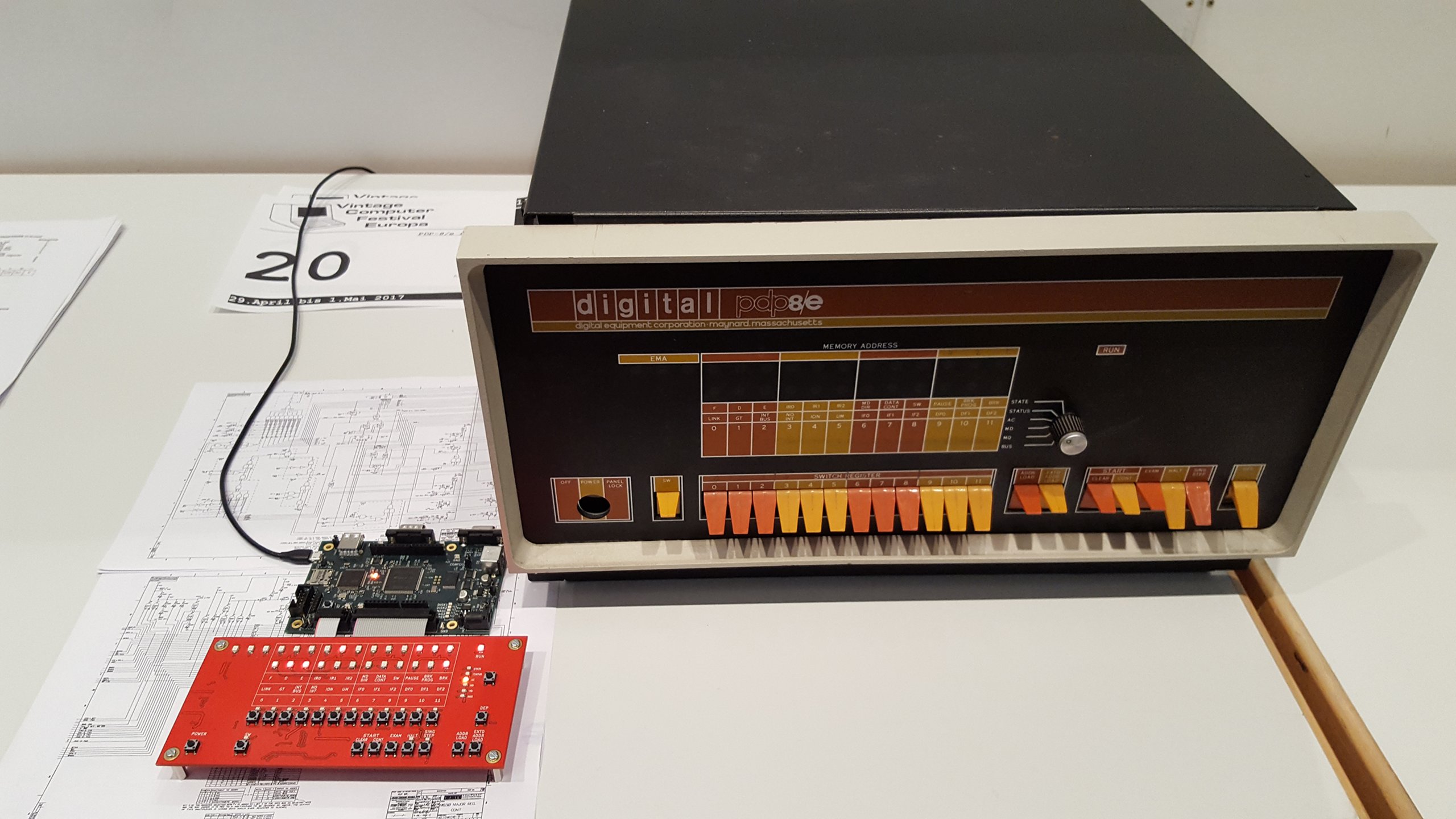
I am creating a replica of the DEC PDP-8/e architecture in an FPGA from schematics of the original hardware. So how did I end up with a project like this? The story begins with me wanting to have a computer with one of those front panels that have many, many lights where you can really see, in real time, what the computer is doing while it is executing code. Not because I am nostalgic for a prior experience with any of those I was born a bit too late for that and my first computer as a kid was a Commodore 64. Now, the front panel era ended around 40 years ago with the advent of microprocessors and computers of that age and older that are complete and working are hard to find and not cheap. And even if you do, there s the issue of weight, size (complete systems with peripherals fill at least a rack) and power consumption. So what to do build myself a small one with modern technology of course. While there s many computer architectures of that era to choose from, the various PDP machines by DEC are significant and well known (and documented) due to their large numbers. The most important are probably the 12 bit PDP-8, the 16 bit PDP-11 and the 36 bit PDP-10. While the PDP-11 is enticing because of the possibility to run UNIX I wanted to start with something simpler, so I chose the PDP-8.
My implementation on display next to a real PDP-8/e at VCFe 18.0

The Original DEC started the PDP-8 line of computers programmed data processors designed as low cost machines in 1965. It is a quite minimalist 12 bit architecture based on the earlier PDP-5, and by minimalist I mean seriously minimal. If you are familiar with early 8 bit microprocessors like the 6502 or 8080 you will find them luxuriously equipped in comparison. The PDP-8 base architecture has a program counter (PC) and an accumulator (AC)1. That s it. There are no pointer or index registers2. There is no stack. It has addition and AND instructions but subtractions and OR operations have to be manually coded. The optional Extended Arithmetic Element adds the MQ register but that s really it for visible registers. The Wikipedia page on the PDP-8 has a good detailed description. Regarding technology, the PDP-8 series has been in production long enough to get the whole range of implementations from discrete transistor logic to microprocessors. The 8/e which I target was right in the middle, implemented in TTL logic where each IC contains multiple logic elements. This allowed the CPU itself (including timing generator) to fit on three large circuit boards plugged into a backplane. Complete systems would have at least another board for the front panel and multiple boards for the core memory, then additional boards for whatever options and peripherals were desired.

Design Choices and Comparisons I m not the only one who had the idea to build something like that, of course. Among the other modern PDP-8 implementations with a front panel, probably the most prominent project is the Spare Time Gizmos SBC6120 which is a PDP-8 single board computer built around the Harris/Intersil HD-6120 microprocessor, which implementes the PDP-8 architecture, combined with a nice front panel. Another is the PiDP-8/I, which is another nice front panel (modeled after the 8/i which has even more lights) driven by the simh simulator running under Linux on a Raspberry Pi. My goal is to get front panel lights that appear exactly like the real ones in operation. This necessitates driving the lights at full speed as they change with every instruction or even within instructions for some display selections. For example, if you run a tight loop that does nothing but increment AC while displaying that register, it would appear that all lights are lit at equal but less than full brightness. The reason is that the loop runs at such a high speed that even the most significant bit, which is blinking the slowest, is too fast to see flicker. Hence they are all effectively 50% on, just at different frequencies, and appear to be constantly light at the same brightness. This is where the other projects lack what I am looking for. The PiDP-8/I is a multiplexed display which updates at something like 30 Hz or 60 Hz, taking whatever value is current in the simulation software at the time. All the states the lights took inbetween are lost and consequently there is flickering where there shouldn t be. On the SBC6120 at least the address lines appear to update at full speed as these are the actual RAM address lines. However the used 6120 microprocessor does not have required data for the indicator display externally available. Instead, the SBC6120 runs an interrupt at 30 Hz to trap into its firmware/monitor program which then reads the current state and writes it to the front panel display, which is essentially just another peripheral. A different considerable problem with the SBC6120 is its use of the 6100 microprocessor family ICs, which are themselves long out of production and not trivial (or cheaply) to come by. Given that the way to go is to drive all lights in step with every cycle3, this can be done by a software running on a dedicated microcontroller which is how I started or by implementing a real CPU with all the needed outputs in an FPGA which is the project I am writing about. In the next post I give an overview of the hardware I built so far and some of the features that are yet to be implemented.

  1. With an associated link bit which is a little different from a carry bit in that it is treated as a thirteenth bit, i.e. it will be flipped rather than set when a carry occurs. [return]
  2. Although there are 8 specially treated memory addresses that will pre-increment when used in indirect addressing. [return]
  3. Basic cycles on the PDP-8/e are 1.4 s for memory modifying cycles and fast cycles of 1.2 s for everything else. Instructions can be one to three cycles long. [return]

Shirish Agarwal: Dreams don t cost a penny, mumma s boy :)

This one I promise will be short  After the last two updates, I thought it was time for something positive to share. While I m doing the hard work (of physiotherapy which is gruelling), the only luxury I have nowadays is of falling on to dreams which are also rare. The dream I m going to share is totally unrealistic as my mum hates travel but I m sure many sons and daughters would identify with it. Almost all travel outside of relatives is because I dragged her onto it. In the dream, I am going to a Debconf, get bursary and the conference is being held somewhere in Europe, maybe Paris (2019 probably)  . I reach and attend the conference, present and generally have a great time sharing and learning from my peers. As we all do in these uncertain times, I too phone home every couple of days ensuring her that I m well and in best of health. The weather is mild like it was in South Africa and this time I had come packed with woollens so all was well. Just the day before the conference is to end, I call up mum and she tells about a specific hotel/hostel which I should check out. I am somewhat surprised that she knows of a specific hotel/hostel in a specific place but I accede to her request. I go there to find a small, quiet, quaint bed & breakfast place (dunno if Paris has such kind of places), something which my mum would like. Intuitively, I ask at the reception to look in the register. After seeing my passport, he too accedes to my request and shows me the logbook of all visitors registering to come in the last few days (for some reason privacy is not a concern then) . I am surprised to find my mother s name in the register and she had turned up just a day or two before. I again request the reception to be able to go to room abcd without being announced and have some sort of key (like for maintenance or laundry as an excuse) . The reception calls the manager and after looking copy of mother s passport and mine they somehow accede to the request with help located nearby just in case something goes wrong. I disguise my voice and announce as either Room service or Maintenance and we are both surprised and elated to see each other. After talking a while, I go back to the reception and register myself as her guest. The next week is a whirlwind as I come to know of hop-on, hop-off buses similar service in Paris as was in South Africa. I buy a small booklet and we go through all the museums. the vineyards or whatever it is that Paris has to offer. IIRC there is also a lock and key on a famous bridge. We also do that. She is constantly surprised at the different activities the city shows her and the mother-son bond becomes much better. I had shared the same dream with her and she laughed. In reality, she is happy and comfortable in the confines of her home. Still I hope some mother-daughter, son-father, son-mother or any combination of parent, sibling takes this entry and enrich each other by travelling together.
Filed under: Miscellenous Tagged: #dream, #mother, #planet-debian, travel

22 June 2017

Dirk Eddelbuettel: nanotime 0.2.0

A new version of the nanotime package for working with nanosecond timestamps just arrived on CRAN. nanotime uses the RcppCCTZ package for (efficient) high(er) resolution time parsing and formatting up to nanosecond resolution, and the bit64 package for the actual integer64 arithmetic. Thanks to a metric ton of work by Leonardo Silvestri, the package now uses S4 classes internally allowing for greater consistency of operations on nanotime objects.

Changes in version 0.2.0 (2017-06-22)
  • Rewritten in S4 to provide more robust operations (#17 by Leonardo)
  • Ensure tz="" is treated as unset (Leonardo in #20)
  • Added format and tz arguments to nanotime, format, print (#22 by Leonardo and Dirk)
  • Ensure printing respect options()$max.print, ensure names are kept with vector (#23 by Leonardo)
  • Correct summary() by defining names<- (Leonardo in #25 fixing #24)
  • Report error on operations that are meaningful for type; handled NA, NaN, Inf, -Inf correctly (Leonardo in #27 fixing #26)

We also have a diff to the previous version thanks to CRANberries. More details and examples are at the nanotime page; code, issue tickets etc at the GitHub repository.

This post by Dirk Eddelbuettel originated on his Thinking inside the box blog. Please report excessive re-aggregation in third-party for-profit settings.

Dirk Eddelbuettel: RcppCCTZ 0.2.3 (and 0.2.2)

A new minor version 0.2.3 of RcppCCTZ is now on CRAN. RcppCCTZ uses Rcpp to bring CCTZ to R. CCTZ is a C++ library for translating between absolute and civil times using the rules of a time zone. In fact, it is two libraries. One for dealing with civil time: human-readable dates and times, and one for converting between between absolute and civil times via time zones. The RcppCCTZ page has a few usage examples and details. This version ensures that we set the TZDIR environment variable correctly on the old dreaded OS that does not come with proper timezone information---an issue which had come up while preparing the next (and awesome, trust me) release of nanotime. It also appears that I failed to blog about 0.2.2, another maintenance release, so changes for both are summarised next.

Changes in version 0.2.3 (2017-06-19)
  • On Windows, the TZDIR environment variable is now set in .onLoad()
  • Replaced init.c with registration code inside of RcppExports.cpp thanks to Rcpp 0.12.11.

Changes in version 0.2.2 (2017-04-20)
  • Synchronized with upstream CCTZ
  • The time_point object is instantiated explicitly for nanosecond use which appears to be required on macOS

We also have a diff to the previous version thanks to CRANberries. More details are at the RcppCCTZ page; code, issue tickets etc at the GitHub repository.

This post by Dirk Eddelbuettel originated on his Thinking inside the box blog. Please report excessive re-aggregation in third-party for-profit settings.

21 June 2017

Vincent Bernat: IPv4 route lookup on Linux

TL;DR: With its implementation of IPv4 routing tables using LPC-tries, Linux offers good lookup performance (50 ns for a full view) and low memory usage (64 MiB for a full view).
During the lifetime of an IPv4 datagram inside the Linux kernel, one important step is the route lookup for the destination address through the fib_lookup() function. From essential information about the datagram (source and destination IP addresses, interfaces, firewall mark, ), this function should quickly provide a decision. Some possible options are: Since 2.6.39, Linux stores routes into a compressed prefix tree (commit 3630b7c050d9). In the past, a route cache was maintained but it has been removed1 in Linux 3.6.

Route lookup in a trie Looking up a route in a routing table is to find the most specific prefix matching the requested destination. Let s assume the following routing table:
$ ip route show scope global table 100
default via 203.0.113.5 dev out2
192.0.2.0/25
        nexthop via 203.0.113.7  dev out3 weight 1
        nexthop via 203.0.113.9  dev out4 weight 1
192.0.2.47 via 203.0.113.3 dev out1
192.0.2.48 via 203.0.113.3 dev out1
192.0.2.49 via 203.0.113.3 dev out1
192.0.2.50 via 203.0.113.3 dev out1
Here are some examples of lookups and the associated results:
Destination IP Next hop
192.0.2.49 203.0.113.3 via out1
192.0.2.50 203.0.113.3 via out1
192.0.2.51 203.0.113.7 via out3 or 203.0.113.9 via out4 (ECMP)
192.0.2.200 203.0.113.5 via out2
A common structure for route lookup is the trie, a tree structure where each node has its parent as prefix.

Lookup with a simple trie The following trie encodes the previous routing table: Simple routing trie For each node, the prefix is known by its path from the root node and the prefix length is the current depth. A lookup in such a trie is quite simple: at each step, fetch the nth bit of the IP address, where n is the current depth. If it is 0, continue with the first child. Otherwise, continue with the second. If a child is missing, backtrack until a routing entry is found. For example, when looking for 192.0.2.50, we will find the result in the corresponding leaf (at depth 32). However for 192.0.2.51, we will reach 192.0.2.50/31 but there is no second child. Therefore, we backtrack until the 192.0.2.0/25 routing entry. Adding and removing routes is quite easy. From a performance point of view, the lookup is done in constant time relative to the number of routes (due to maximum depth being capped to 32). Quagga is an example of routing software still using this simple approach.

Lookup with a path-compressed trie In the previous example, most nodes only have one child. This leads to a lot of unneeded bitwise comparisons and memory is also wasted on many nodes. To overcome this problem, we can use path compression: each node with only one child is removed (except if it also contains a routing entry). Each remaining node gets a new property telling how many input bits should be skipped. Such a trie is also known as a Patricia trie or a radix tree. Here is the path-compressed version of the previous trie: Patricia trie Since some bits have been ignored, on a match, a final check is executed to ensure all bits from the found entry are matching the input IP address. If not, we must act as if the entry wasn t found (and backtrack to find a matching prefix). The following figure shows two IP addresses matching the same leaf: Lookup in a Patricia trie The reduction on the average depth of the tree compensates the necessity to handle those false positives. The insertion and deletion of a routing entry is still easy enough. Many routing systems are using Patricia trees:

Lookup with a level-compressed trie In addition to path compression, level compression2 detects parts of the trie that are densily populated and replace them with a single node and an associated vector of 2k children. This node will handle k input bits instead of just one. For example, here is a level-compressed version our previous trie: Level-compressed trie Such a trie is called LC-trie or LPC-trie and offers higher lookup performances compared to a radix tree. An heuristic is used to decide how many bits a node should handle. On Linux, if the ratio of non-empty children to all children would be above 50% when the node handles an additional bit, the node gets this additional bit. On the other hand, if the current ratio is below 25%, the node loses the responsibility of one bit. Those values are not tunable. Insertion and deletion becomes more complex but lookup times are also improved.

Implementation in Linux The implementation for IPv4 in Linux exists since 2.6.13 (commit 19baf839ff4a) and is enabled by default since 2.6.39 (commit 3630b7c050d9). Here is the representation of our example routing table in memory3: Memory representation of a trie There are several structures involved: The trie can be retrieved through /proc/net/fib_trie:
$ cat /proc/net/fib_trie
Id 100:
  +-- 0.0.0.0/0 2 0 2
      -- 0.0.0.0
        /0 universe UNICAST
     +-- 192.0.2.0/26 2 0 1
         -- 192.0.2.0
           /25 universe UNICAST
         -- 192.0.2.47
           /32 universe UNICAST
        +-- 192.0.2.48/30 2 0 1
            -- 192.0.2.48
              /32 universe UNICAST
            -- 192.0.2.49
              /32 universe UNICAST
            -- 192.0.2.50
              /32 universe UNICAST
[...]
For internal nodes, the numbers after the prefix are:
  1. the number of bits handled by the node,
  2. the number of full children (they only handle one bit),
  3. the number of empty children.
Moreover, if the kernel was compiled with CONFIG_IP_FIB_TRIE_STATS, some interesting statistics are available in /proc/net/fib_triestat4:
$ cat /proc/net/fib_triestat
Basic info: size of leaf: 48 bytes, size of tnode: 40 bytes.
Id 100:
        Aver depth:     2.33
        Max depth:      3
        Leaves:         6
        Prefixes:       6
        Internal nodes: 3
          2: 3
        Pointers: 12
Null ptrs: 4
Total size: 1  kB
[...]
When a routing table is very dense, a node can handle many bits. For example, a densily populated routing table with 1 million entries packed in a /12 can have one internal node handling 20 bits. In this case, route lookup is essentially reduced to a lookup in a vector. The following graph shows the number of internal nodes used relative to the number of routes for different scenarios (routes extracted from an Internet full view, /32 routes spreaded over 4 different subnets with various densities). When routes are densily packed, the number of internal nodes are quite limited. Internal nodes and null pointers

Performance So how performant is a route lookup? The maximum depth stays low (about 6 for a full view), so a lookup should be quite fast. With the help of a small kernel module, we can accurately benchmark5 the fib_lookup() function: Maximum depth and lookup time The lookup time is loosely tied to the maximum depth. When the routing table is densily populated, the maximum depth is low and the lookup times are fast. When forwarding at 10 Gbps, the time budget for a packet would be about 50 ns. Since this is also the time needed for the route lookup alone in some cases, we wouldn t be able to forward at line rate with only one core. Nonetheless, the results are pretty good and they are expected to scale linearly with the number of cores. The measurements are done with a Linux kernel 4.11 from Debian unstable. I have gathered performance metrics accross kernel versions in Performance progression of IPv4 route lookup on Linux . Another interesting figure is the time it takes to insert all those routes into the kernel. Linux is also quite efficient in this area since you can insert 2 million routes in less than 10 seconds: Insertion time

Memory usage The memory usage is available directly in /proc/net/fib_triestat. The statistic provided doesn t account for the fib_info structures, but you should only have a handful of them (one for each possible next-hop). As you can see on the graph below, the memory use is linear with the number of routes inserted, whatever the shape of the routes is. Memory usage The results are quite good. With only 256 MiB, about 2 million routes can be stored!

Routing rules Unless configured without CONFIG_IP_MULTIPLE_TABLES, Linux supports several routing tables and has a system of configurable rules to select the table to use. These rules can be configured with ip rule. By default, there are three of them:
$ ip rule show
0:      from all lookup local
32766:  from all lookup main
32767:  from all lookup default
Linux will first lookup for a match in the local table. If it doesn t find one, it will lookup in the main table and at last resort, the default table.

Builtin tables The local table contains routes for local delivery:
$ ip route show table local
broadcast 127.0.0.0 dev lo proto kernel scope link src 127.0.0.1
local 127.0.0.0/8 dev lo proto kernel scope host src 127.0.0.1
local 127.0.0.1 dev lo proto kernel scope host src 127.0.0.1
broadcast 127.255.255.255 dev lo proto kernel scope link src 127.0.0.1
broadcast 192.168.117.0 dev eno1 proto kernel scope link src 192.168.117.55
local 192.168.117.55 dev eno1 proto kernel scope host src 192.168.117.55
broadcast 192.168.117.63 dev eno1 proto kernel scope link src 192.168.117.55
This table is populated automatically by the kernel when addresses are configured. Let s look at the three last lines. When the IP address 192.168.117.55 was configured on the eno1 interface, the kernel automatically added the appropriate routes:
  • a route for 192.168.117.55 for local unicast delivery to the IP address,
  • a route for 192.168.117.255 for broadcast delivery to the broadcast address,
  • a route for 192.168.117.0 for broadcast delivery to the network address.
When 127.0.0.1 was configured on the loopback interface, the same kind of routes were added to the local table. However, a loopback address receives a special treatment and the kernel also adds the whole subnet to the local table. As a result, you can ping any IP in 127.0.0.0/8:
$ ping -c1 127.42.42.42
PING 127.42.42.42 (127.42.42.42) 56(84) bytes of data.
64 bytes from 127.42.42.42: icmp_seq=1 ttl=64 time=0.039 ms
--- 127.42.42.42 ping statistics ---
1 packets transmitted, 1 received, 0% packet loss, time 0ms
rtt min/avg/max/mdev = 0.039/0.039/0.039/0.000 ms
The main table usually contains all the other routes:
$ ip route show table main
default via 192.168.117.1 dev eno1 proto static metric 100
192.168.117.0/26 dev eno1 proto kernel scope link src 192.168.117.55 metric 100
The default route has been configured by some DHCP daemon. The connected route (scope link) has been automatically added by the kernel (proto kernel) when configuring an IP address on the eno1 interface. The default table is empty and has little use. It has been kept when the current incarnation of advanced routing has been introduced in Linux 2.1.68 after a first tentative using classes in Linux 2.1.156.

Performance Since Linux 4.1 (commit 0ddcf43d5d4a), when the set of rules is left unmodified, the main and local tables are merged and the lookup is done with this single table (and the default table if not empty). Moreover, since Linux 3.0 (commit f4530fa574df), without specific rules, there is no performance hit when enabling the support for multiple routing tables. However, as soon as you add new rules, some CPU cycles will be spent for each datagram to evaluate them. Here is a couple of graphs demonstrating the impact of routing rules on lookup times: Routing rules impact on performance For some reason, the relation is linear when the number of rules is between 1 and 100 but the slope increases noticeably past this threshold. The second graph highlights the negative impact of the first rule (about 30 ns). A common use of rules is to create virtual routers: interfaces are segregated into domains and when a datagram enters through an interface from domain A, it should use routing table A:
# ip rule add iif vlan457 table 10
# ip rule add iif vlan457 blackhole
# ip rule add iif vlan458 table 20
# ip rule add iif vlan458 blackhole
The blackhole rules may be removed if you are sure there is a default route in each routing table. For example, we add a blackhole default with a high metric to not override a regular default route:
# ip route add blackhole default metric 9999 table 10
# ip route add blackhole default metric 9999 table 20
# ip rule add iif vlan457 table 10
# ip rule add iif vlan458 table 20
To reduce the impact on performance when many interface-specific rules are used, interfaces can be attached to VRF instances and a single rule can be used to select the appropriate table:
# ip link add vrf-A type vrf table 10
# ip link set dev vrf-A up
# ip link add vrf-B type vrf table 20
# ip link set dev vrf-B up
# ip link set dev vlan457 master vrf-A
# ip link set dev vlan458 master vrf-B
# ip rule show
0:      from all lookup local
1000:   from all lookup [l3mdev-table]
32766:  from all lookup main
32767:  from all lookup default
The special l3mdev-table rule was automatically added when configuring the first VRF interface. This rule will select the routing table associated to the VRF owning the input (or output) interface. VRF was introduced in Linux 4.3 (commit 193125dbd8eb), the performance was greatly enhanced in Linux 4.8 (commit 7889681f4a6c) and the special routing rule was also introduced in Linux 4.8 (commit 96c63fa7393d, commit 1aa6c4f6b8cd). You can find more details about it in the kernel documentation.

Conclusion The takeaways from this article are:
  • route lookup times hardly increase with the number of routes,
  • densily packed /32 routes lead to amazingly fast route lookups,
  • memory use is low (128 MiB par million routes),
  • no optimization is done on routing rules.

  1. The routing cache was subject to reasonably easy to launch denial of service attacks. It was also believed to not be efficient for high volume sites like Google but I have first-hand experience it was not the case for moderately high volume sites.
  2. IP-address lookup using LC-tries , IEEE Journal on Selected Areas in Communications, 17(6):1083-1092, June 1999.
  3. For internal nodes, the key_vector structure is embedded into a tnode structure. This structure contains information rarely used during lookup, notably the reference to the parent that is usually not needed for backtracking as Linux keeps the nearest candidate in a variable.
  4. One leaf can contain several routes (struct fib_alias is a list). The number of prefixes can therefore be greater than the number of leaves. The system also keeps statistics about the distribution of the internal nodes relative to the number of bits they handle. In our example, all the three internal nodes are handling 2 bits.
  5. The measurements are done in a virtual machine with one vCPU. The host is an Intel Core i5-4670K running at 3.7 GHz during the experiment (CPU governor was set to performance). The benchmark is single-threaded. It runs a warm-up phase, then executes about 100,000 timed iterations and keeps the median. Timings of individual runs are computed from the TSC.
  6. Fun fact: the documentation of this first tentative of more flexible routing is still available in today s kernel tree and explains the usage of the default class .

20 June 2017

Norbert Preining: TeX Live 2017 hits Debian/unstable

Yesterday I uploaded the first packages of TeX Live 2017 to Debian/unstable, meaning that the new release cycle has started. Debian/stretch was released over the weekend, and this opened up unstable for new developments. The upload comprised the following packages: asymptote, cm-super, context, context-modules, texlive-base, texlive-bin, texlive-extra, texlive-extra, texlive-lang, texworks, xindy.

I mentioned already in a previous post the following changes: The last two changes are described together with other news (easy TEXMF tree management) in the TeX Live release post. These changes more or less sum up the new infra structure developments in TeX Live 2017. Since the last release to unstable (which happened in 2017-01-23) about half a year of package updates have accumulated, below is an approximate list of updates (not split into new/updated, though). Enjoy the brave new world of TeX Live 2017, and please report bugs to the BTS! Updated/new packages:
academicons, achemso, acmart, acro, actuarialangle, actuarialsymbol, adobemapping, alkalami, amiri, animate, aomart, apa6, apxproof, arabluatex, archaeologie, arsclassica, autoaligne, autobreak, autosp, axodraw2, babel, babel-azerbaijani, babel-english, babel-french, babel-indonesian, babel-japanese, babel-malay, babel-ukrainian, bangorexam, baskervaldx, baskervillef, bchart, beamer, beamerswitch, bgteubner, biblatex-abnt, biblatex-anonymous, biblatex-archaeology, biblatex-arthistory-bonn, biblatex-bookinother, biblatex-caspervector, biblatex-cheatsheet, biblatex-chem, biblatex-chicago, biblatex-claves, biblatex-enc, biblatex-fiwi, biblatex-gb7714-2015, biblatex-gost, biblatex-ieee, biblatex-iso690, biblatex-manuscripts-philology, biblatex-morenames, biblatex-nature, biblatex-opcit-booktitle, biblatex-oxref, biblatex-philosophy, biblatex-publist, biblatex-shortfields, biblatex-subseries, bibtexperllibs, bidi, biochemistry-colors, bookcover, boondox, bredzenie, breqn, bxbase, bxcalc, bxdvidriver, bxjalipsum, bxjaprnind, bxjscls, bxnewfont, bxorigcapt, bxpapersize, bxpdfver, cabin, callouts, chemfig, chemformula, chemmacros, chemschemex, childdoc, circuitikz, cje, cjhebrew, cjk-gs-integrate, cmpj, cochineal, combofont, context, conv-xkv, correctmathalign, covington, cquthesis, crimson, crossrefware, csbulletin, csplain, csquotes, css-colors, cstldoc, ctex, currency, cweb, datetime2-french, datetime2-german, datetime2-romanian, datetime2-ukrainian, dehyph-exptl, disser, docsurvey, dox, draftfigure, drawmatrix, dtk, dviinfox, easyformat, ebproof, elements, endheads, enotez, eqnalign, erewhon, eulerpx, expex, exsheets, factura, facture, fancyhdr, fbb, fei, fetamont, fibeamer, fithesis, fixme, fmtcount, fnspe, fontmfizz, fontools, fonts-churchslavonic, fontspec, footnotehyper, forest, gandhi, genealogytree, glossaries, glossaries-extra, gofonts, gotoh, graphics, graphics-def, graphics-pln, grayhints, gregoriotex, gtrlib-largetrees, gzt, halloweenmath, handout, hang, heuristica, hlist, hobby, hvfloat, hyperref, hyperxmp, ifptex, ijsra, japanese-otf-uptex, jlreq, jmlr, jsclasses, jslectureplanner, karnaugh-map, keyfloat, knowledge, komacv, koma-script, kotex-oblivoir, l3, l3build, ladder, langsci, latex, latex2e, latex2man, latex3, latexbug, latexindent, latexmk, latex-mr, leaflet, leipzig, libertine, libertinegc, libertinus, libertinust1math, lion-msc, lni, longdivision, lshort-chinese, ltb2bib, lualatex-math, lualibs, luamesh, luamplib, luaotfload, luapackageloader, luatexja, luatexko, lwarp, make4ht, marginnote, markdown, mathalfa, mathpunctspace, mathtools, mcexam, mcf2graph, media9, minidocument, modular, montserrat, morewrites, mpostinl, mptrees, mucproc, musixtex, mwcls, mweights, nameauth, newpx, newtx, newtxtt, nfssext-cfr, nlctdoc, novel, numspell, nwejm, oberdiek, ocgx2, oplotsymbl, optidef, oscola, overlays, pagecolor, pdflatexpicscale, pdfpages, pdfx, perfectcut, pgfplots, phonenumbers, phonrule, pkuthss, platex, platex-tools, polski, preview, program, proofread, prooftrees, pst-3dplot, pst-barcode, pst-eucl, pst-func, pst-ode, pst-pdf, pst-plot, pstricks, pstricks-add, pst-solides3d, pst-spinner, pst-tools, pst-tree, pst-vehicle, ptex2pdf, ptex-base, ptex-fontmaps, pxbase, pxchfon, pxrubrica, pythonhighlight, quran, ran_toks, reledmac, repere, resphilosophica, revquantum, rputover, rubik, rutitlepage, sansmathfonts, scratch, seealso, sesstime, siunitx, skdoc, songs, spectralsequences, stackengine, stage, sttools, studenthandouts, svg, tcolorbox, tex4ebook, tex4ht, texosquery, texproposal, thaienum, thalie, thesis-ekf, thuthesis, tikz-kalender, tikzmark, tikz-optics, tikz-palattice, tikzpeople, tikzsymbols, titlepic, tl17, tqft, tracklang, tudscr, tugboat-plain, turabian-formatting, txuprcal, typoaid, udesoftec, uhhassignment, ukrainian, ulthese, unamthesis, unfonts-core, unfonts-extra, unicode-math, uplatex, upmethodology, uptex-base, urcls, variablelm, varsfromjobname, visualtikz, xassoccnt, xcharter, xcntperchap, xecjk, xepersian, xetexko, xevlna, xgreek, xsavebox, xsim, ycbook.

19 June 2017

Shirish Agarwal: Seizures, Vigo and bi-pedal motion

Dear all, an update is in order. While talking to physiotherapist couple of days before, came to know the correct term to what was I experiencing. I had experienced convulsive seizure , spasms being a part of it. Reading the wikipedia entry and the associated links/entries it seems I am and was very very lucky. The hospital or any hospital is a very bad bad place. I have seen all horror movies which people say are disturbing but have never been disturbed as much as I was in hospital. I couldn t help but hear people s screams and saw so many cases which turned critical. At times it was not easy to remain positive but dunno from where there was a will to live which pushed me and is still pushing me. One of the things that was painful for a long time were the almost constant stream of injections that were injected in me. It was almost an afterthought that the nurse put a Vigo in me. Similar to the Vigo injected in me. While the above medical device is similar, mine had a cross, the needle was much shorter and is injected into the vein. After that all injections are injected into that including common liquid which is salt,water and something commonly given to patients to stabilize first. I am not remembering the name atm. I also had a urine bag which was attached to my penis in a non-invasive manner. Both my grandfather and grandma used to cry when things went wrong while I didn t feel any pain but when the urine bag was disattached and attached again, so seems things have improved there. I was also very conscious of getting bed sores as both my grandpa and grandma had them when in hospital. As I had no strength I had to beg. plead do everything to make sure that every few hours I was turned from one side to other. I also had an air bag which is supposed to alleviate or relief this condition. Constant physiotherapy every day for a while slowly increased my strength and slowly both the vigo and feeding tube put inside my throat was removed. I have no remembrance as to when they had put the feeding tube as it was all rubber and felt bad when it came out. Further physiotherapy helped me crawl till the top of the bed, the bed was around 6 feet in length and and more than enough so I could turn both sides without falling over. Few days later I found I could also sit up using my legs as a lever and that gave confidence to the doctors to remove the air bed so I could crawl more easily. Couple of more days later I stood on my feet for the first time and it was like I had lead legs. Each step was painful but the sense and feeling of independence won over whatever pain was there. I had to endure wet wipes from nurses and ward boys in place of a shower everyday and while they were respectful always it felt humiliating. The first time I had a bath after 2 weeks or something, every part of my body cried and I felt like a weakling. I had thought I wouldn t be able to do justice to the physiotherapy session which was soon after but after the session was back to feeling normal. For a while I was doing the penguin waddle which while painful was also had humor in it. I did think of shooting the penguin waddle but decided against it as I was half-naked most of the time ( the hospital clothes never fit me properly) Cut to today and I was able to climb up and down the stairs on my own and circled my own block, slowly but was able to do it on my own by myself. While I always had a sense of wonderment for bi-pedal motion as well as all other means of transport, found much more respect of walking. I live near a fast food eating joint so I see lot of youngsters posing in different ways with their legs to show interest to their mates. And this I know happens both on the conscious and sub-conscious levels. To be able to see and discern that also put a sense of wonder in nature s creations. All in all, I m probabl6y around 40% independent and still 60% interdependent. I know I have to be patient with myself and those around me and explain to others what I m going through. For e.g. I still tend to spill things and still can t touch-type much. So, the road is long, I can only pray and hope best wishes for anybody who is my condition and do pray that nobody goes through what I went through, especiallly not children. I am also hoping that things like DxtER and range of non-invasive treatments make their way into India and the developing world at large. Anybody who is overweight and is either disgusted or doesn t like the gym route, would recommend doing sessions with a physiotherapist that you can trust. You have to trust that her judgement will push you a bit more and not more that the gains you make are toppled over. I still get dizziness spells while doing therapy but will to break it as I know dizziness doesn t help me. I hope my writings give strength and understanding to either somebody who is going through it, or relatives or/and caregivers so they know the mental status of the person who s going through it. Till later and sorry it became so long. Update I forgot to share this inspirational story from my city which I shared with a friend days ago. Add to that, she is from my city. What it doesn t share is that Triund is a magical place. I had visited once with a friend who had elf ears (he had put on elf ears) and it is kind of place which alchemist talks about, a place where imagination does turn wild and there is magic in the air.
Filed under: Miscellenous Tagged: #air bag, #bed sores, #convulsive epileptic seizure, #crawling, #horror, #humiliation, #nakedness, #penguin waddle, #physiotherapy, #planet-debian, #spilling things, #urine bag, #Vigo medical device

18 June 2017

Eriberto Mota: Como migrar do Debian Jessie para o Stretch

Bem vindo ao Debian Stretch! Ontem, 17 de junho de 2017, o Debian 9 (Stretch) foi lan ado. Eu gostaria de falar sobre alguns procedimentos b sicos e regras para migrar do Debian 8 (Jessie). Passos iniciais
# apt-get update
# apt-get dist-upgrade
Migrando
deb http://ftp.br.debian.org/debian/ stretch main
deb-src http://ftp.br.debian.org/debian/ stretch main
   
deb http://security.debian.org/ stretch/updates main
deb-src http://security.debian.org/ stretch/updates main
# apt-get update
# apt-get dist-upgrade
Caso haja algum problema, leia as mensagens de erro e tente resolver o problema. Resolvendo ou n o tal problema, execute novamente o comando:
# apt-get dist-upgrade
Havendo novos problemas, tente resolver. Busque solu es no Google, se for necess rio. Mas, geralmente, tudo dar certo e voc n o dever ter problemas. Altera es em arquivos de configura o Quando voc estiver migrando, algumas mensagens sobre altera es em arquivos de configura o poder o ser mostradas. Isso poder deixar alguns usu rios pedidos, sem saber o que fazer. N o entre em p nico. Existem duas formas de apresentar essas mensagens: via texto puro em shell ou via janela azul de mensagens. O texto a seguir um exemplo de mensagem em shell:
Ficheiro de configura o '/etc/rsyslog.conf'
 ==> Modificado (por si ou por um script) desde a instala o.
 ==> O distribuidor do pacote lan ou uma vers o atualizada.
 O que deseja fazer? As suas op es s o:
 Y ou I : instalar a vers o do pacote do maintainer
 N ou O : manter a vers o actualmente instalada
 D : mostrar diferen as entre as vers es
 Z : iniciar uma shell para examinar a situa o
 A a o padr o   manter sua vers o atual.
*** rsyslog.conf (Y/I/N/O/D/Z) [padr o=N] ?
A tela a seguir um exemplo de mensagem via janela: Nos dois casos, recomend vel que voc escolha por instalar a nova vers o do arquivo de configura o. Isso porque o novo arquivo de configura o estar totalmente adaptado aos novos servi os instalados e poder ter muitas op es novas ou diferentes. Mas n o se preocupe, pois as suas configura es n o ser o perdidas. Haver um backup das mesmas. Assim, para shell, escolha a op o "Y" e, no caso de janela, escolha a op o "instalar a vers o do mantenedor do pacote". muito importante anotar o nome de cada arquivo modificado. No caso da janela anterior, trata-se do arquivo /etc/samba/smb.conf. No caso do shell o arquivo foi o /etc/rsyslog.conf. Depois de completar a migra o, voc poder ver o novo arquivo de configura o e o original. Caso o novo arquivo tenha sido instalado ap s uma escolha via shell, o arquivo original (o que voc tinha anteriormente) ter o mesmo nome com a extens o .dpkg-old. No caso de escolha via janela, o arquivo ser mantido com a extens o .ucf-old. Nos dois casos, voc poder ver as modifica es feitas e reconfigurar o seu novo arquivo de acordo com as necessidades. Caso voc precise de ajuda para ver as diferen as entre os arquivos, voc poder usar o comando diff para compar -los. Fa a o diff sempre do arquivo novo para o original. como se voc quisesse ver como fazer com o novo arquivo para ficar igual ao original. Exemplo:
# diff -Naur /etc/rsyslog.conf /etc/rsyslog.conf.dpkg-old
Em uma primeira vista, as linhas marcadas com "+" dever o ser adicionadas ao novo arquivo para que se pare a com o anterior, assim como as marcadas com "-" dever o ser suprimidas. Mas cuidado: normal que haja algumas linhas diferentes, pois o arquivo de configura o foi feito para uma nova vers o do servi o ou aplicativo ao qual ele pertence. Assim, altere somente as linhas que realmente s o necess rias e que voc mudou no arquivo anterior. Veja o exemplo:
+daemon.*;mail.*;\
+ news.err;\
+ *.=debug;*.=info;\
+ *.=notice;*.=warn  /dev/xconsole
+*.* @sam
No meu caso, originalmente, eu s alterei a ltima linha. Ent o, no novo arquivo de configura o, s terei interesse em adicionar essa linha. Bem, se foi voc quem fez a configura o anterior, voc saber fazer a coisa certa. Geralmente, n o haver muitas diferen as entre os arquivos. Outra op o para ver as diferen as entre arquivos o comando mcdiff, que poder ser fornecido pelo pacote mc. Exemplo:
# mcdiff /etc/rsyslog.conf /etc/rsyslog.conf.dpkg-old
Problemas com ambientes e aplica es gr ficas poss vel que voc tenha algum problema com o funcionamento de ambientes gr ficos, como Gnome, KDE etc, ou com aplica es como o Mozilla Firefox. Nesses casos, prov vel que o problema seja os arquivos de configura o desses elementos, existentes no diret rio home do usu rio. Para verificar, crie um novo usu rio no Debian e teste com ele. Se tudo der certo, fa a um backup das configura es anteriores (ou renomeie as mesmas) e deixe que a aplica o crie uma configura o nova. Por exemplo, para o Mozilla Firefox, v ao diret rio home do usu rio e, com o Firefox fechado, renomeie o diret rio .mozilla para .mozilla.bak, inicie o Firefox e teste. Est inseguro? Caso voc esteja muito inseguro, instale um Debian 8, com ambiente gr fico e outras coisas, em uma m quina virtual e migre para Debian 9 para testar e aprender. Sugiro VirtualBox como virtualizador. Divirta-se!

14 June 2017

Michael Prokop: Grml 2017.05 Codename Freedatensuppe

The Debian stretch release is going to happen soon (on 2017-06-17) and since our latest Grml release is based on a very recent version of Debian stretch I m taking this as opportunity to announce it also here. So by the end of May we released a new stable release of Grml (the Debian based live system focusing on system administrator s needs), known as version 2017.05 with codename Freedatensuppe. Details about the changes of the new release are available in the official release notes and as usual the ISOs are available via grml.org/download. With this new Grml release we finally made the switch from file-rc to systemd. From a user s point of view this doesn t change that much, though to prevent having to answer even more mails regarding the switch I wrote down some thoughts in Grml s FAQ. There are some things that we still need to improve and sort out, but overall the switch to systemd so far went better than anticipated (thanks a lot to the pkg-systemd folks, especially Felipe Sateler and Michael Biebl!). And last but not least, Darshaka Pathirana helped me a lot with the systemd integration and polishing the release, many thanks! Happy Grml-ing!

Antoine Beaupr : Alioth moving toward pagure

Since 2003, the Debian project has been running a server called Alioth to host source code version control systems. The server will hit the end of life of the Debian LTS release (Wheezy) next year; that deadline raised some questions regarding the plans for the server over the coming years. Naturally, that led to a discussion regarding possible replacements. In response, the current Alioth maintainer, Alexander Wirt, announced a sprint to migrate to pagure, a free-software "Git-centered forge" written in Python for the Fedora project, which LWN covered last year. Alioth currently runs FusionForge, previously known as GForge, which is the free-software fork of the SourceForge code base when that service closed its source in 2001. Alioth hosts source code repositories, mainly Git and Subversion (SVN) and, like other "forge" sites, also offers forums, issue trackers, and mailing list services. While other alternatives are still being evaluated, a consensus has emerged on a migration plan from FusionForage to a more modern and minimal platform based on pagure.

Why not GitLab? While this may come as a surprise to some who would expect Debian to use the more popular GitLab project, the discussion and decision actually took place a while back. During a lengthy debate last year, Debian contributors discussed the relative merits of different code-hosting platforms, following the initiative of Debian Developer "Pirate" Praveen Arimbrathodiyil to package GitLab for Debian. At that time, Praveen also got a public GitLab instance running for Debian (gitlab.debian.net), which was sponsored by GitLab B.V. the commercial entity behind the GitLab project. The sponsorship was originally offered in 2015 by the GitLab CEO, presumably to counter a possible move to GitHub, as there was a discussion about creating a GitHub Organization for Debian at the time. The deployment of a Debian-specific GitLab instance then raised the question of the overlap with the already existing git.debian.org service, which is backed by Alioth's FusionForge deployment. It then seemed natural that the new GitLab instance would replace Alioth. But when Praveen directly proposed to move to GitLab, Wirt stepped in and explained that a migration plan was already in progress. The plan then was to migrate to a simpler gitolite-based setup, a decision that was apparently made in corridor discussions surrounding the Alioth Git replacement BoF held during Debconf 2015. The first objection raised by Wirt against GitLab was its "huge number of dependencies". Another issue Wirt identified was the "open core / enterprise model", preferring a "real open source system", an opinion which seems shared by other participants on the mailing list. Wirt backed his concerns with an hypothetical example:
Debian needs feature X but it is already in the enterprise version. We make a patch and, for commercial reasons, it never gets merged (they already sell it in the enterprise version). Which means we will have to fork the software and keep those patches forever. Been there done that. For me, that isn't acceptable.
This concern was further deepened when GitLab's Director of Strategic Partnerships, Eliran Mesika, explained the company's stewardship policy that explains how GitLab decides which features end up in the proprietary version. Praveen pointed out that:
[...] basically it boils down to features that they consider important for organizations with less than 100 developers may get accepted. I see that as a red flag for a big community like debian.
Since there are over 600 Debian Developers, the community seems to fall within the needs of "enterprise" users. The features the Debian community may need are, by definition, appropriate only to the "Enterprise Edition" (GitLab EE), the non-free version, and are therefore unlikely to end up in the "Community Edition" (GitLab CE), the free-software version. Interestingly, Mesika asked for clarification on which features were missing, explaining that GitLab is actually open to adding features to GitLab CE. The response from Debian Developer Holger Levsen was categorical: "It's not about a specific patch. Free GitLab and we can talk again." But beyond the practical and ethical concerns, some specific features Debian needs are currently only in GitLab EE. For example, debian.org systems use LDAP for authentication, which would obviously be useful in a GitLab deployment; GitLab CE supports basic LDAP authentication, but advanced features, like group or SSH-key synchronization, are only available in GitLab EE. Wirt also expressed concern about the Contributor License Agreement that GitLab B.V. requires contributors to sign when they send patches, which forces users to allow the release of their code under a non-free license. The debate then went on going through a exhaustive inventory of different free-software alternatives:
  • GitLab, a Ruby-based GitHub replacement, dual-licensed MIT/Commercial
  • Gogs, Go, MIT
  • Gitblit, Java, Apache-licensed
  • Kallithea, in Python, also supports Mercurial, GPLv3
  • and finally, pagure, also written Python, GPLv2
A feature comparison between each project was created in the Debian wiki as well. In the end, however, Praveen gave up on replacing Alioth with GitLab because of the controversy and moved on to support the pagure migration, which resolved the discussion in July 2016. More recently, Wirt admitted in an IRC conversation that "on the technical side I like GitLab a lot more than pagure" and that "as a user, GitLab is much nicer than pagure and it has those nice CI [continuous integration] features". However, as he explained in his blog "GitLab is Opencore, [and] that it is not entirely opensource. I don't think we should use software licensed under such a model for one of our core services" which leaves pagure as the only stable candidate. Other candidates were excluded on technical grounds, according to Wirt: Gogs "doesn't scale well" and a quick security check didn't yield satisfactory results; "Gitblit is Java" and Kallithea doesn't have support for accessing repositories over SSH (although there is a pending pull request to add the feature). In an email interview, Sid Sijbrandij, CEO of GitLab, did say that "we want to make sure that our open source edition can be used by open source projects". He gave examples of features liberated following requests by the community, such as branded login pages for the VLC project and GitLab Pages after popular demand. He stressed that "There are no artificial limits in our open source edition and some organizations use it with more than 20.000 users." So if the concern of the Debian community is that features may be missing from GitLab CE, there is definitely an opening from GitLab to add those features. If, however, the concern is purely ethical, it's hard to see how an agreement could be reached. As Sijbrandij put it:
On the mailinglist it seemed that some Debian maintainers do not agree with our open core business model and demand that there is no proprietary version. We respect that position but we don't think we can compete with the purely proprietary software like GitHub with this model.

Working toward a pagure migration The issue of Alioth maintenance came up again last month when Boyuan Yang asked what would happen to Alioth when support for Debian LTS (Wheezy) ends next year. Wirt brought up the pagure migration proposal and the community tried to make a plan for the migration. One of the issues raised was the question of the non-Git repositories hosted on Alioth, as pagure, like GitLab, only supports Git. Indeed, Ben Hutchings calculated that while 90% (\~19,000) of the repositories currently on Alioth are Git, there are 2,400 SVN repositories and a handful of Mercurial, Bazaar (bzr), Darcs, Arch, and even CVS repositories. As part of an informal survey, however, most packaging teams explained they either had already migrated away from SVN to Git or were in the process of doing so. The largest CVS user, the web site team, also explained it was progressively migrating to Git. Mattia Rizzolo then proposed that older repository services like SVN could continue running even if FusionForge goes down, as FusionForge is, after all, just a web interface to manage those back-end services. Repository creation would be disabled, but older repositories would stay operational until they migrate to Git. This would, effectively, mean the end of non-Git repository support for new projects in the Debian community, at least officially. Another issue is the creation of a Debian package for pagure. Ironically, while Praveen and other Debian maintainers have been working for 5 years to package GitLab for Debian, pagure isn't packaged yet. Antonio Terceiro, another Debian Developer, explained this isn't actually a large problem for debian.org services: "note that DSA [Debian System Administrator team] does not need/want the service software itself packaged, only its dependencies". Indeed, for Debian-specific code bases like ci.debian.net or tracker.debian.org, it may not make sense to have the overhead of maintaining Debian packages since those tools have limited use outside of the Debian project directly. While Debian derivatives and other distributions could reuse them, what usually happens is that other distributions roll their own software, like Ubuntu did with the Launchpad project. Still, Paul Wise, a member of the DSA team, reasoned that it was better, in the long term, to have Debian packages for debian.org services:
Personally I'm leaning towards the feeling that all configuration, code and dependencies for Debian services should be packaged and subjected to the usual Debian QA activities but I acknowledge that the current archive setup (testing migration plus backporting etc) doesn't necessarily make this easy.
Wise did say that "DSA doesn't have any hard rules/policy written down, just evaluation on a case-by-case basis" which probably means that pagure packaging will not be a blocker for deployment. The last pending issue is the question of the mailing lists hosted on Alioth, as pagure doesn't offer mailing list management (nor does GitLab). In fact, there are three different mailing list services for the Debian project: Wirt, with his "list-master hat" on, explained that the main mailing list service is "not really suited as a self-service" and expressed concern at the idea of migrating the large number mailing lists hosted on Alioth. Indeed, there are around 1,400 lists on Alioth while the main service has a set of 300 lists selected by the list masters. No solution for those mailing lists was found at the time of this writing. In the end, it seems like the Debian project has chosen pagure, the simpler, less featureful, but also less controversial, solution and will use the same hosting software as their fellow Linux distribution, Fedora. Wirt is also considering using FreeIPA for account management on top of pagure. The plan is to migrate away from FusionForge one bit at a time, and pagure is the solution for the first step: the Git repositories. Lists, other repositories, and additional features of FusionForge will be dealt with later on, but Wirt expects a plan to come out of the upcoming sprint. It will also be interesting to see how the interoperability promises of pagure will play out in the Debian world. Even though the federation features of pagure are still at the early stages, one can already clone issues and pull requests as Git repositories, which allows for a crude federation mechanism. In any case, given the long history and the wide variety of workflows in the Debian project, it is unlikely that a single tool will solve all problems. Alioth itself has significant overlap with other Debian services; not only does it handle mailing lists and forums, but it also has its own issue tracker that overlaps with the Debian bug tracking system (BTS). This is just the way things are in Debian: it is an old project with lots of moving part. As Jonathan Dowland put it: "The nature of the project is loosely-coupled, some redundancy, lots of legacy cruft, and sadly more than one way to do it." Hopefully, pagure will not become part of that "legacy redundant cruft". But at this point, the focus is on keeping the services running in a simpler, more maintainable way. The discussions between Debian and GitLab are still going on as we speak, but given how controversial the "open core" model used by GitLab is for the Debian community, pagure does seem like a more logical alternative.
Note: this article first appeared in the Linux Weekly News.

Mike Gabriel: Ayatana Indicators

In the near future various upstream projects related to the Ubuntu desktop experience as we have known it so far may become only sporadically maintained or even fully unmaintained. Ubuntu will switch to the Gnome desktop environment with 18.04 LTS as its default desktop, maybe even earlier. The Application Indicators [1] brought into being by Canonical Ltd. will not be needed in Gnome (AFAIK) any more. We can expect the Application Indicator related projects become unmaintained upstream. (In fact I have recently been offered continuation of upstream maintenance of libdbusmenu). Historical Background This all started at Ubuntu Developer Summit 2012 when Canonical Ltd. announced Ubuntu to become the successor of Windows XP in business offices. The Unity Greeter received an Remote Login Service enhancement: since then it supports Remote Login to Windows Terminal Servers. The question came up, why Remote Login to Linux servers--maybe even Ubuntu machines--is not on the agenda. It turned out, that it wasn't even a discussable topic. At that time, I started looking into the Unity Greeter code, adding support for X2Go Logon into Unity Greeter. I never really stopped looking at the greeter code from time to time. Since then, it turned into some sort of a hobby... While looking into the Unity Greeter code over the past years and actually forking Unity Greeter as Arctica Greeter [2] in September 2015, I also started looking into the Application Indicators concept just recently. And I must say, the more I have been looking into it, the more I have started liking the concept behind Application Indicators. The basic idea is awesome. However, lately all indicators became more and more Ubuntu-centric and IMHO too polluted by code related to the just declared dead Ubuntu phablet project. Forking Application Indicators Saying all this, I recently forked Application Indicators as Ayatana Indicators. At the moment I represent upstream and Debian package maintainer in one person. Ideally, this is only temporary and more people join in. (I heard some Unity 7 maintainers think about switching to Ayatana Indicators for the now community maintained Unity 7). The goal is to provide Ayatana Indicators to all desktop environments generically, all that want to use them, either as default or optionally. Release-wise, the idea is to strictly differentiate between upstream and Debian downstream in the release cycles of the various related components. I hope, noone is too concerned about the choice of name, as the "Ayatana" word actually was first used for upstream efforts inside Ubuntu [3]. Using the Ayatana term for the indicator forks is meant as honouring the previously undertaken efforts. I have seen very good work, so far, while going through the indicators' code. The upstream code must not be distro-specific, but, of course, can be distro-aware. Contributions Welcome The Ayatana Indicators upstream project components are currently hosted on Github under the umbrella of the Arctica Project. Regarding Debian, first uploads have recently been accepted to Debian experimental. The Debian packages are maintained under the umbrella of the revived Ayatana Packagers team [4]. Meet you at the Ayatana Indicators BoF at DebConf 17 (hopefully) For DebConf 17 (yeah, I am going there, if all plans work out well!!!!) I have submitted a BoF on this topic (let's hope, it gets accepted...). I'd like to give a quick overview on the current status of above named efforts and reasonings behind my commitment to the work. Most of the time during that BoF I would like to get into discussion with desktop maintainers, possibly upstream developers, Ubuntu developers, etc. Anyone who sees an asset in the Indicators approach is welcome to share and contribute. References

Next.

Previous.