Search Results: "nate"

21 August 2016

Dirk Eddelbuettel: RcppEigen 0.3.2.9.0

A new upstream release 3.2.9 of Eigen is now reflected in a new RcppEigen release 0.3.2.9.0 which got onto CRAN late yesterday and is now going into Debian. Once again, Yixuan Qiu did the heavy lifting of merging upstream (and two local twists we need to keep around). Another change is by James "coatless" Balamuta who added a row exporter. The NEWS file entry follows.
Changes in RcppEigen version 0.3.2.9.0 (2016-08-20)
  • Updated to version 3.2.9 of Eigen (PR #37 by Yixuan closing #36 from Bob Carpenter of the Stan team)
  • An exporter for RowVectorX was added (thanks to PR #32 by James Balamuta)
Courtesy of CRANberries, there is also a diffstat report for the most recent release.

This post by Dirk Eddelbuettel originated on his Thinking inside the box blog. Please report excessive re-aggregation in third-party for-profit settings.

20 August 2016

Francois Marier: Remplacer un disque RAID d fectueux

Traduction de l'article original anglais https://feeding.cloud.geek.nz/posts/replacing-a-failed-raid-drive/. Voici la proc dure que j'ai suivi pour remplacer un disque RAID d fectueux sur une machine Debian.

Remplacer le disque Apr s avoir remarqu que /dev/sdb a t expuls de mon RAID, j'ai utilis smartmontools pour identifier le num ro de s rie du disque retirer :
smartctl -a /dev/sdb
Cette information en main, j'ai ferm l'ordinateur, retir le disque d fectueux et mis un nouveau disque vide la place.

Initialiser le nouveau disque Apr s avoir d marr avec le nouveau disque vide, j'ai copi la table de partitions avec parted. Premi rement, j'ai examin la table de partitions sur le disque dur non-d fectueux :
$ parted /dev/sda
unit s
print
et cr une nouvelle table de partitions sur le disque de remplacement :
$ parted /dev/sdb
unit s
mktable gpt
Ensuite j'ai utilis la commande mkpart pour mes 4 partitions et je leur ai toutes donn la m me taille que les partitions quivalentes sur /dev/sda. Finalement, j'ai utilis les commandes toggle 1 bios_grub (partition d'amorce) et toggle X raid (o X est le num ro de la partition) pour toutes les partitions RAID, avant de v rifier avec la commande print que les deux tables de partitions sont maintenant identiques.

Resynchroniser/recr er les RAID Pour synchroniser les donn es du bon disque (/dev/sda) vers celui de remplacement (/dev/sdb), j'ai ex cut les commandes suivantes sur mes partitions RAID1 :
mdadm /dev/md0 -a /dev/sdb2
mdadm /dev/md2 -a /dev/sdb4
et j'ai gard un oeil sur le statut de la synchronisation avec :
watch -n 2 cat /proc/mdstat
Pour acc l rer le processus, j'ai utilis le truc suivant :
blockdev --setra 65536 "/dev/md0"
blockdev --setra 65536 "/dev/md2"
echo 300000 > /proc/sys/dev/raid/speed_limit_min
echo 1000000 > /proc/sys/dev/raid/speed_limit_max
Ensuite, j'ai recr ma partition swap RAID0 comme suit :
mdadm /dev/md1 --create --level=0 --raid-devices=2 /dev/sda3 /dev/sdb3
mkswap /dev/md1
Par que la partition swap est toute neuve (il n'est pas possible de restorer une partition RAID0, il faut la re-cr er compl tement), j'ai d faire deux choses:
  • remplacer le UUID pour swap dans /etc/fstab, avec le UUID donn par la commande mkswap (ou bien en utilisant la command blkid et en prenant le UUID pour /dev/md1)
  • remplacer le UUID de /dev/md1 dans /etc/mdadm/mdadm.conf avec celui retourn pour /dev/md1 par la commande mdadm --detail --scan

S'assurer que l'on peut d marrer avec le disque de remplacement Pour tre certain de bien pouvoir d marrer la machine avec n'importe quel des deux disques, j'ai r install le boot loader grub sur le nouveau disque :
grub-install /dev/sdb
avant de red marrer avec les deux disques connect s. Ceci confirme que ma configuration fonctionne bien. Ensuite, j'ai d marr sans le disque /dev/sda pour m'assurer que tout fonctionnerait bien si ce disque d cidait de mourir et de me laisser seulement avec le nouveau (/dev/sdb). Ce test brise videmment la synchronisation entre les deux disques, donc j'ai d red marrer avec les deux disques connect s et puis r -ajouter /dev/sda tous les RAID1 :
mdadm /dev/md0 -a /dev/sda2
mdadm /dev/md2 -a /dev/sda4
Une fois le tout fini, j'ai red marrer nouveau avec les deux disques pour confirmer que tout fonctionne bien :
cat /proc/mdstat
et j'ai ensuite ex cuter un test SMART complet sur le nouveau disque :
smartctl -t long /dev/sdb

19 August 2016

Dirk Eddelbuettel: RQuantLib 0.4.3: Lots of new Fixed Income functions

A release of RQuantLib is now on CRAN and in Debian. It contains a lot of new code contributed by Terry Leitch over a number of pull requests. See below for full details but the changes focus on Fixed Income and Fixed Income Derivatives, and cover swap, discount curves, swaptions and more. In the blog post for the previous release 0.4.2, we noted that a volunteer was needed for a new Windows library build of QuantLib for Windows to replace the outdated version 1.6 used there. Josh Ulrich stepped up, and built them. Josh and I tried for several month to get the win-builder to install these, but sadly other things took priority and we were unsuccessful. So this release will not have Windows binaries on CRAN as QuantLib 1.8 is not available there. Instead, you can use the ghrr drat and do
if (!require("drat")) install.packages("drat")
drat::addRepo("ghrr")
install.packages("RQuantLib")
to fetch prebuilt Windows binaries from the ghrr drat. Everybody else gets sources from CRAN. The full changes are detailed below.
Changes in RQuantLib version 0.4.3 (2016-08-19)
  • Changes in RQuantLib code:
    • Discount curve creation has been made more general by allowing additional arguments for day counter and fixed and floating frequency (contributed by Terry Leitch in #31, plus some work by Dirk in #32).
    • Swap leg parameters are now in combined variable and allow textual description (Terry Leitch in #34 and #35)
    • BermudanSwaption has been modfied to take option expiration and swap tenors in order to enable more general swaption structure pricing; a more general search for the swaptions was developed to accomodate this. Also, a DiscountCurve is allowed as an alternative to market quotes to reduce computation time for a portfolio on a given valuation date (Terry Leitch in #42 closing issue #41).
    • A new AffineSwaption model was added with similar interface to BermudanSwaption but allowing for valuation of a European exercise swaption utlizing the same affine methods available in BermudanSwaption. AffineSwaption will also value a Bermudan swaption, but does not take rate market quotes to build a term structure and a DiscountCurve object is required (Terry Leitch in #43).
    • Swap tenors can now be defined up to 100 years (Terry Leitch in #48 fising issue #46).
    • Additional (shorter term) swap tenors are now defined (Guillaume Horel in #49, #54, #55).
    • New SABR swaption pricer (Terry Leitch in #60 and #64, small follow-up by Dirk in #65).
    • Use of Travis CI has been updated and switch to maintained fork of deprecated mainline.
Courtesy of CRANberries, there is also a diffstat report for the this release. As always, more detailed information is on the RQuantLib page. Questions, comments etc should go to the rquantlib-devel mailing list off the R-Forge page. Issue tickets can be filed at the GitHub repo.

This post by Dirk Eddelbuettel originated on his Thinking inside the box blog. Please report excessive re-aggregation in third-party for-profit settings.

Michal Čihař: Wammu 0.42

Yesterday, I've released Wammu 0.42. There are no major updates, more likely it's usual localization and minor bugfixes release. As usual up to date packages are now available in Debian sid, Gammu PPA for Ubuntu or openSUSE buildservice for various RPM based distros. Want to support further Wammu development? Check our donation options or support Gammu team on BountySource Salt.

Filed under: Debian English Gammu 0 comments

18 August 2016

Zlatan Todori : DebConf16 - new age in Debian community gathering

DebConf16 Finally got some time to write this blog post. DebConf for me is always something special, a family gathering of weird combination of geeks (or is weird a default geek state?). To be honest, I finally can compare Debian as hacker conference to other so-called hacker conferences. With that hat on, I can say that Debian is by far the most organized and highest quality conference. Maybe I am biased, but I don't care too much about that. I simply love Debian and that is no secret. So lets dive into my view on DebConf16 which was held in Cape Town, South Africa. Cape Town This was the first time we had conference on African continent (and I now see for the first time DebConf bid for Asia, which leaves only Australia and beautiful Pacific islands to start a bid). Cape Town by itself, is pretty much Europe-like city. That was kinda a bum for me on first day, especially as we were hosted at University of Cape Town (which is quite beautiful uni) and the surrounding neighborhood was very European. Almost right after the first day I was fine because I started exploring the huge city. Cape Town is really huge, it has by stats ~4mil people, and unofficially it has ~6mil. Certainly a lot to explore and I hope one day to be back there (I actually hope as soon as possible). The good, bad and ugly I will start with bad and ugly as I want to finish with good notes. Racism down there is still HUGE. You don't have signs on the road saying that, but there is clearly separation between white and black people. The houses near uni all had fences on walls (most of them even electrical ones with sharp blades on it) with bars on windows. That just bring tensions and certainly doesn't improve anything. To be honest, if someone wants to break in they still can do easily so the fences maybe need to bring intimidation but they actually only bring tension (my personal view). Also many houses have sign of Armed Force Response (something in those lines) where in case someone would start breaking in, armed forces would come to protect the home. Also compared to workforce, white appear to hold most of profit/big business positions and fields, while black are street workers, bar workers etc etc. On the street you can feel from time to time the tension between people. Going out to bars also showed the separation - they were either almost exclusively white or exclusively black. Very sad state to see. Sharing love and mixing is something that pushes us forward and here I saw clear blockades for such things. The bad part of Cape Town is, and this is not only special to Cape Town but to almost all major cities, is that small crime is on wide scale. Pickpocketing here is something you must pay attention to it. To me, personally, nothing happened but I heard a lot of stories from my friends on whom were such activities attempted (although I am not sure did the criminals succeed). Enough of bad as my blog post will not change this and it is a topic for debate and active involvement which I can't unfortunately do at this moment. THE GOOD! There are so many great local people I met! As I mentioned, I want to visit that city again and again and again. If you don't fear of those bad things, this city has great local cuisine, a lot of great people, awesome art soul and they dance with heart (I guess when you live in rough times, you try to use free time at your best). There were difference between white and black bars/clubs - white were almost like standard European, a lot of drinking and not much dancing, and black were a lot of dancing and not much drinking (maybe the economical power has something to do with it but I certainly felt more love in black bars). Cape Town has awesome mountain, the Table Mountain. I went on hiking with my friends, and I must say (again to myself) - do the damn hiking as much as possible. After every hike I feel so inspired, that I will start thinking that I hate myself for not doing it more often! The view from Table mountain is just majestic (you can even see the Cape of Good Hope). The WOW moments are just firing up in you. Now lets transfer to DebConf itself. As always, organization was on quite high level. I loved the badge design, it had a map and nice amount of information on it. The place we stayed was kinda not that good but if you take it into account that those a old student dorms (in we all were in female student dorm :D ) it is pretty fancy by its own account. Talks were near which is always good. The general layout of talks and front desk position was perfect in my opinion. All in one place basically. Wine and Cheese this year was kinda funny story because of the cheese restrictions but Cheese cabal managed to pull out things. It was actually very well organized. Met some new people during the party/ceremony which always makes me grow as a person. Cultural mix on DebConf is just fantastic. Not only you learn a lot about Debian, hacking on it, but sheer cultural diversity makes this small con such a vibrant place and home to a lot. Debian Dinner happened in Aquarium were I had nice dinner and chat with my old friends. Aquarium by itself is a thing where you can visit and see a lot of strange creatures that live on this third rock from Sun. Speaking of old friends - I love that I Apollo again rejoined us (by missing the DebConf15), seeing Joel again (and he finally visited Banja Luka as aftermath!), mbiebl, ah, moray, Milan, santiago and tons of others. Of course we always miss a few such as zack and vorlon this year (but they had pretty okay-ish reasons I would say). Speaking of new friends, I made few local friends which makes me happy and at least one Indian/Hindu friend. Why did I mention this separately - well we had an accident during Group Photo (btw, where is our Lithuanian, German based nowdays, photographer?!) where 3 laptops of our GSoC students were stolen :( . I was luckily enough to, on behalf of Purism, donate Librem11 prototype to one of them, which ended up being the Indian friend. She is working on real time communications which is of interest also to Purism for our future projects. Regarding Debian Day Trip, Joel and me opted out and we went on our own adventure through Cape Town in pursue of meeting and talking to local people, finding out interesting things which proved to be a great decision. We found about their first Thursday of month festival and we found about Mama Africa restaurant. That restaurant is going into special memories (me playing drums with local band must always be a special memory, right?!). Huh, to be honest writing about DebConf would probably need a book by itself and I always try to keep my posts as short as possible so I will try to stop here (maybe I write few bits in future more about it but hardly). Now the notes. Although I saw the racial segregation, I also saw the hope. These things need time. I come from country that is torn apart in nationalism and religious hate so I understand this issues is hard and deep on so many levels. While the tensions are high, I see people try to talk about it, try to find solution and I feel it is slowly transforming into open society, where we will realize that there is only one race on this planet and it is called - HUMAN RACE. We are all earthlings, and as sooner we realize that, sooner we will be on path to really build society up and not fake things that actually are enslaving our minds. I just want in the end to say thank you DebConf, thank you Debian and everyone could learn from this community as a model (which can be improved!) for future societies.

17 August 2016

Raphaël Hertzog: My Free Software Activities in July 2016

My monthly report covers a large part of what I have been doing in the free software world. I write it for my donators (thanks to them!) but also for the wider Debian community because it can give ideas to newcomers and it s one of the best ways to find volunteers to work with me on projects that matter to me. DebConf 16 I was in South Africa for the whole week of DebConf 16 and gave 3 talks/BoF. You can find the slides and the videos in the links of their corresponding page: I was a bit nervous about the third BoF (on using Debian money to fund Debian projects) but discussed with many persons during the week and it looks like the project evolved quite a bit in the last 10 years and while it s still a sensitive topic (and rightfully so given the possible impacts) people are willing to discuss the issues and to experiment. You can have a look at the gobby notes that resulted from the live discussion. I spent most of the time discussing with people and I did not do much technical work besides trying (and failing) to fix accessibility issues with tracker.debian.org (help from knowledgeable people is welcome, see #830213). Debian Packaging I uploaded a new version of zim to fix a reproducibility issue (and forwarded the patch upstream). I uploaded Django 1.8.14 to jessie-backports and had to fix a failing test (pull request). I uploaded python-django-jsonfield 1.0.1 a new upstream version integrating the patches I prepared in June. I managed the (small) ftplib library transition. I prepared the new version in experimental, ensured reverse build dependencies do still build and coordinated the transition with the release team. This was all triggered by a reproducible build bug that I got and that made me look at the package last time upstream had disappeared (upstream URL was even gone) but it looks like he became active again and he pushed a new release. I filed wishlist bug #832053 to request a new deblog command in devscripts. It should make it easier to display current and former build logs. Kali related Debian work I worked on many issues that were affecting Kali (and Debian Testing) users: Thanks See you next month for a new summary of my activities.

3 comments Liked this article? Click here. My blog is Flattr-enabled.

16 August 2016

Lars Wirzenius: 20 years ago I became a Debian developer

Today it is 23 years ago since Ian Murdock published his intention to develop a new Linux distribution, Debian. It also about 20 years since I became a Debian developer and made my first package upload. In the time since: It's been a good twenty years. And the fun ain't over yet.

Michal Čihař: Gammu 1.37.4

It has been almost three months since last Gammu release and it's time to push fixes out to users. This time the amount of fixes is quite small, covering Huawei devices and text mode for sending SMS. Full list of changes in 1.37.4: Would you like to see more features in Gammu? You an support further Gammu development at Bountysource salt or by direct donation.

Filed under: Debian English Gammu 0 comments

15 August 2016

Russ Allbery: Review: Winds of Fate

Review: Winds of Fate, by Mercedes Lackey
Series: Mage Winds #1
Publisher: DAW
Copyright: 1991
Printing: July 1992
ISBN: 0-88677-516-7
Format: Mass market
Pages: 460
As a kid working my way through nearly everything in the children's section of the library, I always loved book series, since it meant I could find a lot more of something I liked. But children's book series tended to be linear, with a well-defined order. When I moved into the adult SF section, I encountered a new type of series: one that moves backwards and forwards in time to fill in a broader story. I mention that here because Winds of Fate, although well into the linked series that make up Valdemar, was one of the first Valdemar books I read. (I think it was the first, but my memory is hazy.) Therefore, in my brain, this is where the story of Valdemar "begins": with Elspeth, a country that has other abilities but has forgotten about magic, a rich world full of various approaches to magic, and very pushy magic horses. Talia's story, and particularly Vanyel's, were always backstory, the events that laid the groundwork for Elspeth's story. (I didn't encounter Tarma and Kethry until somewhat later.) Read now in context, this is obviously not the case. The Mage Winds trilogy, of which this is the first book, are clearly sequels to the Arrows of the Queen trilogy. Valdemar was victorious in the first round of war with Ancar, but the Heralds have slowly (and with great difficulty) become aware of their weakness against magic and their surprising lack of it. Elspeth has grown into the role of heir, but she's also one of the few who find it easy to talk about and think about magic (perhaps due to her long association with Kerowyn, who came into Valdemar from the outside world in By the Sword). She therefore takes on the mission of finding an Adept who can return to Valdemar, solve the mystery of whatever is keeping magic out of the kingdom, and start training mages for the kingdom again. Meanwhile, we get the first viewpoint character from the Tayledras: the elf-inspired mages who work to cleanse the Pelagiris forests from magic left over from a long-ago war. They appeared briefly in Vanyel's story, since his aunt was friends with a farther-north tribe of them and Valdemar of the time had contact with mages. Darkwind and his people are far to the south, up against the rim of the Dhorisha crater. Something has gone horribly wrong with Heartstone of the k'Sheyna, his tribe: it cracked when being drained, killing most of the experienced mages including Darkwind's mother, and now it is subtly wrong, twisting and undermining the normal flow of magic inside their Vale. In the aftermath of that catastrophe, Darkwind has forsworn magic and become a scout, putting him sharply at odds with his father. And it's a matter of time before less savory magic users in the area realize how vulnerable k'Sheyna is. Up to this point in the Valdemar series, Lackey primarily did localized world-building to support the stories and characters she was writing about. Valdemar and its Heralds and Companions have been one of the few shared elements, and only rarely did the external magic-using world encounter them. Here, we get the first extended contact between the fairly naive Heralds and experienced mages who understand how they and their Companions fit into the broader system of magic. We also finally get the origin of the Dhorisha Plains and the Tayledras and Shin'a'in, and a much better sense of the broader history of this world. And Need, which started as Kethry's soul-bonded sword and then became Kerowyn's, joins the story in a much more active way. The world-building is a definite feature if you like this sort of thing. It doesn't withstand too much thinking about the typical sword and sorcery lack of technology, but for retroactive coherence constructed from originally scattered stories, it's pretty fun. (I suspect part of why I like the Valdemar world-building is that it feels a lot like large shared universe world-building in comics.) And Need is the high point of the story: she brings a much-needed cynical stubbornness to the cast and is my favorite character in this book. What is not a feature, unfortunately, is the characterization. Darkwind is okay but a largely unremarkable here, more another instance of the troubled but ethical Tayledras type than a clearly defined character. But Elspeth is just infuriating, repeatedly making decisions and taking hard positions that seem entirely unwarranted by the recorded events of the book. This is made worse by how frequently she's shown to be correct in ways that seem like authorial cheating. At times, it feels like she's the heroine by authorial fiat, not because she's doing a particularly good job. I can muster some sympathy for not wanting to follow the plan of the Companions when it became clear they were acting entirely out of character and actively intervening, but she expresses that with petulant, childish insistence rather than reasoned argument. And she suddenly decides Skif is in love with her and treating her like a fragile princess on the basis of absolutely no action that occurs on camera in this book so far as I can tell, and proceeds to treat him like dirt for large sections of the book. That Skif then lives down to this suddenly negative impression doesn't help. This book also has quite a lot of the U-shaped story arc in which everything gets worse and more horrific and more hopeless for the heroes over the course of the book until it turns into torture, and only then do they manage to claw their way back out. I've come to dislike this way of building tension. It's undeniably effective, but the parts of the story near the bottom of the U are difficult and painful reading. I prefer a bit more evenly-spread hurt/comfort storytelling in my popcorn fantasy reading. Winds of Fate is, sadly, not a very good book. Most of the characterization is intensely irritating, the writing is a bit uneven, and the middle section of the book is rather painful to read. For me, though, that's balanced by the world-building and the sense of broadened scope, by Need's abrasive decisiveness, and by some really entertaining reactions to the combination of Elspeth, Need, and her Companion walking naive into the broader world. I still have a fond spot in my heart for it, but I'm hoping the remaining books of the trilogy are better. Rating: 6 out of 10

14 August 2016

Steinar H. Gunderson: Linear interpolation, source alignment, and Debian's embedding policy

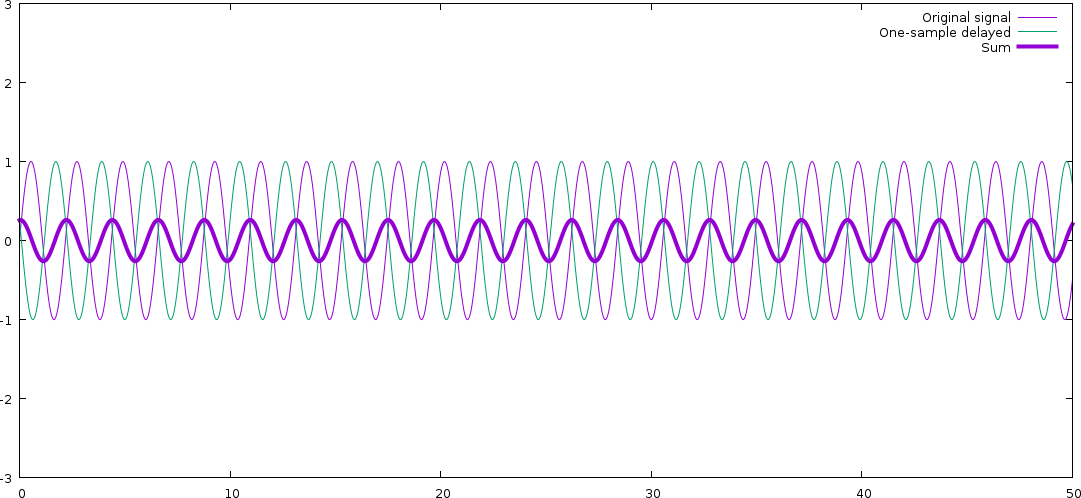
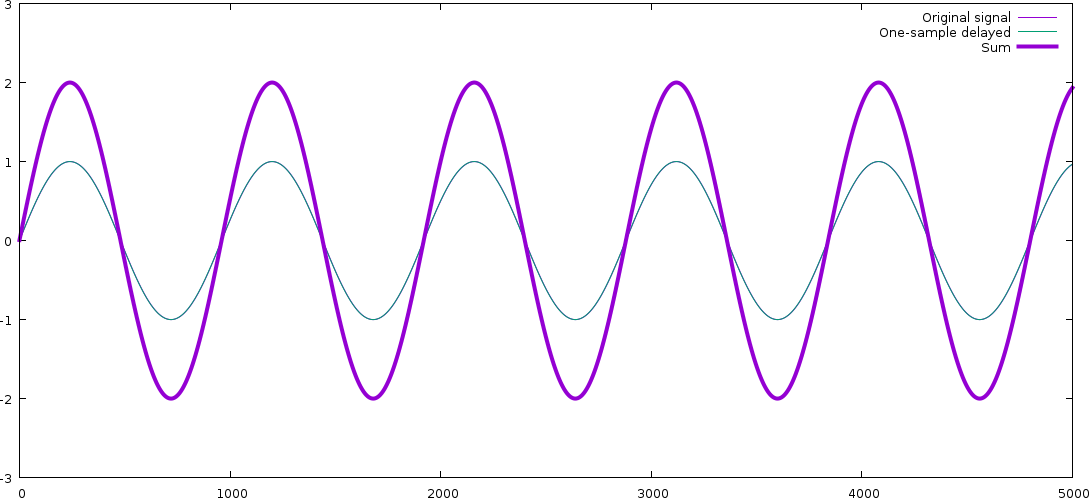
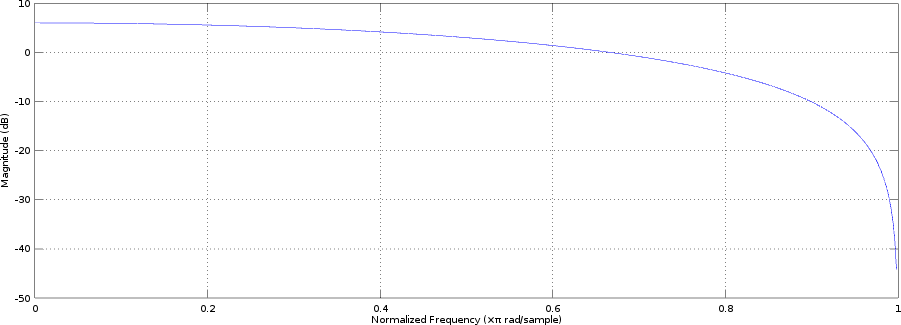
At some point back when the dinosaurs roamed the Earth and I was in high school, I borrowed my first digital signal processing book from a friend. I later went on to an engineering education and master's thesis about DSP, but the very basics of DSP never stop to fascinate me. Today, I wanted to write something about one of them and how it affects audio processing in Nageru (and finally, how Debian's policies put me in a bit of a bind on this issue). DSP texts tend to obscure profound truths with large amounts of maths, so I'll try to present a somewhat less general result that doesn't require going into the mathematical details. That rule is: Adding a signal to weighted, delayed copies of itself is a filtering operation. (It's simple, but ignoring it will have sinister effects, as we'll see later.) Let's see exactly what that means with a motivating example. Let's say that I have a signal where I want to get rid of (or rather, reduce) high frequencies. The simplest way I can think of is to add every neighboring sample; that is, set yn = xn + xn-1. For each sample, we add the previous sample, ie., the signal as it was one sample ago. (We ignore what happens at the edges; the common convention is to assume signals extend out to infinity with zeros.) What effect will this have? We can figure it out with some trigonometry, but let's just demonstrate it by plotting instead: We assume 48 kHz sample rate (which means that our one-sample delay is 20.83 s) and a 22 kHz note (definitely treble!), and plot the signal with one-sample delay (the x axis is sample number): Filtered 22 kHz As you can see, the resulting signal is a new signal of the same frequency (which is always true; linear filtering can never create new frequencies, just boost or dampen existing ones), but with much lower amplitude. The signal and the delayed version of it end up cancelling each other mostly out. Also note that there signal has changed phase; the resulting signal has been a bit delayed compared to the original. Now let's look at a 50 Hz signal (turn on your bass face). We need to zoom out a bit to see full 50 Hz cycles: Filtered 50 Hz The original signal and the delayed one overlap almost exactly! For a lower frequency, the one-sample delay means almost nothing (since the waveform is varying so slowly), and thus, in this case, the resulting signal is amplified, not dampened. (The signal has changed phase here, too actually exactly as much in terms of real time but we don't really see it, because we've zoomed out.) Real signals are not pure sines, but they can be seen as sums of many sines (another fundamental DSP result), and since filtering is a linear operation, it affects those sines independently. In other words, we now have a very simple filter that will amplify low frequencies and dampen high frequencies (and delay the entire signal a little bit). We can do this for all frequencies from 0 to 24000 Hz; let's ask Octave to do it for us: Frequency plot for simple filter (Of course, in a real filter, we'd probably multiply the result with 0.5 to leave the bass untouched instead of boosting it, but it doesn't really change anything. A real filter would have a lot more coefficients, though, and they wouldn't all be the same!) Let's now turn to a problem that will at first seem different: Combining audio from multiple different time sources. For instance, when mixing video, you could have input from two different cameras or sounds card and would want to combine them (say, a source playing music and then some audience sound from a camera). However, unless you are lucky enough to have a professional-grade setup where everything runs off the same clock (and separate clock source cables run to every device), they won't be in sync; sample clocks are good, but they are not perfect, and they have e.g. some temperature variance. Say we have really good clocks and they only differ by 0.01%; this means that after an hour of streaming, we have 360 ms delay, completely ruining lip sync! This means we'll need to resample at least one of the sources to match the other; that is, play one of them faster or slower than it came in originally. There are two problems here: How do you determine how much to resample the signals, and how do we resample them? The former is a difficult problem in its own right; about every algorithm not backed in solid control theory is doomed to fail in one way or another, and when they fail, it's extremely annoying to listen to. Nageru follows a 2012 paper by Fons Adriaensen; GStreamer does well, something else. It fails pretty badly in a number of cases; see e.g. this 2015 master's thesis that tries to patch it up. However, let's ignore this part of the problem for now and focus on the resampling. So let's look at the case where we've determined we have a signal and need to play it 0.01% faster (or slower); in a real situation, this number would vary a bit (clocks are not even consistently wrong). This means that at some point, we want to output sample number 3000 and that corresponds to input sample number 3000.3, ie., we need to figure out what's between two input samples. As with so many other things, there's a way to do this that's simple, obvious and wrong, namely linear interpolation. The basis of linear interpolation is to look at the two neighboring samples and weigh them according to the position we want. If we need sample 3000.3, we calculate y = 0.7 x3000 + 0.3 x3001 (don't switch the two coefficients!), or, if we want to save one multiplication and get better numerical behavior, we can use the equivalent y = x3000 + 0.3 (x3001 - x3000). And if we need sample 5000.5, we take y = 0.5 x5000 + 0.5 x5001. And after a while, we'll be back on integer samples; output sample 10001 corresponds to x10000 exactly. By now, I guess it should be obvious what's going on: We're creating a filter! Linear interpolation will inevitably result in high frequencies being dampened; and even worse, we are creating a time-varying filter, which means that the amount of dampening will vary over time. This manifests itself as a kind of high-frequency flutter , where the amount of flutter depends on the relative resampling frequencies. There's also cubic resampling (which can mean any of several different algorithms), but it only really reduces the problem, it doesn't really solve it. The proper way of interpolating depends a lot on exactly what you want (e.g., whether you intend to change the rate quickly or not); this paper lays out a bunch of them, and was the paper that originally made me understand why linear interpolation is so bad. Nageru outsources this problem to zita-resampler, again by Fons Adriaensen; it yields extremely high-quality resampling under controlled delay, through a relatively common technique known as polyphase filters. Unfortunately, doing this kind of calculations takes CPU. Not a lot of CPU, but Nageru runs in rather CPU-challenged environments (ultraportable laptops where the GPU wants most of the TDP, and the CPU has to go down to the lowest frequency), and it is moving in a direction where it needs to resample many more channels (more on the later), so every bit of CPU helps. So I coded up an SSE optimization of the inner loop for a particular common case (stereo signals) and sent it in for upstream inclusion. (It made the code 2.7 times as fast without any structural changes or reducing precision, which is pretty much what you can expect from SSE.) Unfortunately, after a productive discussion, suddenly upstream went silent. I tried pinging, pinging again, and after half a year pinging again, but to no avail. I filed the patch in Debian's BTS, but the maintainer understandably is reluctant to carry a delta against upstream. I also can't embed a copy; Debian policy would dictate that I build against the system's zita-resampler. I could work around it by rewriting zita-resampler until it looks nothing like the original, which might be a good idea anyway if I wanted to squeeze out the last drops of speed; there are AVX optimizations to be had in addition to SSE, and the structure as-is isn't ideal for SSE optimizations (although some of the changes I have in mind would have to be offset against increased L1 cache footprint, so careful benchmarking would be needed). But in a sense, it feels like just working around a policy that's there for good reason. So like I said, I'm in a bit of a bind. Maybe I should just buy a faster laptop. Oh, and how does GStreamer solve this? Well, it doesn't use linear interpolation. It does something even worse it uses nearest neighbor. Gah. Update: I was asked to clarify that this is about the audio resampling done by the GStreamer audio sink to sync signals, not in the audioresample element, which solves a related but different problem (static sample rate conversion). The audioresample element supports a number of different resampling methods; I haven't evaluated them.
Dirk Eddelbuettel: rfoaas 1.0.0

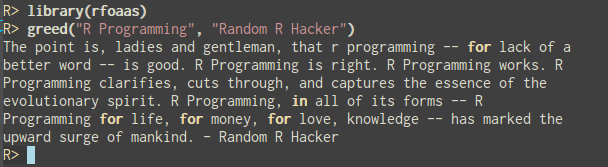
rfoaas greed example The big 1.0.0 is here! Following the unsurpassed lead of the FOAAS project, we have arrived at a milestone: Release 1.0.0 is now on CRAN. The rfoaas package provides an interface for R to the most excellent FOAAS service--which itself provides a modern, scalable and RESTful web service for the frequent need to tell someone to f$#@ off. Release 1.0.0 brings fourteen (!!) new access points: back(), bm(), gfy(), think(), keep(), single_(), look(), looking(), no(), give(), zero(), pulp(), sake(), and anyway(). All with documentation and testing. Even more neatly, thanks to a very pull request by Tyler Hunt, we can now issue random FOs via the getRandomFO() function! As usual, CRANberries provides a diff to the previous CRAN release. Questions, comments etc should go to the GitHub issue tracker. More background information is on the project page as well as on the github repo

This post by Dirk Eddelbuettel originated on his Thinking inside the box blog. Please report excessive re-aggregation in third-party for-profit settings.

12 August 2016

Markus Koschany: My Free Software Activities in July 2016

Welcome to gambaru.de. Here is my monthly report that covers what I have been doing for Debian. Debian Android Debian Games Debian Java Debian LTS This was my sixth month as a paid contributor and I have been paid to work 14,7 hours on Debian LTS. In that time I did the following: Misc and QA

11 August 2016

Matthew Garrett: Microsoft's compromised Secure Boot implementation

There's been a bunch of coverage of this attack on Microsoft's Secure Boot implementation, a lot of which has been somewhat confused or misleading. Here's my understanding of the situation.

Windows RT devices were shipped without the ability to disable Secure Boot. Secure Boot is the root of trust for Microsoft's User Mode Code Integrity (UMCI) feature, which is what restricts Windows RT devices to running applications signed by Microsoft. This restriction is somewhat inconvenient for developers, so Microsoft added support in the bootloader to disable UMCI. If you were a member of the appropriate developer program, you could give your device's unique ID to Microsoft and receive a signed blob that disabled image validation. The bootloader would execute a (Microsoft-signed) utility that verified that the blob was appropriately signed and matched the device in question, and would then insert it into an EFI Boot Services variable[1]. On reboot, the boot loader reads the blob from that variable and integrates that policy, telling later stages to disable code integrity validation.

The problem here is that the signed blob includes the entire policy, and so any policy change requires an entirely new signed blob. The Windows 10 Anniversary Update added a new feature to the boot loader, allowing it to load supplementary policies. These must also be signed, but aren't tied to a device id - the idea is that they'll be ignored unless a device-specific policy has also been loaded. This way you can get a single device-specific signed blob that allows you to set an arbitrary policy later by using a combination of supplementary policies.

This is all fine in the Anniversary Edition. Unfortunately older versions of the boot loader will happily load a supplementary policy as if it were a full policy, ignoring the fact that it doesn't include a device ID. The loaded policy replaces the built-in policy, so in the absence of a base policy a supplementary policy as simple as "Enable this feature" will effectively remove all other restrictions.

Unfortunately for Microsoft, such a supplementary policy leaked. Installing it as a base policy on pre-Anniversary Edition boot loaders will then allow you to disable all integrity verification, including in the boot loader. Which means you can ask the boot loader to chain to any other executable, in turn allowing you to boot a compromised copy of any operating system you want (not just Windows).

This does require you to be able to install the policy, though. The PoC released includes a signed copy of SecureBootDebug.efi for ARM, which is sufficient to install the policy on ARM systems. There doesn't (yet) appear to be a public equivalent for x86, which means it's not (yet) practical for arbitrary attackers to subvert the Secure Boot process on x86. I've been doing my testing on a setup where I've manually installed the policy, which isn't practical in an automated way.

How can this be prevented? Installing the policy requires the ability to run code in the firmware environment, and by default the boot loader will only load signed images. The number of signed applications that will copy the policy to the Boot Services variable is presumably limited, so if the Windows boot loader supported blacklisting second-stage bootloaders Microsoft could simply blacklist all policy installers that permit installation of a supplementary policy as a primary policy. If that's not possible, they'll have to blacklist of the vulnerable boot loaders themselves. That would mean all pre-Anniversary Edition install media would stop working, including recovery and deployment images. That's, well, a problem. Things are much easier if the first case is true.

Thankfully, if you're not running Windows this doesn't have to be a issue. There are two commonly used Microsoft Secure Boot keys. The first is the one used to sign all third party code, including drivers in option ROMs and non-Windows operating systems. The second is used purely to sign Windows. If you delete the second from your system, Windows boot loaders (including all the vulnerable ones) will be rejected by your firmware, but non-Windows operating systems will still work fine.

From what we know so far, this isn't an absolute disaster. The ARM policy installer requires user intervention, so if the x86 one is similar it'd be difficult to use this as an automated attack vector[2]. If Microsoft are able to blacklist the policy installers without blacklisting the boot loader, it's also going to be minimally annoying. But if it's possible to install a policy without triggering any boot loader blacklists, this could end up being embarrassing.

Even outside the immediate harm, this is an interesting vulnerability. Presumably when the older boot loaders were written, Microsoft policy was that they would never sign policy files that didn't include a device ID. That policy changed when support for supplemental policies was added. without this policy change, the older boot loaders could still be considered secure. Adding new features can break old assumptions, and your design needs to take that into account.

[1] EFI variables come in two main forms - those accessible at runtime (Runtime Services variables) and those only accessible in the early boot environment (Boot Services variables). Boot Services variables can only be accessed before ExitBootServices() is called, and in Secure Boot environments all code executing before this point is (theoretically) signed. This means that Boot Services variables are nominally tamper-resistant.

[2] Shim has explicit support for allowing a physically present machine owner to disable signature validation - this is basically equivalent

comment count unavailable comments

9 August 2016

Reproducible builds folks: Finishing the final variations for reprotest

Author: ceridwen I've been working on getting the last of the variations working. With no responses on the mailing list from anyone outside Debian and with limited time remaining, with Lunar I've decided to deemphasize it.
  1. Build path is done.
  2. Host and domain name use domainname and hostname. This site is old, but it indicates that domainname was available on most OSes and hostname was available everywhere as of 2004. Prebuilder uses a Linux-specific utility (unshare --uts) to run this variation in a chroot, but I'm not doing this for reprotest: if you want this variation, use qemu.
  3. User/group will not be portable, because they'll rely on useradd/groupadd and su. useradd and groupadd work on many but not all OSes, notably not including FreeBSD or MacOS X. su was universal in 2004.
  4. Time is not done but will probably be portable to some systems, because it will rely on date -s. Unfortunately, I haven't been able to find any information on how common date -s is across Unix-like OSes, as the -s option is not part of the POSIX standard.
  5. At the moment, I have no idea how to implement changes for /bin/sh and the login shell that will even work across different distributions of Linux, much less different OSes. There are a couple of key problems, starting with the need to find two different shells to use, because there's no way to find out what shells are installed. This blog post explains why /etc/shells doesn't work well for finding what shells are available: not everything in /etc/shells is necessarily a shell (Ubuntu has /usr/bin/screen) and not all available shells are in /etc/shells. Also, there's no good way to find out what shell is the system default because /bin/sh can be an arbitrary binary, not a symlink,and no good way to identify what it is if it is a binary. I can hard-code shell choices, but which shells? bash is obvious for Linux, but what's the best second choice?
On other topics:
  1. reprotest fails to build properly on jessie: Lunar said, and I agree, that fixing this is not a priority. I need someone with more knowledge of Debian Python packaging to help me. If I'm going to support old versions, I also need some kind of CI server, because I don't have the time or ability to maintain old versions of Debian and Python myself.
  2. libc-bin: ldconfig segfaults when run using "setarch uname26": I don't have a good solution for this, but I don't want to hard-code and maintain an architecture-specific disable. Would changing the argument to setarch work around the segfault? Is there a way to test for the presence of the bug that won't cause a segfault or similar crash?
  3. Please put adt-virt-* binaries back onto PATH: reprotest is not affected by this change because I forked the autopkgtest code rather than depending on it, so that reprotest can be installed through PyPi. At the moment, reprotest doesn't make its versions of the programs in virt/ available on $PATH. This is primarily because of the problems with distributing command-line scripts with setuptools. The approach I'm currently using, including the virt/ programs as non-code data with include reprotest/virt/* in MANIFEST.in, doesn't install them to make them available for other programs. Using one of the other approaches potentially could, but it's difficult to make the imports work with those approaches. (I haven't found a way to do it.) I think the best solution to this approach is to split autopkgtest into the Debian-specific components and the general-purpose virtualization components, but I don't have the time to do this myself or to negotiate with Martin Pitt, if he'd even be receptive. I'm also unsure at this point if it wouldn't be better for reprotest to switch from autopkgtest to using something like Ansible to run the virtualization, because Ansible has some solved some of the portability problems already and is not tied to Debian.
My goal is to finish the variations (finally), though as this has always proved more difficult than I expected in the past, I don't make any guarantees. Beyond that, I want to start working on finishing docstrings in the reprotest-specific (i.e., not inherited from autopkgtest) code, improving the documentation in general, and improving the tests.

Shirish Agarwal: Doha and the Supreme Court of DFSG Free

Hi, I am in two minds of what to write about Doha. My job has been vastly simplified by a friend when he shared with me https://www.youtube.com/watch?v=LdrAd-44LW0 . That video is more relevant and more closer to the truth than whatever I can share. As can be seen it is funny but more sad the way Qatarians are trying to figure out how things will be and as can be seen it seems to heading towards a real estate bubble . They would have to let go of the Sharia if they are thinking of wealthy westerners coming to stay put. I am just sad to know that many of my country-men are stuck there and although I hope the best for them, I dread it may turn out the way it has turned out for many people of Indians, and especially from Kerala in Saudi Arabia. I would touch about the Kerala situation probably in another blog post as this time is exclusively for legal aspects which were discussed in Debconf. A bit of backgrounder here, one part of my family is lawyers which means I have somewhat notion of law as practiced in our land. As probably everybody knows, India was ruled by the British for around 150 odd years. One of the things that they gave while leaving was/is the IPC (Indian Penal Code) and is practiced with the common law concept. The concept means precedence of any judgement goes quite some way in framing rulings and law of the land as time goes on besides the lobbying and the politics which happens in any democracy. Free software would not have been there without the GPL The General Public License. And the license is as much a legal document as it s something that the developers can work without becoming deranged, as it is one of the more simpler licenses to work with. My own understanding of the legal, ethical and moral issues around me were framed by two-three different TV shows, books (fiction and non-fiction alike) apart from what little news I heard in family. One was M*A*S*H* (with Alan Alda and his frailness, anarchism, humanism, civil rights), the Practise and Boston Legal which does lay bare the many grey areas that lawyers have to deal with ( The Practice also influenced a lot of civil rights understanding and First amendment, but as it is a TV show, how much of it is actually practiced for lawyers and how much moral dilemma they are can only be guessed at.) . In books it is artists like John Grisham, Michael Connelly as well as Perry Mason Agatha Christie. In non-fiction look at the treasures under bombayhighcourt e-books corner and series of Hamlyn Lectures. I would have to warn that all of the above are major time-sinks but rewarding in their own way. Also haven t read all of them as time and interests are constrained but do know they are good for understanding bit of our history. I do crave for a meetup kind of scenario when non-lawyers can read and discuss about facets of law . All that understanding was vastly amplified by Groklaw.net which made non-lawyers at the very least be able to decipher and understand what is going on in the free software world. After PJ (Pamela Jones) closed it in 2013 due to total surveillance by the Free World (i.e. the United States of America, NSA) we have been thirsty. We do get occasionally somewhat mildly interesting articles in lwn.net or arstechnica.net but nowhere the sheer brilliance of groklaw. So, it was a sheer stroke of luck that I met Mr. Bradley M. Kuhn who works with Karen Sandler on Software Conservancy. While I wanted to be there for his presentation, it was just one of those days which doesn t go as planned. However, as we met socially and over e-mail there were two basic questions which I asked him which also imbibes why we need to fight for software freedom in the court of law. Below is a re-wording of what he shared . Q1. why do people think that GPL still needs to be challenged in the court of law while there are gpl-violations which has been more or less successfully defended in the court of law ? Bradley Kuhn the GPL violations is basically a violation of one or more clauses of the GPL license and not the GPL license as a whole and my effort during my lifetime would be to make/have such precedents that the GPL is held as a valid license in the court of law. Q2. Let s say IF GPL is held to be valid in the court of law, would FSF benefit monetarily, at least to my mind it might be so, as more people and comapnies could be convinced to use strong copyleft licenses such as GPLv3 or AGPLv3 . Bradley Kuhn It may or may not. It is possible that even after winning, that people and especially companies may go for weak copyleft licenses if it suits them. The only benefit would probably would be to those people who are already using GPLv3 as the law could be used to protect them as well. Although we would want and welcome companies who would use strong copyleft license such as the GPL, the future is in future and hence uncertain. Both possibilities co-exist. While Bradley didn t say it, I would add further here it probably would mean also moving from being a more offensive mode (which GPL-violations is based upon where a violation occurs and somebody either from the victim s side or a by-stander notices the violation, brings it to the notice of the victim and the GPL-volations team.) to perhaps it being defended by the DMCA people themselves, once GPL is held as a valid license in the eyes of law. Although should you use the DMCA or not is a matter of choice, personal belief system as well as your legal recourses. I have to share that the FSF and the GPL-violations team are probably very discerning when they take up the fight as most of the work done by them is pro-bono (i.e. they don t make a single penny/paisa from the work done therein.) and hence in view of scarce resources, it makes sense to go only for the biggest violators in the hopes that you can either make them agree to compensate and agree to the terms of license of any software/hardware combination or sue them and take a bigger share of the reward/compensation awarded by the Court to help the defendant and maybe some of the proceeds donated by the defendant and people like you and me to make sure that Conservancy and the GPL-violations team is still around to help the next time something similar happens.
Bradley Kuhn presenting at #Debconf 16

Bradley Kuhn presenting at #Debconf 16

Now, as far as his presentation is concerned, whose video can be seen at http://meetings-archive.debian.net/pub/debian-meetings/2016/debconf16/The_Supreme_Court_of_DFSGFree.webm , I thought it was tame. While he talked about gaming the system in some sense, he was sharing that the system debian-legal works (most-of-the-time). The list actually works because many far more brilliant people than me take time to understand the intricacies of various licenses and how they should be interpreted through the excellently written Debian Free Software Guidelines and whether the license under discussion contravenes the DFSG or is part of it. I do agree with his point though that the ftp-master/s and the team may not be the right person to judge the license in adherence to the DFSG, or her/is not giving a reason for rejecting a package to not entering into the package archive. I actually asked the same question on debian-legal and while I had guessed, it seems there is enough review of the licenses per-se as answer from Paul Wise shows. Charles Pessley also shared an idea he has documented which probably didn t get much traction as involves more work on DD s without any benefit to show for it. All in all I hope it sheds some light on why there is need to be more aware of law in software freedom. Two Organizations which work on software freedom from legal standpoint are SFLC (Delhi) headed by the charming Mr. Eben Moglen and ALF (Bangalore). I do hope more people, especially developers take a bit more interest in some of the resources mentioned above.
Filed under: Miscellenous Tagged: #Alternative Law Forum, #bombayhighcourt e-library, #Common Law, #Debconf16, #Fiction, #Hewlyn lectures, #India, #Jurispudence, #legal fiction, #real estate bubble, #SFLC.in, #Software Freedom, #timesink, Doha, Law

7 August 2016

Dirk Eddelbuettel: drat 0.1.1: Updates schmupdates!

One year ago (tomorrow) drat 0.1.0 was released. It held up rather well, but a number of small fixes and enhancements piled up, along with somewhat-finished to still-raw additions to the examples/ sections. With that, we are happy to announce drat release 0.1.1 which arrived on CRAN earlier today. drat stands for drat R Archive Template, and helps with easy-to-create and easy-to-use repositories for R packages. Since its inception in early 2015 it has found reasonably widespread adoption among R users because repositories is what we use. In other words, friends don't let friends use install_github(). Just kidding. Maybe. Or not. This version 0.1.1 builds on the previous release from one year ago. Several users sent in nicely focused pull request, and I added a bit of spit and polish here and there. The NEWS file (added belatedly in this release) summarises the release as follows:
Changes in drat version 0.1.1 (2016-08-07)
  • Changes in drat functionality
    • Use dir.exists, leading to versioned Depends on R (>= 3.2.0)
    • Optionally pull remote before insert (Mark in PR #38)
    • Fix support for dots (Jan G. in PR #40)
    • Accept dots in package names (Antonio in PR #48)
    • Switch to htpps URLs at GitHub (Colin in PR #50)
    • Support additional fields in PACKAGE file (Jan G. in PR #54)
  • Changes in drat documentation
    • Further improvements and clarifications to vignettes
    • Travis script switched to run.sh from our fork
    • This NEWS file was (belatedly) added
Courtesy of CRANberries, there is a comparison to the previous release. More detailed information is on the drat page.

This post by Dirk Eddelbuettel originated on his Thinking inside the box blog. Please report excessive re-aggregation in third-party for-profit settings.

Dirk Eddelbuettel: littler 0.3.1

max-heap image The second release of littler as a CRAN package is now available, following in the now more than ten-year history as a package started by Jeff in the summer of 2006, and joined by me a few weeks later. littler is the first command-line interface for R and predates Rscript. It is still faster, and in my very biased eyes better as it allows for piping as well shebang scripting via #!, uses command-line arguments more consistently and still starts faster. It prefers to live on Linux and Unix, has its difficulties on the OS X due yet-another-braindeadedness there (who ever thought case-insensitive filesystems where a good idea?) and simply does not exist on Windows (yet -- the build system could be extended -- see RInside for an existence proof, and volunteers welcome!). This release brings us fixes and enhancements from three other contributors, a couple new example scripts, more robust builds, extended documentation and more -- see below for details. The NEWS file entry is below.
Changes in littler version 0.3.1 (2016-08-06)
  • Changes in examples
    • install2.r now passes on extra options past -- to R CMD INSTALL (PR #37 by Steven Pav)
    • Added rcc.r to run rcmdcheck::rcmdcheck()
    • Added (still simple) render.r to render (R)markdown
    • Several examples now support the -x or --usage flag to show extended help.
  • Changes in build system
    • The AM_LDFLAGS variable is now set and used too (PR #38 by Mattias Ellert)
    • Three more directories, used when an explicit installation directory is set, are excluded (also #38 by Mattias)
    • Travis CI is now driven via run.sh from our fork, and deploys all packages as .deb binaries using our PPA where needed
  • Changes in package
    • SystemRequirements now mentions the need for libR, i.e. an R built with a shared library so that we can embed R.
    • The docopt and rcmdcheck packages are now suggested, and added to the Travis installation.
    • A new helper function r() is now provided and exported so that the package can be imported (closes #40).
    • URL and BugReports links were added to DESCRIPTION.
  • Changes in documentation
    • The help output for installGithub.r was corrected (PR #39 by Brandon Bertelsen)
Full details for the littler release are provided as usual at the ChangeLog page. The code is available via the GitHub repo, from tarballs off my littler page and the local directory here -- and now of course all from its CRAN page and via install.packages("littler"). Binary packages are available directly in Debian as well as soon via Ubuntu binaries at CRAN thanks to the tireless Michael Rutter. will probably have new Comments and suggestions are welcome at the GitHub repo.

This post by Dirk Eddelbuettel originated on his Thinking inside the box blog. Please report excessive re-aggregation in third-party for-profit settings.

6 August 2016

Dirk Eddelbuettel: RcppStreams 0.1.1

Streamulus A maintenance release of RcppStreams is now on CRAN. RcppStreams brings the excellent Streamulus C++ template library for event stream processing to R. Streamulus, written by Irit Katriel, uses very clever template meta-programming (via Boost Fusion) to implement an embedded domain-specific event language created specifically for event stream processing. This release updates the compilation standard to C++11 per CRAN's request as this helps with both current and upcoming compiler variants. A few edits were made to DESCRIPTION and README.md, the Travis driver file was updated, but no new code was added. The NEWS file entries follows below:
Changes in version 0.1.1 (2016-08-05)
  • Compilation is now done using C++11 standards per request of CRAN to help with an array of newer (pre-release) and older compilers
  • The Travis CI script was updated to use run.sh from our fork; it now also installs all dependencies as binary .deb files.
  • The README.md was updated with additional badges.
  • The DESCRIPTION file now has URL and BugReports entries.
Courtesy of CRANberries, there is also a copy of the DESCRIPTION file for this initial release. More detailed information is on the RcppStreams page page and of course on the Streamulus page.

This post by Dirk Eddelbuettel originated on his Thinking inside the box blog. Please report excessive re-aggregation in third-party for-profit settings.

3 August 2016

Elena 'valhalla' Grandi: The Cat Model of Package Ownership

The Cat Model of Package Ownership

Debian has been moving away from strong ownership of packages by package maintainers and towards encouraging group maintainership, for very good reasons: single maintainers have a bad bus factor and a number of other disadvantages.

When single maintainership is changed into maintainership by a small , open group of people who can easily communicate and sync with each other, everything is just better: there is an easy way to gradually replace people who want to leave, but there is also no duplication of efforts (because communication is easy), there are means to always have somebody available for emergency work and generally package quality can only gain from it.

Unfortunately, having such group of maintainers for every package would require more people than are available and willing to work on it, and while I think it's worth doing efforts to have big and important packages managed that way, it may not be so for the myriad of small ones that make up the long tail of a distribution.

Many of those packages may end up being maintained in a big team such as the language-based ones, which is probably better than remaining with a single maintainer, but can lead to some problems.

My experience with the old OpenEmbedded, back when it was still using monotone instead of git and everybody was maintaining everything, however, leads me to think that this model has a big danger of turning into nobody maintains anything, because when something needs to be done everybody is thinking that somebody else will do it.

As a way to prevent that, I have been thinking in the general direction of a Cat Model of Package Ownership, which may or may not be a way to prevent some risks of both personal maintainership and big teams.

The basic idea is that the my in my packages is not the my in my toys , but the my in my Cat, to whom I am a servant .

As in the case of a cat, if my package needs a visit to the vet, it's my duty to do so. Other people may point me to the need of such a visit, e.g. by telling me that they have seen the cat leaving unhealty stools, that there is a bug in the package, or even that upstream released a new version a week ago, did you notice?, but the actual putting the package in a cat carrier and bringing it to the vet falls on me.

Whether you're allowed to play with or pet the cat is her decision, not mine, and giving her food or doing changes to the package is usually fine, but please ask first: a few cats have medical issues that require a special diet.

And like cats, sometimes the cat may decide that I'm not doing a good enough job of serving her, and move away to another maintainer; just remember that there is a difference between a lost cat who wants to go back to her old home and a cat that is looking for a new one. When in doubt, packages usually wear a collar with contact informations, trying to ping those is probably a good idea.

This is mostly a summer afternoon idea and will probably require some refinement, but I think that the basic idea can have some value. Comments are appreciated on the federated social networks where this post is being published, via email (valid addresses are on my website http://www.trueelena.org/computers/articles/the_cat_model_of_package_ownership.html and on my GPG key http://www.trueelena.org/about/gpg.html) or with a post on a blog that appears on planet debian http://planet.debian.org/.

how small is small depends a lot on the size of the package, the amount of work it requires, how easy it is to parallelize it and how good are the people involved at communicating, so it would be quite hard to put a precise number here.

I've moved away from it because the boards I was using could run plain Debian, but I've heard that after the move to git there have been a number of workflow changes (of which I've seen the start) and everything now works much better.

Next.

Previous.