Search Results: "ema"

31 January 2017

Enrico Zini: Links for February 2017

On Progress and Historical Change [archive]
Is progress inevitable? Is it natural? Is it fragile? Is it possible? Is it a problematic concept in the first place? Many people are reexamining these kinds of questions as 2016 draws to a close, so I thought this would be a good moment to share the sort-of zoomed out discussions the subject that historians like myself are always having.
A projection of the ISS live feed as a night light [archive]
I always wanted the ISS live feed as a "night light" / ambiance to fall asleep to on my ceiling how to build a "night light" that is actually a small video projector projecting the ISS live feed
Vatican Climate Forest [archive]
The Vatican Climate Forest, to be located in the B kk National Park, Hungary, was donated to the Vatican City by a carbon offsetting company. The forest is to be sized to offset the carbon emissions generated by the Vatican during 2007. The Vatican's acceptance of the offer, at a ceremony on July 5, 2007, was reported as being "purely symbolic", and a way to encourage Catholics to do more to safeguard the planet. No trees have been planted under the project and the carbon offsets have not materialised. I'm fascinated by how purely symbolic "purely symbolic" can be.

Raphaël Hertzog: My Free Software Activities in January 2017

My monthly report covers a large part of what I have been doing in the free software world. I write it for my donors (thanks to them!) but also for the wider Debian community because it can give ideas to newcomers and it s one of the best ways to find volunteers to work with me on projects that matter to me. Debian LTS I was allocated 10 hours to work on security updates for Debian 7 Wheezy. During this time I did the following: Debian packaging With the deep freeze approaching, I made some last-minute updates: Misc work Sponsorship. I sponsored a new asciidoc upload demoting a dependency into a recommends (#850301). I sponsored a new upstream version of dolibarr. Discussions. I seconded quite a few changes prepared by Russ Allbery on debian-policy. I helped Scott Kitterman with #849584 about a misunderstanding of how the postfix service files are supposed to work. I discussed in #849913 about a regression in building of cross-compilers, and made a patch to avoid the problem. In the end, Guillem developed a better fix. Bugs. I investigated #850236 where a django test failed during the first week after each leap year. I filed #853224 on desktop-base about multiple small problems in the maintainer scripts. Thanks See you next month for a new summary of my activities.

No comment Liked this article? Click here. My blog is Flattr-enabled.

Benjamin Mako Hill: Supporting children in doing data science

As children use digital media to learn and socialize, others are collecting and analyzing data about these activities. In school and at play, these children find that they are the subjects of data science. As believers in the power of data analysis, we believe that this approach falls short of data science s potential to promote innovation, learning, and power. Motivated by this fact, we have been working over the last three years as part of a team at the MIT Media Lab and the University of Washington to design and build a system that attempts to support an alternative vision: children as data scientists. The system we have built is described in a new paper Scratch Community Blocks: Supporting Children as Data Scientists that will be published in the proceedings of CHI 2017. Our system is built on top of Scratch, a visual, block-based programming language designed for children and youth. Scratch is also an online community with over 15 million registered members who share their Scratch projects, remix each others work, have conversations, provide feedback, bookmark or love projects they like, follow other users, and more. Over the last decade, researchers including us have used the Scratch online community s database to study the youth using Scratch. With Scratch Community Blocks, we attempt to put the power to programmatically analyze these data into the hands of the users themselves. To do so, our new system adds a set of new programming primitives (blocks) to Scratch so that users can access public data from the Scratch website from inside Scratch. Blocks in the new system gives users access to project and user metadata, information about social interaction, and data about what types of code are used in projects. The full palette of blocks to access different categories of data is shown below.

Project metadata
User metadata
Site-wide statistics
The new blocks allow users to programmatically access, filter, and analyze data about their own participation in the community. For example, with the simple script below, we can find whether we have followers in Scratch who report themselves to be from Spain, and what their usernames are.
Simple demonstration of Scratch Community Blocks
In designing the system, we had two primary motivations. First, we wanted to support avenues through which children can engage in curiosity-driven, creative explorations of public Scratch data. Second, we wanted to foster self-reflection with data. As children looked back upon their own participation and coding activity in Scratch through the project they and their peers made, we wanted them to reflect on their own behavior and learning in ways that shaped their future behavior and promoted exploration. After designing and building the system over 2014 and 2015, we invited a group of active Scratch users to beta test the system in early 2016. Over four months, 700 users created more than 1,600 projects. The diversity and depth of users creativity with the new blocks surprised us. Children created projects that gave the viewer of the project a personalized doughnut-chart visualization of their coding vocabulary on Scratch, rendered the viewer s number of followers as scoops of ice-cream on a cone, attempted to find whether love-its for projects are more common on Scratch than favorites , and told users how talkative they were by counting the cumulative string-length of project titles and descriptions. We found that children, rather than making canonical visualizations such as pie-charts or bar-graphs, frequently made information representations that spoke to their own identities and aesthetic sensibilities. A 13-year-old girl had made a virtual doll dress-up game where the player s ability to buy virtual clothes and accessories for the doll was determined by the level of their activity in the Scratch community. When we asked about her motivation for making such a project, she said:
I was trying to think of something that somebody hadn t done yet, and I didn t see that. And also I really like to do art on Scratch and that was a good opportunity to use that and mix the two [art and data] together.
We also found at least some evidence that the system supported self-reflection with data. For example, after seeing a project that showed its viewers a visualization of their past coding vocabulary, a 15-year-old realized that he does not do much programming with the pen-related primitives in Scratch, and wrote in a comment, epic! looks like we need to use more pen blocks. :D.
Doughnut visualization
Ice-cream visualization
Data-driven doll dress up
Additionally, we noted that that as children made and interacted with projects made with Scratch Community Blocks, they started to critically think about the implications of data collection and analysis. These conversations are the subject of another paper (also being published in CHI 2017). In a 1971 article called Teaching Children to be Mathematicians vs. Teaching About Mathematics , Seymour Papert argued for the need for children doing mathematics vs. learning about it. He showed how Logo, the programming language he was developing at that time with his colleagues, could offer children a space to use and engage with mathematical ideas in creative and personally motivated ways. This, he argued, enabled children to go beyond knowing about mathematics to doing mathematics, as a mathematician would. Scratch Community Blocks has not yet been launched for all Scratch users and has several important limitations we discuss in the paper. That said, we feel that the projects created by children in our the beta test demonstrate the real potential for children to do data science, and not just know about it, provide data for it, and to have their behavior nudged and shaped by it.
This blog post and the paper it describes are collaborative work with Sayamindu Dasgupta. We have also received support and feedback from members of the Scratch team at MIT (especially Mitch Resnick and Natalie Rusk), as well as from Hal Abelson. Financial support came from the US National Science Foundation. The paper itself is open access so anyone can read the entire paper here. This blog post was also posted on Sayamindu Dasgupta s blog, on the Community Data Science Collective blog, and in several other places.

Reproducible builds folks: Reproducible Builds: week 92 in Stretch cycle

Here's what happened in the Reproducible Builds effort between Sunday January 22 and Saturday January 28 2017: Media coverage Upcoming Events Reproducible work in other projects John Gilmore wrote an interesting mail about how Cygnus.com worked on reproducible builds in the early 1990s. It's eye opening to see how the dealt with basically the very same problems we're dealing with today, how they solved them and then to realize that most of this has been forgotten and bit-rotted in the last 20 years. How will we prevent history repeating itself here? Toolchain development and fixes Christoph Biedl wrote a mail describing an interesting problem in to the way binNMUs are done in Debian. Guillem Jover made a number of changes to dpkg that affect the Reproducible Builds effort within Debian: Packages reviewed and fixed, and bugs filed Chris Lamb: Dhole: Reviews of unreproducible packages 17 package reviews have been added, 4 have been updated and 6 have been removed in this week, adding to our knowledge about identified issues. 2 issue types have been added: 1 issue type has been removed: Weekly QA work During our reproducibility testing, the following FTBFS bugs have been detected and reported by: diffoscope development reprotest development buildinfo.debian.net development tests.reproducible-builds.org Misc. This week's edition was written by Chris Lamb and Holger Levsen & reviewed by a bunch of Reproducible Builds folks on IRC & the mailing lists.

30 January 2017

Shirish Agarwal: Different strokes

Delhi Metro - courtesy wikipedia.org Statutory warning It s a long read. I start by sharing I regret, I did not hold onto the Budget and Economics 101 blog post for one more day. I had been holding/thinking on to it for almost couple of weeks before posting, if I had just waited a day more, I would have been able to share an Indian Express story . While I thought that the work for the budget starts around 3 months before the budget, I came to learn from that article that it takes 6 months. As can be seen in the article, it is somewhat of a wasted opportunity, part of it probably due to the Government (irrespective of any political party, dynasty etc.) mismanagement. What has not been stated in the article is what I had shared earlier, reading between the lines, it seems that the Government isn t able to trust what it hears from its advisers and man on the street. Unlike Chanakya and many wise people before him who are credited with advising about good governance, that a good king is one who goes out in disguise, learns how his/er subjects are surviving, seeing what ills them and taking or even not taking corrective steps after seeing the problem from various angles. Of course it s easier said then done, though lot of Indian kings did try and ran successful provinces. There were also some who were more interested in gambling, women and threw/frittered away their kingdoms. The 6-month things while not being said in the Express article is probably more about checking and re-checking figures and sources to make sure they are able to read whatever pattern the various Big Businesses, Industry, Social Welfare schemes and people are saying I guess. And unless mass digitalization as well as overhaul of procedures, Right to Information (RTI) happens, don t see any improvement in the way the information is collected, interpreted and shared with the public at large. It would also require people who are able to figure out how things work sharing the inferences (right or wrong) through various media so there is discussion about figures and policy-making. Such researchers and their findings are sadly missing in Indian public discourses and only found in glossy coffee table books :(. One of the most basic question for instance is, How much of any policy should be based on facts and figures and how much giving fillip to products and services needed in short to medium term ? Also how much morality should play a part in Public Policy ? Surprisingly, or probably not, most Indian budgets are populist by nature with some scientific basis but most of the times there is no dialog about how the FM came to some conclusion or Policy-making. I am guessing a huge part of that has also to do with basic illiteracy as well as Economic and Financial Illiteracy. Just to share a well-known world-over example, one of the policies where the Government of India has been somewhat lethargic is wired broadband penetration. As have shared umpteen times, while superficially broadband penetration is happening, most of the penetration is the unreliable and more expensive mobile broadband penetration. While this may come as a shock to many of the users of technology, BSNL, a Government company who provides broadband for almost 70-80% of the ADSL wired broadband subscribers gives 50:1 contention ratio to its customers. One can now understand the pathetic speeds along with very old copper wiring (20 odd years) on which the network is running. The idea/idiom of running network using duct-tape seems pretty apt in here  Now, the Government couple of years ago introduced FFTH Fiber-to-the-home but because the charges are so high, it s not going anywhere. The Government could say 10% discount in your Income Tax rates if you get FFTH. This would force people to get FFTH and would also force BSNL to clean up its act. It has been documented that a percentage increase in broadband equals a similar percentage rise in GDP. Having higher speeds of broadband would mean better quality of streaming video as well as all sorts of remote teaching and sharing of ideas which will give a lot of fillip to all sorts of IT peripherals in short, medium and long-term as well. Not to mention, all the software that will be invented/coded to take benefit of all that speed. Although, realistically speaking I am cynical that the Government would bring something like this  Moving on Behind a truck - Courtesy TheEconomist.com Another interesting story which I had shared was a bit about World History Now the Economist sort of confirmed how things are in Pakistan. What is and was interesting that the article is made by a politically left-leaning magazine which is for globalization, business among other things . So, there seem to be only three options, either I and the magazine are correct or we both are reading it wrong. The third and last option is that the United States realize that Pakistan can no longer be trusted as Pakistan is siding more and more with Chinese and Russians, hence the article. Atlhough it seems a somewhat far-fetched idea as I don t see the magazine getting any brownie points with President Trump. Unless, The Economist becomes more hawkish, more right-wingish due to the new establishment. I can t claim to have any major political understanding or expertise but it does seem that Pakistan is losing friends. Even UAE have been cautiously building bridges with us. Now how this will play out in the medium to long-term depends much on the personal equations of the two heads of state, happenings in geopolitics around the world and the two countries, decisions they take, it is a welcome opportunity as far they (the Saudis) have funds they want to invest and India can use those investments to make new infrastructure. Now, I need a bit of help of Java and VCS (Version control system) experts . There is a small game project called Mars-Sim. I asked probably a few more questions than I should have and the result was that I was made a member of the game team even though I had shared with them that I m a non-coder. I think such a game is important as it s foss. Both the game itself is foss as well as its build-tools with a basic wiki. Such a game would be useful not only to Debian but all free software distributions. Journeying into the game Unfortunately, the game as it is currently, doesn t work with openjdk8 but private conversations with the devs. have shared they will work on getting it to work on OpenJDK 9 which though is sometime away. Now as it is a game, I knew it would have multiple multimedia assets. It took me quite sometime to figure out where most of the multimedia assets are. I was shocked to find that there aren t any tool/s in Debian as well a GNU/Linux to know about types of content is there inside a directory and its sub-directories. I framed it in a query and found a script as an answer . I renamed the script to file-extension-information.sh (for lack of imagination of better name). After that, I downloaded a snapshot of the head of the project from https://sourceforge.net/p/mars-sim/code/HEAD/tree/ where it shows a link to download the snapshot. https://sourceforge.net/code-snapshots/svn/m/ma/mars-sim/code/mars-sim-code-3847-trunk.zip unzipped it and then ran the script on it [$] bash file-extension-information.sh mars-sim-code-3846-trunk
theme: 1770
dtd: 31915
py: 10815
project: 5627
JPG: 762476
fxml: 59490
vm: 876
dat: 15841044
java: 13052271
store: 1343
gitignore: 8
jpg: 3473416
md: 5156
lua: 57
gz: 1447
desktop: 281
wav: 83278
1: 2340
css: 323739
frag: 471
svg: 8948591
launch: 9404
index: 11520
iml: 27186
png: 3268773
json: 1217
ttf: 2861016
vert: 712
ogg: 12394801
prefs: 11541
properties: 186731
gradle: 611
classpath: 8538
pro: 687
groovy: 2711
form: 5780
txt: 50274
xml: 794365
js: 1465072
dll: 2268672
html: 1676452
gif: 38399
sum: 23040
(none): 1124
jsx: 32070
It gave me some idea of what sort of file were under the repository. I do wish the script defaulted to showing file-sizes in KB if not MB to better assess how the directory is made up but not a big loss . The above listing told me that at the very least theme, JPG, dat, wav, png, ogg and lastly gif files. For lack of better tools and to get an overview of where those multimedia assets used ncdu [shirish@debian] - [~/games/mars-sim-code-3846-trunk] - [10210]
[$] ncdu mars-sim/
--- /home/shirish/games/mars-sim-code-3846-trunk/mars-sim --------------------------------------------------------------------------------------
46.2 MiB [##########] /mars-sim-ui
15.2 MiB [### ] /mars-sim-mapdata
8.3 MiB [# ] /mars-sim-core
2.1 MiB [ ] /mars-sim-service
500.0 KiB [ ] /mars-sim-main
188.0 KiB [ ] /mars-sim-android
72.0 KiB [ ] /mars-sim-network
16.0 KiB [ ] pom.xml
12.0 KiB [ ] /.settings
4.0 KiB [ ] mars-sim.store
4.0 KiB [ ] mars-sim.iml
4.0 KiB [ ] .project
I found that all the media is distributed randomly and posted a ticket about it. As I m not even a java newbie, could somebody look at mokun s comment and help out please ? On the same project, there has been talk of migrating to github.com Now whatever little I know of git, it makes a copy of the whole repository under .git/ folder/directory so having multimedia assets under git is a bad, bad idea, as each multimedia binary format file would be unique and no possibility of diff. between two binary files even though they may be the same file with some addition or subtraction from earlier version. I did file a question but am unhappy with the answers given. Can anybody give some definitive answers if they have been able to do how I am proposing , if yes, how did they go about it ? And lastly Immigrants of the United States in 2000 by country of birth America was founded by immigrants. Everybody knows the story about American Indians, the originals of the land were over-powered by the European settlers. So any claim, then and now that immigration did not help United States is just a lie. This came due to a conversation on #debconf by andrewsh
[18:37:06] I d be more than happy myself to apply for an US tourist not transit visa when I really need it, as a transit visa isn t really useful, is just as costly as a tourist visa, and nearly as difficult to get as a tourist visa
[18:37:40] I m not entirely sure I wish to transit through the US in its Trumplandia incarnation either
[18:38:07] likely to be more difficult and unfun
FWIW I am in complete agreement with Andrew s assessment of how it might be with foreigners. It has been on my mind and thoughts for quite some time although andrewsh put it eloquently. But as always I m getting ahead of myself. The conversation is because debconf this year would be in Canada. For many a cheap flight, one of the likely layovers/stopover can be the United States. I actually would have gone one step further, even if it was cheap transit visa, it would equally be unfun as it would discriminate. About couple of years back, a friend of mine while explaining what visa is, put it rather succinctly the visa officer looks at only 3 things a. Your financial position something which tells that you can take care of your financial needs if things go south b. You are not looking to settle there unlawfully c. You are not a criminal. While costs do matter, what is disturbing more is the form of extremism being displayed therein. While Indians from the South Asian continent in US have been largely successful, love to be in peace (one-off incidents do and will happen anywhere) if I had to take a transit or tourist visa in this atmosphere, it would leave a bad taste in the mouth. When one of my best friends is a Muslim, 20% of the population in India is made of Muslims and 99% of the time both of us co-exist in peace I simply can t take any alternative ideology. Even in Freakonomics 2.0 the authors when they shared that it s less than 0.1 percent of Muslims who are engaged in terrorist activities, if they were even 1 percent than all the world s armed forces couldn t fight them and couldn t keep anyone safe. Which simply means that 99.99% of even all Muslims are good. This resonates strongly with me for number of reasons. One of my uncles in early to late 80 s had an opportunity for work to visit Russia for official work. He went there and there were Secret Police after him all the time. While he didn t know it, I later read it, that it was SOP (Standard Operating Procedure) when all and any foreigners came visiting the country, and not just foreigners, they had spies for their own citizens. Russka a book I read several years ago explained the paranoia beautifully. While U.S. in those days was a more welcoming place for him. I am thankful as well as find it strange that Canada and States have such different visa procedures. While Canada would simply look at the above things, probably discreetly inquire about you if you have been a bad boy/girl in any way and then make a decision which is fine. For United States, even for a transit visa I probably would have to go to Interview where my world view would probably be in conflict with the current American world view. Interestingly, while I was looking at conversations on the web and one thing that is missing there is that nobody has talked about intelligence community. What Mr. Trump is saying in not so many words is that our intelligence even with all the e-mails we monitor and everything we do, we still can t catch you. It almost seems like giving a back-handed compliment to the extremists saying you do a better job than our intelligence community. This doesn t mean that States doesn t have interesting things to give to the world, Star Trek conventions, Grand Canyon (which probably would require me more than a month or more to explore even a little part), NASA, Intel, AMD, SpaceX, CES (when it s held) and LPC (Linux Plumber s conference where whose who come to think of roadmap for GNU/Linux). What I wouldn t give to be a fly in the wall when LPC, CES happens in the States. What I actually found very interesting is that in the current Canadian Government, if what I read and heard is true, then Justin Trudeau, the Prime Minister of Canada made 50 of his cabinet female. Just like in the article, studies even in Indian parliament have shown that when women are in power, questions about social justice, equality, common good get asked and policies made. If I do get the opportunity to be part of debconf, I would like to see, hear, watch, learn how the women cabinet is doing things. I am assuming that reporting and analysis standards of whatever decisions are more transparent and more people are engaged in the political process to know what their elected representatives are doing. Mountain biking in British Columbia, Canada - source wikipedia.org One another interesting point I came to know is that Canada is home to bicycling paths. While I stopped bicycling years ago  as it has been becoming more and more dangerous to bicycle here in Pune as there is no demarcation for cyclists, I am sure lot of Canadians must be using this opportunity fully. Lastly, on the debconf preparation stage, things have started becoming a bit more urgent and hectic. From a monthly IRC meet, it has now become a weekly meet. Both the wiki and the website are slowly taking up shape. http://deb.li/dc17kbp is a nice way to know/see progress of the activities happening . One important decision that would be taken today is where people would stay during debconf. There are options between on-site and two places around the venue, one 1.9 km around, the other 5 km. mark. Each has its own good and bad points. It would be interesting to see which place gets selected and why.
Filed under: Miscellenous Tagged: #budget, #Canada, #debconf organization, #discrimination, #Equal Opportunity, #Fiber, #svn, #United States, #Version Control, Broadband, Git, Pakistan, Subversion

Francois Marier: Creating a home music server using mpd

I recently setup a music server on my home server using the Music Player Daemon, a cross-platform free software project which has been around for a long time.

Basic setup Start by installing the server and the client package:
apt install mpd mpc
then open /etc/mpd.conf and set these:
music_directory    "/path/to/music/"
bind_to_address    "192.168.1.2"
bind_to_address    "/run/mpd/socket"
zeroconf_enabled   "yes"
password           "Password1"
before replacing the alsa output:
audio_output  
   type    "alsa"
   name    "My ALSA Device"
 
with a pulseaudio one:
audio_output  
   type    "pulse"
   name    "Pulseaudio Output"
 
In order for the automatic detection (zeroconf) of your music server to work, you need to prevent systemd from creating the network socket:
systemctl stop mpd.service
systemctl stop mpd.socket
systemctl disable mpd.socket
otherwise you'll see this in /var/log/mpd/mpd.log:
zeroconf: No global port, disabling zeroconf
Once all of that is in place, start the mpd daemon:
systemctl start mpd.service
and create an index of your music files:
MPD_HOST=Password1@/run/mpd/socket mpc update
while watching the logs to notice any files that the mpd user doesn't have access to:
tail -f /var/log/mpd/mpd.log

Enhancements I also added the following in /etc/logcheck/ignore.server.d/local-mpd to silence unnecessary log messages in logcheck emails:
^\w 3  [ :0-9] 11  [._[:alnum:]-]+ systemd\[1\]: Started Music Player Daemon.$
^\w 3  [ :0-9] 11  [._[:alnum:]-]+ systemd\[1\]: Stopped Music Player Daemon.$
^\w 3  [ :0-9] 11  [._[:alnum:]-]+ systemd\[1\]: Stopping Music Player Daemon...$
and created a cronjob in /etc/cron.d/mpd-francois to update the database daily and stop the music automatically in the evening:
# Refresh DB once a day
5 1 * * *  mpd  MPD_HOST=Password1@/run/mpd/socket /usr/bin/mpc --quiet update
# Think of the neighbours
0 22 * * 0-4  mpd  MPD_HOST=Password1@/run/mpd/socket /usr/bin/mpc --quiet stop
0 23 * * 5-6  mpd  MPD_HOST=Password1@/run/mpd/socket /usr/bin/mpc --quiet stop

Clients To let anybody on the local network connect, I opened port 6600 on the firewall (/etc/network/iptables.up.rules since I'm using Debian's iptables-apply):
-A INPUT -s 192.168.1.0/24 -p tcp --dport 6600 -j ACCEPT
Then I looked at the long list of clients on the mpd wiki.

Desktop The official website suggests two clients which are available in Debian and Ubuntu: Both of them work well, but haven't had a release since 2011, even though there is some activity in 2013 and 2015 in their respective source control repositories. Ario has a simpler user interface but gmpc has cover art download working out of the box, which is why I might stick with it. In both cases, it is possible to configure a polipo proxy so that any external resources are fetched via Tor.

Android On Android, I got these two to work: I picked M.A.L.P. since it includes a nice widget for the homescreen.

iOS On iOS, these are the most promising clients I found: since MPoD and MPaD don't appear to be available on the AppStore anymore.

29 January 2017

Reproducible builds folks: Reproducible Builds: week 91 in Stretch cycle

What happened in the Reproducible Builds effort between Sunday January 15 and Saturday January 21 2017: Media Coverage Upcoming Events Toolchain development and fixes Ximin Luo continued work on data formats, code, and test cases for SOURCE_PREFIX_MAP. He also continued to talk with the rustc team on the topic. Chris Lamb submitted a patch to implement SOURCE_DATE_EPOCH for wordwarvi, a game which gave extra points to people who built it from source within one hour. This fixes Debian #786593. Launchpad bug 1657704 was filed for them to start accepting buildinfo files. Bugs filed Reviews of unreproducible packages 10 package reviews have been added, 149 have been updated and 153 have been removed in this week, adding to our knowledge about identified issues. 2 issue types have been updated: Weekly QA work During our reproducibility testing, the following FTBFS bugs have been detected and reported by: diffoscope development diffoscope 69 was uploaded to unstable by Chris Lamb. It included contributions from: Further development continued in Git, and will be released as version 70 next week: reproducible-builds.org website development tests.reproducible-builds.org Misc. This week's edition was written by Ximin Luo, Vagrant Cascadian, Holger Levsen & Chris Lamb and reviewed by a bunch of Reproducible Builds folks on IRC & the mailing lists.

27 January 2017

Iustin Pop: Languages, part 1

Human languages, part 1 I do enjoy writing blog posts, but sometimes time is lacking, other times inspiration. As I was eating dinner today, I was lost in thoughts and my eyes stopped on the documentation from a certain medication for coughing (the thing almost noone reads, like EULAs). I was surprised quite surprised with te text that I said well, some blog posts on languages might be interesting . Background: My mother tongue is Romanian. While growing up and learning foreign languages, I considered only the utilitarian aspect of languages, but as I get older (not old, older! ), I find human languages more and more interesting. Back to the subject: this being Switzerland, most everything is written in German, French and Italian (in this order of frequency). German is still a foreign language to me (let's say I get by, but not nicely), French is the fancy high class cousin, and Italian Well Italian is a special case. When I first saw Italian on TV (a newscast while travelling in Italy) I was shocked at how much one can understand without learning Italian in any way (much, much more than German after years of trying). So Italian language is quite close, and usually one understands a third to half; this is both spoken (less in common language, more in official language) and in writing. In this particular case, the instructions of use say (sorry for typos, manually copying):
In casi rarissimi possono manifestarsi reazioni di ipersensibilit grave con tumefazione del viso, difficolt respiratoria (dispnea) e diminuzione della pressione arteriosa.
What was surprising here was not the list of side effects (hah), but that this short phrase is 98% identical to the translation in Romanian; not only words, but also phrase structure. I don't think I've ever seen this before:
n cazuri rare se pot manifesta reac ii de hipersensibilitate grav cu tumefac ie a fe ei, dificultate respiratorie (dispnee) i diminuare a presiunii arteriale.
Not all the words are identical, but even the one that is obviously different (it. 'del viso', ro. 'a fe ei') is easily translatable as 'visiune' in Romanian means 'to see', so the link is clear. This phrase structure is also quite a natural way to say the things in Romanian. I was then curious to see the French version, which is:
Dans de tr s rares cas, [the medicine] peut d clencher de violentes r actions d'hypersensibilit s'accompagnant d'un gonflement du visage, de d tresse respiratorie e d'une chute de tension.
French is usually quite different from Romanian that one has to learn it (for quite a while, especially for grammar) in order to be proficient in it, but here you can make also word-by-word translation (transposition?) that doesn't lose the meaning:
n cazuri tare rari, [the medicime] poate declan a violente reac ii de hypersensibilitate acompaniate de o umflare a fe ei, de ???? respiratorie i de ???? a tensiunii.
Basically here we have two non-equivalent words, and a bit more wierd phrase structure it sounds more like coloquial speech than written language but for French is also surprisingly close. You'd invert some of the adjective-noun pairs (fr. 'violentes r actions' is understandable in Romanian as 'violente reac ii', but it sounds very poetical and you'd usually write it as 'reac ii violente'). The next phrase is no longer that similar, but the one after is again obviously identical:
Se osserva effetti collaterali qui non descritti, dovrebbe informare il suo medico, il suo farmacista o il suo drogerie.
which is:
[Dac /If] se observ effecte colaterale care nu sunt descrise, trebuie informat medicul vostru, farmacistul vostru sau [xxxx - no real equivalent].
And the French is also identical, modulo again 'droguiste':
Si vouz remarquez de effets secondaires qui ne sont pas mentionn s dans cette notice, veuillez en informer votre m decin, votre pharmacien ou votre droguiste.
which is:
Dac remarca i efecte secundare care nu sunt men ionate n aceast not , informa i medicul vostru, farmacistul vostru sau al vostru [xxxx].
This is even closer; 'votre' is more similar to '[al] vostru' than 'suo', and the phrase structure is much more natural - this is exactly how you'd write it in 'native' Romanian, whereas the Italian is not (I had to add the 'if' to make it parseable). The 'vous' in 'vouz remarquez' is 'voi' in Romanian, but doesn't need to be added as it would be redundant; but it doesn't confuse the phrase. The 'veuillez en informer' doesn't have a 1:1 translation (it would be written as 'v rug m s informa i'), but is still understandable; a false friend translation would be 'vede i s informa i'/see to inform/voir informer. Why is this all surprising? Because Romanian has a significant amount of words of Slavic origin (~11% in overall vocabulary, 15% in most commonly used 2500 words) and some from other nearby countries (Turkey, Greek, some Hungarian and German). At a stretch, it's even possible to write simple but complete sentences entirely with words from Slavic origin, as I learned from this interesting youtube video. Also, our accent is almost always confused with Russian, not with Italian or French. So to get to a summary: normally you see sentence elements that are similar or identical, but not entire sentences, and definitely not phrases. What made the three languages here keep, in this particular case, not only similar but almost identical words and also almost identical phrase structure? Is it the subject (medicine)? Maybe. Is it a random fluke? If so, I don't remember seeing it before. Do I just see similarities where there are none? Possibly , but at least I thought it worth mentioning; it was quite surprising to me. Did my brain get confused by too many languages and I misinterpreted words that don't really exist (e.g. I was sure that 'vizajul' is a Romanian word, but upon checking, it isn't )? Also possible. In any case, for me it was a good subject for a blog post. Now let's not go near Spanish and definitely not near Portuguese

26 January 2017

John Goerzen: What is happening to America?

I still remember vividly my first visit to Europe, back in 2010. I had just barely gotten off a plane in Hamburg and on to a bus to Lubeck, and struck up a conversation with a friendly, well-educated German classical musician next to me. We soon started to discuss politics and religion. Over the course of the conversation, in response to his questions, I explained I had twice voted against George W. Bush, that I opposed the war in Iraq for many reasons, that I did thought there was an ethical imperative to work to defeat climate change, that I viewed health care as an important ethical and religious issue, that I thought evolution was well-established, and that I am a Christian. Finally, without any hint of insult intended, and rather a lot of surprise written all over his face, he said: Wow. You re an American, and a Christian, and you re so . normal! This, it seems to me, has a lot to do with Trump. Ouch It felt like a punch to the gut. The day after the election, having known that a man that appeared to stand for everything that honorable people are against won the election, like people all around the world, I was trying to make sense of how could this happen? As I ve watched since, as he stacks government with wealthy cronies with records nearly as colorful as his own, it is easy to feel even more depressed. Based on how Trump spoke and acted, it would be easy to conclude that the deplorables won the day that he was elected by a contingent of sexists or racists ascendent in power. But that would be too simple an explanation. This is, after all, the same country that elected Barack Obama twice. There are a many people that voted twice for a black man, and then for Trump. Why? Racism, while doubtless a factor, can t explain it all. How Trump could happen Russ Allbery made some excellent points recently:
[Many Americans are] hurt, and they re scared, and they feel like a lot of the United States just slammed the door in their faces. The status quo is not working for people. Technocratic government by political elites is not working for people. Business as usual is not working for people. Minor tweaks to increasingly arcane systems is not working for people. People are feeling lost in bureaucracy, disaffected by elections that do not present a clear alternate vision, and depressed by a slow slide into increasingly dismal circumstances. Government is not doing what we want it to do for us. And people are getting left behind. The left in the United States (of which I m part) has for many years been very concerned about the way blacks and other racial minorities are systematically pushed to the margins of our economy, and how women are pushed out of leadership roles. Those problems are real. But the loss of jobs in the industrial heartland, the inability of a white, rural, working-class man to support his family the way his father supported him, the collapse of once-vibrant communities into poverty and despair: those problems are real too. The status quo is not working for anyone except for a few lucky, highly-educated people on the coasts. People, honestly, like me, and like many of the other (primarily white and male) people who work in tech. We are one of the few beneficiaries of a system that is failing the vast majority of people in this country.
Russ is, of course, right. The Democrats have been either complicit in policies damaging to many, or ineffective in preventing them. They have often appeared unconcerned with the plight of people outside cities (even if that wasn t really the case). And it goes deeper. When s the last time you visited Kansas? I live in Kansas. The nearest paved road is about a 3-mile drive from my home. The nearest town, population 600, is a 6-mile drive. My governor whom I did not vote for cut taxes on the wealthy so much that our excellent local schools have been struggling for years. But my community is amazing, full of loving and caring people, the sort of people who you know you ll be living with for 40 years, and so you make sure you get along well with. I have visited tourist sites in Berlin, enjoyed an opera and a Broadway show in New York, taken a train across the country to Portland, explored San Francisco. I ve enjoyed all of them. Many rural people do get out and experience the world. I have been in so many conversations where I try to explain where I live to people that simply cannot fathom it. I have explained how the 18 acres I own is a very small amount where I am. How, yes, I do actually have electricity and Internet. How a bad traffic day is one where I have to wait for three cars to go past before turning onto the paved road. How I occasionally find a bull in my front yard, how I can walk a quarter mile and be at the creek on the edge of my property, how I can get to an airport faster than most New Yorkers and my kids can walk out the front door and play in a spot more peaceful than Central Park, and how all this is way cheaper than a studio apartment in a bad part of San Francisco. It is rare indeed to see visitors actually traveling to Kansas as a destination. People have no concept of the fact that my mechanic would drop everything and help me get my broken-down car to the shop for no charge, that any number of neighbors or uncles would bring a tractor and come plow the snow off my 1/4-mile driveway out of sheer kindness, that people around here really care for each other in a way you don t see in a city. There are people that I know see politics way differently than me, but I know them to be good people. They would also do anything for a person in need, no matter who they are. I may find the people that they vote for to be repugnant, but I cannot say I ve looked this person in the eyes and they are nothing but deplorable. And so, people in rural areas feel misunderstood. And they are right. Some perspectives on Trump As I ve said, I do find Trump to be deplorable, but not everyone that voted for him is. How, then, do people wind up voting for him? The New Yorker had an excellent story about a man named Mark Frisbie, owner of a welding and fab shop. The recession had been hard on his business. His wife s day-care center also closed. Health care was hard to find, and the long, slow decline had spanned politicians of every stripe. Mark and his wife supposedly did everything they were supposed to: they worked hard, were honest, were entrepreneurial, and yet he had lost his business, his family house, his health coverage, everything. He doesn t want a handout. He wants to be able to earn a living. Asked who he d vote for, he said, Is none of the above an option? The Washington Post had another insightful article, about a professor from Madison, WI interviewing people in rural areas. She said people would often say: All the decisions are made in Madison and Milwaukee and nobody s listening to us. Nobody s paying attention, nobody s coming out here and asking us what we think. Decisions are made in the cities, and we have to abide by them. She pushed back, hard, on the idea that Trump supporters are ignorant, and added that liberals that push that line of thinking are only making the problem worse. I would agree; seeing all the talk about universities dis-inviting speakers that don t hew to certain political views doesn t help either. A related article talks about the lack of empathy for Trump voters. And then we have a more recent CNN article: Where Tump support and Obamacare use soar together, explaining in great detail how it can be logical for someone to be on Obamacare but not like it. We can all argue that the Republicans may have as much to do with that as anything, but the problem exists. And finally, a US News article makes this point:
His supporters realize he s a joke. They do not care. They know he s authoritarian, nationalist, almost un-American, and they love him anyway, because he disrupts a broken political process and beats establishment candidates who ve long ignored their interests. When you re earning $32,000 a year and haven t had a decent vacation in over a decade, it doesn t matter who Trump appoints to the U.N., or if he poisons America s standing in the world, you just want to win again, whoever the victim, whatever the price. According to the Republican Party, the biggest threat to rural America was Islamic terrorism. According to the Democratic Party it was gun violence. In reality it was prescription drug abuse and neither party noticed until it was too late.
Are we leaving people out? All this reminded me of reading about Donald Knuth, the famous computer scientist and something of the father of modern computing, writing about his feelings of trepidation about sharing with his university colleagues that he was working on a project related to the Bible. I am concerned about the complaints about the PC culture , because I think it is good that people aren t making racist or anti-semitic jokes in public anymore. But, as some of these articles point out, in many circles, making fun of Christians and conservatives is still one of the accepted targets. Does that really help anything? (And as a Christian that is liberal, have all of you that aren t Christians so quickly forgotten how churches like the Episcopals blazed the way for marriage equality many years ago already?) But they don t get a free pass I have found a few things, however, absolutely scary. One was an article from December showing that Trump voters actually changed their views on Russia after Trump became the nominee. Another one from just today was a study on how people reacted when showed inauguration crowd photos. NPR ran a story today as well, on how Trump is treating journalists like China does. Chilling stuff indeed. Conclusion So where does this leave us? Heading into uncertain times, for sure, but perhaps just maybe with a greater understanding of our neighbors. Perhaps we will all be able to see past the rhetoric and polarization, and understand that there is something, well, normal about each other. Doing that is going to be the only way we can really take our country back.

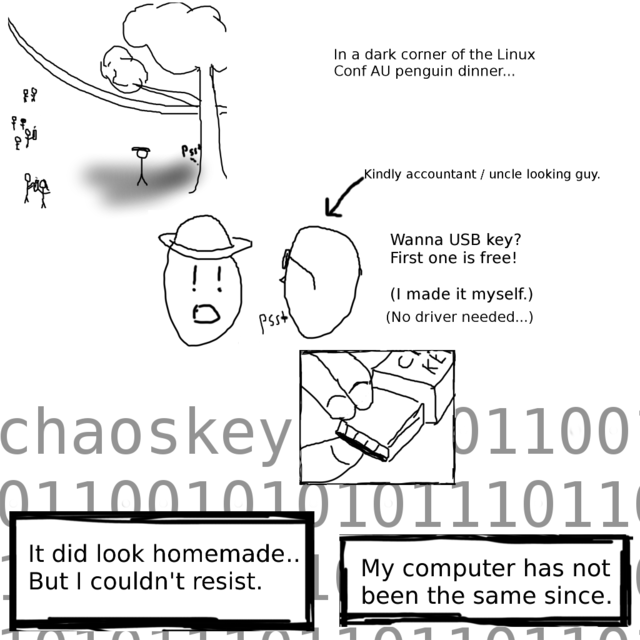
Joey Hess: badUSB

3 panel comic: 1. In a dark corner of the Linux Conf AU penguin dinner. 2. (Kindly accountant / uncle looking guy) Wanna USB key? First one is free! (I made it myself.) (No driver needed..) 3. It did look homemade, but I couldn't resist... My computer has not been the same since This actually happened.
Jan 19 00:05:10 darkstar kernel: usb 2-2: Product: ChaosKey-hw-1.0-sw-1.6.
In real life, my hat is uglier, and Keithp is more kindly looking. gimp source

25 January 2017

Martin-Éric Racine: OpenWRT Backfire on WRT54GL signal strenght

Because I wanted my home router to use at least decently supported software that provides complete out-of-the-box support for native IPv6, I recently got around upgrading my WRT54GL's firmware from White Russian to Backfire, which is the most recent OpenWRT release that fits the hardware's limited amount of flash memory.

One issue remains unanswered:

In GNOME shell's top panel and WiFi menu, the signal strength remains at 2 out of 4 bars. Given how the router sits only a few meters behind me, I would have expected much better signal strength than that.

Would anyone happen to know how to improve on these results? Thanks!

Urvika Gola: Outreachy- Week 4 & 5 Progress

Working with Preferences, AudioManager, RingtoneManager in Android. Sometimes the noise can get too much. Imagine all the people around you at work or in a classroom. All of them have at least one cell phones. Even if they were all to make a tiny blip, the noise would be irritating and disruptive. To avoid devices from interrupting the non-digital life, applications often provide settings that allow users to modify app volumes. My task this week was to enable/disable silent mode in Lumicall. To provide settings for your application, instead of using multiple Views, Preference APIs should be used. Each preference appears as an item in a list and provides the appropriate UI for users to modify the setting. In Lumicall, when settings menu from the menubar is selected, a preference screen is displayed showing various setting options, where I appended a Configure Silent Mode option. The UI for the preference screen is expected to be in Src->xml folder under the name preferences.xml

silentSnippet from Lumicall s preference.xml for Configure Silent Mode preference screen.
In Lumicall, whenever a SIP message comes in, RingtoneManager Class is used to generate a notification sound & AudioManager Class is used to generate sound for incoming encrypted calls. The difference between the two is that, AudioManager provides access to volume and ringer mode control. Ringer modes like, Normal, silent and vibration. Whereas RingtoneManager provides access to ringtones, notification. So to add a simple -disable/enable silent mode- functionality, I decided to use a CheckboxPreference. For the same goal, a better looking widget would be a SwitchPreference, but It does not work properly with DarkThemes which Lumicall uses. So I decided to use a simple Checkbox instead. The result of all the settings are saved as key value pairs in the default SharedPreferences file which can be retrieved to make changes in the app based on the settings modified by the user.
Every preference has a key and the result associated with it.
To fetch the result from the SharedPreferences file-
boolean silentflag=PreferenceManager.getDefaultSharedPreferences(ctx).getBoolean(org.sipdroid.sipua.ui.Settings.PREF_SILENT_MODE, org.sipdroid.sipua.ui.Settings.DEFAULT_SILENT_MODE); Note, the arguments in getBoolean function is (Key, DefaultValue). Don t forget to pass the Context object, ctx in the statement. I wasted a lot of time figuring that one out and created a non-optimal-working way which I eventually had to remove cos I figured out how to retrieve the result value. frustrated
To add a second method of setting silent mode, i.e where the user can enter his work days/time, I wanted to display an activity with required widgets .
To display an activity on a when a preference is selected, intent tags are used. (See the above snippet)
Note that the target package in the intent tags is not the package name of where the java file of the activity is to be found.It s the package name which is your applicationID. Now this activity, like any other activity in android is a combination of an xml and java file.
1. My xml file contains the widgets for user to enter two set of time value in HH:MM format. i.e.the start and end time during which user requires application notifications to be silent it also contains checkboxes for user to select multiple days of the week. 2. The java file associated with this does the following:
2.1 Comparing the Real Time with User s Specified Start and End time
2.2 Checking the current day of the week with the days marked by the user in the checkboxes I have used inbuilt Calendar class and Date class to accomplish this. All done I felt quite proud but this.. this was something that tested my patience and endurance!
As I continue my work, I will keep sharing! Please keep reading!
U


24 January 2017

Shirish Agarwal: Budget and Economics 101

The Budget The story which I wanted to share is there are few friends (from Debian as well as elsewhere) who shared that they didn t get the whole demonetisation play or what the Government is/was trying to do. As budget is just round the corner (India will be presenting its yearly budget on 1st of February), thought it is prudent to share at least some basics, ideas and theories of what goals the Finance Minister would be looking at when presenting his budget. I would NOT talk of Inflation targeting or some such exotica as those topics would require their own blog-posts altogether. I would mainly be talking a bit about Taxation and in that Personal Income Tax. I would also not use words like Receivables and like which thought bit more accurate are not used in everyday language. Just like Private Companies and increasingly public utilities, The Government of the day has two-three different aims when it is presenting a budget a. The first is to give an update about how things went last year. Did all the incomes that were projected, did it happen or was there a short-fall ? If there was a short-fall what were the reasons for the shortfall. Similarly, did all the budgeted expenditure earmarked for the year was spent and were it spent under the heads they were supposed to ? If not what went wrong there ? There is usually a tussle between Planned and Unplanned expenditure and one of the hallmarks of good governance is that unplanned expenditure is kept at minimum, while planned expenditure and projects completion or/and assets coming on-line were within the estimated time-frames. So these updates are given to the Parliament and hence public at large. The second and the more interesting part are the plans for the immediate future, 1 year down-the-line. Based on the performance last year, a bit of crystal-ball gazing of external and internal conditions of the country, the Finance Minister along with her/his colleagues of Finance Ministry. Trivia There hasn t been a female finance minister till date in India. The Finance Ministry as a whole also holds consultations with most sections of the society before sharing/putting his Fiscal Policy (Planned Expenditure) for debate and passage in form of the Budget. While the budget itself is a technical exercise, it is also a Political exercise as both the budget and the finance bill (which contains the taxation proposals) need to be passed in Lok Sabha (Lower house). After passing scrutiny of Lok Sabha (Lower House having people s representatives directly elected) and Rajya Sabha (Upper House, indirectly elected), the taxation proposals becomes the law. It isn t that simple but for our understanding, keeping it simple. This Political model of governance with two houses is modeled under the British (Westminister) model since 1947. The Government, just like any other Organization gives a similar Profit and Loss Account and a Balance Sheet.
How A country's budget is made.

How A country s budget is made. A representational and simplified version of how things flow was made using Graphviz. Click on it to see image in detail.

I am a newbie to graphviz. The graph was made like this
graph Budget
subgraph tier1
node [color="limegreen",style="filled",group="tier1"]
Country_Budget

......
Country_Budget -- Profit_and_Loss_Account [type=s];
It might be possible to make the graph much better than it is currently . The Profit and Loss Account of the Government tells what Incomes it is projected to earn in the upcoming year and whatever Expenditures it hopes to do this year. The Income and Expenditure independently can be bifurcated into two, Revenue Income and Capital Income and Revenue Expenditure and Capital Expenditure.
Indian Railways EMU local train

Indian Railways EMU local train

The simplest example of such planned expenditure which comes to my mind is the Indian Railways Budget which is all planned expenditure. As can be seen even with ample funds Railways were able to spent only 50% of the total amount disbursed last year. Similarly income generation for Railways was far below the target. Examples of Revenue Income include taxes of all sorts, while Capital Income are rare, like divestment/stake sale of a company owned by the Government. These are usually one-off events. Examples of Capital Expenditure is when the Government makes a road, makes a bridge etc. Usually large expenditures come under Capital Expenditure while salaries to Government employees and routine expenditures are known as Revenue Expenditure. There was a statement by the present Government that the last 6-7 years the budgets has been more or less static as far as numbers are concerned. This hampers Government s ability to take up any new work. The Revenue income earned by the Government can again be bifurcated primarily into two Direct Taxes and Indirect Taxes.
INR 2000 Rupees

INR 2000 Rupees

Direct Taxes are those which the Government earns through Personal Income Tax and Corporate Tax. As only 1 percent of Indians pay Personal income tax, the rest Government tries to raise by Hence the Government of the day is in fix. It needs to have more money if it wants to invest into infrastructure, defence spending, social spending such as health and education and so on and so forth. It cannot Another point is that unlike China which is a Large State-backed Enterprises Export-led Economy which has its own problems, India s economy is much more consumption-based, hence any large tinkering upwards may possibly stall whatever little spending the middle-class does, similar to the stall in consumer durables which has been happening over the last few years. There are a couple of short-term solutions that the Government may do While both seem to be attractive ways, but both have their disadvantages also, both have costs associated for them. In the first one, like any other scheme, when any scheme is launched, it needs to be underwritten by GOI which means even if it s not a success they would have to service all and any obligations towards investors. Also they have to be careful how much they are borrowing as excessive borrowing for today could lead to a Greece-like meltdown situation, whether internal or external borrowers. With external borrowers they also usually like to have a guarantee that the Rupee will not slide beyond a point otherwise the Government will have to pay all and any losses but this is going beyond what I wanted to share. Printing excess money in the system could lead to loss in the value of the money itself as well as leading to inflationary pressures which leads to more problems for the poor and greater inequality between the classes among other things. So while the Government may use all of the above ways in varying degrees, the present Government had the idea that if we were to reduce black money or hidden economy (AFAIK no country can claim to completely eliminate it) we would be able to raise the finance we need without a major cost associated to it. For instance, I was reading that even in Canada, it is expected that 20% of black money/shadow economy works and that assessment is by their own taxation authorities. So While doing demonetization, it came out with an equivalent Black Money Declaration Scheme (IDS). The idea is simple, even if 1 percent of the population comes in the traditional tax net the Government of the day would be able to enhance budgets to various expenditure. Now while the idea is good in theory, implementation has been the Achilees heel. While the Government s expected something like 15% of the whole economy was black money or shadow money, almost 95% of the money in circulation came back in Banks during demonetization ( These are unofficial figures, Finance Ministry/RBI would be disclosing the real figures on 1st of February 2017 so we will know). It is suspected that 10% of money in Banks is black money. There are considerable costs to search analyze, prove in the court of law that it is so. There are and would be considerable costs to train new officers as existing Income Tax Officers are already burdened with Advance Tax being paid by Corporates and small business-man paying round the year (every 3 months), The existing Income Tax Officers already have their hands full. Also till Governments don t fix up realty sector/real-estate sector and other places where the black money/shadow economy may prevail. Hence all the training, salary, buildings where new Income Tax Officers could work, infrastructure, new buildings where suspect cases have to be tried and lawyers for those. As have shared a few times on this blog, India has almost 29 million court cases pending in the lower judiciary alone. Unless any such cases are not successfully tried within time by the Government, it would be a waste. Now whether the Government knew of these issues or not would probably be never known. Lastly, there is a voluntary part that the Government hopes, that they will by themselves join the mainstream tax-paying public. This might happen but any such happening will happen over years. People make their own choices. And unless there are not any stick and carrot approach to the Government s Policies people will tend to go back to their old ways. I would share an example from the demonetisation process which would help prove my point During demonetization, there was a great push towards doing digital transaction either via smartphones or greater usage of debit and credit cards etc. For the first 60 days till 31st December 2016, you could do digital transactions without paying any transaction fee. During that period, I used my Debit card to shop, to eat at restaurants or/and even small shops. But come 1st January 2017, the charges for digital transactions are anything between 1.5% to 3% of transactions. Naturally, I stopped using them and use them very sparingly where cash won t work. So at the end, while the Government made the whole demonetization drive to drive out shadow economy, terror financing etc. While terror financing has been hurt quite a bit, the same cannot be said of the shadow/black economy. It seems that the Government would need to close many more doors and windows before people join the mainstream. While Politically it was risky, socially it was also a bit risky move as it was uncertain how and where things will move. Venezuela tried the same thing and fell flat on its face. All said and done, if and when people become part of the tax-paying class/people, The most optimistic idea that the Government has that everybody will go cashless and it would be far easier to find out who s not paying taxes. As shared before, I don t think this will happen unless the charges for cashless is at 0.05% or something similar. Even IF people do join the mainstream, it is very much possible that the present Govt. will not enjoy fruits of this labour as fruits might come in 2018/19 or even later even if they do come. So whether the decision had the right affect or not, we may never come to know. Governments tend to tinker around with the figures as well. But I hope some idea of how things happen is known now.
Filed under: Miscellenous Tagged: #demonetization, #Government Budget, #graphviz, #Limitations, #Profit and Loss Account, #Taxation

22 January 2017

Shirish Agarwal: Debian contributions and World History

Beware, this would be slightly longish. Debian Contributions In the last couple of weeks, was lucky to put up a patch against debian-policy which had been bothering me for a long-long time. The problem statement is simple, man-pages historically were made by software engineers for software-engineers. The idea, probably then was you give the user some idea of what the software does and the rest the software engineer would garner from reading the source-code. But over period of time, the audience has changed. While there are still software engineers who use GNU/Linux for the technical excellence, the man-pages have not kept up with this new audience who perhaps are either not technically so sound that or they do not want to take the trouble to reading the source-code to understand how things flow. An example or examples in a man-page gives us (the lesser mortals) some insight as how the command works, how the logic flows. A good example of a man-page is the ufw man-page
EXAMPLES
Deny all access to port 53: ufw deny 53 Allow all access to tcp port 80: ufw allow 80/tcp Allow all access from RFC1918 networks to this host: ufw allow from 10.0.0.0/8
ufw allow from 172.16.0.0/12
ufw allow from 192.168.0.0/16 Deny access to udp port 514 from host 1.2.3.4: ufw deny proto udp from 1.2.3.4 to any port 514 Allow access to udp 1.2.3.4 port 5469 from 1.2.3.5 port 5469: ufw allow proto udp from 1.2.3.5 port 5469 to 1.2.3.4 port 5469
Now if we had man-pages like the above which give examples, then the user at least can try to accomplish whatever s/he is trying to do. I truly believe not having examples in a man-page kills 50% of your audience and people who could potentially use your tool. Personal wishlist The only thing (and this might be my failure) is we need a good way to search through a man-page. The only way I know is using / and try to give a pattern. Lots of times it fails because I, the user doesn t know the exact keyword which the documenter was using. What would be nice, great if we do have some sort of parser where I tell it, $this is what I m looking for and the parser tries the pattern + all its synonyms and whatever seems to be most relevant passage from the content, in this case a manpage it tells me. It would make my life a lot easier while at the same time force people to document more and more. I dunno if there has been any research or study of the relationship between good documentation and popularity of a program. I know there are lots of different tiny bits which make or break a program, one of which would definitely be documentation and in that a man-page IF it s a command-line tool. A query on Quora gives some indication https://www.quora.com/How-comprehensible-do-you-find-Unix-Linux-Man-pages although the low response rate tells its own story. there have been projects like man2html and man2pdf and others which try to make the content more accessible to people who are not used to the man-page interface but till you don t have Examples the other things can work only so far. Also if anybody talks about X project which claims to solve this problem they will have to fight manpages who have been around like forever. As can be seen in the patch, did some rookie mistakes as can be seen. I also filed a lintian bug at the same time. Hope the patch does get merged at some point in debian-policy and then a check introduced in lintian in some future release. I do agree with anarcat s assertion that it should be at the level of the manpage missing level. I am no coder but finding 14,000 binary packages without a manpage left me both shocked and surprised. I came to know about manpage-alert from the devscripts package to know which all binary packages that have been installed but not have man-pages. I hope to contribute a manpage or two if I across a package I m somewhat comfortable with. I have made a beginning of sorts by running manpage alert and putting the output in a .txt file which I would grep through manually and see if something interesting jumps at me. The learning garnered from putting the patch to the debian package resulted in another patch but this time for an upstream project altogether. As can be seen all are just baby-steps that even a non-coder can take. Another couple of bugs I filed which were fixed were of a sim called unknown-horizons . A 2D realtime strategy simulation. I had filed three bugs, two of which were fixed in 2 days, the 3rd I hope is also fixed soonish. Lastly, I spent most of the week-end poring over packages who have left files in /etc/bash_completion.d/ . I spent almost 4-5 odd hours as each package in question as well as entries found in /etc/bash-completion.d/$filename I had to find which package it belonged to first

[$] dpkg -S /etc/bash_completion.d/git-prompt
git: /etc/bash_completion.d/git-prompt
I know that dpkg-query also does the same
[$] dpkg-query -S /etc/bash_completion.d/git-prompt
git: /etc/bash_completion.d/git-prompt
But I am used to plain dpkg although do know that dpkg-query can do lot more intimate searching in various ways than dpkg can. Once the package name was established, first simulate the purge [$] sudo aptitude -s purge git

[sudo] password for shirish:
The following packages will be REMOVED:
git p
0 packages upgraded, 0 newly installed, 1 to remove and 14 not upgraded.
Need to get 0 B of archives. After unpacking 29.5 MB will be freed.
The following packages have unmet dependencies:
libgit-wrapper-perl : Depends: git but it is not going to be installed
git-extras : Depends: git (>= 1.7.0) but it is not going to be installed
bup : Depends: git but it is not going to be installed
git-remote-gcrypt : Depends: git but it is not going to be installed
git-svn : Depends: git (> 1:2.11.0) but it is not going to be installed
Depends: git ( 1:2.11.0) but it is not going to be installed
Depends: git (= 1:1.8.1) but it is not going to be installed
git-core : Depends: git (> 1:1.7.0.2) but it is not going to be installed
The following actions will resolve these dependencies:
Remove the following packages:
1) bup [0.29-2 (now, testing, unstable)]
2) fdroidserver [0.7.0-1 (now, testing, unstable)]
3) git-annex [6.20161012-1 (now, testing)]
4) git-core [1:2.11.0-2 (now, testing, unstable)]
5) git-extras [4.2.0-1 (now, testing, unstable)]
6) git-remote-gcrypt [1.0.1-1 (now, testing, unstable)]
7) git-repair [1.20151215-1 (now, unstable)]
8) git-svn [1:2.11.0-2 (now, testing, unstable)]
9) gitk [1:2.11.0-2 (now, testing, unstable)]
10) libgit-wrapper-perl [0.047-1 (now, testing, unstable)]
11) python3-git [2.1.0-1 (now, testing, unstable)]
12) svn2git [2.4.0-1 (now, testing, unstable)] Leave the following dependencies unresolved:
13) devscripts recommends libgit-wrapper-perl
14) dh-make-perl recommends git
15) fdroidserver recommends git
16) git-annex recommends git-remote-gcrypt (>= 0.20130908-6)
17) gplaycli recommends fdroidserver
18) python-rope recommends git-core
Accept this solution? [Y/n/q/?] q
Abandoning all efforts to resolve these dependencies.
Abort.
Then I made a note of all the packages being affected, saw purging all of them wouldn t call others (the Package dependency Hell), made the purge and then reinstalled anew. The reason I did this is that many a times during upgrade, either during update/upgrade sometimes the correct action doesn t happen. To take the git s example itself, there were two files git-extras and git-prompt which were in /etc/bash_completion.d/ both of which were showing their source as git. Purging git and installing git afresh removed git-extras file and git-prompt is the only one remaining. While blogging about the package, did try to grep through changelog.Debian.gz and changelog.gz in git

[shirish@debian] - [/usr/share/doc/git] - [10046]
[$] zless changelog.gz
and similarly

[shirish@debian] - [/usr/share/doc/git] - [10046]
[$] zless changelog.Debian.gz
But failed to find any mention of the now gone git-extras. Doing this with all the packages took considerable time as didn t want to deal with any potential fallout later on. For instance, ufw (uncomplicated firewall) also had an entry in /etc/bash_completion.d/, hence before purging ufw, took backup of all the rules I have made, did a successful simulation

[$] sudo aptitude -s purge ufw gufw


The following packages will be REMOVED:
gufw p ufw p
0 packages upgraded, 0 newly installed, 2 to remove and 14 not upgraded.
Need to get 0 B of archives. After unpacking 4,224 kB will be freed.
Note: Using 'Simulate' mode.
Do you want to continue? [Y/n/?] y
Would download/install/remove packages.
purged the packages, reinstalled it and then re-added all the rules. Doing it all for various sundry packages, had to do it manually as there is no one size fits all solution. A sensitive one was grub which still has an entry in /etc/bash_completion.d/grub. Doing it wrong could have resulted in a non-bootable situation. There are workarounds for that, but it would have taken quite a bit of time, energy, notes and bit of recall factor what I did the last time something like that happened. Doing it manually, being present meant I could do it rightly the first time. So, was it worth it It would be if the package maintainers do the needful and the remaining entries are moved out of /etc/bash_completion.d/ to /usr/share/bash-completions and some to my favourite /usr/share/zsh/vendor-completions/ for instance

[shirish@debian] - [/usr/share/zsh/vendor-completions] - [10064]
[$] ll -h _youtube-dl
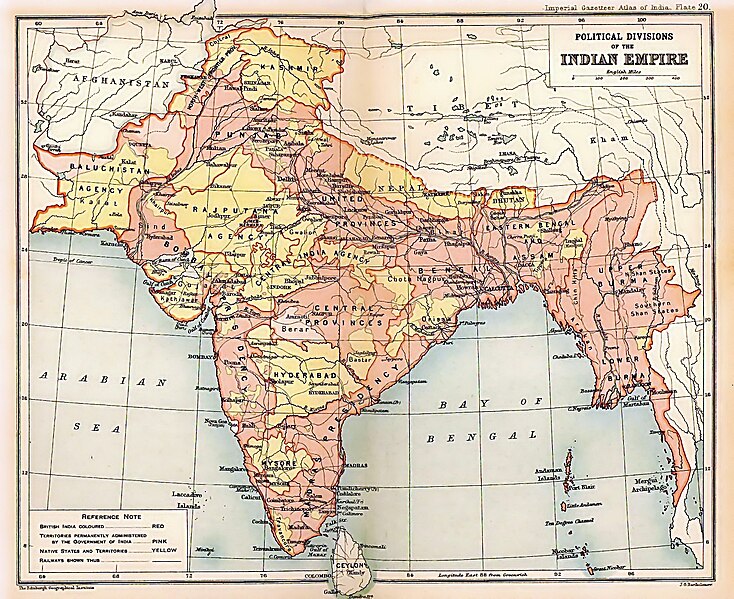
-rw-r--r-- 1 root root 3.2K 2016-12-01 08:48 _youtube-dl But trying to get all or even major packages to use zsh-completions would be hard work and would take oodles of time and this concerns upstream stuff, also very much outside what I was sharing. World History Before, during and even after South-African experience, I was left wondering why India and South Africa, two countries who had similar histories at least the last couple of hundred years or more, the final result of Independence was so different for both the countries. It took me quite sometime to articulate that in a form of question , while the answers were interesting, from what little I know of India itself, if I were an Englishman I would never leave Hindustan . What the people answering failed to take into account was that in that era it was Hindustan or un-divided India.
Pre-partition map of India

Pre-partition map of India

This map can be found at https://commons.wikimedia.org/wiki/File:British_Indian_Empire_1909_Imperial_Gazetteer_of_India.jpg and is part of quite a few Indian articles. I would urge people to look at the map in-depth. Except for the Central India Agency and Central India Provinces, most of the other regions were quite comfortable weather-wise. Hence I can t help but feel the assertion that Britishers didn t like India (as to live here) slightly revolting. See the excerpt/take on Dale Kennedy s The Magic Mountains: Hill Stations and the British Raj. Berkeley: University of California Press, 1996. xv + 264 pp. . A look at the list of hill stations of divided India is enough to tell that there were lot of places which either were founded by the Britishers or they chose to live there. And this is not all, there are supposed to lot of beautiful places even in Pakistan, especially in North East Frontier, Swat for instance. While today it s infamous for Taliban and Islamic Terrorism, there was a time it was known for its beauty.
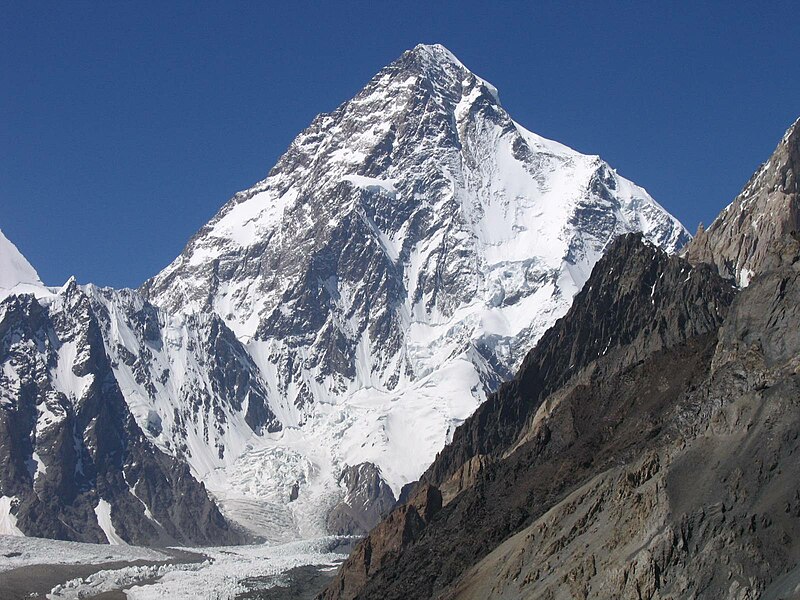
The second most difficult mountain in the world - K2, Pakistan

The second most difficult mountain in the world K2, Pakistan

Trivia After Everest, K2 is the smaller one although whatever I have read of people s accounts, most people who ascended all 14 8,000 metre peaks say K2 is technically more tougher than Everest and after Everest has the highest casualty rate. Also places like the disputed North half of Pakistan Occupied Kashmir, Gilgit Baltistan, Extreme northern Punjab of Pakistan , Northern half of Khyber-Pakhtunkhawa province and Northern Balochistan all of these places would have been more than conducive to the Britishers as it is near to the British climate (snow and pleasant weather all year round). It really is a pity that Pakistan chose to become a terrorist state where it could have become one of the more toured places of Asia. I really feel nauseous and sad at the multiple chances that Pakistan frittered away, it could have been something else.
Filed under: Miscellenous Tagged: #bash-completion, #British Raj, #contributions, #debian, #debian-policy, #Debian-QA, #Hill Stations, #India Independance Movement, #lintian, #obsolete-conffiles, #unknown-horizons, #weather, #World History, adequate, Pakistan, tourism

Lars Wirzenius: Improving debugging via email, followup

Half a year ago I wrote a blog post about debugging over email. This is a follow-up. The blog post summarised: Based on further thinking and feedback, I add: I've not written any code to help with this remote debugging, but it's something I will start experimenting with in the near future. Further ideas welcome.

18 January 2017

Reproducible builds folks: Reproducible Builds: week 90 in Stretch cycle

What happened in the Reproducible Builds effort between Sunday January 8 and Saturday January 14 2017: Upcoming Events Reproducible work in other projects Reproducible Builds have been mentioned in the FSF high-priority project list. The F-Droid Verification Server has been launched. It rebuilds apps from source that were built by f-droid.org and checks that the results match. Bernhard M. Wiedemann did some more work on reproducibility for openSUSE. Bootstrappable.org (unfortunately no HTTPS yet) was launched after the initial work was started at our recent summit in Berlin. This is another topic related to reproducible builds and both will be needed in order to perform "Diverse Double Compilation" in practice in the future. Toolchain development and fixes Ximin Luo researched data formats for SOURCE_PREFIX_MAP and explored different options for encoding a map data structure in a single environment variable. He also continued to talk with the rustc team on the topic. Daniel Shahaf filed #851225 ('udd: patches: index by DEP-3 "Forwarded" status') to make it easier to track our patches. Chris Lamb forwarded #849972 upstream to yard, a Ruby documentation generator. Upstream has fixed the issue as of release 0.9.6. Alexander Couzens (lynxis) has made mksquashfs reproducible and is looking for testers. It compiles on BSD systems such as FreeBSD, OpenBSD and NetBSD. Bugs filed Chris Lamb: Lucas Nussbaum: Nicola Corna: Reviews of unreproducible packages 13 package reviews have been added and 13 have been removed in this week, adding to our knowledge about identified issues. 1 issue type has been added: Weekly QA work During our reproducibility testing, the following FTBFS bugs have been detected and reported by: diffoscope development Bugs in diffoscope in the last year Many bugs were opened in diffoscope during the past few weeks, which probably is a good sign as it shows that diffoscope is much more widely used than a year ago. We have been working hard to squash many of them in time for Debian stable, though we will see how that goes in the end reproducible-website development tests.reproducible-builds.org Misc. This week's edition was written by Ximin Luo, Chris Lamb and Holger Levsen and reviewed by a bunch of Reproducible Builds folks on IRC & the mailing lists.

Jan Wagner: Migrating Gitlab non-packaged PostgreSQL into omnibus-packaged

With the release of Gitlab 8.15 it was announced that PostgreSQL needs to be upgraded. As I migrated from a source installation I used to have an external PostgreSQL database instead of using the one shiped with the omnibus package.
So I decided to do the data migration into the omnibus PostgreSQL database now which I skipped before. Let's have a look into the databases:
$ sudo -u postgres psql -d template1
psql (9.2.18)  
Type "help" for help.
gitlabhq_production=# \l  
                                             List of databases
         Name                  Owner         Encoding   Collate    Ctype           Access privileges
-----------------------+-------------------+----------+---------+---------+---------------------------------
 gitlabhq_production     git                 UTF8       C.UTF-8   C.UTF-8  
 gitlab_mattermost       git                 UTF8       C.UTF-8   C.UTF-8  
gitlabhq_production=# \q  
Dumping the databases and stop PostgreSQL. Maybe you need to adjust database names and users for your needs.
$ su postgres -c "pg_dump gitlabhq_production -f /tmp/gitlabhq_production.sql" && \
su postgres -c "pg_dump gitlab_mattermost -f /tmp/gitlab_mattermost.sql" && \  
/etc/init.d/postgresql stop
Activate PostgreSQL shipped with Gitlab Omnibus
$ sed -i "s/^postgresql\['enable'\] = false/#postgresql\['enable'\] = false/g" /etc/gitlab/gitlab.rb && \
sed -i "s/^#mattermost\['enable'\] = true/mattermost\['enable'\] = true/" /etc/gitlab/gitlab.rb && \  
gitlab-ctl reconfigure  
Testing if the connection to the databases works
$ su - git -c "psql --username=gitlab  --dbname=gitlabhq_production --host=/var/opt/gitlab/postgresql/"
psql (9.2.18)  
Type "help" for help.
gitlabhq_production=# \q  
$ su - git -c "psql --username=gitlab  --dbname=mattermost_production --host=/var/opt/gitlab/postgresql/"
psql (9.2.18)  
Type "help" for help.
mattermost_production=# \q  
Ensure pg_trgm extension is enabled
$ sudo gitlab-psql -d gitlabhq_production -c 'CREATE EXTENSION IF NOT EXISTS "pg_trgm";'
$ sudo gitlab-psql -d mattermost_production -c 'CREATE EXTENSION IF NOT EXISTS "pg_trgm";'
Adjust permissions in the database dumps. Indeed please verify that users and databases might need to be adjusted too.
$ sed -i "s/OWNER TO git;/OWNER TO gitlab;/" /tmp/gitlabhq_production.sql && \
sed -i "s/postgres;$/gitlab-psql;/" /tmp/gitlabhq_production.sql  
$ sed -i "s/OWNER TO git;/OWNER TO gitlab_mattermost;/" /tmp/gitlab_mattermost.sql && \
sed -i "s/postgres;$/gitlab-psql;/" /tmp/gitlab_mattermost.sql  
(Re)import the data
$ sudo gitlab-psql -d gitlabhq_production -f /tmp/gitlabhq_production.sql
$ sudo gitlab-psql -d gitlabhq_production -c 'REVOKE ALL ON SCHEMA public FROM "gitlab-psql";' && \
sudo gitlab-psql -d gitlabhq_production -c 'GRANT ALL ON SCHEMA public TO "gitlab-psql";'  
$ sudo gitlab-psql -d mattermost_production -f /tmp/gitlab_mattermost.sql
$ sudo gitlab-psql -d mattermost_production -c 'REVOKE ALL ON SCHEMA public FROM "gitlab-psql";' && \
sudo gitlab-psql -d mattermost_production -c 'GRANT ALL ON SCHEMA public TO "gitlab-psql";'  
Make use of the shipped PostgreSQL
$ sed -i "s/^gitlab_rails\['db_/#gitlab_rails\['db_/" /etc/gitlab/gitlab.rb && \
sed -i "s/^mattermost\['sql_/#mattermost\['sql_/" /etc/gitlab/gitlab.rb && \  
gitlab-ctl reconfigure  
Now you should be able to connect to all the Gitlab services again. Optionally remove the external database
apt-get remove postgresql postgresql-client postgresql-9.4 postgresql-client-9.4 postgresql-client-common postgresql-common  
Maybe you also want to purge the old database content
apt-get purge postgresql-9.4  

Michael Stapelberg: manpages.debian.org has been modernized

https://manpages.debian.org has been modernized! We have just launched a major update to our manpage repository. What used to be served via a CGI script is now a statically generated website, and therefore blazingly fast. While we were at it, we have restructured the paths so that we can serve all manpages, even those whose name conflicts with other binary packages (e.g. crontab(5) from cron, bcron or systemd-cron). Don t worry: the old URLs are redirected correctly. Furthermore, the design of the site has been updated and now includes navigation panels that allow quick access to the manpage in other Debian versions, other binary packages, other sections and other languages. Speaking of languages, the site serves manpages in all their available languages and respects your browser s language when redirecting or following a cross-reference. Much like the Debian package tracker, manpages.debian.org includes packages from Debian oldstable, oldstable-backports, stable, stable-backports, testing and unstable. New manpages should make their way onto manpages.debian.org within a few hours. The generator program ( debiman ) is open source and can be found at https://github.com/Debian/debiman. In case you would like to use it to run a similar manpage repository (or convert your existing manpage repository to it), we d love to help you out; just send an email to stapelberg AT debian DOT org. This effort is standing on the shoulders of giants: check out https://manpages.debian.org/about.html for a list of people we thank. We d love to hear your feedback and thoughts. Either contact us via an issue on https://github.com/Debian/debiman/issues/, or send an email to the debian-doc mailing list (see https://lists.debian.org/debian-doc/).

B lint R czey: My debian-devel pledge

I pledge that before sending each email to the debian-devel mailing list I move forward at least one actionable bug in my packages.

Next.

Previous.