Search Results: "ean"

26 October 2017

Russell Coker: Anarchy in the Office

Some of the best examples I ve seen of anarchy working have been in corporate environments. This doesn t mean that they were perfect or even as good as a theoretical system in which a competent manager controlled everything, but they often worked reasonably well. In a well functioning team members will encourage others to do their share of the work in the absence of management. So when the manager disappears (doesn t visit the team more than once a week and doesn t ask for any meaningful feedback on how things are going) things can still work out. When someone who is capable of doing work isn t working then other people will suggest that they do their share. If resources for work (such as a sufficiently configured PC for IT work) aren t available then they can be found (abandoned PCs get stripped and the parts used to upgrade the PCs that need it most). There was one time where a helpdesk worker who was about to be laid off was assigned to the same office as me (apparently making all the people in his group redundant took some time). So I started teaching him sysadmin skills, assigned work to him, and then recommended that my manager get him transferred to my group. That worked well for everyone. One difficult case is employees who get in the way of work being done, those who are so incompetent that they break enough things to give negative productivity. One time when I was working in Amsterdam I had two colleagues like that, it turned out that the company had no problem with employees viewing porn at work so no-one asked them to stop looking at porn. Having them paid to look at porn 40 hours a week was much better than having them try to do work. With anarchy there s little option to get rid of bad people, so just having them hang out and do no work was the only option. I m not advocating porn at work (it makes for a hostile work environment), but managers at that company did worse things. One company I worked for appeared (from the non-management perspective) to have a management culture of doing no work. During my time there I did two annual reviews in two weeks, and the second was delayed by over 6 months. The manager in question only did the reviews at that time because he was told he couldn t be promoted until he got the backlog of reviews done, so apparently being more than a year behind in annual reviews was no obstacle to being selected for promotion. On one occasion I raised the issue of a colleague who had done no work for over a year (and didn t even have a PC to do work) with that manager, his response was what do you expect me to do ! I expected him to do anything other than blow me off when I reported such a serious problem! But in spite of that strictly work-optional culture enough work was done and the company was a leader in it s field. There has been a lot of research into the supposed benefits of bonuses etc which usually turn out to reduce productivity. Such research is generally ignored presumably because the people who are paid the most are the ones who get to decide whether financial incentives should be offered so they choose the compensation model for the company that benefits themselves. But the fact that teams can be reasonably productive when some people are paid to do nothing and most people have their work allocated by group consensus rather than management plan seems to be a better argument against the typical corporate management. I think it would be interesting to try to run a company with an explicit anarchic management and see how it compares to the accidental anarchy that so many companies have. The idea would be to have minimal management that just does the basic HR tasks (preventing situations of bullying etc), a flat pay rate for everyone (no bonuses, pay rises, etc) and have workers decide how to spend money for training, facilities, etc. Instead of having middle managers you would have representatives elected from each team to represent their group to senior management. PS Australia has some of the strictest libel laws in the world. Comments that identify companies or people are likely to be edited or deleted.

Russ Allbery: Review: Waypoint Kangaroo

Review: Waypoint Kangaroo, by Curtis C. Chen
Series: Kangaroo #1
Publisher: Thomas Dunne
Copyright: June 2016
ISBN: 1-250-08179-3
Format: Kindle
Pages: 312
Disclaimer: Curtis was a classmate of mine at Stanford and part of the same social circle. That was a surprisingly long time ago. Kangaroo is a spy (and, for this book, you should think James Bond). Agency training, fake identities, lots of gadgets, grumpy yet ridiculously competent support staff... the typical package. But Kangaroo also has a special power, which is the entire reason he ended up in the position he has. He's apparently the only person in the world who can open the pocket: a hole into another dimension, which can function as infinite storage and quite a bit more. Waypoint Kangaroo opens with the tail end of a mission and Kangaroo in action, as an introduction to Kangaroo's first-person narrative voice, job, and the capabilities of the pocket. But the real story starts when Kangaroo is sent on vacation. The office is being audited, Kangaroo hasn't had time off basically ever, and his boss insists on a trip to Mars on the space equivalent of a cruise ship. No work. An expense account. Just relax and have fun. Kangaroo isn't sure he knows how to not work. Or how to avoid boredom when trying hard to not work. It leads to probably ill-advised decisions like falling in love at first glance with the chief engineer, or going on entirely unauthorized spacewalks in the middle of the night. It's very lucky for him that the captain of this commercial cruise ship appears to also work for his agency. And it's good for his inability to stop working that there's a murder on board. For a first novel, this is refreshingly free of a lot of first novel problems. It's lean, well-structured, easy to follow, moves right along, and doesn't feel over-stuffed with exposition or world-building. There's an interplanetary war in the past background, and of course a lot of loving description of the precise mechanics of the pocket and the tricks with momentum and retrieval Kangaroo can do with it, but the book never falls into too much explanation. And the plot is satisfyingly twisty. It's an action story plot, to be clear: don't expect deep puzzles or complex deduction. But there are enough players and hidden motives to keep things interesting. The downside is that I didn't like Kangaroo very much. He's a bit of an ass. Some of this goes with the spy novel territory, and some of it is good (if occasionally grating) characterization. Kangaroo doesn't know how to turn off the part of his brain that makes everything a mission. But his flippant, know-it-all attitude got on my nerves after a book full of first-person narration, and while (full credit to Curtis here) the romance in this book is clearly consensual and stays well away from the creepy romances so common in spy stories, the love-at-first sight bits and some of Kangaroo's awkward reactions provoked more eye-rolling than enjoyment. A lot of this is just personal taste, but that's the peril of books told with first-person narration. The reader has to really like the protagonist to spend a whole book in their head. If that relationship doesn't click, the supporting characters have a harder time salvaging the experience. Waypoint Kangaroo avoids the problem of too many loving descriptions of guns, partly because it's a spy novel and instead has loving descriptions of spy equipment in a future that supports implanted devices. I think there was a smidgen too much of this, but it was within genre conventions and spy stuff is more interesting than guns. But (and I admit that this is probably idiosyncratic), it also had way too many loving descriptions of alcohol and one drunk scene. I don't care to ever read another book with a drunk protagonist (particularly first-person), and I care considerably less about alcohol than I do about spy equipment or guns. That said, I still liked this well enough that I'll probably buy the sequel. (No cliffhangers; Waypoint Kangaroo is a complete story. But this is a character who could easily support a long episodic series.) The pocket is a neat gimmick, the world background is at least mildly interesting, and some of the supporting characters were excellent. (Particularly the security chief and the engineer.) I might even warm to Kangaroo over time if subsequent stories stay more on his creative fast-talking rather than his drinking and awkward romances. I don't think this is quite good enough for me to recommend it, but if you're in the mood for a light and fast-moving first-person Bond-style story with science fiction trappings, it does deliver. Rating: 6 out of 10

25 October 2017

Petter Reinholdtsen: Locating IMDB IDs of movies in the Internet Archive using Wikidata

Recently, I needed to automatically check the copyright status of a set of The Internet Movie database (IMDB) entries, to figure out which one of the movies they refer to can be freely distributed on the Internet. This proved to be harder than it sounds. IMDB for sure list movies without any copyright protection, where the copyright protection has expired or where the movie is lisenced using a permissive license like one from Creative Commons. These are mixed with copyright protected movies, and there seem to be no way to separate these classes of movies using the information in IMDB. First I tried to look up entries manually in IMDB, Wikipedia and The Internet Archive, to get a feel how to do this. It is hard to know for sure using these sources, but it should be possible to be reasonable confident a movie is "out of copyright" with a few hours work per movie. As I needed to check almost 20,000 entries, this approach was not sustainable. I simply can not work around the clock for about 6 years to check this data set. I asked the people behind The Internet Archive if they could introduce a new metadata field in their metadata XML for IMDB ID, but was told that they leave it completely to the uploaders to update the metadata. Some of the metadata entries had IMDB links in the description, but I found no way to download all metadata files in bulk to locate those ones and put that approach aside. In the process I noticed several Wikipedia articles about movies had links to both IMDB and The Internet Archive, and it occured to me that I could use the Wikipedia RDF data set to locate entries with both, to at least get a lower bound on the number of movies on The Internet Archive with a IMDB ID. This is useful based on the assumption that movies distributed by The Internet Archive can be legally distributed on the Internet. With some help from the RDF community (thank you DanC), I was able to come up with this query to pass to the SPARQL interface on Wikidata:
SELECT ?work ?imdb ?ia ?when ?label
WHERE
 
  ?work wdt:P31/wdt:P279* wd:Q11424.
  ?work wdt:P345 ?imdb.
  ?work wdt:P724 ?ia.
  OPTIONAL  
        ?work wdt:P577 ?when.
        ?work rdfs:label ?label.
        FILTER(LANG(?label) = "en").
   
 
If I understand the query right, for every film entry anywhere in Wikpedia, it will return the IMDB ID and The Internet Archive ID, and when the movie was released and its English title, if either or both of the latter two are available. At the moment the result set contain 2338 entries. Of course, it depend on volunteers including both correct IMDB and The Internet Archive IDs in the wikipedia articles for the movie. It should be noted that the result will include duplicates if the movie have entries in several languages. There are some bogus entries, either because The Internet Archive ID contain a typo or because the movie is not available from The Internet Archive. I did not verify the IMDB IDs, as I am unsure how to do that automatically. I wrote a small python script to extract the data set from Wikidata and check if the XML metadata for the movie is available from The Internet Archive, and after around 1.5 hour it produced a list of 2097 free movies and their IMDB ID. In total, 171 entries in Wikidata lack the refered Internet Archive entry. I assume the 70 "disappearing" entries (ie 2338-2097-171) are duplicate entries. This is not too bad, given that The Internet Archive report to contain 5331 feature films at the moment, but it also mean more than 3000 movies are missing on Wikipedia or are missing the pair of references on Wikipedia. I was curious about the distribution by release year, and made a little graph to show how the amount of free movies is spread over the years: I expect the relative distribution of the remaining 3000 movies to be similar. If you want to help, and want to ensure Wikipedia can be used to cross reference The Internet Archive and The Internet Movie Database, please make sure entries like this are listed under the "External links" heading on the Wikipedia article for the movie:
*  Internet Archive film id=FightingLady 
*  IMDb title id=0036823 title=The Fighting Lady 
Please verify the links on the final page, to make sure you did not introduce a typo. Here is the complete list, if you want to correct the 171 identified Wikipedia entries with broken links to The Internet Archive: Q1140317, Q458656, Q458656, Q470560, Q743340, Q822580, Q480696, Q128761, Q1307059, Q1335091, Q1537166, Q1438334, Q1479751, Q1497200, Q1498122, Q865973, Q834269, Q841781, Q841781, Q1548193, Q499031, Q1564769, Q1585239, Q1585569, Q1624236, Q4796595, Q4853469, Q4873046, Q915016, Q4660396, Q4677708, Q4738449, Q4756096, Q4766785, Q880357, Q882066, Q882066, Q204191, Q204191, Q1194170, Q940014, Q946863, Q172837, Q573077, Q1219005, Q1219599, Q1643798, Q1656352, Q1659549, Q1660007, Q1698154, Q1737980, Q1877284, Q1199354, Q1199354, Q1199451, Q1211871, Q1212179, Q1238382, Q4906454, Q320219, Q1148649, Q645094, Q5050350, Q5166548, Q2677926, Q2698139, Q2707305, Q2740725, Q2024780, Q2117418, Q2138984, Q1127992, Q1058087, Q1070484, Q1080080, Q1090813, Q1251918, Q1254110, Q1257070, Q1257079, Q1197410, Q1198423, Q706951, Q723239, Q2079261, Q1171364, Q617858, Q5166611, Q5166611, Q324513, Q374172, Q7533269, Q970386, Q976849, Q7458614, Q5347416, Q5460005, Q5463392, Q3038555, Q5288458, Q2346516, Q5183645, Q5185497, Q5216127, Q5223127, Q5261159, Q1300759, Q5521241, Q7733434, Q7736264, Q7737032, Q7882671, Q7719427, Q7719444, Q7722575, Q2629763, Q2640346, Q2649671, Q7703851, Q7747041, Q6544949, Q6672759, Q2445896, Q12124891, Q3127044, Q2511262, Q2517672, Q2543165, Q426628, Q426628, Q12126890, Q13359969, Q13359969, Q2294295, Q2294295, Q2559509, Q2559912, Q7760469, Q6703974, Q4744, Q7766962, Q7768516, Q7769205, Q7769988, Q2946945, Q3212086, Q3212086, Q18218448, Q18218448, Q18218448, Q6909175, Q7405709, Q7416149, Q7239952, Q7317332, Q7783674, Q7783704, Q7857590, Q3372526, Q3372642, Q3372816, Q3372909, Q7959649, Q7977485, Q7992684, Q3817966, Q3821852, Q3420907, Q3429733, Q774474

Russ Allbery: Review: Clean Sweep

Review: Clean Sweep, by Ilona Andrews
Series: Innkeeper Chronicles #1
Publisher: NYLA
Copyright: 2013
ISBN: 1-62517-343-1
Format: Kindle
Pages: 228
Dina owns a bed and breakfast in a small town in Texas. As the book opens, her neighbor's dogs are being killed by some beast. As far as Dina is concerned, this should be the problem of the local werewolf, given that this is his territory, and she takes him to task for apparently doing nothing about it. The werewolf doesn't take that well, nor wants to admit to being a werewolf, and reacts by threatening Dina. Given Dina's position and the nature of her bed and breakfast, that turns out to be ill-advised. At this point, you're doubtless thinking urban fantasy, and you're not exactly wrong. You're probably also thinking love interest, and you're not entirely wrong there either. The dead dogs are, of course, an early warning sign of an evil monster who has moved into the area and whose violence may escalate. And if I mention that a vampire shows up later in the story and the werewolf and vampire dislike each other at first sight, you'll probably start rolling your eyes. But this also isn't quite what it looks like on the surface. I'm going to gleefully spoil what you find out about a fifth of the way into the book, since it's what got me to buy this book: neither the werewolves nor the vampires are magical creatures. They're aliens. Werewolves are bio-engineered soldiers; vampires are members of a militaristic order with advanced technology and almost imperceptible circulatory systems. And Dina doesn't truly have a bed and breakfast. She maintains an inn: a refuge for aliens traveling on Earth, part of the secrecy that keeps them out of the eyes of normal humans, and an institution sworn to neutrality in local problems. Dina is straining the last part. The alien creatures who are hunting and killing her neighbors' pets aren't exactly threatening the inn, but she's not willing to stand idly by while her neighbors are threatened. It's a dangerous path, since her inn is struggling already. Failure to prioritize correctly and protect her guests might lower her inn's rating, possibly fatally. She's also without a guide ever since her parents (prominent innkeepers themselves) mysteriously disappeared. But she does have an inn. It may be a weaker one, coaxed out of dormancy and desperately in need of more visitors, but it still has considerable technological resources and other abilities that are indistinguishable from magic. It's also sentient, although more like a large animal than a person, and it knows its innkeeper. This is a light, straightforward sort of book that does not take itself particularly seriously, as you might have guessed. It is very aware of the conventions of urban fantasy and is both following them and intentionally poking fun at them. The authors (Ilona Andrews is a husband and wife writing team) play an impish game of wedging fantasy tropes into a science fiction framework, preserving much of the outward appearance while playing with the explanations. I particularly liked the clannish reworking of vampires into a sort of crusader knight, which works considerably better than it has any right to. Clean Sweep is at its best when the story seems to be going down well-trodden urban fantasy paths and then takes an abrupt right turn into science fiction: Dina going through a dimensional gate to an interstellar marketplace to stock up on weapons, for instance. Also, it has a sentient house. This is one of my favorite story elements ever, provided that the story isn't horror (which is all too often the case with sentient houses, but which is not at all the case here). I found the early parts of this book, during which Sean is insulting Dina and Dina is unimpressed but not doing anything about it, rather tedious. Thankfully, once Dina finally loses her patience and knocks some sense into him it gets a lot better. It never becomes great literature, but sometimes that's a feature. If you're in the mood for some urban fantasy with an adequate, if hand-waved, re-spun science fiction justification and an uncomplicated and loyal sentient house, I can wholeheartedly recommend Clean Sweep. I liked it better than I had expected to. Followed by Sweep in Peace. Rating: 7 out of 10

24 October 2017

Daniel Silverstone: Introducing the car

For many years now, I have been driving a diesel based VW Passat Estate. It has served me very well and been as reliable as I might have hoped given how awful I am with cars. Sadly Gunther was reaching the point where it was going to cost more per year to maintain than the car was worth, and also I've been being more and more irked by not having a car from the future. I spent many months doing spreadsheets, trying to convince myself I could somehow afford a Tesla of some variety. Sadly I never quite managed it. As such I set my sights on the more viable BEVs such as the Nissan Leaf. For a while, nothing I saw was something I wanted. I am quite unusual it seems, in that I don't want a car which is a "Look at me, I'm driving an electric car" fashion statement. I felt like I'd never get something which looked like a normal car, but happened to be a BEV. Then along came the Hyundai Ioniq. Hybrid, Plug-in Hybrid, and BEV all looking basically the same, and not in-your-face-special. I began to covet. Eventually I caved and arranged a test drive of an Ioniq plug-in hybrid because the BEV was basically on 9 month lead. I enjoyed the drive and was instantly very sad because I didn't want a plug-in hybrid, I wanted a BEV. Despondent, I left the dealership and went home. I went online and found a small number of second-hand Ioniq BEVs but as I scrolled through the list, none seemed to be of the right trim level. Then, just as I was ready to give up hope, I saw a new listing, no photo, of the right thing. One snag, it was 200 miles away. No matter, I rang the place, confirmed it was available, and agreed to sleep on the decision. The following morning, I hadn't decided to not buy, so I called them up, put down a deposit to hold the car until I could test drive it, and then began the long and awkward process of working out how I would charge the car given I have no off-street parking so I can't charge at home. (Yeah yeah, you'd think I'd have checked that first, but no I'm just not that sensible). Over the week I convinced myself I could do it, I ordered RFID cards for various schemes, signed up with a number of services, and then, on Friday last week, I drove down to a hotel near the dealership and had a fitful night's sleep. I rocked up to the dealership exactly as they opened for business, shook the hand of the very helpful salesman who had gone through the purchase process with me over the phone during the week, and got to see the car. Instant want coursed through me as I sat in it and decided "Yes, this somehow feels right". I took the car for about a 45 minute test drive just to see how it felt relative to the plug-in hybrid I'd driven the week before and it was like night and day. The BEV felt so much better to drive. I was hooked. Back to the dealership and we began the paperwork. Emptying Gunther of all of the bits and bobs scattered throughout his nooks and crannies took a while and gave me a chance to say goodbye to a car which, on reflection, had actually been a pleasure to own, even when its expensive things went wrong, more than once. But once I'd closed the Passat for the last time, and handed the keys over, it was quite a bittersweet moment as the salesman drove off in what still felt like my car, despite (by this point) it not being so. Sitting in the Ioniq though, I headed off for the 200 mile journey back home. With about 90% charge left after the test drive, I had two stops planned at rapid chargers and I headed toward my first. Unfortunately disaster struck, the rapid (50KW) charger refused to initialise, and I ended up with my car on the slower (7KW) charger to get enough juice into it to drive on to the next rapid charger enabled service station. When I got the message that my maximum charge period (45m) had elapsed, I headed back to the car to discover I couldn't persuade it to unlock from the car. Much hassle later, and an AA man came and together we learned that it takes 2 to tango, one to pull the emergency release in the boot, the other to then unplug the cable. Armed with this knowledge, I headed on my way to a rapid charger I'd found on the map which wasn't run by the same company. Vainly hoping that this would work better, I plugged the car in, set the charger going, and headed into the adjacent shop for a rest break. I went back to the car about 20 minutes later to see the charger wasn't running. Horror of horrors. I imagined maybe some nasty little oik had pressed 'stop' so I started the charger up again, and sat in the car to read my book. After about 3 minutes, the charge stopped. Turns out that charger was slightly iffy and couldn't cope with the charge current and kept emergency-stopping as a result. The lovely lady I spoke to about it directed me to a nearby (12 miles or so, easily done with the charge I had) charger in the grounds of a gorgeous chateau hotel. That one worked perfectly and I filled up. I drove on to my second planned stop and that charge went perfectly too. In fact, every charge since has gone flawlessly. So perhaps my baptism of failed charges has hardened me to the problems with owning a BEV. I've spent the past few days trying different charge points around Manchester enjoying my free charge capability, and trying different names for the car before I finally settled on which is a reasonable Korean boy's name (since the car is Korean I even got to set that as the bluetooth ID) and it's roughly pronounced sock/gin which are two wonderful things in life. I'm currently sat in a pub, eating a burger, enjoying myself while suckles on the teat of "free" electricity to make up for the fact that I've developed a non-trivial habit of leaving Audi drivers in the dust at traffic lights. Further updates may happen as I play with Android Auto and other toys in an attempt to eventually be able to ask the car to please "freeze my buttocks" (a feature it has in the form of air-conditioned seats.)

Russ Allbery: Review: Raven Stratagem

Review: Raven Stratagem, by Yoon Ha Lee
Series: Machineries of Empire #2
Publisher: Solaris
Copyright: 2017
ISBN: 1-78618-046-4
Format: Kindle
Pages: 400
Raven Stratagem is the sequel to Ninefox Gambit and will make very little sense if you've not read the previous book. In fact, I'll add a rare warning, one that I wish I'd had and followed: you need to be deeply familiar with the details of the end of Ninefox Gambit or large chunks of this book will make no sense. I read the previous book earlier this year, but my memory of some of the specifics of the ending had slipped, and I ended up having to skim the ending of the previous book several times. Consider re-reading that bit before starting this book if you share my lack of memory for plot specifics and it's been more than a few months. I unfortunately can't provide a plot summary, since there's almost nothing I can say about the plot that doesn't spoil Ninefox Gambit. It is basically the story that you would expect from the very end of Ninefox Gambit, though, although the way it's carried out is not quite as dramatic as I was expecting. I wanted to like this book a great deal. Ninefox Gambit introduced a beautiful magitech system, but it was otherwise mostly setup and one extended battle. Its ending promised engagement with larger universe politics, and prospects of doing something about the deep unfairness of the current political system. I was hoping this book would contain the payoff of that escalation. It does deliver on that payoff, but something about it didn't quite work for me. The best description I've been able to come up with is that Raven Stratagem skitters. Some of this is an increase in the number of viewpoint characters, which made it harder for me to get into a reading rhythm with any of them. But most of it, I think, is that the characters have so many layers of deception, emotional shielding, weariness, and resignation that it's hard to find the true emotional beats of the story except in retrospect. I kept bouncing off surfaces, so many different and conflicting surfaces. This book is full of people who are not being honest with each other, or sometimes with themselves, and who are pretending to motives they don't really have. As a reader, I wanted to be placed in a privileged position where I could experience the character emotions even when they were lying about them. For good or ill, Raven Stratagem doesn't do that. There was also something about the dramatic structure of the story that didn't work for me. When describing the book to a friend, I said that the main plot climax was off-camera. In skimming the book again for this review, I found that wasn't the case, but it still felt that way. I think that's because, despite some event build-up, the emotional build-up wasn't in place for me, so I wasn't ready as a reader for the climax when it came. The build-up to the climax is partly sacrificed to keep the secrecy of a couple of long-awaited revelations. I very much enjoyed those revelations (one satisfying one was set up with Cheris's behavior at the start of Ninefox Gambit), but I wanted the catharsis of the climax as well. As written, the strongest emotional hit was from a somewhat ancillary climax, and that involved characters who mattered considerably less to me than Cheris. The climax also involves quite a lot of hand-waving. While some of that is expected in magitech, I would have liked to understand the mechanisms of what happened, not just the effects. Lee introduces several new viewpoint characters here, including two very contrasting Kel. I warmed to them by the end of the book, but I liked Cheris as a viewpoint character considerably better than either of them. Both of them spend most of this book in conditions of varying powerlessness; Cheris, despite difficult circumstances, was at least driving the plot. I can kind of see why Lee picked the viewpoint characters he did, but I still feel grumbly about it. I would have loved to have a servitor as a primary viewpoint character in this story. All that said, I'm still glad I read this book. The climax is satisfying, as is the growing respect of the characters and the growing realization of just how the universe is being changed. I wanted more of that on camera rather than being held for dramatic surprise, but I still savored it when it happened. The mechanisms of the Hexarchate, particularly formation instinct, are considerably creepier than Ninefox Gambit reveals, which is saying something, and yet oddly logical in their own magitech way. I liked all the pieces; I just wanted them to have more emotional oomph and momentum. Instead, I felt like I was bringing my own emotion to the story rather than letting the story sweep me away, which meant being more analytical and less engrossed than I prefer to be in a novel. I'm still going to read the third book, though. By the end of Raven Stratagem, Lee has set most of the scenery on fire, and I want to see what sort of world rises from the flames. Rating: 6 out of 10

23 October 2017

Patrick Schoenfeld: Testing javascript in a dockerized rails application with rspec-rails

The other day I wanted to add support for tests of javascript functionality in a (dockerized) rails application using rspec-rails. Since rails 5.1 includes system tests with niceties like automatically taking a screenshot on failed tests, I hoped for a way to benefit from this
features without changing to another test framework. Lucky me only recently the authors of rspec-rails added support for so-called system specs. There is not much documentation so far (but there are a lot of useful information in the corresponding bug report #1838 and a friendly guy named Thomas Walpole (@twalpole) is helpfully answering to questions in that issue. To make things a little bit more complicated: the application in question is usually running in a docker container and thus the tests of the application are also run in a docker container. I didn t want to change this, so here is what it took me to get this running. Overview Let s see what we want to achieve exactly: From a technical point of view, we will have the application under test (AUT) and the tests in one container (let s call it: web) and we will need another container running a javascript-capable browser (let s call it browser). Thus we need the tests to drive a remote running browser (at least when running in a docker environment) which needs to access the application under a different address than usually. Namely an address reachable by the chrome-container, since it will not be reachable via 127.0.0.1 as is (rightfully) assumed by default. If we want Warden authentication stubbing to work (as we do, since our application uses Devise) and transactional fixtures as well (e.g. rails handling database cleanup between tests without database_cleaner gem) we also need to ensure that the application server is being started by the tests and the tests are actually run against that server. Otherwise we might run into problems. Getting the containers ready Assuming you already have a container setup (and are using docker-compose like we do) there is not that much to change on the docker front. Basically you need to add a new service called chrome and point it to an appropriate image and add a link to it in your existing web-container. I ve decided to use standalone-chrome for the browser part, for which there are docker images provided by the selenium project (they also have images for other browsers). Kudos for that.
...
services:
  chrome:
    image: selenium/standalone-chrome
   
  web:
   
    links:
      - chrome
The link ensures that the chrome instance is available before we run the tests and that the the web-container is able to resolve the name of this container. Unfortunately this is not true for the other way round, so we need some magic in our test code to find out the ip-address of the web-container. More to this later. Other than that, you probably want to configure a volume for you to be able to access the screenshots, which get saved to tmp/screenshots
in the application directory. Preparing the application for running system tests There is a bit more to do on the application side. The steps are roughly:
  1. Add necessary depends / version constraints
  2. Register a driver for the remote chrome
  3. Configure capybara to use the appropriate host for your tests (and your configured driver)
  4. Add actual tests with type: :system and js: true
Let s walk them through. Add necessary depends What we need is the following: The required features are already part of 3.7.0, but this version is the version I used and it contains a bugfix, which may or may not be relevant. One comment about the rails version: for the tests to properly work it s viable to have puma use certain settings. In rails 5.1.4 (the version released, at time of writing this) uses the settings from config/puma.rb which most likely collides with the necessary settings. You can ensure these settings yourself or use rails from branch 5-1-stable which includes this change. I decided for the latter and pinned my Gemfile to the then current commit. Register a driver for the remote chrome To register the required driver, you ll have to add some lines to your rails_helper.rb:
if ENV['DOCKER']
  selenium_url =
      "http://chrome:4444/wd/hub"
  Capybara.register_driver :selenium_remote do  app 
    Capybara::Selenium::Driver.new(app,
         :url => selenium_url, :browser => :remote, desired_capabilities: :chrome )
  end
end
Note that I added those lines conditionally (since I still want to be able to use a local chrome via chromedriver) if an environment variable DOCKER is set. We defined that environment variable in our Dockerfile and thus you might need to adapt this to your case. Also note that the selenium_url is hard-coded. You could very well take a different approach, e.g. using an externally specified SELENIUM_URL, but ultimately the requirement is that the driver needs to know that the chrome instance is running on host chrome, port 4444 (the containers default). Configure capybara to use the appropriate host and driver The next step is to ensure that javascript-requiring system tests are actually run with the given driver and use the right host. To achieve that we need to add a before-hook to the corresponding tests or we can configure rspec accordingly to always include such a hook by modifying the rspec-configuration in rails_helper.rb like this:
RSpec.configure do  config 
  ...
  config.before(:each, type: :system, js: true) do
    if ENV['DOCKER']
      driven_by :selenium_remote
      ip = Socket.ip_address_list.detect addr  addr.ipv4_private?  .ip_address
      host! "http://# ip :# Capybara.server_port "
    else
      driven_by :headless_chrome
    end
  end
Note the part with the ip-address: it tries to find an IPv4 private address for the web-container (the container running the tests) to ensure the chrome-container uses this address to access the application. The Capybara.server_port is important here, since it will correspond to the puma instance launched by the tests. That heuristic (first ipv4 private address) works for us at the moment, but it might not work for you. It is basically a workaround to the fact that I couldn t get web resolvable for the chrome container which may be fixable on the docker side, but I was to lazy to further investigate that. If you change it: Just make sure the host! method uses an URI pointing to an address of the web-container that is reachable to the chrome-container. Define tests with type: :system and js: true Last but certainly not least, you need actual tests of the required type and with or without js: true. This can be achieved by creating tests files starting like this:
RSpec.feature "Foobar", type: :system, js: true do
Since the new rspec-style system tests are based around the feature-specs which used to be around previously, the rest of the tests is exactly like it is described for feature specs. Run the tests To run the tests a commandline like the following should do: docker-compose run web rspec It won t make a big noise about running the tests against chrome, unless something fails. In that case you ll see a message telling you where the screenshot has been placed. Troubleshooting Below I add some hints about problems I ve seen during configuring that: Test failing, screenshot shows login screen In that case puma might be configured wrongly or you are not using transactional fixtures. See the hints above about the rails version to use which also includes some pointers to helpful explanations. Note that rspec-rails by default does not output the puma startup output as it clutters the tests. For debugging purposes it might be helpful to change that by adding the following line to your tests:
ActionDispatch::SystemTesting::Server.silence_puma = false
Error message: Unable to find chromedriver This indicates that your driver is not configured properly, because the default for system tests is to be driven_by selenium, which tries to spawn an own chrome instance and is suitable for non-dockerized tests. Check if your tests are marked as js: true (if you followed the instructions above) and that you properly added the before-hook to your rspec-configuration. Collisions with VCR If you happen to have tests that make use of the vcr gem you might see it complaining about not knowing what to do with the requests between the driver and the chrome instance. You can fix this, by telling VCR to ignore that requests, by adding a line where you configured VCR:
VCR.configure do  config 
# required so we don't collide with capybara tests
config.ignore_hosts 'chrome'
...

22 October 2017

Steinar H. Gunderson: Introducing Narabu, part 3: Parallel structure

Narabu is a new intraframe video codec. You probably want to read part 1 and part 2 first. Now having a rough idea of how the GPU works, it's obvious that we need our codec to split the image into a lot of independent chunks to be parallel; we're aiming for about a thousand chunks. We'll also aim for a format that's as simple as possible; other people can try to push the frontiers on research, I just want something that's fast, reasonably good, and not too hard to implement. First of all, let's look at JPEG. It works by converting the image to Y'CbCr (usually with subsampled chroma), split each channel into 8x8 blocks, DCT them, quantize and then use Huffman coding to encode those coefficients. This is a very standard structure, and JPEG, despite being really old by now, is actually hard to beat, so let's use that as a template. But we probably can't use JPEG wholesale. Why? The answer is that the Huffman coding is just too serial. It's all just one stream, and without knowing where the previous symbol ends, we don't know where to start decoding the next. You can partially solve this by having frequent restart markers, but these reduce coding efficiency, and there's no index of them; you'd have to make a parallel scan for them, which is annoying. So we'll need to at least do something about the entropy coding. Do we need to change anything else to reach our ~1000 parallel target? 720p is the standard video target these days; the ~1M raw pixels would be great if we could do all of them independently, but we obviously can't, since DCT is not independent per pixel (that would sort of defeat the purpose). However, there are 14,400 DCT blocks (8x8), so we can certainly do all the DCTs in parallel. Quantization after that is trivially parallelizable, at least as long as we don't aim for trellis or the likes. So indeed, it's only entropy coding that we need to worry about. Since we're changing entropy coding anyway, I picked rANS, which is confusing but has a number of neat properties; it's roughly as expensive as Huffman coding, but has an efficiency closer to that of arithmetic encoding, and you can switch distributions for each symbol. It requires a bit more calculation, but GPUs have plenty of ALUs (a typical recommendation is 10:1 calculation to memory access), so that should be fine. I picked a pretty common variation with 32-bit state and 8-bit I/O, since 64-bit arithmetic is not universally available on GPUs (I checked a variation with 64-bit state and 32-bit I/O, but it didn't really matter much for speed). Fabian Giesen has described how you can actually do rANS encoding and decoding in parallel over a warp, but I've treated it as a purely serial operation. I don't do anything like adaptation, though; each coefficient is assigned to one out of four rANS static distributions that are signaled at the start of each stream. (Four is a nice tradeoff between coding efficiency, L1 cache use and the cost of transmitting the distributions themselves. I originally used eight, but a bit of clustering showed it was possible to get it down to four at basically no extra cost. JPEG does a similar thing, with separate Huffman codes for AC and DC coefficients. And I've got separate distributions for luma and chroma, which also makes a lot of sense.) The restart cost of rANS is basically writing the state to disk; some of that we would need to write even without a restart, and there are ways to combine many such end states for less waste (I'm not using them), but let's be conservative and assume we waste all of it for each restart. At 150 Mbit/second for 720p60, the luma plane of one frame is about 150 kB. 10% (15 kB) sounds reasonable to sacrifice to restarts, which means we can have about 3750 of them, or one for each 250th pixel or so. (3750 restarts also means 3750 independent entropy coding streams, so we're still well above our 1000 target.) So the structure is more or less clear; we'll DCT the blocks in parallel (since an 8x8 block can be expressed as 8 vertical DCTs and then 8 horizontal DCTs, we can even get 8-way parallelism there), and then encode at least 250 coefficients into an rANS stream. I've chosen to let a stream encompass a single coefficient from each of 320 DCT blocks instead of all coefficients from 5 DCT blocks; it's sort of arbitrary and might be a bit unintuitive, but it feels more natural, especially since you don't need to switch rANS distributions for each coefficient. So that's a lot of rambling for a sort-of abstract format. Next time we'll go into how decoding works. Or encoding. I haven't really made up my mind yet.

Sean Whitton: Debian Policy call for participation -- October 2017

Here s are some of the bugs against the Debian Policy Manual. In particular, there really are quite a few patches needing seconds from DDs. Consensus has been reached and help is needed to write a patch: #759316 Document the use of /etc/default for cron jobs #761219 document versioned Provides #767839 Linking documentation of arch:any package to arch:all #770440 policy should mention systemd timers #773557 Avoid unsafe RPATH/RUNPATH #780725 PATH used for building is not specified #793499 The Installed-Size algorithm is out-of-date #810381 Update wording of 5.6.26 VCS-* fields to recommend encryption #823256 Update maintscript arguments with dpkg >= 1.18.5 #833401 virtual packages: dbus-session-bus, dbus-default-session-bus #835451 Building as root should be discouraged #838777 Policy 11.8.4 for x-window-manager needs update for freedesktop menus #845715 Please document that packages are not allowed to write outside thei #853779 Clarify requirements about update-rc.d and invoke-rc.d usage in mai #874019 Note that the -e argument to x-terminal-emulator works like #874206 allow a trailing comma in package relationship fields Wording proposed, awaiting review from anyone and/or seconds by DDs: #688251 Built-Using description too aggressive #737796 copyright-format: support Files: paragraph with both abbreviated na #756835 Extension of the syntax of the Packages-List field. #786470 [copyright-format] Add an optional License-Grant field #810381 Update wording of 5.6.26 VCS-* fields to recommend encryption #835451 Building as root should be discouraged #845255 Include best practices for packaging database applications #846970 Proposal for a Build-Indep-Architecture: control file field #850729 Documenting special version number suffixes #864615 please update version of posix standard for scripts (section 10.4) #874090 Clarify wording of some passages #874095 copyright-format: Use the synopsis term established in the de Merged for the next release: #683495 perl scripts: #!/usr/bin/perl MUST or SHOULD? #877674 [debian-policy] update links to the pdf and other formats of the do #878523 [PATCH] Spelling fixes

21 October 2017

Michael Stapelberg: pk4: a new tool to avail the Debian source package producing the specified package

UNIX distributions used to come with the system source code in /usr/src. This is a concept which fascinates me: if you want to change something in any part of your system, just make your change in the corresponding directory, recomile, reinstall, and you can immediately see your changes in action. So, I decided I wanted to build a tool which can give you the impression of that, without the downsides of additional disk space usage and slower update times because of /usr/src maintenance. The result of this effort is a tool called pk4 (mnemonic: get me the package for ) which I just uploaded to Debian. What distinguishes this tool from an apt source call is the combination of a number of features: If you don t want to wait for the package to clear the NEW queue, you can get it from here in the meantime:
wget https://people.debian.org/~stapelberg/pk4/pk4_1_amd64.deb
sudo apt install ./pk4_1_amd64.deb
You can find the sources and issue tracker at https://github.com/Debian/pk4. Here is a terminal screencast of the tool in action, availing the sources of i3, applying a patch, rebuilding the package and replacing the installed binary packages:

20 October 2017

Raphaël Hertzog: Freexian s report about Debian Long Term Support, September 2017

A Debian LTS logoLike each month, here comes a report about the work of paid contributors to Debian LTS. Individual reports In August, about 170 work hours have been dispatched among 13 paid contributors. Their reports are available: Evolution of the situation The number of sponsored hours is the same as last month. But we have a new sponsor in the pipe. The security tracker currently lists 52 packages with a known CVE and the dla-needed.txt file 49. The number of packages with open issues decreased slightly compared to last month but we re not yet back to the usual situation. Thanks to our sponsors New sponsors are in bold.

No comment Liked this article? Click here. My blog is Flattr-enabled.

19 October 2017

Lior Kaplan: Hacktoberfest 2017 @ Tel Aviv

I gave my Midburn creating an open source community talk in Hacktoberfest 2017 @ Tel Aviv. This is the local version of an initiative by DigitalOcean and GitHub. I was surprised about the vibe both the location and the organizers gave the event, and the fact they could easily arrange t-shirts, pizzas and beer. Looking at the github search, it seem the worldwide event brings many new contributions. I think we have something to learn how to do a mass concept like that. Especially when it crosses both project limits and country limits. (e.g. not a local bug squashing party).
Filed under: Open source businesses

Steinar H. Gunderson: Introducing Narabu, part 2: Meet the GPU

Narabu is a new intraframe video codec. You may or may not want to read part 1 first. The GPU, despite being extremely more flexible than it was fifteen years ago, is still a very different beast from your CPU, and not all problems map well to it performance-wise. Thus, before designing a codec, it's useful to know what our platform looks like. A GPU has lots of special functionality for graphics (well, duh), but we'll be concentrating on the compute shader subset in this context, ie., we won't be drawing any polygons. Roughly, a GPU (as I understand it!) is built up about as follows: A GPU contains 1 20 cores; NVIDIA calls them SMs (shader multiprocessors), Intel calls them subslices. (Trivia: A typical mid-range Intel GPU contains two cores, and thus is designated GT2.) One such core usually runs the same program, although on different data; there are exceptions, but typically, if your program can't fill an entire core with parallelism, you're wasting energy. Each core, in addition to tons (thousands!) of registers, also has some shared memory (also called local memory sometimes, although that term is overloaded), typically 32 64 kB, which you can think of in two ways: Either as a sort-of explicit L1 cache, or as a way to communicate internally on a core. Shared memory is a limited, precious resource in many algorithms. Each core/SM/subslice contains about 8 execution units (Intel calls them EUs, NVIDIA/AMD calls them something else) and some memory access logic. These multiplex a bunch of threads (say, 32) and run in a round-robin-ish fashion. This means that a GPU can handle memory stalls much better than a typical CPU, since it has so many streams to pick from; even though each thread runs in-order, it can just kick off an operation and then go to the next thread while the previous one is working. Each execution unit has a bunch of ALUs (typically 16) and executes code in a SIMD fashion. NVIDIA calls these ALUs CUDA cores , AMD calls them stream processors . Unlike on CPU, this SIMD has full scatter/gather support (although sequential access, especially in certain patterns, is much more efficient than random access), lane enable/disable so it can work with conditional code, etc.. The typically fastest operation is a 32-bit float muladd; usually that's single-cycle. GPUs love 32-bit FP code. (In fact, in some GPU languages, you won't even have 8-, 16-bit or 64-bit types. This is annoying, but not the end of the world.) The vectorization is not exposed to the user in typical code (GLSL has some vector types, but they're usually just broken up into scalars, so that's a red herring), although in some programming languages you can get to swizzle the SIMD stuff internally to gain advantage of that (there's also schemes for broadcasting bits by voting etc.). However, it is crucially important to performance; if you have divergence within a warp, this means the GPU needs to execute both sides of the if. So less divergent code is good. Such a SIMD group is called a warp by NVIDIA (I don't know if the others have names for it). NVIDIA has SIMD/warp width always 32; AMD used to be 64 but is now 16. Intel supports 4 32 (the compiler will autoselect based on a bunch of factors), although 16 is the most common. The upshot of all of this is that you need massive amounts of parallelism to be able to get useful performance out of a CPU. A rule of thumb is that if you could have launched about a thousand threads for your problem on CPU, it's a good fit for a GPU, although this is of course just a guideline. There's a ton of APIs available to write compute shaders. There's CUDA (NVIDIA-only, but the dominant player), D3D compute (Windows-only, but multi-vendor), OpenCL (multi-vendor, but highly variable implementation quality), OpenGL compute shaders (all platforms except macOS, which has too old drivers), Metal (Apple-only) and probably some that I forgot. I've chosen to go for OpenGL compute shaders since I already use OpenGL shaders a lot, and this saves on interop issues. CUDA probably is more mature, but my laptop is Intel. :-) No matter which one you choose, the programming model looks very roughly like this pseudocode:
for (size_t workgroup_idx = 0; workgroup_idx < NUM_WORKGROUPS; ++workgroup_idx)     // in parallel over cores
        char shared_mem[REQUESTED_SHARED_MEM];  // private for each workgroup
        for (size_t local_idx = 0; local_idx < WORKGROUP_SIZE; ++local_idx)    // in parallel on each core
                main(workgroup_idx, local_idx, shared_mem);
         
 
except in reality, the indices will be split in x/y/z for your convenience (you control all six dimensions, of course), and if you haven't asked for too much shared memory, the driver can silently make larger workgroups if it helps increase parallelity (this is totally transparent to you). main() doesn't return anything, but you can do reads and writes as you wish; GPUs have large amounts of memory these days, and staggering amounts of memory bandwidth. Now for the bad part: Generally, you will have no debuggers, no way of logging and no real profilers (if you're lucky, you can get to know how long each compute shader invocation takes, but not what takes time within the shader itself). Especially the latter is maddening; the only real recourse you have is some timers, and then placing timer probes or trying to comment out sections of your code to see if something goes faster. If you don't get the answers you're looking for, forget printf you need to set up a separate buffer, write some numbers into it and pull that buffer down to the GPU. Profilers are an essential part of optimization, and I had really hoped the world would be more mature here by now. Even CUDA doesn't give you all that much insight sometimes I wonder if all of this is because GPU drivers and architectures are meant to be shrouded in mystery for competitiveness reasons, but I'm honestly not sure. So that's it for a crash course in GPU architecture. Next time, we'll start looking at the Narabu codec itself.

18 October 2017

Joey Hess: extending Scuttlebutt with Annah

This post has it all. Flotillas of sailboats, peer-to-peer wikis, games, and de-frogging. But, I need to start by talking about some tech you may not have heard of yet... So, how could these be combined together, and what might the result look like? Well, I could start by posting a Scuttlebutt message that defines what True is. And another Scuttlebutt message defining False. And then, another Scuttlebutt message to define the AND function, which would link to my messages for True and False. Continue this until I've built up enough Annah code to write some almost useful programs. Annah can't do any IO on its own (though it can model IO similarly to how Haskell does), so for programs to be actually useful, there needs to be Scuttlebutt client support. The way typing works in Annah, a program's type can be expressed as a Scuttlebutt link. So a Scuttlebutt client that wants to run Annah programs of a particular type can pick out programs that link to that type, and will know what type of data the program consumes and produces. Here are a few ideas of what could be built, with fairly simple client-side support for different types of Annah programs... This kind of extensibility in a peer-to-peer system is exciting! With these new systems, we can consider lessons from the world wide web and replicate some of the good parts, while avoiding the bad. Javascript has been both good and bad for the web. The extensibility is great, and yet it's a neverending security and privacy nightmare, and it ties web pages ever more tightly to programs hidden away on servers. I believe that Annah combined with Scuttlebutt will comprehensively avoid those problems. Shall we build it?
This exploration was sponsored by Jake Vosloo on Patreon.

Steinar H. Gunderson: Introducing Narabu, part 1: Introduction

Narabu is a new intraframe video codec, from the Japanese verb narabu ( ), which means to line up or be parallel. Let me first state straight up that Narabu isn't where I hoped it would be at this stage; the encoder isn't fast enough, and I have to turn my attention to other projects for a while. Nevertheless, I think it is interesting as a research project in its own right, and I don't think it should stop me from trying to write up a small series. :-) In the spirit of Leslie Lamport, I'll be starting off with describing what problem I was trying to solve, which will hopefully make the design decisions a lot clearer. Subsequent posts will dive into background information and then finally Narabu itself. I want a codec to send signals between different instances of Nageru, my free software video mixer, and also longer-term between other software, such as recording or playout. The reason is pretty obvious for any sort of complex configuration; if you are doing e.g. both a stream mix and a bigscreen mix, they will naturally want to use many of the same sources, and sharing them over a single GigE connection might be easier than getting SDI repeaters/splitters, especially when you have a lot of them. (Also, in some cases, you might want to share synthetic signals, such as graphics, that never existed on SDI in the first place.) This naturally leads to the following demands: There's a bunch of intraframe formats around. The most obvious thing to do would be to use Intel Quick Sync to produce H.264 (intraframe H.264 blows basically everything else out of the sky in terms of PSNR, and QSV hardly uses any power at all), but sadly, that's limited to 4:2:0. I thought about encoding the three color planes as three different monochrome streams, but monochrome is not supported either. Then there's a host of software solutions. x264 can do 4:2:2, but even on ultrafast, it gobbles up an entire core or more at 720p60 at the target bitrates (mostly in entropy coding). FFmpeg has implementations of all kinds of other codecs, like DNxHD, CineForm, MJPEG and so on, but they all use much more CPU for encoding than the target. NDI would seem to fit the bill exactly, but fails the licensing check, and also isn't robust to corrupted or malicious data. (That, and their claims about video quality are dramatically overblown for any kinds of real video data I've tried.) So, sadly, this leaves only really one choice, namely rolling my own. I quickly figured I couldn't beat the world on CPU video codec speed, and didn't really want to spend my life optimizing AVX2 DCTs anyway, so again, the GPU will come to our rescue in the form of compute shaders. (There are some other GPU codecs out there, but all that I've found depend on CUDA, so they are NVIDIA-only, which I'm not prepared to commit to.) Of course, the GPU is quite busy in Nageru, but if one can make an efficient enough codec that one stream can work at only 5% or so of the GPU (meaning 1200 fps or so), it wouldn't really make a dent. (As a spoiler, the current Narabu encoder isn't there for 720p60 on my GTX 950, but the decoder is.) In the next post, we'll look a bit at the GPU programming model, and what it means for how our codec needs to look like on the design level.

17 October 2017

Reproducible builds folks: Reproducible Builds: Weekly report #129

Here's what happened in the Reproducible Builds effort between Sunday October 8 and Saturday October 14 2017: Upcoming events Reproducible work in other projects Pierre Pronchery reported that that he has built the foundations for doing more reproducibility work in NetBSD. Packages fixed Upstream bugs and patches: Reproducibility non-maintainer uploads in Debian: QA fixes in Debian: Reviews of unreproducible packages 6 package reviews have been added, 30 have been updated and 37 have been removed in this week, adding to our knowledge about identified issues. Weekly QA work During our reproducibility testing, FTBFS bugs have been detected and reported by: diffoscope development reprotest development Version 0.7.3 was uploaded to unstable by Ximin Luo. It included contributions already covered by posts of the previous weeks, as well as new ones: Misc. This week's edition was written by Ximin Luo, Chris Lamb and Holger Levsen & reviewed by a bunch of Reproducible Builds folks on IRC & the mailing lists.

Russ Allbery: Bundle haul

Confession time: I started making these posts (eons ago) because a close friend did as well, and I enjoyed reading them. But the main reason why I continue is because the primary way I have to keep track of the books I've bought and avoid duplicates is, well, grep on these posts. I should come up with a non-bullshit way of doing this, but time to do more elegant things is in short supply, and, well, it's my blog. So I'm boring all of you who read this in various places with my internal bookkeeping. I do try to at least add a bit of commentary. This one will be more tedious than most since it includes five separate Humble Bundles, which increases the volume a lot. (I just realized I'd forgotten to record those purchases from the past several months.) First, the individual books I bought directly: Ilona Andrews Sweep in Peace (sff)
Ilona Andrews One Fell Sweep (sff)
Steven Brust Vallista (sff)
Nicky Drayden The Prey of Gods (sff)
Meg Elison The Book of the Unnamed Midwife (sff)
Pat Green Night Moves (nonfiction)
Ann Leckie Provenance (sff)
Seanan McGuire Once Broken Faith (sff)
Seanan McGuire The Brightest Fell (sff)
K. Arsenault Rivera The Tiger's Daughter (sff)
Matthew Walker Why We Sleep (nonfiction)
Some new books by favorite authors, a few new releases I heard good things about, and two (Night Moves and Why We Sleep) from references in on-line articles that impressed me. The books from security bundles (this is mostly work reading, assuming I'll get to any of it), including a blockchain bundle: Wil Allsop Unauthorised Access (nonfiction)
Ross Anderson Security Engineering (nonfiction)
Chris Anley, et al. The Shellcoder's Handbook (nonfiction)
Conrad Barsky & Chris Wilmer Bitcoin for the Befuddled (nonfiction)
Imran Bashir Mastering Blockchain (nonfiction)
Richard Bejtlich The Practice of Network Security (nonfiction)
Kariappa Bheemaiah The Blockchain Alternative (nonfiction)
Violet Blue Smart Girl's Guide to Privacy (nonfiction)
Richard Caetano Learning Bitcoin (nonfiction)
Nick Cano Game Hacking (nonfiction)
Bruce Dang, et al. Practical Reverse Engineering (nonfiction)
Chris Dannen Introducing Ethereum and Solidity (nonfiction)
Daniel Drescher Blockchain Basics (nonfiction)
Chris Eagle The IDA Pro Book, 2nd Edition (nonfiction)
Nikolay Elenkov Android Security Internals (nonfiction)
Jon Erickson Hacking, 2nd Edition (nonfiction)
Pedro Franco Understanding Bitcoin (nonfiction)
Christopher Hadnagy Social Engineering (nonfiction)
Peter N.M. Hansteen The Book of PF (nonfiction)
Brian Kelly The Bitcoin Big Bang (nonfiction)
David Kennedy, et al. Metasploit (nonfiction)
Manul Laphroaig (ed.) PoC GTFO (nonfiction)
Michael Hale Ligh, et al. The Art of Memory Forensics (nonfiction)
Michael Hale Ligh, et al. Malware Analyst's Cookbook (nonfiction)
Michael W. Lucas Absolute OpenBSD, 2nd Edition (nonfiction)
Bruce Nikkel Practical Forensic Imaging (nonfiction)
Sean-Philip Oriyano CEHv9 (nonfiction)
Kevin D. Mitnick The Art of Deception (nonfiction)
Narayan Prusty Building Blockchain Projects (nonfiction)
Prypto Bitcoin for Dummies (nonfiction)
Chris Sanders Practical Packet Analysis, 3rd Edition (nonfiction)
Bruce Schneier Applied Cryptography (nonfiction)
Adam Shostack Threat Modeling (nonfiction)
Craig Smith The Car Hacker's Handbook (nonfiction)
Dafydd Stuttard & Marcus Pinto The Web Application Hacker's Handbook (nonfiction)
Albert Szmigielski Bitcoin Essentials (nonfiction)
David Thiel iOS Application Security (nonfiction)
Georgia Weidman Penetration Testing (nonfiction)
Finally, the two SF bundles: Buzz Aldrin & John Barnes Encounter with Tiber (sff)
Poul Anderson Orion Shall Rise (sff)
Greg Bear The Forge of God (sff)
Octavia E. Butler Dawn (sff)
William C. Dietz Steelheart (sff)
J.L. Doty A Choice of Treasons (sff)
Harlan Ellison The City on the Edge of Forever (sff)
Toh Enjoe Self-Reference ENGINE (sff)
David Feintuch Midshipman's Hope (sff)
Alan Dean Foster Icerigger (sff)
Alan Dean Foster Mission to Moulokin (sff)
Alan Dean Foster The Deluge Drivers (sff)
Taiyo Fujii Orbital Cloud (sff)
Hideo Furukawa Belka, Why Don't You Bark? (sff)
Haikasoru (ed.) Saiensu Fikushon 2016 (sff anthology)
Joe Haldeman All My Sins Remembered (sff)
Jyouji Hayashi The Ouroboros Wave (sff)
Sergei Lukyanenko The Genome (sff)
Chohei Kambayashi Good Luck, Yukikaze (sff)
Chohei Kambayashi Yukikaze (sff)
Sakyo Komatsu Virus (sff)
Miyuki Miyabe The Book of Heroes (sff)
Kazuki Sakuraba Red Girls (sff)
Robert Silverberg Across a Billion Years (sff)
Allen Steele Orbital Decay (sff)
Bruce Sterling Schismatrix Plus (sff)
Michael Swanwick Vacuum Flowers (sff)
Yoshiki Tanaka Legend of the Galactic Heroes, Volume 1: Dawn (sff)
Yoshiki Tanaka Legend of the Galactic Heroes, Volume 2: Ambition (sff)
Yoshiki Tanaka Legend of the Galactic Heroes, Volume 3: Endurance (sff)
Tow Ubukata Mardock Scramble (sff)
Sayuri Ueda The Cage of Zeus (sff)
Sean Williams & Shane Dix Echoes of Earth (sff)
Hiroshi Yamamoto MM9 (sff)
Timothy Zahn Blackcollar (sff)
Phew. Okay, all caught up, and hopefully won't have to dump something like this again in the near future. Also, more books than I have any actual time to read, but what else is new.

Fran ois Marier: Checking Your Passwords Against the Have I Been Pwned List

Two months ago, Troy Hunt, the security professional behind Have I been pwned?, released an incredibly comprehensive password list in the hope that it would allow web developers to steer their users away from passwords that have been compromised in past breaches. While the list released by HIBP is hashed, the plaintext passwords are out there and one should assume that password crackers have access to them. So if you use a password on that list, you can be fairly confident that it's very easy to guess or crack your password. I wanted to check my active passwords against that list to check whether or not any of them are compromised and should be changed immediately. This meant that I needed to download the list and do these lookups locally since it's not a good idea to send your current passwords to this third-party service. I put my tool up on Launchpad / PyPI and you are more than welcome to give it a go. Install Postgres and Psycopg2 and then follow the README instructions to setup your database.

Antoine Beaupr : A comparison of cryptographic keycards

An earlier article showed that private key storage is an important problem to solve in any cryptographic system and established keycards as a good way to store private key material offline. But which keycard should we use? This article examines the form factor, openness, and performance of four keycards to try to help readers choose the one that will fit their needs. I have personally been using a YubiKey NEO, since a 2015 announcement on GitHub promoting two-factor authentication. I was also able to hook up my SSH authentication key into the YubiKey's 2048 bit RSA slot. It seemed natural to move the other subkeys onto the keycard, provided that performance was sufficient. The mail client that I use, (Notmuch), blocks when decrypting messages, which could be a serious problems on large email threads from encrypted mailing lists. So I built a test harness and got access to some more keycards: I bought a FST-01 from its creator, Yutaka Niibe, at the last DebConf and Nitrokey donated a Nitrokey Pro. I also bought a YubiKey 4 when I got the NEO. There are of course other keycards out there, but those are the ones I could get my hands on. You'll notice none of those keycards have a physical keypad to enter passwords, so they are all vulnerable to keyloggers that could extract the key's PIN. Keep in mind, however, that even with the PIN, an attacker could only ask the keycard to decrypt or sign material but not extract the key that is protected by the card's firmware.

Form factor The Nitrokey Pro, YubiKey NEO (worn out), YubiKey 4, and FST-01 The four keycards have similar form factors: they all connect to a standard USB port, although both YubiKey keycards have a capacitive button by which the user triggers two-factor authentication and the YubiKey 4 can also require a button press to confirm private key use. The YubiKeys feel sturdier than the other two. The NEO has withstood two years of punishment in my pockets along with the rest of my "real" keyring and there is only minimal wear on the keycard in the picture. It's also thinner so it fits well on the keyring. The FST-01 stands out from the other two with its minimal design. Out of the box, the FST-01 comes without a case, so the circuitry is exposed. This is deliberate: one of its goals is to be as transparent as possible, both in terms of software and hardware design and you definitely get that feeling at the physical level. Unfortunately, that does mean it feels more brittle than other models: I wouldn't carry it in my pocket all the time, although there is a case that may protect the key a little better, but it does not provide an easy way to hook it into a keyring. In the group picture above, the FST-01 is the pink plastic thing, which is a rubbery casing I received along with the device when I got it. Notice how the USB connectors of the YubiKeys differ from the other two: while the FST-01 and the Nitrokey have standard USB connectors, the YubiKey has only a "half-connector", which is what makes it thinner than the other two. The "Nano" form factor takes this even further and almost disappears in the USB port. Unfortunately, this arrangement means the YubiKey NEO often comes loose and falls out of the USB port, especially when connected to a laptop. On my workstation, however, it usually stays put even with my whole keyring hanging off of it. I suspect this adds more strain to the host's USB port but that's a tradeoff I've lived with without any noticeable wear so far. Finally, the NEO has this peculiar feature of supporting NFC for certain operations, as LWN previously covered, but I haven't used that feature yet. The Nitrokey Pro looks like a normal USB key, in contrast with the other two devices. It does feel a little brittle when compared with the YubiKey, although only time will tell how much of a beating it can take. It has a small ring in the case so it is possible to carry it directly on your keyring, but I would be worried the cap would come off eventually. Nitrokey devices are also two times thicker than the Yubico models which makes them less convenient to carry around on keyrings.

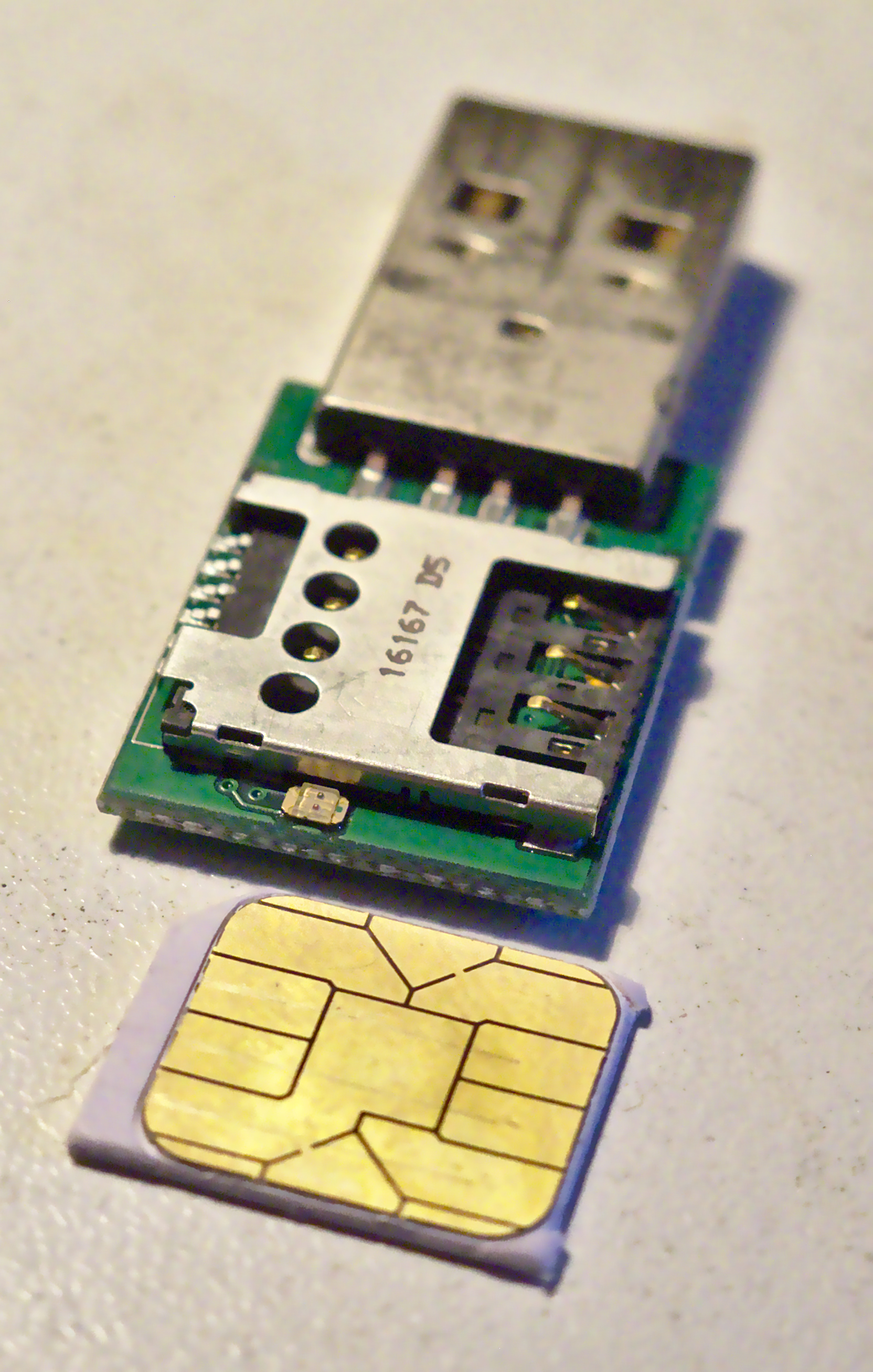
Open and closed designs The FST-01 is as open as hardware comes, down to the PCB design available as KiCad files in this Git repository. The software running on the card is the Gnuk firmware that implements the OpenPGP card protocol, but you can also get it with firmware implementing a true random number generator (TRNG) called NeuG (pronounced "noisy"); the device is programmable through a standard Serial Wire Debug (SWD) port. The Nitrokey Start model also runs the Gnuk firmware. However, the Nitrokey website announces only ECC and RSA 2048-bit support for the Start, while the FST-01 also supports RSA-4096. Nitrokey's founder Jan Suhr, in a private email, explained that this is because "Gnuk doesn't support RSA-3072 or larger at a reasonable speed". Its devices (the Pro, Start, and HSM models) use a similar chip to the FST-01: the STM32F103 microcontroller. Nitrokey Pro with STM32F103TBU6 MCU Nitrokey also publishes its hardware designs, on GitHub, which shows the Pro is basically a fork of the FST-01, according to the ChangeLog. I opened the case to confirm it was using the STM MCU, something I should warn you against; I broke one of the pins holding it together when opening it so now it's even more fragile. But at least, I was able to confirm it was built using the STM32F103TBU6 MCU, like the FST-01. Nitrokey back side But this is where the comparison ends: on the back side, we find a SIM card reader that holds the OpenPGP card that, in turn, holds the private key material and does the cryptographic operations. So, in effect, the Nitrokey Pro is really a evolution of the original OpenPGP card readers. Nitrokey confirmed the OpenPGP card featured in the Pro is the same as the one shipped by the Free Software Foundation Europe (FSFE): the BasicCard built by ZeitControl. Those cards, however, are covered by NDAs and the firmware is only partially open source. This makes the Nitrokey Pro less open than the FST-01, but that's an inevitable tradeoff when choosing a design based on the OpenPGP cards, which Suhr described to me as "pretty proprietary". There are other keycards out there, however, for example the SLJ52GDL150-150k smartcard suggested by Debian developer Yves-Alexis Perez, which he prefers as it is certified by French and German authorities. In that blog post, he also said he was experimenting with the GPL-licensed OpenPGP applet implemented by the French ANSSI. But the YubiKey devices are even further away in the closed-design direction. Both the hardware designs and firmware are proprietary. The YubiKey NEO, for example, cannot be upgraded at all, even though it is based on an open firmware. According to Yubico's FAQ, this is due to "best security practices": "There is a 'no upgrade' policy for our devices since nothing, including malware, can write to the firmware." I find this decision questionable in a context where security updates are often more important than trying to design a bulletproof design, which may simply be impossible. And the YubiKey NEO did suffer from critical security issue that allowed attackers to bypass the PIN protection on the card, which raises the question of the actual protection of the private key material on those cards. According to Niibe, "some OpenPGP cards store the private key unencrypted. It is a common attitude for many smartcard implementations", which was confirmed by Suhr: "the private key is protected by hardware mechanisms which prevent its extraction and misuse". He is referring to the use of tamper resistance. After that security issue, there was no other option for YubiKey NEO users than to get a new keycard (for free, thankfully) from Yubico, which also meant discarding the private key material on the key. For OpenPGP keys, this may mean having to bootstrap the web of trust from scratch if the keycard was responsible for the main certification key. But at least the NEO is running free software based on the OpenPGP card applet and the source is still available on GitHub. The YubiKey 4, on the other hand, is now closed source, which was controversial when the new model was announced last year. It led the main Linux Foundation system administrator, Konstantin Ryabitsev, to withdraw his endorsement of Yubico products. In response, Yubico argued that this approach was essential to the security of its devices, which are now based on "a secure chip, which has built-in countermeasures to mitigate a long list of attacks". In particular, it claims that:
A commercial-grade AVR or ARM controller is unfit to be used in a security product. In most cases, these controllers are easy to attack, from breaking in via a debug/JTAG/TAP port to probing memory contents. Various forms of fault injection and side-channel analysis are possible, sometimes allowing for a complete key recovery in a shockingly short period of time.
While I understand those concerns, they eventually come down to the trust you have in an organization. Not only do we have to trust Yubico, but also hardware manufacturers and designs they have chosen. Every step in the hidden supply chain is then trusted to make correct technical decisions and not introduce any backdoors. History, unfortunately, is not on Yubico's side: Snowden revealed the example of RSA security accepting what renowned cryptographer Bruce Schneier described as a "bribe" from the NSA to weaken its ECC implementation, by using the presumably backdoored Dual_EC_DRBG algorithm. What makes Yubico or its suppliers so different from RSA Security? Remember that RSA Security used to be an adamant opponent to the degradation of encryption standards, campaigning against the Clipper chip in the first crypto wars. Even if we trust the Yubico supply chain, how can we trust a closed design using what basically amounts to security through obscurity? Publicly auditable designs are an important tradition in cryptography, and that principle shouldn't stop when software is frozen into silicon. In fact, a critical vulnerability called ROCA disclosed recently affects closed "smartcards" like the YubiKey 4 and allows full private key recovery from the public key if the key was generated on a vulnerable keycard. When speaking with Ars Technica, the researchers outlined the importance of open designs and questioned the reliability of certification:
Our work highlights the dangers of keeping the design secret and the implementation closed-source, even if both are thoroughly analyzed and certified by experts. The lack of public information causes a delay in the discovery of flaws (and hinders the process of checking for them), thereby increasing the number of already deployed and affected devices at the time of detection.
This issue with open hardware designs seems to be recurring topic of conversation on the Gnuk mailing list. For example, there was a discussion in September 2017 regarding possible hardware vulnerabilities in the STM MCU that would allow extraction of encrypted key material from the key. Niibe referred to a talk presented at the WOOT 17 workshop, where Johannes Obermaier and Stefan Tatschner, from the Fraunhofer Institute, demonstrated attacks against the STMF0 family MCUs. It is still unclear if those attacks also apply to the older STMF1 design used in the FST-01, however. Furthermore, extracted private key material is still protected by user passphrase, but the Gnuk uses a weak key derivation function, so brute-forcing attacks may be possible. Fortunately, there is work in progress to make GnuPG hash the passphrase before sending it to the keycard, which should make such attacks harder if not completely pointless. When asked about the Yubico claims in a private email, Niibe did recognize that "it is true that there are more weak points in general purpose implementations than special implementations". During the last DebConf in Montreal, Niibe explained:
If you don't trust me, you should not buy from me. Source code availability is only a single factor: someone can maliciously replace the firmware to enable advanced attacks.
Niibe recommends to "build the firmware yourself", also saying the design of the FST-01 uses normal hardware that "everyone can replicate". Those advantages are hard to deny for a cryptographic system: using more generic components makes it harder for hostile parties to mount targeted attacks. A counter-argument here is that it can be difficult for a regular user to audit such designs, let alone physically build the device from scratch but, in a mailing list discussion, Debian developer Ian Jackson explained that:
You don't need to be able to validate it personally. The thing spooks most hate is discovery. Backdooring supposedly-free hardware is harder (more costly) because it comes with greater risk of discovery. To put it concretely: if they backdoor all of them, someone (not necessarily you) might notice. (Backdooring only yours involves messing with the shipping arrangements and so on, and supposes that you specifically are of interest.)
Since that, as far as we know, the STM microcontrollers are not backdoored, I would tend to favor those devices instead of proprietary ones, as such a backdoor would be more easily detectable than in a closed design. Even though physical attacks may be possible against those microcontrollers, in the end, if an attacker has physical access to a keycard, I consider the key compromised, even if it has the best chip on the market. In our email exchange, Niibe argued that "when a token is lost, it is better to revoke keys, even if the token is considered secure enough". So like any other device, physical compromise of tokens may mean compromise of the key and should trigger key-revocation procedures.

Algorithms and performance To establish reliable performance results, I wrote a benchmark program naively called crypto-bench that could produce comparable results between the different keys. The program takes each algorithm/keycard combination and runs 1000 decryptions of a 16-byte file (one AES-128 block) using GnuPG, after priming it to get the password cached. I assume the overhead of GnuPG calls to be negligible, as it should be the same across all tokens, so comparisons are possible. AES encryption is constant across all tests as it is always performed on the host and fast enough to be irrelevant in the tests. I used the following:
  • Intel(R) Core(TM) i3-6100U CPU @ 2.30GHz running Debian 9 ("stretch"/stable amd64), using GnuPG 2.1.18-6 (from the stable Debian package)
  • Nitrokey Pro 0.8 (latest firmware)
  • FST-01, running Gnuk version 1.2.5 (latest firmware)
  • YubiKey NEO OpenPGP applet 1.0.10 (not upgradable)
  • YubiKey 4 4.2.6 (not upgradable)
I ran crypto-bench for each keycard, which resulted in the following:
Algorithm Device Mean time (s)
ECDH-Curve25519 CPU 0.036
FST-01 0.135
RSA-2048 CPU 0.016
YubiKey-4 0.162
Nitrokey-Pro 0.610
YubiKey-NEO 0.736
FST-01 1.265
RSA-4096 CPU 0.043
YubiKey-4 0.875
Nitrokey-Pro 3.150
FST-01 8.218
Decryption graph There we see the performance of the four keycards I tested, compared with the same operations done without a keycard: the "CPU" device. That provides the baseline time of GnuPG decrypting the file. The first obvious observation is that using a keycard is slower: in the best scenario (FST-01 + ECC) we see a four-fold slowdown, but in the worst case (also FST-01, but RSA-4096), we see a catastrophic 200-fold slowdown. When I presented the results on the Gnuk mailing list, GnuPG developer Werner Koch confirmed those "numbers are as expected":
With a crypto chip RSA is much faster. By design the Gnuk can't be as fast - it is just a simple MCU. However, using Curve25519 Gnuk is really fast.
And yes, the FST-01 is really fast at doing ECC, but it's also the only keycard that handles ECC in my tests; the Nitrokey Start and Nitrokey HSM should support it as well, but I haven't been able to test those devices. Also note that the YubiKey NEO doesn't support RSA-4096 at all, so we can only compare RSA-2048 across keycards. We should note, however, that ECC is slower than RSA on the CPU, which suggests the Gnuk ECC implementation used by the FST-01 is exceptionally fast. In discussions about improving the performance of the FST-01, Niibe estimated the user tolerance threshold to be "2 seconds decryption time". In a new design using the STM32L432 microcontroller, Aurelien Jarno was able to bring the numbers for RSA-2048 decryption from 1.27s down to 0.65s, and for RSA-4096, from 8.22s down to 3.87s seconds. RSA-4096 is still beyond the two-second threshold, but at least it brings the FST-01 close to the YubiKey NEO and Nitrokey Pro performance levels. We should also underline the superior performance of the YubiKey 4: whatever that thing is doing, it's doing it faster than anyone else. It does RSA-4096 faster than the FST-01 does RSA-2048, and almost as fast as the Nitrokey Pro does RSA-2048. We should also note that the Nitrokey Pro also fails to cross the two-second threshold for RSA-4096 decryption. For me, the FST-01's stellar performance with ECC outshines the other devices. Maybe it says more about the efficiency of the algorithm than the FST-01 or Gnuk's design, but it's definitely an interesting avenue for people who want to deploy those modern algorithms. So, in terms of performance, it is clear that both the YubiKey 4 and the FST-01 take the prize in their own areas (RSA and ECC, respectively).

Conclusion In the above presentation, I have evaluated four cryptographic keycards for use with various OpenPGP operations. What the results show is that the only efficient way of storing a 4096-bit encryption key on a keycard would be to use the YubiKey 4. Unfortunately, I do not feel we should put our trust in such closed designs so I would argue you should either stick with 2048-bit encryption subkeys or keep the keys on disk. Considering that losing such a key would be catastrophic, this might be a good approach anyway. You should also consider switching to ECC encryption: even though it may not be supported everywhere, GnuPG supports having multiple encryption subkeys on a keyring: if one algorithm is unsupported (e.g. GnuPG 1.4 doesn't support ECC), it will fall back to a supported algorithm (e.g. RSA). Do not forget your previously encrypted material doesn't magically re-encrypt itself using your new encryption subkey, however. For authentication and signing keys, speed is not such an issue, so I would warmly recommend either the Nitrokey Pro or Start, or the FST-01, depending on whether you want to start experimenting with ECC algorithms. Availability also seems to be an issue for the FST-01. While you can generally get the device when you meet Niibe in person for a few bucks (I bought mine for around \$30 Canadian), the Seeed online shop says the device is out of stock at the time of this writing, even though Jonathan McDowell said that may be inaccurate in a debian-project discussion. Nevertheless, this issue may make the Nitrokey devices more attractive. When deciding on using the Pro or Start, Suhr offered the following advice:
In practice smart card security has been proven to work well (at least if you use a decent smart card). Therefore the Nitrokey Pro should be used for high security cases. If you don't trust the smart card or if Nitrokey Start is just sufficient for you, you can choose that one. This is why we offer both models.
So far, I have created a signing subkey and moved that and my authentication key to the YubiKey NEO, because it's a device I physically trust to keep itself together in my pockets and I was already using it. It has served me well so far, especially with its extra features like U2F and HOTP support, which I use frequently. Those features are also available on the Nitrokey Pro, so that may be an alternative if I lose the YubiKey. I will probably move my main certification key to the FST-01 and a LUKS-encrypted USB disk, to keep that certification key offline but backed up on two different devices. As for the encryption key, I'll wait for keycard performance to improve, or simply switch my whole keyring to ECC and use the FST-01 or Nitrokey Start for that purpose.
[The author would like to thank Nitrokey for providing hardware for testing.] This article first appeared in the Linux Weekly News.

16 October 2017

Iain R. Learmonth: No more no surprises

Debian has generally always had, as a rule, sane defaults and no surprises . This was completely shattered for me when Vim decided to hijack the mouse from my terminal and break all copy/paste functionality. This has occured since the release of Debian 9. I expect for my terminal to behave consistently, and this is broken every time I log in to a Debian 9 system where I have not configured Vim to disable this functionality. I also see I m not alone in this frustration. To fix this, in your .vimrc:
if !has("gui_running")
  set mouse=
endif
(This will check to see if your using GVim or similar, where it would be reasonable to expect the mouse to work.) This is perhaps not aggresive enough though. I never want to have console applications trying to use the mouse. I ve configured rxvt to do things like open URLs in Firefox, etc. that I always want to work, and I always want my local clipboard to be used so I can copy/paste between remote machines. I ve found a small patch that would appear to disable mouse reporting for rxvt, but unfortunately I cannot do this through an Xresources option. If someone is looking for something to do for Hacktoberfest, I d love to see this be an option for rxvt without re-compiling:
diff --git a/src/rxvt.h b/src/rxvt.h
index 5c7cf66..2751ba3 100644
--- a/src/rxvt.h
+++ b/src/rxvt.h
@@ -646,7 +646,7 @@ enum  
 #define PrivMode_ExtMouseRight  (1UL<<24) // xterm pseudo-utf-8, but works in non-utf-8-locales
 #define PrivMode_BlinkingCursor (1UL<<25)
 
-#define PrivMode_mouse_report   (PrivMode_MouseX10 PrivMode_MouseX11 PrivMode_MouseBtnEvent PrivMode_MouseAnyEvent)
+#define PrivMode_mouse_report   0 /* (PrivMode_MouseX10 PrivMode_MouseX11 PrivMode_MouseBtnEvent PrivMode_MouseAnyEvent) */
 
 #ifdef ALLOW_132_MODE
 # define PrivMode_Default (PrivMode_Autowrap PrivMode_ShiftKeys PrivMode_VisibleCursor PrivMode_132OK)

Next.

Previous.