Russ Allbery: Review: Thud!
| Series: | Discworld #34 |
| Publisher: | Harper |
| Copyright: | October 2005 |
| Printing: | November 2014 |
| ISBN: | 0-06-233498-0 |
| Format: | Mass market |
| Pages: | 434 |
| Series: | Discworld #34 |
| Publisher: | Harper |
| Copyright: | October 2005 |
| Printing: | November 2014 |
| ISBN: | 0-06-233498-0 |
| Format: | Mass market |
| Pages: | 434 |
| Series: | Divide #2 |
| Publisher: | Tor |
| Copyright: | 2021 |
| ISBN: | 1-250-23635-5 |
| Format: | Kindle |
| Pages: | 421 |
I've finally landed a patch/feature for HLedger I've been working on-and-off
(mostly off) since around March.
HLedger has a powerful CSV importer which you configure with a set of rules.
Rules consist of conditional matchers (does field X in this CSV row match
this regular expression?) and field assignments (set the resulting
transaction's account to Y).
motivating problem 1
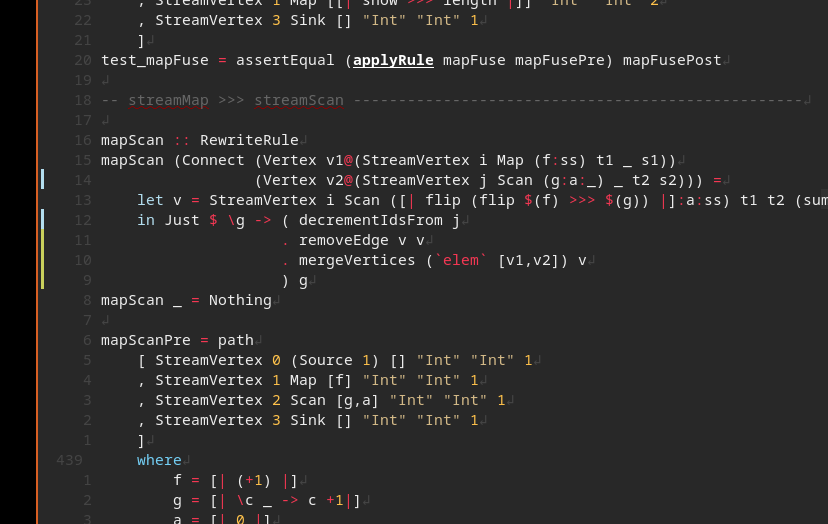
Here's an example of one of my rules for handling credit card repayments. This
rule is applied when I import a CSV for my current account, which pays the
credit card:
if AMERICAN EXPRESS
account2 liabilities:amex
This results in a ledger entry like the following
2023-10-31 AMERICAN EXPRESS
assets:current - 6.66
liabilities:amex 6.66
My current account statements cover calendar months. My credit card period
spans mid-month to mid-month. I pay it off by direct debit, which comes out
after the credit card period, towards the very end of the calendar month.
That transaction falls roughly halfway through the next credit card period.
On my credit card statements, that repayment is "warped" to the start of the
list of transactions, clearing the outstanding balance from the previous
period.
When I import my credit card data to HLedger, I want to compare the result
against a PDF statement to make sure my ledger matches reality. The repayment
"warping" makes this awkward, because it means the balance for roughly half
the new transactions (those that fall before the real-date of the repayment)
don't match up.
motivating problem 2
I start new ledger files each year. I need to import the
closing balances from the previous year to the next, which I do by exporting
the final balance from the previous year in CSV and importing that into the
new ledgers in the usual way.
Between 2022 and 2023 I changed the scheme I use for account
names so I need to translate between the old and the new in
the opening balances. I couldn't think of a way of achieving this in the
import rules (besides writing a bespoke rule for every possible old account
name) so I abused another HLedger feature instead, HLedger
aliases. For example
I added this alias in my family ledger file for 2023
alias /^family:(.*)/ = \1
These are ugly and I'd prefer to get rid of them.
regex match groups
A common feature of regular expressions is defining match groups which can
be referenced elsewhere, such as on the far-side of a substitution. I added
match group support to HLedger's field assignments.
addressing date warping
Here's an updated version rule from the first motivating problem:
if AMERICAN EXPRESS
& %date (..)/(..)/(....)
account2 liabilities:amex
comment2 date:\3-\2-16
We now match on on extra date field, and surround the day/month/year components
with parentheses to define match groups. We add a second field assignment too,
setting the second posting's "comment" field to a string which, once the match
groups are interpolated, instructs HLedger to do date warping (I wrote about
this in date warping in HLedger)
The new transaction looks like this:
2023-10-31 AMERICAN EXPRESS
assets:current - 6.66
liabilities:amex 6.66 ; date:2023-10-16
getting rid of aliases
In the second problem, I can strip off the unwanted account name prefixes at
CSV import time, with rules like this
if %account2 ^family:(.*)$
account2 \1
When!
This stuff landed a week ago in early November, and is not yet in a Hledger release.
252. This version includes the following changes:
* As UI/UX improvement, try and avoid printing an extended traceback if
diffoscope runs out of memory. This may not always be possible to detect.
* Mark diffoscope as stable in setup.py (for PyPI.org). Whatever diffoscope
is, at least, not "alpha" anymore.
![]() |
| Photo by Pixabay |
Given a typical install of 3 generic kernel ABIs in the default configuration on a regular-sized VM (2 CPU cores 8GB of RAM) the following metrics are achieved in Ubuntu 23.10 versus Ubuntu 22.04 LTS:
2x less disk space used (1,417MB vs 2,940MB, including initrd)
3x less peak RAM usage for the initrd boot (68MB vs 204MB)
0.5x increase in download size (949MB vs 600MB)
2.5x faster initrd generation (4.5s vs 11.3s)
approximately the same total time (103s vs 98s, hardware dependent)
For minimal cloud images that do not install either linux-firmware or modules extra the numbers are:
1.3x less disk space used (548MB vs 742MB)
2.2x less peak RAM usage for initrd boot (27MB vs 62MB)
0.4x increase in download size (207MB vs 146MB)
Hopefully, the compromise of download size, relative to the disk space & initrd savings is a win for the majority of platforms and use cases. For users on extremely expensive and metered connections, the likely best saving is to receive air-gapped updates or skip updates.
This was achieved by precompressing kernel modules & firmware files with the maximum level of Zstd compression at package build time; making actual .deb files uncompressed; assembling the initrd using split cpio archives - uncompressed for the pre-compressed files, whilst compressing only the userspace portions of the initrd; enabling in-kernel module decompression support with matching kmod; fixing bugs in all of the above, and landing all of these things in time for the feature freeze. Whilst leveraging the experience and some of the design choices implementations we have already been shipping on Ubuntu Core. Some of these changes are backported to Jammy, but only enough to support smooth upgrades to Mantic and later. Complete gains are only possible to experience on Mantic and later.
The discovered bugs in kernel module loading code likely affect systems that use LoadPin LSM with kernel space module uncompression as used on ChromeOS systems. Hopefully, Kees Cook or other ChromeOS developers pick up the kernel fixes from the stable trees. Or you know, just use Ubuntu kernels as they do get fixes and features like these first.
The team that designed and delivered these changes is large: Benjamin Drung, Andrea Righi, Juerg Haefliger, Julian Andres Klode, Steve Langasek, Michael Hudson-Doyle, Robert Kratky, Adrien Nader, Tim Gardner, Roxana Nicolescu - and myself Dimitri John Ledkov ensuring the most optimal solution is implemented, everything lands on time, and even implementing portions of the final solution.
Hi, It's me, I am a Staff Engineer at Canonical and we are hiring https://canonical.com/careers.
Lots of additional technical details and benchmarks on a huge range of diverse hardware and architectures, and bikeshedding all the things below:
A lot of time has passed since my previous post on my work to make dhcpcd the drop-in replacement for the deprecated ISC dhclient a.k.a. isc-dhcp-client. Current status:

Like each month, have a look at the work funded by Freexian s Debian LTS offering.
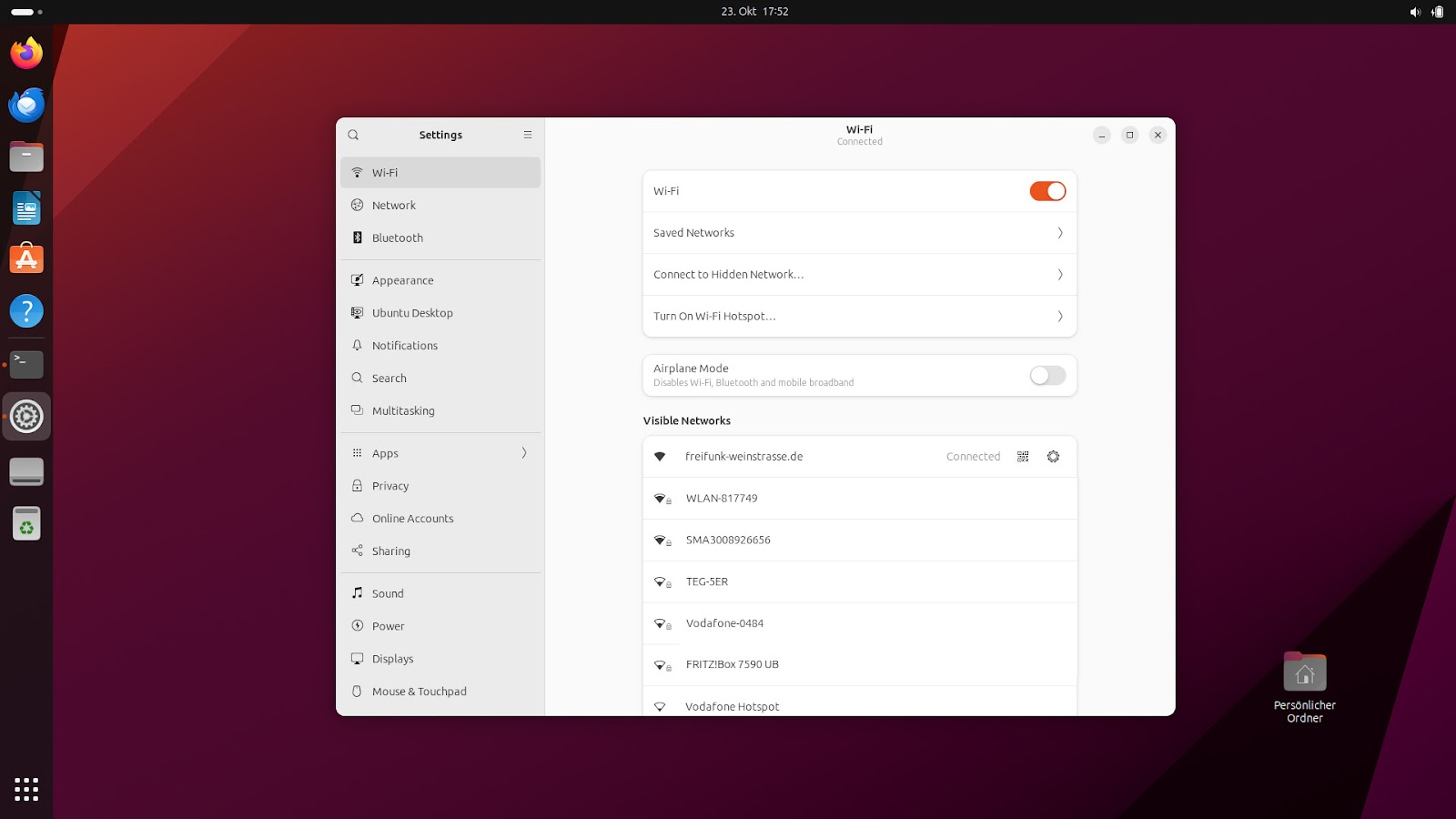
Ubuntu 23.10 Mantic Minotaur Desktop, showing network settings
We released Ubuntu 23.10 Mantic Minotaur on 12 October 2023, shipping its proven and trusted network stack based on Netplan. Netplan is the default tool to configure Linux networking on Ubuntu since 2016. In the past, it was primarily used to control the Server and Cloud variants of Ubuntu, while on Desktop systems it would hand over control to NetworkManager. In Ubuntu 23.10 this disparity in how to control the network stack on different Ubuntu platforms was closed by integrating NetworkManager with the underlying Netplan stack.
Netplan could already be used to describe network connections on Desktop systems managed by NetworkManager. But network connections created or modified through NetworkManager would not be known to Netplan, so it was a one-way street. Activating the bidirectional NetworkManager-Netplan integration allows for any configuration change made through NetworkManager to be propagated back into Netplan. Changes made in Netplan itself will still be visible in NetworkManager, as before. This way, Netplan can be considered the single source of truth for network configuration across all variants of Ubuntu, with the network configuration stored in /etc/netplan/, using Netplan s common and declarative YAML format.
/etc/netplan/. This way, the only thing administrators need to care about when managing a fleet of Desktop installations is Netplan. Furthermore, programmatic access to all network configuration is now easily accessible to other system components integrating with Netplan, such as snapd. This solution has already been used in more confined environments, such as Ubuntu Core and is now enabled by default on Ubuntu 23.10 Desktop.
/etc/NetworkManager/system-connections/ will automatically and transparently be migrated to Netplan s declarative YAML format and stored in its common configuration directory /etc/netplan/.
The same migration will happen in the background whenever you add or modify any connection profile through the NetworkManager user interface, integrated with GNOME Shell. From this point on, Netplan will be aware of your entire network configuration and you can query it using its CLI tools, such as sudo netplan get or sudo netplan status without interrupting traditional NetworkManager workflows (UI, nmcli, nmtui, D-Bus APIs). You can observe this migration on the apt-get command line, watching out for logs like the following:
Setting up network-manager (1.44.2-1ubuntu1.1) ...
Migrating HomeNet (9d087126-ae71-4992-9e0a-18c5ea92a4ed) to /etc/netplan
Migrating eduroam (37d643bb-d81d-4186-9402-7b47632c59b1) to /etc/netplan
Migrating DebConf (f862be9c-fb06-4c0f-862f-c8e210ca4941) to /etc/netplan
In order to prepare for a smooth transition, NetworkManager tests were integrated into Netplan s continuous integration pipeline at the upstream GitHub repository. Furthermore, we implemented a passthrough method of handling unknown or new settings that cannot yet be fully covered by Netplan, making Netplan future-proof for any upcoming NetworkManager release.
15 years, "la ni a bonita", if you ask many of my fellow argentinians, is the amount of time I haven't been present in any Debian-related face to face activity. It was already time to fix that. Thanks to Santiago Ruano Rinc n and Gunnar Wolf that proded me to come I finally attended the Mini DebConf Uruguay in Montevideo.
I took the opportunity to do my first trip by ferry, which is currently one of the best options to get from Buenos Aires to Montevideo, in my case through Colonia. Living ~700km at the south west of Buenos Aires city the trip was long, it included a 10 hours bus, a ferry and yet another bus... but of course, it was worth it.
In Buenos Aires' port I met Emmanuel eamanu Arias, a fellow Argentinian Debian Developer from La Rioja, so I had the pleasure to travel with him.
To be honest Gunnar already did a wonderful blog post with many pictures, I should have taken more.
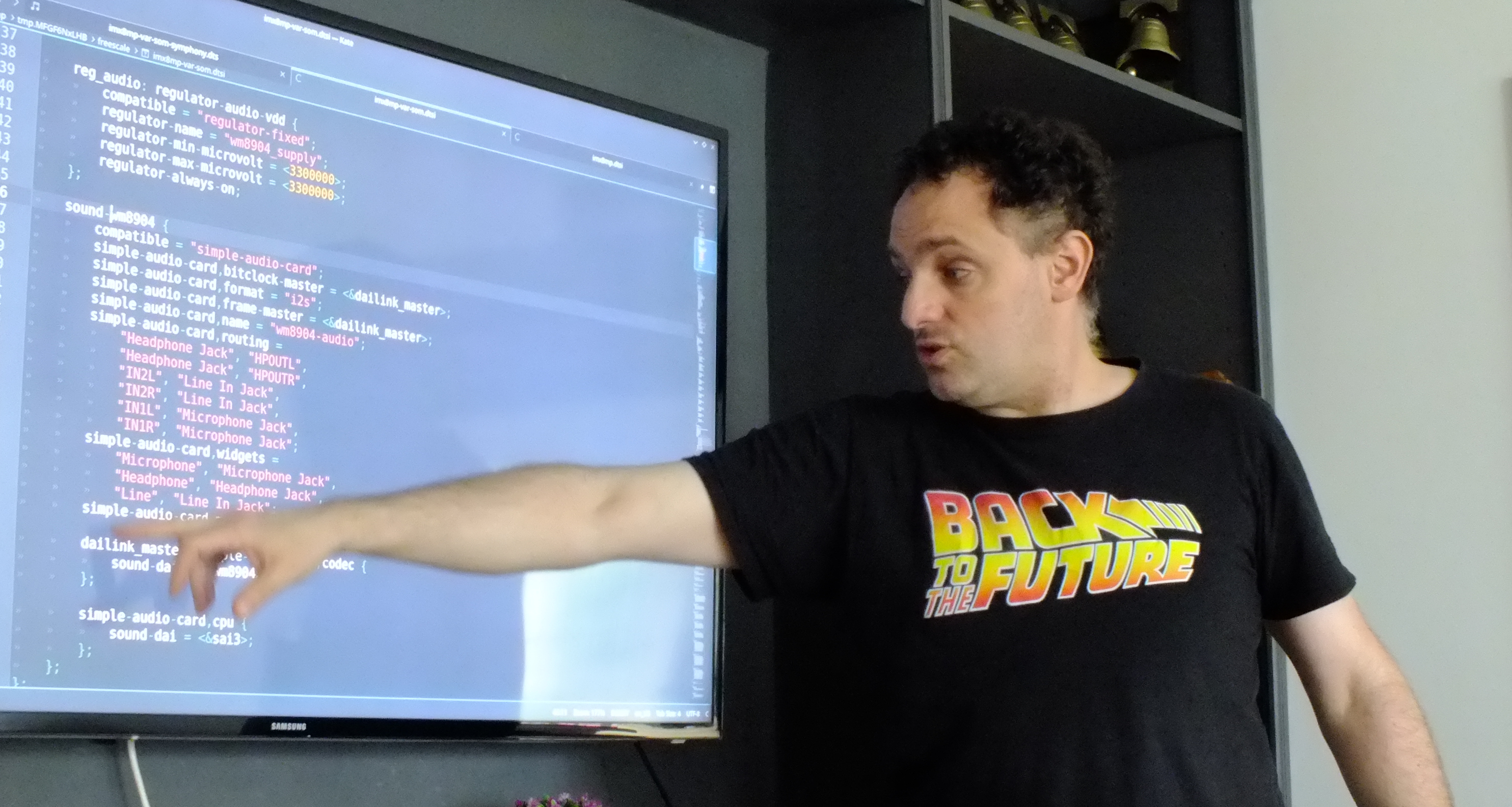
I had the opportunity to talk about device trees, and even look at Gunnar's machine one in order to find why a Display Port port was not working on a kernel but did in another. At the same time I also had time to start packaging qt6-grpc. Sadly I was there just one entire day, as I arrived on Thursday afternoon and had to leave on Saturday after lunch, but we did have a lot of quality Debian time.
I'll repeat here what Gunnar already wrote:
We had a long, important conversation about an important discussion that we are about to present on debian-vote@lists.debian.org.
Stay tuned on that, I think this is something we should all get involved.
All in all I already miss hacking with people on the same room. Meetings for us mean a lot of distance to be traveled (well, I live far away of almost everything), but I really should try to this more often. Certainly more than just once every 15 years :-)
/usr/bin/jq -r '."key"' ~/.config/Signal/config.jsonAssuming the result from that command is 'secretkey', which is a hexadecimal number representing the key used to encrypt the database. Next, one can now connect to the database and inject the encryption key for access via SQL to fetch information from the database. Here is an example dumping the database structure:
% sqlcipher ~/.config/Signal/sql/db.sqlite
sqlite> PRAGMA key = "x'secretkey'";
sqlite> .schema
CREATE TABLE sqlite_stat1(tbl,idx,stat);
CREATE TABLE conversations(
id STRING PRIMARY KEY ASC,
json TEXT,
active_at INTEGER,
type STRING,
members TEXT,
name TEXT,
profileName TEXT
, profileFamilyName TEXT, profileFullName TEXT, e164 TEXT, serviceId TEXT, groupId TEXT, profileLastFetchedAt INTEGER);
CREATE TABLE identityKeys(
id STRING PRIMARY KEY ASC,
json TEXT
);
CREATE TABLE items(
id STRING PRIMARY KEY ASC,
json TEXT
);
CREATE TABLE sessions(
id TEXT PRIMARY KEY,
conversationId TEXT,
json TEXT
, ourServiceId STRING, serviceId STRING);
CREATE TABLE attachment_downloads(
id STRING primary key,
timestamp INTEGER,
pending INTEGER,
json TEXT
);
CREATE TABLE sticker_packs(
id TEXT PRIMARY KEY,
key TEXT NOT NULL,
author STRING,
coverStickerId INTEGER,
createdAt INTEGER,
downloadAttempts INTEGER,
installedAt INTEGER,
lastUsed INTEGER,
status STRING,
stickerCount INTEGER,
title STRING
, attemptedStatus STRING, position INTEGER DEFAULT 0 NOT NULL, storageID STRING, storageVersion INTEGER, storageUnknownFields BLOB, storageNeedsSync
INTEGER DEFAULT 0 NOT NULL);
CREATE TABLE stickers(
id INTEGER NOT NULL,
packId TEXT NOT NULL,
emoji STRING,
height INTEGER,
isCoverOnly INTEGER,
lastUsed INTEGER,
path STRING,
width INTEGER,
PRIMARY KEY (id, packId),
CONSTRAINT stickers_fk
FOREIGN KEY (packId)
REFERENCES sticker_packs(id)
ON DELETE CASCADE
);
CREATE TABLE sticker_references(
messageId STRING,
packId TEXT,
CONSTRAINT sticker_references_fk
FOREIGN KEY(packId)
REFERENCES sticker_packs(id)
ON DELETE CASCADE
);
CREATE TABLE emojis(
shortName TEXT PRIMARY KEY,
lastUsage INTEGER
);
CREATE TABLE messages(
rowid INTEGER PRIMARY KEY ASC,
id STRING UNIQUE,
json TEXT,
readStatus INTEGER,
expires_at INTEGER,
sent_at INTEGER,
schemaVersion INTEGER,
conversationId STRING,
received_at INTEGER,
source STRING,
hasAttachments INTEGER,
hasFileAttachments INTEGER,
hasVisualMediaAttachments INTEGER,
expireTimer INTEGER,
expirationStartTimestamp INTEGER,
type STRING,
body TEXT,
messageTimer INTEGER,
messageTimerStart INTEGER,
messageTimerExpiresAt INTEGER,
isErased INTEGER,
isViewOnce INTEGER,
sourceServiceId TEXT, serverGuid STRING NULL, sourceDevice INTEGER, storyId STRING, isStory INTEGER
GENERATED ALWAYS AS (type IS 'story'), isChangeCreatedByUs INTEGER NOT NULL DEFAULT 0, isTimerChangeFromSync INTEGER
GENERATED ALWAYS AS (
json_extract(json, '$.expirationTimerUpdate.fromSync') IS 1
), seenStatus NUMBER default 0, storyDistributionListId STRING, expiresAt INT
GENERATED ALWAYS
AS (ifnull(
expirationStartTimestamp + (expireTimer * 1000),
9007199254740991
)), shouldAffectActivity INTEGER
GENERATED ALWAYS AS (
type IS NULL
OR
type NOT IN (
'change-number-notification',
'contact-removed-notification',
'conversation-merge',
'group-v1-migration',
'keychange',
'message-history-unsynced',
'profile-change',
'story',
'universal-timer-notification',
'verified-change'
)
), shouldAffectPreview INTEGER
GENERATED ALWAYS AS (
type IS NULL
OR
type NOT IN (
'change-number-notification',
'contact-removed-notification',
'conversation-merge',
'group-v1-migration',
'keychange',
'message-history-unsynced',
'profile-change',
'story',
'universal-timer-notification',
'verified-change'
)
), isUserInitiatedMessage INTEGER
GENERATED ALWAYS AS (
type IS NULL
OR
type NOT IN (
'change-number-notification',
'contact-removed-notification',
'conversation-merge',
'group-v1-migration',
'group-v2-change',
'keychange',
'message-history-unsynced',
'profile-change',
'story',
'universal-timer-notification',
'verified-change'
)
), mentionsMe INTEGER NOT NULL DEFAULT 0, isGroupLeaveEvent INTEGER
GENERATED ALWAYS AS (
type IS 'group-v2-change' AND
json_array_length(json_extract(json, '$.groupV2Change.details')) IS 1 AND
json_extract(json, '$.groupV2Change.details[0].type') IS 'member-remove' AND
json_extract(json, '$.groupV2Change.from') IS NOT NULL AND
json_extract(json, '$.groupV2Change.from') IS json_extract(json, '$.groupV2Change.details[0].aci')
), isGroupLeaveEventFromOther INTEGER
GENERATED ALWAYS AS (
isGroupLeaveEvent IS 1
AND
isChangeCreatedByUs IS 0
), callId TEXT
GENERATED ALWAYS AS (
json_extract(json, '$.callId')
));
CREATE TABLE sqlite_stat4(tbl,idx,neq,nlt,ndlt,sample);
CREATE TABLE jobs(
id TEXT PRIMARY KEY,
queueType TEXT STRING NOT NULL,
timestamp INTEGER NOT NULL,
data STRING TEXT
);
CREATE TABLE reactions(
conversationId STRING,
emoji STRING,
fromId STRING,
messageReceivedAt INTEGER,
targetAuthorAci STRING,
targetTimestamp INTEGER,
unread INTEGER
, messageId STRING);
CREATE TABLE senderKeys(
id TEXT PRIMARY KEY NOT NULL,
senderId TEXT NOT NULL,
distributionId TEXT NOT NULL,
data BLOB NOT NULL,
lastUpdatedDate NUMBER NOT NULL
);
CREATE TABLE unprocessed(
id STRING PRIMARY KEY ASC,
timestamp INTEGER,
version INTEGER,
attempts INTEGER,
envelope TEXT,
decrypted TEXT,
source TEXT,
serverTimestamp INTEGER,
sourceServiceId STRING
, serverGuid STRING NULL, sourceDevice INTEGER, receivedAtCounter INTEGER, urgent INTEGER, story INTEGER);
CREATE TABLE sendLogPayloads(
id INTEGER PRIMARY KEY ASC,
timestamp INTEGER NOT NULL,
contentHint INTEGER NOT NULL,
proto BLOB NOT NULL
, urgent INTEGER, hasPniSignatureMessage INTEGER DEFAULT 0 NOT NULL);
CREATE TABLE sendLogRecipients(
payloadId INTEGER NOT NULL,
recipientServiceId STRING NOT NULL,
deviceId INTEGER NOT NULL,
PRIMARY KEY (payloadId, recipientServiceId, deviceId),
CONSTRAINT sendLogRecipientsForeignKey
FOREIGN KEY (payloadId)
REFERENCES sendLogPayloads(id)
ON DELETE CASCADE
);
CREATE TABLE sendLogMessageIds(
payloadId INTEGER NOT NULL,
messageId STRING NOT NULL,
PRIMARY KEY (payloadId, messageId),
CONSTRAINT sendLogMessageIdsForeignKey
FOREIGN KEY (payloadId)
REFERENCES sendLogPayloads(id)
ON DELETE CASCADE
);
CREATE TABLE preKeys(
id STRING PRIMARY KEY ASC,
json TEXT
, ourServiceId NUMBER
GENERATED ALWAYS AS (json_extract(json, '$.ourServiceId')));
CREATE TABLE signedPreKeys(
id STRING PRIMARY KEY ASC,
json TEXT
, ourServiceId NUMBER
GENERATED ALWAYS AS (json_extract(json, '$.ourServiceId')));
CREATE TABLE badges(
id TEXT PRIMARY KEY,
category TEXT NOT NULL,
name TEXT NOT NULL,
descriptionTemplate TEXT NOT NULL
);
CREATE TABLE badgeImageFiles(
badgeId TEXT REFERENCES badges(id)
ON DELETE CASCADE
ON UPDATE CASCADE,
'order' INTEGER NOT NULL,
url TEXT NOT NULL,
localPath TEXT,
theme TEXT NOT NULL
);
CREATE TABLE storyReads (
authorId STRING NOT NULL,
conversationId STRING NOT NULL,
storyId STRING NOT NULL,
storyReadDate NUMBER NOT NULL,
PRIMARY KEY (authorId, storyId)
);
CREATE TABLE storyDistributions(
id STRING PRIMARY KEY NOT NULL,
name TEXT,
senderKeyInfoJson STRING
, deletedAtTimestamp INTEGER, allowsReplies INTEGER, isBlockList INTEGER, storageID STRING, storageVersion INTEGER, storageUnknownFields BLOB, storageNeedsSync INTEGER);
CREATE TABLE storyDistributionMembers(
listId STRING NOT NULL REFERENCES storyDistributions(id)
ON DELETE CASCADE
ON UPDATE CASCADE,
serviceId STRING NOT NULL,
PRIMARY KEY (listId, serviceId)
);
CREATE TABLE uninstalled_sticker_packs (
id STRING NOT NULL PRIMARY KEY,
uninstalledAt NUMBER NOT NULL,
storageID STRING,
storageVersion NUMBER,
storageUnknownFields BLOB,
storageNeedsSync INTEGER NOT NULL
);
CREATE TABLE groupCallRingCancellations(
ringId INTEGER PRIMARY KEY,
createdAt INTEGER NOT NULL
);
CREATE TABLE IF NOT EXISTS 'messages_fts_data'(id INTEGER PRIMARY KEY, block BLOB);
CREATE TABLE IF NOT EXISTS 'messages_fts_idx'(segid, term, pgno, PRIMARY KEY(segid, term)) WITHOUT ROWID;
CREATE TABLE IF NOT EXISTS 'messages_fts_content'(id INTEGER PRIMARY KEY, c0);
CREATE TABLE IF NOT EXISTS 'messages_fts_docsize'(id INTEGER PRIMARY KEY, sz BLOB);
CREATE TABLE IF NOT EXISTS 'messages_fts_config'(k PRIMARY KEY, v) WITHOUT ROWID;
CREATE TABLE edited_messages(
messageId STRING REFERENCES messages(id)
ON DELETE CASCADE,
sentAt INTEGER,
readStatus INTEGER
, conversationId STRING);
CREATE TABLE mentions (
messageId REFERENCES messages(id) ON DELETE CASCADE,
mentionAci STRING,
start INTEGER,
length INTEGER
);
CREATE TABLE kyberPreKeys(
id STRING PRIMARY KEY NOT NULL,
json TEXT NOT NULL, ourServiceId NUMBER
GENERATED ALWAYS AS (json_extract(json, '$.ourServiceId')));
CREATE TABLE callsHistory (
callId TEXT PRIMARY KEY,
peerId TEXT NOT NULL, -- conversation id (legacy) uuid groupId roomId
ringerId TEXT DEFAULT NULL, -- ringer uuid
mode TEXT NOT NULL, -- enum "Direct" "Group"
type TEXT NOT NULL, -- enum "Audio" "Video" "Group"
direction TEXT NOT NULL, -- enum "Incoming" "Outgoing
-- Direct: enum "Pending" "Missed" "Accepted" "Deleted"
-- Group: enum "GenericGroupCall" "OutgoingRing" "Ringing" "Joined" "Missed" "Declined" "Accepted" "Deleted"
status TEXT NOT NULL,
timestamp INTEGER NOT NULL,
UNIQUE (callId, peerId) ON CONFLICT FAIL
);
[ dropped all indexes to save space in this blog post ]
CREATE TRIGGER messages_on_view_once_update AFTER UPDATE ON messages
WHEN
new.body IS NOT NULL AND new.isViewOnce = 1
BEGIN
DELETE FROM messages_fts WHERE rowid = old.rowid;
END;
CREATE TRIGGER messages_on_insert AFTER INSERT ON messages
WHEN new.isViewOnce IS NOT 1 AND new.storyId IS NULL
BEGIN
INSERT INTO messages_fts
(rowid, body)
VALUES
(new.rowid, new.body);
END;
CREATE TRIGGER messages_on_delete AFTER DELETE ON messages BEGIN
DELETE FROM messages_fts WHERE rowid = old.rowid;
DELETE FROM sendLogPayloads WHERE id IN (
SELECT payloadId FROM sendLogMessageIds
WHERE messageId = old.id
);
DELETE FROM reactions WHERE rowid IN (
SELECT rowid FROM reactions
WHERE messageId = old.id
);
DELETE FROM storyReads WHERE storyId = old.storyId;
END;
CREATE VIRTUAL TABLE messages_fts USING fts5(
body,
tokenize = 'signal_tokenizer'
);
CREATE TRIGGER messages_on_update AFTER UPDATE ON messages
WHEN
(new.body IS NULL OR old.body IS NOT new.body) AND
new.isViewOnce IS NOT 1 AND new.storyId IS NULL
BEGIN
DELETE FROM messages_fts WHERE rowid = old.rowid;
INSERT INTO messages_fts
(rowid, body)
VALUES
(new.rowid, new.body);
END;
CREATE TRIGGER messages_on_insert_insert_mentions AFTER INSERT ON messages
BEGIN
INSERT INTO mentions (messageId, mentionAci, start, length)
SELECT messages.id, bodyRanges.value ->> 'mentionAci' as mentionAci,
bodyRanges.value ->> 'start' as start,
bodyRanges.value ->> 'length' as length
FROM messages, json_each(messages.json ->> 'bodyRanges') as bodyRanges
WHERE bodyRanges.value ->> 'mentionAci' IS NOT NULL
AND messages.id = new.id;
END;
CREATE TRIGGER messages_on_update_update_mentions AFTER UPDATE ON messages
BEGIN
DELETE FROM mentions WHERE messageId = new.id;
INSERT INTO mentions (messageId, mentionAci, start, length)
SELECT messages.id, bodyRanges.value ->> 'mentionAci' as mentionAci,
bodyRanges.value ->> 'start' as start,
bodyRanges.value ->> 'length' as length
FROM messages, json_each(messages.json ->> 'bodyRanges') as bodyRanges
WHERE bodyRanges.value ->> 'mentionAci' IS NOT NULL
AND messages.id = new.id;
END;
sqlite>
Finally I have the tool needed to inspect and process Signal
messages that I need, without using the vendor provided client. Now
on to transforming it to a more useful format.
As usual, if you use Bitcoin and want to show your support of my
activities, please send Bitcoin donations to my address
15oWEoG9dUPovwmUL9KWAnYRtNJEkP1u1b.
Meeting Debian people for having a good time together, for some good hacking,
for learning, for teaching Is always fun and welcome. It brings energy, life
and joy. And this year, due to the six-months-long relocation my family and me
decided to have to Argentina, I was unable to attend the real deal, DebConf23 at
India.
And while I know DebConf is an experience like no other, this year I took part
in two miniDebConfs. One I have already shared in this same blog: I was in
MiniDebConf Tamil Nadu in
India, followed by
some days of pre-DebConf preparation and scouting in Kochi proper, where I got
to interact with the absolutely great and loving team that prepared DebConf.
The other one is still ongoing (but close to finishing). Some months ago, I
talked with Santiago Ruano, jokin as we were Spanish-speaking DDs announcing to
the debian-private mailing list we d be relocating to around R o de la
Plata. And things worked out normally: He has been for several months in
Uruguay already, so he decided to rent a house for some days, and invite Debian
people to do what we do best.
I left Paran Tuesday night (and missed my online class at UNAM! Well, you
cannot have everything, right?). I arrived early on Wednesday, and around noon
came to the house of the keysigning (well, the place is properly called Casa
Key , it s a publicity agency that is also rented as a guesthouse in a very nice
area of Montevideo, close to Nuevo Pocitos beach).
In case you don t know it, Montevideo is on the Northern (or Eastern) shore of
R o de la Plata, the widest river in the world (up to 300Km wide, with current
and non-salty water). But most important for some Debian contributors: You can
even come here by boat!
That first evening, we received Ilu, who was in Uruguay by chance for other
issues (and we were very happy about it!) and a young and enthusiastic
Uruguayan, Felipe, interested in getting involved in Debian. We spent the
evening talking about life, the universe and everything Which was a bit
tiring, as I had to interface between Spanish and English, talking with two
friends that didn t share a common language
On Thursday morning, I went out for an early walk at the beach. And lets say, if
only just for the narrative, that I found a lost penguin emerging from R o de la
Plata!
For those that don t know (who d be most of you, as he has not been seen at
Debian events for 15 years), that s Lisandro Dami n Nicanor P rez Meyer (or just
lisandro), long-time maintainer of the Qt ecosystem, and one of our embedded
world extraordinaires. So, after we got him dry and fed him fresh river fishes,
he gave us a great impromptu talk about understanding and finding our way around
the Device Tree Source files for development boards and similar machines, mostly
in the ARM world.
From Argentina, we also had Emanuel (eamanu) crossing all the way from La
Rioja.
I spent most of our first workday getting my laptop in shape to be useful as
the driver for my online class on Thursday (which is no small feat people that
know the particularities of my much loved ARM-based laptop will understand), and
running a set of tests again on my Raspberry Pi labortory, which I had not
updated in several months.
I am happy to say we are also finally also building Raspberry images for Trixie
(Debian 13, Testing)! Sadly, I managed
to burn my USB-to-serial-console (UART) adaptor, and could neither test those,
nor the oldstable ones we are still building (and will probably soon be dropped,
if not for anything else, to save disk space).
We enjoyed a lot of socialization time. An important highlight of the conference
for me was that we reconnected with a long-lost DD, Eduardo Tr pani, and got him
interested in getting involved in the project again! This second day, another
local Uruguayan, Mauricio, joined us together with his girlfriend,
Alicia, and Felipe came again to hang out with us. Sadly, we didn t get
photographic evidence of them (nor the permission to post it).
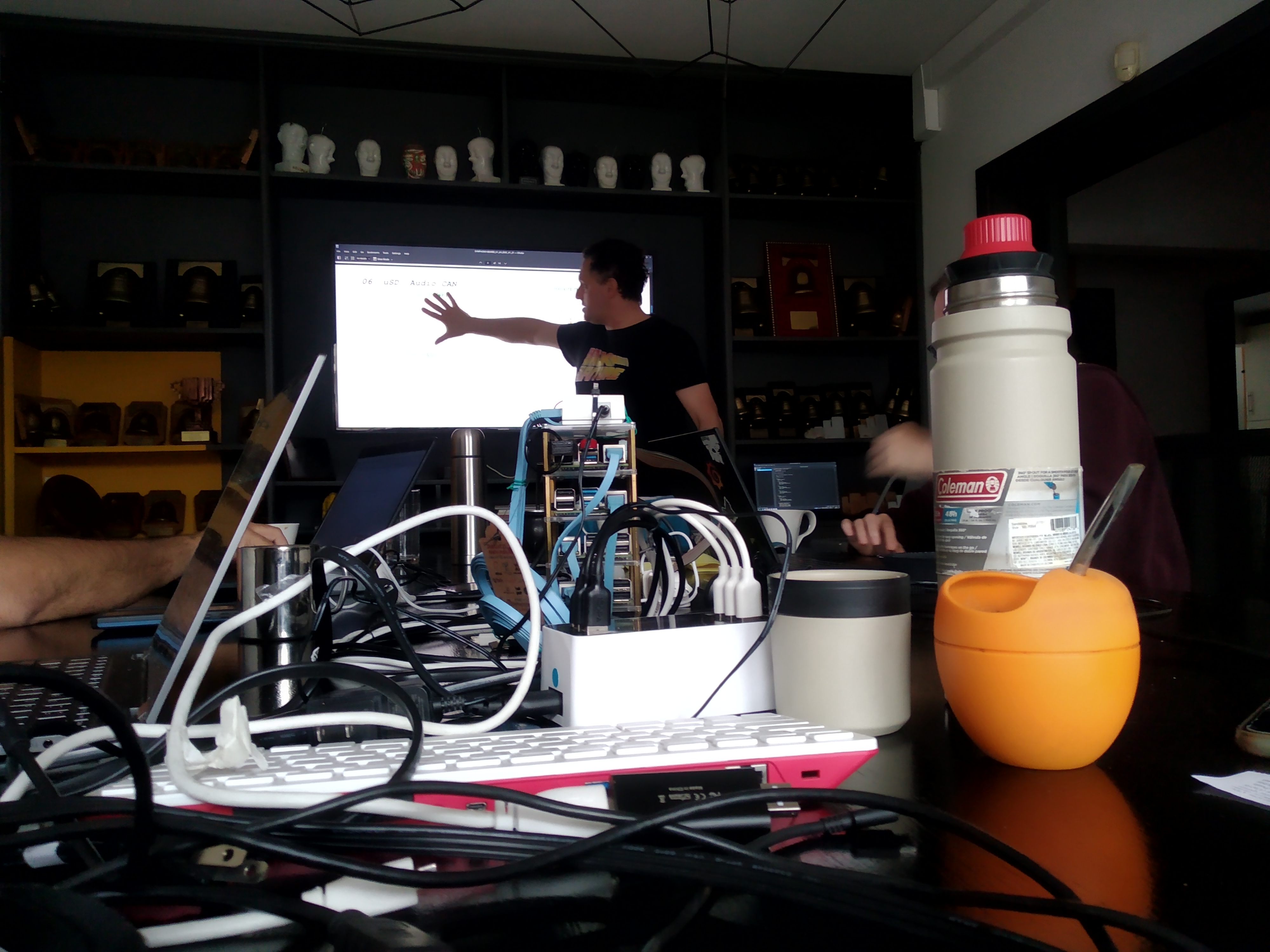
The nice house Santiago got for us was very well equipped for a
miniDebConf. There were a couple of rounds of pool played by those that enjoyed
it (I was very happy just to stand around, take some photos and enjoy the
atmosphere and the conversation).
Today (Saturday) is the last full-house day of miniDebConf; tomorrow we will be
leaving the house by noon. It was also a very productive day! We had a long,
important conversation about an important discussion that we are about to
present on debian-vote@lists.debian.org.
It has been a great couple of days! Sadly, it s coming to an end But this at
least gives me the opportunity (and moral obligation!) to write a long blog
post. And to thank Santiago for organizing this, and Debian, for sponsoring our
trip, stay, foods and healthy enjoyment!


Check it out on GitHub, or get the release tarball or read the documentation or release notes!
release elements that reference downloadable data without an artifact block, which has not been supported for a while. For all of these, I checked to remove only things that had close to no users and that were a significant maintenance burden. So as a rule of thumb: If your XML validated with no warnings with the 0.16.x branch of AppStream, it will still be 100% valid with the 1.0 release.
Another notable change is that the generated output of AppStream 1.0 will always be 1.0 compliant, you can not make it generate data for versions below that (this greatly reduced the maintenance cost of the project).

developer_name tag. With AppStream 1.0, this is changed a bit. There is now a developer tag with a name child (that can be translated unless the translate="no" attribute is set on it). This allows future extensibility, and also allows to set a machine-readable id attribute in the developer element. This permits software centers to group software by developer easier, without having to use heuristics. If we decide to extend the developer information per-app in future, this is also now possible. Do not worry though the developer_name tag is also still read, so there is no high pressure to update. The old 0.16.x stable series also has this feature backported, so it can be available everywhere. Check out the developer tag specification for more details.
scale attribute, to indicate an (integer) scaling factor to apply. This feature was a breaking change and therefore we could not have it for the longest time, but it is now available. Please wait a bit for AppStream 1.0 to become deployed more widespread though, as using it with older AppStream versions may lead to issues in some cases. Check out the screenshots tag specification for more details.
environment attribute on the respective screenshot tag. This was also a breaking change, so use it carefully for now! If projects want to, they can use this feature to supply dedicated screenshots depending on the environment the application page is displayed in. Check out the screenshots tag specification for more details.
references tag, you can associate the AppStream component with a DOI (Digital object identifier) or provide a link to a CFF file to provide citation information. It also allows to link to other scientific registries. Check out the references tag specification for more details.
appstreamcli utility also has much improved support for relation checks, and I wrote about these changes in a previous post. Check it out!
With these changes, I hope this feature will be used much more, and beyond just drivers and firmware.
Welcome to the October 2023 report from the Reproducible Builds project. In these reports we outline the most important things that we have been up to over the past month. As a quick recap, whilst anyone may inspect the source code of free software for malicious flaws, almost all software is distributed to end users as pre-compiled binaries.
Between October 31st and November 2nd, we held our seventh Reproducible Builds Summit in Hamburg, Germany!
Our summits are a unique gathering that brings together attendees from diverse projects, united by a shared vision of advancing the Reproducible Builds effort, and this instance was no different.
During this enriching event, participants had the opportunity to engage in discussions, establish connections and exchange ideas to drive progress in this vital field. A number of concrete outcomes from the summit will documented in the report for November 2023 and elsewhere.
Amazingly the agenda and all notes from all sessions are already online.
The Reproducible Builds team would like to thank our event sponsors who include Mullvad VPN, openSUSE, Debian, Software Freedom Conservancy, Allotropia and Aspiration Tech.
Russ Cox posted a fascinating article on his blog prompted by the fortieth anniversary of Ken Thompson s award-winning paper, Reflections on Trusting Trust:
[ ] In March 2023, Ken gave the closing keynote [and] during the Q&A session, someone jokingly asked about the Turing award lecture, specifically can you tell us right now whether you have a backdoor into every copy of gcc and Linux still today?Although Ken reveals (or at least claims!) that he has no such backdoor, he does admit that he has the actual code which Russ requests and subsequently dissects in great but accessible detail.
Rahul Bajaj, Eduardo Fernandes, Bram Adams and Ahmed E. Hassan from the Maintenance, Construction and Intelligence of Software (MCIS) laboratory within the School of Computing, Queen s University in Ontario, Canada have published a paper on the Time to fix, causes and correlation with external ecosystem factors of unreproducible builds.
The authors compare various response times within the Debian and Arch Linux distributions including, for example:
Arch Linux packages become reproducible a median of 30 days quicker when compared to Debian packages, while Debian packages remain reproducible for a median of 68 days longer once fixed.A full PDF of their paper is available online, as are many other interesting papers on MCIS publication page.
On the NixOS Discourse instance, Arnout Engelen (raboof) announced that NixOS have created an independent, bit-for-bit identical rebuilding of the nixos-minimal image that is used to install NixOS. In their post, Arnout details what exactly can be reproduced, and even includes some of the history of this endeavour:
You may remember a 2021 announcement that the minimal ISO was 100% reproducible. While back then we successfully tested that all packages that were needed to build the ISO were individually reproducible, actually rebuilding the ISO still introduced differences. This was due to some remaining problems in the hydra cache and the way the ISO was created. By the time we fixed those, regressions had popped up (notably an upstream problem in Python 3.10), and it isn t until this week that we were back to having everything reproducible and being able to validate the complete chain.Congratulations to NixOS team for reaching this important milestone! Discussion about this announcement can be found underneath the post itself, as well as on Hacker News.
Seth Larson published a blog post investigating the reproducibility of the CPython source tarballs. Using diffoscope, reprotest and other tools, Seth documents his work that led to a pull request to make these files reproducible which was merged by ukasz Langa.
arm64 hardware from Codethink
Long-time sponsor of the project, Codethink, have generously replaced our old Moonshot-Slides , which they have generously hosted since 2016 with new KVM-based arm64 hardware. Holger Levsen integrated these new nodes to the Reproducible Builds continuous integration framework.
ext4 filesystem images. [ ]
distro-info is a Debian-oriented tool that can provide information about Debian (and Ubuntu) distributions such as their codenames (eg. bookworm) and so on. This month, Benjamin Drung uploaded a new version of distro-info that added support for the SOURCE_DATE_EPOCH environment variable in order to close bug #1034422. In addition, 8 reviews of packages were added, 74 were updated and 56 were removed this month, all adding to our knowledge about identified issues.
Bernhard M. Wiedemann published another monthly report about reproducibility within openSUSE.
edje_cc (race condition)elasticsearch (build failure)erlang-retest (embedded .zip timestamp)fdo-client (embeds private keys)fftw3 (random ordering)gsoap (date issue)gutenprint (date)hub/golang (embeds random build path)Hyprland (filesystem issue)kitty (sort-related issue, .tar file embeds modification time)libpinyin (ASLR)maildir-utils (date embedded in copyright)mame (order-related issue)mingw32-binutils & mingw64-binutils (date)MooseX (date from perl-MooseX-App)occt (sorting issue)openblas (embeds CPU count)OpenRGB (corruption-related issue)python-numpy (random file names)python-pandas (FTBFS)python-quantities (date)python3-pyside2 (order)qemu (date and Sphinx issue)qpid (sorting problem)rakudo (filesystem ordering issue)SLOF (date-related issue)spack (CPU counting issue)xemacs-packages (date-related issue)file -i returns text/plain, fallback to comparing as a text file. This was originally filed as Debian bug #1053668) by Niels Thykier. [ ] This was then uploaded to Debian (and elsewhere) as version 251.
The Reproducible Builds project operates a comprehensive testing framework (available at tests.reproducible-builds.org) in order to check packages and other artifacts for reproducibility. In October, a number of changes were made by Holger Levsen:
#debian-reproducible-changes IRC channel. [ ][ ][ ]systemd-oomd on all Debian bookworm nodes (re. Debian bug #1052257). [ ]schroots. [ ]arm64 machines from Codethink. [ ][ ][ ][ ][ ][ ]#reproducible-builds on irc.oftc.net.
rb-general@lists.reproducible-builds.org
Until now, I haven't hacked my Kobo Libra 2 ereader, despite knowing it
is a relatively open device. The default document reader (Nickel) does
everything I need it to. Syncing the books via USB is tedious, but I don't do
it that often.
Via Videah's blog post My E-Reader
Setup, I learned of
Plato, an alternative document reader.
Plato doesn't really offer any headline features that I need, but it cost
me nothing to try it out, so I installed it (fairly painlessly) and launched
it just once. The library view seems good, although I've not used it much:
I picked a book and read it through1, and I'm 60% through another2. I tend to
read one ebook at a time.
The main reader interface is great: Just the text3.
Page transitions are really, really fast. Tweaking the backlight intensity
is a little slower than Nickel: menu-driven rather than an active scroll
region (which is convenient in Nickel but easy to accidentally turn to 0%
and hard to recover from in pitch black).
Now that I've started down the road of hacking the Kobo, I think I will explore
wifi-syncing the library, perhaps using a variation on the hook scripts shared
in Videah's blog post.

gitsigns is a Neovim plugin
which adds a wonderfully subtle colour annotation in the left-hand gutter to
reflect changes in the buffer since the last git commit1.
My long-term habit with Vim and Git is to frequently background Vim (^Z) to invoke
the git command directly and then foreground Vim again (fg). Over the last few
years I've been trying more and more to call vim-fugitive from
within Vim instead. (I still do rebases and most merges the old-fashioned way).
For the most part Gitsigns is a nice passive addition to that, but it can also
do a lot of useful things that Fugitive also does. Previewing changed hunks in a
little floating window, in particular when resolving an awkward merge conflict, is
very handy.
The above picture shows it in action. I've changed two lines and added another
three in the top-left buffer. Gitsigns tries to choose colours from the currently
active colour scheme (in this case, tender)
struct drm_property. We extended the color
management interface exposed to userspace by leveraging existing resources and
connecting them with driver-specific functions for managing modeset properties.
On the AMD DC layer, the interface with hardware color blocks is established.
The AMD DC layer contains OS-agnostic components that are shared across
different platforms, making it an invaluable resource. This layer already
implements hardware programming and resource management, simplifying the external
developer s task. While examining the DC code, we gain insights into the color
pipeline and capabilities, even without direct access to specifications.
Additionally, AMD developers provide essential support by answering queries and
reviewing our work upstream.
The primary challenge involved identifying and understanding relevant AMD DC
code to configure each color block in the color pipeline. However, the ultimate
goal was to bridge the DC color capabilities with the DRM API. For this, we
changed the AMD DM, the OS-dependent layer connecting the
DC interface to the DRM/KMS framework. We defined and managed driver-specific
color properties, facilitated the transport of user space data to the DC, and
translated DRM features and settings to the DC interface. Considerations were
also made for differences in the color pipeline based on hardware capabilities.
AMD s display driver supports the following pre-defined transfer functions (aka named fixed curves):
- OETF: the opto-electronic transfer function, which converts linear scene light into the video signal, typically within a camera.
- EOTF: electro-optical transfer function, which converts the video signal into the linear light output of the display.
- OOTF: opto-optical transfer function, which has the role of applying the rendering intent .
These capabilities vary depending on the hardware block, with some utilizing hardcoded curves and others relying on AMD s color module to construct curves from standardized coefficients. It also supports user/custom curves built from a lookup table.
- Linear/Unity: linear/identity relationship between pixel value and luminance value;
- Gamma 2.2, Gamma 2.4, Gamma 2.6: pure power functions;
- sRGB: 2.4: The piece-wise transfer function from IEC 61966-2-1:1999;
- BT.709: has a linear segment in the bottom part and then a power function with a 0.45 (~1/2.22) gamma for the rest of the range; standardized by ITU-R BT.709-6;
- PQ (Perceptual Quantizer): used for HDR display, allows luminance range capability of 0 to 10,000 nits; standardized by SMPTE ST 2084.
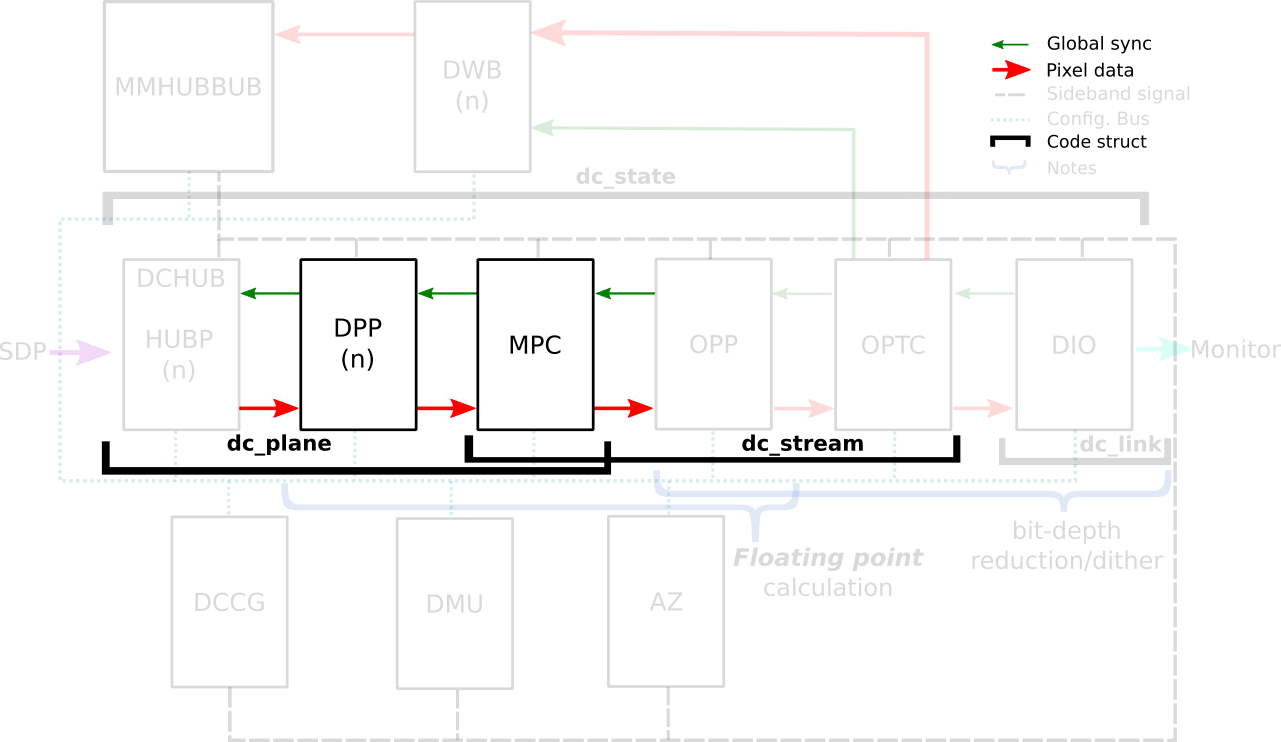
In the AMD Display Core Next hardware pipeline, we encounter two hardware
blocks with color capabilities: the Display Pipe and Plane (DPP) and the
Multiple Pipe/Plane Combined (MPC). The DPP handles color adjustments per plane
before blending, while the MPC engages in post-blending color adjustments.
In short, we expect DPP color capabilities to match up with DRM plane
properties, and MPC color capabilities to play nice with DRM CRTC properties.
Note: here s the catch there are some DRM CRTC color transformations that
don t have a corresponding AMD MPC color block, and vice versa. It s like a
puzzle, and we re here to solve it!
struct
dpp_color_caps
and struct
mpc_color_caps.
The AMD Steam Deck hardware provides a tangible example of these capabilities.
Therefore, we take SteamDeck/DCN301 driver as an example and look at the Color
pipeline capabilities described in the file:
driver/gpu/drm/amd/display/dcn301/dcn301_resources.c
/* Color pipeline capabilities */
dc->caps.color.dpp.dcn_arch = 1; // If it is a Display Core Next (DCN): yes. Zero means DCE.
dc->caps.color.dpp.input_lut_shared = 0;
dc->caps.color.dpp.icsc = 1; // Intput Color Space Conversion (CSC) matrix.
dc->caps.color.dpp.dgam_ram = 0; // The old degamma block for degamma curve (hardcoded and LUT). Gamma correction is the new one.
dc->caps.color.dpp.dgam_rom_caps.srgb = 1; // sRGB hardcoded curve support
dc->caps.color.dpp.dgam_rom_caps.bt2020 = 1; // BT2020 hardcoded curve support (seems not actually in use)
dc->caps.color.dpp.dgam_rom_caps.gamma2_2 = 1; // Gamma 2.2 hardcoded curve support
dc->caps.color.dpp.dgam_rom_caps.pq = 1; // PQ hardcoded curve support
dc->caps.color.dpp.dgam_rom_caps.hlg = 1; // HLG hardcoded curve support
dc->caps.color.dpp.post_csc = 1; // CSC matrix
dc->caps.color.dpp.gamma_corr = 1; // New Gamma Correction block for degamma user LUT;
dc->caps.color.dpp.dgam_rom_for_yuv = 0;
dc->caps.color.dpp.hw_3d_lut = 1; // 3D LUT support. If so, it's always preceded by a shaper curve.
dc->caps.color.dpp.ogam_ram = 1; // Blend Gamma block for custom curve just after blending
// no OGAM ROM on DCN301
dc->caps.color.dpp.ogam_rom_caps.srgb = 0;
dc->caps.color.dpp.ogam_rom_caps.bt2020 = 0;
dc->caps.color.dpp.ogam_rom_caps.gamma2_2 = 0;
dc->caps.color.dpp.ogam_rom_caps.pq = 0;
dc->caps.color.dpp.ogam_rom_caps.hlg = 0;
dc->caps.color.dpp.ocsc = 0;
dc->caps.color.mpc.gamut_remap = 1; // Post-blending CTM (pre-blending CTM is always supported)
dc->caps.color.mpc.num_3dluts = pool->base.res_cap->num_mpc_3dlut; // Post-blending 3D LUT (preceded by shaper curve)
dc->caps.color.mpc.ogam_ram = 1; // Post-blending regamma.
// No pre-defined TF supported for regamma.
dc->caps.color.mpc.ogam_rom_caps.srgb = 0;
dc->caps.color.mpc.ogam_rom_caps.bt2020 = 0;
dc->caps.color.mpc.ogam_rom_caps.gamma2_2 = 0;
dc->caps.color.mpc.ogam_rom_caps.pq = 0;
dc->caps.color.mpc.ogam_rom_caps.hlg = 0;
dc->caps.color.mpc.ocsc = 1; // Output CSC matrix.
struct dpp_color_caps,
struct mpc_color_caps
and struct rom_curve_caps.
Now, using this guideline, we go through color capabilities of DPP and MPC blocks and talk more
about mapping driver-specific properties to corresponding color blocks.
dc->caps.color.dpp.dcn_arch
dc->caps.color.dpp.dgam_ram, dc->caps.color.dpp.dgam_rom_caps,dc->caps.color.dpp.gamma_corr
AMD Plane Degamma data is mapped to the initial stage of the DPP pipeline. It
is utilized to transition from scanout/encoded values to linear values for
arithmetic operations. Plane Degamma supports both pre-defined transfer
functions and 1D LUTs, depending on the hardware generation. DCN2 and older
families handle both types of curve in the Degamma RAM block
(dc->caps.color.dpp.dgam_ram); DCN3+ separate hardcoded curves and 1D LUT
into two block: Degamma ROM (dc->caps.color.dpp.dgam_rom_caps) and Gamma
correction block (dc->caps.color.dpp.gamma_corr), respectively.
Pre-defined transfer functions:
struct drm_color_lut elements. Setting TF = Identity/Default and LUT as
NULL means bypass.
References:
struct drm_color_ctm_3x4. Setting NULL means bypass.
References:
dc->caps.color.dpp.hw_3d_lut
The Shaper block fine-tunes color adjustments before applying the 3D LUT,
optimizing the use of the limited entries in each dimension of the 3D LUT. On
AMD hardware, a 3D LUT always means a preceding shaper 1D LUT used for
delinearizing and/or normalizing the color space before applying a 3D LUT, so
this entry on DPP color caps dc->caps.color.dpp.hw_3d_lut means support for
both shaper 1D LUT and 3D LUT.
Pre-defined transfer function enables delinearizing content with or without
shaper LUT, where AMD color module calculates the resulted shaper curve. Shaper
curves go from linear values to encoded values. If we are already in a
non-linear space and/or don t need to normalize values, we can set a Identity TF
for shaper that works similar to bypass and is also the default TF value.
Pre-defined transfer functions:
calculate_curve() function in the file
amd/display/modules/color/color_gamma.c.struct drm_color_lut elements. When setting Plane Shaper TF (!= Identity)
and LUT at the same time, the color module will combine the pre-defined TF and
the custom LUT values into the LUT that s actually programmed. Setting TF =
Identity/Default and LUT as NULL works as bypass.
References:
dc->caps.color.dpp.hw_3d_lut
The 3D LUT in the DPP block facilitates complex color transformations and
adjustments. 3D LUT is a three-dimensional array where each element is an RGB
triplet. As mentioned before, the dc->caps.color.dpp.hw_3d_lut describe if
DPP 3D LUT is supported.
The AMD driver-specific property advertise the size of a single dimension via
LUT3D_SIZE property. Plane 3D LUT is a blog property where the data is interpreted
as an array of struct drm_color_lut elements and the number of entries is
LUT3D_SIZE cubic. The array contains samples from the approximated function.
Values between samples are estimated by tetrahedral interpolation
The array is accessed with three indices, one for each input dimension (color
channel), blue being the outermost dimension, red the innermost. This
distribution is better visualized when examining the code in
[RFC PATCH 5/5] drm/amd/display: Fill 3D LUT from userspace by Alex Hung:
+ for (nib = 0; nib < 17; nib++)
+ for (nig = 0; nig < 17; nig++)
+ for (nir = 0; nir < 17; nir++)
+ ind_lut = 3 * (nib + 17*nig + 289*nir);
+
+ rgb_area[ind].red = rgb_lib[ind_lut + 0];
+ rgb_area[ind].green = rgb_lib[ind_lut + 1];
+ rgb_area[ind].blue = rgb_lib[ind_lut + 2];
+ ind++;
+
+
+
+ /* Stride and bit depth are not programmable by API yet.
+ * Therefore, only supports 17x17x17 3D LUT (12-bit).
+ */
+ lut->lut_3d.use_tetrahedral_9 = false;
+ lut->lut_3d.use_12bits = true;
+ lut->state.bits.initialized = 1;
+ __drm_3dlut_to_dc_3dlut(drm_lut, drm_lut3d_size, &lut->lut_3d,
+ lut->lut_3d.use_tetrahedral_9,
+ MAX_COLOR_3DLUT_BITDEPTH);
dc->caps.color.dpp.ogam_ram
The Blend/Out Gamma block applies the final touch-up before blending, allowing
users to linearize content after 3D LUT and just before the blending. It supports both 1D LUT
and pre-defined TF. We can see Shaper and Blend LUTs as 1D LUTs that are
sandwich the 3D LUT. So, if we don t need 3D LUT transformations, we may want
to only use Degamma block to linearize and skip Shaper, 3D LUT and Blend.
Pre-defined transfer function:
struct drm_color_lut elements. If plane_blend_tf_property != Identity TF,
AMD color module will combine the user LUT values with pre-defined TF into the
LUT parameters to be programmed. Setting TF = Identity/Default and LUT to NULL
means bypass.
References:
struct drm_color_lut elements. Setting NULL means bypass.
Not really supported. The driver is currently reusing the DPP degamma LUT block
(dc->caps.color.dpp.dgam_ram and dc->caps.color.dpp.gamma_corr) for
supporting DRM CRTC Degamma LUT, as explaning by [PATCH v3 20/32]
drm/amd/display: reject atomic commit if setting both plane and CRTC
degamma.
dc->caps.color.mpc.gamut_remap
It sets the current transformation matrix (CTM) apply to pixel data after the
lookup through the degamma LUT and before the lookup through the gamma LUT. The
data is interpreted as a struct drm_color_ctm. Setting NULL means bypass.
dc->caps.color.mpc.ogam_ram
After all that, you might still want to convert the content to wire encoding.
No worries, in addition to DRM CRTC 1D LUT, we ve got a AMD CRTC gamma transfer
function (TF) to make it happen. Possible TF values are defined by enum
amdgpu_transfer_function.
Pre-defined transfer functions:
struct drm_color_lut elements. When setting CRTC Gamma TF (!= Identity)
and LUT at the same time, the color module will combine the pre-defined TF and
the custom LUT values into the LUT that s actually programmed. Setting TF =
Identity/Default and LUT to NULL means bypass.
References:
color_range and color_encoding properties. It is used for color space
conversion of the input content. On the other hand, we have de DC Output CSC
(OCSC) sets pre-defined coefficients from DRM connector colorspace
properties. It is uses for color space conversion of the composed image to the
one supported by the sink.
References:
Next.