Search Results: "bod"

8 October 2013

Petter Reinholdtsen: Skolelinux / Debian Edu 7.1 install and overview video from Marcelo Salvador

The other day I was pleased and surprised to discover that Marcelo Salvador had published a video on Youtube showing how to install the standalone Debian Edu / Skolelinux profile. This is the profile intended for use at home or on laptops that should not be integrated into the provided network services (no central home directory, no Kerberos / LDAP directory etc, in other word a single user machine). The result is 11 minutes long, and show some user applications (seem to be rather randomly picked). Missed a few of my favorites like celestia, planets and chromium showing the Zygote Body 3D model of the human body, but I guess he did not know about those or find other programs more interesting. :) And the video do not show the advantages I believe is one of the most valuable featuers in Debian Edu, its central school server making it possible to run hundreds of computers without hard drives by installing one central LTSP server. Anyway, check out the video, embedded below and linked to above: Are there other nice videos demonstrating Skolelinux? Please let me know. :)

Russ Allbery: Review: Grimspace

Review: Grimspace, by Ann Aguirre
Series: Sirantha Jax #1
Publisher: Ace
Copyright: March 2008
ISBN: 0-441-01599-9
Format: Mass market
Pages: 312
Sirantha Jax is a jumper: a person with the rare genetic ability to jump spaceships through the shortcut dimension of grimspace. It's a science fiction idea with a long pedigree. It creates a separate in-group for the characters to belong to, a society with its own rules, and sets up tension with the rest of the institutions of the world. In Aguirre's version, jumpers can provide the transition but direction in grimspace has to be done by a pilot, and the jumper and the pilot develop a deep psychic bond. Jax had been jumping with her husband piloting, but on their last trip their ship crashed, killing everyone on board except her. As Grimspace opens, Jax is in a treatment facility that's much more like a prison. In theory, they're trying to figure out whether she's still able to (and safe to allow to) jump. In practice, something quite a bit more sinister is going on, a fact that the reader senses early but only learns more about after Jax is helped to escape. Scarred, deeply depressed, and nearly suicidal, she's pulled into the subversive plans of a small ship of renegades who are trying to break open the Corp monopoly on grimspace travel and their tight hold over every jumper. But she's not sure whether she trusts them, or whether she cares enough about their crusade to truly join in. Grimspace follows well-trod SF paths of special cadres of pilots and navigators, lawless corners of space with local warlords, and rebellion against smothering centralization, but its first-person protagonist and point of view have more in common with urban fantasy. It's written in first-person and, at times, nearly stream of consciousness from Jax's perspective, and Jax displays plenty of profanity, acidic commentary, and emotional angst. If her special ability were shapeshifting or magic instead of jumping spaceships, one could easily see her as the typical burned-out urban fantasy detective. I liked that. It's a fun point of view when it's written well, and it felt fresh when applied to a science fiction background instead of the more typical fantasy. That said, Grimspace has a rather rough start. Jax isn't sure what's going on at first and also isn't sure she cares, and I thought that carried over to the reader's experience. The first section of the book is rough and jagged, with staccato bursts of character introduction, world-building that doesn't quite cohere, and an extended stop on a very odd outback planet that felt to me like a repurposed stage from a western. Part of the early problem is that Jax and the reader are being intentionally kept in the dark about the real goal of this group, but part of the problem is also that none of the characters start off as very likable. That includes Jax, who is a complete mess and who is both scared and despairing to the point of being almost nihilistic. The world-building unfortunately does not carry the reader through that part of the story, and at about eighty pages in I wasn't sure I was going to like this book. It does, however, get much better. For one, Jax calms down and starts making emotional connections with the rest of the crew, and that lets her demonstrate skills as a fearless problem solver. For another, while the goal of the group of people she's fallen in with isn't exactly deep, it does make sense and it does slowly become a cause the reader (and Jax) can believe in. The frenetic pace of introduction and discovery also slows down, the cast stabilizes, and the surroundings get a bit less weird (and a bit more conventional for a science fiction novel). I didn't care for the alien baby subplot I rarely do but the rest of the story slowly pulled me in. One thing Aguirre did extremely well was surprise me. There are several points later in the book where Jax gets put in a fairly typical high-stress position and does something very atypical in reaction to it, twisting the story into a shape quite a bit unlike what I had been expecting. That made Jax feel like a true free agent, establishing her independence and her desire to control her own life, and that appealed to me. Aguirre also palms one card exceptionally well, setting up an ending that I thought was the best set of scenes in the whole book, and that had me thoroughly engrossed. One can see the bones of the urban fantasy heroine inside Jax's character, but they're fresh and interesting in an SF world, and they work better than I would have expected. There is a romance, in fitting with the urban fantasy inspiration, and it didn't quite work for me, but Aguirre also builds in a reason why it might not make sense and makes it spiky and fragile without being too cliched. By the end of the book, I was, if not entirely persuaded, at least willing to go along for the ride. And that's the best summary of Grimspace, I think. Parts of it don't make a great deal of sense, and parts of it are quite choppy. But I liked Jax once she starts getting a handle on her trauma, the other characters grew on me, and the plot surprised me in some interesting ways. It's not the smoothest or most polished SF novel I've read, but it has a lot of energy and an unusual genre mix. I think I'll stick along for the ride. Followed by Wanderlust. Rating: 7 out of 10

7 October 2013

Michal Čihař: Weblate 1.7

Weblate 1.7 has been released today. It comes with lot of improvements, especially in translation speed and many new features. Full list of changes for 1.7: You can find more information about Weblate on it's website, the code is hosted on Github. If you are curious how it looks, you can try it out on demo server. You can login there with demo account using demo password or register your own user. Ready to run appliances will be soon available in SUSE Studio Gallery. Weblate is also being used https://l10n.cihar.com/ as official translating service for phpMyAdmin, Gammu, Weblate itself and others. If you are free software project which would like to use Weblate, I'm happy to help you with set up or even host Weblate for you. Further development of Weblate would not be possible without people providing donations, thanks to everybody who have helped so far!

Filed under: English SUSE Weblate 1 comments Flattr this!

6 October 2013

Axel Beckert: Searching in Screen's copy mode

I m using GNU Screen daily for definitely more than a decade and I became maintainer of Debian s screen package nearly exactly two years ago. Nevertheless it still happens occassionally that I discover features yet unknown to me. Recently I had one of these moments again: I looked for a specific line in the long output of a command which has run inside a Screen session. For that I entered Screen s copy mode with Ctrl-A [ and scrolled around with arrow keys and page-up and -down keys. But didn t find it. I thought, it would be cool if I can search for the string I m looking for. Intu tively I typed /, the search string and pressed enter. And it worked! It jumped to the next occurrence of that string. Of course I immediately had to check if tmux has such a feature, too. And it indeed has, but it seems to be a less sophisticated implementation:
Feature Key-binding in GNU Screen Key-binding in Tmux
Switch into copy/scroll mode
(needed for the remainder)
Ctrl-A [ Ctrl-B [
Search for string once, forward / + string + Enter Ctrl-S + string + Enter
Search for string once, backward ? + string + Enter Ctrl-R + string + Enter
Search for string again, forward / Enter Ctrl-S Enter
Search for string again, backward ? Enter Ctrl-R Enter
Incremental search for string, forward Ctrl-S + string -
Incremental search for string, backward Ctrl-R + string -
(Incremental) search for next occurrence, forward Ctrl-S again -
(Incremental) search for next occurrence, backward Ctrl-R again -
Being able to do incremental search like with GNU Emacs gave me yet another reason for continuing to use Screen and not to switch Tmux. ;-)

Russ Allbery: Review: Captain Vorpatril's Alliance

Review: Captain Vorpatril's Alliance, by Lois McMaster Bujold
Series: Vorkosigan #14
Publisher: Baen
Copyright: November 2012
ISBN: 1-4516-3845-0
Format: Kindle
Pages: 432
This is the fourteenth book in the long-running Vorkosigan series (not counting a few side works). It shifts viewpoint characters, following Ivan Vorpatril instead of either Miles or Cordelia, and could be read on its own since the necessary background is at least briefly explained. But it's probably best read in its proper context in the larger series, since otherwise many of the prior events mentioned here won't have much resonance. Ivan Vorpatril, Miles's cousin, has appeared in multiple previous books along with the rest of Miles's extended family, but he's stayed out of the center of the plot. And he clearly likes it that way. Ivan is not at all ambitious, tries to avoid politics, and just wants to live a quiet life (insofar as that's possible in the Barrayan military), sleep with a few women, and stay out of trouble. But given his relations and his job as aide-de-camp to an admiral this doesn't always work. In this book, the not working comes in the form of Byerly, ImpSec (Imperial Security, the Barrayan equivalent of the CIA), and a request to find out more about a woman who seems to be the target of a bounty. Fairly quickly, Ivan finds himself hopelessly entangled in both politics and in someone else's complex life, and is not entirely sure what to do about either. It's been months since I read this book and I'm only now writing a review, in part because I find it hard to know what to say about it. While Ivan doesn't have Miles's manic energy, the tone of this book is very similar to the rest of the Vorkosigan series, as is the plot and most of the characters. Ivan tries a more laid-back approach and doesn't actively seek danger the way that Miles does, but his persistent efforts to do the right thing in the face of unexpected events lead mostly to the same places. There's a bit of humor, a bit of danger, some galactic politics, some scheming, and a slow process of understanding other people better in short, Captain Vorpatril's Alliance is very similar to the thirteen books that proceeded it. This is obviously not a bad thing. If you've read this far in the series, more of the same is probably just fine. I enjoyed the book. Bujold is great at telling stories, the plot mostly moved right along, and I quite liked the two women Ivan meets over the course of the story. But there wasn't much about the story that grabbed me or, I suspect, that I will find particularly memorable. One reason for my somewhat "meh" reaction is that the core of this story is a romance, and while much of that romance is well-done, there is a large segment in the middle of the book where the suspense of the plot derives mostly from one of the two characters refusing to confide in the other. This is Bujold, so this isn't as much of a train wreck as it might be in the hands of another author, and it is for valid plot reasons. But even with those justifications, I never like that plot element. There were about a hundred pages where I wanted to grab Tej and shake some sense into her, which doesn't endear a character to me. And the leads in a romance, at least this sort of romance, should be endearing. I think one reason why Bujold went for that approach to building tension is that there weren't a lot of options available. The basic outlines of what's going to happen are obvious from early in the book and essentially forced by the structure of the series. We know from past books that Ivan is both trustworthy and related to a staggering variety of powerful people, almost all of whom are highly competent and honorable. It's fairly obvious that, as soon as the necessary people trust Ivan and let him and his family solve their problems, all the problems will be solved. It's also fairly obvious how the romances will play out, and that all the new characters will end up a little in awe of how competent and trustworthy all the Barrayans are (a few misdirections aside). Therefore, much of the book, for a long-time reader of the series, involves waiting until those things happen, and meanwhile getting increasingly annoyed at characters who refuse to trust obviously trustworthy people. All that said, I still quite liked the beginning of the book, because Tej and Rish are a wonderful pair and have a great interpersonal dynamic, and the very end of the book once everyone gets past the communication problems and the plot can deliver on its promises. Both together make up for some noticeable sagging in the middle section of the book. Captain Vorpatril's Alliance is not up to the standards of the most memorable books of the series, but it's a solid dose of "more of the same" and provides its money's worth of entertainment. I'm still hoping for more Ekaterin and more fireworks in the next book, though. Rating: 7 out of 10

4 October 2013

Raphaël Hertzog: My Free Software Activities in September 2013

This is my monthly summary of my free software related activities. If you re among the people who made a donation to support my work (86.18 , thanks everybody!), then you can learn how I spent your money. Otherwise it s just an interesting status update on my various projects. Package Tracking System^U Distro Tracker Marko Lalic implemented quite a few interesting features in the last weeks of the Google Summer of Code (support of teams most notably). Unfortunately he didn t deploy (yet) the latest changes on pts.debian.net. Given the good work he made over the summer, I marked him as successful in his GSOC. Hopefully he will stick around and continue to contribute, he promised to try to handle some mass renaming that we agreed upon. Effectively, after much bike-shedding, I decided that the software would be called Distro Tracker . Once those last-minute cleanups are done, I plan to request tracker.debian.org to Debian System Administrators. This means that it will be deployed in parallel to the current PTS at least until we re at feature parity in the new codebase. The new codebase should be much more easy to get started with, so I should do some promotion and invite people to contribute to it possibly by writing some short how to get started documentation. I started by creating a dedicated wiki page: http://wiki.debian.org/qa.debian.org/distro-tracker
Misc packaging I got two REJECTs from ftpmasters this month (one for galette, one for dolibarr). I took care of fixing the various issues in galette and the package has been promptly accepted afterwards. For dolibarr, I mentored the upstream maintainer about the various problems and got him to fix it. It took a bit more time and the package is thus still in NEW. I packaged wordpress 3.6, and then wordpress 3.6.1 (security update). python-django also had multiple security updates this month, I took care of one or two uploads but Luke Faraone dealt with most of them (including backports to Squeeze!). I packaged Publican 3.6.1 and uploaded dh-linktree 0.4 to fix a FTBFS issue introduced with Perl 5.18. Of anecdotal importance, but I also filed bug #721849 after seeing how much energy was spent to ensure debian/rules didn t contain an improper copyright statement. Thanks See you next month for a new summary of my activities.

No comment Liked this article? Click here. My blog is Flattr-enabled.

2 October 2013

Matthew Garrett: The state of XMir

XMir's been delayed from Ubuntu 13.10. The stated reason is that multi-monitor support isn't sufficiently reliable. That's true, but it's far from the only problem that XMir still has:

It's clear that XMir has turned into a larger project than Canonical had originally anticipated, but that's hardly surprising. There's only one developer with previous X experience working on it full-time, and the announced schedule provided no opportunity to deal with unexpected problems. As if that weren't enough, there's obvious conflict between Ubuntu Desktop and Ubuntu Phone when it comes to developer time and required functionality. The one hardware vendor who's willing to take a public stand has demonstrated that they have no interest in supporting XMir, despite Canonical assuring people that they were already engaging in productive negotiations with GPU manufacturers.

Multiple monitor support may be the single most obvious feature where XMir is lacking, but it's not the only one. Technically and politically, this code is a long way from being ready for prime time. Without significant community contribution, Canonical need to focus on prioritising it appropriately rather than expecting a tiny number of developers to perform miracles. Or, alternatively, they could just drop XMir entirely and focus on Unity 8.

comment count unavailable comments

1 October 2013

Gunnar Wolf: Piracy and culture circulation: #encirc13

This week's lesson on the Arte y cultura en circulaci n: crear y compartir en tiempos digitales course talks about piracy and the circulation of culture, a topic that over time has been debated over and over. And a topic, yes, that can always lead to interesting discussions. This time, we are requested to choose one among ten ideas among the media groups' discourse on what piracy is and means for the "cultural industry". There are tons of material written already on several of those ten lines (i.e. piracy disincentivates creativity, or two that can be seen as two faces of the same argument, If a consumer can have free access to cultural products, he will stop spending his money on them and Every time a consumer has access to an illegal copy, the industry loses a sale), and some are quite obvious (i.e. Piracy makes job positions be lost... Just look at the amount of people the unauthorized distribution industry feeds! Or possibly, Piracy is a prosper industry that gives money to people distributing illegal products Of course, that is true. The problem is, what causes said products to be illegal to begin with? Should they be so?). Some other ideas talk about harsher penalties and ways to punish illegal copying in order to drive actors out of that sector (and into the... void?) So, I chose item #4: Cultural products have a high cost because their production is complex (and a tag could be made, linking complex with expensive). I think this item can lead to a long discussion as to what does this complexity and cost mean. Some cultural products do require quite a bit of investment, yes. Others don't. How do content producers make the jump to produce expensive works? If I am a new programmer/artist/writer/screenplayer/whatever, most likely, my products will be not very complex or expensive. I will start small. And if I excel at my work, somebody will look at me and, in some way, become my patron, my sponsor. Being a sponsor might mean that, based on the results of my good work, I could get hired as a software developer at a large company, or an editorial company would buy the patrimonial rights of my book/music (be it for a fixed fee or for a percentage of sales), or whatever. But the leap is not made quantically A newcomer to the cultural scene will at first, most likely, have a hard time selling his products. At first, it takes convincing just getting people to take a shot at looking at your work ( Hey, please take a look at my program and tell me what you think about it! , Would you be interested in listening to my latest song? And those two are by far ahead of the first attempts where the interactions would more likely be Turn off that $#^#!^ computer, it's well past bedtime or stop murdering that guitar, I'm having a headache ). Maybe the toughest part is to get people to agree to read/hear your work. And there, you start into a continuum Selling your CDs while performing on the street, then getting to play to a bar, then getting somebody to want to produce (maybe even "discover"!) you. Publish some short stories in your school magazine, then in a "From our audience" section in a larger magazine, then a collective book, your self-published book, yet-unwritten books by contract... The same story over and over again, in each different field. Ok, yes, but... This logic succession still leaves space for the Important Producers with the Mighty Big Pockets for the most wanted/largest productions, right? And were unauthorized distribution (piracy) to be the norm (as it currently is, dare I say), wouldn't they stop producing an important portion of cultural works? I'd be tempted to say so. However, a different actor comes into play. When Mighty Big Pockets comes into play, they no longer worry only about getting money from each cultural creation, but from all derived uses of it. And the cultural creation industry (when seen as an industry) goes very much hand in hand with the advertising, marketing industries They end up blending with each other. So, the biggest best sellers will most likely have a hit from illegal copiers. Books are still a great business, but hey An even better business is (usually) movie making. And when you make a movie out of a great story, you will surely link some advertising into it (or at the very least, push advertising/product pushing campaigns to go after it). And there, illegal distribution actually helps the money circle to grow stronger. In the early 1990s, the link between dinosaurs and carbonated drinks was a top seller (because Pepsi was a Jurassic Park sponsor). Although I have always loathed the madness around the World Cups (and basically anything that involves football of any kind), I can perfectly remember several of the theme songs for most of the world cups played during my lifetime. So, in short... No. Illegal distribution does marginally little harm to the money income to the cultural business, at any level. And where it does get some direct harm, it increases the money flux given the auxiliary channels.

28 September 2013

Daniel Kahn Gillmor: RIP Cookiepuss

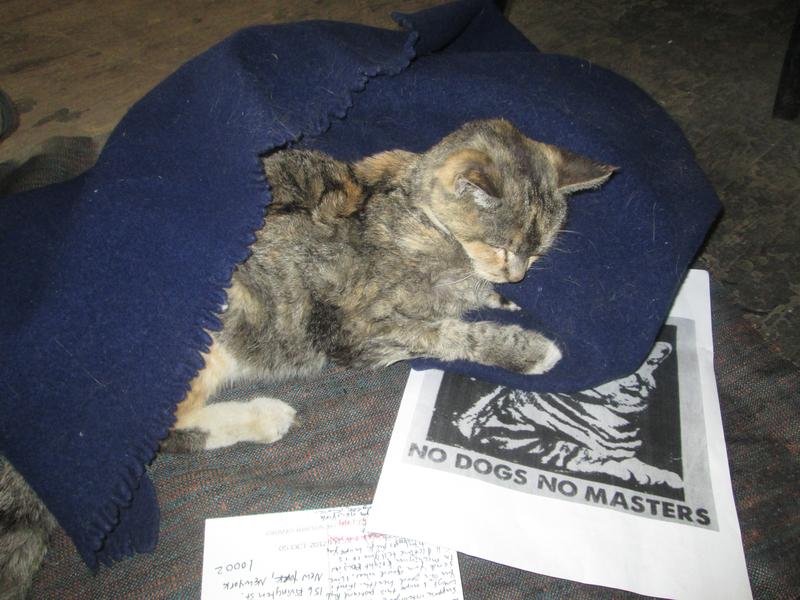
Yesterday, i said a sad goodbye to an old friend at ABC No Rio. Cookiepuss was a steadfast companion in my volunteer shifts at the No Rio computer center, a cranky yet gregarious presence. I met her soon after moving to New York, and have hung out with her nearly every week for years. [Cookiepuss -- No Dogs No Masters] She had the run of the building at ABC No Rio, and was friends with all sorts of people. She was known and loved by punks and fine artists, by experimental musicians and bike mechanics, computer geeks and librarians, travelers and homebodies, photographers, screenprinters, anarchists, community organizers, zinesters, activists, performers, and weirdos of all stripes. For years, she received postcards from all over the world, including several from people who had never even met her in person. In her younger days, she was a ferocious mouser, and even as she shrank with age and lost some of her teeth she remained excited about food. She was an inveterate complainer; a pants-shredder; a cat remarkably comfortable with dirt; a welcoming presence to newcomers and a friendly old curmudgeon who never seemed to really hold a grudge even when i had to do horrible things like help her trim her nails. After a long life, she died having said her goodbyes, and surrounded by people who loved her. I couldn't have asked for better, but I miss her fiercely.

25 September 2013

Gunnar Wolf: Is there some old-school programmer available around here?

Is there some old-school programmer available around here?
Just saw this ad today at my Institute's door. Rough translation: Interim programmer sought Requisites: [Yes, this is a joke post. I don't know how anybody is using such an obsolete job description. A job description at least three decades out of date] [Well, yes, I understand it, because I knowhow that particular union works. But I cannot accept it is for real] [...And no, please don't apply for the job. You will be miserable in the unlikely event you are chosen]

24 September 2013

Simon Josefsson: BLURB: Software repository metadata convention

As a maintainer of several software packages I often find myself copying text snippets from the README file into different places (savannah, github, freecode, emails, etc). Recently I had a need to generate a list of software packages that included every project s name, brief summary, license and URL. I could have generated that list manually by copying the text from every project s README and COPYING files. However then I would have to maintain my list manually to keep it in sync with all the projects. This easily leads to stale information, so I thought a better approach would be to put the information I needed into each projects source code version control system. The advantage is that the manual work to extract the information may be automated by a script, since the data is in a usable format. I ll explain here how my solution works. To be able to find the information using only the URL to the repository, I needed a filename convention. The filename I chose was BLURB; for the etymology, see Wikipedia s page about Blurb. The data format in the file is similar to normal email headers. An example illustrate the principles well. Below is the BLURB file for one of my projects.
Author: Yubico
Basename: libyubikey
Homepage: http://opensource.yubico.com/yubico-c/
License: BSD-2-Clause
Name: Yubico C low-level Library
Project: yubico-c
Summary: C library for manipulating Yubico YubiKey One-Time Passwords (OTPs)
The format is simple: UTF-8 text with each line starting with a header followed by a colon ( : ), some whitespace, and some content. If a line starts with whitespace, it is a continuation of the previous line s content (trim leading whitespace). The following table describes the fields that I use. I may update this blog post in the future with new fields or improved explanations (for reference, current date is 2013-09-24).
Header Meaning
Project Short identifier for the project (e.g., gcc , emacs )
Name Official name of the project in English
Summary Brief one-line summary of the project s purpose in English
Author Origin of the project
Homepage URL to the project s website
License License keyword, preferrably using one of the SPDX license identifiers
Basename The tarball basename, if different from the project name
Finally some reflection of the solution. After quick design, I thought that I couldn t be the first one with this problem, and I tried to find other similar efforts. I haven t been able to find any standardization effort that have the following properties: The related efforts that I found were SPDX which at first look seemed to offer what I wanted. However on closer examination it failed to deliver on all the requirements above, and appeared to have somewhat different goals. However I found the SPDX license list useful and refer to it. Another effort is Eric S. Raymond s freecode-submit and shipper but its primary focus is to encode information about each release. The design of the BLURB file is clearly influenced by these tools. Another influence has been Debian s specification for machine-readable copyright information. The Free Software Foundation s list of software projects seemed like another candidate, but it doesn t suggest any way to store the information in the upstream project itself. flattr this!

23 September 2013

Daniel Pocock: PostBooks packages available

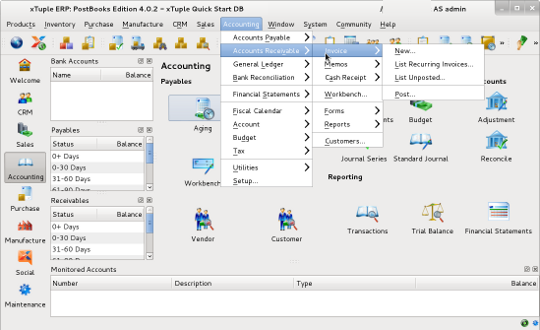
A common theme that comes up in free software evangelism is the question of how to tap into the huge expenditure that small to medium-sized businesses make for off-the-shelf licensed software. It is well known that many small companies are paying over the odds compared to the site-license rates given to big business, so why is it that small businesses are not rushing to adopt free and open source solutions? The answer is not likely to be found by fighting a battle on pricing (even though it is a battle that free software is inherently well prepared for). Rather, the most compelling strategy involves helping businesses find better ways to solve their own problems. A problem that every business encounters in every industry is the maintenance of proper financial records. Up until now, packaged solutions like GnuCash and HomeBank, available in many Linux distributions, have only catered for the smallest businesses and household accounting. At the other end of the spectrum, solutions like Compiere/Adempiere and OpenERP require a level of effort to install and maintain that makes them unsuitable for small users and businesses that don't need their full range of features. OpenERP briefly appeared as a Debian package but subsequently dropped out due to difficulties supporting the package. There is another choice, PostBooks. PostBooks has recently been packaged for Debian and this experience leads me to believe it will be supportable in Fedora and other distributions too. PostBooks, which started off as a commercial product, was re-licensed as an open source solution in 2007. In March 2013, PostBooks was project of the month on Sourceforge. Of particular note,
  • PostBooks has a Qt-based GUI where users of equivalent commercial solutions are likely to feel comfortable very quickly
  • PostBooks does not depend on any dedicated server processes other than a PostgreSQL database
  • Using the quickstart database, it can be set up in less than half a day, making it suitable for many consultants and freelancers who may otherwise use a product having a setup wizard (such as QuickBooks).
  • However, with features like inventory, invoicing, a sophisticated data import GUI (known as CSVImp), a true SQL backend, multi-currency and multiple concurrent users, it scales beyond the use cases that Quickbooks and Sage Accounting are capable of servicing.
  • The company behind PostBooks, xTuple, is well established and offers related services such as training and an annual user conference (which takes place in just a few weeks). Many business users are likely to find this style of support very reassuring and familiar, even if they don't plan to immediately take advantage of these things.
Limitations Two particular limitations caught my attention early when evaluating PostBooks: The developers have acknowledged these limitations and offered to complete these solutions with a crowd-funding campaign dubbed Feature Mob 2.

While everybody likes a free lunch, I personally feel that developers are perfectly entitled to request payment for their work. Having already taken a great leap of faith in open-sourcing a product that had previously been developed in-house, companies like xTuple need to look at new ways to generate revenue. Having looked at some of the prices of equivalent solutions, I felt quite comfortable pledging a similar amount based on four things:
  • it is based on the Kickstarter model, they only keep the money if their funding target is reached and feature implementation goes ahead
  • they are releasing the work as open source
  • the desire to have the option of using a highly capable free software solution that will be around well into the future
  • the probability that this is one piece of software that is likely to create more commercial opportunities for free software developers
Next steps People trying the packages and people who potentially want to package PostBooks for other distributions are very welcome to come and ask questions in the xTuple Debian maintainers packaging list or using the xTuple web forums. Please also feel free to report bugs through the Debian bug tracker.

22 September 2013

Steve Kemp: Some days you just want to do nothing

Today I finally pushed out a new binary release of my slaughter server-automation tool. (Think "CFEngine-lite", with perl. full documetnation is available. Though nobody ever reads it.) Otherwise the weekend is being quiet; we spent last night mostly drinking vodka, until midnight rolled over, and along with some messing around with a camera ("Wow, your arms are getting bigger!") Today has consisted of a Turkish breakfast, an Indonesian dinner, and an ice-cream based tea. I could write more, but I'm hung-over. A rare thing for me.

Russ Allbery: Review: Throne of the Crescent Moon

Review: Throne of the Crescent Moon, by Saladin Ahmed
Series: Crescent Moon Kingdoms #1
Publisher: DAW
Copyright: January 2013
ISBN: 0-7564-0778-8
Format: Mass market
Pages: 367
Doctor Adoulla Makhslood is the last ghul hunter in Dhamsawaat. He's an old man, and tired, and increasingly uncertain whether he wants to continue putting his life in danger to fight one more fight. But there are no replacements; his young and idealistic dervish apprentice, despite obvious skill, is too inexperienced and uninterested in the knowledge and investigation that makes Adoulla so good at what he does. So, when a young boy shows up on his doorstep, a survivor of a vicious ghul attack, he goes hunting once again. And both finds something much darker and stronger than he expected and meets an unexpected ally: a shape-shifting girl who is herself a survivor of something far worse than ghuls. Throne of the Crescent Moon is a first-novel fantasy that has made quite a splash, including a Hugo nomination (although I thought a win was unlikely, and I was right). One of the more interesting comments I've read about it was the observation by Jo Walton that if it had come out in 1980, it would have been an amazing, unusually wonderful, non-normative book. That it isn't is evidence of the changes in fantasy since then. The field has grown. As you might guess from the publisher's insistence on comparing it with The Arabian Nights, and from the names mentioned above, this book is set in an unspecified Middle Eastern culture and draws heavily from its mythology. It does not contain any western characters; the entire story is native to its region. The same is true of the mythology, which gave it a refreshing originality for me. And while I'm not the best one to judge, the presentation of that setting seemed free of the tint of the exotic. People live here, there are factions and multiple cultures, and the supernatural is a backdrop to most of the city. This would be very unusual decades ago. It's a bit less unusual now, and the story itself is a familiar ensemble fantasy, if refreshingly free of extended map exploration journeys. Ahmed brings together five characters with very different backgrounds and throws their varying talents at a problem. A few of those elements are a bit too familiar: female sexuality as a threat to male power is a world-building element that I could do without, for example. I also found the villain completely inadequate in its unidimensional evil (reinforced with a few more torture scenes than I needed to read), and even the attempted complication felt too predictable to me. Except for one touch of perspective, I'd call Throne of the Crescent Moon a competent, enjoyable, but somewhat forgettable fantasy novel, albeit one that's refreshingly concerned with a city instead of countrysides and travel. That touch is in the age of several of the protagonists. We get sections following several of the main characters in tight third person, but Adoulla is the first protagonist and the focus of much of the book. And Adoulla is neither young nor inexperienced, and is not going through the typical fantasy bildungsroman. He's old, experienced, a bit set in his ways, cranky, cantankerous, and deeply in love with his city. In tone, this shifts the story towards Star Wars as seen through the eyes of Obi-Wan Kenobi instead of Luke Skywalker. And that change I really liked, and would be happy to see become more common in fantasy. There was a bit of a downside for me in three of the five main characters being older. At times, Throne of the Crescent Moon has an elegiac tone, a feeling of life, power, and time slipping away and cultures and ways of life being lost. That's not my favorite thematic element. I tend to find it more depressing than I really want in my reading. But, here, the mature perspective more than makes up for some occasional negativity. I particularly liked how the older characters treated the likely budding young romance, which would have been the center of many books in this genre, with bemused detachment and playful encouragement without giving it more significance than it deserves. There's another romance that ends up being more significant, and which needs the weight of time and well-lived lives to become so. I don't think this book deserves a Hugo, but it is an enjoyable fantasy with some interesting characters and a refreshing perspective and setting. The villain really isn't adequate to the story, there's a bit too much torture for my liking, and I could have done without a few of the tropes, but it's a solid entry in its genre and a pleasant few hours of reading. And despite being advertised as the first of a series, it comes to a satisfying conclusion. Rating: 7 out of 10

20 September 2013

Vincent Sanders: Man is fully responsible for his nature and his choices.

Well at least he should be according to Sartre though I am not entirely convinced the repercussions of my choice to manufacture another folding chair were entirely thought through.

After my most recent posting the urge to do "just one more iteration" became too great and I succumbed. I therefore present version 4 of my folding chair which corrects all the previously discovered issues.

The popliteal height (420mm) and buttock popliteal length (400mm) are both comfortable for a wide selection of people. The seat slopes a few degrees front to back and the back rest no longer comes further forward than the rear of the seat.

There is a small gap above where the seat folds in when flat but that is only an aesthetic issue when being stored.

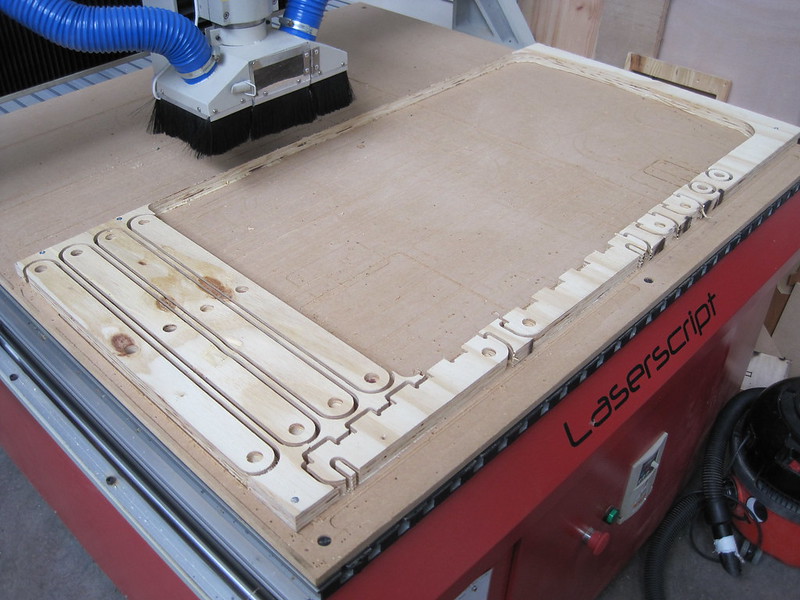
Manufacture wise the design is simple to produce although I really will have to teach our CNC router how to use the round over bit to reduce the finishing steps as currently that takes longer than the CNC operation.

In future if I make more of these I will use this design and, once she is less annoyed at me for making another chair, I am going to consult with my wife on adding some cushioning material to the seat and backrest.

And of course that concludes my furniture making for a while...yeah, right!

there have been comments which have complained about my usage of space on sheets and suggested I waste too much material. That is probably true and in my own defence I have not been working with this machine for very long and am not quite used to what I can "get away with" yet.

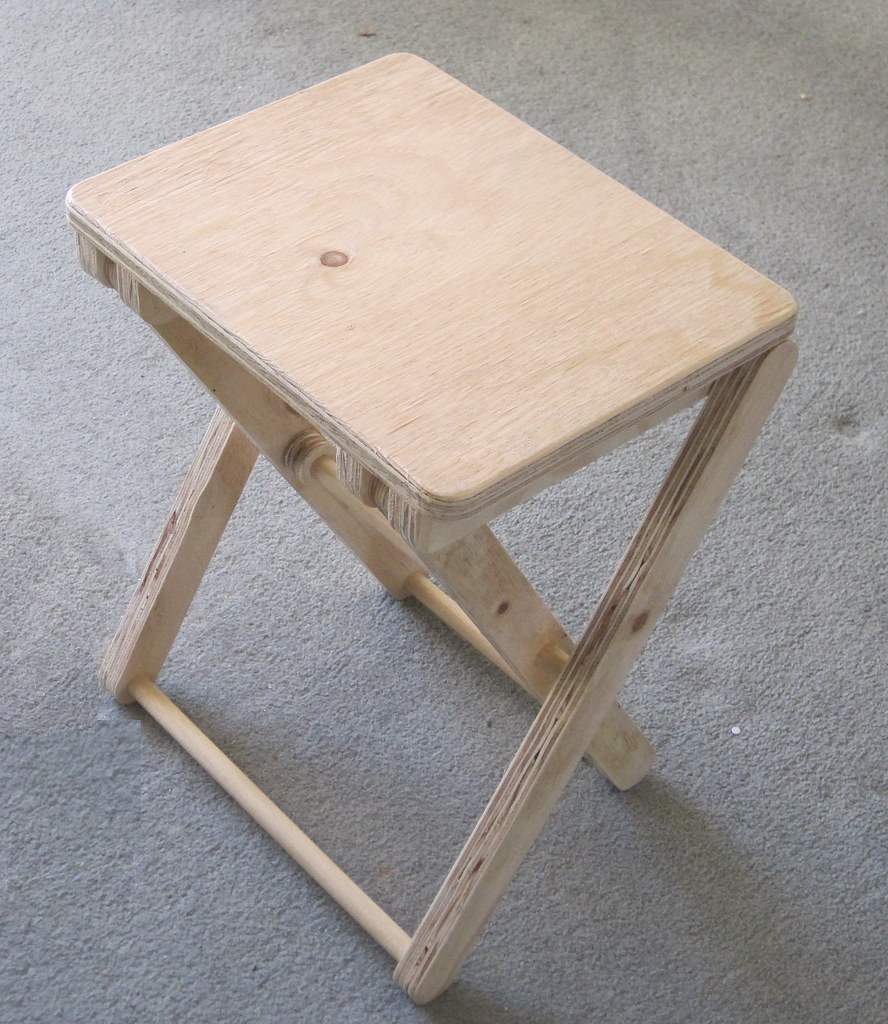
Side X folding stool
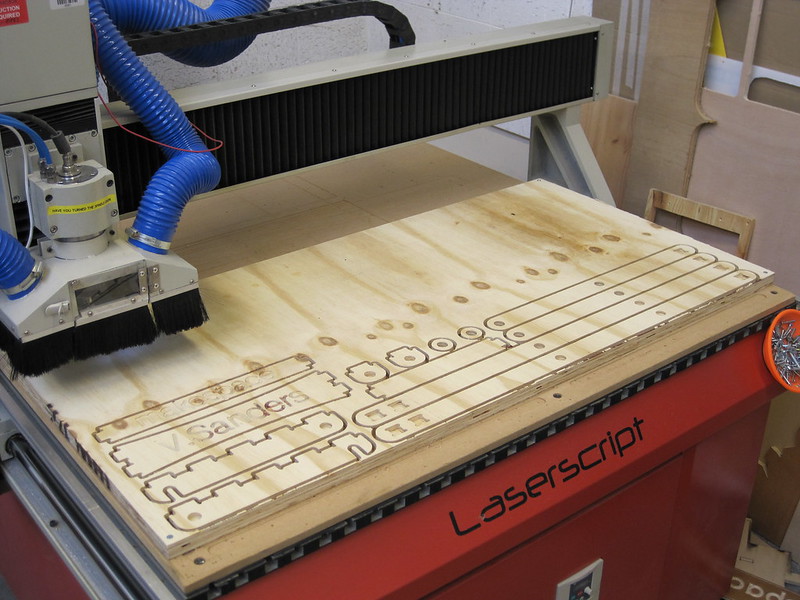
I was looking at the sheet after removing the last chair design and had a thought, I had not attempted a side X type folding design and perhaps I could squeeze one into the offcuts? I kinda got carried away, it roughly went:


Side X folding stool cut from sheet offcut
If all of that sounds like and utterly mad way to design a size X stool, you are of course correct, but it worked, and it was a very fast process taking less than four hours from idea to stool.

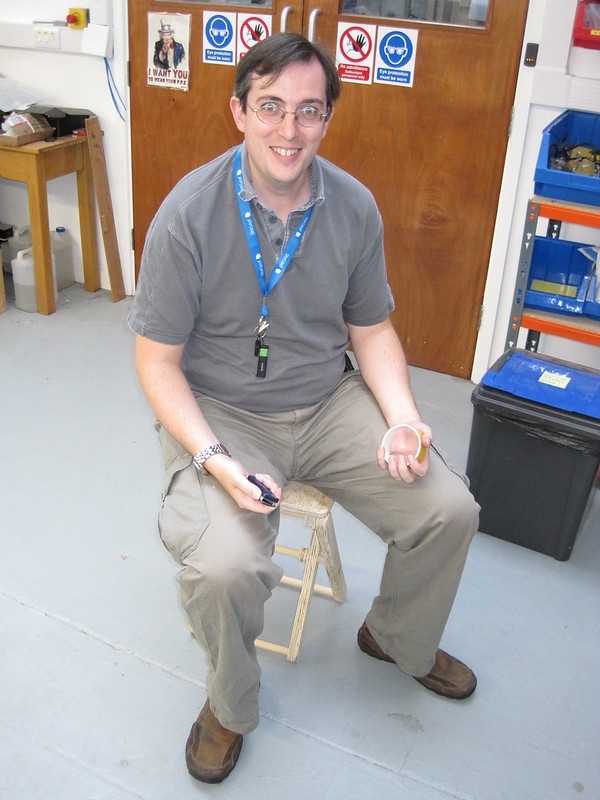
Paul testing the dry fit side X stool
There are a couple of issues:

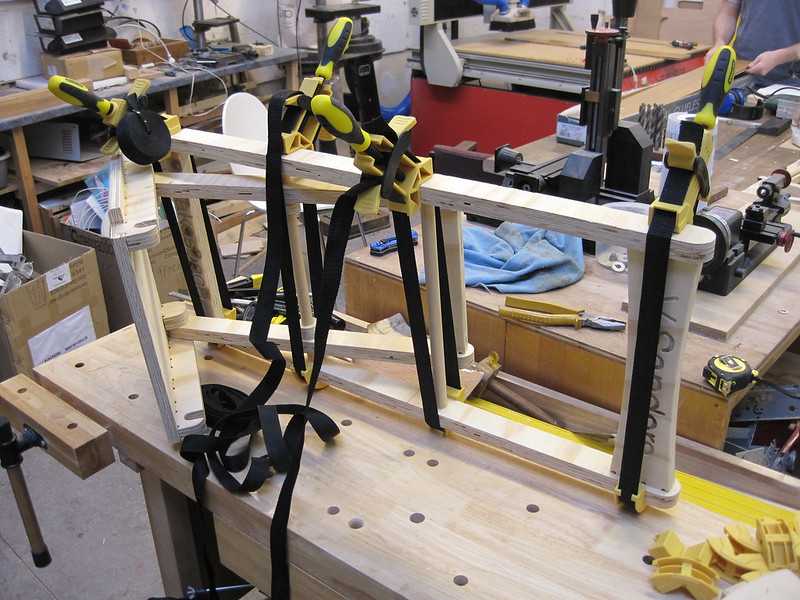
Clamping stool why the glue drys
The seat went together dry fit and Paul tested it for me, however that last issue soon made me realise that this time I was going to have to resort to glue. Yes, sorry, this design needs to be glued to remain stable (I know plywood contains glue...please stop telling me that).


It is pretty simple to put together and aside from needing half the clamps in makespace to hold it in place while the glue dried, I had no trouble.

Though this is definitely not a case of use glue "sparingly" I put generous amounts in all the dowel joints and all the seat slots and got very little ooze so I guess it could have used more.

The final varnished stool is pretty robust but folds up nicely the concept of hooking to its own pivot dowel means it stays closed when flat which makes it very portable.

Total cost was an estimated 10.00 ( 4.25 dowel, 2.50 of 24mm ply, 1.75 for 18mm ply, 0.50 tool wear, 1.00 varnish) though the materials in my case could be argued to have cost nothing.

It has been suggested that I could make an entire picnic table and chairs set this way but if I did I would reduce the stool height by 50mm and examine ways to use less dowel.

This is usually the bit where I point you all at the freely usable design files on github and all the photos on flikr and wrap up.

But you know what the Monty Python boys say? "Nobody Expects the Spanish inquisition"

Or in this case my final (and yes I am going to do something else next) chair design. It is based on the stool, in fact it is the stool design with the outer legs extended and a back rest added.

The modified design reduces the dowel requirements to 775mm but requires a bit more sheet material (cannot get this one entirely from offcuts).

Total cost was an estimated 10.50 ( 2.50 dowel, 4.50 of 24mm ply, 1.75 for 18mm ply, 0.50 tool wear, 1.25 varnish).
Because it is based on the stool design it suffers from the height issue and in addition the back rest is a bit far back to be completely comfortable.

Neither of the side X designs have flaws that interest me enough to follow the iterative approach again to solve them. Both the designs work well enough and rounded out my adventures with folding chairs and indeed furniture for now.

As always the design files are on github and the images are on flikr.


19 September 2013

Daniel Pocock: Install Debian wheezy and jessie directly with btrfs RAID1

Some time ago, I provided an installation report for installing Debian wheezy onto a btrfs RAID1 filesystem. It is not supported directly from the installer partitioning menu partman, but it is not hard to trick the installer to do it, as described in the bug report. I believe this may be a worthy release goal for Debian 8 (jessie), but it is not something I can commit to facilitate myself so I am sharing my experience with it for those who may want to volunteer. Anybody wanting to test it can easily do so with VirtualBox if they don't want to dedicate a real machine to it or if they don't have two real disks in their test machine. My own testing simply involved creating two VirtualBox virtual disks on a single SATA disk. Procedure Here is an abbreviated version of the procedure from the installation report linked above. Run the Debian installer as normal up to the partitioning menu Use manual partition mode Create one big btrfs partition on one HDD (either on a raw partition or on an LV) Designate the partition on one disk as the root FS, designate the partition on the other as unused/unformatted. Continue through the setup, installing to one disk After rebooting into Debian, follow these steps to add the other disk into a RAID1 A variation of this procedure is to use a shell while the installer is running to make the RAID1 during the installation and observe whether /etc/fstab is created correctly. Potential gotchas: is the default fstab sufficient or does it need to be modified after the conversion to RAID1? Does the initframfs need to be regenerated (and potentially modified by hand?) to make it work? Issues to be discussed / resolved Mixing BTRFS filesystems with Logical Volume Management - how many permutations should the installer support? What do people expect/need/require? How to boot if a disk fails? Can grub boot from either? Warning the user when the FS detects instability or failure in either disk

17 September 2013

Julien Danjou: Python 3.4 single dispatch, a step into generic functions

I love to say that Python is a nice subset of Lisp, and I discover that it's getting even more true as time passes. Recently, I've stumbled upon the PEP 443 that describes a way to dispatch generic functions, in a way that looks like what CLOS, the Common Lisp Object System, provides. What are generic functions If you come from the Lisp world, this won't be something new to you. The Lisp object system provides a really good way to define and handle method dispatching. It's a base of the Common Lisp object system. For my own pleasure to see Lisp code in a Python post, I'll show you how generic methods work in Lisp first. To begin, let's define a few very simple classes.
(defclass snare-drum ()
())

(defclass cymbal ()
())

(defclass stick ()
())

(defclass brushes ()
())

This defines a few classes: snare-drum, symbal, stick and brushes, without any parent class nor attribute. These classes compose a drum kit, and we can combine them to play sound. So we define a play method that takes two arguments, and returns a sound (as a string).
(defgeneric play (instrument accessory)
(:documentation "Play sound with instrument and accessory."))

This only defines a generic method: it has no body, and cannot be called with any instance yet. At this stage, we only inform the object system that the method is generic and can be then implemented with various type of arguments. We'll start by implementing versions of this method that knows how to play with the snare-drum.
(defmethod play ((instrument snare-drum) (accessory stick))
"POC!")

(defmethod play ((instrument snare-drum) (accessory brushes))
"SHHHH!")

Now we just defined concrete methods with code. They also takes two arguments: instrument which is an instance of snare-drum and accessory that is an instance of stick or brushes. At this stage, you should note the first difference with object system as built into language like Python: the method isn't tied to any class in particular. The methods are generic, and any class can implement them, or not. Let's try it.
* (play (make-instance 'snare-drum) (make-instance 'stick))
"POC!"

* (play (make-instance 'snare-drum) (make-instance 'brushes))
"SHHHH!"

* (play (make-instance 'cymbal) (make-instance 'stick))
debugger invoked on a SIMPLE-ERROR in thread
#<THREAD "main thread" RUNNING 1002ADAF23 >:
There is no applicable method for the generic function
#<STANDARD-GENERIC-FUNCTION PLAY (2)>
when called with arguments
(#<CYMBAL 1002B801D3 > #<STICK 1002B82763 >).

Type HELP for debugger help, or (SB-EXT:EXIT) to exit from SBCL.

restarts (invokable by number or by possibly-abbreviated name):
0: [RETRY] Retry calling the generic function.
1: [ABORT] Exit debugger, returning to top level.

((:METHOD NO-APPLICABLE-METHOD (T)) #<STANDARD-GENERIC-FUNCTION PLAY (2)> #<CYMBAL 1002B801D3 > #<STICK 1002B82763 >) [fast-method]

As you see, the function called depends on the class of the arguments. The object systems dispatch the function calls to the right function for us, depending on the arguments classes. If we call play with instances that are not know to the object system, an error will be thrown. Inheritance is also supported and the equivalent (but more powerful and less error prone) equivalent of Python's super() is available via (call-next-method).
(defclass snare-drum () ())
(defclass cymbal () ())

(defclass accessory () ())
(defclass stick (accessory) ())
(defclass brushes (accessory) ())

(defmethod play ((c cymbal) (a accessory))
"BIIING!")

(defmethod play ((c cymbal) (b brushes))
(concatenate 'string "SSHHHH!" (call-next-method)))

In this example, we define the stick and brushes classes as subclass of the accessory class. The play method defined will return the sound BIIING! regardless of the accessory instance that is used to play the cymbal. Except in the case where it's a brushes instance; only the most precise method is always called. The (call-next-method) function is used to call the closest parent method, in this case that would be the method returning _"BIIING!".
* (play (make-instance 'cymbal) (make-instance 'stick))
"BIIING!"

* (play (make-instance 'cymbal) (make-instance 'brushes))
"SSHHHH!BIIING!"

Note that CLOS is also able to dispatch on object instances themself by using the eql specializer. But if you're really curious about all features CLOS provides, I suggest you read the brief guide to CLOS by Jeff Dalton as a starter. Python implementation Python implements a simpler equivalence of this workflow with the singledispatch function. It will be provided with Python 3.4 as part of the functools module. Here's a rough equivalence of the above Lisp program.
import functools

class SnareDrum(object): pass
class Cymbal(object): pass
class Stick(object): pass
class Brushes(object): pass

@functools.singledispatch
def play(instrument, accessory):
raise NotImplementedError("Cannot play these")

@play.register(SnareDrum)
def _(instrument, accessory):
if isinstance(accessory, Stick):
return "POC!"
if isinstance(accessory, Brushes):
return "SHHHH!"
raise NotImplementedError("Cannot play these")

We define our four classes, and a base play function that raises NotImplementedError, indicating that by default we don't know what to do. We can then write specialized version of this function with a first instrument, the SnareDrum. We then check for the accessory type that we get, and return the appropriate sound or raise NotImplementedError again if we don't know what to do with it. If we run it, it works as expected:
>>> play(SnareDrum(), Stick())
'POC!'
>>> play(SnareDrum(), Brushes())
'SHHHH!'
>>> play(Cymbal(), Brushes())
Traceback (most recent call last):
File "<stdin>", line 1, in <module>
File "/home/jd/Source/cpython/Lib/functools.py", line 562, in wrapper
return dispatch(args[0].__class__)(*args, **kw)
File "/home/jd/sd.py", line 10, in play
raise NotImplementedError("Cannot play these")
NotImplementedError: Cannot play these
>>> play(SnareDrum(), Cymbal())
Traceback (most recent call last):
File "<stdin>", line 1, in <module>
File "/home/jd/Source/cpython/Lib/functools.py", line 562, in wrapper
return dispatch(args[0].__class__)(*args, **kw)
File "/home/jd/sd.py", line 18, in _
raise NotImplementedError("Cannot play these")
NotImplementedError: Cannot play these

The singledispatch module looks through the classes of the first argument passed to the play function, and calls the right version of it. The first defined version of the play function is always run for the object class, so if our instrument is a class that we did not register for, this base function will be called. For whose eager to try and use it, the singledispatch function is provided Python 2.6 to 3.3 through the Python Package Index. Limitations First, as you noticed in the Lisp version, CLOS provides a multiple dispatcher that can dispatch on the type of any of the argument defined in the method prototype, not only the first one. Unfortunately, Python dispatcher is named singledispatch for this good reason: it only knows to dispatch on the first argument. Guido van Rossum wrote a short article about the subject that he called multimethod a few years ago. Then, there's no way to call the parent function directly. There's no equivalent of the (call-next-method) from Lisp nor the super() function that allows to do that in Python class system. This means you will have to use various trick to bypass this limitation. So while I am really glad that Python is going toward that direction, as it's a really powerful way to enhance an object system, it really lacks a lot of more advanced features that CLOS provides out of the box. Though, improving this could be an interesting challenge. Especially to bring more CLOS power to Hy. :-)
The Hacker Guide to Python
A book I'm writing that will be launched soon, talking about designing Python applications, state of the art, and various Python tips. If you want to be the first to hear about the launch, subscribe now.

Steve Kemp: A new wordpress plugin

There is now a new wordpress plugin, for testing against my blogspam site/service. Now time to talk about something else. This week my partners sister & niece are visiting from Helsinki, so we've both got a few days off work, and we'll be acting like tourists. Otherwise the job of this week is to find a local photographer to shoot the pair of us. I've shot her many, many, many times, and we also have many nice pictures of me but we have practically zero photos of the pair of us. I spent a lot of time talking to local volunteers & models, because I like to shoot them, but I know only a couple of photographers. Still a big city, we're bound to find somebody suitable :)

16 September 2013

Gunnar Wolf: My favorite (or rather, one among my favorite) non-original work Leo Masliah #encirc13

It seems I'm catching up with the pace of this course I'm following and that is compelling me to go back to posting on my blog, Arte y cultura en circulaci n: crear y compartir en tiempos digitales . This week's lesson is (again, in Spanish) Las fronteras del remix (the boundaries of remixes). An interesting text, open to everybody (regardless of whether you are signed up for the course or, I hope, whether time has passed since the course took place). And this week's homework is to find "our favorite" non-original work (I picked one among my favorite works And, yes, this is partly because I am part of the "club" of deniers of true originality: We cannot create anything without being part of a surrounding culture, without a common heritage and language with which we speak to our audience) and to find something about it, anything considered important or significative as to its antecedents. What do I like about this work, what grabs my attention. Do I consider it to be a true new creative work? Why? I am taking as an example Leo Masliah, an Uruguayan writer and musician (writer and interpreter). I have followed and enjoyed Masliah's work since 1996, and although by far I'm most familiar with his musical works, I have two books (a novel and a series of short stories). Among his facets, I most enjoy the acid, nihilistic/dadaistic streaks. I chose three of his songs to talk about I am linking to anonline resource where possible, but uploading the three songs to this blog to make his work better known, so that people understand what I talk about, and with my best intentions. Of course, if there is any request to remove the material, I will do it right away. I hope this can be seen as fair/academic use, although this blog is somewhat widely read.
La recuperaci n del unicornio
This song was in the first Masliah cassette I came across, Although musically it is an original work, the lyrics are a clear, almost line-by-line reply to the ever-repeated Unicornio song, by Silvio Rodr guez. This song (which I'm sure that every Spanish speaker reading this lines knows, like it or not It defines for me a good deal of Rodr guez hyper-sweetness and clicheness) has been analyzed over and over looking for a meaning. Silvio recorded this song in 1981, and by 1987 Masliah published this answer, mocking each of the lines.
So, this song can be seen as an original creation, as it contains no literal copy neither of the music nor of the lyrics of the original, but it cannot be understood without being familiar with Silvio's lost unicornio. It would just be an almost-dadaistic rant. But every person that has tasted Silvio Rodr guez cloying song will surely laugh with this one.
No necesitamos otro h roe Balderrama
I find this to be a very unique piece. It bonds together Argentinian folklore and USA pop.
Masliah sings the famous Argentinian song Zamba de Balderrama, (Castilla / Leguizam n), a song lamenting that the very popular bar and artist stage Balderrama, in Salta (North-Western corner of Argentina), seemed to be on the brink of closing. Of course, when Mart n, Constanza, Regina and me went to Balderrama in July 2010, the danger of closing this place had long been averted. And basically every Argentinian knows this song by heart.
The interesting part is that Masliah sings this song (as he presents it as the closing piece for one of his concerts) being short on time, and decides to present two acts together: Zamba de Balderrama and We don't need another hero, by Tina Turner, from the Mad Max soundtrack. So, of course, even if it's obvious that Masliah had to stretch bits to make them fit together, he achieved a very funny, interesting and unique blend of two completely unrelated works. He derives from one as well as from the other, but creates something unique and new.
Donna Lee
I was thinking what to write for this assignment , and had already chosen the two other songs. Yesterday, we were visiting our friends Octavio and Claudia, in Guanajuato, and I heard for the first time the original(?) version of Donna Lee, by Miles Davis (although often credited to Charlie Parker). That led me to remember Masliah's interpretation, in his Cl sicos album. This album is basically made up with similar excercises: Taking an instrumental piece, with Masliah singing over it. Some of the lyrics follow the story (i.e. the children stories), others just talk nonsense to illustrate a point (i.e. "La voz del medio", "the middle voice") follows the non-protagonist score trying not to grab much attention to the lyrics but to highlight the often ignored melody)... Donna Lee is just a fun excercise on following the melody asking what was in the head of the author that led him to invent such a strange, hard music.
Masliah is a great music performer, although often it seems he tries to hide it (i.e. by abusing the dissonances, ex-profeso singing off-key, etc), and a very funny and crazy author. Most of his works have a deep satirical tone, and it's common to find either simple winks or complete "borrowings" in a clear remix fashion, but nobody will doubt on the originality of his works.
AttachmentSize
07-Donna Lee.MP31.79 MB
16 No necesitamos otro h roe - Balderrama.mp33.49 MB
Leo Masl ah-La Recuperaci n Del Unicornio.mp31.87 MB

Debian Med

DebConf 13 report (by Andreas Tille) General impression unofficial  Scenic Hacklab I'm beginning my DebConf report in an unofficial "Scenic Hacklab" right at the edge of the lake in Yverdon. This is the right place to memorise the last days. When I started from this place cycling to Le Camp 12 days ago I was full of great expectations and what should I say - the reality has even beaten these. Once it comes about comparing DebConfs even if it is an unfair comparison due all the differences my secret long term favourite was Helsinki very closely followed by Argentina and also very closely followed by all the other great DebConfs I joined (and I joined all in Europe). Would Le Camp be able to beat it? The short answer is: Yes, it is now my favourite DebConf while I think I do not suffer from the last-Debconf-was-the-best-DebConf-syndrome (and I realised there are others thinking the same). As you might probably know I'm a bit addicted to swimming. While Helsinki had admittedly the better conditions I was at least able to fix the distance issue using my bicycle. (Hey, those Le Camp photographers did a great job in hiding the fact that you can not actually touch the lake right from the meadow of Le Camp.) Being able to have my bicycle at DebConf scored some extra points. However, the really great view of the lake, the inspiring "Scenic Hacklab" which was my favourite place has bumped DebConf13 at first place in my personal ranking. So it comes quite natural to say: "Kudos to the great organisation team!" They did a Swiss-like precise work and perfectly succeeded in hiding any problems (I assume there were some as always) from the attendees so everything went smooth, nice and shiny for the attendees. The local team was even precise in setting up great weather conditions for DebConf. sunrise over  the lake While saying thanks to the local team I would like to also explicitly thank Luca Capello who has quite some share that this DebConf was possible at all (while I have to decrease my DebConf score one point because he was not really there - Luca to bad that you were not able to come full time!) Also thanks to Gunnar and Gannef who helped remotely (another score down because I were missing them this year as well). Even if it was my favourite DebConf I was not able to work down my todo list fully (which was not only uploading one package per day which I at least statistically fullfilled). But that's probably a general feature of todo lists anyway. One item was definitely done: Doing my daily swimming BoF. I actually was able to do the other parts of the triathlon which was skipped by Christian and have done in summary about 150km cycling with 3500m elevation and estimated 7-8km swimming (0m elevation ;-)). Considering the great view at sunrise over the lake I was not hating my "Senile bed escape" disease too much (I was every day waking up at sunset) - it was simply a great experience. I will never forget seeing water drips glimmering like gold inside the morning sun while seeing the Alps panorama in the distant. I hope I was able to help all interested swimmers with the DebConf Beach Map which was just a by-product of my activities in DebCamp. Speaking about OSM: I was astonished that the area was way less covered than I expected. Thanks to several DebConf attendees the situation became better and the map does not only show random trees in the wild but also the tracks leading to these. (Remark: It was no DebConf attendee who is responsible for plastering the map with single trees.) While I had my mapping focus basically close to the edge of the lake I was also able to even map my very own street. :-) I clearly remember one specific mapping tour when I was invited by the DPL: He convinced me to join him on a bicycle tour and since I was afraid to get fired I joined him instead to keep on hacking. Also Sorina was brave enough to join us on the tour and she did quite well. (Sorina, do you remember the agreement about your work on the installer? ;-)) Lucas described the tour as: going uphill on only asphalted roads. Sorina and me were witnessing the mighty DPL powers when we left the wood around Le Camp to reach the described road: The asphalt was just put onto the road - no doubt that it was done on the immediate demand of mighty DPL. :-) DebCamp time was flying like nose dive and a lot of known (and unknown) faces arrived at Le Camp. What I really liked a lot this year was that several really young children has pulled down the average age of DebConf attendees. I clearly remember all the discussion one year ago what to do about children. As always the issue was solved in a typical Debian way: Just do it and bring your children - they had obviously a great time as well. I think the youngest child was 2 months and the oldest "child" above 20. ;-) Actually Baptiste Perrier did great in making the C&W party a success and had obviously a nice time. (I wished my son would have been able to come as well but he needs to write his bachelor s thesis in physics. :-() It was nice to see the kids using all playing facilities and communicating with geeks. Also I would like to point out that even the very young attendees had their share at the success of DebConf: Just think of the three "bell ringing assistants" who helped me ringing the bells for lunch and dinner. I've got this cool job from Didier in the beginning of DebCamp. I must say having some real bells ringing is by far nicer than just the "lunch / dinner starts in 10 minutes" from IRC bot. The only thing I did not understand was that people did not considered ringing the bells at 8:00 for breakfast as a good idea. Regarding the food in general I would also like to send kudos to the kitchen: It was tasty, freshly prepared, regional food with a good change rate. I really liked this. Extra points for having the chance to sit outside when eating. Talks But lets have a look into the conference programme. I'd really recommend watching the videos of the talks Bits from the DPL (video) and Debian Cosmology (video). I considered both talks as entertaining and interesting. I also really hope that the effort Enrico Zini started in Debian Contributors (video) will be successful. I had some talks and BoFs myself starting with Why running a Blend (video) and I admit that (as usual) the number of attendees was quite low even if I think there is some proof (see below) that it is interesting for way more people who should consider working more "blendish" in their team. Do you know how to recruit one developer per year and relax the man power problem in your team? Feel free to watch the video. We have confirmation that ten DDs of our team have considered to join Debian only because Debian Med exists. Admittedly biology and medicine are really leaf topics inside the Debian universe. So if even this topic that has a very tiny share of the Debian users is able to attract this level of attention - how many more people could we win for multimedia, games, GIS and others? So if you feel you are quite overworked with your packaging and you have no time this is most probably wrong. The amount of time is basically a matter of priorities you set for your tasks. Try to put some higher priority onto using the just existing Blends tools I explained in my talk to attract more users and developers to your team and by doing so spread the workload over more people. It works, the prove was given in my main talk. So before you start working on a specific package you should wonder who else could have an even stronger interest to get this work done and provide him with some additional motivation and help to get the common goal done. The interesting thing is that my BoF about How to attract new developers for your team (video) - which was a simple report about some by-product of the Blends work - made it into the main talk room and got way more attention. For me this is the proof that the Blends concept itself is probably badly perceived as something like "a few outsiders are doing damn specific stuff which is not really interesting for anybody else" instead of what is really is: Smoothing the way from specific upstream applications to the end user via Debian. Once you see the video of this BoF you can observe how my friend Asheesh Laroia became more and more excited about the Blends concept and admitted what I said above: We should have more Blends for different fields. Funnily enough Asheesh asked me in his excitement to talk more about Blends. This would have been a really good suggestion ten years ago. At DebConf 3 in Oslo I had my very first talk about Blends (at this time under the name "Debian Internal Projects"). I continuously kept on talking about this (MiniDebConf Peking 2005, DebConf 5, Helsinki (video), DebConf 7, Edinburgh (video), DebConf 8, Mar del Plata (video), DebConf 9, C ceres (video), MiniDebConf Berlin 2010 (video in German), MiniDebConf Paris 2010 (not video recorded), DebConf 11, Banja Luka (video) ... and these are only (Mini)DebConfs my talks page is full of this topic) and every new year I try different ways to communicate the idea to my fellow Debianistas. I'm wondering how I could invent a title + abstract avoiding the term Blends, put "Git", "release" and "systemd versus upstart" in and being able to inform about Blends reasonably by not becoming to off topic with the abstract. I also registered the Debian Science round table. I admit we were lacking some input from remote via IRC which used to be quite helpful in the past. The attendees agreed upon the handling of citations in debian/upstream files which was invented by Debian Med team to create even stronger bounds to our upstream developers by giving their work extra reward and providing users with even better documentation (see my summary in Wiki). As usual I suggested to create some Debian Science offsprings like "Debian Astronomy", "Debian Electronics", "Debian Mathematics", "Debian Physics" etc. who could perfectly leave the Debian Science umbrella to get a more fine grained structure and a more focused team to enhance the contact to our users. Unfortunately there is nobody who volunteers to take over the lead for such Blends. I have given a short summary about this BoF on the Debian Science mailing list. In the Debian Med meeting I have given some status report. No other long term team members were attending DebConf and so I gave some kind of introduction for newcomers and interested people. I touched also the DebiChem topic which maintains some packages that are used by biologists frequently and so we have a good connection to this team. Finally I had registered three BoFs in Blends I'm actually not (or not yet) active part of. My motivation was to turn the ideas I have explained in my main talk into specific application inside these teams and helping them to implement the Blends framework. In the first BoF about Debian GIS I have shown the usual team metrics graphs to demonstrate, that the one packaging team Pkg-OSM is in danger to become MIA. There are only three persons doing actual uploads. Two of them were at DebConf but did not joined the BoF because they do not consider their contribution to Pkg-OSM as a major part of their general Debian work. I will contact the main contributor David Paleino about his opinion to move the packages step by step into maintenance of Debian GIS packaging team to try to overcome the split of two teams that are sharing a good amount of interest. At least if I might become an Uploader for one of the packages currently maintained by Pkg-OSM I will move this to pkg-grass-devel (which is the name of the packaging team of Debian GIS for historical reasons). The attendees of the BoF have considered this plan as sensible. Moreover I talked about my experiences with OSGeo Live - an Ubuntu derivative that tries to provide a full tool chain to work on GIS and OSM problems ... basically the same goal as Debian GIS has just provided by the OSGeo project. I'm lurking on OSGeo mailing list when I asked explicitly I've got the answer that they are working together with Debian GIS and are using common repository (which is IMHO the optimal way of cooperation). However, it seems that several protagonists of OSGeo Live are underestimating the resources provided by Debian. For instance there was a question about Java packaging issues but people were not aware about the existence of the debian-java mailing list. I was able to give an example how the Debian Med team managed to strengthen its ties to BioLinux that is also an Ubuntu derivative for biologists. At our first Debian Med sprint in 2011 we invited developers from BioLinux and reached a state where they are using the very same VCS on Alioth where we are maintaining our packages. At DebConf I was able to upload two packages where BioLinux developers did certain changes for enhancing the user experience. My "work" was just bumping the version number in changelog and so we did profit from the work of the BioLinux developers as well as they are profiting from our work. I plan to dive a bit more into Debian GIS and try to strengthen the connection to OSGeo Live a bit. The next BoF was the Debian Multimedia meeting. It was nice that the current leader of Ubuntu Studio Kaj Ailomaa joined the meeting. When I was explaining my ideas about cooperation with derivatives I repeated my detailed explanation about the relation with BioLinux. It seems every topic you could cover inside Debian has its related derivative. So to me it seems to be quite natural to work together with the developers of the derivative to join forces. I actually consider a Blend a derivative done the right way = inside Debian. The final work for the derivers that might be left for them is doing some shiny customising of backgrounds or something like this - but all the hard work could and should be done in common with the relevant Debian team. My dream is to raise such relevant teams inside Debian ... the Blends. Finally the last BoF of this series was the Debian Games meeting. As always I presented the team metrics graphs and the Debian Games team members who attended the BoF were quite interested. So it seems to be some unknown fact that team metrics are done for several teams in side Debian and so I repeat the link to it for those who are not yet aware of it. As a result of the BoF Debian Games team members agreed to put some more effort into maintaining their Blends tasks. Moreover Miriam Ruiz wants to put some effort into reviving Debian Jr. Regarding Debian Jr. there was an interesting talk about DouDouLinux - in case you might want to watch the video I'd recommend skipping the first 30min and rather watch the nice live demo. There was also an ad hoc BoF about Debian Jr scheduled to bring together all people interested into this cute project and Per Anderson volunteered to take over the lead. I have given a summary about this specific BoF at the Debian Jr list. For some other talks that I'd regard as remarkable for some reasons: I'd regard the talk "Debian-LAN" by Andreas Mundt as some hidden pearl because it did not got a lot of attention but after having seen the video I was quite impressed - specifically because it is also relevant for the Blends topic. Memories I also liked "Paths into Debian" by Moray Allan (and I was only able to enjoy the latter talks thanks to the great work of the video team!) because it also scratched the same topic I was concerned about in my mentoring talk. Related to this was in my opinion also "Women in Debian 2013" were we tried to find out reasons for the lack of woman compared to other projects and how to overcome this issue. Geert hovering  over the grass Besides the talks I will probably never forget two specific moments that make DebConf so special. One of these moments is recorded on an image that clearly needs no words - just see Geert hovering over the grass. Another strong moment in my personal record was in the DebConf Newbies BoF "First time at DebConf" that unfortunately was not recorded but at least for this statement it would have been very great if we would have some reference better than personal memory. Aarsh Shah a GSoC student from India suddenly raised up and said: "Four months ago I was not even aware that Free Software exists. Now I'm here with so many people who are totally equal. If I will tell my mother at home that I was standing in the same queue where the Debian Project Leader was queuing up for food she will never believe me." He was totally excited about things we are regarding as normal. IMHO we should memorise moments like this that might be part of the key to success in cultures, where Debian is widely unknown and very rarely in use. Amongst these not scheduled great moments the scheduled day trip was also a great thing. I had a really hard time to decide what tour I might join but ended up in the "long distance walking (or should I say running) group". Inspired by the "running Bubulle" who was flashing between the walking groups we went uphill with 5.4km/h which was a nice exercise. Our destination the large cliff was an exciting landscape and I guess we all enjoyed the dinner organised by the "Trout cabal". ;-) say goodby to  friends So I had a hard time to leave Le Camp and tried hard to make sure my memories will remain as long as possible. Keeping some signs attached to my bicycle, conserving the "Scenic Hacklab" sign for my private "scenic hacklab @ home" was one part. I also have cut some branches of the Buxus sempervirens in Le Camp and have put them in my garden at home (where I create some hedgerow from places where I spent some great time). These will probably build a great part of the hedgerow ... Thanks for reading this longish report. Looking forward to see you all in Germany 2015 (or earlier) Andreas. Scenic Hacklab  @ home

Next.

Previous.