Search Results: "az"

23 November 2012

Keith Packard: MicroPeak

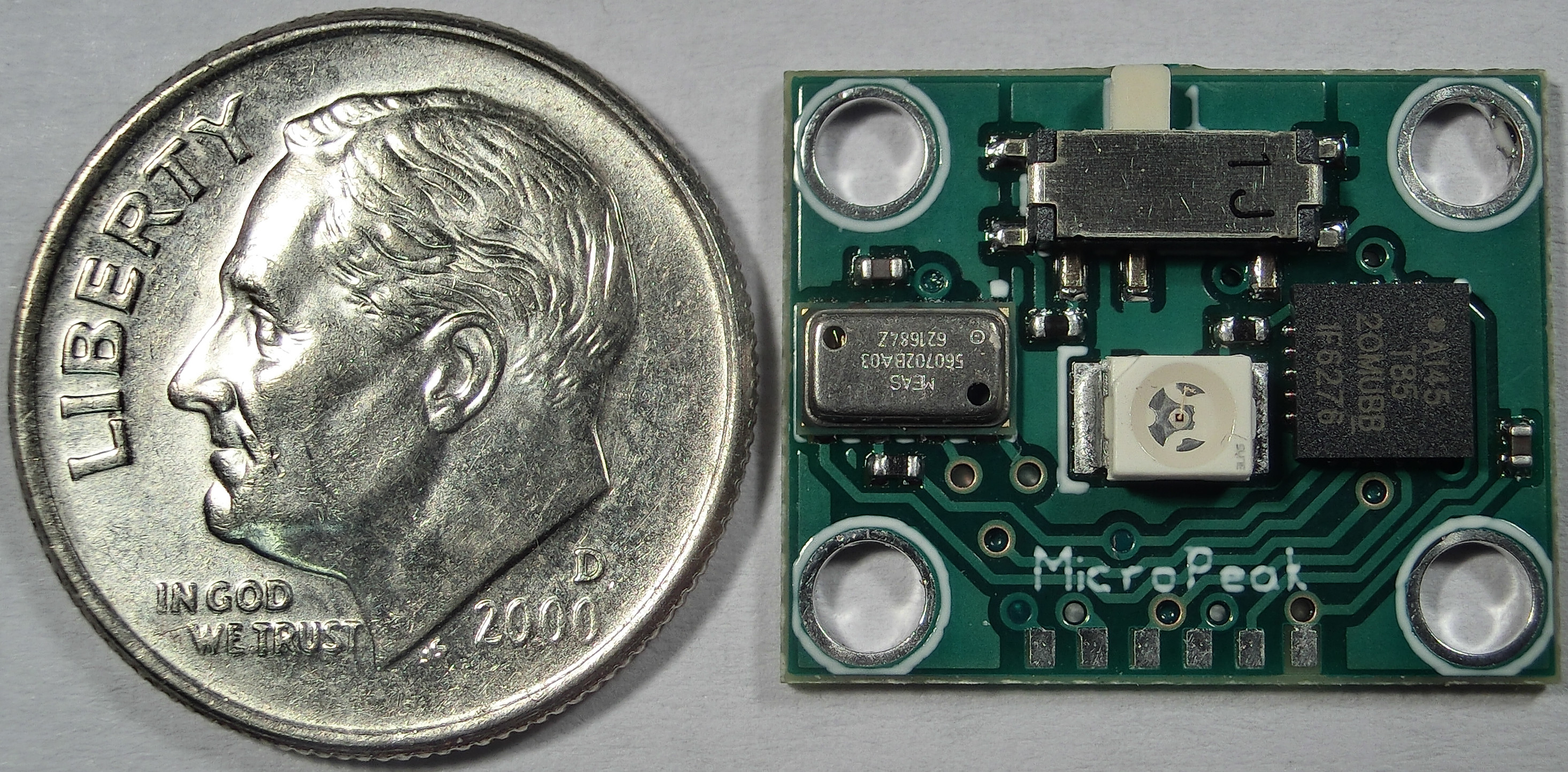
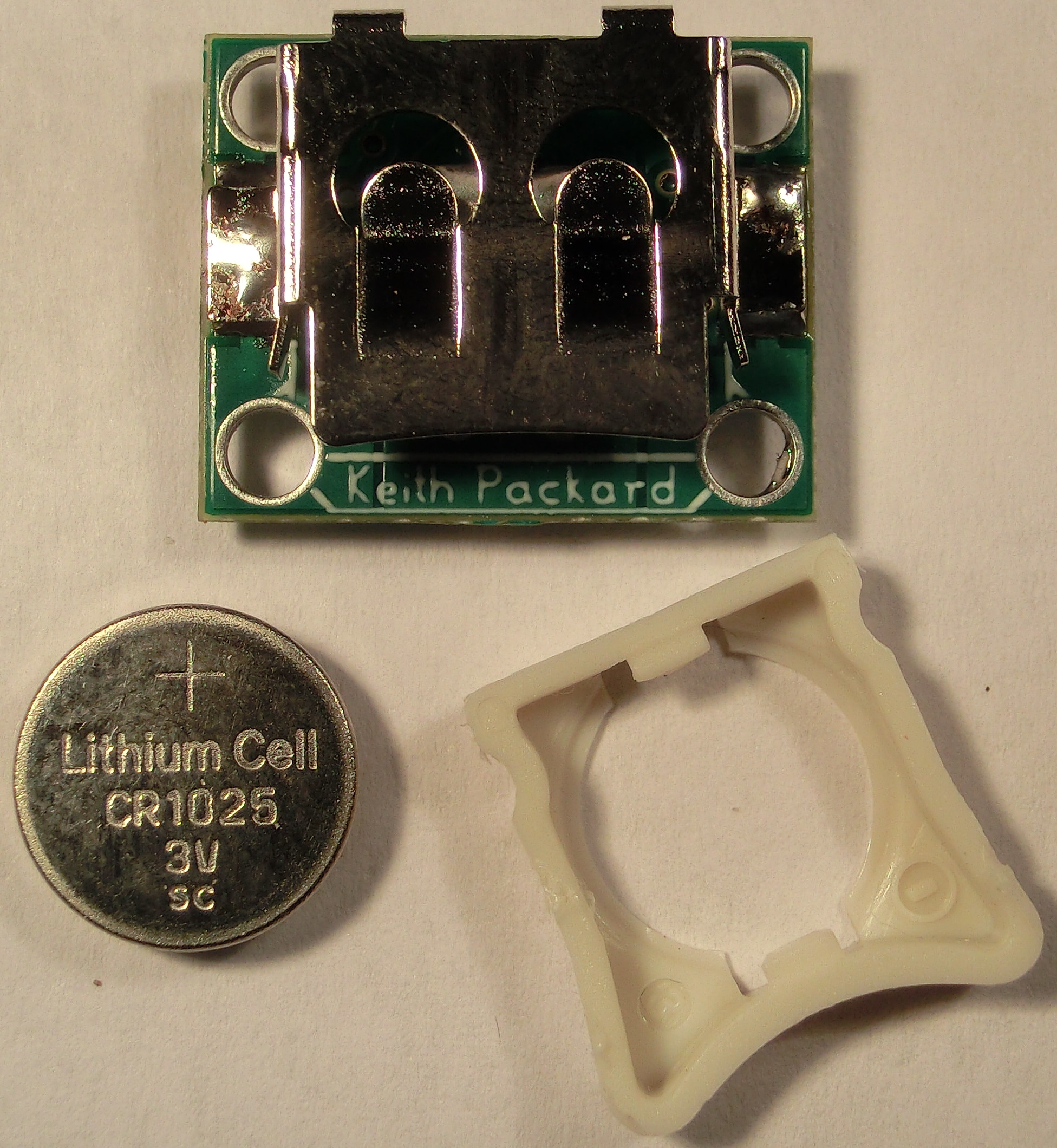
MicroPeak tiny peak-recording altimeter now available MicroPeak is a miniature peak-recording altimeter. About the same size and weight as a US dime (with battery), MicroPeak offers fabulous accuracy (20cm or 8in at sea level) and wide range (up to 31km or 101k ). The size of the board was predicated with the premise that we needed a battery included to avoid having wiring running between the altimeter and the board, we found some small lithium coin-cell battery holders for the CR1025 battery. These battery holders are rated to hold the battery secure up to 150gs. We d already started playing with the Measurement Specialties MS5607 pressure sensor which offers amazing accuracy while using very little power. Taking full-precision measurements every 96ms consumes about .2mA on average. Once on the ground, we stop taking measurements entirely, dropping the power use to around 1 A. It s also pretty small, measuring only 5mm x 3mm. For a CPU, this little project didn t need much. The 8-bit ATtiny85 comes in a 20qwfn package which is only 4mm x 4mm. When run at full speed (8MHz), it consumes a couple of mA of power. Reduce the clock to a pokey 250kHz and the CPU has enough CPU power to track altitude while consuming less than .2mA on average. To avoid losing the battery, we wanted to avoid having it removed while the board wasn t in use. So, we added a little power switch to the board. The one we found is good to at least 50g. Finally, we wanted to find a nice bright LED to show the state of the device and to blink out the final altitude. The OSRAM LO T67K are bright-orange surface-mount LEDs that run happily on 2mA. We used OSHPark.com to create prototype circuit boards for this project. Because of the small size of the board, each prototype run cost only $2 for three boards. It takes a couple of weeks to get boards, but it s really hard to beat the price. All of the schematic and circuit board artwork are published under the TAPR Open Hardware License and are available via git. All of the source code is published under the GPLv2 and is included in the main AltOS source repository.

22 November 2012

Andrew Pollock: [life] Portland bound

So, after just having run 10K, I'm going to sit on a train for 20 hours and completely seize up. I've got me some stretching to do! I'm getting away to Portland for a few days. I'm taking the Coastal Starlight train up and back, and staying with Nigel and his family. I'm looking forward to having some time to myself on the train, I'm looking forward to the trip, because some mutual friends did it, and I've wanted to do it ever since. I'm also looking forward to catching up with Nigel, because I've barely spoken to him since he left Google, and he's a friend and fellow countryman who I really enjoyed working with. I'd also like to check out this barber shop, because I'm weird and like the idea of someone attacking my face with a cutthroat razor. And of course, you can't go to Portland without visiting Powell's City of Books. I'm probably spending as much time on the train as I am in Portland (I head back on Sunday), but I want to be back for Zoe's first dentist appointment on Tuesday.

Andrew Pollock: [life] Silicon Valley Turkey Trot

Sarah, Zoe and I ran in the 10K Applied Materials Silicon Valley Turkey Trot this morning. Apparently it's a bit of a Silicon Valley institution (people get dressed up, particularly as turkeys), so I guess it's up there with the Bay to Breakers. This is the first time I've ever run a 10K fun run and actually run the whole way, so I'm feeling pretty happy with my fitness. In fact, I think I'm the fittest and lightest I've ever been. I'm actually a couple of kilograms under my target weight, and really pleased with myself for being able to run a 10K training run on Tuesday as well as the race today. I managed to run it in a respectable 1:05. I think I'll set a goal for myself to be able to run 10K in under an hour. No idea if that's realistic or not, but it's a goal with a nice round number. Sarah did her run in 1:06, which is impressive considering she was pushing Zoe in the jogging stroller. Zoe also did well putting up with being in the jogging stroller for that long. I think it helped having lots of things for her to look at, as well as a steady supply of food to graze on. She was having a great time running on the closed streets as we headed back to where we parked the car. We might have to make this a Thanksgiving family tradition. It'll be nice when Zoe's big enough to run in the kid's fun run as well.

Andrea Veri: The Linux s perception of my neighbours

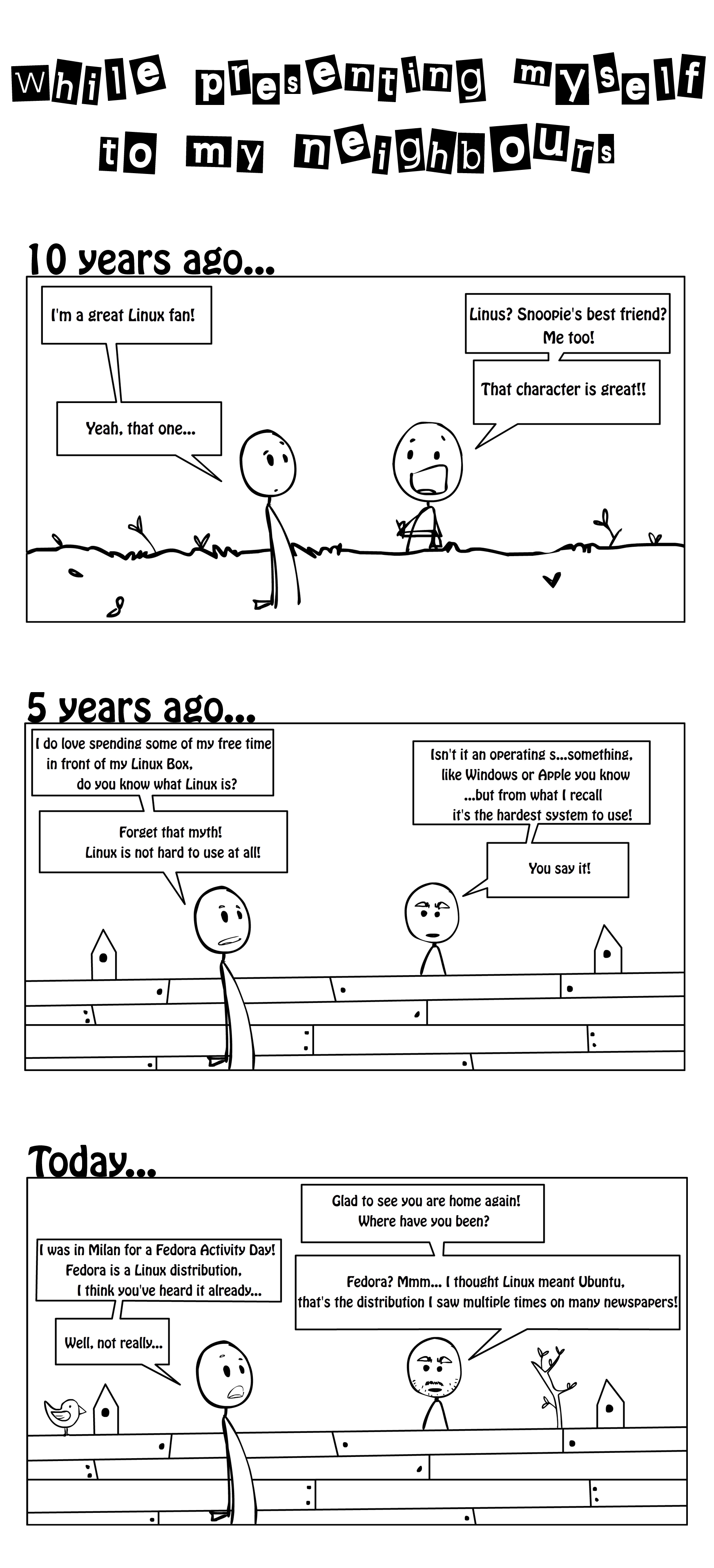
I live in a little village close to the city and one of the houses close to my property is for rent since more than ten years. A lot of families and people succeeded in that house and every time someone new joined my Linux evangelist hat jumped in my head. I ve always presented myself as a Linux geek to my neighbours and it has been nice seeing how the Linux word evolved (with funny and surprising quotes) during the past ten years in their minds. A friend of mine (Aretha Battistutta) made a little comic strip out of the topic and the result is simply amazing. Enjoy!

Cyril Brulebois: Another month, another beta

Today s recipe: Result: Debian Installer 7.0 Beta4 release! Speaking of which, shameless plug: I'm giving a Debian Installer talk at mini-DebConf Paris this sunday.

21 November 2012

Axel Beckert: Suggestions for the GNOME Team

Thanks to Erich Schubert s blog posting on Planet Debian I became aware of the 2012 GNOME User Survey at Phoronix. Like back in 2006 I still use some GNOME applications, so I do consider myself as GNOME user in the widest sense and hence I filled out that survey. Additionally I have to live with GNOME 3 as a system administrator of workstations, and that s some kind of usage, too. ;-) The last question in the survey was Do you have any comments or suggestions for the GNOME team? Sure I have. And since I tried to give constructive feedback instead of only ranting, here s my answer to that question as I submitted it in the survey, too, just spiced up with some hyperlinks and highlighting:
Don t try to change the users. Give the users more possibilities to change GNOME if they don t agree with your own preferences and decisions. (The trend to castrate the user was already starting with GNOME 2 and GNOME 3 made that worse IMHO.) If you really think that you need less configurability because some non-power-users are confused or challenged by too many choices, then please give the other users at least the chance to enable more configuration options. A very good example in that hindsight was Kazehakase (RIP) who offered several user interfaces (novice, intermediate and power user or such). The popular text-mode web browser Lynx does the same, too, btw. GNOME lost me mostly with the change to GNOME 2. The switch from Galeon 1.2 to 1.3/2.0 was horrible and the later switch to Epiphany made things even worse on the browser side. My short trip to GNOME as desktop environment ended with moving back to FVWM (configurable without tons of clicking, especially after moving to some other computer) and for the browser I moved on to Kazehakase back then. Nowadays I m living very well with Awesome and Ratpoison as window managers, Conkeror as web browser (which are all very configurable) and a few selected GNOME applications like Liferea (luckily still quite configurable despite I miss Gecko s about:config since the switch to WebKit), GUCharmap and Gnumeric. For people switching from Windows I nowadays recommend XFCE or maybe LXDE on low-end computers. I likely would recommend GNOME 2, too, if it still would exist. With regards to MATE I m skeptical about its persistance and future, but I m glad it exists as it solves a lot of problems and brings in just a few new ones. Cinnamon as well as SolusOS are based on the current GNOME libraries and are very likely the more persistent projects, but also very likely have the very same multi-head issues we re all barfing about at work with Ubuntu Precise. (Heck, am I glad that I use Awesome at work, too, and all four screens work perfectly as they did with FVWM before.)
Thanks to Dirk Deimeke for his (German written) pointer to Marcus Moeller s interview with Ikey Doherty (in German, too) about his Debian-/GNOME-based distribution SolusOS.

Erich Schubert: Phoronix GNOME user survey

While not everybody likes Phoronix (common complaints include tabloid journalism), they are doing a GNOME user survey again this year. If you are concerned about Linux on the desktop, you might want to participate; it is not particularly long.
Unfortunately, "the GNOME Foundation still isn't interested in having a user survey", and may again ignore the results; and already last year you could see a lot of articles along the lines of The Survey That GNOME Would Rather Ignore. One more reason to fill it out.

20 November 2012

Jon Dowland: Waterstones

In May this year, in a desperate bid to bail water out of a sinking ship, HMV group sold off the Waterstones chain of bookstores. I'm fond of reading so naturally I visit Waterstones from time to time. (but not exclusively.) For many years, their promotions were unanimously structured as "3 for 2" offers: find three books in the promotion, in-store, and get the cheapest of the three for free. I hated these promotions. I always found it very challenging to find three books in the promotion that I wanted. If I was visiting to buy a specific book and found it in the promotion, on more than one occasion I left the shop empty handed: I wasn't prepared to pay full price for a book in a promotion and not get the benefit of the promotion. Since being sold, Waterstones seem to have made a lot of changes. Many new hardbacks from popular authors have debuted at a discount for a short period (Rowling, Pratchett). I've found many more discounted books not tied to others in 3-for-2-style offers, sometimes window-display stock at half price, a month or so after release. They started a loyalty-card scheme, with a 10 gift card the prize you reach once you've spent 100. (I wonder if such schemes are examples of a token economy?) Finally, they've tentatively started to explore putting cafes in their branches. The one in Newcastle is best described as 'fledgling', but it's nice to have one more place to escape for a cup of tea at lunchtimes. The cafe, as well as a very well stocked collection of magazines, were the two killer features of the sadly- defunct Borders bookseller chain. For years before we got our own Borders in the North East, I used to enjoy the York branch if I was passing. I actually managed to fill a loyalty card this year, so clearly their change in attitude has worked on me! I'm generally not a fan of gift cards, especially in today's climate, so I quickly spent it. I hold an American Express credit card, which earns me cashbask on purchases which I make with it. I think the rate is about 1%. However, I can opt to receive the cashback in the form of gift vouchers. If I do so, I get them to the value of 110% my cashback balance. One of the retailers in on the scheme are Waterstones. I'm tempted

18 November 2012

Sandro Tosi: Spending a Sunday on CodingBat.com

I've played a bit with Project Euler but all of their problems are math-centric, which is nice but not exactly what I'm looking for: some real-world programming problems to get back into the coding field.

So asking my friend Google, I found CodingBat: it has a Python section with several tasks to complete. I must say they are some kinda trivial to solve, once you know some idiomatic Python code, but some are a bit more interesting. If you're a junior Python coder, or want to get a grip on the language, give it a look.

Oh, and if you know some website that would give me some real-world programming coding problems (something that would be useful on the job, not just coding for fun), I would love to hear you.

17 November 2012

Craig Sanders: done

OK, I m finished my experiment. It s over now and I can break character . First, I have to offer special thanks to tshirtman for being the first to unambiguously exemplify one of my main points. well done! In case it s not blindingly obvious (as it should be), the reason for my post was that I was outraged by the spectacle of one fairly high-profile member of the linux community trying to rally support to shun and exclude another fairly high-profile member because a nightmare had upset her. WTF? Is that really all it s going to take to destroy someone s reputation and perhaps their career? even with the shunning target s own words available and archived to disprove the ridiculous straw-man mis-characterisations of what he actually said? Not one of the arguments against him actually addressed anything he said, they ALL attacked him for things he didn t say, for things that other people claimed he said. I was further outraged by seeing everyone who even suggested that questioning of stats (or, indeed, ANY claim of fact or evidence) may be, in some small way, a valid and reasonable thing to do get instantly put in their place and dismissed as Yet Another Rape Apologist. Are we supposed to be anti-science, anti-scientific method now? or are rape stats a special case like religion where we are just supposed to switch off our analytical brains and accept what we are told on faith, without question? Surely we are capable of better than that? i know we are capable of better than that. Or, at least, i used to know that. Now i m not so sure. In 2011, all it took was Ted Tso ( TT ) making some fairly reasonable statements about the need for any claimed evidence or statistics to be viewed skeptically and that dissenting research should also be considered and he was instantly vilified as a rape apologist . Sorry, but questioning extremely dodgy stats (that even in feminist circles are viewed more as ideological propaganda than as serious research) is NOWHERE NEAR SUFFICIENT to earn the label of rape-apologist. That is not how debate works you can t just refuse to engage with someone s point and simply accuse them of being the enemy for not agreeing 100% with whatever you say at least, not if you have any intellectual honesty or self-respect. (sure, some people are complete jerks and deserve to be told to FOAD in no uncertain terms but a) jerks like that are self-evident and obvious, and b) TT s participation in that thread was at all times civil and reasonable) But that thread is ancient history it was over and done with nearly two years ago.
In October this year, for reasons which are not at all clear, Valerie Aurora ( VA ) decided to revive the issue (which had been resolved back in 2011 with a resounding fuck no, we don t want misogynist shit or porn in our conferences from pretty much the entire linux community including near-universal support for improved anti-harassment policies both for linux.conf.au and for geek conferences in general) and use it to attack TT. And she did so by twisting his words and claiming in a post on The Ada Initiative blog that he said something which he didn t, that rape was impossible if both people were drunk enough . If he chose, he could quite easily win a libel case against her and TAI on that. It s not what he said, it s not even close to what he said, and VA is clearly too smart to honestly believe that it is what he said. In another post on her personal, blog she talks about how what he said was so terrible that it even now gives her nightmares, and that she can t bear the thought of working with him. Again, WTF? VA can say I had nightmares and was upset and furious and THAT is enough to justify a call to shun TT?? He didn t attack her, or threaten her (explicitly or implicitly), he was polite and civil. What he did was disagree with VA by referring to other research that disputed VA s preferred studies. I agree with and support many (perhaps most) of VA s and The Ada Initiative s aims, I certainly believe that linux and open source etc should be very welcoming and supportive of human diversity (including gender and sexuality, identity, religion, politics and so on), believe that it s a good thing that The Ada Initiative exists as part of that diversity welcome to be particularly supportive of women in geekdom. And i wholeheartedly agree that Linux leaders should not make public statements belittling and condoning rape BUT: a) I haven t seen one instance of that happening, ever and b) I find VA s choice of tactics here to be despicable. as i do when anyone else uses similar tactics, because they ARE despicable tactics. They are exactly the same as accusing someone of being a child pornographer for being against net censorship: You dared to disagree with me so I m going to accuse you of being a monster. (and, i must admit, the enthusiasm level of my support for The Ada Initiative is somewhat .diminished by this tactical blunder by the spokesperson and co-founder) There are far more deserving targets of VA s ire than TT. And there are far better ways for the Ada Initiative to achieve their aims.
Why? So why did I decide to comment when I knew that I was inevitably going to be accused of hating women and being a rape apologist? Mostly because I thought it would be gutless of me not to. Hardly anyone else had, and they quickly backed down under the accusations of misogyny and since I consider myself to be psychologically fairly strong, I felt that I am capable of wearing a little shit (or even a lot) for a while. In my egocentric fashion, I thought if I can t do then it s no wonder that no one else dares . And also because anyone who cared to make even the slightest effort to find out what my actual views on sexual harassment, rape, women s rights and numerous inter-related issues are can fairly easily see a very consistent record of the kinds of things I argue for and against, and my scathing responses to actual misogynists when they appear on lists that I participate in. they are not my kind of people. and even then, i hesitated. it s scary and intimidating to be putting yourself forward to be accused of being one of the things you hate. this is, of course, an instance of the chilling effect. So, I found the prospect scary, almost terrifying .and I can t think of a single person who has met me online or in real life who would even remotely describe me as being any kind of delicate or sensitive wall-flower. again, if i can t do it, it s no wonder no one else dares . so i clicked the Publish button. an ego is useful for some things. Also, I took VA s words but don t be silent as inspiration. In the process, i discovered why it is that some people just simply refuse to engage in rational discourse. I ve seen it many times from the other side, but i ve never experienced the seductive pleasure of indulging in it myself before there s a liberating freedom in just ignoring any and every point that someone makes and simply accuse them of being the enemy. You don t have to try to understand what they wrote, hell you don t even have to really read it you just need to quickly scan it for overall tone and if they don t seem like they re 100% supportive, you just accuse them of being the enemy or an apologist for the enemy. it s that fucking simple and easy. well, sort of easy. easy for some, perhaps. i personally found it extremely difficult a struggle to refrain from engaging, to remain in character (i m not much of an actor). especially when i kind of agreed with whoever was arguing against my experimental character or if i thought they made a good point. and even more so when i thought that some comments skirted a bit too close to being the kind of misogynist crap that i didn t want to tolerate having on MY blog. (i resolved that issue by just approving any reply that didn t squick me or that i could squint at and think hmmm borderline, give benefit of doubt ) but even though i don t like it, i can recognise the attraction it holds for some people.
Other thoughts: I m particularly disgusted by the men who intervene way too early without an explicit invitation or request for help or a clear need such as an immediate threat of violence in womens issues. Many or maybe even most may not realise it, but they are just taking over and asserting male strength and control by protecting women rather than giving them the support and space to discover and practice their own strength and their own voices. These uninvited interventions do not help women, they weaken and undermine them, they perpetuate dependence, they steal strength from the movement. It is patronising and enfeebling. But mostly, they just re-assert male dominance and are an attempt to make women s spaces more comfortable, more palatable, for men.(*) (it s also quite often very transparent self-serving and ingratiating behaviour from blokes who want to lay the groundwork for perhaps getting laid one day) IMO this goes far beyond a problem with men over-involving themselves in feminist causes i feel the same way for any relatively less-privileged group with a need to find their own voice and their own power they ll never find it if members of the privileged class (i.e. white males like me) just ride roughshod over the movement and speak FOR them rather then just silently lending their strength in support. For the most part, they (we) should just shut up and listen we already have more than enough opportunities to have our say. (*) yes, i m well aware of the difficulty in writing something like that paragraph as a member of a privileged class, without coming across as either self-hating or patronising or both. if i ve failed here, it s not for want of trying. done is a post from: Errata

16 November 2012

Julien Danjou: Logitech Unifying devices support in UPower

A few months ago, I wrote about my reverse engineering attempt to Logitech Unifying devices. Back then, I concluded my post with big hopes on the future after receiving a document with some part of the specification of the HID++ 2.0 from Logitech. A couple of weeks ago, some of my summer work has been merged to UPower, adding battery support for some Logitech devices. HID++ UPower As I discovered late in my first reverse engineering attempt, Logitech developed a custom HID protocol named HID++. This protocol exists in two versions, 1.0 and 2.0. Some devices talk with version 1 of the protocol (like my M705 mouse) and some others talk with version 2 of the protocol (like my K750 keyboard). Recently, I've been able to be in touch with a Logitech engineer who worked on the Linux support for the Unifying receiver, and he has been really helpful and exposed me some details about this protocol. Logitech made the decision to publish their HID++ specification publicly about a year ago, but still didn't do it. The internal review needed to publish such documents hasn't be done yet. The only published draft is just an extract of the specification, with even some typo in it as I discovered. Some other documents have been recently published, but I didn't have the time to review them. They contains HID++ 1.0 specifications and some details I asked for about the K750 keyboard. UPower support UPower It took me sometime to get a full understanding of the protocol, its different version etc. After reverse engineering my K750 keyboard, I've also reverse engineered the data stream used to get my M705 mouse battery status. I've also received some information about the HID++ 1.0 protocol, so I've been able to discover a bit more on what the packets mean. Most of my discoveries are now used to do proper #define in up-lg-unifying.c so the code makes more sense. My first patch implements a new property for UPower devices, named luminosity, that use with K750 keyboard to report the light level received. The second patch add support for Logitech Unifying devices (over USB only) and should work with at least Logitech M705 and K750 devices. This should be available with the next version of UPower, which should be 0.9.19. gnome-power-statistics for K750 So far, Logitech has been kind enough to help me understanding part of the protocol and even sent me a few devices so I can play and test my work with them. Unfortunately, this will probably requires some work and time, and so far Logitech was not able to help with that. There should be enough information out there to at least add support for battery to HID++ 2.0 devices, and probably a few other things too. I hope I'd get the time do this at some point, but feel free to beat me in this race!

15 November 2012

Craig Sanders: I had a dream

I had a dream that many prominent members of the Linux community were dressed in Nazi SS uniforms on the Arctic ice, clubbing baby seals to death. I can t bear the thought that so many Linux people may secretly be Nazi seal murderers, so I demand that they be excluded from any future Linux-related events or conferences that I might wish to attend. My nightmare and the strength of my personal reaction to it are conclusive proof that they are guilty. I can t remember all those who were identified in my dream right now, so I need to be able to point the finger at any time in the future and have any individual shunned excluded and banned from events, conferences, mailing lists, and open source projects in general with any who communicate with them (or, worse, support the evil-doers by pretending to a moderate, reasonable, rational, and/or evidence-based stance) being likewise exiled. After all, remember that even in these enlightened times there is still a seething culture of penguin-supremacism in the Linux community overtly pushing the agenda of the pure penguin race over the pernicious and corrosive evil of seals .this culture of seal-murder must be stamped out by whatever means necessary. Zero tolerance for seal-murder apologists! Thank you for understanding and supporting me in my very real fears. You make the world a safer place for everyone. I had a dream is a post from: Errata

Martin Pitt: python-dbusmock templates

With python-dbusmock you can provide mocks for arbitrary D-BUS services for your test suites or if you want to reproduce a bug. However, when writing actual tests for gnome-settings-daemon etc. I noticed that it is rather cumbersome to always have to set up the skeleton of common services such as UPower. python-dbusmock 0.2 now introduces the concept of templates which provide those skeletons for common standard services so that your code only needs to set up the particular properties and specific D-BUS objects that you need. These templates can be parameterized for common customizations, and they can provide additional convenience methods on the org.freedesktop.DBus.Mock interface to provide more abstract functionality like add a battery . So if you want to pretend you have one AC and a half-charged battery, you can now simply do
  def setUp(self):
     (self.p_mock, self.obj_upower) = self.spawn_server_template('upower',  )
  def test_ac_bat(self):
     self.obj_upower.AddAC('mock_AC', 'Mock AC')
     self.obj_upower.AddChargingBattery('mock_BAT', 'Mock Battery', 50.0, 1200)
Or, if your code is not in Python, use the CLI/D-BUS interface, like in shell:
  # start a fake system bus
  eval  dbus-launch 
  export DBUS_SYSTEM_BUS_ADDRESS=$DBUS_SESSION_BUS_ADDRESS
  # start mock upower on the fake bus
  python3 -m dbusmock --template upower &
  # add devices
  gdbus call --system -d org.freedesktop.UPower -o /org/freedesktop/UPower \
      -m org.freedesktop.DBus.Mock.AddAC mock_ac 'Mock AC'
  gdbus call --system -d org.freedesktop.UPower -o /org/freedesktop/UPower \
      -m org.freedesktop.DBus.Mock.AddChargingBattery mock_bat 'Mock Bat' 50.0 1200
In both cases upower --dump or gnome-power-statistics will show you the expected devices (of course you need to run that within the environment of the fake $DBUS_SYSTEM_BUS_ADDRESS, or run the mock on the real system bus as root). Iftikhar Ahmad contributed a template for NetworkManager, which allows you to easily set up ethernet and wifi devices and wifi access points. See pydoc3 dbusmock.templates.networkmanager for details and the test cases for how this looks like in practice. I just released python-dbusmock 0.2.1 and uploaded the new version to Debian experimental. I will sync it into Ubuntu Raring in a few hours.

14 November 2012

Martin F. Krafft: A small office, multi-function printer

Dear lazyweb, we need a new printer-scanner combination for our new office, ideally a laser printer and a high-resolution scanner (1200dpi). It must integrate nicely with CUPS and SANE, without requiring any proprietary, closed-licence drivers or plugins. It also has to come with an automatic document feeder in addition to the plain flatbed scanner. Additional, would-be-nice features in decreasing order of preference are I have investigated the Samsung CLX-6220FX, but the driver situation was such a nightmare (and the printer so loud), that we returned it right away. I should have read this article by Peter beforehand I have recently seen the HP Laserjet Pro 200 M276n, the successor of the HP Laserjet CM1415nf which looks promising, but according to LinuxPrinting.org, a proprietary plugin is required (WTF HP?). Does anyone have experience with these HP models and can recommend them for use with Debian stable? Does anyone have another recommendation? Please send me a message. Thanks!

12 November 2012

Ingo Juergensmann: Resurrecting m68k

In August I picked up Elgar, a m68k machine, from NMMN in Hamburg, where it was ought to run as a buildd (NMMN donated space and network). Unfortunately it was in some kind of bad state: operating system was out of date, expansion cards were getting loose and NMMN wasn't happy about the CRT monitor in its datacenter as well. Elgar is an Amiga 4000 Desktop built into a custom tower case. It took some weeks and months until I found a little time to care about Elgar, but now it's up and running again:
[ 0.000000] Initializing cgroup subsys cpuset
[ 0.000000] Initializing cgroup subsys cpu
[ 0.000000] Linux version 3.2.0-3-amiga (Debian 3.2.23-1) (debian-kernel@lists.debian.org) (gcc version 4.6.3 (Debian 4.6.3-8+m68k.1) ) #1 Wed Jul 25 13:02:31 UTC 2012
[ 0.000000] Enabling workaround for errata I14
[ 0.000000] console [debug0] enabled
[ 0.000000] Amiga hardware found: [A4000] VIDEO BLITTER AUDIO FLOPPY A4000_IDE KEYBOARD MOUSE SERIAL PARALLEL A3000_CLK CHIP_RAM PAULA LISA ALICE_PAL ZORRO3
That's the stock Debian m68k kernel and it already runs on Arrakis and Vivaldi, two other buildds, as well without any problem. The only problem at the moment is the missing SCSI driver for the CyberStorm Mk1 accelerator card. There were some changes in the kernel that need to be dealt with by someone knowing. The other problem was to upgrade from etch-m68k to unstable. I already blogged about this last year. It's not as easy anymore and you'll need to deal with lots of dependency problems and such nowadays. But anyway:
elgar:~# cat /etc/debian_version
wheezy/sid
elgar:~# dpkg -l libc6
Desired=Unknown/Install/Remove/Purge/Hold
Status=Not/Inst/Conf-files/Unpacked/halF-conf/Half-inst/trig-aWait/Trig-pend
/ Err?=(none)/Reinst-required (Status,Err: uppercase=bad)
/ Name Version Architecture Description
+++-====================-===============-===============-==============================================
ii libc6:m68k 2.13-35 m68k Embedded GNU C Library: Shared libraries
It's amazing that the m68k port is in such good condition after more than 4 years. That's because of the real great work of Torsten Glaser who is doing much of the porter work for the tool chain. But m68k has currently 4833 packages in state Needs-Build:
wanna-build statistics - Mon Nov 12 06:51:13 CET 2012
----------------------------------------------------- Distribution unstable:
---------------------
Installed : 1321
Needs-Build : 4833
Building : 0
Uploaded : 0
Failed : 0
Dep-Wait : 0
Reupload-Wait : 0
Install-Wait : 0
Failed-Removed : 0
Dep-Wait-Removed: 0
Not-For-Us : 0
total : 9906 13.34% (1321) up-to-date, 13.34% (1321) including uploaded
48.79% (4833) need building
0.00% ( 0) currently building
0.00% ( 0) failed/dep-wait
0.00% ( 0) old failed/dep-wait
0.00% ( 0) need porting or cause the buildd serious grief
So, there's a lot of work to do, but it's apparent that m68k won't keep up with 10.000 packages in unstable. When I started running an autobuilder back in year 2000 there were 2400 packages for m68k, on Aug. 15th 2005 we had a total of 5949 packages in the archive. For m68k this means that we will have to start adding lots of packages to Not-For-Us. I think m68k will/should end up with approx. 4000 packages at most. In the end m68k is a fairly good shape now. It only needs to get some packages built... Let's see when the buildds are operational again... ;-)
Kategorie:

11 November 2012

Vasudev Kamath: Weekly Log - 27/3 - 112012

OK I became again lazy to log my works and combined 2 weeks again :-). Most of my work is for Debian for this 2 weeks. This week was bit hectic I couldn't dedicate much time for any programming. This week I'm on vacation and will get more time to work on FLOSS and other coding stuffs. Only that I'm on slow network connection :-). Ok cya next week (hopefully) PS: My last weekly log never showed up in planet.d.o not sure what happened may be because I played with feed generating jekyll scripts. Hope this will show up in planet.d.o [1] http://code.metager.de/source/xref/linux/utils/util-linux/sys-utils/setsid.c
[2] http://vasudev.homelinux.net/display/copyninja/34241
[3] https://kakste.com/display/beardyunixer/974150
[4] anonscm.debian.org/gitweb/?p=collab-maint/friendica.git;a=summary

10 November 2012

Martín Ferrari: Amusing ourselves to death

What Orwell feared were those who would ban books. What Huxley feared was that there would be no reason to ban a book, for there would be no one who wanted to read one. --Foreword to the book. Just finished this book today. It was written in 1985, it talks about Dallas, and the 700 Club, Reagan and many other (by now) old fashioned things. It only talks about computers in passing, as this new thing that everybody is talking about. And it is extremely current. It's been 27 years, and it could have been written yesterday. You'll just need to replace some TV shows with Twitter, Reddit, or G+, but it has made me think a lot about my own relationship with information, and amusement. I couldn't help but think about this book when reading various essays that touch culture, education, or politics these days. It has also made me realise my own incongruence: being proud of not owning a TV, while I spent hours of my waking ours watching cat videos, news snippets in Google Reader, or curating links that have been reshared dozens of times. If you're at all interested in understanding our culture and discourse, do yourself a favor and get a copy. It's not long, nor dense in academic jargon. It's only 9 euro with free shipping in the Book Depository, and they even have a Kindle version in Amazon. Tags: Libros, Planet Debian

9 November 2012

Gunnar Wolf: Road trip to ECSL 2012 in Guatemala

Encuentro Centroamericano de Software Libre! Guatemala! During a national (for us) holiday, so it's easy to go without missing too much work time! How would I miss the opportunity? Several years ago, I started playing with the idea of having a road trip Probably this was first prompted with the UK crew and the Three Intrepid Motorcycle Riders arriving by land to DebConf 9 I don't know. Fact is, I wanted to go to DebConf10 in New York by land, as well as to DebConf12 in Nicaragua. Mostly due to a lack of time, I didn't Although we did start making some longish trips. Of course, my desire to show Regina what Mexico is like also helped! So, up until a week ago, our (according to my standards) long distance driving experience included:
  • M xico Guanajuato Puerto Vallarta Guanajuato M xico, in early November 2011, for Festival de Software Libre and with Regina and our Blender friends Octavio and Claudia. Totalling almost 1900Km, mostly consisting of wide, toll highway.
  • M xico Xilitla San Luis Potos M xico, in April 2012, just for fun and for a nice short vacation, alone with Regina. Totalling almost 1200Km, but through Sierra Gorda de Quer taro, a very tough stretch of about 250Km which we did at about 50Km/h on average. Beautiful route for sure! We didn't originally intend to go through San Luis Potos , and it does not appear to make much sense, as it adds ~350Km to the total, but it was even quicker than going back by the same route and according to those who now, even faster than our planned route, via Tamazunchale and Ixmiquilpan!
  • M xico San Luis Potos Zacatecas Aguascalientes Guanajuato M xico, in May 2012, for Congreso Internacional de Software Libre, again with Octavio and Claudia. Totalling 1250Km, and following very good roads, although most of them were toll-free.
But there is always a certain halo over crossing a border, maybe more so in countries as large as Mexico. We convinced Pooka and Moni, and granted, with some aprehension, as we knew of some important security risks in the more rural areas we wanted to go through we decided to go to Guatemala. And, although we wanted to go with a bit more time, Real Life took its toll: We could not take more time than the intersection of what our respective jobs offered. So, here goes a short(?) recap of our six day long, 3200Km trip. Of course, we have a map detailing this. Mexico Veracruz I came to my office early on Wednesday (31-oct), and left with Regina around 10AM towards Veracruz. We agreed to meet there with Moni and Pooka, who would take the night bus, and continue together. Crossing Mexico City proved to be the longest obstacle We arrived to Veracruz already past 3PM, and spent a nice evening walking down the center and port of the city. Veracruz port can still be seen as part of central Mexico; I knew the road quite well. Veracruz San Andr s Tuxtla Catemaco San Cristobal de las Casas We met with our friends at the iconic Gran Caf de la Parroquia at 6:30AM. Had a nice breakfast with coffee, and by 7:30 we were heading south-west. The reason to have a road trip was to get to know the route, to enjoy the countryside So, given we "only" had to make 650Km this day, we took the non-toll road A narrow path stretching along the coastal plains of Veracruz, until Acayucan. Doing so, we also saved some money, as the equivalent toll road is around MX$300 (~US$25)! Veracruz is a hot state. We ended up all sweaty and tired by 19:00, when we reached San Cristobal. We had agreed not to drive at night, due to security issues, but fortunately there was quite a bit of traffic both ways between Tuxtla Guti rrez (Chiapas State capital, around 1hr from San Cristobal, where darkness got us) and our destination, so we carried on. Now, San Cristobal is a high city, almost as high as Mexico City (2100m), and being more humid, it was quite chilly. We went for a walk, and were convinced that at a later time, we had to stay for several days there. The city is beautiful, the region is breath-taking, there is a lot of great handicrafts as well, and it's overall very cheap. Really lovely place. San Cristobal de las Casas Cd. Cuauht moc La Mesilla Guatemala Once again, this day started early. We woke up ready to leave at 7AM, and not earlier because the hotel's parking didn't open earlier. After a very quick visit to San Cristobal downtown, to take some photos that were not right the night before, we took the road to Comit n, stopping just for some tamales de bola y chipil n for breakfast. Central Chiapas is almost continuously populated, differing from most of my experience in Mexico. It is all humid, and has some very beautiful landscapes. We passed Comit n, which is a much larger city than what we expected, went downhill after La Trinitaria, crossed a plain, and continued until hills started taking over again. We stopped in a very chaotic, dirty place: Just accross the border, where Ciudad Cuauht moc becomes La Mesilla. This border was basically what we expected: There is no half-official place to exchange money, so we had to buy quetzales from somebody who offered them on the street, at MX$2 per Q1 (where the real exchange should be around 1.50 to 1). While on the road, I was half-looking for exchange posts in Comit n and onwards, and found none (and being a festive day, they would probably be closed anyway). But we were expecting this, after all, and exchanged just the basic minimum: MX$600 (US$50, which by magic became Q300, US$40). The tramit consists of:
  • Spraying the car against diseases (which has a cost of Q18)
  • Each of us has to go through migration. Note, in case you cross this border: We didn't expressly cross Mexican migration, so officially there was no record of us going out. Be sure to go through migration to avoid problems at re-entry!
    Migration has no cost.
  • Customs. As we were entering by car, I had to purchase a permit for circulation. I don't remember the exact quote, but it was around Q150, and the permit is valid for 90 days.
  • That's it! Welcome to Guatemala!
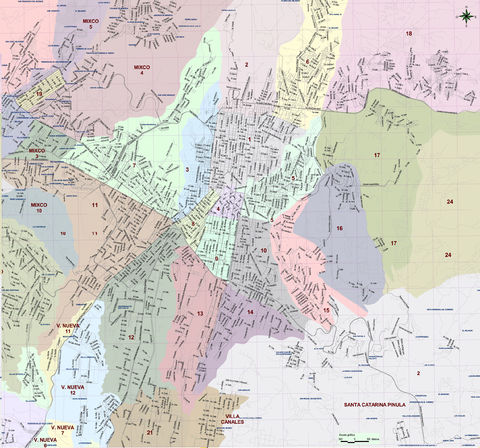
La Mesilla is in Guatemala's Huehuetenango Department, and from all of the Departments we crossed until Guatemala city (Huehuetenango, Quetzaltenango, Totonicap n, Solol , Chimaltenango, Sacatep quez and Guatemala), this is the largest one. Huehuetenango is home to the Cuchumatanes mountain ridge. We found beautiful, really steep, really fertile mountains. It is plainly amazing: Mountains over 60 , and quite often full with agricultural use Even at their steepest points! The CA-1 highway is, in general, in very good shape. There are however many (many, many) speed bumps (or topes, in Mexican terminology. Or t mulos in Guatemalan), at least a couple at every village we crossed, not always painted. The road is narrow and quite winding; it follows river streams for most of the way. We feared it would be in much worse shape, from what we have heard, but during the whole way we found only three points where the road was unusable due to landslides and an alternative road was always in place when we needed it. After Totonicap n, the narrow road becomes a wide (four lane) highway. Don't let that fool you! It still goes through the center of every village along the road, so it's really not meant for speeding. Also, even though the pavement is in very good condition, it is really steep quite often. It is not the easiest road to drive, but it's (again) by far not as bad as we expected. We arrived to Guatemala City as dawn was falling, and got promptly lost. Guatemala has a very strange organization scheme: The city is divided in several zones, laid out in a swirl-like fashion. East-west roads are called Calle and North-south roads are called Avenida (except for zona 4, I think, where they are diagonal, and some are Rutas while the others are V as). I won't go into too much detail). Thing is, many people told us it's a foolproof design, and people from different countries understand the system perfectly. We didn't... At least not when we arrived. We got quite lost, and it took us around one hour to arrive to our hotel, at almost 19:00 Almost 12 hours since we left San Cristobal. Went for a quick dinner, and then waited for our friends to arrive after the first day of work of ECSL, which we missed completely. And, of course, we were quite tired, so we didn't stay up much longer. Antigua Guatemala On Saturday, ECSL's activities started after 14:00 so we almost-kidnapped Wences, the local organization lead, and took him to show us around Antigua Guatemala. Antigua was the capital of Guatemala until an earthquake destroyed it in the 1770s; the capital was moved to present-day Guatemala city, but Antigua was never completely abandoned. Today, it is a world heritage site, a beautiful city, where we could/should have stayed for several days. But we were there for the conference, so we were in Antigua just a couple of hours, and headed back to Guatemala. Word of caution: Going from Guatemala to Antigua, we went down via the steepest road I have ever driven. Again, a real four-lane highway... but quite scary! The main focus for this post is to give some roadtrip advice to potential readers... So, this time around, I won't give much detail regarding ECSL. It was quite interesting, we had some very good discussions... but it would take me too much space to talk about it! The road back: Guatemala Tec n Um n; Cd. Hidalgo Arriaga So, about the road back: Yes, we just spent three days getting to Guatemala City. We were there only for ~36 hours. And... We needed to be here by Tuesday morning no matter what. So, Sunday at noon we said goodbye to our good friends in ECSL and started the long way back. To get to know more of Guatemala, we went back by the CA-2 highway, which goes via the coastal plains Not close to the Pacific ocean, which we didn't get to see at all, but not through the mountains. To get to CA-2, we took CA-9 from Guatemala. If I am not mistaken, this is the only toll road in Guatemala (at least, the only we used, and we used some pretty good highways!) It is not expensive; I don't remember right now, but must have been around Q20 (US$3). Went South past Palin and until CA-2, just outside Escuintla city, and headed West. All of Escuintla and Suchitep quez it is again a four lane highway; somewhere in Retalhueu it becomes a two lane highway. We were strongly advised not to take this road at night because, as the population density is significantly lower than in CA-1, it can get lonely at times And there are several reports of robberies. We did feel the place much less populated, but saw nothing suspicious in any way. Something important: There are almost no speedbumps in CA-2! The terrain stayed quite flat and easy as we crossed Quetzaltenango, and only in San Marcos we found some interesting hills and a very strong rain that would intermitetntly accompany us for the rest of the ride. So, we finally arrived to the border city of Tec n Um n at around 16:30 Approximately four hours after leaving the capital. The Tec n Um n Cd. Hidalgo cities and border pass are completely different from the disorderly and dirty Cd. Cuauht moc La Mesilla ones. The city of Tec n Um n could be just a nice town anywhere in the country, it does not feel aggressive as most border cities I have seen in our continent. We stopped to eat at El pollo campero and headed to the border. In the Mexican side, we also saw a very well consolidated, big and ordered migration area. Migration officers were very kind and helpful As we left Cd. Cuauht moc, Regina didn't get a stamp of leaving Mexico, so technically she was ilegally out of the country (as she is not a national... They didn't care about the rest of us). The tramit to fix this was easy, simple, straightforward. We only paid for the fumigation again (MX$60, US$5), and were allowed to leave. Anyway, we crossed the border. There is a ~30Km narrow road between Cd. Hidalgo and Tapachula, but starting in Tapachula we went on Northwards via a very good, four lane and very straight highway. Even though we had agreed not to drive at night... Well, we were quite hurried and still too far from Mexico City, so we decided to push it for three more hours, following the coastline until the city of Arriaga, almost at the border between Chiapas and Oaxaca. Found a little hotel to sleep some hours and collapsed. Word of warning: This road (from Tapachula to Arriaga) is also known for its robberies. We saw only one suspicious thing: Two guys were pushing up their motorcycle, from which they had apparently fallen. We didn't stop, as they looked healthy and not much in need of help, but later on talked about this Even though this was at night, they were not moving as if they had just crashed; nothing was scratched, not the motorcycle and not their clothes. That might have been an attempt to mug us (or whoever stopped by). This highway is very lonely, and the two directions are separated by a wall of vegetation, so nobody would have probably seen us were we to stop for some minutes. Be aware if you use this road! The trip comes to an end: Arriaga Niltepec Istmo C rdoba M xico The next (last, finally!) day, we left at 6:30AM. After driving somewhat over one hour, we arrived to Niltepec, where a group of taxi drivers had the highway closed as a protest against their local government's tolerance of mototaxis. We evaluated going back to Arriaga and continue via the Tuxtla Guti rrez highway, but that would have been too long. We had a nice breakfast of tlayudas (which resulted in Pooka getting an alergic reaction shortly afterwards) and, talking with people here and there, were told about an alternative route by an agricultural road that surrounds the blockade. So, we took this road the best way we could, and after probably 1hr of driving at 20Km/h, finally came back to the main road. We planned on crossing the isthmus using the Acayucan-Juchit n road We were amazed at the La Ventosa ("the windy") area, where we crossed a huge eolic plant for electricity generation, so of course we got our good share of photos. From then onwards, not much more worth mention. Crossed the isthmus via a quite secondary road in not too good shape (although there is a lot of machinery, and the road will much likely improve in the next few months/years), then took the toll freeway along Veracruz until C rdoba. We stopped for a (delilcious and revigorizing!) cup of coffee in Hotel Zeballos, where Agust n de Iturbide signed with Viceroy Juan O'Donoj the treaties that granted Mexico the independence. Traveller, beware: When crossing between Puebla and Veracruz, there is a steep slope of almost 1000m where , you will almost always (except if it's close to noon) find very thick fog; taking the highway from C rdoba, this is in the region known as Cumbres de Maltrata. We had the usual fog, and just as we left it, a thin but constant rain that went on with us up until we got home. Crossed Puebla state with no further eventualities, and arrived to Pooka and Moni's house by 22:00. Less than one hour later, Regina and me arrived home as well. This was four days ago... and I have finally finished writing it all down ;-) Hope you find this useful, or if not, at least entertaining! If you read this post in my blog, you will find many pictures taken along the trip below (Well, if you are reading the right page, not in the general blog index...). If you are reading from a planet or other syndication service... Well, come to the blog! Dreamhost woes Oh, and... Yes, it sometimes happens: My blog is hosted at Dreamhost. This means that usually it works correctly... But sometimes, specially when many people request many nontrivial pages, it just gives an error. If you get an error, reload once or twice... Or until your patience manages ;-)

6 November 2012

Stefano Zacchiroli: bits from the DPL for October 2012

Freshly baked, bits from the DPL for October 2012.
Dear Project Members,
another month, another periodic report of DPL-ish activities, this time for October 2012. Highlights Debian on public clouds I've spent quite some time to improve Debian presence on the so called "public clouds". Following up to an inquiry of a fellow developer, I've reached out to Microsoft to investigate the possibility of having Debian as an option on Windows Azure. Around the same time, I've been approached by Amazon to have Debian as an option on the AWS marketplace. In both cases, we will need to overcome challenges of various kinds, at the technical (e.g. image preparation), bureaucratic (e.g. terms of the agreements we'll need to accept to be present), and political (e.g. chain of trust, platform freedom) levels. Up to now, discussions have been going on mostly in private, simply because they started as 1-to-1 inquiries and continued from there, but there is no good reason they should remain so. Hence, thanks to the listmasters and in particular Alexander Wirt, we have setup the new debian-cloud mailing list. If you are interested in these topics please join the list. For both Azure and AWS there is good progress on the technical part already; summaries will soon be posted on the list so that we are all on the same page. Similarly, I'll post there status reports about the bureaucratic requirements. And of course there is no reason to focus on specific clouds, if you'd like to support others and are willing to put some work to that end, please join the list and let us know. DPL helpers meeting I've already bothered you at least in my last platform and DebConf13 talk with observations about how non-scalable the DPL job is. After having collected applications of DPL helpers for a while, I've finally sat down and tried to put those applications into good use. The idea is simple: to the extend of possible, we should shift from a one-man-band job to a more "board-like" job, with people sharing an agenda, a list of outstanding tasks, and public communication. We have started slowly, setting up the #debian-dpl IRC channel and running periodic bi-weekly meetings there. You can find the meeting minutes and full logs at the usual place. We are still ramping up, so we don't have yet "fancy" stuff like a mailing list or an issue tracker entry, but they're in the working. Some of the outcome are starting to show, too (e.g. as part of recent discussions on 3rd party orphaning, or on our inbound trademark policy, or even in the forthcoming DMCA policy to make mentors.d.n an official project service). It's an experiment and a big challenge. I'm, for one thing, not yet convinced there are enough people interested in sharing the load of DPL duties (that look boring, for many tech geeks) in the long run. But I'm also convinced that the sustainability of the Debian organization model depends on this, so it's worth trying. If you're interested in the challenge and willing to volunteer some of your time, please join us on #debian-dpl . I'll take care of keeping the project informed of further evolution, in particular about the communication channels we will pick for day to day activities and accountability. Events / public communication I've spent most of my remaining Debian time in October attending events on behalf of the Project, in particular: On the topic of public communication, I've also coordinated with the press team an answer to a press inquiry about Secure Boot (which has become part of this article), and happily vouched for the Ubuntu charity marathon, adding some Debian challenges to it. Delegations As largely overdue matters, I've finalized the delegations mentioned last month, namely: FTP masters, New Members Front Desk, and Policy editors. Assets and legal stuff Miscellanea Now let's all go back to RC Bug squashing to make Wheezy a reality. SPAM-my link of the month is http://udd.debian.org/bugs.cgi and its various "views" at the bottom of the page. Cheers.
PS the day-to-day activity log for October 2012 is available at the usual place master:/srv/leader/news/bits-from-the-DPL.txt.201210

Russ Allbery: Review: Cerebus

Review: Cerebus, by Dave Sim
Series: Cerebus #1
Publisher: Aardvark-Vanaheim
Copyright: August 1987
Printing: July 2003
ISBN: 0-919359-08-6
Format: Graphic novel
Pages: 546
Cerebus is something of a legend in comics. Begun in December of 1977 by Dave Sim, it was one of the first entirely independent, self-published comics in a field dominated by the large work-for-hire companies like Marvel and DC. It ran for 300 issues and nearly 27 years and became one of the most influential independent comic books of all time, in part due to Sim's outspoken views in favor of creator rights and his regular use of the editorial pages in Cerebus issues to air those views. This collection (the first "phonebook") collects issues 1 through 25, with one of the amazing wrap-around covers that makes all of the phonebooks so beautiful (possibly partly by later Cerebus collaborator Gerhard, although if so it's uncredited so far as I can tell). Cerebus reliably has some of the best black-and-white art you will ever see in comics. There is some debate over where to start with Cerebus, and a faction that, for good reasons, argues for starting with the second phonebook (High Society). While these first twenty-five issues do introduce the reader to a bunch of important characters (Elrod, Lord Julius, Jaka, Artemis Roach, and Suenteus Po, for example), all those characters are later reintroduced and nothing that happens here is hugely vital for the overall story. It's also quite rough, starting as Conan parody with almost no depth. The first half or so of this collection features lots of short stories with little or no broader significance, and the early ones are about little other than Cerebus's skills and fighting abilities. That said, when reading the series, I like to start at the beginning. It is nice to follow the characters from their moment of first introduction, and it's delightful to watch Sim's ability grow (surprisingly quickly) through the first few issues. Cerebus #1 is bad: crude, simplistic artwork, almost nothing in the way of a story, and lots of purple narration. But flipping forward even to Cerebus #6 (the first appearance of Jaka), one sees a remarkable difference. By Cerebus #7, Cerebus looks like himself, the plot is getting more complex, and Sim is clearly hitting his stride. And, by the end of this collection, the art has moved from crude past competent and into truly beautiful in places. It's one of the few black-and-white comics where I never miss color. The detailed line work is more enjoyable than I think any coloring could be. The strength of Cerebus as an ongoing character slowly emerges from behind the parody. What I like the most about Cerebus is that he's neither a predestined victor (apart from the early issues that follow the Conan model most closely) nor a pure loner who stands apart from the world. He gets embroiled in political affairs, but almost always for his own reasons (primarily wealth). He has his own moral code, but it's fluid and situational; it's the realistic muddle of impulse and vague principle that most of us fall back on in our everyday life, which is remarkably unlike the typical moral code in comics (or even fiction in general). And while he is in one sense better and more powerful than anyone else in the story, that doesn't mean Cerebus gets what he wants. Most stories here end up going rather poorly for him, forcing daring escapes or frustrating cutting of losses. Sim quickly finds a voice for Cerebus that's irascible, wise, practical, and a bit world-weary, as well as remarkably unflappable. He's one of the best protagonists in comics, and that's already clear by the end of this collection. Parody is the focus of these first issues, which is a mixed bag. The early issues are fairly weak sword-and-sorcery parody (particularly Red Sonja, primarily a vehicle for some tired sexist jokes) and worth reading only for the development in Sim's art style and the growth of Cerebus as a unique voice. Sim gets away from straight parody for the middle of the collection, but then makes an unfortunate return for the final few issues, featuring parodies of Man-Thing and X-Men that I thought were more forced than funny. You have to have some tolerance for this, and (similar to early Pratchett) a lot of it isn't as funny as the author seems to think it is. That said, three of Sim's most brilliant ongoing characters are parodies, just ones that are mixed and inserted into the "wrong" genres in ways that bring them alive. Elrod of Melvinbone, a parody of Moorcock's Elric of Melnibone who speaks exactly like Foghorn Leghorn, should not work and yet does. He's the source of the funniest moments in this collection. His persistant treatment of Cerebus as a kid in a bunny suit shouldn't be as funny as it is, but it reliably makes me laugh each time I re-read this collection. Lord Julius is a straight insertion of Groucho Marx who really comes into his own in the next collection, High Society, but some of the hilarious High Society moments are foreshadowed here. And Artemis Roach, who starts as a parody of Batman and will later parody a huge variety of comic book characters, provides several delightful moments with Cerebus as straight man. I'm not much of a fan of parody, but I still think Cerebus is genuinely funny. High Society is definitely better, but I think one would miss some great bits by skipping over the first collection. Much of what makes it work is the character of Cerebus, who is in turn a wonderful straight man for Sim's wilder characters and an endless source of sharp one-liners. It's easy to really care about and root for Cerebus, even when he's being manipulative and amoral, because he's so straightforward and forthright about it. The world Sim puts him into is full of chaos, ridiculousness, and unfairness, and Cerebus is the sort of character to put his head down, make a few sarcastic comments, and then get on with it. It's fun to watch. One final note: I've always thought the "phonebook" collections were one of Sim's best ideas. Unlike nearly all comic book collections, a Cerebus phonebook provides enough material to be satisfying and has always felt like a good value for the money. I wish more comic book publishers would learn from Sim's example and produce larger collections that aren't hardcover deluxe editions (although Sim has an admitted advantage from not having to reproduce color). Followed by High Society. Rating: 7 out of 10

Next.

Previous.