Search Results: "ah"

17 September 2011

Andrew Pollock: [life/americania] Whirlwind visit to the Windy City

Our friend Susan was going to be in Chicago for a conference, and as we hadn't seen Chicago yet, and it was on the list of cities we wanted to visit, we made the semi-spur of the moment decision to have a three day weekend there last weekend. We got the Virgin America red-eye flight from SFO, which left on Friday at around 5pm, and got into Chicago at around 11:30pm, local time. Zoe didn't do as well as she has previously, and didn't sleep very well on the flight over, despite us getting lucky and scoring an empty seat between us on an otherwise fairly full flight. I think she's getting too big to comfortably sleep in the Ergo baby carrier (or isn't keen on sleeping vertically any more). We stayed at the Swissotel, because that was where Susan was staying (and was where her conference was) and nearby hotels seemed to be around the same price range. When we checked in, we let them talk us into an upgrade to a larger room, which had fantastic views of Lake Michigan and the Chicago River. Lake Michigan is just mind-bogglingly big. It's an inland sea. What can I say? I was totally in love with Chicago. The weather while we were there was unbelievable. Clear skies. High 20's (Celsius). It was more humid than the Bay Area, but less humid than Brisbane. The first thing we did on Saturday was go visit a friend of Sarah's who lived in Bryn Mawr. We took the "L" there. The elevated train was an interesting affair, and turned out to be less accessible than we'd been led to believe from some light research in advance. In fact, I found Chicago in general to be fairly wheelchair (and by extension, stroller) unfriendly. We had to lug Zoe's stroller up and down stairs quite a bit to get from the river level to where the hotel was. Zoe seemed to find it amusing, at least. Aside from that problem, the city seemed pretty flat. I'm really glad that we got out of the city and into Bryn Mawr, because it was really great to see that aspect of Chicago life as well. Lovely, quiet, tree-lined streets with wide sidewalks. Beautiful buildings. Sarah's friend was fostering 8 kittens, so Zoe got to have a play with all of them, which she thought was pretty cool. After we returned to the city, Sarah and I kicked back in Millennium Park while Zoe napped in the stroller. Saturday, being 9/10/11 in US date format, seemed to be particularly popular for weddings, and there were a lot of couples getting wedding photos taken in the park. That night, we tried to have some deep dish pizza at Uno, the home of deep dish pizza, but the line was ridiculous. We subsequently learned about Due, and went there the following night. The pizza was good, and I found the crust to be slightly different from what we'd get at Patxi's. We checked out the Navy Pier on both Sunday and Monday, taking Zoe to the Chicago Children's Museum both days (we got free entry thanks to our membership at the Children's Discovery Museum of San Jose). We had grand plans of checking out the Shedd Aquarium, but it turned out that Monday was a "free for all Illinois residents" day, and the line at 11am was ridiculous, so we gave it a miss and took at water taxi back to Navy Pier. It was Zoe's first boat ride, and she enjoyed it. I got some unbelievably good photos of the city skyline from the boat. Our flight out was at 7pm, so we took the train to Midway. I was very impressed that we could get all the way to the airport by train for the standard price. I love flat-rate fares. I really love a city with good mass public transit. The only thing that detracted from this in Chicago was the accessibility issues. We explicitly went to the Orange Line Clarke/Lake station to go to Midway because it was listed as being wheelchair accessible, and we had a stroller and a suitcase. We ended up going up to the wrong platform, and getting across to the other side was a bit of a mission. We'd entered the station from the street level, took the elevator up, and then realised we were on the wrong side. We had to go back down the elevator to the level below the street, cross the street from underneath it, and then go back up the elevator on the other side. Aside from these sorts of shenanigans, the whole elevated train thing was pretty cool (but I wouldn't have wanted to have an apartment with the train line right outside my window). If only the cars had glass roofs, the Loop would have been a lot more scenic. Overall, it'd be hard to say whether I liked Chicago or New York City better. I liked the clean, flat nature of Chicago, the architecture and the lower density of buildings, but I also really love New York just because it's New York, and has an awesome (probably equally stroller-unfriendly) subway system. Photos from the trip are here.

MJ Ray: Tour of Britain: Cheddar Gorge-ous

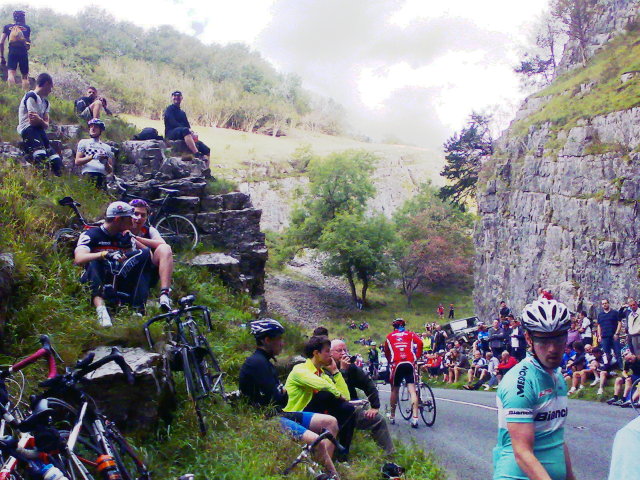
Photo of Fans in the Gorge

Fans in the Gorge

So tired, but so happy. Well worth it as a day out. Yesterday I went to the Tour of Britain as it passed through Cheddar Gorge. It was a fairly social trip, riding along with two from Bristol on the way in (hope they got back OK one bike broke crossing the orchard at Sandford, but I showed them Cheddar Cycle Store) and one from Milton on the way back. When I got there, I rode up the Gorge until I had to stop (or else fall off) and it was still packed with fans. It was a good half-hour before the race would pass by, but already almost every flattish piece of land by the road had either a spectator or a bicycle on it. I watched twitter for race news, posted an update @mjray, then put the phone away as the green-fronted police bikes came through just ahead of the racers. I tried videoing the race, but it s only the second outing for the handlebarcam and I seem to have deleted the recording before hooking it up to the laptop. Thankfully, the itv4 coverage (repeated 13:00) is pretty good. (My back is on TV! Ahem.) Now, today (Saturday) I will be mostly doing the work scheduled for Friday, but it was still worth it. Go along if you get the chance: Suffolk and Norfolk today, Westminster tomorrow. I suggested it to @enterprisehub s #coopsweekend because the Rabobank team are doing well.

16 September 2011

John Goerzen: Mexico Part 5: Food, Restaurants, and Dueling Karaoke Guys

The fifth in a series; see also parts 1, 2, 3, and 4. One piece of advice we got in Mexico went like this: the nicer a place looks, the worse the food and prices will be. Roadside taco stands will be great, and nice-looking restaurants not so much. That seemed to be accurate. We only tried one real nice-looking restaurant and it was very good (though pricy), but it may have been sort of an exception. But perhaps the most interesting bit about eating in Mexico wasn t the food. It s the adventure. We ate one day at Guadalajara s San Juan de Dios market. In that huge labyrinth somewhere was a set of restaurants. They d tend to have a small cooking area, usually just open, and a few tables. We chose one. And at this point, I have to take brief detour and explain something. There are a lot of people in Mexico that do things for tips, and quite often without being asked. Some other examples might be washing a car s windshield at a stoplight. So anyhow, we had ordered our food, and before long, a guy wanders down the aisle and plonks down a boombox. And turns it on. And then he pulled out a microphone, which we quite soon realized was connected to the boombox. (I guess making it more of a karaoke box.) Anyhow, he started singing a song decently and seemed to be enjoying it. About 45 seconds into it, a competing boombox man plonked down a competing boombox 25 feet away, turned it on, and yes, you guessed it pulled out a microphone and started singing a different song. Worse than the first person but louder. Eventually the boombox people left and our lunchtime conversation could resume. But pretty soon a drum guy showed up. He had a bunch of drums on a strap so he could just walk around and play them. He apparently decided that an excellent place to play them would be directly behind my head. I did not entirely agree with his decision, but hey, it beat the competing karaoke guys. Eventually the drum guy left, and somehow between the time I looked down to get out money to pay our bill and the time I had it counted out, a clown had shown up and made several balloon animals for our boys. I tipped him, we paid, and then headed on. You might think from this story that this would be an annoying series of events. And honestly, if it had happened in a big mall in the USA, it would probably have been both annoying and creepy. But really I enjoyed it. The fact that dueling karaoke happened, despite sounding really awful, was pretty funny and really seeing this whole parade of people was interesting too. It made American restaurants seem a little boring. You always know what s going to happen here (and if something surprising does happen, the place probably gets a bad review on Yelp.) Interesting things sometimes happen at mealtimes in Mexico and I like it that way. I had a torta ahogada (drowned sandwich) at that restaurant. And at this point, another brief aside. I m the kind of person that can go to an average American restaurant, see items on the menu helpfully indicated as spicy, order one, and genuinely wonder if other people would find them spicy, because I either don t notice spiciness at all, or maybe notice a tiny bit if I concentrate really hard. Others, meanwhile, might take a bite and lunge for the water. Having said that, I know people that lived in Thailand for awhile and I have nowhere near their tolerance for spiciness. So, having been in Mexico a whole 24 hours or so, I decided not to follow Jonathan s wise lead in ordering a torta with the spicy sauce on the side. I figured I hadn t had anything spicy yet, so maybe this was would be nice and mild for me. Via Jonathan s translation, I ordered it with the spicy sauce. I believe the phrase I heard him use was con chile . The waitress looked at me, gave me an amused the American is ordering it con chile? Hahaha . sort of smile, and went off. Pretty soon our food arrived. (The food always seems to arrive pretty soon in Mexico, by the way.) Oliver was having a bit of a culture shock that day, and mostly refusing to eat (once hunger got the best of him later, he really enjoyed Mexican food.) But the rest of us dug in, including me. I enjoyed my torta. It was spicy, but not too bad. I took some big bites (it was, after all, a thick sandwich) and was really enjoying it. For about a minute. Slowest-acting spiciness I ve had in awhile. Then it hit me. Spiciness, and lots of it. I took a big gulp of my horchata (a creamy sweet rice drink that I found at many restaurants). That helped. A little. I really liked the torta and ate it, but it wouldn t surprise me if the waitress noticed how extremely quickly a drank my horchata Another interesting experience was in Guanajuato. It was raining as we walked towards the Guanajuato market. Their market was large and similar in concept to the Guadalajara one, though a lot smaller. The restaurants were all in a row, in a side of the building that was open to the outside. Most were on the ground level but it looked like a restaurant or two were upstairs. As we approached, all of a sudden people were yelling at us. First it was a guy on the second story, then pretty soon people at the restaurants on the first floor did so as well. They were yelling rapidly in Spanish, waving their menus around in the air. I m imagining they were naming foods they sold or reasons to eat there, but I don t know enough Spanish to know. As we walked down the long row of restaurants, the ones we left behind would quiet down in disgust and other hopeful restaurant owners would take up the yelling and waving cause. I imagine if we did some time-lapse videography and walked up and down that row, we could produce an effect not unlike the sound of a dot-matrix printer going back and forth on the page. Anyhow, we selected one of the quieter restaurants pretty much random. The others then quieted down until another person chanced to walk past at which point it would get loud again. The lunch there was good but I think I mainly will remember it for the selection process! On our way into Guanajuato, we stopped at a wonderful roadside taco place. In typical fashion, they had a large vertical pork thing (I don t know the proper word for it) from which they would carve off meat on the spot anytime someone ordered something with pastor. We found a table. And we ordered a few tacos and such. They were usually a few pesos each (working out to less than a dollar), small round things on a soft tortilla, with meat, cilantro, and onion on top. And typically delicious. They had very little in common with an American taco . We d often order a few, and if we wanted more, just order more. They were made quickly enough for that. Tacos were very similar from one restaurant to the next. My favorite flavors were pastor (pork), chorizo (sausage), and bistec (beef steak). A restaurant in Guadalajara sadly I ve forgotten its name, since we kept calling it the potato place had what I might call a Mexican version of the loaded baked potato, with a meat, queso (cheese), a delicious sauce with a flavor unlike anything I d had before, and some garnish. But really my favorite thing from that restaurant was their amazing juices. I am not much of a juice drinker normally, but in Mexico I went for them whenever they were offered. What passes as fruit juice in the USA has about as much resemblance to a real Mexican fruit juice as Taco Bell has to a real Mexican taco stand. (Very little, in case that wasn t crystal clear.) That particular restaurant offered three types of juices, which were, if I m remembering right, aguas, frescas, and jugos. I has a jugo verde (green juice) on the first visit there. It was good, but the one I can still remember was called, I think, the fresa fresca (fresh strawberry juice). And it was incredible. I m not sure how to describe it, other than real. One observation before I end. It seemed a common thread at some Mexican roadside taco stands to not have soap in their restrooms. Instead there would be a plastic cup holding I kid you not powder-form Tide laundry detergent. It was amusing anyhow. My hands left those places extremely soft and smelling like laundry. One of the last restaurants we visited on our trip was in Ajijic, near the Chapala lake. It was actually right on the lake and served seafood. This was the only restaurant with prices as high as I d be used to in the United States. I ordered a stew served in a stone bowl. It came out sizzling, and since the very thick stone bowl retains heat well, it kept sizzling the entire time I was eating. It was excellent as usual. Coming up in part 6: some thoughts on returning to the United States, our decision to visit, communication, and tips for anyone else considering a first visit to Mexico.

14 September 2011

Christian Perrier: Sometimes, I'm really happy to live in the Debian world...

...and not in this other world where you have to deal with a bug reported against apt because installing libreoffice in the distro development branch is not possible:
sudo apt-get install libreoffice
Reading package lists... Done
Building dependency tree       
Reading state information... Done
Some packages could not be installed. This may mean that you have
requested an impossible situation or if you are using the unstable
distribution that some required packages have not yet been created
or been moved out of Incoming.
The following information may help to resolve the situation:
The following packages have unmet dependencies:
 libreoffice : Depends: libreoffice-core (= 1:3.4.3-1ubuntu2) but it is not going to be installed
               Depends: libreoffice-writer but it is not going to be installed
               Depends: libreoffice-calc but it is not going to be installed
               Depends: libreoffice-impress but it is not going to be installed
               Depends: libreoffice-draw but it is not going to be installed
               Depends: libreoffice-math but it is not going to be installed
               Depends: libreoffice-base but it is not going to be installed
               Depends: libreoffice-report-builder-bin but it is not
 going to be installed
               Depends: libreoffice-filter-mobiledev but it is not going to be installed
               Depends: libreoffice-java-common (>= 1:3.4.3~) but it is not going to be installed
E: Unable to correct problems, you have held broken packages.
And I therefore really admire those folks who are brave enough to triage out bugs reported in Launchpad (current counter: about #850000...in only SEVEN years). Yeah, I know, whining about clueless users is BAD, we should be friendly and gentle and kind and polite and nice and happy, but COME ON DUDE, could you at least think ONE BLOODY SECOND? End of rant.

13 September 2011

Vincent Sanders: Electricity is really just organized lightning.

I have recently been working on a project that requires a 12V supply. Ordinarily this is no problem my selection of bench supplies are generally more than a match for anything I throw at them.

My TS3022S Bench SupplyThis project however needed a little more "oomph" than usual, specifically 200W more. Funnily enough a precision variable output bench supply capable of supplying 20A are rare and *very* expensive beasties.

So we turn to a fixed output supply, after all I will want to run my project without hogging my bench supplies anyway. These can be bought from various electronics suppliers like Farnell from around the 50 mark and Chinese imports from Ebay sellers start around the 20 mark.

All very well and good but that is money I was not planning on spending and possibly a month of waiting for an already badly delayed project. So I decided to Convert an old ATX PSU into a 12V source. This is not a new idea and a quick search revealed many suitable guides online. I had a quick skim, decided I did understand the general idea and ploughed ahead.

Wikipedia has a very useful page on the ATX standard complete with pinout diagrams and colour codes. The pile of grey box ATX supplies available on my shelf was examined and one was helpfully labelled with a sticker proclaiming 22A@12V and we had a winner.

Opening the case of the donor 450W CIT branded supply revealed a mostly empty enclosure with the usual basic switching arrangement. I removed most of the wire loom aside from two of each output voltage (3.3V, 5V and 12V i figured the other voltages might be useful in future) and three commons, the 3.3V and 5V sense lines were also kept. Each of these pairs were cut to length and leads were wired to 4mm sockets.

The "PWR_EN" line was wired via a toggle switch to ground so the output can be switched on and off easily. The 5V standby and a 5V output line were wired to a green/red bi-colour LED (via 270 current limit resistors) to give indication that mains is present and when the output is on.

Holes were drilled for four 4mm sockets an indicator LED and a switch. The connectors and switches were all mounted in the PSU casework. I plugged it all in, put an 8.2 load resistor on the 5V line with an ammeter in line and a voltmeter across the 12V rail.

ATX bench power supply I turned the mains on and the LED lit up green (5V standby worked) and when I flicked the output switch the LED turned orange, the 12V line went to 12V and the expected 0.6A flowed through the load resistor.

Basically, Success!

I have since loaded the supply up to the 200W operating load and nothing unexpected has happened so I am happy. Seems converting an ATX PSU is a perfectly good way of getting a 200W 12V supply and I can recommend it for anyone as cheap as me willing to put an hour or so into such a project.

Sylvain Beucler: More Science and Lighting

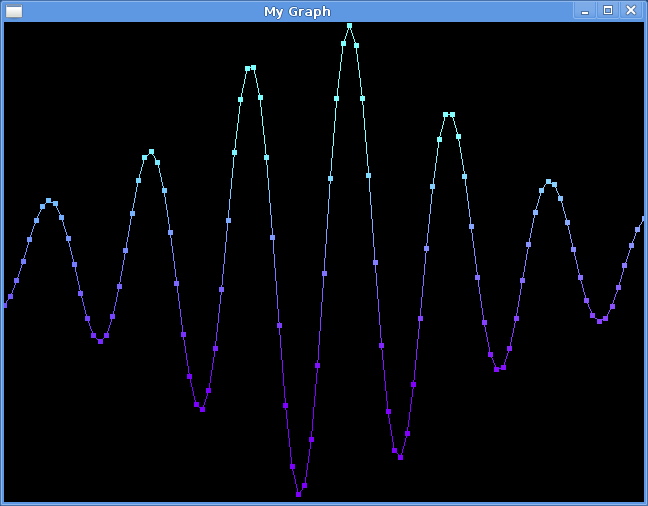
plot Guus wrote another scientific OpenGL tutorial, storing ordinates as a one-dimensional texture for increased performances.
http://en.wikibooks.org/wiki/OpenGL_Programming/Scientific_OpenGL_Tutorial_02
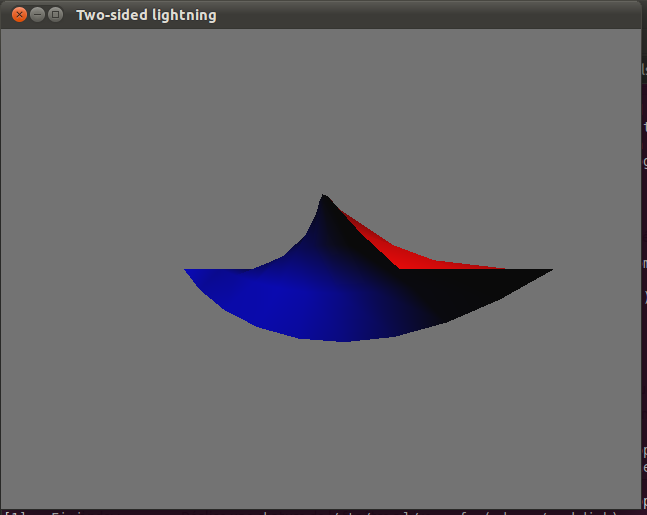
two-sided I also went ahead and added a tutorial on two-sided lighting:
http://en.wikibooks.org/wiki/GLSL_Programming/GLUT/Two-Sided_Surfaces
Remember: this is free documentation that you can share and/or improve upon - make sure you do so :)

12 September 2011

John Goerzen: Mexico Part 3: Shopping

The third in my serious about my family s recent visit to Mexico see also part 1 and part 2. Shopping in Mexico was probably the thing I was least prepared for. I probably had the biggest wins of the trip shopping, and also the biggest fails (though they weren t all that significant). It seems to me that shopping is all about serendipity. You almost have to be good at impulse buying. I normally try hard to resist impulse purchases, preferring to research and compare carefully before making a decision. That attitude didn t serve me well in Mexico, and when I was able to overcome it, I got some great purchases. Around here, some of the best places to shop are the ones that have been in business for decades. Anderson Office Supply in Newton, KS, for instance, has been around for over 100 years, and has in stock, even everything from a ribbon for my slightly obscure 1940s typewriter to local history books. Moler s Camera in Wichita often meets or beats the online stores prices, and has better service. But in Mexico the best places seemed to be packed into a large crowded shopping area, or a dusty stand along a road, or a guy selling stuff on a plaza somewhere. Here is Guadalajara s market (San Juan de Dios): It s an incredible open-air market. We spent quite some time there, even ate lunch, and yet I m sure we saw only a small fraction of what they had. It was a cramped place, with small booths and tiny aisles, but all sorts of interesting things. Although I did appreciate walking quickly past the raw pork and fish corner. Terah bought some genuine extract of vanilla there, at a good price. Some of the street vendors were selling what I think were butterfly toys they had some sort of launcher that would launch them in the air, and they d flutter and float down to the ground. We saw them mainly in Guadalajara Centro on our first day, and I (unwisely, it turns out) thought, Hmm, a plastic toy our boys would love it, but I don t want to buy it on our first day. Besides, I m sure we ll see them all over or online. Wrong on both counts. So there s one of my fails. My greatest win came on the road back from Guachimontones (an ancient pyramid site). Every so often along that country road, there would be a vendor with a table selling something or other. I saw some paintings out my window, thought neat , but and here you can see how terrible an impulse buyer I am didn t actually put together that we should turn around and look at them until 10 minutes later after a bathroom stop for Jacob. We went back, and I picked out a beautiful painting on canvas of those pyramids at sunset. And the charge: 200 pesos (about $17 USD). Incredible and incredibly cheap, and there is a great place on my wall for it. The vendor was also the artist. I am kicking myself for only buying one. (No photo yet as it was too big to practically transport by plane.) Another memorable purchase was this one: This was another roadside find. We were driving through Ajijic, and I noted a rug vendor along the side of the road. I had walked past a rug vendor in the Guadalajara market, so I was keeping my eye out. I made a note to stop there on our way back out of Ajijic. So we did. This is a rug made in the Zapotec tradition, all hand-made, with natural dyes and wool. It was 550 pesos (about $46 USD), which I considered to also be a pretty good deal for what it was. I have no idea how many hours went into creating it, but I m sure it was many. My luck in shops wasn t so good. We visited Tlaquepaque, which had lots of shops selling beautiful things. But the prices there were higher than I d pay for similar things back home. Tonala s shops were too inconveniently located to be practical with what were then tired boys, so we didn t go in there. I m not used to shopping without planning, and perhaps am not very good at it. On the other hand, I really enjoyed making those two purchases, and only regret not buying another 200-peso painting! Maybe next time I m in Mexico, I ll even buy something on the first day there. Terah will be so proud..

John Goerzen: Mexico Part 2: Lodging & Family

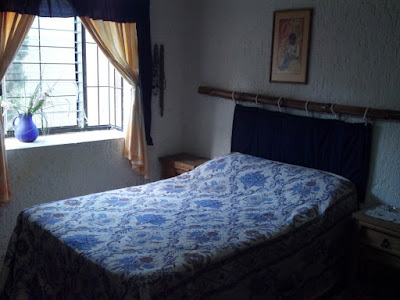
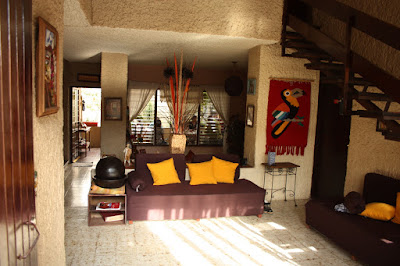
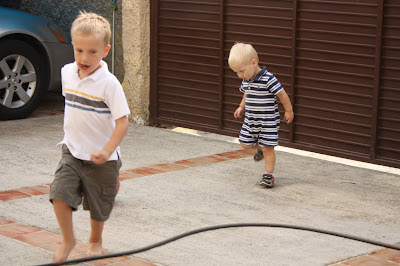
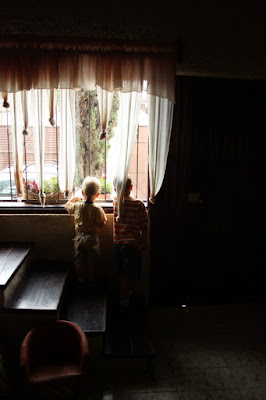
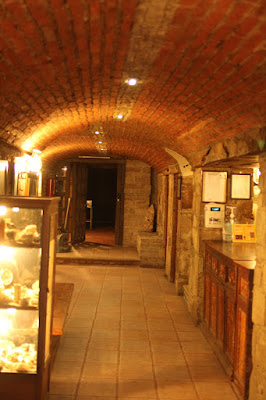
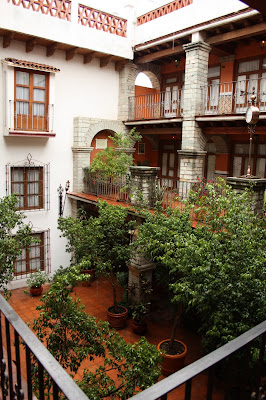
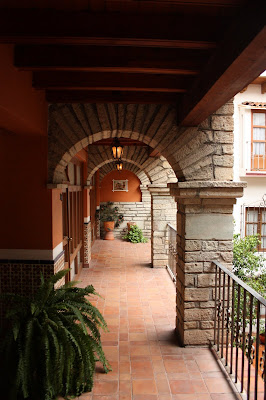
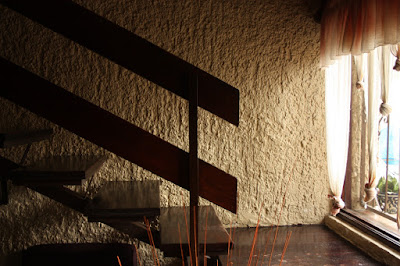
As I wrote in part 1, my family and I were in Mexico recently. Today I ll write about the places we stayed. We spent most of the time in a room we rented in a private home in Guadalajara. My friend Jonathan had found it for us, and it was not too far from his home. The owner was a grandmother, and across the courtyard was more family, including a granddaughter close in age to our boys. They enjoyed playing together. It was really a perfect arrangement for us. There s no better way to be a part of local life when traveling than to stay in someone s house. Here s our bedroom: Notice the glass slats in the window it s a nifty, though not airtight, alternative to our regular windows. More on that later. More of the inside: We had a bit of a language barrier while in Mexico, though never anything significant. My Spanish vocabulary started with almost nothing and I reached maybe a few dozen words by the time we left. Terah knew some Spanish from high school and college, and my friend was fluent. Our hostess also knew a little English. But we all communicated well enough. Terah or Jonathan would help translate when needed. As I d seen before, the children would say things to each other, but never seemed to be bothered that their playmates didn t understand what was being said. They just had a great time anyhow. On Sunday afternoon, when we came back from our activities, there was a buzz of activity. Children everywhere outside, running and playing. Adults too, chatting. We didn t know exactly what was happening, but sent Jacob and Oliver out to play anyhow (which they were eager to do). The yard was enclosed by a wall, so children could pretty much run around without lots of supervision. Eventually they were invited to have some birthday cake (ah ha!) it was one of the children s birthday. Jacob and Oliver actually were served the first two pieces of cake (as the amigos ). Everyone seemed so friendly, warm, and welcoming. Each morning started with breakfast at the house, followed by a scene like this: That s Jacob and Oliver, looking to see if Jonathan had arrived for the day yet. I often noticed in Mexico that I was unsure if I was inside or outside. Here in Kansas, we can have a string of summer days that each exceed 110F (44C) or a few weeks in winter that never get above 15F (-9C), even in daytime. And then we have some pleasant days like right now, too or rain blowing sideways at 60MPH. In general, we spend a lot of effort keeping the outside, well, out. It is quite clear that this isn t a problem in the Guadalajara area. Some restaurants could have been described as buildings with large, open windows so you feel a lot of breeze while inside. Or perhaps as a simple shade roof with a few supports on the edges, so you re never really inside at all (sort of like going under a small shade tent outdoors). To the extent that windows could close, many of them couldn t be made airtight. It was clear that in that area, people spend more energy finding ways to invite the outdoors in rather than to keep it out, thanks to the year-round moderate climate. Perhaps the best example of this surprised me one evening. We were arriving in Guanajuato, an old silver mining town in the mountains, and were going to spend the night at Hotel Socav n, which had been recommended to us by a local friend of Jonathan s. From the street, the hotel looked tiny. But walk in, and you get in this old-looking (and feeling) entry tunnel: That s the front desk, apparently cut out of it there on the right. We asked to see some of the rooms before buying apparently a normal request around there. The innkeeper agreed, and gave us keys and directions to find them on the third floor. It included going up 2 flights of stairs, passing through a courtyard, and going up another flight. It was after dark, and the hotel was dimly lit something I was fine with. I thought we were stepping out into a beautiful atrium with some potted plants in the center of the building something fairly common in some nicer hotels. Until I felt rain on my head. Then I realized that the courtyard, which began two floors up from the street, was open to the sky. Beautiful! Here was the view from out room door: And down the hall : After getting home, a Google happened to turn up some reviews of this hotel. I was so annoyed at what some people wrote! One person gave them only 3 stars because they didn t have air conditioning, had poor water pressure, and lots of steps . Someone else complained of the dark entry tunnel something I couldn t help but smiling about the moment I entered. My review, which should hopefully get posted soon, is certainly different. I gave them 5 stars, because if I wanted a Super 8 with generic fluorescent lighting and the same layout as thousands of other hotels, I would have gone to Nebraska instead of Mexico. Most homes and local hotels in the region don t have air conditioning because they don t need it, and that s just how water pressure is in Mexico (due to needing to pump it from municipal supplies to private storage tanks overhead). And who doesn t appreciate entering a hotel through a brick tunnel? Ah, sigh This should give you some idea of the kind of travel we like: part of the point of traveling is enjoying the differences from home, and I think it is a huge mistake to be annoyed at everything that is different. Enjoy the differences! Finally, here s a photo of the staircase in the home we stayed in, which I thought was fascinating:

11 September 2011

Gregor Herrmann: RC bugs 2011/36

after some months of looking only at "my" packages, I'm back in the #RCBW flow. here's my overview of RC bug activities & NMUs in the last week: two short observations:

John Goerzen: Mexico Part 1: Genesis and Travel

My family and I (including our boys) are just back from a great visit to Mexico. It was my first time there, and also the first time our boys have been outside the USA. I ll be writing about all the fun stuff in the posts to come, so you ll have to bear with me on this one as I describe why we did something that appears to horrify a segment of Americans. About a year ago, I wrote a review of Travel as a Political Act by Rick Steves. Rick s point wasn t actually directly political in the conventional sense, but summed up as:
I ve taught people how to travel. I focus mostly on the logistics: finding the right hotel, avoiding long lines But that s not why we travel. We travel to have enlightening experiences, to meet inspirational people, to be stimulated, to learn, and to grow. Travel has taught me the fun in having my cultural furniture rearranged and my ethnocentric self-assuredness walloped.
He speaks of giving onesself permission to have a conversation with someone that doesn t speak a language you know, for instance. I got an email this spring from my longtime friend Jonathan Hall, who had moved to Mexico a couple of years ago. He invited my family and me to go to Mexico, generously offered to host us and show us around, and specifically mentioned my review of Rick Steves as a reason to do so, this was immediately intriguing. Due to his other plans, it was also something of a limited-time offer. Those of you that don t live in the USA may not know what sort of stories we get about Mexico over here. Most of them involve either illegal immigration to the USA or the Mexican drug war. Occasionally there is some sort of drug-related violence on the US side of the border as well, which always makes the news. There are a lot of people that have the perception that Mexico is a dangerous place to be. Terah even knows some people that grew up in Mexico and are too afraid to return. So we did some research, asked some questions, and it became pretty clear that yes, some parts of Mexico are dangerous, but many parts are really quite safe, and Jonathan had invited us to one of those. The reactions we got from Americans when we told them of our plan ranged from excitement that we would get to visit a beautiful country to concern and worry about our safety. Besides that, I knew almost no Spanish and Terah had a few high school and college classes years ago to go on. And, we knew that Mexico would, in many ways, be more different from the USA than Germany was. We concluded that this would get us out of our comfort zone in a significant way, have lots of great things to do, be a good experience for the boys, and something that we wouldn t do without Jonathan. So we bought the tickets for it! As you might notice, I m quite glad we did. I ll follow up with the details in the next stories, but for today I ll end with the story of getting there. It involves two cute boys, so of course it ll be interesting. Jacob is almost 5 and Oliver is 2, and neither one of them had flown for over a year. Despite leaving home at 5AM to drive to the airport (about an hour away), they were both awake and alert. Jacob was jabbering away the whole way there. He enjoyed the security process and found it interesting I had to explain that they were checking to make sure everyone was following the airplane rules. Then as we walked to our gate, he pressed his face against every window, looking at the parked airplanes in the dark. Oliver would see him doing this and run over to join him. With a bit of help, he noticed some airplanes had United Express painted on them, and others had American with an AA on them. He would talk about American AA and United Express airplanes for the rest of the week whenever he heard one in the sky. I sat between the boys on our flight to Dallas, and Terah was in the row ahead of us. This is how Jacob spent most of the flight. And Oliver, who had the aisle seat, enjoyed paging through the inflight magazines, safety brochure, wifi instruction card, and airsickness bag. The real highlight came at the Dallas/Ft. Worth (DFW) airport, where we had a connection. And the reason: we needed to take a train to get to our connecting gate. The DFW Skylink system really works very well but the boys cared most that it s a TRAIN. It was difficult to get them both away from it when we got off. They wanted to see it leave, stay and watch the next one come, etc. Jacob was only happy when he realized he could see the Skylink trains running high above the window at our departure gate for Guadalajara. The 2.5-hour flight to Guadalajara got a little long for them, but they managed OK. We struck up several conversations with friendly people that knew English as we waited in various lines. It seems to be something of a rarity for American families with young children and no Mexican heritage to visit Mexico. People went out of their way to be friendly and welcoming even the customs officials. It felt like a great start to the visit. One Mexican man who was chatting with me encouraged me to learn some Spanish. I said my wife knows some, and that I had tried to learn some German back when I took foreign language classes. Laughing, he said, Why would you do that? Not as an insult; it just genuinely didn t seem useful to him. I think they were happy and proud that someone wanted to visit Mexico and was excited about it! More to come.

10 September 2011

Christian Perrier: Ka mate! Ka mate! Ka ora!

So, Rugby World Cup 2011 began yesterday. Tricky for us europeans to watch those games in New Zealand, particularly during the week. So, I think I'll mostly tape the games that happen in the morning (New Zealand's evening) or night (NZ afternoon)....and try to avoid my work colleagues to spoil results. One game per day will be mostly what we'll be watching, so expect me talking about scrums, offsides, tries, etc. in this blog, for about 1.5 months until October 23rd. The opening ceremony was great, with many references to New Zealand's roots and culture as well as the rugby traditions and values. Its closing with fireworks all over Auckland were apparently very nice...unfortunately they were ruined by the broadcasting of the infamous TF1 TV channel here. Yes, unfortunately RWC games are mostly broadcasted on TF1 here, a channel that usually never broadcasts rugby. This already was a big PITA for RWC2007 and I fear it will be the same this time, particularly for games of the french team. The opening game between Tonga and New Zealand was without surprise. Tonga were indeed crushed very quicly in 1st half, mostly because being too weak in defense on the outside game. All Blacks rear players were very inspired and nearly didn't miss anything during that lahftime, which lead to 29-3 after 4 minutes. Impressive. However, All Blacks game vanished during 2nd halftime and Tonga could even score a try after a really impressive 10 minutes pick and go battle. That made me happy for the Tonga players (half of them do indeed play in France...). In 45 minutes, we'll have the opening for France, against Japan. That should theoretically be easy but, well, anything can happen. We'll see!

7 September 2011

Gunnar Wolf: Language designers, API designers, PHP and utter fails

After many years of successfully dodging doing any serious programming in PHP, I had to get my feet wet with PHP for my RL job: I was requested to develop a simple but non-trivial module for our Institute's Drupal-based webpage. It basically meant two and a half weeks devoted to head-scratching: I had read the very good John van Dyk's Pro Drupal Development book, and knew it would be an important resource were I to face writing a module or work on a theme beyond the most basic stuff So I checked it out of the library, and started basically writing something similar to my good and trusty Perl code. After all, PHP seems quite similar to Perl, although forcing you to write more for no gain (i.e. requiring an array() declaration whenever you want to store more than one value together) or lacking important and useful constructs (not having a sane way to prepare a SQL statement for multiple executions with different parameters Yes, there are DB access methods that do provide it, but Drupal 6 does not use them). Anyway, book in hand, I started understanding while implementing (which is way different than just reading the book, right?) Drupal's notions. I cannot say I like them, but it's ahem doable. Now, I hit a problem twice. I chose to ignore it the first time, as it was a corner case I'd look into later on, but had to devote for hours of my attention later on. When designing the menu (which for Drupal means not only the facility which prepares/displays links to the bits of functionality, but also the access control layer and the action dispatcher a huge yay! for responsability separation!), I had only two access levels: Public and administrator. So, this seemed like a good fit:
  1. $public = array('first/action', 'second/action',
  2. 'third/action', 'something/else');
  3. foreach (array_keys($items) as $item)
  4. if (array_search($item, $public))
  5. $items[$item]['access callback'] = TRUE
  6. else
  7. $items[$item]['access arguments'] = array('diradmin');
But... No matter what I did, the first element in $public refused to be publicly visible. It was not until after a severe amount of head-scratching I came across this jewel in the PHP online manual:
Warning This function may return Boolean FALSE, but may also return a non-Boolean value which evaluates to FALSE, such as 0 or "". Please read the section on Booleans for more information. Use the === operator for testing the return value of this function.
GRAH. Using a sane language for some time had made me forget about the problems of true/false sharing space with other meaningful values. So, yes, checking for inclusion of a value in an array in PHP this way should be compared with class-bound identity (that's what === means) to FALSE, or better yet, using a function that exclusively returns a boolean (as in_array()). Anyway While arrays (which in PHP are any kind of list, be it keyed as a hash or consecutive as a traditional array) are such an usual construct in any language, please do take a look at PHP's array-handling API. Too long. Too complex. Too many corner cases. I cannot but wonder what keeps PHP as a popular language. It hurts.

5 September 2011

Andrew Pollock: [life] Four years later

I'm not very good with dates. For the last two years now, Joshua's anniversary has snuck up on me and caught me by surprise. I don't think that I'd really appreciated until this year that we lost him on the Labor Day long weekend. I'll have to remember that for next year so I don't forget. I don't know what my problem was this year. I just didn't realise that it was this early in September that we lost him. Last year I was just too exhausted from dealing with a new baby to realise when his anniversary was, and I felt terrible for missing it. This year, I just felt terrible for not realising when it was, but at least Sarah pointed it out before the fact. For added irony, the 4th of September this year is Father's Day in Australia. Yesterday, I was looking at photos of Joshua to remember him, and Gallery gave me a random photo of Zoe in the corner. That was something. I'm not sure what. I feel like Zoe being a wonderful child is some sort of consolation prize from the universe for taking Joshua, but I often wonder what Joshua would be like today if he were almost four.

2 September 2011

Asheesh Laroia: Debian bug squashing party at SIPB, MIT


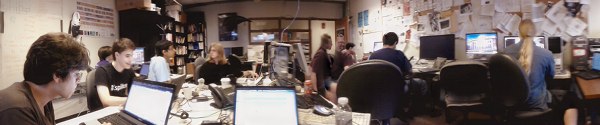
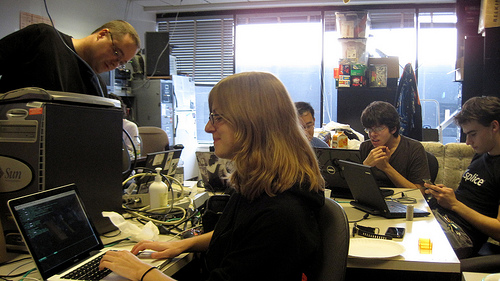
(Photo credit: Obey Arthur Liu; originally on Picasa, license.) Three weekends ago, I participated in a Debian bug squashing party. It was more fun than I had guessed! The event worked: we squashed bugs. Geoffrey Thomas (geofft) organized it as an event for MIT's student computing group, SIPB. In this post, I'll review the good parts and the bad. I'll conclude with beaming photos of my two mentees and talk about the bugs they fixed. So, the good:

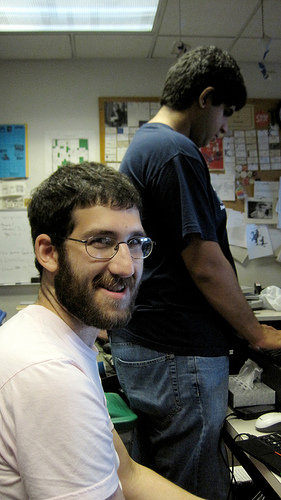
The event was a success, but as always, there are some things that could have gone more smoothly. Here's that list: Still, it turned out well! I did three NMUs, corresponding to three patches submitted for release-critical bugs by my two mentees. Those mentees were: Jessica enjoying herself Jessica McKellar is a software engineer at Ksplice Oracle and a recent graduate of MIT's EECS program. She solved three release-critical bugs. This was her first direct contribution to Debian. In particular: Jessica has since gotten involved in the Twisted project's personal package archive. Toward the end of the sprint, she explained, "I like fixing bugs. I will totally come to the next bug squashing party." Noah grinning Noah Swartz is a recent graduate of Case Western Reserve University where he studied Mathematics and played Magic. He is an intern at the MIT Media Lab where he contributes to DoppelLab in Joe Paradiso's Responsive Environments group. This was definitely his first direct contribution to Debian. It was also one of the most intense command-line experiences he has had so far. Noah wasn't originally planning to come, but we were having lunch together before the hackathon, and I convinced him to join us. Noah fixed #625177, a fails-to-build-from-source (FTBFS) bug in nslint. The problem was that "-Wl" was instead written in all lowercase in the debian/rules file, as "-wl". Noah fixed that, making sure the package properly built in pbuilder, and then spent some quality time with lintian figuring out the right way to write a debian/changelog. That's a wrap! We'll hopefully have one again in a few months, and before that, I hope to write up a guide so that we run things even more smoothly next time.

1 September 2011

Thorsten Glaser: Subversion for Dummies (or visitors of the #cvs IRC channel)

Oh well someone came into the #cvs channel on IRC without a clue, again. I ve made a nice picture to show the competition (rival, whatever) to newbies (warning, sarcasm ahead)

Niels Thykier: DEP-5, JW, dev docs and other goodies

Are you using DEP-5 in copyright file? Are you doing it right? Thanks to the work of Jakub Wilk, Lintian 2.5.3 will spot some of the regular mistakes (including syntax errors) and check if you are using the newest revision. This is far from the only thing Jakub Wilk has added to Lintian in this development cycle. Most of his contributions in 2.5.3 are listed next to a little [JW] in the changelog and I hope to see a lot more of those. :) Together with Jeremiah Foster, we have created a small POD document that hopefully will help aspiring developers. The file currently explains how the source code is divided, some core concepts and how to run specific tests in the test suite. The plan is to make it available on lintian.d.o along with a link to the git source code (#639974). Last time, I mentioned we have gotten rid of collection/fields by a simple improvement to our Lintian::Collect API. Turns out the same improvement could also be used on collection/source-control-file. This means we no longer create a file per field in the d/control of the source package. To avoid (any more) confusion, Lintian will now inform you if the package carries an override for a non-overridable tag (except if you use --quiet). On a related note, Lintian will now error out if it sees an unknown field in a vendor profile. Previously it would just silently ignore the field. There is one more change I would like to highlight and this one is probably best served with an example:
$ lintian --show-overrides ../lintian_2.5.2.dsc
N: We build-depend on cdbs for the test suite
O: lintian source: unused-build-dependency-on-cdbs
N: We build-depend on quilt for the test suite
O: lintian source: quilt-build-dep-but-no-series-file
N: We don't have a patch system for lintian itself
O: lintian source: patch-system-but-no-source-readme
Lintian will now attempt to extract and print the comment related to the override from the overrides file. The comment will be printed above each tag the override applies to (so you may see some repeated comments). The full documentation for how Lintian finds the comments (or why it does not find the comment) is available in the Lintian User Manual. The exact format of the comments being outputted may change in the near future. Particularly, we may add a marker to assist the tools generating lintian.d.o to find the comments. Hopefully we will be able to close #512901 soon. Beyond the changes above, I am very happy to see the bug count drop below 180 unfixed bugs[1]. We have not been this low there since the 2.5.0~rc1 upload (in February) and I hope we can keep it this time. :) Finally if you ever wanted to run your own little lintian.d.o , then you may find the Lintian harness proposal interesting. The basic idea the is to clean up the current tools and make a proper frontend out of them. Should you be interested, feel free to come with suggestions or requests. [1] Lintain bug page I use the number next to Outstanding under Status near the bottom. So pending bugs are considered fixed in my numbering.

31 August 2011

Axel Beckert: Useful but Unknown Unix Tools: How wdiff and colordiff help to choose the right Swiss Army Knife

In light of the fact that it seems possible to fit the plastic caps of a Debian branded Swiss Army Knife (Last orders today!) on an existing Swiss Army Knife (German written howto as PDF), I started to think about which Victorinox Cybertool would be the best fitting for me. And because the Victorinox comparison page doesn t really show diffs, just columns with floating text which are not very helpful for generating diffs in your head, I used command line tools for that purpose: wdiff Because the floating texts are not line- but just whitespace-based, the tool of choice is not diff but wdiff, a word-based diff. It encloses additions and removals in + + and [- -] blocks. (No, those aren t Japanese smileys although they look a lot like some. ^^). The easiest and clearest way is to copy and paste the texts from Victorinox comparison page into some text files and compare them with wdiff:
$ wdiff cybertool34.txt cybertool41.txt
+Schraubendreher 2.5mm,+ Pinzette, N hahle mit Nadel hr, +Holzs ge,+ Bit-Schl ssel( 5 mm Innensechskant f r die D-SUB Steckverbinder, 4 mm Innensechskant f r Bits, Bit Phillips 0, Bit Phillips 1, Bit-Schlitzschrauben 4 mm, Bit Phillips 2, Bit Hex 4 mm, Bit Torx 8, Bit Torx 10, Bit Torx 15 ), Kombizange( H lsenpresser, Drahtschneider ), Stech-Bohrahle, Kugelschreiber( auch zum DIP-Switch verstellen ), Mehrzweckhaken (Pakettr ger), +Metalls ge( Metallfeile, Nagelfeile, Nagelreiniger ),+ Dosen ffner( kleiner Schraubendreher ), Kleine Klinge, Grosse Klinge, Ring, inox, Mini-Schraubendreher, Kapselheber( Schraubendreher, Drahtabisolierer ), +Holzmeissel / Schaber,+ Bit-Halter, Stecknadel, inox, Schere, Korkenzieher, Zahnstocher
So this already extracted the information which are the seven tools which are in the Cybertool 41, but not in the Cybertool 34. Nevertheless the diff is still not easily recognizable on the first glance. There are several ways to help here. First wdiff has an option --no-common (the according short option is -3) which just shows added and removed words:
$ wdiff -3 cybertool34.txt cybertool41.txt
======================================================================
 +Schraubendreher 2.5mm,+ 
======================================================================
  +Holzs ge,+ 
======================================================================
  +Metalls ge( Metallfeile, Nagelfeile, Nagelreiniger ),+ 
======================================================================
  +Holzmeissel / Schaber,+ 
======================================================================
This is already way better to quickly recognize the actual differences. But if you still also want to see the common tools of the two knifes you need some visual help: One option is to use wdiff s --terminal (or short -t) option. Added words are then displayed inverse and removed words are shown underlined (background and foreground colors hardcoded as there is no invert colors style in CSS or HTML):

$ wdiff -t cybertool34.txt cybertool41.txt
Schraubendreher 2.5mm, Pinzette, N hahle mit Nadel hr, Holzs ge, Bit-Schl ssel( 5 mm Innensechskant f r die D-SUB Steckverbinder, 4 mm Innensechskant f r Bits, Bit Phillips 0, Bit Phillips 1, Bit-Schlitzschrauben 4 mm, Bit Phillips 2, Bit Hex 4 mm, Bit Torx 8, Bit Torx 10, Bit Torx 15 ), Kombizange( H lsenpresser, Drahtschneider ), Stech-Bohrahle, Kugelschreiber( auch zum DIP-Switch verstellen ), Mehrzweckhaken (Pakettr ger), Metalls ge( Metallfeile, Nagelfeile, Nagelreiniger ), Dosen ffner( kleiner Schraubendreher ), Kleine Klinge, Druckkugelschreiber, Grosse Klinge, Ring, inox, Mini-Schraubendreher, Kapselheber( Schraubendreher, Drahtabisolierer ), Holzmeissel / Schaber, Bit-Halter, Stecknadel, inox, Schere, Korkenzieher, Zahnstocher

But some still like to to use color instead of the contrast-rich inverse and the easily to oversee underlining. This is where colordiff comes into play: colordiff colordiff is like syntax highlighting for diffs on the command line. I works with classic and unified diffs as well as with wdiffs and debdiffs (the debdiff command is part of the devscripts package).
$ wdiff cybertool34.txt cybertool41.txt colordiff
+Schraubendreher 2.5mm,+ Pinzette, N hahle mit Nadel hr, +Holzs ge,+ Bit-Schl ssel( 5 mm Innensechskant f r die D-SUB Steckverbinder, 4 mm Innensechskant f r Bits, Bit Phillips 0, Bit Phillips 1, Bit-Schlitzschrauben 4 mm, Bit Phillips 2, Bit Hex 4 mm, Bit Torx 8, Bit Torx 10, Bit Torx 15 ), Kombizange( H lsenpresser, Drahtschneider ), Stech-Bohrahle, Kugelschreiber( auch zum DIP-Switch verstellen ), Mehrzweckhaken (Pakettr ger), +Metalls ge( Metallfeile, Nagelfeile, Nagelreiniger ),+ Dosen ffner( kleiner Schraubendreher ), Kleine Klinge, Grosse Klinge, Ring, inox, Mini-Schraubendreher, Kapselheber( Schraubendreher, Drahtabisolierer ), +Holzmeissel / Schaber,+ Bit-Halter, Stecknadel, inox, Schere, Korkenzieher, Zahnstocher
$ wdiff cybertool29.txt cybertool41.txt colordiff
+Schraubendreher 2.5mm,+ Pinzette, N hahle mit Nadel hr, +Holzs ge,+ Bit-Schl ssel( 5 mm Innensechskant f r die D-SUB Steckverbinder, 4 mm Innensechskant f r Bits, Bit Phillips 0, Bit Phillips 1, Bit-Schlitzschrauben 4 mm, Bit Phillips 2, Bit Hex 4 mm, Bit Torx 8, Bit Torx 10, Bit Torx 15 ), +Kombizange( H lsenpresser, Drahtschneider ),+ Stech-Bohrahle, +Kugelschreiber( auch zum DIP-Switch verstellen ), Mehrzweckhaken (Pakettr ger), Metalls ge( Metallfeile, Nagelfeile, Nagelreiniger ),+ Dosen ffner( kleiner Schraubendreher ), Kleine Klinge, [-Druckkugelschreiber,-] Grosse Klinge, Ring, inox, Mini-Schraubendreher, Kapselheber( Schraubendreher, Drahtabisolierer ), +Holzmeissel / Schaber,+ Bit-Halter, Stecknadel, inox, +Schere,+ Korkenzieher, Zahnstocher
(Coloured Screenshots done with ANSI HTML Adapter from the package aha.) Some, especially those who are used to git, are probably confused by the default choice of diff colors. This is easily fixable by writing the following into you ~/.colordiffrc:
newtext=green
oldtext=red
diffstuff=darkblue
cvsstuff=darkyellow
(See also /etc/colordiff for the defaults and hints.) colordiff has by the way two operating modes: So now let us compare the Cybertool 29 with Cybertool 34 in a normal diff (by using the texts from above and replacing all commata with newline characters) with git-like colors:
$ colordiff cybertool29-lines.txt cybertool34-lines.txt
12a13,14
> Kombizange( H lsenpresser
> Drahtschneider )
13a16,17
> Kugelschreiber( auch zum DIP-Switch verstellen )
> Mehrzweckhaken (Pakettr ger)
16d19
< Druckkugelschreiber
25a29
> Schere
Or as unifed diff with some context:
$ colordiff -u cybertool29-lines.txt cybertool34-lines.txt
--- cybertool29-lines.txt     2011-08-31 20:55:37.195546238 +0200
+++ cybertool34-lines.txt   2011-08-31 20:55:11.667710504 +0200
@@ -10,10 +10,13 @@
 Bit Torx 8
 Bit Torx 10
 Bit Torx 15 )
+Kombizange( H lsenpresser
+Drahtschneider )
 Stech-Bohrahle
+Kugelschreiber( auch zum DIP-Switch verstellen )
+Mehrzweckhaken (Pakettr ger)
 Dosen ffner( kleiner Schraubendreher )
 Kleine Klinge
-Druckkugelschreiber
 Grosse Klinge
 Ring
 inox
@@ -23,5 +26,6 @@
 Bit-Halter
 Stecknadel
 inox
+Schere
 Korkenzieher
 Zahnstocher
So if you want nicely colored diffs with Subversion like you re used to with git, you can use svn diff colordiff.

29 August 2011

Axel Beckert: SSH Multiplexer: parallel-ssh

There are many SSH multiplexers in Debian and most of them have one or two features which make them unique and especially useful for that one use case. I use some of them regularily (I even maintain the Debian package of one of them, namely pconsole :-) and I ll present then and when one of them here. For non-interactive purposes I really like parallel-ssh aka pssh. It takes a file of hostnames and a bunch of common ssh parameters as parameters, executes the given command in parallel in up to 32 threads (by default, adjustable with -p) and waits by default for 60 seconds (adjustable with -t). For example to restart hobbit-client on all hosts in kiva.txt, the following command is suitable:
$ parallel-ssh -h kiva.txt -l root /etc/init.d/hobbit-client restart
[1] 19:56:03 [FAILURE] kiva6 Exited with error code 127
[2] 19:56:04 [SUCCESS] kiva
[3] 19:56:04 [SUCCESS] kiva4
[4] 19:56:04 [SUCCESS] kiva2
[5] 19:56:04 [SUCCESS] kiva5
[6] 19:56:04 [SUCCESS] kiva3
[7] 19:57:03 [FAILURE] kiva1 Timed out, Killed by signal 9
(Coloured Screenshots done with ANSI HTML Adapter from the package aha.) You easily see on which hosts the command failed and partially also why: On kiva6 hobbit-client is not installed and therefore the init.d script is not present. kiva1 is currently offline so the ssh connection timed out. If you want to see the output of the commands, you have a two choices. Which one to choose depends on the expected amount of output: If you don t expect a lot of output, the -i (or --inline) option for inline aggregated output is probably the right choice:
$ parallel-ssh -h kiva.txt -l root -t 10 -i uptime
[1] 20:30:20 [SUCCESS] kiva
 20:30:20 up 7 days,  5:51,  0 users,  load average: 0.12, 0.08, 0.06
[2] 20:30:20 [SUCCESS] kiva2
 20:30:20 up 7 days,  5:50,  0 users,  load average: 0.19, 0.08, 0.02
[3] 20:30:20 [SUCCESS] kiva3
 20:30:20 up 7 days,  5:49,  0 users,  load average: 0.10, 0.06, 0.06
[4] 20:30:20 [SUCCESS] kiva4
 20:30:20 up 7 days,  5:49,  0 users,  load average: 0.25, 0.17, 0.14
[5] 20:30:20 [SUCCESS] kiva6
 20:30:20 up 7 days,  5:49, 10 users,  load average: 0.16, 0.08, 0.02
[6] 20:30:21 [SUCCESS] kiva5
 20:30:21 up 7 days,  5:49,  0 users,  load average: 3.11, 3.36, 3.06
[7] 20:30:29 [FAILURE] kiva1 Timed out, Killed by signal 9
If you expect a lot of output you can give directories with the -o (or --outdir) and -e (or --errdir) option:
$ parallel-ssh -h kiva.txt -l root -t 20 -o kiva-output lsb_release -a
[1] 20:36:51 [SUCCESS] kiva
[2] 20:36:51 [SUCCESS] kiva2
[3] 20:36:51 [SUCCESS] kiva3
[4] 20:36:51 [SUCCESS] kiva4
[5] 20:36:53 [SUCCESS] kiva6
[6] 20:36:54 [SUCCESS] kiva5
[7] 20:37:10 [FAILURE] kiva1 Timed out, Killed by signal 9
$ ls -l kiva-output
total 24
-rw-r--r-- 1 abe abe  98 Aug 28 20:36 kiva
-rw-r--r-- 1 abe abe   0 Aug 28 20:36 kiva1
-rw-r--r-- 1 abe abe  98 Aug 28 20:36 kiva2
-rw-r--r-- 1 abe abe  98 Aug 28 20:36 kiva3
-rw-r--r-- 1 abe abe  98 Aug 28 20:36 kiva4
-rw-r--r-- 1 abe abe 102 Aug 28 20:36 kiva5
-rw-r--r-- 1 abe abe 100 Aug 28 20:36 kiva6
$ cat kiva-output/kiva5
Distributor ID:	Debian
Description:	Debian GNU/Linux 6.0.2 (squeeze)
Release:	6.0.2
Codename:	squeeze
The only annoying thing IMHO is that the host list needs to be in a file. With zsh, bash and the original ksh (but neither tcsh, pdksh nor mksh), you can circumvent this restriction with one of the following command lines:
$ parallel-ssh -h <(printf "host1\nhost2\nhost3\n ") -l root uptime
[ ]
$ parallel-ssh -h <(echo host1 host2 host3     xargs -n1) -l root uptime
[ ]
In addition to parallel-ssh the pssh package also contains some more ssh based tools: I though think that parallel-ssh is by far the most useful tool from the pssh package. (Probably no wonder as it s the most generic one. :-)

28 August 2011

Christian Perrier: 10 years being Debian Developer - part 3: the news and genealogy years

I stopped my story in early 1994, after my Big Switch to the mysterious and new world of Linux. My home server, kheops, is now running Debian and is fed with news and mail by FrMug, formerly French Minix Users Group and now run by AFAU, the "Association Fran aise des Amateurs de Usenet". As I'm still console-challenged, I'm reading mail and news on another machine I have at home, named "khephren", which is running an, ahem, beta copy of Microsoft Windows 95. Yeah, I know...:-) These 1994-1999 years were mostly the Usenet years, for me. I gradually became more and more involved in several fr.* newsgroups, either related to the Linux world...or to the Windows world. The latter was professionnally a bonus for me as 1994 is also the year where I switched from the Material Science department at Onera to the Network and Computing Department. My mission there was to accompany the increasing prevalence of personal desktop workstations in the daily life of what was formerly the Big Castle of Computing at Onera, hosting various generations of Cray computers, most of which being in the Top500 world supercomputers (we even had one in the Top10, very briefly, at somepoint). So, I was "the PC and Windows guy" in this world of supercomputing, Unix and network wizards. But my hobby at home helped me keeping and growing skills in both "worlds" which, over the years, has proven to be a not so common profile..:-) Meanwhile, at home, I was spending hours and nights reading those newsgroups...or getting involved in fr.* hierarchy management..or expanding my friends network to many people in the news, Linux, BSD worlds. That lasted for about 3 years with ups and downs (with three young kids at home, you end up having slightly less time...). I was gradually improving my home server use, adding more functionalities to it, for instance setting it up as a file and print server with Samba 1.9.something (this will be the beginning of a long story with samba!). Unfortunately, my dear Ren had passed in the meantime. Ren did so much for Linux in France that he'll be the only link I give in this article. If you happen to go through P re Lachaise cemetery in Paris, go to its Memory garden instead of visiting Jim Morrison's grave and drink a whisky bottle in memory of Ren . Or just install one of the most funnily named Debian packages: le-dico-de-rene-cougnenc and, again, drink something to his memory (whisky is highly preferred). We then reached 1997 and a specific event: my father (who was very sick for years) passed during summer, some time after my grand-father passed too. As it apparently happens for many people, it triggerred me into the interest for family history. After all, those people who are going away are family memories. And, in some way, I wanted to keep track of this memory. As a consequence, I started collecting family memories, interviewing my close relatives (the oldest ones) and ending, of course, in tracking all this with my computers. That was the start of a long genealogy research that sent me on the track of the Perrier family (of course), but also all other branches, on my mother and father side, as well as reconstructing the tree of cousins we have, etc, etc. As anybody who did that knows, this is quite an endless task but I went very committed to it. I quickly ended up in joining research groups that were using the recent growth of personal access to Internet communication. Those groups were, in these 90's, building elaborated systems where people can help together in their research instead of having to travel to places where archives are stored. I participated to many such groups and even ended up animating one who was doing research in archives of the "Yvelines" "d partement", my place of living (even though I have no family branch there). At the same time, other groups were sending me research results for my own family in the French region where my roots are. Collective effort, help others for free, you can recognize things that are a constant all over these years, indeed. It actually helped me in tracking my Perrier ancestors up to about 1680, with 11 generations of men holding that name (from Jean-Baptiste, my son, up to tienne Perrier, who is born about 1640-1650, in the small village named Briant in Sa ne et Loire, in France). Or even climbing up to Laurent Polette, born circa 1510, mentioned in a document date February 1562. He his my oldest known ancestor.Those folks being 15 generations before me. My oldest ancestor is born under Fran ois the First, King of France, protector of Leonardo Da Vinci, at the time La Joconde was painted or the Chambord castle was built. Doh. Unfortunately, genealogy software, at that time, was quite poor for Unix systems. Lifelines was a quite strong development but wasn't that user-friendly and I ended up using a Windows-based "shareware" software written by an individual. Still, my Linux machine was used quite intensively: databases were stored there, and saved there, all important informations were there, my mail was received there, along with dozens of mailing lists I was reading. I even hosted a few mailing lists on my home server. Still, in the meantime also, again in 1997, in October, another event happened. We had a pollution peak in Paris area and October 1st was the first (and as of now the only ever) day where driving restrictions were applied. Up to that moment, I was driving to/from work (30 kilometers one way). I decided to use this opportunity to really test public transport, for one full month. As I knew it would take me much more time than driving, I tried to imagine a way to use that time. How about reading mail and news on a laptop instead of only at home? Done... In a few days, I found a used Compaq Aero laptop (486 16MHz), I installed Debian "bo" on it, switched my mail and news workflow to console programs (mutt and slrn) and here we go! So, finally, in October 1997, I was using Linux nearly all time long, the only exception being genealogy data handling. That laptop was named "mykerinos" (the small pyramid) and....my laptop is still named mykerinos, though it's now the 5th mykerinos I have..:-) Ah, and since then, I nearly always use public transport to go to/from work. Debian addiction is good for the planet! At some point (I don't remember exactly when...about 1999, I think), DSL connections appeared and one of the first DSL FAI emerged on France: Free. I was already using their services for dialup access, but DSL was then a revolution: persistent connection! And nearly immediately, static IP! I became one of their first DSL customers (and I'm still one). Moreover, I had then friends working there...and they had many Debian machines to host their services. So, with the help of my Freenix friends, some DNS hosting on their machines and the still tireless eu.org entirely free domain, perrier.eu.org was born. Immediately, this gave me opportunities for doing many interesting things with my home server: setting up www.perrier.eu.org and use it....for learning web things and sharing genealogical data. For instance, I ended up hosting some data sent by other genealogists such as digital copies of archives for some French regions, all served through my 512/128kbps DSL line (quickly upgraded to 2Mb, IIRC). And, very quickly, I felt the need to share my family tree, of course! And here comes Geneweb. Written (in Ocaml) by Daniel de Rauglaudre, Geneweb was (and still is) by far one of the best tools to share genealogy data over the Net. So, I ended up installing it on my home machine. Guess how I did that? "apt-get install geneweb", of course. Yes, it was packaged. Indeed by Brent Fulgham who did the initial release on July 22nd 2000. Here, my memory is a little bit vague. I think I actually packaged Geneweb for my own use and sharing it on upstream FTP site, forking Brent's package as a start, but updating to latest upstream release. Then I quickly ended up having discussions with Brent about this new upstream release, and that lead to:
geneweb (3.10-3) unstable; urgency=low
  * Merging with unofficial package from Geneweb ftp site
    (in preparation of new maintainer [Christian Perrier] takeing
    over responsibility).  Note that all of this work is from
    Christian.
  * Default database dir is now writable by members of geneweb group
  * New geneweb group added at installation
  * Package tries to properly handle former installations of the
    unofficial Geneweb package available on Geneweb ftp site
  * Debconf dialogs translated in french
  * More languages available
  * Creation of /var/geneweb/etc, /var/geneweb/cnt, /var/geneweb/images
    with proper permission so that authorised users may use these also
  * When de-installed, all databases are exported with gwu (should allow
    smooth upgrades when the databse format changes)
 -- Brent A. Fulgham <bfulgham>  Mon, 22 Jan 2001 19:30:47 -0800
See? Already "debconf translation to French"! "More languages available". Here we are. As discussed with Brent, he propsoed me to take the package over. So, on January 11th 2001, I had applied in the New Maintainer Process. I'm amazed how quickly it went indeed: there was a tool I needed, it needed to be packaged, I could handle the packaging...and then I decided to be involved. Here we are: bubulle is on his way to become one of those magicians who are building the best universal operating system. Yes, me, the clueless material scientist..:-) How did it go? You'll know this in next episode, of course...

27 August 2011

Axel Beckert: Useful but Unknown Unix Tools: Calculating with IPs, The Sequel

This is a direct followup on my previous blog posting about calculating IPs and netmasks with the tools netmask and prips. Kurt Roeckx (via e-mail) and Niall Donegan (via a comment to that blog posting) both told me about the package sipcalc, and Kurt also mentioned the package ipcalc. Thanks for that! And since I found both useful, too, let s put them in their own blog posting: Both tools, ipcalc and sipcalc offer a get all information at once mode which are not present in the previously presented tool netmask. ipcalc ipcalc by default outputs all information and even in ANSI colors:
$ ipcalc 192.168.96.0/21
Address:   192.168.96.0         11000000.10101000.01100 000.00000000
Netmask:   255.255.248.0 = 21   11111111.11111111.11111 000.00000000
Wildcard:  0.0.7.255            00000000.00000000.00000 111.11111111
=>
Network:   192.168.96.0/21      11000000.10101000.01100 000.00000000
HostMin:   192.168.96.1         11000000.10101000.01100 000.00000001
HostMax:   192.168.103.254      11000000.10101000.01100 111.11111110
Broadcast: 192.168.103.255      11000000.10101000.01100 111.11111111
Hosts/Net: 2046                  Class C, Private Internet
(Coloured Screenshots done with ANSI HTML Adapter from the package aha.) You can suppress the bitwise option or directly output HTML via commandline options. For example ipcalc -b -h 192.168.96.0/21 outputs the following content:
Address: 192.168.96.0
Netmask: 255.255.248.0 = 21
Wildcard: 0.0.7.255
=>
Network: 192.168.96.0/21
HostMin: 192.168.96.1
HostMax: 192.168.103.254
Broadcast: 192.168.103.255
Hosts/Net: 2046 Class C, Private Internet
Yes, that s an HTML table and no preformatted text, just with a monospaced font. (I just removed the hardcoded text color from it, otherwise it would not look nice on dark backgrounds like in Planet Commandline s default color scheme.) Like netmask, ipcalc can also deaggregate IP ranges into largest possible networks:
$ ipcalc 192.168.87.0 - 192.168.110.255
deaggregate 192.168.87.0 - 192.168.110.255
192.168.87.0/24
192.168.88.0/21
192.168.96.0/21
192.168.104.0/22
192.168.108.0/23
192.168.110.0/24
(ipcalc -r 192.168.87.0 192.168.110.255 is just another way to write this, and it results in the same output.) To find networks with at least 20, 63 and 30 IP addresses within a /24 network, use for example:
Address:   192.0.2.0            
Netmask:   255.255.255.0 = 24   
Wildcard:  0.0.0.255            
=>
Network:   192.0.2.0/24         
HostMin:   192.0.2.1            
HostMax:   192.0.2.254          
Broadcast: 192.0.2.255          
Hosts/Net: 254                   Class C
1. Requested size: 20 hosts
Netmask:   255.255.255.224 = 27 
Network:   192.0.2.128/27       
HostMin:   192.0.2.129          
HostMax:   192.0.2.158          
Broadcast: 192.0.2.159          
Hosts/Net: 30                    Class C
2. Requested size: 63 hosts
Netmask:   255.255.255.128 = 25 
Network:   192.0.2.0/25         
HostMin:   192.0.2.1            
HostMax:   192.0.2.126          
Broadcast: 192.0.2.127          
Hosts/Net: 126                   Class C
3. Requested size: 30 hosts
Netmask:   255.255.255.224 = 27 
Network:   192.0.2.160/27       
HostMin:   192.0.2.161          
HostMax:   192.0.2.190          
Broadcast: 192.0.2.191          
Hosts/Net: 30                    Class C
Needed size:  192 addresses.
Used network: 192.0.2.0/24
Unused:
192.0.2.192/26
sipcalc sipcalc is similar to ipcalc. One big difference seems to be the IPv6 support:
$ sipcalc 2001:DB8::/32
-[ipv6 : 2001:DB8::/32] - 0
[IPV6 INFO]
Expanded Address        - 2001:0db8:0000:0000:0000:0000:0000:0000
Compressed address      - 2001:db8::
Subnet prefix (masked)  - 2001:db8:0:0:0:0:0:0/32
Address ID (masked)     - 0:0:0:0:0:0:0:0/32
Prefix address          - ffff:ffff:0:0:0:0:0:0
Prefix length           - 32
Address type            - Aggregatable Global Unicast Addresses
Network range           - 2001:0db8:0000:0000:0000:0000:0000:0000 -
                          2001:0db8:ffff:ffff:ffff:ffff:ffff:ffff
(Thanks to Niall for the pointer to RFC3849. :-) It can also split up networks into smaller chunks, but only same-size chunks, like e.g. split a /32 IPv6 network into /34 networks:
sipcalc -S34 2001:DB8::/32
-[ipv6 : 2001:DB8::/32] - 0
[Split network]
Network                 - 2001:0db8:0000:0000:0000:0000:0000:0000 -
                          2001:0db8:3fff:ffff:ffff:ffff:ffff:ffff
Network                 - 2001:0db8:4000:0000:0000:0000:0000:0000 -
                          2001:0db8:7fff:ffff:ffff:ffff:ffff:ffff
Network                 - 2001:0db8:8000:0000:0000:0000:0000:0000 -
                          2001:0db8:bfff:ffff:ffff:ffff:ffff:ffff
Network                 - 2001:0db8:c000:0000:0000:0000:0000:0000 -
                          2001:0db8:ffff:ffff:ffff:ffff:ffff:ffff
-
Similar thing with IPv4:
sipcalc -s27 192.0.2.0/24
-[ipv4 : 192.0.2.0/24] - 0
[Split network]
Network                 - 192.0.2.0       - 192.0.2.31
Network                 - 192.0.2.32      - 192.0.2.63
Network                 - 192.0.2.64      - 192.0.2.95
Network                 - 192.0.2.96      - 192.0.2.127
Network                 - 192.0.2.128     - 192.0.2.159
Network                 - 192.0.2.160     - 192.0.2.191
Network                 - 192.0.2.192     - 192.0.2.223
Network                 - 192.0.2.224     - 192.0.2.255
sipcalc also has a show me all information mode with the -a option:
$ sipcalc -a 192.168.96.0/21
-[ipv4 : 192.168.96.0/21] - 0
[Classfull]
Host address            - 192.168.96.0
Host address (decimal)  - 3232260096
Host address (hex)      - C0A86000
Network address         - 192.168.96.0
Network class           - C
Network mask            - 255.255.255.0
Network mask (hex)      - FFFFFF00
Broadcast address       - 192.168.96.255
[CIDR]
Host address            - 192.168.96.0
Host address (decimal)  - 3232260096
Host address (hex)      - C0A86000
Network address         - 192.168.96.0
Network mask            - 255.255.248.0
Network mask (bits)     - 21
Network mask (hex)      - FFFFF800
Broadcast address       - 192.168.103.255
Cisco wildcard          - 0.0.7.255
Addresses in network    - 2048
Network range           - 192.168.96.0 - 192.168.103.255
Usable range            - 192.168.96.1 - 192.168.103.254
[Classfull bitmaps]
Network address         - 11000000.10101000.01100000.00000000
Network mask            - 11111111.11111111.11111111.00000000
[CIDR bitmaps]
Host address            - 11000000.10101000.01100000.00000000
Network address         - 11000000.10101000.01100000.00000000
Network mask            - 11111111.11111111.11111000.00000000
Broadcast address       - 11000000.10101000.01100111.11111111
Cisco wildcard          - 00000000.00000000.00000111.11111111
Network range           - 11000000.10101000.01100000.00000000 -
                          11000000.10101000.01100111.11111111
Usable range            - 11000000.10101000.01100000.00000001 -
                          11000000.10101000.01100111.11111110
[Networks]
Network                 - 192.168.96.0    - 192.168.103.255 (current)
Thanks again to Kurt and Niall for their contributions!

Now listening to the schreimaschine and fausttanz submissions for the interactive competition at the B nzli/DemoDays in Olten (Switzerland)

Next.

Previous.