Search Results: "will"

14 August 2021

Gunnar Wolf: Bullseye arrives. Private ARM64 install fest!

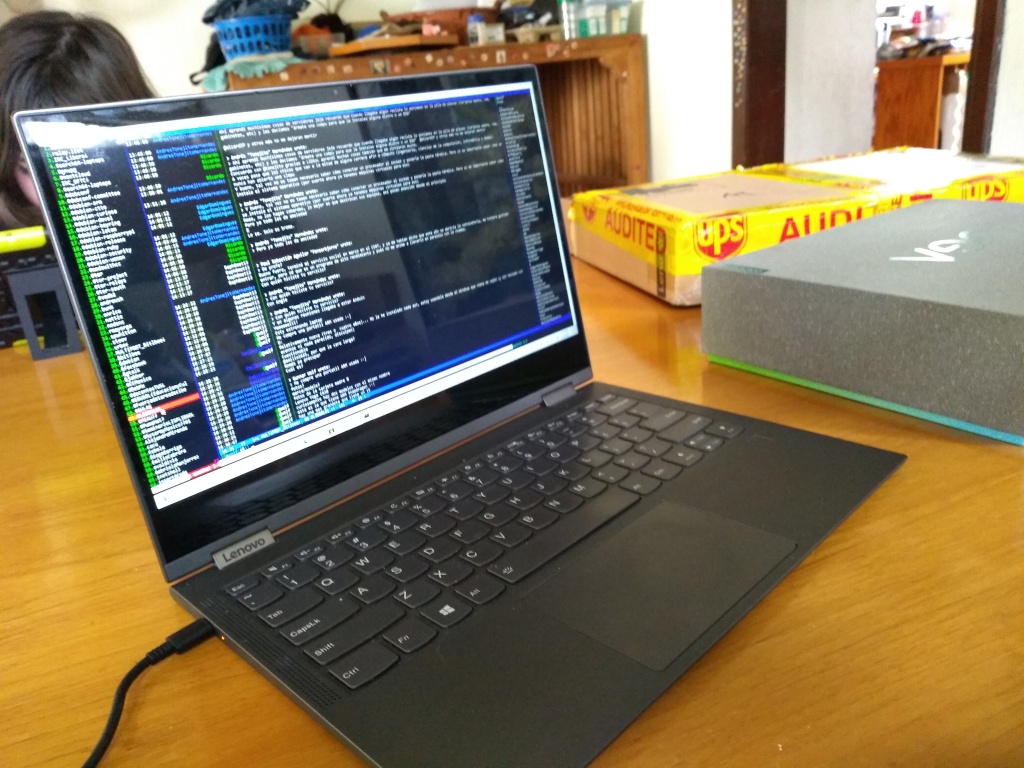
So today is the day when a new Debian release comes out! Congratulations to everybody, and thanks a lot mainly to the Release Team. Lots of very hard work was put into making Debian 11 Bullseye a reality! My very personal way to celebrate this was to do a somewhat different Debian install at home. Why different? Well, I have quite a bit of old, older and frankly elderly laptops at home. And as many of you know, I have done more than my fair share of Raspberry Pi installs I have played and worked with assorted ARM machines at least since 2013, and I cannot consider myself a newbie with them by any means. But this is the first time I installed Debian on a mass-market, decently-specced ARM64-based laptop. Yes, I know the Pinebook has been there like for ages, but it really does feel like a computer to show off and not to use seriously (and I ve seen probably too many people fiddling with it, unable to get $foo to work). So I got myself a used Lenovo Yoga C630. Yes, a discontinued product it seems Lenovo was not able to properly market this machine, and it had a pretty short shelf life the machine was available for samples in late 2018 and for general sale in 2019! The specs are quite decent: Installing it via an almost-standard debian-installer is almost straightforward does require the installer to know what he is doing but is not too different from a regular Debian install. The AArch64 laptops project has done quite a feat in getting a d-i image ready to be inserted as a USB drive, and comprehensive instructions to help through the process. The shipped scripts even reap the Windows partition for the firmware images! I have reduced Windows to 25GB, but having only a 128GB drive, it still is a little bit too much.. I guess I ll blow it away sooner rather than later. The installer image has a regular GNOME install, which works beautifully, but I promptly replaced it with i3, as it s fundamental for me to work happily. Of course, the computer has quirks, more than I d expect from a regular x86 system, but well within what I expected to achieve during my first day with it. The issues I have most noted are: Of course, more quirks will surely appear with use. And I ll start trying to address some of them. So Happy Bullseye! Happy Debian 11! Enjoy a great release! \o/

13 August 2021

Leandro Doctors: Clojure CLI Tools in Debian - GSoC 2021 Partial Evaluation Report

NOTE: this blog post is based on my "Clojure CLI Tools in Debian" GSoC 2021 project Partial Evaluation Report.Hi, everybody!For those who don't know me, my name is Leandro Doctors (allentiak on IRC), and I'm the Debian Clojure Team's GSoC 2021 intern. My mentor is Louis-Philippe V ronneau[*] (pollo on IRC). My co-mentor is Utkarsh Gupta (utkarsh2102 on IRC). My 'no-mentor' :) is Elana Hashman (ehashman on IRC).In this message, I will summarize what I've been up to during the Coding I period (June 7th - July 16th).
TL;DR: my updated data-xml-clojure package was accepted[1] in experimental on Wednesday night :-)
[1] https://tracker.debian.org/news/1244465/accepted-data-xml-clojure-020alpha6-1-source-into-experimental/Now, let's tell the full story.During the first days of the "Coding I" phase, I did some research on the clj dependencies. And after the precious feedback from Louis-Philippe, Elana, Utkarsh, and Alex Miller (the upstream developer of clj, among many other libraries), I came up with the following packaging strategy.
  1. update org.clojure:data.xml (data-xml-clojure) to 0.2.0-beta6.
  2. package org.clojure:tools.gitlibs (tools-gitlibs-clojure).
  3. consider updating libjsch-agent-proxy-java, jgit, libtools-cli-clojure (all of them already in Debian).
  4. consider packaging com.cognitec.aws:* packages.
According to my original proposal, I should have completed all four tasks during Coding I. Looking back, the main lesson from these past weeks is a known classic: my timeline was too optimistic: I definitely underestimated the difficulty of the packaging process. Out of the four tasks, I only finished the first one.There were many challenges I had to overcome in order to update the library from version 0.0.8 to 0.2.0-alpha6:This what I did:First, I patched the source code so:Then, I completely overhauled the packaging code (this is, what goes inside debian/).All this improved the quality of the package.I also improved the Clojure Packaging Tutorial[2] to make the process easier to follow.[2] https://wiki.debian.org/Clojure/PackagingTutorialLooking back, it is almost as if I had started packaging the library from scratch...But, more that what I produced, I think the most important part of all this is what I learned during these weeks.As it was the first time I ever packaged anything in Debian, I had to learn the basics, bump by bump. (And, oh my, I surely did bump quite a few times!)[2] https://wiki.debian.org/Clojure/PackagingTutorial[3] https://wiki.debian.org/sbuild[4] https://manpages.debian.org/unstable/git-buildpackage/gbp.1.en.html[5] https://wiki.debian.org/UsingQuiltDefinitely, all this was worth it. After all, my updated data-xml-clojure package was accepted[1] in experimental on Wednesday :-)[1] https://tracker.debian.org/news/1244465/accepted-data-xml-clojure-020alpha6-1-source-into-experimental/Now that I've learned the basics of packaging bumped enough to get my package accepted, I'm hopeful I can ramp up and catch up with (at least most of) my original schedule during Coding II.tools-gitlibs-clojure, you're next :-)Thank you very much Louis-Philippe, Elana, and Utkarsh (plus a special mention to Alex) for your precious support during the last few weeks!

10 August 2021

Shirish Agarwal: BBI, IP report, State Borders and Civil Aviation I

If I have seen further, it is by standing on the shoulders of Giants Issac Newton, 1675. Although it should be credited to 12th century Bernard of Chartres. You will know why I have shared this, probably at the beginning of Civil Aviation history itself.

Comments on the BBI court case which happened in Kenya, then and the subsequent appeal. I am not going to share much about the coverage of the BBI appeal as Gautam Bhatia has shared quite eloquently his observations, both on the initial case and the subsequent appeal which lasted 5 days in Kenya and was shown all around the world thanks to YouTube. One of the interesting points which stuck with me was that in Kenya, sign language is one of the official languages. And in fact, I was able to read quite a bit about the various sign languages which are there in Kenya. It just boggles the mind that there are countries that also give importance to such even though they are not as rich or as developed as we call developed economies. I probably might give more space and give more depth as it does carry some important judicial jurisprudence which is and which will be felt around the world. How does India react or doesn t is probably another matter altogether  But yes, it needs it own space, maybe after some more time. Report on Standing Committee on IP Regulation in India and the false promises. Again, I do not want to take much time in sharing details about what the report contains, as the report can be found here. I have uploaded it on WordPress, in case of an issue. An observation on the same subject can be found here. At least, to me and probably those who have been following the IP space as either using/working on free software or even IP would be aware that the issues shared have been known since 1994. And it does benefit the industry rather than the country. This way, the rent-seekers, and monopolists win. There is ample literature that shared how rich countries had weak regulation for decades and even centuries till it was advantageous for them to have strong IP. One can look at the history of Europe and the United States for it. We can also look at the history of our neighbor China, which for the last 5 decades has used some provision of IP and disregarded many others. But these words are of no use, as the policies done and shared are by the rich for the rich.

Fighting between two State Borders Ironically or because of it, two BJP ruled states Assam and Mizoram fought between themselves. In which 6 policemen died. While the history of the two states is complicated it becomes a bit more complicated when one goes back into Assam and ULFA history and comes to know that ULFA could not have become that powerful until and unless, the Marwaris, people of my clan had not given generous donations to them. They thought it was a good investment, which later would turn out to be untrue. Those who think ULFA has declined, or whatever, still don t have answers to this or this. Interestingly, both the Chief Ministers approached the Home Minister (Mr. Amit Shah) of BJP. Mr. Shah was supposed to be the Chanakya but in many instances, including this one, he decided to stay away. His statement was on the lines of you guys figure it out yourself. There is a poem that was shared by the late poet Rahat Indori. I am sharing the same below as an image and will attempt to put a rough translation.
kisi ke baap ka hindustan todi hain Rahat Indori
Poets, whether in India or elsewhere, are known to speak truth to power and are a bit of a rebel. This poem by Rahat Indori is provocatively titled Kisi ke baap ka Hindustan todi hai , It challenges the majoritarian idea that Hindustan/India only belongs to the majoritarian religion. He also challenges as well as asserts at the same time that every Indian citizen, regardless of whatever his or her religion might be, is an Indian and can assert India as his home. While the whole poem is compelling in itself, for me what hits home is in the second stanza

:Lagegi Aag to aayege ghat kayi zad me, Yaha pe sirf hamara makan todi hai The meaning is simple yet subtle, he uses Aag or Fire as a symbol of hate sharing that if hate spreads, it won t be his home alone that will be torched. If one wants to literally understand what he meant, I present to you the cult Russian movie No Escapes or Ogon as it is known in Russian. If one were to decipher why the Russian film doesn t talk about climate change, one has to view it from the prism of what their leader Vladimir Putin has said and done over the years. As can be seen even in there, the situation is far more complex than one imagines. Although, it is interesting to note that he decried Climate change as man-made till as late as last year and was on the side of Trump throughout his presidency. This was in 2017 as well as perhaps this. Interestingly, there was a change in tenor and note just a couple of weeks back, but that could be only politicking or much more. Statements that are not backed by legislation and application are usually just a whitewash. We would have to wait to see what concrete steps are taken by Putin, Kremlin, and their Duma before saying either way.

Civil Aviation and the broad structure Civil Aviation is a large topic and I would not be able to do justice to it all in one article/blog post. So, for e.g. I will not be getting into Aircraft (Boeing, Airbus, Comac etc., etc.) or the new electric aircraft as that will just make the blog post long. I will not be also talking about cargo or Visa or many such topics, as all of them actually would and do need their own space. So this would be much more limited to Airports and to some extent airlines, as one cannot survive without the other. The primary reason for doing this is there is and has been a lot of myth-making in India about Civil Aviation in general, whether it has to do with Civil Aviation history or whatever passes as of policy in India.

A little early history Man has always looked at the stars and envisaged himself or herself as a bird, flying with gay abandon. In fact, there have been many paintings, sculptors who imagined how we would fly. The Steam Engine itself was invented in 82 BCE. But the attempt to fly was done by a certain Monk called Brother Elmer of Malmesbury who attempted the same in 1010., shortly after the birth of the rudimentary steam engine The most famous of all would be Leonardo da Vinci for his amazing sketches of flying machines in 1493. There were a couple of books by Cyrano de Bergerac, apparently wrote two books, both sadly published after his death. Interestingly, you can find both the book and the gentleman in the Project Gutenberg archives. How much of M/s Cyrano s exploits were his own and how much embellished by M/S Curtis, maybe a friend, a lover who knows, but it does give the air of the swashbuckling adventurer of the time which many men aspired to in that time. So, why not an author???

L Autre Monde: ou les tats et Empires de la Lune (Comical History of the States and Empires of the Moon) and Les tats et Empires du Soleil (The States and Empires of the Sun). These two French books apparently had a lot of references to flying machines. Both of them were authored by Cyrano de Bergerac. Both of these were sadly published after his death, one apparently in 1656 and the other one a couple of years later. By the 17th century, while it had become easy to know and measure the latitude, measuring longitude was a problem. In fact, it can be argued and probably successfully that India wouldn t have been under British rule or UK wouldn t have been a naval superpower if it hadn t solved the longitudinal problem. Over the years, the British Royal Navy suffered many blows, one of the most famous or infamous among them might be the Scilly naval disaster of 1707 which led to the death of 2000 odd British Royal naval personnel and led to Queen Anne, who was ruling over England at that time via Parliament and called it the Longitude Act which basically was an open competition for anybody to fix the problem and carried the prize money of 20,000. While nobody could claim the whole prize, many did get smaller amounts depending upon the achievements. The best and the nearest who came was John Harrison who made the first sea-watch and with modifications, over the years it became miniaturized to a pocket-sized Marine chronometer although, I doubt the ones used today look anything in those days. But if that had not been invented, we surely would have been freed long ago. The assumption being that the East India Company would have dashed onto rocks so many times, that the whole exercise would have been futile. The downside of it is that maritime trade routes that are being used today and the commerce would not have been. Neither would have aircraft or space for that matter, or at the very least delayed by how many years or decades, nobody knows. If one wants to read about the Longitudinal problem, one can get the famous book Longitude .

In many mythologies, including Indian and Arabian tales, in which we had the flying carpet which would let its passengers go from one place to the next. Then there is also mention of Pushpak Vimana in ancient texts, but those secrets remain secrets. Think how much foreign exchange India could make by both using it and exporting the same worldwide. And I m being serious. There are many who believe in it, but sadly, the ones who know the secret don t seem to want India s progress. Just think of the carbon credits that India could have, which itself would make India a superpower. And I m being serious.

Western Ideas and Implementation. Even in the late and early 18th century, there were many machines that were designed to have controlled flight, but it was only the Wright Flyer that was able to demonstrate a controlled flight in 1903. The ones who came pretty close to what the Wrights achieved were the people by the name of Cayley and Langley. They actually studied what the pioneers had done. They looked at what Otto Lilienthal had done, as he had done a lot of hang-gliding and put a lot of literature in the public domain then.

Furthermore, they also consulted Octave Chanute. The whole system and history of the same are a bit complicated, but it does give a window to what happened then. So, it won t be wrong to say that whatever the Wright Brothers accomplished would probably not have been possible or would have taken years or maybe even decades if that literature and experiments, drawings, etc. in the commons were not available. So, while they did experimentation, they also looked at what other people were doing and had done which was in public domain/commons.

They also did a lot of testing, which gave them new insights. Even the propulsion system they used in the 1903 flight was a design by Nicolaus Otto. In fact, the Aircraft would not have been born if the Chinese had not invented kites in the early sixth century A.D. One also has to credit Issac Newton because of the three laws of motion, again without which none of the above could have happened. What is credited to the Wilbur brothers is not just they made the Kitty Hawk, they also made it commercial as they sold it and variations of the design to the American Air Force and also made a pilot school where pilots were trained for warfighting. 119 odd pilots came out of that school. The Wrights thought that air supremacy would end the war early, but this turned out to be a false hope.

Competition and Those Magnificent Men and their flying machines One of the first competitions to unlock creativity was the English Channel crossing offer made by Daily Mail. This was successfully done by the Frenchman Louis Bl riot. You can read his account here. There were quite a few competitions before World War 1 broke out. There is a beautiful, humorous movie that does dedicate itself to imagining how things would have gone in that time. In fact, there have been two movies, this one and an earlier movie called Sky Riders made many a youth dream. The other movie sadly is not yet in the public domain, and when it will be nobody knows, but if you see it or even read it, it gives you goosebumps.

World War 1 and Improvements to Aircraft World War 1 is remembered as the Great War or the War to end all wars in an attempt at irony. It did a lot of destruction of both people and property, and in fact, laid the foundation of World War 2. At the same time, if World War 1 hadn t happened then Airpower, Plane technology would have taken decades. Even medicine and medical techniques became revolutionary due to World War 1. In order to be brief, I am not sharing much about World War 1 otherwise that itself would become its own blog post. And while it had its heroes and villains who, when, why could be tackled perhaps another time.

The Guggenheim Family and the birth of Civil Aviation If one has to credit one family for the birth of the Civil Aviation, it has to be the Guggenheim family. Again, I would not like to dwell much as much of their contribution has already been noted here. There are quite a few things still that need to be said and pointed out. First and foremost is the fact that they made lessons about flying from grade school to college and afterward till college and beyond which were in the syllabus, whereas in the Indian schooling system, there is nothing like that to date. Here, in India, even in Engineering courses, you don t have much info. Unless until you go for professional Aviation or Aeronautical courses and most of these courses cost a bomb so either the very rich or the very determined (with loans) only go for that, at least that s what my friends have shared. And there is no guarantee you will get a job after that, especially in today s climate. Even their fund, grants, and prizes which were given to people for various people so that improvements could be made to the United States Civil Aviation. This, as shared in the report/blog post shared, was in response to what the younger child/brother saw as Europe having a large advantage both in Military and Civil Aviation. They also made several grants in several Universities which would not only do notable work during their lifetime but carry on the legacy researching on different aspects of Aircraft. One point that should be noted is that Europe was far ahead even then of the U.S. which prompted the younger son. There had already been talks of civil/civilian flights on European routes, although much different from what either of us can imagine today. Even with everything that the U.S. had going for her and still has, Europe is the one which has better airports, better facilities, better everything than the U.S. has even today. If you look at the lists of the Airports for better value of money or facilities, you would find many Airports from Europe, some from Asia, and only a few from the U.S. even though they are some of the most frequent users of the service. But that debate and arguments I would have to leave for perhaps the next blog post as there is still a lot to be covered between the 1930s, 1950s, and today. The Guggenheims archives does a fantastic job of sharing part of the story till the 1950s, but there is also quite a bit which it doesn t. I will probably start from that in the next blog post and then carry on ahead. Lastly, before I wind up, I have to share why I felt the need to write, capture and share this part of Aviation history. The plain and simple reason being, many of the people I meet either on the web, on Twitter or even in real life, many of them are just unaware of how this whole thing came about. The unawareness in my fellow brothers and sisters is just shocking, overwhelming. At least, by sharing these articles, I at least would be able to guide them or at least let them know how it all came to be and where things are going and not just be so clueless. Till later.

9 August 2021

Ben Hutchings: Debian LTS work, July 2021

In July I was assigned 16 hours of work by Freexian's Debian LTS initiative and carried over 2.75 hours from earlier months. I worked 12.75 hours and will carry over the remainder. I applied some urgent (and some not-so-urgent) security fixes to the linux (Linux 4.9), uploaded it, and issued DLA-2713-2. I also updated the linux-4.19 package based on the stable security update, and issued DLA-2714-1.

Ian Wienand: nutdrv_qx setup for Synology DSM7

I have a cheap no-name UPS acquired from Jaycar and was wondering if I could get it to connect to my Synology DS918+. It rather unhelpfully identifies itself as MEC0003 and comes with some blob of non-working software on a CD; however some investigation found it could maybe work on my Synology NAS using the Network UPS Tools nutdrv_qx driver with the hunnox subdriver type. Unfortunately this is a fairly recent addition to the NUTs source, requiring rebuilding the driver for DSM7. I don't fully understand the Synology environment but I did get this working. Firstly I downloaded the toolchain from https://archive.synology.com/download/ToolChain/toolchain/ and extracted it. I then used the script from https://github.com/SynologyOpenSource/pkgscripts-ng to download some sort of build environment. This appears to want root access and possibly sets up some sort of chroot. Anyway, for DSM7 on the DS918+ I ran EnvDeploy -v 7.0 -p apollolake and it downloaded some tarballs into toolkit_tarballs that I simply extracted into the same directory as the toolchain. I then grabbed the NUTs source from https://github.com/networkupstools/nut. I then built NUTS similar to the following
./autogen.sh
PATH_TO_TC=/home/your/path
export CC=$ PATH_TO_CC /x86_64-pc-linux-gnu/bin/x86_64-pc-linux-gnu-gcc
export LD=$ PATH_TO_LD /x86_64-pc-linux-gnu/bin/x86_64-pc-linux-gnu-ld
./configure \
  --prefix= \
  --with-statepath=/var/run/ups_state \
  --sysconfdir=/etc/ups \
  --with-sysroot=$ PATH_TO_TC /usr/local/sysroot \
  --with-usb=yes
  --with-usb-libs="-L$ PATH_TO_TC /usr/local/x86_64-pc-linux-gnu/x86_64-pc-linux-gnu/sys-root/usr/lib/ -lusb" \
  --with-usb-includes="-I$ PATH_TO_TC /usr/local/sysroot/usr/include/"
make
The tricks to be aware of are setting the locations DSM wants status/config files and overriding the USB detection done by configure which doesn't seem to obey sysroot. If you would prefer to avoid this you can try this prebuilt nutdrv_qx (ebb184505abd1ca1750e13bb9c5f991eaa999cbea95da94b20f66ae4bd02db41). SSH to the DSM7 machine; as root move /usr/bin/nutdrv_qx out of the way to save it; scp the new version and move it into place. If you cat /dev/bus/usb/devices I found this device has a Vendor 0001 and ProdID 0000.
T:  Bus=01 Lev=01 Prnt=01 Port=00 Cnt=01 Dev#=  3 Spd=1.5  MxCh= 0
D:  Ver= 2.00 Cls=00(>ifc ) Sub=00 Prot=00 MxPS= 8 #Cfgs=  1
P:  Vendor=0001 ProdID=0000 Rev= 1.00
S:  Product=MEC0003
S:  SerialNumber=ffffff87ffffffb7ffffff87ffffffb7
C:* #Ifs= 1 Cfg#= 1 Atr=80 MxPwr=100mA
I:* If#= 0 Alt= 0 #EPs= 2 Cls=03(HID  ) Sub=00 Prot=00 Driver=usbfs
E:  Ad=81(I) Atr=03(Int.) MxPS=   8 Ivl=10ms
E:  Ad=02(O) Atr=03(Int.) MxPS=   8 Ivl=10ms
DSM does a bunch of magic to autodetect and configure NUTs when a UPS is plugged in. The first thing you'll need to do is edit /etc/nutscan-usb.sh and override where it tries to use the blazer_usb driver for this obviously incorrect vendor/product id. The line should now look like
static usb_device_id_t usb_device_table[] =  
    0x0001, 0x0000, "nutdrv_qx"  ,
    0x03f0, 0x0001, "usbhid-ups"  ,
  ... and so on ...
Then you want to edit the file /usr/syno/lib/systemd/scripts/ups-usb.sh to start the nutdrv_qx; find the DRV_LIST in that file and update it like so:
local DRV_LIST="nutdrv_qx usbhid-ups blazer_usb bcmxcp_usb richcomm_usb tripplite_usb"
This is triggered by /usr/lib/systemd/system/ups-usb.service and is ultimately what tries to setup the UPS configuration. Lastly, you will need to edit the /etc/ups/ups.conf file. This will probably vary depending on your UPS. One important thing is to add user=root above the driver; it seems recent NUT has become more secure and drops permissions, but the result it will not find USB devices in this environment (if you're getting something like no appropriate HID device found this is likely the cause). So the configuration should look something like:
user=root
[ups]
driver = nutdrv_qx
port = auto
subdriver = hunnox
vendorid = "0001"
productid = "0000"
langid_fix = 0x0409
novendor
noscanlangid
#pollonly
#community =
#snmp_version = v2c
#mibs =
#secName =
#secLevel =
#authProtocol =
#authPassword =
#privProtocol =
#privPassword =
I then restarted the UPS daemon by enabling/disabling UPS support in the UI. This should tell you that your UPS is connected. You can also check /var/log/ups.log which shows for me
2021-08-09T18:14:51+10:00 synology synoups[11994]: =====log UPS status start=====
2021-08-09T18:14:51+10:00 synology synoups[11996]: device.mfr=
2021-08-09T18:14:51+10:00 synology synoups[11998]: device.model=
2021-08-09T18:14:51+10:00 synology synoups[12000]: battery.charge=
2021-08-09T18:14:51+10:00 synology synoups[12002]: battery.runtime=
2021-08-09T18:14:51+10:00 synology synoups[12004]: battery.voltage=13.80
2021-08-09T18:14:51+10:00 synology synoups[12006]: input.voltage=232.0
2021-08-09T18:14:51+10:00 synology synoups[12008]: output.voltage=232.0
2021-08-09T18:14:51+10:00 synology synoups[12010]: ups.load=31
2021-08-09T18:14:51+10:00 synology synoups[12012]: ups.status=OL
2021-08-09T18:14:51+10:00 synology synoups[12013]: =====log UPS status end=====
Which corresponds to the correct input/output voltage and state. Of course this is all unsupported and probably likely to break -- although I don't imagine much of these bits are updated very frequently. It will likely be OK until the UPS battery dies; at which point I would reccommend buying a better UPS on the Synology support list.

Russ Allbery: Review: The Last Battle

Review: The Last Battle, by C.S. Lewis
Illustrator: Pauline Baynes
Series: Chronicles of Narnia #7
Publisher: Collier Books
Copyright: 1956
Printing: 1978
ISBN: 0-02-044210-6
Format: Mass market
Pages: 184
The Last Battle is the seventh and final book of the Chronicles of Narnia in every reading order. It ties together (and spoils) every previous Narnia book, so you do indeed want to read it last (or skip it entirely, but I'll get into that). In the far west of Narnia, beyond the Lantern Waste and near the great waterfall that marks Narnia's western boundary, live a talking ape named Shift and a talking donkey named Puzzle. Shift is a narcissistic asshole who has been gaslighting and manipulating Puzzle for years, convincing the poor donkey that he's stupid and useless for anything other than being Shift's servant. At the start of the book, a lion skin washes over the waterfall and into the Cauldron Pool. Shift, seeing a great opportunity, convinces Puzzle to retrieve it. The king of Narnia at this time is Tirian. I would tell you more about Tirian except, despite being the protagonist, that's about all the characterization he gets. He's the king, he's broad-shouldered and strong, he behaves in a correct kingly fashion by preferring hunting lodges and simple camps to the capital at Cair Paravel, and his close companion is a unicorn named Jewel. Other than that, he's another character like Rilian from The Silver Chair who feels like he was taken from a medieval Arthurian story. (Thankfully, unlike Rilian, he doesn't talk like he's in a medieval Arthurian story.) Tirian finds out about Shift's scheme when a dryad appears at Tirian's camp, calling for justice for the trees of Lantern Waste who are being felled. Tirian rushes to investigate and stop this monstrous act, only to find the beasts of Narnia cutting down trees and hauling them away for Calormene overseers. When challenged on why they would do such a thing, they reply that it's at Aslan's orders. The Last Battle is largely the reason why I decided to do this re-read and review series. It is, let me be clear, a bad book. The plot is absurd, insulting to the characters, and in places actively offensive. It is also, unlike the rest of the Narnia series, dark and depressing for nearly all of the book. The theology suffers from problems faced by modern literature that tries to use the Book of Revelation and related Christian mythology as a basis. And it is, most famously, the site of one of the most notorious authorial betrayals of a character in fiction. And yet, The Last Battle, probably more than any other single book, taught me to be a better human being. It contains two very specific pieces of theology that I would now critique in multiple ways but which were exactly the pieces of theology that I needed to hear when I first understood them. This book steered me away from a closed, judgmental, and condemnatory mindset at exactly the age when I needed something to do that. For that, I will always have a warm spot in my heart for it. I'm going to start with the bad parts, though, because that's how the book starts. MAJOR SPOILERS BELOW. First, and most seriously, this is a second-order idiot plot. Shift shows up with a donkey wearing a lion skin (badly), only lets anyone see him via firelight, claims he's Aslan, and starts ordering the talking animals of Narnia to completely betray their laws and moral principles and reverse every long-standing political position of the country... and everyone just nods and goes along with this. This is the most blatant example of a long-standing problem in this series: Lewis does not respect his animal characters. They are the best feature of his world, and he treats them as barely more intelligent than their non-speaking equivalents and in need of humans to tell them what to do. Furthermore, despite the assertion of the narrator, Shift is not even close to clever. His deception has all the subtlety of a five-year-old who doesn't want to go to bed, and he offers the Narnians absolutely nothing in exchange for betraying their principles. I can forgive Puzzle for going along with the scheme since Puzzle has been so emotionally abused that he doesn't know what else to do, but no one else has any excuse, especially Shift's neighbors. Given his behavior in the book, everyone within a ten mile radius would be so sick of his whining, bullying, and lying within a month that they'd never believe anything he said again. Rishda and Ginger, a Calormene captain and a sociopathic cat who later take over Shift's scheme, do qualify as clever, but there's no realistic way Shift's plot would have gotten far enough for them to get involved. The things that Shift gets the Narnians to do are awful. This is by far the most depressing book in the series, even more than the worst parts of The Silver Chair. I'm sure I'm not the only one who struggled to read through the first part of this book, and raced through it on re-reads because everything is so hard to watch. The destruction is wanton and purposeless, and the frequent warnings from both characters and narration that these are the last days of Narnia add to the despair. Lewis takes all the beautiful things that he built over six books and smashes them before your eyes. It's a lot to take, given that previous books would have treated the felling of a single tree as an unspeakable catastrophe. I think some of these problems are due to the difficulty of using Christian eschatology in a modern novel. An antichrist is obligatory, but the animals of Narnia have no reason to follow an antichrist given their direct experience with Aslan, particularly not the aloof one that Shift tries to give them. Lewis forces the plot by making everyone act stupidly and out of character. Similarly, Christian eschatology says everything must become as awful as possible right before the return of Christ, hence the difficult-to-read sections of Narnia's destruction, but there's no in-book reason for the Narnians' complicity in that destruction. One can argue about whether this is good theology, but it's certainly bad storytelling. I can see the outlines of the moral points Lewis is trying to make about greed and rapacity, abuse of the natural world, dubious alliances, cynicism, and ill-chosen prophets, but because there is no explicable reason for Tirian's quiet kingdom to suddenly turn to murderous resource exploitation, none of those moral points land with any force. The best moral apocalypse shows the reader how, were they living through it, they would be complicit in the devastation as well. Lewis does none of that work, so the reader is just left angry and confused. The book also has several smaller poor authorial choices, such as the blackface incident. Tirian, Jill, and Eustace need to infiltrate Shift's camp, and use blackface to disguise themselves as Calormenes. That alone uncomfortably reveals how much skin tone determines nationality in this world, but Lewis makes it far worse by having Tirian comment that he "feel[s] a true man again" after removing the blackface and switching to Narnian clothes. All of this drags on and on, unlike Lewis's normally tighter pacing, to the point that I remembered this book being twice the length of any other Narnia book. It's not; it's about the same length as the rest, but it's such a grind that it feels interminable. The sum total of the bright points of the first two-thirds of the book are the arrival of Jill and Eustace, Jill's one moment of true heroism, and the loyalty of a single Dwarf. The rest is all horror and betrayal and doomed battles and abject stupidity. I do, though, have to describe Jill's moment of glory, since I complained about her and Eustace throughout The Silver Chair. Eustace is still useless, but Jill learned forestcraft during her previous adventures (not that we saw much sign of this previously) and slips through the forest like a ghost to steal Puzzle and his lion costume out from the under the nose of the villains. Even better, she finds Puzzle and the lion costume hilarious, which is the one moment in the book where one of the characters seems to understand how absurd and ridiculous this all is. I loved Jill so much in that moment that it makes up for all of the pointless bickering of The Silver Chair. She doesn't get to do much else in this book, but I wish the Jill who shows up in The Last Battle had gotten her own book. The end of this book, and the only reason why it's worth reading, happens once the heroes are forced into the stable that Shift and his co-conspirators have been using as the stage for their fake Aslan. Its door (for no well-explained reason) has become a door to Aslan's Country and leads to a reunion with all the protagonists of the series. It also becomes the frame of Aslan's final destruction of Narnia and judging of its inhabitants, which I suspect would be confusing if you didn't already know something about Christian eschatology. But before that, this happens, which is sufficiently and deservedly notorious that I think it needs to be quoted in full.
"Sir," said Tirian, when he had greeted all these. "If I have read the chronicle aright, there should be another. Has not your Majesty two sisters? Where is Queen Susan?" "My sister Susan," answered Peter shortly and gravely, "is no longer a friend of Narnia." "Yes," said Eustace, "and whenever you've tried to get her to come and talk about Narnia or do anything about Narnia, she says 'What wonderful memories you have! Fancy your still thinking about all those funny games we used to play when we were children.'" "Oh Susan!" said Jill. "She's interested in nothing nowadays except nylons and lipstick and invitations. She always was a jolly sight too keen on being grown-up." "Grown-up indeed," said the Lady Polly. "I wish she would grow up. She wasted all her school time wanting to be the age she is now, and she'll waste all the rest of her life trying to stay that age. Her whole idea is to race on to the silliest time of one's life as quick as she can and then stop there as long as she can."
There are so many obvious and dire problems with this passage, and so many others have written about it at length, that I will only add a few points. First, I find it interesting that neither Lucy nor Edmund says a thing. (I would like to think that Edmund knows better.) The real criticism comes from three characters who never interacted with Susan in the series: the two characters introduced after she was no longer allowed to return to Narnia, and a character from the story that predated hers. (And Eustace certainly has some gall to criticize someone else for treating Narnia as a childish game.) It also doesn't say anything good about Lewis that he puts his rather sexist attack on Susan into the mouths of two other female characters. Polly's criticism is a somewhat generic attack on puberty that could arguably apply to either sex (although "silliness" is usually reserved for women), but Jill makes the attack explicitly gendered. It's the attack of a girl who wants to be one of the boys on a girl who embraces things that are coded feminine, and there's a whole lot of politics around the construction of gender happening here that Lewis is blindly reinforcing and not grappling with at all. Plus, this is only barely supported by single sentences in The Voyage of the Dawn Treader and The Horse and His Boy and directly contradicts the earlier books. We're expected to believe that Susan the archer, the best swimmer, the most sensible and thoughtful of the four kids has abruptly changed her whole personality. Lewis could have made me believe Susan had soured on Narnia after the attempted kidnapping (and, although left unstated, presumably eventual attempted rape) in The Horse and His Boy, if one ignores the fact that incident supposedly happens before Prince Caspian where there is no sign of such a reaction. But not for those reasons, and not in that way. Thankfully, after this, the book gets better, starting with the Dwarfs, which is one of the two passages that had a profound influence on me. Except for one Dwarf who allied with Tirian, the Dwarfs reacted to the exposure of Shift's lies by disbelieving both Tirian and Shift, calling a pox on both their houses, and deciding to make their own side. During the last fight in front of the stable, they started killing whichever side looked like they were winning. (Although this is horrific in the story, I think this is accurate social commentary on a certain type of cynicism, even if I suspect Lewis may have been aiming it at atheists.) Eventually, they're thrown through the stable door by the Calormenes. However, rather than seeing the land of beauty and plenty that everyone else sees, they are firmly convinced they're in a dark, musty stable surrounded by refuse and dirty straw. This is, quite explicitly, not something imposed on them. Lucy rebukes Eustace for wishing Tash had killed them, and tries to make friends with them. Aslan tries to show them how wrong their perceptions are, to no avail. Their unwillingness to admit they were wrong is so strong that they make themselves believe that everything is worse than it actually is.
"You see," said Aslan. "They will not let us help them. They have chosen cunning instead of belief. Their prison is only in their own minds, yet they are in that prison; and so afraid of being taken in that they cannot be taken out."
I grew up with the US evangelical version of Hell as a place of eternal torment, which in turn was used to justify religious atrocities in the name of saving people from Hell. But there is no Hell of that type in this book. There is a shadow into which many evil characters simply disappear, and there's this passage. Reading this was the first time I understood the alternative idea of Hell as the absence of God instead of active divine punishment. Lewis doesn't use the word "Hell," but it's obvious from context that the Dwarfs are in Hell. But it's not something Aslan does to them and no one wants them there; they could leave any time they wanted, but they're too unwilling to be wrong. You may have to be raised in conservative Christianity to understand how profoundly this rethinking of Hell (which Lewis tackles at greater length in The Great Divorce) undermines the system of guilt and fear that's used as motivation and control. It took me several re-readings and a lot of thinking about this passage, but this is where I stopped believing in a vengeful God who will eternally torture nonbelievers, and thus stopped believing in all of the other theology that goes with it. The second passage that changed me is Emeth's story. Emeth is a devout Calormene, a follower of Tash, who volunteered to enter the stable when Shift and his co-conspirators were claiming Aslan/Tash was inside. Some time after going through, he encounters Aslan, and this is part of his telling of that story (and yes, Lewis still has Calormenes telling stories as if they were British translators of the Arabian Nights):
[...] Lord, is it then true, as the Ape said, that thou and Tash are one? The Lion growled so that the earth shook (but his wrath was not against me) and said, It is false. Not because he and I are one, but because we are opposites, I take to me the services which thou hast done to him. For I and he are of such different kinds that no service which is vile can be done to me, and none which is not vile can be done to him. Therefore if any man swear by Tash and keep his oath for the oath's sake, it is by me that he has truly sworn, though he know it not, and it is I who reward him. And if any man do a cruelty in my name, then, though he says the name Aslan, it is Tash whom he serves and by Tash his deed is accepted. Dost thou understand, Child? I said, Lord, thou knowest how much I understand. But I said also (for the truth constrained me), Yet I have been seeking Tash all my days. Beloved, said the Glorious One, unless thy desire had been for me, thou wouldst not have sought so long and so truly. For all find what they truly seek.
So, first, don't ever say this to anyone. It's horribly condescending and, since it's normally said by white Christians to other people, usually explicitly colonialist. Telling someone that their god is evil but since they seem to be a good person they're truly worshiping your god is only barely better than saying yours is the only true religion. But it is better, and as someone who, at the time, was wholly steeped in the belief that only Christians were saved and every follower of another religion was following Satan and was damned to Hell, this passage blew my mind. This was the first place I encountered the idea that someone who followed a different religion could be saved, or that God could transcend religion, and it came with exactly the context and justification that I needed given how close-minded I was at the time. Today, I would say that the Christian side of this analysis needs far more humility, and fobbing off all the evil done in the name of the Christian God by saying "oh, those people were really following Satan" is a total moral copout. But, nonetheless, Lewis opened a door for me that I was able to step through and move beyond to a less judgmental, dismissive, and hostile view of others. There's not much else in the book after this. It's mostly Lewis's charmingly Platonic view of the afterlife, in which the characters go inward and upward to truer and more complete versions of both Narnia and England and are reunited (very briefly) with every character of the series. Lewis knows not to try too hard to describe the indescribable, but it remains one of my favorite visions of an afterlife because it makes so explicit that this world is neither static or the last, but only the beginning of a new adventure. This final section of The Last Battle is deeply flawed, rather arrogant, a little bizarre, and involves more lectures on theology than precise description, but I still love it. By itself, it's not a bad ending for the series, although I don't think it has half the beauty or wonder of the end of The Voyage of the Dawn Treader. It's a shame about the rest of the book, and it's a worse shame that Lewis chose to sacrifice Susan on the altar of his prejudices. Those problems made it very hard to read this book again and make it impossible to recommend. Thankfully, you can read the series without it, and perhaps most readers would be better off imagining their own ending (or lack of ending) to Narnia than the one Lewis chose to give it. But the one redeeming quality The Last Battle will always have for me is that, despite all of its flaws, it was exactly the book that I needed to read when I read it. Rating: 4 out of 10

5 August 2021

Ian Wienand: Lyte Portable Projector Investigation

I recently picked up this portable projector for a reasonable price. It might also be called a "M5" projector, but I can not find one canonical source. In terms of projection, it performs as well as a 5cm cube could be expected to. They made a poor choice to eschew adding an external video input which severely limits the device's usefulness. The design is nice and getting into it is quite an effort. There is no wasted space! After pulling off the rubber top covering and base, you have to pry the decorative metal shielding off all sides to access the screws to open it. This almost unavoidably bends it so it will never quite be the same. To avoid you having to bother, some photos: Lyte ProjectorIt is fairly locked down. I found a couple of ways in; installing the Disney+ app from the "Aptoide TV" store it ships with does not work, but the app prompts you to update it, which sends you to an action where you can then choose to open the Google Play store. From there, you can install things that work on it's Android 7 OS. This allowed me to install a system-viewer app which revealed its specs: Another weird thing I found was that if you go into the custom launcher "About" page under settings and keep clicking the "OK" button on the version number, it will open the standard Android settings page. From there you can enable developer options. I could not get it connecting to ADB, although you perhaps need a USB OTG cable which I didn't have. It has some sort of built-in Miracast app that I could not get anything to detect. It doesn't have the native Google app store; most of the apps in the provided system don't work. Somehow it runs Netflix via a webview or which is hard to use. If it had HDMI input it would still be a useful little thing to plug things into. You could perhaps sideload some sort of apps to get the screensharing working, or it plays media files off a USB stick or network shares. I don't believe there is any practical way to get a more recent Android on this, leaving it on an accelerated path to e-waste for all but the most boutique users.

4 August 2021

Dirk Eddelbuettel: x13binary 1.1.57-1 on CRAN: New Upstream, New M1 Binary

Christoph and I are please to share that a new release 1.1.57-1 of x13binary, of the X-13ARIMA-SEATS program by the US Census Bureau (with updated upstream release 1.1.57) is now on CRAN. The x13binary package takes the pain out of installing X-13ARIMA-SEATS by making it a fully resolved CRAN dependency. For example, when installing the excellent seasonal package by Christoph, then X-13ARIMA-SEATS will get pulled in via the x13binary package and things just work. Just depend on x13binary and on all major OSs supported by R you should have an X-13ARIMA-SEATS binary installed which will be called seamlessly by the higher-level packages such as seasonal or gunsales. With this the full power of the what is likely the world s most sophisticated deseasonalization and forecasting package is now at your fingertips and the R prompt, just like any other of the 17960+ CRAN packages. You can read more about this (and the seasonal package) in the Journal of Statistical Software paper by Christoph and myself. This release brings a new upstream release as well as binaries. We continue to support two Linux flavours (theh standard x86_64 as well as armv7l), windows and for a first time two macOS flavour. In addition to the existing Intel binary we now have a native built using the arm64 M1 chip (with thanks to Kirill for the assist). We still lack a genuine binary for Solaris so if any of the esteemed readers of this post happens to have access to R on Solaris along with a basic Fortran compiler, we would love to hear from you. Building X-13ARIMA-SEATS from source on Solaris should be straightforward as it is on the other OSs. Or is someone with a bit of time wants to help following Gabor s tutorial we would greatly appreciate it. Courtesy of my CRANberries, there is also a diffstat report for this release showing changes to the previous release. If you like this or other open-source work I do, you can sponsor me at GitHub.

This post by Dirk Eddelbuettel originated on his Thinking inside the box blog. Please report excessive re-aggregation in third-party for-profit settings.

Petter Reinholdtsen: Mechanic's words in five languages, English, Norwegian and Northern S mi editions

Almost thirty years ago, some forward looking teachers at Samisk videreg ende skole og reindriftsskole teaching metal work and Northern S mi, decided to create a list of words used in Northern S mi metal work. After almost ten years this resulted in a dictionary database, published as the book "Mekanihkk rs nit : Mekanikerord = Mekaanisen alan sanasto = Mechanic's words" in 1999. The story of this work is available from the pen of Svein Lund, one of the leading actors behind this effort. They even got the dictionary approved by the S mi Language Council as the recommended metal work words to use. Fast forward twenty years, I came across this work when I recently became interested in metal work, and started watching educational and funny videos on the topic, like the ones from mrpete222 and This Old Tony. But they all talk English, but I wanted to know what the tools and techniques they used were called in Norwegian. Trying to track down a good dictionary from English to Norwegian, after much searching, I came across the database of words created almost thirty years ago, with translations into English, Norwegian, Northern S mi, Swedish and Finnish. This gave me a lot of the Norwegian phrases I had been looking for. To make it easier for the next person trying to track down a good Norwegian dictionary for the metal worker, and because I knew the person behind the database from my Skolelinux / Debian Edu days, I decided to ask if the database could be released to the public without any usage limitations, in other words as a Creative Commons licensed data set. And happily, after consulting with the S mi Parliament of Norway, the database is now available with the Creative Commons Attribution 4.0 International license from my gitlab repository. The dictionary entries look slightly different, depending on the language in focus. This is the same entry in the different editions. English
lathe
dreiebenk (nb) v rve, v rvenbea ka, jorahanbea ka, v tnanbea ka (se) svarv (sv) sorvi (fi)
Norwegian
dreiebenk
lathe (en) v rve, v rvenbea ka, jorahanbea ka, v tnanbea ka (se) svarv (sv) sorvi (fi)
(nb): sponskj rande bearbeidingsmaskin der ein med skj reverkt y lausgj r spon fr eit roterande arbetsstykke
Northern S mi
v rve, v rvenbea ka, jorahanbea ka, v tnanbea ka
dreiebenk (nb) lathe (en) svarv (sv) sorvi (fi)
(se): ma iidna mainna uohpp vuolahasaid jorri bargo vdnasis
(nb): sponskj rande bearbeidingsmaskin der ein med skj reverkt y lausgj r spon fr eit roterande arbetsstykke
The database included term description in both Norwegian and Northern S mi, but not English. Because of this, the Northern S mi edition include both descriptions, the Norwegian edition include the Norwegian description and the English edition lack a descripiton. Once the database was available without any usage restrictions, and armed with my experience in publishing books, I decided to publish a Norwegian/English dictionary as a book using the database, to make the data set available also on paper and as an ebook. Further into the project, it occurred to me that I could just as easily make an English dictionary, and talking to Svein and concluding that it was within reach, I decided to make a Northern S mi dictionary too. Thus I suddenly find myself publishing a Northern S mi dictionary, even though I do not understand the language myself. I hope it will be well received, and can help revive the impressive work done almost thirty years ago to document the vocabulary of metal workers. If I get some help, I might even extend it with some of the words I find missing, like collet, rotary broach, carbide, knurler, arbor press and others. But the first edition build from a lightly edited version of the original database, with no new entries added. If you would like to check it out, visit my list of published books and consider buying a paper or ebook copy from lulu.com. The paper edition is only available in hardcover to increase its durability in the workshop. I am very happy to report that in the process, and thanks to help from both Svein Lund and B rre Gaup who understand the language, the docbook tools I use to create books, dblatex and docbook-xsl, now include support for Northern S mi. Before I started, these lacked the needed locale settings for this language, but now the patches are included upstream. As usual, if you use Bitcoin and want to show your support of my activities, please send Bitcoin donations to my address 15oWEoG9dUPovwmUL9KWAnYRtNJEkP1u1b.

2 August 2021

Dirk Eddelbuettel: RcppFarmHash 0.0.2: Maintenance

A minor maintenance release of the new package RcppFarmHash, first released in version 0.0.1 a week ago, is now on CRAN in an version 0.0.2. RcppFarmHash wraps the Google FarmHash family of hash functions (written by Geoff Pike and contributors) that are used for example by Google BigQuery for the FARM_FINGERPRINT digest. This releases adds a #define which was needed on everybody s favourite CRAN platform to not attempt to include a missing header endian.h. With this added #define all is well as we can already tell from looking at the CRAN status where the three machines maintained by you-may-know-who have already built the package. The others will follow over the next few days. I also tweeted about the upload with a screenshot demonstrating an eight minute passage from upload to acceptance with the added #ThankYouCRAN tag to say thanks for very smooth and fully automated processing at their end. The very brief NEWS entry follows:

Changes in version 0.0.2 (2021-08-02)
  • On SunOS, set endianness to not error on #include endian.h
  • Add badges and installation notes to README as package is on CRAN

If you like this or other open-source work I do, you can now sponsor me at GitHub.

This post by Dirk Eddelbuettel originated on his Thinking inside the box blog. Please report excessive re-aggregation in third-party for-profit settings.

Colin Watson: Launchpad now runs on Python 3!

After a very long porting journey, Launchpad is finally running on Python 3 across all of our systems. I wanted to take a bit of time to reflect on why my emotional responses to this port differ so much from those of some others who ve done large ports, such as the Mercurial maintainers. It s hard to deny that we ve had to burn a lot of time on this, which I m sure has had an opportunity cost, and from one point of view it s essentially running to stand still: there is no single compelling feature that we get solely by porting to Python 3, although it s clearly a prerequisite for tidying up old compatibility code and being able to use modern language facilities in the future. And yet, on the whole, I found this a rewarding project and enjoyed doing it. Some of this may be because by inclination I m a maintenance programmer and actually enjoy this sort of thing. My default view tends to be that software version upgrades may be a pain but it s much better to get that pain over with as soon as you can rather than trying to hold back the tide; you can certainly get involved and try to shape where things end up, but rightly or wrongly I can t think of many cases when a righteously indignant user base managed to arrange for the old version to be maintained in perpetuity so that they never had to deal with the new thing (OK, maybe Perl 5 counts here). I think a more compelling difference between Launchpad and Mercurial, though, may be that very few other people really had a vested interest in what Python version Launchpad happened to be running, because it s all server-side code (aside from some client libraries such as launchpadlib, which were ported years ago). As such, we weren t trying to do this with the internet having Strong Opinions at us. We were doing this because it was obviously the only long-term-maintainable path forward, and in more recent times because some of our library dependencies were starting to drop support for Python 2 and so it was obviously going to become a practical problem for us sooner or later; but if we d just stayed on Python 2 forever then fundamentally hardly anyone else would really have cared directly, only maybe about some indirect consequences of that. I don t follow Mercurial development so I may be entirely off-base, but if other people were yelling at me about how late my project was to finish its port, that in itself would make me feel more negatively about the project even if I thought it was a good idea. Having most of the pressure come from ourselves rather than from outside meant that wasn t an issue for us. I m somewhat inclined to think of the process as an extreme version of paying down technical debt. Moving from Python 2.7 to 3.5, as we just did, means skipping over multiple language versions in one go, and if similar changes had been made more gradually it would probably have felt a lot more like the typical dependency update treadmill. I appreciate why not everyone might want to think of it this way: maybe this is just my own rationalization. Reflections on porting to Python 3 I m not going to defend the Python 3 migration process; it was pretty rough in a lot of ways. Nor am I going to spend much effort relitigating it here, as it s already been done to death elsewhere, and as I understand it the core Python developers have got the message loud and clear by now. At a bare minimum, a lot of valuable time was lost early in Python 3 s lifetime hanging on to flag-day-type porting strategies that were impractical for large projects, when it should have been providing for bilingual strategies (code that runs in both Python 2 and 3 for a transitional period) which is where most libraries and most large migrations ended up in practice. For instance, the early advice to library maintainers to maintain two parallel versions or perhaps translate dynamically with 2to3 was entirely impractical in most non-trivial cases and wasn t what most people ended up doing, and yet the idea that 2to3 is all you need still floats around Stack Overflow and the like as a result. (These days, I would probably point people towards something more like Eevee s porting FAQ as somewhere to start.) There are various fairly straightforward things that people often suggest could have been done to smooth the path, and I largely agree: not removing the u'' string prefix only to put it back in 3.3, fewer gratuitous compatibility breaks in the name of tidiness, and so on. But if I had a time machine, the number one thing I would ask to have been done differently would be introducing type annotations in Python 2 before Python 3 branched off. It s true that it s technically possible to do type annotations in Python 2, but the fact that it s a different syntax that would have to be fixed later is offputting, and in practice it wasn t widely used in Python 2 code. To make a significant difference to the ease of porting, annotations would need to have been introduced early enough that lots of Python 2 library code used them so that porting code didn t have to be quite so much of an exercise of manually figuring out the exact nature of string types from context. Launchpad is a complex piece of software that interacts with multiple domains: for example, it deals with a database, HTTP, web page rendering, Debian-format archive publishing, and multiple revision control systems, and there s often overlap between domains. Each of these tends to imply different kinds of string handling. Web page rendering is normally done mainly in Unicode, converting to bytes as late as possible; revision control systems normally want to spend most of their time working with bytes, although the exact details vary; HTTP is of course bytes on the wire, but Python s WSGI interface has some string type subtleties. In practice I found myself thinking about at least four string-like types (that is, things that in a language with a stricter type system I might well want to define as distinct types and restrict conversion between them): bytes, text, ordinary native strings (str in either language, encoded to UTF-8 in Python 2), and native strings with WSGI s encoding rules. Some of these are emergent properties of writing in the intersection of Python 2 and 3, which is effectively a specialized language of its own without coherent official documentation whose users must intuit its behaviour by comparing multiple sources of information, or by referring to unofficial porting guides: not a very satisfactory situation. Fortunately much of the complexity collapses once it becomes possible to write solely in Python 3. Some of the difficulties we ran into are not ones that are typically thought of as Python 2-to-3 porting issues, because they were changed later in Python 3 s development process. For instance, the email module was substantially improved in around the 3.2/3.3 timeframe to handle Python 3 s bytes/text model more correctly, and since Launchpad sends quite a few different kinds of email messages and has some quite picky tests for exactly what it emits, this entailed a lot of work in our email sending code and in our test suite to account for that. (It took me a while to work out whether we should be treating raw email messages as bytes or as text; bytes turned out to work best.) 3.4 made some tweaks to the implementation of quoted-printable encoding that broke a number of our tests in ways that took some effort to fix, because the tests needed to work on both 2.7 and 3.5. The list goes on. I got quite proficient at digging through Python s git history to figure out when and why some particular bit of behaviour had changed. One of the thorniest problems was parsing HTTP form data. We mainly rely on zope.publisher for this, which in turn relied on cgi.FieldStorage; but cgi.FieldStorage is badly broken in some situations on Python 3. Even if that bug were fixed in a more recent version of Python, we can t easily use anything newer than 3.5 for the first stage of our port due to the version of the base OS we re currently running, so it wouldn t help much. In the end I fixed some minor issues in the multipart module (and was kindly given co-maintenance of it) and converted zope.publisher to use it. Although this took a while to sort out, it seems to have gone very well. A couple of other interesting late-arriving issues were around pickle. For most things we normally prefer safer formats such as JSON, but there are a few cases where we use pickle, particularly for our session databases. One of my colleagues pointed out that I needed to remember to tell pickle to stick to protocol 2, so that we d be able to switch back and forward between Python 2 and 3 for a while; quite right, and we later ran into a similar problem with marshal too. A more surprising problem was that datetime.datetime objects pickled on Python 2 require special care when unpickling on Python 3; rather than the approach that ended up being implemented and documented for Python 3.6, though, I preferred a custom unpickler, both so that things would work on Python 3.5 and so that I wouldn t have to risk affecting the decoding of other pickled strings in the session database. General lessons Writing this over a year after Python 2 s end-of-life date, and certainly nowhere near the leading edge of Python 3 porting work, it s perhaps more useful to look at this in terms of the lessons it has for other large technical debt projects. I mentioned in my previous article that I used the approach of an enormous and frequently-rebased git branch as a working area for the port, committing often and sometimes combining and extracting commits for review once they seemed to be ready. A port of this scale would have been entirely intractable without a tool of similar power to git rebase, so I m very glad that we finished migrating to git in 2019. I relied on this right up to the end of the port, and it also allowed for quick assessments of how much more there was to land. git worktree was also helpful, in that I could easily maintain working trees built for each of Python 2 and 3 for comparison. As is usual for most multi-developer projects, all changes to Launchpad need to go through code review, although we sometimes make exceptions for very simple and obvious changes that can be self-reviewed. Since I knew from the outset that this was going to generate a lot of changes for review, I therefore structured my work from the outset to try to make it as easy as possible for my colleagues to review it. This generally involved keeping most changes to a somewhat manageable size of 800 lines or less (although this wasn t always possible), and arranging commits mainly according to the kind of change they made rather than their location. For example, when I needed to fix issues with / in Python 3 being true division rather than floor division, I did so in one commit across the various places where it mattered and took care not to mix it with other unrelated changes. This is good practice for nearly any kind of development, but it was especially important here since it allowed reviewers to consider a clear explanation of what I was doing in the commit message and then skim-read the rest of it much more quickly. It was vital to keep the codebase in a working state at all times, and deploy to production reasonably often: this way if something went wrong the amount of code we had to debug to figure out what had happened was always tractable. (Although I can t seem to find it now to link to it, I saw an account a while back of a company that had taken a flag-day approach instead with a large codebase. It seemed to work for them, but I m certain we couldn t have made it work for Launchpad.) I can t speak too highly of Launchpad s test suite, much of which originated before my time. Without a great deal of extensive coverage of all sorts of interesting edge cases at both the unit and functional level, and a corresponding culture of maintaining that test suite well when making new changes, it would have been impossible to be anything like as confident of the port as we were. As part of the porting work, we split out a couple of substantial chunks of the Launchpad codebase that could easily be decoupled from the core: its Mailman integration and its code import worker. Both of these had substantial dependencies with complex requirements for porting to Python 3, and arranging to be able to do these separately on their own schedule was absolutely worth it. Like disentangling balls of wool, any opportunity you can take to make things less tightly-coupled is probably going to make it easier to disentangle the rest. (I can see a tractable way forward to porting the code import worker, so we may well get that done soon. Our Mailman integration will need to be rewritten, though, since it currently depends on the Python-2-only Mailman 2, and Mailman 3 has a different architecture.) Python lessons Our database layer was already in pretty good shape for a port, since at least the modern bits of its table modelling interface were already strict about using Unicode for text columns. If you have any kind of pervasive low-level framework like this, then making it be pedantic at you in advance of a Python 3 port will probably incur much less swearing in the long run, as you won t be trying to deal with quite so many bytes/text issues at the same time as everything else. Early in our port, we established a standard set of __future__ imports and started incrementally converting files over to them, mainly because we weren t yet sure what else to do and it seemed likely to be helpful. absolute_import was definitely reasonable (and not often a problem in our code), and print_function was annoying but necessary. In hindsight I m not sure about unicode_literals, though. For files that only deal with bytes and text it was reasonable enough, but as I mentioned above there were also a number of cases where we needed literals of the language s native str type, i.e. bytes in Python 2 and text in Python 3: this was particularly noticeable in WSGI contexts, but also cropped up in some other surprising places. We generally either omitted unicode_literals or used six.ensure_str in such cases, but it was definitely a bit awkward and maybe I should have listened more to people telling me it might be a bad idea. A lot of Launchpad s early tests used doctest, mainly in the style where you have text files that interleave narrative commentary with examples. The development team later reached consensus that this was best avoided in most cases, but by then there were far too many doctests to conveniently rewrite in some other form. Porting doctests to Python 3 is really annoying. You run into all the little changes in how objects are represented as text (particularly u'...' versus '...', but plenty of other cases as well); you have next to no tools to do anything useful like skipping individual bits of a doctest that don t apply; using __future__ imports requires the rather obscure approach of adding the relevant names to the doctest s globals in the relevant DocFileSuite or DocTestSuite; dealing with many exception tracebacks requires something like zope.testing.renormalizing; and whatever code refactoring tools you re using probably don t work properly. Basically, don t have done that. It did all turn out to be tractable for us in the end, and I managed to avoid using much in the way of fragile doctest extensions aside from the aforementioned zope.testing.renormalizing, but it was not an enjoyable experience. Regressions I know of nine regressions that reached Launchpad s production systems as a result of this porting work; of course there were various other regressions caught by CI or in manual testing. (Considering the size of this project, I count it as a resounding success that there were only nine production issues, and that for the most part we were able to fix them quickly.) Equality testing of removed database objects One of the things we had to do while porting to Python 3 was to implement the __eq__, __ne__, and __hash__ special methods for all our database objects. This was quite conceptually fiddly, because doing this requires knowing each object s primary key, and that may not yet be available if we ve created an object in Python but not yet flushed the actual INSERT statement to the database (most of our primary keys are auto-incrementing sequences). We thus had to take care to flush pending SQL statements in such cases in order to ensure that we know the primary keys. However, it s possible to have a problem at the other end of the object lifecycle: that is, a Python object might still be reachable in memory even though the underlying row has been DELETEd from the database. In most cases we don t keep removed objects around for obvious reasons, but it can happen in caching code, and buildd-manager crashed as a result (in fact while it was still running on Python 2). We had to take extra care to avoid this problem. Debian imports crashed on non-UTF-8 filenames Python 2 has some unfortunate behaviour around passing bytes or Unicode strings (depending on the platform) to shutil.rmtree, and the combination of some porting work and a particular source package in Debian that contained a non-UTF-8 file name caused us to run into this. The fix was to ensure that the argument passed to shutil.rmtree is a str regardless of Python version. We d actually run into something similar before: it s a subtle porting gotcha, since it s quite easy to end up passing Unicode strings to shutil.rmtree if you re in the process of porting your code to Python 3, and you might easily not notice if the file names in your tests are all encoded using UTF-8. lazr.restful ETags We eventually got far enough along that we could switch one of our four appserver machines (we have quite a number of other machines too, but the appservers handle web and API requests) to Python 3 and see what happened. By this point our extensive test suite had shaken out the vast majority of the things that could go wrong, but there was always going to be room for some interesting edge cases. One of the Ubuntu kernel team reported that they were seeing an increase in 412 Precondition Failed errors in some of their scripts that use our webservice API. These can happen when you re trying to modify an existing resource: the underlying protocol involves sending an If-Match header with the ETag that the client thinks the resource has, and if this doesn t match the ETag that the server calculates for the resource then the client has to refresh its copy of the resource and try again. We initially thought that this might be legitimate since it can happen in normal operation if you collide with another client making changes to the same resource, but it soon became clear that something stranger was going on: we were getting inconsistent ETags for the same object even when it was unchanged. Since we d recently switched a quarter of our appservers to Python 3, that was a natural suspect. Our lazr.restful package provides the framework for our webservice API, and roughly speaking it generates ETags by serializing objects into some kind of canonical form and hashing the result. Unfortunately the serialization was dependent on the Python version in a few ways, and in particular it serialized lists of strings such as lists of bug tags differently: Python 2 used [u'foo', u'bar', u'baz'] where Python 3 used ['foo', 'bar', 'baz']. In lazr.restful 1.0.3 we switched to using JSON for this, removing the Python version dependency and ensuring consistent behaviour between appservers. Memory leaks This problem took the longest to solve. We noticed fairly quickly from our graphs that the appserver machine we d switched to Python 3 had a serious memory leak. Our appservers had always been a bit leaky, but now it wasn t so much a small hole that we can bail occasionally as the boat is sinking rapidly : A serious memory leak (Yes, this got in the way of working out what was going on with ETags for a while.) I spent ages messing around with various attempts to fix this. Since only a quarter of our appservers were affected, and we could get by on 75% capacity for a while, it wasn t urgent but it was definitely annoying. After spending some quality time with objgraph, for some time I thought traceback reference cycles might be at fault, and I sent a number of fixes to various upstream projects for those (e.g. zope.pagetemplate). Those didn t help the leaks much though, and after a while it became clear to me that this couldn t be the sole problem: Python has a cyclic garbage collector that will eventually collect reference cycles as long as there are no strong references to any objects in them, although it might not happen very quickly. Something else must be going on. Debugging reference leaks in any non-trivial and long-running Python program is extremely arduous, especially with ORMs that naturally tend to end up with lots of cycles and caches. After a while I formed a hypothesis that zope.server might be keeping a strong reference to something, although I never managed to nail it down more firmly than that. This was an attractive theory as we were already in the process of migrating to Gunicorn for other reasons anyway, and Gunicorn also has a convenient max_requests setting that s good at mitigating memory leaks. Getting this all in place took some time, but once we did we found that everything was much more stable: A rather flat memory graph This isn t completely satisfying as we never quite got to the bottom of the leak itself, and it s entirely possible that we ve only papered over it using max_requests: I expect we ll gradually back off on how frequently we restart workers over time to try to track this down. However, pragmatically, it s no longer an operational concern. Mirror prober HTTPS proxy handling After we switched our script servers to Python 3, we had several reports of mirror probing failures. (Launchpad keeps lists of Ubuntu archive and image mirrors, and probes them every so often to check that they re reasonably complete and up to date.) This only affected HTTPS mirrors when probed via a proxy server, support for which is a relatively recent feature in Launchpad and involved some code that we never managed to unit-test properly: of course this is exactly the code that went wrong. Sadly I wasn t able to sort out that gap, but at least the fix was simple. Non-MIME-encoded email headers As I mentioned above, there were substantial changes in the email package between Python 2 and 3, and indeed between minor versions of Python 3. Our test coverage here is pretty good, but it s an area where it s very easy to have gaps. We noticed that a script that processes incoming email was crashing on messages with headers that were non-ASCII but not MIME-encoded (and indeed then crashing again when it tried to send a notification of the crash!). The only examples of these I looked at were spam, but we still didn t want to crash on them. The fix involved being somewhat more careful about both the handling of headers returned by Python s email parser and the building of outgoing email notifications. This seems to be working well so far, although I wouldn t be surprised to find the odd other incorrect detail in this sort of area. Failure to handle non-ISO-8859-1 URL-encoded form input Remember how I said that parsing HTTP form data was thorny? After we finished upgrading all our appservers to Python 3, people started reporting that they couldn t post Unicode comments to bugs, which turned out to be only if the attempt was made using JavaScript, and was because I hadn t quite managed to get URL-encoded form data working properly with zope.publisher and multipart. The current standard describes the URL-encoded format for form data as in many ways an aberrant monstrosity , so this was no great surprise. Part of the problem was some very strange choices in zope.publisher dating back to 2004 or earlier, which I attempted to clean up and simplify. The rest was that Python 2 s urlparse.parse_qs unconditionally decodes percent-encoded sequences as ISO-8859-1 if they re passed in as part of a Unicode string, so multipart needs to work around this on Python 2. I m still not completely confident that this is correct in all situations, but at least now that we re on Python 3 everywhere the matrix of cases we need to care about is smaller. Inconsistent marshalling of Loggerhead s disk cache We use Loggerhead for providing web browsing of Bazaar branches. When we upgraded one of its two servers to Python 3, we immediately noticed that the one still on Python 2 was failing to read back its revision information cache, which it stores in a database on disk. (We noticed this because it caused a deployment to fail: when we tried to roll out new code to the instance still on Python 2, Nagios checks had already caused an incompatible cache to be written for one branch from the Python 3 instance.) This turned out to be a similar problem to the pickle issue mentioned above, except this one was with marshal, which I didn t think to look for because it s a relatively obscure module mostly used for internal purposes by Python itself; I m not sure that Loggerhead should really be using it in the first place. The fix was relatively straightforward, complicated mainly by now needing to cope with throwing away unreadable cache data. Ironically, if we d just gone ahead and taken the nominally riskier path of upgrading both servers at the same time, we might never have had a problem here. Intermittent bzr failures Finally, after we upgraded one of our two Bazaar codehosting servers to Python 3, we had a report of intermittent bzr branch hangs. After some digging I found this in our logs:
Traceback (most recent call last):
  ...
  File "/srv/bazaar.launchpad.net/production/codehosting1-rev-20124175fa98fcb4b43973265a1561174418f4bd/env/lib/python3.5/site-packages/twisted/conch/ssh/channel.py", line 136, in addWindowBytes
    self.startWriting()
  File "/srv/bazaar.launchpad.net/production/codehosting1-rev-20124175fa98fcb4b43973265a1561174418f4bd/env/lib/python3.5/site-packages/lazr/sshserver/session.py", line 88, in startWriting
    resumeProducing()
  File "/srv/bazaar.launchpad.net/production/codehosting1-rev-20124175fa98fcb4b43973265a1561174418f4bd/env/lib/python3.5/site-packages/twisted/internet/process.py", line 894, in resumeProducing
    for p in self.pipes.itervalues():
builtins.AttributeError: 'dict' object has no attribute 'itervalues'
I d seen this before in our git hosting service: it was a bug in Twisted s Python 3 port, fixed after 20.3.0 but unfortunately after the last release that supported Python 2, so we had to backport that patch. Using the same backport dealt with this. Onwards!

Russ Allbery: Review: Piranesi

Review: Piranesi, by Susanna Clarke
Publisher: Bloomsbury Publishing
Copyright: 2020
ISBN: 1-63557-564-8
Format: Kindle
Pages: 245
Piranesi is a story told in first-person journal entries by someone who lives in a three-floored world of endless halls full of statues. The writing style is one of the most distinctive things about this book (and something you'll have to get along with to enjoy it), so it's worth quoting a longer passage from the introductory description of the world:
I am determined to explore as much of the World as I can in my lifetime. To this end I have travelled as far as the Nine-Hundred-and-Sixtieth Hall to the West, the Eight-Hundred-and-Ninetieth Hall to to the North and the Seven-Hundred-and-Sixty-Eighth Hall to the South. I have climbed up to the Upper Halls where Clouds move in slow procession and Statues appear suddenly out of the Mists. I have explored the Drowned Halls where the Dark Waters are carpeted with white water lilies. I have seen the Derelict Halls of the East where Ceilings, Floors sometimes even Walls! have collapsed and the dimness is split by shafts of grey Light. In all these places I have stood in Doorways and looked ahead. I have never seen any indication that the World was coming to an End, but only the regular progression of Halls and Passageways into the Far Distance. No Hall, no Vestibule, no Staircase, no Passage is without its Statues. In most Halls they cover all the available space, though here and there you will find an Empty Plinth, Niche or Apse, or even a blank space on a Wall otherwise encrusted with Statues. These Absences are as mysterious in their way as the Statues themselves.
So far as the protagonist knows, the world contains only one other living person, the Other, and thirteen dead ones who exist only as bones. The Other is a scientist searching for Great and Secret Knowledge, and calls the protagonist Piranesi, which is odd because that is not the protagonist's name. Be warned that I'm skating around spoilers for the rest of this review. I don't think I'm giving away anything that would ruin the book, but the nature of the story takes some sharp turns. If knowing anything about that would spoil the book for you and you want to read this without that knowledge, you may want to stop reading here. I also want to disclose early in this review that I wanted this to be a different book than it is, and that had a significant impact on how much I enjoyed it. Someone who came to it with different expectations may have a different and more enjoyable experience. I was engrossed by the strange world, the atmosphere, and the mystery of the halls full of statues. The protagonist is also interested in the same things, and the early part of the book is full of discussion of exploration, scientific investigation, and attempts to understand the nature of the world. That led me to hope for the sort of fantasy novel in which the setting is a character and where understanding the setting is a significant part of the plot. Piranesi is not that book. The story that Clarke wants to tell is centered on psychology rather than setting. The setting does not become a character, nor do we learn much about it by the end of the book. While we do learn how the protagonist came to be in this world, my first thought when that revelation starts halfway through the book was "this is going to be disappointing." And, indeed, it was. I say all of this because I think Piranesi looks, from both its synopsis and from the first few chapters, like it's going to be a world building and exploration fantasy. I think it runs a high risk of disappointing readers in the way that it disappointed me, and that can lead to disliking a book one may have enjoyed if one had read it in a different mood and with a different set of expectations. Piranesi is, instead, about how the protagonist constructs the world, about the effect of trauma on that construction, and about the complexities hidden behind the idea of recovery. And there is a lot to like here: The ending is complex and subtle and does not arrive at easy answers (although I also found it very sad), and although Clarke, by the end of the book, is using the setting primarily as metaphor, the descriptions remain vivid and immersive. I still want the book that I thought I was reading, but I want that book in large part because the fragments of that book that are in this one are so compelling and engrossing. What did not work for me was every character in the book except for the protagonist and one supporting character. The relationship between the protagonist and the Other early in the book is a lovely bit of unsettling complexity. It's obvious that the Other has a far different outlook on the world than the protagonist, but the protagonist seems unaware of it. It's also obvious that the Other is a bit of a jerk, but I was hoping for a twist that showed additional complexity in his character. Sadly, when we get the twist, it's not in the direction of more complexity. Instead, it leads to a highly irritating plot that is unnecessarily prolonged through the protagonist being gullible and child-like in the face of blatantly obvious gaslighting. This is a pattern for the rest of the book: Once villains appear on stage, they're one-note narcissists with essentially no depth. There is one character in Piranesi that I liked as well or better than the protagonist, but they only show up late in the story and get very little character development. Clarke sketches the outline of a character I wanted to learn much more about, but never gives us the details on the page. That leads to what I thought was too much telling rather than showing in the protagonist's relationships at the end of the book, which is part of why I thought the ending was so sad. What the protagonist loses is obvious to me (and lines up with the loss I felt when the book didn't turn out to be what I was hoping it would be); what the protagonist gains is less obvious, is working more on the metaphorical level of the story than the literal level, and is more narrated than shown. In other words, this is psychological fantasy with literary sensibilities told in a frame that looks like exploration fantasy. Parts of it, particularly the descriptions and the sense of place, are quite skillful, but the plot, once revealed, is superficial, obvious, and disappointing. I think it's possible this shift in the reader's sense of what type of book they're reading is intentional on Clarke's part, since it works with the metaphorical topic of the book. But it's not the existence of a shift itself that is my primary objection. I like psychological fantasy as well as exploration fantasy. It's that I thought the book after the shift was shallower, less interesting, and more predictable than the book before the shift. The one thing that is excellent throughout Piranesi, though, is the mood. It takes a bit to get used to the protagonist's writing style (and I continue to dislike the Affectation of capitalizing Nouns when writing in English), but it's open-hearted, curious, thoughtful, observant, and capable in a way I found delightful. Some of the events in this book are quite dark, but it never felt horrifying or oppressive because the protagonist remains so determinedly optimistic and upbeat, even when yanked around by the world's most obvious and blatant gaslighting. That persistent hopefulness and lightness is a good feature in a book published in 2020 and is what carried me through the parts of the story I didn't care for. I wish this had been a different book than it was, or failing that, a book with more complex and interesting supporting characters and plot to fit its complex and interesting psychological arc. I also wish that Clarke had done something more interesting with gender in this novel; it felt like she was setting that up for much of the book, and then it never happened. Ah well. As is, I can't recommend Piranesi, but I can say the protagonist, atmosphere, and sense of place are very well done and I think it will work for some other readers better than it did for me. Rating: 6 out of 10

1 August 2021

Russ Allbery: Review: Fugitive Telemetry

Review: Fugitive Telemetry, by Martha Wells
Series: Murderbot Diaries #6
Publisher: Tordotcom
Copyright: April 2021
ISBN: 1-250-76538-2
Format: Kindle
Pages: 167
Fugitive Telemetry is the fifth Murderbot novella. It is not a sequel to the (as yet) lone novel, Network Effect. Instead, it takes place between Exit Strategy and Network Effect, filling in more of the backstory of the novel. You should not read it before Exit Strategy, but I believe it and Network Effect could be read in any order. A human has been murdered on Preservation Station. That is not a thing that happens on Preservation Station, which is normally a peaceful place whose crime is limited to intoxication-related stupidity. Murderbot's first worry, and the first worry of his humans, is that this may be one of their enemies getting into position to target them. That risk at least makes the murder worth investigating, rather than leaving it solely to Station Security. The problem from Murderbot's perspective is that there is an effective and efficient way of doing such an investigation, which starts with hacking into the security systems to get necessary investigative data and may end with the silent disposal of dead bodies of enemy agents. But this is Preservation Station, not the Corporation Rim, and Murderbot agreed to not do things like casually compromise all the station security systems or murder people who are security threats.
There was a big huge deal about it, and Security was all "but what if it takes over the station's systems and kills everybody" and Pin-Lee told them "if it wanted to do that it would have done it by now," which in hindsight was probably not the best response.
Worse, Murderbot's human wants it to work collaboratively with Station Security. That is a challenge, given that Security has a lot of reasons not to trust SecUnits, and Murderbot has a lot of reasons not to trust a security organization (not to mention considers them largely incompetent). Also, the surveillance systems are totally inadequate compared to the Corporation Rim for various financial and civil rights reasons that are doubtless wonderful except in situations where someone has been murdered. But hopefully the humans won't get in the way too much. This is one of those books (well, novellas) that I finished a while back but then stalled out on reviewing. I think that's because I don't have that much to say about it. Network Effect pushed the world-building and Murderbot's personal storyline forward significantly, but Fugitive Telemetry doesn't pick up those threads. Instead, this is another novella in much the same vein as the first four. If you, like me, are eager to see where Wells takes the story after the events of the novel, this is somewhat disappointing. But if you enjoyed the novellas, this is more of what you enjoyed: snarky comments about humanity, competence porn, Murderbot getting pulled into problems somewhat against its will and then trying to sort them out, and the occasional touching moment of emotional connection that Murderbot escapes from as quickly as possible. It's quite enjoyable, helped considerably by Wells's wise choice to not make the supporting human characters idiots. Collaboration is not Murderbot's strength; it is certain the investigation will be an endless series of frustrations and annoyances given the level of suspicion Station Security starts with. But some humans (and some SecUnits) are capable of re-evaluating their conclusions when given new evidence, and watching that happen is part of the fun of this novella. What this novella is missing is the overarching plot structure of the rest of the series, since where this story sits chronologically doesn't leave much room for advancing or even deepening the plot arc. It therefore feels incidental: delightful while I was reading it, probably missable if you have to, and not something I spent time thinking about after I finished it. If you liked the Murderbot novellas up until now, you will want to read this one. If you haven't started the series yet, this is not a place to start. If you want something more like the Network Effect novel, or a story where Murderbot makes significant decisions about its future, the wait continues. Rating: 8 out of 10

31 July 2021

Russell Coker: Links July 2021

The News Tribune published an article in 2004 about the Dove of Oneness , a mentally ill woman who got thousands of people to believe her crazy ideas about NESARA [1]. In recent time the QANON conspiracy theory has drawn on the NESARA cult and encouraged it s believers to borrow money and spend it in the belief that all debts will be forgiven (something which was not part of NESARA). The Wikipedia page about NESARA (proposed US legislation that was never considered by the US congress) notes that the second edition of the book about it was titled Draining the Swamp: The NESARA Story Monetary and Fiscal Policy Reform . It seems like the Trump cult has been following that for a long time. David Brin (best-selling SciFi Author and NASA consultant) wrote an insightful blog post about the Tytler Calumny [2], which is the false claim that democracy inevitably fails because poor people vote themselves money. When really the failure is of corrupt rich people subverting the government processes to enrich themselves at the expense of their country. It s worth reading, and his entire blog is also worth reading. Cory Doctorow has an insightful article about his own battle with tobacco addiction and the methods that tobacco companies and other horrible organisations use to prevent honest discussion about legislation [3]. Cory Doctorow has an insightful article about consent theater which is describes how consent in most agreements between corporations and people is a fraud [4]. The new GDPR sounds good. The forum for the War Thunder game had a discussion on the accuracy of the Challenger 2 tank which ended up with a man who claims to be a UK tank commander posting part of a classified repair manual [5]. That s pretty amusing, and also good advertising for War Thunder. After reading about this I discovered that it s free on Steam and runs on Linux! Unfortunately it whinged about my video drivers and refused to run. Corey Doctorow has an insightful and well researched article about the way the housing market works in the US [6]. For house prices to increase conditions for renters need to be worse, that may work for home owners in the short term but then in the long term their children and grandchildren will end up renting.

25 July 2021

Marco d'Itri: Run an Ansible playbook in a chroot

Running a playbook in a remote chroot or container is not supported by Ansible, but I have invented a good workaround to do it anyway. The first step is to install Mitogen for Ansible (ansible-mitogen in Debian) and then configure ansible.cfg to use it:

[defaults]
strategy = mitogen_linear
But everybody should use Mitogen anyway, because it makes Ansible much faster. The trick to have Ansible operate in a chroot is to make it call a wrapper script instead of Python. The wrapper can be created manually or by another playbook, e.g.:
  vars:
  - fsroot: /mnt
  tasks:
  - name: Create the chroot wrapper
    copy:
      dest: "/usr/local/sbin/chroot_ inventory_hostname_short "
      mode: 0755
      content:  
        #!/bin/sh -e
        exec chroot  fsroot  /usr/bin/python3 "$@"
  - name: Continue with stage 2 inside the chroot
    debug:
      msg:
        - "Please run:"
        - "ansible-playbook therealplaybook.yaml -l  inventory_hostname  -e ansible_python_interpreter=/usr/local/sbin/chroot_ inventory_hostname_short "
This works thanks to Mitogen, which funnels all remote tasks inside that single call to Python. It would not work with standard Ansible, because it copies files to the remote system with SFTP and would do it outside of the chroot. The same principle can also be applied to containers by changing wrapper script, e.g:
#!/bin/sh -e
exec systemd-run --quiet --pipe --machine= container_name  --service-type=exec /usr/bin/python3 "$@"
After the wrapper will have been installed then you can run the real playbook by setting the ansible_python_interpreter variable, either on the command line, in the inventory or anywhere else that variables can be defined:
ansible-playbook therealplaybook.yaml -l  inventory_hostname  -e ansible_python_interpreter=/usr/local/sbin/chroot_ inventory_hostname_short 

23 July 2021

Evgeni Golov: It's not *always* DNS

Two weeks ago, I had the pleasure to play with Foremans Kerberos integration and iron out a few long standing kinks. It all started with a user reminding us that Kerberos authentication is broken when Foreman is deployed on CentOS 8, as there is no more mod_auth_kerb available. Given mod_auth_kerb hasn't seen a release since 2013, this is quite understandable. Thankfully, there is a replacement available, mod_auth_gssapi. Even better, it's available in CentOS 7 and 8 and in Debian and Ubuntu too! So I quickly whipped up a PR to completely replace mod_auth_kerb with mod_auth_gssapi in our installer and successfully tested that it still works in CentOS 7 (even if upgrading from a mod_auth_kerb installation) and CentOS 8. Yay, the issue at hand seemed fixed. But just writing a post about that would've been boring, huh? Well, and then I dared to test the same on Debian Turns out, our installer was using the wrong path to the Apache configuration and the wrong username Apache runs under while trying to setup Kerberos, so it could not have ever worked. Luckily Ewoud and I were able to fix that too. And yet the installer was still unable to fetch the keytab from my FreeIPA server Let's dig deeper! To fetch the keytab, the installer does roughly this:
# kinit -k
# ipa-getkeytab -k http.keytab -p HTTP/foreman.example.com
And if one executes that by hand to see the a actual error, you see:
# kinit -k
kinit: Cannot determine realm for host (principal host/foreman@)
Well, yeah, the principal looks kinda weird (no realm) and the interwebs say for "kinit: Cannot determine realm for host":
  • Kerberos cannot determine the realm name for the host. (Well, duh, that's what it said?!)
  • Make sure that there is a default realm name, or that the domain name mappings are set up in the Kerberos configuration file (krb5.conf)
And guess what, all of these are perfectly set by ipa-client-install when joining the realm But there must be something, right? Looking at the principal in the error, it's missing both the domain of the host and the realm. I was pretty sure that my DNS and config was right, but what about gethostname(2)?
# hostname
foreman
Bingo! Let's see what happens if we force that to be an FQDN?
# hostname foreman.example.com
# kinit -k
NO ERRORS! NICE! We're doing science here, right? And I still have the CentOS 8 box I had for the previous round of tests. What happens if we set that to have a shortname? Nothing. It keeps working fine. And what about CentOS 7? VMs are cheap. Well, that breaks like on Debian, if we force the hostname to be short. Interesting. Is it a version difference between the systems?
  • Debian 10 has krb5 1.17-3+deb10u1
  • CentOS 7 has krb5 1.15.1-50.el7
  • CentOS 8 has krb5 1.18.2-8.el8
So, something changed in 1.18? Looking at the krb5 1.18 changelog the following entry jumps at one: Expand single-component hostnames in host-based principal names when DNS canonicalization is not used, adding the system's first DNS search path as a suffix. Given Debian 11 has krb5 1.18.3-5 (well, testing has, so lets pretend bullseye will too), we can retry the experiment there, and it shows that it works with both, short and full hostname. So yeah, it seems krb5 "does the right thing" since 1.18, and before that gethostname(2) must return an FQDN. I've documented that for our users and can now sleep a bit better. At least, it wasn't DNS, right?! Btw, freeipa won't be in bulsseye, which makes me a bit sad, as that means that Foreman won't be able to automatically join FreeIPA realms if deployed on Debian 11.

21 July 2021

Molly de Blanc: Updates (2)

I feel like I haven t had a lot to say about open source or, in general, tech for a while. From another perspective, I have a whole lot of heady things to say about open source and technology and writing about it seems like a questionable use of time when I have so much other writing and reading and job hunting to do. I will briefly share the two ideas I am obsessed with at the moment, and then try to write more about them later. The Defensible-Charitable-Beneficent Trichotamy I will just jokingly ha ha no but seriously maybe jk suggest calling this the de Blanc-West Theory, considering it s heavily based on ideas from Ben West. Actions fall into one of the following categories: Defensible: When an action is defensible, it is permissible, acceptable, or okay. We might not like it, but you can explain why you had to do it and we can t really object. This could also be considered the bare minimum. Charitable: A charitable action is better than a defensible action in that it produces more good, and it goes above and beyond the minimum. Beneficent: This is a genuinely good action that produces good. It is admirable. I love J.J. Thomson example of Henry Fonda for this. For a full explanation see section three at this web site. For a summary: imagine that you re sick and the only thing that can cure you is Henry Fonda s cool touch on your fevered brow. It is Defensible for Henry Fonda to do nothing he doesn t owe you anything in particular. It is Charitable for, say if Henry Fonda happened to be in the room, to walk across it and touch your forehead. It is Beneficent for Henry Fonda to re-corporealize back into this life and travel to your bedside to sooth your strange illness. P.S. Henry Fonda died in 1982. I don t think these ideas are particularly new, but it s important to think about what we re doing with technology and its design: are our decisions defensible, charitable, or beneficent? Which should they be? Why? The Offsetting Harm-Ameliorating Harm-Doing Good Trichotamy
I ve been doing some research and writing around carbon credits. I owe a lot of thanks to Philip Withnall and Adam Lerner for talking with me through these ideas. Extrapolating from action and policy recommendations, I suggest the following trichotamy: Offsetting harm is attempting to look at the damage you ve done and try to make up for it in some capacity. In the context of, e.g., air travel, this would be purchasing carbon credits. Ameliorating harm is about addressing the particular harm you ve done. Instead of carbon credits, you would be supporting carbon capture technologies or perhaps giving to or otherwise supporting groups and ecosystems that are being harmed by your air travel. Doing Good is Doing Good. This would be like not traveling by air and choosing to still help the harm being caused by carbon emissions. These ideas are also likely not particularly new, but thinking about technology in this context is also useful, especially as we consider technology in the context of climate change.

Sean Whitton: Delivering Common Lisp executables using Consfigurator

I realised this week that my recent efforts to improve how Consfigurator makes the fork(2) system call have also created a way to install executables to remote systems which will execute arbitrary Common Lisp code. Distributing precompiled programs using free software implementations of the Common Lisp standard tends to be more of a hassle than with a lot of other high level programming languages. Executables will often be hundreds of megabytes in size even if your codebase is just a few megabytes, because the whole interactive Common Lisp environment gets bundled along with your program s code. Commercial Common Lisp implementations manage to do better, as I understand it, by knowing how to shake out unused code paths. Consfigurator s new mechanism uploads only changed source code, which might only be kilobytes in size, and updates the executable on the remote system. So it should be useful for deploying Common Lisp-powered web services, and the like. Here s how it works. When you use Consfigurator you define an ASDF system analagous to a Python package or Perl distribution called your consfig . This defines HOST objects to represent the machines that you ll use Consfigurator to manage, and any custom properties, functions those properties call, etc.. An ASDF system can depend upon other systems; for example, every consfig depends upon Consfigurator itself. When you execute Consfigurator deployments, Consfigurator uploads the source code of any ASDF systems that have changed since you last deployed this host, starts up Lisp on the remote machine, and loads up all the systems. Now the remote Lisp image is in a similarly clean state to when you ve just started up Lisp on your laptop and loaded up the libraries you re going to use. Only then are the actual deployment instructions are sent on stdin. What I ve done this week is insert an extra step for the remote Lisp image in between loading up all the ASDF systems and reading the deployment from stdin: the image calls fork(2) and establishes a pipe to communicate with the child process. The child process can be sent Lisp forms to evaluate, but for each Lisp form it receives it will actually fork again, and have its child process evaluate the form. Thus, going into the deployment, the original remote Lisp image has the capability to have arbitrary Lisp forms evaluated in a context in which all that has happened is that a statically defined set of ASDF systems has been loaded the child processes never see the full deployment instructions sent on stdin. Further, the child process responsible for actually evaluating the Lisp form received from the first process first forks off another child process and sets up its own control pipe, such that it too has the capacbility to have arbitrary Lisp forms evaluated in a cleanly loaded context, no matter what else it might put in its memory in the meantime. (Things are set up such that the child processes responsible for actually evaluating the Lisp forms never see the Lisp forms received for evaluation by other child processes, either.) So suppose now we have an ASDF system :com.silentflame.cool-web-service, and there is a function (start-server PORT) which we should call to start listening for connections. Then we can make our consfig depend upon that ASDF system, and do something like this:
CONSFIG> (deploy-these ((:ssh :user "root") :sbcl) server.example.org
           ;; Set up Apache to proxy requests to our service.
           (apache:https-vhost ...)
           ;; Now apply a property to dump the image.
           (image-dumped "/usr/local/bin/cool-web-service"
                         '(cool-web-service:start-server 1234)))
Consfigurator will: SSH to server.example.org; upload all the ASDF source for your consfig and its dependencies; compile and load that code into a remote SBCL process; call fork(2) and set up the control pipe; receive the applications of APACHE:HTTPS-VHOST and IMAGE-DUMPED shown above from your laptop, on stdin; apply the APACHE:HTTPS-VHOST property to ensure that Apache is proxying connections to port 1234; send a request into the control pipe to have the child process fork again and dump an executable which, when started, will evaluate the form (cool-web-service:start-server 1234). And that form will get evaluated in a pristine Lisp image, where the only meaningful things that have happened is that some ASDF systems have been loaded and a single fork(2) has taken place. You d probably need to add some other properties to add some mechanism for actually invoking /usr/local/bin/cool-web-service and restarting it when the executable is updated. (Background: The primary reason why Consfigurator s remote Lisp images need to call fork(2) is that they need to do things like setuid from root to other accounts and enter chroots without getting stuck in those contexts. Previously we forked right before entering such contexts, but that meant that Consfigurator deployments could never be multithreaded, because it might later be necessary to fork, and you can t usually do that once you ve got more than one thread running. So now we fork before doing anything else, so that the parent can then go multithreaded if desired, but can still execute subdeployments in contexts like chroots by sending Lisp forms to evaluate in those contexts into the control pipe.)

Antoine Beaupr : Hacking my Kobo Clara HD

I just got a new Kobo ebook reader, a Kobo Clara HD. It's pretty similar to the Glo HD I had but which has unfortunately died after 5 years, even after trying to replace the battery.

Quick hardware review This is a neat little device. It's very similar to the Glo HD, which is a bit disappointing: you'd think they would have improved on the design in the 5+ years since the Glo HD has come out.. It does have an "amber" night light which is nice, but the bezel is still not level with the display, and the device is still kind of on the thick side. A USB-C (instead of micro-USB) port would have been nice too. But otherwise, it's pretty slick, and just works. And because the hardware design didn't change, I can still hack at it like a madman, which is really why I bought this thing in the first place. Hopefully it will last longer than 5 years. Ebook readers should really last for decades, not years, but I guess that's too much to expect from our consumerist, suicidal, extinctionist society.

Configuration hacks Here are the hacks I done on the device. I had done many more hacks on the Kobo Glo HD, but I decided to take a more streamlined, minimalist and, hopefully, easier for new users than the pile of hacks I was doing before (which I expand on at the end of the article).

SD card replacement I replaced the SD card. The original card shipped with the Clara HD was 8GB which meant all my books actually fitted on the original, but just barely. The new card is 16GB. Unfortunately, I did this procedure almost at the end of this guide (right before writing the syncthing scripts, below). Next time, that should be the first thing done so the original SD card acts as a pristine copy of the upstream firmware. So even though this seems like an invasive and difficult procedure, I actually do recommend you do it first. The process is basically to:
  1. crack open the Kobo case (don't worry, it sounds awful but I've done it often)
  2. take the SD card out
  3. copy it over to a new, larger card (say on your computer)
  4. put the larger card in
This guide has all the details.

Registration bypass hack This guide (from the same author!) has this awesome trick to bypass the annoying registration step. Basically:
  1. pretend you do not have wifi
  2. mount the device
  3. sqlite3 /media/.../KOBOeReader/.kobo/KoboReader.sqlite
  4. INSERT INTO user(UserID,UserKey) VALUES('1','');
  5. unmount the device
More details in the above guide, again.

Install koreader My e-reader of choise is Koreader. It's just that great. I still don't find the general user interface (ie. the "file browswer") as intuitive as the builtin one, but the book reading just feels better. And anyways it's the easier way to get a shell on the device. Follow those instructions, particularly the NickelMenu instructions (see also the NickelMenu home page). Yes, you need to install some other thing to start koreader, which doesn't start on its own. NickelMenu is the simplest and better integrated I have found. You might also want to install some dictionnaries and configure SSH:
  1. mount USB
  2. drop your SSH public key in .../KOBOeReader/.adds/koreader/settings/SSH/authorized_keys
  3. unmount USB
  4. enable SSH in koreader (Gear -> Network -> SSH -> start SSH)
Note that ed25519 keys do not work: try an RSA key. This might be because koreader ships with dropbear (or an older version), but I haven't verified this.

Install syncthing I use Syncthing to copy all my books into the device now. I was previously using Koreader's OPDS support with Calibre's web interface, but that was clunky and annoying, and I'd constantly have to copy books around. Now the entire collection is synchronized. As a bonus, I can actually synchronise (and backup!) the koreader metadata, since it's stored next to the files. So in theory, this means I could use koreader from multiple devices and have my reading progress sync'd, but I haven't tested that feature just yet. I chose Syncthing because it's simple, lightweight, supported on Linux and Android, and statically compiles by default which means it's easy to deploy on the Kobo. Here is how I installed and started Syncthing at first:
  1. Download the latest version for ARM
  2. extract the archive
  3. copy the syncthing binary into .../KOBOeReader/.adds/
  4. login over SSH (see above on how to enable) with -p 2222 -l root
  5. create the following directory: ~/.config/syncthing/
  6. create the following configuration file, named config.xml:
    <configuration version="18">
        <gui enabled="true" tls="false" debugging="false">
            <address>0.0.0.0:8384</address>
        </gui>
    </configuration>
    
  7. copy a valid ca-certificates.crt file (say from your Linux desktop) into /etc/ssl/certs/ on the Kobo (otherwise syncthing cannot bootstrap discovery servers)
  8. launch syncthing over SSH: /mnt/onboard/.adds/syncthing
You should now be able to connect to the syncthing GUI through your web browser. Immediately change the GUI admin user and password on the Settings: GUI tab. Then, figure out how to start it. Here are your options:
  1. on boot (inittab or whatever). downside: power usage.
  2. on wifi (udev hacks). downside: unreliable (see wallabako).
  3. on demand (e.g. nickel menu, koreader terminal shortcuts). downside: kind of clunky in koreader, did not work in nickel menu.
  4. manually, through shell. downside: requires a shell, but then again we already have one through koreader?
What I have done is to write trivial shell scripts (in .../KOBOeReader/scripts) to start syncthing. The first is syncthing-start.sh:
#!/bin/sh
/mnt/onboard/.adds/syncthing serve &
Then syncthing-stop.sh:
#!/bin/sh
/usr/bin/pkill syncthing
This makes those scripts usable from the koreader file browser. Then the folder can be added to the folder shortcuts and a long-hold on the script will allow you to execute it. Still have to figure out why the Nickel Menu script is not working, but it could simply reuse the above to simplify debugging. This is the script I ended up with, in .../KOBOeReader/.adds/nm/syncthing:
menu_item :main    :Syncthing (toggle)    :cmd_spawn         :exec /mnt/onboard/scripts/syncthing-stop.sh
  chain_success:skip:4
    chain_success                      :cmd_spawn          :exec /mnt/onboard/scripts/syncthing-start.sh
    chain_success                      :dbg_toast          :Started Syncthing server
    chain_failure                      :dbg_toast          :Error starting Syncthing server
    chain_always:skip:-1
  chain_success                        :dbg_toast          :Stopped Syncthing server
menu_item :main    :Syncthing (start)    :cmd_output         :exec /mnt/onboard/scripts/syncthing-start.sh
menu_item :main    :Syncthing (stop)    :cmd_output         :exec /mnt/onboard/scripts/syncthing-stop.sh
It's unclear why this doesn't work: I only get "Error starting Syncthing server" for the toggle, and no output for the (start) action. In either case, syncthing doesn't actually start.

Avoided tasks This list wouldn't be complete without listing more explicitly the stuff I have done before on the Kobo Glo HD and which I have deliberately decided not to do here because my time is precious:
  • plato install: beautiful project, but koreader is good enough
  • wallabako setup: too much work to maintain, Wallabag articles are too distracting and available on my phone anyways
  • using calibre to transfer books: not working half the time, different file layout than the source, one less Calibre dependency
  • using calibre to generate e-books based on RSS feeds (yes, I did that, and yes, it was pretty bad and almost useless)
  • SSH support: builtin to koreader
Now maybe I'll have time to actually read a book...

Next.

Previous.