Search Results: "tar"

3 December 2021

Paul Tagliamonte: Transmitting BPSK symbols (Part 2/5)

This post is part of a series called "PACKRAT". If this is the first post you've found, it'd be worth reading the intro post first and then looking over all posts in the series.
In the last post, we worked through what IQ is, and different formats that it may be sent or received in. Let s take that and move on to Transmitting BPSK using IQ data! When we transmit and receive information through RF using an SDR, data is traditionally encoded into a stream of symbols which are then used by a program to modulate the IQ stream, and sent over the airwaves. PACKRAT uses BPSK to encode Symbols through RF. BPSK is the act of modulating the phase of a sine wave to carry information. The transmitted wave swaps between two states in order to convey a 0 or a 1. Our symbols modulate the transmitted sine wave s phase, so that it moves between in-phase with the SDR s transmitter and 180 degrees (or radians) out of phase with the SDR s transmitter. The difference between a Bit and a Symbol in PACKRAT is not incredibly meaningful, and I ll often find myself slipping up when talking about them. I ve done my best to try and use the right word at the right stage, but it s not as obvious where the line between bit and symbol is at least not as obvious as it would be with QPSK or QAM. The biggest difference is that there are three meaningful states for PACKRAT over BPSK - a 1 (for In phase ), -1 (for 180 degrees out of phase ) and 0 (for no carrier ). For my implementation, a stream of all zeros will not transmit data over the airwaves, a stream of all 1s will transmit all 1 bits over the airwaves, and a stream of all -1s will transmit all 0 bits over the airwaves. We re not going to cover turning a byte (or bit) into a symbol yet I m going to write more about that in a later section. So for now, let s just worry about symbols in, and symbols out.

Transmitting a Sine wave at 0Hz If we go back to thinking about IQ data as a precisely timed measurements of energy over time at some particular specific frequency, we can consider what a sine wave will look like in IQ. Before we dive into antennas and RF, let s go to something a bit more visual. For the first example, you can see an example of a camera who s frame rate (or Sampling Rate!) matches the exact number of rotations per second (or Frequency!) of the propeller and it appears to stand exactly still. Every time the Camera takes a frame, it s catching the propeller in the exact same place in space, even though it s made a complete rotation. The second example is very similar, it s a light strobing (in this case, our sampling rate, since the darkness is ignored by our brains) at the same rate (frequency) as water dropping from a faucet and the video creator is even nice enough to change the sampling frequency to have the droplets move both forward and backward (positive and negative frequency) in comparison to the faucet. IQ works the same way. If we catch something in perfect frequency alignment with our radio, we ll wind up with readings that are the same for the entire stream of data. This means we can transmit a sine wave by setting all of the IQ samples in our buffer to 1+0i, which will transmit a pure sine wave at exactly the center frequency of the radio.
 var sine []complex 
for i := range sine  
sine[i] = complex(1.0, 0.0)
 
Alternatively, we can transmit a Sine wave (but with the opposite phase) by flipping the real value from 1 to -1. The same Sine wave is transmitted on the same Frequency, except when the wave goes high in the example above, the wave will go low in the example below.
 var sine []complex 
for i := range sine  
sine[i] = complex(-1.0, 0.0)
 
In fact, we can make a carrier wave at any phase angle and amplitude by using a bit of trig.
 // angle is in radians - here we have
 // 1.5 Pi (3 Tau) or 270 degrees.
 var angle = pi * 1.5
// amplitude controls the transmitted
 // strength of the carrier wave.
 var amplitude = 1.0
// output buffer as above
 var sine []complex 
for i := range sine  
sine[i] = complex(
amplitude*cos(angle),
amplitude*sin(angle),
)
 
The amplitude of the transmitted wave is the absolute value of the IQ sample (sometimes called magnitude), and the phase can be computed as the angle (or argument). The amplitude remains constant (at 1) in both cases. Remember back to the airplane propeller or water droplets we re controlling where we re observing the sine wave. It looks like a consistent value to us, but in reality it s being transmitted as a pure carrier wave at the provided frequency. Changing the angle of the number we re transmitting will control where in the sine wave cycle we re observing it at.

Generating BPSK modulated IQ data Modulating our carrier wave with our symbols is fairly straightforward to do we can multiply the symbol by 1 to get the real value to be used in the IQ stream. Or, more simply - we can just use the symbol directly in the constructed IQ data.
 var sampleRate = 2,621,440
var baudRate = 1024
// This represents the number of IQ samples
 // required to send a single symbol at the
 // provided baud and sample rate. I picked
 // two numbers in order to avoid half samples.
 // We will transmit each symbol in blocks of
 // this size.
 var samplesPerSymbol = sampleRate / baudRate
var samples = make([]complex, samplesPerSymbol)
// symbol is one of 1, -1 or 0.
 for each symbol in symbols  
for i := range samples  
samples[i] = complex(symbol, 0)
 
// write the samples out to an output file
 // or radio.
 write(samples)
 
If you want to check against a baseline capture, here s 10 example packets at 204800 samples per second.

Next Steps Now that we can transmit data, we ll start working on a receive path in Part 3, in order to check our work when transmitting the packets, as well as being able to hear packets we transmit from afar, coming up next in Part 3!!

Dirk Eddelbuettel: littler 0.3.15 on CRAN: Package Updates

max-heap image The sixteenth release of littler as a CRAN package just landed, following in the now fifteen year history (!!) as a package started by Jeff in 2006, and joined by me a few weeks later. littler is the first command-line interface for R as it predates Rscript. It allows for piping as well for shebang scripting via #!, uses command-line arguments more consistently and still starts faster. It also always loaded the methods package which Rscript only started to do in recent years. littler lives on Linux and Unix, has its difficulties on macOS due to yet-another-braindeadedness there (who ever thought case-insensitive filesystems as a default were a good idea?) and simply does not exist on Windows (yet the build system could be extended see RInside for an existence proof, and volunteers are welcome!). See the FAQ vignette on how to add it to your PATH. A few examples are highlighted at the Github repo, as well as in the examples vignette. This release brings a more robust and featureful install2.r script (thanks to Gergely Dar czi), corrects some documentation typos (thanks to John Kerl), and now compacts pdf vignette better when using the build.r helper. It also one more updates the URLs for the two RStudio downloaders, and adds a simplermarkdown wrapper. Next, we removed the YAML file (and badge) for the disgraced former continuous integration service we shall not name (yet that we all used to use). And, following digest two days ago and drat yesterday, we converted the vignettes from using the minidown package to the (fairly new) simplermarkdown package which is so much more appropriate for our use of the minimal water.css style. The full change description follows.

Changes in littler version 0.3.15 (2021-12-03)
  • Changes in examples
    • The install2 script can select download methods, and cope with errors from parallel download (thanks to Gergely Daroczi)
    • The build.r now uses both as argument to --compact-vignettes
    • The RStudio download helper were once again updated for changed URLs
    • New caller for simplermarkdown::mdweave_to_html
  • Changes in package
    • Several typos were correct (thanks to John Kerl)
    • Travis artifacts and badges have been pruned
    • Vignettes now use simplermarkdown

My CRANberries service provides a comparison to the previous release. Full details for the littler release are provided as usual at the ChangeLog page, and also on the package docs website. The code is available via the GitHub repo, from tarballs and now of course also from its CRAN page and via install.packages("littler"). Binary packages are available directly in Debian as well as soon via Ubuntu binaries at CRAN thanks to the tireless Michael Rutter. Comments and suggestions are welcome at the GitHub repo. If you like this or other open-source work I do, you can now sponsor me at GitHub.

This post by Dirk Eddelbuettel originated on his Thinking inside the box blog. Please report excessive re-aggregation in third-party for-profit settings.

Petter Reinholdtsen: A Brazilian Portuguese translation of the book Made with Creative Commons

A few days ago, a productive translator started working on a new translation of the Made with Creative Commons book for Brazilian Portuguese. The translation take place on the Weblate web based translation system. Once the translation is complete and proof read, we can publish it on paper as well as in PDF, ePub and HTML format. The translation is already 16% complete, and if more people get involved I am conviced it can very quickly reach 100%. If you are interested in helping out with this or other translations of the Made with Creative Commons book, start translating on Weblate. There are partial translations available in Azerbaijani, Bengali, Brazilian Portuguese, Dutch, French, German, Greek, Polish, Simplified Chinese, Swedish, Thai and Ukrainian. The git repository for the book contain all source files needed to build the book for yourself. HTML editions to help with proof reading is also available. As usual, if you use Bitcoin and want to show your support of my activities, please send Bitcoin donations to my address 15oWEoG9dUPovwmUL9KWAnYRtNJEkP1u1b.

Evgeni Golov: Dependency confusion in the Ansible Galaxy CLI

I hope you enjoyed my last post about Ansible Galaxy Namespaces. In there I noted that I originally looked for something completely different and the namespace takeover was rather accidental. Well, originally I was looking at how the different Ansible content hosting services and their client (ansible-galaxy) behave in regard to clashes in naming of the hosted content. "Ansible content hosting services"?! There are currently three main ways for users to obtain Ansible content:
  • Ansible Galaxy - the original, community oriented, free hosting platform
  • Automation Hub - the place for Red Hat certified and supported content, available only with a Red Hat subscription, hosted by Red Hat
  • Ansible Automation Platform - the on-premise version of Automation Hub, syncs content from there and allows customers to upload own content
Now the question I was curious about was: how would the tooling behave if different sources would offer identically named content? This was inspired by Alex Birsan: Dependency Confusion: How I Hacked Into Apple, Microsoft and Dozens of Other Companies and zofrex: Bundler is Still Vulnerable to Dependency Confusion Attacks (CVE - 2020 - 36327), who showed that the tooling for Python, Node.js and Ruby can be tricked into fetching content from "the wrong source", thus allowing an attacker to inject malicious code into a deployment. For the rest of this article, it's not important that there are different implementations of the hosting services, only that users can configure and use multiple sources at the same time. The problem is that, if the user configures their server_list to contain multiple Galaxy-compatible servers, like Ansible Galaxy and Automation Hub, and then asks to install a collection, the Ansible Galaxy CLI will ask every server in the list, until one returns a successful result. The exact order seems to differ between versions, but this doesn't really matter for the issue at hand. Imagine someone wants to install the redhat.satellite collection from Automation Hub (using ansible-galaxy collection install redhat.satellite). Now if their configuration defines Galaxy as the first, and Automation Hub as the second server, Galaxy is always asked whether it has redhat.satellite and only if the answer is negative, Automation Hub is asked. Today there is no redhat namespace on Galaxy, but there is a redhat user on GitHub, so The canonical answer to this issue is to use a requirements.yml file and setting the source parameter. This parameter allows you to express "regardless which sources are configured, please fetch this collection from here". That's is nice, but I think this not being the default syntax (contrary to what e.g. Bundler does) is a bad approach. Users might overlook the security implications, as the shorter syntax without the source just "magically" works. However, I think this is not even the main problem here. The documentation says: Once a collection is found, any of its requirements are only searched within the same Galaxy instance as the parent collection. The install process will not search for a collection requirement in a different Galaxy instance. But as it turns out, the source behavior was changed and now only applies to the exact collection it is set for, not for any dependencies this collection might have. For the sake of the example, imagine two collections: evgeni.test1 and evgeni.test2, where test2 declares a dependency on test1 in its galaxy.yml. Actually, no need to imagine, both collections are available in version 1.0.0 from galaxy.ansible.com and test1 version 2.0.0 is available from galaxy-dev.ansible.com. Now, given our recent reading of the docs, we craft the following requirements.yml:
collections:
- name: evgeni.test2
  version: '*'
  source: https://galaxy.ansible.com
In a perfect world, following the documentation, this would mean that both collections are fetched from galaxy.ansible.com, right? However, this is not what ansible-galaxy does. It will fetch evgeni.test2 from the specified source, determine it has a dependency on evgeni.test1 and fetch that from the "first" available source from the configuration. Take for example the following ansible.cfg:
[galaxy]
server_list = test_galaxy, release_galaxy, test_galaxy
[galaxy_server.release_galaxy]
url=https://galaxy.ansible.com/
[galaxy_server.test_galaxy]
url=https://galaxy-dev.ansible.com/
And try to install collections, using the above requirements.yml:
% ansible-galaxy collection install -r requirements.yml -vvv                 
ansible-galaxy 2.9.27
  config file = /home/evgeni/Devel/ansible-wtf/collections/ansible.cfg
  configured module search path = ['/home/evgeni/.ansible/plugins/modules', '/usr/share/ansible/plugins/modules']
  ansible python module location = /usr/lib/python3.10/site-packages/ansible
  executable location = /usr/bin/ansible-galaxy
  python version = 3.10.0 (default, Oct  4 2021, 00:00:00) [GCC 11.2.1 20210728 (Red Hat 11.2.1-1)]
Using /home/evgeni/Devel/ansible-wtf/collections/ansible.cfg as config file
Reading requirement file at '/home/evgeni/Devel/ansible-wtf/collections/requirements.yml'
Found installed collection theforeman.foreman:3.0.0 at '/home/evgeni/.ansible/collections/ansible_collections/theforeman/foreman'
Process install dependency map
Processing requirement collection 'evgeni.test2'
Collection 'evgeni.test2' obtained from server explicit_requirement_evgeni.test2 https://galaxy.ansible.com/api/
Opened /home/evgeni/.ansible/galaxy_token
Processing requirement collection 'evgeni.test1' - as dependency of evgeni.test2
Collection 'evgeni.test1' obtained from server test_galaxy https://galaxy-dev.ansible.com/api
Starting collection install process
Installing 'evgeni.test2:1.0.0' to '/home/evgeni/.ansible/collections/ansible_collections/evgeni/test2'
Downloading https://galaxy.ansible.com/download/evgeni-test2-1.0.0.tar.gz to /home/evgeni/.ansible/tmp/ansible-local-133/tmp9uqyjgki
Installing 'evgeni.test1:2.0.0' to '/home/evgeni/.ansible/collections/ansible_collections/evgeni/test1'
Downloading https://galaxy-dev.ansible.com/download/evgeni-test1-2.0.0.tar.gz to /home/evgeni/.ansible/tmp/ansible-local-133/tmp9uqyjgki
As you can see, evgeni.test1 is fetched from galaxy-dev.ansible.com, instead of galaxy.ansible.com. Now, if those servers instead would be Galaxy and Automation Hub, and somebody managed to snag the redhat namespace on Galaxy, I would be now getting the wrong stuff Another problematic setup would be with Galaxy and on-prem Ansible Automation Platform, as you can have any namespace on the later and these most certainly can clash with namespaces on public Galaxy. I have reported this behavior to Ansible Security on 2021-08-26, giving a 90 days disclosure deadline, which expired on 2021-11-24. So far, the response was that this is working as designed, to allow cross-source dependencies (e.g. a private collection referring to one on Galaxy) and there is an issue to update the docs to match the code. If users want to explicitly pin sources, they are supposed to name all dependencies and their sources in requirements.yml. Alternatively they obviously can configure only one source in the configuration and always mirror all dependencies. I am not happy with this and I think this is terrible UX, explicitly inviting people to make mistakes.

2 December 2021

Jonathan McDowell: Building a desktop to improve my work/life balance

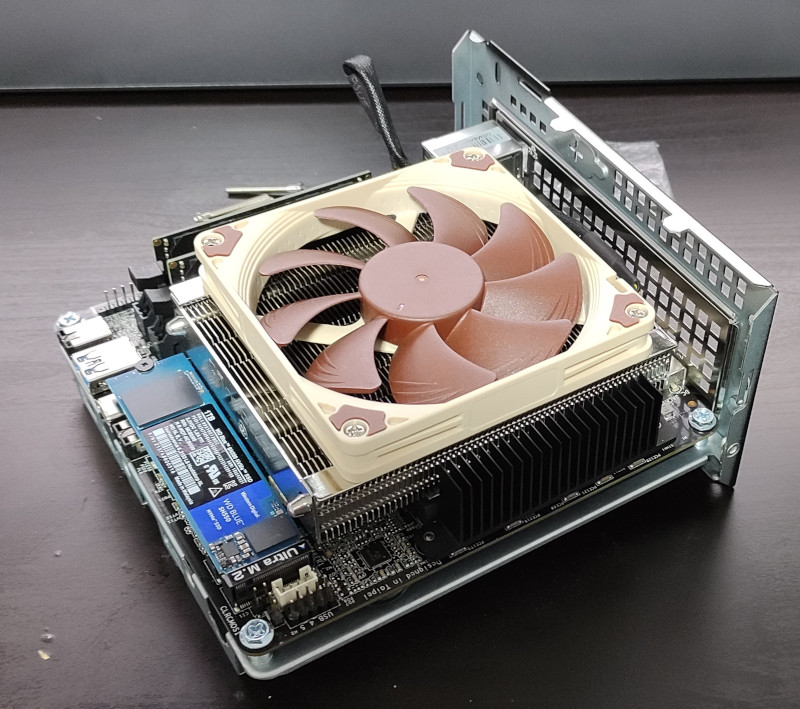
ASRock DeskMini X300 It s been over 20 months since the first COVID lockdown kicked in here in Northern Ireland and I started working from home. Even when the strict lockdown was lifted the advice here has continued to be If you can work from home you should work from home . I ve been into the office here and there (for new starts given you need to hand over a laptop and sort out some login details it s generally easier to do so in person, and I ve had a couple of whiteboard sessions that needed the high bandwidth face to face communication), but day to day is all from home. Early on I commented that work had taken over my study. This has largely continued to be true. I set my work laptop on the stand on a Monday morning and it sits there until Friday evening, when it gets switched for the personal laptop. I have a lovely LG 34UM88 21:9 Ultrawide monitor, and my laptops are small and light so I much prefer to use them docked. Also my general working pattern is to have a lot of external connections up and running (build machine, test devices, log host) which means a suspend/resume cycle disrupts things. So I like to minimise moving things about. I spent a little bit of time trying to find a dual laptop stand so I could have both machines setup and switch between them easily, but I didn t find anything that didn t seem to be geared up for DJs with a mixer + laptop combo taking up quite a bit of desk space rather than stacking laptops vertically. Eventually I realised that the right move was probably a desktop machine. Now, I haven t had a desktop machine since before I moved to the US, realising at the time that having everything on my laptop was much more convenient. I decided I didn t want something too big and noisy. Cheap GPUs seem hard to get hold of these days - I m not a gamer so all I need is something that can drive a ~ 4K monitor reliably enough. Looking around the AMD Ryzen 7 5700G seemed to be a decent CPU with one of the better integrated GPUs. I spent some time looking for a reasonable Mini-ITX case + motherboard and then I happened upon the ASRock DeskMini X300. This turns out to be perfect; I ve no need for a PCIe slot or anything more than an m.2 SSD. I paired it with a Noctua NH-L9a-AM4 heatsink + fan (same as I use in the house server), 32GB DDR4 and a 1TB WD SN550 NVMe SSD. Total cost just under 650 inc VAT + delivery (and that s a story for another post). A desktop solves the problem of fitting both machines on the desk at once, but there s still the question of smoothly switching between them. I read Evgeni Golov s article on a simple KVM switch for 30. My monitor has multiple inputs, so that s sorted. I did have a cheap USB2 switch (all I need for the keyboard/trackball) but it turned out to be pretty unreliable at the host detecting the USB change. I bought a UGREEN USB 3.0 Sharing Switch Box instead and it s turned out to be pretty reliable. The problem is that the LG 32UM88 turns out to have a poor DDC implementation, so while I can flip the keyboard easily with the UGREEN box I also have to manually select the monitor input. Which is a bit annoying, but not terrible. The important question is whether this has helped. I built all this at the end of October, so I ve had a month to play with it. Turns out I should have done it at some point last year. At the end of the day instead of either sitting at work for a bit longer, or completely avoiding the study, I m able to lock the work machine and flick to my personal setup. Even sitting in the same seat that disconnect , and the knowledge I won t see work Slack messages or emails come in and feeling I should respond, really helps. It also means I have access to my personal setup during the week without incurring a hit at the start of the working day when I have to set things up again. So it s much easier to just dip in to some personal tech stuff in the evening than it was previously. Also from the point of view I don t need to setup the personal config, I can pick up where I left off. All of which is really nice. It s also got me thinking about other minor improvements I should make to my home working environment to try and improve things. One obvious thing now the winter is here again is to improve my lighting; I have a good overhead LED panel but it s terribly positioned for video calls, being just behind me. So I think I m looking some sort of strip light I can have behind the large monitor to give a decent degree of backlight (possibly bouncing off the white wall). Lots of cheap options I m not convinced about, and I ve had a few ridiculously priced options from photographer friends; suggestions welcome.

Paul Tagliamonte: Processing IQ data formats (Part 1/5)

This post is part of a series called "PACKRAT". If this is the first post you've found, it'd be worth reading the intro post first and then looking over all posts in the series.
When working with SDRs, information about the signals your radio is receiving are communicated by streams of IQ data. IQ is short for In-phase and Quadrature , which means 90 degrees out of phase. Values in the IQ stream are complex numbers, so converting them to a native complex type in your language helps greatly when processing the IQ data for meaning. I won t get too deep into what IQ is or why complex numbers (mostly since I don t think I fully understand it well enough to explain it yet), but here s some basics in case this is your first interaction with IQ data before going off and reading more.
Before we get started at any point, if you feel lost in this post, it's OK to take a break to do a bit of learning elsewhere in the internet. I'm still new to this, so I'm sure my overview in one paragraph here won't help clarify things too much. This took me months to sort out on my own. It's not you, really! I particularly enjoyed reading visual-dsp.switchb.org when it came to learning about how IQ represents signals, and Software-Defined Radio for Engineers for a more general reference.
Each value in the stream is taken at a precisely spaced sampling interval (called the sampling rate of the radio). Jitter in that sampling interval, or a drift in the requested and actual sampling rate (usually represented in PPM, or parts per million how many samples out of one million are missing) can cause errors in frequency. In the case of a PPM error, one radio may think it s 100.1MHz and the other may think it s 100.2MHz, and jitter will result in added noise in the resulting stream. A single IQ sample is both the real and imaginary values, together. The complex number (both parts) is the sample. The number of samples per second is the number of real and imaginary value pairs per second. Each sample is reading the electrical energy coming off the antenna at that exact time instant. We re looking to see how that goes up and down over time to determine what frequencies we re observing around us. If the IQ stream is only real-valued measures (e.g., float values rather than complex values reading voltage from a wire), you can still send and receive signals, but those signals will be mirrored across your 0Hz boundary. That means if you re tuned to 100MHz, and you have a nearby transmitter at 99.9MHz, you d see it at 100.1MHz. If you want to get an intuitive understanding of this concept before getting into the heavy math, a good place to start is looking at how Quadrature encoders work. Using complex numbers means we can see up in frequency as well as down in frequency, and understand that those are different signals. The reason why we need negative frequencies is that our 0Hz is the center of our SDR s tuned frequency, not actually at 0Hz in nature. Generally speaking, it s doing loads in hardware (and firmware!) to mix the raw RF signals with a local oscillator to a frequency that can be sampled at the requested rate (fundamentally the same concept as a superheterodyne receiver), so a frequency of -10MHz means that signal is 10 MHz below the center of our SDR s tuned frequency. The sampling rate dictates the amount of frequency representable in the data stream. You ll sometimes see this called the Nyquist frequency. The Nyquist Frequency is one half of the sampling rate. Intuitively, if you think about the amount of bandwidth observable as being 1:1 with the sampling rate of the stream, and the middle of your bandwidth is 0 Hz, you would only have enough space to go up in frequency for half of your bandwidth or half of your sampling rate. Same for going down in frequency.

Float 32 / Complex 64 IQ samples that are being processed by software are commonly processed as an interleaved pair of 32 bit floating point numbers, or a 64 bit complex number. The first float32 is the real value, and the second is the imaginary value.
I#0
Q#0
I#1
Q#1
I#2
Q#2
The complex number 1+1i is represented as 1.0 1.0 and the complex number -1-1i is represented as -1.0 -1.0. Unless otherwise specified, all the IQ samples and pseudocode to follow assumes interleaved float32 IQ data streams. Example interleaved float32 file (10Hz Wave at 1024 Samples per Second)

RTL-SDR IQ samples from the RTL-SDR are encoded as a stream of interleaved unsigned 8 bit integers (uint8 or u8). The first sample is the real (in-phase or I) value, and the second is the imaginary (quadrature or Q) value. Together each pair of values makes up a complex number at a specific time instant.
I#0
Q#0
I#1
Q#1
I#2
Q#2
The complex number 1+1i is represented as 0xFF 0xFF and the complex number -1-1i is represented as 0x00 0x00. The complex number 0+0i is not easily representable since half of 0xFF is 127.5.
Complex Number Representation
1+1i []uint8 0xFF, 0xFF
-1+1i []uint8 0x00, 0xFF
-1-1i []uint8 0x00, 0x00
0+0i []uint8 0x80, 0x80 or []uint8 0x7F, 0x7F
And finally, here s some pseudocode to convert an rtl-sdr style IQ sample to a floating point complex number:
...
in = []uint8 0x7F, 0x7F 
real = (float(iq[0])-127.5)/127.5
imag = (float(iq[1])-127.5)/127.5
out = complex(real, imag)
....
Example interleaved uint8 file (10Hz Wave at 1024 Samples per Second)

HackRF IQ samples from the HackRF are encoded as a stream of interleaved signed 8 bit integers (int8 or i8). The first sample is the real (in-phase or I) value, and the second is the imaginary (quadrature or Q) value. Together each pair of values makes up a complex number at a specific time instant.
I#0
Q#0
I#1
Q#1
I#2
Q#2
Formats that use signed integers do have one quirk due to two s complement, which is that the smallest negative number representable s absolute value is one more than the largest positive number. int8 values can range between -128 to 127, which means there s bit of ambiguity in how +1, 0 and -1 are represented. Either you can create perfectly symmetric ranges of values between +1 and -1, but 0 is not representable, have more possible values in the negative range, or allow values above (or just below) the maximum in the range to be allowed. Within my implementation, my approach has been to scale based on the max integer value of the type, so the lowest possible signed value is actually slightly smaller than -1. Generally, if your code is seeing values that low the difference in step between -1 and slightly less than -1 isn t very significant, even with only 8 bits. Just a curiosity to be aware of.
Complex Number Representation
1+1i []int8 127, 127
-1+1i []int8 -128, 127
-1-1i []int8 -128, -128
0+0i []int8 0, 0
And finally, here s some pseudocode to convert a hackrf style IQ sample to a floating point complex number:
...
in = []int8 -5, 112 
real = (float(in[0]))/127
imag = (float(in[1]))/127
out = complex(real, imag)
....
Example interleaved int8 file (10Hz Wave at 1024 Samples per Second)

PlutoSDR IQ samples from the PlutoSDR are encoded as a stream of interleaved signed 16 bit integers (int16 or i16). The first sample is the real (in-phase or I) value, and the second is the imaginary (quadrature or Q) value. Together each pair of values makes up a complex number at a specific time instant. Almost no SDRs capture at a 16 bit depth natively, often you ll see 12 bit integers (as is the case with the PlutoSDR) being sent around as 16 bit integers. This leads to the next possible question, which is are values LSB or MSB aligned? The PlutoSDR sends data LSB aligned (which is to say, the largest real or imaginary value in the stream will not exceed 4095), but expects data being transmitted to be MSB aligned (which is to say the lowest set bit possible is the 5th bit in the number, or values can only be set in increments of 16). As a result, the quirk observed with the HackRF (that the range of values between 0 and -1 is different than the range of values between 0 and +1) does not impact us so long as we do not use the whole 16 bit range.
Complex Number Representation
1+1i []int16 32767, 32767
-1+1i []int16 -32768, 32767
-1-1i []int16 -32768, -32768
0+0i []int16 0, 0
And finally, here s some pseudocode to convert a PlutoSDR style IQ sample to a floating point complex number, including moving the sample from LSB to MSB aligned:
...
in = []int16 -15072, 496 
// shift left 4 bits (16 bits - 12 bits = 4 bits)
 // to move from LSB aligned to MSB aligned.
 in[0] = in[0] << 4
in[1] = in[1] << 4
real = (float(in[0]))/32767
imag = (float(in[1]))/32767
out = complex(real, imag)
....
Example interleaved i16 file (10Hz Wave at 1024 Samples per Second)

Next Steps Now that we can read (and write!) IQ data, we can get started first on the transmitter, which we can (in turn) use to test receiving our own BPSK signal, coming next in Part 2!

1 December 2021

Thorsten Alteholz: My Debian Activities in November 2021

FTP master This month I accepted 564 and rejected 93 packages. The overall number of packages that got accepted was 591. Debian LTS This was my eighty-ninth month that I did some work for the Debian LTS initiative, started by Raphael Hertzog at Freexian. This month my all in all workload has been 40h. During that time I did LTS and normal security uploads of: I also started to work on pgbouncer to get an update for each release and had to process packages from NEW on security-master. Further I worked on a script to automatically publish DLAs on the Debian website, that are posted to debian-lts-announce. The script can be found on salsa. It only publishes stuff from people on a whitelist. At the moment it is running on a computer at home. You might run your own copy, or just send me an email to be put on the whitelist as well. Last but not least I did some days of frontdesk duties. Debian ELTS This month was the forty-first ELTS month. During my allocated time I uploaded: Last but not least I did some days of frontdesk duties. Debian Printing Unfortunately I did not do as much as I wanted this month. At least I looked at some old bugs and uploaded new upstream versions of I hope this will improve in December again. New versions of cups and hplip are on my TODO-list. Debian Astro This month I uploaded new versions of Other stuff I improved packaging or fixed bugs of:

Utkarsh Gupta: FOSS Activites in December 2021

Here s my (twenty-sixth) monthly but brief update about the activities I ve done in the F/L/OSS world.

Debian
This was my 35th month of actively contributing to Debian. I became a DM in late March 2019 and a DD on Christmas 19! \o/ Just churning through the backlog again this month. Ugh. Anyway, I did the following stuff in Debian:

Uploads and bug fixes:
  • rails (2:6.1.4.1+dfsg-3) - No-change rebuild for unstable.

Other $things:
  • Mentoring for newcomers.
  • Moderation of -project mailing list.

Ubuntu
This was my 10th month of actively contributing to Ubuntu. Now that I ve joined Canonical to work on Ubuntu full-time, there s a bunch of things I do! \o/ I mostly worked on different things, I guess. I was too lazy to maintain a list of things I worked on so there s no concrete list atm. Maybe I ll get back to this section later or will start to list stuff from next year onward, as I was doing before. :D

Debian (E)LTS
Debian Long Term Support (LTS) is a project to extend the lifetime of all Debian stable releases to (at least) 5 years. Debian LTS is not handled by the Debian security team, but by a separate group of volunteers and companies interested in making it a success. And Debian Extended LTS (ELTS) is its sister project, extending support to the Jessie release (+2 years after LTS support). This was my twenty-sixth month as a Debian LTS and seventeenth month as a Debian ELTS paid contributor.
I was assigned 30.00 hours for LTS and 45.00 hours for ELTS and worked on the following things:

LTS CVE Fixes and Announcements:
  • Issued DLA 2813-1, fixing CVE-2021-33829 and CVE-2021-37695, for ckeditor.
    For Debian 9 stretch, these problems have been fixed in version 4.5.7+dfsg-2+deb9u1.
  • Issued DLA 2817-1, fixing CVE-2021-23214 and CVE-2021-23222, for postgresql-9.6.
    For Debian 9 stretch, these problems have been fixed in version 9.6.24-0+deb9u1.
  • Issued DLA 2836-1, fixing CVE-2021-43527, for nss.
    For Debian 9 stretch, these problems have been fixed in version 2:3.26.2-1.1+deb9u3.
  • Started working on src:samba for CVE-2020-25717 to CVE-2020-25722 and CVE-2021-23192 for jessie and stretch, both.
    The version difference b/w the suites are a bit too much for the patch(es) to be easily backported. I ve talked to Anton to work something out. \o/
  • Found the problem w/ libjdom1-java. Will have to roll the regression upload.
    I ve prepared the patch but needs some testing to be finally rolled out. Same for jessie.
  • Started working on libgit2.

ELTS CVE Fixes and Announcements:

Other (E)LTS Work:
  • Front-desk duty from 29-11 to 05-12 for both LTS and ELTS.
  • Triaged udisk2, wordpress, samba, gmp, nss, ntfs-3g, and openssh.
  • Auto EOL ed dwarfutils, radare2, mongodb, linux for jessie.
  • As FD, did a deep dive into the no-pu-update issue. Will write to list shortly.
  • Attended monthly Debian LTS meeting.
  • Answered questions (& discussions) on IRC (#debian-lts and #debian-elts).
  • General and other discussions on LTS private and public mailing list.

Debian LTS Survey I ve spent 3 hours on the LTS survey on the following bits:
  • Talking to Laura to revive the old a/c on survey.d.net.
  • Setting up stuff there.
  • Discussing the survey questions and other bits w/ Jeremiah.
  • Partly reviewing the questions of the survey.
  • Doing a walkthru of the LimeSurvey instance we have to make sure there are no changes .

Until next time.
:wq for today.

Russ Allbery: Review: A World Without Email

Review: A World Without Email, by Cal Newport
Publisher: Portfolio/Penguin
Copyright: 2021
ISBN: 0-525-53657-4
Format: Kindle
Pages: 264
A World Without Email is the latest book by computer science professor and productivity writer Cal Newport. After a detour to comment on the drawbacks of social media in Digital Minimalism, Newport is back to writing about focus and concentration in the vein of Deep Work. This time, though, the topic is workplace structure and collaborative process rather than personal decisions. This book is a bit hard for me to review because I spoiled myself for the contents by listening to a lot of Newport's podcast, where he covers the same material. I therefore didn't enjoy it as much as I otherwise would have because the ideas were familiar. I recommend the book over the podcast, though; it's tighter, more coherent, and more comprehensive. The core contention of this book is that knowledge work (roughly, jobs where one spends significant time working on a computer processing information) has stumbled into a superficially tempting but inefficient and psychologically harmful structure that Newport calls the hyperactive hive mind. This way of organizing work is a local maxima: it feels productive, it's flexible and very easy to deploy, and most minor changes away from it make overall productivity worse. However, the incentive structure is all wrong. It prioritizes quick responses and coordination overhead over deep thinking and difficult accomplishments. The characteristic property of the hyperactive hive mind is free-flowing, unstructured communication between co-workers. If you need something from someone else, you ask them for it and they send it to you. The "email" in the title is not intended literally; Slack and related instant messaging apps are even more deeply entrenched in the hyperactive hive mind than email is. The key property of this workflow is that most collaborative work is done by contacting other people directly via ad hoc, unstructured messages. Newport's argument is that this workflow has multiple serious problems, not the least of which is that it makes us miserable. If you have read his previous work, you will correctly expect this to tie into his concept of deep work. Ad hoc, unstructured communication creates a constant barrage of unimportant small tasks and interrupts, most of which require several asynchronous exchanges before your brain can stop tracking the task. This creates constant context-shifting, loss of focus and competence, and background stress from ever-growing email inboxes, unread message notifications, and the semi-frantic feeling that you're forgetting something you need to do. This is not an original observation, of course. Many authors have suggested individual ways to improve this workflow: rules about how often to check one's email, filtering approaches, task managers, and other personal systems. Newport's argument is that none of these individual approaches can address the problem due to social effects. It's all well and good to say that you should unplug from distractions and ignore requests while you concentrate, but everyone else's workflow assumes that their co-workers are responsive to ad hoc requests. Ignoring this social contract makes the job of everyone still stuck in the hyperactive hive mind harder. They won't appreciate that, and your brain will not be able to relax knowing that you're not meeting your colleagues' expectations. In Newport's analysis, the necessary solution is a comprehensive redesign of how we do knowledge work, akin to the redesign of factory work that came with the assembly line. It's a collective problem that requires a collective solution. In other industries, organizing work for efficiency and quality is central to the job of management, but in knowledge work (for good historical reasons) employees are mostly left to organize their work on their own. That self-organization has produced a system that doesn't require centralized coordination or decisions and provides a lot of superficial flexibility, but which may be significantly inferior to a system designed for how people think and work. Even if you find this convincing (and I think Newport makes a good case), there are reasons to be suspicious of corporations trying to make people more productive. The assembly line made manufacturing much more efficient, but it also increased the misery of workers so much that Henry Ford had to offer substantial raises to retain workers. As one of Newport's knowledge workers, I'm not enthused about that happening to my job. Newport recognizes this and tries to address it by drawing a distinction between the workflow (how information moves between workers) and the work itself (how individual workers solve problems in their area of expertise). He argues that companies need to redesign the former, but should leave the latter to each worker. It's a nice idea, and it will probably work in industries like tech with substantial labor bargaining power. I'm more cynical about other industries. The second half of the book is Newport's specific principles and recommendations for designing better workflows that don't rely on unstructured email. Some of this will be familiar (and underwhelming) to anyone who works in tech; Newport recommends ticket systems and thinks agile, scrum, and kanban are pointed in the right direction. But there are some other good ideas in here, such as embracing specialization. Newport argues (with some evidence) that the drastic reduction in secretarial jobs, on the grounds that workers with computers can do the same work themselves, was a mistake. Even with new automation, this approach increased the range of tasks required in every other job. Not only was this a drain on the time of other workers, it caused more context switching, which made everyone less efficient and undermined work quality. He argues for reversing that trend: where the work cannot be automated, hire more support workers and more specialized workers in general, stop expecting everyone to be their own generalist admin, and empower support workers to create better systems rather than using the hyperactive hive mind model to answer requests. There's more here, ranging from specifics of how to develop a structured process for a type of work to the importance of enabling sustained concentration on a task. It's a less immediately actionable book than Newport's previous writing, but I welcome the partial shift in focus to more systemic issues. Newport continues to be relentlessly apolitical, but here it feels less like he's eliding important analysis and more like he thinks the interests of workers and good employers are both served by the approach he's advocating. I will warn that Newport leans heavily on evolutionary psychology in his argument that the hyperactive hive mind is bad for us. I think he has some good arguments about the anxiety that comes with not responding to requests from others, but I'm not sure intrusive experiments on spectacularly-unusual remnant hunter-gatherer groups, who are treated like experimental animals, are the best way of making that case. I realize this isn't Newport's research, but I think he could have made his point with more directly relevant experiments. He also continues his obsession with the superiority of in-person conversation over written communication, and while he has a few good arguments, he has a tendency to turn them into sweeping generalizations that are directly contradicted by, well, my entire life. It would be nice if he were more willing to acknowledge that it's possible to express deep emotional nuance and complex social signaling in writing; it simply requires a level of practice and familiarity (and shared vocabulary) that's often missing from the workplace. I was muttering a lot near the start of this book, but thankfully those sections are short, and I think the rest of his argument sits on a stronger foundation. I hope Newport continues moving in the direction of more systemic analysis. If you enjoyed Deep Work, you will probably find A World Without Email interesting. If you're new to Newport, this is not a bad place to start, particularly if you have influence on how communication is organized in your workplace. Those who work in tech will find some bits of this less interesting, but Newport approaches the topic from a different angle than most agile books and covers a broader range if ideas. Recommended if you like reading this sort of thing. Rating: 7 out of 10

Paul Wise: FLOSS Activities November 2021

Focus This month I didn't have any particular focus. I just worked on issues in my info bubble.

Changes

Issues

Review

Administration
  • Debian BTS: unarchive/reopen/triage bugs for reintroduced packages
  • Debian wiki: unblock IP addresses, approve accounts

Communication
  • Respond to queries from Debian users and contributors on the mailing lists and IRC

Sponsors The SPTAG, visdom, gensim, purple-discord, plac, fail2ban, uvloop work was sponsored by my employer. All other work was done on a volunteer basis.

30 November 2021

Russell Coker: Links November 2021

The Guardian has an amusing article by Sophie Elmhirst about Libertarians buying a cruise ship to make a seasteading project off the coast of Panama [1]. It turns out that you need permits etc to do this and maintaining a ship is expensive. Also you wouldn t want to mine cryptocurrency in a ship cabin as most cabins are small and don t have enough airconditioning to remain pleasant if you dump 1kW or more into the air. NPR has an interesting article about the reaction of the NRA to the Columbine shootings [2]. Seems that some NRA person isn t a total asshole and is sharing their private information, maybe they are dying and are worried about going to hell. David Brin wrote an insightful blog post about the singleton hypothesis where he covers some of the evidence of autocratic societies failing [3]. I think he makes a convincing point about a single centralised government for human society not being viable. But something like the EU on a world wide scale could work well. Ken Shirriff wrote an interesting blog post about reverse engineering the Yamaha DX7 synthesiser [4]. The New York Times has an interesting article about a Baboon troop that became less aggressive after the alpha males all died at once from tuberculosis [5]. They established a new more peaceful culture that has outlived the beta males who avoided tuberculosis. The Guardian has an interesting article about how sequencing the genomes of the entire population can save healthcare costs while improving the health of the population [6]. This is somthing wealthy countries should offer for free to the world population. At a bit under $1000 per test that s only about $7 trillion to test everyone, and of course the price should drop significantly if there were billions of tests being done. The Strategy Bridge has an interesting article about SciFi books that have useful portrayals of military strategy [7]. The co-author is Major General Mick Ryan of the Australian Army which is noteworthy as Major General is the second highest rank in use by the Australian Army at this time. Vice has an interesting article about the co-evolution of penises and vaginas and how a lot of that evolution is based on avoiding impregnation from rape [8]. Cory Doctorow wrote an insightful Medium article about the way that governments could force interoperability through purchasing power [9]. Cory Doctorow wrote an insightful article for Locus Magazine about imagining life after capitalism and how capitalism might be replaced [10]. We need a Star Trek future! Arstechnica has an informative article about new developmenet in the rowhammer category of security attacks on DRAM [11]. It seems that DDR4 with ECC is the best current mitigation technique and that DDR3 with ECC is harder to attack than non-ECC RAM. So the thing to do is use ECC on all workstations and avoid doing security critical things on laptops because they can t juse ECC RAM.

Russell Coker: Your Device Has Been Improved

I ve just started a Samsung tablet downloading a 770MB update, the description says:
Technically I have no doubt that both those claims are true and accurate. But according to common understanding of the English language I think they are both misleading. By stability improved they mean fixed some bugs that made it unstable and no technical person would imagine that after a certain number of such updates the number of bugs will ever reach zero and the tablet will be perfectly reliable. In fact if you should consider yourself lucky if they fix more bugs than they add. It s not THAT uncommon for phones and tablets to be bricked (rendered unusable by software) by an update. In the past I got a Huawei Mate9 as a warranty replacement for a Nexus 6P because an update caused so many Nexus 6P phones to fail that they couldn t be replaced with an identical phone [1]. By security improved they usually mean fixed some security flaws that were recently discovered to make it almost as secure as it was designed to be . Note that I deliberately say almost as secure because it s sometimes impossible to fix a security flaw without making significant changes to interfaces which requires more work than desired for an old product and also gives a higher probability of things going wrong. So it s sometimes better to aim for almost as secure or alternatively just as secure but with some features disabled. Device manufacturers (and most companies in the Android space make the same claims while having the exact same bugs to deal with, Samsung is no different from the others in this regards) are not making devices more secure or more reliable than when they were initially released. They are aiming to make them almost as secure and reliable as when they were released. They don t have much incentive to try too hard in this regard, Samsung won t suffer if I decide my old tablet isn t reliable enough and buy a new one, which will almost certainly be from Samsung because they make nice tablets. As a thought experiment, consider if car repairers did the same thing. Getting us to service your car will improve fuel efficiency , great how much more efficient will it be than when I purchased it? As another thought experiment, consider if car companies stopped providing parts for car repair a few years after releasing a new model. This is effectively what phone and tablet manufacturers have been doing all along, software updates for stability and security are to devices what changing oil etc is for cars.

29 November 2021

Evgeni Golov: Getting access to somebody else's Ansible Galaxy namespace

TL;DR: adding features after the fact is hard, normalizing names is hard, it's patched, carry on. I promise, the longer version is more interesting and fun to read! Recently, I was poking around Ansible Galaxy and almost accidentally got access to someone else's namespace. I was actually looking for something completely different, but accidental finds are the best ones! If you're asking yourself: "what the heck is he talking about?!", let's slow down for a moment:
  • Ansible is a great automation engine built around the concept of modules that do things (mostly written in Python) and playbooks (mostly written in YAML) that tell which things to do
  • Ansible Galaxy is a place where people can share their playbooks and modules for others to reuse
  • Galaxy Namespaces are a way to allow users to distinguish who published what and reduce name clashes to a minimum
That means that if I ever want to share how to automate installing vim, I can publish evgeni.vim on Galaxy and other people can download that and use it. And if my evil twin wants their vim recipe published, it will end up being called evilme.vim. Thus while both recipes are called vim they can coexist, can be downloaded to the same machine, and used independently. How do you get a namespace? It's automatically created for you when you login for the first time. After that you can manage it, you can upload content, allow others to upload content and other things. You can also request additional namespaces, this is useful if you want one for an Organization or similar entities, which don't have a login for Galaxy. Apropos login, Galaxy uses GitHub for authentication, so you don't have to store yet another password, just smash that octocat! Did anyone actually click on those links above? If you did (you didn't, right?), you might have noticed another section in that document: Namespace Limitations. That says:
Namespace names in Galaxy are limited to lowercase word characters (i.e., a-z, 0-9) and _ , must have a minimum length of 2 characters, and cannot start with an _ . No other characters are allowed, including . , - , and space. The first time you log into Galaxy, the server will create a Namespace for you, if one does not already exist, by converting your username to lowercase, and replacing any - characters with _ .
For my login evgeni this is pretty boring, as the generated namespace is also evgeni. But for the GitHub user Evil-Pwnwil-666 it will become evil_pwnwil_666. This can be a bit confusing. Another confusing thing is that Galaxy supports two types of content: roles and collections, but namespaces are only for collections! So it is Evil-Pwnwil-666.vim if it's a role, but evil_pwnwil_666.vim if it's a collection. I think part of this split is because collections were added much later and have a much more well thought design of both the artifact itself and its delivery mechanisms. This is by the way very important for us! Due to the fact that collections (and namespaces!) were added later, there must be code that ensures that users who were created before also get a namespace. Galaxy does this (and I would have done it the same way) by hooking into the login process, and after the user is logged in it checks if a Namespace exists and if not it creates one and sets proper permissions. And this is also exactly where the issue was! The old code looked like this:
    # Create lowercase namespace if case insensitive search does not find match
    qs = models.Namespace.objects.filter(
        name__iexact=sanitized_username).order_by('name')
    if qs.exists():
        namespace = qs[0]
    else:
        namespace = models.Namespace.objects.create(**ns_defaults)
    namespace.owners.add(user)
See how namespace.owners.add is always called? Even if the namespace already existed? Yepp! But how can we exploit that? Any user either already has a namespace (and owns it) or doesn't have one that could be owned. And given users are tied to GitHub accounts, there is no way to confuse Galaxy here. Now, remember how I said one could request additional namespaces, for organizations and stuff? Those will have owners, but the namespace name might not correspond to an existing user! So all we need is to find an existing Galaxy namespace that is not a "default" namespace (aka a specially requested one) and get a GitHub account that (after the funny name conversion) matches the namespace name. Thankfully Galaxy has an API, so I could dump all existing namespaces and their owners. Next I filtered that list to have only namespaces where the owner list doesn't contain a username that would (after conversion) match the namespace name. I found a few. And for one of them (let's call it the_target), the corresponding GitHub username (the-target) was available! Jackpot! I've registered a new GitHub account with that name, logged in to Galaxy and had access to the previously found namespace. This felt like sufficient proof that my attack worked and I mailed my findings to the Ansible Security team. The issue was fixed in d4f84d3400f887a26a9032687a06dd263029bde3 by moving the namespace.owners.add call to the "new namespace" branch. And this concludes the story of how I accidentally got access to someone else's Galaxy namespace (which was revoked after the report, no worries).

Russ Allbery: Fall haul

It's been a while since I've posted one of these, and I also may have had a few moments of deciding to support authors by buying their books even if I'm not going to get a chance to read them soon. There's also a bit of work reading in here. Ryka Aoki Light from Uncommon Stars (sff)
Frederick R. Chromey To Measure the Sky (non-fiction)
Neil Gaiman, et al. Sandman: Overture (graphic novel)
Alix E. Harrow A Spindle Splintered (sff)
Jordan Ifueko Raybearer (sff)
Jordan Ifueko Redemptor (sff)
T. Kingfisher Paladin's Hope (sff)
TJ Klune Under the Whispering Door (sff)
Kiese Laymon How to Slowly Kill Yourself and Others in America (non-fiction)
Yuna Lee Fox You (romance)
Tim Mak Misfire (non-fiction)
Naomi Novik The Last Graduate (sff)
Shelley Parker-Chan She Who Became the Sun (sff)
Gareth L. Powell Embers of War (sff)
Justin Richer & Antonio Sanso OAuth 2 in Action (non-fiction)
Dean Spade Mutual Aid (non-fiction)
Lana Swartz New Money (non-fiction)
Adam Tooze Shutdown (non-fiction)
Bill Watterson The Essential Calvin and Hobbes (strip collection)
Bill Willingham, et al. Fables: Storybook Love (graphic novel)
David Wong Real-World Cryptography (non-fiction)
Neon Yang The Black Tides of Heaven (sff)
Neon Yang The Red Threads of Fortune (sff)
Neon Yang The Descent of Monsters (sff)
Neon Yang The Ascent to Godhood (sff)
Xiran Jay Zhao Iron Widow (sff)

28 November 2021

Russ Allbery: Review: Soul Music

Review: Soul Music, by Terry Pratchett
Series: Discworld #16
Publisher: Harper
Copyright: January 1995
Printing: November 2013
ISBN: 0-06-223741-1
Format: Mass market
Pages: 420
Soul Music is the sixteenth Discworld novel and something of a plot sequel to Reaper Man (although more of a sequel to the earlier Mort). I would not start reading the Discworld books here. Susan is a student in the Quirm College for Young Ladies with an uncanny habit of turning invisible. Well, not invisible exactly; rather, people tend to forget that she's there, even when they're in the middle of talking to her. It's disconcerting for the teachers, but convenient when one is uninterested in Literature and would rather read a book.
She listened with half an ear to what the rest of the class was doing. It was a poem about daffodils. Apparently the poet had liked them very much. Susan was quite stoic about this. It was a free country. People could like daffodils if they wanted to. They just should not, in Susan's very definite opinion, be allowed to take up more than a page to say so. She got on with her education. In her opinion, school kept on trying to interfere with it. Around her, the poet's vision was being taken apart with inexpert tools.
Susan's determinedly practical education is interrupted by the Death of Rats, with the help of a talking raven and Binky the horse, and without a lot of help from Susan, who is decidedly uninterested in being the sort of girl who goes on adventures. Adventures have a different opinion, since Susan's grandfather is Death. And Death has wandered off again. Meanwhile, the bard Imp y Celyn, after an enormous row with his father, has gone to Ankh-Morpork. This is not going well; among other things, the Guild of Musicians and their monopoly and membership dues came as a surprise. But he does meet a dwarf and a troll in the waiting room of the Guild, and then buys an unusual music instrument in the sort of mysterious shop that everyone knows has been in that location forever, but which no one has seen before. I'm not sure there is such a thing as a bad Discworld novel, but there is such a thing as an average Discworld novel. At least for me, Soul Music is one of those. There are some humorous bits, a few good jokes, one great character, and some nice bits of philosophy, but I found the plot forgettable and occasionally annoying. Susan is great. Imp is... not, which is made worse by the fact the reader is eventually expected to believe Susan cares enough about Imp to drive the plot. Discworld has always been a mix of parody and Pratchett's own original creation, and I have always liked the original creation substantially more than the parody. Soul Music is a parody of rock music, complete with Cut-Me-Own-Throat Dibbler as an unethical music promoter. The troll Imp meets makes music by beating rocks together, so they decide to call their genre "music with rocks in it." The magical instrument Imp buys has twelve strings and a solid body. Imp y Celyn means "bud of the holly." You know, like Buddy Holly. Get it? Pratchett's reference density is often on the edge of overwhelming the book, but for some reason the parody references in this one felt unusually forced and obvious to me. I did laugh occasionally, but by the end of the story the rock music plot had worn out its welcome. This is not helped by the ending being a mostly incoherent muddle of another parody (admittedly featuring an excellent motorcycle scene). Unlike Moving Pictures, which is a similar parody of Hollywood, Pratchett didn't seem to have much insightful to say about music. Maybe this will be more your thing if you like constant Blues Brothers references. Susan, on the other hand, is wonderful, and for me is the reason to read this book. She is a delightfully atypical protagonist, and her interactions with the teachers and other students at the girl's school are thoroughly enjoyable. I would have happily read a whole book about her, and more broadly about Death and his family and new-found curiosity about the world. The Death of Rats was also fun, although more so in combination with the raven to translate. I wish this part of her story had a more coherent ending, but I'm looking forward to seeing her in future books. Despite my complaints, the parody part of this book wasn't bad. It just wasn't as good as the rest of the book. I wanted a better platform for Susan's introduction than a lot of music and band references. If you really like Pratchett's parodies, your mileage may vary. For me, this book was fun but forgettable. Followed, in publication order, by Interesting Times. The next Death book is Hogfather. Rating: 7 out of 10

27 November 2021

Russ Allbery: Review: A Psalm for the Wild-Built

Review: A Psalm for the Wild-Built, by Becky Chambers
Series: Monk & Robot #1
Publisher: Tordotcom
Copyright: July 2021
ISBN: 1-250-23622-3
Format: Kindle
Pages: 160
At the start of the story, Sibling Dex is a monk in a monastery in Panga's only City. They have spent their entire life there, love the buildings, know the hidden corners of the parks, and find the architecture beautiful. They're also heartily sick of it and desperate for the sound of crickets.
Sometimes, a person reaches a point in their life when it becomes absolutely essential to get the fuck out of the city.
Sibling Dex therefore decides to upend their life and travel the outlying villages doing tea service. And they do. They commission an ox-bike wagon, throw themselves into learning cultivation and herbs, experiment with different teas, and practice. It's a lot to learn, and they don't get it right from the start, but Sibling Dex is the sort of person who puts in the work to do something well. Before long, they have a new life as a traveling tea monk. It's better than living in the City. But it still isn't enough. We don't find out much about the moon of Panga in this story. Humans live there and it has a human-friendly biosphere with recognizable species, but it is clearly not Earth. The story does not reveal how humans came to live there. Dex's civilization is quite advanced and appears to be at least partly post-scarcity: people work and have professions, but money is rarely mentioned, poverty doesn't appear to be a problem, and Dex, despite being a monk with no obvious source of income, is able to commission the construction of a wagon home without any difficulty. They follow a religion that has no obvious Earth analogue. The most fascinating thing about Panga is an event in its history. It previously had an economy based on robot factories, but the robots became sentient. Since this is a Becky Chambers story, the humans reaction was to ask the robots what they wanted to do and respect their decision. The robots, not very happy about having their whole existence limited to human design, decided to leave, walking off into the wild. Humans respected their agreement, rebuilt their infrastructure without using robots or artificial intelligence, and left the robots alone. Nothing has been heard from them in centuries. As you might expect, Sibling Dex meets a robot. Its name is Mosscap, and it was selected to check in with humans. Their attempts to understand each other is much of the story. The rest is Dex's attempt to find what still seems to be missing from life, starting with an attempt to reach a ruined monastery out in the wild. As with Chambers's other books, A Psalm for the Wild-Built contains a lot of earnest and well-meaning people having thoughtful conversations. Unlike her other books, there is almost no plot apart from those conversations of self-discovery and a profile of Sibling Dex as a character. That plus the earnestness of two naturally introspective characters who want to put their thoughts into words gave this story an oddly didactic tone for me. There are moments that felt like the moral of a Saturday morning cartoon show (I am probably dating myself), although the morals are more sophisticated and conditional. Saying I disliked the tone would be going too far, but it didn't flow as well for me as Chambers's other novels. I liked the handling of religion, and I loved Sibling Dex's efforts to describe or act on an almost impossible to describe sense that their life isn't quite what they want. There are some lovely bits of description, including the abandoned monastery. The role of a tea monk in this imagined society is a neat, if small, bit of world-building: a bit like a counselor and a bit like a priest, but not truly like either because of the different focus on acceptance, listening, and a hot cup of tea. And Dex's interaction with Mosscap over offering and accepting food is a beautiful bit of characterization. That said, the story as a whole didn't entirely gel for me, partly because of the didactic tone and partly because I didn't find Mosscap or the described culture of the robots as interesting as I was hoping that I would. But I'm still invested enough that I would read the sequel. A Psalm for the Wild-Built feels like a prelude or character introduction more than a complete story. When we leave the characters, they're just getting started. You know more about the robots (and Sibling Dex) at the end than you did at the beginning, but don't expect much in the way of resolution. Followed by A Prayer for the Crown-Shy, scheduled for 2022. Rating: 7 out of 10

23 November 2021

Enrico Zini: Really lossy compression of JPEG

Suppose you have a tool that archives images, or scientific data, and it has a test suite. It would be good to collect sample files for the test suite, but they are often so big one can't really bloat the repository with them. But does the test suite need everything that is in those files? Not necesarily. For example, if one's testing code that reads EXIF metadata, one doesn't care about what is in the image. That technique works extemely well. I can take GRIB files that are several megabytes in size, zero out their data payload, and get nice 1Kb samples for the test suite. I've started to collect and organise the little hacks I use for this into a tool I called mktestsample:
$ mktestsample -v samples1/*
2021-11-23 20:16:32 INFO common samples1/cosmo_2d+0.grib: size went from 335168b to 120b
2021-11-23 20:16:32 INFO common samples1/grib2_ifs.arkimet: size went from 4993448b to 39393b
2021-11-23 20:16:32 INFO common samples1/polenta.jpg: size went from 3191475b to 94517b
2021-11-23 20:16:32 INFO common samples1/test-ifs.grib: size went from 1986469b to 4860b
Those are massive savings, but I'm not satisfied about those almost 94Kb of JPEG:
$ ls -la samples1/polenta.jpg
-rw-r--r-- 1 enrico enrico 94517 Nov 23 20:16 samples1/polenta.jpg
$ gzip samples1/polenta.jpg
$ ls -la samples1/polenta.jpg.gz
-rw-r--r-- 1 enrico enrico 745 Nov 23 20:16 samples1/polenta.jpg.gz
I believe I did all I could: completely blank out image data, set quality to zero, maximize subsampling, and tweak quantization to throw everything away. Still, the result is a 94Kb file that can be gzipped down to 745 bytes. Is there something I'm missing? I suppose JPEG is better at storing an image than at storing the lack of an image. I cannot really complain :) I can still commit compressed samples of large images to a git repository, taking very little data indeed. That's really nice!

22 November 2021

Ricardo Mones: Claws Mail 4 in experimental

A full month has passed since Claws Mail 4.0.0 was uploaded to Debian experimental, and, somewhat surprisingly, I've received no bug report about it. This of course can be either because nobody has been brave enough to install it or because well, it works really nice. For those who don't know what I'm talking about, just note that this version is the first Debian upload for the GTK+3 version of Claws Mail. There was an initial upstream release, namely 3.99, but it was less polished and also I was very busy, so I decided not to upload it. Since then I've been using git's 'gtk3' branch daily without problems, so, for me, it's as stable as its GTK+2 counterpart. There's still some rough edges, of course. Note also that, if everything goes well, Claws Mail 4.x will be the version to be shipped with Debian 12 (bookworm).

Paul Tagliamonte: Be careful when using vxlan!

I ve spent a bit of time playing with vxlan - which is very neat, but also incredibly insecure by default.When using vxlan, be very careful to understand how the host is connected to the internet. The kernel will listen on all interfaces for packets, which means hosts accessable to VMs it s hosting (e.g., by bridged interface or a private LAN will accept packets from VMs and inject them into arbitrary VLANs, even ones it s not on.I reported this to the kernel mailing list to no reply with more technical details.The tl;dr is:
  $ ip link add vevx0a type veth peer name vevx0z
  $ ip addr add 169.254.0.2/31 dev vevx0a
  $ ip addr add 169.254.0.3/31 dev vevx0z
  $ ip link add vxlan0 type vxlan id 42 \
    local 169.254.0.2 dev vevx0a dstport 4789
  $ # Note the above 'dev' and 'local' ip are set here
  $ ip addr add 10.10.10.1/24 dev vxlan0
results in vxlan0 listening on all interfaces, not just vevx0z or vevx0a. To prove it to myself, I spun up a docker container (using a completely different network bridge with no connection to any of the interfaces above), and ran a Go program to send VXLAN UDP packets to my bridge host:
$ docker run -it --rm -v $(pwd):/mnt debian:unstable /mnt/spam 172.17.0.1:4789
$
which results in packets getting injected into my vxlan interface
$ sudo tcpdump -e -i vxlan0
tcpdump: verbose output suppressed, use -v[v]... for full protocol decode
listening on vxlan0, link-type EN10MB (Ethernet), snapshot length 262144 bytes
21:30:15.746754 de:ad:be:ef:00:01 (oui Unknown) > Broadcast, ethertype IPv4 (0x0800), length 64: truncated-ip - 27706 bytes missing! 33.0.0.0 > localhost: ip-proto-114
21:30:15.746773 de:ad:be:ef:00:01 (oui Unknown) > Broadcast, ethertype IPv4 (0x0800), length 64: truncated-ip - 27706 bytes missing! 33.0.0.0 > localhost: ip-proto-114
21:30:15.746787 de:ad:be:ef:00:01 (oui Unknown) > Broadcast, ethertype IPv4 (0x0800), length 64: truncated-ip - 27706 bytes missing! 33.0.0.0 > localhost: ip-proto-114
21:30:15.746801 de:ad:be:ef:00:01 (oui Unknown) > Broadcast, ethertype IPv4 (0x0800), length 64: truncated-ip - 27706 bytes missing! 33.0.0.0 > localhost: ip-proto-114
21:30:15.746815 de:ad:be:ef:00:01 (oui Unknown) > Broadcast, ethertype IPv4 (0x0800), length 64: truncated-ip - 27706 bytes missing! 33.0.0.0 > localhost: ip-proto-114
21:30:15.746827 de:ad:be:ef:00:01 (oui Unknown) > Broadcast, ethertype IPv4 (0x0800), length 64: truncated-ip - 27706 bytes missing! 33.0.0.0 > localhost: ip-proto-114
21:30:15.746870 de:ad:be:ef:00:01 (oui Unknown) > Broadcast, ethertype IPv4 (0x0800), length 64: truncated-ip - 27706 bytes missing! 33.0.0.0 > localhost: ip-proto-114
21:30:15.746885 de:ad:be:ef:00:01 (oui Unknown) > Broadcast, ethertype IPv4 (0x0800), length 64: truncated-ip - 27706 bytes missing! 33.0.0.0 > localhost: ip-proto-114
21:30:15.746899 de:ad:be:ef:00:01 (oui Unknown) > Broadcast, ethertype IPv4 (0x0800), length 64: truncated-ip - 27706 bytes missing! 33.0.0.0 > localhost: ip-proto-114
21:30:15.746913 de:ad:be:ef:00:01 (oui Unknown) > Broadcast, ethertype IPv4 (0x0800), length 64: truncated-ip - 27706 bytes missing! 33.0.0.0 > localhost: ip-proto-114
10 packets captured
10 packets received by filter
0 packets dropped by kernel
(the program in question is the following:)
  package main
  import (
      "net"
      "os"
      "github.com/mdlayher/ethernet"
      "github.com/mdlayher/vxlan"
  )
  func main()  
      conn, err := net.Dial("udp", os.Args[1])
      if err != nil   panic(err)  
      for i := 0; i < 10; i++  
          vxf := &vxlan.Frame 
              VNI: vxlan.VNI(42),
              Ethernet: &ethernet.Frame 
                  Source:      net.HardwareAddr 0xDE, 0xAD, 0xBE,
0xEF, 0x00, 0x01 ,
                  Destination: net.HardwareAddr 0xFF, 0xFF, 0xFF,
0xFF, 0xFF, 0xFF ,
                  EtherType:   ethernet.EtherTypeIPv4,
                  Payload:     []byte("Hello, World!"),
              ,
          
          frb, err := vxf.MarshalBinary()
          if err != nil   panic(err)  
          _, err = conn.Write(frb)
          if err != nil   panic(err)  
      
  
When using vxlan, be absolutely sure all hosts that can address any interface on the host are authorized to send arbitrary packets into any VLAN that box can send to, or there s very careful and specific controls and firewalling. Note this includes public interfaces (e.g., dual-homed private network / internet boxes), or any type of dual-homing (VPNs, etc).

21 November 2021

Julian Andres Klode: APT Z3 Solver Basics

Z3 is a theorem prover developed at Microsoft research and available as a dynamically linked C++ library in Debian-based distributions. While the library is a whopping 16 MB, and the solver is a tad slow, it s permissive licensing, and number of tactics offered give it a huge potential for use in solving dependencies in a wide variety of applications. Z3 does not need normalized formulas, but offers higher level abstractions like atmost and atleast and implies, that we will make use of together with boolean variables to translate the dependency problem to a form Z3 understands. In this post, we ll see how we can apply Z3 to the dependency resolution in APT. We ll only discuss the basics here, a future post will explore optimization criteria and recommends.

Translating the universe APT s package universe consists of 3 relevant things: packages (the tuple of name and architecture), versions (basically a .deb), and dependencies between versions. While we could translate our entire universe to Z3 problems, we instead will construct a root set from packages that were manually installed and versions marked for installation, and then build the transitive root set from it by translating all versions reachable from the root set. For each package P in the transitive root set, we create a boolean literal P. We then translate each version P1, P2, and so on. Translating a version means building a boolean literal for it, e.g. P1, and then translating the dependencies as shown below. We now need to create two more clauses to satisfy the basic requirements for debs:
  1. If a version is installed, the package is installed; and vice versa. We can encode this requirement for P above as P == atleast( P1,P2 , 1).
  2. There can only be one version installed. We add an additional constraint of the form atmost( P1,P2 , 1).
We also encode the requirements of the operation.
  1. For each package P that is manually installed, add a constraint P.
  2. For each version V that is marked for install, add a constraint V.
  3. For each package P that is marked for removal, add a constraint !P.

Dependencies Packages in APT have dependencies of two basic forms: Depends and Conflicts, as well as variations like Breaks (identical to Conflicts in solving terms), and Recommends (soft Depends) - we ll ignore those for now. We ll discuss Conflicts in the next section. Let s take a basic dependency list: A Depends: X Y, Z. To represent that dependency, we expand each name to a list of versions that can satisfy the dependency, for example X1 X2 Y1, Z1. Translating this dependency list to our Z3 solver, we create boolean variables X1,X2,Y1,Z1 and define two rules:
  1. A implies atleast( X1,X2,Y1 , 1)
  2. A implies atleast( Z1 , 1)
If there actually was nothing that satisfied the Z requirement, we d have added a rule not A. It would be possible to simply not tell Z3 about the version at all as an optimization, but that adds more complexity, and the not A constraint should not cause too many problems.

Conflicts Conflicts cannot have or in them. A dependency B Conflicts: X, Y means that only one of B, X, and Y can be installed. We can directly encode this in Z3 by using the constraint atmost( B,X,Y , 1). This is an optimized encoding of the constraint: We could have encoded each conflict in the form !B or !X, !B or !X, and so on. Usually this leads to worse performance as it introduces additional clauses.

Complete example Let s assume we start with an empty install and want to install the package a below.
Package: a
Version: 1
Depends: c   b
Package: b
Version: 1
Package: b
Version: 2
Conflicts: x
Package: d
Version: 1
Package: x
Version: 1
The translation in Z3 rules looks like this:
  1. Package rules for a:
    1. a == atleast( a1 , 1) - package is installed iff one version is
    2. atmost( a1 , 1) - only one version may be installed
    3. a a must be installed
  2. Dependency rules for a
    1. implies(a1, atleast( b2, b1 , 1)) the translated dependency above. note that c is gone, it s not reachable.
  3. Package rules for b:
    1. b == atleast( b1,b2 , 1) - package is installed iff one version is
    2. atmost( b1, b2 , 1) - only one version may be installed
  4. Dependencies for b (= 2):
    1. atmost( b2, x1 , 1) - the conflicts between x and b = 2 above
  5. Package rules for x:
    1. x == atleast( x1 , 1) - package is installed iff one version is
    2. atmost( x1 , 1) - only one version may be installed
The package d is not translated, as it is not reachable from the root set a1 , the transitive root set is a1,b1,b2,x1 .

Next iteration: Optimization We have now constructed the basic set of rules that allows us to solve solve our dependency problems (equivalent to SAT), however it might lead to suboptimal solutions where it removes automatically installed packages, or installs more packages than necessary, to name a few examples. In our next iteration, we have to look at introducing optimization; for example, have the minimum number of removals, the minimal number of changed packages, or satisfy as many recommends as possible. We will also look at the upgrade problem (upgrade as many packages as possible), the autoremove problem (remove as many automatically installed packages as possible).

Next.

Previous.