Search Results: "pm"

27 November 2014

Keith Packard: Black Friday 2014

Altus Metrum's 2014 Black Friday Event BLACK FOREST, Colorado USA Altus Metrum announces two special offers for "Black Friday" 2014. We are pleased to announce that both TeleMetrum and TeleMega will be back in stock and available for shipment before the end of November. To celebrate this, any purchase of a TeleMetrum, TeleMega, or EasyMega board will include, free of charge, one each of our 160, 400, and 850 mAh Polymer Lithium Ion batteries and a free micro USB cable! To celebrate NAR's addition of our 1.9 gram recording altimeter, MicroPeak, to the list of devices approved for use in contests and records, and help everyone get ready for NARAM 2015's altitude events, purchase 4 MicroPeak boards and we'll throw in a MicroPeak USB adapter for free! These deals will be available from 00:00 Friday, 28 November 2014 through 23:59 Monday, 1 December, 2014. Only direct sales through our web store at http://shop.gag.com are included; no other discounts apply. Find more information on all Altus Metrum products at http://altusmetrum.org. Thank you for your continued support of Altus Metrum in 2014. We continue to work on more cool new products, and look forward to meeting many of you on various flight lines in 2015!

Pau Garcia i Quiles: Reminder: Desktops DevRoom @ FOSDEM 2015

We are less than 10 days away from the deadline for the Desktops DevRoom at FOSDEM 2015, the largest Free and Open Source event in Europe. Do you think you can fill a room with 200+ people out of 6,000+ geeks? Prove it! Check the Call for Talks for details on how to submit your talk proposal about anything related to the desktop: http://www.elpauer.org/2014/10/fosdem-2015-desktops-devroom-call-for-talks/

25 November 2014

Dirk Eddelbuettel: YATORP -- Yet Another Tutorial on R Packaging

What the world needs right now is yet another tutorial on R packages and their creation. Luckily, this last Friday and Saturday, I had the opportunity to present in a workshop organized by Frank DiTraglia at Penn's shiny new Warren Center, and held at Wharton. Given the Warren Center's focus, the workshop centered around Big Data and Open Science with R. Yihui Xie and myself alternated on delivering four units on an Introduction to R, Writing R packages, Dynamic Documents with R, and HPC with Rcpp and RcppArmadillo. So I had to come up with a plan for teaching creating R packages -- and decided to do it from the very bottom up, clearly introducing the underlying R CMD ... commands and only then switching to taking advantage of an environment such as the RStudio IDE. The resulting slides are now available on my presentations page. The code examples are in a repo subdirectory on GitHub as well. While both were designed to support the parallel live instruction offered in the workshop, I would be interested in feedback (preferably via email) about how useful the slides are by themselves.

This post by Dirk Eddelbuettel originated on his Thinking inside the box blog. Please report excessive re-aggregation in third-party for-profit settings.

24 November 2014

John Goerzen: My boys love 1986 computing

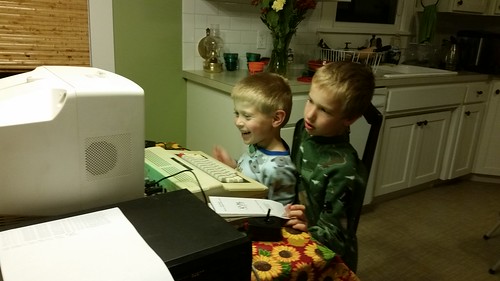
Yesterday, Jacob (age 8) asked to help me put together a 30-year-old computer from parts in my basement. Meanwhile, Oliver (age 5) asked Laura to help him learn cursive. Somehow, this doesn t seem odd for a Saturday at our place. 2014-11-22 18.58.36 Let me tell you how this came about. I ve had a project going on for a while now to load data from old floppies. It s been fun, and had a surprise twist the other day: my parents gave me an old TRS-80 Color Computer II (aka CoCo 2 ). It was, in fact, my first computer, one they got for me when I was in Kindergarten. It is nearly 30 years old. I have been musing lately about the great disservice Apple did the world by making computers easy to learn namely the fact that few people ever bother to learn about them. Who bothers to learn about them when, on the iPhone for instance, the case is sealed shut, the lifespan is 1 or 2 years for many purchasers, and the platform is closed in lots of ways? I had forgotten how finicky computers used to be. But after some days struggling with IDE incompatibilities, booting issues, etc., when I actually managed to get data off a machine that had last booted in 1999, I had quite the sense of accomplishment, which I rarely have lately. I did something that was hard to do in a world where most of the interfaces don t work with equipment that old (even if nominally they are supposed to.) The CoCo is one of those computers normally used with a floppy drive or cassette recorder to store programs. You type DIR, and you feel the clack of the drive heads through the desk. You type CLOAD and you hear the relay click closed to turn on the tape motor. You wiggle cables around until they make contact just right. You power-cycle for the times when the reset button doesn t quite do the job. The details of how it works aren t abstracted away by innumerable layers of controllers, interfaces, operating system modules, etc. It s all right there, literally vibrating your desk. So I thought this could be a great opportunity for Jacob to learn a few more computing concepts, such as the difference between mass storage and RAM, plus a great way to encourage him to practice critical thinking. So we trekked down to the basement and came up with handfulls of parts. We brought up the computer, some joysticks, all sorts of tangled cables. We needed adapters, an old TV. Jacob helped me hook everything up, and then the moment of truth: success! A green BASIC screen! I added more parts, but struck out when I tried to connect the floppy drive. The thing just wouldn t start up right whenever the floppy controller cartridge was installed. I cleaned the cartridge. I took it apart, scrubbed the contacts, even did a re-seat of the chips. No dice. So I fired up my CoCo emulator (xroar), and virtually saved some programs to cassette (a .wav file). I then burned those .wav files to an audio CD, brought up an old CD player from the basement, connected the cassette in plug to the CD player s headphone jack, and presto instant programs. (Well, almost. It takes a couple of minutes to load a program from audio codes.) The picture above is Oliver cackling at one of the very simplest BASIC programs there is: number find. The computer picks a random number between 1 and 2000, and asks the user to guess it, giving a too low or too high clue with each incorrect guess. Oliver delighted in giving invalid input (way too high numbers, or things that weren t numbers at all) and cackled at the sarcastic error messages built into the program. During Jacob s turn, he got very serious about it, and is probably going to be learning about how to calculate halfway points before too long. But imagine my pride when this morning, Jacob found the new CD I had made last night (correcting a couple recordings), found my one-line instruction on just part of how to load a program, and correctly figured out by himself all the steps to do in order (type CLOAD on the CoCo, advance the CD to the proper track, press play on the player, wait for it to load on the CoCo, then type RUN). I ordered a replacement floppy controller off eBay tonight, and paid $5 for a coax adapter that should fix some video quality issues. I rescued some 5.25 floppies from my trash can from another project, so they should have plenty of tools for exploration. It is so much easier for them to learn how a disk drive works, and even what the heck a track is, when you can look at a floppy drive with the cover off and see the heads move. There are other things we can do with more modern equipment Jacob has shown a lot of interest in Arduino projects but I have so far drawn a blank on ways to really let kids discover how a modern PC (let alone a modern phone or tablet) works. Update Nov. 24: Every so often, the world surprises me by deciding to, well, read one of my random blog posts. For the benefit of those of you that don t already know my boys, you might want to know that among their common play activites are turning trees into pretend trains, typing at a manual typewriter, reading, writing their own books, using a cassette recorder, building a PC and learning to use bash or xmonad, making long paper tapes with an adding machine, playing records on a record player, building electric gizmos, and even making mud balls. I am often asked about the role of the computer in the lives, given that my hobby and profession involves computers. The answer: less than that of most of their peers. I look for opportunities for them to learn by doing, discovering, playing, or imagining. I make no presumption that they will develop the passion for computers that I did. What I want is for them to have the curiosity and drive to learn everything there is to know about whatever they do develop a passion for, so they will be great at it.

21 November 2014

Daniel Pocock: PostBooks 4.7 packages available, xTupleCon 2014 award

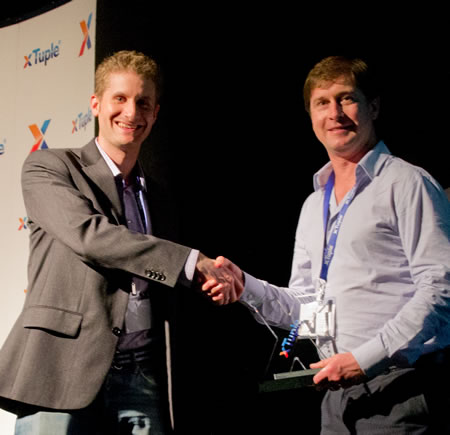
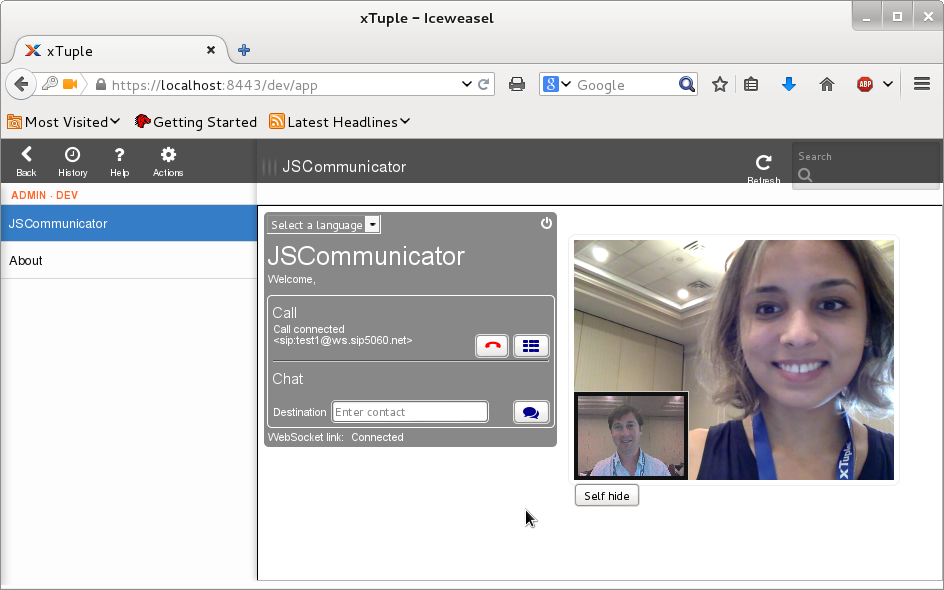
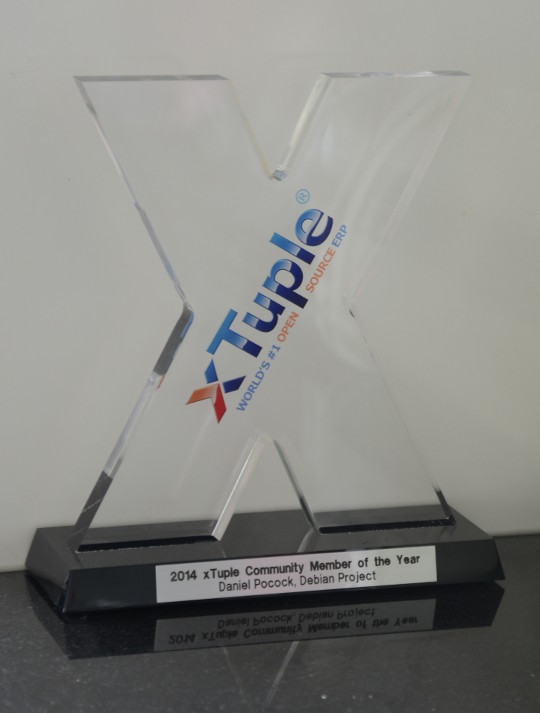
I recently updated the PostBooks packages in Debian and Ubuntu to version 4.7. This is the version that was released in Ubuntu 14.10 (Utopic Unicorn) and is part of the upcoming Debian 8 (jessie) release. Better prospects for Fedora and RHEL/CentOS/EPEL packages As well as getting the packages ready, I've been in contact with xTuple helping them generalize their build system to make packaging easier. This has eliminated the need to patch the makefiles during the build. As well as making it easier to support the Debian/Ubuntu packages, this should make it far easier for somebody to create a spec file for RPM packaging too. Debian wins a prize While visiting xTupleCon 2014 in Norfolk, I was delighted to receive the Community Member of the Year award which I happily accepted not just for my own efforts but for the Debian Project as a whole. Steve Hackbarth, Director of Product Development at xTuple, myself and the impressive Community Member of the Year trophy This is a great example of the productive relationships that exist between Debian, upstream developers and the wider free software community and it is great to be part of a team that can synthesize the work from so many other developers into ready-to-run solutions on a 100% free software platform. Receiving this award really made me think about all the effort that has gone into making it possible to apt-get install postbooks and all the people who have collectively done far more work than myself to make this possible: Here is a screenshot of the xTuple web / JSCommunicator integration, it was one of the highlights of xTupleCon: and gives a preview of the wide range of commercial opportunities that WebRTC is creating for software vendors to displace traditional telecommunications providers. xTupleCon also gave me a great opportunity to see new features (like the xTuple / Drupal web shop integration) and hear about the success of consultants and their clients deploying xTuple/PostBooks in various scenarios. The product is extremely strong in meeting the needs of manufacturing and distribution and has gained a lot of traction in these industries in the US. Many of these features are equally applicable in other markets with a strong manufacturing industry such as Germany or the UK. However, it is also flexible enough to simply disable many of the specialized features and use it as a general purpose accounting solution for consulting and services businesses. This makes it a good option for many IT freelancers and support providers looking for a way to keep their business accounts in a genuinely open source solution with a strong SQL backend and a native Linux desktop interface.

Julien Danjou: Distributed group management and locking in Python with tooz

With OpenStack embracing the Tooz library more and more over the past year, I think it's a good start to write a bit about it. A bit of history A little more than year ago, with my colleague Yassine Lamgarchal and others at eNovance, we investigated on how to solve a problem often encountered inside OpenStack: synchronization of multiple distributed workers. And while many people in our ecosystem continue to drive development by adding new bells and whistles, we made a point of solving new problems with a generic solution able to address the technical debt at the same time. Yassine wrote the first ideas of what should be the group membership service that was needed for OpenStack, identifying several projects that could make use of this. I've presented this concept during the OpenStack Summit in Hong-Kong during an Oslo session. It turned out that the idea was well-received, and the week following the summit we started the tooz project on StackForge. Goals Tooz is a Python library that provides a coordination API. Its primary goal is to handle groups and membership of these groups in distributed systems. Tooz also provides another useful feature which is distributed locking. This allows distributed nodes to acquire and release locks in order to synchronize themselves (for example to access a shared resource). The architecture If you are familiar with distributed systems, you might be thinking that there are a lot of solutions already available to solve these issues: ZooKeeper, the Raft consensus algorithm or even Redis for example. You'll be thrilled to learn that Tooz is not the result of the NIH syndrome, but is an abstraction layer on top of all these solutions. It uses drivers to provide the real functionalities behind, and does not try to do anything fancy. All the drivers do not have the same amount of functionality of robustness, but depending on your environment, any available driver might be suffice. Like most of OpenStack, we let the deployers/operators/developers chose whichever backend they want to use, informing them of the potential trade-offs they will make. So far, Tooz provides drivers based on: All drivers are distributed across processes. Some can be distributed across the network (ZooKeeper, memcached, redis ) and some are only available on the same host (IPC). Also note that the Tooz API is completely asynchronous, allowing it to be more efficient, and potentially included in an event loop. Features Group membership Tooz provides an API to manage group membership. The basic operations provided are: the creation of a group, the ability to join it, leave it and list its members. It's also possible to be notified as soon as a member joins or leaves a group. Leader election Each group can have a leader elected. Each member can decide if it wants to run for the election. If the leader disappears, another one is elected from the list of current candidates. It's possible to be notified of the election result and to retrieve the leader of a group at any moment. Distributed locking When trying to synchronize several workers in a distributed environment, you may need a way to lock access to some resources. That's what a distributed lock can help you with. Adoption in OpenStack Ceilometer is the first project in OpenStack to use Tooz. It has replaced part of the old alarm distribution system, where RPC was used to detect active alarm evaluator workers. The group membership feature of Tooz was leveraged by Ceilometer to coordinate between alarm evaluator workers. Another new feature part of the Juno release of Ceilometer is the distribution of polling tasks of the central agent among multiple workers. There's again a group membership issue to know which nodes are online and available to receive polling tasks, so Tooz is also being used here. The Oslo team has accepted the adoption of Tooz during this release cycle. That means that it will be maintained by more developers, and will be part of the OpenStack release process. This opens the door to push Tooz further in OpenStack. Our next candidate would be write a service group driver for Nova. The complete documentation for Tooz is available online and has examples for the various features described here, go read it if you're curious and adventurous!

20 November 2014

Steve McIntyre: UEFI Debian CDs for Jessie...

So, my work for Wheezy gave us working amd64 UEFI installer images. Yay! Except: there were a few bugs that remained, and also places where we could deal better with some of the more crappy UEFI implementations out there. But, things have improve since then and we should be better for Jessie in quite a few ways. First of all, Colin and the other Grub developers have continued working hard and quite a lot of the old bugs in this area look to be fixed. I'm hoping we're not going to see so many "UEFI boot gives me a blank black screen" type of problems now. For those poor unfortunates with Windows 7 on their machines, using BIOS boot despite having UEFI support in their hardware, I've fixed a long-standing bug (#763127) that could leave people with broken systems, unable to dual boot. We've fixed a silly potential permissions bug in how the EFI System Partition is mounted: (#770033). Next up, I'm hoping to add a workaround for some of the broken UEFI implementations, by adding support in our Grub packages (and in d-i) for forcing the installation of a copy of grub-efi in the removable media path. See #746662 for more of the details. It's horrid to be doing this, but it's just about the best thing we can do to support people with broken firmware. Finally, I've been getting lots of requests for adding i386 (32-bit x86) UEFI support in our official images. Back in the Wheezy development cycle, I had test images that worked on i386, but decided not to push that support into the release. There were worries about potentially critical bugs that could be tickled on some hardware, plus there were only very few known i386 UEFI platforms at the time; the risk of damage outweighed the small proportion of users, IMHO. However, I'm now revisiting that decision. The potentially broken machines are now 2 years older, and so less likely to be in use. Also, Intel have released some horrid platform concoction around the Bay Trail CPU: a 64-bit CPU (that really wants a 64-bit kernel), but running a 32-bit UEFI firmware with no BIOS Compatibility Mode. Recent kernels are able to cope with this mess, but at the moment there is no sensible way to install Debian on such a machine. I'm hoping to fix that next (#768461). It's going to be awkward again, needing changes in several places too. You can help! Same as 2 years ago, I'll need help testing some of these images. Particularly for the 32-bit UEFI support, I currently have no relevant hardware myself. That's not going to make it easy... :-/ I'll start pushing unofficial Jessie EFI test images shortly.

Matthew Palmer: Multi-level prefix delegation is not a myth! I've seen it!

Unless you ve been living under a firewalled rock, you know that IPv6 is coming. There s also a good chance that you ve heard that IPv6 doesn t have NAT. Or, if you pay close attention to the minutiae of IPv6 development, you ve heard that IPv6 does have NAT, but you don t have to (and shouldn t) use it. So let s say we ll skip NAT for IPv6. Fair enough. However, let s say you have this use case:
  1. A bunch of containers that need Internet access
  2. That are running in a VM
  3. On your laptop
  4. Behind your home router!
For IPv4, you d just layer on the NAT, right? While SIP and IPsec might have kittens trying to work through three layers of NAT, for most things it ll Just Work. In the Grand Future of IPv6, without NAT, how the hell do you make that happen? The answer is Prefix Delegation , which allows routers to delegate management of a chunk of address space to downstream routers, and allow those downstream routers to, in turn, delegate pieces of that chunk to downstream routers. In the case of our not-so-hypothetical containers-in-VM-on-laptop-at-home scenario, it would look like this:
  1. My border router (a DNS-323 running Debian) asks my ISP for a delegated prefix, using DHCPv6. The ISP delegates a /561. One /64 out of that is allocated to the network directly attached to the internal interface, and the rest goes into the pool , as /60 blocks (so I ve got 15 of them to delegate, if required).
  2. My laptop gets an address on the LAN between itself and the DNS-323 via stateless auto-addressing ( SLAAC ). It also uses DHCPv6 to request one of the /60 blocks from the DNS-323. The laptop puts one /64 from that block as the address space for the virtual LAN (actually a Linux bridge) that connects the laptop to all my VMs, and puts the other 15 /64 blocks into a pool for delegation.
  3. The VM that will be running the set of containers under test gets an address on the all VMs virtual LAN via SLAAC, and then requests a delegated /64 to use for the all containers virtual LAN (another bridge, this one running on the VM itself) that the containers will each connect to themselves.
Now, almost all of this Just Works. The current releases of ISC DHCP support prefix delegation just fine, and a bit of shell script plumbing between the client and server seals the deal the client needs to rewrite the server s config file to tell it the netblock from which it can delegate. Except for one teensy, tiny problem routing. When the DHCP server delegates a netblock to a particular machine, the routing table needs to get updated so that packets going to that netblock actually get sent to the machine the netblock was delegated to. Without that, traffic destined for the containers (or the VM) won t actually make it to its destination, and a one-way Internet connection isn t a whole lot of use. I cannot understand why this problem hasn t been tripped over before. It s absolutely fundamental to the correct operation of the delegation system. Some people advocate running a dynamic routing protocol, but that s a sledgehammer to crack a nut if ever I saw one. Actually, I know this problem has been tripped over before, by OpenWrt. Their solution, however, was to use a PHP script to scan logfiles and add routes. Suffice it to say, that wasn t an option I was keen on exploring. Instead, I decided to patch ISC DHCP so that the server can run an external script to add the necessary routes, and perhaps modify firewall rules and also to reverse the process when the delegation is released (or expired). If anyone else wants to play around with it, I ve put it up on Github. I don t make any promises that it s the right way to do it, necessarily, but it works, and the script I ve added in contrib/prefix-delegation-routing.rb shows how it can be used to good effect. By the way, if anyone knows how pull requests work over at ISC, drop me a line. From the look of their website, they don t appear to accept (or at least encourage) external contributions. So, that s one small patch for DHCP, one giant leap for my home network.
  1. The standard recommendation is for ISPs to delegate each end-user customer a /48 (giving 65,536 /64 networks); my ISP is being a little conservative in only giving me 256 /64s. It works fine for my purposes, but if you re an ISP getting set for deploying IPv6, make life easy on your customers and give them a /48.

19 November 2014

Thorsten Glaser: Debian init system freedom of choice GR worst possible outcome

Apparently (the actual results have not yet been published by the Secretary), the GR is over, and the worst possible option has won. This is an absolutely ambiguous result, while at the same time sending a clear signal that Debian is not to be trusted wrt. investing anything into it, right now. Why is this? Simply: GR not required means that whatever people do is probably right . Besides this, we have one statement from the CTTE ( systemd is default init system for jessie. Period. ) and nothing else. This means that runit, or upstart, or file-rc, or uselessd, can be the default init system for zurg^H^H^H^Hstretch, or even the only one. It also means that the vast majority of Debian Developers are sheeple, neither clearly voting to preserve freedom of choice between init systems for its users, nor clearly voting to unambiguously support systemd and progress over compatibility and choice, nor clearly stating that systemd is important but supporting other init systems is still recommended. (I ll not go into detail on how the proposer of the apparently winning choice recommends others to ignore ftpmaster constraints and licences, and even suggests to run a GR to soften up the DFSG interpretation.) I d have voted this as no, absolutely not if it was possible to do so more strongly. Judging from the statistics, the only thing I voted above NOTA/FD is the one least accepted by DDs, although the only other proposal I considered is the first-rated of them: support for other init systems is recommended but not required. What made me vote it below NOTA/FD was: The Debian Project makes no statement at this time on sysvinit support beyond the jessie release. This sentence made even this proposal unbearable, unacceptable, for people wanting to invest (time, money, etc.) into Debian. Update: Formal result announced. So 358 out of 483 voting DDs decided to be sheeple (if I understand the eMail correctly). We had 1006 DDs with voting rights, which is a bit ashaming as well. That s 48.01% only. I wonder what s worse. This opens up a very hard problem: I m absolutely stunned by this and wondering what to do now. While there is no real alternative to Debian at $dayjob I can always create customised packages in my own APT repository, and while it was great when those were eventually (3.1.17-1) accepted into Debian, even replacing the previous packages completely it is simpler and quicker to not do so. While $dayjob benefits from having packages I work on inside Debian itself, even though I cannot always test all scenarios Debian users would need, some work reduction due to reactions already led to Debian losing out on Mediawiki for jessie and some additional suffering. With my own package repository, I can modulo installing/debootstrap serve my needs for $dayjob much quicker, easily, etc. and only miss out on absolutely delightful user feedback. But then, others could always package software I m upstream of for Debian. Or, if I do not leave the project, continue doing so via QA uploads. I m also disappointed because I have invested quite some effort into trying to make Debian better (my idea to join as DD was if I ve got to use it, it better be damn good! ), into packaging software and convincing people at work that developing software as Debian packages instead of (or not) thinking of packaging later was good. I ve converted our versions of FusionForge and d-push to Debian packages, and it works pretty damn well. Sometimes it needs backports of my own, but that s the corportate world, and no problem to an experienced DD. (I just feel bad we ($orkplace) lost some people, an FTP master along them, before this really gained traction.) I d convert to OpenBSD because, despite MirBSD s history with them, they re the only technically sound alternative, but apparently tedu (whom I respect technically, and who used to offer good advice to even me when asked, and who I think wouldn t choose systemd himself) still (allying with the systemd side (I m not against people being able to choose systemd, for the record, I just don t want to be forced into it myself!)) has some sort of grudge against me. Plus, it d be hard to get customers to follow. So, no alternative right now. But I m used to managing my own forks of software; I m doomed to basically hack and fix anything I use (I recently got someone who owns a licence to an old-enough Visual Studio version to transfer that to me, so I can hack on the Windows Mobile 6 version of Cachebox, to fix bugs in one of the geocaching applications I use. Now I just need to learn C# and the .NET Compact Framework. So I m also used to some amount of pain.) I m still unresolved wrt. the attitude I should show the Debian project now. I had decided to just continue to live on, and work on the things I need done, but that was before this GR non-result. I absolutely cannot recommend anyone to invest into Debian (without sounding hypocriet), but I cannot recommend anything else either. I cannot justify leaving but don t know if I want to stay. I think I should sleep over it. One thing I promised, and thus will do, is to organise a meeting of the Debian/m68k people soonish. But then, major and important and powerful forces inside Debian still insist that Debian-Ports are not part of it [Update: yes, DSA is moving it closer, thanks for that by the way, but that doesn t mean anything to certain maintainers or the Release Team, although, the latter is actually understandable and probably sensible.] yet, all forks of Debian now suffer from the systemd adoption in it instead of having a freedom-of-choice upstream. I ve said, and I still feel that systemd adoption should have done in a Debian downstream / (pure?) blend, and maybe (parts of) GNOME removed from Debian itself for it. (Adding cgroups support to the m68k kernel to support systemd was done. I adviced against it, on the grounds of memory and code size. But no downstream can remove it now.)

18 November 2014

Michal Čihař: Mercurial support in Weblate

Weblate has started as a translation system tightly bound to Git version control system. This was in no means design decision, but rather it was the version control I've used. But this has shown not to be sufficient and other systems were requested as well. And Mercurial is first of them to be supported. Weblate 2.0 already had separated VCS layer and adding another system to that is quite easy if you know the VCS you're adding. Unfortunately this wasn't the case for me with Mercurial as I've never used it for anything more serious than cloning a repository, committing fixes and pushing it back. Weblate needs a bit more than that, especially in regard to remote branches. But nevertheless I've figured out all operations and the implementation is ready in our Git. In case somebody is interested in adding support for another version control, patches are always welcome!

Filed under: English phpMyAdmin SUSE Weblate 0 comments Flattr this!

16 November 2014

Daniel Leidert: Getting the audio over HDMI to work for the HP N54L microserver running Debian Wheezy and a Sapphire Radeon HD 6450

Conclusion: Sound over HDMI works with the Sapphire Radeon HD 6450 card in my HP N54L microserver. It requires a recent kernel and firmware from Wheezy 7.7 backports and the X.org server. There is no sound without X.org, even if audio has been enabled for the radeon kernel module. Last year I couldn't get audio over HDMI to work after I installed a Sapphire Radeon HD 6450 1 GB (11190-02-20g) card into my N54L microserver. The cable that connects the HDMI interfaces between the card and the TV monitor supports HDMI 1.3, so audio should have been possible even then. However, I didn't get any audio output by XBMC playing video or music files. Nothing happened with stock Wheezy 7.1 and X.org/XBMC installed. So I removed the latter two and used the server as stock server without X/desktop and delayed my plans for an HTPC.Now I tried again after I found some new hints, that made me curious for a second try :) Imagine my joy, when (finally) speaker-test produced noise on the TV! So here is my configuration and a step-by-step guide to
  • enable Sound over HDMI for the Radeon HD 6450
  • install a graphical environment
  • install XBMC
  • automatically start XBMC on boot
The latter two will be covered by a second post. Also note, that there is lot of information out there to achive the above tasks. So this is only about my configuration. Some packages below are marked as optional. A few are necessary only for the N54L microserver (firmware) and for a few I'm not sure they are necessary at all. Step 1 - Prepare the systemAt this point I don't have any desktop nor any other graphical environment (X.org) installed. First I purged pulseaudio and related packages completely and only use ALSA:
# apt-get autoremove --purge pulseaudio pulseaudio-utils pulseaudio-module-x11 gstreamer0.10-pulseaudio
# apt-get install alsa-base alsa-utils alsa-oss
Next I installed a recent linux kernel and recent firmware from Wheezy backports:
# apt-get install -t wheezy-backports linux-image-amd64 firmware-linux-free firmware-linux firmware-linux-nonfree firmware-atheros firmware-bnx2 firmware-bnx2x
This put linux-image-3.16-0.bpo.3-amd64 and recent firmware onto my system. I've chosen to upgrade linux-image-amd64 instead to pick a special (recent) linux kernel package from Wheezy backports to keep up-to-date with recent kernels from there.Then I enabled the audio output of the kernel radeon module. Essentially there are at least three ways to do this. I use the one to modify /etc/modules.d/radeon.conf and set the audio parameter there. The hw_i2c parameter is disabled. I read, that it might cause trouble with the audio output here although I never personally experienced it:
options radeon audio=1 hw_i2c=0
JFTR: This is how I boot the N54L by default:
GRUB_CMDLINE_LINUX_DEFAULT="quiet splash acpi=force pcie_aspm=force nmi_watchdog=0"
After rebooting I see this for the Radeon card in question:

# lsmod egrep snd\ radeon\ drm awk ' print $1 ' sort
[..]
drm
drm_kms_helper
i2c_algo_bit
i2c_core
radeon
snd
snd_hda_codec
snd_hda_codec_hdmi
snd_hda_controller
snd_hda_intel
snd_hwdep
snd_pcm
snd_seq
snd_seq_device
snd_timer
soundcore
ttm
[..]
# lspci -k
[..]
01:00.0 VGA compatible controller: Advanced Micro Devices, Inc. [AMD/ATI] Caicos [Radeon HD 6450/7450/8450 / R5 230 OEM]
Subsystem: PC Partner Limited / Sapphire Technology Device e204
Kernel driver in use: radeon
01:00.1 Audio device: Advanced Micro Devices, Inc. [AMD/ATI] Caicos HDMI Audio [Radeon HD 6400 Series]
Subsystem: PC Partner Limited / Sapphire Technology Radeon HD 6450 1GB DDR3
Kernel driver in use: snd_hda_intel
[..]
# cat /sys/module/radeon/parameters/audio
1
# cat /sys/module/radeon/parameters/hw_i2c
0
# aplay -l
**** List of PLAYBACK Hardware Devices ****
card 0: HDMI [HDA ATI HDMI], device 3: HDMI 0 [HDMI 0]
Subdevices: 0/1
Subdevice #0: subdevice #0
# aplay -L
null
Discard all samples (playback) or generate zero samples (capture)
pulse
PulseAudio Sound Server
hdmi:CARD=HDMI,DEV=0
HDA ATI HDMI, HDMI 0
HDMI Audio Output
At this point, without having the X.org server installed, I still have no audio output to the connected monitor. Running alsamixer I only see the S/PDIF bar for the HDA ATI HDMI device, showing a value of 00. I can mute and un-mute this device but not change the value. No need to worry, sound comes with step two. Step 2 - Install a graphical environment (X.org server)Next is to install a graphical environment, basically the X.org server. This is done in Debian by the desktop task. Unfortunately tasksel makes use of APT::Install-Recommends="true" and would install a desktop environment and some more recommended packages. At the moment I don't want this, only X. So basically I installed only the task-desktop package with dependencies:
# apt-get install task-desktop xfonts-cyrillic
Next is to install a display manager. I've chosen lightdm:
# apt-get install lightdm accountsservice
Done. Now (re-)start the X server. Simply ...
# service lightdm restart
... should do. And now there is sound, probably due to the X.org Radeon driver. The following command created noise on the two monitor speakers :)
# speaker-test -c2 -D hdmi:0 -t pink
Finally there is sound over HDMI! Step 3 - Install XBMC To be continued ...

Vincent Bernat: Replacing Swisscom router by a Linux box

I have recently moved to Lausanne, Switzerland. Broadband Internet access is not as cheap as in France. Free, a French ISP, is providing an FTTH access with a bandwith of 1 Gbps1 for about 38 (including TV and phone service), Swisscom is providing roughly the same service for about 200 2. Swisscom fiber access was available for my appartment and I chose the 40 Mbps contract without phone service for about 80 . Like many ISP, Swisscom provides an Internet box with an additional box for TV. I didn t unpack the TV box as I have no use for it. The Internet box comes with some nice features like the ability to setup firewall rules, a guest wireless access and some file sharing possibilities. No shell access! I have bought a small PC to act as router and replace the Internet box. I have loaded the upcoming Debian Jessie on it. You can find the whole software configuration in a GitHub repository. This blog post only covers the Swisscom-specific setup (and QoS). Have a look at those two blog posts for related topics:

Ethernet The Internet box is packed with a Siligence-branded 1000BX SFP3. This SFP receives and transmits data on the same fiber using a different wavelength for each direction. Instead of using a network card with an SFP port, I bought a Netgear GS110TP which comes with 8 gigabit copper ports and 2 fiber SFP ports. It is a cheap switch bundled with many interesting features like VLAN and LLDP. It works fine if you don t expect too much from it.

IPv4 IPv4 connectivity is provided over VLAN 10. A DHCP client is mandatory. Moreover, the DHCP vendor class identifier option (option 60) needs to be advertised. This can be done by adding the following line to /etc/dhcp/dhclient.conf when using the ISC DHCP client:
send vendor-class-identifier "100008,0001,,Debian";
The first two numbers are here to identify the service you are requesting. I suppose this can be read as requesting the Swisscom residential access service. You can put whatever you want after that. Once you get a lease, you need to use a browser to identify yourself to Swisscom on the first use.

IPv6 Swisscom provides IPv6 access through the 6rd protocol. This is a tunneling mechanism to facilitate IPv6 deployment accross an IPv4 infrastructure. This kind of tunnel is natively supported by Linux since kernel version 2.6.33. To setup IPv6, you need the base IPv6 prefix and the 6rd gateway. Some ISP are providing those values through DHCP (option 212) but this is not the case for Swisscom. The gateway is 6rd.swisscom.com and the prefix is 2a02:1200::/28. After appending the IPv4 address to the prefix, you still get 4 bits for internal subnets. Swisscom doesn t provide a fixed IPv4 address. Therefore, it is not possible to precompute the IPv6 prefix. When installed as a DHCP hook (in /etc/dhcp/dhclient-exit-hooks.d/6rd), the following script configures the tunnel:
sixrd_iface=internet6
sixrd_mtu=1472                  # This is 1500 - 20 - 8 (PPPoE header)
sixrd_ttl=64
sixrd_prefix=2a02:1200::/28     # No way to guess, just have to know it.
sixrd_br=193.5.29.1             # That's "6rd.swisscom.com"
sixrd_down()  
    ip tunnel del $ sixrd_iface    true
 
sixrd_up()  
    ipv4=$ new_ip_address:-$old_ip_address 
    sixrd_subnet=$(ruby <<EOF
require 'ipaddr'
prefix = IPAddr.new "$ sixrd_prefix ", Socket::AF_INET6
prefixlen = $ sixrd_prefix#*/ 
ipv4 = IPAddr.new "$ ipv4 ", Socket::AF_INET
ipv6 = IPAddr.new (prefix.to_i + (ipv4.to_i << (64 + 32 - prefixlen))), Socket::AF_INET6
puts ipv6
EOF
)
    # Let's configure the tunnel
    ip tunnel add $ sixrd_iface  mode sit local $ipv4 ttl $sixrd_ttl
    ip tunnel 6rd dev $ sixrd_iface  6rd-prefix $ sixrd_prefix 
    ip addr add $ sixrd_subnet 1/64 dev $ sixrd_iface 
    ip link set mtu $ sixrd_mtu  dev $ sixrd_iface 
    ip link set $ sixrd_iface  up
    ip route add default via ::$ sixrd_br  dev $ sixrd_iface 
 
case $reason in
    BOUND REBOOT)
        sixrd_down
        sixrd_up
        ;;
    RENEW REBIND)
        if [ "$new_ip_address" != "$old_ip_address" ]; then
            sixrd_down
            sixrd_up
        fi
        ;;
    STOP EXPIRE FAIL RELEASE)
        sixrd_down
        ;;
esac
The computation of the IPv6 prefix is offloaded to Ruby instead of trying to use the shell for that. Even if the ipaddr module is pretty basic , it suits the job. Swisscom is using the same MTU for all clients. Because some of them are using PPPoE, the MTU is 1472 instead of 1480. You can easily check your MTU with this handy online MTU test tool. It is not uncommon that PMTUD is broken on some parts of the Internet. While not ideal, setting up TCP MSS will alievate any problem you may run into with a MTU less than 1500:
ip6tables -t mangle -A POSTROUTING -o internet6 \
          -p tcp --tcp-flags SYN,RST SYN \
          -j TCPMSS --clamp-mss-to-pmtu

QoS UPDATED: Unfortunately, this section is incorrect, including its premise. Have a look at Dave Taht comment for more details. Once upon a time, QoS was a tacky subject. The Wonder Shaper was a common way to get a somewhat working setup. Nowadays, thanks to the work of the Bufferbloat project, there are two simple steps to get something quite good:
  1. Reduce the queue of your devices to something like 32 packets. This helps TCP to detect congestion and act accordingly while still being able to saturate a gigabit link.
    ip link set txqueuelen 32 dev lan
    ip link set txqueuelen 32 dev internet
    ip link set txqueuelen 32 dev wlan
    
  2. Change the root qdisc to fq_codel. A qdisc receives packets to be sent from the kernel and decide how packets are handled to the network card. Packets can be dropped, reordered or rate-limited. fq_codel is a queuing discipline combining fair queuing and controlled delay. Fair queuing means that all flows get an equal chance to be served. Another way to tell it is that a high-bandwidth flow won t starve the queue. Controlled delay means that the queue size will be limited to ensure the latency stays low. This is achieved by dropping packets more aggressively when the queue grows.
    tc qdisc replace dev lan root fq_codel
    tc qdisc replace dev internet root fq_codel
    tc qdisc replace dev wlan root fq_codel
    

  1. Maximum download speed is 1 Gbps, while maximum upload speed is 200 Mbps.
  2. This is the standard Vivo XL package rated at CHF 169. plus the 1 Gbps option at CHF 80. .
  3. There are two references on it: SGA 441SFP0-1Gb and OST-1000BX-S34-10DI. It transmits to the 1310 nm wave length and receives on the 1490 nm one.

Stefano Zacchiroli: Debsources Participation in FOSS Outreach Program

Jingjie Jiang selected as OPW intern for Debsources I'm glad to announce that Jingjie Jiang, AKA sophiejjj, has been selected as intern to work on Debsources as part of the FOSS Outreach Program (formerly known as Outreach Program for Women, or OPW). I'll co-mentor her work together with Matthieu Caneill. I've just added sophiejjj's blog to Planet Debian, so you will soon hear about her work in the Debian blogosphere. I've been impressed by the interest that the Debsources proposal in this round of OPW has spawned. Together with Matthieu I have interacted with more than a dozen OPW applicants. Many of them have contributed useful patches during the application period, and those patches have been in production at http://sources.debian.net since quite a while now (see the commit log for details). A special mention goes to Akshita Jha, who has shown a lot of determination in tackling both simple and complex issues affecting Debsources. I hope there will be other chances to work with her in the future. OPW internship will begin December 9th, fasten your seat belts for a boost in Debsources development!

14 November 2014

Debian Med: Bits from Debian Med team (by Andreas Tille)

New set of metapackagesThe version number of debian-med metapackages was bumped to 1.99 as a signal that we plan to release version 2.0 with Jessie. As usual the metapackages will be recreated shortly before the final release to include potential changes in the package pool. Feel free to install the metapackages med-* with the package installer of your choice. As always you can have a look at the packages in our focus by visiting our tasks pages. Please note that there may be new packages that aren t ready for release and that won t be installed by using the current metapackages. This is because we don t stop packaging software when the current testing is in freeze. Some support for Hospital Information SystemsThis release contains, for the first time some support for Hospital Information Systems (HIS) with the dependency fis-gtm of the med-his metapackage. This was made possible due to the work of Luis Ibanez (at kitware at the time when working on the packaging) and Amul Shah (fisglobal). Thanks to a fruitful cooperation between upstream FIS and Debian the build system of fis-gtm was adapted to enable an easier packaging. The availability of fis-gtm will simplify running Vista-foia on Debian systems and we are finally working on packaging Vista as well to make Debian fit for running inside hospitals. There was some interesting work done by Emilien Klein who was working hard to get GNUHealthpackaged. Emilien has given a detailed explanation on the Debian Med mailing list giving reasons why he removed the existing packages from the Debian package pool again. While this is a shame for GNUHealth users there might be an opportunity to revive this effort if there was better coordination between upstream and Tryton (which is the framework GNUHealth is based upon). In any case the packaging code in SVN as a useful resource to base private packages on. Feel free to contact us via the Debian Med mailing list if you consider creating GNUHealth Debian packages. Packages moved from non-free to mainThe Debian Med team worked hard to finally enable DFSG free licenses for PHYLIPand other package based on this tool. PHYLIP is well known in bioinformatics and actually one of the first packages in this field inside Debian (oldest changelog entry 28 Aug 1998). Since then it was considered non-free because its use was restricted to scientific / non-commercial use and also has the condition that you need to pay a fee to the University of Washington if you intend to use it commercially. Since Debian Med was started we were in continuous discussion with the author Joe Felsenstein. We even started an online petition to show how large the interest in a DFSG free PHYLIP might be. As a side note: This petition was *not* presented to the authors since they happily decided to move to a free license because of previous discussion and since they realised that the money they "gained" over they years was only minimal. The petition is mentioned here to demonstrate that it is possible to gather support to see positive changes implemented that benefit all users and that this approach can be used for similar cases. So finally PHYLIP was released in September under a BSD-2-clause license and in turn SeaView (a similarly famous program and also long term non-free citizen) depending on PHYLIP code was freed as well. There are several other tools like python-biopython and python-cogent which are calling PHYLIP if it exists. So not only is PHYLIP freed we can now stop removing those parts of the test suites of these other tools that are using PHYLIP. Thanks to all who participated in freeing PHYLIP specifically its author Joe Felsenstein. Autopkgtest in Debian Med packagesWe tried hard to add autopkgtests to all packages where some upstream test suite exists and we also tried to create some tests on our own. Since we consider testing of scientific software a very important feature this work was highly focused on for the Jessie release. When doing so we were able to drastically enhance the reliability of packages and found new formerly hidden dependency relations. Perhaps the hardest work was to run the full test suite of python-biopython which also has uncovered some hidden bugs in the upstream code on architectures that are not so frequently used in the field of bioinformatics. This was made possible by the very good support of upstream who were very helpful in solving the issues we reported. However, we are not at 100% coverage of autopkgtest and we will keep on working on our packages in the next release cycle for Jessie+1. General quality assuranceA general inspection of all Debian Med packages was done to check all packages which were uploaded before the Wheezy release and never touched since then. Those packages where checked for changed upstream locations which might have been hidden from uscan and in some cases new upstream releases were spotted by doing this investigation. Other old packages were re-uploaded conforming to current policy and packaging tools also polishing lintian issues. Publication with Debian Med involvementThe Debian Med team is involved in a paper which is in BioMed Central (in press). The title will be "Community-driven development for computational biology at Sprints, Hackathons and Codefests" Updated team metricsThe team metrics graphs on the Debian Med Blend entry page were updated. At the bottom you will find a 3D Bar chart of dependencies of selected metapackages over different versions. It shows our continuous work in several fields. Thanks to all Debian Med team members for their rigorous work on our common goal to make Debian the best operating system for medicine and biology. Please note that VCS stat calculation is currently broken and does not reflect the latest commits this year. Blends installable via d-i?In bug #758116 it is requested to list all Blends and thus also Debian Med in the initial tasksel selection. This would solve a long term open issue which was addessed more than eleven years ago (in #186085) in a more general and better way. This would add a frequently requested feature by our users who always wonder how to install Debian Med. While there is no final decision on bug #758116 and we are quite late with the request to get this implemented in Jessie feel free to contribute ideas so that this selection of Blends can be done in the best possible manner. Debian Med Bug Squashing Advent Calendar 2014The Debian Med team will again do the Bug Squashing Advent Calendar. Feel free to join us in our bug squashing effort where we close bugs while other people are opening doors. :-)

13 November 2014

Bits from Debian: DebConf15 welcomes its first nine sponsors!

DebConf15 will take place in Heidelberg, Germany in August 2015. We strive to provide an intense working environment and enable good progress for Debian and for Free Software in general. We extend an invitation to everyone to join us and to support this event. As a volunteer-run non-profit conference, we depend on our sponsors. Nine companies have already committed to sponsor DebConf15! Let's introduce them: Our first Gold sponsor is credativ, a service-oriented company focusing on open-source software, and also a Debian development partner. Our second Gold sponsor is sipgate, a Voice over IP service provider based in Germany that also operates in the United Kingdom (sipgate site in English). Google (the search engine and advertising company), Fairsight Security, Inc. (developers of real-time passive DNS solutions), Martin Alfke / Buero 2.0 (Linux & UNIX Consultant and Trainer, LPIC-2/Puppet Certified Professional) and Ubuntu (the OS supported by Canonical) are our three Silver sponsors. And last but not least, Logilab, Netways and Hetzner have agreed to support us as Bronze-level. Become a sponsor too! Would you like to become a sponsor? Do you know of or work in a company or organization that may consider sponsorship? Please have a look at our sponsorship brochure (also available in German), in which we outline all the details and describe the sponsor benefits. For instance, sponsors have the option to reach out to Debian contributors, derivative developers, upstream authors and other community members during a Job Fair and through postings on our job wall, and to show-case their Free Software involvement by staffing a booth on the Open Weekend. In addition, sponsors are able to distribute marketing materials in the attendee bags. And it goes without saying that we honour your sponsorship with visibility of your logo in the conference's videos, on our website, on printed materials, and banners. The final report of DebConf14 is also available, illustrating the broad spectrum, quality, and enthusiasm of the community at work, and providing detailed information about the different outcomes that last conference brought up (talks, participants, social events, impact in the Debian project and the free software scene, and much more). For further details, feel free to contact us through sponsors@debconf.org, and visit the DebConf15 website at http://debconf15.debconf.org.

10 November 2014

Gustavo Noronha Silva: Yay, the left won! Or did it?

Originally published on politi.kov I have been asked by a bunch of friends from outside of Brazil for my opinion regarding the recent elections we had in Brazil, and it is a bit complicated to explain it without some background, so I decided to write this piece providing a bit of history so that people can understand my opinion. The elections this year were a rematch of our traditional polarization between the workers party (PT) and the social democracy party (PSDB), which has been going on since 1994. PT and PSDB used to be allies. In the 80s, when the dictatorship dropped the law that forbade more than 2 parties, the opposition party, MDB, began breaking up in several smaller ones. PSDB was founded by politicians and intelectuals who were inspired by Europe s social democracy and political systems. Parliamentarism, for instance, is one of the historical causes of the party. The workers party had a more grassroots origin, with union leaders, marxist intelectuals and marxist-inspired catholic priests being the main founders. They drew their inspiration from the USSR and Cuba, and were very close to social movements.
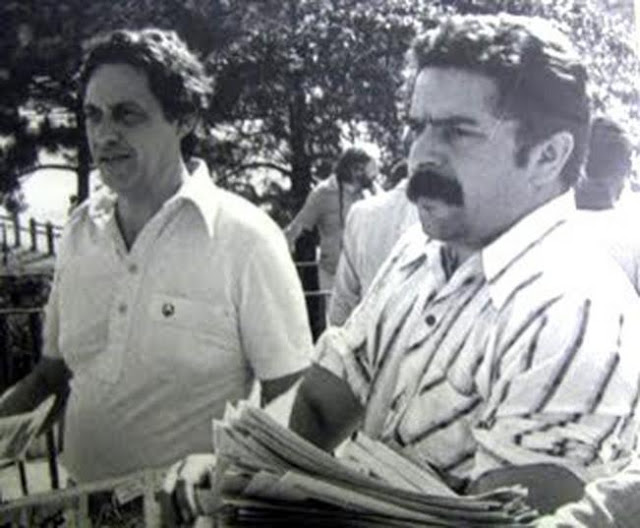
Lula and FHC campaigning together in 1981, by Cl vis Cranchi Sobrinho

Lula (PT) and FHC (PSDB) campaigning together in 1981, by Cl vis Cranchi Sobrinho

Some people have celebrated the reelection of Dilma Roussef as a victory of the left against the right. In my opinion that view is wrong for several reasons. First, because I disagree that PSDB and A cio Neves in particular are right-wing, both in terms of economics and social/moral issues. Second, because I believe Dilma s first government has taken a quite severe turn to the right in several topics that matter a lot to me. Since comparisons with PSDB s government during the 90s has been one of the main strategies of the campaign this year, I ll argue why I think it was actually a pretty good government with a lot of left in it. Unlike what happens in most other places, Brazil does not really have an actual right-wing party, economics-wise. Although we might see the birth of a couple in the near future, no current party is really against public health, education and social security being provided by the state as rights, or wants to decrease state size and lower taxes significantly. It should come as no surprise that even though it has undergone a lot of liberal reforms over the last 20 years, Brazil is still a very closed country, with very high import tariffs and a huge presence of the state in the economy. There is a certain consensus about all of that, with disagreements being essentially on implementation details, not goals. On the other hand, and contrary to popular belief, when it comes to social and moral issues we are a very conservative people. Ironically, the two parties which have been in power over the last 20 years are quite progressive, being historically proponents of diversity, minorities rights, reproductive rights. They have had to compromise on those causes to become viable alternatives, given the conservative nature of the majority of the voters. Despite their different origins and beliefs, both parties share socialist inclinations and were allies from the onset. That changed in 1992, when president Collor, who had been elected on a runoff against Lula (who PSDB supported), was impeached by Congress for corruption. With no formal political support and a chaotic situation in his hands, Itamar Franco, the vice president, called for a national union government to go through the last two years of his term. PSDB answered the call, but the workers party decided against being part of the government. Fernando Henrique Cardoso, a sociologist who was one of the leaders of PSDB was chosen to lead the Foreign Relations Ministry, but a few months later got nominated to the Economy. At the time, Brazil lived under hyperinflation of close to 1000% a year, and several stabilization plans had been attempted. Economy Ministers did not last very much in office at the time. FHC gathered a team of economists and sponsored their stabilization plan, which turned out to be highly successful: the Plano Real ( Real Plan ). In addition to introducing a new currency, something that was becoming pretty common to Brazilians by then, it also attacked the structural causes of inflation. Lula was counting on the failure of the Plano Real when he ran against FHC in 1994, but the plan succeeded, giving FHC two terms as president. During those two terms, FHC introduced several institutional changes that made Brazil a saner country. In addition to the hyperinflation, Brazil had lived a debt crises for decades and was still in default. FHC s team renegotiated the debts, reopened lines of credit, but most importantly, introduced reforms that made the Brazilian finances and financial system credible. The problem was not even that Brazil had a fiscal d ficit, it just did not have any control whatsoever of money supply and budget. Banks, regardless of whether they were private or public, had very little regulation and took advantage of the hyperinflation to hide monstrous holes in their balances. When inflation was gone and regulation became more strict, those became apparent, and it was pretty clear that the system would collapse if nothing was done. Some people like to say that FHC was a president who ruled for the rich and didn t care about the poor. I think the way the potential collapse of the banking system was handled is a great counter-example of that. The government passed laws that made the owners of the banks responsible for the financial problems, regardless of whether caused by mismanagement or fraud. If a bank went under, the central bank intervened and added enough money to protect the deposits, but that money was a loan that had to be repaid by the owners of the bank, and the owners properties were added as collateral to the loan. As a brazilian journalist once said, the people did not risk losing their deposits, the bankers did risk losing the banks, though. Today, we have a separate fund, filled with money from the banks, that does what the central bank did back then when required. Compare that to countries where the banking system was saved with tax payer money and executives kept getting huge bonuses regardless, while owners kept their profits. It is hard to find an initiative that is more focused on the public interest against the interest of the rich people who caused the problem. This legislation, called PROER, is still in place today, and it came along with solid regulation of the banking system. It should come as no surprise that Brazil went through the financial crisis of 2008 with not a single hiccup of the banking system and no fear of bank runs. Despite having been against PROER back in the day, Lula celebrated its existence in 2008, when it was clear it was one of the reasons we would not suffer much. He even advertised it as something that should be adopted by the US and Europe. It is also pretty common to hear that under FHC social questions were not a priority. I believe it is pretty simple to see that that was not the case both by inspecting the growth of social spending and the improvement of social indicators for the period, such as UN s human development index. One area in which people are particularly critical of the FHC government is the investment on higher education, and they are actually quite right. Brazil has free Federal universities and those did not get a lot of priority in the 90s. However, I would argue that while it is a matter of priorities, it is not one of education versus something else, but rather of what to invest on inside education. The reality is basic education was the priority. When FHC came to power, Brazil had a significant number of children who were not going to school at all. The goal was to make access to schools universal for young children, and that goal was reached. Every child has been going to school since the early 2000s, and that is a significant achievement which reaches the poorest. While the federal universities are attended essentially by the Brazilian elite, given the difficulty of passing the exams and the relative lack of quality of free public schools compared to private ones, which is still a reality to this day, investment on getting children to even go to school for the early years has a significant impact on the lives of the poorest. It is important to remember that getting every child to go to school is also what gave birth to one of the most celebrated programs from the Lula era: Bolsa Fam lia ( Family Allowance ) is a direct money transfer to poor families, particularly those who have children and has been an important contribution to lowering inequality and getting people out of extreme poverty. To get the money, the families need to ensure their children are 1) attending school and 2) getting vaccinated. That program comes from the FHC government, in which it was created with the name Bolsa Escola ( School Allowance ), in its turn inspired by a program of the same name by governor Cristovam Buarque, from PT. What Lula did, and he deserves a lot of credit for this, was to merge a series of smaller programs with Bolsa Escola, and then expand the program to ensure it got to more and more people. Interestingly, during the announcement of the program he credited the idea of doing that to a state governor from PSDB. You can see why I think these two should be allies again. When faced with all these arguments, people will eventually say that FHC was bad because he privatized companies and used orthodox economic policies. Well, if that is what it takes, then we ll have to take Lula down with him, because his first term was essentially a continuation of FHC s second term: orthodox economic policies to keep inflation down, along with privatization of several state-owned companies and banks. But Lula, whom I voted for and whose government I believe was a good one, is not my subject: Dilma is. On Lula s second term, Dilma gained a lot of power when other major leaders of PT went down for corruption. She became second in command and started leading several programs. A big believer in developmentalism, she started pushing for a bigger role of the state in the coordination of the productive sector, with a clear focus on growing the industrial base. One of the initiatives she sponsored was a sizable increase on the number and size of subsidized loans given out by the national development bank (BNDES). Brazil started an unnofficial national champions program, where the government elected a few big companies to get a huge amount of subsidized credit. The goal was for these selected firms to get big enough to be competitive on the global market. The criteria for the choices is completely opaque, if it even exists, and includes handing out milions in subsidized credit for Eike Batista, who became Brazil s richest enterpreneur for a while, and lost pretty much everything when it became clear the oil would not be pumping out of his camps after all, sinking with them a huge amount of public funds invested by BNDES. The way this policy was enacted, it is unclear how much it really costs in terms of public funds: the Brazilian treasury emits debt to capitalize, lends that money to BNDES with higher than market interest, and BNDES then lends it out to the big companies with a lower than market interest rate. Although it is obviously unsustainable, the problem does not yet show in the balance because the grace period for BNDES debt with the treasury is 2040. The fact that this has a cost and, perhaps more importantly, a huge opportunity cost is not clear because it is not part of the government budget. Why are we putting money in this rather than quadrupling Bolsa Fam lia, which studies show generates 1,78 reais in GDP for every 1 real invested? Worse, why are we not even updating Bolsa Fam lia enough to cover inflation? When Dilma got elected in 2010, the first signs were pretty bad. She was already seen as someone who did not care much for the environment, and on her first month in power she made good on that promise by pushing to get the Belo Monte Dam building started as soon as possible regardless of conditionalities being satisfied. To this day there are several issues with how the building of the dam is going: the handling of the indigenous people and the small city nearby are lacking, conditionalities are not met. Beyond Belo Monte, indigenous leaders are being assassinated, deforestation in the Amazon forest has increased by 122% in 2014 alone. Dilma s answer to people who question her on these kinds of issues is essentially: would you rather not have electric power? Her populist authoritarian nature and obsession with industry are also pretty evident when it comes to her policies in the energy area as a whole. She showed up in national tv on the eve of our independence day celebration to announce a reduction in electric tariffs, mainly for industry, but also for homes. Nobody really knew how. The following week she sent a fast-track project to Congress to automatically renew concessions of power grid operators, requiring those who accepted it to lower tariffs, instead of doing an auction, which was already necessary anyway because the concessions were up on 2015. There was no discussion with stakeholders, there was just a populist announcement and a great deal of rhethoric to paint anyone who opposed as being against the people. And now, everything went into the crapper because that represented a breach of contract that required indemnification, and we had a pretty bad drought that made power more expensive given the need to turn on the thermal generators. Combining the costs of the thermal generation, indemnity, and financial fallout that the grid operators suffered, we are already at 105 billion reais and counting, nobody knows how high the cost will reach. Any reduction in tariffs has long been invalidated. And the fact that industry has lowered production significantly ends up being good news, we would probably be under rationing already if that was not the case. You would expect someone who fought a dictatorship to be pretty good in terms of human and civil rights. What we see in reality is a lack of respect for those things. During the world cup, Dilma has put the army on the streets and has supported arbitrary behaviour from state polices throughout the country. They jailed a bunch of demonstrators preemptively. No shit. The would be demonstrators were kept in jail throghout the tournament under false accusations. Dilma s Minister of Justice said several times that the case against them was solid and that the arrests were legal, but it turned out the case simply did not exist. Just this week we had a number of executions orchestrated by policemen in the state of Par and there is zero reaction from the federal government. In the oil industry, Dilma has enacted a policy of subsidizing gas prices by using a fixed price that used to be lower than the international prices (it is no longer the case with the fall in international prices). That would not be a problem if Brazil was selfsufficient in oild and gas, which we are not: we had to import a significant amount of both. The implicit subsidy cost Petrobr s a huge amount of cash the more gas it sold, the bigger the losses. This lead not only to decreasing the company s market value (it is a state-controlled, but open company), but to reducing its capacity of investment as well. That is more problematic than it sounds because, with our current concession model, every single oil camp needs to have Petrobr s as a member of the consortium. Limiting the company s investment capacity limits the rate at which our pre-salt oil camps can be explored and thus the speed at which we can become selfsufficient. Chicken and egg anyone? To make things worse, Dilma has made policies that lowered taxes on car production, used to foster economic activity during the crisis in 2008-2010, essentially permanent. This lead to a significant increase in traffic and polution on Brazilian cities, while at the same time increasing the pressure on Petrobr s, which had to import more and more gas. Meanwhile, Brazilian cities suffer from a severe lack of mobility infrastructure. A recent study has shown that Brazil has spend almost twice as much subsidized money on pro-car policies than on pro-mass transit projects. Talk about good usage of public funds. One of the only remaining good news the government was still able to mention was the constant reduction in extreme poverty. Dilma was actually ellected promising to erradicate extreme poverty and changed the government s slogan to A rich country is a country with no poverty (Pa s rico pa s sem pobreza). Well, it turns out all of these policies caused inequality and extreme poverty both to stop falling as of 2013. And given the policies were actually deepened in 2014, I believe it is very likely we ll see an increase in both when we get the data for 2014, next year. Other than that, her policies ended up being a complete failure. Despite giving tax benefits to several sectors, investment has fallen, growth has fallen and inflation is quite high at 6,6% for the last 12 months. In terms of minorities, her government has been a severe set back, with the government going back on educational material against homophoby saying it would not do advertisement of sexual choice , and going back on a decree that allowed the public health system to perform abortions on the cases allowed by the law (essentially if the woman has been raped). Looking at Dilma s policies, I really can t see that much of the left, honestly. So why, you might ask, has this victory been deemed a victory of the left over the right? My explanation is the aura the workers party still manages to keep over itself. There s a notion that whatever PT does, it will still be more to the left than PSDB, which I think is just crazy. There is also a fair amount of idealizing Dilma just because she is Lula s proteg . People will forgive anything, provided it is the workers party doing it. Thankfully, the number of people aligned on the left that supported the candidate from PSDB this election tells me this is changing quite rapidly. Hopefully that leads to PT having to reinvent itself, and get in touch with the left again.

Neil Williams: On getting NEW packages into stable

There s a lot of discussion / moaning /arguing at this time, so I thought I d post something about how LAVA got into Debian Jessie, the work involved and the lessons I ve learnt. Hopefully, it will help someone avoid the disappointment of having their package missing the migration into a future stable release. This was going to be a talk at the Minidebconf-uk in Cambridge but I decided to put this out as a permanent blog entry in the hope that it will be a useful reference for the future, not just Jessie. Context LAVA relies on a number of dependencies which were at the time all this started NEW to Debian as well as many others already in Debian. I d been running LAVA using packages on my own system for a few months before the packages were ready for use on the main servers (I never actually installed LAVA using the old virtualenv method on my own systems, except in a VM). I did do quite a lot of this on my own but I also had a team supporting the effort and valuing the benefits of moving to a packaged system. At the time, LAVA was based on Ubuntu (12.04 LTS Precise Pangolin) and a new Ubuntu LTS was close (Trusty Tahr 14.04) but I started work on this in 2013. By the time my packages were ready for general usage, it was winter 2013 and much too close to get anything into Ubuntu in time for Trusty. So I started a local repo using space provided by Linaro. At the same time, I started uploading the dependencies to Debian. json-schema-validator, django-testscenarios and others arrived in April and May 2014. (Trusty was released in April). LAVA arrived in NEW in May, being accepted into unstable at the end of June. LAVA arrived in testing for the first time in July 2014. Upstream development continued apace and a regular monthly upload, with some hotfixes in between, continued until close to the freeze. At this point, note that although upstream is a medium sized team, the Debian packaging also has a team but all the uploads were made by me. I planned ahead. I knew that I would be going to Macau for Linaro Connect in February a critical stage in the finalisation of the packages and the migration of existing instances from the old methods. I knew that I would be on vacation from August through to the end of September 2014 including at least two weeks with absolutely no connectivity of any kind. Right at this time, Django1.7 arrived in experimental with the intent to go into unstable and hence into Jessie. This was a headache for me, I initially sought to delay the migration until after Jessie. However, we discussed it upstream, allocated time within the busy schedule and also sought help from within Debian with the RFH tag. Rapha l Hertzog contributed patches for django1.7 support and we worked on those patches upstream, once I was back from vacation. (The final week of my vacation was a work conference, so we had everyone together at one hacking table.) Still there was more to do, the django1.7 patches allowed the unit tests to complete but broke other parts of the lava-server package and needed subsequent tweaks and fixes. Even with all this, the auto-removal from testing for packages affected by RC bugs in their dependencies became very important to monitor (it still is). It would be useful if some packages had less complex dependency chains (I m looking at you, uwsgi) as the auto-removal also covers build-depends. This led to some more headaches with libmatheval. I m not good with functional programming languages, I did have some exposure to Scheme when working on Gnucash upstream but it wasn t pleasant. The thought of fixing a scheme problem in the test suite of libmatheval was daunting. Again though, asking for help, I found people in the upstream team who wanted to refresh their use of scheme and were able to help out. The fix migrated into testing in October. Just for added complications, lava-server gained a few RC bugs of it s own during that time too fixed upstream but awkward nonetheless. Achievement unlocked So that s how a complex package like lava-server gets into stable. With a lot of help. The main problem with top-level packages like this is the sheer weight of the dependency chain. Something seemingly unrelated (like libmatheval) can seriously derail the migrations. The package doesn t use the matheval support provided by uwsgi. The bug in matheval wasn t in the parts of matheval used by uwsgi. It wasn t in a language I am at all comfortable in fixing but it s my name on the changelog of the NMU. That happened because I asked for help. OK, when django1.7 was scheduled to arrive in Debian unstable and I knew that lava was not ready, I reacted out of fear and anxiety. However, I sought help, help was provided and that help was enough to get upstream to a point where the side-effects of the required changes could be fixed. Maintaining a top-level package in Debian is becoming more like maintaining a core package in Debian and that is a good thing. When your package has a lot of dependencies, those dependencies become part of the maintenance workload of your package. It doesn t matter if those are install time dependencies, build dependencies or reverse dependencies. It doesn t actually matter if the issues in those packages are in languages you would personally wish to be expunged from the archive. It becomes your problem but not yours alone. Debian has a lot of flames right now and Enrico encouraged us to look at what else is actually happening in Debian besides those arguments. Well, on top of all this with lava, I also did what I could to help the arm64 port along and I m very happy that this has been accepted into Jessie as an official release architecture. That s a much bigger story than LAVA yet LAVA was and remains instrumental in how arm64 gained the support in the kernel and various upstreams which allowed patches to be accepted and fixes to be incorporated into Debian packages. So a roll call of helpers who may otherwise not have been recognised via changelogs, in no particular order: Also general thanks to the Debian FTP and Release teams. Lessons learnt
  1. Allow time! None of the deadlines or timings involved in this entire process were hidden or unexpected. NEW always takes a finite but fairly lengthy amount of time but that was the only timeframe with any amount of uncertainty. That is actually a benefit it reminds you that this entire process is going to take a significant amount of time and the only loser if you try to rush it is going to be you and your package. Plan for the time and be sceptical about how much time is actually required.
  2. Ask for help! Everyone in Debian is a volunteer. Yes, the upstream for this project is a team of developers paid to work on this code (and largely only this code) but the upstream also has priorities, requirements, objectives and deadlines. It s no good expecting upstream to do everything. It s no good leaving upstream insufficient time to fit the required work into the existing upstream schedules. So ask for help within upstream and within Debian ask for help wherever you can. You don t know who may be able to help you until you ask. Be clear when asking for help how would someone test their proposed fix? Exactly what are you asking for help doing? (Hint: everything is not a good answer.)
  3. Keep on top of announcements and changes. The release team in Debian have made the timetable strict and have published regular updates, guidelines and status notes. As maintainer, it is your responsibility to keep up with those changes and make others in the upstream team aware of the changes and the implications. Upstream will rely on you to provide accurate information about these requirements. This is almost more important than actually providing the uploads or fixes. Without keeping people informed, even asking for help can turn out to be counter-productive. Communicate within Debian too talk to the teams, send status updates to bugs (even if the status is tag 123456 + help).
  4. Be realistic! Life happens around us, things change, personal timetables get torn up. Time for voluntary activity can appear and disappear (it tends to disappear far more often than extends, so take that into account too).
  5. Do not expect others to do the work for you asking for help is one thing, leaving the work to others is quite another. No complaining to the release team that they are blocking your work and avoid pleading or arguing when a decision is made. The policies and procedures within Debian are generally clear and there are quite enough arguments without adding more. Read the policies, read the guidelines, watch how other packages and other maintainers are handled and avoid those mistakes. Make it easy for others to help deliver what you want.
  6. Get to know your dependency chain follow the links on the packages.debian.org pages and get a handle on which packages are relevant to your package. Subscribe to the bug pages for some of the more high-risk packages. There are tools to help. rc-alert can help you spot problems with runtime dependencies (you do have your own package installed on a system running unstable if not, get that running NOW). Watching build-dependencies is more difficult, especially build-dependencies of a runtime dependency, so watch the RC bug lists for packages in your dependency chain.
Above all else, remember why you and upstream want the packages in Debian in the first place. Debian is a respected distribution and has an acknowledged reputation for stability and portability. The very qualities that you and your upstream desire from having your package in Debian have direct implications for the amount of work and the amount of time that will be required to get your packages into Debian and keep them there. Having your package in Debian will bring considerable benefits but you will be required to invest a considerable amount of time. It is this contribution which is valuable to Debian and it is this work which will deliver the benefits you seek. Being an expert in the one package is wildly inadequate. Debian is about the system, the whole distribution and sooner or later, you as the maintainer will be absolutely required to handle something which is so far out of your comfort zone it s untrue. The reality is that you are not expected to fix that problem you are expected to handle that problem and that includes seeking and acknowledging the help of others. The story isn t over until release day. Having your package in testing the day before the freeze is one step. It may be a large step, but it is only one. The status of that package still needs monitoring. That long dependency chain can still come back and bite. Don t wait for problems to surprise you. Finally One thing I do ask is that other upstream teams and maintainers think about the dependency chain they are creating. It may sound nice to have bindings for every interpreted language possible when releasing your compiled library but it does not help people using that library. Yes, it is more work releasing the bindings separately because a stable API is going to be needed to allow version 1.2.3 to work alongside 1.2.2 and 1.3.0 or the entire effort is pointless. Consider how your upstream package migrates. Consider how adding yet another build-dependency for an optional component makes things exponentially harder for those who need to rely on that upstream. If it is truly optional, release it separately and keep backwards compatibility on each side. It is more work but in reality, all that is happening is that the work is being transferred from the distribution (where it helps only that one distribution and causes duplication into other distributions) into the upstream (where it helps all distributions). Think carefully about what constitutes core functionality and release the rest separately. Combining bindings for php, ruby, python, java, lua and xslt into a single upstream release tarball is a complete nonsense. It simply means that the package gets blocked from new uploads by the constant churn of being involved in every transition that occurs in the distribution. There is a very real risk that the package will miss a stable release simply by having fingers in too many pies. That hurts not only this upstream but every upstream trying to use any part of your code. Every developer likes to think that people are using and benefiting from their effort. It s not nice to directly harm the interests of other developers trying to use your code. It is not enough for the binary packages to be discrete migrations happen by source package and the released tarball needs to not include the optional bindings. It must be this way because it is the source package which determines whether version 1.2.3 of plugin foo can work with version 1.2.0 of the library as well as with version 1.3.0. Maintainers regularly deal with these issues so talk to your upstream teams and explain why this is important to that particular team. Help other maintainers use your code and help make it easier to make a stable release of Debian. The quicker the freeze & release process becomes, the quicker new upstream versions can be uploaded and backported.

Konstantinos Margaritis: New owner/maintainer for CSVChart Drupal module

Back in ~2008, I had created a small Drupal module that used CustomFilter and Google Chart Tools: Image Charts, called CSV Chart. It was a simple module that took embedded CSV data and presented them as Google charts. It was very handy for what I wanted -and still want- to do, present benchmarks for my work on Altivec (and now in general SIMD). However, I don't really code in PHP anymore -haven't coded PHP since 2010- so the module was left to bitrot. I did some minor adjustment to run with the current D7-based site, but that was it. Thankfully, others found the module useful to use and adopt and the result has been that in the last days I transfered ownership of the CSV Chart to Pierre Vriens, so that he can continue development and maintenance of this tiny module. I would like to publicly thank Pierre for his work! And that's the beauty of Free Software!

9 November 2014

Antti-Juhani Kaijanaho: About to retire from Debian

I got involved with Debian development in, I think, 1998. In early 1999, I was accepted as a Debian developer. The next two or three years were a formative experience for me. I learned both software engineering and massively international collaboration; I also made two major contributions to Debian that are still around (of this, I am very proud). In consequence, being a Debian developer became a part of my identity. Even after my activity lessened more than a decade ago, after I no longer was a carefree student, it was very hard for me to let go. So I ve hung on. Until now. I created my 4096-bit GPG key (B00B474C) in 2010, but never got around to collecting signatures to it. I ve seen other people send me their key transition statements, but I have not signed any keys based on them. It just troubles me to endorse a better secured key based on the fact that I once verified a less secure key and I have a key signature chain to it. For this reason, I have not made any transition statements of my own. I ve been meaning to set up key signing meetings with Debian people in Finland. I never got around to that, either. That, my friends, was my wakeup call. If I can t be bothered to do that, what business do I have clinging on to my Debian identity? My conclusion is that there is none. Therefore, I will be retiring from Debian. This is not a formal notice; I will be doing the formal stuff (including disposing of my packages) separately in the appropriate forums in the near future. I agree with the sentiment that Joey Hess wrote elsewhere: It s become abundantly clear that this is no longer the project I originally joined . Unlike Joey, I think that is a good thing. Debian has grown, a lot. It s not perfect, but like my elementary-school teacher once said: A thing that is perfect was not made by people. Just remember to continue growing and getting better. And keep making the Universal Operating System. Thank you, all.

Wouter Verhelst: Thanks, joeyh

Last friday saw a somewhat distressing email to the debian-devel mailinglist, wherein Joey Hess, one of Debian's most valuable contributors, announced his decision to quit the project. For all of Joey's contributions over the years, this is an unwelcome message; I'd much rather have seen him remain active in Debian, both on a personal and a technical level. As it is, I have a feeling of not just losing a colleague in Debian, but also a friend. For people not active in Debian, it's easy to miss Joey's contributions to the project, but let me tell you that without Joey Hess, Debian simply would not be where it is today. We would not have the debian-installer and we would not have debhelper (so we would have massively complicated debian/rules files). More than that, though, Joey has been one of those people who, on a technical level, seemed to instinctively sense the right thing to do; as in, whenever Joey Hess disagrees with you on a technical matter, you know you must be doing something wrong. As sudden and as unwelcome as last friday's announcement was, however, I can't say that it was totally unexpected. I've noticed Joey reducing his efforts in core areas of the project over the past few years, where on the one hand he has been mostly withdrawing from debian-installer development, and on the other hand his two most recent 'large' projects (ikiwiki and git-annex) haven't really been about Debian. Still, it's a painful loss; and while Debian has lost other high-profile contributors in the past over divisive issues, and recovered, that doesn't make it any less fun. Here's to you, Joey. May you find joy in whatever you decide to do next. May you not disappear from our collective radars. May we meet again, at some conference in the future, so I can buy you a beer. (hint: FOSDEM ;-) )

Next.

Previous.