Search Results: "eric"

29 October 2007

Julien Danjou: awesome developement

awesome developement is in a very good shape. We're now more than half way on the 2.0 road. The contributors base is increasing, since there's now 2-3 people regularly sending patches, so this is very good, and the (still small) users base is increasing smoothly. The awesome core code is step by step rewritten in a better and more generic way. The next big work is tabs implementation, that I am still postponing right now because of the core which is not ready to handle. It needs to become even more generic to not break everything by adding such a feature. I still hope to release awesome 2.0-rc1 by the end of november.

28 October 2007

Erich Schubert: Flashblock in Epiphany: whitelisting?

Flashblock, one of my favourite (read: must-have) Firefox extensions can also be used with Epiphany (see their 'other browsers' install).However, whitelisting doesn't seem to work for me. Any pointers?I've set 'flashblock.whitelist' accordingly in about:config, but it doesn't work... :-(

26 October 2007

Biella Coleman: Should it stay or should it go?

What a week. Most notably, I am still in a state of partial disbelief that my case with Blue Cross Blue Shield is now on a path toward resolution and I don t have do battle with them, or at least in the same vigorous, soul-crushing way I have been engaged in since May (they still have not paid all the bills but at least part of them are resolved). But the very same day that I received the good news about BCBS, I received not so good news from my dermatologist about the black-blue mole that lies right under my left eye. He wants it gone, removed. So my whole fight with BCBS concerned claims over pre-existing conditions related to my moles. My claim was that I never had a problem with them until I had BCBS insurance and that is indeed the case. Soon after I first started having problems, I went on mole patrol and found a suspicious mole on my sister, which turned out to be melanoma. Now whenever I see a dermatologist, they all say, given my family history, given I grew up in the tropics, and given the odd size and very dark color of my mole, that it has to go. In fact the last dermatologist said with the firmest of tones: there is no doubt in my mind that it must be removed. The words stung because, well, I am pretty attached to the mole. I have lived with it for my whole life and it is fundamentally, even if somewhat mysteriously, linked to my sense of self. If it goes, I would feel like a very important part of me would also vanish. On more prosaic grounds, I can t help think that part of the drive to remove such a spot is just part of somewhat unhealthy social trend toward measuring most everything in finer and finder gradations of risk. Given that this mole is on my face and I see my face at least 2x a day in the mirror, I would probably catch anything if it started to change but given our risk society it is unsurprising that every American dermatologist keeps saying it is time to bid adieu to it. Given my background in medical anthropology I can t help conceptualize all this advice within these much larger social trends and then I go back and forth endlessly in my head as to whether I should remove it because it is safe and right and sound or whether I am caving in to somewhat irrational trend toward the risk management of everything. Finally I fear my insurance company again. Though I have a good job and decent insurance, I may not have good enough insurance for what this procedure entails.
Because of the size and location of the mole (large and close to my eye), if removed it must be done by a plastic surgeon. And plastic surgery in the US and plastic surgery in NYC costs a very pretty penny. While I would plan on getting pre-approval for the surgery, I somehow have the feeling that they will not pay the full cost and I am going to be left with another bill. And I am trying to stop the unnecessary onslaught of bills. So should it stay or should it go? I bet that I will lean toward the latter but not without a lot more thoughts, internal cries of resistance, and sense that even if I decide it is the best thing, I will lose a small piece of myself once removed

23 October 2007

Simon Richter: Folding Ubuntu's changes into Debian

Once again there is a discussion whether uClibc based systems should get their own architecture, or whether it would be more like Ubuntu -- they, too, have a different C library (with stack-protector support; this simplifies the gcc bootstrap sequence a bit). Thinking further, why not have generic support for keeping different configurations for various derived distributions in a single source tree, so the same source package could be used on Debian, Ubuntu, emdebian and all the others which all build different binaries? The gcc package does this, to some extent, but it looks at the build system to find out which configuration to use -- a standard mechanism, for example a DEB_BUILD_VARIANT environment variable would be nice.

Wouter Verhelst: Automounters

You know the problem? Something happens, and all your systems go down—scheduled or otherwise. When you boot them up, one box is faster than the other; and as a result, some network mounts don't really work correctly. While this doesn't really happen at work, I've seen it after a power failure at home. I thought this was a feature that Windows had but Linux doesn't. I really should've known better...
wouter@country:~$ mount
/dev/hda5 on / type ext3 (rw,errors=remount-ro,commit=0)
tmpfs on /lib/init/rw type tmpfs (rw,nosuid,mode=0755)
(...)
binfmt_misc on /proc/sys/fs/binfmt_misc type binfmt_misc (rw,noexec,nosuid,nodev)
automount(pid15173) on /autofs type autofs (rw,fd=5,pgrp=15173,minproto=2,maxproto=4)
wouter@country:~$ ls /mnt/stuff
(lots of private data snipped...)
wouter@country:~$ mount
/dev/hda5 on / type ext3 (rw,errors=remount-ro,commit=0)
tmpfs on /lib/init/rw type tmpfs (rw,nosuid,mode=0755)
(...)
binfmt_misc on /proc/sys/fs/binfmt_misc type binfmt_misc (rw,noexec,nosuid,nodev)
automount(pid15173) on /autofs type autofs (rw,fd=5,pgrp=15173,minproto=2,maxproto=4)
goa:/stuff on /autofs/stuff type nfs (rw,addr=192.168.119.23)
And after I wait a minute, that last line is gone. Automounters are cool. And not too hard to set up, either, if only a bit confusing at first. My /etc/auto.master contains the following (not counting commented-out examples):
/autofs	/etc/auto.autofs --timeout=60
I then need to have a directory /autofs, on which the automounter mounts a special filesystem if it's started; this is the "automount" in the above mount output. The autofs needs a second automounter map, which looks like this in my case:
cdrom	-fstype=iso9660,ro,nosuid,nodev	:/dev/cdrom
stuff	-fstype=nfs			goa:/stuff
camerab	-fstype=vfat,ro,umask=133,dmask=22 :/dev/disk/by-id/usb-GENERIC_USB_Storage-SDC_200606191719424ND-0:1-part1
floppy	-fstype=auto			:/dev/disk/by-id/usb-Y-E_DATA_USB_Floppy_Drive
Occasionally, yes, from the above lines it can be inferred that this indeed also works for my USB floppy drive, my multicardreader, and my CD-ROM drive. Finally, I need a symlink into the automount filesystem, like so:
wouter@country:~$ ls -l /mnt/stuff
lrwxrwxrwx 1 root root 13 2007-10-23 19:21 /mnt/stuff -> /autofs/stuff
et voila: if I now try to access anything below /autofs/stuff, the automounter kicks in, transparently mounts the filesystem, and without any further delay or ado, I can get at my files. Well—unless the server is down, that is.

21 October 2007

Eric Dorland: Slick

My UPS died today, so I went to the store to get a new one. It came with a USB cable and when I plugged it into my desktop an icon popped into the Gnome panel to show me my new UPS, how much charge it had, etc (and I assume shut it down when . Very cool, and honestly completely unexpected. I think a couple of years ago I would be much less impressed by this, but as I find my free time dwindling I really appreciate when things just work. It's also a small, but encouraging sign that "Desktop Linux" is making good progress.
20 October 2007

John Goerzen: Short-Term Thinking

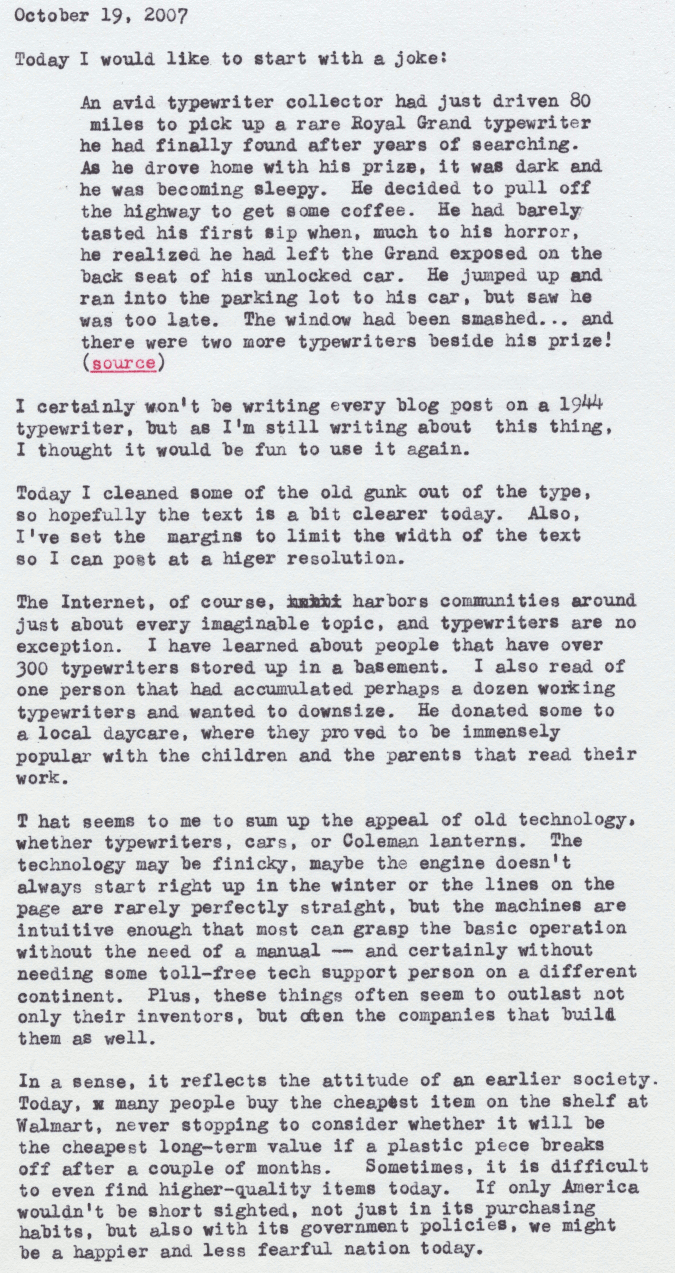
Today I would like to start with a joke:
An avid typewriter collector had just driven 80 miles to pick up a rare Royal
Grand typewriter he had finally found after years of searching.  As he drove
home with his prize, it was dark and he was becoming sleepy.  He decided
to pull off the highway to get some coffee.  He had barely tasted his first
sip when, much to his horror, he realized he had left the Grand exposed on
the back seat of his unlocked car.  He jumped up and ran into the parking
lot to his car, but saw he was too late.  The window had been smashed...
and there were two more typewriters beside his prize!
I certainly won't be writing every blog post on a 1944 typewriter, but I'm
still writing about this thing, I thought it would be fun to use it again.
Today I cleaned some of the old gunk out of the type, so hopefully the
text is a bit clearer today.  Also, I've set the margins to limit the width
of the text so I can post at a higher resolution.
The Internet, of course, harbors communities around just about every
imaginable topic, and typewriters are no exception.  I have learned about people that have over 300 typewriters stored up in a basement.  I also read of one person that had accumulated perhaps a dozen working typewriters and wanted to downsize.  He donated some to a local daycare, where they proved to be immensely popular with the children and the parents that read their work.
That seems to sum up the appeal of old technology, whether typewriters, care, or Coleman lanterns.  The technology may be finicky, maybe the engine doesn't always start right up in the winter or the lines on the page are rarely perfectly straight, but the machines are intuitive enough that most can grasp the basic operation without the need of a manual -- and certainly without needing some toll-free tech support person on a different continent.  Plus, these things often seem to outlast not only their inventors, but often the companies that build them as well.
In a sense, it reflects the attitude of an earlier society.  Today, many people buy the cheapest item on the shelf at Walmart, never stopping to consider whether it will be the cheapest long-term value if a plastic piece breaks off after a couple of months.  Sometimes, it is difficult to even find higher-quality items today.  If only America wouldn't be short sighted, not just in its purchasing habits, but also with its government policies, we might be a happier and less fearful nation today. flickr page

Enrico Zini: apt-xapian-index

Introducing apt-xapian-index apt-xapian-index has just been approved into experimental, and in the next days I'm going to blog more about it. The package contains a tool called update-apt-xapian-index that indexes Debian package metadata into a Xapian index located at /var/lib/apt-xapian-index/index. The index is read-only, except for update-apt-xapian-index; however, it is world-readable: every user can query it, all the time, at the same time, even during index updates. The index can contain more than package descriptions. update-apt-xapian-index indexes data using plugins located in /usr/share/apt-xapian-index/plugins, and any package can add their own. For example, debtags will provide a plugin to index tags. Since Xapian can index numeric values as well, if anyone makes a popcon package that downloads popcon information, they can provide a plugin to index popcon values. If anyone makes an iterating package that downloads ratings, they can provide a plugin to index ratings. Another plugin could be a specialised Debian stemmer that generates token such as foo out of libfoo-dev. I think you get the idea: it's very extensible. You can have a look at the initial set of plugins in subversion. The index is also self-documenting, so that one can keep track of all the intresting things that can be found in it. update-apt-xapian-index does not only maintain the index, but also the file /var/lib/apt-xapian-index/README that aggregates documentation provided by the plugins. To query the index, you just use Xapian. Debian contains Xapian bindings for various languages: In the next days I am going to post various example queries and interesting tricks that the index allows you to do. It's going to be fun.

16 October 2007

Russell Coker: War is Bad for the Environment

I just read a nutty post claiming that Neo-Conservatism is good for the environment [1]. The first bogus claim is that Saddam had WMD and war was required because he was a despot. The fact is that the Iraqi government was always repressive, there are many factions in Iraq that don’t like each other and a repressive government is the only way to keep such groups in a united country. The current civil war in Iraq and the effective secession of Kurdistan (which currently seems to be involved in an undeclared border war with Turkey) demonstrates this. Saddam was always a despot, but he did improve the living conditions of most Iraqis - the best way to avoid a revolution is to convince the majority of the population that things will get worse if there is change. I suggest reading the Wikipedia page about Saddam Hussein [2]. The best information on Fourth Generation Warfare (4GW) seems to be on the conservative military analysis site Defense and the National Interest [7]. It covers all the issues related to invading other countries from a conservative point of view. Note that Neo-Conservatives are not Conservatives, the real Conservatives hate the Neo-Cons more than anyone else does. The amusing statement is made that “apologists claim it was one of the most advanced Arab nations” and then a link is provided to information on Saudi Arabian censorship. It’s worth reading the wikipedia page about the history of Saudi Arabia [3], among other interesting facts “the U.S. Army Corps of Engineers built the country’s television and broadcast facilities and oversaw the development of its defense industry” (does the US army share responsibility for the censorship?). It’s widely regarded that if the US military support was removed then the Saudi government would be overthrown. Referring to Saudi Arabia hardly seems like something you want to do if trying to justify occupying other middle-eastern states. An unsubstantiated claim is made that under-developed countries produce excess pollution due to inefficient technology. Unlike some people I try to get some facts before posting so I looked up the wikipedia page on CO2 emissions per capita [4]. It seems that the highest ranking first-world country is Luxembourg at #4, the next is the US at #10. The countries on the list that rank higher than the US have a combined population of about 11,000,000 while the US population is 302,000,000 - some quite mental arithmetic suggests that the US produces about 20 times more CO2 than the top 9 countries on the list combined! It doesn’t seem that having the highest technology is helping the US protect the environment, I guess that they just use it to build bigger cars. The next thing I noticed is the countries that are at the bottom of the list - they are the world’s poorest countries. It seems that countries without much money just can’t afford to burn lots of oil, while countries with lots of money can. No real surprises there. The lowest ranking on the list for a country that is unlikely to be regarded as being in abject poverty is India at position #133. The next lowest is Turkey at position #98 followed by China at #91. As a final point of reference Switzerland is at position #69 a produces just under 27% the CO2 that the US does (on a per-capita basis). According to the CIA World Fact Book Switzerland has an infant mortality rate of 4.28/1000 and a life expectancy of 80.62 [5], while the US has an infant mortality rate of 6.37/1000 and a life expectancy of 78 [6]. I believe that the infant mortality rate and the life expectancy are the two factors that are most representative of quality of life as they are the easiest factors for measuring the overall health of the population. Being healthy is one of the most important factors in quality of life. It seems to me that by all objective measures the Swiss are doing better than the people of the US, yet they produce less pollution and never invade other countries. Probably the most ridiculous statement in the post is “see rapidly dwindling resources wasted on jihad and revolution“. A revolution (locals using force to create a new government) takes little resources and most actions that a more simple-minded analysis might call “jihad” takes almost none. Sending an invasion force to the other side of the world and supporting an occupying army for years does however use significant resources, consider that the Hummvee is the least fuel-efficient vehicle on American roads in terms of work done (trucks and buses use more fuel but carry large amounts of cargo or many people), but it’s also the most fuel-efficient vehicle used by the US army in Iraq. There is the possibility that Jaldhar was attempting satire. If so then I suggest that satire be kept separate from serious web content to avoid confusion about where the satire ends. But if you want some satire about oil then I suggest consulting theonion.com. Before someone accuses me of being impolite, over a year ago the best estimate for the death toll from the occupation of Iraq was 655,000 [8]. Current extrapolations from the previous medical research suggest that the death toll has now exceeded 1,000,000. Regardless of whether the original post was intended as satire or not, I’m not laughing and I don’t feel the need to be polite to someone who makes excuses for such loss of life. Finally as a positive suggestion towards the environment (and any other issue that you may want to discuss), I suggest analysing the issues before writing about them and not blindly trusting other people. When you write a post make objective claims with references to back them up. When you read a post consider the points that are made and the references that are cited. Do the references support the claims? Are there other interpretations of the evidence? Are the reference sites reputable?

Benjamin Mako Hill: What I'm Up To

So, I finished graduate school at MIT. I presented some of my thesis work at Wikimania and I'll be posting information, code, and the thesis itself, in the next weeks as I find time. I've decided to focus, at least in the immediate future, on several important projects. Here's what I'm up to: This is, of course, in addition to my work with FSF, Debian, and Ubuntu which I'll be continuing. And talks. And writing. (Yikes!) I'll be keeping my office at MIT (yes, like RMS) for the time being and sticking around Cambridge at least until Mika finishes her degree at Harvard School of Public Health. I'll be in wrapping up projects modes for the next few weeks and months and will be posting about them here as I go.

Alastair McKinstry: The Curse of Oil

Jaldhar Vyas points to the rogues gallery of oil producing states and argues that Neoconservatism is good, well at least it gets rid of the dictators such as Saddam Hussein while it grabs the oil. As he ightly points out, we are researching new alternative energy sources, and just as importantly (or even more importantly) energy conservation. But we have been doing this for decades. Sooner or later we have to realize that the "Oil Crisis" isn't due to a shortage of energy sources: its due to deliberate politics to make us dependent on oil. Peak Oil is "only" a crisis for us consumers, dependent on oil to drive our cars, heat our houses, and supply our food. For oil companies, it means (1) they are shipping oil at a greater rate than ever before, (2) at higher demand than ever before, and (3) in circumstances where pesky politics like OPEC can't interfere and try and moderate the price down (I'm not arguing OPEC or cartels are good; its just that its long-term 'maximize the benefit for the oil producing nations' strategy interferes with oil companies shorter-term profit maximization). For the Oil Companies, its a good thing. In this context we have to see our current dependence on oil as the result of deliberate policy by the oil companies. The small filip that USanian governments have done towards alternative energy, such as funding Hydrogen fuel-cell research, nuclear power, etc. are so long-term, and so small in scale, that they have to be seen as deliberately not solving the problem. Thinking that research into alternative sources is good is gpoing to save us (disclaimer: as a scientist I think research is a good thing :-)) is missing the real problem. Its politics: the oil companies have simply been better at politics than the strugging alternatives; we need to recognize this, and fight for alternatives. When oil prices reach $100/barrel, and we struggle to pay rising food and energy bills, its because other have deliberately caused the crisis. Oil has often been called a Curse because of the effects 'Oil Wealth' have caused so many countries. They are not co-incidentally dictatorships; Saddam Hussein remained in power in Iraq for so long because it benefitted the West (see the weapons supplies to Iraq in the so-called "Iran-Contra" affair, for example). Ditto Saudi Arabia, remaining 'friends' of the USA despite its ties to 911. Overthrowing Saddam Hussein was about consolidating even more power in the Gulf than America had previously, not democracy. What was planned for Iraq was democracy in name only: all real power was already neutralised, with decisions to US benefit cemented in place before the parliament met: non-negotiable contracts already signed giving US companies control. This is straight imperialism, and cannot be considered democracy or a good thing. Tags , ,

Ross Burton: Mark Thomas

A couple of nights ago (Tuesday, the 8th) I went to see a live Mark Thomas show. A very enjoyable show, he is wonderful at telling stories, making the entire audience collapse with laughter, and then can suddenly make the entire room silent with a serious point about the terrors the Western world manages to inflict on other nations. Lots of interesting facts, like the poor drunk American who is in prison for three years for mentioning the "day of judgement" and "a burning Bush". The number of people dying daily due to lack of action from us. The propaganda about the current war, forced in our faces every second of every day, until the war is over (as far as the media is concerned), at which point it will be ignored and never mentioned again. I am now a proud white ribbon wearer, supporting How About Not Killing Everyone? A small piece of advice from the wise -- if you see MT live, and he starts to talk about John Major and Edwina Curry... look away. Quickly. You shall be haunted for the rest of your days if you do not.

15 October 2007

DebConf team: DebConf8 dates decided! (Posted by Mart n Ferrari)

After a very short meeting, the DebConf team agreed on having the next DebConf the first two weeks of August. That will be August, 2nd to August, 17th. Also, the Debian Day will be held after DebConf in Buenos Aires, just before the eigth edition of the Regional Free Software Conference, a very big event with people coming from different countries in South America. This way, we expect to reach much more people.

Erich Schubert: Small tools: network-test

I wasn't aware of the "network-test" command in Debian, but it's actually quite neat:
INFO: This system has exactly one default route
INFO: Host localhost answers to ICMP pings
INFO: Loopback interface is working properly
[...]
INFO: The wifi0 interface has tx and rx packets.
INFO: The router 192.168.2.1 is reachable
INFO: This system is configured to use nameserver 192.168.2.1
INFO: Host 192.168.2.1 answers to ICMP pings
INFO: Dns server 192.168.2.1 resolved correctly www.debian.org
INFO: The nameserver configured for this system works properly
INFO: System can reach Internet host www.debian.org
INFO: System can access web server at Internet host www.debian.org
It does a quick network debugging output. I'd s/Dns/DNS/ though.

13 October 2007

Adam Rosi-Kessel: Opened Pandora

Via Eric Goldman’s recent recommendation, I decided to give Pandora another shot. The short version: Pandora is an intelligent predictive personalized Internet radio service with an arguably sustainable and protectable business model. And by “intelligent,” I mean there are real human brains at work. As Eric explains:
Pandora’s main competitive differentiator is its “Music Genome Project.” 50 trained musicians with at least a college degree in music (called “music analysts”) listen to songs all day long and rate each song on 400 different musical attributes. See the 2005 WSJ article discussing them. By profiling songs this way, the system can predict that a person who likes an artist’s song might like other songs with similar musical attributes. From listening to Pandora for many, many hours, IMO the system isn’t perfect, but it does a pretty good job, and it has definitely hooked me on music that I wouldn’t have listened to otherwise.
They have apparently cataloged approximately half a million songs and the database continues to grow apace. There is also a collaborative-filtering aspect, similar to Netflix and Amazon. I suspect this hybrid between the “wisdom of crowds” and the “wisdom of experts” will be the future of most large content projects (including wikipedia). My first few hours have returned excellent results. I created a for-working “station” called, lazily, “The Bad Plus Radio” (described as “Avant garde and angular funk/jazz, but not so dissonant that you can’t do mind-taxing work while listening”). You are welcome to listen as well. (See also my Pandora Profile.) The “artist seeds” for the channel include the following: Pandora has played several tracks by these artists, but is increasingly mixing in other artists that match up on some axis of preference. I’ve thumbed-up and thumbed-down several tracks from beyond the “seed” set (and will continue to do so), thus driving the predictive engine. I look forward to creating some entirely different channels and publishing the URLs here. Although supposedly the “free” version is ad-supported, I haven’t heard any ads yet. Maybe that is still to come. In any case, it is probably worth the $36/year subscription cost. Beyond the specific content I’m enjoying here, it is nice to see a Web 2.0 (or pick your favorite version) business model that doesn’t require a leap of faith to see how it can work. Of course, they have a Facebook app as well.

Daniel Burrows: Monad.Reader

The Reader monad is a simple and easy-to-use structure from the Haskell library that solves a common problem.

Very often, it's the case that you have a lot of functions that all need to use the same values. For instance, you might be laying out some text on a page, and you need to keep the details of the page size around in all your layout algorithms. Typically, you handle this situation by adding a new parameter to all your functions which represents the state. So,


layoutPage :: Text -> Page


becomes


layoutPage :: PageLayoutParams -> Text -> Page


This works just fine, but it can get really ugly. Every single function gets a new parameter, which must be threaded through to every related function that it ever calls. This causes visual clutter, particularly for functions that don't actually use the parameter themselves but just pass it on.

A function written in the Reader monad is augmented with a hidden parameter. For the hypothetical example above, we would write:


import Control.Monad.Reader
type LayoutFunc = Reader PageLayoutParams

layoutPage :: Text -> LayoutFunc Page


Note that the Reader monad is partially applied here. The result, LayoutFunc, is a new monad that adds a parameter of type PageLayoutParams to any code that runs inside it.

So, now that we have this monad, how do we use it? The "ask" operation retrieves the parameter that's hidden in the monad:


ask :: Reader a a


or, specialized to LayoutFunc:


ask :: LayoutFunc PageLayoutParams


In order to remain close to the example in question, I will provide specialized type signatures for the rest of the library functions. You can find the generic type signatures in the Haskell library documentation for Control.Monad.Reader.

Suppose that layoutPage started out like this before it was moved into the monad:


layoutPage st txt =
let width = pageWidth st
...


In the Reader monad, this becomes:


layoutPage txt =
do st - ask
let width = pageWidth st
...


As you can see, we've gone from one line of code to two. As this is clearly unacceptable for a clutter-reducing device, the Reader module provides a convenience function encapsulating the above pattern:


asks :: (PageLayoutParams -> a) -> PageLayoutFunc a


This allows us to simplify the monadic implementation to:


layoutPage txt =
do width - asks pageWidth
...


It's quite common, when multiple functions share context information, to invoke a function in an altered context. For instance, we might have a layoutSubPage routine that changes the page width:


layoutSubPage st newWidth txt =
doLayout (st pageWidth = newWidth txt)


The Reader equivalent of this idiom is the function "local":


local :: (PageLayoutParams -> PageLayoutParams) -> LayoutFunc a -> LayoutFunc a


local executes an operation in a context modified by its first parameter. For instance,


layoutSubPage newWidth txt =
local (\st -> st pageWidth = newWidth ) txt


Finally, to actually invoke a computation in the Reader monad, use runReader:


runReader :: LayoutFunc a -> PageLayoutParams -> a

main = showPage (runReader defaultPageParams someText)


For much more information on the Reader monad, see All About Monads, or the Haskell library documentation.

9 October 2007

David Welton: Languages: worst case vs average

This is a pretty good take on Tim Bray vs Erlang. However, I'd like to focus on something said at the end:
The fact is, all languages optimize for particular problem domains and I don't think that a universal programming language exists that would perform well on all tasks. Bray rapidly found out that Erlang isn't optimized for doing line-oriented I/O and it's regex library sucks. So what? While those problems could be eliminated from Erlang, the fact that Ericsson has deployed large telecom gear without having to fix those issues means that Erlang is ideally suited to its original programming domain.
The problem is that learning new languages is difficult for many people. They're not going to bother starting from 0 with a new language if what they've got is only 10/20% worse than the other guys. For companies, developing expertise (and trying to maintain it) in lots of languages is probably less productive than picking a few (Google only has four: Java, Python, Javascript and C++, and they're not exactly lacking in brainpower or cash). This is why "the right tool for the right job" works for things like saws and hammers, but not for complicated, idiomatic things like programming languages. Therefore, it's important that languages that aim to be widely used do lots of things pretty well, and try to avoid doing anything really badly. This is something I've always admired about Python, even if I don't use it anymore. It's a language that you can do a very wide variety of tasks with, and you can be sure there's probably some code out there already, and that Python will be ok for your task, even if it's not the best thing. Performance is a weak point compared to compiled languages, but even there, get the libraries right and things aren't *so* bad. In any case, my point isn't to bash Erlang (which I like), or put Python on a pillar (I prefer Ruby and Tcl), but to say that a widely used programming language doesn't need to be the best at everything, but it should aim to make people comfortable using it, safe in the knowledge that they can probably do most things *ok* if needs be. That's a far better situation than being able to do one thing realy well, and perform poorly at many other tasks, forcing its users to look elsewhere for solutions to those tasks. Personally, I think that for concurrency, Erlang is in a bit of a race right now - they're pretty far ahead in terms of concurrency (and also fault tolerance, but fewer people care about that), but behind in other areas (less library code). Other languages don't have as good a tools for concurrency, which isn't an easy problem. So, what will happen first - Erlang catches up elsewhere, other languages get "good enough" concurrency solutions, or a new language (like Scala) comes along and takes the lead?

5 October 2007

Biella Coleman: On Traveling, Airports, and Thinking

After 6 weeks of teaching and over 2 months in my new apartment, I am making a short escape from NYC to visit my mom and sister in PR. In my Impacts of Technology class, we just finished a week on large-scale and complex technological systems, with a focus on industrial farming. We read a few sections of Micahel Pollan’s fanstastic book, The Ominvore’s Dilemma, which combines the odd qualities of being seductively alluring (thanks to his exquisite writing) and repulsive (thanks to the content, well at least the part on factory animal “farming”). I can’t recommend it enough and look forward to reading the rest, when I find the (magical) time to do so. Now that I am at the airport, I am struck at how little I know about this place, which is also a large and complex technological system and I bet revealing its technological and cultural innards would provide as fascinating (although not quite as gross) of a story as that of factory animal farming. There are many questions I would love answered: How exactly is coordination secured and what are the toughest elements to airport coordination? Where are the lines of cooperation and those of competition between airlines? What factors and values go into the design of the airport? (I know that for one thing, in American airports, there rarely seems to be enough electrical jacks; I am now sitting under the telephones, the only place with jacks in terminal 8 at JFK, and the funny thing is that there are a row of 7 unused phones and only one jack and I am sure it would be more useful to have 1 pay phone and a row of 7 jacks, instead). What sorts of airport technologies have put people out of jobs? What technologies have created new job opportunities? What sorts of social hierarchies are there in airports? Like who runs the big show? Is it a CEO? Or is something more like a university provost? What is standardized by the FAA, and what elements are more flexible, and thus different airport to airport? Is there a sense of camaraderie among airport employees, or are loyalties built primarily among employees of one airline or among the classes of workers? Given that unions are quite strong among airport employees and from the top (pilots) down (food workers), what is the political culture of airports/employees like? (I remember once overhearing a group of machinist and ground crew talking about the ugly face of globalization and NAFTA over coffee and I was dumbfounded and pretty psyched too). Are airports one of the few last remaining places in th US that provides for decent job security? Why do so many of the ground crew have such athletic, bulging calves? :-) Is it a result of the physical demands of the job? Or is it that the type of job ( outdoors with lots of heavy lifting), attract the athletic types? Do they have to pass certain physical standards as to pilots? Was there always first class seats? Or did that come about when flying became cheaper? Are employees trained to deal with irate passengers? In what ways do pilots bitch about the long waits/delays they also have to endure? What can they do when they are waiting, as we did for an hour last night, during the massive traffic jams that are especially noxious in NYC-area airports? Do pilots have any say in the way airports are run? Why do they consistently provide less chairs than are needed in lounges, even in new terminals, as the one I was in tonight? Do air traffic controllers ever meet face-to-face with pilots or do they largely have a virtual relationship? Are programmers who patch, improve, and build traffic control systems housed in the airports, or elsewhere? Airports are not only fascinating for technological and sociological reasons but I reckon there is a lot of interesting psychological work that must happen in airports. I imagine that during those long, endless waits in the lounge, on the security lines, on the tarmac, people must often take the time to reflect, on where am I going, where am I coming from, and not in the literal sense but the metaphorical one. I know that I have spent many hours in airports letting my mind wander to places and thoughts in ways that don’t happen as easily or often elsewhere. And in many instances, I don’t think that this propensity to indulge in some reflective thinking, is a matter of time, that is waiting. For me at least, it is the fact that many times when I fly, I am moving between worlds. While I have flown hundreds of times, I never have been shed of the sense of awe I feel about planes and their ability to shrink space and time so quickly. For me, it is less the act of flying itself (that feels boring, tiring, annoying, mostly because of the insane waits and delays and I never seem to get the right amount of sleep the night before) but the visceral contrast it brings. In the morning my life is of a particular tone and rhythm, currently situated in NYC and by evening, I am back at home in PR, surrounded by thick humidity and the loud sound of coquis. Once there, my as currently configured in NYC, has little direct bearing to those around me. Planes don’t just transport, they shift and convert your inner and outer world… So, if anyone (who got this far) knows of a good social history of the airport, do tell. I would love to read it.

29 September 2007

Clint Adams: This K se-Knoblauch Suppe is delicious, but what is that floating in it?

My next installment was going to cover a different topic, but Marty made a wish and unless Rajaton intercedes before this blog entry is over, the curriculum is going to careen off the track. The relevant question is something like Why do I have to type all that junk in when there's perfectly good --help output to parse? and the relevant answer is something like Yes. No. ROFLcows. Lamar. This is somewhat easy when a program has well-behaved, sane-ish, GNU-style --help output. Let's say you want completion for GNU ptx. Now you could go through and write a function using _arguments like you learned all about here, or you could just type
compdef _gnu_generic ptx
Suddenly you'll be able to complete options after ptx. You'll notice a few things as you perform your QA due diligence. It won't understand the subtleties of -G. It won't know what STRING and REGEXP and NUMBER mean, but then, neither do I. It's possible to use _arguments to explain what WORDS IN ALL CAPITALS mean, but let's find a less BORING example.
Usage: nurmepuu [OPTION]... [FILE]
Drive Miss Nurmepuu
  -c, --compress=TYPE            apply this compression TYPE to the aircon
  -f, --force                    use force
  -s, --side=SIDE                drive on this SIDE of the road
  -u, --unbearability=LEVEL      tolerate this LEVEL of unbearability
So start out the way you have now learned instinctually.
#compdef nurmepuu
_arguments -- \
WAIT. WHAT'S THAT The double hyphen-minus, contrary to the expectations of GNU and git users alike, means (are you ready for this?) parse the --help output and try to sanely complete long options. Now lets give it some hints so it isn't too braindead.
  '*=TYPE*:compression type:(gzip bzip2 lossy gainy pancakebatfish)' \
  '*=SIDE*:side of the road:(left right east west up)' \
  '*=LEVEL*:tolerance level:((japan\:haha radiohead\:hoho))'
There you go. The patterns on the left will be matched against the help output, and the completion actions on the right. The list in double parens are matches paired with descriptions (note the backslashed colons). Once more, the whole thing:
#compdef nurmepuu
_arguments -- \
  '*=TYPE*:compression type:(gzip bzip2 lossy gainy pancakebatfish)' \
  '*=SIDE*:side of the road:(left right east west up)' \
  '*=LEVEL*:tolerance level:((japan\:haha radiohead\:hoho))'

23 September 2007

Jeff Bailey: Tour of Mountain View

We took a tour of Mountain View with Leslie yesterday. It was nice to look around and see what was actually around here for shopping / things to do / how to escape to somewhere else. It looks like the biggest redeeming feature of MTV is that one can leave. It reminds me of Coquitlam. It's the last place we're considering outside of the city - but considering that we're not going to really be out partying in the next year, the crime rate is very low, and rent is sometimes half of what we'd pay, it's definetly worth considering. It also will keep the commute down to something reasonable (probably 15 minutes on a bike, almost too short).

Weird American thing of the day: Apparently for everything you need your SSN here. At home, the only people who are allowed to ask for the Canadian equivalent (SIN) are people who are going to pay you money. So a credit check can't require it. Your health card can't require it. Your driver's license can't require it. Angie not having one is going to get sticky in a few cases.

I actually walked just under 10,000 steps on Friday. I didn't bike because I wasn't feeling well, and it seems that the walk to the commuter train is somewhere between 2 and 3 thousand steps.

Next.

Previous.
