Search Results: "az"

18 December 2012

Raphael Geissert: Nicer, but stricter

Lately I've been working on making the redirector nicer to the mirrors and to some potential users. More specifically, those behind a caching proxy.

The redirector is now nicer to traditional web proxies by redirecting to objects that are known not to change with a "moved permanently" code (HTTP status code 301.) This applies to files in the pool/ directory and ".pdiff" files, among others.
Previously, a traditional caching web proxy would sometimes end up with multiple copies of the same object, fetched from different mirrors; and the redirection would not be cached at all. With this change, this is no longer the case.

Using a caching proxy that is aware of the Debian repository design is still more likely to yield better results, however: If my memory serves correctly, apt-cacher has the ability of updating the Packages, Sources, and similar files with the ".pdiff"s on the server side. Apt-Cacher-NG apparently can use debdelta, and so on.
Check my blog post about one APT caching proxy not being efficient for some comments related to those tools.

Another recent change is that mirrors that can't be used by the redirector will no longer be monitored as often as the other mirrors. For instance, if a mirror doesn't generate a trace file (used for monitoring) then the redirector will gradually limit the rate at which the mirror is checked.
This rate-limiting mechanism applies to different kinds of errors, and should reduce the amount of wasted time and bandwidth while still allowing automatic-detection of mirrors that recover.


Projection of a rate-limited mirror over six weeks. The mirror would have to fail in every attempt for that to happen.
N.b. there's a bump in the scale.

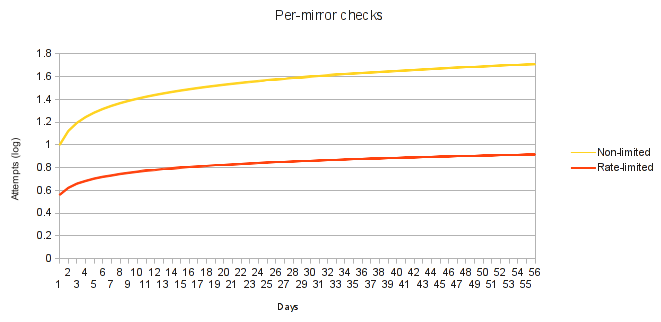
The rate limiter applies an initial exception to allow temporary errors to not affect the use of the mirror by the redirector. After that exception, it is pretty much linear. However, that chart doesn't really reflect the effect of the rate limiter, so put in comparison with the normal checking behaviour:


Comparison of the two behaviours over an 8 weeks period using a logarithmic scale.
Nice chart colours by Libreoffice.

The code to detect mirrors that don't perform a two-stages sync that I talked about in a previous post has not yet been integrated as the current implementation would be too expensive on the mirrors to just add it as-is.

While tracking down problems exposed to users, I decided to take a stricter approach as to what mirrors are used by the redirector. Suffice to say that the remaining mirrors using the obsolete anonftpsync are going to be ignored entirely. ftpsync has been around for a few years now and it is the standard tool.
Whether you are mirroring Debian, Raspbian, Ubuntu, or any other Debian-like packages repository, ftpsync is the right tool to use.

Most of the issues I've been discovering, and sometimes working around, affect direct users of the mirrors and are not related to the http.debian.net redirector. When not detected beforehand they happen to be exposed by the redirector, but like I said, I plan to be stricter in order to increase the redirector's reliability. Once a strict and reliable foundation is built, more workarounds might see their way in to better use the available resources.

That's it for now. The road is long, the challenge is great, and being an observer in an uncontrolled environment makes it even more interesting.

17 December 2012

Lars Wirzenius: Obnam 1.3 (backup software) and other releases

I've just pushed out the release files for Obnam version 1.3, my backup application, as well as Larch, my B-tree library, and cliapp, my Python framework for command line applications. They are available via my home page (http://liw.fi/). Since Debian is frozen, I am not uploading packages to Debian, but .deb files are available from my personal apt repository for the intrepid. (I will be uploading to Debian again after the freeze. I am afraid I'm too lazy to upload to experimental, or do backports. Help is welcome!) From the Obnam NEWS file: Bug fixes for Obnam: NEWS for Larch: NEWS for cliapp:

15 December 2012

Martin Pitt: Running a script with unshared mount namespace

When writing system integration tests it often happens that I want to mount some tmpfses over directories like /etc/postgresql/ or /home, and run the whole script with an unshared mount namespace so that (1) it does not interfere with the real system, and (2) is guaranteed to clean up after itself (unmounting etc.) after it ends in any possible way (including SIGKILL, which breaks usual cleanup methods like trap , finally , def tearDown() , atexit() and so on). In gvfs and postgresql-common s tests, which both have been around for a while, I prepare a set of shell commands in a variable and pipe that into unshare -m sh, but that has some major problems: It doesn t scale well to large programs, looks rather ugly, breaks syntax highlighting in editors, and it destroys the real stdin, so you cannot e. g. call a bash -i in your test for interactively debugging a failed test. I just changed postgresql-common s test runner to use unshare/tmpfses as well, and needed a better approach. What I eventually figured out preserves stdin, $0, and $@, and still looks like a normal script (i. e. not just a single big string). It still looks a bit hackish, but I can live with that:
#!/bin/sh
set -e
# call ourselves through unshare in a way that keeps normal stdin, $0, and CLI args
unshare -uim sh -- -c " tail -n +7 $0 " "$0" "$@"
exit $?
# unshared program starts here
set -e
echo "args: $@"
echo "mounting tmpfs"
mount -n -t tmpfs tmpfs /etc
grep /etc /proc/mounts
echo "done"
As Unix/Linux shebang parsing is rather limited, I didn t find a way to do something like
#!/usr/bin/env unshare -m sh
If anyone knows a trick which avoids the tail -n +7 hack and having to pay attention to passing around $@ , I d appreciate a comment how to simplify this.

14 December 2012

Richard Hartmann: Release Critical Bug report for Week 50

The UDD bugs interface currently knows about the following release critical bugs: How do we compare to the squeeze cycle ?
Week Squeeze Wheezy Diff
43 284 (213+71) 468 (332+136) +184 (+119/+65)
44 261 (201+60) 408 (265+143) +147 (+64/+83)
45 261 (205+56) 425 (291+134) +164 (+86/+78)
46 271 (200+71) 401 (258+143) +130 (+58/+72)
47 283 (209+74) 366 (221+145) +83 (+12/+71)
48 256 (177+79) 378 (230+148) +122 (+53/+69)
49 256 (180+76) 360 (216+155) +104 (+36/+79)
50 204 (148+56) 339 (195+144) +135 (+47/+90)
51 124 (124+54)
52 115 (78+37)
1 93 (60+33)
2 82 (46+36)
3 25 (15+10)
4 14 (8+6)
5 2 (0+2)
6 release!
Graphical overview of bug stats thanks to azhag:

Joachim Breitner: Pl tzchentetris

What happens if the same person (in this case, my girlfriend) is both a bit geeky and likes to bake? She has ideas leading to this:
Tetris Biscuits
And what is the obvious thing to do with such biscuit (or are they cookies?). Play tetris:
<video controls="true" height="720" poster="http://www.joachim-breitner.de/various/Plaetzchentetris-poster.jpg" tabindex="0" width="960"> <source src="http://www.joachim-breitner.de/various/Plaetzchentetris.webm" type="video/webm"> <source src="http://www.joachim-breitner.de/various/Plaetzchentetris.avi" type="video/x-msvideo"> Your browser does not support the video tag. Try youtube instead! </video>
(Also on YouTube if your browser does not play the video above.) Oh, and to refute common stereotypes about me: The baking was done by me, but she helped me glazing the biscuits.

11 December 2012

Christian Perrier: Celebrate Samba!

Samba 4 is out. That's just it. 21 years (same age than the Linux kernel, 2 years older than Debian) after a crazy australian student started it, Samba 4 is out. Doh.

Francesca Ciceri: Welcome Malatesta, Goodbye Kasbah!

Kasbah, my old laptop, is almost dead. It was my first laptop, an Asus X50C, which worked like a charm and was robust like a tank. But then the screen hinges broke. Time for a new one. So, ladies and gentlemen, I'm glad to present you malatesta. Malatesta is a Lenovo Thinkpad E335. Sadly, while kasbah worked with free drivers, malatesta requires proprietary drivers both for the video card and the wifi. Which sounds a bit ironic for a laptop named after a famous anarchist. The only two problems I encountered with it were related to the video card (00:01.0 VGA compatible controller: Advanced Micro Devices [AMD] nee ATI Device 9808) and the special keys. Malatesta worked well with the kernel of Squeeze, but freezed during the boot with Wheezy. Thankfully, I stumbled upon this blogpost by Blars Blarson suggesting to use the fglrx-driver with Sid. And that solved the problem. Another little odissey was the brightness of the monitor. With kernels < 3.2.0-4-amd64 the thinkpad_acpi didn't recognize my model and I was stuck with a brightness level probably visible from the outer space. Neither xrandr nor xbacklight could help, and I was seriously considering to use sunglasses to work (a slight unusual approach to the brightness problem, I know, but I suffer of migraines and couldn't bear an hyper-bright monitor), when the upgrade to Sid solved the problem. On the bright side (pun intended) this laptop was born without Windows. (Both malatesta and kasbah were shipped with FreeDOS). Now, if you're wondering about the names: my first namescheme was "references to songs by the Clash" (and kasbah is obviously for "Rock the Casbah", with a typo). But it wasn't really scalable. Since last year, I've decided to name my systems after famous anarchists. The server is named after one of my all time favourite anarchists, Buenaventura Durruti.
madamezou@durruti:~$ cat /etc/motd
%%%%%%%%%%%%%%%%%%%%%%%%%%%%%%%%%%%%%%%%%%%%%%%%%%%%%%%%%%%%%%%%%%%%%
Llevamos un mundo nuevo en nuestros corazones;
y ese mundo est  creciendo en este instante
                        Buenaventura Durruti
%%%%%%%%%%%%%%%%%%%%%%%%%%%%%%%%%%%%%%%%%%%%%%%%%%%%%%%%%%%%%%%%%%%%%
While the new laptop's name comes from Errico Malatesta.
madamezou@malatesta:~$ cat /etc/motd 
%%%%%%%%%%%%%%%%%%%%%%%%%%%%%%%%%%%%%%%%%%%%%%%%%%%%%%%%%%%%%%%%%%%%%
We anarchists do not want to emancipate the people;
We want the people to emancipate themselves.
            Errico Malatesta, L'Agitazione (18 June 1897)
%%%%%%%%%%%%%%%%%%%%%%%%%%%%%%%%%%%%%%%%%%%%%%%%%%%%%%%%%%%%%%%%%%%%%

9 December 2012

Stefano Zacchiroli: bits from the DPL for November 2012

Just posted, bits from the DPL for November 2012.
 ---------------------------------------------------------------------------------
/ Pop-up advertisement. Breaking news. Help the Release Team [0] by reviewing     \
  pending unblock requests. Oh, and by fixing RC bugs too.                         
                                                                                   
  [0]: http://nthykier.wordpress.com/2012/12/09/wheezy-release-progress-december/  
\---------------------------------------------------------------------------------/

Dear Project Members, here is another (delayed) monthly report of DPL activities, this time for November 2012. Highlights Events Assets That's all for now,
let's go back releasing Wheezy,
Cheers.
PS the day-to-day activity log for November 2012 is available at the usual place master:/srv/leader/news/bits-from-the-DPL.txt.201211

8 December 2012

Dirk Eddelbuettel: RcppArmadillo 0.3.6.0

Conrad launched the 3.6 series of Armadillo earlier today with a first 3.6.0 release. So RcppArmadillo, our wrapper for R and Armadillo, is now on CRAN with its corresponding version 0.3.6.0. No R level or interface changes were needed, and the upstream changes are summarized below.
Changes in RcppArmadillo version 0.3.6.0 (2012-12-07)
  • Upgraded to Armadillo release Version 3.6.0 (Piazza del Duomo)
    • faster handling of compound expressions with submatrices and subcubes
    • added support for loading matrices as text files with NaN and Inf elements
    • added stable_sort_index(), which preserves the relative order of elements with equivalent values
    • added handling of sparse matrices by mean(), var(), norm(), abs(), square(), sqrt()
    • added saving and loading of sparse matrices in arma_binary format
Courtesy of CRANberries, there is also a diffstat report for the most recent release As always, more detailed information is on the RcppArmadillo page. Questions, comments etc should go to the rcpp-devel mailing list off the R-Forge page.

7 December 2012

Richard Hartmann: Release Critical Bug report for Week 49

The UDD bugs interface currently knows about the following release critical bugs: How do we compare to the squeeze cycle ?
Week Squeeze Wheezy Diff
43 284 (213+71) 468 (332+136) +184 (+119/+65)
44 261 (201+60) 408 (265+143) +147 (+64/+83)
45 261 (205+56) 425 (291+134) +164 (+86/+78)
46 271 (200+71) 401 (258+143) +130 (+58/+72)
47 283 (209+74) 366 (221+145) +83 (+12/+71)
48 256 (177+79) 378 (230+148) +122 (+53/+69)
49 256 (180+76) 360 (216+155) +104 (+36/+79)
50 204 (148+56)
51 124 (124+54)
52 115 (78+37)
1 93 (60+33)
2 82 (46+36)
3 25 (15+10)
4 14 (8+6)
5 2 (0+2)
6 release!
Graphical overview of bug stats thanks to azhag:

6 December 2012

Leo 'costela' Antunes: Silly Wal(l Cloc)k 2.0

So I finally got the first laser-cut version of the Silly Wal(l Cloc)k done: The back plate was cut from a 1mm plexiglass sheet using this SVG. The black parts were spray painted with matte black and inserted back into the hollowed out sections (I should have made pictures of the pieces before assembling; too lazy to do it now). This proved out to be somewhat problematic, since keeping the small pieces (the chin and the white part of the suitcase handle) in place isn t really easy without gluing everything together, which I wanted to avoid because I m not sure what effect the glue might have on plexiglass in the long term. Another problem was the fact that the plexiglass sheet is white, but slightly translucent. Since the back piece of the clock is black, this caused the white parts to look dirty . As a workaround for both problems I ended up using a thin white cardboard sheet as additional background, where the small hollowed out pieces could be affixed and the translucency of the plexiglass could be hidden. On the other hand, the 1mm thickness for the plexiglass turned out to be perfect for the clock hands (or feet). I think it would still have worked with 2mm, but that might be too heavy for the puny clock torque and they might start snagging on each other. Careful eyes will also note that I made a stupid mistake when writing down the dimensions for the back plate and it ended up being slightly smaller than the available space. Not my brightest moment, but it worked out alright with the additional cardboard background. The next iteration will probably be made with a different two-color plexiglass sheet that can be engraved. Let s see how that works out. Related: Silly Wal(l Cloc)k

James Bromberger: Official Debian Images on Amazon Web Services EC2

Please Note: this article is written from my personal perspective as a Debian Developer, and is not the opinion or expression of my employer.
Amazon Web Service s EC2 offers customers a number of Operating Systems to run. There are many Linux Distributions available, however for all this time, there has never been an Official Debian Image or Amazon Machine Image (AMI), created by Debian. For some Debian users this has not been an issue as there are several solutions of creating your own personal AMI. However for the AWS Users who wanted to run a recognised image, it has been a little confusing at times; several Debian AIMs have been made available by other customers, but the source of those images has not been Debian . In October 2012 the AWS Marketplace engaged in discussions with the Debian Project Leader, Stefano Zacchiroli. A group of Debian Developers and the wider community formed to generated a set of AMIs using Anders Ingemann s ec2debian-build-ami script. These AMIs are published in the AWS Marketplace, and you can find the listing here: No fees are collected for Debian for the use of these images via the AWS Marketplace; they are listed here for your convenience. This is the same AMI that you may generate yourself, but this one has been put together by Debian Developers. If you plan to use this AMI, I suggest you read http://wiki.debian.org/Cloud/AmazonEC2Image, and more explicity, SSH as the user admin and then sudo -i to root. Additional details Anders Ingemann and others maintain a GitHub project called ec2debian-build-ami which generates a Debian AMI. This script supports several desired features, an was also updated to add in some new requirements. This means the generated image supports: Debian Stable (Squeeze; 6.0.6 at this point in time) does not contain the cloud-init package, and neither does Debian Testing (Wheezy). A fresh AWS account (ID 379101102735) was used for the initial generation of this image. Any Debian Developer who would like access is welcome to contact me. Minimal charges for the resource utilisation of this account (storage, some EC2 instances for testing) are being absorbed by Amazon for this. Co-ordination of this effort is held on the debian-cloud mailing list. The current Debian stable is 6.0.6 Squeeze , and we re in deep freeze for the Wheezy release. Squeeze has a Xen kernel that works on the Parallel Virtual Machine (PVM) EC2 instance, and hence this is what we support on EC2. (HVM images are a next phase, being headed up by Yasuhiro Akarki <ar@d.o>). Marketplace Listing The process of listing in the AWS Marketplace was conducted as follows: This image went out on the 19th of November 2012. Additional documentation was put into the Wiki at: http://wiki.debian.org/Cloud/AmazonEC2Image/Squeeze A CloudFormation template may help you launch a Debian instance by containing a mapping to the relevent AMI in the region you re using: see the wiki link above. What s Next The goal is to continue stable releases as they come out. Further work is happening to support generation of Wheezy images, and HVM (which may all collapse into one effort with a Linux 3.x kernel in Wheezy). If you re a Debian Developer and would like a login to the AWS account we ve been using, then please drop me a line. Further work to improve this process has come from Marcin Kulisz, who is starting to package ec2debian-build-ami into a Debian: this will complete the circle of the entire stack being in main (one day)! Thanks goes to Stefano, Anders, Charles, and everyone who contributed to this effort. Resources

3 December 2012

Pablo Lorenzzoni: Nostalgia time

My parents will soon be moving to a smaller home, so they are digging up a lot of stuff of my sister and mine past. Among my stuff, they just sent me my first computer (which was, of course, the first computer of my father s company I was using in the spare time). I couldn t believe they kept that. It was an Unitron Apple ][ 64K!! I just had it cleaned and took this picture: Due to the closed informatics market Brazilians were subject to at the time, it came with a full set of manuals in Portuguese which taught me how to code in Basic (I was too young to learn English at the time) Interesting how a bad policy like that can result in a Good Thing sometimes. :-) Is it just me or does this picture made you nostalgic also?

Joey Hess: hledger

Apologies in advance for writing a long blog post about the dull and specialised subject of double-entry accounting from the Unix tools perspective, that ends up talking about Monads to boot. I can't believe I'm about to write such a thing, but I'm finding it an oddly interesting subject. double-entry accounting I've known of, though probably not really understood double entry accounting for a while, thanks to GnuCash. I think GnuCash did something rather special in making such a subject approachable to the layman, and I've been happy to recommend GnuCash to friends. I was stoked to find a chapter in my sister Anna's new book that happily and plausibly suggests readers use GnuCash. But for my personal use, GnuCash is clunky. I mean, I'm a programmer, but I can't bring any of my abilities to bear on it, without a deep dive into the code. The file format is opaque (and a real pain to keep checked into git with all the log files); the user interface is often confusing, but there's no benefit to its learning curve, it never seems to get better than manually entering data into its ledger, or perhaps importing data from a bank. I've never found the reports very useful. I've got perhaps a year of data in GnuCash, but it's fragmented and incomplete and not something I've been able to motivate myself to keep up with. So I have less financial data than I'd like. I'm hoping ledger will change that. ledger I've known about ledger for a while, at least since This Linux Weekly News article. It's a quintessential Unix tool, that simply processes text files. The genius of it is the simplicity of the file format, that gets the essence and full power of double entry bookeeping down to something that approaches a meme. Once you get the file format stuck in your head, you're done for.
2004/05/27 Book Store
      Expenses:Books                 $20.00
      Liabilities:Visa
starting to use hledger Now as a Haskell guy, I was immediately drawn to the Haskell clone, hledger. It's nice that there are two (mostly) compatable implementations of ledger too. So from here on, I'll be talking about hledger. I sat down and built a hledger setup for myself the other day. I started by converting the GnuCash books I have been keeping up-to-date, for a small side business (a rental property). It quickly turned into something like programming, in the best way, as I used features like: a modern unix program While I've been diving into hledger, I've been drawing all kinds of parallels between it and other modern Unix-friendly programs I use lately. I think we've gone over a bit of a watershed recently. Unix tools used to be either very simple and crude (though often quite useful), or really baroque and complex with far too many options (often due to 10-30 years of evolution). Or they were a graphical user interface, like GnuCash, and completely divorced from Unix traditions. The new unix programs have some commonalities... importing data After manually converting my GnuCash data, I imported all my PayPal history into hledger. And happily it calculates the same balance Paypal does. It also tells me I've paid PayPal $180 in transaction fees over the years, which is something PayPal certianly doesn't tell you on their website. (However, my current import from PayPal's CSV files is a hackish, and only handles USD currency, so I miss some currency conversion fees.) I also imported my Amazon Payments history, which includes all the Kickstarter transactions. I almost got this to balance, but hledger and Amazon disagree about how many hundreths of a cent remain in my account. Still, pretty good, and I know how much I paid Amazon in fees for my kickstarter, and how much was kicked back to Kickstarter as well. (Look for a cost breakdown in some future blog post.) At this point, hledger stats says I have 3700 transactions on file, which is not bad for what was just a few hours work yesterday. One problem is hledger's gotten a little slow with this many transactions. It takes 5 seconds to get a balance. The ledger program, written in C, is reportedly much faster. hledger recently had a O(n^2) slowdown fixed, which makes me think it's probably only starting to be optimised. With Haskell code, you can get lucky and get near C (language, not speed of light) performace without doing much, or less lucky and get not much better than python performance until you dive into optimising. So there's hope. harnessing haskell If there's one place hledger misses out on being a state of the art modern Unix program, it's in the rules files that are used to drive CSV imports. I found these really hard to use; the manual notes that "rules file parse errors are not the greatest"; and it's just really inflexible. I think the state of the art would be to use a Domain Specific Language here. For both my Amazon and PayPal imports I had CVS data something like:
date, description, amount, fees, gross
I want to take the feeds into account, and make a split transaction, like this:
date description
    assets:accounts:PayPal             $9.90
    expenses:transaction fees:PayPal   $0.10
    income:misc:PayPal                 -$10.00
This does not seem possible with the rules file. I also wanted to combine multiple CVS lines, to do with currency conversions, into a single transaction, and couldn't. The problem is that the rules file is an ad-hoc format, not a fully programmable one. If instead, hledger's rules files were compiled into standalone haskell programs that performed the import, arbitrarily complicated conversions like the above could be done. So, I'm thinking about something like this for a DSL.. I doubt I'll get much further than this, since I have a hacked together multi-pass importer that meets my basic needs. Still, this would be nice, and being able to think about adding thing kind of thing to a program cleanly is one of the reasons I reach for the Haskell version when possible these days. First, here's part of one of my two paypal import rules files (the other one extracts the transaction fees):
amount-field 7
date-field 0
description-field %(3) - %(4) - %(11)
base-account assets:accounts:PayPal
Bank Account
assets:accounts:checking
.*
expenses:misc:PayPal
That fills out the basic fields, and makes things with "Bank Account" in their description be categorised as bank transfers. Here's how it'd look as Haskell, carefully written to avoid the $ operator that's more than a little confusing in this context. :)
main :: IO ()
main = convert paypalConveter
paypalConverter :: [CSVLine] -> [Maybe Transaction]
paypalConverter = map convert
  where
    convert = do
        setAmount =<< field 7
        setDate =<< field 0
        setDescription =<< combine " - " [field 3, field 4, field 11]
        defaultAccounts
            "assets:accounts:PayPal" ==> "expenses:misc:PayPal"
        inDescription "Bank Account" ?
            "assets:accounts:PayPal" ==> "assets:accounts:checking"
That seems like something non-haskell people could get their heads around, especially if they didn't need to write the boilerplate function definitions and types at the top. But I may be biased. :) Internally, this seems to be using a combination Reader and Writer monad that can get at fields from a CSV line and build up a Transaction. But I really just made up a simple DSL as I went along and thew in enough syntax to make it seem practical to implement. :) Of course, a Haskell programmer can skip the monads entirely, or use others they prefer. And could do arbitrarily complicated stuff during imports, including building split transactions, and combining together multiple related CVS lines into a single transaction.

1 December 2012

Michael Stapelberg: rc bug #694670: kscd does not play any CD

Dear Lazyweb, I recently investigated #694670 - kscd does not play any CD essentially, at least on my machine, phonon-based applications such as kscd won t play Audio CDs when your CD drive is not called /dev/cdrom, but e.g. /dev/cdrom5 because I have had multiple CD drives connected to my machine. Now, I am not very deeply involved into KDE or phonon in particular. Therefore, I am asking: Is there anyone who could have a look into this issue? It should be easy to reproduce, you can simply append "5" to "cdrom" in /etc/udev/rules.d/70-persistent-cd.rules and reboot afterwards. As an outsider, I am somewhat baffled by the complexity of C++, phonon, gstreamer, etc. All these layers of abstraction are not that easy to debug, at least not for me. Good blog posts about digging into this issue are appreciated :-).

29 November 2012

Roland Mas: Wii(gh2)midi yet again

Not that I'm bored or anything, but I spent some more time on this since last month, and apparently some people are interested enough, so here's the recent news about wiigh2midi. Also, since the code moved (and it doesn't harm mentioning it again): Wiimidi is developed with Bazaar, and the public branch is at https://alioth.debian.org/~lolando/bzr/wiimidi/trunk/. So, to grab a copy:
 bzr checkout https://alioth.debian.org/~lolando/bzr/wiimidi/trunk/
Patches welcome, of course! Also, I'll be interested to hear about your applications. I've been told about a Wiimote-powered foot controller, which is exactly the kind of unpredictable results I was hoping to achieve by publishing my code. Keep it up, I want to hear about Wiimote-controlled robot dinosaurs next! Update: Wiimidi now has its dedicated page at Wiimidi.

27 November 2012

Daniel Kahn Gillmor: more proprietary workarounds, sigh

In supporting a labful of Debian GNU/Linux machines with NFS-mounted home directories, i find some of my users demand a few proprietary programs. Adobe Flash is one of the most demanded, in particular because some popular streaming video services (like Amazon Prime and Hulu) seem to require it. I'm not a fan of proprietary network services, but i'm happy to see that Amazon Prime takes Linux support seriously enough to direct users to Adobe's Linux Flash "Protected Content" troubleshooting page (Amazon Prime's rival NetFlix, by comparison, has an abysmal record on this platform). Of course, none of this will work on any platform but i386, since the flash player is proprietary software and its proprietors have shown no interest in porting it or letting others port it :( One of the main issues with proprietary network services is their inclination to view their customer as their adversary, as evidenced by various DRM schemes. In two examples, the Flash Player's DRM module appears to arbitrarily break when you use one home directory across multiple machines. Also, the DRM module appears to depend on HAL, which is being deprecated by most of the common distributions. Why bother with this kind of gratuitous breakage? We know that video streaming can and does work fine without DRM. With modern browsers, freely-formatted video, and HTML5 video tags, video just works, and it works under the control of the user, on any platform. But Flash appears to throw up unnecessary hurdles, requiring not only proprietary code, but deprecated subsystems and fiddly workarounds to get it functional. I'm reminded of Mako's concept of "antifeatures" -- how much engineering time and effort went into making this system actually be less stable and reliable than it would have otherwise been? How could that work have been better-directed? Tags: antifeatures, flash, hal, proprietary, streaming

26 November 2012

Russell Coker: Links November 2012

Julian Treasure gave an informative TED talk about The 4 Ways Sound Affects US [1]. Among other things he claims that open plan offices reduce productivity by 66%! He suggests that people who work in such offices wear headphones and play bird-songs. Naked Capitalism has an interesting interview between John Cusack and Jonathan Turley about how the US government policy of killing US citizens without trial demonstrates the failure of their political system [2]. Washington s blog has an interesting article on the economy in Iceland [3]. Allowing the insolvent banks to go bankrupt was the best thing that they have ever done for their economy. Clay Shirky wrote an insightful article about the social environment of mailing lists and ways to limit flame-wars [4]. ZRep is an interesting program that mirrors ZFS filesystems via regular snapshots and send/recv operations [5]. It seems that it could offer similar benefits to DRBD but at the file level and with greater reliability. James Lockyer gave a movingTEDx talk about his work in providing a legal defence for the wrongly convicted [6]. This has included overturning convictions after as much as half a century in which the falsely accused had already served a life sentence. Nathan Myers wrote an epic polemic about US government policy since 9-11 [7]. It s good to see that some Americans realise it s wrong. There is an insightful TED blog post about TED Fellow Salvatore Iaconesi who has brain cancer [8]. Apparently he had some problems with medical records in proprietary formats which made it difficult to get experts to properly assess his condition. Open document standards can be a matter of life and death and should be mandated by federal law. Paul Wayper wrote an interesting and amusing post about Emotional Computing which compares the strategies of Apple, MS, and the FOSS community among other things [9]. Kevin Allocca of Youtube gave an insightful TED talk about why videos go viral [10]. Jason Fried gave an interesting TED talk Why Work Doesn t Happen at Work [11]. His main issues are distraction and wasted time in meetings. He gives some good ideas for how to improve productivity. But they can also be used for sabotage. If someone doesn t like their employer then they could call for meetings, incite managers to call meetings, and book meetings so that they don t follow each other and thus waste more of the day (EG meetings at 1PM and 3PM instead of having the second meeting when the first finishes). Shyam Sankar gave an interesting TED talk about human computer cooperation [12]. He describes the success of human-computer partnerships in winning chess tournaments, protein folding, and other computational challenges. It seems that the limit for many types of computation will be the ability to get people and computers to work together efficiently. Cory Doctorow wrote an interesting and amusing article for Locus Magazine about some of the failings of modern sci-fi movies [13]. He is mainly concerned with pointless movies that get the science and technology aspects wrong and the way that the blockbuster budget process drives the development of such movies. Of course there are many other things wrong with sci-fi movies such as the fact that most of them are totally implausible (EG aliens who look like humans). The TED blog has an interesting interview with Catarina Mota about hacker spaces and open hardware [14]. Sociological Images has an interesting article about sporting behaviour [15]. They link to a very funny youtube video of a US high school football team who make the other team believe that they aren t playing until they win [16] Related posts:
  1. Links April 2012 Karen Tse gave an interesting TED talk about how to...
  2. Links March 2012 Washington s Blog has an informative summary of recent articles about...
  3. Links November 2011 Forbes has an interesting article about crowd-sourcing by criminals and...

24 November 2012

Richard Hartmann: Release Critical Bug report for Week 47

The gap As you can see below, the gap between this release cycle and the last is closing slowly but steadily. The graph Pawel Sadkowski published a very nice graph up to and including week 46. The gang This weekend, there are BSPs in Essen (Germany), Munich, Paris, and Tokyo. They are all hanging out on irc.debian.org (OFTC) in #debian-bugs. The gist The UDD bugs interface currently knows about the following release critical bugs: How do we compare to the squeeze cycle ?
Week Squeeze Wheezy Diff
43 284 (213+71) 468 (332+136) +184 (+119/+65)
44 261 (201+60) 408 (265+143) +147 (+64/+83)
45 261 (205+56) 425 (291+134) +164 (+86/+78)
46 271 (200+71) 401 (258+143) +130 (+58/+72)
47 283 (209+74) 366 (221+145) +83 (+12/+71)
48 256 (177+79)
49 256 (180+76)
50 204 (148+56)
51 124 (124+54)
52 115 (78+37)
1 93 (60+33)
2 82 (46+36)
3 25 (15+10)
4 14 (8+6)
5 2 (0+2)
6 release!

23 November 2012

Benjamin Mako Hill: Cultivated Disinterest in Professional Sports

Like many of my friends, I have treated professional sports with cultivated indifference. But a year and a half ago, I decided to become a football fan. Several years ago, I was at a talk by Michael Albert at MIT where he chastised American intellectuals for what he claimed was cultivated disdain of professional sports. Albert suggested that sports reflect the go-to topic for small talk and building rapport across class and context. But he suggested that almost everybody who used the term "working class struggle" was incapable of making small talk with members of the working class because unlike most working class people (and most people in general) educated people systematically cultivate ignorance in sports. Professional sports are deeply popular. In the US, Sunday Night Football is now the most popular television show among women in its time slot and the third most popular television in America among 18-49 year old women. That it is also the most popular television show in general is old news. There are very few things that anywhere near half of Americans have in common. Interest in football is one of them. An enormous proportion of the US population watches the Superbowl each year. I recognized myself in Albert's critique. So I decided to follow a local team. I picked football because it is the most popular sport in America and because their strong revenue sharing system means that either team has a chance to win any given match. My local team is the New England Patriots and I've watched many of the team's games or highlights over the last season and a half. I've also followed a couple football blogs. A year and half in, I can call myself a football fan. And I've learned a few things in the process:
  1. With a little effort, getting into sports is easy. Although learning the rules of a sport can be complicated, sports are popular because people, in general, find them fun to watch. If you watch a few games with someone who can explain the rules, and if you begin to cheer for a team, you will find yourself getting emotionally invested and excited.
  2. Sports really do, as Albert implied, allow one to build rapport and small talk across society. I used to dread the local cab driver who would try to make small talk by mentioning Tom Brady or the Red Sox. No more! Some of these conversations turn into broader conversations about life and politics.
  3. Interest in sports can expand or shrink to fill the time you're willing to give it. It can mean just glancing through the sports sections of the paper and watching some highlights here or there. Or it can turn into a lifestyle.
  4. It's not all great. Football, like most professional sports, is deeply permeated with advertisements, commercialism, and money. Like other sports, it is also violent. I don't think I could ever get behind a fight sport where the goal is to hurt someone else. The machoness and absence of women in the highest levels of most professional sports bothers me deeply.
I've also tried to think a lot about why I, like most of my friends, avoided sports in the past. Disinterest in sports among academics and the highly educated is, in my experience, far from passive. I've heard people almost compete to explain the depth of their ignorance in sports one doesn't even know the rules, one doesn't own a television, one doesn't know the first thing about the game. I did the same thing myself. Bethany Bryson, a sociologist at JMU has shown that increased education is associated with increased inclusiveness in musical taste (i.e., highly educated people like more types of music) but that these people are most likely to reject music that is highly favored by the least educated people. Her paper's title sums up the attitude: "Anything But Heavy Metal". For highly educated folks, it's a sign of cultivation to be eclectic in one's tastes. But to signal to others that you belong in the intellectual elite, it can pay in cultural capital to dislike things, like sports, that are enormously popular among the least educated parts of society. This ignorance among highly educated people limits our ability to communicate, bond, and build relationships across different segments of society. It limits our ability to engage in conversations and build a common culture that crosses our highly stratified and segmented societies. Sports are not politically or culturally unproblematic. But they provide an easy and enjoyable way to build common ground with our neighbors and fellow citizens that transcend social boundaries.

Next.

Previous.