Search Results: "ag"

17 February 2009

Russell Coker: Lenny Play Machine Online

As Debian/Lenny has been released and the temperatures in my part of the world are no longer insanely hot I have put my SE Linux Play Machine [1] online again. It is running Debian/Lenny and is a Xen DomU on a Debian/Lenny Dom0. To get this working I had to make a few more fixes to the SE Linux policy and will update my Lenny repository (as mentioned in my document on installing SE Linux on Lenny [2]) in the near future. I have reformatted most of the text from the thanks.txt file on my Play Machine and put is online on my documents blog [3]. I have also graphed the logins to my Play Machine using Webalizer [4] with 1KB transfer in the graph meaning one minute of login time. Below is the Perl code I used to convert the output of last -i to what looks like an Apache log file, the program takes a single command-line parameter which indicates the year that the data is from (which is not included in last output) and takes the output of last -i on standard input and gives a web log on standard output. #!/usr/bin/perl my @output; while(<STDIN>)

if(not $_ =~ /^root.*pts/)

next;

$_ =~ s/ +/ /g;
$_ =~ s/^root pts.[0-9]+ //;
chomp $_;
my @arr = split(' ', $_);
my $url = "/";
if($arr[6] =~ /crash/)

$url = "/crash";

my $t = $arr[7];
$t =~ s/[()]//g;
my @times = split(':', $t);
if($times[0] =~ /\+/)

my @hours = split('\+', $times[0]);
$t = $hours[0] * 24 * 60 + $hours[1] * 60 + $times[1];

else

$t = $times[0] * 60 + $times[1];

$t *= 1024;
if($t == 0)

$t = 1;

if(length($arr[3]) == 1)

$arr[3] = "0" . $arr[3];

$output[$#output + 1] = "$arr[0] - - [$arr[3]/$arr[2]/$ARGV[0]:$arr[4]:00 +0000] \"GET $url HTTP/1.0\" 200 $t \"-\"\n";
my $i;
for($i = $#output; $i > -1; $i--)

print $output[$i];

Michal &#268;iha&#345;: Gammu test version 1.22.95

Okay, again delay :-). I wanted to push this version out yesterday, but real life has caught me and I did not manage to do it. So this time Gammu is released on Tuesday, but I want to get back to Monday releases next week. If all things go without problems, this is last testing release before 1.23.0. Besides changing files structure a lot (I hope current one better matches current state of code), there are only some minor fixes and cleanups. Full list of changes follows: You can download from usual place: http://cihar.com/gammu/, Debian users will find packages in experimental soon, SUSE, Fedora and Mandriva users can check experimental repository in OpenSuse Build Service.

Ingo Juergensmann: Upgrading to Lenny

After the release of Lenny I've upgraded all my servers to it. Earlier than I planned. The upgrade went mostly smooth, but there were some glitches:

  1. somehow the roundcube webmailer was gone and uninstallable. I could fix that by building the package from Sids sources and installing it.

  2. Squirrelmail was broken in that regard that you got an error message after logging in, stating something about the compatibility plugin. A Google search confimed that there are problems with the compatibility plugin. But sadly it didn't help to just deactivate the plugin in the config. Instead I needed to rename/remove the old directory from Squirrelmails plugin directory and installed the appropriate package again. Works again.

  3. OpenLDAP has changed its method how replicas are being configured. But as this is just a change in configuration, it shouldn't be difficult, although I haven't found the time yet to do the changes.


I guess I'll have more "fun" in upgrade a Xen domU at work that is running Ubuntu dapper... sigh ;-)

Joey Hess: new project

So, I've had this plan for ages to follow up with what I did with my nslu2, and hide a Debian box inside a working stereo. Finally I've started work on this little project. I bought a cheap stereo with CD/tape/radio, mostly on the criteria: I got lucky.. after removing the CD drive, ripping out the battery compartment, and making other modifications to the interior of the case, I had just enough space to fit the qnap board, with centimeters to spare in some places, and millimeters in others. It fits perfectly. The board's LEDs and reset button will be accessible via the CD slot. I was able to keep the radio and amp working. Wiring up a USB sound card to that was easy. I could have kept the cassette deck working, but since I don't have any more of that media, I stripped it, and am planning to put a USB hub in there, accessible by pressing Stop/Eject. ;-) It seems I will even have a fair bit of empty space. Pondering adding a small UPS. Or, I might toss in an access point.

Sami Haahtinen: Know you upgrades, apt-listchanges

As an obligatory note, Debian Lenny was released earlier today. Which means that sysadmins all over the world are starting to upgrade their servers. There is an oddly little known tool that each and every sysadmin should install on at least one server they maintain, called apt-listchanges. It lists changes made to packages since the currently installed version. Sure that information will be overwhelming on major upgrades, but what is useful even on major upgrades is the capability to parse News files in the same way. News files contain important information about the package in question. For example a maintainer could list known upgrade problems there, like is done in the lighttpd package. Or list changes in package specific default behaviour, like is done in Vim package. Sure, you will notice these in time, but it's nice to get a heads up before a problem bites you.

John Goerzen: How To Think About Compression

and the case against bzip2 Compression is with us all the time. I want to talk about general-purpose lossless compression here. There is a lot of agonizing over compression ratios: the size of output for various sizes of input. For some situations, this is of course the single most important factor. For instance, if you re Linus Torvalds putting your code out there for millions of people to download, the benefit of saving even a few percent of file size is well worth the cost of perhaps 50% worse compression performance. He compresses a source tarball once a month maybe, and we are all downloading it thousands of times a day. On the other hand, when you re doing backups, the calculation is different. Your storage media costs money, but so does your CPU. If you have a large photo collection or edit digital video, you may create 50GB of new data in a day. If you use a compression algorithm that s too slow, your backup for one day may not complete before your backup for the next day starts. This is even more significant a problem when you consider enterprises backing up terabytes of data each day. So I want to think of compression both in terms of resulting size and performance. Onward Starting Point I started by looking at the practical compression test, which has some very useful charts. He has charted savings vs. runtime for a number of different compressors, and with the range of different settings for each. If you look at his first chart, you ll notice several interesting things: All this was very interesting, but had one limitation: it applied only to the gimp source tree, which is something of a best-case scenario for compression tools. A 6GB Test
I wanted to try something a bit more interesting. I made an uncompressed tar file of /usr on my workstation, which comes to 6GB of data. My /usr contains highly compressible data such as header files and source code, ELF binaries and libraries, already-compressed documentation files, small icons, and the like. It is a large, real-world mix of data. In fact, every compression comparison I saw was using data sets less than 1GB in size hardly representative of backup workloads. Let s start with the numbers:
Tool MB saved Space vs. gzip Time vs. gzip Cost
gzip 3398 100.00% 100.00% 0.15
bzip2 3590 92.91% 333.05% 0.48
pbzip2 3587 92.99% 183.77% 0.26
lzma -1 3641 91.01% 195.58% 0.28
lzma -2 3783 85.76% 273.83% 0.37
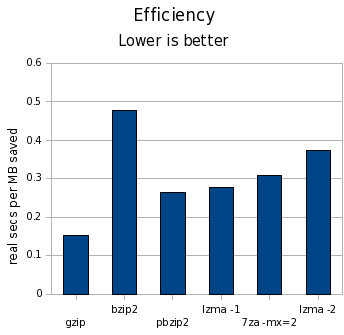
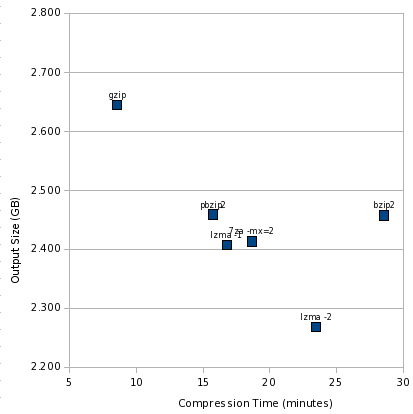
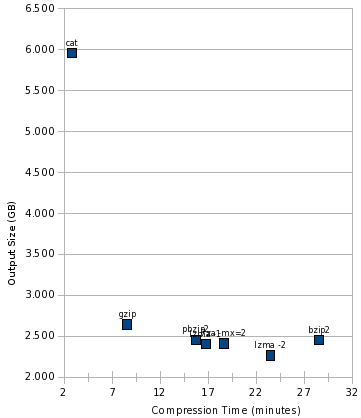
In the MB saved column, higher numbers are better; in all other columns, lower numbers are better. I m using clock seconds here on a dual-core machine. The cost column is clock seconds per MB saved. What does this tell us? Some Pretty Charts First, let s see how the time vs. size numbers look: compress-zoomed Like the other charts, the best area is the lower left, and worst is upper right. It s clear we have two outliers: gzip and bzip2. And a cluster of pretty similar performers. This view somewhat magnifies the differences, though. Let s add cat to the mix: compress-big And finally, look at the cost: compress-efficiency Conclusions First off, the difference in time is far larger than the difference in space. We re talking a difference of 15% at the most in terms of space, but orders of magnitude for time. I think this pretty definitively is a death knell for bzip2. lzma -1 can achieve better compression in significantly less time, and lzma -2 can achieve significantly better compression in a little less time. pbzip2 can help even that out in terms of clock time on multicore machines, but 7za already has a parallel LZMA implementation, and it seems only a matter of time before /usr/bin/lzma gets it too. Also, if I were to chart CPU time, the numbers would be even less kind to pbzip2 than to bzip2. bzip2 does have some interesting properties, such as resetting everything every 900K, which could provide marginally better safety than any other compressor here though I don t know if lzma provides similar properties, or could. I think a strong argument remains that gzip is most suitable for backups in the general case. lzma -1 makes a good contender when space is at more of a premium. bzip2 doesn t seem to make a good contender at all now that we have lzma. I have also made my spreadsheet (OpenOffice format) containing the raw numbers and charts available for those interested. Update Part 2 of this story is now available, which considers more compression tools, and looks at performance compressing files individually rather than the large tar file.
James Morrison: Larry

[This is something old I wrote up while I was in Brazil]

It turns out I can't have an uneventful *set* of flights when Brazil is involved. My first flights to Brazil would be the most uneventful, I got earlier flights than I had booked. The next time I tried to fly, I flew out of Brazil, which since I booked through an agency outside Brazil I had to get paper tickets. The paper tickets didn't get to me in time, so I basically had to rebuy my tickets.

So this time, I learned my lesson, I bought the international tickets separate from my inside brazil tickets. This means I could get electronic tickets all the way. One problem is that I can't pay any of the Brazilian carriers directly since I don't have a Brazilian CPF. So a friend bought my ticket the day before I left. The ticket had a small problem, I had to go through Rio to get to S o Paulo. I would have two hours between the flight from Rio to the flight to JFK. Unfortunatly the leg from Rio to S o Paulo was an hour late and I had to run to get checked into to the flight to JFK. It turns out I had lost my seat, but I did get on the plane and wasn't the last one to check in. The way back to Belo Horizonte was supposed to be simpler, I had a lot of time in S o Paulo before the direct flight to Belo Horizonte. Well, unfortunatly the boarding passes I was given was for Larry Morrison going to Lima, not for James Morrison going to S o Paulo. It feels really bad that the woman who checked me in, used checked two pieces of ID, and the security guy who checked my boarding pass didn't notice this. I didn't notice this either since I had two boarding passes with the first one going to Miami. Anyway, so after Larry and I had the same seat on the flight to Miami we figured out I had the wrong ticket. I got the right one then we were off. We arrived in Miami in good time, but our gate was occupied, which meant we disembarked 20 minutes late and 10 of us had to push through the aisles to get out and onto the connecting flight to S o Paulo. This flight was again uneventful. However, in S o Paulo there was a nice long wait at customs, no processing time for me, then the discovery that I had made it to S o Paulo, but my backpack hadn't. Fortunatly, there was a second flight from Miami arriving in 30 minutes (left 2 hours later than mine) that should have my bag. It turned out I did, so I could finally go check in for my flight to Belo Horizonte. That checkin was almost uneventful, but again the line took forever. I waited for 8 minutes as the second person in line. Again, I took no time getting processed. Given the time I take to go through customs and checking in, how could both those lines move so slow?

16 February 2009

Daniel Leidert: Update to Lenny

Now that Lenny has been released I ve updated some machines and found just one flaw. There is a cvsd installation, which has been extended with an OpenSSH server. After the upgrade the server refused the connection. Enabling debugging output showed:
sshd[...]: fatal: ssh_selinux_getctxbyname: ssh_selinux_getctxbyname: security_getenforce() failed
in the log. Searching the web a bit revealed, that the CHROOT now needs a mounted /proc. Done and everything works :)

Steve McIntyre: Release++

Thanks to everyone involved. Just finished my pieces of the release process, generating 502 CD/DVD/BD images. And technically it's still February 14th, somewhere... :-) I should go and get some (more!) sleep, but I want to see us completely finished before I do. Update: (15th Feb) People have been asking about the BD images. We decided a while back that we wouldn't ship full-size BD ISO images, simply due to the sizes of those images. For the same reason, we didn't generate them for all architectures, just concentrating on i386, amd64 and source. If you're looking for the BD images, you can download/make them via jigdo. Update #2: (16th Feb) Yes, it's possible that we could make a multi-arch BD image containing all of i386, amd64 and source, similar to the multi-arch DVD. Last time I built that, it would just about fit on a dual-layer disc. That would be a really expensive disc to burn, but let me know by email and I can make the image for you if you really want it.

Wouter Verhelst: Heather Dale: Live in K ln

Last june, I went to Cologne to visit a friend I'd first met Heike at Debconf7 in Edinburg, where we had much fun playing some music together. So the next time we met, which was at FOSDEM '08, she told me that she'd been playing in a band. As in, the kind of people who make music profesionally. Which was really cool. She also told me that this band, which consists mainly of a Canadian couple, would be playing in Cologne in early june, and that perhaps it'd be nice if I could come over to watch. Considering that'd be a nice excuse for a short holiday, I went, and had a great week in Cologne. Since Heike and the others had to practice, I only saw them in the evening; but Cologne is a great city, with interesting museums and other things, so I would spend the day sightseeing in Cologne (and Bonn on one day), and would be at the particular bar or whatever where the concert would be in the evening. I had a great time. Before going home, I bought one of their CDs, since I really liked the music. Anyway, at this year's FOSDEM, Heike told me that there was a new CD out (actually MP3 downloads), made from a recording that was done at one of the concerts. So, today, I bought a copy. Come to think of it, this is the first time I bought an album of a concert that I actually went to, and where I did not perform myself. After all, I don't really go to concerts all that often unless I'll be on stage. What's strange is that the music sounds slightly different from how I remember it. The mind can do strange things... or is it the case that a recording is not the real thing? Probably. In any case, the music is great, so go check it out!

Joey Hess: debhelper dh overrides

This is a followup to the earlier design of dh. After converting many packages to minimal rules files using dh, I find that it works very well for the 3 line rules file case, which works for 80% of packages. But getting from there to a slightly more complex rules file that 20% of packages need can be non-obvious. So, let's make it obvious. Suppose I want to run dh_compress -Xsomefile. But my rules file as it currently stands doesn't offer an easy place to run that command:
#!/usr/bin/make -f
%:
    dh $@
To use dh in this situation you had to go look up rather a lot of boilerplate, and to insert an explicit version of the right target, with the right dependencies, that called dh before and after your command:
#!/usr/bin/make -f
%:
    dh $@
binary: binary-indep
binary-indep:
    dh $@ --before dh_compress
    dh_compress -Xsomefile
    dh $@ --after dh_compress
That took me half an hour to come up with, and I wrote this stuff! Also, if I want to override a second command, I have to do it in the right order. So, the full flexability of debhelper is there, but it's too hard to get at. Here's the new new thing.
#!/usr/bin/make -f
%:
    dh $@
override_dh_compress:
        dh_compress -Xsomefile
What this does should be obvious. These override targets can be written for any debhelper command that you need to change the default behavior of, or even avoid running at all.
override_dh_auto_configure:
    ./configure --with-kitchen-sink
override_dh_auto_test:
    # The test suite for this package is busted on s390.
    if [ $DEB_BUILD_ARCH != s390 ]; then dh_auto_test; fi
The overrides can also be used to run additional stuff before, or after any debhelper command:
override_dh_clean:
    dh_clean
    rm -rf build_dir
So, I think that's beautiful. Simple, clean, no boilerplate, and intuitively obvious if you are familiar with debhelper.
FWIW, the implementation, which will be in the next debhelper release unless someone screams loudly, is not beautiful. Mostly because I sorta shot myself in the foot with the cute implicit "%:" rules. But, I got around it. :-)

Erich Schubert: Congratulations, Debian

Debian Lenny Banner Congratulations to all developers (DDs or not, we have sponsored uploads, Debian contributors and such, too!) who contributed to the release of Debian GNU/Linux "lenny" 5.0. I must admit that I've been largely inactive recently, I just managed to keep the bugs on my remaining packages low. Funnily, just the day lenny was released I learned about a bug in Enigma on AMD64 that is probably worth fixing through proposed updates ...

Amaya Rodrigo: Oh, the Irony...

My heart, self-steem, ability to smile, or find joy in life
were severely broken on February the 13th (it was a Friday, BTW),
and then Debian comes out on Valentine's day.
I don't know whether I want to kill or kiss you people,
anyway, there must be some message there.

Russell Coker: Xen and Lenny

Debian GNU/Linux 5.0 AKA Lenny has just been released [1]. One of the features that is particularly noteworthy is that Xen has been updated and now works fully and correctly on the 2.6.26 kernel (see the Debian Wiki page about Xen for details [2]). This may not sound exciting, but I know that a lot of people put a lot of work into getting this going, and for a long time in Unstable it wasn t working well. I ve just upgraded three Xen servers from Etch to Lenny (actually one was Etch kernel with Lenny user-space), and they all worked! Those three servers were all running the i386 architecture, the next thing to do is to try it out with the AMD64 architecture. One of my plans is to try the latest Debian kernel on the server I use in Germany, but I ll try on a few other AMD64 machines first.

Jon Dowland: hard sf

"Hard SF" is a sub-genre of Science Fiction where "Science" is key. It's very hard to draw solid lines around stories that are examples of Hard SF, but it's easier to provide examples of things which are not: "Star Wars", for example, where space ships, travel and light sabres are window-dressing around a fantasy story. If you look at the Wikipedia article on Hard SF, in particular it's edit history, you will see people continually argue back and forth. Editor Jonathan Strahan recently asked for some recommendations of Hard SF authors to be included in a new Hard SF anthology. I stumbled across this via sfsignal. There are some good comments at both sites, and a fair amount of disagreement over whether certain authors should be considered Hard SF authors or not. Alastair Reynolds was cited by people several times. I really enjoy much of Reynold's writing, but I wouldn't consider it Hard SF. I argued this point and Reynolds himself joined the discussion.
This page is a draft.

Paul van Tilburg: Post-FOSDEM 2009

I have attended FOSDEM again this year. Most of all, it was nice to see everyone again, especially the Collabora crew. Besides having fun while hanging out with them again, I must say FOSDEM was quite a motivation boost too! I feel motivated again to work on Ruby packaging. The whole RubyGem mess and other less-specific Ruby-related messes keep draining my motivation. This feels very conflicting, since I like the language very much. The upcoming transition to Ruby 1.9.1 will be quite a challenge and I hope that we can finally work out a nice, actual Ruby policy for Squeeze. A few days ago I have also joined the pkg-gstreamer team, mainly to work on Elisa packaging. Elisa is a nice-looking media center application that I am using on my HTPC(Home Theater PC). Debian s experimental suite now contains an up-to-date version of Elisa, try it out if you want. Elisa 0.5.27 So, why is Elisa not in unstable yet. Well, Elisa has a plugin system which also features auto-updates. While this is very nice on platforms such as Windows, it is not really nice for Debian. I have been working to get this updating disabled by default. Once I am sure (hopefully by the time 0.5.28 gets released) that it is in order, I wil upload it to unstable. Meanwhile I am planning to work on some Elisa plugins to add some features that I feel are missing. First of all I need webradio a la Rhythmbox in there. Then something to watch TV: a MythTV frontend-plugin, via UPnp, or whatever works. Finally it might be nice to have to have a plugin to setup video-conferencing using Telepathy. I m quite sure some of these things are lying around somewhere, more about that later.

Christoph Haas: Debian 5.0 cake

Thanks to all involved people for the Debian 5.0 Lenny release! My wife made me a cake for my coworkers so we can celebrate a little. But even my boss believes that it must have been my birthday because no sane person would bring a cake to celebrate bits and bytes. Well, here it is (black forest cake style): My wife\'s contribution to the Debian 5.0 Lenny release (Sorry for the quality of the photo. My real camera died yesterday.) ((Now I have to verify the complaints of a coworker that LXDE still doesn t install.))

Martin-&#201;ric Racine: Roadmap to a better FreeDesktop: ridding us of the Firefox filth

Lately, I've been pondering how to solve one annoying aspect of the FreeDesktop, namely how to eject the piece of bloat called Firefox from the picture and get myself a fast web browser that I can rely on and that yet offers a similar UI experience based upon native GTK2 widgets rather than XUL components. Just to investigate possible options, I tested Epiphany, Galeon and Konqueror. My conclusions were than a Gecko-based Epiphany or Gaelon is incredibly fast and that Konqueror offers a similarily efficient experience albeit using QT, rather than GTK2 widgets. Why is Firefox so bloody bloated then, if it uses the same Gecko engine as Epiphany and Galeon? The only possible conclusion I could come up with is that its crappy XUL implementation, rather than leverage existing native GTK2 or QT widgets, tries to reinvent the wheel with its own UI toolkit running as a gigantic RAM blackhole. One option that I wanted to investigate but found too deficient was a Webkit-based port of Epiphany. Unfortunately, at its current stage, the GTK2 port of Webkit simply isn't mature enough to consider, although the fact that Webkit has been succesfully ported to a number of platforms and constitutes the basis for Safari on Mac OS suggests that the potential is significant. That only leaves one single aspect on which Firefox wins hands-down: its UI concept; it just works well, whereas Epiphany simply has a UI concept that is utterly inadequate, because it is too crude, lacking basic necessities such as a session saving feature that also works when purposely unloading the application, rather than only as a crash recovery measure. Simply put, Epiphany's premise that a browser should never be closed and thus ought to always remain open in the background of a desktop session is utterly flawed; it doesn't work like that in real life and Firefox acknowledges this, while Epiphany stubbornly doesn't because someone wreaked Havoc in our desktop paradigm. Anyhow, to me the solution is clear: regardless of which rendering engine it uses, Epiphany's UI concept needs to become more like Firefox, before it can truly gain acceptance as the default browser among Linux distributions.

Joey Hess: mmmmm

I took the package of blackberries from the freezer, where it had sat, neglected since I picked them from my fecund vines in August. They had some frost on top; it didn't seem that the wait could have improved them. But, I figured, let's do this right. No store-bought pie crust, made my own with lots of love, and no little trepidation, since pie crust is not my strong suite. Put it back in the fridge to rest as I melted the frozen berries. Added some honey, then worried I'd sweetened it too much. Seemed too runny, so added some flour. Spent what seemed a long time criss-crossing strips of the pastry on top. Which, now that I look at it, doesn't seem to be quite the way it's typically done, but whatever. 45 minutes later, it came out, and bliss, it's the most perfect pie I've ever made. Crust acceptably flaky, berries just the right mix of tart and sweet. But mostly, it tastes of summer and care, and the wait seems to have been worth it. So that's my Debian release pie.
On the software side of things, I didn't do anything much toward making this release happen. Indeed, I have forgotten most of what I put into the mix earlier. (Something to do with armel, and firmware, and maybe boot menus?) It was a nice change to sit back and watch and not worry (much) about doing anything myself. I think that someone fell asleep in his chair while running the CD builds and had to get a wakeup call early this morning to finish. Dedication. Seems like there should be a better way, but you can't argue with the result. Previously: Easter Etch, Releases and Such, Where was I When ..

15 February 2009

Steve McIntyre: Release++

Thanks to everyone involved. Just finished my pieces of the release process, generating 502 CD/DVD/BD images. And technically it's still February 14th, somewhere... :-) I should go and get some (more!) sleep, but I want to see us completely finished before I do. Update: People have been asking about the BD images. We decided a while back that we wouldn't ship full-size BD ISO images, simply due to the sizes of those images. For the same reason, we didn't generate them for all architectures, just concentrating on i386, amd64 and source. If you're looking for the BD images, you can download/make them via jigdo.

Next.

Previous.