Search Results: "ag"

18 February 2009

Julian Andres Klode: Python modules, licenses, and more


Today, I want to present you some things I have asked myself and some ideas about them. You should not expect the information to be correct. Therefore, if you find mistakes, please leave a comment. Copyright statements / Comments MIT license: The above copyright notice and this permission notice shall be included in all copies or substantial portions of the Software. - If you had a python module released under the MIT license, and this is in the comment of the module and you somehow ship only pyc or pyo files, you would be violating the license by not including the copyright notice, because these files do not contain the modules. This is also true for many other licenses, but this seems to be the best example. If you include this in the docstrings, you would only violate such license terms if you distribute bytecode created with the -OO option. This also does not apply if the code is a program which prints the license (eg. via a commandline license option). GPL vs LGPL Is there any difference at all? The LGPL requires you to publish all changes you make to the code, while the GPL also requires you to publish source files you have created. This also means that you can t link a non-free program to a GPL library, but you can link it to a LGPL library. Because Python modules are not linked to each other, everything you do is normally considered a use of the module. Therefore, if there is a module G released under the GPL, and a module X released under a different, incompatible license X, you would still be able to use the facilities provided by the module G. This also effects subclassing classes of G in X. Due to the enormous flexibility provided by Python you can easily break the intented rules of the GPL. Instead of editing the class definition you subclass the class and edit it. You can also replace stuff inside the module G during run-time, simply by setting the relevant attributes. In summary, Python makes it very easy to work around the restrictions of the GPL, therefore, using the LGPL instead of the GPL makes no sense. You can t give others more rights than they already have. You would just make it easier for others in case they want to write new code and want to copy some of yours. What about the AGPL? The AGPL exposes (compared to the GPL3) further restrictions on using the software on eg. websites. It is intended for programs which may be used by SaaS providers. Like with the GPL, the enormous flexibility of Python compensates most of the restrictions the license. BTW, which license to choose? I normally choose to release my programs and modules, etc. under the terms of the GNU General Public License, version 3 (or at your option) any later version. But it also depends on the size of the project. When I work on small scripts, like hardlink, I generally choose the MIT license. This is also somehow related to the fact that I don t want to have a license which takes more than 50% of the size of my project. This is actually a bit different to what Bruce Perens does. Bruce recommends 3 types of licenses. The first one is what he calls the gift license. He recommends the Apache License 2.0, because it provides better protection from software patent lawsuites . The MIT license is another example for this type of license. While not providing the patent protection, this is not that critical for persons like me who live in Germany. Furthermore, the number of patents possibly infringed by the code is proportional to the amount of code. The second type he recommends is a sharing-with-rules license, like the GPL 3. Like him, I mostly use this license for my code. Sometimes I also use the GPL 2, but only when I am required to do so, or because of tradition. In generally, I only upgrade software from GPL-2+ to GPL-3+ when I introduce new features, not for bug fixes or similar. The third type he describes is the in-between license , like the LGPL. As I pointed out above, this type of license is not much different than the GPL, at least if applied to Python modules. Therefore, I never release any Python module under such a license. Things may be different for C libraries (and others), but I never released one. Documentation, etc. Well, I license all my documentation under the same license as the software. This makes it easier for the user because he does not need to read yet another license (at least if he reads all the licenses of the software he uses). If I distribute non-code content independent of code, I generally choose a Creative Commons License (CC-BY-SA 3.0, CC-BY 3.0), Germany. This also has an effect on this blog. From now on, all content (ever) provided by me via this blog is licensed under the terms of the Creative Commons Attribution-Share Alike 3.0 Germany, unless a different license information is included as part of the post. The design and comments from other persons are not included. Why I wrote this Really, I don t know. Maybe I just want to write something, maybe I want to write these things down, so I can read them. Anyway, please tell me if I my conclusions/ideas are wrong. Update 1: There was a mistake should expect the information to be correct , fixed now: should not expect [...] . I may be wrong with the GPL vs. LGPL thing, have not completely checked this. (2009-02-18 19:18 CET) Update 2: Seems the GPL vs LGPL thing is not correct, as written by Anonymous and Bruce. (2009-02-18 19:26 CET) Posted in General

Kartik Mistry: 3 Years!


* It all started with this sip! At Marriage.. 3 years. Thanks my dear Koki!

Julien Blache: mt-daapd EPIC WIN

I ve been doing some code lately, fixing things here and there, and over the last few days gave mt-daapd some attention. First, I was reported a segfault of mt-daapd when reloading web pages too fast. Surprisingly, it turned out to be a stupid omission in a simple routine and it is hard to hit without disabling the cache in the browser. Now, I just fixed something that s been bugging me for a while: mt-daapd did not handle Avahi daemon restarts, leading to mt-daapd becoming invisible to clients relying on mDNS until you restarted it. And, wow, that went a bit further than expected. As I expected, the simple piece of code needed to handle that wasn t there. But still it did not work, as it turns out the event loop for the Avahi polling wasn t being run. Replace stupid code reinventing the wheel by the Avahi-provided wheel and there, it works. But not when run as a daemon (aka foreground only). Well yes, starting the thread before daemonizing isn t going to work well, so fix that. EPIC WIN \o/ As mt-daapd s upstream is not active anymore I m accumulating fixes for mt-daapd in the Debian package, to the point I m starting to consider setting up a git repository somewhere with those fixes and possibly some more code rework if I feel like it.

Jon Dowland: mml

Some time ago, I wrote some quick-and-dirty greasemonkey javascripts to parse plain text bodies of mail messages and mark up things such as quotes, so you could collapse/expand them, colour quotes differently depending on depth, etc. As a result of that experience and countless flamewars about top vs. bottom posting, I've often thought that a markup language specifically designed for email was a good idea. top/bottom posting could be a presentation decision of the client; you could GPG-verify quoted mail; conventions like 'Re:' could be internationalized, again on the client side, etc. This morning I discovered Mail Markup Language which is exactly that. Unfortunately, it appears to have some outright bizarre features. The RFC draft describing it is enormous, including a full XSLT description of the markup language (and not in an appendix either); a legal preface claiming that the entire thing was patent pending (and using a subset of MML would be considered patent infringement); it claimes to obsolete 1939, 3501, 5322, which are POP3, IMAP4r1, and Internet Message Format respectively. You shouldn't judge a book by it's cover, but the fact their website displays awfully for me (epiphany 2.22.x) did prepare me somewhat for the zaniness that followed.

Mark Brown: Buffer overflows ahoy

I may be wrong on this but it looks like Microsoft SMTP clients (at least Windows Mail and Outlook) don t like being sent a large volume of SSL certificate information when opening a TLS connection. They appear to assume that the data they are being sent is malformed and assume that STARTTLS failed, continuing with an unencrypted SMTP dialogue. This can be triggered relatively easily on a Debian system by telling Exim to use all the certificates provided by the ca-certificates package (which is the default configuration). The Windows clients will give an unhelpful the remote end dropped the connection style error, caused by the server getting upset by the unexpected fallback to unencrypted SMTP. The server logs will show something like this:
2009-02-17 21:32:55 TLS error on connection from client.example.com (Client) [192.168.192.168] (gnutls_handshake): A TLS packet with unexpected length was received.
2009-02-17 21:33:00 SMTP protocol synchronization error (input sent without waiting for greeting): rejected connection from H=client.example.com [192.168.192.168] input="EHLO Client\r\n"
Configuring the MAIN_VERIFY_TLS_CERTIFICATES option in the Debian Exim configuration (which sets the tls_verifiy_certificates option in the actual Exim configuration) to point to something with less certificates in should avoid the issue. On the bright side, at least they re making an effort to avoid overflows.

MJ Ray: Banking with Free Software/Firefox: MPS Italy

A web browser
Websites I ve just updated the online banking compatibility list after a report from Italy that Monte dei Paschi di Siena is not currently working for GNU/Linux users. Can anyone confirm they broke it, or tell us how to get it working, please?

MJ Ray: OSI and FSF Licence Approval Comparison

The Open Source Initiative and the Free Software Foundation are probably the two authorities on what is free and open source software that are better respected than the debian project. It s fairly easy to see that the famous licences (GNU GPL) appear on both lists, but how similar are their approvals? There was a comparison at Asheeshworld Notes you will like: OSI vs FSF in 2007, but I ve noticed more and more duplicates in that listing and the source code didn t work for me. I ve captured the current differences between their actual approvals in a pseudo-diff. The generating code and intermediate steps are splattered around the same folder. Many of the differences look like a result of process differences, but I m not sure because OSI doesn t make any comments and their licence review process archive seems awkward to search. As I understand it, a lawyer advocates a licence in the OSI process, so it requires the licensor to contribute (and many licensors couldn t care less about OSI); but FSF does an independent review, so FSF has to decide it s worth reviewing. In case it s not obvious, I think FSF s independent foundation-led review is much the better of those two. There are two licences that OSI approved but FSF lists as non-free: NASA Open Source Agreement and the Reciprocal Public License. Both of these are send-back-ware where changes have to be sent back or made available to the upstream developer. Many debian developers agree such payments-in-kind are non-free (OSI s OSDefinition is based on the Debian Free Software Guidelines), but I think an early OSI advisor thought they were a good idea, so those approvals look like an OSI bug to me. It s not obvious if there are licences that FSF approves but OSI rejects. OSI doesn t seem to list licences to avoid. Is it helpful to see the differences? Would a comparison with the debian archive be useful? Are there other curiousities captured in the differences? Are people interested in reconciling the differences?

Biella Coleman: Medpedia

Given the fact that patients have been shamelessly and copiously sharing information on the web since, well, it first sprung up, it is nice to see that the medical establishment has gotten on board with the idea of collaboration. Medpedia is firmly an expert project (though it looks like anyone can provide suggestions) and I am not bothered by this limitation. What I do hope to see is a recognition of the controversies that abound in the realm of medicine (Lyme disease, fibromylagia, and a real hot rod issue = autism). There is much about diagnosis and therapy in medicine that exists in the I am not sure (how to diagnose/treat category and I wonder if this will be reflected in this new project. I certainly hope so.

Biella Coleman: Medpedia

Given the fact that patients have been shamelessly and copiously sharing information on the web since, well, it first sprung up, it is nice to see that the medical establishment has gotten on board with the idea of collaboration. Medpedia is firmly an expert project (though it looks like anyone can provide suggestions) and I am not bothered by this limitation. What I do hope to see is a recognition of the controversies that abound in the realm of medicine (Lyme disease, fibromylagia, and a real hot rod issue = autism). There is much about diagnosis and therapy in medicine that exists in the I am not sure (how to diagnose/treat category and I wonder if this will be reflected in this new project. I certainly hope so.

John Goerzen: How To Think About Compression, Part 2

Yesterday, I posted part 1 of how to think about compression. If you haven t read it already, take a look now, so this post makes sense. Introduction In the part 1 test, I compressed a 6GB tar file with various tools. This is a good test if you are writing an entire tar file to disk, or if you are writing to tape. For part 2, I will be compressing each individual file contained in that tarball individually. This is a good test if you back up to hard disk and want quick access to your files. Quite a few tools take this approach rdiff-backup, rdup, and backuppc are among them. We can expect performance to be worse both in terms of size and speed for this test. The compressor tool will be executed once per file, instead of once for the entire group of files. This will magnify any startup costs in the tool. It will also reduce compression ratios, because the tools won t have as large a data set to draw on to look for redundancy. To add to that, we have the block size of the filesystem 4K on most Linux systems. Any file s actual disk consumption is always rounded up to the next multiple of 4K. So a 5-byte file takes up the same amount of space as a 3000-byte file. (This behavior is not unique to Linux.) If a compressor can t shrink enough space out of a file to cross at least one 4K barrier, it effectively doesn t save any disk space. On the other hand, in certain situations, saving one byte of data could free 4K of disk space. So, for the results below, I use du to calculate disk usage, which reflects the actual amount of space consumed by files on disk. The Tools Based on comments in part 1, I added tests for lzop and xz to this iteration. I attempted to test pbzip2, but it would have taken 3 days to complete, so it is not included here more on that issue below. The Numbers Let s start with the table, using the same metrics as with part 1:
Tool MB saved Space vs. gzip Time vs. gzip Cost
gzip 3081 100.00% 100.00% 0.41
gzip -1 2908 104.84% 82.34% 0.36
gzip -9 3091 99.72% 141.60% 0.58
bzip2 3173 97.44% 201.87% 0.81
bzip2 -1 3126 98.75% 182.22% 0.74
lzma -1 3280 94.44% 163.31% 0.63
lzma -2 3320 93.33% 217.94% 0.83
xz -1 3270 94.73% 176.52% 0.68
xz -2 3309 93.63% 200.05% 0.76
lzop -1 2508 116.01% 77.49% 0.39
lzop -2 2498 116.30% 76.59% 0.39
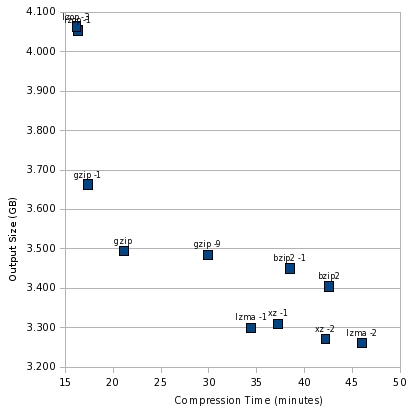
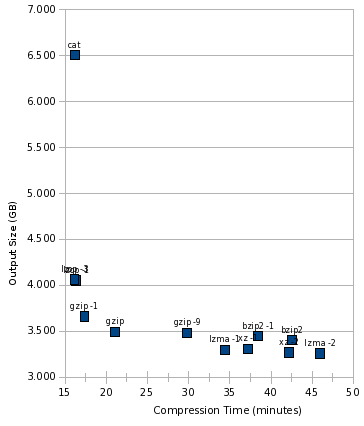
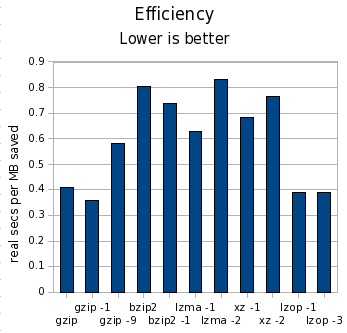
As before, in the MB saved column, higher numbers are better; in all other columns, lower numbers are better. I m using clock seconds here on a dual-core machine. The cost column is clock seconds per MB saved. Let s draw some initial conclusions: The Pretty Charts Now, let s look at an illustration of this. As before, the sweet spot is the lower left, and the worst spot is the upper right. First, let s look at the compression tools themselves: compress2-zoomed At the extremely fast, but not as good compression, end is lzop. gzip is still the balanced performer, bzip2 still looks really bad, and lzma -1 is still the best high-compression performer. Now, let s throw cat into the mix: compress2-big Here s something notable, that this graph makes crystal clear: lzop was just as fast as cat. In other words, it is likely that lzop was faster than the disk, and using lzop compression would be essentially free in terms of time consumed. And finally, look at the cost: compress2-efficiency What happened to pbzip2? I tried the parallel bzip2 implementation just like last time, but it ran extremely slow. Interestingly, pbzip2 < notes.txt > notes.txt.bz2 took 1.002 wall seconds, but pbzip2 notes.txt finished almost instantaneously. This 1-second startup time for pbzip2 was a killer, and the test would have taken more than 3 days to complete. I killed it early and omitted it from my results. Hopefully this bug can be fixed. I didn t expect pbzip2 to help much in this test, and perhaps even to see a slight degradation, but not like THAT. Conclusions As before, the difference in time was far more significant than the difference in space. By compressing files individually, we lost about 400MB (about 7%) space compared to making a tar file and then combining that. My test set contained 270,101 files. gzip continues to be a strong all-purpose contender, posting fast compression time and respectable compression ratios. lzop is a very interesting tool, running as fast as cat and yet turning in reasonable compression though 25% worse than gzip on its default settings. gzip -1 was almost as fast, though, and compressed better. If gzip weren t fast enough with -6, I d be likely to try gzip -1 before using lzop, since the gzip format is far more widely supported, and that s important to me for backups. These results still look troubling for bzip2. lzma -1 continued to turn in far better times and compression ratios that bzip2. Even bzip2 -1 couldn t match the speed of lzma -1, and compressed barely better than gzip. I think bzip2 would be hard-pressed to find a comfortable niche anywhere by now. As before, you can download my spreadsheet with all the numbers behind these charts and the table.

Matt Brown: Blacked Out - no Guilt Upon Accusation

If you re reading this post via the website rather than a feed/planet then you will notice that the site has gone completely black in support of the Creative Freedom Foundation s campaign against S92A of the NZ Copyright Amendment Act which is due to come into effect on 28th February 2009. I ve also joined the wave of people blacking out their avatar on Facebook/Jabber/MSN, etc. S92A introduces Guilt Upon Accusation whereby if you are accused of copyright infringement (downloading music and movies, etc) repeatedly (likely 3 or more times) you are at risk of being disconnected from the Internet by your ISP. The law does not require any proof or substantiation of the accusations and the entire process would occur outside of the courts and the established legal system. Not only does it place every user at risk, the wording is very unclear on exactly what type of organisation is considered an ISP and there is significant concern that schools, businesses, libraries and hospitals will be placed in the difficult position of determining whether their users have broken the law and require disconnection. Opposition to the law is not an attack on copyright, or a statement that we should be free to download all the movies and music that we desire. Those sorts of activities are clearly wrong, and I don t have any issue with copyright holders wanting to enforce their rights when their content is illegally copied. However, disconnecting people upon accusation, with no proof or formal legal process to prove guilt is not the right way to go about it. The fact that the law does not require proof of guilt is only the tip of the iceberg in terms of problems with it. For further background on the problems it causes for ISPs by placing them as the middle-man in copyright disputes you should refer to the following posts: Finally, I think it is worth pointing out that S92A was removed from the proposed Amendment at the select committee stage, but was later reintroduced by Judith Tizard during the final reading of the bill. Mark Harris has an excellent post on the history of the amendment which includes facts such as the official report on the amendment also recommended removing S92A as it was unecessary given existing ISP terms and conditions which forbid illegal activity. The fact that the select committee (based on public submissions) recognised the problems with S92A and removed it, only to have it added back in again at the last stage when we no longer had any say on it really hacks me off and I cant help but feel the influence of the big money American media companies pressuring our politicians to pass a law that they don t really understand the full consequences of. So what is to be done? The Blacked Out campaign, being run by the Creative Freedom Foundation is gathering steam and international attention. Peter Dunne of United Future (who originally voted for the amendment) has declared that the amendment is wrong, and doesn t do what they thought they were voting to do, we need to convince National and the rest of the house of the same. Time is running out for this to happen before the amendment comes into effect on Feb 28th, but there is still time to write to your local MP and sign the petition against S92A Guilt Upon Accusation . The Creative Freedom Foundation site has a nice easy list of what you can do to register your protest.

17 February 2009

Neil Williams: Taking over the reins of drivel

Neil McGovern noticed me using drivel for my blog entries at the recent Debian UK BSP for Lenny and as he isn't using it anymore, suggested that I might want to take over maintenance. It's always better to have a package maintained by a regular user of the program.

So, this is the blog post prior to the upload of the blog client, drivel.

I have a feeling that I may be taking on another upstream project into the bargain - I'm interested but not sure how much time it should consume. Upstream is not exactly active but that isn't a huge problem for me. There is a new unreleased version that needs a few fixes but the hardest part is the external bells and whistles, not the core of the program.

The initial upload fixes all the lintian stuff in the current package but drivel is a bit different to other packages, fixing bugs in drivel means having a way to test drivel with a variety of blogs, not just my own and that means setting up admin access to a variety of blog engines. Not sure I really want to be setting aside that much time.

Once the new version is in Squeeze, I'd welcome any ideas about extra functionality, provided all such ideas come with either patches or a willingness to test the upstream code against your own blog. :-)

Adrian von Bidder: Bowflex machine

After dropping all (pretense at) regular exercise after leaving high/grammar/secondary school (the german word is Gymnasium) and doing more or less nothing for more than 10 years, I've taken up weight training (after a not very successful attempt at volleyball; I like the sport but the team fell apart) two years ago. Since I actually managed to work out regularly (twice a week) in the first year, and since membership in a gym is not cheap, and since I moved and thus had to find a different solution anyway, I decided to buy a Bowflex Sport home gym. I can't compare it to other home equipment, and it apparently it has been discontinued by Nautilus, but nonetheless, a few thoughts: The conclusion first: Would I buy it again? No. Was it a waste of money? No, it's not that bad. In detail: Closing remarks: I'll probably keep it for quite a while. I've thought about spending much less money and just getting a bench and a few weights, but I really like to have a lat tower. Overall I can do what I want to do with the exception of cardio workouts. The other angle is that there is quite a bit of bad press around about the founder of Nautilus, Arhur Jones. I can't comment on how trustworthy these articles are, and I can't comment on Nautilus' business practices today (Mr. Jones seems to be dead), so take this with a large pinch of salt before making a buying decision based on moral/ethical standards.

Matthew Palmer: Depressing, yet Inspiring

If you're not reading The Daily WTF, today's soapbox article, Programming Sucks! Or At Least, It Ought To is a good reason to at least give it a glance now and then. Essentially, it's a wake-up call to all those programmers who think that their working life isn't complete unless every project is implemented in a new language, with a new framework, or at the very least using a bunch of the latest whizz-bang techniques that they read about on the back of their weeties blog this morning. My favourite rule, and one that I really need to re-learn myself, is:
Serve the Business. Every tradesman wants to use the latest, greatest, and most powerful tools, but rarely are they appropriate for the job. Likewise, there's hardly ever a business case to immediately upgrade all platforms/libraries/languages. That 10-year old "Classic ASP" code hasn't gotten worn out, just much less fun to maintain.
The rest of his rules are also useful, and should probably be printed out and stuck up around the offices of every IS development shop.

Dann Frazier: Adding firmware blobs to install media

Here's a shell script I wrote to stuff non-free firmware bits into an existing lenny installer image. It currently can operate on either a initrd.gz file or an isolinux-based iso image. I've only tested it on a netboot initrd.gz and a netinst iso, but it should work on larger images as well. If you need support for some other media type or architecture, let me know.

Lucas Nussbaum: Re: GIT sucks

Scott has several posts about git (1, 2, 3), and the I worked on this locally, now I want to push this to a remote place where others will be able to fetch it . I ve been using the following snippet for that. YMMV.

REPO=reponame
ROOT=/wheremygitreposare/
SERV=remoteserver
git clone --bare . /tmp/$ REPO .git && \
rsync -avzP /tmp/$ REPO .git $ SERV :$ROOT && \
git remote add origin $ SERV :$ ROOT $ REPO .git && \
git config branch.master.remote origin && \
git config branch.master.merge refs/heads/master
(Please post comments if you can improve it!)
But I totally agree that this common use case is not well addressed in git.

Gunnar Wolf: Yay for Lenny! (But nay for installation media)

Yay! This blog post is not strictly speaking news anymore - But for those who don't know it yet, three days ago Debian 5.0 Lenny was released, after 22 months of work (plus fun, plus flamewars, plus everything that makes a Free Software lover tick). And, of course, that makes us all very happy and proud. As always, upgrading is a breeze. Hats off specially to Wolfgang and everybody who worked towards the great release notes - No, it is not a simple task, by far. And I _do_ feel ashamed I didn't even beep that way :-( So, many of us are in the middle of planning/executing our servers' migrations. So far, I'm amazed for good. Even hairy issues such as firmware removal are magically and beautifully taken care of - i.e. my firewall kindly informed me during update that I would need to install the non-free firmware for my BNX2 (Broadcom) network interfaces, and I was just a package away from absolute happiness. Lets see what happens next Friday, as I will be upgrading our storage+application server (which is _way_ more complex than the servers I've dealt with so far). Anyway... But what good is a blog post if you are not ranting? Many people recognize me as one of the most Debian-connected people in Mexico, and that's very good. And yes, besides being a Debian Developer, I am a co-sysadmin for the main Debian mirror in Mexico. Some people have already asked me for CD-ROMs and DVDs. Of course, if I had a BluRay drive, I'm sure I'd also get requests for it. People: Do you really want such media? Think again... Do you really want 31 CDs or five DVDs for your favorite architecture? Ok, maybe many will say "nah, just give me the first one" - Then, do you want to limit your Debian experience to just the software that lives on the first 1/31th (or 1/5th) of it all? Of course there are many situations where it is desirable. Low bandwidth users, or people with no regular connectivity, will be much better served by suitable media from which to install. However, most of us (computer geeks living in Mexico City - Yes, that's the people contacting me) have at least a 1Mbps connection at home. People, just get the Netinst or Businesscard (180 or 40MB) images and download whatever is left via the network. Debian is extremely network-friendly. And, believe me, even if packages are sorted by popularity (and that's why most people will be happy with the first DVD if needed), you never know if you will want precisely a package that sits towards the lonely tail of popularity. And, yes, I did have my CD images handy for the Potato, Woody and Sarge cycles - but increasingly, it became easier for me just to ask apt-get to fetch stuff from the web (which is done without me moving from my comfy chair while I do anything else) than asking apt-get to ask me to go search for the f.*ing CD which I left dont-remember-where. Anyway... I'm not saying I won't burn your CDs - If you want them, please tell me in advance and come to my office, I'll be glad to give you some Debian disks. But spare the environment. We don't need to burn more and more disks. Use the network, be a better human being!

Wouter Verhelst: RedHat sucks

So a customer of mine needs to use RedHat. It's not their choice, the choice was forced upon them by the people who wrote the tools they need to use. The new version of this particular tool which they wanted to use requires RHEL5, and they're currently running RHEL4. So I had to upgrade their systems from RHEL4 to RHEL5. No sweat, right? Yeah, right. RedHat has this nice 'Red Hat Network', where you can manage your servers, and remotely mark packages for upgrade. You can also, by way of a command line tool, say that you want it to upgrade from one release to another. This can't be done remotely, which sortof makes sense; upgrading from one release to another might cause problems that you really really don't want if you don't have an immediate shell. So you should use 'up2date --upgrade-to-release=5' to upgrade from RHEL4 to RHEL5. Except that that doesn't work. For some reason, RedHat chose not to support in-place upgrades from RedHat 4 to RedHat 5. Instead, you have to download installation media, boot from them (thereby inducing downtime) and select 'upgrade' in the installer. Which part of this distribution is "Enterprise", again? Oh well. So I download the first ISO, and start the upgrade process. Surely that'll work, right? Hah. No, I really need all six images. So I download them, and start again. Some minutes into the installation, the HP iLO session that I'm using times out, and takes my Virtual CD device with it. As such, the installer-in-upgrade-mode obviously can't find the CD-ROM anymore, and produces a read error. This is totally normal. The system provides me with a 'retry' button. That button doesn't work. That is to say, it works, but after two or so files, the installation goes to a grinding halt. I had to reboot, and start over. So after rebooting, changing my iLO session settings so the timeout is at 120 minutes (the maximum) rather than 30 minutes (what appears to be the default), and I restart the upgrade process, making sure to click in the iLO interface every once in a while to keep it active. When it's somewhere at 80% and 3 hours into the upgrade process (god, why does that have to take so long?), it suddenly finds itself out of disk space. Well, shit happens, of course; guess there's nothing to blame RedHat with that one. But the way this situation is handled, is beyond my comprehension: The only 'recover' option is 'reboot'. There's no 'retry'. I don't mind diving to a second console, mucking about a bit on the mounted partition, and doing 'retry', but the installer doesn't even offer me that option. Instead, I have to choose 'reboot'. Never mind that the system is halfway through an installation process and might be totally and utterly broken, and not even bootable. Well, that's what rescue modes on installation media are for, I guess, but still. After cleaning out some old files that aren't needed anymore and going back to the installer, you'd suppose that the system could figure out what it'd already done, and continue from there, right? Well, no, it can't. It starts over from scratch, thereby forcing me to sit and wait for another three hours. Times like these make me remember why I'm a Debian developer, and not a RedHat one. Why I chose not to finish that Linux From Scratch project that I'd started after using RedHat for three years and about six months before becoming a Debian Developer. Why I stopped hitting my computer screen around that time. Stupid piece of shit. disclaimer: this is all IMAO, and you don't have to agree with me. But what's a blog for, if not to rant? ;-)

Erich Schubert: Weird Sansa Bug with 20+ playlists

On my Sansa Clip, a playlist that worked fine before suddenly stopped working. I couldn't find anything wrong with the list: it had DOS line separators, DOS directory separators and relative paths (all stuff that Sansa needs, unfortunately). I had generated proper EXTINF meta data lines, the list was called .m3u8 to singal it's UTF-8. And after all: it had worked before.After deleting a leftover playlist, suddenly I noticed with another playlist that had worked the day before that it was now empty. Ouch. So I investigated a bit more...At some point, I ran across a post on a similar Sansa device titled
Firmware Bug - Playlists numbers 43, 46, and 49 are always empty
This is also what I'm seeing on my device. Certain 'slots' in the playlist list don't work.No, I'm not kidding.The way I 'fixed' my non-working playlist was this: I duplicated the file. Now the duplicate is on the broken slot, and the old copy is working again. Unfortunately, this also has shifted the later playlists into other slots, so I'll have to repeat this for the other affected playlists. I guess I'll just write a script to keep duplicate copies of all my playlists, since apparently there are no two consequent slots affected.Broken slots on my Sansa Clip v2: 22, 25, 28, 34, 37, 40 (I have 59 lists currently on the player, so there might be more broken 'blocks' somewhere)

Jon Dowland: too much debconf a bad thing

I think a desireable property of the helper stuff that debian packages wrap around the underlying program (such as mailservers, webservers, etc.) is that you are still exposed to some extend to the configuration of the underlying service. The exim4 debian "value-add" layer is so thick that despite using exim4 in Debian for more than 4 years, I have been totally insulated from the configuration and have no idea how to do even the simplest tasks. Upgrading to lenny and exim4-config will not install due to DEBCONF templates in my config file. Yes, they are there, the older exim4 packages put them there. When prompted by debconf during the initial upgrade attempt, I said "do not overwrite my local exim4 configuration, it's changed a little". Reading the resulting error messages, that was the wrong answer: Now I need domain knowledge that the debian package has kept from me for all these years to proceed at all, and the tone of NEWS.gz is that it's my own damn fault. Thanks to Brett Parker for the solution: cp /var/lib/exim4/config.autogenerated /etc/exim4/exim4.conf and finally put a stop to this poisonous relationship that the exim4 packaging and I have had for all this time.
This page is a draft.

Next.

Previous.