Search Results: "sten"

28 April 2011

Russell Coker: What is Valid SE Linux Policy?

Guido Trentalancia started an interesting discussion on the SE Linux policy development list about how to manage the evolution of the policy [1]. The Problem The SE Linux policy is the set of rules that determine what access is granted. It assigns types to files and domains to processes and has a set of rules that specify all the permitted interactions between processes and files (among many other things). The policy evolves over time to match the requirements of programs (applications and daemons). As a program evolves the things that it does will change and the SE Linux policy will tend to evolve to permit the set of all operations that were requested by all versions because people only complain when things stop working not when excessive privilege is granted. So we need to periodically remove old allow rules from the policy. One difficulty in this regard is the fact that multiple versions of programs are often available for use at the same time. Debian in particular has a good history of providing separate packages for the old and new versions of programs such as Apache to meet the needs of users who want the tried and tested version and of users who want the newer version with better performance, more features, better documentation, or something else good. There is also a demand to have the same policy work with multiple versions of a distribution without excessive effort. Finally all the distributions that have SE Linux support have different people deciding when the new version of a daemon is ready for inclusion and therefore there is a need to support multiple versions for multiple distributions. So support for older versions of daemons can t be removed easily. One of the things I do to make these things a little easier to manage is to put ifdef( distro_debian', before any Debian specific bits of policy. When policy is conditional and only used in Debian I can freely remove it at any future time if Debian works well without it. Also it doesn t matter if such Debian specific policy allows access that is not needed or desired in other distributions, the only down-side to this is that sometimes other distributions need to repeat work that I did, they determine what access is needed for their configuration and discover that it was already enabled for Debian. What is Valid Policy? We went to only have Valid Policy (as described by Christopher J. PeBenito), so the challenge is determining what is Valid Policy. It seems to me that there are three type of access granted by valid policy (it is debatable whether type #3 is valid):
  1. Access that is needed for an application to perform it s minimal designed task.
  2. Access that is needed for the application to perform all the optional configurations, EG an ftpd running from inetd or as a daemon, and daemons like http server being granted access to ssl keys or not.
  3. Access that is needed to perform all the operations the application requests, but which the application doesn t require or shouldn t require if it worked correctly.
Some common operations that aren t required include opening utmp for write, searching /root, and many other relatively innocuous access attempts which don t affect the program operation if they are denied. There are also many things such as writing temporary files to /root that don t seem unusual if the application developer is not considering SE Linux (but which are often considered bad practice anyway). Some of these things (like using /root for stuff that belongs in /var/lib) have the potential to break things (for the daemon or for other system processes) even if you don t consider SE Linux. How to deal with those types:
  1. In most cases this can be determined without too much effort. For example a web server needs to listen on port 80 and read files and directories that relate to data. When writing policy I can write a lot of the allow rules without even testing the application because I know from the design what it will do. A large part of the other access is obvious in a I can t believe I didn t realise it would need this sense.
  2. The main question here is whether we have booleans (settings which can be tuned at run-time by the sysadmin which determine how the policy works) to specify which optional tasks or whether we allow all access for optional configurations by default. The secondary question is when certain unusual corner cases should be not supported at all such that the people who do such unusual corner cases need to use audit2allow to generate local policy to allow their operations.
  3. Sometimes we have to allow things that we really don t like. Even when we write policy to allow a daemon to do unusual things (such as using /root instead of /var/lib) it s still a lot better than running without SE Linux. Also SE Linux policy to allow such obviously broken things stands out and is a constant reminder that the daemon needs fixing, this is better than allowing symptoms of broken design to be forgotten.
How to Improve the Situation We could have comments in the policy source for everything that is in category 3. If the comments had a fixed format so that a recursive grep could find them all then it would allow us to more easily remove the gross things from the policy at a later date. But it seems to me that the main problem is a lack of people working on this. I am not aware of any people actively testing Debian policy for excessive privilege in regard to such issues.

Meike Reichle: What it's like to do Debian Press Work

A few days ago I did an interview for the People Behind Debian series that, among other things, covered my Debian press work and asked what it's like to do that kind of work for Debian. Here's a little addendum: Sometimes Debian Press Work is great: All these people do all this amazing stuff and it's a pure pleasure to talk about it. Our last release was such an experience for example. I was clamped to my laptop for almost 20 hours straight and I had a great time! There was this great common feeling of community, achievement and pride in our work and I was proud and happy to be a part of it. And then there are times like the last few days, where Alex and I went South for 4.5 precious and long-awaited days of vacation and ended up spending the first two of them working on an obituary for a dear and much valued member of our community and once this was done spent the remaining days of our holidays nervously watching the net and drafting and re-drafting press announcements because some <bleep> thought it might be oh-so-hilarous to send out faked cease and desist orders to a Debian user, ostensibly as a funny prank but along the way causing a huge amount of completely unsubstantiated FUD that we'll probably spend weeks clearing up. Somewhere in between these events is what Debian press work is like.

23 April 2011

Ben Hutchings: Recent changes in Debian Linux packages

Linux 2.6.38 and 2.6.39 As you've probably seen, the testing suite finally got a new upstream kernel version (Linux 2.6.38) and is currently synchronised with unstable. I'm just about to upload a new version of linux-2.6 based on upstream stable update 2.6.38.4. Linux 2.6.39 is well on its way to release, so 2.6.39-rc4 should soon be in experimental. The Debian source package will add support for the new armhf (ARM with hardware floating-point) architecture. Splitting linux-2.6 The linux-base package, introduced to handle transitions and other support functions for 'image' packages, is now built from a separate source package. It won't be changed very often, so you will no longer need to upgrade linux-base every time you upgrade an 'image' package. (This doesn't apply within 'squeeze', but I may have a way to work around that.) The firmware-linux-free package, containing a few firmware and configuration blobs from Linux that are DFSG-compliant, is also now built from a separate source package. These blobs have not changed for a very long time, so again you will no longer be recommended to upgrade this package every time you upgrade an 'image' package. Secondly, this allows us to remove the entire 'firmware' directory from the upstream source rather than carefully removing and patching to leave just the DFSG-compliant bits. Wireless regulations The '2.4 GHz' and '5 GHz' ISM bands used for wifi are not defined identically around the world. The exact frequency ranges and maximum permitted power levels vary between countries. Radio equipment manufacturers have a legal responsibility to ensure their equipment operates within these regulations. Since it is expensive to implement such regulations in hardware (including many different variants for different regions), these restrictions are usually implemented in the driver using a country code retrieved from the hardware's EEPROM or flash. So this is now our responsibility. We need to be able to look up regulations by country codes, and we also need to support the case where a device sold in one country is used in another country with tighter regulations. For some time, the wifi configuration library (cfg80211) included regulatory information for a small number of countries and regions. However, the default since Linux 2.6.34 has been to build-in only the 'world' domain (intersection of all the restrictions) and to request information from user-space. In Debian, we didn't have anything to provide this information, so for example channels 12-13 became unavailable for users in Europe. The regulatory information should be provided by the Central Regulatory Domain Agent (CRDA) from a current database. These are now packaged as crda and wireless-regdb respectively. Drivers that do not use cfg80211 (mostly those from the 'staging' area) will not be affected, and may or may not implement correct regulations. When you travel to another country or use an imported wifi device with an incorrect country code (I hear 'CN' is common), you can use iw reg set to ensure that your wifi devices operate within the regulations of the country you are in. Set the REGDOMAIN variable in /etc/default/crda to make this persistent. These will be intersected with the regulations specified by the hardware.

21 April 2011

Rapha&#235;l Hertzog: People behind Debian: Meike Reichle, member of Debian Women

Meike Reichle is a Debian developer since 2008 but has been involved for longer than that, in particular in Debian Women. She s a great speaker and shared her experience in a Debconf talk. She s also part of the Debian publicity team and managed the live coverage of the last release on identi.ca. Enough introduction, learn more about her by reading the interview. My questions are in bold, the rest is by Meike. Who are you? My name is Meike Reichle, I am a studied information scientist and work as a project manager at Pengutronix, an embedded Linux company probably best known for their ARM kernel work. I live in Germany, more exactly in Lower Saxony, but I was originally born and raised in Swabia. Although I moved here ten years ago I still have a rather strong Swabian cultural identity. (Among other things I pride myself on having introduced a number of fellow DDs to the true promise that are real hand-made Sp tzle ;-) ) I am married to Alexander Reichle-Schmehl, we ll have our third wedding anniversary this summer. Apart from Debian most of my spare time is used for all kinds of crafts and DIY activities. Making things with my hands always gives me a great sense of accomplishment. My Free software history is summed up pretty quickly. Like most women of my age I wasn t introduced to computers until well into my teens. I didn t have a computer of my own until I started studying at the university in 2001. From there on things developed rather quickly: Working on the University s Unix terminals got me hooked on *nixes, so I got me one of those Linuxes everyone talked about. I tried a couple of different distributions, ended up with Debian around 2004, started contributing in 2005, and finally became a full DD what a nice coincidence! exactly this day (Apr 18th) three years ago. You re part of Debian Women. How is the project going? I have the feeling that the number of women involved in Debian has not significantly increased. The amount of women active within Debian is a tricky thing to judge. Here s a quick example why: When the DPL was elected in 2004 there were 911 Debian Developers eligible to vote, 4 of them were female. Shortly after, during DebConf4, debian-women was founded. When the current DPL was reelected last month, there were again 911 Debian Developers eligible to vote, but this time 13 of them were women. You can look at these numbers and say The number of female DDs has more than tripled, what a success! Or you can pull out your calculator and it will tell you that in terms of ratio this puts us from a measly 0.4% to an only slightly less measly 1.4% ratio of female DDs. This still is pardon my language a bloody shame, but sadly also pretty close to the average ratio of women in Free Software. So, while I do think that the debian-women project did already have a significant impact on the Debian project as a whole, I don t think it has achieved its goals yet. Not for a long time. There s still a lot to be done but unfortunately the debian-women project has somewhat run out of steam at the moment. The seven years of its existence divide quite equally into the first half, which was very active and saw great results, and the second half, which was very slow and much more passive. In my impression debian-women is currently undergoing a rather bumpy generational change. On the one hand a lot of the original members, including myself, have reduced their involvement. Speaking for myself this is caused by shift of interests as much as general weariness. On the other hand there are only very few women following up. This development is also reflected quite harshly in DD numbers: If I don t misjudge any first names (and I desperately hope I do!) for the last three years not a single woman has joined Debian as a developer! After the great start debian-women has had, this is a very painful thing to see! That said, things don t look all bad. There is a number of women maintaining packages without being DDs and there s also at least one woman currently in NM, so there s hope this standstill won t last very much longer. But still, the fact remains that debian-women is suffering from a rather serious recruitment problem and I hope that this interview might actually help to spur some new or not yet active members into action. The aim of debian-women is far from achieved and now that its initial members are receding its time for new members to step up and take initiative. What should Debian do to be more attractive to women ? I think the general atmosphere has improved, we re less tolerant with rude behaviour, the usual tone on mailing lists has improved. Yet it doesn t seem to be enough. If there was a female DD for every time I answered that question First of all, I agree, Debian as a community has improved tremendously! Our general tone is much more friendly and cooperative and there is now a much better awareness of the impression we give to outsiders and newcomers. Now on to the difficult part: The question what should be done to get more women into Free Software has been around almost as long as Free Software exists, and it has been answered very well by a lot of people: Twenty years ago Ellen Spertus wrote Why are There so Few Female Computer Scientists? and most of it still holds true. Almost ten years ago Val Henson (now Aurora) wrote HOWTO Encourage Women in Linux and that also is still pretty accurate. In 2006 Floss Pols undertook extensive research to find out why there were so few women in Open Source and Free Software and how that could be changed. They also came up with a very good set of recommendations. All of these texts highlight different aspects of that question and all of them have very good points. I personally have, over the years, arrived at a rather sociological, not to say holistic point of view. In fact I answered the exact same question a few days ago, and the answer I gave then was this: After ~10 years of women in tech advocacy I d say the ultimate and final measure to get more women into Free Software is by finally achieving a truly equal society and at the same time dramatically improving child care support in almost any country. I ve come to the conclusion that what really holds women back in practice is not so much a lack of skill or interest but a simple lack of opportunity. For most of us Free Software is what we do in our spare time and that s something that women, even today, have considerably less of than men. Even in couples where both partners work full-time it is still mostly the woman who does the majority of the housework and child care duties. In most cultures men have a perceived right to their leisure time that does not to the same degree exist for women. That is one major reason, the other is instilled modesty, which has kind of become my personal arch-enemy by now. I ve talked to so many girls and women at all sorts of events about why they won t take up Computer Science studies or join a Free Software project and the answer I hear most often is that they do not consider themselves good enough in one or another aspect. Sometimes they will doubt their technical skills, sometimes their language skills, sometimes their stamina. Needless to say these girls and women were not any less qualified than the people already active in Free Software. So, yes, in the short and medium term making Debian a more welcoming and friendly place is the way to go. As many others pointed out already this will not only benefit prospective contributors but the community as a whole: those new to it as well as those who ve been in it for a long time. In the long term however what we need is empowerment! Women who are just as confident about their skills as men and are not discouraged by uncooperative environments. This is of course something that is culturally deep-rooted and can only happen in a very large time frame. So, for the moment the way to go in my view is accessibility: a cooperative atmosphere, a code of conduct, comprehensive documentation not only of technical aspects but also of structures and processes. The other thing we need to do is to have as many already active women as possible attend as many Linux/Debian/Free Software/Whatever events as possible. In my experience it happens quite often that other women see these women, feel very inspired by them, get to talk to them and then a few days later show up on some mailing list or IRC channel. From what I ve seen personal contact still beats any other kind of recruiting measures. You re a Debian developer but you re also married with a Debian developer (Alexander Reichle-Schmehl). Did you meet because of Debian? If not, who introduced Debian to the other one? :-) We did in fact meet because of Debian. More specifically during our booth shift at the Debian booth at LinuxTag 2005, where I did a talk on the debian-women project and Alex organised the DebianDay. After that our relationship developed pretty much along our Debian activities: After our initial meeting we talked a lot on #debian.de, when Alex went to DebConf5 and I didn t we noticed that we kind of missed each other. The first gift he ever gave me was a Debconf5 shirt and a box Finnish chocolates (I still have one of them today. :) ) Our first secret kiss was at ApacheCon 2005, where we were both staffing the Debian booth (kudos to abe for pretending not to notice). We then became an official couple at Berlinux 2005 where we were both staffing the Debian booth and giving talks on packaging and user motivation. Our first real relationship stress test was when we both joined the DebConf6 orga team. It was a stressful time, but we passed it with flying colours! About a year later we announced our engagement via planet.debian.org. Our wedding was a veritable MiniDebConf, one of the best gifts we got was a Debian cookbook including the favourite recipes of DDs from around the world. By now we ve both finished university and work full-time jobs, so we don t do as many talks and attend as many Debian events as we used to. Instead we now mainly focus on press and publicity work, which is quite practical to work on as a pair. It s actually rather funny that way, Alex and I get confused with each other quite often, since we have almost the same name, often pick up on each other s E-Mail conversations and are most often quoted by our function rather than by name. Because of we have kind of merged into this virtual Debian Press Person in the perception of many of our contacts. You also have another hat : Debian Press Officer. What is this about? What would you suggest to people who would like get involved in that domain? Debian press work is mainly about providing an official and coordinated point of contact to anyone wanting information from or about Debian. The press team answers all sorts of inquiries (the most popular one is is of course always the next release date) and makes sure all important events and developments within Debian receive the attention and recognition they deserve. Debian is a diverse project where every sort of contributor is free to voice his or her opinion in any way. We don t have NDAs or prescribed terminology. That s one of the things I love about Debian but also something that makes us difficult to handle for conventional media. They want official statements, in generally understandable terms, at appointed times. That s what the press team takes care of. Almost all of the press work is done in the publicity team, which coordinates using IRC, Mail and SVN. The publicity team also publishes the Debian Project News, which are very popular among our users and developers. Press work is also an area of work that offers lots of possibilities for non-technical contribution. http://wiki.debian.org/Teams/Publicity lists a number of possibilities for contribution and, like most Debian Teams, we d be more than grateful to get some more helping hands and happy to introduce interested newcomers to our work. What s the biggest problem of Debian? In my view: Overwork. Debian has thousands of contributors but still a lot of the main work rests on very few shoulders. We need more contributors, especially, but not only in the key teams. In order to get more people we need to do some marketing which is very hard for us, since we are very proud of our independence and have a strong focus on purely technical aspects rather than aiming for popularity. However, with the current amount of Open Source and Free Software projects to join we find ourselves not only in a contest on technical excellence but also a sort of popularity contest that is about perception rather than hard facts. This popularity contest is difficult for Debian and currently costs us quite a bunch of very capable people. Do you have wishes for Debian Wheezy? My answer to that is a non-technical one: I think Debian is currently very under-appreciated, we do a lot of great work and maybe even more importantly we do a lot of important work for Software Freedom, sometimes even at the cost of our above-mentioned popularity. I hope people will appreciate that more again in the future. Is there someone in Debian that you admire for their contributions? Over the years I have made a lot of friends within the Debian community, some have even become family. That makes it somewhat hard to single out individual people. I think what I admire most is continuous commitment. I am very impressed by those among us who have kept up a high level of commitment over many years and at the same time managed to bring that in line with a fulfilled personal/family life. That s something that I hope I ll also be able to achieve in the years to come.

Thank you to Meike for the time spent answering my questions. I hope you enjoyed reading her answers as I did. Subscribe to my newsletter to get my monthly summary of the Debian/Ubuntu news and to not miss further interviews. You can also follow along on Identi.ca, Twitter and Facebook.

2 comments Liked this article? Click here. My blog is Flattr-enabled.

20 April 2011

Bastian Venthur: Introducing python-ardrone

Flying AR.Drone The last weeks I spend quite a lot of time hacking on a Python library for the AR.Drone. The AR.Drone is a nice toy for nerds. You connect to it via WIFI and soon you ll realize that it has 4 ports open. Reading the specs you ll find, that on one port it listens for AT-Commands with which you can remote control the drone, on the other two ports it waits for an incoming package which will trigger the drone to send the navdata (speed, angles, battery status, etc) and the video stream. Heck, you can even telnet into the drone Unfortunately it comes without a proper software to control the drone, only an iPhone app (w/o iPhone of course). But given the documentation, it should be easy to write your own. While getting the beast to fly was relatively easy, decoding the almost -jpg-video-stream was not. Almost-jpg, since the images the drone sends are more or less jpg with a small difference which makes it impossible to decode them using standard multi-media libraries. Anyways, the format is documented and implementing a decoder was not that hard. The tricky part was to get the framerates from unacceptable 0.5 FPS to 12-22 FPS the whole decoder is written in Python. I m cheating a bit by using psyco, but the code in arvideo.py is heavily optimized to minimize calculations and to please psyco. In the code is also a small demo app which uses Pygame to display the video stream and allows to control the AR.Drone with the keyboard. It should be ready-to-use as soon as you are connected to the drone via WIFI. The git repository is here, the license is MIT. Suggestions and patches are welcome. Here is a video of the drone flying through the office.

19 April 2011

Christian Perrier: [life] [running] Boston marathon 2011

For marathon freaks, Boston marathon is a mythical one. Probably more than New York marathon, because this is the world's oldest annual marathon. Also because is is quite difficult to register for it (this year, the 20,000 seats reserved for qualifiers were distributed in....8 hours). In order to qualify, runners must have a previous mark that depends on their age and gender. For instance, in my age category (50-54), the required mark for men is 3h30, something I never achieved yet. This is what's required for the 2013 race. For 2012, it will be still 3h35, but a rolling process will be held to give best runners priority. So, in short, it will probably stay among my dream marathons forever..:-) The 2011 race happened yesterday and was a great event. Kenyan runners Geoffrey Mutai and Moses Mosop even broke Haile Gebresselassie's world record, set in Berlin, back in 2008. The ran in 2h03'02" while Gebresselassie's mark is 2h03'59". However, this record will not become official because Boston's race is one-way (thus with a possibility of consistent tailwind) and has a too big altitude difference between start and finish. However, many consider that hills on the race compensate this quite strongly, so this year's time is a really great time. And, really, from all reports I read and all images I saw, the level of support you get from the crowd is incredible there, with world famous moments like Wellesley College "scream tunnel", or Kenmore Square where, traditionnaly, the Red Sox have a game prior to marathon and the crowd then goes from Fenway Park to Kenmore Square to cheer the runners for their final mile (I have no idea how they can manage the unpredictable length of a base-ball game). And I can't even mention the final mile on Commonwealth Av., then Bolston St. Everybody who ran this once says this is something you have to do once in your life. So, well, I'm still crossing fingers..:-)...Maybe, one day a miracle happens, I can qualify *and* I get a seat and I fly to Boston...

18 April 2011

Steve McIntyre: Lies, damn lies and voting system lies

So we're just over 2 weeks away from our next set of local elections in the UK (May 5th), and alongside those elections we're also being asked about switching to a new voting system for future elections. For a long time we've used the simple First Past The Post (FPTP) system here, but now we have the possbility of moving to Alternative Vote (AV) instead. First Past The Post FPTP is simple to understand - the person who receives more votes than any single other person wins. But that simplicity is the only good thing, and there are many problems with it. It's unfair: in an election with 10 candidate, it's possible for a winner to have just 11% of the vote, even in the case where the other 89% of voters would consider them to be the worst option. It's also very susceptible to tactical voting, leading to nasty tactics in parties' election literature like claiming "party foo cannot win here, so don't waste your vote on them - vote for us instead!". See this Wikipedia article for more background. Alternative Vote AV is slightly more complicated. Instead of just placing a mark against their single preferred candidate, voters are able to rank as many of the candidates as they like. In the case that there is not a clear winner with more than 50% of the votes from the initial count, the lowest-ranked candidate is eliminated and second-choice votes from their supporters are counted and re-distributed for the other candidates. Iterate this process until one candidate gets more than 50% of the total votes. By re-calculating the votes this way, supporters of less popular candidates / parties should no longer feel the pressure to vote tactically and a more accurate picture of voter intention should emerge. The downsides? AV will tend to lead to slower, more expensive counting due to the potential for several rounds. It's still not real proportional voting, but it's better than FPTP in this regard. Again, Wikipedia has a good article about this subject. Other options? I'd be much happier to see discussion / trials of other voting systems. For example, Debian uses a variation on Condorcet called Cloneproof Schwartz Sequential Dropping which is an excellent system for fair voting, but it's very difficult to explain and counting votes is comparatively very expensive. It's bad enough getting ostensibly-intelligent Debian developers to understand this system; extending this to a national election would be impossible in my opinion. It's also not an option on the ballot here... :-) Politicians spreading lies I know this won't come as a major shock for a nationwide referendum, but there's a lot of campaigning going on. And, in the best traditions of political campaigning, there's a huge amount of bullshit being spread. The worst is coming from the "No to AV" campaign, as far as I can see. Without many positive things to claim, various members of the Conservative party (current government, with most to fear from a change of voting system, of course) are spouting outright lies and sowing FUD in all directions:

  1. Claiming that AV will cost 250 million, most of which would be for the cost of electronic voting machines. Except... there's no evidence that these would be needed, nor are there any plans to use them.
  2. Continuing on, highlighting the alleged "extra costs" of AV: campaign poster FUD saying that we need to choose between cardiac facilities for babies and AV, or between equipment for our soldiers and AV. Except... there's no evidence that costs will be that high, nor that we have to make such binary choices.
  3. Claims from senior Conservative figures that changing to AV would mean more votes and legitimacy for extremists like the British National Party. Except... there is no evidence that AV will boost minority extremist parties. The BNP themselves are urging their supporters to vote against AV. Finally, if these parties have a high enough proportion of votes that they should be getting seats in parliament then they should have those seats - this is one of the tenets of democracy. Why should we be choosing a voting system to deliberately disenfranchise people?
  4. Finally, even David Cameron is at it: "too much of the debate about the alternative vote (AV) had so far been dominated by 'scientific' evaluation of the two systems' merits. But for me, politics shouldn't be some mind-bending exercise. It's about what you feel in your gut - about the values you hold dear and the beliefs you instinctively have. And I just feel it, in my gut, that AV is wrong." Well, it's nice that our Prime Minister wants to ignore all the scientific evidence and go with his gut feeling. After all, why would we want to think about choices like this?
Don't swallow the bullshit If you're eligible to vote in the UK, please ignore the bollocks. Make up your own mind how to vote in this referendum, by looking at the facts. I've done that and I'll be voting in favour of switching to AV.

17 April 2011

Jonathan McDowell: Why Linux? (Part 7: Support)

(This is part of a series of posts on Why Linux?) This is probably a non-obvious reason to run Linux to most people. One of the complaints I've heard in the past is the lack of support for Linux. It's not really relevant to running it on a work desktop (where support is presumably from some central IT organisation), but I believe it's a red herring. Support in the Free software world can exceed that in the proprietary by an impressive margin. And that can turn out to be useful at work, even if you do suppose the existence of central IT. The support I've received for Linux and applications under it has been, on numerous occasions, excellent in a way I feel I could never expect from the commercial software world. And when it isn't, I have the choice of whomever I want to try and fix my problems, rather than being stuck with no options. I have found that if I am polite, and provide useful information, and patient, I can talk directly to the developers who make the software I use. If I have a patch they will often take it from me, or use it as a basis for the final fix. If they are no longer available, or too busy, then because I have the source I can find someone else to look at the problem, or do so myself. The chances of most large proprietary software companies giving me the time of day is low. I don't understand why small businesses think that Windows is a safer choice due to being able to get support from Microsoft. Again using experience gained at Black Cat, at one point we had a problem with IPv6 routes being updated. Signs pointed to Quagga, Simon collected relevant information and got in contact with the Quagga devs. They investigated, realised it wasn't a problem with their code, and then proceeded to find the issue in the Linux kernel, produce the fix and pass it upstream. Within hours of us reporting the problem. I'll accept that's an exceptional response that can be matched within the proprietary software world, but not without a hefty support contract and I doubt you would have got a response other than "Not our fault, talk to the other supplier", or maybe a workaround at best. More recently, I had a conversation about Linux and discard support, with one of the people who'd worked on it. Very interesting from my PoV, useful to my work (I ended up fixing something in our code base that led to the Linux support Just Working with our product) and I believe was useful to that developer too, in terms of providing some insight to the other side of the problem. I don't get that kind of access to proprietary software developers - while it could be argued that I know a lot of Free software people, I also know a lot of other programmers and they're just not able to be so open about things, so both sides lose out. Or my new laptop's ethernet wasn't supported by the kernel in squeeze. I filed a bug requesting the driver be added (and pointing to the patch). The week I wrote the first draft of this article I saw confirmation that this had been done, and will be part of the final squeeze release. I think that's pretty impressive. (Thanks, Ben.)

16 April 2011

Iustin Pop: LaTex fun

Recently, I've had the pleasure of having to write many short documents in LaTex (short as in 1 to 6 pages). I haven't written a lot in LaTex since my school time, so this was a very nice flashback to those times. However, since then PDF is the new "standard" format, not PostScript, so I had to do a bit of adjustement. The biggest change is that pdflatex doesn't "like" EPS files for images, so what to do? As usual, the road to enlightenment has many turns First, reading docs, I said simple, create a PNG file, scaled at high resolution, then include it scaled down so that it kind of loses the ugly scaled-bitmap feel. But that's not a nice solution: it is still bitmap, just looks like aliased. So I wanted another solution and threw gnuplot's set terminal png and fig2dev's -L png out the door. Next was, of course, embedding PDFs, since pdflatex supports that. However, gnuplot's pdfcairo output is not as nice as I wanted. It works, but only kind of. Issues with font consistency and scaling, etc. Then I remembered the nice pslatex output from xfig, and learned that there's a pdftex output. And that gnuplot also can generate .fig output. So I went and redid my Makefiles and gnuplot command files and everything, and suddenly all looked almost right. There are still a few issues: So while this setup has some drawbacks, it works well enough. I was happy to simply have a well defined workflow. But then I wanted to do a simple graph (of a 3-wire sorting network), and I realised that positioning all of that using xfig will be painful. I kept stumbling upon pgf and tikz during my previous investigations, and I said I should check it out. Wow. tikz and pgfplot. While you lose a bit on the graphing capabilities, you also gain a lot. Basically one can replace both xfig (instead of hand-drawn diagrams you can actually write them in code, programatically, no more guessing) and gnuplot (so that you have consistent fonts/scaling). I was so amazed at this excellent combination that I've converted for all my new docs to this. And now I have the problem that I keep wanting to write LaTex code in ikiwiki :) PS: Yes, I've been busy lately, so busy that my Debian work has mostly been suspended. Should be back in about a month or so.

Timo Jyrinki: MeeGo Summit FI Days 1 & 2

MeeGo Summit FI is now nearing completion, with several keynotes and other presentations, Meegathon 24h contest just coming to an end and a lot of interesting discussions had. See full program for details. Yesterday was a hugely energetic day, but today the lack of sleep starts to kick in a bit at least for me.

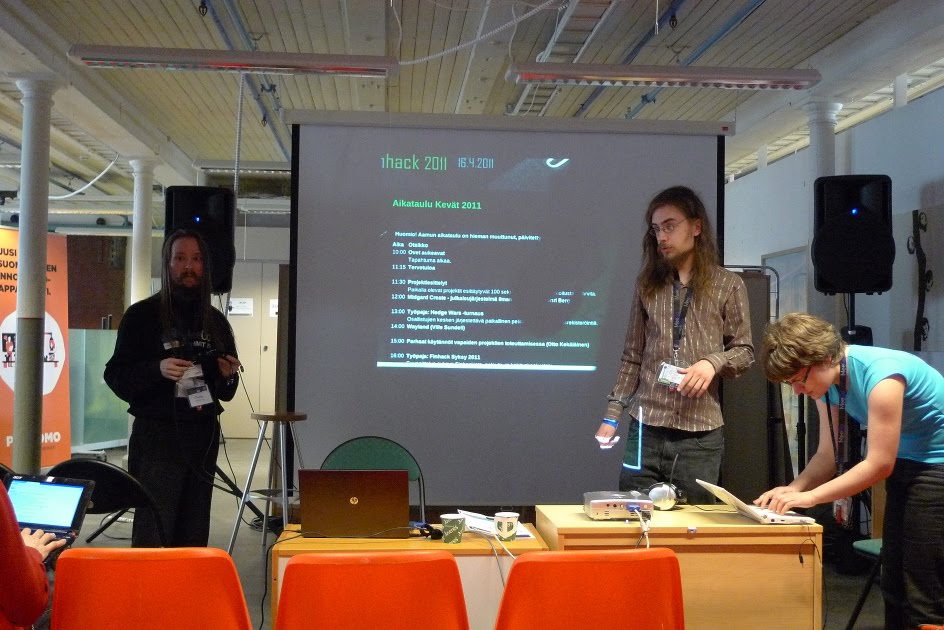
Some highlights via photos:


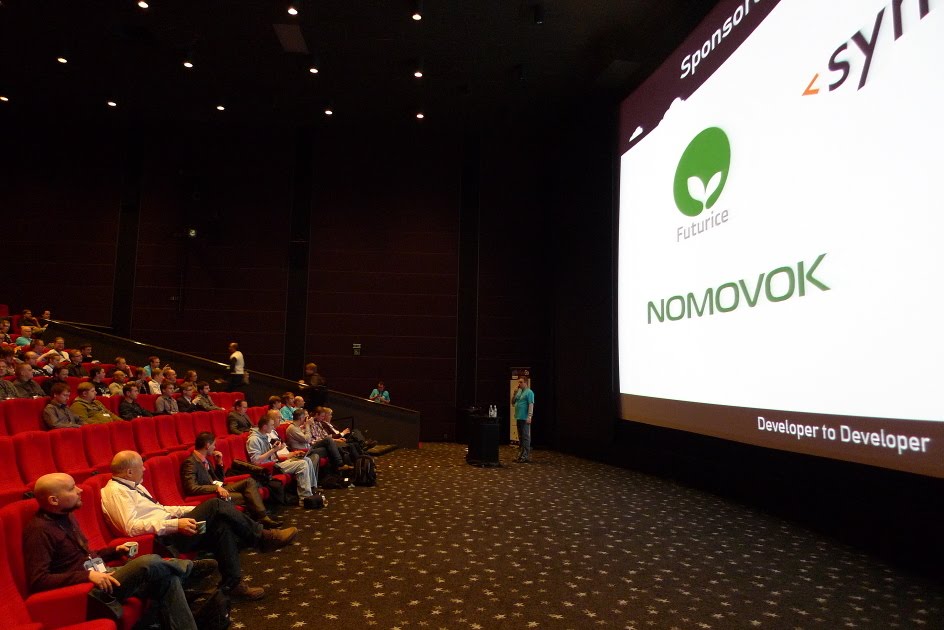
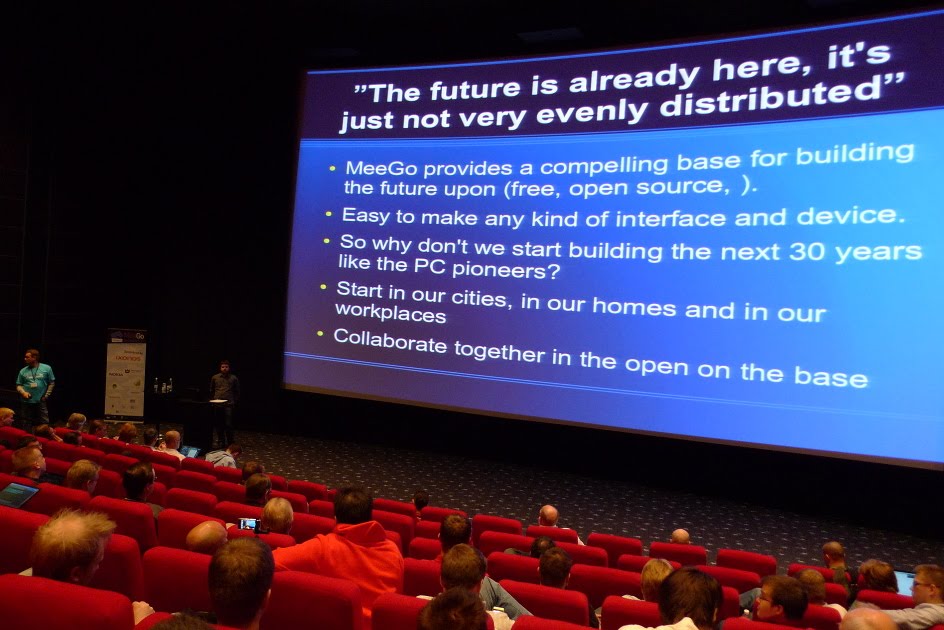
Keynote venue was a movie theater


MeeGo status update by Valtteri Halla / Intel - talking among else about tablets, IVI, and the 20 person team at Nokia doing MeeGo(.com) for N900 phone


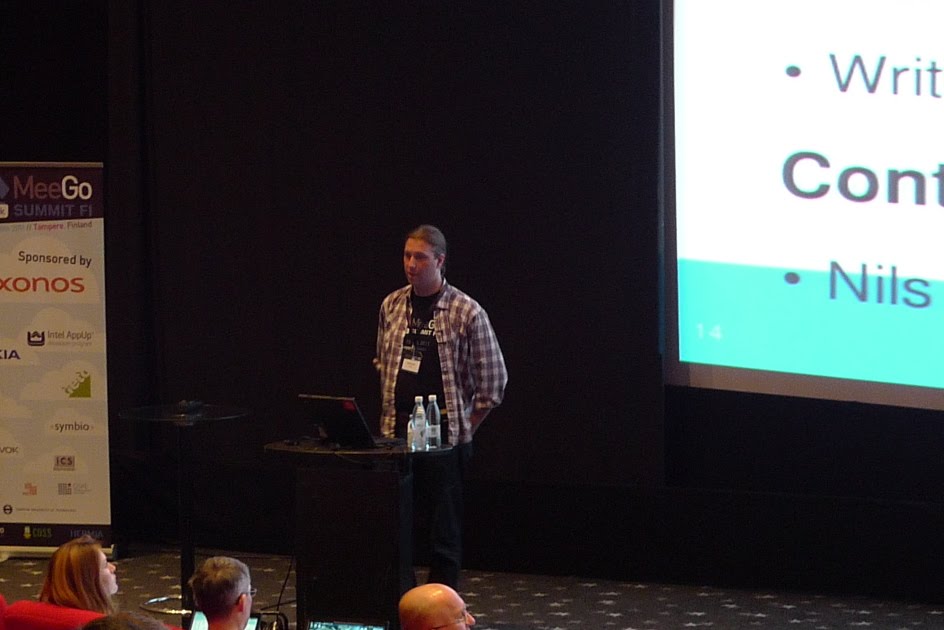
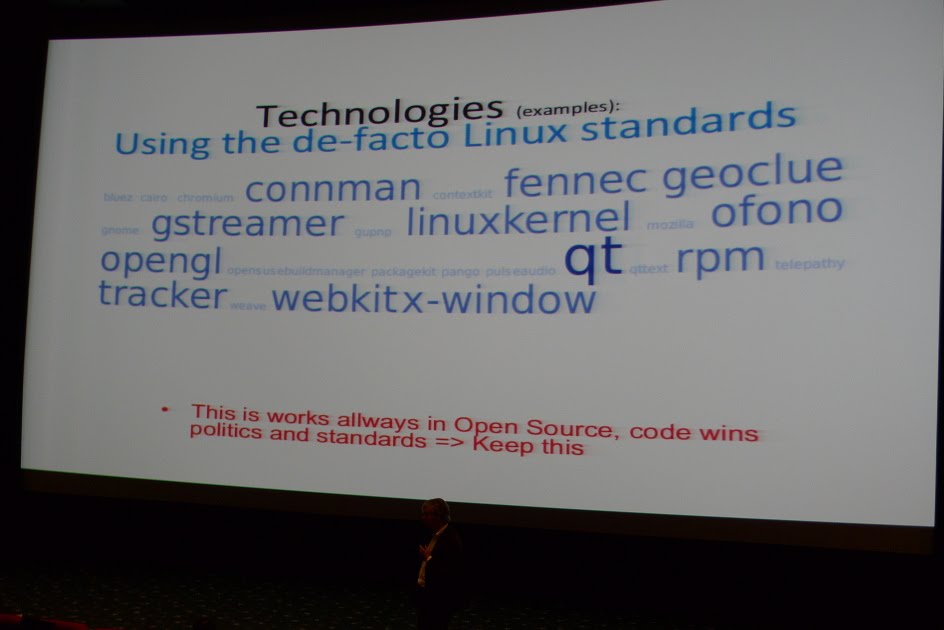
Mikko Terho / Nokia - "Internet for the next billion => Qt good candidate", "code wins politics and standards"


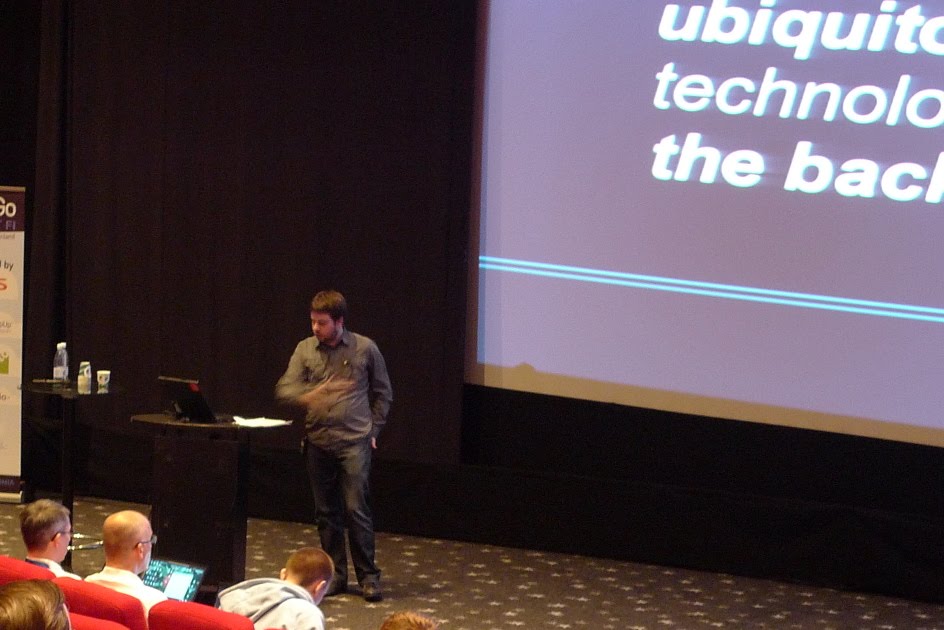
Carsten Munk / Nomovok - "Hacking your existence: the importance of open-ended devices in the MeeGo world"


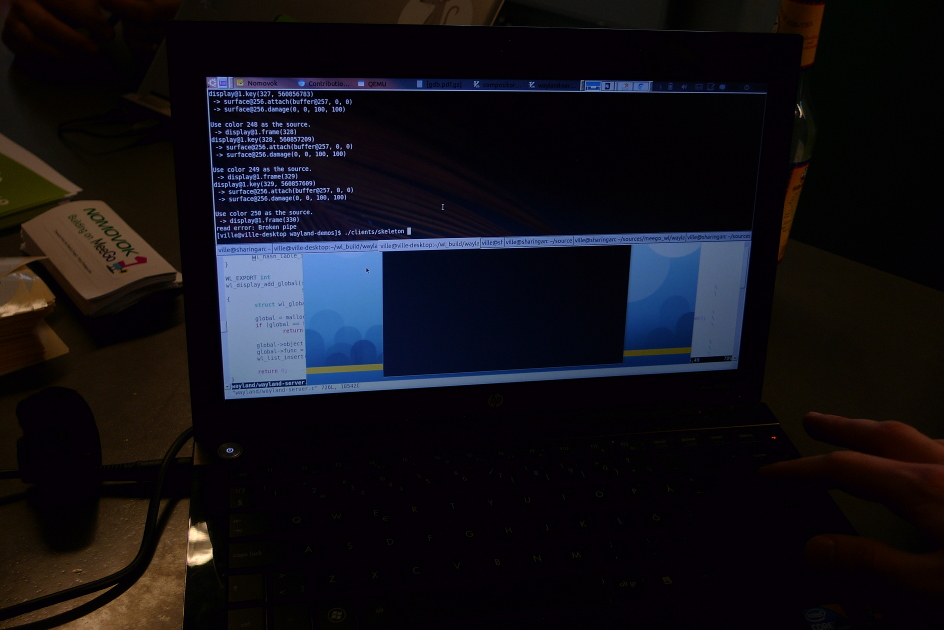
In addition to MeeGo tablet demonstrations a Wayland compositor was demoed by a Nomovok employee.


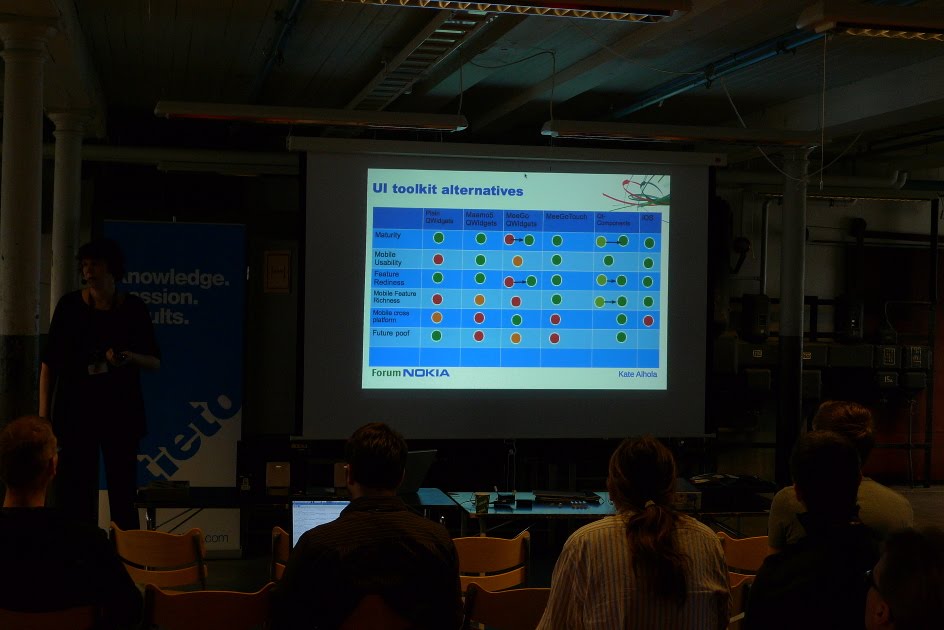
One of the many Qt / QML related talks was held by Tapani Mikola / Nokia


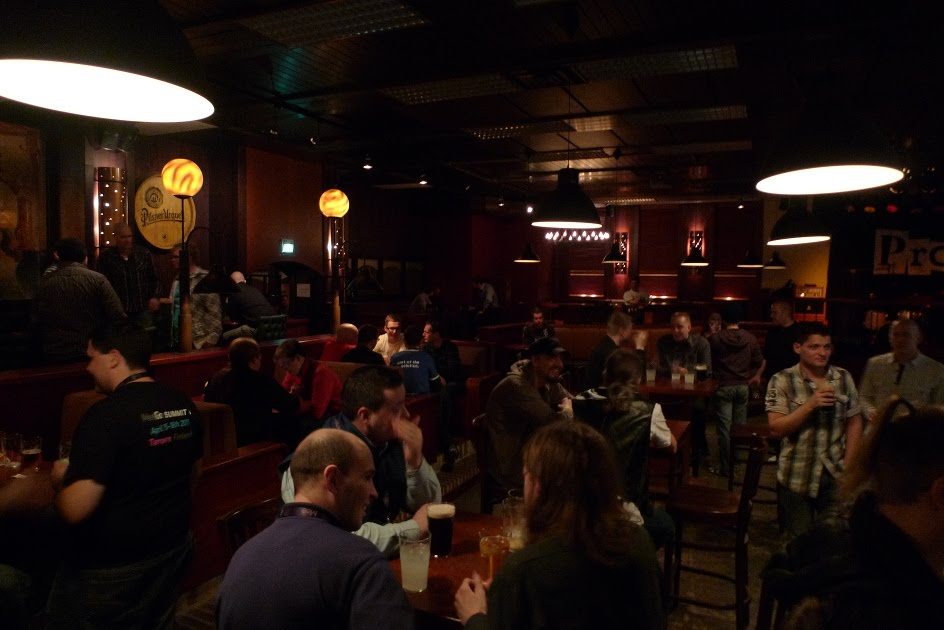
Evening party


Day 2 started with a few more presentations and Finhack event launching in the Protomo room as well

Still remaining for the day are Meegathon demonstrations (well actually I'm right now already following those while finishing this - cool demos!) , Meegathon awards, a panel discussion on "MeeGo, Nokia, Finns - finished? Can MeeGo be important in Finland without being inside Nokia's core?", BoF sessions and finally Intel AppUp Application Lab including some MeeGo table give-outs.

Thanks to organizers, many of whom were volunteers. The event has been running completely smoothly, coming not as a big surprise after the hugely successful last summer's Akademy 2010 also held in Tampere.

10 April 2011

John Goerzen: The Mennonite Mecca

I d like to paint you a picture of the sorts of things that have been going on around here the past few months, and with growing fervor the past few days. I ll start with church basements. Possibly a little chilly, but with a bunch of women getting together to make some quilts along with some conversation, maybe some snacks. Or perhaps about hundreds of kitchens throughout Kansas, warm with baking pies, cookies, breads, and all sorts of items. Then there are a bunch of wood shops, turning up sawdust, building things from toys to furniture. Or even a body shop donating its time and materials to put some finishing touches on a classic car. I ve also seen around 300 men getting together to practice for a men s chorus concert. I know there was large crowd of people gathering to make verenike. People always wind up running 5km on a particular Saturday morning, rain or shine. Or ride 35 miles on a bicycle on a different Saturday. Or even help build a house using as much volunteer labor and donated materials as possible. And then, of course, comes this week, where Mennonites from all over Kansas start to converge on Hutchinson, KS. I can imagine you might see some odd sights rolling down the road: a vehicle called the borscht buggy for preparing large quantities of the delicious soup. Several old tractors being hauled down the road on trailers. Semi loads of food. Vanloads of pie and cookies. Plants, trees, rugs, quilts, even a lawn mower. And then, yesterday and today, excited people ready to buy all of these things. Families with children excited to get a ride on the largest slide they ve ever seen. And, of course, so many people wanting to eat the famous food that, despite the many parallel serving areas, lines still can extend for blocks. It s all because people are hungry. Not these Kansans with pie-laden kitchens, though it s to help those in need. It s all part of the annual Kansas MCC Relief Sale. The idea is that people make, bake, build, sing, or give things to the sale. The items are then sold, and the proceeds go to Mennonite Central Committee, one of the world s most efficient charities. MCC not only helps with directly bringing people out of hunger, but also supports sustainable projects, such as building hand-operated wells to give those in need a safe source of drinking water. Virtually all of the money you spend on those pies winds up helping someone in poverty. Each year, the relief sale and related events raise around half a million dollars for charity. It s not unusual to see a quilt sell for thousands of dollars. Most of the things sell at more normal prices, but last year someone decided to add a loaf of bread to an auction and it sold for $100. And so it was this that we took the boys to today. We started with the Feeding the Multitude a wonderful meal with some traditional Kansas Mennonite food. Here s a photo: That bread is zwieback, then there is cherry moos, bohne berrogi, verenike, and of course, sausage. Here are Jacob and Oliver enjoying their food: IMG_5548.JPG After that, we went over to the giant slide. I m not sure how many stories tall it is, but it s big enough that they have a strip of carpet there at the bottom to slow people down at the end. Here s a photo of Jacob on my lap after going down the slide. If you zoom in, you can see the giant smile on his face. IMG_5562.JPG After that, we hopped on the mass transit at the sale: a wagon being pulled by a tractor. We checked out the general auction, with Jacob wanting to be sure to peer under the hood of each car present. Then after a stop to buy some kettle corn for Jacob, we checked out the plants, quilt auction, and then on to buy cheese curds. After another stop at the slide, it was time to head home. And then tomorrow is a concert of the Kansas Mennonite Men s Chorus (motto: We Sing That Others May Live). You get around 300 men on a stage signing together and wow no recording can do it justice. It s amazing to hear the power of the choir at the loud parts, but still more amazing to listen to 300 men signing as softly as they possibly can. I ve been singing with that choir for 3 years, and we ve been practicing for a few months now. If you ever hear some Mennonites boasting about something, it s probably going to be about how much money they ve raised for charity. And on that note, I ll nudge those Indiana folks reading this and point out that you have some catching up to do with the Kansas sale

7 April 2011

Tiago Bortoletto Vaz: Hello, Miro Community! Bye, Miro Community.

(from http://lists.debconf.org/lurker/message/20110213.040506.1beb418f.en.html)
To: debconf-video
Subject: [Debconf-video] Announcing debian/watch, the Debian Miro Community Hi all,
With help of dc-video people I've just finished generating RSS feeds from penta data and published all Debconf(5-10) available videos to our new Miro Community page: http://debian.mirocommunity.org/
Soon I'll upload the feeds to dc-video repository. The process had to be semi- automated since I noticed some inconsistencies in penta which I'll point later.
I've written the following description for this channel: http://debian.mirocommunity.org/about/ (english language fixes / suggestions are welcome!)
Other nice Miro Community channels for reference:
http://gnome.mirocommunity.org/ http://ubuntu.mirocommunity.org/ [...]
(from a recent email message to Debian Miro Community admins)
Your Site is Now Running Miro Community 1.2!
Hi,
We have just migrated http://debian.mirocommunity.org/ to the latest version of Miro Community. From here forward, we're asking our heaviest users to help support ongoing software development and server costs by upgrading to a paid account, which is very easy to do!
This release limits some features you currently use. You will have 2 weeks to upgrade your account or you will no longer be able to use the following features.
* You have more than one administrator. If you choose to remain at the Basic account level, the following administrators will lose admin privileges: valessio tiago
* You have 556 published videos. If you do not upgrade your account, we will unpublish the oldest videos to keep you within the 500 video limit. You can also cull videos you no longer want at http://debian.mirocommunity.org/admin/bulk_edit/ [...]
Although I understand Miro Community needs of releasing paid accounts, I think the features are now too restricted for non-premium users.So, at the end I have to thank Valessio for his amazing CSS work on this and Holger for warning me in time to not announce Debian Miro Community as an official channel for Debconf videos.It seems Miro will unpublish 56 videos from our channel in two weeks. I'm thinking about keeping there only Debconf videos, which should then fit on their new quota... At least until we find another place to publish them. Suggestions are very welcome. Debconf and other Debian videos are currently hosted at http://video.debian.net. Debconf videos feeds are available at http://tiagovaz.org/videoteam/ and corresponding thumbnails at http://tiagovaz.org/thumbs/.

3 April 2011

Christian Perrier: [life] Radio Bemba

There's nothing better than listening Manu Chao's "Radio Bemba Sound System" during a family meal at home. And, later on, while working on a new font package for Uyghur language. And, I say, Piwet.

31 March 2011

Torsten Werner: My Wheezy release goal: JS removal

Debian is preferring feature based releases over time based releases and that is why we currently have some discussion about release goals for our next version that has the codename Wheezy. I want to suggest the full removal of all software written by J rg Schilling who is well known for making trouble in projects that want to redistribute his software.

28 March 2011

Rapha&#235;l Hertzog: People behind Debian: Bdale Garbee, chair of the technical committee

Bdale is a long-time Free Software believer, he has been contributing even before Debian existed in the prehistoric era of free software. :-) Anyone who went to a big Free Software conference has seen one of his colorful t-shirts. Or maybe you have heard the story where he got his beard shaved by Linus Torvalds to raise funds to protect the Tasmanian Devil. More seriously Bdale has played and continue to play a number of important roles in the Debian community. He also represents one of the biggest corporate sponsors (both for DebConf and for the servers that Debian owns): Hewlett Packard. My questions are in bold, the rest is by Bdale. Who are you? I made my first personal contribution of source code to what we now call Free Software in 1979. I started with HP in 1986 and for nearly a decade have served the company as Chief Technologist for Open Source & Linux. I am president of Software in the Public Interest, which is the umbrella organization providing legal and financial existence for Debian in the USA. I also represent users, developers, and Debian interests on a number of boards including at the Linux Foundation and the Freedombox Foundation. I m happily married with two children. Many people in Debian have met some or all of my family. They all joined me for Debconf in Edinburgh, and my daughter Elizabeth also attended in Caceres and New York. I joined Debian in 1994. I ve been responsible for a number of packages essential to our base system continuously since that time. But I ve also contributed to the project in many other ways over the years. I ran the first server that was fully dedicated to Debian. Ideas of mine influenced the development of project infrastructure, from the early design of our mirror network to structuring the archive around a package pool . I started or made significant early contributions to 5 ports of Debian to non-i386 architectures. I served as Debian Project Leader (DPL) in 2002-2003, was acting Secretary for a while, and have served on the Technical Committee for a number of years. Over the years, I ve also had some interesting hobbies. I helped design, build, and program pieces of various amateur radio satellites. I enjoy making physical things, and have many tools for working in wood and metals. My son and I are very active in the world of high power model rockets. And with my partner (and fellow Debian developer!) Keith Packard I m now running a small business making and selling open hardware and open source avionics for hobby rockets. You can read more about that at http://altusmetrum.org. You re the chair of the Debian technical committee. Can you quickly explain the role of this committee? I think many people assume the Technical Committee has a larger role in Debian than it really does. Section 6 of Debian s constitution defines the official role of the Technical Committee. Most importantly, the committee exists as a last resort place to resolve technical conflicts between Debian developers that they are unable to resolve by themselves. Most of the power in Debian is left in the hands of individual developers, who are usually able to collaborate with each other to make good technical decisions. So the Technical Committee s resolution process has only rarely been needed, which I think is a very good thing. From my point of view, the technical committee is not working. In many cases, the committee does not take any (timely) decision and just waits until the underlying situation has evolved to a point where the intervention of the committee is no longer needed. Do you agree with this and how can you explain it? I think it s very important for all of us to remember that everyone working on Debian does so voluntarily, and people who volunteer their time generally deserve a measure of respect and appreciation for their efforts. No issue is brought to the Technical Committee unless resolving it is expected to be really difficult, or at least contentious. And often, the issues brought to the committee have been as much or more about personality than technology. That makes some of them really hard to solve. So I do not agree that the technical committee is not working. It seems to me that the decisions that bog down and take a long time are the ones where arguments start out or become emotional instead of technical. In this context, if committee members can help lead public and private discussions in a way that causes a situation to evolve to the point where a decision is no longer needed, that may be healthier for the project in the long term than a quick vote that satisfies some contributors at the expense of others. The last important change that was made to try to revive the committee was the addition of two new members (Don Armstrong and Russ Allbery). Is there anything else that could be tried? The biggest improvement I could personally wish for is something people sending issues to the committee can help with. As the ultimate technical decision making body for a project whose output is mostly software, the more a request can be put in terms of a decision about source code, the easier it will be for us to make a decision. That won t always be possible, but when we re forced to try and dream up alternatives and then figure out whether anyone would actually be willing to write the code to implement those alternatives, the process takes a lot longer than choosing between competing patch sets or deciding whether a patch should be included. Besides your role in the technical committee, you have held the role of mediator/facilitator/advisor on numerous occasions. Because you re an old wise bearded guy who travels a lot and knows many Debian contributors I would like to thank you for all this work that few people notice. Are there been times where this has been a real burden for you? Thank you for mentioning this. I ve put a lot of my heart into Debian over the years, largely because it s a project and a community that continues to amaze and inspire me. I feel fortunate to have been able to meet and work on Debian with so many outstanding people from around the world. Many are now my friends, with all the silly and serious things being a friend implies. I ve been asked for and have given advice many times. I ve helped celebrate birthdays, marriages, new jobs, and the arrival of children. Sadly, I have also found myself having to try and find the right words to mark the loss of some of these friends The only time any of this feels like a burden is when there s some important problem that many people care about, that I m working behind the scenes to help fix, but can t really talk about publicly without causing more harm than good. It s distressing to have people think you don t care or aren t helping, when really you re doing everything you possibly can just not in a publicly visible way. Of course I understand that this is an impossible situation. If you can t see what s happening, there s no way to know if something is happening or not. That s why I advocate doing as much as possible in Debian, and SPI, and everywhere else I contribute in as open a way as possible. You have been Debian Project Leader and you promoted the vision of Debian as the Universal Operating System. What does universal mean for you? The biggest thing to me at the time was the idea that Debian could be anything. Those who chose to work on Debian would ultimately determine what Debian became. I also wanted to make sure we thought about as broad a set of potential users and collaborators as possible. But this vision provided a framework for pursuing a whole range of worthwhile increases in Debian s scope of utility, some of which I articulated in my DPL platforms, some others put forward. Internationalization, porting to more supported architectures, our inclusive and evolving approaches to accepting new developers and new packages, and so forth. I think this vision has served us well, and it pleases me that it has stayed a part of our collective thinking for so long. We re again in Debian s electoral period, what do you think of the work done by the current DPL? I m very happy with what I ve observed of Stefano s activities during his first year as DPL. He has an obvious enthusiasm for Debian, communicates well both in one to one interactions and in front of a crowd, and I think represents Debian very well. It is interesting that he s running unopposed for re-election this year. I choose to interpret that as evidence he s doing a good job, the project is running well, and nobody feels the need to try and take the job away From him. I m glad he s willing to continue in this role for another year. What s the most important thing that Debian should achieve in the wheezy timeframe? I don t yet have a very crisp personal wish-list for wheezy. But I would certainly like to see multiarch support finally completed! I m also very interested to see what comes from the CUT work. You have been an early supporter of multiarch , a project to allow easy installation of foreign architecture packages. It s on good track for Wheezy. Do you think it s an important milestone? My original motivation for requesting multiarch support was to enable support for 32-bit x86 binaries on ia64 Itanium systems, in the time leading up to the sarge release. I ended up creating the ia32-libs package, which I m not proud of. The emergence of 64-bit extensions to x86 (the amd64 architecture) made this a much broader issue. Today, I run a 64 bit kernel and a 32 bit user space on my notebook. There are problems with just moving entirely to 64 bit but I would like to be able to run some applications that work with large data sets in full 64 bit mode!
Thank you to Bdale Garbee for the time spent answering my questions. I hope you enjoyed reading his answers as I did. Subscribe to my newsletter to get my monthly summary of the Debian/Ubuntu news and to not miss further interviews. You can also follow along on Identi.ca, Twitter and Facebook.

4 comments Liked this article? Click here. My blog is Flattr-enabled.

26 March 2011

Thorsten Glaser: Various joys

I m online again. (In case you didn t notice, duh ) Seems as if we (the Telco/ISP guy and me) just needed to look at it hard enough for it to go away first he could dial in, using my account data, which I probably should change now, then herc with ppp(8) and pppoe(8) was working (although at about 50 KiB/s down, he showed me 508 KiB/s a rate I had never achieved with his WiXP), then I took my notebook, which worked with pppoe(4). Now herc s working again. (Maybe altq(9) can explain the slowdown? Hm, from debian.netcologne.de I get 500 so it looks okay.)
But eurynome isn t, oh the joy. Luckily, gecko2 who administers its host system just woke up. Things we do want to see: the Telco/ISP guy accepting that I run MirBSD on a P-233MMX box with Hercules graphics card and a 9 monitor with no comment other than considering its age (and that it usually runs 24/7) as partial cause for the bug. Thanks, Netcologne! Things we don t want to see:
Mar 26 10:40:02 blau /bsd: signal 11 received by (screen:16857) UID(2999) EUID(2999), parent (screen:19111) UID(2999) EUID(2999)
Suddenly the Dungeon collapses!! - You die... (luckily, I get it about once a year only) ObCoffeeSpices: Marrakech (Cumin, Allspice, Cumin Aroma) though, due to its relative strength compared to the others, the only coffee spice I have left. And another hint: pre-warming the coffee cup with hot water, so it doesn t cool down too fast with the amounts of milk I put in, rocks. I just wore the Squeeze Release (FOSDEM, Spacefun) T-Shirt to the bakery and got asked by a neighbour: Oh, a Debian fan? Developer, even now imagine the typical informed interested guy talk for a conference booth of your OS of choice here. How proud he was to get his wife and himself Windows -free at home; how he likes to tinker a bit (if he s got any time left), which has become harder with Windows; how his time constraints have him at OpenSuSE currently but asked how squeeze is; and the usual complaints at places like $ork where they have to use Windows and MSIE (apparently you can t centrally manage Firefox, eh, good someone tells me, because that s what we do ). Wow. Anyway, it s spring, so people, wear your shirts. (Hrm, what do I make of the fact that this is my only Debian shirt although I m thinking how to get Tartan Trousers if money were no issue and nobody had ever commented on my various BSD, FOSDEM, FrOSCon, etc. wear )

Joerg Jaspert: Debian FTPMaster meeting 2011 - Internet! Is that thing still around?

And here we are again. And we still have energy for one more day (and a half). Barely, but still. And it is actually looking good, we do think we will have a working archive when we are leaving here tomorrow at noon. And compared to last year we won t even need a session until 3AM to make this work (and still have half of the tools not working). Yay. Yesterday had Ansgar fixing up various issues until we set him onto Generate Packages/Sources files out of the database . Which got us some funny quotes later on, like are 3.6 seconds to write a Sources file ok or too slow? (compared to the roughly 90 seconds it takes today). Torsten had various bugfixes (as we all, somehow there is never an end of them) and is currently looking at DSUS , which is the result we got out of a GSOC project. Mark tried to continue the multi-archive stuff but got distracted a lot, we regularly asked him to look at other items and then we also made him restart all the thoughts on it by slightly redefining the parameters for the multiple archives. I myself continued with shell scripting around the buildd autosigning and today I take to check up on all our cronjobs (besides unchecked/dinstall which we know do work) to ensure we can turn them back on starting this afternoon.

25 March 2011

Joerg Jaspert: Debian FTPMaster meeting 2011 - No, he's pretty dumb. He's in all the same special classes I am.

Should you have thought we are gone, let me assure you - we are not. I just blog a bit later than I did the last days. Anyways, we did have a good day yesterday. Turns out that, when Ansgar said I don t know much Python so might not be able to do much he actually meant Just point me at problems, no matter how complicated, and I come up with the python code to fix them . And so we did point him at various problems and got lots of code. And we intend to continue this until Sunday. Yesterday Mark got his Packages/Sources tool so far that we are about ready to ditch the old things, even though he took time to finalize my generate-release changes too. Not to speak about that database changes I wrote about in my last entry, which he now seems to have finally wrapped his brain around in a way to get those done. Short cite: good god, this will overhaul about all our code and database handling . And thats where he is currently working on too. He did draw a plenty complicated thats how it works onto the flip chart, and now seems to dump his brain into some form of python code. I m curious about the result, lets see. Torsten fixed up the code that generated the Maintainers and Uploaders files. The old code was just plain silly and took about 15 minutes just for the Uploaders file. It is now doing both of them in less than two. Of course there had been lots of bugfixes and code enhances too, not really good to list in a blog like this. My work, besides getting a bit sick in the evening, consisted of writing shell scripts to enable us and wanna-build admins to handle the keys needed for the automated signing of packages build on DSA maintained buildds. I have those ready now, so we are able to start doing the autosign stuff today/tomorrow. Phil - well, did whatever buildd related stuff he has to. Different place, I dont see much of it, but he has a blog himself, look over there.

24 March 2011

Joerg Jaspert: Debian FTPMaster meeting 2011 - I didn't do it, nobody saw me do it, there's no way you can prove anything!

And here we are, with another day of work ahead. And another huge unchecked/dinstall run about to finish. Yesterday evening Ansgar and later on Phil turned up, so we are now 5 persons sitting here and mostly coding happily away. Mark continued trying to wrap his brain around the changes we need to properly support multiple archives, with different sets of rights attached to them. It is a complex topic giving lots of headache. Besides that he is on a very good way of letting us completly remove apt-ftparchive by importing all the data we need to write Packages/Sources files on our own. And even better, the same work we can use to rewrite our rm and cruft-report commands in a sane way, not parsing Packages files anymore. Torsten did help with various database issues around the Packages/Sources issue and continued working on importing all the source filenames into the database, so we can soon provide a Contents file for sources. My own work, besides writing blog entries and preparing meeting minutes, consists of a rewrite of the script generating our Release files, the old one just wasn t up to it anymore. Especially not as we are on our way of having more and more of our tools use parallel processing, to fully use the power our ftp-master host has. And when I am done with this I will be off to tackle the keyring maintenance part we will need to enable autosigning by buildds to work. Should get interesting, with the shit of an interface one usually finds to gpg Ansgar started out by working on changes to our NEW handling, something I started with the dpkg bug #619131 and he just finished our site of the NEW handling scripts. Which means that, as soon as the dpkg maintainers added the code on their side and support this field in the .dsc files, NEW handling for packages like linux-2.6 will be much smoother. He is now implementing version control constraints into our control-suite tool. Phil is working on wanna-build stuff. And while this is just a short overview of what we did, there is always lots of discussion and bugfixing going on. It is incredibly useful to have a team sitting in one room for some days.

Next.

Previous.