Search Results: "hug"

14 August 2006

Jaldhar Vyas: Debian Linux Adopts SeaMonkey

Well it's in NEW anyway. It should arrive in unstable in a few days once the ftpmasters process it. For those who don't know SeaMonkey is the latest incarnation of the erstwhile Mozilla Internet suite. Apart from a web browser, it includes an email and Usenet reader, an HTML editor, and IRC client. It's a big complex piece of software and I would like to get a packaging team going to look after it. My current work is available in SVN. There are a huge number of lintian errors most of which are probably bogus but still need to to be looked at. I'm sure there are other improvements that could be made too. If you would like to help, please contact me In light of some of the FUD that's going around I should mention that this package was made possible by support from the good people of Linspire Update: Ow the package was rejected. Apparently you're supposed to fix the huge list of packaging bugs before it gets distributed to millions of people. Back to the drawing board. Update 2: SeaMonkey SeaMonkey SeaMonkey

13 August 2006

Andrew Pollock: [tech] More benchmarking

When I did my Red Hat Certified Engineer training, the second time around (when I updated from Red Hat 7.1 to Enterprise Linux 3), the trainer mentioned this Ext3 vs Reiserfs benchmark that Gurulabs performed. Probably because it had such a memorable name, I've remembered it and referred people to it, and referred to it myself, a few times over the years since. So it seemed only fair to try out their benchmarking methods (i.e. use NetApp's postmark with a few different settings) on the uber-disk as well, while I had it idle. So I did. Firstly, I ran it locally on minotaur, the piddling little 866Mhz Pentium III, with 320Mb of RAM (but with 1.5Tb of disk attached directly via USB), and then I ran the exact same tests from teevee, the box destined to become my MythTV server (3.0Ghz Pentium 4, 1Gb of RAM), with the disks mounted with ATA over Ethernet. This was with a JFS filesystem on a single logical volume striped across four physical volumes. I ran the tests three times, just like the Gurulabs benchmark, first time around, it was with: The idea being that this will generate around 150Mb of data, which should all fit in the RAM (of either system) The second time around was with: The idea being that this, generating 1400Mb of data, will exceed the RAM on both systems (but not uniformally, obviously). The final run was a total thrash with: This one causes about 19Gb of data to be written, and absolutely hammers the living daylights out of the disks (or the network, and the disks, in the case of ATAoE). So, now for the results:
Test case 1, with locally attached disks
Time:
        22 seconds total
        21 seconds of transactions (2380 per second)
Files:
        27170 created (1235 per second)
                Creation alone: 2000 files (2000 per second)
                Mixed with transactions: 25170 files (1198 per second)
        24986 read (1189 per second)
        24697 appended (1176 per second)
        27170 deleted (1235 per second)
                Deletion alone: 2340 files (2340 per second)
                Mixed with transactions: 24830 files (1182 per second)
Data:
        149.53 megabytes read (6.80 megabytes per second)
        161.85 megabytes written (7.36 megabytes per second)
Test case 1, with ATAoE attached disks
Time:
        27 seconds total
        25 seconds of transactions (2000 per second)
Files:
        27170 created (1006 per second)
                Creation alone: 2000 files (2000 per second)
                Mixed with transactions: 25170 files (1006 per second)
        24986 read (999 per second)
        24697 appended (987 per second)
        27170 deleted (1006 per second)
                Deletion alone: 2340 files (2340 per second)
                Mixed with transactions: 24830 files (993 per second)
Data:
        149.53 megabytes read (5.54 megabytes per second)
        161.85 megabytes written (5.99 megabytes per second)
Findings
A degradation in performance, sure, but not a huge one. Graph of the results
Test case 2, with locally attached disks
Time:
        218 seconds total
        209 seconds of transactions (239 per second)
Files:
        27144 created (124 per second)
                Creation alone: 2000 files (400 per second)
                Mixed with transactions: 25144 files (120 per second)
        24830 read (118 per second)
        25094 appended (120 per second)
        27144 deleted (124 per second)
                Deletion alone: 2288 files (572 per second)
                Mixed with transactions: 24856 files (118 per second)
Data:
        1405.24 megabytes read (6.45 megabytes per second)
        1535.91 megabytes written (7.05 megabytes per second)
Test case 2, with ATAoE attached disks
Time:
        165 seconds total
        158 seconds of transactions (316 per second)
Files:
        27144 created (164 per second)
                Creation alone: 2000 files (1000 per second)
                Mixed with transactions: 25144 files (159 per second)
        24830 read (157 per second)
        25094 appended (158 per second)
        27144 deleted (164 per second)
                Deletion alone: 2288 files (457 per second)
                Mixed with transactions: 24856 files (157 per second)
Data:
        1405.24 megabytes read (8.52 megabytes per second)
        1535.91 megabytes written (9.31 megabytes per second)
Findings
Whoa, who'd have thought this? Better performance over the wire? I'm blaming the fact that minotaur is a bit of a weakling compared to teevee, and teevee had a better caching advantage with more RAM. Mind you, you'd expect to see the same for the first test as well, unless size is a factor. Inconclusive results I guess. Graph of the results
Test case 3, with locally attached disks
Time:
        7356 seconds total
        7310 seconds of transactions (27 per second)
Files:
        104099 created (14 per second)
                Creation alone: 4000 files (117 per second)
                Mixed with transactions: 100099 files (13 per second)
        100246 read (13 per second)
        99560 appended (13 per second)
        104099 deleted (14 per second)
                Deletion alone: 4198 files (349 per second)
                Mixed with transactions: 99901 files (13 per second)
Data:
        18995.06 megabytes read (2.58 megabytes per second)
        19738.85 megabytes written (2.68 megabytes per second)
Test case 3, with ATAoE attached disks
Time:
        12320 seconds total
        12111 seconds of transactions (16 per second)
Files:
        104099 created (8 per second)
                Creation alone: 4000 files (32 per second)
                Mixed with transactions: 100099 files (8 per second)
        100246 read (8 per second)
        99560 appended (8 per second)
        104099 deleted (8 per second)
                Deletion alone: 4198 files (49 per second)
                Mixed with transactions: 99901 files (8 per second)
Data:
        18995.06 megabytes read (1.54 megabytes per second)
        19738.85 megabytes written (1.60 megabytes per second)
Findings
So presumably the network latency made its presence felt with data volumes of this magnitude. Graph of the results

12 August 2006

Daniel Burrows: Giving away secrets

Erich Schubert writes that


Oh, and I actually doubt that ATI would give away much secrets if it would allow distributing the existing opensource X drivers. It's not as if the specs of their CPU would be a huge surprise to Nvidia. Some actually say nvidia builds the better graphics cards. And Intel does even give away source code. We're not talking about chip design here, or driver optimizations. Just the plain registers and ports.


-- note: what follows is just my opinion and I'm wrong on a regular basis, so take it with a grain of salt --

The problem here is you aren't thinking like a corporation. As far as I can figure, the corporate view here is that you have two options:

(a) Keep the secrets you have. This is the status quo, you know how to make money here, and no-one else can benefit from your secrets even if you yourself can't.

(b) Give away your secrets. This always carries a risk that someone else will find a more clever (=profitable) way to use your secrets than you; thus, companies try to avoid this unless they absolutely have to.


I personally agree that the risk to ATI appears small. However, just to throw out a hypothetical, giving away their register specs would allow other companies to build cards that are register-compatible with ATI's. (Remember the ne2000?) Obviously this would be good for you and me -- but it's almost certain to drive down ATI's profits at least a little by providing more direct competition in the market for graphics cards; thus it's not good for ATI. This may be a far-fetched or overblown concern, but ATI will need a reason to "go uphill" against it when their current strategy seems to be doing just fine.

Intel, on the other hand, is in a different situation; as far as I know, they generally are playing catchup in the graphics area to NVIDIA and ATI, and as a result, they have more to gain and less to lose by opening their specs. [UPDATE] And as I mentioned in my previous post on this topic, the types of cards Intel sells are probably more interesting to free software users than the cards ATI sells. (I'm sorry you don't have any Intel cards -- they seem to have come automatically with most of the new computers I've seen lately, so I assumed it was a trend!)

Erich Schubert: On onboard graphics,

Daniel Burrows writes "and the built-in graphics card (usually Intel) on the motherboard is just fine for that." I would agree with you, if I had an built-in graphics card with Intel. That is in fact what I'm aiming for for my next laptop. But actually none of the PCs I have in my house has Intel graphics, unfortunately. Intel graphics is pretty much restricted to Core CPUs and Laptops. Which sucks. I wish there would be more "budget" systems with Intel graphics. As you mentioned I don't need high end graphics anyway. I actually don't need high end CPU anyway (power consumption is more interesting, and the value/price ratio). I wish I could have bought a system with Intel graphics, but that would have been twice the price. I wish we had some standard like VESA, just a bit more modern. Like having sane refresh rates for non-TFT screens and maybe some extra acceleration. Oh, and I actually doubt that ATI would give away much secrets if it would allow distributing the existing opensource X drivers. It's not as if the specs of their CPU would be a huge surprise to Nvidia. Some actually say nvidia builds the better graphics cards. And Intel does even give away source code. We're not talking about chip design here, or driver optimizations. Just the plain registers and ports. heck, ATI, Nvidia and Intel could probably even agree on a standard here, except it would mean they'd need to change their drivers and hardware for the next generation with really no visible benefit to them (only to us, we could maybe run the basics with the same driver).

11 August 2006

Jonathan McDowell: So, where did you two meet?

I get asked this a lot about people. Most recently when visiting the Fat Cat with Simon and his work mates this week, but often about the other Simon (who's my business partner as well as a long time friend). The truth is a lot of the people I know I met first online, be it Fidonet (hello Pads, Peter, Simon and several others), Usenet (hello Ox.Net), mailing lists (hello ALUG) or IRC (hello, er, lots of people). I don't think I'm in any way unique here, but it can sometimes be awkward explaining this to people who preconceive internet friendships to be something seedy involving 40 year old fat man and 15 year old naive children. Or at least that's what they seem to be thinking when you say "Oh, we met online". Let's give some examples. I met Simon on Fidonet, back when we were both 17 or so. We were in a couple of echoes together and we did netmail a bit. When I came to England for university one of the echoes we were in had a meet up and so I decided to go. I ended up staying at Simon's (making his mother worry a bit; even back in 1997 people thought meeting online was freaky!) and that was the first time I met him. We've kept in good touch ever since and even gone into business together. Is this a lot odder than a chance meeting at a pub or through friends? I don't think so, but some people do. Or take when I moved to Norwich. I had some friends who could help me load up the van in Harpenden (where I was moving from), but didn't know anyone in Norwich to help unload. I'd already joined the ALUG list, so I thought I'd ask there if anyone was prepared to help in exchange for beer and food afterwards. Adam and Edward Betts both turned up to help, not knowing anything about me. And were very helpful and we got everything unloaded. I still see Adam reasonably often, both online and in person (last night, for example). I haven't really kept in touch with Edward since he left UEA though. :( There are many more examples like this of people who I see a reasonable amount in real life and yet if you asked me I'd have to admit I first knew online, sometimes for several years before actually physically meeting. And lots of people understand it these days, but please tell me I'm not alone in getting the funny looks sometimes. Please?

Aigars Mahinovs: Security costs? You pay!

Apparently the government agencies in UK that are managing the current security craze have little to no idea how much their super-paranoid security policies acctualy cost. It appears that direct losses from one day of air traffic chaos costs airlines 175 million pounds. Everyone who has their flight delayed for more then an hour for whatever reason need simply to sue the airlines and further the UK government according the EU regulations. Each person delayed for just 4 hours can claim as much as 600 euros of compensations. I wonder what compensation must a person delayed 24+ hours get, considering missed meeting, needed hotel bookings and other expenses. Now if all passengers and all airlines united and sued the government for the compensations (those can be in billions, considering that no sane business person would fly without their mobile and notebook and no mother would want to fly without toys to keep their children happy, so that will cause huge decreese in flying), then the government will think twice before disturbing lives of tens of thousands of people even when all suspects have been arrested. And we do not even know if there was any terror plot. Last time there was a terror craze in the UK, a road was closed and isolated, a house was raided and then disassembled and a man was shot, but in the end nothing was found. Who will foot the bill this time? The news say that people will not receive any compensation even if they were insured, because “it was an extreme event”. WTF?! That is what regulations and insurance are for!!! And the minister is saying that they think that most restrictions will stay forever. No carry-on baggage? That is ridiculose. SUE THE UK GOVERNMENT!

Julien Danjou: Novell and RedHat fighting about Xen

Some days ago, RedHat claims that Xen is not ready yet for production environment. Now, Novell strikes back and defend their inclusion of Xen in their latest SUSE release. That's so funny, because in fact they don't give any concret argument. RedHat says that it's not mature, and Novell just answers that they've contributed to the code. As a member of the Debian Xen team, I'll arbitrate between us. Xen is nowadays deployed in a lot of solution and in a lot of system architecture. I don't think this is because the Xen technology is mature, but only because it's the solution which fit the best the need of virtualization (and cost rationalisation) that organizations may have. Xen can not pretend to be stable, mature, or whatever you want, because it is still not integrated into the Linux kernel tree, and thus far for a good reason: the API/ABI is not yet stable.
I know that in theory it is, but in fact it's quite wrong and you cannot rely on that specification. Xen works fine but from a developer point of view it is not in a stable and fixed shape. It seems that Linus and others kernel people are not very happy to integrate directly Xen into the mainline kernel, and I can understand them, since this technology is rather new. I don't think Xen will be a suitable solution which can be deployed for years until Linus decide to integrate a virtualization system into the Linux kernel. Furthermore, Xen is still a huge source tarball of mess with a big kernel patch. And even if I really think that Xen will be the adopted solution for everyone, it won't be in its current state. So, I think RedHat is pretty right. Just think about the Xgl/AIGLX stuff, that's quite again the same behavior between this two companies.

10 August 2006

Andrew Pollock: [tech] Performance comparison between LVM and a straight disk

The beauty of having your hardware arrive in installments is you can do all sorts of fooling around with lots of storage that you wouldn't otherwise do because you'd be falling over yourself to get it all up and running yesterday. So as I impatiently wait for my TV tuner card to arrive, I've been doing some "benchmarking" to see how various different configurations perform. One of the things I wanted to find out was how much overhead did LVM give you. So I took one of the four disks in my non-redundant array of Bloody Huge Storage, and ran bonnie++ on it as a straight JFS volume on /dev/sda and as a logical volume in a volume group that used all of the logical extents provided by making /dev/sda into a physical volume. Again, I ran bonnie++ as:
bonnie++ -d /mnt -s 2G -n 1024 -u nobody:nogroup
So here's the results of running it on a JFS filesystem straight on /dev/sda:
                    -Per Chr- --Block-- -Rewrite- -Per Chr- --Block-- --Seeks--
Machine        Size K/sec %CP K/sec %CP K/sec %CP K/sec %CP K/sec %CP  /sec %CP
minotaur         2G 13712  95 18561  21  9152  11 13874  94 20446  18 142.2   1
                    ------Sequential Create------ --------Random Create--------
                    -Create-- --Read--- -Delete-- -Create-- --Read--- -Delete--
              files  /sec %CP  /sec %CP  /sec %CP  /sec %CP  /sec %CP  /sec %CP
               1024  5999  37  7125  19  1604  12   616  12   168   0    61   1
And here's the results of running it on a JFS filesystem on a logical volume that used all of the free logical extents provided by a volume group consisting of a physical volume made from /dev/sda
Version  1.03       ------Sequential Output------ --Sequential Input- --Random-
                    -Per Chr- --Block-- -Rewrite- -Per Chr- --Block-- --Seeks--
Machine        Size K/sec %CP K/sec %CP K/sec %CP K/sec %CP K/sec %CP  /sec %CP
minotaur         2G 13790  96 18566  21  9132  11 14202  96 20628  18 146.3   1
                    ------Sequential Create------ --------Random Create--------
                    -Create-- --Read--- -Delete-- -Create-- --Read--- -Delete--
              files  /sec %CP  /sec %CP  /sec %CP  /sec %CP  /sec %CP  /sec %CP
               1024  5989  37  7056  20  1605  12   611  12   167   0    61   1
Yup, that's right. It was actually slightly faster in a few cases. I can't explain that one. But it certainly goes to show that there is no noticeable performance impact of using LVM. Nice.

9 August 2006

Evan Prodromou: 21 Thermidor CCXIV

We had a great trip up from wt:Boston yesterday and today. Monday morning, after Wikimania had ended, I went to visit the Cambridge offices of Let's Go publications. Let's Go is a travel guide series researched, written, edited and published exclusively by Harvard students. It's an amazing feat, and I've always liked the quality of the guides and the depth of coverage. Let's Go is far from the most prolific of travel publishers, but they have good writing and high-quality listings. I spent about an hour talking with the publicity manager, editor-in-chief, and publisher, mostly about Let's Go but also about Wikitravel a bit. It was a good time. Catching back up with Maj and Amita June, we had lunch at the Barking Crab, a clam shack on the harbor in Boston. Amita June loved the clam chowder; Maj ordered crab legs, and cracked them open with a big rock. Sated, we headed out of Boston on Massachusetts highway 2, through wt:Concord (Massachusetts) and a few other towns to the Connecticut River. It took a while to get out of Greater Boston, but once we were out it was beautiful country, still very wild after almost 400 years of Europeans. We drove up through wt:Brattleboro to wt:White River Junction and then called it a night -- the baby was wailing something fierce. We got a calzone and a Greek salad delivered by Ramunto's Pizza in wt:West Lebanon (New Hampshire), right across the border. It was a great addition to the otherwise so-so wp:X-Men: The Last Stand that we watched on the hotel movie channel. tags: ramunto's pizza

Today This afternoon was even better. We got up this morning early and were on the road before 9AM. That's always the best time to drive with the baby -- before she gets too crazy. We whizzed past wt:Burlington (Vermont) and up into the Lake Champlain Islands -- a really nice string of communities that reminds me of wt:Prince Edward Island. The baby started wailing around noon, so we stopped at North Hero State Park and waded in the lake a bit. Lake Champlain has a lake serpent like Loch Ness, but this one is named "Champ". I held Amita June carefully to make sure she wasn't swept away by this fossil reptile. After a two-hour nap on the grass (!), we had some delicious sandwiches in wt:Alburg then crossed the border. Maj had to renew her work permit -- she sent in a renewal by mail a couple of months ago, but she hadn't received the permit by the time we left, so she had to re-apply at the border. Once we got through with that, it wasn't long before we were back in Montreal. Home again, home again, though. I guess there was some pretty nasty weather last week in Quebec -- there are huge tree limbs, 3-4 feet in diameter, on the ground across the street in Parc La Fontaine. My lawn out front is positively glowing green, though. tags:

8 August 2006

Ross Burton: Cornish Bliss (part 2)

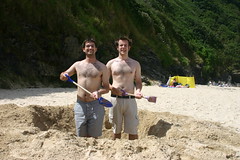
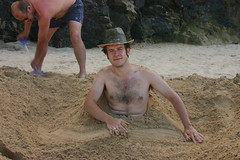
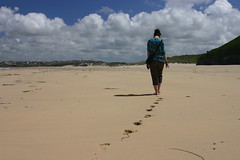
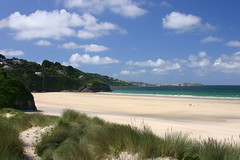
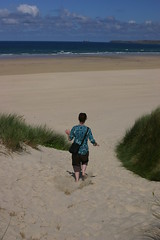
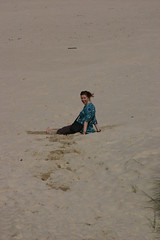
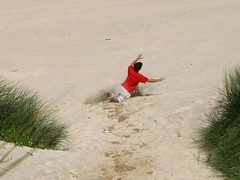
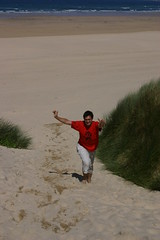
Now, where was I... Carbis Bay Carbis Bay Ah yes. After the horrendously grim weather had passed, the weather improved and we headed for the beach. On the way down we commented on how this was the classic British burning weather: bright sunshine, a strong breeze, and occassional clouds combine to burn skin without even feeling that hot. Of course knowing this meant nothing, we were too distracted with purchasing pasties and drink to think about putting a decent amount of sunblock on. Steve Relaxing Obviously the main thing to do at the beach, after we'd sat down, not applied sunblock, and scoffed a pasty, was to dig a hole. A huge hole. Spades were purchased and we took turns to help Pete dig The Hole. Digging Diggers Astute readers will notice the inevitable outcome of saying this is burning weather, not putting enough sunblock on, and digging a hole (an activity that results in the back being exposed to the sun). Ouch. After the hole had been dug we had to full it in again to avoid trapping small childen in it. Obviously this led to a series of hilarious scenes involving burying Pete up to his chest, modelling breasts and a penis, and so on. Finally the hole was flat again, at which point an impromptu long jump sand pit was arranged. I came first in the long jump, and although failing miserably at triple jump although I swear my technique was best (it's all in the wrists). Pete Next was to explore the costal path in the opposite direction towards Porthkidney beach. The beach is pretty huge by my standards, and due to the lack of facilities (no close car park, shops, toilets, and so on) it's almost deserted: there were a few other people there with dogs (the other local beaches are dog-free in summer) and that's about it. Googling to confirm the name of the beach reveals that there is a history of naturism and "inappropriate gay activity", but we didn't encounter any of that. ;) Progression Ross Footprints The costal path was great, far more rough than the walk to St Ives (often just a foot wide cutting in the ground), steep in places, and generally running very close to the cliff edge. The views were great, but I always think what a horror paths like these would be in winter, with the full force of the Atlantic winds pounding against the cliffs. As a finale it turns out that the costal path follows the cliff all the way along the back of the beach, which would easily be another twenty minutes of walking to reach sand. There is a shortcut down some stone stairs to the beach, but we arrived at high tide and the bottom of the stairs (well, rocks) were a foot deep in water. Wading up to the beach was a fitting end to the walk, and made the beach feel like our own little desert island! Cliff Steps Wading To Land Limpets! Ross I'll have to explain the expression on Vicky in the above photo. As a child when Vicky went to visit her father in Devon they used to go to the beach and spend the day annoying the wildlife: chasing crabs, kicking limpets off rocks and so on. When Vicky noticed that the rocks at the bottom of the cliff were covered in limpets, she shouted "limpets!" with a manic expression and preceeded to prod them frantically. After lots of sitting around and digging tunnels, we headed for the dunes for a spot of dune diving. This involves running at top spead down the dunes and throwing yourself into the sand at the bottom. Ah, the simple pleasures in life! Porthkidney Beach Dune Diving Dune Diving Dune Diving Dune Diving After my dive I ran back up the hill in the manner of a mad man, arms out-stretched to Vicky as I collapsed in front of her, gasping "It's". "What?", was the confused reply. This is terrible, I really need to get Vicky to watch the Best Of Monty Python DVD we have somewhere... It's! Possibly more to write, but Lost is on, so I'm off for now.

7 August 2006

Evan Prodromou: 20 Thermidor CCXIV

Wikimania is over now, and although I have to admit that I'm relieved in a lot of ways, since it's been a long week, I was still a little bummed to say goodbye to people at the closing event last night. I'm a big believer in the meaning and value of on-line communication, but there's something about being physically present with the people who are making wiki and Open Content happen that means a lot to me. Saturday's discussions were all pretty good -- I really liked hearing about The Internet Archive and the amazing amount of knowledge they're making available for future generations. 26 million books, 300,000 films, 3-4 million audio recordings... there is a lot of human culture that we can and should preserve in digital format. Brion's talk about future developments in MediaWiki was great, too. As usual, the hallway conversations were almost as productive as the sessions themselves. I talked to Ray and Mark about using WikiIndex as a clearinghouse for wp:Interwiki coordination. I talked to Ward, who's going to dig in deeper to the MediaWiki parser (impressive!). Maj and I talked with Gil Penchina, who's a real nice guy. And, as the event was wrapping up Saturday evening, I spent a half-hour talking with Kevin Scott, who's got some interesting ideas for launching a new wiki site (or cluster of sites). As I was getting ready to leave, I ran into a cluster of people around wp:Richard Stallman, who'd shown up more or less out of the blue. He was haranguing the crowd about the term intellectual property, and as Brad Patrick, interim CEO of the Wikimedia Foundation and an IP lawyer, was at the front of the line, I got the feeling that Brad had made the mistake of introducing himself. Whoops. I talked with Mako for a while; he had a t-shirt that said, "debian-legal stole my DFSG". Excellent! I also met Thomas Malone, and we talked a bit about how an information commons affects what we think of as "work" and "knowledge workers". Everyone was drifting off to eat before the party, and Professor Malone invited me to join him, but I had to get back and see Maj and Amita June. But, catching a familiar face nearby, I said, "Thomas, have you met wp:Ward Cunningham before...?" They headed off to dinner together, and since they were still hanging out when I saw them later at the party, I assume they hit it off. We had dinner Saturday night at Charlie's Kitchen, a misnamed bar with lots of good, fried crab items. I guess the burgers are good, too, but we enjoyed the seafood and the juke box. Poor Amita June -- growing up in juke joints across North America. She does love french fries, though... Saturday night we went to the Wikimania party at the MIT Museum, which had an amazing number of great exhibits of neat AI schtuff. I spent some time talking with Professor Malone and Ross Mayfield of SocialText. Ross had on a T-shirt from d-Camp, and as we talked about the BarCamp phenomenon Professor Malone decided to hold one at MIT. Cool. Ross had some questions about the recent launch of Wikicars, which has some configuration issues at launch time such that the license shown was incorrect. He was glad to hear it was fixed. I think Ross does a good job keeping an eye on the business aspect of wikis -- I don't think there's another blogger out there who's doing quite as good a job at it. We headed home early -- we've been dragging our poor baby around to too many parties lately -- and got a good night's sleep. tags:

Sunday Sunday's events were pretty good, although I was starting to feel pretty crispy. The discussion about the Wikimedia Foundation's board was really fascinating, but also a bit alarming. The Foundation has a huge job, and they're such a young organization -- like a colt just standing on its feet. Growing pains are inevitable, but it's impressive how committed the people on the board are. They love Wikipedia and the other Wikimedia as much as we all do. I saw a great discussion of wiki map editing (using SVG and Javascript to provide in-browser editing), something very near and dear to my heart, since we need it for Wikitravel. Sadly it was opposite Joseph Reagle's talk on neutrality, so I missed parts of both switching between events. The event ended with a big speech about the nature of knowledge by wp:Dave Weinberger. He started off with a hilarious send-up of Lawrence Lessig's presentation style, but got down to some fundamentals of semiotics in a very approachable way. It was a good finisher for the Wikimania event. Today we're going to stop in to see some people here in wt:Cambridge (Massachusetts), then it's off to wt:New Hampshire and back home. Where we'll be for all of 10 days before packing off for WikiSym. Man, what a month of wikis. tags:

4 August 2006

Adeodato Sim : mmm, abuse

  [LarstiQ] gar, why does firefox assume ftp when the host starts with ftp
  * dato hugs konq.
  [LarstiQ] dato: is it possible in konqueror to bind 'ttp://' to 'http://'?
  [dato] LarstiQ, yes
  [dato] Complete Abuse Of The Software (TM), but works
  [dato] LarstiQ: know about web shortcuts? map shortcut 'ttp' to 'http://\ @ '
NP: Mala Rodr guez, Tengo un trato

3 August 2006

Arnaud Vandyck: Debian packages upload

Yesterday, I uploaded libcommons-collection3-java to add the testframework jar (bug#268223). I investigate the security alert for tomcat5 (CVE2006-3835) as mentioned by Alec Berryman in bug#380361. Alec also filed this bug for tomcat5.5 but I was not able to reproduce the attack with the releases of tomcat in Debian. I filed a removal bug for libgnujaxp-java (bug#381014) which is in GNU-Classpath for a long time now. I uploaded a new upstream of libapache(2)-mod-jk (bug#338158). Today, I uploaded libmsv-xsdlib-java (the package was prepared by Eric Lavarde, but it was refused by ftpmasters because of the license) to non-free and solved the FTBFS of libjaxp1.3-java reported by Andreas Jochens (bug#379530). Except the security alert I closed because I think they were not affected releases of tomcat in Debian, I did not investigate more bugs of tomcat. But I’ll need it for my day-time and extra jobs so I hope I’ll be working on it after augustus 15. Update: I’m trying to fix argouml in Debian and that’s a huge job (well, the whole afternoon!)!
  1. Update libtoolbar-java (new upstream + comment issue#6);
  2. Update libswidgets-java (new upstream + comment issue#1);
  3. Downgrade libgef-java to match ArgoUML development;
  4. Update ArgoUML from 0.19.6 to 0.22.beta3 (new upstream + open issue#4391 and issue#4392). The main developer of ArgoUML said in the mailing list that this release will not be that much different to the final release and the new upstream upload (plus some corrections in the package) will permit to close some bugs: bug#342200, bug#217878, bug#335294, bug#353464, bug#368244, bug#289241.
Even with all this work, argouml does not want to start on my laptop. It’s a problem loading the ‘models’. I suspect a problem with the new mdr-model that I do not build because of dependencies not documented and not DFSG free. So I uploaded every package except argouml. I updated the subversion repository so the work is not lost and I’ll review the problem as soon as possible. You can find a copy of the generated package at my Debian’s webspace (click on the argouml directory).

2 August 2006

Evan Prodromou: 15 Thermidor CCXIV

I'm at the Wikimania hacking days today. We drove down from wt:Montreal through wt:Vermont and wt:New Hampshire on Monday, stopping overnight in the beautiful town of wt:Lincoln (New Hampshire) in the White Mountains. Amita June had a crappy ride on Monday -- she was unhappy and uncomfortable and let us know it at every possible opportunity. We stopped in wt:Saint Johnsbury, VT for dinner, and she got some time to walk around and play, but beside that she was crabby. Tuesday morning was much better -- she had a big bagel from the Comfort Inn's breakfast buffet, and her Sleepy Bear teddy bear, and she was happy. Sleepy Bear is winning the war for hearts and minds in our house -- it's the bear that she's starting to sleep with more and more, and she makes a happy squeal when she sees it. This could be good or bad news. Anyways, we made it down to wt:Cambridge (Massachusetts) aaaalmost in time for the beginning of Hacking Days. HD is the technical pre-conference for the more sociological and content-oriented Wikimania. I thought it was going to be mostly MW committers and Wikimedia sysadmins, but it's turned out to be huge. I think there are about 40-50 people here -- a just gigantic group. Anyways, I was sitting in the One Laptop Per Child office meeting room with about 30 hackers yesterday morning. I was about 20 minutes late, but I managed to find a seat anyways. Everyone was giving introductions, and up stand David Recordon, Jonathan Daugherty, and David Strauss, all of whom say they're there to help me with the OpenID MediaWiki extension. As everyone's talking, I realize wp:Ward Cunningham is sitting right in front of me. The guy sitting next to me stands up to introduce himself, and says, "I'm Dan Bricklin, who many of you may know as the inventor of the spreadsheet..." Jeez. Anyways, the talk has been fast and furious. Yesterday was a long discussion about the state of Wikimedia servers, the upshot of which, for me, was: Holy Shit, Wikimedia is a big project. I managed to talk to a ton of people, including Travis Derouin of wikiHow, Jason from Wikia, all the OpenID folks, etc. etc. Jonathan Daugherty and I actually got some hacking done, which was great. tags:

The future of MediaWiki This morning Brion Vibber and Tim Starling gave a discussion about the future of MediaWiki. The story? More cool features, I think. The OpenID will be part of it; incorporating a WYSIWYG editor like WikiWyg or FCKEditor into the software. Also, more [[wp:AJAX]-y features, which are coming up through the codebase right now. I think in a large way MW's future is going to be outside of Wikipedia proper. Some of the cooler developments using the MW as a platform include WiktionaryZ and Semantic MediaWiki, both of which provide a structured data substrate to wiki pages. They're not compatible, which I think is something that needs to happen at some point in the future, but they're very promising for future projects. Another big class of projects is bots -- like PyWikipediabot or some of the "vandal fighting" bots and interfaces, e.g. Tawkerbot. I think that MediaWiki is drifting from being a monolithic browser app more into a Web-based service, which will be really productive from a content-production and -maintenance point of view, but which is extremely challenging from the social point of view. Finally, I think the great explosion in the world of customized MW extensions and skins is meaning a real marketplace for expanding the software is happening. I think this is pretty fabu, also. Some people have been discussing formalizing this ecology into a CPAN or JabberStudio-style site for hosting and organizing MW extensions. We'll see what happens with that, but if it comes around, I hope that it's named $wgForge. Maj and Amita June are running around Boston today... very slowly and carefully. They've got a brutal heat wave on here, and people are fainting and collapsing like wilting flowers. I think they're going to go places that have air conditioning, like museums and so forth. tags:

1 August 2006

Simon Law: 2006 Ottawa Linux Symposium


Penguin and his boy
Originally uploaded by sfllaw.
The Ottawa Linux Symposium is arguably Canada's biggest conference about Linux and its associated technologies. It happens every year, right after the Kernel Summit, which virtually guarantees that some famous people stick around afterwards to attend OLS. Now the Kernel Summit is a small gathering of Linux developers where they hash out big issues in the kernel. After all, it's a lot easier to get your point across when you're sitting in the same room as the person you're talking to. Mailing lists are just not the same. OLS, however, is a free-for-all. If you pay in time, you get to show up. This makes for an astoundingly large conference, about 850 people in total. I brought along [info]wlach, who had never been to OLS before. So I was doing my part in inflating the number of people there. I think he ended up in the right crowds. Which is difficult, because there are a lot of crowds there. People walk past in a blur and you can never quite remember if you've met someone before.

Bowtied
Originally uploaded by sfllaw.
At the conference, there are four tracks of presentations, at any one time. Some of these are perennial talks, like the tutorial on writing your own kernel module. And others change as the years go by. The big topic this year was Xen, the free virtualization software that really got huge in the past two years. Xen allows people to run multiple copies of their operating system inside one computer, with very little overhead. This makes it attractive to a lot of people, be they system administrators, software developers, or people who like fiddling with their machine. I met a consultant from Chicago that sells Xen-based solutions. She builds a big server and runs various virtual servers for small business inside that one box. It's very cost effective and is a good way to make server maintanance easy. Whenever I wanted to find her, I'd just pop into one of the ubiquitous Xen talks. The amount of work that gets done at this conference is astounding. You'll see people sitting around at tables hashing out designs and beating out flaws. Hackers huddle around laptops in an attempt to get the C library building on PA-RISC again. That's because the bandwidth to communication is very high and the latency is inconsequential. There were times when I wanted to pull out my laptop and do some work. But then I remembered that I left it in the hotel. Because it's heavy. There's actually a lot of space at OLS, because it's spread across the three floors of the Ottawa Congress Centre. It's really easy to miss someone for weeks before bumping into him at a party. Like [info]opalmirror, for example, who I was very glad to meet in person. And are there ever parties.

Super balls
Originally uploaded by sfllaw.
Ostensibly, you go there for the talks. And talks there are: some of them quite good and the vast majority are rather mediocre. They're the results of a year of hacking, months of academic research, or inspired observation. I have to admit that I get a bit lax when attending speakers. It reminds me too much of the classroom. And just like university, I buy the course notes to mitigate my guilt. They make for good reading when finals come along. It's the conversation that you go there for. When you get to sit down with Alan and have a good laugh about geeky topics. Or buy Donald a drink for working on those ugly network cards all those years ago. You get to connect with people that you've only seen online, or read as their names flashed past in the boot messages. That's that kind of bonding that people yearn for. I'm looking forward to next year already.

Gunnar Wolf: Israeli mistakes

Reading Jordi's blog, I cannot but agree with him (in most points): I plainly cannot understand Israel's actions in the last weeks. I can sadly understand how some people defend them, specially people not living in Israel - I was talking with a friend today, a friend who does not share a single political viewpoint with me, but still... The world seems to be completely polarized. Some have the impression that Israelis live under constant shelling, that life is unsustainable in that poor country, the last corner of civilization in that mess called the Middle East, and that the Arab countries (which are huge and petroleum-rich) just want to throw Jews to the sea or worse. The rest of the world think that Israelis are mass-murderers who decided to take a heavily populated bit of land and martyrize its originary population by any possible means, establishing an Apartheid.
Both views are false. But of course, both views hold their bits of truth.
I cannot claim to be neutral on this: Although I lived there in total for ~18 months, I am an Israeli by choice (I adopted the Israeli nationality in 1996 and wanted to live my life there - I came back to Mexico for personal reasons, and I later decided to stay here). I have not been to Israel since then - But I try to keep myself informed. And, living in a Jewish family, it's hard not to be somewhat informed - and of course, shocked at your relatives' opinions. Jews outside Israel tend to be right-wingers. I lived in a kibbutz, and I still sympathyze with Meretz, the most leftwing Zionist party.
I won't restate what Jordi eloquently said. I know not everybody who reads my blog reads Jordi's as well - Please do. If you missed it some lines above, here is the link. I insist: I agree with most of what he wrote. What could Israel do to protect itself from its enemies? The answer is simple: Don't give them a reason to hate you.
One year ago, I was optimistic because Israel was heading the right way. Of all people, Ariel Sharon (one of Israel's most hawkish, right-wing strongmen of all times) decided to withdraw from Gaza, and hinted that areas in the West Bank would follow. No, not the best way possible, not as his predecessor Menahem Begin did with Egypt leading to a strong and long lasting peace, and certainly not in the very notable way Itzhak Rabin did with Jordan, getting peace and even friendship. But at least, Sharon accepted the reality, and seemed he meant to let Palestinians build their state. When he organized a new party which reduced Likud to a shadow of its past, one of Israel's most prominent figures for the peace camp, Shimon Peres, joined. Amazing.
But still, there is too much hatred. Of course, life in Gaza is plainly not sustainable. You can walk the Gaza strip side to side in less than one hour, and North to South it's less than 50 Km long. Still, over 400,000 people live in there. The area is simply unsustainable.
Gaza depends for everything from Israel. Of course, according to the never-stable security status, the border between Gaza and Israel opens or closes every day. When I lived in Zikim, mostly every day there were five or six Arabs working with us... Except for the days when they weren't there. And, of course, Israel also depends on the Arabs for much of its hard labor jobs (as it's always the case when two economically disparate populations live together).
Anyway, back on track: Besides giving the Arabs their slice of land (which in a squeezed area as Israel is always hard; people have fought for such small spaces it's hard to believe), the only thing Israel can do is help them. It has worked before: Israeli Arabs (the Arabs living inside the internationally recognized borders of Israel) are full citizens. Yes, there is racism in the country towards them, and yes, they are not really equal with Jewish Israelis - But they have voting rights, they have the right to be elected, they can optionally join the army (it's not compulsory as it is with the Jewish population), and they get government aid. Arab towns are poorer than Jewish towns, yes, but they have their dignity.
The problem in Gaza and South Lebanon (somewhat less so in the West Bank, but also) is that it's plainly all made up of refugee camps. Refugees that were born there, and whose parents were born there as well. And, let me emphasize this, they are not Israel's fault. The refugees fled the newborn Israel because the Arab states said (in May 1948) they would enter Palestine and butcher everybody, inviting Arab civilians to flee and then get back home - of course, 700,000 (out of 1,300,000 who lived in Palestine by then) Arabs did so. And when the Arabs lost the war, the Palestinians were denied citizenship by all the Arab countries except for Jordan (not surprisingly, the most stable of them all, and with which Israel has the closest relation). They were given refugee camps to live, one over the other. When Egypt signed the peace with Israel, it demanded back every inch of the Sinai - But not an inch of Gaza. And not a single Palestinian refugee.
I agree here with Jordi as well: There is a huge military operation in Gaza, but it's more spectacular in Lebanon today. The media talks about Lebanon, but not about Gaza. And the crisis in Gaza is not easier. But how can it be solved in a permanent way? Israel does neither have land to spare to give to the Palestinians - and even if it did, most of Gaza is surrounded by the Negev, a desert where it would not be easy for them to get anything better than what they have inside Gaza. As desirable as it would be to have a completely independent Palestinian state, Gaza would just remain a concentration camp. There is too much hatred, and neither Arabs nor Israelis want to keep working together, not trusting each other. The only solution I can find to this is to have an agreement with Egypt, where Egypt opens its border with Gaza, gives either nationality or work permits to Gazan Palestinians, and Israel injects capital to develop Northern Sinai, to give some hope of survival to the almost half million people.
The same in Lebanon: Israel was widely applauded to withdraw from South Lebanon in 2000. The area is mostly peaceful - For $ DEITY 's sake, what is the kidnapping of two soldiers in a six year period compared to soldiers being killed in the occupation army every week or two? Israel did well to leave Lebanon. Lebanon was starting an incredible national rebuilding process, as Robert Fisk tells us (Spanish only. I could find only the first paragraphs of the original English version, which appears to require subscription) of the wonders of the rebuilding process, reduced to rubble again. Of course, Israeli and Syrian armies left Lebanon. The Lebanese government and army are plainly too weak to care for the country. Hezbollah (which, indoubtely, is a terrorist entity, no matter how many benefical aspects it does have) have poured tremendous amounts of money to rebuild its area of influence, South Lebanon. Of course, they rebuilt, healed and educated with a strong ideological inclination, and that's not good for Israel. What can Israel do to leasen the Islamist influence? Simple: Send aid. Don't just leave. Don't leave a void, don't invite bad people to loot, don't invite extremist people to recruite future bombers. Turn occupation into aid. Build hospitals. Build houses. Give money, give infrastructure. Do it behind your back, as you gave money to the South Lebanon Army for almost 20 years. But make the people see you don't want to kill and rob them - Make the Lebanese Arabs feel their neighbour as a friend, although different. Bring back the good border. What's that? That's the nickname for the Lebanese border between +- 1950 and 1970 - The only border that was stable, that was not filled with hatred, where Israeli doctors treated Lebanese patients across the fence. And still today, the border is just a simple fence.
How can you convince a people of not killing themselves to kill the invasor? Don't act as an invasor. Act in all your best self-interest - Save them from poverty and from indignity.

Erich Schubert: Speeding up Bittorrent

I've recently used bittorrent a bit. For example, I loaded the Ubuntu installer CD with it. For power users, I think rtorrent is a good client. I tried freeloader, but apart from some obvious bugs (it doesn't save the maximum bandwidth settings value), i'm lacking interesting information such as the number of peers or of distributed copies. When toying around with rtorrent and it's options I noticed a couple of interesting things. First of all, if you're firewalled, you'll be much slower. Allowing incoming connetions (and having a port forwarding in your router) makes a huge difference in the number of peers. My estimates are that 70% of peers are firewalled; if both of you are, you can't transfer data! The other thing is that apparently BitTorrent clients use some kind of "Tit for Tat" strategy. They request a packet, you request a packet. If you don't send them data, they'll stop sending you any. They'll still eventually retry (maybe you were overloaded), but largely your download speed will be related to your upload speed. I don't know how much peers (and seeds) trade information on who has which parts or is sharing how much upload speed. I guess they do somehow to deflect cheaters. Assuming that the illegal file sharing tools work similarly, this gives some interesting (theoretical?) ways to recude illegal file sharing:

31 July 2006

Erich Schubert: Most of web 2.0 is not web 2.0

Have you noticed, that most of the web 2.0 "sites" aren't really worth being called "web 2.0"? Take for example friendster. Many people say that friendster is a web 2.0 thing. Sure, it's using Ajax. But apart from that? Where's the open API? Where is remixing? What is it really different from, lets say, geocities with the addition of some easier linking and search functionality (read: "social networking") And seriously, the profile pages there suck just as bad as the homepages people made with geocities. Especially social networking pages tend to sit on their data and keep it closed. No FOAF files available. That's so web 1.0ish... the web 2.0 is a lot about APIs and open data access. Can you imagine a blogging service not offering syndication (e.g. RSS)? So why a social networking without FOAF? One of the few "true web 2.0 services" remains Google Maps. Even though it doesn't have tag clouds or social networking. ;-) But Mashups adding all that. We should rename the term to "Web 2.0 beta" anyway. It's not released yet. Or use the proper term for it: "DotCom 2.0" Or we should just stop using it, because it's all marketing buzz. Talk about open APIs, remixing, mashups, semantic web, syndication, tagging instead. [Update: web 2.0 is officially just "beta" - see for yourself. It ain't a true web2.0 logo if it doesn't contain "beta"... - also check out this huge list of web 2.0 logo mockups for known brands, including FedExr, McDndld's and of course S.NY beta...]

29 July 2006

Christian Perrier: Holidays

Well, I haven't been much active blogging these days. I indeed was quite busy at work with a reorganization taking place in my department and a few more responsibilities to have for me. My biggest holidays of the year begin right now. I'll leave today and visit my mom and my sister's family in the region of St-Etienne, in France. Then back home three days later and we will leave for a 18-days trip in Mexico on Thursday. This year is my mexican year..:-) That means a 3-week break in mail and Debian activities. See you in late August with, hopefully, a new beta of the installer which will have been released by our tireless release manager Frans Pop. I will come back and the base system will already be frozen and all of us on our way to the Etch release. Great. Hugs to those of you I use to hug and kisses to others!

Felipe Augusto van de Wiel: 28 Jul 2006

Hoooray! Fast updates, that's always cool! :-)

SysAdmin Day
Yes, that's it! July 28th, SysAdmin Day! I received only one "Happy SysAdmin Day" today, but I'm very happy! I also sent a few messages to friends and other sysadmins, congratulating them. So, if you didn't hug your sysadmin today, do it as soon as possible, and if he (or she) doesn't like to be hugged, at least say that you appreciate his/her job, that would be nice.


So, I found the necessary courage and sent a message to my AM speaking about this diary and Planet Debian (thanks to Paul Wise to encourage me on that one).

Next.

Previous.