Search Results: "cas"

31 August 2017

Paul Wise: FLOSS Activities August 2017

Changes

Issues

Review

Administration
  • myrepos: get commit/admin access from joeyh at DebConf17, add commit/admin access for other patch submitters, apply my stack of patches
  • Debian: fix weird log file issues, redirect hardware donor, cleaned up a weird dir, fix some OOB info, ask for TLS on meetings-archive.d.n, check an I/O error, restart broken stunnels, powercycle 1 borked machine,
  • Debian mentors: lintian/security updates & reboot
  • Debian wiki: remove some stray cache files, whitelist 3 email domains, whitelist some email addresses, disable 1 spammer account, disable 1 accounts with bouncing email,
  • Debian QA: apply patch to fix PTS watch file errors, deploy changes
  • Debian derivatives census: run scripts for Purism, remove some noise from logs, trigger a recheck, merge fix by Unit193, deploy changes
  • Openmoko: security updates, reboots, enable unattended-upgrades

Communication
  • Attended DebConf17 and provided some input in BoFs
  • Sent Misc Dev News #44
  • Invite Google gLinux (on IRC) to the Debian derivatives census
  • Welcome Sven Haardiek (of GreenboneOS) to the Debian derivatives census
  • Inquire about the status of Canaima

Sponsors The samba bug report was sponsored by my employer. All other work was done on a volunteer basis.

Chris Lamb: Free software activities in August 2017

Here is my monthly update covering what I have been doing in the free software world in August 2017 (previous month):
Reproducible builds

Whilst anyone can inspect the source code of free software for malicious flaws, most software is distributed pre-compiled to end users. The motivation behind the Reproducible Builds effort is to allow verification that no flaws have been introduced either maliciously or accidentally during this compilation process by promising identical results are always generated from a given source, thus allowing multiple third-parties to come to a consensus on whether a build was compromised. I have generously been awarded a grant from the Core Infrastructure Initiative to fund my work in this area. This month I:
  • Presented a status update at Debconf17 in Montr al, Canada alongside Holger Levsen, Maria Glukhova, Steven Chamberlain, Vagrant Cascadian, Valerie Young and Ximin Luo.
  • I worked on the following issues upstream:
    • glib2.0: Please make the output of gio-querymodules reproducible. (...)
    • gcab: Please make the output reproducible. (...)
    • gtk+2.0: Please make the immodules.cache files reproducible. (...)
    • desktop-file-utils: Please make the output reproducible. (...)
  • Within Debian:
  • Categorised a large number of packages and issues in the Reproducible Builds "notes" repository.
  • Worked on publishing our weekly reports. (#118, #119, #120, #121 & #122)

I also made the following changes to our tooling:
diffoscope

diffoscope is our in-depth and content-aware diff utility that can locate and diagnose reproducibility issues.

  • Use name attribute over path to avoid leaking comparison full path in output. (commit)
  • Add missing skip_unless_module_exists import. (commit)
  • Tidy diffoscope.progress and the XML comparator (commit, commit)

disorderfs

disorderfs is our FUSE-based filesystem that deliberately introduces non-determinism into directory system calls in order to flush out reproducibility issues.

  • Add a simple autopkgtest smoke test. (commit)


Debian
Patches contributed
  • openssh: Quote the IP address in ssh-keygen -f suggestions. (#872643)
  • libgfshare:
    • SIGSEGV if /dev/urandom is not accessible. (#873047)
    • Add bindnow hardening. (#872740)
    • Support nodoc build profile. (#872739)
  • devscripts:
  • memcached: Add hardening to systemd .service file. (#871610)
  • googler: Tidy long and short package descriptions. (#872461)
  • gnome-split: Homepage points to domain-parked website. (#873037)

Uploads
  • python-django 1:1.11.4-1 New upstream release.
  • redis:
    • 4:4.0.1-3 Drop yet more non-deterministic tests.
    • 4:4.0.1-4 Tighten systemd/seccomp hardening.
    • 4:4.0.1-5 Drop even more tests with timing issues.
    • 4:4.0.1-6 Don't install completions to /usr/share/bash-completion/completions/debian/bash_completion/.
    • 4:4.0.1-7 Don't let sentinel integration tests fail the build as they use too many timers to be meaningful. (#872075)
  • python-gflags 1.5.1-3 If SOURCE_DATE_EPOCH is set, either use that as a source of current dates or the UTC-version of the file's modification time (#836004), don't call update-alternatives --remove in postrm. update debian/watch/Homepage & refresh/tidy the packaging.
  • bfs 1.1.1-1 New upstream release, tidy autopkgtest & patches, organising the latter with Pq-Topic.
  • python-daiquiri 1.2.2-1 New upstream release, tidy autopkgtests & update travis.yml from travis.debian.net.
  • aptfs 2:0.10-2 Add upstream signing key, refer to /usr/share/common-licenses/GPL-3 in debian/copyright & tidy autopkgtests.
  • adminer 4.3.1-2 Add a simple autopkgtest & don't install the Selenium-based tests in the binary package.
  • zoneminder (1.30.4+dfsg-2) Prevent build failures with GCC 7 (#853717) & correct example /etc/fstab entries in README.Debian (#858673).

Finally, I reviewed and sponsored uploads of astral, inflection, more-itertools, trollius-redis & wolfssl.

Debian LTS

This month I have been paid to work 18 hours on Debian Long Term Support (LTS). In that time I did the following:
  • "Frontdesk" duties, triaging CVEs, etc.
  • Issued DLA 1049-1 for libsndfile preventing a remote denial of service attack.
  • Issued DLA 1052-1 against subversion to correct an arbitrary code execution vulnerability.
  • Issued DLA 1054-1 for the libgxps XML Paper Specification library to prevent a remote denial of service attack.
  • Issued DLA 1056-1 for cvs to prevent a command injection vulnerability.
  • Issued DLA 1059-1 for the strongswan VPN software to close a denial of service attack.

Debian bugs filed
  • wget: Please hash the hostname in ~/.wget-hsts files. (#870813)
  • debian-policy: Clarify whether mailing lists in Maintainers/Uploaders may be moderated. (#871534)
  • git-buildpackage: "pq export" discards text within square brackets. (#872354)
  • qa.debian.org: Escape HTML in debcheck before outputting. (#872646)
  • pristine-tar: Enable multithreaded compression in pristine-xz. (#873229)
  • tryton-meta: Please combine tryton-modules-* into a single source package with multiple binaries. (#873042)
  • azure-cli:
  • fwupd-tests: Don't ship test files to generic /usr/share/installed-tests dir. (#872458)
  • libvorbis: Maintainer fields points to a moderated mailing list. (#871258)
  • rmlint-gui: Ship a rmlint-gui binary. (#872162)
  • template-glib: debian/copyright references online source without quotation. (#873619)

FTP Team

As a Debian FTP assistant I ACCEPTed 147 packages: abiword, adacgi, adasockets, ahven, animal-sniffer, astral, astroidmail, at-at-clojure, audacious, backdoor-factory, bdfproxy, binutils, blag-fortune, bluez-qt, cheshire-clojure, core-match-clojure, core-memoize-clojure, cypari2, data-priority-map-clojure, debian-edu, debian-multimedia, deepin-gettext-tools, dehydrated-hook-ddns-tsig, diceware, dtksettings, emacs-ivy, farbfeld, gcc-7-cross-ports, git-lfs, glewlwyd, gnome-recipes, gnome-shell-extension-tilix-dropdown, gnupg2, golang-github-aliyun-aliyun-oss-go-sdk, golang-github-approvals-go-approval-tests, golang-github-cheekybits-is, golang-github-chzyer-readline, golang-github-denverdino-aliyungo, golang-github-glendc-gopher-json, golang-github-gophercloud-gophercloud, golang-github-hashicorp-go-rootcerts, golang-github-matryer-try, golang-github-opentracing-contrib-go-stdlib, golang-github-opentracing-opentracing-go, golang-github-tdewolff-buffer, golang-github-tdewolff-minify, golang-github-tdewolff-parse, golang-github-tdewolff-strconv, golang-github-tdewolff-test, golang-gopkg-go-playground-validator.v8, gprbuild, gsl, gtts, hunspell-dz, hyperlink, importmagic, inflection, insighttoolkit4, isa-support, jaraco.itertools, java-classpath-clojure, java-jmx-clojure, jellyfish1, lazymap-clojure, libblockdev, libbytesize, libconfig-zomg-perl, libdazzle, libglvnd, libjs-emojify, libjwt, libmysofa, libundead, linux, lua-mode, math-combinatorics-clojure, math-numeric-tower-clojure, mediagoblin, medley-clojure, more-itertools, mozjs52, openssh-ssh1, org-mode, oysttyer, pcscada, pgsphere, poppler, puppetdb, py3status, pycryptodome, pysha3, python-cliapp, python-coloredlogs, python-consul, python-deprecation, python-django-celery-results, python-dropbox, python-fswrap, python-hbmqtt, python-intbitset, python-meshio, python-parameterized, python-pgpy, python-py-zipkin, python-pymeasure, python-thriftpy, python-tinyrpc, python-udatetime, python-wither, python-xapp, pythonqt, r-cran-bit, r-cran-bit64, r-cran-blob, r-cran-lmertest, r-cran-quantmod, r-cran-ttr, racket-mode, restorecond, rss-bridge, ruby-declarative, ruby-declarative-option, ruby-errbase, ruby-google-api-client, ruby-rash-alt, ruby-representable, ruby-test-xml, ruby-uber, sambamba, semodule-utils, shimdandy, sjacket-clojure, soapysdr, stencil-clojure, swath, template-glib, tools-analyzer-jvm-clojure, tools-namespace-clojure, uim, util-linux, vim-airline, vim-airline-themes, volume-key, wget2, xchat, xfce4-eyes-plugin & xorg-gtest. I additionally filed 6 RC bugs against packages that had incomplete debian/copyright files against: gnome-recipes, golang-1.9, libdazzle, poppler, python-py-zipkin & template-glib.

Jonathan McDowell: C, floating point, and help!

Floating point is a pain. I know this. But I recently took over the sigrok packages in Debian and as part of updating to the latest libsigkrok4 library enabled the post compilation tests. Which promptly failed on i386. Some narrowing down of the problem leads to the following test case (which fails on both gcc-6 under Debian/Stretch and gcc-7 on Debian/Testing):
#include <inttypes.h>
#include <stdio.h>
#include <stdint.h>
int main(int argc, char *argv[])
 
        printf("%" PRIu64 "\n", (uint64_t)((1.034567) * (uint64_t)(1000000ULL)));
 
We expect to see 1.034567 printed out. On x86_64 we do:
$ arch
x86_64
$ gcc -Wall t.c -o t ; ./t
1034567
If we compile for 32-bit the result is also as expected:
$ gcc -Wall -m32 t.c -o t ; ./t
1034567
Where things get interesting is when we enable --std=c99:
$ gcc -Wall --std=c99 t.c -o t ; ./t
1034567
$ gcc -Wall -m32 --std=c99 t.c -o t ; ./t
1034566
What? It turns out all the cXX standards result in the last digit incorrectly being 6, while the gnuXX standards (gnu11 is apparently the default) result in the correct trailing 7. Is there some postfix I can add to the value to prevent the floating point truncation taking place? Or do I just have to accept this? It works fine on armel, so it s not a simple 32/64 bit issue.

30 August 2017

Kees Cook: GRUB and LUKS

I got myself stuck yesterday with GRUB running from an ext4 /boot/grub, but with /boot inside my LUKS LVM root partition, which meant GRUB couldn t load the initramfs and kernel. Luckily, it turns out that GRUB does know how to mount LUKS volumes (and LVM volumes), but all the instructions I could find talk about setting this up ahead of time ( Add GRUB_ENABLE_CRYPTODISK=y to /etc/default/grub ), rather than what the correct manual GRUB commands are to get things running on a failed boot. These are my notes on that, in case I ever need to do this again, since there was one specific gotcha with using GRUB s cryptomount command (noted below). Available devices were the raw disk (hd0), the /boot/grub partition (hd0,msdos1), and the LUKS volume (hd0,msdos5):
grub> ls
(hd0) (hd0,msdos1) (hd0,msdos5)
Used cryptomount to open the LUKS volume (but without ()s! It says it works if you use parens, but then you can t use the resulting (crypto0)):
grub> insmod luks
grub> cryptomount hd0,msdos5
Enter password...
Slot 0 opened.
Then you can load LVM and it ll see inside the LUKS volume:
grub> insmod lvm
grub> ls
(crypto0) (hd0) (hd0,msdos1) (hd0,msdos5) (lvm/rootvg-rootlv)
And then I could boot normally:
grub> configfile $prefix/grub.cfg
After booting, I added GRUB_ENABLE_CRYPTODISK=y to /etc/default/grub and ran update-grub. I could boot normally after that, though I d be prompted twice for the LUKS passphrase (once by GRUB, then again by the initramfs). To avoid this, it s possible to add a second LUKS passphrase, contained in a file in the initramfs, as described here and works for Ubuntu and Debian too. The quick summary is: Create the keyfile and add it to LUKS:
# dd bs=512 count=4 if=/dev/urandom of=/crypto_keyfile.bin
# chmod 0400 /crypto_keyfile.bin
# cryptsetup luksAddKey /dev/sda5 /crypto_keyfile.bin
*enter original password*
Adjust the /etc/crypttab to include passing the file via /bin/cat:
sda5_crypt UUID=4aa5da72-8da6-11e7-8ac9-001cc008534d /crypto_keyfile.bin luks,keyscript=/bin/cat
Add an initramfs hook to copy the key file into the initramfs, keep non-root users from being able to read your initramfs, and trigger a rebuild:
# cat > /etc/initramfs-tools/hooks/crypto_keyfile <<EOF
#!/bin/bash
if [ "$1" = "prereqs" ] ; then
    cp /crypto_keyfile.bin "$ DESTDIR "
fi
EOF
# chmod a+x /etc/initramfs-tools/hooks/crypto_keyfile
# chmod 0700 /boot
# update-initramfs -u
This has the downside of leaving a LUKS passphrase in the clear while you re booted, but if someone has root, they can just get your dm-crypt encryption key directly anyway:
# dmsetup table --showkeys sda5_crypt
0 155797496 crypt aes-cbc-essiv:sha256 e3b0c44298fc1c149afbf4c8996fb92427ae41e4649b934ca495991b7852b855 0 8:5 2056
And of course if you re worried about Evil Maid attacks, you ll need a real static root of trust instead of doing full disk encryption passphrase prompting from an unverified /boot partition. :)

2017, Kees Cook. This work is licensed under a Creative Commons Attribution-ShareAlike 3.0 License.
Creative Commons License

Daniel Silverstone: STM32 USB and Rust - Packet Memory Area

In this, our next exciting installment of STM32 and Rust for USB device drivers, we're going to look at what the STM32 calls the 'packet memory area'. If you've been reading along with the course, including reading up on the datasheet content then you'll be aware that as well as the STM32's normal SRAM, there's a 512 byte SRAM dedicated to the USB peripheral. This SRAM is called the 'packet memory area' and is shared between the main bus and the USB peripheral core. Its purpose is, simply, to store packets in transit. Both those IN to the host (so stored queued for transmission) or OUT from the host (so stored, queued for the application to extract and consume). It's time to actually put hand to keyboard on some Rust code, and the PMA is the perfect starting point, since it involves two basic structures. Packets are the obvious first structure, and they are contiguous sets of bytes which for the purpose of our work we shall assume are one to sixty-four bytes long. The second is what the STM32 datasheet refers to as the BTABLE or Buffer Descriptor Table. Let's consider the BTABLE first.

The Buffer Descriptor Table The BTABLE is arranged in quads of 16bit words. For "normal" endpoints this is a pair of descriptors, each consisting of two words, one for transmission, and one for reception. The STM32 also has a concept of double buffered endpoints, but we're not going to consider those in our proof-of-concept work. The STM32 allows for up to eight endpoints (EP0 through EP7) in internal register naming, though they support endpoints numbered from zero to fifteen in the sense of the endpoint address numbering. As such there're eight descriptors each four 16bit words long (eight bytes) making for a buffer descriptor table which is 64 bytes in size at most.
Buffer Descriptor Table
Byte offset in PMA Field name Description
(EPn * 8) + 0 USB_ADDRn_TX The address (inside the PMA) of the TX buffer for EPn
(EPn * 8) + 2 USB_COUNTn_TX The number of bytes present in the TX buffer for EPn
(EPn * 8) + 4 USB_ADDRn_RX The address (inside the PMA) of the RX buffer for EPn
(EPn * 8) + 6 USB_COUNTn_RX The number of bytes of space available for the RX buffer for EPn (and once received, the number of bytes received)
The TX entries are trivial to comprehend. To transmit a packet, part of the process involves writing the packet into the PMA, putting the address into the appropriate USB_ADDRn_TX entry, and the length into the corresponding USB_COUNTn_TX entry, before marking the endpoint as ready to transmit. To receive a packet though is slightly more complex. The application must allocate some space in the PMA, setting the address into the USB_ADDRn_RX entry of the BTABLE before filling out the top half of the USB_COUNTn_RX entry. For ease of bit sizing, the STM32 only supports space allocations of two to sixty-two bytes in steps of two bytes at a time, or thirty-two to five-hundred-twelve bytes in steps of thirty-two bytes at a time. Once the packet is received, the USB peripheral will fill out the lower bits of the USB_COUNTn_RX entry with the actual number of bytes filled out in the buffer.

Packets themselves Since packets are, typically, a maximum of 64 bytes long (for USB 2.0) and are simply sequences of bytes with no useful structure to them (as far as the USB peripheral itself is concerned) the PMA simply requires that they be present and contiguous in PMA memory space. Addresses of packets are relative to the base of the PMA and are byte-addressed, however they cannot start on an odd byte, so essentially they are 16bit addressed. Since the BTABLE can be anywhere within the PMA, as can the packets, the application will have to do some memory management (either statically, or dynamically) to manage the packets in the PMA.

Accessing the PMA The PMA is accessed in 16bit word sections. It's not possible to access single bytes of the PMA, nor is it conveniently structured as far as the CPU is concerned. Instead the PMA's 16bit words are spread on 32bit word boundaries as far as the CPU knows. This is done for convenience and simplicity of hardware, but it means that we need to ensure our library code knows how to deal with this. First up, to convert an address in the PMA into something which the CPU can use we need to know where in the CPU's address space the PMA is. Fortunately this is fixed at 0x4000_6000. Secondly we need to know what address in the PMA we wish to access, so we can determine which 16bit word that is, and thus what the address is as far as the CPU is concerned. If we assume we only ever want to access 16bit entries, we can just multiply the PMA offset by two before adding it to the PMA base address. So, to access the 16bit word at byte-offset 8 in the PMA, we'd look for the 16bit word at 0x4000_6000 + (0x08 * 2) => 0x4000_6010.

Bundling the PMA into something we can use I said we'd do some Rust, and so we shall
    // Thanks to the work by Jorge Aparicio, we have a convenient wrapper
    // for peripherals which means we can declare a PMA peripheral:
    pub const PMA: Peripheral<PMA> = unsafe   Peripheral::new(0x4000_6000)  ;
    // The PMA struct type which the peripheral will return a ref to
    pub struct PMA  
        pma_area: PMA_Area,
     
    // And the way we turn that ref into something we can put a useful impl on
    impl Deref for PMA  
        type Target = PMA_Area;
        fn deref(&self) -> &PMA_Area  
            &self.pma_area
         
     
    // This is the actual representation of the peripheral, we use the C repr
    // in order to ensure it ends up packed nicely together
    #[repr(C)]
    pub struct PMA_Area  
        // The PMA consists of 256 u16 words separated by u16 gaps, so lets
        // represent that as 512 u16 words which we'll only use every other of.
        words: [VolatileCell<u16>; 512],
     
That block of code gives us three important things. Firstly a peripheral object which we will be able to (later) manage nicely as part of the set of peripherals which RTFM will look after for us. Secondly we get a convenient packed array of u16s which will be considered volatile (the compiler won't optimise around the ordering of writes etc). Finally we get a struct on which we can hang an implementation to give our PMA more complex functionality. A useful first pair of functions would be to simply let us get and put u16s in and out of that word array, since we're only using every other word
    impl PMA_Area  
        pub fn get_u16(&self, offset: usize) -> u16  
            assert!((offset & 0x01) == 0);
            self.words[offset].get()
         
        pub fn set_u16(&self, offset: usize, val: u16)  
            assert!((offset & 0x01) == 0);
            self.words[offset].set(val);
         
     
These two functions take an offset in the PMA and return the u16 word at that offset. They only work on u16 boundaries and as such they assert that the bottom bit of the offset is unset. In a release build, that will go away, but during debugging this might be essential. Since we're only using 16bit boundaries, this means that the first word in the PMA will be at offset zero, and the second at offset two, then four, then six, etc. Since we allocated our words array to expect to use every other entry, this automatically converts into the addresses we desire. If we pop (and please don't worry about the unsafe stuff for now):
    unsafe   (&*usb::pma::PMA.get()).set_u16(4, 64);  
into our main function somewhere, and then build and objdump our test binary we can see the following set of instructions added:
 80001e4:   f246 0008   movw    r0, #24584  ; 0x6008
 80001e8:   2140        movs    r1, #64 ; 0x40
 80001ea:   f2c4 0000   movt    r0, #16384  ; 0x4000
 80001ee:   8001        strh    r1, [r0, #0]
This boils down to a u16 write of 0x0040 (64) to the address 0x4006008 which is the third 32 bit word in the CPU's view of the PMA memory space (where offset 4 is the third 16bit word) which is exactly what we'd expect to see. We can, from here, build up some functions for manipulating a BTABLE, though the most useful ones for us to take a look at are the RX counter functions:
    pub fn get_rxcount(&self, ep: usize) -> u16  
        self.get_u16(BTABLE + (ep * 8) + 6) & 0x3ff
     
    pub fn set_rxcount(&self, ep: usize, val: u16)  
        assert!(val <= 1024);
        let rval: u16 =  
            if val > 62  
                assert!((val & 0x1f) == 0);
                (((val >> 5) - 1) << 10)   0x8000
              else  
                assert!((val & 1) == 0);
                (val >> 1) << 10
             
         ;
        self.set_u16(BTABLE + (ep * 8) + 6, rval)
     
The getter is fairly clean and clear, we need the BTABLE base in the PMA, add the address of the USB_COUNTn_RX entry to that, retrieve the u16 and then mask off the bottom ten bits since that's the size of the relevant field. The setter is a little more complex, since it has to deal with the two possible cases, this isn't pretty and we might be able to write some better peripheral structs in the future, but for now, if the length we're setting is 62 or less, and is divisible by two, then we put a zero in the top bit, and the number of 2-byte lumps in at bits 14:10, and if it's 64 or more, we mask off the bottom to check it's divisible by 32, and then put the count (minus one) of those blocks in, instead, and set the top bit to mark it as such. Fortunately, when we set constants, Rust's compiler manages to optimise all this very quickly. For a BTABLE at the bottom of the PMA, and an initialisation statement of:
    unsafe   (&*usb::pma::PMA.get()).set_rxcount(1, 64);  
then we end up with the simple instruction sequence:
80001e4:    f246 001c   movw    r0, #24604  ; 0x601c
80001e8:    f44f 4104   mov.w   r1, #33792  ; 0x8400
80001ec:    f2c4 0000   movt    r0, #16384  ; 0x4000
80001f0:    8001        strh    r1, [r0, #0]
We can decompose that into a C like *((u16*)0x4000601c) = 0x8400 and from there we can see that it's writing to the u16 at 0x1c bytes into the CPU's view of the PMA, which is 14 bytes into the PMA itself. Since we know we set the BTABLE at the start of the PMA, it's 14 bytes into the BTABLE which is firmly in the EP1 entries. Specifically it's USB_COUNT1_RX which is what we were hoping for. To confirm this, check out page 651 of the datasheet. The value set was 0x8400 which we can decompose into 0x8000 and 0x0400. The first is the top bit and tells us that BL_SIZE is one, and thus the blocks are 32 bytes long. Next the 0x4000 if we shift it right ten places, we get the value 2 for the field NUM_BLOCK and multiplying 2 by 32 we get the 64 bytes we asked it to set as the size of the RX buffer. It has done exactly what we hoped it would, but the compiler managed to optimise it into a single 16 bit store of a constant value to a constant location. Nice and efficient. Finally, let's look at what happens if we want to write a packet into the PMA. For now, let's assume packets come as slices of u16s because that'll make our life a little simpler:
    pub fn write_buffer(&self, base: usize, buf: &[u16])  
        for (ofs, v) in buf.iter().enumerate()  
            self.set_u16(base + (ofs * 2), *v);
         
     
Yes, even though we're deep in no_std territory, we can still get an iterator over the slice, and enumerate it, getting a nice iterator of (index, value) though in this case, the value is a ref to the content of the slice, so we end up with *v to deref it. I am sure I could get that automatically happening but for now it's there. Amazingly, despite using iterators, enumerators, high level for loops, function calls, etc, if we pop:
    unsafe   (&*usb::pma::PMA.get()).write_buffer(0, &[0x1000, 0x2000, 0x3000]);  
into our main function and compile it, we end up with the instruction sequence:
80001e4:    f246 0000   movw    r0, #24576  ; 0x6000
80001e8:    f44f 5180   mov.w   r1, #4096   ; 0x1000
80001ec:    f2c4 0000   movt    r0, #16384  ; 0x4000
80001f0:    8001        strh    r1, [r0, #0]
80001f2:    f44f 5100   mov.w   r1, #8192   ; 0x2000
80001f6:    8081        strh    r1, [r0, #4]
80001f8:    f44f 5140   mov.w   r1, #12288  ; 0x3000
80001fc:    8101        strh    r1, [r0, #8]
which, as you can see, ends up being three sequential halfword stores directly to the right locations in the CPU's view of the PMA. You have to love seriously aggressive compile-time optimisation :-) Hopefully, by next time, we'll have layered some more pleasant routines on our PMA code, and begun a foray into the setup necessary before we can begin handling interrupts and start turning up on a USB port.

Wouter Verhelst: Re-encoding DebConf17 videos

Feedback we received after DebConf17 was that the quality of the released videos was rather low. Since I'd been responsible for encoding the videos, I investigated that, and found that I had used the video bitrate defaults of ffmpeg, which are rather low. So, I read some more documentation, and came up with better settings for the encoding to be done properly. While at it, I found that the reason that VP9 encoding takes forever, as I'd found before, has everything to do with the same low-bitrate defaults, and is not an inherent problem to VP9 encoding. In light of that, I ran a test encode of a video with VP8 as well as VP9 encoding, and found that it shaves off some of the file size for about the same quality, with little to no increase in encoder time. Unfortunately, the initial VP9 encoder settings that I used produced files that would play in some media players and in some browsers, but not in all of them. A quick email to the WebM-discuss mailinglist got me a reply, explaining that since our cameras used YUV422 encoding, which VP9 supports but some media players do not, and that since VP8 doesn't support that format, the result was VP9 files with YUV422 encoding, and VP8 ones with YUV420. The fix was to add a single extra command-line parameter to force the pixel format to YUV420 and tell ffmpeg to also downsample the video to that. After adding another few parameters so as to ensure that some metadata would be added to the files as well, I've now told the system to re-encode the whole corpus of DebConf17 videos in both VP8 as well as VP9. It would appear that the VP9 files are, on average, about 1/4th to 1/3rd smaller than the equivalent VP8 files, with no apparent loss in quality. Since some people might like them for whatever reason, I've not dropped the old lower-quality VP8 files, but instead moved them to an "lq" directory. They are usually about half the size of the VP9 files, but the quality is pretty terrible. TLDR: if you downloaded videos from the debconf video archive, you may want to check whether it has been re-encoded yet (which would be the case if the state on that page is "done"), and if so, download them anew.

29 August 2017

Jeremy Bicha: GNOME Tweaks 3.25.91

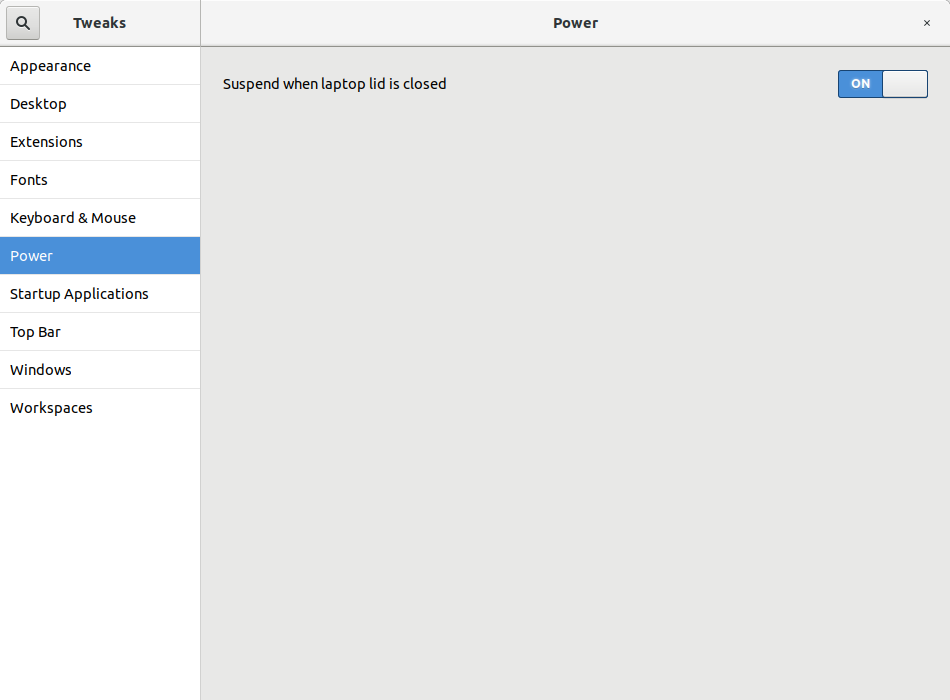
The GNOME 3.26 release cycle is in its final bugfix stage before release. Here s a look at what s new in GNOME Tweaks since my last post. I ve heard people say that GNOME likes to remove stuff. If that were true, how would there be anything left in GNOME? But maybe it s partially true. And maybe it s possible for removals to be a good thing? Removal #1: Power Button Settings The Power page in Tweaks 3.25.91 looks a bit empty. In previous releases, the Tweaks app had a When the Power button is pressed setting that nearly duplicated the similar setting in the Settings app (gnome-control-center). I worked to restore support for Power Off as one of its options. Since this is now in Settings 3.25.91, there s no need for it to be in Tweaks any more. Removal #2: Hi-DPI Settings GNOME Tweaks offered a basic control to scale windows 2x for Hi-DPI displays. More advanced support is now in the Settings app. I suspect that fractional scaling won t be supported in GNOME 3.26 but it s something to look forward to in GNOME 3.28! Removal #3 Global Dark Theme I am announcing today that one of the oldest and popular tweaks will be removed from Tweaks 3.28 (to be released next March). Global Dark Theme is being removed because: Adwaita now has a separate Adwaita Dark theme. Arc has 2 different dark variations. Therefore, if you are a theme developer, you have about 6-7 months to offer a dark version of your theme. The dark version can be distributed the same way as your regular version. Removal #4 Some letters from our name In case you haven t noticed, GNOME Tweak Tool is now GNOME Tweaks. This better matches the GNOME app naming style. Thanks Alberto Fanjul for this improvement! For other details of what s changed including a helpful scrollbar fix from Ant nio Fernandes, see the NEWS file.

28 August 2017

John Goerzen: The Joy of Exploring: Old Phone Systems, Pizza, and Discovery

This story involves boys pretending to be pizza deliverymen using a working automated Strowger telephone exchange demonstrator on display in a museum, which is very old and is, to my knowledge, the only such working exhibit in the world. (Yes, I have video.) But first, a thought on exploration. There are those that would say that there is nothing left to explore anymore that the whole earth is mapped, photographed by satellites, and, well, known. I prefer to look at it a different way: the earth is full of places that billions of people will never see, and probably don t even know about. Those places may be quiet country creeks, peaceful neighborhoods one block away from major tourist attractions, an MTA museum in Brooklyn, a state park in Arkansas, or a beautiful church in Germany. Martha is not yet two months old, and last week she and I spent a surprisingly long amount of time just gazing at tree branches she was mesmerized, and why not, because to her, everything is new. As I was exploring in Portland two weeks ago, I happened to pick up a nearly-forgotten book by a nearly-forgotten person, Beryl Markham, a woman who was a pilot in Africa about 80 years ago. The passage that I happened to randomly flip to in the bookstore, which really grabbed my attention, was this:
The available aviation maps of Africa in use at that time all bore the cartographer s scale mark, 1/2,000,000 one over two million. An inch on the map was about thitry-two miles in the air, as compared to the flying maps of Europe on which one inch represented no more than four air miles. Moreover, it seemed that the printers of the African maps had a slightly malicious habit of including, in large letters, the names of towns, junctions, and villages which, while most of them did exist in fact, as a group of thatched huts may exist or a water hold, they were usually so inconsequential as completely to escape discovery from the cockpit. Beyond this, it was even more disconcerting to examine your charts before a proposed flight only to find that in many cases the bulk of the terrain over which you had to fly was bluntly marked: UNSURVEYED . It was as if the mapmakers had said, We are aware that between this spot and that one, there are several hundred thousands of acres, but until you make a forced landing there, we won t know whether it is mud, desert, or jungle and the chances are we won t know then! Beryl Markham, West With the Night
My aviation maps today have no such markings. The continent is covered with radio beacons, the world with GPS, the maps with precise elevations of the ground and everything from skyscrapers to antenna towers. And yet, despite all we know, the world is still a breathtaking adventure. Yesterday, the boys and I were going to fly to Abilene, KS, to see a museum (Seelye Mansion). Circumstances were such that we neither flew, nor saw that museum. But we still went to Abilene, and wound up at the Museum of Independent Telephony, a wondrous place for anyone interested in the history of technology. As it is one of those off-the-beaten-path sorts of places, the boys got 2.5 hours to use the hands-on exhibits of real old phones, switchboards, and also the schoolhouse out back. They decided why not? to use this historic equipment to pretend to order pizzas. Jacob and Oliver proceeded to invent all sorts of things to use the phones for: ordering pizza, calling the cops to chase the pizza delivery guys, etc. They were so interested that by 2PM we still hadn t had lunch and they claimed we re not hungry despite the fact that we were going to get pizza for lunch. And I certainly enjoyed the exhibits on the evolution of telephones, switching (from manual plugboards to automated switchboards), and such. This place was known it even has a website, I had been there before, and in fact so had the boys (my parents took them there a couple of years ago). But yesterday, we discovered the Strowger switch had been repaired since the last visit, and that it, in fact, is great for conversations about pizza. Whether it s seeing an eclipse, discovering a fascination with tree branches, or historic telephones, a spirit of curiosity and exploration lets a person find fun adventures almost anywhere.

27 August 2017

Carl Chenet: The Importance of Choosing the Correct Mastodon Instance

Remember, Mastodon is a new decentralized social network, based on a free software which is rapidly gaining users (already there is more than 1.5 million accounts). As I ve created my account in June, I was a fast addict and I ve already created several tools for this network, Feed2toot, Remindr and Boost (mostly written in Python).

Now, with all this experience I have to stress out the importance of choosing the correct Mastodon instance.

Some technical reminders on how Mastodon works

First, let s quickly clarify something about the decentralized part. In Mastodon, decentralization is made through a federation of dedicated servers, called instances , each one with a complete independent administration. Your user account is created on one specific instance. You have two choices:

  • Create your own instance. Which requires advanced technical knowledge.
  • Create your user account on a public instance. Which is the easiest and fastest way to start using Mastodon.

You can move your user account from one instance to another, but you have to follow a special procedure which can be quite long, considering your own interest for technical manipulation and the total amount of your followers you ll have to warn about your change. As such, you ll have to create another account on a new instance and import three lists: the one with your followers, the one with the accounts you have blocked, and the one with the account you have muted.

From this working process, several technical and human factors will interest us.

A good technical administration for instance

As a social network, Mastodon is truly decentralized, with more than 1.5 million users on more than 2350 existing instances. As such, the most common usage is to create an account on an open instance. To create its own instance is way too difficult for the average user. Yet, using an open instance creates a strong dependence on the technical administrator of the chosen instance.
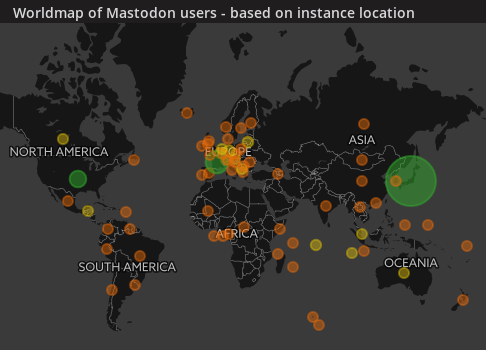
The technical administrator will have to deal with several obligations to ensure its service continuity, with high-quality hardware and regular back-ups. All of these have a price, either in money and in time. Regarding the time factor, it would be better to choose an administration team over an individual, as life events can change quite fast everyone s interests. As such, Framasoft, a French association dedicated to promoting the Free software use, offers its own Mastodon instance named: Framapiaf. The creator of the mastodon project, also offers a quite solid instance, Mastodon.social (see below).

Regarding the money factor, many instance administrators with a large number of users are currently asking for donation via Patreon, as hosting an instance server or renting one cost money.
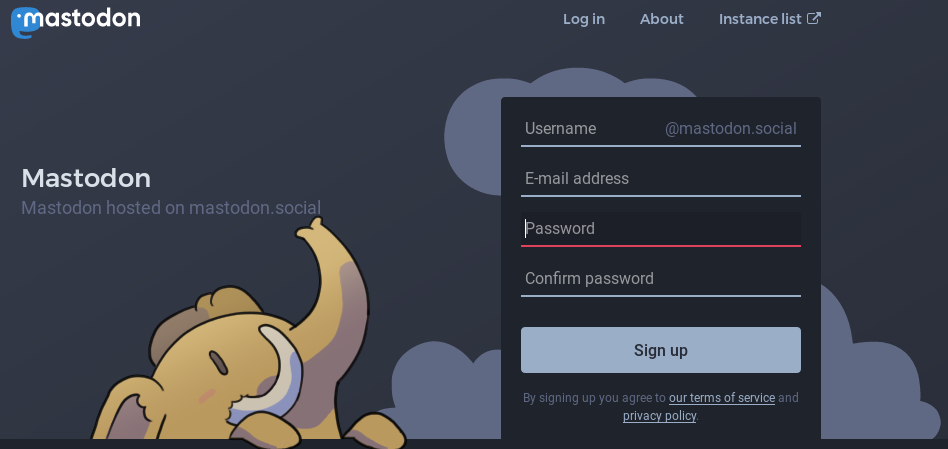
Mastodon.social, the first instance of the Mastodon network

The Ideological Trend Of Your Instance

If anybody could have guessed the previous technical points since the recent registration explosion on the Mastodon social network, the following point took almost everyone by surprise. Little by little, different instances show their culture , their protest action, and their propaganda on this social network.

As the instance administrator has all the powers over its instance, he or she can block the instance of interacting with some other instances, or ban its instance s users from any interaction with other instances users.

With everyone having in mind the main advantages to have federalized instance from, this partial independence of some instances from the federation was a huge surprise. One of the most recent example was when the Unixcorn.xyz instance administrator banned its users from reading Aeris account, which was on its own instance. It was a cataclysm with several consequences, which I ve named the #AerisGate as it shows the different views on moderation and on its reception by various Mastodon users.

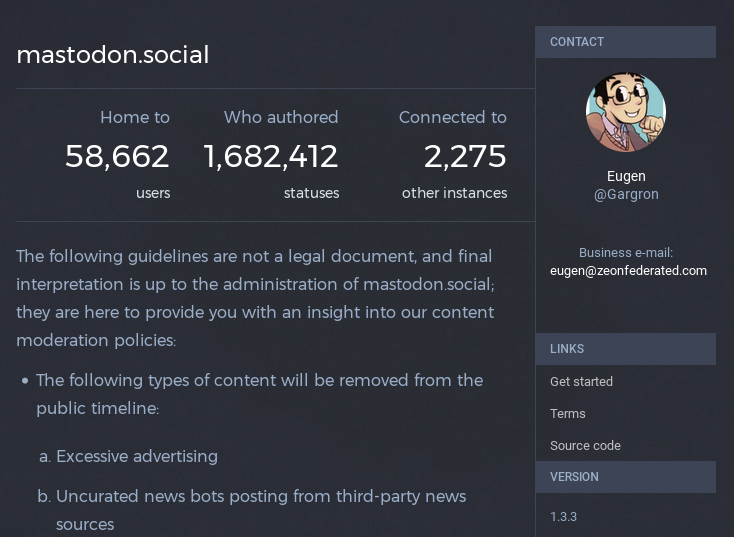
If you don t manage your own instance, when you ll have to choose the one where to create your account, make sure that the content you plan to toot is within the rules and compatible with the ideology of said instance s administrator. Yes, I know, it may seem surprising but, as stated above, by entering a public instance you become dependent on someone else s infrastructure, who may have an ideological way to conceive its Mastodon hosting service. As such, if you re a nazi, for example, don t open your Mastodon account on a far-left LGBT instance. Your account wouldn t stay open for long.

The moderation rules are described in the about/more page of the instance, and may contain ideological elements.
To ease the process for newcomers, it is now possible to use a great tool to select what instance should be the best to host your account.
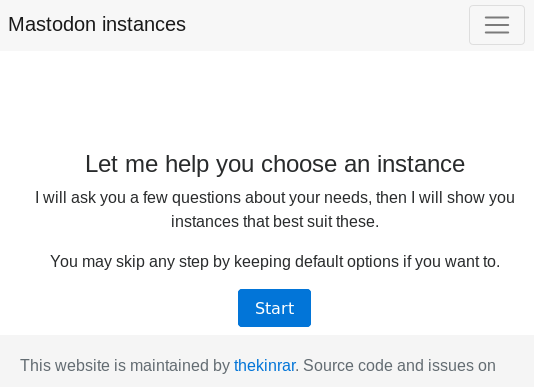
Remember that, as stated above, Mastodon is decentralized, and as such there is no central authority which can be reached in case you have a conflict with your instance administrator. And nobody can force said administrator to follow its own rules, or not to change them on the fly. Think Twice Before Creating Your Account

If you want to create an account on an instance you don t control, you need to check two elements: the availability of the instance hosting service in the long run, often linked to the administrator or the administration group of said instance, and the ideological orientation of your instance. With these two elements checked, you ll be able to let your Mastodon account growth peacefully, without fearing an outage of your instance, or simple your account blocked one morning because it doesn t align with your instance s ideological line.

in Conclusion

To help me get involved in free software and writing articles for this blog, please consider a donation through my Liberapay page, even if it s only a few cents per week. My contact Bitcoin and Monero are also available on this page. Follow me on Mastodon Translated from French to English by St phanie Chaptal.


25 August 2017

Steve Kemp: Interesting times debugging puppet

I recently upgraded a bunch of systems from Jessie to Stretch, and as a result of that one of my hosts has started showing me a lot of noise in an hourly cron-email:
Command line is not complete. Try option "help"
I've been ignoring these emails for the past while, but today I sat down to track down the source. It was obviously coming from facter, the system that puppet uses to gather information about hosts. Running facter -debug made that apparent:
 root@smaug ~ # facter --debug
 Found no suitable resolves of 1 for ec2_metadata
 value for ec2_metadata is still nil
 value for netmask_git is still nil
 value for ipaddress6_lo is still nil
 value for macaddress_lo is still nil
 value for ipaddress_master is still nil
 value for ipaddress6_master is still nil
 Command line is not complete. Try option "help"
 value for netmask_master is still nil
 value for ipaddress_skx_mail is still nil
 ..
There we see the issue, and it is obviously relating to our master interface. To cut a long-story short /usr/lib/ruby/vendor_ruby/facter/util/ip.rb contains some code which eventually runs this:
 ip link show $interface
That works on all other interfaces I have:
  $ ip link show git
  6: git: <BROADCAST,MULTICAST,UP,LOWER_UP> mtu 1500 qdisc pfifo_fast state UNKNOWN mode DEFAULT group default qlen 1000
But not on master:
  $ ip link show master
  Command line is not complete. Try option "help"
I ninja-edited the code from this:
  ethbond = regex.match(%x /sbin/ip link show '# interface ' )
to:
  ethbond = regex.match(%x /sbin/ip link show dev '# interface ' )
And suddenly puppet-runs without any errors. I'm not 100% sure if this is a bug bug, but it is something of a surprise anyway.
This host runs KVM guests, one of the guests is a puppet-master, with a local name master. Hence the name of the interface. Similarly the interface git is associated with the KVM guest behind git.steve.org.uk.

23 August 2017

Antoine Beaupr : The supposed decline of copyleft

At DebConf17, John Sullivan, the executive director of the FSF, gave a talk on the supposed decline of the use of copyleft licenses use free-software projects. In his presentation, Sullivan questioned the notion that permissive licenses, like the BSD or MIT licenses, are gaining ground at the expense of the traditionally dominant copyleft licenses from the FSF. While there does seem to be a rise in the use of permissive licenses, in general, there are several possible explanations for the phenomenon.

When the rumor mill starts Sullivan gave a recent example of the claim of the decline of copyleft in an article on Opensource.com by Jono Bacon from February 2017 that showed a histogram of license usage between 2010 and 2017 (seen below).
[Black Duck   histogram]
From that, Bacon elaborates possible reasons for the apparent decline of the GPL. The graphic used in the article was actually generated by Stephen O'Grady in a January article, The State Of Open Source Licensing, which said:
In Black Duck's sample, the most popular variant of the GPL version 2 is less than half as popular as it was (46% to 19%). Over the same span, the permissive MIT has gone from 8% share to 29%, while its permissive cousin the Apache License 2.0 jumped from 5% to 15%.
Sullivan, however, argued that the methodology used to create both articles was problematic. Neither contains original research: the graphs actually come from the Black Duck Software "KnowledgeBase" data, which was partly created from the old Ohloh web site now known as Open Hub. To show one problem with the data, Sullivan mentioned two free-software projects, GNU Bash and GNU Emacs, that had been showcased on the front page of Ohloh.net in 2012. On the site, Bash was (and still is) listed as GPLv2+, whereas it changed to GPLv3 in 2011. He also claimed that "Emacs was listed as licensed under GPLv3-only, which is a license Emacs has never had in its history", although I wasn't able to verify that information from the Internet archive. Basically, according to Sullivan, "the two projects featured on the front page of a site that was using [the Black Duck] data set were wrong". This, in turn, seriously brings into question the quality of the data:
I reported this problem and we'll continue to do that but when someone is not sharing the data set that they're using for other people to evaluate it and we see glimpses of it which are incorrect, that should give us a lot of hesitation about accepting any conclusion that comes out of it.
Reproducible observations are necessary to the establishment of solid theories in science. Sullivan didn't try to contact Black Duck to get access to the database, because he assumed (rightly, as it turned out) that he would need to "pay for the data under terms that forbid you to share that information with anybody else". So I wrote Black Duck myself to confirm this information. In an email interview, Patrick Carey from Black Duck confirmed its data set is proprietary. He believes, however, that through a "combination of human and automated techniques", Black Duck is "highly confident at the accuracy and completeness of the data in the KnowledgeBase". He did point out, however, that "the way we track the data may not necessarily be optimal for answering the question on license use trend" as "that would entail examination of new open source projects coming into existence each year and the licenses used by them". In other words, even according to Black Duck, its database may not be useful to establish the conclusions drawn by those articles. Carey did agree with those conclusions intuitively, however, saying that "there seems to be a shift toward Apache and MIT licenses in new projects, though I don't have data to back that up". He suggested that "an effective way to answer the trend question would be to analyze the new projects on GitHub over the last 5-10 years." Carey also suggested that "GitHub has become so dominant over the recent years that just looking at projects on GitHub would give you a reasonable sampling from which to draw conclusions".
[GitHub   graph]
Indeed, GitHub published a report in 2015 that also seems to confirm MIT's popularity (45%), surpassing copyleft licenses (24%). The data is, however, not without its own limitations. For example, in the above graph going back to the inception of GitHub in 2008, we see a rather abnormal spike in 2013, which seems to correlate with the launch of the choosealicense.com site, described by GitHub as "our first pass at making open source licensing on GitHub easier". In his talk, Sullivan was critical of the initial version of the site which he described as biased toward permissive licenses. Because the GitHub project creation page links to the site, Sullivan explained that the site's bias could have actually influenced GitHub users' license choices. Following a talk from Sullivan at FOSDEM 2016, GitHub addressed the problem later that year by rewording parts of the front page to be more accurate, but that any change in license choice obviously doesn't show in the report produced in 2015 and won't affect choices users have already made. Therefore, there can be reasonable doubts that GitHub's subset of software projects may not actually be that representative of the larger free-software community.

In search of solid evidence So it seems we are missing good, reproducible results to confirm or dispel these claims. Sullivan explained that it is a difficult problem, if only in the way you select which projects to analyze: the impact of a MIT-licensed personal wiki will obviously be vastly different from, say, a GPL-licensed C compiler or kernel. We may want to distinguish between active and inactive projects. Then there is the problem of code duplication, both across publication platforms (a project may be published on GitHub and SourceForge for example) but also across projects (code may be copy-pasted between projects). We should think about how to evaluate the license of a given project: different files in the same code base regularly have different licenses often none at all. This is why having a clear, documented and publicly available data set and methodology is critical. Without this, the assumptions made are not clear and it is unreasonable to draw certain conclusions from the results. It turns out that some researchers did that kind of open research in 2016 in a paper called "The Debsources Dataset: Two Decades of Free and Open Source Software" [PDF] by Matthieu Caneill, Daniel M. Germ n, and Stefano Zacchiroli. The Debsources data set is the complete Debian source code that covers a large history of the Debian project and therefore includes thousands of free-software projects of different origins. According to the paper:
The long history of Debian creates a perfect subject to evaluate how FOSS licenses use has evolved over time, and the popularity of licenses currently in use.
Sullivan argued that the Debsources data set is interesting because of its quality: every package in Debian has been reviewed by multiple humans, including the original packager, but also by the FTP masters to ensure that the distribution can legally redistribute the software. The existence of a package in Debian provides a minimal "proof of use": unmaintained packages get removed from Debian on a regular basis and the mere fact that a piece of software gets packaged in Debian means at least some users found it important enough to work on packaging it. Debian packagers make specific efforts to avoid code duplication between packages in order to ease security maintenance. The data set covers a period longer than Black Duck's or GitHub's, as it goes all the way back to the Hamm 2.0 release in 1998. The data and how to reproduce it are freely available under a CC BY-SA 4.0 license.
[Debsource   graph]
Sullivan presented the above graph from the research paper that showed the evolution of software license use in the Debian archive. Whereas previous graphs showed statistics in percentages, this one showed actual absolute numbers, where we can't actually distinguish a decline in copyleft licenses. To quote the paper again:
The top license is, once again, GPL-2.0+, followed by: Artistic-1.0/GPL dual-licensing (the licensing choice of Perl and most Perl libraries), GPL-3.0+, and Apache-2.0.
Indeed, looking at the graph, at most do we see a rise of the Apache and MIT licenses and no decline of the GPL per se, although its adoption does seem to slow down in recent years. We should also mention the possibility that Debian's data set has the opposite bias: toward GPL software. The Debian project is culturally quite different from the GitHub community and even the larger free-software ecosystem, naturally, which could explain the disparity in the results. We can only hope a similar analysis can be performed on the much larger Software Heritage data set eventually, which may give more representative results. The paper acknowledges this problem:
Debian is likely representative of enterprise use of FOSS as a base operating system, where stable, long-term and seldomly updated software products are desirable. Conversely Debian is unlikely representative of more dynamic FOSS environments (e.g., modern Web-development with micro libraries) where users, who are usually developers themselves, expect to receive library updates on a daily basis.
The Debsources research also shares methodology limitations with Black Duck: while Debian packages are reviewed before uploading and we can rely on the copyright information provided by Debian maintainers, the research also relies on automated tools (specifically FOSSology) to retrieve license information. Sullivan also warned against "ascribing reason to numbers": people may have different reasons for choosing a particular license. Developers may choose the MIT license because it has fewer words, for compatibility reasons, or simply because "their lawyers told them to". It may not imply an actual deliberate philosophical or ideological choice. Finally, he brought up the theory that the rise of non-copyleft licenses isn't necessarily at the detriment of the GPL. He explained that, even if there is an actual decline, it may not be much of a problem if there is an overall growth of free software to the detriment of proprietary software. He reminded the audience that non-copyleft licenses are still free software, according to the FSF and the Debian Free Software Guidelines, so their rise is still a positive outcome. Even if the GPL is a better tool to accomplish the goal of a free-software world, we can all acknowledge that the conversion of proprietary software to more permissive and certainly simpler licenses is definitely heading in the right direction.
[I would like to thank the DebConf organizers for providing meals for me during the conference.] Note: this article first appeared in the Linux Weekly News.

22 August 2017

Jonathan McDowell: Notes on upgrading from Jessie to Stretch

I upgraded my last major machine from Jessie to Stretch last week. That machine was the one running the most services, but I d made notes while updating various others to ensure it went smoothly. Below are the things I noted along the way, both for my own reference and in case they are of use to anyone else. Other than those points things were pretty smooth. Nice work by all those involved!

Sven Hoexter: whois databases and registration spam

Lately I experienced some new kind of spam, at least new to myself. Seems that spammer abuse registration input fields that do not implement strong enough validation, and echo back several values from the registration process in some kind of welcome mail. Basically filling the spam message in name and surname fields. So far I found a bunch of those originating from the following AS: AS49453, AS50896, AS200557 and AS61440. The first three belong to something identifying itself as "QUALITYNETWORK". The last one, AS61440, seems to be involved only partially with some networks being delegated to "Atomohost". To block them it's helpful to query the public radb service whois.radb.net for all networks belonging to the specific AS like this:
whois -h whois.radb.net -- '-i origin AS50896'
Another bunch of batch capable whois services are provided by Team Cymru. They've some examples at the end of https://www.team-cymru.org/IP-ASN-mapping.html. In this specific case the spam was for "www.robotas.ru" which is currently terminated at CloudFlare and redirects via JS document.location to "http://link31.net/b494d/ooo/", which in turn redirects via JS window.location to "http://revizor-online.ga/" which is again hosted at CloudFlare. The page at the end plays some strange youtube video - currently at around 1900 plays, so not that widely spread. In the end an interesting indicator about spam campaign success.

20 August 2017

Vincent Bernat: IPv6 route lookup on Linux

TL;DR: With its implementation of IPv6 routing tables using radix trees, Linux offers subpar performance (450 ns for a full view 40,000 routes) compared to IPv4 (50 ns for a full view 500,000 routes) but fair memory usage (20 MiB for a full view).
In a previous article, we had a look at IPv4 route lookup on Linux. Let s see how different IPv6 is.

Lookup trie implementation Looking up a prefix in a routing table comes down to find the most specific entry matching the requested destination. A common structure for this task is the trie, a tree structure where each node has its parent as prefix. With IPv4, Linux uses a level-compressed trie (or LPC-trie), providing good performances with low memory usage. For IPv6, Linux uses a more classic radix tree (or Patricia trie). There are three reasons for not sharing:
  • The IPv6 implementation (introduced in Linux 2.1.8, 1996) predates the IPv4 implementation based on LPC-tries (in Linux 2.6.13, commit 19baf839ff4a).
  • The feature set is different. Notably, IPv6 supports source-specific routing1 (since Linux 2.1.120, 1998).
  • The IPv4 address space is denser than the IPv6 address space. Level-compression is therefore quite efficient with IPv4. This may not be the case with IPv6.
The trie in the below illustration encodes 6 prefixes: Radix tree For more in-depth explanation on the different ways to encode a routing table into a trie and a better understanding of radix trees, see the explanations for IPv4. The following figure shows the in-memory representation of the previous radix tree. Each node corresponds to a struct fib6_node. When a node has the RTN_RTINFO flag set, it embeds a pointer to a struct rt6_info containing information about the next-hop. Memory representation of a routing table The fib6_lookup_1() function walks the radix tree in two steps:
  1. walking down the tree to locate the potential candidate, and
  2. checking the candidate and, if needed, backtracking until a match.
Here is a slightly simplified version without source-specific routing:
static struct fib6_node *fib6_lookup_1(struct fib6_node *root,
                                       struct in6_addr  *addr)
 
    struct fib6_node *fn;
    __be32 dir;
    /* Step 1: locate potential candidate */
    fn = root;
    for (;;)  
        struct fib6_node *next;
        dir = addr_bit_set(addr, fn->fn_bit);
        next = dir ? fn->right : fn->left;
        if (next)  
            fn = next;
            continue;
         
        break;
     
    /* Step 2: check prefix and backtrack if needed */
    while (fn)  
        if (fn->fn_flags & RTN_RTINFO)  
            struct rt6key *key;
            key = fn->leaf->rt6i_dst;
            if (ipv6_prefix_equal(&key->addr, addr, key->plen))  
                if (fn->fn_flags & RTN_RTINFO)
                    return fn;
             
         
        if (fn->fn_flags & RTN_ROOT)
            break;
        fn = fn->parent;
     
    return NULL;
 

Caching While IPv4 lost its route cache in Linux 3.6 (commit 5e9965c15ba8), IPv6 still has a caching mechanism. However cache entries are directly put in the radix tree instead of a distinct structure. Since Linux 2.1.30 (1997) and until Linux 4.2 (commit 45e4fd26683c), almost any successful route lookup inserts a cache entry in the radix tree. For example, a router forwarding a ping between 2001:db8:1::1 and 2001:db8:3::1 would get those two cache entries:
$ ip -6 route show cache
2001:db8:1::1 dev r2-r1  metric 0
    cache
2001:db8:3::1 via 2001:db8:2::2 dev r2-r3  metric 0
    cache
These entries are cleaned up by the ip6_dst_gc() function controlled by the following parameters:
$ sysctl -a   grep -F net.ipv6.route
net.ipv6.route.gc_elasticity = 9
net.ipv6.route.gc_interval = 30
net.ipv6.route.gc_min_interval = 0
net.ipv6.route.gc_min_interval_ms = 500
net.ipv6.route.gc_thresh = 1024
net.ipv6.route.gc_timeout = 60
net.ipv6.route.max_size = 4096
net.ipv6.route.mtu_expires = 600
The garbage collector is triggered at most every 500 ms when there are more than 1024 entries or at least every 30 seconds. The garbage collection won t run for more than 60 seconds, except if there are more than 4096 routes. When running, it will first delete entries older than 30 seconds. If the number of cache entries is still greater than 4096, it will continue to delete more recent entries (but no more recent than 512 jiffies, which is the value of gc_elasticity) after a 500 ms pause. Starting from Linux 4.2 (commit 45e4fd26683c), only a PMTU exception would create a cache entry. A router doesn t have to handle those exceptions, so only hosts would get cache entries. And they should be pretty rare. Martin KaFai Lau explains:
Out of all IPv6 RTF_CACHE routes that are created, the percentage that has a different MTU is very small. In one of our end-user facing proxy server, only 1k out of 80k RTF_CACHE routes have a smaller MTU. For our DC traffic, there is no MTU exception.
Here is how a cache entry with a PMTU exception looks like:
$ ip -6 route show cache
2001:db8:1::50 via 2001:db8:1::13 dev out6  metric 0
    cache  expires 573sec mtu 1400 pref medium

Performance We consider three distinct scenarios:
Excerpt of an Internet full view
In this scenario, Linux acts as an edge router attached to the default-free zone. Currently, the size of such a routing table is a little bit above 40,000 routes.
/48 prefixes spread linearly with different densities
Linux acts as a core router inside a datacenter. Each customer or rack gets one or several /48 networks, which need to be routed around. With a density of 1, /48 subnets are contiguous.
/128 prefixes spread randomly in a fixed /108 subnet
Linux acts as a leaf router for a /64 subnet with hosts getting their IP using autoconfiguration. It is assumed all hosts share the same OUI and therefore, the first 40 bits are fixed. In this scenario, neighbor reachability information for the /64 subnet are converted into routes by some external process and redistributed among other routers sharing the same subnet2.

Route lookup performance With the help of a small kernel module, we can accurately benchmark3 the ip6_route_output_flags() function and correlate the results with the radix tree size: Maximum depth and lookup time Getting meaningful results is challenging due to the size of the address space. None of the scenarios have a fallback route and we only measure time for successful hits4. For the full view scenario, only the range from 2400::/16 to 2a06::/16 is scanned (it contains more than half of the routes). For the /128 scenario, the whole /108 subnet is scanned. For the /48 scenario, the range from the first /48 to the last one is scanned. For each range, 5000 addresses are picked semi-randomly. This operation is repeated until we get 5000 hits or until 1 million tests have been executed. The relation between the maximum depth and the lookup time is incomplete and I can t explain the difference of performance between the different densities of the /48 scenario. We can extract two important performance points:
  • With a full view, the lookup time is 450 ns. This is almost ten times the budget for forwarding at 10 Gbps which is about 50 ns.
  • With an almost empty routing table, the lookup time is 150 ns. This is still over the time budget for forwarding at 10 Gbps.
With IPv4, the lookup time for an almost empty table was 20 ns while the lookup time for a full view (500,000 routes) was a bit above 50 ns. How to explain such a difference? First, the maximum depth of the IPv4 LPC-trie with 500,000 routes was 6, while the maximum depth of the IPv6 radix tree for 40,000 routes is 40. Second, while both IPv4 s fib_lookup() and IPv6 s ip6_route_output_flags() functions have a fixed cost implied by the evaluation of routing rules, IPv4 has several optimizations when the rules are left unmodified5. Those optimizations are removed on the first modification. If we cancel those optimizations, the lookup time for IPv4 is impacted by about 30 ns. This still leaves a 100 ns difference with IPv6 to be explained. Let s compare how time is spent in each lookup function. Here is a CPU flamegraph for IPv4 s fib_lookup(): IPv4 route lookup flamegraph Only 50% of the time is spent in the actual route lookup. The remaining time is spent evaluating the routing rules (about 30 ns). This ratio is dependent on the number of routes we inserted (only 1000 in this example). It should be noted the fib_table_lookup() function is executed twice: once with the local routing table and once with the main routing table. The equivalent flamegraph for IPv6 s ip6_route_output_flags() is depicted below: IPv6 route lookup flamegraph Here is an approximate breakdown on the time spent:
  • 50% is spent in the route lookup in the main table,
  • 15% is spent in handling locking (IPv4 is using the more efficient RCU mechanism),
  • 5% is spent in the route lookup of the local table,
  • most of the remaining is spent in routing rule evaluation (about 100 ns)6.
Why does the evaluation of routing rules is less efficient with IPv6? Again, I don t have a definitive answer.

History The following graph shows the performance progression of route lookups through Linux history: IPv6 route lookup performance progression All kernels are compiled with GCC 4.9 (from Debian Jessie). This version is able to compile older kernels as well as current ones. The kernel configuration is the default one with CONFIG_SMP, CONFIG_IPV6, CONFIG_IPV6_MULTIPLE_TABLES and CONFIG_IPV6_SUBTREES options enabled. Some other unrelated options are enabled to be able to boot them in a virtual machine and run the benchmark. There are three notable performance changes:
  • In Linux 3.1, Eric Dumazet delays a bit the copy of route metrics to fix the undesirable sharing of route-specific metrics by all cache entries (commit 21efcfa0ff27). Each cache entry now gets its own metrics, which explains the performance hit for the non-/128 scenarios.
  • In Linux 3.9, Yoshifuji Hideaki removes the reference to the neighbor entry in struct rt6_info (commit 887c95cc1da5). This should have lead to a performance increase. The small regression may be due to cache-related issues.
  • In Linux 4.2, Martin KaFai Lau prevents the creation of cache entries for most route lookups. The most sensible performance improvement comes with commit 4b32b5ad31a6. The second one is from commit 45e4fd26683c, which effectively removes creation of cache entries, except for PMTU exceptions.

Insertion performance Another interesting performance-related metric is the insertion time. Linux is able to insert a full view in less than two seconds. For some reason, the insertion time is not linear above 50,000 routes and climbs very fast to 60 seconds for 500,000 routes. Insertion time Despite its more complex insertion logic, the IPv4 subsystem is able to insert 2 million routes in less than 10 seconds.

Memory usage Radix tree nodes (struct fib6_node) and routing information (struct rt6_info) are allocated with the slab allocator7. It is therefore possible to extract the information from /proc/slabinfo when the kernel is booted with the slab_nomerge flag:
# sed -ne 2p -e '/^ip6_dst/p' -e '/^fib6_nodes/p' /proc/slabinfo   cut -f1 -d:
   name            <active_objs> <num_objs> <objsize> <objperslab> <pagesperslab>
fib6_nodes         76101  76104     64   63    1
ip6_dst_cache      40090  40090    384   10    1
In the above example, the used memory is 76104 64+40090 384 bytes (about 20 MiB). The number of struct rt6_info matches the number of routes while the number of nodes is roughly twice the number of routes: Nodes The memory usage is therefore quite predictable and reasonable, as even a small single-board computer can support several full views (20 MiB for each): Memory usage The LPC-trie used for IPv4 is more efficient: when 512 MiB of memory is needed for IPv6 to store 1 million routes, only 128 MiB are needed for IPv4. The difference is mainly due to the size of struct rt6_info (336 bytes) compared to the size of IPv4 s struct fib_alias (48 bytes): IPv4 puts most information about next-hops in struct fib_info structures that are shared with many entries.

Conclusion The takeaways from this article are:
  • upgrade to Linux 4.2 or more recent to avoid excessive caching,
  • route lookups are noticeably slower compared to IPv4 (by an order of magnitude),
  • CONFIG_IPV6_MULTIPLE_TABLES option incurs a fixed penalty of 100 ns by lookup,
  • memory usage is fair (20 MiB for 40,000 routes).
Compared to IPv4, IPv6 in Linux doesn t foster the same interest, notably in term of optimizations. Hopefully, things are changing as its adoption and use at scale are increasing.

  1. For a given destination prefix, it s possible to attach source-specific prefixes:
    ip -6 route add 2001:db8:1::/64 \
      from 2001:db8:3::/64 \
      via fe80::1 \
      dev eth0
    
    Lookup is first done on the destination address, then on the source address.
  2. This is quite different of the classic scenario where Linux acts as a gateway for a /64 subnet. In this case, the neighbor subsystem stores the reachability information for each host and the routing table only contains a single /64 prefix.
  3. The measurements are done in a virtual machine with one vCPU and no neighbors. The host is an Intel Core i5-4670K running at 3.7 GHz during the experiment (CPU governor set to performance). The benchmark is single-threaded. Many lookups are performed and the result reported is the median value. Timings of individual runs are computed from the TSC.
  4. Most of the packets in the network are expected to be routed to a destination. However, this also means the backtracking code path is not used in the /128 and /48 scenarios. Having a fallback route gives far different results and make it difficult to ensure we explore the address space correctly.
  5. The exact same optimizations could be applied for IPv6. Nobody did it yet.
  6. Compiling out table support effectively removes those last 100 ns.
  7. There is also per-CPU pointers allocated directly (4 bytes per entry per CPU on a 64-bit architecture). We ignore this detail.

19 August 2017

Vasudev Kamath: Writing a UDP Broadcast Receiver as Python Iterator

I had to write a small Python application to listen for some broadcast message and process the message. This broadcast messages are actually sort of discovery messages to find some peers in a network. Writing a simple UDP Server to listen on a particular port was easy; but while designing an application I was wondering how can I plugin this server into my main code. There are 2 possibility

  1. Use threading module of python to send the server code in back ground and give it a callback to communicate the data to main thread.
  2. Periodically read some messages from server code and then dispose of server.
I didn't like first approach because I need to pass a callback function and I some how will end up complicating code. Second approach sounded sane but I did want to make server more like iterator. I searched around to see if some one has attempted to write something similar, but did not find anything useful (may be my Googling skills aren't good enough). Anyway so I thought what is wrong in trying?. If it works then I'll be happy that I did something different :-). The first thing for making iterator in Python is having function __iter__ and __next__ defined in your class. For Python 2 iterator protocol wanted next to be defined instead of __next__. So for portable code you can define a next function which in return calls __next__. So here is my first shot at writing BroadCastReceiver class.
from socket import socket, AF_INET, SOCK_DGRAM
class BroadCastReceiver:
    def __init__(self, port, msg_len=8192):
        self.sock = socket(AF_INET, SOCK_DGRAM)
        self.sock.setsockopt(SOL_SOCKET, SO_REUSEADDR, 1)
        self.sock.bind(('', port))
        self.msg_len = msg_len
    def __iter__(self):
             return self
    def __next__(self):
             try:
                 addr, data = self.sock.recvfrom(self.msg_len)
                 return addr, data
             except Exception as e:
                 print("Got exception trying to recv %s" % e)
                 raise StopIteration
This version of code can be used in a for loop to read from socket UDP broadcasts. One problem will be that if no packet is received which might be due to disconnected network the loop will just block forever. So I had to modify the code slightly to add timeout parameter. So changed portion of code is below.
...
    def __init__(self, port, msg_len=8192, timeout=15):
        self.sock = socket(AF_INET, SOCK_DGRAM)
        self.sock.setsockopt(SOL_SOCKET, SO_REUSEADDR, 1)
        self.sock.settimeout(timeout)
        self.sock.msg_len = msg_len
        self.sock.bind(('', port))
 ...
So now if network is disconnected or no packet was received for timeout period we get a socket.timeout exception due to which StopIteration will be raised causing the for loop using server as iterator to exit. This avoids us just blocking our periodic code run forever when network is disconnected or no messages are received for long time. (may be due to connected to wrong network). Now every thing looks fine but only part is if we create the server object each time our periodic code is called we will have binding issue as we did not properly close the socket once iterator has stopped. So I added socket closing code in __del__ function for the class. __del__ will be called when garbage collector try to recollect object when it goes out of scope.
...
    def __del__(self):
        self.sock.close()
So the server can be used in for loop or by passing the object of server to next built-in function. Here are 2 examples.
r = BroadCastReceiver(5000, timeout=10)
count = 0
for (address, data) in r:
    print('Got packet from %s: %s' % address, data)
    count += 1
    # do whatever you want with data
    if count > 10:
        break
Here we use an counter variable to track iteration and after some iteration we exit for loop. Another way is use for loop with range of iteration like below.
r = BroadCastReceiver(5000,  timeout=10)
for i in range(20):
    try:
        address, data = next(r)
        # do whatever you want with data
    except:
        break
Here an additional try block was needed inside the for loop to card call to next, this is to handle the timeout or other exception and exit the loop. In first case this is not needed as StopIteration is understood by for. Both use cases I described above are mostly useful when it is not critical to handle each and every packet (mostly peer discovery) and packets will always be sent. So if we miss some peers in one iteration we will still catch them in next iteration. We just need to make sure we provide big enough counter to catch most peers in each iteration. If its critical to receive each packet we can safely send this iterating logic to a separate thread which keeps receiving packets and process data as needed. For now I tried this pattern mostly with UDP protocol but I'm sure with some modification this can be used with TCP as well. I'll be happy to get feed back from Pythonistas out there on what you think of this approach. :-)
Update I got a suggestion from Ryan Nowakowski to make the server object as context manager and close the socket in __exit__ as it can't be guaranteed that __del__ will be called for objects which exists during interpreter exits. So I slightly modified the class to add __enter__ and __exit__ method like below and removed __del__
...
    def __enter__(self):
        return self
    def __exit__(self, exc_type, exc_value, traceback):
        self.sock.close()
Usage pattern is slightly modified because of this and we need to use with statement while creating object.
with BroadCastReceiver(2000) as r:
    # use server object as you wish
    ...
It is also possible to cleanly close socket without adding context manager that is adding finally statement to our try and except block in __next__. The modified code without adding context manager looks like below.
def __next__(self):
    try:
        addr, data = self.sock.recvfrom(self.msg_len)
        return addr, data
    except Exception as e:
        print("Got exception trying to recv %s" % e)
        raise StopIteration
    finally:
        self.sock.close()
When we raise StopIteration again from except block, it will be temporarily saved and finally block is executed which will now close the socket.

Arturo Borrero Gonz lez: Running Suricata 4.0 with Debian Stretch

debian-suricata logo Do you know what s happening in the wires of your network? There is a major FLOSS player in the field of real time intrusion detection (IDS), inline intrusion prevention (IPS) and network security monitoring (NSM). I m talking about Suricata, a mature, fast and robust network threat detection engine. Suricata is a community driven project, supported by the Open InfoSec Foundation (OISF). For those who doesn t know how Suricata works, it usually runs by loading a set of pre-defined rules for matching different network protocols and flow behaviours. In this regards, Suricata has been always ruleset-compatible with the other famous IDS: snort. The last major release of Suricata is 4.0.0, and I m uploading the package for Debian stretch-backports as I write this line. This means the updated package should be available for general usage after the usual buildds processing ends inside the Debian archive. You might be wondering, How to start using Suricata 4.0 with Debian Stretch? First, I would recommend reading the docs. Please checkout: My recommendation is to run Suricata from stretch-backports or from testing, and just installing the package should be enough to get the environment up and running:
% sudo aptitude install suricata
You can check that the installation was good:
% sudo systemctl status suricata
  suricata.service - Suricata IDS/IDP daemon
   Loaded: loaded (/lib/systemd/system/suricata.service; enabled; vendor preset: enabled)
   Active: active (running) since Sat 2017-08-19 12:50:49 CEST; 44min ago
     Docs: man:suricata(8)
           man:suricatasc(8)
           https://redmine.openinfosecfoundation.org/projects/suricata/wiki
 Main PID: 1101 (Suricata-Main)
    Tasks: 8 (limit: 4915)
   CGroup: /system.slice/suricata.service
            1101 /usr/bin/suricata -D --af-packet -c /etc/suricata/suricata.yaml --pidfile /var/run/suricata.pid
ago 19 12:50:44 nostromo systemd[1]: Starting Suricata IDS/IDP daemon...
ago 19 12:50:47 nostromo suricata[1032]: 19/8/2017 -- 12:50:47 - <Notice> - This is Suricata version 4.0.0 RELEASE
ago 19 12:50:49 nostromo systemd[1]: Started Suricata IDS/IDP daemon.
You can interact with Suricata using the suricatasc tool:
% sudo suricatasc -c uptime
 "message": 3892, "return": "OK" 
And start inspecting the generated logs at /var/log/suricata/ The default configuration, in file /etc/suricata/suricata.yaml, comes with some preconfigured values. For a proper integration into your enviroment, you should tune the configuration file, define your networks, network interfaces, running modes, and so on (refer to the upstream documentation for this). In my case, I tested suricata by inspecting the traffic of my laptop. After installation, I only had to switch the network interface:
[...]
# Linux high speed capture support
af-packet:
  - interface: wlan0
[...]
After a restart, I started seeing some alerts:
% sudo systemctl restart suricata
% sudo tail -f /var/log/suricata/fast.log
08/19/2017-14:03:04.025898  [**] [1:2012648:3] ET POLICY Dropbox Client Broadcasting [**] \
	[Classification: Potential Corporate Privacy Violation] [Priority: 1]  UDP  192.168.1.36:17500 -> 255.255.255.255:17500
One of the main things when running Suricata is to keep your ruleset up-to-dated. In Debian, we have the suricata-oinkmaster package which comes with some handy options to automate your ruleset updates using the Oinkmaster software. Please note that this is a Debian-specific glue to integrate and automate Suricata with Oinkmaster. To get this funcionality, simply install the package:
% sudo aptitude install suricata-oinkmaster
A daily cron-job will be enabled. Check suricata-oinkmaster-updater(8) for more info. By the way, Did you know that Suricata can easily handle big loads of traffic? (i.e, 10Gbps). And I heard some scaling works are in mind to reach 100Gpbs. I have been in charge of the Suricata package in Debian for a while, several years already, with the help of some other DD hackers: Pierre Chifflier (pollux) and Sascha Steinbiss (satta), among others. Due to this work, I believe the package is really well integrated into Debian, ready to use and with some powerful features. And, of course, we are open to suggestions and bug reports. So, this is it, another great stuff you can do with Debian :-)

18 August 2017

Rapha&#235;l Hertzog: Freexian s report about Debian Long Term Support, July 2017

A Debian LTS logoLike each month, here comes a report about the work of paid contributors to Debian LTS. Individual reports In July, about 181 work hours have been dispatched among 11 paid contributors. Their reports are available: Evolution of the situation The number of sponsored hours increased slightly with two new sponsors: Leibniz Rechenzentrum (silver sponsor) and Catalyst IT Ltd (bronze sponsor). The security tracker currently lists 74 packages with a known CVE and the dla-needed.txt file 64. The number of packages with open issues increased of almost 50% compared to last month. Hopefully this backlog will get cleared up when the unused hours will actually be done. In any case, this evolution is worth watching. Thanks to our sponsors New sponsors are in bold.

No comment Liked this article? Click here. My blog is Flattr-enabled.

Dirk Eddelbuettel: RcppArmadillo 0.7.960.1.0

armadillo image The bi-monthly RcppArmadillo release is out with a new version 0.7.960.1.0 which is now on CRAN, and will get to Debian in due course. And it is a big one. Lots of nice upstream changes from Armadillo, and lots of work on our end as the Google Summer of Code project by Binxiang Ni, plus a few smaller enhancements -- see below for details. Armadillo is a powerful and expressive C++ template library for linear algebra aiming towards a good balance between speed and ease of use with a syntax deliberately close to a Matlab. RcppArmadillo integrates this library with the R environment and language--and is widely used by (currently) 379 other packages on CRAN---an increase of 49 since the last CRAN release in June! Changes in this release relative to the previous CRAN release are as follows:

Changes in RcppArmadillo version 0.7.960.1.0 (2017-08-11)
  • Upgraded to Armadillo release 7.960.1 (Northern Banana Republic Deluxe)
    • faster randn() when using OpenMP (NB: usually omitted when used fromR)
    • faster gmm_diag class, for Gaussian mixture models with diagonal covariance matrices
    • added .sum_log_p() to the gmm_diag class
    • added gmm_full class, for Gaussian mixture models with full covariance matrices
    • expanded .each_slice() to optionally use OpenMP for multi-threaded execution
  • Upgraded to Armadillo release 7.950.0 (Northern Banana Republic)
    • expanded accu() and sum() to use OpenMP for processing expressions with computationally expensive element-wise functions
    • expanded trimatu() and trimatl() to allow specification of the diagonal which delineates the boundary of the triangular part
  • Enhanced support for sparse matrices (Binxiang Ni as part of Google Summer of Code 2017)
    • Add support for dtCMatrix and dsCMatrix (#135)
    • Add conversion and unit tests for dgT, dtT and dsTMatrix (#136)
    • Add conversion and unit tests for dgR, dtR and dsRMatrix (#139)
    • Add conversion and unit tests for pMatrix and ddiMatrix (#140)
    • Rewrite conversion for dgT, dtT and dsTMatrix, and add file-based tests (#142)
    • Add conversion and unit tests for indMatrix (#144)
    • Rewrite conversion for ddiMatrix (#145)
    • Add a warning message for matrices that cannot be converted (#147)
    • Add new vignette for sparse matrix support (#152; Dirk in #153)
    • Add support for sparse matrix conversion from Python SciPy (#158 addressing #141)
  • Optional return of row or column vectors in collapsed form if appropriate #define is set (Serguei Sokol in #151 and #154)
  • Correct speye() for non-symmetric cases (Qiang Kou in #150 closing #149).
  • Ensure tests using Scientific Python and reticulate are properly conditioned on the packages being present.
  • Added .aspell/ directory with small local directory now supported by R-devel.

Courtesy of CRANberries, there is a diffstat report. More detailed information is on the RcppArmadillo page. Questions, comments etc should go to the rcpp-devel mailing list off the R-Forge page.

This post by Dirk Eddelbuettel originated on his Thinking inside the box blog. Please report excessive re-aggregation in third-party for-profit settings.

17 August 2017

Reproducible builds folks: Reproducible Builds: Weekly report #120

Here's what happened in the Reproducible Builds effort between Sunday 6th and Saturday 12th August 2017: Notes about reviews of unreproducible packages 13 package reviews have been added, 7 have been updated and 34 have been removed in this week, adding to our knowledge about identified issues. Packages reviewed and fixed, and reproducibility related bugs filed Upstream packages: Other bugs filed diffoscope development trydiffoscope development tests.reproducible-builds.org Misc. This week's edition was written by Chris Lamb & Holger Levsen & reviewed by a bunch of Reproducible Builds folks on IRC & the mailing lists.

Shirish Agarwal: Composers are not given due recognition

Update Some youtube links are not viewable or even seen on planet.debian.org. Seems p.d.o. tries its best to remove external links, sorry for the breakage. Beware some youtube-links would be shared in this entry, sorry couldn t find a better/easier media platform to work with. If anyone knows any other platform or wants to suggest, feel free to either mail me or let me know in comments. I want to start today s sharing with a picture of Ganesha I saw today. It is and was public art hence sharing it without an issue. Sketch of Ganesha/Ganapati This is starting of festivities time in India and Ganesha or Ganpati is looked up as a good omen in India. The festival of Ganesh Chaturthi would be starting on the 25th of August and is a sight to behold. Just like Rio has its carnival, Ganesh Chaturthi is also a carnival. We also have parades where people come with Pandals (or temporary structures) The mythology says he has a sweet tooth (hence lot of distribution of sweets, especially modak) and anything which might be troubling people, he creates solutions for them. Here is one video of how people celebrate his immersion in India. This is from my home-town few years ago, every year the madness and the celebrations are becoming more and more. People from far off come to see how we celebrate and see how different people make their Pandals. While some are with music, others are with social messages. Usually people start going to see these structures after dusk and return home way after midnight or early morning. I hope to do this endeavour after many years. One is drunk from hearing all sorts of different kids of music, decoration, messages, a feast and a strain to all the senses. Ganesha immersion celebrations https://www.youtube.com/watch?v=hjWfpGUryho If one is interested one can find more info. at https://en.wikipedia.org/wiki/Ganesh_Chaturthi After quite a bit of time, I wrote an article about various foss internships which I knew besides GSOC over the years. I finally penned them down at https://itsfoss.com/best-open-source-internships/ Interestingly, I was amazed to see that all FOSS U.S. projects (outside of GSOC) are for students who are either living or studying in U.S. and have a student work visa (which from private discussions I came to know is lot harder to get nowadays than before). Except for the National Science Foundation (NSF) which probably has U.S. defence relations and hence they might be sensitive, I fail to understand other institutes preferences for only getting people from the U.S. and hence having a lesser talent pool of people. This also affects the growth of the projects themselves. Just think how limited Debian would have been if it had decided to only have people from only any one community develop it. Dunno if this is due to the present President Trump or these policies had been there before. It would be nice and interesting if people in the know can share. What has also been interesting to watch is Mr. Trump blaming low-cost manufacturing centres like India and China when as far as I recall, lot of manufacturing, specifically auto-mobiles manufacturing was shifted out of the U.S. to Ireland and other places years before which are relatively high-cost places (at least compared to India). I *believe* the change was as early as in 1980 s itself where India was insulated and had a limited market for everything (similar to Russian communism as shown in popular media but not so bad.) Interestingly, it took almost a month for the perl 2.56 to make the transition smoothly. It took quite a bit of time for all the components to work together and be installable. Also saw this few days back http://fortune.com/2017/04/12/auto-industry-decline/ While Tesla is expensive even by American standards the idea of lesser parts, lesser complexity and hence lower costs to use, maintain is good. I do hope that he and his team or any of the competitors do overcome the significant challenges. Any significant improvement in battery technology is bound to have huge impact in almost everything that is used in 21st century. Two recent articles tell me the future may become present very quickly. https://www.purdue.edu/newsroom/releases/2017/Q2/instantly-rechargeable-battery-could-change-the-future-of-electric-and-hybrid-automobiles.html Toyota could finally start mass producing electric cars thanks to China I do hope to see EV being prevalent before the next decade is over otherwise we don t have any hope due to climate change. As for my health, I am much better than before. Just to share some stats, before my illness for lack of better word, I was 120 kgs. , when I was kept in the hospital for about 2-2.5 weeks I came down to 95 kgs. and now back upto 108 kgs. Do go for exercising every other day and trying to get back the strength, stamina and increasing a bit of both. Doctors have given me another 4-5 months after which a brain scan will reveal if there are any remaining blood clots in the brain or not. Lastly, while it has become somewhat of a sensitive issue to love Muslims or to talk about their work in any field in the current political climate, there are 4-5 music pieces I listen whenever I can, especially before going to bed. While almost all the pieces have been sung and written by Muslims, sadly I don t know who the composers of these beautiful songs are. While it is much easier to get the names of the singer and the lyricist, one of the more important roles in my view is the composer or/and music arranger. Without them, the songs would not have the same haunting quality that the songs have. While I have been lucky to find the names of the composer/music arranger for the pieces below but this is not the case if and when the songs comes on television. I do remember in old times at least on Radio they used to mention about who has given the music as well, dunno in modern times. I am sharing the songs, and hopefully will also share the translations if I find on the web, please see the lyrics. The numbering is for convenience only and am torn in these 4-5 songs which is the best. Just to share these are all sufi love songs except the last one which I am sharing. 1. Lyrical song https://www.youtube.com/watch?v=ehqN6oTpmb8 Translation with video of song http://www.bollynook.com/en/lyrics/6443/aaj-din-chadheya/ While there probably are stories with each song, I was lucky to find the story about this one. The lyrics of the song are actually a love lost Punjabi poet who writes in the memory of his beloved to which he could not marry and he pens those when standing in line for his liquor. The story goes on that he marries a girl later in life who bears a resemblance to his beloved whom he couldn t forget till his dying day. 2. Lyrical song https://www.youtube.com/watch?v=uTC_2c83qn0 The same song has been sung by different people and I love them all the more for it. Another video https://www.youtube.com/watch?v=3G7Qg4LJ7WE Another video https://www.youtube.com/watch?v=kOsvNuR3m5Y Translation http://www.bollynook.com/en/lyrics/10703/o-re-piya/ 3. Lyrical song https://www.youtube.com/watch?v=qG7Kms_YA5Q The translation http://www.filmyquotes.com/songs/885 The translation of the song is a bit crude but then translations are supposed to be crude  Anyways, the above song is what would be called a perfect Sufi song. I hope people enjoy the longing and the silence which follows this piece. Another classic one 4. Lyrical song https://www.youtube.com/watch?v=Ube5XhN_lpM English translation http://www.ardhamy.com/song/aye-dil-e-naadan While the song is from the movie Razia Sultana and was a flop as the movie was about Race and controversial then as it probably would be now. As seen in the other songs of the same genre, it has strands of longing, loneliness as seen of the above. 5. Lyrical song https://www.youtube.com/watch?v=tv242qOnHJA This one is not a sufi song but I love all the women and the girls and the way they enhanced the song. I dunno how much they must have practised as it s a very fast and peppy song and doesn t give time to the singer to breathe except for that one section which has a bit of Carnatic music. At the very end I would like to share http://www.globalrhythm.net/ I have found some interesting sounds on the site. Hope the site enriches you as well. FWIW I have no links with the site except as somebody who likes to diversify his music listening. Lastly, for a long period of time, I had been hearing the criticism, especially for FOSS games that they don t have AAA quality assets. Recently I came across a game called Starship Theory (sadly its only for MS-Windows) Game video https://www.youtube.com/watch?v=imaL2pjNURg You look at the game and see the number of videos the guy has made. What FOSS game developers can learn from this, you don t need high-end 2.5/3d models, clipart will do but need depth in gameplay which can make FOSS games be popular and also earn a pretty bundle. I do hope some FOSS game upstream developers take note and use that game s inspiration to bring more depth. That doesn t mean games like 0ad are not liked by people but it takes huge amount of time and resources. 0ad video https://www.youtube.com/watch?v=DHx5XBtypcQ Hope you have a good time with all the ideas, anecdotes and videos I shared above.
Filed under: Miscellenous Tagged: #FOSS Internships, #Ganesh Chaturthi, #Ganeshji, #planet-debian, #Sufi Bollywood Music, FOSS, FOSS games, politics

Next.

Previous.