Search Results: "tca"

12 April 2013

Michal Čihař: Hackweek 9 is over

Hackweek 9 is over and it's time to share what I've done on Weblate during that. I think everything went quite well and Weblate is now ready for 1.5 release. I'm slowly deploying it on my installations (unfortunately this release migration will need some noticeable downtime for bigger installations) and everything seems to work fine so far. I believe this is possible thanks to massive test coverage - all important code is covered by testcases. So what you can expect in 1.5 release? The most visible change is probably new machine translation support, providing support for way more backends and allow you to plug in own services as well. The other changes include word counting (what might give you more idea how much work is remaining) or fancy progress bars in all places (they used to be available for translations only). From the other side, Weblate can now run custom scripts to pre-process translations before commit, what can be used for various things from generating byte compiled files to sorting or cleaning up the translation files. Also Weblate should be now much faster - there were dozen of optimizations done, leading to much lower press on database server. If you want to see more detailed work progress, check Hackweek project page or Weblate changelog. PS: In case no problems appear, Weblate 1.5 should be released on Sunday.

Filed under: English Phpmyadmin Suse Weblate 0 comments Flattr this!

11 April 2013

Daniel Pocock: reSIProcate and reTURN come to Fedora

This week, I've released the first official reSIProcate packages for Fedora. EPEL packages for RHEL5 and RHEL6 are on the way too. This is exceptionally good news for Debian, Ubuntu, OpenWRT routers and every other platform that is already carrying these packages. reSIProcate is not just SIP: it also contains the powerful STUN/TURN server, reTurn Server. The TURN protocol is the IETF standard that solves many of the difficulties faced using VoIP/RTC from behind NAT. It is equally useful for SIP or XMPP (Jabber) and is supported in various ways by Empathy, Jitsi and Lumicall and it is a mandatory element of WebRTC which is expected to rapidly rise in prominence during 2013. Metcalfe's law tells us that the success of a communications platform grows quadratically in proportion to the number of users. In simple terms, doubling the number of potential SIP users gives four times the benefit to existing users. The tide lifts all ships equally The significance of these developments should not be underestimated. The success of Free software and open standards is intricately linked with the success of Free and open communications technology. In the world of RTC, projects don't exist in an ideological bubble, they have to be implemented in the real world and connected together for personal use, small business and large enterprise. People committed to free and open technology need to win all those domains. Conversely, the peer pressure of proprietary softphone technology is one of the strongest barriers faced in the deployment of all forms of Free software on the desktop. Offering an alternative is a high priority campaign of the FSF

4 April 2013

Andrew Pollock: [life/repatexpat] Day #4 of repatriation -- delivery central

Today was spent at my apartment with Zoe. Harvey Norman were scheduled to deliver the fridge, washing machine and TV. Someone from Telstra was scheduled to come out and monkey with the MDF to get the naked ADSL happening, and my desk was scheduled to be delivered. My parents drove us over in the morning, with some of our suitcases. Zoe was very happy with her new room and bed. I was going to get a 1 hour advance warning of Harvey Norman coming, so we all went for a little walk around the neighbourhood to explore. It turns out there's a convenience store right next door, which is, well extremely convenient. I won't need to even hop in the car to get last minute bread or milk or anything like that. Very happy about that. There's also a really gorgeous little boutique deli/gourmet grocery that is easily within walking distance. The neighbourhood is indeed very nice. Mid-morning, Brent dropped around with his daughter to say hi. Zoe had a good time playing with her as well, and we went out for lunch at the Hawthorne Garage. At the end of lunch, Harvey Norman called to say they'd be an hour away, which was well timed. Zoe declined to nap again, so we just hung out waiting for the delivery. In the middle of them delivering, the desk delivery happened as well, and then as Brent was leaving, the Telstra guy turned up, so it all happened at once. I set up the TV and DVD player and Zoe happily christened it all by watching some Play School DVDs, and then my Dad came back and picked us up. So the apartment is now almost habitable. I just need my bed. That's scheduled for Saturday. I'm planning on sleeping there on Saturday night. In the furniture department, I'm still lacking a sofa, a dining table and something to put the TV on. Leah has volunteered to help me shop tomorrow, but I'm starting to think I should focus on resolving the lack of a car, then I can do any further shopping myself. Nick had set me up with a car wholesaler who was going to search for a used Subaru Forester for me, but so far he hasn't turned anything up, so I'm thinking I need to widen my net a little and use some other avenues as well. I'd really wanted for the car finding to be outsourced as much as possible so I could focus on other things, but it's not looking like that's going to be the case, and I really need mobility. I got a notification from Internode after I'd left today that the Internet should now be working, so I need to configure the ADSL router when I next get a chance and confirm that's the case, then I'm all sorted for being technologically able to work from home.

21 March 2013

Martin Pitt: python-dbusmock 0.6 released

I just pushed out a new python-dbusmock release 0.6. Calling a method on the mock now emits a MethodCalled signal on the org.freedesktop.DBus.Mock interface. In some cases this is easier to track than parsing the mock s log or using GetMethodCalls. Thanks to Lars Uebernickel for this. DBusMockObject.AddTemplate() and DBusTestCase.spawn_server_template() can now load local templates from your own project by specifying a path to a *.py file as template name. Thanks to Lucas De Marchi for this feature. I also wrote a quite comprehensive template for systemd s logind. It stubs out the power management functionality as well as user/seat/session objects, and is convincing enough for loginctl. Some bits like AttachDevice is missing, as this sounds unlikely to be required for D-BUS mock tests, but please let me know if you need anything else. The mock processes now terminate automatically if their connected D-BUS goes down, as advertised in the documentation. You can get the new tarball from Launchpad, and I uploaded it to Debian experimental now. Enjoy!

14 March 2013

Joerg Jaspert: zsh config - and prompt

As most people that are using that funny grey on black thing with the blinking white box AKA a commandline, I do have a heavily configured shell. zsh in my case. Some while ago my old configuration for it started to annoy me and so I set out to redo it. With the basic requirement to be flexible and able to adjust to various zsh versions (back as far as Lenny). I ve set out and looked how others do it and took the (I hope) best bits and put them together in a way I like it. Maybe others want to pick from me, so here I describe a little, maybe someone is interested First - the config is completly inside .zsh. The only thing directly in my $HOME is a symlink from $HOME/.zshenv to $HOME/.zsh/zshenv.home. All in one place, nicer this way. The zshenv just sets ZDOTDIR, so zsh then uses the .zsh itself. Next I am using modules . Well, actually everything is splitted out in small(er) files, so its way easier to maintain. And to overwrite stuff wherever I need to. So my .zshrc just loads those module files - and then goes and checks if it finds the same file inside a series of subdirectories. Those subdirectories are based on the hostname, the kernel name, the username, the domain name and the name of the distribution of the system. And a number of combinations of those. That system allows me, for example, to have a set of aliases defined only on Debian systems (like those to do with apt-get & co). Or define some extra variables if I login to the host franck, domain debian.org. Or whatever more. I m also on the way of doing something similar for all my dotfiles. While I was working at that I finally got fed up with the fact that my prompt, which is based on Phil! s wasn t doing what I wanted it on various of the hosts I access. Thankfully someone pointed me at a change to the grml zsh config: Frank Terbeck rewrote their prompt to make use of the zstyle system. Now that got me going, I like the idea of having the whole prompt easily configurable and changeable. My prompt always has shown slight differences depending on where the shell runs, which meant I had to carefully craft PS1 for every such change, and when one changes something one had to check all the places to adjust them too. No longer. I took Franks work and extended it for me. I wanted to still have a design matching my old prompt (minus colors, I changed color themes anyways), but with full flexibility the zstyle system can offer here. Now I am at a point where As an example, on the ftp-master host my prompt, while otherwise being the same as everywhere else, contains one extra item - displaying the current status of the archive (dinstall). If you want to try it, the setup file is available, but note that I don t give any warranty. :) Works for me . I load it in my Prompts module, while having the prompt setup file in my function path. The 4 commented lines, my testcase, are a nice example of a custom token, though a real life one, the setup for the ftp-master prompt with the one extra item can be found over here. Comments? Bugfixes? Enhancements? Update: Got asked for an example how to use my prompt to fake another. So here is what you need to do to use my prompt setup to imitate the prompt clint, as delivered with zsh:
autoload promptinit && promptinit
zstyle ':prompt:ganneff' vcs_info true
# Alternatively you can set whatever you like it to be.
zstyle ':prompt:ganneff' set_vcs_info_defaults true
zstyle ':prompt:ganneff' colors true
## no right prompt
zstyle ':prompt:ganneff:right:setup' use-rprompt false
## color of brackets depending on variable
zstyle ':prompt:ganneff:*:items:openbracket' pre '$ $ SSH_CLIENT+"$ PR_YELLOW " :-"$ PR_RED " '
zstyle ':prompt:ganneff:*:items:openbracket' post '$ PR_NO_COLOR '
zstyle ':prompt:ganneff:*:items:closebracket' pre '$ $ SSH_CLIENT+"$ PR_YELLOW " :-"$ PR_RED " '
zstyle ':prompt:ganneff:*:items:closebracket' post '$ PR_NO_COLOR '
zstyle ':prompt:ganneff:*:items:openanglebracket' pre '$ $ SSH_CLIENT+"$ PR_YELLOW " :-"$ PR_RED " '
zstyle ':prompt:ganneff:*:items:openanglebracket' post '$ PR_NO_COLOR '
zstyle ':prompt:ganneff:*:items:closeanglebracket' pre '$ $ SSH_CLIENT+"$ PR_YELLOW " :-"$ PR_RED " '
zstyle ':prompt:ganneff:*:items:closeanglebracket' post '$ PR_NO_COLOR '
## extra date format, and its color
zstyle ':prompt:ganneff:*:items:date' token '%D %a %y/%m/%d %R %Z '
zstyle ':prompt:ganneff:*:items:date' pre '$ PR_CYAN '
## pts. %l instead of %y, also color again
zstyle ':prompt:ganneff:*:items:pts' token '%l'
zstyle ':prompt:ganneff:*:items:pts' pre '$ PR_GREEN '
zstyle ':prompt:ganneff:*:items:pts' post '$ PR_NO_COLOR '
## host ends with :
zstyle ':prompt:ganneff:*:items:host' token '%m:'
## and a different style for the rc level
zstyle ':prompt:ganneff:*:items:rc' token '%(?..[%?%1v] )'
zstyle ':prompt:ganneff:*:items:rc' pre ''
## change color for other parts that differ to my default
zstyle ':prompt:ganneff:*:items:user' pre '$ PR_GREEN '
zstyle ':prompt:ganneff:*:items:host' pre '$ PR_GREEN '
zstyle ':prompt:ganneff:*:items:at' pre '$ PR_GREEN '
zstyle ':prompt:ganneff:*:items:path' pre '$ PR_GREEN '
zstyle ':prompt:ganneff:*:items:history' pre ''
## Show the shell level in a different way
zstyle ':prompt:ganneff:*:items:shell-level' pre ''
zstyle ':prompt:ganneff:*:items:shell-level' token 'zsh%(2L./$SHLVL.) '
## And history is just a bold number. Lazy here, not using pre and post
zstyle ':prompt:ganneff:*:items:history' token '%B%h%b '
## And the last part in prompt, a # or % depending on privileges
## Using standard zsh tokens for bold
zstyle ':prompt:ganneff:*:items:privileges' pre '%B'
zstyle ':prompt:ganneff:*:items:privileges' post '%b'
## Now there are two parts not defined by default, so lets create them
## Both are simple existing variables, no need for extra precmd functions
## system info
zstyle ':prompt:ganneff:extra:ostype' pre '$ PR_CYAN '
zstyle ':prompt:ganneff:extra:ostype' post '$ PR_NO_COLOR '
zstyle ':prompt:ganneff:extra:ostype' token "$ MACHTYPE /$ OSTYPE /$(uname -r)"
## zsh version
zstyle ':prompt:ganneff:extra:zshvers' pre '$ PR_CYAN '
zstyle ':prompt:ganneff:extra:zshvers' post '$ PR_NO_COLOR '
zstyle ':prompt:ganneff:extra:zshvers' token "$ ZSH_VERSION "
zstyle ':prompt:ganneff:left:full:setup' items \
    openbracket date closebracket openbracket pts closebracket openbracket ostype closebracket \
    openbracket zshvers closebracket newline openanglebracket user at host \
    path closeanglebracket newline \
    shell-level space history rc space vcs privileges space
prompt ganneff
And if you now tell me Uh, thats so much more than just saying /prompt clint/ , then you are right. But then: This way is flexible. As I wrote above, my prompt on the ftpmaster host is different. Actually, my prompt on all machines inside the domain debian.org differs, by having
zstyle ':prompt:ganneff:*:items:host' pre '$ PR_YELLOW '
in the Prompts definition for domain:debian.org. And thats enough to show me im on a .debian.org machine by a yellow hostname, instead of my default red. On the ftpmaster host I have the additional few lines: # Want one more piece in my prompt here, dinstall status zstyle :prompt:ganneff:left:full:setup items \ ulcorner line openparentheses user at host pts closeparentheses line history \ line dinstall line shell-level line flexline openparentheses path closeparentheses line urcorner newline \ llcorner line rc openparentheses time closeparentheses line vcs line change-root pipe space
zstyle ':prompt:ganneff:extra:dinstall' pre '$ PR_CYAN '
zstyle ':prompt:ganneff:extra:dinstall' post '$ PR_NO_COLOR '
zstyle ':prompt:ganneff:extra:dinstall' token '$DINSTALL'
zstyle ':prompt:ganneff:extra:dinstall' precmd jj_update_dinstall
zmodload zsh/mapfile
jj_update_dinstall ()  
    DINSTALL="$ $ (z)$ (f)mapfile[/srv/ftp.debian.org/web/dinstall.status] [2] [3,99] "
 
And woo, thats simple. I think. (There ought to be a way to just easily add the item at a defined place in the items zstyle, but meh, too lazy to look).

22 February 2013

Richard Hartmann: Finland I

Finland. Helsinki, Lahti, streets Arriving at Helsinki airport, we filed a claim with Lufthansa as a hard shell suitcase had a splintered corner. We were surprised that so many Finns arrived from Munich with skis, more on that later. We picked up our car and started on our way towards Koli; driving with a top speed of 100 km/h and often being limited to 80 km/h or even 60 km/h is... unusual... Finnish police/authorities seem to be obsessed with enforcing those speed limits as there are a lot of speed cameras along the way. Finnish people seem to be similarly obsessed with slot machines; there is an incredible amount of them at gas stations and a constant stream of people playing them. From an outsider's perspective, it's weird that a country as strict about one form of addiction, alcohol, and working against it vigorously, by means of taxes, would allow another form of addiction, gambling, run as freely and this allow so many slot machines. Speaking of taxes on alcohol: a single 0.33 l bottle of beer is more expensive in a Finnish supermarket than 0.5 l of beer in a German restaurant. Which also explains why supermarkets tend to have a rather large section with relatively cheap alcohol free beer. Anyway, coming back to streets: Highway intersections don't have continuous on/off ramps from which you change from one highway to another; you drive off of the highway, stop at a traffic light, and then continue onto the other highway. Weird system, but given the amount of traffic we witnessed, it's probably Good Enough (tm). Stopping for a short time in Lohti simply because it's apparently famous for winter sports competitions, we arrived at Future Freetime in Koli national park after about five to six gruelling hours of net driving through somewhat bad weather and behind slow drivers. Koli Hiking up to Ukko-Koli and its sister peaks proved to be rather exhausting as we kept on breaking through the snow cover to our knees and sometimes even our hips. Once we were up there, we realized that even though you couldn't see it in between the trees, there was fog all over the plains so we couldn't see anything. Still, it was a nice hike even if somewhat short. Note to self: Even when a trail is marked locally, if OpenStreetMap does not know about it... don't walk along it. Especially not when the going's rough already. And if there's a sign suggesting you wear snow shoes... wear snow shoes. Returning to Koli Hotel and the museum next to it, we walked over to the ski slope. The highest peak within Koli,Ukko-Koli, is 347 meters high, the local ski slope starts a good way below that. This would explain why a lot of Finns came back from Munich with their skis... Afterwards, we rented a snow mobile, without guide or supervision, and drove from Loma-Koli over lake Pielien towards Purnuniemi and in a large circle down towards lake Ryyn skyl where we turned around and went back the same way. If we thought Finnish streets don't have a lot of signs we soon realized that snow mobile tracks have even less. There are at most two or three signs pointing you in the right direction, but on the plus side, there are no posted speed limits for snow mobiles, either. In somewhat related news, snow mobiles can go at least 95 km/h. At that point, the scratched and dirty visor of your rental helmet will keep slamming down, forcing you to take one hand off the handle and thus stop accelerating to maintain stability. To round off the day, we heated up the sauna built into our little wooden hut. Running outside three times to rub myself off with snow from head to toes, I almost slipped and fell while standing still. When your feet are too hot for the snowy ground, you'll start to melt your own little pools of slippery water/snow mush within seconds. File that one under "I would never have guessed unless I had experienced it myself". Generic The MarkDown source of this blog post is not even 5 kiB in size; even in a worst case scenario, pushing this to my ikiwiki instance via git will eat up less 10 kiB of mobile data. Which is good because I have 78 MiB of international data left on this plan. This is also the reason why there are no links in this blog post: I am writing everything off line and don't want to search for the correct URLs to link to. I really wish EU regulators would start to tackle data roaming now that SMS and voice calls are being forced down into somewhat sane pricing regions by regulations. PS:
-rw-r--r-- 1 richih richih 4.6K Feb 11 22:55 11-Finland-I.mdwn
[...]
Writing objects: 100% (7/7), 2.79 KiB, done.

14 February 2013

Robert Collins: Time to revise the subunit protocol

Subunit is seven and a half years old now Conrad Parker and I first sketched it up at a CodeCon camping and coding, a brilliant combination in mid 2005.
revno: 1
committer: Robert Collins <robertc@robertcollins.net>
timestamp: Sat 2005-08-27 15:01:20 +1000
message:  design up a protocol with kfish
It has proved remarkably resilient as a protocol the basic nature hasn t changed at all, even though we ve added tags, timestamps, support for attachments of arbitrary size. However a growing number of irritations have been building up with it. I think it is time to design another iteration of the protocol, one that will retain the positive qualities of the current protocol, while helping it become suitable for the next 7 years. Ideally we can keep compatibility and make it possible for a single stream to be represented in any format. Existing design The existing design is a mostly human readable line orientated protocol that can be sniffed out from the regular output of make or other build systems. Binary attachments are done using HTTP chunking, and the parser has to maintain state about the current test, tags, timing data and test progression [a simple stack of progress counters]. How to arrange subunit output is undefined, how to select tests to run is undefined. This makes writing a parser quite easy, and the tagging and timestamp facility allow multiplexing streams from two or more concurrent test runs into one with good fidelity but also requires that state be buffered until the end of a test, as two tests cannot be executing at once. Dealing with debuggers The initial protocol was intended to support dropping into a debugger just pass each line read through to stdout, and connect stdin to the test process, and voila, you have a working debugger connection. This works, but the current line based parsers make using it tedious the line buffered nature of it makes feedback on what has been typed fiddly, and stdout tends to be buffered, leading to an inability to see print statements and the like. All in-principle fixable, right ? When running two or more test processes, which test process should stdin be connected to? What if two or more drop into a debugger at once? What is being typed to which process is more luck than anything else. We ve added some idioms in testrepository that control test execution by a similar but different format one test per line to list tests, and have runners permit listing and selecting by a list. This works well, but the inconsistency with subunit itself is a little annoying you need two parsers, and two output formats. Good points The current protocol is extremely easy to implement for emitters, and the arbitrary attachments and tagging features have worked extremely well. There is a comprehensive Python parser which maps everything into Python unittest API calls (an extended version of the standard, with good backwards compatibility). Pain points The debugging support was a total failure, and the way the parser depraminates it s toys when a test process corrupts an outcome line is extremely frustrating. (other tests execute but the parser sees them as non-subunit chatter and passes the lines on through stdout). Dealing with concurrency The original design didn t cater for concurrency. There are three concurrency issues the corruption issue (see below for more detail) and multiplexing. Consider two levels of nested concurrency: A supervisor process such as testrepository starts 2 (or more but 2 is sufficient to reason about the issue) subsidiary worker processes (I1 and I2), each of which starts 2 subsidiary processes of their own (W1, W2, W3, W4). Each of the 4 leaf processes is outputting subunit which gets multiplexed in the 2 intermediary processes, and then again in the supervisor. Why would there be two layers? A concrete example is using testrepository to coordinate test runs on multiple machines at once, with each machine running a local testrepository to broker tests amongst the local CPUs. This could be done with 4 separate ssh sessions and no intermediaries, but that only removes a fraction of the issues. What issues? Well, consider some stdout chatter that W1 outputs. That will get passed to I1 and from there to the supervisor and captured. But there is nothing marking the chatter as belonging to W1: there is no way to tell where it came from. If W1 happened to fail, and there was a diagnostic message printed, we ve lost information. Or at best muddled it all up. Secondly, buffering imagine that a test on W1 hangs. I1 will know that W1 is running a test, but has no way to tell the supervisor (and thus the user) that this is the case, without writing to stdout [and causing a *lot* of noise if that happens a lot]. We could have I1 write to stdout only if W1 s test is taking more than 5 seconds or something but this is a workaround for a limitation of the protocol. Adding to the confusion, the clock on W1 and W3 may be very skewed, so timestamps for everything have to be carefully synchronised by the multiplexer. Thirdly, scheduling if W1/W2 are on a faster machine than W3/W4 then a partition of equal-timed tests onto each machine will lead one idle before the other finishes. It would be nice to be able to pass tests to run to the faster machine when it goes idle, rather than having to start a new runner each time. Lastly, what to do when W1 and W2 both wait for user input on stdin (e.g. passphrases, debugger input, $other). Naively connecting stdin to all processes doesn t work well. A GUI supervisor could connect a separate fd to each of I1 and I2, but that doesn t help when it is W1 and W2 reading from stdin. So additional requirement over baseline subunit:
  1. make it possible for stdout and stderr output to be captured from W1 and routed through I1 to the supervisor without losing its origin. It might be chatter from a noisy test, or it might be build output. Either way, the user probably will benefit if we can capture it and show it to them later when they review the test run. The supervisor should probably show it immediately as well the protocol doesn t need to care about that, just make it possible.
  2. make it possible to pass information about tests that have not completed through one subunit stream while they are still incomplete.
  3. make it possible (but optional) to pass tests to run to a running process that accepts subunit.
  4. make it possible to route stdin to a specific currently process like W1. This and point 3 suggest that we need a bidirectional protocol rather than the solely unidirectional protocol we have today. I don t know of a reliable portable way to tell when some process is seeking such input, so that will be up to the user I think. (e.g. printing (pdb) to stdout might be a sufficiently good indicator.)
Dealing with corruption Consider the following subunit fragment:
test: foo
starting serversuccess:foo
This is a classic example of corruption: the test foo started a server and helpfully wrote to stdout explaining that it did that, but missed the newline. As a result the success message for the test wasn t printed on a line of its own, and the subunit parser will believe that foo never completed. Every subsequent test is then ignored. This is usually easy to identify and fix, but its a head-scratcher when it happens. Another way it can happen is when a build tool like make runs tests in parallel, and they output subunit onto the same stdout file handle. A third way is when a build tool like make runs two separate test scripts serially, and the first one starts a test but errors hard and doesn t finish it. That looks like:
test: foo
test: bar
success: bar
One way that this sort of corruption can be mitigated is to put subunit on it s own file descriptor, but this has several caveats: it is harder to tunnel through things like ssh and it doesn t solve the failing test script case. I think it is unreasonable to require a protocol where arbitrary interleaving of bytes between different test runner streams will work so the make -j2 case can be ignored at the wire level though we should create a simple way to safely mux the output from such tests when the execute. The root of the issue is that a dropped update leaves bad state in the parser and it never recovers. So some way to recover, or less state to carry in the parser, would neatly solve things. I favour reducing parser state as that should shift stateful complexity onto end nodes / complex processors, rather than being carried by every node in the transmission path. Dependencies Various suggestions have been made JSON, Protobufs, etc A key design goal of the first subunit was a low barrier to entry. We keep that by being backward compatible, but being easy to work with for the new revision is also a worthy goal. High level proposal A packetised length prefixed binary protocol, with each packet containing a small signature, length, routing code, a binary timestamp in UTC, a set of UTF8 tags (active only, no negative tags), a content tag one of (estimate + number, stdin, stdout, stderr, test- + test id), test status (one of exists/inprogress/xfail/xsuccess/success/fail/skip), an attachment name, mime type, a last-block marker and a block of bytes. The content tags: Test status values are pretty ordinary. Exists is used to indicate a test that can be run when listing tests, and inprogress is used to report a test that has started but not necessarily completed. Attachment names must be unique per routing code + testid. So how does this line up? Interleaving and recovery We could dispense with interleaving and say the streams are wholly binary, or we can say that packets can start either after a \n or directly after another packet. If we say that binary-only is the approach to take, it would be possible to write a filter that would apply the newline heuristic (or even look for packet headers at every byte offset. I think mandating adjacent to a packet or after \n is a small concession to make and will avoid tools like testrepository forcing users to always configure a heuristic filter. Non-subunit content can be wrapped in subunit for forwarding (the I1 in W1->I1->Supervisor chain would do the wrapping). This won t eliminate corruption but it will localise it and permit the stream to recover: the test that was corrupted will show up as incomplete, or with incomplete attachment data. listing Test listing would emit many small non-timestamped packets. It may be useful to have a wrapper packet for bulk amounts of fine grained data like listing is, or for multiplexers with many input streams that will often have multiple data packets available to write at once. Selecting tests to run Same as for listing while passing regexes down to the test runner to select groups of tests is a valid use case, thats not something subunit needs to worry about : if the selection is not the result of the supervisor selecting by test id, then it is known at the start of the test run and can just be a command line parameter to the backend : subunit is relevant for passing instructions to a runner mid-execution. Because the supervisor cannot just hand out some tests and wait for the thing it ran to report that it can accept incremental tests on stdin, supervisor processes will need to be informed about that out of band. Debugging Debugging is straight forward . The parser can read the first 4 or so bytes of a packet one at a time to determine if it is a packet or a line of stdout/stderr, and then either read to end of line, or the binary length of the packet. So, we combine a few things; non-subunit output should be wrapped and presented to the user. Subunit that is being multiplexed and forwarded should prepend a routing code to the packet (e.g. I1 would append 1 or 2 to select which of W1/W2 the content came from, and then forward the packet. S would append 1 or 2 to indicate I1/I2 the routing code is a path through the tree of forwarding processes). The UI the user is using needs to supply some means to switch where stdin is attached. And stdin input should be routed via stdin packets. When there is no routing code left, the packet should be entirely unwrapped and presented as raw bytes to the process in question. Multiplexing Very straight forward unwrap the outer layer of the packet, add or adjust the routing code, serialise a header + adjusted length + rest of packet as-is. No buffering is needed, so the supervisor can show in-progress tests (and how long they have been running for). Parsing / representation in Python or other languages The parser should be very simple to write. Once parsed, this will be fundamentally different to the existing Python TestCase->TestResult API that is in used today. However it should be easy to write two adapters: old-style <-> this new-style. old-style -> new-style is useful for running existing tests suites and generating subunit, because thats way the subunit generation is transparent. new-style->old-style is useful for using existing test reporting facilities (such as junitxml or html TestResult objects) with subunit streams. Importantly though, a new TestResult style that supports the features of this protocol would enable some useful features for regular Python test suites: The API might be something like:
class StreamingResult(object):
    def startTestRun(self):
        pass
    def stopTestRun(self):
        pass
    def estimate(self, count, route_code=None):
        pass
    def stdin(self, bytes, route_code=None):
        pass
    def stdout(self, bytes, route_code=None):
        pass
    def test(self, test_id, status, attachment_name=None, attachment_mime=None, attachment_eof=None, attachment_bytes=None):
        pass
This would support just-in-time debugging by wiring up pdb to the stdin/stdout handlers of the result object, rather than actual stdin/stdout of the process a simple matter once written. Alternatively, the test runner could replace sys.stdin/stdout etc with thunk file-like objects, which might be a good idea anyway to capture spurious output happening during a test run. That would permit pdb to Just Work (even if the test process is internally running concurrent tests.. until it has two pdb objects running concurrently :) Generation new streams Should be very easy in anything except shell. For shell, we can have a command line tool that when invoked outputs a subunit stream for one instruction. E.g. test foo completed + some attachments or test foo starting .

25 January 2013

Johannes Schauer: Bootstrappable Debian - New Milestone

This post is about the port bootstrap build ordering tool (naming suggestions welcome) which was started as a Debian Google Summer of Code project in 2012 and continued to be developed afterwards. Sources are available through gitorious. In the end of November 2012, I managed to put down an approximation algorithm to the feedback arc set problem which allowed to break the dependency graph into a directed acyclic graph with only few removed build dependencies. I wrote about this effort on our mailinglist but didnt mention it here because it was still too much of a proof-of-concept. Later, in January 2013, I mentioned the result of this algorithm in an email wookey and me wrote to debian-devel mailinglist. Many things happened since November 2012:

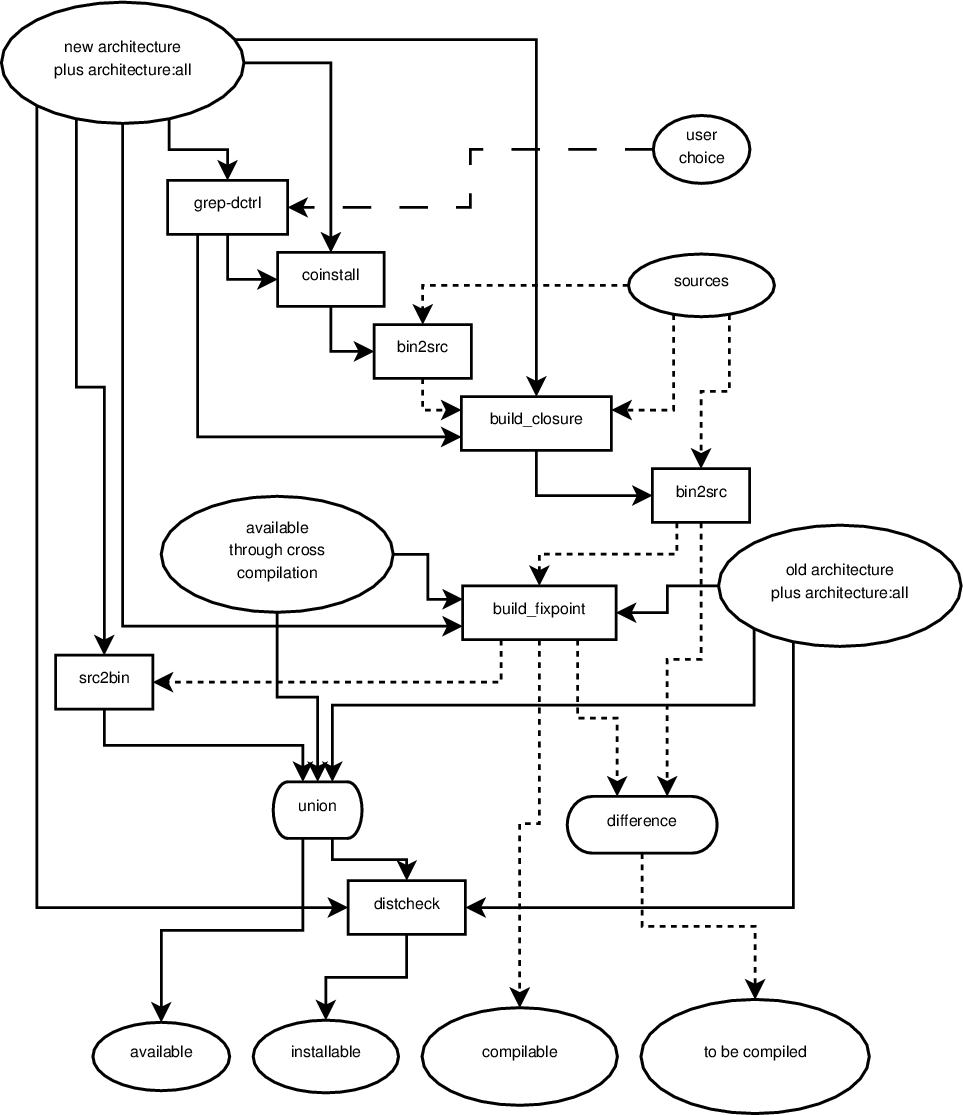
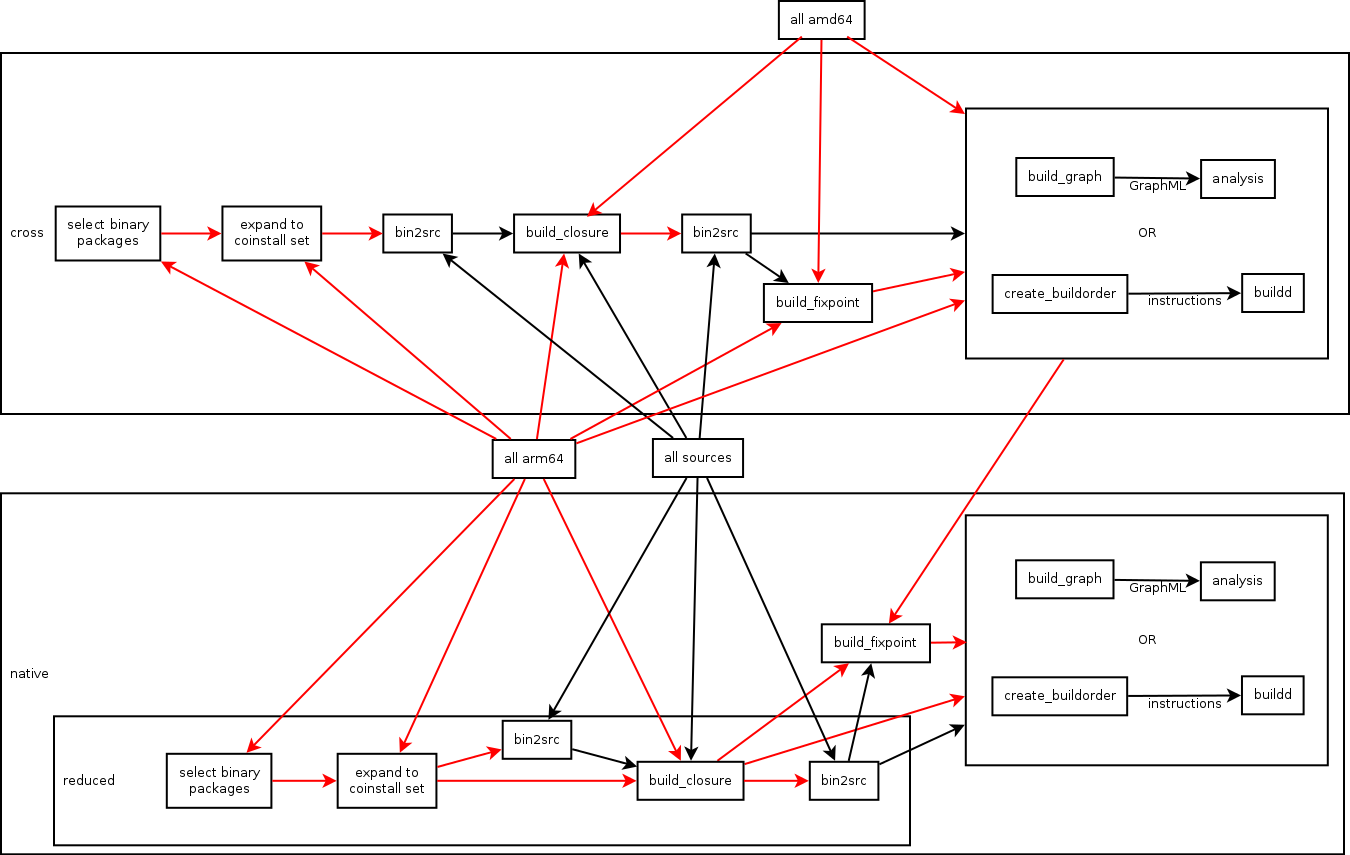
Processing pipeline instead of monolithic tools The tools I developed so far tried to accomplish everything by themselves, reusing functionality implemented in a central library. Therefor, if one wanted to try out even trivial new things, it mostly meant to hack some OCaml code. Pietro Abate suggested to instead develop smaller tools which could work independently of each other, would only execute one algorithm each and could easily be connected together in different ways to achieve different effects. This switch is now done and all functionality from the old tools is moved into a new toolset. The exchange format between the tools is either plain text files in deb822 control format (Packages/Sources files) or a dependency graph. The dependency graph is currently marshalled by OCaml but future versions should work with just passing a GraphML (an XML graph format) representation around. This new way of doing things seems close to the UNIX philosophy (each program does one thing well, data is stored as text, every program is a filter). For example the deb822 control output can easily be manipulated using grep-dctrl(1) and there exist many tools which can read, analyze and manipulate GraphML. It is a big improvement over the old, monolithic tools which did not allow to manipulate any intermediate result by external, existing tools. Currently, a shell script (native.sh) will execute all tools in a meaningful order, connecting them together correctly. The same tools will be used for a future cross.sh but they will be connected differently. I wrote about a first proposal of what the individual tools should do and how they should be connected in this email from which I also linked a confusing overview of the pipeline. This overview has recently been improved to be even more confusing and the current version of the lower half (the native part) now looks like this: native reduced Solid arrows represent a flow of binary packages, dottend arrows represent a flow of source packages, ovals represent a set of packages, boxes with rounded corners represent set operations, rectangular boxes represent filters. There is only one input to a filter, which is the arrow connected to the top of the box. Outgoing arrows from the bottom represent the filtered input. Ingoing arrows to either side are arguments to the filter and control how the filter behaves depending on the algorithm. I will explain this better once the pipeline proved to be less in flux. The pipeline is currently executed like this by native.sh.

Two new ways to break dependency cycles have been discovered So far, we knew of three ways to formally break dependency cycles:
  • remove build dependencies through build profiles
  • find out that the build dependency is only used to build arch:all packages and therefor put it into Build-Depends-Indep
  • cross compile some source packages
Two new methods can be added to the above:

Dependency graph definition changed Back in September when I was visiting irill, Pietro found a flaw in how the dependency graph used to be generated. He supplied a new definition of the dependency graph which does away with the problem he found. After fixing some small issues with his code, I changed all the existing algorithms to use the new graph definition. The old graph is as of today removed from the repository. Thanks to Pietro for supplying the new graph definition - I must still admit that my OCaml foo is not strong enough to have come up with his code.

Added complexity for profile built source packages As mentioned in the introduction, wookey and me addressed the debian-devel list with a proposal on necessary changes for an automated bootstrapping of Debian. During the discussiong, two important things came up which are to be considered by the dependency graph algorithms:
  • profile built source packages may not create all binary packages
  • profile built source packages may need additional build dependencies
Both things make it necessary to alter the dependency graph during the generation of a feedback arc set and feedback vertex set beyond the simple removal of edges. Luckily, the developed approximation algorithms can be extended to support such changes in the graph.

Different feedback arc set algorithms The initially developed feedback arc set algorithm is well suited to discover build dependency edges which should be dropped. It performs far worse when creating the final build order because it only considers edges by itself and not how many edges of a source package can be dropped by profile building it. The adjusted algorithm for generating a build order is more of a feedback vertex set algorithm because instead of greedily finding the edge with most cycles through it, it greedily finds the source package which would break most cycles if it was profile built.

Generating a build order with less profile built source packages After implementing all the features above I now feel more confident to publish the current status of the tools to a wider audience. The following test shows a run of the aforementioned ./native.sh shell script. Its final output is a list of source packages which have to be profile built and a build order. Using the resulting build order, starting from a minimal build system (essential:yes, build-essential and debhelper), all source packages will be compiled which are needed to compile all binary packages in the system. The result will therefor be a list of source and binary packages which fulfill the following property:
  • all binary packages can be built from the available source packages
  • all source packages can be built with the available binary packages
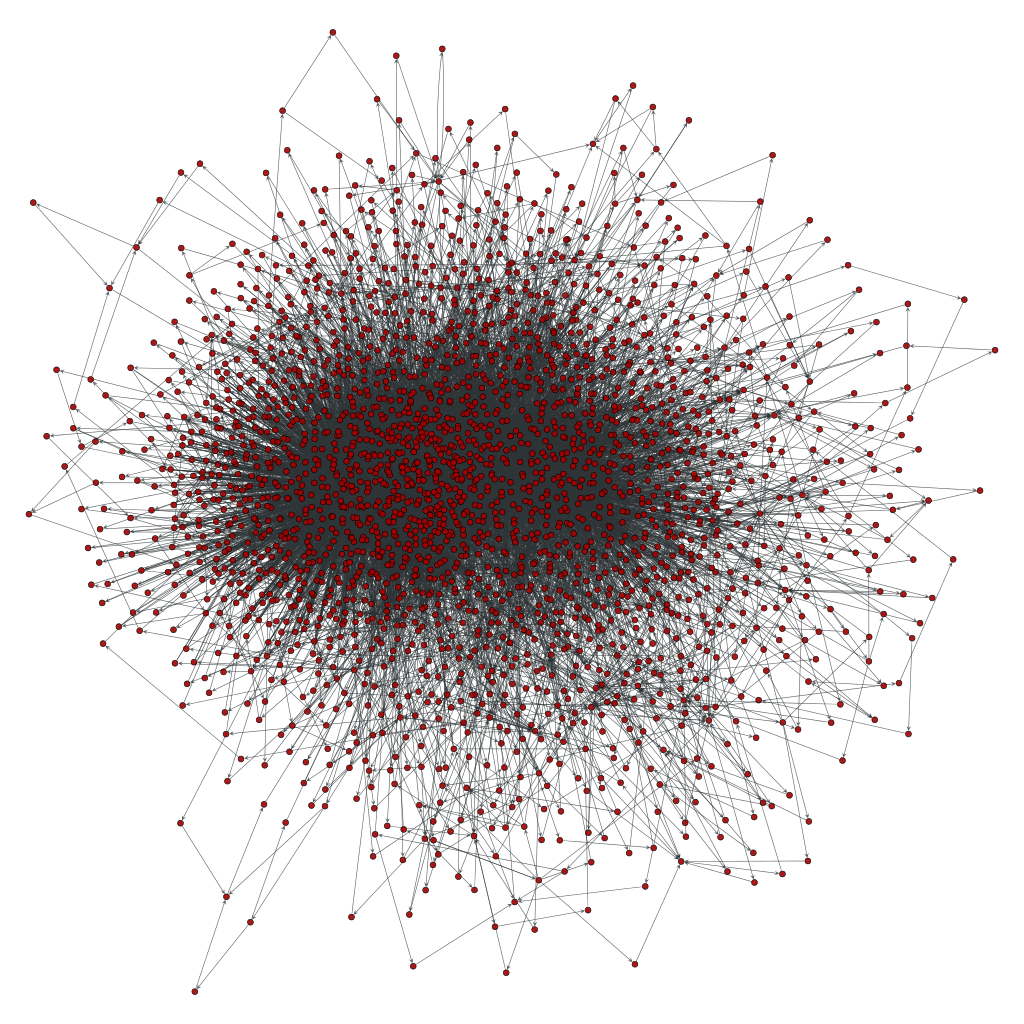
I called this a "reduceded distribution" in earlier posts. The interesting property of this specific selection is, that it contains the biggest problem set of Debian when bootstrapping it: a 900 to 1000 nodes big strongly connected component. Here is a visualization of the problem: hideous mess Source packages do not yet come with build profiles and the cross build situation can not yet be analyzed, so the following assumptions were made: The last point is about 14 build dependencies which were decided to be broken by the feedback arc set algorithm but for which other data sources did not indicate that they are actually breakable. Those 14 are dynamically generated by native.sh. If above assumptions should not be too far from the actual situation, then not more than 73 source packages have to be modified to bootstrap a reduced distribution. This reduced distribution even includes dependency-wise "big" packages like webkit, metacity, iceweasel, network-manager, tracker, gnome-panel, evolution-data-server, kde-runtime, libav and nautilus. By changing one line in native.sh one could easily develop a build order which generates gnome-desktop or really any given (meta-)package selection. All of native.sh takes only 80 seconds to execute on my system (Core i5, 2.5 GHz, singlethreaded). Here is the final build order which creates 2044 binary packages from 613 source packages.
  1. nspr, libio-pty-perl, libmcrypt, unzip, libdbi-perl, cdparanoia, libelf, c-ares, liblocale-gettext-perl, libibverbs, numactl, ilmbase, tbb, check, libogg, libatomic-ops, libnl($), orc($), libaio, tcl8.4, kmod, libgsm, lame, opencore-amr, tcl8.5, exuberant-ctags, mhash, libtext-iconv-perl, libutempter, pciutils, gperf, hspell, recode, tcp-wrappers, fdupes, chrpath, libbsd, zip, procps, wireless-tools, cpufrequtils, ed, libjpeg8, hesiod, pax, less, dietlibc, netkit-telnet, psmisc, docbook-to-man, libhtml-parser-perl, libonig, opensp($), libterm-size-perl, linux86, libxmltok, db-defaults, java-common, sharutils, libgpg-error, hardening-wrapper, cvsps, p11-kit, libyaml, diffstat, m4
  2. openexr, enca, help2man, speex, libvorbis, libid3tag, patch, openjade1.3, openjade, expat, fakeroot, libgcrypt11($), ustr, sysvinit, netcat, libirman, html2text, libmad, pth, clucene-core, libdaemon($), texinfo, popt, net-tools, tar, libsigsegv, gmp, patchutils($), dirac, cunit, bridge-utils, expect, libgc, nettle, elfutils, jade, bison
  3. sed, indent, findutils, fastjar, cpio, chicken, bzip2, aspell, realpath, dctrl-tools, rsync, ctdb, pkg-config($), libarchive, gpgme1.0, exempi, pump, re2c, klibc, gzip, gawk, flex-old, original-awk, mawk, libtasn1-3($), flex($), libtool
  4. libcap2, mksh, readline6, libcdio, libpipeline, libcroco, schroedinger, desktop-file-utils, eina, fribidi, libusb, binfmt-support, silgraphite2.0, atk1.0($), perl, gnutls26($), netcat-openbsd, ossp-uuid, gsl, libnfnetlink, sg3-utils, jbigkit, lua5.1, unixodbc, sqlite, wayland, radvd, open-iscsi, libpcap, linux-atm, gdbm, id3lib3.8.3, vo-aacenc, vo-amrwbenc, fam, faad2, hunspell, dpkg, tslib, libart-lgpl, libidl, dh-exec, giflib, openslp-dfsg, ppl($), xutils-dev, blcr, bc, time, libdatrie, libpthread-stubs, guile-1.8, libev, attr, libsigc++-2.0, pixman, libpng, libssh2, sqlite3, acpica-unix, acl, a52dec
  5. json-c, cloog-ppl, libverto, glibmm2.4, rtmpdump, libdbd-sqlite3-perl, nss, freetds, slang2, libpciaccess, iptables, e2fsprogs, libnetfilter-conntrack, bash, libthai, python2.6($), libice($), libpaper, libfontenc($), libxau, libxdmcp($), openldap($), cyrus-sasl2($), openssl, python2.7($)
  6. psutils, libevent, stunnel4, libnet-ssleay-perl, libffi, readline5, file, libvoikko, gamin, libieee1284, build-essential, libcap-ng($), lcms($), keyutils, libxml2, libxml++2.6, gcc-4.6($), binutils, dbus($), libsm($), libxslt, doxygen($)
  7. liblqr, rarian, xmlto, policykit-1($), libxml-parser-perl, tdb, devscripts, eet, libasyncns, libusbx, icu, linux, libmng, shadow, xmlstarlet, tidy, gavl, flac, dbus-glib($), libxcb, apr, krb5, alsa-lib
  8. usbutils, enchant, neon27, uw-imap, libsndfile, yasm, xcb-util, gconf($), shared-mime-info($), audiofile, ijs($), jbig2dec, libx11($)
  9. esound, freetype, libxkbfile, xvidcore, xcb-util-image, udev($), libxfixes, libxext($), libxt, libxrender
  10. tk8.4, startup-notification, libatasmart, fontconfig, libxp, libdmx, libvdpau, libdrm, libxres, directfb, libxv, libxxf86dga, libxxf86vm, pcsc-lite, libxss, libxcomposite, libxcursor, libxdamage, libxi($), libxinerama, libxrandr, libxmu($), libxpm, libxfont($)
  11. xfonts-utils, libxvmc, xauth, libxtst($), libxaw($)
  12. pmake, corosync, x11-xserver-utils, x11-xkb-utils, coreutils, xft, nas, cairo
  13. libedit, cairomm, tk8.5, openais, pango1.0($)
  14. ocaml, blt, ruby1.8, firebird2.5, heimdal, lvm2($)
  15. cvs($), python-stdlib-extensions, parted, llvm-2.9, ruby1.9.1, findlib, qt4-x11($)
  16. xen, mesa, audit($), avahi($)
  17. x11-utils, xorg-server, freeglut, libva
  18. jasper, tiff3, python3.2($)
  19. openjpeg, qt-assistant-compat, v4l-utils, qca2, jinja2, markupsafe, lcms2, sip4, imlib2, netpbm-free, cracklib2, cups($), postgresql-9.1
  20. py3cairo, pycairo, pam, libgnomecups, gobject-introspection($)
  21. gdk-pixbuf, libgnomeprint, gnome-menus, gsettings-desktop-schemas, pangomm, consolekit, vala-0.16($), colord($), atkmm1.6
  22. libgee, gtk+3.0($), gtk+2.0($)
  23. gtkmm2.4, poppler($), openssh, libglade2, libiodbc2, gcr($), libwmf, systemd($), gcj-4.7, java-atk-wrapper($)
  24. torque, ecj($), vala-0.14, gnome-keyring($), gcc-defaults, gnome-vfs($)
  25. libidn, libgnome-keyring($), openmpi
  26. mpi-defaults, dnsmasq, wget, lynx-cur, ghostscript, curl
  27. fftw3, gnupg, libquvi, xmlrpc-c, raptor, liboauth, groff, fftw, boost1.49, apt
  28. boost-defaults, libsamplerate, cmake, python-apt
  29. qjson, qtzeitgeist, libssh, qimageblitz, pkg-kde-tools, libical, dwarves-dfsg, automoc, attica, yajl, source-highlight, pygobject, pygobject-2, mysql-5.5($)
  30. libdbd-mysql-perl, polkit-qt-1, libdbusmenu-qt, raptor2, dbus-python, apr-util
  31. rasqal, serf, subversion($), apache2
  32. git, redland
  33. xz-utils, util-linux, rpm, man-db, make-dfsg, libvisual, cryptsetup, libgd2, gstreamer0.10
  34. mscgen, texlive-bin
  35. dvipng, luatex
  36. libconfig, transfig, augeas, blas, libcaca, autogen, libdbi, linuxdoc-tools, gdb, gpm
  37. ncurses, python-numpy($), rrdtool, w3m, iproute, gcc-4.7, libtheora($), gcc-4.4
  38. libraw1394, base-passwd, lm-sensors, netcf, eglibc, gst-plugins-base0.10
  39. libiec61883, qtwebkit, libvirt, libdc1394-22, net-snmp, jack-audio-connection-kit($), bluez
  40. redhat-cluster, gvfs($), pulseaudio($)
  41. phonon, libsdl1.2, openjdk-6($)
  42. phonon-backend-gstreamer($), gettext, libbluray, db, swi-prolog, qdbm, swig2.0($)
  43. highlight, libselinux, talloc, libhdate, libftdi, libplist, python-qt4, libprelude, libsemanage, php5
  44. samba, usbmuxd, libvpx, lirc, bsdmainutils, libiptcdata, libgtop2, libgsf, telepathy-glib, libwnck3, libnotify, libunique3, gnome-desktop3, gmime, glib2.0, json-glib, libgnomecanvas, libcanberra, orbit2, udisks, d-conf, libgusb
  45. libgnomeprintui, libimobiledevice, nautilus($), libbonobo, librsvg
  46. evas, wxwidgets2.8, upower, gnome-disk-utility, libgnome
  47. ecore, libbonoboui
  48. libgnomeui
  49. graphviz
  50. exiv2, libexif, lapack, soprano, libnl3, dbus-c++
  51. atlas, libffado, graphicsmagick, libgphoto2, network-manager
  52. pygtk, jackd2, sane-backends, djvulibre
  53. libav($), gpac($), ntrack, python-imaging, imagemagick, dia
  54. x264($), matplotlib, iceweasel
  55. strigi, opencv, libproxy($), ffms2
  56. kde4libs, frei0r, glib-networking
  57. kde-baseapps, kate, libsoup2.4
  58. geoclue, kde-runtime, totem-pl-parser, libgweather, librest, libgdata
  59. webkit
  60. zenity, gnome-online-accounts
  61. metacity, evolution-data-server
  62. gnome-panel
  63. tracker
The final recompilation of profile built source packages is omitted. Source packages marked with a ($) are selected to be profile built. All source packages listed in the same line can be built in parallel as they do not depend upon each other. This order looks convincing as it first compiles a multitude of source packages which have no or only few build dependencies lacking. Later steps allow fewer source packages to be compiled in parallel. The amount of needed build dependencies is highest in the source packages that are built last.

22 January 2013

Julien Danjou: Extending Swift with middleware: example with ClamAV

In this article, I'm going to explain you how you can extend Swift, the OpenStack Object Storage project, so it performs extra action on files at upload or at download time. We're going to build an anti-virus filter inside Swift. The goal is to refuse uploaded data if they contain a virus. To help us with virus analyses, we'll use ClamAV. WSGI, paste and middleware
In a pipeline, a black cat can become a white cat with the help of some middleware.
To do our content analysis, the best place to hook in the Swift architecture is at the beginning of every request, on swift-proxy, before the file is actually stored on the cluster. Swift proxy uses, like many other OpenStack projects, paste to build his HTTP architecture. Paste uses WSGI and provides an architecture based on a pipeline. The pipeline is composed of a succession of middleware, ending with one application. Each middleware has the chance to look at the request or at the response, can modify it, and then pass it to the following middleware. The latest component of the pipeline is the real application, and in this case, the Swift proxy server. If you've already deployed Swift, you encountered a default pipeline in the swift-proxy.conf configuration file:
[pipeline:main]
pipeline = catch_errors healthcheck cache ratelimit tempauth proxy-logging proxy-server

This is a really basic pipeline with a few middleware. The first one catches error, the second one is in charge to return 200 OK response if you send a GET /healthcheck request on your proxy server. The third one is in charge of caching, the fourth one is used for rate limiting, the fifth for authentication, the sixth one for logging, and the final one is the actual proxy server, in charge of proxying the request to the account, container, or object servers (the others components of Swift). Of course, we could remove or add any of the middleware here at our convenience. Be aware that the order matters: for example, if you put healthcheck after tempauth, you won't be able to access the /healthcheck URL without being authenticated! ClamAV
If you don't know ClamAV, it's an antivirus engine designed for detecting trojans, viruses, malware and other malicious threats. Wwe're going to use it to scan every incoming file. To build the middleware, we'll use the Python binding pyclamd. The API is quite simple, see:
>>> import pyclamd
>>> pyclamd.init_unix_socket('/var/run/clamav/clamd.ctl')
>>> print pyclamd.scan_stream(pyclamd.EICAR)
'stream': 'Eicar-Test-Signature(44d88612fea8a8f36de82e1278abb02f:68)'
>>> print pyclamd.scan_stream("safe!")
None

Anatomy of a WSGI middleware Your WSGI middleware should consist of a callable object. Usually this is done with a class implementing the __call__ method. Here's a basic boilerplate:
class SwiftClamavMiddleware(object):
"""Middleware doing virus scan for Swift."""

def __init__(self, app, conf):
# app is the final application
self.app = app

def __call__(self, env, start_response):
return self.app(env, start_response)


def filter_factory(global_conf, **local_conf):
conf = global_conf.copy()
conf.update(local_conf)

def clamav_filter(app):
return SwiftClamavMiddleware(app, conf)
return clamav_filter

I'm not going to expand more on why this is built this way, but if you want to have more info on this kind of filter middleware, you can read their documentation on Paste. This middleware will just do nothing as it is. It's going to simply pass all requests it receives to the final application, and returns the result. Testing our basic middleware
Now is a really good time to add unit tests. I hope you didn't think we were going to write code without some tests, right? It's really easy to test a middleware, as we're going to use WebOb for that.
import unittest
from webob import Request


class FakeApp(object):
def __call__(self, env, start_response):
return Response(body="FAKE APP")(env, start_response)


class TestSwiftClamavMiddleware(unittest.TestCase):

def setUp(self):
self.app = SwiftClamavMiddleware(FakeApp(), )

def test_simple_request(self):
resp = Request.blank('/',
environ=
'REQUEST_METHOD': 'GET',
).get_response(self.app)
self.assertEqual(resp.body, "FAKE APP")

We create a FakeApp class, that represents a fake WSGI application. You could also use a real application, or write a fake application looking like the one you want to test. It'll require more time, but your tests will be closer to the reality. Here we write the simplest test we can for our middleware. We're just sending a GET / request to it, so it passes the request to the final application and returns the result. It is transparent, it does nothing. Now, with that solid base we'll able to add more features and test these features incrementally. Plugging ClamAV in With our base ready, we can start thinking about how to plug ClamAV in. What we want to check here, is the content of the file when it's uploaded. If we refer to the OpenStack object storage API , a file upload is done via a PUT request, so we're going to limit the check to that kind of requests. Obviously, more checks could be added, but we'll keep things simple here for the sake of comprehensibility. With WSGI, the content of the request is available in env['wsgi.input'] as an object implementing a file interface. We'll scan that stream with ClamAV to check for viruses.
import pyclamd
from webob import Response


class SwiftClamavMiddleware(object):
"""Middleware doing virus scan for Swift."""

def __init__(self, app, conf):
pyclamd.init_unix_socket('/var/run/clamav/clamd.ctl')
# app is the final application
self.app = app

def __call__(self, env, start_response):
if env['REQUEST_METHOD'] == "PUT":
# We have to read the whole content in memory because pyclamd
# forces us to, but this is a bad idea if the file is huge.
scan = pyclamd.scan_stream(env['wsgi.input'].read())
if scan:
return Response(status=403,
body="Virus %s detected" % scan['stream'],
content_type="text/plain")(env, start_response)
return self.app(env, start_response)


def filter_factory(global_conf, **local_conf):
conf = global_conf.copy()
conf.update(local_conf)

def clamav_filter(app):
return SwiftClamavMiddleware(app, conf)
return clamav_filter

That's it. We only check for PUT requests and if there's a virus in the file, we return a 403 Forbidden error with the name of the detected virus, bypassing entirely the rest of the middleware chain and the application handling. Then, we can simply test it.
import unittest
from cStringIO import StringIO
from webob import Request, Response


class FakeApp(object):
def __call__(self, env, start_response):
return Response(body="FAKE APP")(env, start_response)


class TestSwiftClamavMiddleware(unittest.TestCase):
def setUp(self):
self.app = SwiftClamavMiddleware(FakeApp(), )

def test_put_empty(self):
resp = Request.blank('/v1/account/container/object',
environ=
'REQUEST_METHOD': 'PUT',
).get_response(self.app)
self.assertEqual(resp.body, "FAKE APP")

def test_put_no_virus(self):
resp = Request.blank('/v1/account/container/object',
environ=
'REQUEST_METHOD': 'PUT',
'wsgi.input': StringIO('foobar')
).get_response(self.app)
self.assertEqual(resp.body, "FAKE APP")

def test_put_virus(self):
resp = Request.blank('/v1/account/container/object',
environ=
'REQUEST_METHOD': 'PUT',
'wsgi.input': StringIO(pyclamd.EICAR)
).get_response(self.app)
self.assertEqual(resp.status_code, 403)

The first test test_put_empty simulates an empty PUT request. The second one, test_put_no_virus simulates a regular PUT request but with a simple file containing no virus. Finally, the third and last test simulates the upload of a virus using the EICAR test file. This is a special test file that is recognized as a virus, even if it's not real one. Very handy for testing virus detection software! Configuring Swift proxy Our middleware is ready! We can configure Swift's proxy server to use it. We need to add the following lines to our swift-proxy.conf to teach it how to load the filter:
[filter:clamav]
paste.filter_factory = swiftclamav:clamav_filter

We'll assume that our Python modules is named swiftclamava here. Now that we've defined our filter and how to load it, we can use it in our pipeline:
[pipeline:main]
pipeline = catch_errors healthcheck cache ratelimit tempauth clamav proxy-logging proxy-server

Just before reaching the proxy-server, and after the user being authenticated, the content will be scanned for viruses. It's important here to put this after authentication for example, because otherwise we may scan content that will get rejected by the authtemp module, thus scanning for nothing! Beyond scanning And voil , we now have a simple middleware testing uploaded content and refusing infected files. We could enhance it with various other things, like configuration handling, but I'll let that as an exercise for the interested readers. We didn't exploited it here, but note that you can also manipulate request headers and modify them if needed. For example, we could have added a header X-Object-Meta-Scanned-By: ClamAV to indicates that the file has been scanned by ClamAV. You should now be able to build your own middleware doing whatever you want with uploaded data. Happy hacking!

14 January 2013

Petter Reinholdtsen: Modalias strings - a practical way to map "stuff" to hardware

While looking into how to look up Debian packages based on hardware information, to find the packages that support a given piece of hardware, I refreshed my memory regarding modalias values, and decided to document the details. Here are my findings so far, also available in the Debian Edu subversion repository: Modalias decoded This document try to explain what the different types of modalias values stands for. It is in part based on information from <URL: https://wiki.archlinux.org/index.php/Modalias >, <URL: http://unix.stackexchange.com/questions/26132/how-to-assign-usb-driver-to-device >, <URL: http://code.metager.de/source/history/linux/stable/scripts/mod/file2alias.c > and <URL: http://cvs.savannah.gnu.org/viewvc/dmidecode/dmidecode.c?root=dmidecode&view=markup >. The modalias entries for a given Linux machine can be found using this shell script:
find /sys -name modalias -print0   xargs -0 cat   sort -u
The supported modalias globs for a given kernel module can be found using modinfo:
% /sbin/modinfo psmouse   grep alias:
alias:          serio:ty05pr*id*ex*
alias:          serio:ty01pr*id*ex*
%
PCI subtype A typical PCI entry can look like this. This is an Intel Host Bridge memory controller:
pci:v00008086d00002770sv00001028sd000001ADbc06sc00i00
This represent these values:
 v   00008086  (vendor)
 d   00002770  (device)
 sv  00001028  (subvendor)
 sd  000001AD  (subdevice)
 bc  06        (bus class)
 sc  00        (bus subclass)
 i   00        (interface)
The vendor/device values are the same values outputted from 'lspci -n' as 8086:2770. The bus class/subclass is also shown by lspci as 0600. The 0600 class is a host bridge. Other useful bus values are 0300 (VGA compatible card) and 0200 (Ethernet controller). Not sure how to figure out the interface value, nor what it means. USB subtype Some typical USB entries can look like this. This is an internal USB hub in a laptop:
usb:v1D6Bp0001d0206dc09dsc00dp00ic09isc00ip00
Here is the values included in this alias:
 v    1D6B  (device vendor)
 p    0001  (device product)
 d    0206  (bcddevice)
 dc     09  (device class)
 dsc    00  (device subclass)
 dp     00  (device protocol)
 ic     09  (interface class)
 isc    00  (interface subclass)
 ip     00  (interface protocol)
The 0900 device class/subclass means hub. Some times the relevant class is in the interface class section. For a simple USB web camera, these alias entries show up:
usb:v0AC8p3420d5000dcEFdsc02dp01ic01isc01ip00
usb:v0AC8p3420d5000dcEFdsc02dp01ic01isc02ip00
usb:v0AC8p3420d5000dcEFdsc02dp01ic0Eisc01ip00
usb:v0AC8p3420d5000dcEFdsc02dp01ic0Eisc02ip00
Interface class 0E01 is video control, 0E02 is video streaming (aka camera), 0101 is audio control device and 0102 is audio streaming (aka microphone). Thus this is a camera with microphone included. ACPI subtype The ACPI type is used for several non-PCI/USB stuff. This is an IR receiver in a Thinkpad X40:
acpi:IBM0071:PNP0511:
The values between the colons are IDs. DMI subtype The DMI table contain lots of information about the computer case and model. This is an entry for a IBM Thinkpad X40, fetched from /sys/devices/virtual/dmi/id/modalias:
dmi:bvnIBM:bvr1UETB6WW(1.66):bd06/15/2005:svnIBM:pn2371H4G:pvrThinkPadX40:rvnIBM:rn2371H4G:rvrNotAvailable:cvnIBM:ct10:cvrNotAvailable:
The values present are
 bvn  IBM            (BIOS vendor)
 bvr  1UETB6WW(1.66) (BIOS version)
 bd   06/15/2005     (BIOS date)
 svn  IBM            (system vendor)
 pn   2371H4G        (product name)
 pvr  ThinkPadX40    (product version)
 rvn  IBM            (board vendor)
 rn   2371H4G        (board name)
 rvr  NotAvailable   (board version)
 cvn  IBM            (chassis vendor)
 ct   10             (chassis type)
 cvr  NotAvailable   (chassis version)
The chassis type 10 is Notebook. Other interesting values can be found in the dmidecode source:
  3 Desktop
  4 Low Profile Desktop
  5 Pizza Box
  6 Mini Tower
  7 Tower
  8 Portable
  9 Laptop
 10 Notebook
 11 Hand Held
 12 Docking Station
 13 All In One
 14 Sub Notebook
 15 Space-saving
 16 Lunch Box
 17 Main Server Chassis
 18 Expansion Chassis
 19 Sub Chassis
 20 Bus Expansion Chassis
 21 Peripheral Chassis
 22 RAID Chassis
 23 Rack Mount Chassis
 24 Sealed-case PC
 25 Multi-system
 26 CompactPCI
 27 AdvancedTCA
 28 Blade
 29 Blade Enclosing
The chassis type values are not always accurately set in the DMI table. For example my home server is a tower, but the DMI modalias claim it is a desktop. SerIO subtype This type is used for PS/2 mouse plugs. One example is from my test machine:
serio:ty01pr00id00ex00
The values present are
  ty  01  (type)
  pr  00  (prototype)
  id  00  (id)
  ex  00  (extra)
This type is supported by the psmouse driver. I am not sure what the valid values are. Other subtypes There are heaps of other modalias subtypes according to file2alias.c. There is the rest of the list from that source: amba, ap, bcma, ccw, css, eisa, hid, i2c, ieee1394, input, ipack, isapnp, mdio, of, parisc, pcmcia, platform, scsi, sdio, spi, ssb, vio, virtio, vmbus, x86cpu and zorro. I did not spend time documenting all of these, as they do not seem relevant for my intended use with mapping hardware to packages when new stuff is inserted during run time. Looking up kernel modules using modalias values To check which kernel modules provide support for a given modalias, one can use the following shell script:
  for id in $(find /sys -name modalias -print0   xargs -0 cat   sort -u); do \
    echo "$id" ; \
    /sbin/modprobe --show-depends "$id" sed 's/^/  /' ; \
  done
The output can look like this (only the first few entries as the list is very long on my test machine):
  acpi:ACPI0003:
    insmod /lib/modules/2.6.32-5-686/kernel/drivers/acpi/ac.ko 
  acpi:device:
  FATAL: Module acpi:device: not found.
  acpi:IBM0068:
    insmod /lib/modules/2.6.32-5-686/kernel/drivers/char/nvram.ko 
    insmod /lib/modules/2.6.32-5-686/kernel/drivers/leds/led-class.ko 
    insmod /lib/modules/2.6.32-5-686/kernel/net/rfkill/rfkill.ko 
    insmod /lib/modules/2.6.32-5-686/kernel/drivers/platform/x86/thinkpad_acpi.ko 
  acpi:IBM0071:PNP0511:
    insmod /lib/modules/2.6.32-5-686/kernel/lib/crc-ccitt.ko 
    insmod /lib/modules/2.6.32-5-686/kernel/net/irda/irda.ko 
    insmod /lib/modules/2.6.32-5-686/kernel/drivers/net/irda/nsc-ircc.ko 
  [...]
If you want to help implementing a system to let us propose what packages to install when new hardware is plugged into a Debian machine, please send me an email or talk to me on #debian-devel. Update 2013-01-15: Rewrite "cat $(find ...)" to "find ... -print0 xargs -0 cat" to make sure it handle directories in /sys/ with space in them.

5 January 2013

Ian Campbell: Debugging Initramfs Issues With No Console

The QNAP TS-XXX NAS boxes are nice little systems but one thing I really miss is a console. Martin Michlmayr has some instructions (TS-119, TS-219, TS-41x) on his excellent Debian On QNAP pages on how to build a suitable adaptor but sadly even though I've managed to get all the parts I've been too lazy to actually solder the thing together (it doesn't help that I nearly always burn myself when I use a soldering iron!). This became more pressing when someone reported that Debian bug #693263 in qcontrol was not fixed in Wheezy since the issue appeared to be in the initramfs hook. Worse it seemed like something in my proposed fix was causing the system to not boot at all! Having finally found the hardware needed to reproduce the issue my first thought was to try netconsole. To do this I edited /etc/initramfs-tools/modules to add:
      mv643xx_eth
      netconsole netconsole=@<IP>/eth0,@<DST-IP>/<DST-MAC>
The option syntax is described in netconsole.txt but briefly: <IP> is the address of the TS-419P II I'm debugging on, and <DST-IP> and <DST-MAC> are the IP and MAC address of another machine on the network. Having done that, running update-initramfs -u and rebooting I can use netcat -u -l -p 6666 on the other machine to see all the kernel messages. So far so good but this doesn't get me any debugging from the userspace portions of the initramfs. To get those we have to get a bit hacky by editing /usr/share/initramfs-tools/init, first to change:

     # Parse command line options
    -for x in $(cat /proc/cmdline); do
    +for x in $(cat /proc/cmdline) debug; do
            case $x in
and secondly:

             debug)
                     debug=y
                     quiet=n
    -                exec >/run/initramfs/initramfs.debug 2>&1
    +                exec >/dev/kmsg 2>&1
                     set -x
                     ;;
The first of these simulates adding debug to the kernel command line (which can't otherwise easily be edited on these systems) and the second redirects the initramfs process's output to the kernel log. The overall effect is that the output of the initramfs processes appears over netcat.

Tanguy Ortolo: rlwrap: give readline super powers to any command line tool

Did you ever use a tool such as netcat, which has no history and does not allow you to edit the line you are typing?

% nc localhost smtp
220 cocorico.example.com ESMTP Postfix
HELO localhost
250 cocorico.example.com
MAIL FROM: <tanguy@localhost>
250 2.1.0 Ok
RCTP TO: <tanguy@localhost>
502 5.5.2 Error: command not recognized
^[[A Sh*t, line recall does not work!
502 5.5.2 Error: command not recognized
Here comes rlwrap: it is a small and useful tool that wraps any command line-oriented tool using readline to provide you a history allow you to edit each line before you send it:
% rlwrap nc localhost smtp
220 cocorico.example.com ESMTP Postfix
HELO localhost
250 cocorico.example.com
MAIL FROM: <tanguy@localhost>
250 2.1.0 Ok
RCTP TO: <tanguy@localhost>
502 5.5.2 Error: command not recognized
  RCTP TO: <tanguy@localhost>  
rlwrap's effect is hard to describe with a transcript, so here are two screencasts, with and without it. If you often use tools such as netcat, try it!
<video alt="SMTP session with netcat" controls="controls" src="http://tanguy.ortolo.eu/blog/data/images/screenshots/smtp-session.webm">Sorry your browser does not support videos, you may want to try another one.</video>

SMTP session without rlwrap

<video alt="SMTP session with netcat and rlwrap" controls="controls" src="http://tanguy.ortolo.eu/blog/data/images/screenshots/smtp-session-rlwrap.webm">Sorry your browser does not support videos, you may want to try another one.</video>

SMTP session with rlwrap

6 December 2012

Leo 'costela' Antunes: Silly Wal(l Cloc)k 2.0

So I finally got the first laser-cut version of the Silly Wal(l Cloc)k done: The back plate was cut from a 1mm plexiglass sheet using this SVG. The black parts were spray painted with matte black and inserted back into the hollowed out sections (I should have made pictures of the pieces before assembling; too lazy to do it now). This proved out to be somewhat problematic, since keeping the small pieces (the chin and the white part of the suitcase handle) in place isn t really easy without gluing everything together, which I wanted to avoid because I m not sure what effect the glue might have on plexiglass in the long term. Another problem was the fact that the plexiglass sheet is white, but slightly translucent. Since the back piece of the clock is black, this caused the white parts to look dirty . As a workaround for both problems I ended up using a thin white cardboard sheet as additional background, where the small hollowed out pieces could be affixed and the translucency of the plexiglass could be hidden. On the other hand, the 1mm thickness for the plexiglass turned out to be perfect for the clock hands (or feet). I think it would still have worked with 2mm, but that might be too heavy for the puny clock torque and they might start snagging on each other. Careful eyes will also note that I made a stupid mistake when writing down the dimensions for the back plate and it ended up being slightly smaller than the available space. Not my brightest moment, but it worked out alright with the additional cardboard background. The next iteration will probably be made with a different two-color plexiglass sheet that can be engraved. Let s see how that works out. Related: Silly Wal(l Cloc)k

20 November 2012

Michal &#268;iha&#345;: Weblate hook at Github

Github now provides native hook for Weblate. This means that all you need to do to link these two together is to enter URL of your Weblate installation and you are done. This was actually my first code in Ruby and I don't think I will start to like it, Python still looks nicer to me :-). However it was not that hard as I expected and I've even contribute (simple) testcase for this service.

Filed under: English Weblate 3 comments Flattr this!

4 November 2012

Wouter Verhelst: Windows usability: followup.

Yesterday, I posted a blog post containing a list of issues with Windows, in response to a similar list for Linux, which has received quite some response; I've seen people +1 it on google+, and I've received a number of replies on the blog post itself. One of these replies was by the author of the original list; and as expected, he totally and utterly failed to see the point. He also has the audacity to claim I haven't installed Linux yet what?!? The last time I used anything other than Linux on my personal machine for any real work was on Windows 98. And no, that was not because I was too cheap to buy the latest and greatest. I have used Windows in some cases since then, but never on my own hardware. First of all, I should note that the list which I posted was only semi-serious (with tongue in cheek); the fact that it refers to Windows as the operating system which "attempts to replace Linux as the major operating system" should have been a pretty big clue to that effect. Like the original list that it was a reply to, my list contains things that are only true in a particular context (e.g., the one about requiring recent hardware), it contains things that don't matter for the large majority of Windows users (e.g., the point about focus-follows-mouse) but that are major arguments for why I don't use Windows, it contains things that are so alien to what most of us are used to that even most Linux users don't use it, while on the other hand some swear by it (like the SELinux argument), and it contains some things that a seasoned Windows user will call bullshit on but that are real actual problems for the non-seasoned Windows user that I am (such as the mouse argument). It also contains some actual facts, like the statement about most crashes being a direct result of faulty drivers that's pulled directly from a scientific study on the subject conducted by Microsoft, together with some independent researchers. Like the original list, I don't expect this list to change anything for the better, precisely because it is flawed in exactly the same way. But whether the items on that list were right or wrong isn't the point. This is: Nobody (except nutcases) ever said Linux is perfect, or that it's useful for everyone; and while the issues Artem lists may be bugs or may be design flaws or any of a number of other things that could be real problems, the fact is that creating a long "list of issues" isn't going to solve anything. If you find that there are problems with Linux, you basically have three options: fix the problem, get someone to fix it for you, or stop using Linux. Really. Rather than better or worse, Linux is different. It will have its own set of problems, and it will have its own set of advantages. Some of the design decisions cause problems, but also have serious advantages, and focussing on only these problems (the existence of which I'm not denying) isn't very helpful. A good example is the library model: under Linux, libraries are typically installed in a system-wide location, and use a SONAME which is (part of) the filename of that library and which defines the binary interface exported by that library. In contrary to the situation under Windows, Linux libraries also must use position-independent code. The result is a more robust library model. The downside to that model, however, is that when you install older applications that require older SONAME versions of a particular library, getting those older versions may be a challenge. While in theory, installing an older version of a library is not going to cause any problem if the SONAME is different, in practice you'll often find that you'll need to go to (unsupported) older packages from older versions of the distribution, which may not install due to missing or conflicting dependencies, or which may expect data files in a different format in the same location that newer versions of the same library do, or which may have any number of other issues. When that happens, the solution is to either use an older version of the distribution in a chroot or some such, or to patch and/or compile the needed libraries yourself, and install them alongside the newer version of the same library. That's perfectly possible, after all, precisely because of the SONAME. Another good example is the development model: where Windows has a central authority (Microsoft) which defines what it is to be "Windows" and what is and isn't part of that, the same simply isn't true about Linux. Yes, Linus defines what the official Linux kernel has, but he doesn't have any say about the user interface, the boot process, or any number of other things; other people make decisions there. As a result, in effect, who decides what it means to be a "Linux system" is, really, you, the user. If you believe that the Linux user space is completely wrong, you can just change it to something else entirely; and that's precisely what Google did when they created Android. Since there's no central authority making decisions about what will and won't go into the system, this means that inevitably, at any given time, there will be many competing options for many subsystems. Usually this will be an advantage; e.g., the competition between KDE and Gnome benefits both. Sometimes, however, the competing options are so confusingly interwoven that even those who should know the system inside out can't make heads or tails of it, and debugging issues then becomes quite a challenge. Unfortunately, the Linux sound subsystem is currently an example of the latter. I'm not saying that all the items in Artem's list are invalid; a minority are, in fact, actual problems for a majority of Linux users. Most however, are personal opinions, issues affecting only a small minority of Linux users, or, as above, things where he only talks about the downsides of a design decision that also has major advantages. As an example of something in the second category: it's easy, for example, to list hundreds if not thousands of issues relating to particular pieces of hardware that don't work under Linux, simply because the manufacturer doesn't provide any information, and the people developing drivers for Linux have to reverse engineer how everything works. If you're a bit careful in what you buy, however much like MacOS users need to be careful, too then using Linux isn't an issue. My Lenovo Thinkpad X220, for instance, has no parts that don't work; and this includes things like a docking station, and the fact that my (9-cell) battery life is over fourteen hours, which (I believe) is more than on the same laptop with the same battery under Windows. So how is making a list of issues useful? The answer to that is simply, not at all. If you want to help, don't look for other people's problems; we can all do that. Instead, try to look for solutions to these problems. That's not always easy, and in many cases requires that you first understand why something is done in a particular way. If you don't want to spend time doing that, that's perfectly fine; but then don't expect that open source developers (who are already strapped for time, usually) will suddenly jump up and fix the problems you think are most important, as opposed to what they think should be worked on most urgently. After all, most Open Source developers have their own sets of priorities what they think requires most work, and that's what they'll work on not what's shown in a particular list by someone they don't know and have no reason to respect, somewhere on the Internet. Finally, I'd like to note that any statement which claims that Linux isn't "ready" to be used on the desktop, when hundreds of thousands (if not millions) of people are using it in exactly that way for their day-to-day work, is insulting these people's intelligence. Since that includes me, it's also insulting my intelligence. And I don't like to have my intelligence insulted...

31 October 2012

Yves-Alexis Perez: Update on OpenPGPv2 smartcards

After some feedback from other people, I have an important update to make on my last post. As I said, what decided me to eventually buy an OpenPGP smartcard was that it supported 4096 bit keys, so it would fit my 4096R/71EF0BA8 key. In the end, it seems it's a little more complicated than that. 4096R keys are indeed supported, as far as signing and authentication are concerned. But encryption keys seem limited to 3072 bits (or maybe more, I didn't test toroughly). When trying to decrypt some stuff encrypted for a 4096R key on the smartcard, gpg fails with some general error . It has already been reported here, but no news since. In my case, it's not that bad, I decided to go for 2048R for all subkeys. But if you desperately need 4096 bit encryption key, OpenPGPv2 smartcards might not be the right solution for you. I have no idea if the problem lies in GnuPG or in the smartcard, and I can't really find much information on this.

29 October 2012

Yves-Alexis Perez: Switching to OpenPGP smartcard

A friend of mine recently reminded me of the OpenPGP smartcard v2, and told me that it was perfectly able to handle 4096 bit RSA keys (provided you have GnuPG v2.0.18+). I had the opportunity to play with one a little, and notice it was super easy to use it for ssh authentication, especially since I already use gpg-agent as my ssh-agent (it should be easy to use a purely software authentication key as ssh key with GnuPG 2.1). So I decided to buy two of them and try to switch my main key (0x71ef0ba8) to it. The cards arrived this weekend, and I was able to play with it a little. I didn't log every command I typed, but it was pretty easy, in the end. What I decided to do was to use one smartcard for every day usage, and one only for key signing. So basically, I would generate three (signing, encryption, authentication) subkeys, put them on smartcard 1, then put the primary key on smartcard 2. Then erase the private parts, and only keep them on smartcards. In case it interests people, here the somehow detailed steps. Note that everywhere 'gpg' means 'gpg2' on Debian, we really need GnuPG v2 for correct smartcard handling. You'd better use gpg-agent too, although it doesn't seem mandatory.
  1. make a backup! As we're gonna play with private parts (!), it's always a good idea to have backups. And it'll be useful to have one later, in case there's a problem with the smartcards. You can do a copy of your complete ~/.gnupg folder, but I simply did:
    corsac@scapa: umask 066
    corsac@scapa: gpg -o 71ef0ba8.gpg --export-secret-keys 71ef0ba8
    
  2. Add three subkeys. Skip this is you already have subkeys (you usually already have an encryption subkey, but I wanted to switch to a new one too) --expert is needed in order to chose capabilities.
    corsac@scapa: gpg --expert --edit-key 71ef0ba8
    gpg> addkey
    Please select what kind of key you want:
       (3) DSA (sign only)
       (4) RSA (sign only)
       (5) Elgamal (encrypt only)
       (6) RSA (encrypt only)
       (7) DSA (set your own capabilities)
       (8) RSA (set your own capabilities)
    Your selection? 8
    Possible actions for a RSA key: Sign Encrypt Authenticate 
    Current allowed actions: Sign Encrypt 
       (S) Toggle the sign capability
       (E) Toggle the encrypt capability
       (A) Toggle the authenticate capability
       (Q) Finished
    Your selection? e
    Possible actions for a RSA key: Sign Encrypt Authenticate 
    Current allowed actions: Sign 
       (S) Toggle the sign capability
       (E) Toggle the encrypt capability
       (A) Toggle the authenticate capability
       (Q) Finished
    Your selection? Q
    RSA keys may be between 1024 and 4096 bits long.
    What keysize do you want? (2048) 
    Requested keysize is 2048 bits
    Please specify how long the key should be valid.
             0 = key does not expire
            = key expires in n days
          w = key expires in n weeks
          m = key expires in n months
          y = key expires in n years
    Key is valid for? (0) 1y
    Key expires at dim. 27 oct. 2013 20:38:44 CET
    Is this correct? (y/N) y
    Really create? (y/N) y
    We need to generate a lot of random bytes. It is a good idea to perform
    some other action (type on the keyboard, move the mouse, utilize the
    disks) during the prime generation; this gives the random number
    generator a better chance to gain enough entropy.
    
    Repeat this for encryption and authentication subkeys. Then save and send the key to keyservers
    gpg> save
    corsac@scapa: gpg --send-keys 71ef0ba8
    
  3. Next, we'll switch to the smartcard part. I use a Gemalto PC ExpressCard reader which is perfectly recognized under Debian. You just need few tools:
    root@scapa: ~# apt-get install pcscd scdaemon
    
    Plug the reader, insert the card, make sure it's detected:
    corsac@scapa: gpg --card-status
    Application ID ...: D2760001240102000005000016A10000
    Version ..........: 2.0
    Manufacturer .....: ZeitControl
    ...
    
    You can edit various parameter (name etc.) and change the PINs using gpg:
    corsac@scapa: gpg --change-pin
    corsac@scapa: gpg --card-edit
    
  4. Then we'll put the subkeys in the first smartcard. It might be a good idea to export again the private keys for backups.
    corsac@scapa: gpg -o 71ef0ba8.gpg --export-secret-keys 71ef0ba8
    
  5. We'll now use the keytocard gpg command to move the private parts on the smartcard:
    corsac@scapa: gpg --edit-key 71ef0ba8
    gpg> key 1 # select encryption subkey
    gpg> keytocard
    gpg> key 2 # select signature subkey
    gpg> keytocard
    gpg> key 3 # select authentication subkey
    gpg> keytocard
    gpg> save
    
    A quick check on the card now reveals that it's populated:
    corsac@scapa: gpg --card-status
    Application ID ...: D2760001240102000005000016A10000
    Version ..........: 2.0
    Manufacturer .....: ZeitControl
    Serial number ....: 000016A1
    Name of cardholder: Yves-Alexis Perez
    Language prefs ...: fr
    Sex ..............: unspecified
    URL of public key : http://www.corsac.net/71ef0ba8.asc
    Login data .......: corsac
    Signature PIN ....: forced
    Key attributes ...: 2048R 2048R 2048R
    Max. PIN lengths .: 32 32 32
    PIN retry counter : 3 3 3
    Signature counter : 7
    Signature key ....: 9745 B022 7323 81FE 9E7E  AFF5 6DDB 53F2 A675 C0A5
          created ....: 2012-10-27 11:24:07
    Encryption key....: F7E0 078F EA1A 5F23 92E0  20B3 A83A D136 D98D 0D9F
          created ....: 2012-10-27 11:27:01
    Authentication key: 8CFD D478 AB4A 16F8 F0EC  CD33 24E2 3B5C CC0E 273D
          created ....: 2012-10-17 14:29:18
    General key info..: pub  2048R/A675C0A5 2012-10-27 Yves-Alexis Perez 
    sec>  4096R/71EF0BA8  created: 2009-05-06  expires: never     
                          card-no: 0005 000016A2
    ssb   4096g/36E31BD8  created: 2009-05-06  expires: never     
    ssb>  2048R/CC0E273D  created: 2012-10-17  expires: 2013-10-27
                          card-no: 0005 000016A1
    ssb>  2048R/A675C0A5  created: 2012-10-27  expires: 2013-10-27
                          card-no: 0005 000016A1
    ssb>  2048R/D98D0D9F  created: 2012-10-27  expires: 2013-10-27
                          card-no: 0005 000016A1
    
  6. At that point, the private part is replaced by a stub in the secret keyring, so when you export them, you only export stubs which you can then use anywhere without actually giving your private key. So now is a good idea to export the subkeys so you can import them on other boxes:
    corsac@scapa: gpg -o 71ef0ba8-subkeys.gpg --export-secret-subkeys 71ef0ba8
    
    Note that only the subkeys private parts have been moved to the card, not the primary one, so you're still able to sign keys. Here, you have multiple choices. You can simply erase the private key (and later re-import the stubs) and use the offline copy made above when you need to sign another key.
  7. What I did is something else. I've put the primary key on my second OpenPGP smartcard. That way, I won't lose it, it'll be kept safely in my house, but still be on a hardware token where it won't come out. The procedure for doing is so is exactly the same as above. First take a backup (in case you didn't do it first, do it now since after the keytocard command you won't have a backup of your primary key and there'll be no way to extract it from the smartcard. Then put the new smartcard in the reader, edit the key (don't select a subkey) and run the keytocard command. After that, running gpg --export-secret-keys will export the stub and not the private part of your primary key.
In the end, it seems that everything is running fine. Only issue is that scdaemon is sometime not behaving nicely (especially after a card change or or suspend/resume cycle). I didn't yet report a bug but you might want to kill it in case it's stuck. You can also use the authentication subkey for ssh logins. When the card is inserted, the authentication subkey appears automatically (through the magic of gpg-agent):

corsac@scapa: ssh-add -L
ssh-rsa AAAAB3NzaC1yc2EA... cardno:0005000016A1 And now you can add it to your various authorized_keys and use the smartcard for SSH.

17 October 2012

Martin Pitt: Running a Samba server as normal user for testing

For writing tests for GVFS (current tests, proposed improvements) I want to run Samba as normal user, so that we can test gvfs smb backend without root privileges and thus can run them safely and conveniently in a make check environment for developers and in JHBuild for continuous integration testing. Before these tests could only run under gvfs-testbed, which needs root. Unlike other servers such as ssh or ftp, this turned out surprisingly non-obvious and hard, so I want to document it in this blog post for posterity s benefit. Running the server Running smbd itself is mainly an exercise of figuring out all the options that you need to set; Alex Larsson and I had some fun figuring out all the quirks and hiccups that happen between Ubuntu s and Fedora s packaging and 3.6 vs. 4.0, but finally arrived at something working. First, you need to create an empty directory where smbd can put all its databases and state files in. For tests you would use mkdtemp(), but for easier reading I just assume mkdir /tmp/samba here. The main knowledge is in the Samba configuration file, let s call it /tmp/smb.conf:
[global]
workgroup = TESTGROUP
interfaces = lo 127.0.0.0/8
smb ports = 1445
log level = 2
map to guest = Bad User
passdb backend = smbpasswd
smb passwd file = /tmp/smbpasswd
lock directory = /tmp/samba
state directory = /tmp/samba
cache directory = /tmp/samba
pid directory = /tmp/samba
private dir = /tmp/samba
ncalrpc dir = /tmp/samba
[public]
path = /tmp/public
guest ok = yes
[private]
path = /tmp/private
read only = no
For running this as a normal user you need to set a port > 1024, so this uses 1445 to resemble the original (privileged) port 445. The map to guest line makes anonymous logins work on Fedora/Samba 4.0 (I m not sure whether it s a distribution or a version issue). Don t ask about dir vs. directory , that s an inconsistency in Samba; with above names it works on both 3.6 and 4.0. We use the old smbpasswd backend as shipping large tdb files is usually too inconvenient and brittle for test suites. I created an smbpasswd file by running smbpasswd on a real Samba installation, and then using pdbedit to convert it to a smbpasswd file:
sudo smbpasswd -a martin
sudo pdbedit -i tdbsam:/var/lib/samba/passdb.tdb -e smbpasswd:/tmp/smbpasswd
The result for password foo is
myuser:0:XXXXXXXXXXXXXXXXXXXXXXXXXXXXXXXX:AC8E657F83DF82BEEA5D43BDAF7800CC:[U          ]:LCT-507C14C7:
which you are welcome to copy&paste (you can replace myuser with any valid user name, of course). This also defines two shares, one public, one authenticated. You need to create the directories and populate them a bit:
mkdir /tmp/public /tmp/private
echo hello > /tmp/public/hello.txt
echo secret > /tmp/private/myfile.txt
Now you can run the server with
smbd -iFS -s /tmp/smb.conf
The main problem with this approach is that smbd exits ( Server exit (failed to receive smb request) ) after a client terminates, so you need to write your tests in a way to only run one connection/request per test, or to start smbd in a loop. Running the client If you merely use the smbclient command line tool, this is rather simple: It has a -p option for specifying the port:
$ smbclient -p 1445 //localhost/private
Enter martin's password: [enter "foo" here]
Domain=[TESTGROUP] OS=[Unix] Server=[Samba 3.6.6]
smb: \> dir
  .                                   D        0  Wed Oct 17 08:28:23 2012
  ..                                  D        0  Wed Oct 17 08:31:24 2012
  myfile.txt                                   7  Wed Oct 17 08:28:23 2012
In the case of gvfs it wasn t so simple, however. Surprisingly, libsmbclient does not have an API to set the port, it always assumes 445. smbclient itself uses some internal libcli API which does have a way to change the port, but it s not exposed through libsmbclient. However, Alex and I found some mailing list posts ([1], [2]) that mention $LIBSMB_PROG, and it s also mentioned in smbclient s manpage. It doesn t quite work as advertised in the second ML post (you can t set it to smbd, smbd apparently doesn t speak the socket protocol over stdin/stdout), and it s not being used anywhere in the current Samba sources, but what does work is to use good old netcat:
export LIBSMB_PROG="nc localhost 1445"
with that, you can use smbclient or any program using libsmbclient to talk to our test smb server running as user.

1 October 2012

Martin Pitt: Announcing D-Bus mocker library

I was working on writing tests for gnome-settings-daemon a week or so ago, and finally got blocked on being unable to set up upower/ConsoleKit/etc. the way I need them. Also, doing so needs root privileges, I don t want my test suite to actually suspend my machine, and using the real service is generally not suitable for test suites that are supposed to run during make check , in jhbuild, and the like these do not have the polkit privileges to do all that, and may not even have a system D-Bus running in the first place. So I wrote a little test_upower.py helper, then realized that I need another one for systemd/ConsoleKit (for the system idle property), also looked at the mock polkit in udisks and finally sat down for two days to generalize this and do this properly. The result is python-dbusmock, I just released the first tarball. With this you can easily create mock objects on D-Bus from any programming language with a D-Bus binding, or even from the shell. The mock objects look like the real API (or at least the parts that you actually need), but they do not actually do anything (or only some action that you specify yourself). You can configure their state, behaviour and responses as you like in your test, without making any assumptions about the real system status. When using a local system/session bus, you can do unit or integration testing without needing root privileges or disturbing a running system. The Python API offers some convenience functions like start_session_bus() and start_system_bus() for this, in a DBusTestCase class (subclass of the standard unittest.TestCase ). Surprisingly I found very little precedence here. There is a Perl module, but that s not particuarly helpful for test suites in C/Vala/Python. And there is Phil s excellent Bendy Bus, but this has a different goal: If you want to thoroughly test a particular D-BUS service, such as ensuring that it does the right thing, doesn t crash on bad input, etc., then Bendy Bus is for you (and python-dbusmock isn t). However, it is too much overhead and rather inconvenient if you want to test a client-side program and just need a few system services around it which you want to set up in different states for each test. You can use python-dbusmock with any programming language, as you can run the mocker as a normal program. The actual setup of the mock (adding objects, methods, properties, etc.) all happen via D-Bus methods on the org.freedesktop.DBus.Mock interface. You just don t have the convenience D-Bus launch API. The simplest possible example is to create a mock upower with a single Suspend() method, which you can set up like this from Python:
import dbus
import dbusmock
class TestMyProgram(dbusmock.DBusTestCase):
[...]
    def setUp(self):
        self.p_mock = self.spawn_server('org.freedesktop.UPower',
                                        '/org/freedesktop/UPower',
                                        'org.freedesktop.UPower',
                                        system_bus=True,
                                        stdout=subprocess.PIPE)
        # Get a proxy for the UPower object's Mock interface
        self.dbus_upower_mock = dbus.Interface(self.dbus_con.get_object(
            'org.freedesktop.UPower', '/org/freedesktop/UPower'),
            'org.freedesktop.DBus.Mock')
        self.dbus_upower_mock.AddMethod('', 'Suspend', '', '', '')
[...]
    def test_suspend_on_idle(self):
        # run your program in a way that should trigger one suspend call
        # now check the log that we got one Suspend() call
        self.assertRegex(self.p_mock.stdout.readline(), b'^[0-9.]+ Suspend$')
This doesn t depend on Python, you can just as well run the mocker like this:
python3 -m dbusmock org.freedesktop.UPower /org/freedesktop/UPower org.freedesktop.UPower
and then set up the mocks through D-Bus like
gdbus call --system -d org.freedesktop.UPower -o /org/freedesktop/UPower \
      -m org.freedesktop.DBus.Mock.AddMethod '' Suspend '' '' ''
If you use it with Python, you get access to the dbusmock.DBusTestCase class which provides some convenience functions to set up and tear down local private session and system buses. If you use it from another language, you have to call dbus-launch yourself. Please see the README for some more details, pointers to documentation and examples. Update: You can now install this via pip from PyPI or from the daily builds PPA. Update 2: Adjusted blog entry for version 0.0.3 API, to avoid spreading now false information too far.

6 September 2012

Joey Hess: UPS farce

This is not the kind of place I live, though I don't mind a visit. Errol looking out over Salsalito and the Bay I'm not bothered by a more rural life, I thrive on peace and quiet, and am not bothered by needing to haul my water, split firewood, or spend an hour just mowing my driveway. I bought a GPS the other day, and it doesn't know where my driveway is..

or where the road leading to my driveway is..
or even about the highway leading to that road!
not many roads on this map.. The only thing that really bothers me about living here off the map is that I'm in the middle of a food desert too. The nearest semi-decent grocery store and produce market are 40 minutes away. There's one restaurant worth eating at, and while a very congenial place to eat rustic food while watching the river flow by, it serves almost no vegetables. Adding to the problem, my fridge is a rather expensive propane model, which is about half a normal size, and has no freezer. Managing a healthy meal plan is a constant struggle, though I do have time to cook, at least, thanks to not having the kind of commute that is typical around here. Well, the food desert was my only real problem. Now I can add to that the UPS emergency. A week ago, a package left Shenzen China for here. It quickly passed through Anchorage Alaska, and with a few days had arrived an hour and a half from here. Getting it here has taken the whole rest of the week.
I only knew UPS attempted delivery because a neighbor told me. Seems they took one look at my driveway and turned around. They never tried again, and they didn't bother to leave a note on the mailbox, or anything. Now, the US postal service is happy to drive up this driveway; they drive a sensible 4x4 around here. I think DHL and Fedex have been here too. (Contrary to John Goerzen's experiences) My compact car is not bothered by my driveway either... But UPS's brand involves large brown trucks, even where inappropriate, and damage to them from such things as low-hanging branches apparently comes out of the driver's paycheck. And while normally UPS leaves small things in my mailbox, or with a neighbor, this was an important package from China, and it needed a signature. But really, a post card? "emergency"?! So, I bought the GPS to find UPS, because my package was in an industrial park in some town I've never been to. And on Tuesday I was within an hour of there and swung by. And it was closed. UPS's website had not mentioned this; other businesses are open the day after Memorial day. That turned out to be a really annoying day all around. When I got home, after a night away, I found my fridge's fire had blown out, and nearly all my food was only fit for the dog. Today I went out to try again (and buy groceries). When I reached the UPS depot.. it was closed! Until 3 pm. At this point I felt this story was reaching full-on farce. After cooling my heels in a library for three hours, I was finally able to open the most over-packed package I've probably ever seen. My kickstarter reward sample looks good.. I'll be ordering a lot more, but not to this address. As a coda to the UPS farce, arriving home today I checked my mailbox, and found the UPS postcard had finally arrived. It included mention of the 3 pm opening time, and noted that I had until tomorrow before they'd return my package to China. The coda to the coda is that on my way home from this second annoying day delivered courtesy of UPS, I stumbled on a restaurant overlooking a waterfall, just outside the town where I get my groceries. It serves food that satisfies both my Cajun and healthy cravings. Now I just need a larger fridge..

Next.

Previous.