Search Results: "tar"

17 April 2026

Russell Coker: Home Battery

Prices On the 19th of March I got a home battery system installed. The government has a rebate scheme so it had a list price of about $22k for a 40kWh setup and cost me about $12k. It seems that 40KWh is the minimum usable size for the amount of electricity I use, I have 84 cores running BOINC when they have nothing better to do which is 585W of TDP according to Intel. While the CPUs are certainly using less than the maximum TDP (both due to design safety limits and the fact that I have disabled hyper-threading on all systems due to it providing minimal benefits and potential security issues) given some power usage by cooling fans and some inefficiency in PSUs I think that assuming that 585W is accounted for 24*7 by CPUs is reasonable. So my home draws between 800W and 1KW when no-one is home and with an electric car and all electric cooking a reasonable amount of electricity can be used. My bills prior to the battery installation were around $200/month which was based on charging my car only during sunny times as my electricity provider (Amber Electric) has variable rates based on wholesale prices. Also the feed in rates if my solar panels produce too much electricity in sunny times often go negative so if I don t use enough electricity. I haven t had the electric car long enough to find out what the bills might be in winter without a home battery. Before getting the battery my daily bills according to the Amber app were usually between $5 and $10. After getting it the daily bills have almost always been below $5. The only day where it s been over $5 since the battery installation was when electricity was cheap and I fully charged the home battery and my car which used 50KWh in one day and cost $7.87 which is 16 cents per KWh. 16 cents isn t the cheapest price (sometimes it gets as low as 10 cents) but is fairly cheap, sometimes even in the cheap parts of the day it doesn t get that low (the cheapest price on the day I started writing this was 20 cents). So it looks like this may save me $100 per month, if so there will be a 10% annual return on investment on the $12K I spent. This makes it a good investment, better than repaying a mortgage (which is generally under 6%) and almost as good as the long term results of index tracker funds. However if it cost $22K (the full price without subsidy) then it would still be ok but wouldn t be a great investment. The government subsidised batteries because the huge amount of power generated by rooftop solar systems was greater than the grid could use during the day in summer and batteries are needed to use that power when it s dark. Android App The battery system is from Fox ESS and the FoxCloud 2.0 Android app is a bit lacking in functionality. It has a timer for mode setting with options Self-use (not clearly explained), Feed-in Priority (not explained but testing shows feeding everything in to the grid), Back Up , Forced Charge , and Forced Discharge . Currently I have Forced Charge setup for most sunny 5 hours of the day for a maximum charge power of 5KW. I did that because about 25KW/day is what I need to cover everything and while the system can do almost 10KW that would charge the battery fully in a few hours and then electricity would be exported to the grid which would at best pay me almost nothing and at worst bill me for supplying electricity when they don t want it. There doesn t seem to be a never put locally generated power into the grid unless the battery is full option. The force charge mode allows stopping at a certain percentage, but when that is reached there is no fallback to another option. It would be nice if the people who designed the configuration could take as a baseline assumption that the macro programming in office suites and functions in spreadsheets are things that regular people are capable of using when designing the configuration options. I don t think we need a Turing complete programming language in the app to control batteries (although I would use it if there was one), but I think we need clauses like if battery is X% full then end this section . There is no option to say force charge until 100% or force charge for the next X minutes as a one-off thing. If I came home in the afternoon with my car below 50% battery and a plan to do a lot of driving the next day then I d want to force charge it immediately to allow charging the car overnight. But I can t do that without entering a schedule . For Unix people imagine having to do everything via a cron job and no option to run something directly from the command-line. It s a little annoying that they appear to have spent more development time on animations for the app than some of what should be core functionality. Management Amber has an option to allow my battery to be managed by them based on wholesale pries but I haven t done that as the feed-in prices are very low. So I just charge my battery when electricity is cheap and use it for the rest of the day. There is usually a factor of 2 or more price difference between the middle of the day and night time so that saves money. It also means I don t have to go out of my way to try and charge my car in the middle of the day. There is some energy lost in charging and discharging the batteries but it s not a lot. I configured the system to force charge for the 5 sunniest hours every day for 5KW as that s enough to keep it charged overnight and 5KW is greater than the amount of solar electricity produced on my house since I ve been monitoring it so that forces it to all be used for the battery. In summer I might have to change that to 6KW for the sunniest 2 or 3 hours and then 4KW or 5KW surrounding that which will be a pain to manage. Instead of charging the car every day during sunny times I charge it once or twice a week, I have a 3.3KW charger and the car has a 40KWh battery so usually it takes me less than 10 hours to fully charge it and I get at least 5 hours of good sunlight in the process. There are people hacking on these devices which is interesting to get direct control from computers [1], and apparently not banned from the official community for doing so. I m not enthusiastic enough to do this, I ve got plenty of other free software things to work on. But it s good that others are doing so.


16 April 2026

Sahil Dhiman: What is Life (to you)?

It started with a thought: to understand people s perspectives on life and its meaning. So I texted folks, What is life (to you)? . Each of the following list items (-) is a response from a different individual, mostly verbatim.
- A lot
- Everyone has a few universal basic qualities, and some special qualities. To me life is pursuit of exploring world based on those qualities and maturing those qualities as one goes on about exploring world/life with those qualities.
Discovering and enhancing experiences as one goes through them.
- life is endless suffering
- my answer might change daily, but this is what I ve noticed and feel recently. Life is a spectrum with two distinct ends: what we control and what we don t. At birth, the spectrum is largely tilted toward control, but throughout our lives, it gradually shifts toward the other side. Ultimately, as we approach death, we lose all control over any aspect of our existence, reaching the other end of the spectrum.
tho this isn t universal, privilege plays a huge part in what you control tho i believe it holds true for the majority
but yeah man, meaning and purpose are dynamic, it s in their nature to change i can give you a different answer this evening itself xD
- Funeral Monologue from Synecdoche, New York. https://www.youtube.com/watch?v=Z9PzSNy3xj0
- Zindagi ek nadiya hai, Aur mujhe tairna nahi aata
(translation - Life is a river, and I don t know how to swim)
On a more serious note, Life is what you make it out for yourself. The only established truth is that it will end. We can never know if there is something after or if there was something before. So try to live a life that you feel aspired by? But this question was beautifully answered by that book which you had about that dying professor
(Me - He was talking about Tuesday s with Morrie)
- My answer is 42
- One, it s living on your own terms, you define everything for yourself, success, normal, whatever. You get to curate your version of it no matter the societal norms.
It s an accumulation of experiences - friends, parents, work, activities, doing shit loads. Sab try karo- travel, zumba, art, music, workout, sports, dil kara ye karna hai karlo. (translation - If your heart wants to do it, just do it.)
Then I think relationships - all that you ve nurtured, people forget maintaining people because of work. It takes efforts to keep people in your life, everyone that comes has a place in yours, how well thats stays is upto you. You also get to curate your people, who stays who don t. Family toh hai hi (translation - family is there) but everyone else that comes along can make it pretty good.
So I don t want to be 50 and be like chalo ab kuch apne liye karte hai (translation - Come on, now let s do something for ourselves) Do whatever shit you want today. Not everything costs money, and if it does get thrifty
But do keep healthy while doing all of that
- Being alive so that my daughter can grow up and i can help raising her kids as well. Raising kids without mother is tough :P
- Definitively, I feel like Life is a by product of proteins and energy working together. But in a more personal sense, Life is a dumb joke played onto us. It s a rat race. But rats exists because of life and then it becomes a chicken-egg problem
Honestly, I don t give good answers to life questions. I m generally the one asking
Life can be like a box of chocolates, you don t know what you re gonna get untill you experience the chocolate(assuming the chocolates are heterogenous and contains a mix of everything)
Camus once said, Life is a revolt , and one of his students added more spice to it like Life is a revolt against the meaninglessness of existence"
I kinda feel like Life is the pursuit of every person s search for meaning
- Imprisonment waiting for execution
I have one more thought while we are on the topic , game with pre defined starting position and predefined destination , path to reach is a maze
- A phase where you can have a really good time or really bad one, usually the mix of both. A phase where you are prisoner to responsibility and materialistic wants.
It s a hell for you, where you try to create heaven for others. Being born was never your choice, but ending is always in your hands but you are a prisoner. You fear that leaving this world behind will destroy the heavens you created for others and they will be back to hell. But eventually everyone moves on watching the hourglass of their life.
Once you are left with no desires or no one to create heavens for, you look arround yourself. You see everyone chasing something, everyone scared of their limitted life time sliping away yet you want it to end sooner.
Doesn t matter if it was all good till now, or all bad. The other half is waiting for redemption. If it was all good, it s best time to die don t wait for the bad to start. If was all bad, it s still the best time to die what if it was the good one and more worst is waiting for you. We desire to be remembered, yet we want to free from this loop of suffering.
Someone once said, life is a suffering, chose your sufferings.
- Life to me is to live without regrets and live with freedom.
Life is always unpredictable and this unpredictability makes it more interesting and worth it.
- As of now, for the state of mind that I am in , I think for me life is about subtle struggle, subtle inconveniences and yet moving forward cause that s all I know.
I am not sure if any of this has any meaning, but sometimes I feel I was born of a purpose and that the universe has my back.
For me it s about raising my consciousness, understanding people to their depths, gaining moderate material success and helping people to some extend.
I have tried to seek a grander meaning but I have failed.
Life for me is what I make out it.
In my times of great success i rarely think about life for I am busy enjoying it, whatever you may call that state of mind.
- For me its the little things that you enjoy with YOUR people
- Life to me is about living and loving, and doing it in a way that sustains. It s the people who shape you, the work you get absorbed in, the quiet moments in between. There s also the wanting, the drive to figure out what s worth going after and how to get there, but that s just one part of it, not the point of it. And none of it happens in a vacuum. I m aware of the privileges that let me live this way, and I try to hold on to that gratitude. In the end, life has both a material and a non-material side, and a lot of what we do is chasing material things in an attempt to satisfy something non-material within us
- Mere liye (translation - for me) life is staying at my home and studying random economics papers. That s when I enjoy myself the most.
- Very complicated
Some days I wish this life never ended and some time I feel it would be better if it stopped at that moment.
It all depends on the events that happen in the so called life .
So life to me is a string of events that happen anyway and you get to make some decisions which can turn it in any direction and then you wonder how did that happen.
- not forgetting to breathe, learn, eat, game, take a good shit, love, sleep.
- To be honest it changed with time! At 19 it was about freedom, wasn t sure what freedom meant but i wanted that! To be free from everything, maybe because parents still controlled a part of my life. Then came 22-24 where i was working, trying to figure out what i want, the meaning changed from freedom to living for myself. To earn more, to be greedy about myself and pursue whatever would help me gain more steps in my career.
Came my mba life, switched my life from doing for myself to trying everything out to have no regrets. Life meaning was just about living with no regrets, invested, gambled, did everything to earn that tag of yeah, have tried that . Now it has all switched to, it was all just a fake facade. Life turned to having a meaningful life rather than finding meaning in what i am doing. Living for people around me, chhoti chhoti cheezo m khushi (translation - happiness in small things(?)) isn t really a topic of conversation but more of happy thing for me. So it changed, and m quite happy to be honest. Life did show me a lot of failures, but was privileged enough to face those failures. Gained a lot of learnings if not money
Hopeful for more learnings and change meaning of life with time
- A task.
- You have different answers at different times You learn different meanings at different times When you are studying, basically it is about job, finding a partner then it becomes, house, car other things based on your income in between, there can be passion too
Free Software was a passion, electoral politics too, but both kind of faded and I want cooperative and user driven development now (prav - something that motivates me every day) and these days learning Chinese and watching Cdrama takes a huge part of my leisure time it is heavily subjective and also influences by previous experiences people around you, how much influence they have on you
it also depends on if they had to struggle in their life or not, for some life did not give much troubles and trouble itself can be relative people who never had to struggle may find even smallest challenges as troubles like if you own a car, your worry is finding a parking slot
- I am too young to think about lyfe
- A ticket to see the show on earth, I guess
I guess life is different depending on the mood. It is a very broad question.
(Me - What is it in this present mood?)
Learning stuff (like I am learning a new language) and being happy but also to regulate emotions in a world where being optimistic is getting harder each day.
Life is also having a unique set of glasses you wear. Both in terms of looking from your eyeballs and your psychological perspective. Both are unique and cannot be replicated.
It is interesting what people on their deathbed think of life. If I know I am dying, my perspective would change a whole lot.
Life is finishing reading books while we are alive
Life is sleeping after a good XMPP chat
- Dukh dard peeda (translation - surrow pain suffering)
- uhh to word it? life is just like a journey from A to somewhere and its all about what paths you take and what line you get on to me, just a series of short adventures that all connect to a larger sequence until you can t have any more adventures-
(Me - eee, THE END. drop dead, like a coin)
yeaaaah- I am not really for spirituality of an afterlife, to me life just ends at some point, after which point there fails to remain a discernable you, and some X time after which, you will be last remembered, try to make that last time a good one I guess?
(Me - no soul?)
uhhh not in the way most people think of it i guess?
theres just a lot of yous, theres the physical you, there is the idea of you, there is the expectation of you, and one of the undefinable you I would label as the soul maybe? like the part thats not physically you, but also certainly you
(Me - can t say I understood part, but I get you in this sense)
mhm- well its about just questioning who you are more so questioning what life is-, I have sadly spent way too much time trying to figure that out
- Making the best of the time you have
- living a full range of experiences and embracing the good ones, seeing all that the world has to offer. In the end we were always just stardust. Might as well enjoy it when we are stardust with a consciousness of our own.
- For some reason or the Universe s /dev/random I was born here as a biological being, and from my experience I understood living is hard and the best way to live is by embracing it. Loving everyone and everything around you. Be happy and joyful until you naturally say good bye to this world.
- Life is being fucked by everything and you just have to figure out and try to stick to the things worth being fucked for
Note: Following was transcribed from a audio message.
- There are five conditions to become a life to survive in the environment. I think there s five conditions by the biological definitions and reproduction is one of the factor virus is not considered a life form because it cannot reproduce on its own but technically it s kind of a life because it reproduces using the DNA ability this is the biological definition. Do you want a philosophical definition?
My definition is kind of the same except that you get life experiences along with it as a human. Extra benefits is that you are not an NPC. All other organisms are NPCs. But humans can interpret the world and change it to their liking. That is life in the case of a human. But then many humans are mostly NPCs. But they still can change the life. Okay, fuck this. Where is this even going?
A human is an exception in the case of life, because human is not an NPC. Human can interrupt the world, human can change it to its liking, which is why we are such a successful organism on this planet. That is life to me. That s a human. But all of this is kind of meaningless, because the biological impurity of a human being still exists, so you still have the urges to reproduce, which kind of makes it like just another organism. But then, humans are yet to evolve to overcome that biological imperative.
I m grateful for all the replies, outlooks, and subsequent conversations I got to have after this question with everyone. After all, it was a deeply personal question. It does fit in nicely with my definition of life:
Life is all about experiences and all the transient relationships one gets to have with folks we meet on the way.

15 April 2026

Paul Tagliamonte: designing arf, an sdr iq encoding format

Interested in future updates? Follow me on mastodon at @paul@soylent.green. Posts about hz.tools will be tagged #hztools.

Want to jump right to the draft? I'll be maintaining ARF going forward at /draft-tagliamonte-arf-00.txt.
It s true processing data from software defined radios can be a bit complex which tends to keep all but the most grizzled experts and bravest souls from playing with it. While I wouldn t describe myself as either, I will say that I ve stuck with it for longer than most would have expected of me. One of the biggest takeaways I have from my adventures with software defined radio is that there s a lot of cool crossover opportunity between RF and nearly every other field of engineering. Fairly early on, I decided on a very light metadata scheme to track SDR captures, called rfcap. rfcap has withstood my test of time, and I can go back to even my earliest captures and still make sense of what they are IQ format, capture frequencies, sample rates, etc. A huge part of this was the simplicity of the scheme (fixed-lengh header, byte-aligned to supported capture formats), which made it roughly as easy to work with as a raw file of IQ samples. However, rfcap has a number of downsides. It s only a single, fixed-length header. If the frequency of operation changed during the capture, that change is not represented in the capture information. It s not possible to easily represent mulit-channel coherent IQ streams, and additional metadata is condemned to adjacent text files.

ARF (Archive of RF) A few years ago, I needed to finally solve some of these shortcomings and tried to see if a new format would stick. I sat down and wrote out my design goals before I started figuring out what it looked like. First, whatever I come up with must be capable of being streamed and processed while being streamed. This includes streaming across the network or merely written to disk as it s being created. No post-processing required. This is mostly an artifact of how I ve built all my tools and how I intereact with my SDRs. I use them extensively over the network (both locally, as well as remotely by friends across my wider lan). This decision sometimes even prompts me to do some crazy things from time to time. I need actual, real support for multiple IQ channels from my multi-channel SDRs (Ettus, Kerberos/Kracken SDR, etc) for playing with things like beamforming. My new format must be capable of storing multiple streams in a single capture file, rather than a pile of files in a directory (and hope they re aligned). Finally, metadata must be capable of being stored in-band. The initial set of metadata I needed to formalize in-stream were Frequency Changes and Discontinuities. Since then, ARF has grown a few more. After getting all that down, I opted to start at what I thought the simplest container would look like, TLV (tag-length-value) encoded packets. This is a fairly well trodden path, and used by a bunch of existing protocols we all know and love. Each ARF file (or stream) was a set of encoded packets (sometimes called data units in other specs). This means that unknown packet types may be skipped (since the length is included) and additional data can be added after the existing fields without breaking existing decoders.
tag
length
value
Heads up! Once this is posted, I'm not super likely to update this page. Once this goes out, the latest stable copy of the ARF spec is maintained at draft-tagliamonte-arf-00.txt. This page may quickly become out of date, so if you're actually interested in implementing this, I've put a lot of effort into making the draft comprehensive, and I plan to maintain it as I edit the format.
Unlike a traditional TLV structure, I opted to add flags to the top-level packet. This gives me a bit of wiggle room down the line, and gives me a feature that I like from ASN.1 a critical bit. The critical bit indicates that the packet must be understood fully by implementers, which allows future backward incompatible changes by marking a new packet type as critical. This would only really be done if something meaningfully changed the interpretation of the backwards compatible data to follow.
Flag Description
0x01Critical (tag must be understood)
Within each Packet is a tag field. This tag indicates how the contents of the value field should be interpreted.
Tag ID Description
0x01Header
0x02Stream Header
0x03Samples
0x04Frequency Change
0x05Timing
0x06Discontinuity
0x07Location
0xFEVendor Extension
In order to help with checking the basic parsing and encoding of this format, the following is an example packet which should parse without error.
 00, // tag (0; no subpacket is 0 yet)
 00, // flags (0; no flags)
 00, 00 // length (0; no data)
 // data would go here, but there is none
Additionally, throughout the rest of the subpackets, there are a few unique and shared datatypes. I document them all more clearly in the draft, but to quickly run through them here too:

UUID This field represents a globally unique idenfifer, as defined by RFC 9562, as 16 raw bytes.

Frequency Data encoded in a Frequency field is stored as microhz (1 Hz is stored as 1000000, 2 Hz is stored as 2000000) as an unsigned 64 bit integer. This has a minimum value of 0 Hz, and a maximum value of 18446744073709551615 uHz, or just above 18.4 THz. This is a bit of a tradeoff, but it s a set of issues that I would gladly contend with rather than deal with the related issues with storing frequency data as a floating point value downstream. Not a huge factor, but as an aside, this is also how my current generation SDR processing code (sparky) stores Frequency data internally, which makes conversion between the two natural.

IQ samples ARF supports IQ samples in a number of different formats. Part of the idea here is I want it to be easy for capturing programs to encode ARF for a specific radio without mandating a single iq format representation. For IQ types with a scalar value which takes more than a single byte, this is always paired with a Byte Order field, to indicate if the IQ scalar values are little or big endian.
ID Name Description
0x01f32interleaved 32 bit floating point scalar values
0x02i8 interleaved 8 bit signed integer scalar values
0x03i16interleaved 16 bit signed integer scalar values
0x04u8 interleaved 8 bit unsigned integer scalar values
0x05f64interleaved 64 bit floating point scalar values
0x06f16interleaved 16 bit floating point scalar values

Stream Header Immediately after the arf Header, some number of Stream Headers follow. There must be exactly the same number of Stream Header packets as are indicated by the num streams field of the Header. This has the nice effect of enabling clients to read all the stream headers without requiring buffering of unread packets from the stream.
id
flags
fmt
bo
rate
freq
guid
site
In order to help with checking the basic parsing and encoding of this format, the following is an example stream header subpacket (when encoded or decoded this will be found inside an ARF packet as described above) which should parse without error, with known values.
00, 01, // id (1)
00, 00, 00, 00, 00, 00, 00, 00, // flags
01, // format (float32)
01, // byte order (Little Endian)
00, 00, 01, d1, a9, 4a, 20, 00, // rate (2 MHz)
00, 00, 5a, f3, 10, 7a, 40, 00, // frequency (100 MHz)

// guid (7b98019d-694e-417a-8f18-167e2052be4d)
7b, 98, 01, 9d, 69, 4e, 41, 7a,
8f, 18, 16, 7e, 20, 52, be, 4d,

// site_id (98c98dc7-c3c6-47fe-bc05-05fb37b2e0db)
98, c9, 8d, c7, c3, c6, 47, fe,
bc, 05, 05, fb, 37, b2, e0, db,

Samples Block of IQ samples in the format indicated by this stream s format and byte_order field sent in the related Stream Header.
id
iq samples
In order to help with checking the basic parsing and encoding of this format, the following is an samples subpacket (when encoded or decoded this will be found inside an ARF packet as described above). The IQ values here are notional (and are either 2 8 bit samples, or 1 16 bit sample, depending on what the related Stream Header was).
01, // id
ab, cd, ab, cd, // iq samples

Frequency Change The center frequency of the IQ stream has changed since the Stream Header or last Frequency Change has been sent. This is useful to capture IQ streams that are jumping around in frequency during the duration of the capture, rather than starting and stopping them.
id
frequency
In order to help with checking the basic parsing and encoding of this format, the following is a frequency change subpacket (when encoded or decoded this will be found inside an ARF packet as described above).
01, // id
00, 00, b5, e6, 20, f4, 80, 00 // frequency (200 MHz)

Discontinuity Since the last Samples packet for this stream, samples have been dropped or not encoded to this stream. This can be used for a stream that has dropped samples for some reason, a large gap (radio was needed for something else), or communicating iq snippits .
id
In order to help with checking the basic parsing and encoding of this format, the following is a discontinuity subpacket (when encoded or decoded this will be found inside an ARF packet as described above).
01, // id

Location Up-to-date location as of this moment of the IQ stream, usually from a GPS. This allows for in-band geospatial information to be marked in the IQ stream. This can be used for all sorts of things (detected IQ packet snippits aligned with a time and location or a survey of rf noise in an area)
flags
sys
lat
long
el
accuracy
The sys field indicates the Geodetic system to be used for the provided latitude, longitude and elevation fields. The full list of supported geodetic systems is currently just WGS84, but in case something meaningfully changes in the future, it d be nice to migrate forward. Unfortunately, being a bit of a coward here, the accuracy field is a bit of a cop-out. I d really rather it be what we see out of kinematic state estimation tools like a kalman filter, or at minimum, some sort of ellipsoid. This is neither of those - it s a perfect sphere of error where we pick the largest error in any direction and use that. Truthfully, I can t be bothered to model this accurately, and I don t want to contort myself into half-assing something I know I will half-ass just because I know better.
System Description
0x01 WGS84 - World Geodetic System 1984
In order to help with checking the basic parsing and encoding of this format, the following is a location subpacket (when encoded or decoded this will be found inside an ARF packet as described above).
00, 00, 00, 00, 00, 00, 00, 00, // flags
01, // system (wgs84)
3f, f3, be, 76, c8, b4, 39, 58, // latitude (1.234)
40, 02, c2, 8f, 5c, 28, f5, c3, // longitude (2.345)
40, 59, 00, 00, 00, 00, 00, 00, // elevation (100)
40, 24, 00, 00, 00, 00, 00, 00 // accuracy (10)

Vendor Extension In addition to the fields I put in the spec, I expect that I may need custom packet types I can t think of now. There s all sorts of useful data that could be encoded into the stream, so I d rather there be an officially sanctioned mechanism that allows future work on the spec without constraining myself. Just an example, I ve used a custom subpacket to create test vectors, the data is encoded into a Vendor Extension, followed by the IQ for the modulated packet. If the demodulated data and in-band original data don t match, we ve regressed. You could imagine in-band speech-to-text, antenna rotator azimuth information, or demodulated digital sideband data (like FM HDR data) too. Or even things I can t even think of!
id
data
In order to help with checking the basic parsing and encoding of this format, the following is a vendor extension subpacket (when encoded or decoded this will be found inside an ARF packet as described above).
// extension id (b24305f6-ff73-4b7a-ae99-7a6b37a5d5cd)
b2, 43, 05, f6, ff, 73, 4b, 7a,
ae, 99, 7a, 6b, 37, a5, d5, cd,

// data (0x01, 0x02, 0x03, 0x04, 0x05)
01, 02, 03, 04, 05

Tradeoffs The biggest tradeoff that I m not entirely happy with is limiting the length of a packet to u16 65535 bytes. Given the u8 sample header, this limits us to 8191 32 bit sample pairs at a time. I wound up believing that the overhead in terms of additional packet framing is worth it because always encoding 4 byte lengths felt like overkill, and a dynamic length scheme ballooned codepaths in the decoder that I was trying to keep as easy to change as possible as I worked with the format.

Freexian Collaborators: Debian Contributions: Debusine projects in GSoC, Debian CI updates, Salsa CI maintenance and more! (by Anupa Ann Joseph)

Debian Contributions: 2026-03 Contributing to Debian is part of Freexian s mission. This article covers the latest achievements of Freexian and their collaborators. All of this is made possible by organizations subscribing to our Long Term Support contracts and consulting services.

Debusine projects in Google s Summer of Code While Freexian initiated Debusine, and is investing a lot of resources in the project, we manage it as a true free software project that can and should have a broader community. We always had documentation for new contributors and we aim to be reactive with them when they interact via the issue tracker or via merge requests. We decided to put those intentions under stress tests by proposing five projects for Google s Summer of Code as part of Debian s participation in that program. Given that at least 11 candidates managed to get their merge request accepted in the last 30 days (interacting with the development team is part of the pre-requisites to apply to Google Summer of Code projects these days), the contributing experience must not be too bad. If you want to try it out, we maintain a list of quick fixes that are accessible to newcomers. And as always, we welcome your feedback!

Debian CI: incus backend and upgrade to Bootstrap 5, by Antonio Terceiro debci 3.14 was released on March 4th, with a followup 3.14.1 release with regression fixes a few days afterwards. Those releases were followed by new development and maintenance work that will provide extra capabilities and stability to the platform. This month saw the initial version of an incus backend land in Debian CI. The transition into the new backend will be done carefully so as to not disrupt testing migration. Each package will be running jobs with both the current lxc backend and with incus. Packages that have the same result on both backends will be migrated over, and packages that exhibit different results will be investigated further, resulting in bug reports and/or other communication with the maintainers. On the frontend side, the code has been ported to Bootstrap 5 over from the now ancient Bootstrap 3. This need has been originally reported back in 2024 based on the lack of security support for Bootstrap 3. Beyond improving maintainability, this upgrade also enables support for dark mode in debci, which is still work in progress. Both updates mentioned in this section will be available in a following debci release.

Salsa CI maintenance by Santiago Ruano Rinc n et al. Santiago reviewed some Salsa CI issues and reviewed associated merge requests. For example, he investigated a regression (#545), introduced by the move to sbuild, on the use of extra repositories configured as .source files; and reviewed the MR (!712) that fixes it. Also, there were conflicts with changes made in debci 3.14 and debci 3.14.1 (those updates are mentioned above), and different people have contributed to fix the subsequent issues, in a long-term way. This includes Rapha l who proposed MR !707 and who also suggested Antonio to merge the Salsa CI patches to avoid similar errors in the future. This happened shortly after. Those fixes finally required the unrelated MR !709, which will prevent similar problems when building images. To identify bugs related to the autopkgtest support in the backport suites as early as possible, Santiago proposed MR !708. Finally, Santiago, in collaboration with Emmanuel Arias also had exchanges with GSoC candidates for the Salsa CI project, including the contributions they have made as merge requests. It is important to note that there are several very good candidates interested in participating. Thanks a lot to them for their work so far!

Miscellaneous contributions
  • Rapha l reported a zim bug affecting Debian Unstable users, which was already fixed in git apparently. He could thus cherry-pick the fix and update the package in Debian Unstable.
  • Carles created a new page on the InstallingDebianOn in Debian Wiki.
  • Carles submitted translation errors in the debian-installer Weblate.
  • Carles, using po-debconf-manager, improved Catalan translations: reviewed and submitted 3 packages. Also improved error handling when forking or submitting an MR if the fork already existed.
  • Carles kept improving check-relations: code base related general improvements (added strict typing, enabled pre-commit). Also added DebPorts support, virtual packages support and added commands for reporting missing relations and importing bugs from bugs.debian.org.
  • Antonio handled miscellaneous Salsa support requests.
  • Antonio improved the management of MiniDebConf websites by keeping all non-secret settings in git and fixed exporting these sites as static HTML.
  • Stefano uploaded routine updates to hatchling, python-mitogen, python-virtualenv, python-discovery, dh-python, pypy3, python-pipx, and git-filter-repo.
  • Faidon uploaded routine updates to crun, libmaxminddb, librdkafka, lowdown, platformdirs, python-discovery, sphinx-argparse-cli, tox, tox-uv.
  • Stefano and Santiago continued to help with DebConf 26 preparations.
  • Stefano reviewed some contributions to debian-reimbursements and handled admin for reimbursements.debian.net.
  • Stefano attended the Debian Technical Committee meeting.
  • Helmut sent 8 patches for cross build failures.
  • Building on the work of postmarketOS, Helmut managed to cross build systemd for musl in rebootstrap and sent several patches in the process.
  • Helmut reviewed several MRs of Johannes Schauer Marin Rodrigues expanding support for DPKG_ROOT to support installing hurd.
  • Helmut incorporated a final round of feedback for the Multi-Arch documentation in Debian policy, which finally made it into unstable together with documentation of Build-Profiles.
  • In order to fix python-memray, Helmut NMUed libunwind generally disabling C++ exception support as being an incompatible duplication of the gcc implementation. Unfortunately, that ended up breaking suricata on riscv64. After another NMU, python-memray finally migrated.
  • Thorsten uploaded new upstream versions of epson-inkjet-printer-escpr and sane-airscan. He also fixed a packaging bug in printer-driver-oki. As of systemd 260.1-1 the configuration of lpadmin has been added to the sysusers.d configuration. All printing packages can now simply depend on the systemd-sysusers package and don t have to take care of its creation in maintainer scripts anymore.
  • In collaboration with Emmanuel Arias, Santiago had exchanges with GSoC candidates and reviewed the proposals of the Linux livepatching GSoC 2026 project.
  • Colin helped to fix CVE-2026-3497 in openssh and CVE-2026-28356 in multipart.
  • Colin upgraded tango and pytango to new upstream releases and packaged pybind11-stubgen (needed for pytango), thanks to a Freexian customer. Tests of reproducible builds revealed that pybind11-stubgen didn t generate imports in a stable order; this is now fixed upstream.
  • Lucas fixed CVE-2025-67733 and CVE-2026-21863 affecting src:valkey in unstable and testing. Also reviewed the same fixes targeting stable proposed by Peter Wienemann.
  • Faidon worked with upstream and build-dep Debian maintainers on resolving blockers in order to bring pyHanko into Debian, starting with the adoption of python-pyhanko-certvalidator. pyHanko is a suite for signing and stamping PDF files, and one of the few libraries that can be leveraged to sign PDFs with eIDAS Qualified Electronic Signatures.
  • Anupa co-organized MiniDebConf Kanpur and attended the event with many others from all across India. She handled the accommodation arrangements along with the registration team members, worked on the budget and expenses. She was also a speaker at the event.
  • Lucas helped with content review/schedule for the MiniDebConf Campinas. Thanks Freexian for being a Gold sponsor!
  • Lucas organized and took part in a one-day in-person sprint to work on Ruby 3.4 transition. It was held in a coworking space in Brasilia - Brazil on April 6th. There were 5 DDs and they fixed multiple packages FTBFSing against Ruby 3.4 (coming to unstable soon hopefully). Lucas has been postponing a blog post about this sprint since then :-)

14 April 2026

Dirk Eddelbuettel: anytime 0.3.13 on CRAN: Mostly Minor Bugfix

A maintenance release 0.3.13 of the anytime package arrived on CRAN today, sticking with the roughly yearly schedule we have now. Binaries for r2u have been built already. The package is fairly feature-complete, and code and functionality remain mature and stable. anytime is a very focused package aiming to do just one thing really well: to convert anything in integer, numeric, character, factor, ordered, input format to either POSIXct (when called as anytime) or Date objects (when called as anydate) and to do so without requiring a format string as well as accomodating different formats in one input vector. See the anytime page, the GitHub repo for a few examples, the nice pdf vignette, and the beautiful documentation site for all documentation. This release was triggered by a bizarre bug seen on elementary os 8. For reason anytime was taking note on startup where it runs, and used a small and simply piece of code reading /etc/os-release when it exists. We assumed sane content, but this particular operating system and releases managed to have a duplicate entry throwing us spanner. So now this code is robust to duplicates, and no longer executed on each startup but as needed which is a net improvement. We also switched the vignette to being deployed by the new Rcpp::asis() driver. The short list of changes follows.

Changes in anytime version 0.3.13 (2026-04-14)
  • Continuous integration has received minor updates
  • The vignette now use the Rcpp::asis() driver, and references have been refreshed
  • Stateful 'where are we running' detection is now more robust, and has been moved from running on each startup to a cached 'as needed' case

Courtesy of my CRANberries, there is also a diffstat report of changes relative to the previous release. The issue tracker tracker off the GitHub repo can be use for questions and comments. More information about the package is at the package page, the GitHub repo, in the vignette, and at the documentation site.

This post by Dirk Eddelbuettel originated on his Thinking inside the box blog. If you like this or other open-source work I do, you can now sponsor me at GitHub. You can also sponsor my Tour de Shore 2026 ride in support of the Maywood Fine Arts Center.

Petter Reinholdtsen: Talking to the Computer, and Getting Some Nonsense Back...

At last, I can run my own large language model artificial idiocy generator at home on a Debian testing host using Debian packages directly from the Debian archive. After months of polishing the llama.cpp, whisper.cpp and ggml packages, and their dependencies, I was very happy to see today that they all entered Debian testing this morning. Several release-critical issues in dependencies have been blocking the migration for the last few weeks, and now finally the last one of these has been fixed. I would like to extend a big thanks to everyone involved in making this happen. I've been running home-build editions of whisper.cpp and llama.cpp packages for a while now, first building from the upstream Git repository and later, as the Debian packaging progressed, from the relevant Salsa Git repositories for the ROCM packages, GGML, whisper.cpp and llama.cpp. The only snag with the official Debian packages is that the JavaScript chat client web pages are slightly broken in my setup, where I use a reverse proxy to make my home server visible on the public Internet while the included web pages only want to communicate with localhost / 127.0.0.1. I suspect it might be simple to fix by making the JavaScript code dynamically look up the URL of the current page and use that to determine where to find the API service, but until someone fixes BTS report #1128381, I just have to edit /usr/share/llama.cpp-tools/llama-server/themes/simplechat/simplechat.js every time I upgrade the package. I start my server like this on my machine with a nice AMD GPU (donated to me as a Debian developer by AMD two years ago, thank you very much):
  LC_ALL=C llama-server \
    -ngl 256  \
    -c $(( 42 * 1024)) \
    --temp 0.7 \
    --repeat_penalty 1.1 \
    -n -1 \
    -m Qwen3-Coder-30B-A3B-Instruct-Q5_K_S.gguf
It only takes a few minutes to load the model for the first time and prepare a nice API server for me at https://my.reverse.proxy.example.com:8080/v1/, available (note, this sets up the server up without authentication; use a reverse proxy with authentication if you need it) for all the API clients I care to test. I switch models regularly to test different new ones, the Qwen3-Coder one just happen to be the one I use at the moment. Perhaps these packages is something for you to have fun with too? As usual, if you use Bitcoin and want to show your support of my activities, please send Bitcoin donations to my address 15oWEoG9dUPovwmUL9KWAnYRtNJEkP1u1b.

Russell Coker: Furilabs FLX1s Finally Working

I ve been using the Furilabs FLX1s phone [1] as my daily driver for 6 weeks, it s a decent phone, not as good as I hoped but good enough to use every day and rely on for phone calls about job interviews etc. I intend to keep using it as my main phone and as a platform to improve phone software in Debian as you really can t effectively find bugs unless you use the platform for important tasks. Support Problems I previously wrote about the phone after I received it without a SIM caddy on the 13th of Jan. I had a saga with support about this, on the 16th of Jan one support person said that they would ship it immediately but didn t provide a tracking number or any indication of when it would arrive. On the 5th of Feb I contacted support again and asked how long it would be, the new support person seemed to have no record of my previous communication but said that they would send it. On the 17th of Feb I made another support request including asking for a way of direct communication as the support email came from an address that wouldn t accept replies, I was asked for a photo showing where the problem is. The support person also said that they might have to send a replacement phone! The last support request I sent included my disappointment at the time taken to resolve the issue and the proposed solution of replacing the entire phone (why have two international shipments of a fragile and expensive phone when a single letter with a cheap SIM caddy would do?). I didn t receive a reply but the SIM caddy arrived on the 2nd of Mar. Here is a pic of the SIM caddy and the package it came in: One thing that should be noted is that some of the support people seemed to be very good at their jobs and they were all friendly. It was the system that failed here, turning a minor issue of a missing part into a 6 week saga. Furilabs needs to do the following to address this issue:
  1. Make it possible to reply directly to a message from a support person. Accept email with a custom subject to sort it, give a URL for a web form, anything. Collating discussions with a customer allows giving better support while taking less time for the support people.
  2. Have someone monitor every social media address that is used by the company. When someone sends a support request in a public Mastodon post it indicates that something has gone wrong and you want to move quickly to resolve it.
  3. Take care of the little things, like sending a tracking number for every parcel. If it s something too small for a parcel (the SIM caddy could have fit in a regular letter) then just tell the customer what date it was posted and where it was posted from so they have some idea of when it will arrive.
This is not just a single failure of Furilabs support, it s a systemic failure of their processes. Problems I Will Fix Unless Someone Beats Me to it Here are some issues I plan to work on. Smart Watch Support I need to port one of the smart watch programs to Debian. Also I want to make one of them support the Colmi P80 [2]. A smart watch significantly increases the utility of a phone even though IMHO they aren t doing nearly all the things that they could and should do. When we get Debian programs talking to the PineTime it will make a good platform for development of new smart phone and OS features. Nextcloud I have ongoing issues of my text Nextcloud installation on a Debian VM not allowing connection from the Linux desktop app (as packaged in Debian) and from the Android client (from f-droid). The desktop client works with a friend s Nextcloud installation on Ubuntu so I may try running it on an Ubuntu VM I run while waiting for the Debian issue to get resolved. There was a bug recently fixed in Nextcloud that appears related so maybe the next release will fix it. For the moment I ve been running without these features and I call and SMS people from knowing their number or just returning calls. Phone calls generally aren t very useful for me nowadays except when applying for jobs. If I could deal with recruiters and hiring managers via video calls then I would consider just not having a phone number. Wifi IPv6 Periodically IPv6 support just stops working, I can t ping the gateway. I turn wifi off and on again and it works. This might be an issue with my wifi network configuration. This might be an issue with the way I have configured my IPv6 networking, although that problem doesn t happen with any of my laptops. Chatty Sorting Chatty is the program for SMS that is installed by default (part of the phosh/phoc setup), it also does Jabber. Version 0.8.7 is installed which apparently has some Furios modifications and it doesn t properly support sorting SMS/Jabber conversations. Version 0.8.9 from Debian sorts in the same way as most SMS and Jabber programs with the most recent at the top. But the Debian version doesn t support Jabber (only SMS and Matrix). When I went back to the Furilabs version of Chatty it still sorted for a while but then suddenly stopped. Killing Chatty (not just closing the window and reopening it) seems to make it sort the conversations sometimes. Problems for Others to Fix Here are the current issues I have starting with the most important. Important The following issues seriously reduce the usability of the device. Hotspot The Wifi hotspot functionality wasn t working for a few weeks, this Gitlab issue seems to match it [3]. It started working correctly for a day and I was not sure if an update I applied fixed the bug or if it s some sort of race condition that worked for this boot and will return next time I reboot it. Later on I rebooted it and found that it s somewhat random whether it works or now. Also while it is mostly working it seemed to stop working about every 25 minutes or so and I had to turn it off and on again to get it going. On another day it went to a stage where it got repeated packet loss when I pinged the phone as a hotspot from my laptop. A pattern of 3 ping responses and 3 Destination Host Unreachable messages was often repeated. I don t know if this is related to the way Android software is run in a container to access the hardware. 4G Reliability Sometimes 4G connectivity has just stopped, sometimes I can stop and restart the 4G data through software to fix it and sometimes I need to use the hardware switch. I haven t noticed this for a week or two so there is a possibility that one fix addressed both Hotspot and 4G. One thing that I will do is setup monitoring to give an alert on the phone if it can t connect to the Internet. I don t want it to just quietly stop doing networking stuff and not tell me! On-screen Keyboard The compatibility issues of the GNOME and KDE on-screen keyboards are getting me. I use phosh/phoc as the login environment as I want to stick to defaults at first to not make things any more difficult than they need to be. When I use programs that use QT such as Nheko the keyboard doesn t always appear when it should and it forgets the setting for word completion (which means spelling correction). The spelling correction system doesn t suggest replacing dont with don t which is really annoying as a major advantage for spelling checkers on touch screens is inserting an apostrophy. An apostrophy takes at least 3* longer than a regular character and saving that delay makes a difference to typing speed. The spelling correction doesn t correct two words run together. Medium Priority These issues are ongoing annoyances. Delay on Power Button In the best case scenario this phone has a much slower response to pressing the power button than the Android phones I tested (Huawei Mate 10 Pro and Samsung Galaxy Note 9) and a much slower response than my recollection of the vast majority of Android phones I ve ever used. For testing pressing buttons on the phones simultaneously resulted in the Android phone screens lighting up much sooner. Something like 200ms vs 600ms I don t have a good setup to time these things but it s very obvious when I test. In a less common case scenario (the phone having been unused for some time) the response can be something like 5 seconds. The worst case scenario is something in excess of 20 seconds. For UI designers, if you get multiple press events from a button that can turn the screen on/off please make your UI leave the screen on and ignore all the stacked events. Having the screen start turning on and off repeatedly when the phone recovers and processes all the button presses isn t good, especially when each screen flash takes half a second. Notifications Touching on a notification for a program often doesn t bring it to the foreground. I haven t yet found a connection between when it does and when it doesn t. Also the lack of icons in the top bar on the screen to indicate notifications is annoying, but that seems to be an issue of design not the implementation. Charge Delay When I connect the phone to a power source there is a delay of about 22 seconds before it starts to charge. Having it miss 22 seconds of charge time is no big deal, having to wait 22 seconds to be sure it s charging before leaving it is really annoying. Also the phone makes an audible alert when it gets to 0% charge which woke me up one night when I had failed to push the USB-C connector in hard enough. This phone requires a slightly deeper connector than most phones so with some plugs it s easy to not quite insert them far enough. Torch aka Flash The light for the torch or flash for camera is not bright at all. In a quick test staring into the light from 40cm away wasn t unpleasant compared to my Huawei Mate 10 Pro which has a light bright enough that it hurts to look at it from 4 meters away. Because of this photos at night are not viable, not even when photographing something that s less than a meter away. The torch has a brightness setting which doesn t seem to change the brightness, so it seems likely that this is a software issue and the brightness is set at a low level and the software isn t changing it. Audio When I connect to my car the Lollypop player starts playing before the phone directs audio to the car, so the music starts coming from the phone for about a second. This is an annoying cosmetic error. Sometimes audio playing pauses for no apparent reason. It doesn t support the phone profile with Bluetooth so phone calls can t go through the car audio system. Also it doesn t always connect to my car when I start driving, sometimes I need to disable and enable Bluetooth to make it connect. When I initially set the phone up Lollypop would send the track name when playing music through my car (Nissan LEAF) Bluetooth connection, after an update that often doesn t happen so the car doesn t display the track name or whether the music is playing but the pause icon works to pause and resume music (sometimes it does work). About 30 seconds into a phone call it switches to hands-free mode while the icon to indicate hands-free is not highlighted, so I have to press the hands-free button twice to get it back to normal phone mode. Low Priority I could live with these things remaining as-is but it s annoying. Ticket Mode There is apparently some code written to display tickets on screen without unlocking. I want to get this working and store screen-caps of the Android barcode screens of the different loyalty cards so I can scan them without unlocking. My threat model does not include someone trying to steal my phone to get a free loaf of bread on the bakery loyalty program. Camera The camera app works with both the back and front cameras, which is nice, and sadly based on my experience with other Debian phones it s noteworthy. The problem is that it takes a long time to take a photo, something like a second after the button is pressed long enough for you to think that it just silently took a photo and then move the phone. The UI of the furios-camera app is also a little annoying, when viewing photos there is an icon at the bottom left of the screen for a video camera and an icon at the bottom right with a cross. Which every time makes me think record videos and leave this screen not return to taking photos and delete current photo . I can get used to the surprising icons, but being so slow is a real problem. GUI App Installation The program for managing software doesn t work very well. It said that there were two updates for Mesa package needed, but didn t seem to want to install them. I ran flatpak update as root to fix that. The process of selecting software defaults to including non-free, and most of the available apps are for desktop/laptop with no way to search for phone/tablet apps. Generally I think it s best to just avoid this and use apt and flatpak directly from the command-line. Being able to ssh to my phone from a desktop or laptop is good! Android Emulation The file /home/furios/.local/share/andromeda/data/system/uiderrors.txt is created by the Andromeda system which runs Android apps in a LXC container and appears to grow without end. After using the phone for a month it was 3.5G in size. The disk space usage isn t directly a problem, out of the 110G storage space only 17G is used and I don t have a need to put much else on it, even if I wanted to put backups of /home from my laptop on it when travelling that would still leave plenty of free space. But that sort of thing is a problem for backing up the phone and wasting 3.5G out of 110G total is a fairly significant step towards breaking the entire system. Also having lots of logging messages from a subsystem that isn t even being used is a bad sign. I just tried using it and it doesn t start from either the settings menu or from the f-droid icon. Android isn t that important to me as I want to get away from the proprietary app space so I won t bother trying this any more. Unfixable Problems Unlocking After getting used to fingerprint unlocking going back to a password is a pain. I think that the hardware isn t sufficient for modern quality face recognition that can t be fooled by a photo and there isn t fingerprint hardware. When I first used an Android phone using a pin to unlock didn t seem like a big deal, but after getting used to fingerprint unlock it s a real drag to go without. This is a real annoyance when doing things like checking Wikipedia while watching TV. This phone would be significantly improved with a fingerprint sensor or a camera that worked well enough for face unlock. Plasma Mobile According to Reddit Plasma Mobile (KDE for phones) doesn t support Halium and can never work on this phone because of it [4]. This is one of a number of potential issues with the phone, running on hardware that was never designed for open OSs is always going to have issues. Wifi MAC Address The MAC keeps changing on reboot so I can t assign a permanent IPv4 address to the phone. It appears from the MAC prefix of 00:08:22 that the network hardware is made in InPro Comm which is well known for using random addresses in the products it OEMs. They apparently have one allocation of 2^24 addresses and each device randomly chooses a MAC from that range on boot. In the settings for a Wifi connection the Identity tab has a field named Cloned Address which can be set to Stable for SSID that prevents it from changing and allows a static IP address allocation from DHCP. It s not ideal but it works. Network Manager can be configured to have a permanent assigned MAC address for all connections or for just some connections. In the past for such things I have copied MAC addresses from ethernet devices that were being discarded and used them for such things. For the moment the Stable for SSID setting does what I need but I will consider setting a permanent address at some future time. Docks Having the ability to connect to a dock is really handy. The PinePhonePro and Librem5 support it and on the proprietary side a lot of Samsung devices do it with a special desktop GUI named Dex and some Huawei devices also have a desktop version of the GUI. It s unfortunate that this phone can t do it. The Good Things It s good to be able to ssh in to my phone, even if the on-screen keyboard worked as well as the Android ones it would still be a major pain to use when compared to a real keyboard. The phone doesn t support connecting to a dock (unlike Samsung phones I ve used for which I found Dex to be very useful with a 4K monitor and proper keyboard) so ssh is the best way to access it. This phone has very reliable connections to my home wifi. I ve had ssh sessions from my desktop to my phone that have remained open for multiple days. I don t really need this, I ve just forgotten to logout and noticed days later that the connection is still running. None of the other phones running Debian could do that. Running the same OS on desktop and phone makes things easier to test and debug. Having support for all the things that Linux distributions support is good. For example none of the Android music players support all the encodings of audio that comes from YouTube so to play all of my music collection on Android I would need to transcode most of them which means either losing quality, wasting storage space, or both. While Lollypop plays FLAC0, mp3, m4a, mka, webm, ogg, and more. Conclusion This is a step towards where I want to go but it s far from the end goal. The PinePhonePro and Librem5 are more open hardware platforms which have some significant benefits. But the battery life issues make them unusable for me. Running Mobian on a OnePlus 6 or Droidian on a Note 9 works well for the small tablet features but without VoLTE. While the telcos have blocked phones without VoLTE data devices still work so if recruiters etc would stop requiring phone calls then I could make one of them an option. The phone works well enough that it could potentially be used by one of my older relatives. If I could ssh in to my parents phones when they mess things up that would be convenient. I ve run this phone as my daily driver since the 3rd of March and it has worked reasonably well. 6 weeks compared to my previous use of the PinePhonePro for 3 days. This is the first time in 15 years that a non-Android phone has worked for me personally. I have briefly used an iPhone 7 for work which basically did what it needed to do, it was at the bottom of the pile of unused phones at work and I didn t want to take a newer iPhone that could be used by someone who s doing more than the occasional SMS or Slack message. So this is better than it might have been, not as good as I hoped, but a decent platform to use it while developing for it.

12 April 2026

Dirk Eddelbuettel: littler 0.3.23 on CRAN: Mostly Internal Fixes

max-heap image The twentyfourth release of littler as a CRAN package landed on CRAN just now, following in the now twenty-one year history (!!) as a (initially non-CRAN) package started by Jeff in 2006, and joined by me a few weeks later. littler is the first command-line interface for R as it predates Rscript. It allows for piping as well for shebang scripting via #!, uses command-line arguments more consistently and still starts faster. It also always loaded the methods package which Rscript only began to do in later years. littler lives on Linux and Unix, has its difficulties on macOS due to some-braindeadedness there (who ever thought case-insensitive filesystems as a default were a good idea?) and simply does not exist on Windows (yet the build system could be extended see RInside for an existence proof, and volunteers are welcome!). See the FAQ vignette on how to add it to your PATH. A few examples are highlighted at the Github repo:, as well as in the examples vignette. This release, which comes just two months after the previous 0.3.22 release that brought a few new features, is mostly internal. (The previous release erroneously had 0.3.23 in its blog and social media posts, it really was 0.3.22 and this one now is is 0.3.23.) Mattias Ellert address a nag (when building for a distribution) about one example file with a shebang not have excutable modes. I accommodated the ever-changing interface the C API of R (within about twelve hours of being notified). A few other smaller changes were made as well polishing a script or two or usual, see below for more. The full change description follows.

Changes in littler version 0.3.23 (2026-04-12)
  • Changes in examples scripts
    • Correct spelling in installGithub.r to lower-case h
    • The r2u.r now recognises resolute aka 26.06
    • installRub.r can install (more easily) from r-multiverse
    • A file permission was corrected (Mattias Ellert in #131)
  • Changes in package
    • Update script count and examples in README.md
    • Continuous intgegration scripts received minor updates
    • The C level access to the R API was updated to reflect most recent standards (Dirk in #132)

My CRANberries service provides a comparison to the previous release. Full details for the littler release are provided as usual at the ChangeLog page, and also on the package docs website. The code is available via the GitHub repo, from tarballs and now of course also from its CRAN page and via install.packages("littler"). Binary packages are available directly in Debian as well as (in a day or two) Ubuntu binaries at CRAN thanks to the tireless Michael Rutter. Comments and suggestions are welcome at the GitHub repo.

This post by Dirk Eddelbuettel originated on his Thinking inside the box blog. If you like this or other open-source work I do, you can sponsor me at GitHub. You can also sponsor my Tour de Shore 2026 ride in support of the Maywood Fine Arts Center.

Russ Allbery: Review: The Teller of Small Fortunes

Review: The Teller of Small Fortunes, by Julie Leong
Publisher: Ace
Copyright: November 2024
ISBN: 0-593-81590-4
Format: Kindle
Pages: 324
The Teller of Small Fortunes is a cozy found-family fantasy with a roughly medieval setting. It was Julie Leong's first novel. Tao is a traveling teller of small fortunes. In her wagon, pulled by her friendly mule Laohu, she wanders the small villages of Eshtera and reads the trivial fortunes of villagers in the tea leaves. An upcoming injury, a lost ring, a future kiss, a small business deal... she looks around the large lines of fate and finds the small threads. After a few days, she moves on, making her solitary way to another village. Tao is not originally from Eshtera. She is Shinn, which means she encounters a bit of suspicion and hostility mixed with the fascination of the exotic. (Language and culture clues lead me to think Shinara is intended to be this world's not-China, but it's not a direct mapping.) Tao uses the fascination to help her business; fortune telling is more believable from someone who seems exotic. The hostility she's learned to deflect and ignore. In the worst case, there's always another village. If you've read any cozy found-family novels, you know roughly what happens next. Tao encounters people on the road and, for various reasons, they decide to travel together. The first two are a massive mercenary (Mash) and a semi-reformed thief (Silt), who join Tao somewhat awkwardly after Tao gives Mash a fortune that is far more significant than she intended. One town later, they pick up an apprentice baker best known for her misshapen pastries. They also collect a stray cat, because of course they do. It's that sort of book. For me, this sort of novel lives or dies by the characters, so it's good news that I liked Tao and enjoyed spending time with her. She's quiet, resilient, competent, and self-contained, with a difficult past and some mysteries and emotions the others can draw over time. She's also thoughtful and introspective, which means the tight third-person narration that almost always stays on Tao offers emotional growth to mull over. I also liked Kina (the baker) and Mash; they're a bit more obvious and straightforward, but Kina adds irrepressible energy and Mash is a good example of the sometimes-gruff soldier with a soft heart. Silt was a bit more annoying and I never entirely warmed to him, but he's tolerable and does get a bit of much-needed (if superficial) character development. It takes some time for the reader to learn about the primary conflict of the story (Tao does not give up her secrets quickly), so I won't spoil it, but I thought it worked well. I was momentarily afraid the story would develop a clear villain, but Leong has some satisfying alternate surprises in store. The ending was well-done, although it is very happily-ever-after in a way that may strike some readers as too neat. The Teller of Small Fortunes aims for a quiet and relaxed mood rather than forcing character development through difficult choices; it's a fine aim for a novel, but it won't match everyone's mood. I liked the world-building, although expect small and somewhat disconnected details rather than an overarching theory of magic. Tao's ability gets the most elaboration, for obvious reasons, and I liked how Leong describes it and explores its consequences. Most of the attention in the setting is on the friction, wistfulness, and small reminders of coming from a different culture than everyone around you, but so long ago that you are not fully a part of either world. This, I thought, was very well-done and is one of the places where the story is comfortable with complex feelings and doesn't try to reach a simplifying conclusion. There is one bit of the story that felt like it was taken directly out of a Dungeons & Dragons campaign to a degree that felt jarring, but that was the only odd world-building note. This book felt like a warm cup of tea intended to comfort and relax, without large or complex thoughts about the world. It's not intended to be challenging; there are a few plot twists I didn't anticipate, but nothing that dramatic, and I doubt anyone will be surprised by the conclusions it reaches. It's a pleasant time with some nice people and just enough tension and mystery to add some motivation to find out what happens next. If that's what you're in the mood for, recommended. If you want a book that has Things To Say or will put you on the edge of your seat, maybe save this one for another mood. All the on-line sources I found for this book call it a standalone, but The Keeper of Magical Things is set in the same world, so I would call it a loose series with different protagonists. The Teller of Small Fortunes is a complete story in one book, though. Rating: 7 out of 10

10 April 2026

Reproducible Builds: Reproducible Builds in March 2026

Welcome to the March 2026 report from the Reproducible Builds project! These reports outline what we ve been up to over the past month, highlighting items of news from elsewhere in the increasingly-important area of software supply-chain security. As ever, if you are interested in contributing to the Reproducible Builds project, please see the Contribute page on our website.

  1. Linux kernel hash-based integrity checking proposed
  2. Distribution work
  3. Tool development
  4. Upstream patches
  5. Documentation updates
  6. Two new academic papers
  7. Misc news

Linux kernel hash-based integrity checking proposed Eric Biggers posted to the Linux Kernel Mailing List in response to a patch series posted by Thomas Wei schuh to introduce a calculated hash-based system of integrity checking to complement the existing signature-based approach. Thomas original post mentions:
The current signature-based module integrity checking has some drawbacks in combination with reproducible builds. Either the module signing key is generated at build time, which makes the build unreproducible, or a static signing key is used, which precludes rebuilds by third parties and makes the whole build and packaging process much more complicated.
However, Eric s followup message goes further:
I think this actually undersells the feature. It s also much simpler than the signature-based module authentication. The latter relies on PKCS#7, X.509, ASN.1, OID registry, crypto_sig API, etc in addition to the implementations of the actual signature algorithm (RSA / ECDSA / ML-DSA) and at least one hash algorithm.

Distribution work In Debian this month,
  • Lucas Nussbaum announced Debaudit, a new service to verify the reproducibility of Debian source packages :
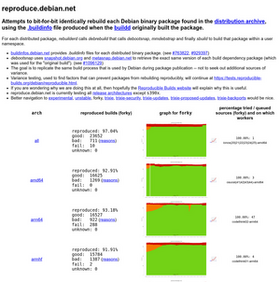
    debaudit complements the work of the Reproducible Builds project. While reproduce.debian.net focuses on ensuring that binary packages can be bit-for-bit reproduced from their source packages, debaudit focuses on the preceding step: ensuring that the source package itself is a faithful and reproducible representation of its upstream source or Vcs-Git repository.
  • kpcyrd filed a bug against the librust-const-random-dev package reporting that the compile-time-rng feature of the ahash crate uses the const-random crate in turn, which uses a macro to read/generate a random number generator during the build. This issue was also filed upstream.
  • 60 reviews of Debian packages were added, 4 were updated and 16 were removed this month adding to our knowledge about identified issues. One new issue types was added, pkgjs_lock_json_file_issue.
Lastly, Bernhard M. Wiedemann posted another openSUSE monthly update for their work there.

Tool development diffoscope is our in-depth and content-aware diff utility that can locate and diagnose reproducibility issues. This month, Chris Lamb made a number of changes, including preparing and uploading versions, 314 and 315 to Debian.
  • Chris Lamb:
    • Don t run test_code_is_black_clean test in the autopkgtests. (#1130402). [ ]
    • Add some debugging info for PyPI debugging. [ ]
  • Jelle van der Waa:
    • Fix compatibility with LLVM version 22. [ ]
    • Adjust the PGP file detection regular expression. [ ]
  • Michael R. Crusoe:
    • Reformat the source code using Black version 26.1.0 [ ][ ]
In addition, Vagrant Cascadian updated diffoscope in GNU Guix to version 315.
rebuilderd, our server designed monitor the official package repositories of Linux distributions and attempt to reproduce the observed results there; it powers, amongst other things, reproduce.debian.net. A new version, 0.26.0, was released this month, with the following improvements:
  • Much smoother onboarding/installation.
  • Complete database redesign with many improvements.
  • New REST HTTP API.
  • It s now possible to artificially delay the first reproduce attempt. This gives archive infrastructure more time to catch up.
  • And many, many other changes.

Upstream patches The Reproducible Builds project detects, dissects and attempts to fix as many currently-unreproducible packages as possible. We endeavour to send all of our patches upstream where appropriate. This month, we wrote a large number of such patches, including:

Documentation updates Once again, there were a number of improvements made to our website this month including:
  • kpcyrd:
    • Add a new page about Rust specifics. [ ][ ][ ]
  • Robin Candau:
    • Add link to the diffoci Arch Linux package on the Tools page. [ ]
  • Timo Pohl:

Two new academic papers Marc Ohm, Timo Pohl, Ben Swierzy and Michael Meier published a paper on the threat of cache poisoning in the Python ecosystem: Attacks on software supply chains are on the rise, and attackers are becoming increasingly creative in how they inject malicious code into software components. This paper is the first to investigate Python cache poisoning, which manipulates bytecode cache files to execute malicious code without altering the human-readable source code. We demonstrate a proof of concept, showing that an attacker can inject malicious bytecode into a cache file without failing the Python interpreter s integrity checks. In a large-scale analysis of the Python Package Index, we find that about 12,500 packages are distributed with cache files. Through manual investigation of cache files that cannot be reproduced automatically from the corresponding source files, we identify classes of reasons for irreproducibility to locate malicious cache files. While we did not identify any malware leveraging this attack vector, we demonstrate that several widespread package managers are vulnerable to such attacks. A PDF of the paper is available online.
Mario Lins of the University of Linz, Austria, has published their PhD doctoral thesis on the topic of Software supply chain transparency: We begin by examining threats to the software distribution stage the point at which artifacts (e.g., mobile apps) are delivered to end users with an emphasis on mobile ecosystems [and] we next focus on the operating system on mobile devices, with an emphasis on mitigating bootloader-targeted attacks. We demonstrate how to compensate lost security guarantees on devices with an unlocked bootloader. This allows users to flash custom operating systems on devices that no longer receive security updates from the original manufacturer without compromising security. We then move to the source code stage. [Also,] we introduce a new architecture to ensure strong source-to-binary correspondence by leveraging the security guarantees of Confidential Computing technology. Finally, we present The Supply Chain Game, an organizational security approach that enhances standard risk-management methods. We demonstrate how game-theoretic techniques, combined with common risk management practices, can derive new criteria to better support decision makers. A PDF of the paper is available online.

Misc news On our mailing list this month:
  • Holger Levsen announced that this year s Reproducible Builds summit will almost certainly be held in Gothenburg, Sweden, from September 22 until 24, followed by two days of hacking. However, these dates are preliminary and not 100% final an official announcement is forthcoming.
  • Mark Wielaard posted to our list asking a question on the difference between debugedit and relative debug paths based on a comment on the Build path page: Have people tried more modern versions of debugedit to get deterministic (absolute) DWARF paths and found issues with it?


Finally, if you are interested in contributing to the Reproducible Builds project, please visit our Contribute page on our website. However, you can get in touch with us via:

Jamie McClelland: AI Hacking the Planet

A colleague asked me if we should move all our money to our pillow cases after reading the latest AI editorial from Thomas Friedman. The article reads like a press release from Anthropic, repeating the claim that their latest AI model is so good at finding software vulnerabilities that it is a danger to the world. I think I now know what it s like to be a doctor who is forced to watch Gray s Anatomy. By now every journalist should be able to recognize the AI publicity playbook: Step 1: Start with a wildly unsubstantiated claim about how dangerous your product is: AI will cause human extinction before we have a chance to colonize mars (remember that one? Even Kim Stanley Robinson, author of perhaps the most compelling science fiction on colonizing mars calls bull shit on it). AI will eliminate all of our jobs (this one was extremely effective at providing cover for software companies laying off staff but it has quickly dawned on people that the companies that did this are living in chaos not humming along happily with functional robots) AI will discover massive software vulnerabilities allowing bad actors to hack pretty much every major software system in the world . (Did Friedman pull that directly from Anthropic s press release or was that his contribution?) Step 2: To help stave off human collapse, only release the new version to a vetted group of software companies and developers, preferably ones with big social media followings Step 3: Wait for the limited release developers to spew unbridled enthusiasm and shocking examples that seem to suggest this new AI produce is truly unbelievable Step 4: Watch stock prices and valuations soar Step 5: Release to the world, and experience a steady stream of mockery as people discover how wrong you are Step 6: Start over Even if Friedman missed the text book example of the playbook, I have to ask: if you think bad actors compromising software resulting in massive loss of private data, major outages and wasted resources needs to be reported on, then where have you been for the last 10 years? This literally happens on a daily basis due to the fundamentally flawed way capitalism has been writing software even before the invention of AI. A small part of me wonders - maybe AI writing software is not so bad, because how could it be any worse than it is now? Also, let s keep in mind that AI s super ability at finding vulnerable software depends on having access to the software s source code, which most companies keep locked up tight. That means the owners of the software can use AI to find vulnerabilities and fix them but bad actors can t. Oh, but wait, what if a company is so incompetent that they accidentally release their proprietary software to the Internet? Surely that would allow AI bots to discover their vulnerabilities and destroy the company right? I m not sure if anyone has discovered world ending vulnerabilities in Anthropic s Claude code since it was accidentally released, but it is fun to watch people mock software that is clearly written by AI (and spoiler alert, it seems way worse that software written now). Well we probably should all be keeping our money in a pillow case anyway.

9 April 2026

Russell Coker: HP Z640 and E5-2696 v4

I recently decided to upgrade the CPU in my workstation, the E5-2696 v3 CPU was OK (passmark 2045 for single thread and 21,380 for multi thread) [1] but I felt like buying something better so I got a E5-2696 v4 (passmark 2115 and 24,643) [2]. I chose the E5-2696 v4 because I was looking for a E5-2699 v4 and found an ebay seller who had them at $140 but was offering the E5-2696 v4 for $99 and the passmark results for the two CPUs are almost identical. After buying the CPU and waiting for it to be delivered I realised that the Z640 doesn t include it in the list of supported CPUs and that the maximum TDP of any supported CPU is 145W while according to passmark it has a TDP of 150W. I looked for information about it on Intel ARK (the official site for specs of Intel CPUs) and discovered that The Intel Xeon Processor E5-2696 v4 is designed to be used by system manufacturers (OEMs), and this means they can modify its specifications depending on the system where it will be implemented and The processor does not have an ARK page for this reason, since it has no standard specification from Intel, so depending on the original system, it is necessary to contact that system manufacturer for information [3]. That s the official response from an Intel employee saying that there are no standard specs for that CPU!!! Somehow I had used a E5-2696 v3 for 3 years without realising that the same lack of support and specs applies to it [4]! I installed the new CPU in another Z640 which had a E5-1620 v3 CPU and it worked. I was a little surprised to discover that the hole in the corner is in the bottom right (according to the alignment of the printed text on the top) for all my E5-26xx CPUs while it s in the top left on the E5-1620 v3. Google searches for things like e5-2600 e5-1600 difference and e5-2600 e5-1600 difference hole in corner didn t turn up any useful information. The best information I found was from the Linus Tech Tips forum which says that the hole is to allow gasses to escape when the CPU package is glued together [5] which implies (but doesn t state) that the location of the hole has no meaning. I had previously thought that the hole was to indicate the location of pin 1 and was surprised when the new CPU had the hole in the opposite corner. Hopefully in future when people have such concerns they can find this post and not be worried that they are about to destroy their CPU, PC, or both when upgrading the CPU. The previous Z640 was one I bought from Facebook marketplace for $50 in unknown condition in the expectation that I would get at least $50 of parts but it worked perfectly apart from one DIMM socket. The Z640 I m using now is one I bought from Facebook marketplace for $200 and it s working perfectly with 4 DIMMs, 128G of RAM, and the E5-2696 v4 CPU. $300 for a workstation with ECC RAM and a 22 core CPU is good value for money! There are some accounts of the E5-2696 v4 not working on white-box motherboards including a claim that when it was selling for $4000US someone s motherboard destroyed one. The best plan for such CPUs is to google for someone who s already got it working in the same machine, which means a name-brand server. That doesn t guarantee that it will work (Intel refuses to supply specs and states that different items may work differently) but greatly improves the probability. This system has the HP BIOS version 2.61, note that the Linux fwupd package doesn t seem to update the BIOS on HP workstations so you need to manually download it and install it. There is a possibility that a Z640 with an older BIOS won t work with this CPU. Here is the previous post in my Z640 saga [6].

6 April 2026

Thorsten Alteholz: My Debian Activities in March 2026

Debian LTS/ELTS This was my hundred-forty-first month that I did some work for the Debian LTS initiative, started by Raphael Hertzog at Freexian. During my allocated time I uploaded or worked on: I also worked on the check-advisories script and proposed a fix for cases where issues would be assigned to the coordinator instead of the person who forgot doing something. I also did some work for a kernel update and packages snapd and ldx on security-master and attended the monthly LTS/ELTS meeting. Last but not least I started to work on gst-plugins-bad1.0 Debian Printing This month I uploaded a new upstream versions: Several packages take care of group lpadmin in their maintainer scripts. With the upload of version 260.1-1 of systemd there is now a central package (systemd systemd-standalone-sysusers systemd-sysusers) that takes care of this. Other dependencies like adduser can now be dropped. This work is generously funded by Freexian! Debian Lomiri This month I continued to work on unifying packaging on Debian and Ubuntu. This makes it easier to work on those packages independent of the used platform. I am also able to upload Debian packages to the corresponding Ubuntu PPA now. A small bug had to be fixed in the python script to allow the initial configuration in Launchpad. This work is generously funded by Fre(i)e Software GmbH! Debian Astro This month I uploaded a new upstream version or a bugfix version of: I also uploaded lots of indi-drivers (libplayerone, libsbig, libricohcamerasdk, indi-asi, indi-eqmod, indi-fishcamp, indi-inovaplx, indi-pentax, indi-playerone, indi-sbig, indi-mi, libahp-xc, indi-aagcloudwatcher, indi-aok, indi-apogee, libapogee3, indi-nightscape, libasi, libinovasdk, libmicam, indi-avalon, indi-beefocus, indi-bresserexos2, indi-dsi, indi-ffmv, indi-fli, indi-gige, info-gphoto, indi-gpsd, indi-gpsnmea, indi-limesdr, indi-maxdomeii, indi-mgen, indi-rtklib, indi-shelyak, indi-starbook, indi-starbookten, indi-talon6, indi-weewx-json, indi-webcam, indi-orion-ssg3, indi-armadillo-playtypus ) to experimental to make progress with the indi-transition. No problems with those drivers appeared and the next step would be the upload of indi version 2.x to unstable. I hope this will happen soon, as new drivers are already waiting in the pipeline. There have been also four packages, that migrated to the official indi package and are no longer needed as 3rdparty drivers (indi-astrolink4, indi-astromechfoc, indi-dreamfocuser, indi-spectracyber). While working on these packages, I thought about testing them. Unfortunately I don t have enough hardware to really check out every package, so I can upload most of them only as is. In case anybody is interested in a better testing coverage and me being able to provide upstream patches, I would be very glad about hardware donations. Debian IoT This month I uploaded a new upstream version or a bugfix version of: Debian Mobcom This month I uploaded a new upstream version or a bugfix version of: misc This month I uploaded a new upstream version or a bugfix version of: I also sponsored the upload of Matomo. Thanks a lot to William for preparing the package.

4 April 2026

Isoken Ibizugbe: Post Outreachy Activities

It s been about a month since I wrapped up my Outreachy internship, but my journey with Debian is far from over. I planned to keep contributing and exploring the community, and these past few weeks have been busy

Testing Locales and Solving Bug #1111214

For the openQA project, we decided to explore how accurate local language installations are and see if we can improve the translations. While exploring this, I started working on automating a test for a specific bug report: Debian Bug #1111214

This is a test I had started by writing a detailed description of the installation process to confirm that selecting the Spanish_panama locale works accurately. I spent time studying previous language installation tests, and I learned that I needed to add a specific tag (LANGUAGE-) to the needles (visual test markers).

Since the installation wasn t in English anymore, taking the correct screenshots and defining the areas took quite some time. I used the following command on the CLI to run the test:

openqa-cli api -X POST isos ISO=debian-live-testing-amd64-gnome.iso DISTRI=debian-live VERSION=forky FLAVOR=gnome LANGUAGE=spanish_panama ARCH=x86_64 BUILD=1311 CHECKSUM=unknown

While working on this, I got stuck at the complete_installation step. Because the keyboard layout had changed to Spanish, the commands required to confirm a successful install weren t working as expected. Specifically, we had an issue typing the greater than sign (>).

My mentor, Roland Clobus, worked on a clever maneuver for the keys (AltGr-Shift-X), which was actually submitted upstream to openSUSE.

In this step, I also had to confirm that the locale was correctly set to LANG= es_PA.UTF-8 . I had to dig into the scripts and Linux commands to make this work. It was a bit intimidating at first, but it turned out to be a great learning experience. You can follow my progress on this Merge Request here. I m currently debugging a small issue where the home key seems to click twice in the final step, and after that, the test would be complete  .

Community & Connections

Beyond the code, I ve been getting more involved in the social side of Debian:

  • Debian Women: I attended the monthly meeting and met Sruthi Chandran. I ve always seen her name as an Outreachy organizer, so it was great to meet her! She is currently running for Debian Project Leader (DPL). We also discussed starting technical sessions to introduce members to packaging, which I am very excited to learn.
  • DebConf Preparation: I am officially preparing for my first DebConf! My mentors, Tassia and Roland, along with my fellow intern Hellen, have been incredibly supportive in guiding me through the application and presentation process.

2 April 2026

Joerg Jaspert: Building a house - 1 year in

Haven t written here about it, but last March we finally started on our journey to get our own house build, so we can move out of the rented flat here. That will be a big step, both the actual building, but also the moving - I am living at this one single place for 36 years now. If you can read german there is a dedicated webpage where I sometimes write about the process. Will have much more details (and way more ramblings) than the following part. If you can t read german, a somewhat short summary follows. Yes, still a lot of text, but shortened, still.

What? Why now? Current flat has 83m - which simply isn t enough space. And the number of rooms also doesn t fit anymore. But it is hard to find a place that fits our requirements (which do include location). Moving to a different rented place would also mean changed amount of rent. And nowadays that would be huge increase (my current rent is still the price from about 30 years ago!). So if we go and pay more - we could adjust and pay for something we own instead. And both, my wife and I had changes in our jobs that made it possible for us now, so we started looking.

Market Brrrr, looking is good, actually finding something that fits - not so. We never found an offer that fit. Space wise, sure. But then location was off, or price was idiotically high. Location fit, but then size was a joke, and guess about the price Who needs 200 square meters with 3 rooms? Entirely stupid design choices there. Or how about 40 square meters of hallway - with 50m of tiny rooms around. What are they smoking? Oh, there, useful size, good rooms - but now you want more money than a kidney is worth, or something. Thanks, no.

New place In February 2025 we finally got lucky and found a (newly opened) area with a large number of places to build a house on. Had multiple talks with someone from on of the companies developing that area (there are two you can select from), then talked with banks and signed a contract in March 2025. We got promised that actual house construction would be first quarter of 2026, finished in second quarter.

House type There are basically 2 ways of building a new house (that matter here). First is called Massivhaus , second is called Fertighaus in german, roughly translating to solid and prefabricated. The latter commonly a wood based construction, though it doesn t need to be. The important part of it is the prefabrication, walls and stuff get assembled in a factory somewhere and then transported to your place, where they play big kid lego for a day and suddenly a house is there. A common thought is prefabricated is faster, but that is only a half true. Sure, the actual work on side is way shorter - usually one or two days and the house is done - while a massive construction usually takes weeks to build up. But that is only a tiny part of the time needed, the major part goes of into planning and waiting and in there it doesn t matter what material you end up with.

Money fun Last year already wasn t the best time to start a huge loan - but isn t it always a few years ago would have been better ? So we had multiple talks with different banks and specialised consultants until we found something that we thought is good for us. Thinking about it now - we should have put even more money on top as reserve , but who could have thought that 2026 turns into such a shitshow? Does not help at all, quite the contrary. And that damn lotto game always ends up with the wrong numbers, meh.

Plans and plans and more plans - and rules For whichever reason you can not just go and put something on your ground and be happy. At least not if you are part of the normal people and not enormously rich. There is a large set of rules to follow. Usually that is a good thing, even though some rules are sometimes hard to understand. In Germany, besides the usual laws, we have something that is called Bebauungsplan , which translates to development plan (don t know if that carries the right meaning, it s a plan on what and how may be build, which can have really detailed specifications in). It basically tells you every aspect on top of the normal law that you have to keep in mind. In our case we have the requirement of 2 full floors and CAN have a third smaller on top, it limits how high the house can be and also how high our ground floor may be compared to the street. It regulates where on the property we may build and how much ground we may cover with the house, it gives a set of colors we are allowed to use, it demands a flat roof that we must have as a green roof and has a number of things more that aren t important enough to list here. If you do want to see the full list, my german post on it has all the details that matter to us. With all that stuff in mind - off to plans. Wouldn t have believed how many details there are to take in. Room sizes are simple, but how to arrange them for ideal usage of the sun, useful ways inside the house, but also keeping in mind that water needs to flow through and out. Putting a bath room right atop a living room means a water pipe needs to go down there. Switch the bath room side in the house, and it suddenly is above the kitchen - means you can connect the pipes from it to the ones from kitchen, which is much preferred than going through the living room. And lots more such things. It took us until nearly end of October to finalize the plans! And we learned a whole load from it. We started with a lot of wishes. The planner tried to make them work. Then we changed our minds. Plans changed. Minds changed again. Comparing the end result with the first draft we changed most of the ground floor around, with only the stairs and the entrance door at the same position. Less changes for the upper floor, but still enough.

Side quests The whole year was riddled with something my son named side quests. We visited a construction exhibition near us, we went to the house builders factory and took a look on how they work. We went to many different other companies that do SOME type of work which we need soon, say inside floors, painters, kitchen and more stuff. Of course the most important side quest was a visit to the notary to finalize the contracts, especially for the plot of land (in Germany you must have a notary for that to get entered into the governments books). Creates lots of fees, of course, for the notary and also the government (both fees and taxes here).

Building permit We had been lucky and only needed a small change to the plans to get the building permit - and the second part, the wastewater permit (yes, you need a separate one for this) also got through without trouble.

Choices, so many of them So in January we finally had an appointment for something that s called Bemusterung which badly translates to Sampling . Basically two days at the house builders factory to select all of what s needed for the house that you don t do in the plans. Doors, inside and out and their type and color and handles. Same things for the windows and the blinds and the protection level you want the windows to have. Decide about stairs, design for the sanitary installations - and also the height of the toilet! - and the tiles to put into the bathrooms. Decisions on all the tech needed (heating system, ventilation and whatnot. Two days, busy ones - and you can easily spend a lot of extra money here if you aren t careful. We managed to get out of it with only about 4000 extra, so pretty good.

Electro and automation Now, here I am special. Back when I was young the job I learned is electrician. So here I have very detailed wishes. I am also running lots of automatism in my current flat - obviously the new house should be better than that. So I have a lot of ideas and thoughts on it, so this is entirely extra and certainly out of the ordinary the house builder usually see. Which means I do all of that on my own. Well, the planning and some of the work, I must have a company at hand for certain tasks, it is required by some rules. But they will do what I planned, as long as I don t violate regulations. Which means the whole electrical installation is different. Entirely planned for automatisms and using KNX for it. I am so happy to ditch Homeassistant and the load of Homematic, Zigbee and ZWave based wireless things. Ok, Homeassistant is a nice thing - it can do a lot. And it can bridge between about any system you can find. But it is a central single point of failure. And it is a system that needs constant maintenance. Not touched for a while? Plan for a few hours playing update whack-a-mole. And often enough a component here or there breaks with an update. Can be fixed, but takes another hour or two. So I change. Away from wireless based stuff. To wires. To a system thats a standard for decades already. And works entirely without a SPOF. (Yes, you can add one here too). And, most important, should I ever die - can easily be maintained by anyone out there dealing with KNX, which is a large number of people and companies. Without digging through dozens of specialised integrations and whatnot. I may even end up with Homeassistant again - but that will entirely be as a client. It won t drive automations. It won t be the central point to do anything for the house. It will be a logging and data collecting thing that enables me to put up easy visualizations. It may be an easy interface for smartphones or tablets to control parts of the house, for those parts where one wants this to happen. Not the usual day-to-day stuff, extras on top.

Actual work happening Since march there finally is action visible. The base of the house is getting build. Wednesday the 1st April we finally got the base slab poured on the construction site and in another 10 days the house is getting delivered and build up. A 40ton mobile crane will be there.

Samuel Henrique: Bringing HTTP/3 to curl on Amazon Linux

Screenshot of the top entry of the curl package's changelog, showing the following: Changelogs for curl-8.17.0-1.amzn2023.0.2.x86_64 * Mon Mar 16 00:00:00 2026 Samuel Henrique (samueloph) <samhn@amazon.com> - 8.17.0-1.amzn2023.0.2 - Enable HTTP/3 support in the full build using ngtcp2 and nghttp3 - HTTP/3 is explicitly disabled in the minimal build - Add runtime dependencies on libnghttp3 and libngtcp2 with minimum version pinning - Run tests in parallel via upstream make test-nonflaky, with serial fallback for race-prone tests

tl;dr Starting with curl 8.17.0-1.amzn2023.0.2 in Amazon Linux 2023, you can now use HTTP/3.
dnf swap -y libcurl-minimal libcurl-full
dnf swap -y curl-minimal curl-full
curl --http3-only https://example.com
(HTTP/3 is only enabled in the curl -full builds) Or, if you would like to try it out in a container:
podman run amazonlinux:2023 /bin/sh -c 'dnf upgrade -y --releasever=latest && dnf swap -y libcurl-minimal libcurl-full && dnf swap -y curl-minimal curl-full && curl --http3-only https://example.com'
For a list of test endpoints, you can refer to https://bagder.github.io/HTTP3-test/

The Upgrade I Didn't Have to Make My teammate Steve Zarkos, who previously worked on upgrading OpenSSL in Amazon Linux from 3.0 to 3.2, spent the last few months on the complex task of bumping OpenSSL again, this time to 3.5. A bump like this only happens after extensive code analysis and testing, something that I didn't foresee happening when AL2023 was released but that was a notable request from users. Having enabled HTTP/3 on Debian, I was always keeping an eye on when I would get to do the same for Amazon Linux (mind you, I work at AWS, in the Amazon Linux org). The bump to OpenSSL 3.5 was the perfect opportunity to do that, for the first time Amazon Linux is shipping an OpenSSL version that is supported by ngtcp2 for HTTP/3 support.

Non-Intrusive Change In order to avoid any intrusive changes to existing users of AL2023, I've only enabled HTTP/3 in the full build of curl, not in the minimal one, this means there is no change for the minimal images. The way curl handles HTTP/3 today also does not lead to any behavior changes for those who have the full variants of curl installed, this is due to the fact that HTTP/3 is only used if the user explicitly asks for it with the flags --http3 or --http3-only.

Side Quests Supporting HTTP/3 on curl also requires building it with ngtcp2 and nghttp3, two packages which were not shipped in Amazon Linux, besides, my team doesn't even own the curl package, we are a security team so our packages are the security related stuff such as OpenSSL and GnuTLS. Our main focus is the services behind Amazon Linux's vulnerability handling, not package maintenance. I worked with the owners of the curl package and got approvals on a plan to introduce the two new dependencies under their ownership and to enable the feature on curl, I appreciate their responsiveness. Amazon Linux 2023 is forked from Fedora, so while introducing ngtcp2, I also sent a couple of Pull Requests upstream to keep things in sync: [ngtcp2] package latest release 1.21.0 [ngtcp2] do not skip tests While building the curl package in Amazon Linux, I've noticed the build was taking 1 hour from start to end, and the culprit was something well known to me; tests. The curl test suite is quite extensive, with more than 1600 tests, all of that running without parallelization, running two times for each build of the package; once for the minimal build and again for the full build. I had previously enabled parallel tests in Debian back in 2024 but never got around to submit the same improvements to Amazon Linux or Fedora, this is now fixed. The build times for Amazon Linux came down to 10 minutes under the same host (previously 1 hour), and Fedora promptly merged my PR to do the same there: [curl] run tests in parallel All of this uncovered a test which is timing-dependent, meaning it's not supposed to be run with high levels of parallelism, so there goes another PR, this time to curl: Flag test 766 as timing-dependent#21155 What started as enabling a single feature turned into improvements that landed in curl, Fedora, and Amazon Linux alike. I did this in a mix of work and volunteer time, mostly during work hours (work email address used when this was the case), but I'm glad I put in the extra time for the sake of improving curl for everyone.

Release Notes Amazon Linux 2023 release notes for 2023.10.20260330

1 April 2026

Matthew Garrett: Self hosting as much of my online presence as practical

Because I am bad at giving up on things, I ve been running my own email server for over 20 years. Some of that time it s been a PC at the end of a DSL line, some of that time it s been a Mac Mini in a data centre, and some of that time it s been a hosted VM. Last year I decided to bring it in house, and since then I ve been gradually consolidating as much of the rest of my online presence as possible on it. I mentioned this on Mastodon and a couple of people asked for more details, so here we are. First: my ISP doesn t guarantee a static IPv4 unless I m on a business plan and that seems like it d cost a bunch more, so I m doing what I described here: running a Wireguard link between a box that sits in a cupboard in my living room and the smallest OVH instance I can, with an additional IP address allocated to the VM and NATted over the VPN link. The practical outcome of this is that my home IP address is irrelevant and can change as much as it wants - my DNS points at the OVH IP, and traffic to that all ends up hitting my server. The server itself is pretty uninteresting. It s a refurbished HP EliteDesk which idles at 10W or so, along 2TB of NVMe and 32GB of RAM that I found under a pile of laptops in my office. We re not talking rackmount Xeon levels of performance, but it s entirely adequate for everything I m doing here. So. Let s talk about the services I m hosting.

Web This one s trivial. I m not really hosting much of a website right now, but what there is is served via Apache with a Let s Encrypt certificate. Nothing interesting at all here, other than the proxying that s going to be relevant later.

Email Inbound email is easy enough. I m running Postfix with a pretty stock configuration, and my MX records point at me. The same Let s Encrypt certificate is there for TLS delivery. I m using Dovecot as an IMAP server (again with the same cert). You can find plenty of guides on setting this up. Outbound email? That s harder. I m on a residential IP address, so if I send email directly nobody s going to deliver it. Going via my OVH address isn t going to be a lot better. I have a Google Workspace, so in the end I just made use of Google s SMTP relay service. There s various commerical alternatives available, I just chose this one because it didn t cost me anything more than I m already paying.

Blog My blog is largely static content generated by Hugo. Comments are Remark42 running in a Docker container. If you don t want to handle even that level of dynamic content you can use a third party comment provider like Disqus.

Mastodon I m deploying Mastodon pretty much along the lines of the upstream compose file. Apache is proxying /api/v1/streaming to the websocket provided by the streaming container and / to the actual Mastodon service. The only thing I tripped over for a while was the need to set the X-Forwarded-Proto header since otherwise you get stuck in a redirect loop of Mastodon receiving a request over http (because TLS termination is being done by the Apache proxy) and redirecting to https, except that s where we just came from. Mastodon is easily the heaviest part of all of this, using around 5GB of RAM and 60GB of disk for an instance with 3 users. This is more a point of principle than an especially good idea.

Bluesky I m arguably cheating here. Bluesky s federation model is quite different to Mastodon - while running a Mastodon service implies running the webview and other infrastructure associated with it, Bluesky has split that into multiple parts. User data is stored on Personal Data Servers, then aggregated from those by Relays, and then displayed on Appviews. Third parties can run any of these, but a user s actual posts are stored on a PDS. There are various reasons to run the others, for instance to implement alternative moderation policies, but if all you want is to ensure that you have control over your data, running a PDS is sufficient. I followed these instructions, other than using Apache as the frontend proxy rather than nginx, and it s all been working fine since then. In terms of ensuring that my data remains under my control, it s sufficient.

Backups I m using borgmatic, backing up to a local Synology NAS and also to my parents home (where I have another HP EliteDesk set up with an equivalent OVH IPv4 fronting setup). At some point I ll check that I m actually able to restore them.

Conclusion Most of what I post is now stored on a system that s happily living under a TV, but is available to the rest of the world just as visibly as if I used a hosted provider. Is this necessary? No. Does it improve my life? In no practical way. Does it generate additional complexity? Absolutely. Should you do it? Oh good heavens no. But you can, and once it s working it largely just keeps working, and there s a certain sense of comfort in knowing that my online presence is carefully contained in a small box making a gentle whirring noise.

30 March 2026

Jamie McClelland: Mailman3 has 2 databases. Whoops.

At May First we have been carefully planning our migration of about 1200 lists from mailman2 to mailman3 for almost six months now. We did a lot of user communications, had several months of beta testing with a handful of lists ported over, and everything was looking good. So we kicked off the migration! But, about 15% of the way through I started seeing sqlite lock errors. Wait, what? I carefully re-configured mailman3 to use postgres, not sqlite. Well, yes, but apparently that was for the database managing the email list configuration, not the database powering the django web app, which, incidentally, also includes hundresds of gigabytes of archives. In other words, the one we really need in postgres, not sqlite.

Moving from sqlite to postgres Well that sucks. We immediately stopped the migration to deal with this. I noticed that the web is full of useful django instructions on how to migrate your database from one database to antoher. However, if you read the fine print, those convenient looking dumpdata loaddata workflows are designed to move the table definitions and a small amount of data. In our case, even after just 15% of our lists moved, our sqlite database was about 30GB. I considered some of the hacks to manage memory and try to run this via django, but eventually decided that pgloader was a more robust option. This option also allowed me to more easily test things out on a copy of our sqlite database (made while mailman was turned off). This way I could migrate and re-migrate the sqlite database over and over without impacting our live installation until I was satisfied it was all working. My first decision was to opt out of pgloader s schema creation. I used django s schema creation tool by:
  • Turning off mailman3 and mailman3-web and changing the mailman web configuration to use the new postgresql database.
  • Running mailman-web migrate
  • Changing the mailman web configuration back to sqlite and starting everything again.
Note: I tried just adding new database settings in the mailman web configuration indexed to new - django has the ability to define different databases by name, then you can run mailman-web migrate --database new. But, during the migration, I caught django querying the sqlite database for some migrations that required referencing existing fields (specifically hyperkitty s 0003_thread_starting_email). I didn t want any of these steps to touch the live database so I opted for the cleaner approach. Once I had a clean postgres schema, I dumped it so I could easily return to this spot. Next I started working on our pgloader load file. After a lot of trial and error, I ended with:
LOAD DATABASE
    FROM sqlite:///var/lib/mailman3/sqlite-postgres-migration/mailman3web.clean.backup.db
    INTO postgresql://mailmanweb:xxxxxxxxxxx@localhost:5432/mailmanweb

WITH data only,
    reset sequences,
    include no drop,
    disable triggers,
    create no tables,
    batch size = 5MB,
    batch rows = 500,
    prefetch rows = 50,
    workers = 2,
    concurrency = 1

SET work_mem to '64MB',
    maintenance_work_mem to '512MB'

CAST type datetime to timestamptz drop default drop not null,
    type date to date drop default drop not null,
    type int when (= precision 1) to boolean using tinyint-to-boolean,
    type text to varchar using remove-null-characters;
The batch, prefetch, workers and concurreny settings are all there to ensure memory doesn t blow up. I also discovered that I had to make some changes to the schema before loading data. Mostly truncating tables that the django migrate command populated to avoid duplicate key errors:
TRUNCATE TABLE django_migrations CASCADE;
TRUNCATE TABLE django_content_type CASCADE;
TRUNCATE TABLE auth_permission CASCADE;
TRUNCATE TABLE django_site CASCADE;
And also, I had to change a column type. Apparently the mailman import process allowed an attachment file name that exceeds the limit for postgres, but was allowed into sqlite:
ALTER TABLE hyperkitty_attachment ALTER COLUMN name TYPE text
When pgloader runs, we still get a lot of warnings from pgloader, which wants to cast columns differently than django does. These are harmless (I was able to import the data without a problem). And there are still a lot of warnings along the lines of:
2026-03-30T14:08:01.691990Z WARNING PostgreSQL warning: constraint hyperkitty_vote_email_id_73a50f4d_fk_hyperkitty_email_id of relation hyperkitty_vote does not exist, skipping
These are harmless as well. They appear because disable triggers disables foreign key constraints. Without it, we wouldn t be able to load tables that require values in tables that have not yet been populated. After all the tweaking, the import of our 30GB sqlite database took about 40 minutes.

Final Steps I think the reset sequences from pgloader should take care of this, but just in case:
mailman-web sqlsequencereset hyperkitty mailman_django auth   mailman-web dbshell
And, just to ensure postgres is optimized, run this in the psql shell:
ANALYZE VERBOSE;

Last thoughts I understand very well all the decisions the mailman3 devs made in designing the next version of mailman, and if I was in the same place I may have made them the same ones. For example, separating the code running the mailing list from the code managing the archives and the web interface makes perfectly good sense - many people might want to run just the mailing list part without a web interface. And building the web interface in django makes a lot of sense as well - why re-invent the wheel? I m sure a lot of time and effort was saved by simply using the built in features you get for free with django. But the unfortunate consequence of these decisions is that sys admins have a much harder time. Almost everyone wants the email lists along with the web interface and the archives. But nobody wants two different configuration files with different syntaxes and logic, not to mention two different command lines to use for maintenance and configuration with completely different APIs. Trying to understand how to change a default template or set list defaults requires a lot of research and usually you have to write a python script to do it. I have finally come to the conclusion that mailman2 is designed for sys admins, while mailman3 is designed for developers. Despite these short comings, I am impressed with the community and their quick and friendly responses to the questions of a confused sys admin. That might be more valuable than anything else.

Utkarsh Gupta: FOSS Activites in March 2026

Here s my monthly but brief update about the activities I ve done in the FOSS world.

Debian
Whilst I didn t get a chance to do much, here are still a few things that I worked on:
  • A quick exchange with Xavier about node-lodash fixes for stable releases.
  • Uploaded ruby-rack to CVE-2026-25500 & CVE-2026-22860 to sid, trixie, and bookworm.
  • Started to work on the DebConf Bursary team along with PEB.
  • Assited a few folks in getting their patches submitted via Salsa.
  • Mentoring for newcomers.
  • Moderation of -project mailing list.

Ubuntu
I joined Canonical to work on Ubuntu full-time back in February 2021. Whilst I can t give a full, detailed list of things I did, here s a quick TL;DR of what I did:
  • Successfully released 26.04 LTS Beta!
  • Worked further on the whole artifact signing story for cdimage.
  • Assisted a bunch of folks with my Archive Admin and Release team hats to:
    • Review and grant FFes.
    • Coordinating weekly syncs.
    • Promoting/demoting binaries to/from main.
    • Taking care of package removals and so on.
  • Was pretty occupied with the new release processs architecture and design.
  • Preparing for the 26.04 LTS final release.

Debian (E)LTS
This month I have worked 50 hours on Debian Long Term Support (LTS) and on its sister Extended LTS project and did the following things:

Released Security Updates

Work in Progress
  • knot-resolver: Affected by CVE-2023-26249, CVE-2023-46317, and CVE-2022-40188, leading to Denial of Service.
  • node-lodash: Affected by CVE-2025-13465, prototype pollution in the baseUnset function.
    • [stable]: Xavier from the JS team ACK d the patch. The trixie and bookworm uploads will follow.
    • [LTS]: The bullseye test and upload will follow in April once the stable uploads are in and ACK d by the SRMs.
  • vlc: Affected by CVE-2025-51602, an out-of-bounds read and denial of service via a crafted 0x01 response from an MMS server.
    • [LTS]: 3.0.23 backport is ready but not tested. I ll get this over the line in March.
    • [ELTS]: 3.0.23 backport is ready but not very clean. Would like to complete LTS and get back to this.

Other Activities
  • [ELTS] Continued to review ruby-rack for ELTS it has since received about 13 new CVEs, making it even more chaotic. Might consider releasing in batches.
  • [E/LTS] Monitored discussions on mailing lists, IRC, and all the documentation updates.
  • [E/LTS] Attended the monthly LTS meeting on IRC. Summary here.
  • [Other] Spent quite some time debugging a bug in debusine. Filed https://salsa.debian.org/freexian-team/debusine/-/issues/1412 for the same. Have worked on a preliminary patch but would like to submit something for Colin to review. Will follow up in April.

Until next time.
:wq for today.

Russ Allbery: Review: The Cloak and Its Wizard

Review: The Cloak and Its Wizard, by R.Z. Nicolet
Publisher: UpLit Press
Copyright: February 2026
ISBN: 1-917849-15-X
Format: Kindle
Pages: 423
The Cloak and Its Wizard is a standalone (at least so far) urban fantasy superhero (sort of) novel. R.Z. Nicolet is the marketing pseudonym for Rachel Reddick. This is her first novel.
I'm picky about wizards. The wizards themselves will complain about that, but of course I'm picky. When I choose a wizard, barring utter abandonment of moral scruples, it's a till-death-do-us-part situation. (Their death, not mine. I'm the next best thing to indestructible.)
The Cloak of Sunset and Starlight is a major artifact, meaning that it has its own preferences and is capable of independent action. It has been sitting in a glass case in the wizards' library for about a hundred years, waiting for someone interesting. (Well, mostly sitting. Occasionally it sneaks out to eavesdrop or move the books around.) Veronica Noble is interesting. She's older than most initiates, thoughtful, observant, and clearly had some mundane career before joining the Order. Her aura is appealing, and her mental shields and resistance to influence are intriguing. Normally, the Cloak would take its time investigating a new potential wizard, but the Sword was making thoughtful rattling sounds, and no way is the Cloak going to let the Sword claim her first. Time to choose a new wizard!
It was nice, being draped over warm shoulders, and feeling a heartbeat again. I could tell she closed her eyes without even looking. She sighed. "I just got picked by the intransigent one, didn't I?"
The last time I picked a book from the Big Idea feature in Scalzi's Whatever blog, it didn't go that well, but if you're going to write a book specifically for me, I'm going to read it. There are very few tropes of SFF that I love more than intelligent companion objects, and Nicolet's introduction to the story was compelling. So I gave this book discovery method another chance. I'm glad I did, because this was exactly what I was in the mood for and a delight from cover to cover. Veronica Noble is not a typical wizard. She's a surgeon and was quite happy to be a surgeon until an unexpected encounter with a magical creature killed her brother. The forgetting spell cast by the wizards who came to handle the Cassandra wyrm didn't work on her, so she was dragged reluctantly into the secret magical world of the Order. This long-lived society of wizards quietly defends the world against magical intrusions from other planes of existence. Now she's a wizard with a magical cloak, which she is not at all sure she wants. Veronica is not the protagonist, though. The Cloak of Sunset and Starlight is. As far as it is concerned, its job is to assist its wizard, enjoy watching interesting feats of magic, and look fabulous doing so. It's protective, dramatic, rather vain, endlessly curious, easily bored, and intensely loyal. When it becomes clear that the Order has some serious problems, the Cloak knows what side it's on. This sounds a bit like urban fantasy, so I was surprised when the first superheroes showed up, although given the explicit Doctor Strange inspiration I probably should have expected them. The Order and the superheroes do not mix, at least at the start of the novel. The wizards view the superheroes as a loud and irritating intrusion and hide magical activities from them the same as they do the rest of the world. Veronica's opening opinion on superheroes is based on being a trauma surgeon in a hospital dealing with the aftermath of their fights (which makes me wonder if the author has read Hench, although the idea is older than that book). As with the Order, the role of superheroes in this world gets more complicated as the plot develops. There is a surprising amount of plot and some very nice world-building here, including multiple twists that I was not expecting. Veronica is the sort of stubborn and deeply ethical person who will not leave a problem alone if she has the ability to fix it, which is a good recipe for getting deeper and deeper into a complex plot. She's believable as a surgeon: somewhat taciturn, calm in emergencies, detail-oriented, methodical, and not at all dramatic. This makes the Cloak a perfect foil and complement. Watching their partnership develop was very satisfying. This is a sidekick novel, and like the best sidekick novels it makes the not-protagonist more interesting and more relatable by showing them from an outside and skewed perspective. Piecing together what Veronica must be thinking is part of the fun, as is sharing the Cloak's protectiveness towards her as it becomes clear how much she's been through and how good of a person she is. The Cloak's personality was a little too much like a cat for me I would have preferred a more unique viewpoint, fewer cat-coded shenanigans, and a bit less of the running laundry machine joke. But that's a quibble. Its endless curiosity drives the plot forward and uncovers more of the world-building, and I just love reading stories from the perspective of this sort of loyal and protective magical creature. I had so much fun with this book. It's a popcorn sort of book, and I thought the ending sputtered a little, but overall it was great. Parts of it could have been designed in a lab to appeal to me specifically, so I'm not sure if other people will enjoy it as much, but its hit rate with my friends so far has been good. Highly recommended, and I will be watching for any further novels from Nicolet. The Cloak and Its Wizard reaches a satisfying conclusion and doesn't advertise itself as part of a series, but there is room for a sequel. If Nicolet ever writes one, I'd read it. Rating: 8 out of 10

Next.

Previous.