
Search Results: "storm"

2 November 2015

Sven Hoexter: Ubuntu 14.04 php-apcu backport arrived

In case you're one of those troubled by the sorry state of the apcu release in Ubuntu 14.04 you can now switch to the official backport. Micah Gersten was kind enough to invest some time and got it uploaded.

17 October 2015

Sven Hoexter: TclCurl snapshot uploaded to unstable

While I was pondering if I should drop the tclcurl package and get it removed from Debian Christian Werner from Androwish (a Tcl/Tk port for Android) started to fix the open bugs. Thanks a lot Christian! I've now uploaded a new TclCurl package to unstable based on the code in the new upstream repository plus the patches from Christian. In case you're one of the few TclCurl users out there please try the new package. I'm still pondering if it's worth to keep the package. For the last five years or so I could get along with the Tcl http module just fine and thus no longer use TclCurl myself. In case someone would like to adopt it just write me a mail, I'd be happy to give it away.

15 October 2015

Laura Arjona: Long summer story, Welcome team, and I am a Debian Developer now

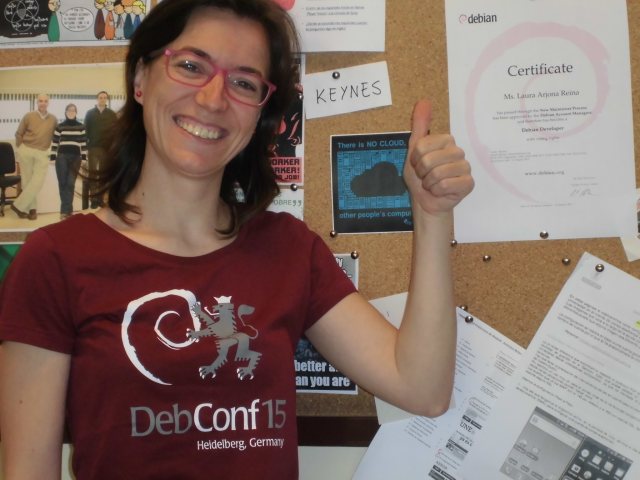
Note: 2015/10/16: I need to add some links but I won t delay this more, posting now, will edit later. Summer ended long time ago, but believe me, I m still catching up with all the things that I began in June/July, all the things I left in August when I went holidays, and more things that appeared in August and September. This is a long overdue post, I hope you bear with me for waiting so long, and writing (now) so long too! June In June, I was 100% sure that I would not attend DebConf15 (well, I was 98% sure until then), and when the new Outreach Sponsorship grants were announced, I decided to write some mails to several Debian contributors, so they consider applying for the grant and attend DebConf (and maybe trigger some i18n/l10n meeting ). They kindly declined, and I understood their reasons, but also wondered what would have happened if the proposal would have come from somebody more official instead of a random contributor that they don t know. I also hoped that lots of other Debianites also write to newbies or not-yet-DD-contributors or non-packaging contributors to invite them to DebConf, and I hoped that they had better luck than me in convincing them :) July In July I usually work hard preparing the computer labs for next academic year at my workplace in the University, but I also have more free time in the long afternoons and evenings, since I don t sleep much, and there is not much to do outside with the summer hot. So I used that month to go on contributing to DebConf publicity and think a bit more about Debian and the other free software communities. I didn t put much time in advancing my selfhosting (no SSL yet in *.larjona.net! booooo!) but I decided to deep my toe in Sandstorm.io, and try to selfhost an instance ( http://lacaja.larjona.net ) and try Etherpad inside Sandstorm (since I failed in deploying Etherpad by myself in my jessie+nginx+postgres box). Sandstorm worked, and Etherpad was packaged in Sandstorm so it worked too; and I have my free-software-base pads now for writing and share. So I joined #sandstorm IRC channel since then, and there I learnt that Asheesh Laroia (who works in Sandstorm.io and is also a Debian Developer and was going to give a talk about Sandstorm.io in DebConf15) was offering mentorship for people wanting to learn Sandstorm packaging, and his proposal was to begin packaging Framadate. I also failed in selfhosting Dudle (prepared for Apache + FastCGI, couldn t make it work in my Nginx), so Asheesh s proposal looked suitable for me. We talked and decided to invest the rest of July and first days of August in learning to package Framadate. I learned a lot, but couldn t finish the task. I encountered many issues (setting my dev environment, and later trying to package), and we solved some of them but my time ran out. I posted my work in the list, and I hope that my feedback on the documentation and the issues I encountered helped Asheesh and the Sandstorm community. Framadate is packaged in Sandstorm.io now, Drew Fisher packaged it, not sure if my stuff was useful or not (it s been useful for me, for learning, at least). I ll talk more about Sandstorm.io in a future blog post updating on my selfhosting adventures. What I liked most was the kind of proposal of mentoring that Asheesh made. It was very detailed in every aspect: the task, the things you need to accomplish it, details about his availability for mentorship I try to be welcoming in the teams in which I participate, but the fact is that I fail in actually mentor, maybe because of not making specific proposals to people (until now, I was like Hi, newcomer! Go read this, this and this, and try for yourself any task you feel you like it, and come back if you have issues , la Debian ). This, plus the thoughts about my mails in June for diversity outreach in DebConf, made me feel the need of having a team where people willing to welcome newcomers share tricks and procedures, write together more specific proposals, and follow up the newcomers experiences in a regular way. I talked with Enrico Zini and we wrote down some notes for a Welcome Team in Debian; he said he would spread the word during DebCamp/DebConf and we would see what people thinks about it. August August came, and the day before going on holidays I was really tired: too much luggage to prepare, too many hours in front of the computer, and the usual stress of traveling; and I took the bad decision of signing some GPG keys of several Debianites that I met in July. I say bad decision because the lack of sleep showed its black magic and I accidentally deleted my secring.gpg file. I knew I had a backup but I didn t have too much time to invest and I didn t want to mess it with the backup too, and my laptop was going to stay at home, powered off, during the whole month, so I just went on holidays and left the GPG issue for later. The day after, meanwhile I was waiting in the airport for my boarding time, I received a mail accepting me as Debian Developer. Wow!! Really, I was not expecting that the process was already finished, I had interchanged several mails with my Application Manager (who happens to be the current DPL!) and I thought that his summer could be quite packed of Debian/DebConf work and my process could wait a bit. So it was a very happy news and very motivating after one month (July) full of free software work. On the other side, I was a bit scared: what type of Debian Developer are you, larjona, not capable to sign some GPG keys without breaking your setup?! but I answered myself well, I m the type of Debian Developer that has backups :) and then, with that mixed feelings of excitement and impostor syndrome, I took my plane and went on holidays, not expecting to touch any computer until the end of the month. August is probably the month in the year when I have more free time (holidays), but less time to dedicate to free software. I devote most of the month to visit family and stay with them, with no internet connection available or no free time to look at the mailbox or social networks or IRC But DebCamp and DebConf15 were happening during my holidays. And this DebConf15 was the first one in which I participated in the organization, and the first one in which I felt more than being a consumer of Debian videos . I could not follow the streamings, my only internet-capable device was my Android 2.x phone, but when I had wifi I fetched the mail, and during the nights, while everybody else was sleeping and I was laying on the terrace, below the sky full of stars, I could read batches of hundred of mails from debconf-discuss mailing list. And I could get some feeling from DebConf life, because I learned about the ad-hoc BoFs and discussions, the morning bike rides and swimming proposals, and the dancing classes, the i18m/l10n meeting, and many other things. I could answer some mail from time to time, and I also knew that a fellow Debianite from Madrid was going to bring me some stickers, maybe a t-shirt, and shake hands in my name to some persons. September and October September was about finishing reading all the mails and try to answer the pending ones, and preparing my computer to use my new Debian identity (and stop using larjona-guest). I still have some things to do, pending technical work, and some mails that I should have answered and I ve forgotten, for sure (if you sent me a mail that needs answer or would be fine that I answer (even if it was months ago!), please resend or ping me). I recovered my secring.gpg but and just now I added larjona@debian.org to the ID in my GPG key, but didn t signed the pending keys again (sorry dkg and holger! will catch up there soon). My subkeys expired and I m trying to find out how to proceed (they are in my FSFE SmartCard) :/ About the Debian teams, I ve resumed my work in publicity team (this year I ll try to be more involved, in Debian Project News in particular), partially in the website team, and recently I ve finished catching up with the Spanish translation of the website. I ve also joined the DebConf team again (for DebConf16, no matter I probably won t attend) and documented the Publicity task for DebConf, and I try to engage the mailing list and the IRC meetings. I finally could have time to watch some DebConf15 videos and Andreas Tille s talk ( Creating a more inviting environment for newcomers New experiences from MoM, SoB, Teammetrics ) helped me to step ahead in welcoming people with more useful stuff than Hi, newcomer! Go read this (general URLs), try for yourself whatever you like . I have made specific proposals for two people. In mid September I accepted an interview about Debian for a podcast with quite a lot audience (in Spanish), in which I explained the idea of the Welcome Team and offered myself as first-contact. Since then, two more people have contacted me and I have offered specific tasks I think are suitable for them. I also try to be more available in the IRC and offer some time spans for new contributors to DebConf to explain the git setup, the wiki, and all this stuff that looks more complicated than what it is. And I think that s all. My Debianite friend kindly brought me some stickers and a DebConf t-shirt, plus the organization t-shirt that the team gave me as present for my contributions in DebConf15. Neil McGovern kindly sent me a certificate of my new Debian Developer status (thanks!!), and it s posted in my wall at work. Here you are a photo! larjona_dd.JPG (Note: my wall is full of stickers and pieces of papers with things I need, things I like and things I use to explain my work (sometimes sarcastically/ironically ). Maybe some day I ll make a blog post about that!) I feel very proud and happy. Still, a lot of things to learn and work to do, but my intentions are: to keep on progressing (sometimes fast, sometimes slowly), never give up, and enjoy the multiple flowers I find in my way :) Thanks everybody! October and future Some other ideas/plans for the future (the ones I didn t say yet): Comments? If you want to comment you can use this pump.io thread.
Filed under: My experiences and opinion, News Tagged: Communities, Contributing to libre software, Debian, Developer motivations, encryption, English, Free Software, gpg, libre software

28 September 2015

Sven Hoexter: HP tooling switches from hpacucli to hpssacli

I guess I'm a bit late in the game but I just noticed that HP no longer provides the venerable hpacucli tool for Debian/jessie and Ubuntu 14.04. While you could still install it (as I did from an internal repository) it won't work anymore on Gen9 blades. The replacement seems to be hpssacli, and it's available as usual from the HP repository. I should've read the manual.

27 September 2015

Sven Hoexter: 1blu hack and the usual TLS certificate key madness

Some weeks ago the german low cost hoster 1blu got hacked and there was a bit of fuss later about the TLS certificates issued by 1blu. I think they reissued all of them. Since I knew that some hoster offer to generate the complete cert + key package for the customer I naively assumed that only the lazy and novice customers were the victims of that issue. Today, while helping someone, I learned that 1blu forces you to use the key generated by them for certificates included in a virtual server bundle and probably other bundles. That makes those bundles a lot less attractive since the included certificate is not useful at all. One could of course argue that a virtual server is not trustworthy anyway, but I'd like to believe for now that it's more complicated to extract stuff from all running virtual servers compared to dumping the central database / key repository. Maybe it's time to create a wrapper around openssl that is less opaque to novice users so we can get rid of key generation by a third party one day. In the end it's a disasterous trend that only got started because of usability issues.

25 September 2015

Sven Hoexter: Ubuntu 14.04 php-apcu 4.0.7 backport

Looks like the php-apcu release shipped with Ubuntu 14.04 is really buggy. Since nobody at Ubuntu seems to care about packages in universe I've added a backport of php-apcu 4.0.7 to my ppa. It's just a rebuild, so no magic involved. Update: I've used the requestbackport thingy now to request a backport the Ubuntu way.

Sven Hoexter: getting rid of xchat

I'm lazy. So I sticked to xchat for way too long. It seems to be dead since 2010 but luckily some good souls maintain a fork called hexchat. That's what I moved myself to a few weeks ago. Now looking at the Debian xchat package I feel the urgent need to fill a request for removal. Sine I'm not a member of QA I asked for some advice, but the feedback is a bit sparse so far. Maybe everyone still using xchat could just switch to hexchat so we can remove xchat next year and nobody would notice it? The only obvious drawback I can see at the moment is the missing Tcl plugin. The rest of the migration is more or less reconfiguring everything to your preferences.

Sven Hoexter: whiteboards

If you visit your potentially new team in the office and there is no whiteboard, or only a barely used one, you might be better off looking for a different team.

14 September 2015

Sven Hoexter: mysql password hash

Note to myself how the mysql PASSWORD() function works as a one-liner:
echo -n foobar   openssl sha1 -binary   openssl sha1 -hex   sed 's/(stdin)= /*/'   tr '[:lower:]' '[:upper:]'

4 September 2015

Sven Hoexter: wildcard SubjectAlternativeNames

After my experiment with a few more SANs then usual, I received the advice that multiple wildcards should in theory work as well. In practise I could not get something like 'DNS: . .sven.stormbind.net' to be accepted by any decent browser. The other obstacle would be to find a CA to sign it for you. As far as I can tell everyone sticks to the wildcard definition given in the CAB BR.
Wildcard Certificate: A Certficiate containing an asterisk (*) in the left-most position of any of the
Subject Fully-Qualified Domain Names contained in the Certificate.
That said I could reduce the number of SANs from 1960 to 90 when I added a wildcard SAN per person. That's also a number small enough for the Internet Explorer to not fail during the handshake. I rejected that option initially because I thought that multiple wildcards on one certificate are not accepted by browsers. In practise it just seems to be a rarely available option provided on the market.

30 August 2015

Sven Hoexter: 1960 SubjectAlternativeNames on one certificate

tl;dr; You can add 1960+ SubjectAlternativeNames on one certificate and at least Firefox and Chrome are working fine with that. Internet Explorer failed but I did not investigate why. So why would you want to have close to 2K SANs on one certificate? While we're working on adopting a more dynamic development workflow at my workplace we're currently bound to a central development system. From there we serve a classic virtual hosting setup with "projectname.username.devel.ourdomain.example" mapped on "/web/username/projectname/". That is 100% dynamic with wildcard DNS entries and you can just add a new project to your folder and use it directly. All of that is served from just a single VirtualHost. Now our developers started to go through all our active projects to make them fit for serving via HTTPS. While we can verify the proper usage of https on our staging system where we've validating certificates, that's not the way you'd like to work. So someone approached me to look into a solution for our development system. Obvious choices like wildcard certificates do not work here because we've two dynamic components in the FQDN. So we would've to buy a wildcard certificate for every developer and we would've to create a VirtualHost entry for every new developer. That's expensive and we don't want all that additional work. So I started to search for documented limits on the number of SANs you can have on a certificate. The good news: there are none. The RFC does not define a limit. So much about the theory. ;) Following Ivans excellent documentation I setup an internal CA and an ugly "find ... sed ... tr ..." one-liner later I had a properly formated openssl config file to generate a CSR with all 1960 "projectname.username..." SAN combinations found on the development system. Two openssl invocations (CSR generation and signing) later I had a signed certificate with 1960 SANs on it. I imported the internal CA I created in Firefox and Chrome, and to my surprise it worked. Noteworthy: To sign with "openssl ca" without interactive prompts you've to use the "-batch" option. I'm thinking about regenerating the certificate every morning so our developers just have to create a new project directory and within 24h serving via HTTPS would be enabled. The only thing I'm currently pondering about is how to properly run the CA in a corporate Windows world. We could of course ask the Windows guys to include it for everyone but then we would've to really invest time in properly running the CA. I'd like to avoid that hassle. So I'd guess we just stick to providing the CA for those developers who need it. This all or nothing model is a constant PITA, and you really do not want to get owned via your own badly managed CA. :( Regarding Internet Explorer it jumped in my face with a strange error message that recommended to enable TLS 1.0, 1.1 and 1.2 in the options menu. Of course that's already enable. I'll try to take a look at the handshake next week, but I bet we've to accept for the moment that IE will not work with so many SANs. Would be interesting to try out Windows 10 with Spartan, but well I'm not that interested in Windows to invest more time on that front. Other TLS implementations, like Java, would be also interesting to test.

4 August 2015

Sven Hoexter: TLS scanning and IPv6

I just noticed that SSLLabs now supports IPv6. I could not find an announcement for it but I'd guess it's already there for some time. There is also a new sslscan release in experimental with IPv6 support. Thanks to Marvin and formorer who finally made that happen. Update: Since this won't hit official backports.d.o soon I've done a pbuilder build for jessie.

3 August 2015

Sven Hoexter: Failing with F5: CMP - Clustered Multiprocessing

The last Whiteboard Wednesday tackled a few of the gotchas of the F5 CMP implementation. I take that as an opportunity to finish a blog post I started to write six month ago on this topic. I've run into two scenarios where CMP got in my way: All of this happened on TMOS 11.4.1+HF run on BigIP 2K systems. Since F5 is sometimes moving very quickly you might not experience those issues on other hardware or with a different software release. applying low and strict connection limits Apparently connection limits are counted on a per tmm level and are not shared between the tmm processes running on different CPUs. So if you've two CPU cores with HT you'll see four tmm processes that will all enforce the connection limit. If you have a max connection limit set to two you might still see a maximum of eight connections. That is a very bad thing if you abuse the F5 to limit your outbound connections because your counter part is not able to enforce connection limits, but forces you via a contract to not open more then two connections. Disable CMP and it will all end on the same tmm process and suddenly your connection limits work as expected. If your connection limit is big enough you can cheat, say it's twelve connections, you can configure a limit of three. With four processes that makes a max of twelve connections as required. Though due to the hashing and distribution among the tmm processes it could happen that you reject connections on one process while others are idle. Another option would be to enter the dirty land of iRules and tables to maintain your own connection count table. There are examples given in the F5 devcentral community, but the best resolution you can get, without starting to scan the whole table on every request, is X requests per minute. active health checks Active monitoring checks were added to detect the operational state of our application servers. Now imagine you have some realtime processing with over a hundred requests per minute. So in case you've issues with one instance you'd like to remove it from the pool rather sooner then later, which requires frequent checking. So here is a simple active http check:
defaults-from http-appmon
destination *:*
interval 9
recv "^HTTP/1\\.1 200 OK"
send "GET /mon/state HTTP/1.1\\r\\nHost: MON\\r\\nConnection: Close\\r\\n\\r\\n"
time-until-up 0
timeout 2
up-interval 1
(Configuration options are described here) With an up-interval of 1 second and a timeout of 2 seconds someone naive like me expected that a fatal issue like a crashed application would be detected within three seconds and no more requests should hit the application after second 3. That turned out to be slightly longer, at least 4s for this case, often longer. Also for a regular maintenance we had to instruct our scripts to flip the application monitor to unavailable and wait for interval X tmm process count + timeout + 1s + max allowed request duration. That is not an instant off. If you use tcpdump (on the F5 where it's patched to show you the tmm that received the request) to look at the health check traffic you'll notice that the tmm threads pass around the handle to do a health check. So my guess is the threads do only sync the health check state of the application when they're due to run the health check. Makes sense performance wise but if you operate with longer timeouts and bigger intervals you will definetly loose a notable amount of requests. Even in our low end case we already loose a notable amount of requests in 4s. While you could resent them you never know exactly if a request was already processed or not. So you have to ensure that somewhere else in your stack. One option is to disable CMP but I guess that's not an option for most people that are required to scale out to handle the load and not only for the sake of redundancy. If you're running the balancer only for the sake of redundancy the choice is easy. You find a hint on this kind of issue if you lookup the documentation for the inband monitor: Note: Systems with multiple tmm processes use a per-process number to calculate failures, depending on the specified load balancing method. That case is a bit different due to the nature of the monitor but points in the same direction. The actual check is executed by bigd according to this document, so I'm pretty sure I'm still missing some pieces of the picture. Just be warned that you've to really test your outage scenarios and you should double check it if you run a transaction based service that is sensitive to lost requests.

Sven Hoexter: mod_realdoc packages

I'm currently looking at mod_realdoc from Rasmus Lerdorf / etsy, to find out if it can scratch one of my itches at work. Since the packaging in the etsy github repository is slightly incomplete, and there are no real tarball releases I've rolled one on my own. For Debian/jessie I've dumped a test build here and for Ubuntu 14.04 I've wrestled with launchpad.net and created a ppa.

22 July 2015

Sven Hoexter: moto g falcon CM 12.1 nightly - eating the battery alive

At least the nightly builds from 2015-07-21 to 2015-07-24 eat the battery alive. Until that one is fixed one can downgrade to cm-12.1-20150720-NIGHTLY-falcon.zip. The downgrade fixed the issue for me. Update: I'm now running fine with the build from 2015-07-26.

21 July 2015

Sven Hoexter: O: courierpassd

In case you're one of the few still depending on courierpassd and would like to see it to be part of stretch, please pick it up. I'm inclined to fill a request for removal before we release stretch in case nobody picks it up.

14 July 2015

Sven Hoexter: some more thoughts on DHE usage

I looked a bit more into the possible arguments to keep DHE alive once you support ECDHE and you only expect traffic from endusers with a real browser (machine2machine traffic with access from obscure libraries is a different matter). From the SSL Labs checks we can deduce the following components that support DHE but do not support ECDHE: Windows XP does not support forward secrecy at all, and all other browsers beside IE (except for the first Chrome releases) bring their own TLS implementation. A very interesting data point is the cipher usage graphing provided by Wikimedia you can find on this dashboard. Currently I see roughly 4% of connections to be negotiated with some variant of a DHE cipher. That is after all not much, so I'm tempted to disable DHE for HTTPS where I've working ECDHE support soon. I'd first like to gather some stats from the BigIPs which I'm babysitting but that unfortunately is not that easy. As far as I can tell the only option is to insert a header a via an iRule and log the header on a backend system. Or you can setup HSL and log directly from the iRule.

11 July 2015

Joey Hess: sweet summer

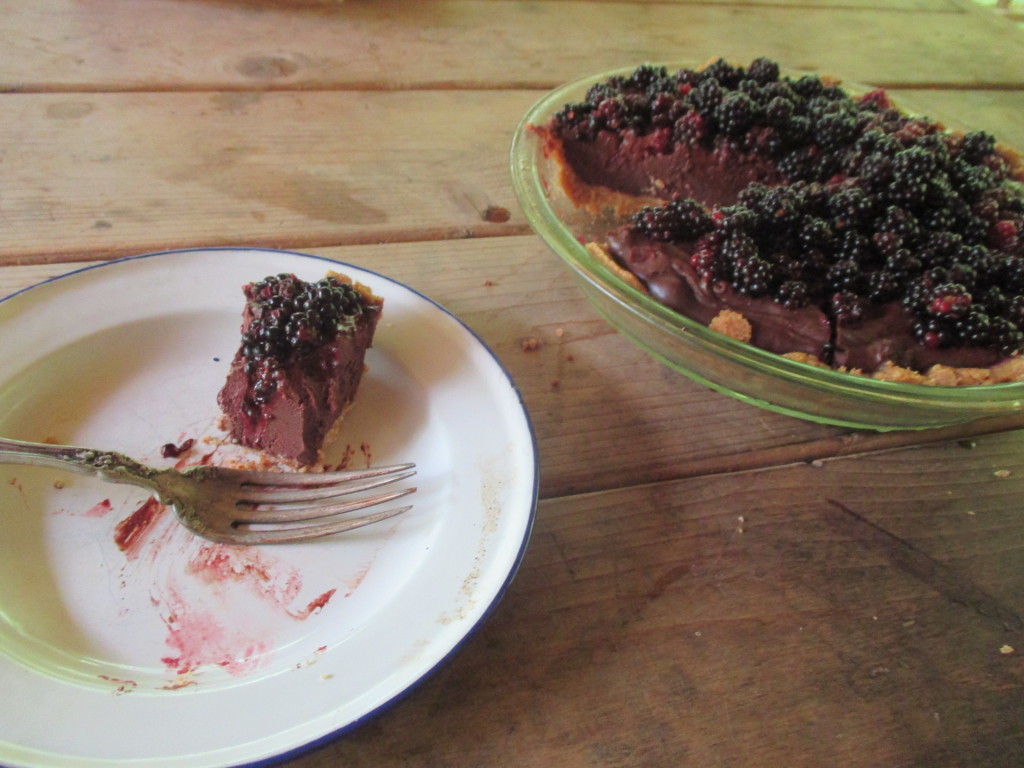
blackberrytart.jpg Having a wonderful summer, full of simple sweet pleasures. Mom visited today, and I made her this blackberry chocolate tart. Picking berries, swimming in the river, perfect summer day. dunetent.jpg Earlier this summer, camped at in the dunes on Ocracoke island with many family and friends. Thunderstorms away across the sound flashed and grumbled long in the night, but mostly missed us. Jupiter and Venus in conjunction overhead, and the arch of the milky way completed the show. beachselfie.jpg


9 July 2015

Sven Hoexter: Ubuntu 14.04 upstart and bonding

As usual when you add something new to your technology stack you'll find a "new" issue. A bit late in the game I made my first contact today with Ubuntu in the 14.04 incarnation when a colleague tried to stop and start a bond with:
ifdown bond0 && ifup bond0
About an hour later I had a virtual machine running and found the same bug in the pre-up ifenslave script which I later found to be already described in LP1269921. Apparantly Ubuntu integrated parts of the networking stuff with upstart and udev but did not care about how to cater people with bonding setups. At least the official documentation is very sparse on that topic. While someone from sysEleven rewrote the ifenslave script, I found that way too invasive and not well to handle. You can either push it via a configuration management system and overwrite a package owned script, or you roll you own package. So after some tinkering I decided to go with a different dirty workaround and setup the bond itself via pre-up snippets. In my test case it looks like this:
auto eth1 eth2 bond0
iface eth1 inet manual
  bond-master bond0
iface eth2 inet manual
  bond-master bond0
iface bond0 inet static
  address 192.168.1.1
  netmask 255.255.255.0
  bond-primary eth1
  bond-slaves eth1 eth2
  pre-up echo +bond0 > /sys/class/net/bonding_masters   true
  pre-up ifenslave bond0 eth1 eth2
I'm not yet sure if that breaks some other features of the ifenslave integration in ifupdown, but it seems to work so far. Let's see how far I can get with it.

8 July 2015

Sven Hoexter: for the reproducible builds gang

I gave up maintaining the LyX package about five years ago, but I still care. So I filled #9414 some time ago and it should be fixed for the next major release 2.2.0. So in case someone from the reproducible builds gang starts to look at LyX please hold the line and wait for the next major release instead.

Next.

Previous.