Here is my monthly update covering what I have been doing in the free software world (previously):
Whilst anyone can inspect the source code of free software for malicious flaws, most GNU/Linux distributions provide binary (or "compiled") packages to end users. The motivation behind the Reproducible Builds effort is to allow verification that no flaws have been introduced either maliciously and accidentally during this compilation process by promising identical binary packages are always generated from a given source.
Presented a talk entitled "Reproducible Builds" talk at Software Freedom Kosova, in Prishtina, Republic of Kosovo.
I filed my 2,500th bug in the Debian BTS: #840972: golang-google-appengine: accesses the internet during build.
In order to build packages reproducibly, one not only needs identical sources but also some external and sharable definition of the environment used for a particular build, stipulating such things such as the version numbers of the required build-dependencies. It is not currently clear how to handle these .buildinfo files after the archive software has processed them and how to make them available to the world so I started development on a proof-of-concept server to see what issues arise in practice. It is available at buildinfo.debian.net.
Chaired an IRC meeting and ran a poll to determine a regular time .
Submitted two design proposals to our wiki page.
Improvements to our tests.reproducible-builds.org testing framework:
It all started last June when my son had his Janoi (Yagnopavita) ceremony -- the ritual by which a Brahmana boy becomes "twice-born" and eligible to study the Vedas. As well as a profound religious experience, it is also an important social occasion with a reception for as many friends and family as can attend. (I think our final guest total was ~250.) This meant new outfits for everyone which might be exciting for some people but not me. I still don't know why I couldn't just keep wearing the khes and pitambar from the puja but no, apparently that's a faux pas. So I relented and agreed to wear my "darbari" suit from my wedding. And it didn't fit. I knew I had gained some weight in the intermediate 17 years but the thing was sitcom levels of too small. I ended up having to purchase a new one, a snazzy (and shiny!) maroon number with gold stripes (or were they black stripes?) Problem having been solved, much was eaten, more weight was gained and then I forgot about the whole thing.
Tip 1: Actually Do Something.
I have over the years tried to improve my physical condition but it has never gotten very far. For instance I have a treadmill/coatrack and a couple of years ago I began using it in earnest. I got to the point where I actually ran a 10K race without dying. But I did not train systematically and I ended up in some pain which caused me to stop working out for a while and then I never got around to restarting. Diets have also failed because I don't have a clear idea of what and how much I am eating. All I know is that women go into the kitchen and when they come out they have food. By what eldritch process this occurs is a mystery, I just eat whats given to me thankful that the magic happens. Once I was moved to try and help but quickly fell afoul of the lack of well-defined algorithms in Gujarati home cooking.
"How much saffron should I add?"
"this much."
"How much is this much in SI units?"
"You're annoying me. Get out."Fast forward to March of this year. For my birthday, my wife got me a Fitbit fitness tracker. This is what I had needed all this time. It measure heart rate, distance travelled, time slept and several other pieces of info you can use to really plan a fitness regimen rationally. For example, I was chagrined to learn that sometimes when I'm at the computer, I am so immobile that the fitbit thought I was asleep. So I started planning to taken more frequent breaks. (A recent firmware upgrade has added the ability to nudge to walk atleast 250 paces each daytime hour which is handy for this.) Also by checking my heart rate I discovered that I went on the treadmill I ran too fast thereby stressing my body for little gain and ending up going too slow to get much aerobic effect. Now I can pace myself appropriately for maximum cardiac efficiency without ending up injuring myself and giving up. I also get a little more activity each day by simple changes such as taking the stairs instead of the lift and instead of getting off at the 14th street PATH I go all the way to 34th street and walk down. Tip 2: You must have data in order to see what you did right or wrong and to plan what you need to do moving forward. One caveat about these fitness trackers. They are not anywhere as accurate as a proper checkup from a doctor who specializes in such things. If you want to do any kind of pro or amateur athletics you probably should not rely on them but for the average shlub who just wants to avoid appearing on the news being winched off his sofa by the fire brigade they are good enough. Another practice I began was keeping a food diary. It can be a real eye-opener to see how much you are actually eating. It is probably much more than you thought. I am fortunate that my diet is pretty good to begin with. Vegetarian, (not vegan, Hindus eat dairy products,) mostly home-cooked with fresh ingredients, not fried or processed, and I don't drink alcohol. However there were a few optimizations I could make. I drink a lot of soda; atleast two cans a day. I really ought to stop altogether but in lieu of that I have atleast switched from Coke to Coke Zero thereby saving a lot of empty calories. I now eat 4 rotlis with my dinner instead of six. We as a family eat more green vegetables instead of potatos, skim milk instead of whole fat, canola oil instead of corn oil, and less rice and don't slather ghee on everything quite so much. One entirely new practice I've adopted that may seem faddish but works for me is intermittent fasting. The idea is to steadily train your body to need less food by eating all your days allowed amount pf calories during a 6-8 hour window and not eating at all during the remaining time. It's hard to get used to for many people but I fast atleast 2-3 times a month for religious reasons anyway so I adapted pretty quickly. The fitbit tells me how many calories I am expending and how many I can eat to maintain a healthy level of weight loss but other than that I don't bother with "food groups" or specific diets such as paleo, or low-carb etc. As long as what you eat is reasonably balanced and you are burning more calories than you are adding, it should be enough for weight loss. Indeed from the end of March to now, I've lost 3 stones (20Kg) even with the occasional "cheat" day. Tip 3: All published diets are bullshit without scientifically proven efficacy. Don't bother with them. Experiment instead and see what works for you and your metabolism. As long as you are getting all the proper nutrients (you shouldn't need a supplement unless you have an actual medical condition.) and you have a net calorie deficit, it's all good. If you eat food you enjoy, you are more likely to stick to your diet. The proper amount of sleep is one area of a healthy lifestyle I am still doing poorly in and the reasons are not all raven-related. I have always had problems with insomnia and was once actually diagnosed with sleep apnea. Losing weight has helped a lot but the fitbit is still reporting that I toss and turn a lot during the night. And that's when I'm in bed in the first place. I stay up much too late which can also lead to subsidiary bad behaviours such as midnight snacking. It's something I need to work on. Tip 4: Stop blogging at all hours of the night, It's not doing you any good. So that's what I'm doing. Moving forward, I need to deal with the sleep thing and I would also like to start some program of strength-training, I'm doing ok in terms of aerobic exercise but from what I've read, you also have to build up muscles to keep weight loss permanent. The difficulty is that it would involve joining a gym and then actually going to that gym so I've put it off for now. The immediate threat is Diwali (and Thanksgiving and Christmas...) My wife bought 4 lbs of sweets today and I can feel their presence in the fridge calling to me.
As mentioned
previously I am working toward getting
Gitano into Stretch. Last time we spoke about
lace, on which a colleague and friend of
mine (Richard Maw) did a large pile of work. This time I'm going to
discuss deprecation approaches and building more capability out of fewer
features.
First, a little background -- Gitano is written in Lua which is a
deliberately small language whose authors spend more time thinking about what
they can remove from the language spec than they do what they could add in. I
first came to Lua in the 3.2 days, a little before 4.0 came out. (The authors
provide a lovely timeline in case you're interested.) With each of the
releases of Lua which came after 3.2, I was struck with how the authors looked
to take a number of features which the language had, and collapse them into
more generic, more powerful, smaller, fewer features.
This approach to design stuck with me over the subsequent decade, and when I
began Gitano I tried to have the smallest number of core features/behaviours,
from which could grow the power and complexity I desired. Gitano is, at its
core, a set of files in a single format (clod) stored in a consistent manner
(Git) which mediate access to a resource (Git repositories). Some of those
files result in emergent properties such as the concept of the 'owner' of a
repository (though that can simply be considered the value of the
project.owner property for the repository). Indeed the concept of the owner
of a repository is a fiction generated by the ACL system with a very small
amount of collusion from the core of Gitano. Yet until recently Gitano had a
first class command set-owner which would alter that one configuration value.
[gitano] set-description ---- Set the repo's short description (Takes a repo)
[gitano] set-head ---- Set the repo's HEAD symbolic reference (Takes a repo)
[gitano] set-owner ---- Sets the owner of a repository (Takes a repo)
Those of you with Gitano installations may see the above if you ask it for
help. Yet you'll also likely see:
[gitano] config ---- View and change configuration for a repository (Takes a repo)
The config command gives you access to the repository configuration file
(which, yes, you could access over git instead, but the config command can be
delegated in a more fine-grained fashion without having to write hooks). Given
the config command has all the functionality of the three specific set-*
commands shown above, it was time to remove the specific commands.
set-description, set-head, or
set-owner commands then you will want to switch to the config command before
you migrate your server to the current or any future version of Gitano.
In brief, where you had:
ssh git@gitserver set-FOO repo something
You now need:
ssh git@gitserver config repo set project.FOO something
It looks a little more wordy but it is consistent with the other features that
are keyed from the project configuration, such as:
ssh git@gitserver config repo set cgitrc.section Fooble Section Name
And, of course, you can see what configuration is present with:
ssh git@gitserver config repo show
Or look at a specific value with:
ssh git@gitserver config repo show specific.key
As always, you can get more detailed (if somewhat cryptic) help with:
ssh git@gitserver help config
Next time I'll try and touch on the new PGP/GPG integration support.
Summary stats
=============
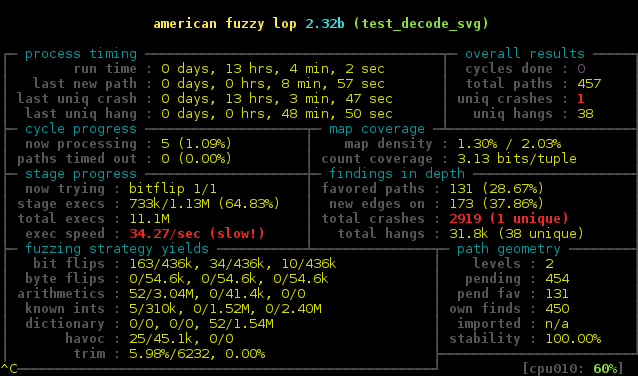
Fuzzers alive : 10
Total run time : 68 days, 7 hours
Total execs : 9268 million
Cumulative speed : 15698 execs/sec
Pending paths : 0 faves, 2501 total
Pending per fuzzer : 0 faves, 250 total (on average)
Crashes found : 9 locally unique
afl-cmin -i queue_all/ -o queue_cmin -- test_decode_svg @@ 1.0 /dev/null
corpus minimization tool for afl-fuzz by
[+] OK, 1447 tuples recorded.
[*] Obtaining traces for input files in 'queue_all/'...
Processing file 8242/8242...
[*] Sorting trace sets (this may take a while)...
[+] Found 23812 unique tuples across 8242 files.
[*] Finding best candidates for each tuple...
Processing file 8242/8242...
[*] Sorting candidate list (be patient)...
[*] Processing candidates and writing output files...
Processing tuple 23812/23812...
[+] Narrowed down to 2612 files, saved in 'queue_cmin'.
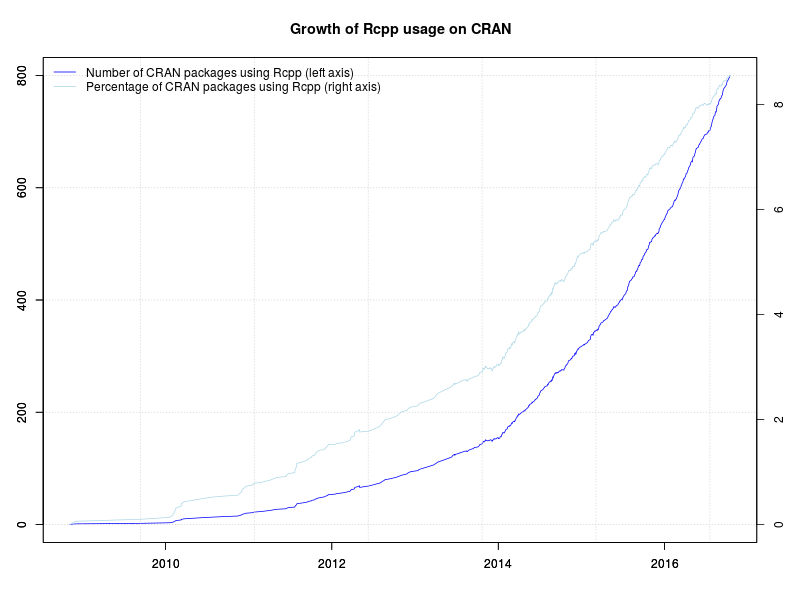
A moment ago, Rcpp hit another milestone: 800 packages on CRAN now depend on it (as measured by Depends, Imports and LinkingTo declarations). The graph is on the left depicts the growth of Rcpp usage over time.
The easiest way to compute this is to use the reverse_dependencies_with_maintainers() function from a helper scripts file on CRAN. This still gets one or false positives of packages declaring a dependency but not actually containing C++ code and the like. There is also a helper function revdep() in the devtools package but it includes Suggests: which does not firmly imply usage, and hence inflates the count. I have always opted for a tighter count with corrections.
Rcpp cleared 300 packages in November 2014. It passed 400 packages in June of last year (when I only tweeted about it), 500 packages less than a year ago in late October, 600 packages this March and 700 packages this July. The chart extends to the very beginning via manually compiled data from CRANberries and checked with crandb. The next part uses manually saved entries. The core (and by far largest) part of the data set was generated semi-automatically via a short script appending updates to a small file-based backend. A list of packages using Rcpp is kept on this page.
Also displayed in the graph is the relative proportion of CRAN packages using Rcpp. The four per-cent hurdle was cleared just before useR! 2014 where I showed a similar graph (as two distinct graphs) in my invited talk. We passed five percent in December of 2014, six percent July of last year, seven percent just before Christmas and eight percent this summer.
800 user packages is staggeringly large and humbling number. This puts more than some responsibility on us in the Rcpp team as we continue to keep Rcpp as performant and reliable as it has been.
At the rate we are going, the big 1000 may be hit before we all meet again for useR! 2017.
And with that a very big Thank You! to all users and contributors of Rcpp for help, suggestions, bug reports, documentation or, of course, code.
This post by Dirk Eddelbuettel originated on his Thinking inside the box blog. Please report excessive re-aggregation in third-party for-profit settings.
The tint package, whose name stands for Tint Is Not Tufte , on CRAN offers a fresh take on the excellent Tufte-style for html and pdf presentations.
It marks a milestone for me: I finally have a repository with more "stars" than commits. Gotta keep an eye on the big prize...
Kidding aside, and as a little teaser, here is what the pdf variant looks like:
NEWS.Rd file. We quote from it the entries for the current as well as previous releases:
Courtesy of CRANberries, there is a comparison to the previous release. More information is on the tint page. For questions or comments use the issue tracker off the GitHub repo.Changes in tint version 0.0.3 (2016-10-15)
- Correct pdf mode to no use italics in table of contents (#9 fixing #8); also added color support for links etc
- Added (basic) Travis CI support (#10)
Changes in tint version 0.0.2 (2016-10-06)
- In html mode, correct use of italics and bold
- Html function renamed to
tintHtmlRoboto fonts with (string) formats and locales; this allow for adding formats; (PRs #6 and #7)- Added pdf mode with new function
tintPdf(); added appropriate resources (PR #5)- Updated resource files
Changes in tint version 0.0.1 (2016-09-24)
- Initial (non-CRAN) release to ghrr drat
This post by Dirk Eddelbuettel originated on his Thinking inside the box blog. Please report excessive re-aggregation in third-party for-profit settings.
Continuing on from the previous article,
here is a (probably incomplete) list of the critical changes to Gitano which
have been, or will be, worked on during the run toward a 1.0 release. Each
of these will have a blog posting to discuss what the changes mean for current
and future users. Sometimes I'll aggregate postings, sometimes I won't.
The following are some highlights from the past little while of development
which has been undertaken by Richard and myself. Each item is, I feel,
important enough to warrant commentary, even for those who already use Gitano.
[foo bar] which makes for simpler
rulesets.auto_user_XXX and auto_group_XXX Lace predicatesuser foo but
instead requires a match kind such as group prefix bar-.yarn.set-owner)gall and lace), and that leaves the newest library (tongue) and then
Gitano itself still to go. The Debian FTP team have been awesome in helping me
with all this, so thanks go to them.
debrepro
script by Antonio Terceiro which is similar in purpose to reprotest but more
lightweight; specific to Debian packages and without support for virtual servers
or configurable variations.
Packages reviewed and fixed, and bugs filed
The following updated packages have become reproducible in our testing framework
after being fixed:
61 was
uploaded to unstable by Chris
Lamb. It included
contributions
from:
--help text and add an --output-empty option.--status-fd CLI option.0.3.2 was
uploaded to unstable by Ximin
Luo. It included
contributions
from:
--diffoscope-arg CLI option to pass extra args to diffoscope.
I have been working quite hard, along with my friend and colleague
Richard Maw, on getting Gitano ready for a release suitable for
inclusion into Debian Stretch.
You can see how we're doing on the various Trello boards for:
As Richard and I work toward a version of Gitano we're prepared to support
long-term in Debian we are making many changes to make our lives easier. For
those of you who have been using Gitano over the past few years, you'll need to
pay attention to some postings which will be coming soon about how to make the
changes you need so as to not explode horribly when you upgrade to the version
we're releasing soon. For those of you who are not yet using Gitano but feel
like you might want to; I'll also be producing some postings about getting
started with the packages. And for those happily running current HEAD of
Gitano already, I'll be posting about some of the new features over the next
little while in case you're not aware of them.
IMPORTANT: If you're using Gitano already and have any issues or feature requests then please please please let me know ASAP otherwise they're unlikely to be resolved/implemented before 1.0. irl already asked for the facility to verify GPG signed commits and tags, but if you want anything else considering then I need to know v. soon. (Ideally email me, but you may comment on this posting too if you must)
| Series: | Mage Winds #2 |
| Publisher: | DAW |
| Copyright: | August 1993 |
| ISBN: | 0-88677-563-9 |
| Format: | Mass market |
| Pages: | 475 |
Next week our friends at Igalia will be hosting this year s Web Engines Hackfest. Collabora will be there! We are gold sponsors, and have three developers attending. It will also be an opportunity to celebrate Igalia s 15th birthday \o/. Looking forward to meet you there! =)
Carlos Garcia has recently released WebKitGTK+ 2.14, the latest stable release. This is a great release that brings a lot of improvements and works much better on Wayland, which is becoming mature enough to be used by default. In particular, it fixes the clipboard, which was one of the main missing features, thanks to Carlos Garnacho! We have also been able to contribute a bit to this release =)
One of the biggest changes this cycle is the threaded compositor, which was implemented by Igalia s Gwang Yoon Hwang. This work improves performance by not stalling other web engine features while compositing. Earlier this year we contributed fixes to make the threaded compositor work with the web inspector and fixed elements, helping with the goal of enabling it by default for this release.
Wayland was also lacking an accelerated compositing implementation. There was a patch to add a nested Wayland compositor to the UIProcess, with the WebProcesses connecting to it as Wayland clients to share the final rendering so that it can be shown to screen. It was not ready though and there were questions as to whether that was the way to go and alternative proposals were floating around on how to best implement it.
At last year s hackfest we had discussions about what the best path for that would be where collaborans Emanuele Aina and Daniel Stone (proxied by Emanuele) contributed quite a bit on figuring out how to implement it in a way that was both efficient and platform agnostic.
We later picked up the old patchset, rebased on the then-current master and made it run efficiently as proof of concept for the Apertis project on an i.MX6 board. This was done using the fancy GL support that landed in GTK+ in the meantime, with some API additions and shortcuts to sidestep performance issues. The work was sponsored by Robert Bosch Car Multimedia.
Igalia managed to improve and land a very well designed patch that implements the nested compositor, though it was still not as efficient as it could be, as it was using glReadPixels to get the final rendering of the page to the GTK+ widget through cairo. I have improved that code by ensuring we do not waste memory when using HiDPI.
As part of our proof of concept investigation, we got this WebGL car visualizer running quite well on our sabrelite imx6 boards. Some of it went into the upstream patches or proposals mentioned below, but we have a bunch of potential improvements still in store that we hope to turn into upstreamable patches and advance during next week s hackfest.
One of the improvements that already landed was an alternate code path that leverages GTK+ s recent GL super powers to render using gdk_cairo_draw_from_gl(), avoiding the expensive copying of pixels from the GPU to the CPU and making it go faster. That improvement exposed a weird bug in GTK+ that causes a black patch to appear when shrinking the window, which I have a tentative fix for.
We originally proposed to add a new gdk_cairo_draw_from_egl() to use an EGLImage instead of a GL texture or renderbuffer. On our proof of concept we noticed it is even more efficient than the texturing currently used by GTK+, and could give us even better performance for WebKitGTK+. Emanuele Bassi thinks it might be better to add EGLImage as another code branch inside from_gl() though, so we will look into that.
Another very interesting igalian addition to this release is support for the MemoryPressureHandler even on systems with no cgroups set up. The memory pressure handler is a WebKit feature which flushes caches and frees resources that are not being used when the operating system notifies it memory is scarce.
We worked with the Raspberry Pi Foundation to add support for that feature to the Raspberry Pi browser and contributed it upstream back in 2014, when Collabora was trying to squeeze as much as possible from the hardware. We had to add a cgroups setup to wrap Epiphany in, back then, so that it would actually benefit from the feature.
With this improvement, it will benefit even without the custom cgroups setups as well, by having the UIProcess monitor memory usage and notify each WebProcess when memory is tight.
Some of these improvements were achieved by developers getting together at the Web Engines Hackfest last year and laying out the ground work or ideas that ended up in the code base. I look forward to another great few days of hackfest next week! See you there o/
A masterpiece by Yukio Mishima Patriotism the story of love and dead. A short story about the double suicide of a Lieutenant and his wife following the Ni Ni Roku Incident where some parts of the military tried to overthrow government and military leaders. Although Lieutenant Takeyama wasn t involved into the coup, because his friends wanted to safeguard him and his new wife, he found himself facing a fight and execution of his friends. Not being able to cope with this situation he commits suicide, followed by his wife.
Written in 1960 by one of the most interesting writers of Japanese modern history, Yukio Mishima, this book and the movie made by Mishima himself, are very disturbing images of the relation between human and state.
Although the English title says Patriotism, the Japanese one is (Yukoku) which is closer to Concern for one s own country. This concern, and the feeling of devotion to the Imperial system and the country that leads the two into their deed. We are guided through the whole book and movie by a large scroll with (shisei, devotion) written on it.
But indeed, Patriotism is a good title I think one of the most dangerous concepts mankind has brought forth. If Patriotism would be only the love for one s own country, all would be fine. But reality shows that patriotism unfailingly brings along xenophobia and the feeling of superiority.
For someone coming from a small and unimportant country, I never had even the slightest allure to be patriotic in the bad sense. And looking at the world and people around me, I often have the feeling that mainly big countries produce the biggest and worst style of patriotism. This is obvious in countries like China, but having recently learned that all US pupils have to recite (obviously without understanding) the Pledge of Allegiance, the shock of how bad patriotism can start washing the brains of even the smallest kids in a seemingly free country is still present.
But back to the book: Here the patriotism is exhibited by the presence of the Imperial images and shrine in the entrance, in front of which the two pray the last time before executing themselves.
Not only the book is a masterpiece by itself, also the movie is a special piece of art: Filmed in silent movie style with text inserts, the whole story takes place on a Noh stage. This is in particular interesting as Mishima was one of the few, if not the only, modern Noh play writer. He has written several Noh plays.
Another very impressive scene for me was when, after her husbands suicide, Reiko returns from putting up her final make-up into the central room. Her kimono is already blood soaked and the trailing kimono leaves traces on the Noh stage resembling the strokes of a calligraphy, as if her movement is guided, too, by .
The final scene of the movie shows the two of them in a Zen stone garden, forming the stone, the unreachable island of happiness.
Very impressive, both the book as well as the movie.
Quite on schedule (just one day later), Weblate 2.7 is out today. This release brings Subversion support or improved zen mode.
Full list of changes:
demo account using demo password or register your own user. Weblate is also being used on https://hosted.weblate.org/ as official translating service for phpMyAdmin, OsmAnd, Aptoide, FreedomBox, Weblate itself and many other projects.
Should you be looking for hosting of translations for your project, I'm happy to host them for you or help with setting it up on your infrastructure.
Further development of Weblate would not be possible without people providing donations, thanks to everybody who have helped so far! The roadmap for next release is just being prepared, you can influence this by expressing support for individual issues either by comments or by providing bounty for them.
Filed under: Debian English Gammu phpMyAdmin SUSE Weblate 0 comments
With days beginning to shorten toward fall, my house is in initial power
saving mode. Particularly, the internet gateway is powered off overnight.
Still running electric lights until bedtime, and still using the inverter
and other power without much conservation during the day.
Indeed, I had two laptops running cpu-melting keysafe benchmarks for much
of today and one of them had to charge up from empty too. That's why the
house power is a little low, at 11.0 volts now, despite over 30 amp-hours
of power having been produced on this mostly clear day. (1 week average is
18.7 amp-hours)
September/October is the tricky time where it's easy to fall off a battery
depletion cliff and be stuck digging out for a long time. So time to start
dusting off the conservation habits after summer's excess.

Today it is 23 years ago since Ian Murdock published his intention to
develop a new Linux distribution, Debian. It also about 20 years since
I became a Debian developer and made my first package upload.
In the time since:
Next.