Search Results: "seb"

25 August 2007

Michael Prokop: Debian @ Froscon 2007

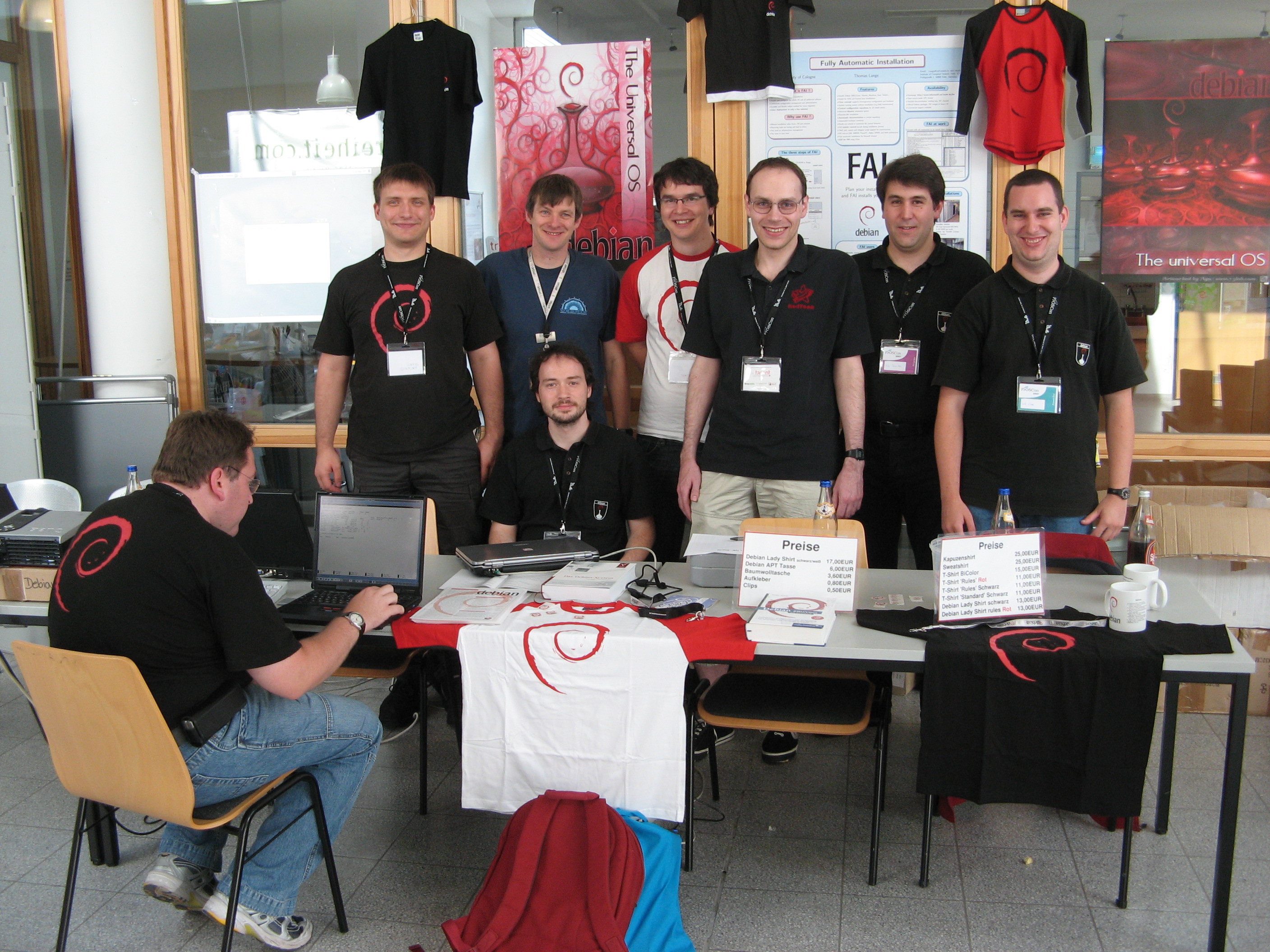
The Debian-Team at the Debian-booth of Froscon 2007: Debian-Team at Froscon 2007, picture Standing (from left): Bernd Zeimetz, Thomas ‘MrFai’ Lange, Sebastian Harl, Elmar Hoffmann, Martin Zobel-Helas, Luk Claes;
Sitting in the middle: Christoph ‘myon’ Berg

15 August 2007

Adam Rosi-Kessel: Reduced to Quirk

Michael Hirschorn in this month’s Atlantic reduces my generation’s entire cultural zeitgeist to a single word: quirk.
Quirk, loosed from its moorings, quickly becomes exhausting. It s easy for David Cross s character on Arrested Development to cover himself in paint for a Blue Man Group audition, or for the New Zealand duo on Flight of the Conchords to make a spectacularly cheesy sci-fi video about the future while wearing low-rent robot costumes. But the pleasures are passing. Like the proliferation of meta-humor that followed David Letterman and Jerry Seinfeld in the 90s, quirk is everywhere because quirkiness is so easy to achieve: Just be odd but endearing. It becomes a kind of psychographic marker, like wearing laceless Chuck Taylors or ironic facial hair a self-satisfied pose that stands for nothing and doesn t require you to take creative responsibility. Just because you can doesn t mean you should.
Hirschorn makes a fair point which, I think, can be restated that much of the content I enjoy is really just candy. The Atlantic seems to have recently figured out its readership (or at least figured out me). Hard to Swallow (by B.R. Myers, who more typically writes about Korean issues) is a pointed moral critique of modern food lovers (chowhounds?) and food writing (including Michael Pollan’s The Omnivore’s Dilemma: A Natural History of Four Meals, much read by my contemporaries). If I weren’t already a vegetarian, I might take umbrage. “Insider baseball” pieces on Karl Rove and Michael Gerson are also excellent, and in the case of the former quite timely. To wrap up this encomium, props to the magazine for its clean new website design, which I believe premiered today, and for including an embedded Youtube video in the online version of the quirk article.

9 July 2007

Evan Prodromou: 19 Messidor CCXV

Busy weekend, and I haven't taken the time to blog over the last few days as I should have. On Thursday and then Friday, Maj, Amita June and Brian and I went down to the Montreal Jazz Festival, which took place last week. It was a great time -- we went and saw some free acts, including some Dixieland, some Latin jazz, and the awesome Klez Dispensers playing klesmer. We also went to the huge playground and crafts centre for children on-site. It had slides, a big moonwalk bouncy-room, tunnels, a sandbox, and a giant piano that kids can step on to play music. They also had cool drawing and crafts projects -- a neat, active addition. The Jazz Fest is a great place to bring little kids. Amita June loved dancing to the music and playing in the playground. tags:

Quebec City Yesterday and today we spent in Quebec City. Brian hadn't been before, and the old, walled city is on the list of UNESCO World Heritage Sites, so we dragged him up there. It was also the Festival d' t de Quebec while we were there, which was pretty fun. We had no idea the festival was happening, so it was a pleasant surprise. Hell, I have a hard time keeping the festivals in our own city straight. We got rooms at the really nice Hotel Ch teau Laurier just outside the walls near the festival site. It was really nice -- modern, sleek, and pretty affordable (we got a big double-queen room for $150). Then we walked around the Upper Old Town in on-again-off-again rain, and watched some of the street performers. There was a troupe of stilt-walkers dressed like stone angels and gargoyles -- an awesome performance that scared the bejeesus out of Amita June. But as they left she said, "Bye bye, monsters," so I guess they weren't all bad. We had dinner at the cozy Moine chanson, a really nice restaurant just outside the walls of the Upper Old City. Quebec's restaurant scene in this are is, well, pretty dreadful -- lots of mass-production restaurants that serve tourists mechanical food from conveyor belts. The Moine was an accidental find, and it was really a godsend -- pleasant, interesting pan-Mediterranean food. I had grilled sardines (memories of Portugal); Brian had a thoughtful paella and Maj had a roasted vegetables with polenta plate. They also had a choice selection of organic wines. I have preconceptions about organics, I admit, but we had a very tasty and complex organic Douro from Portugal last night that set me back in my seat. We walked home through the music festival just as Nickelback was coming on the main stage. Brian wandered a bit, Amita June and Maj and I went to bed. Unfortunately, that wasn't the last time we were up: AJ woke up vomiting in the middle of the night. She only barfed once, and we're not sure what caused it: whether she overate at the restaurant (she packed away a lot of food), or if she got some sausage or chicken in the couple of cupfuls of Brian's paella she ate. Either way, she was a sad toddler and we were freaked-out parents. Having your child get sick while you're traveling is really scary. You start thinking about helicopter rescue. But she was fine after one big purge, and we all slept well until this morning. Maj got up to change Amita's diaper, and we realized we didn't have any. Not in the hotel room, not in the car. I went out from the hotel in increasingly wide spirals looking for a convenience store, but those that had diapers weren't open on a Sunday morning, and those that were open didn't carry diapers. After a couple of hours (!), I came back to the hotel in defeat. Fortunately, Maj managed to find a diaper in the emergency stash in the trunk of the car. We picked up Brian and drove to another part of town, where we got a tasty brunch on the terrasse and found some diapers at the Jean Coutu drugstore. Brian kept going from Quebec City -- he's heading all the way around the Gasp Peninsula to New Brunswick, Nova Scotia and Prince Edward Island, and coming back to Montreal in about a week. Maj and I drove home on the South Shore -- Amita fell asleep as we hit the freeway and woke up when we pulled into the driveway -- and had a nice afternoon at home. tags:

Seafood windfall On Friday, our friend Sebastian called us with a problem: his sister, who lives in the les-de-la-Madeleine, had sent him too much fresh seafood. It had come out of the sea and been driven to Montreal, and there was too much for him and his family to eat. The fish was less than 24 hours out of the water -- could we help him out? So we ended up with two huge bags of succulent lobster meat and three more of scallops. Oh, man, were they good. On Saturday morning before we left for Quebec City I made up two giant lobster omelets for the four of us to share. They had just huge chunks of lobster in them, and it was the most decadent meal I've had in a while. It was so much, we all lay around on the couch moaning for about an hour. Tonight, I cooked up the scallops. They were gigantic, tender, and fresh, so I pan-seared them in butter and olive oil with salt & pepper and prepped garlic and oregano. I know, that seems too much for such a delicate meat, but it worked out great. I put them on a bed of whole-wheat linguine, arugula, and red peppers. They were really, really good. I don't think I'm going to have seafood this good again for a while. Mmmmm. Thanks, Sebastian! tags:

News in brief from the land of the Free Two Freedom news items: tags:

David Moreno Garza: Back

Yeah, we are almost two weeks back now, but until now I can feel we are done with lots of pending issues.

To summarize, I left DebConf on Saturday morning, arrived NYC on the afternoon where Raquel was waiting for me. By Sunday, we had the very nice chance to meet with abrotman, rcox and stew. We stayed at stew and rcox’s place until Tuesday, when we got back. We also had the chance to meet with people that we have been working for remotely. We were walking around in NYC, and suddenly, the 5th avenue became multicolor. It was the gay pride parade. You can take a look at the pics on the gallery, lots of gay people. Our visit to NYC was pretty gayish actually, since we spent our first night in Chelsea, presenced an electronic music festival or similar for lesbians, and the next day, first row on the parade :-)

And that’s it, since we came back until like yesterday, life was a mess; lots of work pending to deliver and many other issues. Finally, we are right now settled up again, enjoying a cold rainy nice weather in Mexico City with very cheap beer (compared with UK pints!) and loved people :-) Thanks to all who made such a wonderful DebConf, even that, in my case, I arrived late and left early, it was just great (thanks also to MJ Ray, specially; and also to all people who was worried about my arrival, you know who you are, thanks). Thanks also to Mike and Rachel who hosted us, they are a very nice couple. And also, thanks to Alex who joined us in NYC, coming from Philadelphia, spent a nice day with us, took us to Chinatown and Little Italy and gave me a Phillies baseball cap (just as exchange of the worldwide famous umbrella hat).

2 July 2007

Evan Prodromou: 13 Messidor CCXV

More weekend stories: on Friday, we had a Geek Lunch at La ka to welcome Tara Hunt to Montreal. She's in town for a few days for Montreal Jazz Fest, and she asked to meet some people in the local Web/BarCamp/hacker scene. Lunch was good and interesting people came. Austin Hill made it, as well as Patrick Tanguay, Fred Ngo and Ben Yoskovitz, and Niko. I was especially glad to see Seb Paquet, who I don't get enough time with. All in all a good time was had. tags:

Rest of the weekend Friday night John Usher came over for our weekly Pizza Night and we had beers until very late indeed. Saturday I got a nice glass desk for my office, and we got a big square wooden coffee table off of Montreal Craigslist. We went down to the Pont Jacques Cartier to see the fireworks on Saturday night, part of the International Fireworks Competition. Except there weren't any fireworks on Saturday night. Doh! Long walk home. Yesterday, Canada Day, we had our new neighbours Jake and Magda over for a get-to-know-you brunch. Jake is a structural engineer, and Magda is a professor of history at UQ M. They're expecting a baby any day now, so we figured it was a good idea to hang out with them before the madness begins. I made a couple of quiches, a big green salad, and some banana bread. It was a good meal. tags:

12 June 2007

Biella Coleman: Housebreaking Your Health Insurance

Are you having trouble with your health insurance? Are they stalling on paying a bill? Denying a claim? Not telling you what the heck is going on?? Well you can and should take action to eliminate some of the mystery and move forward, and possibly win fight against the health insurance company. Thanks to my unpleasant ordeals with BCBS of NJ, I have compiled some handy resources and tips to get you started. Good luck and I welcome any other tips that you think should be here. Please email them to me at biella(at)gmail(dot)com Can’t get a straight answer when dealing with health insurance representatives on the phone? Are different representatives providing different and contradictory information? Does talking to the representatives leave you with a pounding headache? Then the following may be helpful: 1. Ideally you should tape record all conversations. If this is not possible, get the name or employee number of the person you are talking to and write down what they told you along with the time and date. If they have agreed to something, make sure they send it to you in writing. This sort of documentation may come in handy later when you are trying to contest or prove something. Is your insurance company flip flopping on a claim? For example telling you that the claim is still being “reviewed” but sending you statements that indicate it has not been paid and never will be? What action can you take to inch things forward? The following may help: 1. Most states have a Department of Banking and Insurance and they are there to help you. Many (perhaps all) provide a service for filing a complaint against your health insurance company and other insurance and banking companies too. When I used the service in NJ , I got assigned an investigator and their service was prompt and helpful. It was my experience that even though they were not able to resolve my issue, the insurance company started to make firm decision on many claims and this alone has been helpful. Before this, it was impossible to get a clear answer from them as to the state of all sorts of claims. They said “NO,” & you think they should say “YES, YES, YES, YES!!!!” In other words, appealing a denial: 1. This site has some great information on how to avoid a denial and what you can do to fight one. 2. Included on their site is the Health Insurance Laws and Benefits Tool which will provide specific information about your rights in different states. For example, you will want to know if there is an external or independent grievance system to appeal your plan’s decisions. In the case of NJ, which is the state I am fighting, the tool provided the following helpful information:
Does New Jersey require an external or independent grievance system to appeal your health plan’s unfavorable decisions? Yes, for all health plans.

On what grounds can you file your external grievance?
Investigational treatment appeal, medical necessity. What is the status of the external grievance panel’s decision?
Binding. External grievance systems allow you to take a dispute with your health plan to a doctor or review board unaffiliated with your health plan. Thus, both you and your health plan receive an impartial ruling on its decision to deny coverage of services or treatment. Additionally, you can file a complaint against your health insurer with your state’s department of insurance.
Additional Helpful Information and Resources 1. The message boards on lawyers.com are a great place to hit for information. I have found folks there helpful.
2. You many want to blog about your experience as you may get an unexpected response directly from your insurance company. I think there are pro’s and cons to blogging about your experience but it does provide a public face to your ordeal and allows you to chronicle exactly what has transpired.
3. If your cases is particularly shocking, do not hesitate to hit the local media.
4. If your claim has been denied by an external review panel, you may not have much luck suing but if there is no external review panel, you can and should also try Small Claims Court or other legal action. Further, even if your claim was denied by an external review board, you may have other options for suing, for example, due to their bad faith handling of a claim. And on that note, here is a great legal resource covering the topic.

3 June 2007

Marco d'Itri: Fun with IPMI

IPMI is a standard protocol which allows out of band access to hardware features like reading sensors and error logs, turning the power on or off or accessing the serial console. This is made possible by the Baseboard Management Controller (BMC), an independent CPU which is accessed from the operating system or by sharing an Ethernet port with the OS. Most modern servers offer an IPMI 1.5 or 2.0 interface and usually loading the ipmi_si driver is all that is needed to verify if it is supported, but some may need additional parameters and/or a kernel upgrade. dmidecode is also useful to determine if the system has a BMC. After loading the ipmi_si and ipmi_devintf drivers the BMC will be accessible from Linux, e.g. using the ipmitool command. The ipmitool package will also install the ipmievd daemon, which logs events like overheating a failed fan (beware: it uses local.* syslog facility which on Debian systems is not configured by default). It is also useful to install the ipmi_poweroff driver, which will generate an ACPI power button event when a clean shutdown is requested by the BMC (you need to install acpid too). The details of accessing the BMC over an Ethernet connection varies depending on the server model and manufacturer, e.g. IBM xSeries servers are shipped with the same default IP address, username and password which means that anybody on the same L2 network (no gateway address is configured) can shut down your system: ipmitool -I lan -H 10.1.1.97 -A PASSWORD -U USERID -P PASSW0RD shell The most convenient way to experiment with IPMI is to run ipmitool shell locally and trying the available commands. These are some trivial examples:

# show the parameters for Ethernet access
lan print
# reset the system
chassis power reset
# cleanly shut down the OS and then power off the system
chassis power soft
# at the next boot, boot from the network
chassis bootdev pxe
# turn on the locator LED
chassis identify 255
# print the system event log
sel list
# read a specific sensor
# (with enough servers you could create a 3D thermal map of the room...)
sensor get "Ambient Temp"

29 May 2007

Evan Prodromou: 8 Prairial CCXV

So, I forgot to mention that I had a great evening last Thursday. In the afternoon, Niko and I met with Marie-Claude Doyon to talk about a new project we're working on. I think it's going to be pretty fun. That evening, I met up with Eugene Eric Kim and Seb Paquet at La ka, which was really great. I brought Niko along because we were having fun and thought it would be good to take a walk along av. Mont-Royal. It was great hanging out with EEK and Seb. There's something about talking to people who are as deep into wiki as I am that's really satisfying. It happens too seldom in my life -- just around conferences, really. Eugene got a shot of the four of us together. tags:

Gymnophobia i.never.nu sounds a lot like "I'm never nude". I'm just saying. tags:

24 May 2007

Nico Golde: creating (dynamic) function call graphs

I am currently writing a general purpose shared library for acpi (more on that soon).
I was interested in having a function call graph especially to see if the interface looks somehow clean and to include it in the documentation of the library. Of course I wanted to do it with open source tools. There are several tools for static call graphs but if you want dynamic call graphs you have to use additional features of your compiler to generate a graph based on code during runtime.

The first variant I tried was using egypt a small perl script to generate a dot file. Dot (today included into graphviz? is a tool originally developed at AT&T to generate hierarchical or layered drawings of directed graphs.

So what is needed?
First install software (here on a Debian systen, egypt is not included in Debian):
$ aptitude install graphviz graphicsmagick (+ download egypt from the homepage)

Compile your software using gcc with the option -dr to dump an RTL file of the source.
Most of gcc's work is done in an intermediate representation of your code, called register transfer language (RTL). This pretty much describes the instructions in plain text and is inspired by LISP lists.
Ok, here we go:
$ gcc -dr list.c libacpi.c test.c
This generates three RTL files, for every source file one. Depending on the gcc version the names may vary, here the names are libacpi.c.00.expand list.c.00.expand and test.c.00.expand.

Now use egypt to create a dot file (I don't want one for test.c now):
$ egypt libacpi.c.00.expand list.c.00.expand dot -Gsize=100,100 -Grankdir=LR -Tps -o graph.ps
Egypt will create dot-output and by piping it to dot with -Tps -o graph.ps you get the resulting graph as a ps file. -Grankdir is used to generate a graph which runs from the left to the right, default is up-down which looks a bit strange.

Now convert the ps file into a png:
$ gm convert graph.ps graph.png
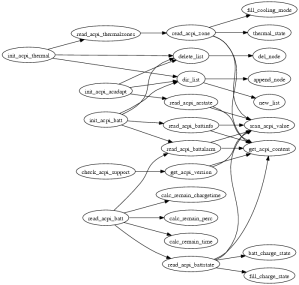
The result looks like this (looks cool huh? :-)):


The second variant I tested is a bit different and in my opinion the resulting graph looks a bit better.
The gcc commandline switch -finstrument-functions allows easy creations of call-graphs for C/C++ (script languages used but I haven't tried).
You need to compile every file with the -finstrument-functions switch. Then gcc places a call to the functions __cyg_profile_func_enter upon entering a function and __cyg_profile_func_exit on leaving a function.

Compile your sources with -g and -finstrumental-functions:
$ gcc -g -finstrumental-functions list.c libacpi.c test.c -o test
Now you need to get some source code by Sebastian Krahmer (SuSE):
$ wget http://www.suse.de/~krahmer/instrumental/instrumental.tgz && tar xvfz instrumental.tgz && cd instrumental
Compile a shared object file:
$ cc -fPIC -c instrumental.c && ld -Bshareable instrumental.o -o inst.so
This generates a shared object file you can preload with LD_PRELOAD
$ LD_PRELOAD=./inst.so test
.....

Now you will find a log.inst.dot.<pid> and log.inst.ascii.<pid> in /tmp (path can be modified in instrumental.c).
The first file is a dot file you can now create a ps and a png file with but you need to attach a closing bracket at the end of the file since the package is not
able to intercept exit() or aborts. echo ' ' >> log.inst.dot.<pid>
$ dot -Gsize=15,20 -Grankdir=LR -Tps -o graph.ps log.inst.dot.<pid> && gm convert graph.ps graph.png
The result looks like:


PDF file which scales a bit better

The other file represents the call graph in ascii:
~ [1000 1000 1000] -- main (0x8049ea4)
~ [1000 1000 1000] -- check_acpi_support (0x8048984)
~ [1000 1000 1000] -- get_acpi_version (0x8048782)
~ [1000 1000 1000] -- get_acpi_content (0x80486b4)
~ [1000 1000 1000] -- scan_acpi_value (0x8048837)
~ [1000 1000 1000] -- init_acpi_batt (0x80489d6)
~ [1000 1000 1000] -- dir_list (0x804a447)
~ [1000 1000 1000] -- new_list (0x804a23c)
~ [1000 1000 1000] -- append_node (0x804a309)
~ [1000 1000 1000] -- read_acpi_battinfo (0x80497d3)
~ [1000 1000 1000] -- get_acpi_content (0x80486b4)
....

So both methods work but the first seems to be more useful if you want a graph for a specific file, not a specific program since you get an RTL file for each source file and you don't need all to create the dot file. The second method however looks better but has the limitation that you actually need to run the program (but that's dynamic and not static) and you can't (correct me if I miss something) create graphs for single files.

Have fun creating graphs for your favorite software and have a look into Sebastian Krahmers paper http://www.suse.de/~krahmer/instrumental/instrumental.pdf and http://www.ibm.com/developerworks/library/l-graphvis/. He also created a graph for openssh http://www.suse.de/~krahmer/ossh4.6.pdf.
11 May 2007

Andrew Pollock: [life] It's a girl^Wboy!

My parents got back from a whirlwind trip to Canada this afternoon, and we thought that since their visit here was scheduled before we knew Sarah was pregnant, we thought one small way they could participate was to come along to an ultrasound screening that determined the baby's gender. So we lashed out on one of those gimmicky 3D/4D ultrasounds, and didn't tell Mum and Dad what was going on until we got there, so as to make it a bit of a surprise for them. I think Dad thought we were going to see a baseball game, because when Mum asked what to wear, I told her it didn't matter, and that it was a spectator activity. I called it as a boy before the sonographer made a call. She initially thought it was a girl, but revised it to be a boy as the scan progressed. I'll update this post with some of the images later.

13 April 2007

Evan Prodromou: 22 Germinal CCXV

A lot of people have asked me about the Tim Wu piece in Slate about Wikitravel. I've commented already about the article in Wikitravel's Logbook: 8 April 2007. The upshot: Wu got a lot of things really wrong about Wikitravel (like saying we didn't have any hotel listings for Bangkok). But if our readers get things wrong, that means Wikitravellers need to do some more work to help them get things right. User errors are developer errors writ large; we can do better. But I think Tim Wu missed the main reason Wikitravel guides will always be better than proprietary guides: they are Free Cultural Works. Where I come from, that means a lot. I wrote to Tim about his article, and he responded really kindly. The thing I liked most is that when he got home, he updated Wikitravel with the information he picked up on his trip to Thailand. That is pretty cool. I'm not taking others' responses to the article too seriously. Wikitravel got a Webby Award nomination for Best Travel Site the same week. As Tom Wolfe said, "The lead dog is the one they always try to bite in the ass." And Oscar Wilde: "The only thing worse than being talked about is not being talked about." (Thanks to Hugh!) tags:

Off to San Juan We're getting prepared this morning to head out to Puerto Rico for the first annual World-wide Wikitravel Get-together. Our flight leaves at 2:20PM, so we've got kind of a leisurely morning to get ready. As usual, we're pretty tense: what are we forgetting? And I usually get hung up on unnecessary stuff to deal with. I should probably print out the Spanish phrasebook from Wikitravel, because my Spanish is pretty rusty. And I should download all the WT pages about Puerto Rico destinations to my laptop, just to know where we should fill in. And we can't find the charger for our camera's battery. And I want to bring a certain pair of cargo pants, but there's a button missing. Do I have time to sew on another? Of course, all these anxieties melt once we get out of the house and into a taxi to the airport. Once you can't do things, you stop worrying about what you should do. I think. The more I learn about Puerto Rico, the more fascinated I am. San Juan (Puerto Rico)'s Old Town is a UNESCO World Heritage site. The giant telescope at Arecibo is world-renowned as the SETI site. The islands of Vieques and Culebra are isolated and fun, and Fajardo and Rincon has world-class surfing. My friend Biella Coleman gave me a great list of travel tips for San Juan and Culebra, which have been a big help in our planning. OK, enough blogging: gotta get to work sewing on that button. (I've been stalling long enough for Maj to have found the camera charger under a baseball hat. Yay!) tags:

1 March 2007

MJ Ray: OpenWRT (2)

OK, it's taking longer to find time to do this. The network is holding up this week and customers have work that needs doing urgently, so I've not risked bricking the router. sdf commented:
"i would try dd-wrt (dd-wrt.de) instead..."
Mark commented:
"Install OpenWRT 0.9 (not "Kamikaze", which is a ground-up rewrite in pre-alpha). Install X-WRT to get webinf^2 (better web interface for configuration). Read the OpenWRT documentation on how to backup/restore your firmware. Make a backup once after you get everything configured, again before installing any major new packages, and again just before a firmware upgrade. The IRC channel is hit-or-miss but the forums are well-attended by knowledgeable people. Hope this helps."
Thanks. That's a great help. sebastian commented:
"Just saw your blog entry, you could have a look at X-WRT, which is an enhanced web configuration frontend to OpenWRT. ( http://x-wrt.org/ ) otherwise, they just plain rock (my opinion) ;-)"
Ben Finney commented:
"One warning I'd give is to make clear that OpenWRT happily sets up a 'non-free' repository source for its 'ipkg' package manager. This is necessary to get the Linux 2.4.3x module for most Broadcom wireless chips, and for 'nas' which is apparently needed for WPA encryption. I vaguely recall someone announcing recently that free-software drivers were now available for most Broadcom chipsets, but that's likely only in Linux 2.6.x and may take quite some time to appear in OpenWRT."
I'm aware that I'm pretty screwed by the Broadcom chipset, but it's a step forwards from where I am. The reply:
"I'm not sure whether to hope for an improvement. Do you know if the Broadcom chipset on these devices is one that now has free drivers available? If so, possibly we could agitate for those drivers to be backported to the kernel used in OpenWRT."
I don't know, but I guess I'll find out soon. Thanks for all the great comments so far, but now I'm not sure whether I want OpenWRT, X-WRT or dd-wrt!

17 February 2007

Daniel Baumann: Debian Live Encryption

In the past, the (compressed) filesystem image was always unencrypted. Thanks to a patch from Sebastien Raveau, live-package 0.9.22-1 and casper 1.81+debian-2 now supports encrypted live filesystems through loop-aes.

15 February 2007

David Pashley: Old Style Firefox Tabs

Firefox 2 is an improvement on previous versions, but one thing annoys me is the new tab style. I don't like having a close button on each tab and I don't like it hiding tabs after you have a certain number open. Fortunately you can fix this. Go to about:config in the URL and then set browser.tabs.closeButtons to 3 and browser.tabs.tabMinWidth to 0 and now you should have a close button on the right and all tabs displayed.
Read Comments (3)

9 February 2007

Evan Prodromou: 19 Pluvi se CCXV

I had a full day yesterday. I'm not sure how this happened, but for some reason both Montreal Wiki Wednesday and Yulblog First Wednesdays fall on (ta-da!) the same day of each month. So we get a whole lot of Internet social-software craziness all in one intense burst during the day. Wiki Wednesday last night was a good time. We had it up at La bande passante, the informal meeting space that Robin Millette, Marco and roommates have up near Metro Cr mazie. It's a really nice space for a meeting of <20 people in an informal setting. They have lots of space, equipment for presentations, WiFi, a big table and comfy chairs. Hugh McGuire, Anne Goldenberg and Antoine Beaupr , Marc LaPorte, Seb Paquet and Robin Millette were all there (with various bande-passistes passing in and out as needed). I talked about experiences with RecentChangesCamp 2007, especially the "what we should have done" session at the end of the event. It really informs what we're going to do with RoCoCo in May of this year. In particular, we've made a commitment to try to get invitations and sponsorship requests out in February -- about 3 months before the event proper. We hope this is close enough to the event itself that people won't put it off or forget about it, but far enough away that people have time to make plans. Hugh talked about his new project Visible Politics. It's kind of a Wikipedia-meets-They Work for You. It's a wiki project for sharing objective information about the voting records, positions, and affiliations of Canadian federal politicians. It's still in its infancy, but I think the project can lend a really great hand to making public information about civic activities possible. On top of that, Robin demoed a really cool project for measuring activity on parts of a wiki site, Hot Off the Wiki. His demo versions use the BarCamp wiki, but I think the plan is to expand the tool to work for other wiki engines and sites. It's a good idea. I also demoed the MediaWiki OpenID extension, which I think was pretty interesting. I didn't say it at the time, but I mostly did the demo for Marc, who I think could benefit from one of the US$5000 Open Source OpenID bounty. I believe that TikiWiki meets the popularity requirements and the OpenIDEnabled.com libraries should make it easy to implement. Anyways, good Wiki Wednesday all around. I'm looking forward to the next one in March. tags:

YULblog when I tell you to blog After WW, Hugh and I went down to the YULblog event at the Quincaillerie on rue Rachel. We actually stopped in and had a poutine at La Banquise really quickly, which definitely put me in a good mood. When we got to the bar around 8:30 -- in my mind, fashionably late -- the place was already jam-packed. There were easily over 50 bloggers there, and maybe closer to 75. My friend Nicolas Ritoux was already there, sitting down at a table eating papadum with a lot of nice folks. I got a chance to talk to Patrick Tanguay about his upcoming trip to San Francisco, and Niko and I chatted in French about how we never chat in French. I also managed to get a whole stack of Moo Cards from the likes of Hugh and Vanou. All in all a good time, although I left a little early to get some baby quality time in. I really love YULblog; it's a great event that makes me feel connected to the local community. tags:

Personal note Thanks for the blogroll link from the anonymous author of The Love Shack. My guess is that it's Alex Malinovich, but I'm not sure. Anyways, let me know who you are so I can add you to my roll. tags:

30 January 2007

Bastian Venthur: Random Firefox Tweaks

The following options have to be changed or added in about:config. Those tweaks can of course be achieved through extensions, but by setting them directly you can abandon some extensions and hopefully conserve some memory. In order to open a bookmark-folder with mid-click in tabs without overwriting the current tabs change: browser.tabs.loadFolderAndReplace=false To remove the close buttons on the tabs (they still can be closed by mid-clicking on them): browser.tabs.closeButtons=2 Enable the spellchecker for inputfields and textareas (default is textareas only): layout.spellcheckDefault=2 To override the useragent string: general.useragent.override=foobrowser And the last one really made my day: Open lastfm://-links directly in amarok:

network.protocol-handler.app.lastfm=amarok
network.protocol-handler.external.lastfm=true
BTW: Shouldn’t firef*cough* iceweasel open the composer of your mailclient when clicking on mailto-links?

29 January 2007

Ross Burton: Sound Juicer "Let's Kill First The Banker" 2.16.3

Sound Juicer "Let's Kill First The Banker" 2.16.3 is out. Tarballs are available on burtonini.com, or from the GNOME FTP servers. Loads of fixes!

28 January 2007

Evan Prodromou: 8 Pluvi se CCXV

I got some email from Dan Brickley on Friday asking for some help getting the MediaWiki OpenID extension working. It looks like the FOAF wiki now allows you to login with OpenID. Cool beans on that! tags:

Wikicalc Speaking of people whose names match the production "Dan Brick*", Dan Bricklin just releases WikiCalc 1.0. WikiCalc is an awesome piece of software that provides shared spreadsheets with a Wiki flavor. I'm interested in using it for some new projects, so I'm really glad Dan's worked so hard on it. Congratulations to him and to sponsor SocialText for such good work. tags:

Lucinda I'm excited to see that one of my favorite people in Montreal has set up a blog. Lucinda Catchlove is a Montreal writer, and also a good friend with a clear voice and an honest opinion. I'm looking forward to seeing what her blog will have to offer. tags:

Google in Montreal It's probably not an overstatement to say that Montreal's digerati are a-twitter with gossip that Google will be opening a small office in Montreal (note: link in French). It's only space for a dozen or so people in downtown, but more tantalizing is the prospect that they're shopping for commercial real estate capable of handling 200-300 employees. The blogosph re (or is it the blogod me...? I get those confused all the time) here is pretty excited about the news, but a post by star podcaster Julien Smith has been more controversial. In Montreal... Needs... Brains... he says that he thinks the Montreal tech scene isn't as dynamic and interdependent as in other cities. He thinks the city needs a Google office as a shot-in-the-arm for developing our technology culture. I don't believe that this is the case. Montreal has a vibrant tech scene with a lot of cross-pollination. There are a lot of formal and informal venues for discussion in Montreal. We have the monthly Yulblog and Wiki Wednesday, last year's BarCampMontreal and the upcoming BarCampMontreal2, as well as RoCoCo. There's also the quarterly Montreal Creative Commons Salon. On the informal side, Seb Paquet's had a few group lunches with some of the most interesting people in town, and le Sans Fil gives us great hotspots like La ka and L'Utopik for serendipitous or on-purpose path-crossings. I guess my main point is that Montreal's got a great Scene, and I don't think it needs a big infusion of Googloids to make it better. Is there more that could be done? Sure. I think we need to get a Web Montag going to pull together the various sub-cultures forming. And we should probably be using SAT more -- it's a great space. But I think we're doing pretty good overall. Side notes: Hugh MacGuire has a quick list of Montreals doing stuff, and Robin Millette has some ideas about Montreal Action. tags:

22 January 2007

Jacobo Tarr&#237;o Barreiro: Annoying dialog boxes

So I installed Eclipse to do some web development in Java, and this dialog box appeared: This Eclipse build doesn't have support for the integrated browser. I didn’t know what it was, and that was already reported twice (one, two), so I just clicked on Ok , and Eclipse worked correctly. But the next time I started Eclipse, the same box appeared: This Eclipse build doesn't have support for the integrated browser. This time I pressed Cancel to see what happened. Eclipse did not load. So I ran Eclipse again and… well, I’ll spare you the dialog box. Needless to say, I was less than impressed. Now I’m hoping it will eventually get bored of always saying the same thing when starting Eclipse, and graduate to small talk: What a crazy weather. They say it'll snow this week, at last. About time. If not, it could at least take advantage of the fact that it’s being run on a Debian developer’s computer and show this: How about a nice game of Mao?

30 December 2006

Russell Coker: more about vista security

While reading the discussion of Vista security on Bruce Schneier's blog it occurred to me that comparing the issues of DRM that face MS with the issues faced by SE Linux developers provides some benefits.

SE Linux is designed to enable the owner of a computer to effectively enforce security policies to protect their system integrity and the confidentiality of their data. Some of the SE Linux users (military users) use all the available features, but most people only use the targeted policy which provides a sub-set of the system integrity and data confidentiality protections that are available to give a greater ease of use.

Fedora and Red Hat Enterprise Linux ship with the SE Linux targeted policy enabled by default. This policy is not something that most users notice. The main program that is commonly used which might have an issue with the default SE Linux policy is Apache. Fedora and RHEL systems that do not run Apache (which is most of them) can run SE Linux with almost no costs.
setsebool -P httpd_disable_trans 1
/etc/init.d/httpd restart
It seems clear to me that there is no good reason for disabling SE Linux by default. There are reasons for running a particular daemon in the unconfined_t domain via the FOO_disable_trans boolean. EG to run Apache without restrictions you would type the above commands.

In spite of the SE Linux targeted policy being so easy to use, the fact that it prevents certain daemon compromises from allowing immediate control of the system, and also prevents some kernel exploits from working, there are still some people who turn it off when installing Fedora and RHEL systems and advise others to do so.

Given this great fear of some people to use a technology that is specifically designed for their own benefit I find it difficult to imagine that any users will be inclined to accept the MS DRM technology that is specifically designed to go against their interests.

ESR claims that the 64bit transition is the critical period for Linux to move on the desktop. While he makes many interesting observations I don't find his argument convincing. Firstly current P4 CPUs with PAE can handle significantly more than 4G of RAM (64G is possible now). Secondly it's quite possible to run a 64bit kernel with 32bit applications, this means that you can use a 64bit kernel to access >64G of RAM with each 32bit application getting direct access to something slightly less than 4G of virtual memory. As ESR's point seems based on total system memory the 4G per application doesn't seem to be an issue. As an aside the only applications I've used which could benefit from >4G are database servers (in the broadest interpretation - consider an LDAP server as a database) and JVM environments. Again it would not be difficult to ship an OS with mostly 32bit code that has a 64bit kernel, JVM, and database servers.

I hope that Vista will be a good opportunity for mass transition to Linux. Vista offers little that users desire, many things that will hurt them, and is expensive too!

With Vista you pay more for the OS and more for the hardware (Vista has the usual excessive Windows hardware requirements plus the extra hardware for TPM encryption) without providing anything substantial in return.

What I want to see next is support for Security Enhanced X to protect desktop environments against hostile X clients. This will make a significant difference to the security of Linux desktop environments and provide another significant benefit for choosing Linux over Windows. While MS is spending their effort in making their OS act against the best interests of the users we will keep making Linux enforce the access controls that users need to protect their systems. Hopefully Linux users will choose to use SE-X, but if they don't they are given the freedom to make that choice - unlike the poor sods who use Windows.

Next.

Previous.