Search Results: "ron"

12 March 2026

Reproducible Builds: Reproducible Builds in February 2026

Welcome to the February 2026 report from the Reproducible Builds project! These reports outline what we ve been up to over the past month, highlighting items of news from elsewhere in the increasingly-important area of software supply-chain security. As ever, if you are interested in contributing to the Reproducible Builds project, please see the Contribute page on our website.

  1. reproduce.debian.net
  2. Tool development
  3. Distribution work
  4. Miscellaneous news
  5. Upstream patches
  6. Documentation updates
  7. Four new academic papers

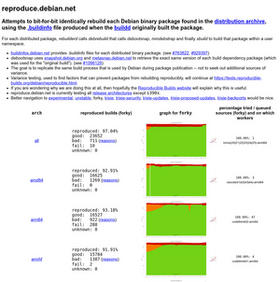
reproduce.debian.net The last year has seen the introduction, development and deployment of reproduce.debian.net. In technical terms, this is an instance of rebuilderd, our server designed monitor the official package repositories of Linux distributions and attempt to reproduce the observed results there. This month, however, Holger Levsen added suite-based navigation (eg. Debian trixie vs forky) to the service (in addition to the already existing architecture based navigation) which can be observed on, for instance, the Debian trixie-backports or trixie-security pages.
Tool development diffoscope is our in-depth and content-aware diff utility that can locate and diagnose reproducibility issues. This month, Chris Lamb made a number of changes, including preparing and uploading versions, 312 and 313 to Debian. In particular, Chris updated the post-release deployment pipeline to ensure that the pipeline does not fail if the automatic deployment to PyPI fails [ ]. In addition, Vagrant Cascadian updated an external reference for the 7z tool for GNU Guix. [ ]. Vagrant Cascadian also updated diffoscope in GNU Guix to version 312 and 313.

Distribution work In Debian this month:
  • 26 reviews of Debian packages were added, 5 were updated and 19 were removed this month adding to our extensive knowledge about identified issues.
  • A new debsbom package was uploaded to unstable. According to the package description, this package generates SBOMs (Software Bill of Materials) for distributions based on Debian in the two standard formats, SPDX and CycloneDX. The generated SBOM includes all installed binary packages and also contains Debian Source packages.
  • In addition, a sbom-toolkit package was uploaded, which provides a collection of scripts for generating SBOM. This is the tooling used in Apertis to generate the Licenses SBOM and the Build Dependency SBOM. It also includes dh-setup-copyright, a Debhelper addon to generate SBOMs from DWARF debug information, which are extracted from DWARF debug information by running dwarf2sources on every ELF binaries in the package and saving the output.
Lastly, Bernhard M. Wiedemann posted another openSUSE monthly update for their work there.

Miscellaneous news

Upstream patches The Reproducible Builds project detects, dissects and attempts to fix as many currently-unreproducible packages as possible. We endeavour to send all of our patches upstream where appropriate. This month, we wrote a large number of such patches, including:

Documentation updates Once again, there were a number of improvements made to our website this month including:

Four new academic papers Julien Malka and Arnout Engelen published a paper titled Lila: Decentralized Build Reproducibility Monitoring for the Functional Package Management Model:
[While] recent studies have shown that high reproducibility rates are achievable at scale demonstrated by the Nix ecosystem achieving over 90% reproducibility on more than 80,000 packages the problem of effective reproducibility monitoring remains largely unsolved. In this work, we address the reproducibility monitoring challenge by introducing Lila, a decentralized system for reproducibility assessment tailored to the functional package management model. Lila enables distributed reporting of build results and aggregation into a reproducibility database [ ].
A PDF of their paper is available online.
Javier Ron and Martin Monperrus of KTH Royal Institute of Technology, Sweden, also published a paper, titled Verifiable Provenance of Software Artifacts with Zero-Knowledge Compilation:
Verifying that a compiled binary originates from its claimed source code is a fundamental security requirement, called source code provenance. Achieving verifiable source code provenance in practice remains challenging. The most popular technique, called reproducible builds, requires difficult matching and reexecution of build toolchains and environments. We propose a novel approach to verifiable provenance based on compiling software with zero-knowledge virtual machines (zkVMs). By executing a compiler within a zkVM, our system produces both the compiled output and a cryptographic proof attesting that the compilation was performed on the claimed source code with the claimed compiler. [ ]
A PDF of the paper is available online.
Oreofe Solarin of Department of Computer and Data Sciences, Case Western Reserve University, Cleveland, Ohio, USA, published It s Not Just Timestamps: A Study on Docker Reproducibility:
Reproducible container builds promise a simple integrity check for software supply chains: rebuild an image from its Dockerfile and compare hashes. We built a Docker measurement pipeline and apply it to a stratified sample of 2,000 GitHub repositories that contained a Dockerfile. We found that only 56% produce any buildable image, and just 2.7% of those are bitwise reproducible without any infrastructure configurations. After modifying infrastructure configurations, we raise bitwise reproducibility by 18.6%, but 78.7% of buildable Dockerfiles remain non-reproducible.
A PDF of Oreofe s paper is available online.
Lastly, Jens Dietrich and Behnaz Hassanshahi published On the Variability of Source Code in Maven Package Rebuilds:
[In] this paper we test the assumption that the same source code is being used [by] alternative builds. To study this, we compare the sources released with packages on Maven Central, with the sources associated with independently built packages from Google s Assured Open Source and Oracle s Build-from-Source projects. [ ]
A PDF of their paper is available online.

Finally, if you are interested in contributing to the Reproducible Builds project, please visit our Contribute page on our website. However, you can get in touch with us via:

Mike Gabriel: Debian Lomiri Tablets 2025-2027 - Project Report (Q4/2025)

On 25th Oct 2025, I announced via my personal blog and on Mastodon that Fre(i)e Software GmbH was hiring. The hiring process was a mix of asking developers I know and waiting for new people to apply. At the beginning of November 2025 / in mid November 2025, we started with 13 developers (all part-time) to work on various topics around Lomiri (upstream and downstream). Note that the below achievements don't document the overall activity in the Lomiri project, but that part that our team at Fre(i)e Software GmbH contributed to. Organizational Achievements Maintenance Development Qt6 Porting Feature Development Research [1] https://gitlab.com/groups/ubports/development/-/boards/9895029?label_name%5B%5D=Topic%3A%20Qt%206

[2] https://gitlab.com/groups/ubports/development/-/boards/10037876?label_name[]=Topic%3A%20salsa2ubports%20DEB%20syncing

10 March 2026

Freexian Collaborators: Debian Contributions: Opening DebConf 26 Registration, Debian CI improvements and more! (by Anupa Ann Joseph)

Debian Contributions: 2026-02 Contributing to Debian is part of Freexian s mission. This article covers the latest achievements of Freexian and their collaborators. All of this is made possible by organizations subscribing to our Long Term Support contracts and consulting services.

DebConf 26 Registration, by Stefano Rivera, Antonio Terceiro, and Santiago Ruano Rinc n DebConf 26, to be held in Santa Fe Argentina in July, has opened for registration and event proposals. Stefano, Antonio, and Santiago all contributed to making this happen. As always, some changes needed to be made to the registration system. Bigger changes were planned, but we ran out of time to implement them for DebConf 26. All 3 of us have had experience in hosting local DebConf events in the past and have been advising the DebConf 26 local team.

Debian CI improvements, by Antonio Terceiro Debian CI is the platform responsible for automated testing of packages from the Debian archive, and its results are used by the Debian Release team automation as Quality Assurance to control the migration of packages from Debian unstable into testing, the base for the next Debian release. Antonio started developing an incus backend, and that prompted two rounds of improvements to the platform, including but not limited to allowing user to select a job execution backend (lxc, qemu) during the job submission, reducing the part of testbed image creation that requires superuser privileges and other refactorings and bug fixes. The platform API was also improved to reduce disruption when reporting results to the Release Team automation after service downtimes. Last, but not least, the platform now has support for testing packages against variants of autopkgtest, which will allow the Debian CI team to test new versions of autopkgtest before making releases to avoid widespread regressions.

Miscellaneous contributions
  • Carles improved po-debconf-manager while users requested features / found bugs. Improvements done - add packages from unstable instead of just salsa.debian.org, upgrade and merge templates of upgraded packages, finished adding typing annotations, improved deleting packages: support multiple line texts, add debug to see subprocess.run commands, etc.
  • Carles, using po-debconf-manager, reviewed 7 Catalan translations and sent bug reports or MRs for 11 packages. Also reviewed the translations of fortunes-debian-hints and submitted possible changes in the hints.
  • Carles submitted MRs for reportbug (reportbug --ui gtk detecting the wrong dependencies), devscript (delete unused code from debrebuild and add recommended dependency), wcurl (format help for 80 columns). Carles submitted a bug report for apt not showing the long descriptions of packages.
  • Carles resumed effort for checking relations (e.g. Recommends / Suggests) between Debian packages. A new codebase (still in early stages) was started with a new approach in order to detect, report and track the broken relations.
  • Emilio drove several transitions, most notably the haskell transition and the glibc/gcc-15/zlib transition for the s390 31-bit removal. This last one included reviewing and requeueing lots of autopkgtests due to britney losing a lot of results.
  • Emilio reviewed and uploaded poppler updates to experimental for a new transition.
  • Emilio reviewed, merged and deployed some performance improvements proposed for the security-tracker.
  • Stefano prepared routine updates for pycparser, python-confuse, python-cffi, python-mitogen, python-pip, wheel, platformdirs, python-authlib, and python-virtualenv.
  • Stefano updated Python 3.13 and 3.14 to the latest point releases, including security updates, and did some preliminary work for Python 3.15.
  • Stefano reviewed changes to dh-python and merged MRs.
  • Stefano did some debian.social sysadmin work, bridging additional IRC channels to Matrix.
  • Stefano and Antonio, as DebConf Committee Members, reviewed the DebConf 27 bids and took part in selecting the Japanese bid to host DebConf 27.
  • Helmut sent patches for 29 cross build failures.
  • Helmut continued to maintain rebootstrap addressing issues relating to specific architectures (such as musl-linux-any, hurd-any or s390x) or specific packages (such as binutils, brotli or fontconfig).
  • Helmut worked on diagnosing bugs such as rocblas #1126608, python-memray #1126944 upstream and greetd #1129070 with varying success.
  • Antonio provided support for multiple MiniDebConfs whose websites run wafer + wafer-debconf (the same stack as DebConf itself).
  • Antonio fixed the salsa tagpending webhook.
  • Antonio sent specinfra upstream a patch to fix detection of Debian systems in some situations.
  • Santiago reviewed some Merge Requests for the Salsa CI pipeline, including !703 and !704, that aim to improve how the build source job is handled by Salsa CI. Thanks a lot to Jochen for his work on this.
  • In collaboration with Emmanuel Arias, Santiago proposed a couple of projects for the Google Summer of Code (GSoC) 2026 round. Santiago has been reviewing applications and giving feedback to candidates.
  • Thorsten uploaded new upstream versions of ipp-usb, brlaser and gutenprint.
  • Rapha l updated publican to fix an old bug that became release critical and that happened only when building with the nocheck profile. Publican is a build dependency of the Debian s Administrator Handbook and with that fix, the package is back into testing.
  • Rapha l implemented a small feature in Debusine that makes it possible to refer to a collection in a parent workspace even if a collection with the same name is present in the current workspace.
  • Lucas updated the current status of ruby packages affecting the Ruby 3.4 transition after a bunch of updates made by team members. He will follow up on this next month.
  • Lucas joined the Debian orga team for GSoC this year and tried to reach out to potential mentors.
  • Lucas did some content work for MiniDebConf Campinas - Brazil.
  • Colin published minor security updates to bookworm and trixie for CVE-2025-61984 and CVE-2025-61985 in OpenSSH, both of which allowed code execution via ProxyCommand in some cases. The trixie update also included a fix for mishandling of PerSourceMaxStartups.
  • Colin spotted and fixed a typo in the bug tracking system s spam-handling rules, which in combination with a devscripts regression caused bts forwarded commands to be discarded.
  • Colin ported 12 more Python packages away from using the deprecated (and now removed upstream) pkg_resources module.
  • Anupa is co-organizing MiniDebConf Kanpur with Debian India team. Anupa was responsible for preparing the schedule, publishing it on the website, co-ordination with the fiscal host in addition to attending meetings.
  • Anupa attended the Debian Publicity team online sprint which was a skill sharing session.

9 March 2026

Isoken Ibizugbe: Starting Out in Outreachy

So you want to join Outreachy but you don t understand it, you re scared, or you don t know what open source is about.

What is FOSS anyway?

Free and Open Source Software (FOSS) refers to software that anyone can use, modify, and share freely. Think of it as a community garden; instead of one company owning the food, people from all over the world contribute, improve, and maintain it so everyone can benefit for free. You can read more here on what it means to contribute to open source.

Outreachy provides paid internships to anyone from any background who faces underrepresentation, systemic bias, or discrimination in the technical industry where they live. Their goal is to increase diversity in open source. Read their website for more. I spent a good amount of time reading all the guides listed, including the applicant guide and the how-to-apply guide.

The Secret to Applying (Spoiler: It s not a secret)

I know newcomers are scared or unsure and would prefer answers from previous participants, but the Outreachy website is actually a goldmine, almost every question you have is already answered there if you look closely. I used to hate reading documentation, but I ve learned to love it. Documentation is the Source of Truth.

  • My Advice: Read every single guide on their site. The applicant guide is your roadmap. Embracing documentation now will make you a much better contributor later.

The AI Trap: Be Yourself

Now for the part most newcomers have asked about is the initial essay. I know it s tempting to use AI, but I really encourage you to skip it for this. Your own story is much more powerful than a generated one. Outreachy and its mentoring organizations value your unique story. They are strongly against fabricated or AI-exaggerated essays.

For example, when I contributed to Debian using openQA, the information wasn t well established on the web. When I tried to use AI, it suggested imaginary ideas. The project maintainers had a particular style of contributing, so I had to follow the instructions carefully, observe the codebase, and read the provided documentation. With that information, I always wrote a solution first before consulting AI, and mine was always better. AI can only be intelligent in the context of what you give it; if it doesn t have your answer, it will look for the most similar solution (hallucinate). We do not want to increase the burden on reviewers their time is important because they are volunteers, too. This is crucial when you qualify for the contribution phase.

The Application Process

There are two main stages:

  • The initial application: Here you fill in basic details, time availability, and essay questions (you can find these on the Outreachy website).
  • The contribution phase: This is where you show you have the skills to work on the projects. Every project will list the skills needed and the level of proficiency.

When you qualify for the contribution phase:
  • A lot of people will try to create buzz or even panic; you just have to focus. Once you ve gotten the hang of the project, remember to help others along the way.
  • You can start contributions with spelling corrections, move to medium tasks (do multiple of these), then a hard task if possible. You don t need to be a guru on day one.
  • It s all about community building. Do your part to help others understand the project too; this is also a form of contribution.
  • Lastly, every project mentor has a way of evaluating candidates. My summary is: be confident, demonstrate your skills, and learn where you are lacking. Start small and work your way up, you don t have to prove yourself as a guru.

Tips
  • Watch this: This step-by-step video is a great walkthrough of the initial application process.
  • Sign up for the email list to get updates: https://lists.outreachy.org/cgi-bin/mailman/listinfo/announce
  • Be fast: Complete your initial application in the first 3 days, as there are a lot of applicants.
  • Back it up: In your essay about systemic bias, include some statistics to back it up.
  • Learn Git: Even if you don t have programming skills, contributions are pushed to GitHub or GitLab. Practice some commands and contribute to a first open issue to understand the flow: https://github.com/firstcontributions/first-contributions

The most important tip? Apply anyway. Even if you feel underqualified, the process itself is a massive learning experience.

8 March 2026

Gunnar Wolf: As Answers Get Cheaper, Questions Grow Dearer

This post is an unpublished review for As Answers Get Cheaper, Questions Grow Dearer
This opinion article tackles the much discussed issues of Large Language Models (LLMs) both endangering jobs and improving productivity. The authors begin by making a comparison, likening the current understanding of the effects LLMs are currently having upon knowledge-intensive work to that of artists in the early XIX century, when photography was first invented: they explain that photography didn t result in painting becoming obsolete, but undeniably changed in a fundamental way. Realism was no longer the goal of painters, as they could no longer compete in equal terms with photography. Painters then began experimenting with the subjective experiences of color and light: Impressionism no longer limits to copying reality, but adds elements of human feeling to creations. The authors argue that LLMs make getting answers terribly cheap not necessarily correct, but immediate and plausible. In order for the use of LLMs to be advantageous to users, a good working knowledge of the domain in which LLMs are queried is key. They cite as LLMs increasing productivity on average 14% at call centers, where questions have unambiguous answers and the knowledge domain is limited, but causing prejudice close to 10% to inexperience entrepreneurs following their advice in an environment where understanding of the situation and critical judgment are key. The problem, thus, becomes that LLMs are optimized to generate plausible answers. If the user is not a domain expert, plausibility becomes a stand-in for truth . They identify that, with this in mind, good questions become strategic: Questions that continue a line of inquiry, that expand the user s field of awareness, that reveal where we must keep looking. They liken this to Clayton Christensen s 2010 text on consulting : A consultant s value is not in having all the answers, but in teaching clients how to think. LLMs are already, and will likely become more so as they improve, game-changing for society. The authors argue that for much of the 20th century, an individual s success was measured by domain mastery, but bring to the table that the defining factor is no longer knowledge accumulation, but the ability to formulate the right questions. Of course, the authors acknowledge (it s even the literal title of one of the article s sections) that good questions need strong theoretical foundations. Knowing a specific domain enables users to imagine what should happen if following a specific lead, anticipate second-order effects, and evaluate whether plausible answers are meaningful or misleading. Shortly after I read the article I am reviewing, I came across a data point that quite validates its claims: A short, informally published paper on combinatorics and graph theory titled Claude s Cycles written by Donald Knuth (one of the most respected Computer Science professors and researchers and author of the very well known The Art of Computer Programming series of books). Knuth s text, and particularly its postscripts , perfectly illustrate what the article of this review conveys: LLMs can help a skillful researcher connect the dots in very varied fields of knowledge, perform tiring and burdensome calculators, even try mixing together some ideas that will fail or succeed. But guided by a true expert of the field, asking the right, insightful and informed questions will the answers prove to be of value and, in this case, of immense value. Knuth writes of a particular piece of the solution, I would have found this solution myself if I d taken time to look carefully at all 760 of the generalizable solutions for m=3 , but having an LLM perform all the legwork it was surely a better use of his time. Christensen, C.M. How Will You Measure Your Life? Harvard Business Review Press (2017). Knuth, D. Claude s Cycles. https://cs.stanford.edu/~knuth/papers/claude-cycles.pdf

6 March 2026

Antoine Beaupr : Wallabako retirement and Readeck adoption

Today I have made the tough decision of retiring the Wallabako project. I have rolled out a final (and trivial) 1.8.0 release which fixes the uninstall procedure and rolls out a bunch of dependency updates.

Why? The main reason why I'm retiring Wallabako is that I have completely stopped using it. It's not the first time: for a while, I wasn't reading Wallabag articles on my Kobo anymore. But I had started working on it again about four years ago. Wallabako itself is about to turn 10 years old. This time, I stopped using Wallabako because there's simply something better out there. I have switched away from Wallabag to Readeck! And I'm also tired of maintaining "modern" software. Most of the recent commits on Wallabako are from renovate-bot. This feels futile and pointless. I guess it must be done at some point, but it also feels we went wrong somewhere there. Maybe Filippo Valsorda is right and one should turn dependabot off. I did consider porting Wallabako to Readeck for a while, but there's a perfectly fine Koreader plugin that I've been pretty happy to use. I was worried it would be slow (because the Wallabag plugin is slow), but it turns out that Readeck is fast enough that this doesn't matter.

Moving from Wallabag to Readeck Readeck is pretty fantastic: it's fast, it's lightweight, everything Just Works. All sorts of concerns I had with Wallabag are just gone: questionable authentication, questionable API, weird bugs, mostly gone. I am still looking for multiple tags filtering but I have a much better feeling about Readeck than Wallabag: it's written in Golang and under active development. In any case, I don't want to throw shade at the Wallabag folks either. They did solve most of the issues I raised with them and even accepted my pull request. They have helped me collect thousands of articles for a long time! It's just time to move on. The migration from Wallabag was impressively simple. The importer is well-tuned, fast, and just works. I wrote about the import in this issue, but it took about 20 minutes to import essentially all articles, and another 5 hours to refresh all the contents. There are minor issues with Readeck which I have filed (after asking!): But overall I'm happy and impressed with the result. I'm also both happy and sad at letting go of my first (and only, so far) Golang project. I loved writing in Go: it's a clean language, fast to learn, and a beauty to write parallel code in (at the cost of a rather obscure runtime). It would have been much harder to write this in Python, but my experience in Golang helped me think about how to write more parallel code in Python, which is kind of cool. The GitLab project will remain publicly accessible, but archived, for the foreseeable future. If you're interested in taking over stewardship for this project, contact me. Thanks Wallabag folks, it was a great ride!

5 March 2026

Ian Jackson: Adopting tag2upload and modernising your Debian packaging

Introduction tag2upload allows authorised Debian contributors to upload to Debian simply by pushing a signed git tag to Debian s gitlab instance, Salsa. We have recently announced that tag2upload is, in our opinion, now very stable, and ready for general use by all Debian uploaders. tag2upload, as part of Debian s git transition programme, is very flexible - it needs to support a large variety of maintainer practices. And it s relatively unopinionated, wherever that s possible. But, during the open beta, various contributors emailed us asking for Debian packaging git workflow advice and recommendations. This post is an attempt to give some more opinionated answers, and guide you through modernising your workflow. (This article is aimed squarely at Debian contributors. Much of it will make little sense to Debian outsiders.) Why Ease of development git offers a far superior development experience to patches and tarballs. Moving tasks from a tarballs and patches representation to a normal, git-first, representation, makes everything simpler. dgit and tag2upload do automatically many things that have to be done manually, or with separate commands, in dput-based upload workflows. They will also save you from a variety of common mistakes. For example, you cannot accidentally overwrite an NMU, with tag2upload or dgit. These many safety catches mean that our software sometimes complains about things, or needs confirmation, when more primitive tooling just goes ahead. We think this is the right tradeoff: it s part of the great care we take to avoid our software making messes. Software that has your back is very liberating for the user. tag2upload makes it possible to upload with very small amounts of data transfer, which is great in slow or unreliable network environments. The other week I did a git-debpush over mobile data while on a train in Switzerland; it completed in seconds. See the Day-to-day work section below to see how simple your life could be. Don t fear a learning burden; instead, start forgetting all that nonsense Most Debian contributors have spent months or years learning how to work with Debian s tooling. You may reasonably fear that our software is yet more bizarre, janky, and mistake-prone stuff to learn. We promise (and our users tell us) that s not how it is. We have spent a lot of effort on providing a good user experience. Our new git-first tooling, especially dgit and tag2upload, is much simpler to use than source-package-based tooling, despite being more capable. The idiosyncrasies and bugs of source packages, and of the legacy archive, have been relentlessly worked around and papered over by our thousands of lines of thoroughly-tested defensive code. You too can forget all those confusing details, like our users have! After using our systems for a while you won t look back. And, you shouldn t fear trying it out. dgit and tag2upload are unlikely to make a mess. If something is wrong (or even doubtful), they will typically detect it, and stop. This does mean that starting to use tag2upload or dgit can involve resolving anomalies that previous tooling ignored, or passing additional options to reassure the system about your intentions. So admittedly it isn t always trivial to get your first push to succeed. Properly publishing the source code One of Debian s foundational principles is that we publish the source code. Nowadays, the vast majority of us, and of our upstreams, are using git. We are doing this because git makes our life so much easier. But, without tag2upload or dgit, we aren t properly publishing our work! Yes, we typically put our git branch on Salsa, and point Vcs-Git at it. However:
  • The format of git branches on Salsa is not standardised. They might be patches-unapplied, patches-applied, bare debian/, or something even stranger.
  • There is no guarantee that the DEP-14 debian/1.2.3-7 tag on salsa corresponds precisely to what was actually uploaded. dput-based tooling (such as gbp buildpackage) doesn t cross-check the .dsc against git.
  • There is no guarantee that the presence of a DEP-14 tag even means that that version of package is in the archive.
This means that the git repositories on Salsa cannot be used by anyone who needs things that are systematic and always correct. They are OK for expert humans, but they are awkward (even hazardous) for Debian novices, and you cannot use them in automation. The real test is: could you use Vcs-Git and Salsa to build a Debian derivative? You could not. tag2upload and dgit do solve this problem. When you upload, they:
  1. Make a canonical-form (patches-applied) derivative of your git branch;
  2. Ensure that there is a well-defined correspondence between the git tree and the source package;
  3. Publish both the DEP-14 tag and a canonical-form archive/debian/1.2.3-7 tag to a single central git depository, *.dgit.debian.org;
  4. Record the git information in the Dgit field in .dsc so that clients can tell (using the ftpmaster API) that this was a git-based upload, what the corresponding git objects are, and where to find them.
This dependably conveys your git history to users and downstreams, in a standard, systematic and discoverable way. tag2upload and dgit are the only system which achieves this. (The client is dgit clone, as advertised in e.g. dgit-user(7). For dput-based uploads, it falls back to importing the source package.) Adopting tag2upload - the minimal change tag2upload is a substantial incremental improvement to many existing workflows. git-debpush is a drop-in replacement for building, signing, and uploading the source package. So, you can just adopt it without completely overhauling your packaging practices. You and your co-maintainers can even mix-and-match tag2upload, dgit, and traditional approaches, for the same package. Start with the wiki page and git-debpush(1) (ideally from forky aka testing). You don t need to do any of the other things recommended in this article. Overhauling your workflow, using advanced git-first tooling The rest of this article is a guide to adopting the best and most advanced git-based tooling for Debian packaging. Assumptions
  • Your current approach uses the patches-unapplied git branch format used with gbp pq and/or quilt, and often used with git-buildpackage. You previously used gbp import-orig.
  • You are fluent with git, and know how to use Merge Requests on gitlab (Salsa). You have your origin remote set to Salsa.
  • Your main Debian branch name on Salsa is master. Personally I think we should use main but changing your main branch name is outside the scope of this article.
  • You have enough familiarity with Debian packaging including concepts like source and binary packages, and NEW review.
  • Your co-maintainers are also adopting the new approach.
tag2upload and dgit (and git-debrebase) are flexible tools and can help with many other scenarios too, and you can often mix-and-match different approaches. But, explaining every possibility would make this post far too confusing. Topics and tooling This article will guide you in adopting:
  • tag2upload
  • Patches-applied git branch for your packaging
  • Either plain git merge or git-debrebase
  • dgit when a with-binaries uploaded is needed (NEW)
  • git-based sponsorship
  • Salsa (gitlab), including Debian Salsa CI
Choosing the git branch format In Debian we need to be able to modify the upstream-provided source code. Those modifications are the Debian delta. We need to somehow represent it in git. We recommend storing the delta as git commits to those upstream files, by picking one of the following two approaches.
rationale Much traditional Debian tooling like quilt and gbp pq uses the patches-unapplied branch format, which stores the delta as patch files in debian/patches/, in a git tree full of unmodified upstream files. This is clumsy to work with, and can even be an alarming beartrap for Debian outsiders.
git merge Option 1: simply use git, directly, including git merge. Just make changes directly to upstream files on your Debian branch, when necessary. Use plain git merge when merging from upstream. This is appropriate if your package has no or very few upstream changes. It is a good approach if the Debian maintainers and upstream maintainers work very closely, so that any needed changes for Debian are upstreamed quickly, and any desired behavioural differences can be arranged by configuration controlled from within debian/. This is the approach documented more fully in our workflow tutorial dgit-maint-merge(7).
git-debrebase Option 2: Adopt git-debrebase. git-debrebase helps maintain your delta as linear series of commits (very like a topic branch in git terminology). The delta can be reorganised, edited, and rebased. git-debrebase is designed to help you carry a significant and complicated delta series. The older versions of the Debian delta are preserved in the history. git-debrebase makes extra merges to make a fast-forwarding history out of the successive versions of the delta queue branch. This is the approach documented more fully in our workflow tutorial dgit-maint-debrebase(7). Examples of complex packages using this approach include src:xen and src:sbcl.
Determine upstream git and stop using upstream tarballs We recommend using upstream git, only and directly. You should ignore upstream tarballs completely.
rationale Many maintainers have been importing upstream tarballs into git, for example by using gbp import-orig. But in reality the upstream tarball is an intermediate build product, not (just) source code. Using tarballs rather than git exposes us to additional supply chain attacks; indeed, the key activation part of the xz backdoor attack was hidden only in the tarball! git offers better traceability than so-called pristine upstream tarballs. (The word pristine is even a joke by the author of pristine-tar!)
First, establish which upstream git tag corresponds to the version currently in Debian. From the sake of readability, I m going to pretend that upstream version is 1.2.3, and that upstream tagged it v1.2.3. Edit debian/watch to contain something like this:
version=4
opts="mode=git" https://codeberg.org/team/package refs/tags/v(\d\S*)
You may need to adjust the regexp, depending on your upstream s tag name convention. If debian/watch had a files-excluded, you ll need to make a filtered version of upstream git.
git-debrebase From now on we ll generate our own .orig tarballs directly from git.
rationale We need some upstream tarball for the 3.0 (quilt) source format to work with. It needs to correspond to the git commit we re using as our upstream. We don t need or want to use a tarball from upstream for this. The .orig is just needed so a nice legacy Debian source package (.dsc) can be generated.
Probably, the current .orig in the Debian archive, is an upstream tarball, which may be different to the output of git-archive and possibly even have different contents to what s in git. The legacy archive has trouble with differing .origs for the same upstream version . So we must until the next upstream release change our idea of the upstream version number. We re going to add +git to Debian s idea of the upstream version. Manually make a tag with that name:
git tag -m "Compatibility tag for orig transition" v1.2.3+git v1.2.3~0
git push origin v1.2.3+git
If you are doing the packaging overhaul at the same time as a new upstream version, you can skip this part.
Convert the git branch
git merge Prepare a new branch on top of upstream git, containing what we want:
git branch -f old-master         # make a note of the old git representation
git reset --hard v1.2.3          # go back to the real upstream git tag
git checkout old-master :debian  # take debian/* from old-master
git commit -m "Re-import Debian packaging on top of upstream git"
git merge --allow-unrelated-histories -s ours -m "Make fast forward from tarball-based history" old-master
git branch -d old-master         # it's incorporated in our history now
If there are any patches, manually apply them to your main branch with git am, and delete the patch files (git rm -r debian/patches, and commit). (If you ve chosen this workflow, there should be hardly any patches,)
rationale These are some pretty nasty git runes, indeed. They re needed because we want to restart our Debian packaging on top of a possibly quite different notion of what the upstream is.
git-debrebase Convert the branch to git-debrebase format and rebase onto the upstream git:
git-debrebase -fdiverged convert-from-gbp upstream/1.2.3
git-debrebase -fdiverged -fupstream-not-ff new-upstream 1.2.3+git
If you had patches which patched generated files which are present only in the upstream tarball, and not in upstream git, you will encounter rebase conflicts. You can drop hunks editing those files, since those files are no longer going to be part of your view of the upstream source code at all.
rationale The force option -fupstream-not-ff will be needed this one time because your existing Debian packaging history is (probably) not based directly on the upstream history. -fdiverged may be needed because git-debrebase might spot that your branch is not based on dgit-ish git history.
Manually make your history fast forward from the git import of your previous upload.
dgit fetch
git show dgit/dgit/sid:debian/changelog
# check that you have the same version number
git merge -s ours --allow-unrelated-histories -m 'Declare fast forward from pre-git-based history' dgit/dgit/sid
Change the source format Delete any existing debian/source/options and/or debian/source/local-options.
git merge Change debian/source/format to 1.0. Add debian/source/options containing -sn.
rationale We are using the 1.0 native source format. This is the simplest possible source format - just a tarball. We would prefer 3.0 (native) , which has some advantages, but dpkg-source between 2013 (wheezy) and 2025 (trixie) inclusive unjustifiably rejects this configuration. You may receive bug reports from over-zealous folks complaining about the use of the 1.0 source format. You should close such reports, with a reference to this article and to #1106402.
git-debrebase Ensure that debian/source/format contains 3.0 (quilt).
Now you are ready to do a local test build. Sort out the documentation and metadata Edit README.source to at least mention dgit-maint-merge(7) or dgit-maint-debrebase(7), and to tell people not to try to edit or create anything in debian/patches/. Consider saying that uploads should be done via dgit or tag2upload. Check that your Vcs-Git is correct in debian/control. Consider deleting or pruning debian/gbp.conf, since it isn t used by dgit, tag2upload, or git-debrebase.
git merge Add a note to debian/changelog about the git packaging change.
git-debrebase git-debrebase new-upstream will have added a new upstream version stanza to debian/changelog. Edit that so that it instead describes the packaging change. (Don t remove the +git from the upstream version number there!)
Configure Salsa Merge Requests
git-debrebase In Settings / Merge requests , change Squash commits when merging to Do not allow .
rationale Squashing could destroy your carefully-curated delta queue. It would also disrupt git-debrebase s git branch structure.
Set up Salsa CI, and use it to block merges of bad changes Caveat - the tradeoff gitlab is a giant pile of enterprise crap. It is full of startling bugs, many of which reveal a fundamentally broken design. It is only barely Free Software in practice for Debian (in the sense that we are very reluctant to try to modify it). The constant-churn development approach and open-core business model are serious problems. It s very slow (and resource-intensive). It can be depressingly unreliable. That Salsa works as well as it does is a testament to the dedication of the Debian Salsa team (and those who support them, including DSA). However, I have found that despite these problems, Salsa CI is well worth the trouble. Yes, there are frustrating days when work is blocked because gitlab CI is broken and/or one has to keep mashing Retry . But, the upside is no longer having to remember to run tests, track which of my multiple dev branches tests have passed on, and so on. Automatic tests on Merge Requests are a great way of reducing maintainer review burden for external contributions, and helping uphold quality norms within a team. They re a great boon for the lazy solo programmer. The bottom line is that I absolutely love it when the computer thoroughly checks my work. This is tremendously freeing, precisely at the point when one most needs it deep in the code. If the price is to occasionally be blocked by a confused (or broken) computer, so be it. Setup procedure Create debian/salsa-ci.yml containing
include:
  - https://salsa.debian.org/salsa-ci-team/pipeline/raw/master/recipes/debian.yml
In your Salsa repository, under Settings / CI/CD , expand General Pipelines and set CI/CD configuration file to debian/salsa-ci.yml.
rationale Your project may have an upstream CI config in .gitlab-ci.yml. But you probably want to run the Debian Salsa CI jobs. You can add various extra configuration to debian/salsa-ci.yml to customise it. Consult the Salsa CI docs.
git-debrebase Add to debian/salsa-ci.yml:
.git-debrebase-prepare: &git-debrebase-prepare
  # install the tools we'll need
  - apt-get update
  - apt-get --yes install git-debrebase git-debpush
  # git-debrebase needs git user setup
  - git config user.email "salsa-ci@invalid.invalid"
  - git config user.name "salsa-ci"
  # run git-debrebase make-patches
  # https://salsa.debian.org/salsa-ci-team/pipeline/-/issues/371
  - git-debrebase --force
  - git-debrebase --noop-ok make-patches
  # make an orig tarball using the upstream tag, not a gbp upstream/ tag
  # https://salsa.debian.org/salsa-ci-team/pipeline/-/issues/541
  - git-deborig
.build-definition: &build-definition
  extends: .build-definition-common
  before_script: *git-debrebase-prepare
build source:
  extends: .build-source-only
  before_script: *git-debrebase-prepare
variables:
  # disable shallow cloning of git repository. This is needed for git-debrebase
  GIT_DEPTH: 0
rationale Unfortunately the Salsa CI pipeline currently lacks proper support for git-debrebase (salsa-ci#371) and has trouble directly using upstream git for orig tarballs (#salsa-ci#541). These runes were based on those in the Xen package. You should subscribe to the tickets #371 and #541 so that you can replace the clone-and-hack when proper support is merged.
Push this to salsa and make the CI pass. If you configured the pipeline filename after your last push, you will need to explicitly start the first CI run. That s in Pipelines : press New pipeline in the top right. The defaults will very probably be correct. Block untested pushes, preventing regressions In your project on Salsa, go into Settings / Repository . In the section Branch rules , use Add branch rule . Select the branch master. Set Allowed to merge to Maintainers . Set Allowed to push and merge to No one . Leave Allow force push disabled. This means that the only way to land anything on your mainline is via a Merge Request. When you make a Merge Request, gitlab will offer Set to auto-merge . Use that. gitlab won t normally merge an MR unless CI passes, although you can override this on a per-MR basis if you need to. (Sometimes, immediately after creating a merge request in gitlab, you will see a plain Merge button. This is a bug. Don t press that. Reload the page so that Set to auto-merge appears.) autopkgtests Ideally, your package would have meaningful autopkgtests (DEP-8 tests) This makes Salsa CI more useful for you, and also helps detect and defend you against regressions in your dependencies. The Debian CI docs are a good starting point. In-depth discussion of writing autopkgtests is beyond the scope of this article. Day-to-day work With this capable tooling, most tasks are much easier. Making changes to the package Make all changes via a Salsa Merge Request. So start by making a branch that will become the MR branch. On your MR branch you can freely edit every file. This includes upstream files, and files in debian/. For example, you can:
  • Make changes with your editor and commit them.
  • git cherry-pick an upstream commit.
  • git am a patch from a mailing list or from the Debian Bug System.
  • git revert an earlier commit, even an upstream one.
When you have a working state of things, tidy up your git branch:
git merge Use git-rebase to squash/edit/combine/reorder commits.
git-debrebase Use git-debrebase -i to squash/edit/combine/reorder commits. When you are happy, run git-debrebase conclude. Do not edit debian/patches/. With git-debrebase, this is purely an output. Edit the upstream files directly instead. To reorganise/maintain the patch queue, use git-debrebase -i to edit the actual commits.
Push the MR branch (topic branch) to Salsa and make a Merge Request. Set the MR to auto-merge when all checks pass . (Or, depending on your team policy, you could ask for an MR Review of course.) If CI fails, fix up the MR branch, squash/tidy it again, force push the MR branch, and once again set it to auto-merge. Test build An informal test build can be done like this:
apt-get build-dep .
dpkg-buildpackage -uc -b
Ideally this will leave git status clean, with no modified or un-ignored untracked files. If it shows untracked files, add them to .gitignore or debian/.gitignore as applicable. If it dirties the tree, consider trying to make it stop doing that. The easiest way is probably to build out-of-tree, if supported upstream. If this is too difficult, you can leave the messy build arrangements as they are, but you ll need to be disciplined about always committing, using git clean and git reset, and so on. For formal binaries builds, including for testing, use dgit sbuild as described below for uploading to NEW. Uploading to Debian Start an MR branch for the administrative changes for the release. Document all the changes you re going to release, in the debian/changelog.
git merge gbp dch can help write the changelog for you:
dgit fetch sid
gbp dch --ignore-branch --since=dgit/dgit/sid --git-log=^upstream/main
rationale --ignore-branch is needed because gbp dch wrongly thinks you ought to be running this on master, but of course you re running it on your MR branch. The --git-log=^upstream/main excludes all upstream commits from the listing used to generate the changelog. (I m assuming you have an upstream remote and that you re basing your work on their main branch.) If there was a new upstream version, you ll usually want to write a single line about that, and perhaps summarise anything really important.
(For the first upload after switching to using tag2upload or dgit you need --since=debian/1.2.3-1, where 1.2.3-1 is your previous DEP-14 tag, because dgit/dgit/sid will be a dsc import, not your actual history.)
Change UNRELEASED to the target suite, and finalise the changelog. (Note that dch will insist that you at least save the file in your editor.)
dch -r
git commit -m 'Finalise for upload' debian/changelog
Make an MR of these administrative changes, and merge it. (Either set it to auto-merge and wait for CI, or if you re in a hurry double-check that it really is just a changelog update so that you can be confident about telling Salsa to Merge unverified changes .) Now you can perform the actual upload:
git checkout master
git pull --ff-only # bring the gitlab-made MR merge commit into your local tree
git merge
git-debpush
git-debrebase
git-debpush --quilt=linear
--quilt=linear is needed only the first time, but it is very important that first time, to tell the system the correct git branch layout.
Uploading a NEW package to Debian If your package is NEW (completely new source, or has new binary packages) you can t do a source-only upload. You have to build the source and binary packages locally, and upload those build artifacts. Happily, given the same git branch you d tag for tag2upload, and assuming you have sbuild installed and a suitable chroot, dgit can help take care of the build and upload for you: Prepare the changelog update and merge it, as above. Then:
git-debrebase Create the orig tarball and launder the git-derebase branch:
git-deborig
git-debrebase quick
rationale Source package format 3.0 (quilt), which is what I m recommending here for use with git-debrebase, needs an orig tarball; it would also be needed for 1.0-with-diff.
Build the source and binary packages, locally:
dgit sbuild
dgit push-built
rationale You don t have to use dgit sbuild, but it is usually convenient to do so, because unlike sbuild, dgit understands git. Also it works around a gitignore-related defect in dpkg-source.
New upstream version Find the new upstream version number and corresponding tag. (Let s suppose it s 1.2.4.) Check the provenance:
git verify-tag v1.2.4
rationale Not all upstreams sign their git tags, sadly. Sometimes encouraging them to do so can help. You may need to use some other method(s) to check that you have the right git commit for the release.
git merge Simply merge the new upstream version and update the changelog:
git merge v1.2.4
dch -v1.2.4-1 'New upstream release.'
git-debrebase Rebase your delta queue onto the new upstream version:
git debrebase mew-upstream 1.2.4
If there are conflicts between your Debian delta for 1.2.3, and the upstream changes in 1.2.4, this is when you need to resolve them, as part of git merge or git (deb)rebase. After you ve completed the merge, test your package and make any further needed changes. When you have it working in a local branch, make a Merge Request, as above. Sponsorship git-based sponsorship is super easy! The sponsee can maintain their git branch on Salsa, and do all normal maintenance via gitlab operations. When the time comes to upload, the sponsee notifies the sponsor that it s time. The sponsor fetches and checks out the git branch from Salsa, does their checks, as they judge appropriate, and when satisfied runs git-debpush. As part of the sponsor s checks, they might want to see all changes since the last upload to Debian:
dgit fetch sid
git diff dgit/dgit/sid..HEAD
Or to see the Debian delta of the proposed upload:
git verify-tag v1.2.3
git diff v1.2.3..HEAD ':!debian'
git-debrebase Or to show all the delta as a series of commits:
git log -p v1.2.3..HEAD ':!debian'
Don t look at debian/patches/. It can be absent or out of date.
Incorporating an NMU Fetch the NMU into your local git, and see what it contains:
dgit fetch sid
git diff master...dgit/dgit/sid
If the NMUer used dgit, then git log dgit/dgit/sid will show you the commits they made. Normally the best thing to do is to simply merge the NMU, and then do any reverts or rework in followup commits:
git merge dgit/dgit/sid
git-debrebase You should git-debrebase quick at this stage, to check that the merge went OK and the package still has a lineariseable delta queue.
Then make any followup changes that seem appropriate. Supposing your previous maintainer upload was 1.2.3-7, you can go back and see the NMU diff again with:
git diff debian/1.2.3-7...dgit/dgit/sid
git-debrebase The actual changes made to upstream files will always show up as diff hunks to those files. diff commands will often also show you changes to debian/patches/. Normally it s best to filter them out with git diff ... ':!debian/patches' If you d prefer to read the changes to the delta queue as an interdiff (diff of diffs), you can do something like
git checkout debian/1.2.3-7
git-debrebase --force make-patches
git diff HEAD...dgit/dgit/sid -- :debian/patches
to diff against a version with debian/patches/ up to date. (The NMU, in dgit/dgit/sid, will necessarily have the patches already up to date.)
DFSG filtering (handling non-free files) Some upstreams ship non-free files of one kind of another. Often these are just in the tarballs, in which case basing your work on upstream git avoids the problem. But if the files are in upstream s git trees, you need to filter them out. This advice is not for (legally or otherwise) dangerous files. If your package contains files that may be illegal, or hazardous, you need much more serious measures. In this case, even pushing the upstream git history to any Debian service, including Salsa, must be avoided. If you suspect this situation you should seek advice, privately and as soon as possible, from dgit-owner@d.o and/or the DFSG team. Thankfully, legally dangerous files are very rare in upstream git repositories, for obvious reasons. Our approach is to make a filtered git branch, based on the upstream history, with the troublesome files removed. We then treat that as the upstream for all of the rest of our work.
rationale Yes, this will end up including the non-free files in the git history, on official Debian servers. That s OK. What s forbidden is non-free material in the Debianised git tree, or in the source packages.
Initial filtering
git checkout -b upstream-dfsg v1.2.3
git rm nonfree.exe
git commit -m "upstream version 1.2.3 DFSG-cleaned"
git tag -s -m "upstream version 1.2.3 DFSG-cleaned" v1.2.3+ds1
git push origin upstream-dfsg
And now, use 1.2.3+ds1, and the filtered branch upstream-dfsg, as the upstream version, instead of 1.2.3 and upstream/main. Follow the steps for Convert the git branch or New upstream version, as applicable, adding +ds1 into debian/changelog. If you missed something and need to filter out more a nonfree files, re-use the same upstream-dfsg branch and bump the ds version, eg v1.2.3+ds2. Subsequent upstream releases
git checkout upstream-dfsg
git merge v1.2.4
git rm additional-nonfree.exe # if any
git commit -m "upstream version 1.2.4 DFSG-cleaned"
git tag -s -m "upstream version 1.2.4 DFSG-cleaned" v1.2.4+ds1
git push origin upstream-dfsg
Removing files by pattern If the files you need to remove keep changing, you could automate things with a small shell script debian/rm-nonfree containing appropriate git rm commands. If you use git rm -f it will succeed even if the git merge from real upstream has conflicts due to changes to non-free files.
rationale Ideally uscan, which has a way of representing DFSG filtering patterns in debian/watch, would be able to do this, but sadly the relevant functionality is entangled with uscan s tarball generation.
Common issues
  • Tarball contents: If you are switching from upstream tarballs to upstream git, you may find that the git tree is significantly different. It may be missing files that your current build system relies on. If so, you definitely want to be using git, not the tarball. Those extra files in the tarball are intermediate built products, but in Debian we should be building from the real source! Fixing this may involve some work, though.
  • gitattributes: For Reasons the dgit and tag2upload system disregards and disables the use of .gitattributes to modify files as they are checked out. Normally this doesn t cause a problem so long as any orig tarballs are generated the same way (as they will be by tag2upload or git-deborig). But if the package or build system relies on them, you may need to institute some workarounds, or, replicate the effect of the gitattributes as commits in git.
  • git submodules: git submodules are terrible and should never ever be used. But not everyone has got the message, so your upstream may be using them. If you re lucky, the code in the submodule isn t used in which case you can git rm the submodule.
Further reading I ve tried to cover the most common situations. But software is complicated and there are many exceptions that this article can t cover without becoming much harder to read. You may want to look at:
  • dgit workflow manpages: As part of the git transition project, we have written workflow manpages, which are more comprehensive than this article. They re centered around use of dgit, but also discuss tag2upload where applicable. These cover a much wider range of possibilities, including (for example) choosing different source package formats, how to handle upstreams that publish only tarballs, etc. They are correspondingly much less opinionated. Look in dgit-maint-merge(7) and dgit-maint-debrebase(7). There is also dgit-maint-gbp(7) for those who want to keep using gbp pq and/or quilt with a patches-unapplied branch.
  • NMUs are very easy with dgit. (tag2upload is usually less suitable than dgit, for an NMU.) You can work with any package, in git, in a completely uniform way, regardless of maintainer git workflow, See dgit-nmu-simple(7).
  • Native packages (meaning packages maintained wholly within Debian) are much simpler. See dgit-maint-native(7).
  • tag2upload documentation: The tag2upload wiki page is a good starting point. There s the git-debpush(1) manpage of course.
  • dgit reference documentation: There is a comprehensive command-line manual in dgit(1). Description of the dgit data model and Principles of Operation is in dgit(7); including coverage of out-of-course situations. dgit is a complex and powerful program so this reference material can be overwhelming. So, we recommend starting with a guide like this one, or the dgit- (7) workflow tutorials.
  • Design and implementation documentation for tag2upload is linked to from the wiki.
  • Debian s git transition blog post from December. tag2upload and dgit are part of the git transition project, and aim to support a very wide variety of git workflows. tag2upload and dgit work well with existing git tooling, including git-buildpackage-based approaches. git-debrebase is conceptually separate from, and functionally independent of, tag2upload and dgit. It s a git workflow and delta management tool, competing with gbp pq, manual use of quilt, git-dpm and so on.
git-debrebase
  • git-debrebase reference documentation: Of course there s a comprehensive command-line manual in git-debrebase(1). git-debrebase is quick and easy to use, but it has a complex data model and sophisticated algorithms. This is documented in git-debrebase(5).

Edited 2026-03-05 18:48 UTC to add a missing --noop-ok to the Salsa CI runes. Thanks to Charlemagne Lasse for the report. Apologies if this causes Debian Planet to re-post this article as if it were new.


comment count unavailable comments

4 March 2026

Sean Whitton: Southern Biscuits with British ingredients

I miss the US more and more, and have recently been trying to perfect Southern Biscuits using British ingredients. It took me eight or nine tries before I was consistently getting good results. Here is my recipe. Ingredients Method
  1. Slice and then chill the butter in the freezer for at least fifteen minutes.
  2. Preheat oven to 220 C with the fan turned off.
  3. Twice sieve together the flours, leaveners and salt. Some salt may not go through the sieve; just tip it back into the bowl.
  4. Cut cold butter slices into the flour with a pastry blender until the mixture resembles coarse crumbs: some small lumps of fat remaining is desirable. In particular, the fine crumbs you are looking for when making British scones are not wanted here. Rubbing in with fingertips just won t do; biscuits demand keeping things cold even more than shortcrust pastry does.
  5. Make a well in the centre, pour in the buttermilk, and stir with a metal spoon until the dough comes together and pulls away from the sides of the bowl. Avoid overmixing, but I ve found that so long as the ingredients are cold, you don t have to be too gentle at this stage and can make sure all the crumbs are mixed in.
  6. Flour your hands, turn dough onto a floured work surface, and pat together into a rectangle. Some suggest dusting the top of the dough with flour, too, here.
  7. Fold the dough in half, then gather any crumbs and pat it back into the same shape. Turn ninety degrees and do the same again, until you have completed a total of eight folds, two in each cardinal direction. The dough should now be a little springy.
  8. Roll to about inch thick.
  9. Cut out biscuits. If using a round cutter, do not twist it, as that seals the edges of the biscuits and so spoils the layering.
  10. Transfer to a baking sheet, placed close together (helps them rise). Flour your thumb and use it to press an indent into the top of each biscuit (helps them rise straight), brush with buttermilk.
  11. Bake until flaky and golden brown: about fifteen minutes.
Gravy It turns out that the pepper gravy that one commonly has with biscuits is just a white/b chamel sauce made with lots of black pepper. I haven t got a recipe I really like for this yet. Better is a sausage gravy ; again this has a white sauce as its base, I believe. I have a vegetarian recipe for this to try at some point. Variations Notes

Sean Whitton: dgit-as-a-service retrospective

We recently launched tag2upload, aka cloud dgit or dgit-as-a-service. This was something of a culmination of work I ve been doing since 2016 towards modernising Debian workflows, so I thought I d write a short personal retrospective. When I started contributing to Debian in 2015, I was not impressed with how packages were represented in Git by most package maintainers, and wanted a pure Git workflow. I read a couple of Joey Hess s blog posts on the matter, a rope ladder to the dgit treehouse and upstream git repositories and made a bug report against dgit hoping to tie some things together. The results of that early work were the git-deborig(1) program and the dgit-maint-merge(7) tutorial manpage. Starting with Joey s workflow pointers, I developed a complete, pure Git workflow that I thought would be suitable for all package maintainers in Debian. It was certainly well-suited for my own packages. It took me a while to learn that there are packages for which this workflow is too simple. We now also have the dgit-maint-debrebase(7) workflow which uses git-debrebase, something which wasn t invented until several years later. Where dgit-maint-merge(7) won t do, you can use dgit-maint-debrebase(7), and still be doing pretty much pure Git. Here s a full, recent guide to modernisation. The next most significant contribution of my own was the push-source subcommand for dgit. dgit push required a preexisting .changes file produced from the working tree. I wanted to make dgit push-source prepare that .changes file for you, but also not use the working tree, instead consulting HEAD. The idea was that you were doing a git push which doesn t care about the working tree direct to the Debian archive, or as close as we could get. I implemented that at DebConf18 in Taiwan, I think, with Ian, and we also did a talk on git-debrebase. We ended up having to change it to look at the working tree in addition to HEAD to make it work as well as possible, but I think that the idea of a command which was like doing a Git push direct to the archive was perhaps foundational for us later wanting to develop tag2upload. Indeed, while tag2upload s client-side tool git-debpush does look at the working tree, it doesn t do so in a way that is essential to its operation. tag2upload is dgit push-source-as-a-service. And finally we come to tag2upload, a system Ian and I designed in 2019 during a two-person sprint at his place in Cambridge, while I was visiting the UK from Arizona. With tag2upload, appropriately authorised Debian package maintainers can upload to Debian with only pure Git operations namely, making and pushing a signed Git tag to Debian s GitLab instance. Although we had a solid prototype in 2019, we only finally launched it last month, February 2026. This was mostly due to political delays, but also because we have put in a lot of hours making it better in various ways. Looking back, one thing that seems notable to me is that the core elements of the pure Git workflows haven t changed much at all. Working out all the details of dgit-maint-merge(7), designing and writing git-debrebase (Ian s work), and then working out all the details of dgit-maint-debrebase(7), are the important parts, to me. The rest is mostly just large amounts of compatibility code. git-debrebase and dgit-maint-debrebase(7) are very novel but dgit-maint-merge(7) is mostly just an extrapolation of Joey s thoughts from 13 years ago. And yet, adoption of these workflows remains low. People prefer to use what they are used to using, even if the workflows have significant inconveniences. That s completely understandable; I m really interested in good workflows, but most other contributors care less about it. But you would expect enough newcomers to have arrived in 13 years that the new workflows would have a higher uptake. That is, packages maintained by contributors that got involved after these workflows became available would be maintained using newer workflows, at least. But the inertia seems to be too strong even for that. Instead, new contributors used to working purely out of Git are told they need to learn Debian s strange ways of representing things, tarballs and all. It doesn t have to be that way. We hope that tag2upload will make the pure Git workflows seem more appealing to people.

Jonathan Dowland: More lava lamps

photograph of a Mathmos Telstar rocket lava lamp with orange wax and purple water
Mathmos had a sale on spare Lava lamp bottles around Christmas, so I bought a couple of new-to-me colour combinations.
photograph of a Mathmos Telstar rocket lava lamp with blue wax in purple water
photograph of a Mathmos Telstar rocket lava lamp with pink wax in clear water
The lamp I have came with orange wax in purple liquid, which gives a strong red glow in a dark room. I bought blue wax in purple liquid, which I think looks fantastic and works really nicely with my Rob Sheridan print. The other one I bought was pink in clear, which is nice, but I think the coloured liquids add a lot to the tone of lighting in a room. Recently, UK vid-blogger Techmoan did some really nice videos about Mathmos lava lamps: Best Lava Lamp? and LAVA LAMPS Giant, Mini & Neo.

3 March 2026

Matthew Garrett: To update blobs or not to update blobs

A lot of hardware runs non-free software. Sometimes that non-free software is in ROM. Sometimes it s in flash. Sometimes it s not stored on the device at all, it s pushed into it at runtime by another piece of hardware or by the operating system. We typically refer to this software as firmware to differentiate it from the software run on the CPU after the OS has started1, but a lot of it (and, these days, probably most of it) is software written in C or some other systems programming language and targeting Arm or RISC-V or maybe MIPS and even sometimes x862. There s no real distinction between it and any other bit of software you run, except it s generally not run within the context of the OS3. Anyway. It s code. I m going to simplify things here and stop using the words software or firmware and just say code instead, because that way we don t need to worry about semantics. A fundamental problem for free software enthusiasts is that almost all of the code we re talking about here is non-free. In some cases, it s cryptographically signed in a way that makes it difficult or impossible to replace it with free code. In some cases it s even encrypted, such that even examining the code is impossible. But because it s code, sometimes the vendor responsible for it will provide updates, and now you get to choose whether or not to apply those updates. I m now going to present some things to consider. These are not in any particular order and are not intended to form any sort of argument in themselves, but are representative of the opinions you will get from various people and I would like you to read these, think about them, and come to your own set of opinions before I tell you what my opinion is. THINGS TO CONSIDER Ok we re done with the things to consider. Please spend a few seconds thinking about what the tradeoffs are here and what your feelings are. Proceed when ready. I trust my CPU vendor. I don t trust my CPU vendor because I want to, I trust my CPU vendor because I have no choice. I don t think it s likely that my CPU vendor has designed a CPU that identifies when I m generating cryptographic keys and biases the RNG output so my keys are significantly weaker than they look, but it s not literally impossible. I generate keys on it anyway, because what choice do I have? At some point I will buy a new laptop because Electron will no longer fit in 32GB of RAM and I will have to make the same affirmation of trust, because the alternative is that I just don t have a computer. And in any case, I will be communicating with other people who generated their keys on CPUs I have no control over, and I will also be relying on them to be trustworthy. If I refuse to trust my CPU then I don t get to computer, and if I don t get to computer then I will be sad. I suspect I m not alone here. Why would I install a code update on my CPU when my CPU s job is to run my code in the first place? Because it turns out that CPUs are complicated and messy and they have their own bugs, and those bugs may be functional (for example, some performance counter functionality was broken on Sandybridge at release, and was then fixed with a microcode blob update) and if you update it your hardware works better. Or it might be that you re running a CPU with speculative execution bugs and there s a microcode update that provides a mitigation for that even if your CPU is slower when you enable it, but at least now you can run virtual machines without code in those virtual machines being able to reach outside the hypervisor boundary and extract secrets from other contexts. When it s put that way, why would I not install the update? And the straightforward answer is that theoretically it could include new code that doesn t act in my interests, either deliberately or not. And, yes, this is theoretically possible. Of course, if you don t trust your CPU vendor, why are you buying CPUs from them, but well maybe they ve been corrupted (in which case don t buy any new CPUs from them either) or maybe they ve just introduced a new vulnerability by accident, and also you re in a position to determine whether the alleged security improvements matter to you at all. Do you care about speculative execution attacks if all software running on your system is trustworthy? Probably not! Do you need to update a blob that fixes something you don t care about and which might introduce some sort of vulnerability? Seems like no! But there s a difference between a recommendation for a fully informed device owner who has a full understanding of threats, and a recommendation for an average user who just wants their computer to work and to not be ransomwared. A code update on a wifi card may introduce a backdoor, or it may fix the ability for someone to compromise your machine with a hostile access point. Most people are just not going to be in a position to figure out which is more likely, and there s no single answer that s correct for everyone. What we do know is that where vulnerabilities in this sort of code have been discovered, updates have tended to fix them - but nobody has flagged such an update as a real-world vector for system compromise. My personal opinion? You should make your own mind up, but also you shouldn t impose that choice on others, because your threat model is not necessarily their threat model. Code updates are a reasonable default, but they shouldn t be unilaterally imposed, and nor should they be blocked outright. And the best way to shift the balance of power away from vendors who insist on distributing non-free blobs is to demonstrate the benefits gained from them being free - a vendor who ships free code on their system enables their customers to improve their code and enable new functionality and make their hardware more attractive. It s impossible to say with absolute certainty that your security will be improved by installing code blobs. It s also impossible to say with absolute certainty that it won t. So far evidence tends to support the idea that most updates that claim to fix security issues do, and there s not a lot of evidence to support the idea that updates add new backdoors. Overall I d say that providing the updates is likely the right default for most users - and that that should never be strongly enforced, because people should be allowed to define their own security model, and whatever set of threats I m worried about, someone else may have a good reason to focus on different ones.

  1. Code that runs on the CPU before the OS is still usually described as firmware - UEFI is firmware even though it s executing on the CPU, which should give a strong indication that the difference between firmware and software is largely arbitrary
  2. And, obviously 8051
  3. Because UEFI makes everything more complicated, UEFI makes this more complicated. Triggering a UEFI runtime service involves your OS jumping into firmware code at runtime, in the same context as the OS kernel. Sometimes this will trigger a jump into System Management Mode, but other times it won t, and it s just your kernel executing code that got dumped into RAM when your system booted.
  4. I don t understand most of the diff between one kernel version and the next, and I don t have time to read all of it either.
  5. There s a bunch of reasons to do this, the most reasonable of which is probably not wanting customers to replace the code and break their hardware and deal with the support overhead of that, but not being able to replace code running on hardware I own is always going to be an affront to me.

Michael Ablassmeier: pbsindex - file backup index

If you take backups using the proxmox-backup-client and you wondered what backup may include a specific file, the only way to find out is to mount the backup and search for the files. For regular file backups, the Proxmox Backup Server frontend provides a pcat1 file for download, whose binary format is somewhat undocumented but actually includes a listing of the files backed up. A Proxmox backup server datastore includes the same pcat1 file as blob index (.pcat1.didx). So to actually beeing able to tell which backup contains which files, one needs to: 1) Open the .pcat1.didx file and find out required blobs, see format documentation 2) Reconstruct the .pcat1 file from the blobs 3) Parse the pcat1 file and output the directory listing. I ve implemented this in pbsindex which lets you create a central file index for your backups by scanning a complete PBS datastore. Lets say you want to have a file listing for a specific backup, use:
 pbsindex --chunk-dir /backup/.chunks/ /backup/host/vm178/2026-03-02T10:47:57Z/catalog.pcat1.didx
 didx uuid=7e4086a9-4432-4184-a21f-0aeec2b2de93 ctime=2026-03-02T10:47:57Z chunks=2 total_size=1037386
 chunk[0] start=0 end=344652 size=344652 digest=af3851419f5e74fbb4d7ca6ac3bc7c5cbbdb7c03d3cb489d57742ea717972224
 chunk[1] start=344652 end=1037386 size=692734 digest=e400b13522df02641c2d9934c3880ae78ebb397c66f9b4cf3b931d309da1a7cc
 d ./usr.pxar.didx
 d ./usr.pxar.didx/bin
 l ./usr.pxar.didx/bin/Mail
 f ./usr.pxar.didx/bin/[ size=55720 mtime=2025-06-04T15:14:05Z
 f ./usr.pxar.didx/bin/aa-enabled size=18672 mtime=2025-04-10T15:06:25Z
 f ./usr.pxar.didx/bin/aa-exec size=18672 mtime=2025-04-10T15:06:25Z
 f ./usr.pxar.didx/bin/aa-features-abi size=18664 mtime=2025-04-10T15:06:25Z
 l ./usr.pxar.didx/bin/apropos
It also lets you scan a complete datastore for all existing .pcat1.didx files and store the directory listings in a SQLite database for easier searching.

2 March 2026

Isoken Ibizugbe: Wrapping Up My Outreachy Internship at Debian

Twelve weeks ago, I stepped into the Debian ecosystem as an Outreachy intern with a curiosity for Quality Assurance. It feels like just yesterday, and time has flown by so fast! Now, I am wrapping up that journey, not just with a completed project, but with improved technical reasoning.

I have learned how to use documentation to understand a complex project, how to be a good collaborator, and that learning is a continuous process. These experiences have helped me grow much more confident in my skills as an engineer.

My Achievements

As I close this chapter, I am leaving a permanent Proof-of-Work in the Debian repositories:

  • Full Test Coverage: I automated apps_startstop tests for Cinnamon, LXQt, and XFCE, covering both Live images and Netinst installations.
  • Synergy: I used symbolic links and a single Perl script to handle common application tests across different desktops, which reduces code redundancy.
  • The Contributor Style Guide: I created a guide for future contributors to make documentation clearer and reviews faster, helping to reduce the burden on reviewers.

Final Month: Wrap Up

In this final month, things became easier as my understanding of the project grew. I focused on stability and finishing my remaining tasks:

  • I spent time exploring different QEMU video options like VGA, qxl, and virtio on KDE desktop environment . This was important to ensure screen rendering remained stable so that our needles (visual test markers) wouldn t fail because of minor glitches.
  • I successfully moved from familiarizing to test automation for the XFCE desktop. This included writing prepare steps and creating the visual needles needed to make the tests reliable.
  • One of my final challenges was the app launcher function. Originally, my code used else if blocks for each desktop. I proposed a unified solution, but hit a blocker: XFCE has two ways to launch apps (App Finder and the Application Menu). Because using different methods sometimes caused failures, I chose to use the application menu button across the board.

What s Next?

I don t want my journey with Debian to end here. I plan to stay involved in the community and extend these same tests to the LXDE desktop to complete the coverage for all major Debian desktop environments. I am excited to keep exploring and learning more about the Debian ecosystem.

Thank You

This journey wouldn t have been possible without the steady guidance of my mentors: Tassia Camoes Araujo, Roland Clobus, and Philip Hands. Thank you for teaching me that in the world of Free and Open Source Software (FOSS), your voice and your code are equally important.

To my fellow intern Hellen and the entire Outreachy community, thank you for the shared learning and support. It has been an incredible 12 weeks.

Valhalla's Things: A Pen Case (or a Few)

Posted on March 2, 2026
Tags: madeof:atoms, FreeSoftWear, craft:sewing
A pen case made of two pieces of a relatively stiff black material with a flat base and three separate channels on top, plus a flap covering everything and a band to keep the flap closed; there is visible light blue stitching all around the channels. For my birthday, I ve bought myself a fancy new expensive1 fountain pen. A two slot pen case in the same material as above, but brown: the flap is too short to cover the pens, and there isn't a band to keep it closed. Such a fancy pen, of course requires a suitable case: I couldn t use the failed prototype of a case I ve been keeping my Preppys in, so I had to get out the nice vegetable tanned leather Yeah, nope, I don t have that (yet). I got out the latex and cardboard material that is sold as a (cheaper) leather substitute, doesn t look like leather at all, but is quite nice (and easy) to work with. The project is not vegan anyway, because I used waxed linen thread, waxing it myself with a lot of very nicely smelling beeswax. a case similar to the one above, but this one only has two slots, and there is a a Faber Castell pen nested on top of the case between the two slots. Here the stitches are white, and in a coarser thread. I got the measurements2 from the less failed prototype where I keep my desktop pens, and this time I made a proper pattern I could share online, under the usual Free Culture license. A case like the one above, except that the stitches are in black, and not as regular. This one has also been scrunched up a bit for a different look, and now the band is a bit too wide. From the width of the material I could conveniently cut two cases, so that s what I did, started sewing the first one, realized that I got the order of stitching wrong, and also that if I used light blue thread instead of the black one it would look nice, and be easier to see in the pictures for the published pattern, started sewing the second one, and kept alternating between the two, depending on the availability of light for taking pictures. The open pen case, showing two pens, a blue Preppy and a gunmetal Plaisir cosily nested in the two outer slots, while the middle slot is ominously empty. One of the two took the place of my desktop one, where I had one more pen than slots, and one of the old prototypes was moved to keep my bedside pen, and the other new case was used for the new pen in my handbag, together with a Preppy, and now I have a free slot and you can see how this is going to go wrong, right? :D
  1. 16 . plus a 9 converter, and another 6 pen to get the EF nib from, since it wasn t available for the expensive pen.
  2. I have them written down somewhere. I couldn t find them. So I measured the real thing, with some approximation.

1 March 2026

Benjamin Mako Hill: Pronunciation

Had a discussion about how to pronounce the name of Google s chatbot. Turns out, we were all wrong.


28 February 2026

Utkarsh Gupta: FOSS Activites in February 2026

Here s my monthly but brief update about the activities I ve done in the FOSS world.

Debian
Whilst I didn t get a chance to do much, here are still a few things that I worked on:
  • Uploaded node-lodash/4.17.21+dfsg+~cs8.31.198.20210220-10 to fix CVE-2025-13465 in unstable. Pinged Xavier and Praveen to see how they feel about the backport for the stable releases.
  • Assited a few folks in getting their patches submitted via Salsa.
    • Reviewing pyenv MR for Ujjwal.
    • Reviewing and assisting Anshul with his Golang stuff.
  • Mentoring for newcomers.
  • Started to be a bit involved with DC 26 bits.
  • Moderation of -project mailing list.

Ubuntu
I joined Canonical to work on Ubuntu full-time back in February 2021. Whilst I can t give a full, detailed list of things I did, here s a quick TL;DR of what I did:
  • Successfully released Resolute Snapshot 4!
    • This one was also done without the ISO tracker and cdimage access.
    • We also worked very hard to build and promote all the image in due time.
    • This was one done with the Test Observer. The first one.
  • Worked further on the whole artifact signing story for cdimage.
  • Assisted a bunch of folks with my Archive Admin and Release team hats to:
    • Review and grant FFes.
    • Coordinating weekly syncs.
    • Promoting binaries to main.
    • Taking care of package removals and so on.
  • Was pretty occupied with the new release processs architecture.

Debian (E)LTS
This month I have worked 42 hours on Debian Long Term Support (LTS) and on its sister Extended LTS project and did the following things:

Released Security Updates

Work in Progress
  • knot-resolver: Affected by CVE-2023-26249, CVE-2023-46317, and CVE-2022-40188, leading to Denial of Service.
  • ruby-rack: There were multiple vulnerabilities reported in Rack, leading to DoS (memory exhaustion) and proxy bypass.
    • [ELTS]: I ve partially reviewed patches by Bastien but whilst doing so, new ones came up for all the releases.
    • [sid]: Uploaded ruby-rack/3.2.5-1 to unstable to fix the new CVEs, CVE-2026-25500 and CVE-2026-22860.
    • [stable]: Prepared the upload for stable releases, as requested by the Security Team. Will upload them in March.
    • [bullseye]: Backport for CVE-2026-22860 hasn t been as trivial as it appears to be. There are test failures, which aren t really ignore-able:
      The tests requests /cgi/../test, which File.expand_path resolves to <root>/test - firmly inside @root. With the old code, it hit the return unless path_info.include? ".." guard and fell through to 403. But it would also have returned early via start_with?(@root) being true
    • anyway, this needs more investigation - I ll continue to do so in March as P1.
  • node-lodash: Affected by CVE-2025-13465, lrototype pollution in baseUnset function.
    • [stable]: The patch for trixie and bookworm are ready and have been awaiting the maintainer review.
    • [LTS]: The bullseye upload will follow once the stable uploads are in and ACK d by the SRMs.
  • vlc: Affected by CVE-2025-51602, an out-of-bounds read and denial of service via a crafted 0x01 response from an MMS server.
    • [LTS]: 3.0.23 backport is ready but not tested. I ll get this over the line in March.
    • [ELTS]: 3.0.23 backport is ready but not very clean. Would like to complete LTS and get back to this.

Other Activities
  • [LTS] Coordinated the libvirt sitaution with Ben Hutchings. The upload has already been prepped, will upload in March.
  • [ELTS] Continued to help Bastien and Markus with the tomcat9 regression for buster.
  • [ELTS] Partially reviewed ruby-rack CVEs to help Bastien. This took more time than expected with some more develpments hapening at the end of the month - new CVEs that aren t as easy to backport as I expected them to be. Will continue with these in March.
  • [E/LTS] Front Desk duties: Performed a large batch of CVE triage, marking numerous packages for bullseye, buster, and stretch as either postponed, end-of-life, not-affected, or added them to the Xla-needed.txt files.
    • Also replied to certain mails and IRC texts around FD related tasks.
  • [E/LTS] Monitored discussions on mailing lists, IRC, and all the documentation updates.
  • [E/LTS] Attended the monthly LTS meeting on Jitsi. Summary here.

Until next time.
:wq for today.

27 February 2026

Petter Reinholdtsen: Free software toolchain for the simplest RISC-V CPU in a small FPGA?

On Wednesday I had the pleasure of attending a presentation organized by the Norwegian Unix Users Group on implementing RISC-V using a small FPGA. This project is the result of a university teacher wanting to teach students assembly programming using a real instruction set, while still providing a simple and transparent CPU environment. The CPU in question implements the smallest set of opcodes needed to still call the CPU a RISC-V CPU, the RV32I base set. The author and presenter, Kristoffer Robin Stokke, demonstrated how to build both the FPGA setup and a small startup code providing a "Hello World" message over both serial port and a small LCD display. The FPGA is programmed using VHDL, the entire source code is available from github, but unfortunately the target FPGA setup is compiled using the proprietary tool Quartus. It is such a pity that such a cool little piece of free software should be chained down by non-free software, so my friend Jon Nordby set out to see if we can liberate this small RISC-V CPU. After all, it would be unforgivable sin to force students to use non-free software to study at the University of Oslo. The VHDL code for the CPU instructions itself is only 1138 lines, if I am to believe wc -l lib/riscv_common/* lib/rv32i/*. On the small FPGA used during the talk, the entire CPU, ROM, display and serial port driver only used up half the capacity. These days, there exists a free software toolchain for FPGA programming not only in Verilog but also in VHDL, and we hope the support in yosys, ghdl, and yosys-plugin-ghdl (sadly and strangely enough, removed from Debian unstable) is complete enough to at least build this small and simple project with some minor portability fixes. Or perhaps there are other approaches that work better? The first patches are already floating on github, to make the VHDL code more portable and to test out the build. If you are interested in running your own little RISC-V CPU on a FPGA chip, please get in touch. At the moment we sadly have hit a GHDL bug, which we do not quite know how to work around or fix:
******************** GHDL Bug occurred ***************************
Please report this bug on https://github.com/ghdl/ghdl/issues
GHDL release: 5.0.1 (Debian 5.0.1+dfsg-1+b1) [Dunoon edition]
Compiled with unknown compiler version
Target: x86_64-linux-gnu
/scratch/pere/src/fpga/memstick-fpga-riscv-upstream/
Command line:
Exception CONSTRAINT_ERROR raised
Exception information:
raised CONSTRAINT_ERROR : synth-vhdl_expr.adb:1763 discriminant check failed
******************************************************************
Thus more work is needed. For me, this simple project is the first stepping stone for a larger dream I have of converting the MESA machine controller system to build its firmware using a free software toolchain. I just need to learn more FPGA programming first. :) As usual, if you use Bitcoin and want to show your support of my activities, please send Bitcoin donations to my address 15oWEoG9dUPovwmUL9KWAnYRtNJEkP1u1b.

25 February 2026

Sahil Dhiman: Publicly Available NKN Data Traffic Graphs

National Knowledge Network (NKN) is one of India s main National Research and Educational Network (NREN). The other being the less prevalent Education and Research Network (ERNET). This post grew out of this Mastodon thread where I kept on adding various public graphs (from various global research and educational entities) that peer or connect with NKN. This was to get some purview about traffic data between them and NKN.

CERN CERN, birthplace of the World Wide Web (WWW) and home of the Large Hadron Collider (LHC). India participates in the LHCONE project, which carries LHC data over these links for scientific research purposes. This presentation from Vikas Singhal from Variable Energy Cyclotron Centre (VECC), Kolkata, at the 8th Asian Tier Center Forum in 2024 gives some details.

G ANT G ANT is pan European Union s collaboration of NRENs.

LEARN Lanka Education and Research Network (LEARN) is Sri Lanka s NREN.

NORDUnet NREN for Nordic countries. I couldn t find any public live data transfer graphs from NKN side. If you know any other graphs, do let me know.

Joachim Breitner: Vibe-coding a debugger for a DSL

Earlier this week a colleague of mine, Emilio Jes s Gallego Arias, shared a demo of something he built as an experiment, and I felt the desire to share this and add a bit of reflection. (Not keen on watching a 5 min video? Read on below.)

What was that? So what did you just see (or skipped watching)? You could see Emilio s screen, running VSCode and editing a Lean file. He designed a small programming language that he embedded into Lean, including an evaluator. So far, so standard, but a few things stick out already:
  • Using Lean s very extensible syntax this embedding is rather elegant and pretty.
  • Furthermore, he can run this DSL code right there, in the source code, using commands like #eval. This is a bit like the interpreter found in Haskell or Python, but without needing a separate process, or like using a Jupyter notebook, but without the stateful cell management.
This is already a nice demonstration of Lean s abilities and strength, as we know them. But what blew my mind the first time was what happened next: He had a visual debugger that allowed him to debug his DSL program. It appeared on the right, in Lean s Info View , where various Lean tools can hook into, show information and allow the user to interact. But it did not stop there, and my mind was blown a second time: Emilio opened VSCode s Debugger pane on the left, and was able to properly use VSCode s full-fledged debugger frontend for his own little embedded programming language! Complete with highlighting the executed line, with the ability to set breakpoints there, and showing the state of local variables in the debugger. Having a good debugger is not to be taken for granted even for serious, practical programming languages. Having it for a small embedded language that you just built yourself? I wouldn t have even considered that.

Did it take long? If I were Emilio s manager I would applaud the demo and then would have to ask how many weeks he spent on that. Coming up with the language, getting the syntax extension right, writing the evaluator and especially learning how the debugger integration into VSCode (using the DAP protocol) works, and then instrumenting his evaluator to speak that protocol that is a sizeable project! It turns out the answer isn t measured in weeks: it took just one day of coding together with GPT-Codex 5.3. My mind was blown a third time.

Why does Lean make a difference? I am sure this post is just one of many stories you have read in recent weeks about how new models like Claude Opus 4.6 and GPT-Codex 5.3 built impressive things in hours that would have taken days or more before. But have you seen something like this? Agentic coding is powerful, but limited by what the underlying platform exposes. I claim that Lean is a particularly well-suited platform to unleash the agents versatility. Here we are using Lean as a programming language, not as a theorem prover (which brings other immediate benefits when using agents, e.g. the produced code can be verified rather than merely plausible, but that s a story to be told elsewhere.) But arguably because Lean is also a theorem prover, and because of the requirements that stem from that, its architecture is different from that of a conventional programming language implementation:
  • As a theorem prover, it needs extensible syntax to allow formalizing mathematics in an ergonomic way, but it can also be used for embedding syntax.
  • As a theorem prover, it needs the ability to run tactics written by the user, hence the ability to evaluate the code right there in the editor.
  • As a theorem prover, it needs to give access to information such as tactic state, and such introspection abilities unlock many other features such as a debugger for an embedded language.
  • As a theorem prover, it has to allow tools to present information like the tactic state, so it has the concept of interactive Widgets .
So Lean s design has always made such a feat possible. But it was no easy feat. The Lean API is large, and documentation never ceases to be improvable. In the past, it would take an expert (or someone willing to become one) to pull off that stunt. These days, coding assistants have no issue digesting, understanding and using the API, as Emilio s demo shows. The combination of Lean s extensibility and the ability of coding agents to make use of that is a game changer to how we can develop software, with rich, deep, flexible and bespoke ways to interact with our code, created on demand.

Where does that lead us? Emilio actually shared more such demos (Github repository). A visual explorer for the compiler output (have a look at the screenshot. A browser-devtool-like inspection tool for Lean s InfoTree . Any of these provide a significant productivity boost. Any of these would have been a sizeable project half a year ago. Now it s just a few hours of chatting with the agent. So allow me to try and extrapolate into a future where coding agents have continued to advance at the current pace, and are used ubiquitously. Is there then even a point in polishing these tools, shipping them to our users, documenting them? Why build a compiler explorer for our users, if our users can just ask their agent to build one for them, right then when they need it, tailored to precisely the use case they have, with no unnecessary or confusing feature. The code would be single use, as the next time the user needs something like that the agent can just re-create it, maybe slightly different because every use case is different. If that comes to pass then Lean may no longer get praise for its nice out-of-the-box user experience, but instead because it is such a powerful framework for ad-hoc UX improvements. And Emilio wouldn t post demos about his debugger. He d just use it.

24 February 2026

Louis-Philippe V ronneau: Montreal's Debian & Stuff - February 2026

Our Debian User Group met on February 22nd for our first meeting of the year! Here's what we did: pollo: lelutin: viashimo: tvaz: lavamind: Pictures This time around, we held our meeting at c gep du Vieux Montr al, the college where I currently work. Here is the view we had: View from my office We also ordered some delicious pizzas from Pizzeria dei Compari, a nice pizzeria on Saint-Denis street that's been there forever. The pizzas we ate Some of us ended up grabbing a drink after the event at l'Am re boire, a pub right next to the venue, but I didn't take any pictures.

Next.

Previous.