Search Results: "robert"

14 August 2014

Gregor Herrmann: RC bugs 2014/13 - 2014/33

perl 5.20 got uploaded to debian unstable a few minutes ago; be prepared for some glitches when upgrading sid machines/chroots in the next days, while all 557 reverse dependencies are rebuilt via binNMUs. how does this relate to this blog post's title? it does, since during the last weeks I was mostly trying to help with the preparation of this transition. & we managed to fix quite a few bugs while they were not bumped to serious yet, otherwise the list below would be a bit longer :) anyway, here are the the RC bugs I've worked on in the last 20 or so weeks: p.s.: & now, go & enjoy the new perl 5.20 features :)

1 July 2014

Russell Coker: Blog Comments

John Scalzi wrote an insightful post about the utility of blog comments with the way the Internet works nowadays [1]. He starts out focusing on hate comments that could reasonably be described as terrorism (death threats with the aim of preventing people writing about politics meet any reasonable definition of terrorism ). Terrorists on the Internet are a significant problem but it s one that doesn t get much attention as it generally only affects people who aren t straight-acting white men. Blogging About Technology One corner case that John doesn t seem to consider is that of writing about technology. Issues related to programming often aren t related to politics and are often testable so comments will be based on things that have been shown to work rather than stuff people invent or want to believe. I ve received many useful and educational comments on my technical posts with little hostility. Even getting a snarky comment is rare when writing a strictly technical blog post. The comments problem for technology blogging is spam. I ve been using the WordPress plugin Block Spam by Math [2] (which is obsolete but still works) for years. Initially it stopped almost all spam, but now I m getting at least 20 spam comments a day. Extremely Popular Blogs The comments section of a blog is sometimes described as a conversation . When a blog post gets comments from less than 10 people it is possible for them to have something that resembles a conversation with the author that is of benefit to other readers and doesn t take excessive amounts of time for the author. When a blog is very popular and every post gets comments from 50+ people it s not really possible. So a traditional blog comment section seems to work best when the blog is primarily read by a small well connected group of people who sometimes comment and some casual readers who never comment (but sometimes find value in the comments of others). Discussions of blog comment systems usually include a reference to a post written by someone who disabled comments on their blog and found it to be a good thing, it always seems that the person who writes such a post has a large and varied audience who s comments would take a lot of time to moderate. John followed the usual form in this regard by linking to a reasonably popular SF author who would presumably have a lot of fans with good net access. I m not going to criticise anyone for disabling comments when their blog becomes really popular, but any advice that they have to offer about such things won t apply to the vast majority of blogs. Due to the long-tail effect the small blogs would probably comprise the majority of all comments so in terms of the way the blog environment works I don t think it makes much difference when the small minority of very popular blogs disable comments. The vast majority of blogs that I regularly read only have a small number of comments. One thing that should be noted is that getting a lot of readers shouldn t be the only factor for writing a successful blog. For example some of my blog posts about SE Linux are aimed at a small audience of Linux programmers and have an even smaller number of people who are qualified to comment. When I write a post that can only receive comments other than please explain more because I don t understand from a few dozen people that doesn t make it any less important. Sometimes the few dozen people who know a topic well need to work together to educate the few thousand who can implement the ideas for the benefit of millions of users of the software. Disabling Comments on Contentious Posts One interesting method John uses is to disable comments early when posting about contentious issues. It s a general practice when running a blog to disable comments on posts after a certain period of time (3 months to 1 year seem to be common time limits for comments). This means that the moderators can concentrate on recent posts and not be bothered with spam bots hitting ancient posts as the interest in writing legitimate comments on an old post is vanishingly small. John has a practice of disabling comments after a couple of days when the comments start to lose quality. No matter how contentious the issue is I m not likely to get the 400+ comments that John gets. But the idea of closing comments quickly still has some merit for my blog and other blogs with less traffic. Not Accepting Comments While Asleep John has a practice of closing comments while he s asleep to avoid allowing a troll to get 8 hours of viewing for a nasty comment. The most immediate down-side to that is that it inconveniences people who don t want to wait 8 hours to comment and prioritises comments from people in the same time zone, this makes me think of Cory Doctorow s novel Eastern Standard Tribe (which is available for free download and I highly recommend reading it) [3]. It seems that a better solution to that problem would be to have a team of moderators to watch things 24*7 which is what a lot of popular blogs that allow comments do. The WordPress capabilities model doesn t support granting a user no special privileges other than moderating comments [4], as WordPress is the most popular self-hosted blog software this limits the possibilities for people moderating comments on other people s blogs. No variation of this would work for me. I have lots of things that require my ongoing attention and don t want to add my blog to the list. If I have other things to work on for a few days I want to just not bother with my blog. This means that my blog needs to be able to run on autopilot for days at a time however I do monitor my blog closely after publishing a post that is likely to attract nasty comments. One extra problem that I have is that the Android client for WordPress has problems in synchronising comments. Using a Forum for Comments Popular Planet installations such as Planet Debian and Planet Linux Australia syndicate more than a few blogs that have comments disabled. A forum installation for such a Planet would be useful to allow people to comment on all posts and also support bloggers who are thinking of disabling comments. While the use of a forum for blog comments has been proven to work well for Boing Boing forums have their own issues of spam and anti-social behavior. Debian already has a forum [5], if a section of that was devoted to discussing blog posts from Planet Debian then it shouldn t make much of an increase to the work of the forum administrators while providing a benefit to the community. Also if the Debian forum had such a section it would probably attract use from more Debian Developers, I would use that forum if it was a place to comment on blogs that don t have a comment section and I might also comment on other forum discussions. It would be good if there was a forum for discussing Linux in Australia. I m not volunteering to run it but I would help out if someone else wants to be the main sysadmin and I can offer free hosting.

6 June 2014

Robert Edmonds: BIND and GCC 4.9

ISC has issued an operational notification advising the use of the -fno-delete-null-pointer-checks flag when compiling current versions of BIND with GCC 4.9:
Beginning with GCC 4.9.0, code optimization in GCC now includes (by default) an optimization which is intended to eliminate unnecessary null pointer comparisons in compiled code. Unfortunately this optimization removes checks which are necessary in BIND and the demonstrated effect is to cause unpredictable assertion failures during execution of named, resulting in termination of the server process. Future versions of BIND will be modified so that the optimizer does not incorrectly remove necessary checks when building from source, and until those versions are available multiple immediate workarounds are available.
According to the GCC documentation, -fdelete-null-pointer-checks performs the following optimization, and is enabled by default even when compiling with -O0:
Assume that programs cannot safely dereference null pointers, and that no code or data element resides there. This enables simple constant folding optimizations at all optimization levels. In addition, other optimization passes in GCC use this flag to control global dataflow analyses that eliminate useless checks for null pointers; these assume that if a pointer is checked after it has already been dereferenced, it cannot be null.
This optimization dates back to 1999 but it recently became more aggressive in the GCC 4.9 release:
GCC might now optimize away the null pointer check in code like:
int copy (int* dest, int* src, size_t nbytes)  
  memmove (dest, src, nbytes);
  if (src != NULL)
    return *src;
  return 0;
 
The pointers passed to memmove (and similar functions in <string.h>) must be non-null even when nbytes==0, so GCC can use that information to remove the check after the memmove call. Calling copy(p, NULL, 0) can therefore deference a null pointer and crash. The example above needs to be fixed to avoid the invalid memmove call, for example:
if (nbytes != 0)
  memmove (dest, src, nbytes);
It's interesting that the ISC operational advisory labels this an "incorrect" optimization. I wonder if this is a similar case to the Glibc optimization which exposed incorrect usage of memcpy() in many applications, including BIND. Fortunately, few users should be affected by this bug, since GCC 4.9 is fairly new. (The upcoming Fedora 21 release will probably be the first mainstream distribution to ship with GCC 4.9 as the default compiler.) Update: Debian bug #750760 filed.

28 May 2014

John Goerzen: Review: The Wheel of Time

Five years ago, I opened The Eye of the World, the first book in the Wheel of Time series, and read:
Lord of the Morning, he said, I have come for you.

On the island, the air shimmered and coalesced. The black-clad man stood staring at the fiery mountain rising out of the plain. His face twisted in rage and contempt. You cannot escape so easily, Dragon. It is not done between us. It will not be done until the end of time. Then he was gone, and the mountain and the island stood alone. Waiting.
And then, as often, Robert Jordan began books citing some of the prophecy he invented:
And it came to pass in those days, as it had come before and would come again, that the Dark lay heavy on the land and weighed down the hearts of men, and the green things failed, and hope died. And men cried out to the Creator, saying, O Light of the Heavens, Light of the World, let the Promised One be born of the mountain, according to the prophecies, as he was in ages past and will be in ages to come. Let the Prince of the Morning sing to the land that green things will grow and the valleys give forth lambs. Let the arm of the Lord of the Dawn shelter us from the Dark, and the great sword of justice defend us. Let the Dragon ride again on the winds of time. from Charal Drianaan to Calamon,
The Cycle of the Dragon.
Author unknown, the Fourth Age
And then, the grand opening to each of the books in the 11,000-page series, something like this:
The Wheel of Time turns, and Ages come and pass, leaving memories that become legend. Legend fades to myth, and even myth is long forgotten when the Age that gave it birth comes again. In one Age, called the Third Age by some, an Age yet to come, an Age long past, a wind rose in the Mountains of Mist. The wind was not the beginning. There are neither beginnings nor endings to the turning of the Wheel of Time. But it was a beginning. Born below the ever cloud-capped peaks that gave the mountains their name, the wind blew east, out across the Sand Hills, once the shore of a great ocean, before the Breaking of the World. Down it flailed into the Two Rivers, into the tangled forest called the Westwood, and beat at two men walking with a cart and horse down the rock-strewn track called the Quarry Road.
And yesterday, 11,000 pages later, I have completed the series. Really, how could I have put down a book with such a majestic beginning as that? It hinted at the epic that was to come, the amazing literature I was going to read. I didn t read it straight through; I enjoyed books like War and Peace along the way. But what a trip the Wheel of Time series was. The characters were so detailed, so deep, the setting so elaborate, the plots so grand and also so small everyone from servants to queens were well-represented in the books. Not every section was a page-turner; in fact, around the 4th or 5th book, the series started to plod for a thousand pages or two, reading more like a history book than a novel. Sometimes the prejudices and stereotypes of the characters, particularly the sexism that both the men and women displayed, were frustrating to read. I never quite figured out of this was brilliant writing (making the reader feel frustrated at the plodding pace of the book when it was describing characters being frustrated at the plodding pace of events), or if it could have been trimmed down by 2/3 in some places. But really, the number of brilliant endings, laugh-out-loud situations, and page-turning suspense that somehow managed to build over hundreds, and then even thousands of pages, outweighed the flaws.
Politics is a foggy mire full of snakes. - The Eye of the World
Ah. Furlan washed his hands in one direction, then rubbed them in the other. Ah. Forgive me, Master Andra, but Lady Alys is a fierce sounding woman. Only with those who displease her, Lan said blandly. Her bite is far worse than her bark. Ah. Ah. Ah. Your rooms are this way. . . - The Dragon Reborn
One of the marks of truly good writing is that I leave a book or series with a sense of sadness or nostalgia, leaving characters that seem almost like friends. I felt that after finishing the last book in the series, A Memory of Light. The ending was deep, and satisfying, but ultimately left me wanting even more even more than 11,000 pages, somehow.
Elienda and Briain woke from the dream. She might have been speaking of the weather rather than two deaths among women she knew. We all must wake eventually. - Knife of Dreams
I was often touched by the way the Aiel referred to each other. A desert people, their fond farewall was may you always find water and shade. A fitting metaphor for anyone s life, I think. And they referred to their spouse as shade of my heart. Jordan touched on quite a few themes of religion and philosophy. In that quote above, he has the Aiel referring to death as waking from a dream. An intriguing metaphor, isn t it? He even writes conflicts of philosophy, religion, and culture into the series. I was particularly impressed with his treatment of theodicy and the problem of evil (the argument and religious response relating to the presence of evil in the world in the face of a loving God.) It is the most impressive treatment I have seen in fiction, and does a better job of advancing the theodistic argument than many philosophers have, I suspect. It is hard to really go into that one here because of the length and potential for spoilers. I can, however, comment on his treatment of existential nihilism the theory that life and the universe is without meaning, and the sometimes-related comment that what does anything matter then anyway? Here are a couple of quotes:
In Maradon, I saw what had been done to men who followed me. I saw Light in them, Min. Defying the Dark One no matter the length of his shadow. We will live, that defiance said. We will love and we will hope. And I saw him trying so hard to destroy that. He knows that if he could break them, it would mean something. Something much more than Maradon. Breaking the spirit of men he thirsts for that. He struck far harder than he otherwise would have because he wanted to break my spirit. His voice grew softer and he opened his eyes, looking down at her. And so I stood against him. - Towers of Midnight
What if I think it s all meaningless? he demanded with the loud voice of a king. What if I don t want it to keep turning? We live our lives by the blood of others! And those others become forgotten. What good is it if everything we know will fade? Great deeds or great tragedies, neither means anything! They will become legends, then those legends will be forgotten, then it will all start over again!

Why? Rand thought with wonder. Because each time we live, we get to love again.

It felt relaxing to stare out at that distant light, so welcoming and noble. Storms will soon come, it seemed to say. But for now, I am here. I am here. - The Gathering Storm
I unfortunately can t put in in its proper context due to spoilers, but it is a pivotal turning point in the series, relating to the preservation of the world. By giving what we might normally call a characteristic or behavior evil an almost-human voice and character, it can be discussed in interesting ways.
We are always more afraid than we wish to be, but we can always be braver than we expect. Hold on to your heart, and the Aes Sedai cannot harm what is really you, your heart. They are not nearly so far above us as we believed. May you always find water and shade, Egwene. And always remember your heart. - Lord of Chaos
Eben is dead. Would you want to forget your pain if you lost that hulking giant of yours? Have your feelings for him cut away like some spoiled chunk of flesh in an otherwise good roast? - The Gathering Storm
These quotes are examples of characters in the series dealing with difficult situations. In one, a character is yelled at for offering to use her special powers to numb the pain of another person over a death. It brings up a question that those of us that have known pain might find interesting: would we really have wanted our pain erased? And suggests perhaps not. That there is a benefit to it. That we get through it by embracing it by embracing it while still being true to our heart.
He had four rules concerning action and information. Never make a plan without knowing as much as you can of the enemy. Never be afraid to change your plans when you receive new information. Never believe you know everything. And never wait to know everything. - Lord of Chaos
Sometimes the series treats us to logical thinkers, whether they are generals or innkeepers, and gives us little tidbits like this one.
Androl brushed off his hands, smiling. Children were so adaptable. Before them, centuries of tradition, terror and superstition could melt away like butter left too long in the sun. - Towers of Midnight
And sometimes, things to chew over. Isn t that an interesting comment on prejudice? Children aren t born prejudiced; we can see how easily they make friends with anyone. It is sad that we teach them to be, isn t it? Wheel of Time is a fine story, expertly woven. But it is not just a story. It is true, in the sense that it illuminates truths, just like Romeo and Juliet can. In it, I see lessons and echoes of the civil rights era, comments on what makes good leaders, characters wrestling with decisions without adequate data, people putting on a mask of emotions, sacrifice, and the overall theme of the entire series: the power of love and compassion. The inspiration of the series for me well, it is there, but it may take a few more days to figure it out. I think it has something to do with this: The wind rose high and free, to soar in an open sky with no clouds.

20 May 2014

Daniel Pocock: Ganglia welcomes Google Summer of Code students for 2014

Ganglia has been granted funding for five students in the 2014 Google Summer of Code The names of the students chosen for the program were announced on 21 April and the official coding period has started this week. The students are:
Project Student
Data science Plamen Dimitrov
NVIDIA GPU monitoring Md Ali Ahsan Rana
Ganglia/Nagios integration Chandrika Parimoo
JMXetric Ng Zhi An
Internal Ganglia metrics Oliver Hamm
and the mentoring team consists of Rajat Phull, Bernard Li, Nick Satterly, Robert Kovacs and Daniel Pocock. The whole Ganglia community congratulates the students on their selection for GSoC this year and is very excited about working with them. We would also like to thank O'Reilly for generously providing the GSoC students with copies of the book Monitoring with Ganglia If any other member of the community would like to assist formally or informally in the mentoring program, testing any of the projects or anything else please just get in touch with us through the Ganglia developers mailing list or #ganglia on freenode

5 May 2014

Robert Collins: Distributed bugtracking quick thoughts

Just saw http://sny.no/2014/04/dbts and I feel compelled to note that distributed bug trackers are not new the earliest I personally encountered was Aaron Bentley s Bugs everywhere coming up on it s 10th birthday. BE meets many of the criteria in the dbts post I read earlier today, but it hasn t taken over the world and I think this is in large part due to the propogation nature of bugs being very different to code different solutions are needed. XXXX: With distributed code versioning we often see people going to some effort to avoid conflicts semantic conflicts are common, and representation conflicts extremely common.The idions Take for example https://bugs.launchpad.net/ubuntu/+source/ntp/+bug/805661. Here we can look at the nature of the content:
  1. Concurrent cannot-conflict content e.g. the discussion about the bug. In general everyone should have this in their local bug database as soon as possible, and anyone can write to it.
  2. Observations of fact e.g. the code change that should fix the bug has landed in Ubuntu or Commit C should fix the bug .
  3. Reports of symptoms e.g. Foo does not work for me in Ubuntu with package versions X, Y and Z .
  4. Collaboratively edited metadata tags, title, description, and arguably even the fields like package, open/closed, importance.
Note that only one of these things the commit to fix the bug happens in the same code tree as the code; and that the commit fixing it may be delayed by many things before the fix is available to users. Also note that conceptually conflicts can happen in any of those fields except 1). Anyhow my humble suggestion for tackling the conflicts angle is to treat all changes to a bug as events in a timeline e.g. adding a tag foo is an event to add foo , rather than an event setting the tags list to bar,foo then multiple editors adding foo do not conflict (or need special handling). Collaboratively edited fields would be likely be unsatisfying with this approach though last-writer-wins isn t a great story. OTOH the number of people that edit the collaborative fields on any given bug tend to be quite low so one could defer that to manual fixups. Further, as a developer wanting local access to my bug database, syncing all of these things is appealing but if I m dealing with a million-bug bug database, I may actually need the ability to filter what I sync or do not sync with some care. Even if I want everything, query performance on such a database is crucial for usability (something git demonstrated convincingly in the VCS space). Lastly, I don t think distributed bug tracking is needed it doesn t solve a deeply burning use case offline access would be a 90% solution for most people. What does need rethinking is the hugely manual process most bug systems use today. Making tools like whoopsie-daisy widely available is much more interesting (and that may require distributed underpinnings to work well and securely). Automatic collation of distinct reports and surfacing the most commonly experienced faults to developers offers a path to evidence based assessment of quality something I think we badly need.

10 April 2014

Christine Spang: a tuturial about search

Today I gave a tutorial at PyCon 2014 entitled Search 101: An Introduction to Information Retrieval. It was an experiment of sorts: the first workshop I've run primarily by myself, my first tutorial at PyCon, my first paid teaching gig. It was an opportunity to take some of the lessons I learned from teaching the Boston Python Workshop and apply them to a new situation. The material itself is a distillation of many hours of frustration with the documentation for various open source search engine libraries, frustration that they didn't tell me where to start or about the big picture, they just jumped straight into the details. Here's what worked: Here's what caused problems: Intermediate students are a different crowd than beginners. There was less of an air of discovery in the room, though I organized the class around open-ended tasks. Since the material allowed for folks to take it in the direction of their interest, I found it a bit difficult to gauge whether people were following or not. Overall though, everyone was attentive and studious. I had fun. Ruben and Stuart, the PyCon tutorial organizers, had logistics running super smoothly, AV, lunch, everything. Thanks for that you guys, you rock. :) And thanks as well to my helpers: Leo, the tutorial host, Eben, my TA, and Roberto, on AV. It's impossible to pay adequate attention to 20+ people as a single person, couldn't have done a decent job without y'all. ;)

1 April 2014

Russ Allbery: Review: Asimov's, September 2011

Review: Asimov's Science Fiction, September 2011
Editor: Sheila Williams
Issue: Volume 35, No. 9
ISSN: 1065-2698
Pages: 112
Due to various other life priorities, it's been quite a while since I read this magazine. Let's see if I can remember the contents well enough to review it properly. The editorial this issue was about the Readers' Awards. Vaguely interesting, but Williams didn't have much to add beyond announcing the winners. I'm very happy to see Rusch's "Becoming One with the Ghosts" win best novella, though. The Silverberg column was more interesting: some musings and pop history about the Japanese convention of a retired emperor and how that fit into national politics. Di Filippo's book review column is all about short story collections, continuing the trend of Di Filippo mostly being interested in things I don't care about. "The Observation Post" by Allen M. Steele: A bit of alternate history set during the Cuban Missile Crisis, but with airships. The protagonist was a radioman aboard a blimp that was patrolling the ocean for Russian vessels sailing to Cuba. A storm forces them down on an island, resulting in an encounter with some claimed tourists who may be Russian spies. The SFnal twist is unlikely to come as much surprise to an experienced reader, and the barb at the end of the story suffers from the same problem. I appreciate the ethical dilemma, but I've also seen it in lots of stories and have a hard time getting fully invested in another version of it. But the story is otherwise competently written. (6) "D.O.C.S." by Neal Barrett, Jr.: Everyone has an author or two that they just don't get. Barrett is one of mine, although this story is a bit less surreal than most of his. I'm fairly sure it's an odd twist on the "death panel" conspiracy theory given a fantastic twist, but it's not entirely forthright about what's going on. Possibly of more interest to those who like Barrett better. (5) "Danilo" by Carol Emshwiller: Emshwiller's stories are always distinctive and not quite like anyone else's, involving odd outsiders and their attempts to make sense of their world. This one involves, as is common, an out-of-the-way village. Lewella claims that she's going to be married to a stranger from the north. No one believes her, although they give her bridal gifts anyway, and then one day she takes her gifts and leaves. The protagonist follows her, to look after her. The rest of the story walks the boundary that Emshwiller often walks, leaving the reader unsure whether the characters are in touch with some deeper reality or insane and suffering, but the ending is even more ambiguous than normal and, at least for me, entirely unsatisfying. (4) "Shadow Angel" by Erick Melton: This is another retread of an old SF idea. This time, it's that piloting through hyperspace involves alternate modes of consciousness and has profound effects on the pilot. The risk of this sort of story is that it turns hallucinatory and a bit incoherent, and I think that happened here. I like the world-building; the glimmers of future politics and trade and the way he weaves alternate timelines into the story caught my interest. But the story wasn't quite coherent enough (although part of this may be reviewing it quite some time after I originally read it). Promising, but not clear, and without quite enough agency for the protagonist. (6) "The Odor of Sanctity" by Ian Creasey: I found this story more memorable. The conceit is that a future society has developed technology that allows the capture and replay of scents, which has created a huge market for special scent experiences and the triggering of memories. The story is set in the Philippines and revolves around a Catholic priest who takes the mission to the poor seriously. He's dying, and several people wonder if it is possible to capture the mythical odor of scantity: the sweet scent said to follow the death of a saint rather than the normal odor of human death. Creasey handles this idea well, blending postulated future technology, the practical and cynical world of the poor streets, and a balance between mystical belief and practical skepticism. Nothing in the story is that surprising, but I was happy with the eventual resolution. (7) "Grandma Said" by R. Neube: This story's protagonist is a cleanser on a frontier planet made extremely dangerous by a virulent alien fungus. It is almost always fatal and very difficult to eradicate. Vic's job is to completely sanitize anything that had been in contact with a victim and maintain the other rules of strict quarantine required to keep the fungal infection from spreading uncontrolled. Nuebe weaves world-building together with Vic's background and adds a twist in the form of deeply unhealthy responses to the constant stress of living near death. Well told, if a bit disturbing. (7) "Stalker" by Robert Reed: Reed has a knack for fascinating and disturbing stories, and this is an excellent example of the type. The protagonist is a manufactured companion who is completely devoted to its owner. Their commercial name is Adorers, but everyone calls them Stalkers. In this case, the protagonist's owner is a serial rapist and murderer; given that, and given how good Reed is at writing these sorts of stories, you can probably imagine how chilling it is. As usual, there is a sharp barb in the ending, and not the one I was expecting. Good if you can handle the graphic violence and disturbing subject material. (7) "Burning Bibles" by Alan Wall: This is an interesting twist on the spy thriller. A three-letter agency in charge of investigating possible terrorist plots becomes suspicious after a warehouse of Bibles burns in mysterious circumstances. The agent they send in is a deaf-mute with special powers of intuition. This prompted some eye-rolling, and there's a lot of magic disability powers here to annoy, but it's played mostly straight after that introduction. The rest is a fairly conventional spy story, despite special empathic powers, but it's one I enjoyed and thought was fairly well-written. (7) Rating: 6 out of 10

29 March 2014

Dirk Eddelbuettel: R / Finance 2014 Open for Registration

The annoucement below just went to the R-SIG-Finance list. More information is as usual at the R / Finance page:
Now open for registrations: R / Finance 2014: Applied Finance with R
May 16 and 17, 2014
Chicago, IL, USA
The registration for R/Finance 2014 -- which will take place May 16 and 17 in Chicago -- is now open! Building on the success of the previous conferences in 2009, 2010, 2011, 2012 and 2013, we expect around 300 attendees from around the world. R users from industry, academia, and government will joining 30+ presenters covering all areas of finance with R. We are very excited about the four keynotes by Bill Cleveland, Alexios Ghalanos, Bob McDonald and Luke Tierney. The main agenda (currently) includes sixteen full presentations and twenty-one shorter "lightning talks". We are also excited to offer four optional pre-conference seminars on Friday morning. To celebrate the sixth year of the conference in style, the dinner will be returning to The Terrace of the Trump Hotel. Overlooking the Chicago River and skyline, it is a perfect venue to continue conversations while dining and drinking. More details of the agenda are available at:
http://www.RinFinance.com/agenda/
Registration information is available at
http://www.RinFinance.com/register/
and can also be directly accessed by going to
http://www.regonline.com/RFinance2014
We would to thank our 2014 Sponsors for the continued support enabling us to host such an exciting conference:
International Center for Futures and Derivatives at UIC Revolution Analytics
MS-Computational Finance at University of Washington OneMarketData
RStudio
On behalf of the committee and sponsors, we look forward to seeing you in Chicago!
Gib Bassett, Peter Carl, Dirk Eddelbuettel, Brian Peterson,
Dale Rosenthal, Jeffrey Ryan, Joshua Ulrich
See you in Chicago in May!

This post by Dirk Eddelbuettel originated on his Thinking inside the box blog. Please report excessive re-aggregation in third-party for-profit settings.

22 February 2014

Robert Millan: Newcons coming to Debian GNU/kFreeBSD (testers wanted!)

FreeBSD vt(4) -commonly known as Newcons -, which is planned to replace Syscons as the default FreeBSD console, is now available on Debian GNU/kFreeBSD. It is enabled by default, but only in kfreebsd-11 packages from experimental. Newcons provides many interesting new features, such as KMS support, Unicode, double-width CJK characters, etc. More details are available in FreeBSD wiki. Ironically, Debian GNU/kFreeBSD is in a bit more of a hurry to deploy Newcons than FreeBSD is. The reason for this is that Newcons is practically a requirement for using the new KMS drivers. While FreeBSD Ports, in order to ensure a smooth transition, preserve support for UMS (User Mode Setting) in their X11/DRI userland, Debian supports many kernels and (contrary to some ill claims I heard) gives priority to new features on Debian GNU/Linux port, which is the one with most users and developers. In this case, it means KMS is the only option when it comes to X11/DRI userland in Debian. Anyway, we ve been making some nice progress. Here s a screenshot of Newcons in action in a Debian system (running on VirtualBox, thus with VGA backend): newcons The idea is to backport this to kfreebsd 10.0, as FreeBSD plans to merge it into stable/10 anyway. However, it is still in the process of being tested (and being polished on FreeBSD, I hear they plan to merge it on March).

25 January 2014

Ben Hutchings: Looking back on my time at Solarflare, part 1

Friday was my last day at Solarflare Communications, which I joined in 2006 (originally as Level 5 Networks). When I started, Level 5 Networks (L5N) had a 2-port gigabit Ethernet controller called EF1 and a user-level network stack called EtherFabric which ran on Linux. It had nearly completed the Falcon project to develop a 10-gigabit controller (also supporing a 2-port gigabit mode) and was porting EtherFabric to Windows. Later that year, however, L5N merged with Solarflare Communications (SF), which was developing a 10GBASE-T PHY (for 10-gigabit Ethernet over twisted-pair cables). The investors and management saw the opportunity to create an integrated 10GBASE-T LAN-on-motherboard chip that would be attractive to OEMs and so had the potential for mass sales. EtherFabric was put on the back-burner, but regular net drivers for Linux, Windows and other operating systems became more important. In a change from my previous jobs, my initial role at L5N was to maintain and extend the in-house test automation software, Runbench, written in Python. I worked with Dickon Reed who had written most of Runbench up to then. One of my first major tasks was to extend it to cover DUTs running Windows. Aside from changing Runbench itself, I wrote a simple SSH server to be installed on DUTs, using the Twisted.Python framework. (Cygwin's port of OpenSSH wasn't suitable for running a lot of native Windows commands.) I rewrote the test-installation script for the Windows driver itself, converting it to Python (with a C extension to get around the WOW64 nonsense). As Windows does not allow loading a driver just once (like insmod in Linux), except by using the kernel debugger, I added a time check in the driver so the test-installation script can make it fail early when reloaded after a reboot, so that a crasher bug in the probe path would usually be recoverable. In 2007 I persuaded management in Cambridge to loan several older servers to DebConf. I took them there and back by car, and they were used to convert video for live streams and recordings. (This was repeated in 2009.) I was also asked to work on other small development tasks, including some cleanup on the Linux net driver (sfc). In mid-2007, when SF decided it was time to get sfc upstream (in-tree), I joined Steve Hodgson and Robert Stonehouse in working on that. Out-of-tree (separately distributed) drivers for Linux normally need a large number of preprocessor conditions for compatibility with Linux's kernel module API across a range of supported versions. They may also implement some features with a driver-specific interface that should be replaced with a standard interface (possibly including the work to define that standard). They may not comply with the kernel coding style or unwritten conventions for kernel code. All of these problems were present and had to be dealt with. As part of this work, I extended unifdef so that it could be used to remove all of the backward-compatibility and not-for-upstream code without introducing extra blank lines. I could then export the out-of-tree driver from CVS(!) into a kernel source tree automatically and turn it into a patch or patch series that would stand a chance of being acceptable upstream. Our first few attempts got little response, but eventually we newbies got the message that the driver was simply too big for a single submission and that putting patches on a web site because they're too big for the list was not a solution. In the next week, I removed about half of the code (on a git branch), resulting in a relatively lean driver that could be sent to the netdev list. And finally the 9th (I think) submission was accepted. Following this, I continued to work on sfc but was also brought into the Siena project. Siena (SFL9021) was the LAN-on-motherboard chip that had been planned following the merger. It combined a dual-port controller based on Falcon with a 10GBASE-T PHY and a management controller (MC) to support Lights-Out Management (LOM). (Since 10GBASE-T has not taken off, it is now mostly sold as the SFC9020 variant in which the PHY is disabled.) I worked on some of the test framework and test cases for validating the controller design in software simulation and FPGA. In the course of this I learned to read and (somewhat) understand the chip design written in Verilog, but only made a single trivial fix to it. In August 2009, the first Siena ASICs came back from the fab. There were a few ASIC-specific bugs but all of them were quickly worked around in firmware, so it would soon be ready for production. But there was much work still to be done on the driver and firmware. The firmware had until then been running in a smaller block of RAM with no peripherals to manage, while sfc had earlier been modified just enough to configure a sim or FPGA for running a userland test application. sfc now had many special cases scattered around it, and would tell the MC firmware to peek and poke registers that were no longer directly accessible from the host. The software and firmware developers had agreed that, in order to support LOM, the MC would be responsible for managing the ports and all peripherals and drivers would send higher-level requests to the MC. As a bonus, this removed the need for the driver to know the details of each new board, so that it would not be necessary to backport sfc into distribution kernels very often. Over the next few months, the firmware team did an excellent job of defining and implementing those operations, including writing the driver-side functions to invoke them. Meanwhile, Steve and I concentrated on refactoring sfc so most of the Falcon/Siena differences could be abstracted through a few structures with function pointers. The refactoring and new code for Siena were completed and submitted upstream in several large patch series in October and November. In fact, there were so many patches that Solarflare appeared in LWN's table of who wrote Linux 2.6.33 (as did I, thanks also to another patch series adding firmware metadata to many drivers). Sadly we had missed Linux 2.6.32 which was a longterm stable branch and used in many distributions, but I was able to get this version backported into all the major distributions over the next year. (To be continued.)

18 January 2014

James Bromberger: Linux.conf.au 2014: LCA TV

The radio silence here on my blog has been not from lack of activity, but the inverse. Linux.conf.au chewed up the few remaining spare cycles I have had recently (after family and work), but not from organising the conference (been there, got the T-Shirt and the bag). So, let s do a run through of what has happened LCA2014 Perth has come and gone in pretty smooth fashion. A remarkable effort from the likes of the Perth crew of Luke, Paul, Euan, Leon, Jason, Michael, and a slew of volunteers who stepped up not to mention our interstate firends of Steve and Erin, Matthew, James I, Tim the Streaming guy and others, and our pro organisers at Manhattan Events. It was a reasonably smooth ride: the UWA campus was beautiful, the leacture theatres were workable, and the Octogon Theatre was at its best when filled with just shy of 500 like minded people and an accomplished person gracing the stage. What was impressive (to me, at least) was the effort of the AV team (which I was on the extreme edges of); videos of keynotes hit the Linux Australia mirror within hours of the event. Recording and live streaming of all keynotes and sessions happend almost flawlessly. Leon had built a reasonably robust video capture management system (eventstreamer on github) to ensure that people fresh to DVswitch had nothing break so bad it didn t automatically fix itself and all of this was monitored from the Operations Room (called the TAVNOC, which would have been the AV NOC, but somehow a loose reference to the UWA Tavern the Tav crept in there). Some 167 videos were made and uploaded most of this was also mirrored on campus before th end of the conference so attendees could load up their laptops with plenty of content for the return trip home. Euan s quick Blender work meant there was a nice intro and outro graphic, and Leon s scripting ensured that Zookeepr, the LCA conference manegment software, was the source of truth in getting all videos processed and tagged correctly. I was scheduled (and did give) a presentation at LCA 2014 about Debian on Amazon Web Services (on Thursday), and attended as many of the sessions as possible, but my good friend Michael Davies (LCA 2004 chair, and chair of the LCA Papers Committee for a good many years) had another role for this year. We wanted to capture some of the hallway track of Linux.conf.au that is missed in all the videos of presentations. And thus was born LCA TV. LCA TV consisted of the video equipment for an additional stream mixer host, cameras, cables and switches, hooking into the same streaming framework as the rest of the sessions. We took over a corner of the registration room (UWA Undercroft), brought in a few stage lights, a couch, coffee table, seat, some extra mics, and aimed to fill the session gaps with informal chats with some of the people at Linux.conf.au speakers, attendees, volunteers alike. And come they did. One or two interviews didn t succeed (this was an experiment), but in the end, we ve got over 20 interviews with some interesting people. These streamed out live to the people watching LCA from afar; those unable to make it to Perth in early January; but they were recorded too and we can start to watch them (see below) I was also lucky enough to mix the video for the three keynotes as well as the opening and closing, with very capable crew around the Octogon Theatre. As the curtain came down, and the 2014 crew took to the stage to be congratulated by the attendees, I couldn t help but feel a little bit proud and a touch nostalgic memories from 11 years earlier when LCA 2003 came to a close in the very same venue. So, before we head into the viewing season for LCA TV, let me thank all the volunteers who organised, the AV volunteers, the Registration volunteers, the UWA team who helped with Octogon, Networking, awesome CB Radios hooked up to the UWA repeated that worked all the way to the airport. Thanks to the Speakers who submitted proposals. The Speakers who were accepted, made the journey and took to the stage. The people who attended. The sponsors who help make this happen. All of the above helps share the knowledge, and ultimately, move the community forward. But my thanks to Luke and Paul for agreeing to stand there in the middle of all this madness and hive of semi structured activity that just worked. Please remember this was experimental; the noise was the buzz of the conference going on around us. There was pretty much only one person on the AV kit my thanks to Andrew Cooks who I ll dub as our sound editor, vision director, floor manager, and anything else. So who did we interview? One or two talks did not work, so appologies to those that are missing. Here s the playlist to start you off! Enjoy.
6 January 2014

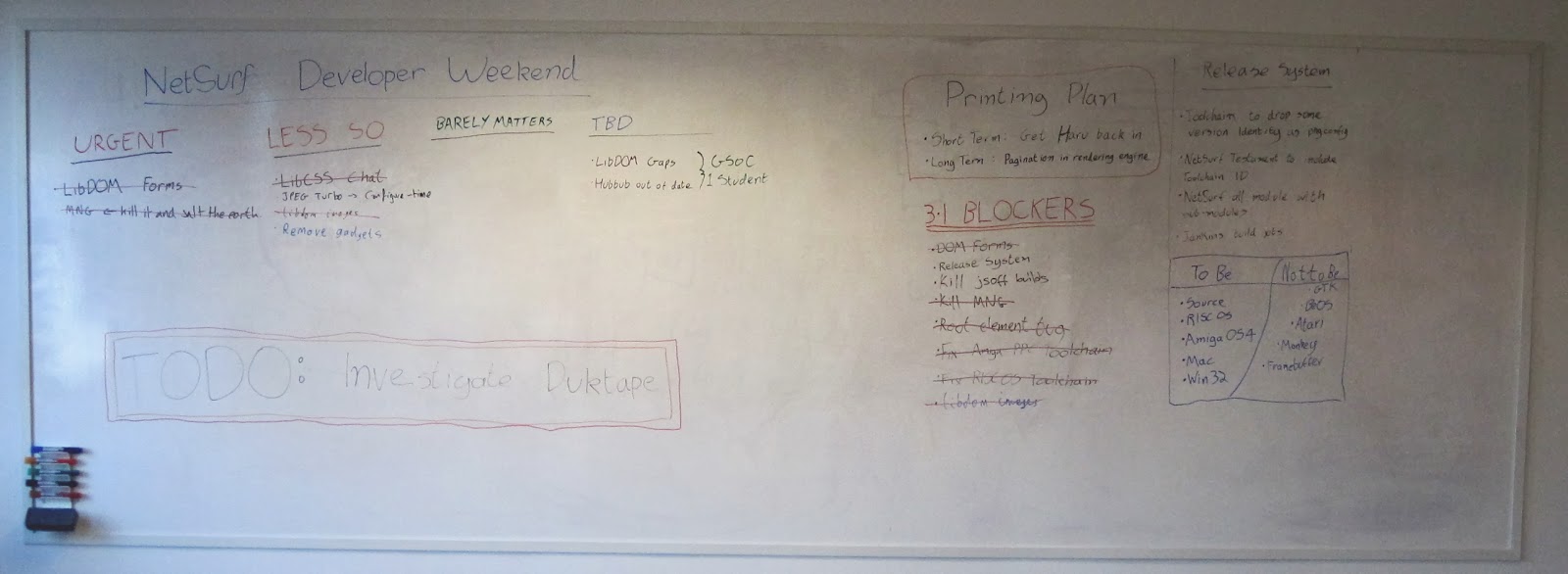
Vincent Sanders: NetSurf Developer Workshop Redux

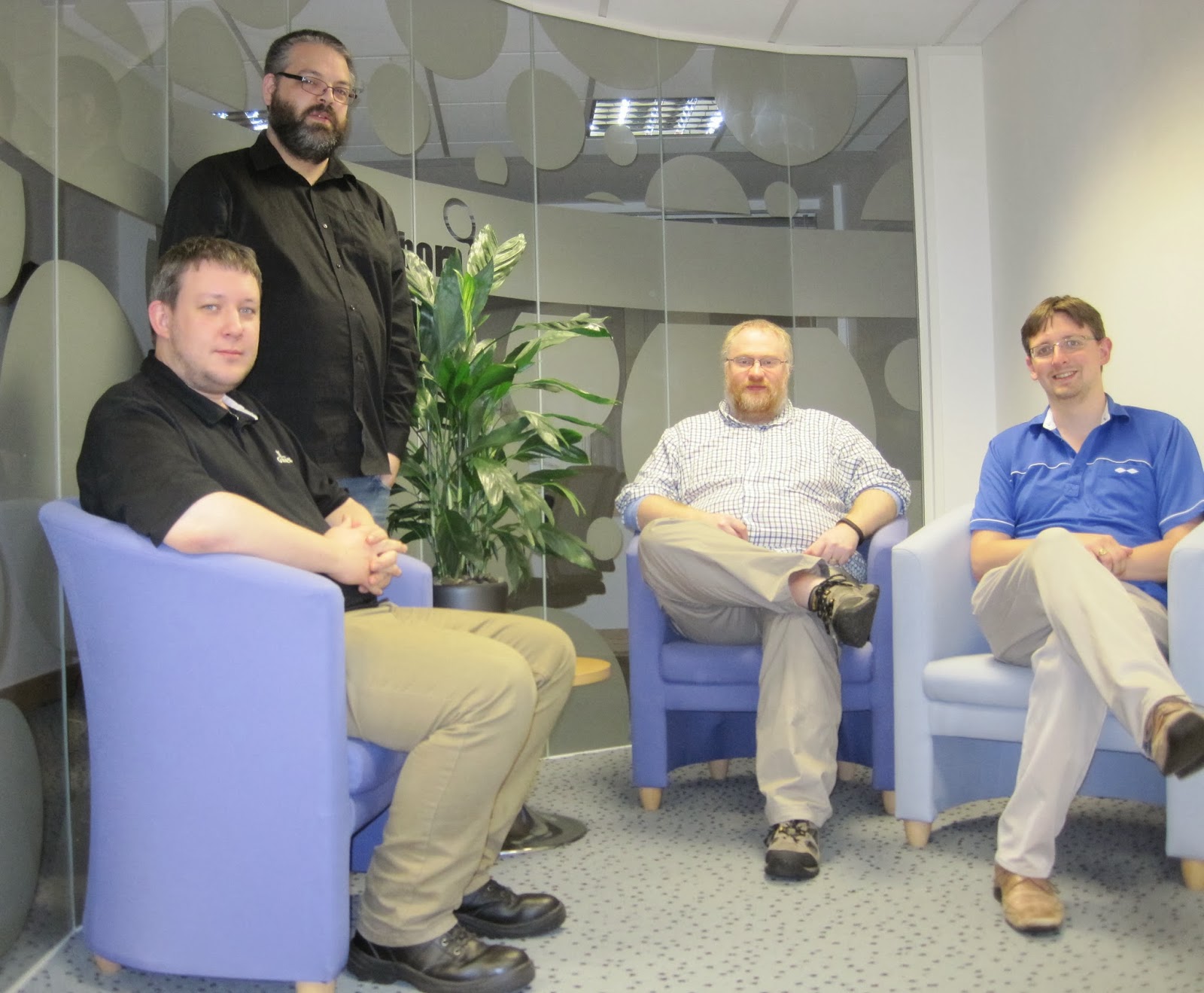
The NetSurf Developers bringing you alternative LOLcat viewing software since 2002Once again the NetSurf developers congregated in Cambridge at the Collabora offices where we were made welcome in a nice environment for the event.

Five developers managed to attend from around the UK Rob Kendrick, Vincent Sanders, Daniel Silverstone, John-Mark Bell and Michael Drake. We also had Chris Young and Fran ois Revol providing some bug fixes remotely.

This was the first time we had all met since the previous event towards the end of 2012 and we took full advantage of this to discuss a pretty extensive agenda in addition to the practical programming tasks.

From Friday lunchtime through to Sunday evening we managed 30 hours of work consisting of over 70 commits to over 100 files.

The whiteboard of our notes

Our main focus was working towards a 3.1 release which is scheduled for early April. Along with the source the release will have binary builds for RISC OS, AmigaOS, Windows and Mac OS X (x86 and ppc). Although the NetSurf project will not be directly releasing binaries for the GTK and Framebuffer frontends we will be ensuring the Debian packages are updated which is our prefered method of distribution for those targets.

We analysed the 3.0 release and formulated an improved process for the future. The 3.1 release will be generated automatically by the CI system ensuring constant results and removing the problems we encountered previously.

A set of release blocking issues was derived which we used as a task list during the workshop.The majority of these were completed including:
DOM based forms
Web forms are a feature Netsurf has supported for a long time and their implementation has not kept up with the rest of the browser. This is a long standing problem area which has resulted in numerous strange bugs with form submission. With this change the form system has been reworked to correctly operate directly from the DOM resulting in the squashing of a large number of bugs and a much improved user experience.

DOM based image loading
Up to now image fetching was performed only during the rendering of a page. With this change when the image link is placed into the DOM during the page parse it is scheduled to be fetched, this should give an improved user experience as images should be available earlier in a pages render.

Removal of MNG support
NetSurf has supported MNG since the 1.0 release, indeed the MNG library used to provide the PNG support too though we have long ago transitioned to libPNG. Alas the web has moved on and MNG has been largely forgotten, the libMNG library that performs the image decoding is old and generally unsupported specifically lacking security updates.

The build issues with libMNG (lack of pkg-config, reliance on libcms1 etc.) were causing maintenance issues in code nobody was actually using (there were crash bugs discovered during its removal!). Because of these issues it was decided to join the vast majority of browsers and remove support for this format.
The developers also addressed several issues with toolchain construction and a number of annoying usability bugs.

Plans for how to improve printing support we made. Initially we intend to fix the existing haru based pdf generation using this to print via pdf and in future have correct css styled page paginated printing render output.

The perennial issue of javascript was discussed however, while efforts to improve the existing support are ongoing, our usage of the spidermonkey library continues to raise various challenges including platform support and API changes between versions.

Due to these issues it has been suggested that we might add support for using the duktape JS engine instead, initial results are promising but given the size of the task of implementing an additional javascript engine binding further investigation is necessary before making a commitment.

Amongst the other discussions the group has also agreed that we will once again apply to be a GSoC organisation for a single student with some very focused projects:
  • Improving our HTML5 parser (hubbub)
  • Improving the DOM library implementing missing functionality.
While neither of these projects are as fashionable as some of our previous proposals they are well defined enough that as a group we believe we could offer enough support to the student to make their experience a pleasurable one and get the resulting code reviewed and merged promptly.

This event was very successful with a great deal achieved, the project is much more likely to be in a good shape to release 3.1 by April now and the meeting has given the developers a much welcomed boost.

I would like to extend the groups thanks to Robert McQueen for letting us use the Collabora offices, Dor e Carrier for organising all the administrative things and to Vivek Dasmohapatra for coming out on his Sunday afternoon to let us back in after locking ourselves out.


5 January 2014

Jon Dowland: 2013 In Fiction

I read a lot this year - I'll write more about that and reflections on goodreads in another post - but most of the things I read weren't published in 2013. (I should also write a bit about my thoughts on e-readers). However, it seems I have enough to write about 2013's novels to make a round-up post worthwhile, so here we go.
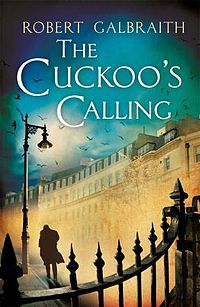
The Cuckoos Calling UK cover
This year, crime author Robert Galbraith published his first novel The Cuckoo's Calling. I'd never have heard of it if Galbraith was not outed as an alias for Joanne "JK" Rowling. Clues that Rowling was working on a detective story exist as early as a Guardian preview article in 2012 for her last novel, The Casual Vacancy. Further hints, for me, that this was no first-time author were the taglines from Ian Rankin and Val McDermid on the cover, writers of a calibre I'd be surprised a new author could attract. However I don't know whether they were on the pre-unveiling cover or not. Rowling was upset be outed, having enjoyed the freedom to write without the baggage of expectation that she is subject to. I hope she's pleased: prior to her unmasking the novel was warmly received by the (admittedly relatively small) number of people who read it. And a very good novel it is too. It starts with a genre clich of a grizzled, meloncholy detective, Mr. Cormoran Strike, in an upstairs office with a neon light flickering through the window, but fleshes the story out both forwards - a client, a mysterious death - and backwards - how did Mr. Strike end up in that upstairs office - living out of it, no less? As is traditional for the genre there's a very clever twist. What I really enjoyed about Cormoran Strike was Galbraith/Rowling moving quickly from Chandler-esque everyman to a well fleshed-out, complex protagonist, intertwining the development of the character with the unfolding of the wider plot. I'm looking forward to the sequel, expected in 2014.
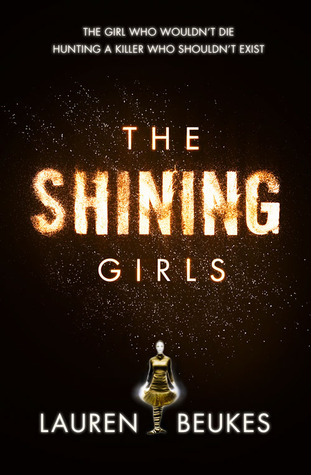
The Shining Girls UK cover
A second surprise favourite this year was Lauren Beukes' time-tripping crime story The Shining Girls. A monsterous murder of women somehow finds a room in Chicago that lets him travel through time (or perhaps the room finds him). He uses this facility to stalk and murder a set of Shining Girls: women who, for one reason or another, literally 'shine' in his perception of them. One such woman survives his first attack and decides to try and find out who attacked her, and why. The crimes are described in a brutal fashion which - from a distance - resemble the sometimes glorified violence for which crime fiction is sometimes criticised, but the focus of the story is very much on the victims: they are fully fleshed out characters and each death is felt by the reader as a genuine tragedy. I discovered Beukes when her earlier novel Zoo City was included in a Humble eBook bundle. On reading The Shining Girls I felt that the novel deserved to be more widely known than I would expect it to be trapped in the ghetto of genre fiction, so I was pleased to discover that the very mainstream Richard and Judy Book Club discovered it. In established author news, Terry Pratchett, having adopted speech recognition for writing (to combat his debilitating Alzheimer's) has seemingly managed to accelerate his rate of production and squeezed out at least two this year: The Long War with Stephen Baxter is the sequel to 2012's The Long Earth which I very much enjoyed, but it really felt like "difficult second novel" to me. Hopefully there'll be a third. Raising Steam, the 40th Discworld novel, was an enjoyable romp around the concept of steam trains, featuring the relatively new Moist von Lipwig who has managed to become one of my favourite Discworld characters. I can't think of much more to say about the novel, really. It's a Discworld novel, probably not the best introduction to the series for a new reader, but will give a reader familiar with the franchise everything they expect, and possibly no more. Iain Banks sadly died this year, shortly after the publication of his last novel, The Quarry. It's sat on my hardback shelf for the time being. I couldn't bring myself to read it in 2013. I did read his last SF offering from the year prior, The Hydrogen Sonata. Sadly, yet coincidentally, both of these books examine the nature of living and dying, The Quarry in particular from the point of view of a terminal cancer sufferer. I have a small backlog of unread Banks fiction which I want to take my time over with. Finally, whilst not really a book, I thoroughly enjoyed the BBC's 2013 adaptation of Neil Gaiman's Neverwhere. Natalie Dormer wrote a piece on the making of the drama which should serve as a good introduction. At the time of writing, most of the programmes have disappeared from iPlayer, but I would be surprised if this wasn't released commercially at some point.

21 December 2013

Russell Coker: Links December 2013

Andres Lozano gave an interesting TED talk about the use of electrodes inside the brain (deep brain stimulation) to treat Alzheimers disease, Parkinson s disease, and depression [1]. Daniel Pocock wrote an interesting post commenting on some bad political decisions being made in Australia titled Evacuating Australia [2]. You can read that as a suggestion to leave Australia or to try and make Australia better. Marco Tempest gave an interesting TED talk about Nikola Tesla [3]. The presentation method is one that I ve never seen before so I recommend watching the talk even if you already know all about Tesla. Charmian Gooch gave an interesting TED talk about global corruption [4]. I think we need people to send the information on shell company ownership to organisations like Wikileaks. The punishment for leaking such information would be a lot less than Chelsea Manning is getting and the chance of getting caught is also low. Rich Mogul wrote an interesting and insightful article for Macworld about the Apple approach to security problems [5]. To avoid the problem of users disabling security features they work to make the secure way of doing things EASIER for the user. That won t work with all security problems but it s something we need to think about when working on computer security. Ray Raphael gave an interesting TED talk about the parts of the US revolution that don t appear in history books [6]. He warns the listener to beware of the narrative forms, but another way to interpret his talk is that you should present your version of history in the narrative form that is best accepted. That lesson is well known and it s easy to see history being deliberately distorted in most media outlets. Will Wright gave an interesting TED talk about how he designed the game Spore and his ideas about games in general [7]. Spore is a really good game. Chris Lintott gave an interesting TED talk about crowd-sourced astronomy titled How to Discover a Planet from Your Sofa [8]. He referenced the Zooniverse.org site which lists many crowd-sourced science projects [9]. Jake Socha gave an interesting TED talk about flying snakes, you have to see this to believe it [10]. Nikita Bier gave an interesting TED talk about his webapp to analyse economic policies [11]. Apparently 60% of people were going to vote in their best economic interest before seeing his site and 66% would do so afterwards that could change an election result. Anya Kamenetz wrote an interesting article for Salon about The Iliad Project which aims to use Indigogo to help identify new anti-biotics [12]. The current ways of discovering anti-biotics aren t working, lets hope this one does. Peter Finocchiaro wrote an interesting Salon article about how right-wing politicians in the US were opposed to Nelson Mandela [13] racism meets anti-communism. Katie McDonough wrote an interesting Salon article about Rick Santorum and Bill O Reilly comparing Obamacare to apartheid while supposedly honoring Nelson Mandela [14], Katie also notes that Nelson enshrined universal healthcare in the South African constitution something all countries should do. Mary Elizabeth Williams wrote a Salon article about Susan Boyle s announcement about being diagnosed with Asperger Syndrome [15]. Not a surprise though, some people can be diagnosed with Autism by merely watching them on TV. Amelia Hill wrote an article for The Guardian/The Observer about the educational results of Home Schooling [16]. Apparently Home-Schooled kids learn significantly more and home-educated children of working-class parents achieved considerably higher marks in tests than the children of professional, middle-class parents and that gender differences in exam results disappear among home-taught children . Wow, Home Schooling beats gender and class problems! I m sure it s even better for GLBT kids too. Robert Reich wrote an interesting Salon article about the way rich people in the US give tax-deductable (taxpayer supported) donations to charities that benefit themselves [17]. Dan Savage wrote a very funny review of Sarah Palin s latest Christmas book, one classic quote is why should I have to read the whole thing? Lord knows Sarah Palin didn t write the whole thing [18]. He makes a good point that we should use the term happy holidays instead of happy Christmas just to show that we aren t assholes.

9 November 2013

Russ Allbery: Review: Fantasy & Science Fiction, July/August 2011

Review: Fantasy & Science Fiction, July/August 2011
Editor: Gordon van Gelder
Issue: Volume 121, No. 1 & 2
ISSN: 1095-8258
Pages: 258
Nothing of particular interest in the book reviews in this issue, although I was entertained to see Charles de Lint review a collection of the Prince Valiant strip. I have memories of that strip being one of the most boring works of art created by mankind. De Lint, of course, quite likes it. Our tastes seem to be very disjoint, although I have to admit that I've not read it collected and it may be more coherent and more interesting in that format. The science column in this issue, by Paul Doherty and Pat Murphy, deserves special mention. It's on roshambo (rock-paper-scissors), human difficulties with randomness, and strategy in roshambo competitions. It's also the first essay I've read that clearly explains how there can be strategy to roshambo, and why that strategy is worth studying. Even though the primary topic of the column is randomness, it's worth reading from the perspective of strategy in competitive human vs. human games. "Bronsky's Dates with Death" by Peter David: Anyone familiar with PAD's body of work will immediately expect a humorous story with some deeper thoughtful bits, and that's exactly what this is. Bronsky, the title character, is a man almost incapable of saying exactly what's on his mind, and what's on his mind is his eventual death. Not that it bothers him that much; he's just thinking a lot about it. But his incessant discussion of it certainly bothers the people around him. This leads to a few entertaining exchanges with his family, and then to more entertaining exchanges with Death. Or Deaths, as there appear to be several different kinds. I found the exact metaphysics a bit confused, but the ending was still touching and a bit funny. (7) "The Way It Works Out and All" by Peter S. Beagle: This is a reprint of a special fund-raising story about Avram Davidson, so a lot of it was lost on me given that I know almost nothing about Davidson and have yet to get to any of his novels I own. But even without that background, it's a diverting story of hidden and parallel worlds and unexpected explorations. There isn't all that much in the way of a plot, but it's a nice bit of characterization set against a fun SF twist. (6) "Less Stately Mansions" by Rob Chilson: This is a story about conservatism in life, about a farmer staying on his farm and resisting change, and about nostalgia, but I liked it much better than I normally like stories with those themes. It's set against a future world in which climate change is making life increasingly untenable. Humans are migrating into space colonies of various types, but Jacob refuses. This frustrates some parts of the family who want a piece of the substantial cash-out he's being offered for his farm, which of course makes Jacob even more stubborn. It's more of an elegy than a story, but I think it captures a particular stubborn mood, and a conscious decision to go with what one knows even if it doesn't have a long future, quite well. (7) "The Ants of Flanders" by Robert Reed: This is the novella of the issue, and, as you might expect from the author, it's thoughtful, meaty, and satisfying. At the start of the book, the planet is visited by an extraterrestrial ship (or ships it's not entirely clear at first). One of the people near one landing is Bloch, a huge teenager who has an odd lack of natural fear. He stays near the center of the story as Reed slowly develops a cosmology and a galactic political background that makes it clear humans may be incidental to everything that's happening. I liked this. It's a touch depressing in spots, and Bloch is a strange protagonist, but the cosmology is not the normal SF background and sparks some thoughts about how a status quo would be maintained by powers that don't care much about individual lives. The interlude with the leopard is nicely done, even if its significance is inobvious at first. (7) "Hair" by Joan Aiken: This is one of those weird Gothic horror stories about creepy families and half-explained supernatural events that some people love and that do nothing for me. (3) "The Witch of Corinth" by Steven Saylor: This is straight historical fantasy, featuring a Roman and his Greek tutor (heroes, apparently, of a series of historical mysteries) visiting the ruins of Corinth and encountering some bloody and dangerous local conflicts. It's slow and atmospheric, carried along by good characterization and description of ruins. It's not that much of a mystery the characters don't figure things out as much as stick around until the answer becomes obvious but it kept me entertained throughout a sizable story. Numerous elements of the story appear to be fantasy and then get other explanations, but there is a fantasy twist to the ending. (6) "Sir Morgravain Speaks of Night Dragons and Other Things" by Richard Bowes: This odd story is set among the knights of King Arthur on Avalon, where they sleep (mostly), awaiting their call to aid Britain again. Most of the story is told as one-sided dialogue from Morgravain, interspersed with some italic narration. Again, not much of a plot; the story, as such, is figuring out what Morgravain is doing and the point of his interactions with the other knights. I thought it was slight and oddly pointless, but I may have just missed the point. (4) "Someone Like You" by Michael Alexander: A time travel story, but one that's less about time travel per se than about examining and speculating about the alternate paths childhood could take and whether those changes produce different people. It takes some time to figure out what's going on, during which Alexander fills in the protagonist's past and the murder mystery that drives the tale. The time travel mechanism is blatantly hand-waved, making this more of a fantasy than an SF story, which matches the emphasis on emotion and psychology. It's not a bad story, and I think I see where the author was going with the slowly-constructed central conflict, but I still found it hard to take the conflict that seriously. One of the problems with time travel is that undermining of causality also undermines finality of decisions and consequences in ways that can rob stories of their punch. (6) "The Ramshead Algorithm" by KJ Kabza: The first-person protagonist is a well-respected and experienced fixer in a world of chaos and dimensional connection, a world with physics and inhabitants very much unlike ours. But the story doesn't spend much time there; his connection to his home earth is threatened, and he returns to try to stabilize it, which leads to the reader discovering that his family considers him a worthless appendage on a wealthy business family whose sole purpose in life is to stay out of their way. And his portal is rooted in a hedge maze that his father intends to demolish. This is one of those stories that gets more interestingly complex the deeper one gets into it. Ramshead's family is badly screwed up along multiple axes, but not without some hope of redemption. He's desperate and ineffective in his home universe, but more confident and capable when it comes to dealing with dimensional portal problems (although he still seems very young and relies on tools given to him by others). And there's always more going on than it first appears, and not as few obvious villains as it first appears. Good stuff, although I would have liked to understand more about Ramshead's world. (7) Rating: 7 out of 10

5 November 2013

Russ Allbery: Review: Asimov's, August 2011

Review: Asimov's Science Fiction, August 2011
Editor: Sheila Williams
Issue: Volume 35, No. 8
ISSN: 1065-2698
Pages: 112
The editorial this issue is about the Dell Magazines Award, so newsy without a lot of content (particularly since we don't get to read the winners). Silverberg's column is much more interesting, focusing on the complex rules of the honor code of the Albanian highlands and pointing out that there's more complexity and strangeness in things we can find on Earth than in a lot of science fiction. Even within the rules of real human cultures. James Patrick Kelly's column this issue is an interesting summary of what graduates of the Clarion writing workshop learned, in their own words. It's a nice barrage of quick writing tips, and an interesting view of what people take away from a writing workshop. The book review column this issue is Peter Heck's normal workman-like job. "The End of the Line" by Robert Silverberg: Someday, I really should read Lord Valentine's Castle. As you might guess from this comment, this is another Majipoor story. This one follows an official who is part of an advance party for the Coronal Lord, the ruler (of sorts). He's decided, as part of those duties, to take the opportunity to learn more about the aboriginal people of Majipoor: the somewhat mysterious metamorphs, or Piurivar. I'm not that familiar with the history of Majipoor, since all I've read is this story and one other, none of the novels. Apparently, knowing that the official in question is named Stiamot will place this story for more familiar readers. For the unfamiliar, such as myself, there's a lot of politics here and what's clearly background for a major event in the world, but as a standalone story it's a bit unsatisfying (and grim). It's not that clear why things had to turn out the way they did, and the characters seem largely without agency. It's well-written, but mostly a story for fans of the series, I think. (6) "Corn Teeth" by Melanie Tem: This is a tight third-person story about a human child raised by alien foster parents, and it's deeply disturbing. Not because of the fostering, which appears wonderful and loving, but because it's a train wreck sort of story: the reader can see the horrible coming and can't do anything about it (and it turns out even worse than one might expect). It's also a story built around failure of communication and failure of empathy, and has a monumentally depressing ending, the kind that leaves scars. I'm sure all of this is entirely intentional; it seems very well-written. But I really didn't want this much horrible misunderstanding and depressing hopelessness in my reading. (2) "Watch Bees" by Philip Brewer: I rather liked this story even if the protagonist is an awful person. The story is set in a future of bioengineered insects and hard economic times, and it features a man who is supposedly working his way from farm to farm to get back home. What he's actually after is more complicated and is closely related to the defense systems that keep intruders off of farms. You might guess some of the rest from the title. It's a story about understanding layered defense systems, and about economic warfare. I didn't care much for any of the characters, but the story is well-plotted and kept me interested in seeing what would happen next. (6) "For I Have Lain Me Down on the Stones of Loneliness and I'll Not Be Back Again" by Michael Swanwick: By Swanwick, so it's a little odd, but I found this story surprisingly moving and ambiguous. It's about an American of Irish descent, a trip to Ireland, and a love affair with a fierce Irish nationalist, all set against an SF background of an Earth conquered by benevolent aliens. It's angry, uncertain, fanatical, and realistic by turns, and left me with profound mixed feelings. I think it does a good job capturing in a brief story the emotional complexities of what it means to give onself to a cause. (7) "We Were Wonder Scouts" by Will Ludwigsen: This is a short and odd story about a variant of the Boy Scouts founded by a man who is a little too obsessed with the paranormal, and an outing in the woods that turns rather creepy. It's a type of story that I'm not very fond of: one that twists the delight of discovery into something dark and mundane. I suppose you could call it horror; it's more horror than fantasy, at least. Anyway, not my thing. (3) "Pairs" by Zachary Jernigan: This story, on the other hand, isn't as dark as it seems like it should be from the setup. Humans have been conquered and enslaved by more powerful alien races, and now human souls are a profitable business. The protagonist is a person who has been embodied in a spaceship, and who works with (and monitors) another largely insane embodied person as they work as couriers, carrying souls to their buyers. But neither of them are as fully under control as they might appear, which is the point of the story. There is no grand tale of redemption, and the price is high, but I found the psychological portrayal oddly satisfying and faintly hopeful, and I was intrigued by the world background. (7) "Paradise is a Walled Garden" by Lisa Goldstein: The cover story, this is by far the best story of the issue. It's steampunk, set in a world where Muslim civilization was not pressed back by Christianity and continues to thrive into the reign of Queen Elizabeth as, among other things, makers of automata. A girl has managed to get herself a job in a British factory by posing as a boy and is the first to sound the alarm when the automata that do most of the work go strangely (and violently) haywire. That leads to her being assigned to the subsequent delegation to Al-Andulus (Muslim Spain, if you're not familiar with that name from history). The protagonist is the best part of this story. She's thoughtful, resourceful, and delights in learning things, something that she's rarely had the opportunity to do. She's also utterly unintimidated. In Al-Andulus, she thrives, despite the contempt of the leader of the expedition and some dangerous intrigues around the source of the anomalous behavior. I won't spoil the ending, but it's a delight, leaving the reader with a lot of hope for her future. I also liked the portrayal of the Muslim world, which is engrossed in its own business and has its own advantages and disadvantages, but is at least open to and focused on learning and technological development. The contrast with the superstitious British delegation is both pointed and historically grounded in Muslim relations with Europe around the point of divergence of Goldstein's world. (8) Rating: 7 out of 10

2 November 2013

Robert Collins: Learning is hard

I feel like I m taking a big personal risk writing this, even though I know the internet is large and probably no-one will read this :-) . So, dear reader, please be gentle. As we grow as people, as developers, as professionals some lessons are are hard to learn (e.g. you have to keep trying and trying to learn the task), and some are hard to experience (they might still be hard to learn, but just being there is hard itself ) I want to talk about a particular lesson I started learning in late 2008/early 2009 while I was at Canonical sadly one of those that was hard to experience. At the time I was one of the core developers on Bazaar, and I was feeling pretty happy about our progress, how bzr was developing, features, community etc. There was a bunch of pressure on to succeed in the marketplace, but that was ok, challenges bring out the stubborn in me :) . There was one glitch though we d been having a bunch of contentious code reviews, and my manager (Martin Pool) was chatting to me about them. I was as far as I could tell doing precisely the right thing from a peer review perspective: I was safeguarding the project, preventing changes that didn t fit properly, or that reduced key aspects- performance, usability from landing until they were fixed. However, the folk on the other side of the review were feeling frustrated, that nothing they could do would fix it, and generally very unhappy. Reviews and design discussions would grind to a halt, and they felt I was the cause. [They were right]. And here was the thing I simply couldn t understand the issue. I was doing my job; I wasn t angry at the people submitting code; I wasn t hostile; I wasn t attacking them (but I was being shall we say frank about the work being submitted). I remember saying to Martin one day look, I just don t get it can you show me what I said wrong? and he couldn t. Canonical has a 360 review system every 6 months / year (it changed over time) you review your peers, subordinate(s) and manager(s), and they review you. Imagine my surprise I was used to getting very positive reports with some constructive suggestions when I scored low on a bunch of the inter-personal metrics in the review. Martin explained that it was the reviews thing folk were genuinely unhappy, even as they commended me on my technical merits. Further to that, he said that I really needed to stop worrying about technical improvement and focus on this inter-personal stuff. Two really important things happened around this time. Firstly, Steve Alexander, who was one of my managers-once-removed at the time, reached out to me and suggested I read a book Getting out of the box and that we might have a chat about the issue after I had read it. I did so, and we chatted. That book gave me a language and viewpoint for thinking about the problem. It didn t solve it, but it meant that I got it , which I hadn t before. So then the second thing happened we had a company all hands and I got to chat with Claire Davis (head of HR at Canonical at the time) about what was going on. To this day the sheer embarrassment I felt when she told me that the broad perception of me amongst other teams managers was and I paraphrase a longer, more nuance conversation here technically fantastic but very scary to have on the team will disrupt and cause trouble . So, at this point about 6 months had passed, I knew what I wanted I wanted folk to want to work with me, to find my presence beneficial and positive on both technical and team aspects. I already knew then that what I seek is technical challenges: I crave novelty, new challenges, new problems. Once things become easy, it call all too easily slip into tedium. So at that time my reasoning was somewhat selfish: how was I to get challenges if no-one wanted to work with me except in extremis? I spent the next year working on myself as much as specific projects: learning more and more about how to play well with others. In June 2010 I got a performance review I could be proud of again I was in no way perfect, but I d made massive strides. This journey had also made huge improvements to my personal life a lot of stress between Lynne and I had gone away. Shortly after that I was invited to apply for a new role within Canonical as Technical Architect for Launchpad and Francis Lacoste told me that it was only due to my improved ability to play well with others that I was even considered. I literally could not have done the job 18 months before. I got the job, and I think I did pretty well in fact I was awarded an internal Spotlight on Success award for what we (it was a whole Launchpad team team effort) achieved while I was in that role. So, what did I change/learn? There s just a couple of key changes I needed to make in myself, but a) they aren t sticky: if I get overly tired, ye old terrible Robert can leak out, and b) there s actually a /lot/ of learnable skills in this area, much of which is derived lots of practice and critical self review is a good thing. The main thing I learnt was that I was Selfish. Yes capital S. For instance, in a discussion about adding working tree filter to bzr, I would focus on the impact/risk on me-and-things-I-directly-care-about: would it make my life harder, would it make bzr slower, was there anything that could go wrong. And I would spend only a little time thinking about what the proposer needed: they needed support and assistance making their idea reach the standards the bzr community had agreed on. The net effect of my behaviours was that I was a class A asshole when it came to getting proposals into a code base. The key things I had to change were:
  1. I need to think about the needs of the person I m speaking to *and not my own*. [Thats not to say you should ignore your needs, but you shouldn't dwell on them: if they are critical, your brain will prompt you].
  2. There s always a reason people do things: if it doesn t make sense, ask them! [The crucial conversations books have some useful modelling here on how and why people do things, and on how-and-why conversations and confrontations go bad and how to fix them.]
Ok so this is all interesting and so forth, but why the blog post? Firstly, I want to thank four folk who were particularly instrumental in helping me learn this lesson: Martin, Steve, Claire and of course my wife Lynne I owe you all an unmeasurable debt for your support and assistance. Secondly, I realised today that while I ve apologised one on one to particular folk who I knew I d made life hard for, I d never really made a widespread apology. So here it is: I spent many years as an ass, and while I didn t mean to be one, intent doesn t actually count here actions do. I m sorry for making your life hell in the past, and I hope I m doing better now. Lastly, if I m an ass to you now, I m sorry, I m probably regressing to old habits because I m too tired something I try to avoid, but it s not always possible. Please tell me, and I will go get some sleep then come and apologise to you, and try to do better in future. Less-assily-yrs,
Rob

Russ Allbery: Review: Fantasy & Science Fiction, May/June 2011

Review: Fantasy & Science Fiction, May/June 2011
Editor: Gordon van Gelder
Issue: Volume 120, No. 5 & 6
ISSN: 1095-8258
Pages: 258
The editorial in this issue is about the investigation into the troubling death of long-time contributor F. Gwynplain MacIntyre (which was not his real name). It's disturbing, but to me it underscores one of the things that I love about the Internet: people for whom life isn't working very well can still find an outlet, make friendships, and control how they choose to present themselves to the world on-line. That's something quite valuable, and part of why the pushes for "real names" always gives me pause. Somewhat thematically related, this issue also features a non-fiction essay by Maria E. Alonzo about her investigation of Jesse Francis McComas, her great-uncle but better known to the SF community as one of the founding editors of F&SF and co-editor of the famous classic anthology Adventures in Time and Space. This is mostly a curiosity, but it's fun to read about the sense of triumph in tracking down lost family history. This issue also features a Chris Moriarty book review column, always a plus, as well as a few positive reviews of obscure superhero movies by Kathi Maio (plus the required grumbling about a more mainstream film). "The Final Verse" by Chet Williamson: This is more of a horror story than I would normally like, but I got pulled into the investigation of an old bluegrass song and the guesswork and footwork required to track down where it came from. Williamson does a good job with the tone and first-person narration, and the degree to which the protagonist cares about the song to the exclusion of the horrific happenings of the story blunts the horror. Not quite my thing, but I thought it was well-done and played well with the possible meanings of song lyrics. (6) "Stock Photos" by Robert Reed: This is well-written, like nearly all Reed stories, but it lacked enough clues for the reader for me. It's a very short story about a man who's out mowing his lawn when approached by two strangers who apparently want to take photographs of him for stock image collections. Then things get rather weird, but without any explanation, and the ending lost me completely. Frustrating. (It is partially explained by the later "The Road Ahead" story in this same issue.) (4) "The Black Mountain" by Albert E. Cowdrey: From one of F&SF's most reliable story-tellers to another, and this is a more typical story. Cowdrey offers an abandoned and very strange cathedral for an obscure religion, a conflict over a development project, and some rather creepy results, all told in Cowdrey's entertaining fashion. Some places you just don't mess with. (6) "Agent of Change" by Steven Popkes: Told Dos-Passos-style with news excerpts, web sites, and the transcript of an emergency committee, this story shows the discovery of Godzilla, or something akin to Godzilla, in the Pacific, where it's destroying whaling vessels. I do like this style of storytelling, and here it mixes well with humor and a bit of parody as Popkes shows how each different news outlet puts its own recognizable spin on the story. The story isn't particularly memorable, and it doesn't end so much as just stop, but it was fun. (7) "Fine Green Dust" by Don Webb: This story is dedicated to Neal Barrett, which will give SFF short story readers a warning of weirdness to come. In a near future where global warming as continued to make summers even more miserable, the protagonist happens across a naked woman painted green. The green turns out to be a sun block that claims to assist humans in metamorphosis into animals. Most of the story is the protagonist trying to decide what to think of that, interspersed with staring at his neighbor's naked daughter. It's mildly amusing if you don't think about it too much and don't mind the rather prominent male gaze. (5) "Rampion" by Alexandra Duncan: The novella of the story, this is set in Muslim Spain some time during the long fights between Muslims and Christians in the north. It's told as two parallel stories: one telling the protagonist's first meeting with his love, and the second following him as a blind man, some time later, deciding whether, and how, to re-engage with the world. The style feels like fantasy, but there's very little overt fantasy here, and the story could be read as historical adventure. It's good adventure, though; conventional in construction, but with some romance and some drama and a good ending. (7) "Signs of Life" by Carter Scholz: This is to science fiction what "Rampion" is to fantasy: not really SF in the classic sense, but fiction about the process of science. The protagonist works on gene sequencing and is mildly obsessed with a visualization of junk DNA in an attempt to find patterns in it. Like a lot of fiction about science, it's primarily concerned with office politics, grant funding, and an awful boss. There is a faint touch of the supernatural, but that strand of the story doesn't amount to much. There's a happy ending of sorts, but the story left me with a bad taste in my mouth, and I'd completely forgotten it by the time I sat down to write this review. (4) "Starship Dazzle" by Scott Bradfield: I've never seen much in Bradfield's ongoing series of stories about Dazzle, the talking dog. In this one, he's sent via rocket on a one-way trip into outer space and ends up making a bizarre sort of first contact. Like the other Dazzle stories, it's full of attempts at humor that don't really work for me, even though you'd think I'd be sympathetic to the mocking of our commercialization of everything. The ending is just silly, and not in a good way. (3) "The Old Terrologist's Tale" by S.L. Gilbow: I love the setup for this story. It's set in some sort of far future in which terraforming has become routine, and a group of people are telling each other stories over drinks. The first-person protagonist is a terrologist, someone who designs planets (and the technology is available to do this almost from scratch). The conversation is taking a turn towards the humiliating, with a politician belittling the work of terrologists, when an old terrologist who has been listening quietly starts telling a story about designing worlds, both mundane and dangerously beautiful. Gilbow does a great job here capturing blithe self-importance, the habit of belittling other people's technical work, and revenge via storytelling with a nasty barb. This was my favorite story of the issue. (7) "Altogether Elsewhere, Vast Herds of Reindeer" by Ken Liu: This is a rather odd but quite touching story about mothers, daughters, nature, connection, and uploading. It's set after a singularity, in a time when all humans are uploaded into computers and exploring higher dimensions, digital natives in a much deeper sense than is meant today. But Rene 's mother is an Ancient, from before the singularity and still three-dimensional, and she wants to spend some time with her daughter. That leads to a memorable moment of connection, without pulling Rene entirely out of her father's world. Well done. (7) "The Road Ahead" by Robert Reed: Two Reed stories in one issue! And this one is a sequel to "Stock Photos" from earlier, since apparently I wasn't the only one who found it hopelessly confusing. It provides some backstory and makes a bit more sense of the first story, and that also makes it a more interesting story in its own right. The stock photo concept wasn't entirely a lie, as I had thought it was after the first story. There is analysis, anticipation, and trends behind who the pair take pictures of. But this story explores some internal tension, some conflict between them and some knowledge that the woman has that the man doesn't. And in the process it makes everything creepier, but also more interesting, and provides a hint at a really dark way of viewing the news media. I would say that this salvages "Stock Photos," except that I don't think "Stock Photos" is necessary now that one can read this story. (7) "Music Makers" by Kate Wilhelm: This is another story about investigation of the history of music, mingled with the supernatural, but unlike the story that opened this issue, it's not horror. Rather, it's a gentle and sweet fantasy about the power of music and benevolent ghosts and a community coming together. It's a positive and happy note on which to end the issue. (6) Rating: 6 out of 10

13 October 2013

Robert Collins: key transition time

I ve transitioned to a new key announcement here or below. If you ve signed my key in the past please consider signing my new key to get it integrated into the web of trust. Thanks!
-----BEGIN PGP SIGNED MESSAGE-----
Hash: SHA1,SHA256
Sun, 2013-10-13
Time for me to migrate to a new key (shockingly late - sorry!).
My old key is set to expire early next year. Please use my new key effective
immediately. If you have signed my old key then please sign my key - this
message is signed by both keys (and the new key is signed by my old key).
old key:
pub 1024D/FBD3EB8E 2002-07-20
Key fingerprint = 9222 8732 859D 25CC 2560 B617 867B F9A9 FBD3 EB8E
new key:
pub 4096R/AAC0E286 2013-10-13
Key fingerprint = 8244 0CEA B440 83C7 9431 D2CC 298E 9A19 AAC0 E286
The new key is up on the keyservers, so you can just pull it from there.
- -Rob
-----BEGIN PGP SIGNATURE-----
Version: GnuPG v2.0.19 (GNU/Linux)
iEYEARECAAYFAlJZ8FEACgkQhnv5qfvT644WxACfWBoKdVW+YDrMR1H9IY6iJUk8
ZC8AoIMRc55CTXsyn3S7GWCfOR1QONVhiQEcBAEBCAAGBQJSWfBRAAoJEInv1Yjp
ddbfbvgIAKDsvPLQil/94l7A3Y4h4CME95qVT+m9C+/mR642u8gERJ1NhpqGzR8z
fNo8X3TChWyFOaH/rYV+bOyaytC95k13omjR9HmLJPi/l4lnDiy/vopMuJaDrqF4
4IS7DTQsb8dAkCVMb7vgSaAbh+tGmnHphLNnuJngJ2McOs6gCrg3Rb89DzVywFtC
Hu9t6Sv9b0UAgfc66ftqpK71FSo9bLQ4vGrDPsAhJpXb83kOQHLXuwUuWs9vtJ62
Mikb0kzAjlQYPwNx6UNpQaILZ1MYLa3JXjataAsTqcKtbxcyKgLQOrZy55ZYoZO5
+qdZ1+wiD3+usr/GFDUX9KiM/f6N+Xo=
=EVi2
-----END PGP SIGNATURE-----

Next.

Previous.