Search Results: "radu"

27 February 2013

Julien Danjou: OpenStack Ceilometer and Heat projects graduated

The OpenStack Technical Committee have voted these last weeks about graduation of Heat and Ceilometer, to change their status from incubation to integrated. The details of the discussion can be found in the TC IRC meetings logs for the brave. The results are:
Approve graduation of Heat (to be integrated in common Havana release)?
yes: 10, abstain: 1, no: 1
Approve graduation of Ceilometer (to be integrated in common Havana release)?
yes: 11, abstain: 1
Therefore both projects have been graduated from Incubation to Integrated status. That means that Heat and Ceilometer will be released as part as OpenStack for the next release cycle Havana, due in Autumn 2013. For people being curious, we the Ceilometer team put up a nice wiki page about our status and what we think we were ready to jump. For the curious, The OpenStack Technical Committee charter has some explanations about the incubation and integration process. What about Grizzly? Both projects will be released with Grizzly too, obviously, since they already follow the release process of OpenStack. What about core?
The question that has been raised several times to me is if that means the projects are becoming Core projects. The answer is no, because how to become a Core project is still under discussion and is more a matter for the Board of Directors than the Technical Committee. But this is definitely a step in this direction. Anyway, from a technical point of view, this means both projects are now onboard with other OpenStack components so you can enjoy them!

21 February 2013

Biella Coleman: Coding Freedom: The Ethics and Aesthetics of Hacking

Although the book has been out for a number of months, available for purchase and download, Coding Freedom finally has a dedicated home on the Interwebz. Based on my graduate research in anthropology and my dissertation, the book takes an up front and close look at various personal, affective, ethical and political dimensions of free software development. While the book is not on Debian per se, there is one chapter dedicated to the project and a whole lot of Debian developers were interviewed for the book. You can read some reviews and if you like what you see, take a dip.

16 February 2013

Christian Perrier: DPL game or why I'm not your man

I am in some way flattered (en_FR?) that some people think that I should stand as DPL candidate (here, or there, or there). Thank you, ladies and gentlemen, for your confidence, it's appreciated. Still, I won't stand and I feel like I should explain why. Yes, I now have some experience in the Debian Project after more than 11 years as DD. Yes, I like to represent the project and I think I don't do that so badly when I do it (which is not as often as one might imagine). Yes, I feel like I have some experience in acting as a "leader" though I often have doubts about this, probably just like many people who have management duties in their professional life. Yes, I often define myself as a non-technical person which helps in dealing with problems and projects with different perspectives. Still, this is often not so true and that extends to my professionnal activity. I *am* indeed a technical person but I'm more a "specialist of everything and nothing" in this aspect. That's probably good for a DPL. But, still I won't stand. There are indeed many reasons for this and I'll try to give them here. First of all, Debian has always been a hobby for me. A hobby that sometimes ate several hours a day and still eats part of my time. But still a hobby. It can't become the major part of my life. And I think that someone spending one year as DPL "has" to do it as the major part of her his life. I can't free time from my work schedule. My work, though being in IT, has few to relate with Free Software, and I can't divert part of it with Debian duties...or merge it with Debian duties. For about 3 years, I compensate the loss of two people in my team by working hard and VERY fast, in a constant stress....connecting with Onera nearly all time long and maintaining the level of services our users deserve as high as I can. And I like it. I can't free time from my family schedule. Of course, my children don't request much attention right now, they all live their own lives. Jean-Baptiste is now having a full-time paid job and does great things in a geeky style I recognize very well. Sophie will soon be a great graduated social worker and will start working in next Summer. And Magali is studying physical therapy so that she can later help me recovering after too hard running races..:-). However, last and definitely not least, I have a wonderful wife who I want to share as much as I can with. And I can't share Debian with her. Indeed, Elizabeth is the very first reason for my reasoning.....because she is the center of my life for more than 30 years now. You also know that I happen to run a little bit..:-)...and that requires time too. Something I won't sacrifice as it brought more equilibrium in my life (and a great health, at an age where one has to care about one's health, now). All this doesn't leave much room. And I indeed noticed that my involvement in Debian has reduced noticeably in the past months. That is indeed the most important point: I'm "slowing down" in Debian...or, at least, I'm trying to find an equilibrium where it represents only a part of my hobbies....and not an ever-growing one. Last...maybe not least, I'm somehow pessimistic about the future of the project. You may have read that subtly in my writings, here or there. I feel like we are slowing down in innovation and are slowly feeling short of resources. Renewal in project members doesn't come as fast as it used to. You are free to disagree with me and I hope you'll be right to. But, still, that won't remove my pessimism. And, well, it's hard to lead a project when you're partly pessimistic about it, isn't it? In short, all in all, I'm currently "fighting" in some way to keep motivation for something I deeply love being involved in. And that's really important. And that's why I can't stand: it wouldn't be a good service to the project. It would be good for my ego, certainly (yes, I have one....and sometimes not a small one)....but it wouldn't be a good service to the project, and I also feel it could very well lead me to burnout. And, if you "nominated" me...or think I would candidate for DPL, you don't want me to burnout and vanish from Debian, right? So, this is why I won't stand. And this is why you'll continue to have great Cheese and Wine parties at Debconfs....or boring l10n reports....or, here or there, some broken uploads in the archive..:-)....but not another French DPL, at least not /me. PS: by the way, I have my own list of preferred candidates. Not sure I want it to be public, though...:-)...you'll see soon if I change my mind!

17 January 2013

Matthew Garrett: Experiences with depression

I've been lucky in life. I've known several people who've killed themselves, but I've been friendly with them rather than friends with them. Their deaths have saddened me, but haven't left giant gaping holes that I have trouble imagining filling. I've also been lucky in that I'm not especially predisposed towards depression, and even luckier that the one serious episode I had ended well. That luck means I'm not qualified to speak authoritatively on the topic, but this seems like a good time to share. Most of 2002 wasn't great for me. Many of my friends had graduated and moved away. My PhD, which was what I'd spent the past few years of my life working towards, was going horribly wrong. The girl I liked didn't like me. Lots of individual small things that didn't fundamentally matter, but which build up into overall feelings of isolation and failure at life. I was spending an increasing number of days not leaving bed and not talking to people. It wasn't that I couldn't have fun - socialising was still pleasurable, and I didn't actively avoid people, but it was always tempered with the knowledge that this was temporary and I'd be returning to the unhappiness afterwards. I couldn't see any sequence of events that would turn my life around and restore my happiness. This was how life was, and this was how life was going to be. I'd irrevocably fucked up, and this was my future. Looking back, what strikes me is how reasonable this seemed. I could point at specific things that were making me unhappy, and nobody could argue that it was unreasonable to be unhappy about them. There wasn't any point in speaking to people about it, because what would they be able to do except agree that I was justifiably unhappy? I thought about suicide. Not seriously, because overall life still seemed worthwhile, but I could conceive of a level of further unhappiness that would make it seem like the best choice. I don't think it would ever have occured to me to speak to someone about it first. It seemed like it would be the same argument - I'm justifiably unhappy, I already feel like I'm letting my friends down, what could they do other than tell me that my feelings are wrong or make me feel even more guilty? So, when I saw exhortions for people to speak to someone if they felt suicidal, it seemed like they were talking to people who hadn't thought this through as well as me. It felt like I'd thought this all through carefully and rationally and come to a completely logical decision. If changes in circumstances and further consideration made it seem like suicide was the better choice, that would be because it was the better choice. Maybe other people weren't thinking about this as logically as I was. Maybe they'd have their minds changed by speaking to a friend or a professional. I wouldn't. Of course, with hindsight I was rationalising the way I already felt rather than making entirely rational decisions. I could have rationalised myself to death even though there were (in my case) straightforward ways to make my life better. In any case, I've no idea how close I ever got to that point. Things were at their worst in August - by September I had a new job and new house, and things just got better from there. In the end, the friends I was convinced could do nothing for me ended up giving me the opportunity to find gainful employment and made sure I had somewhere to live. Without them, things might have been different. As it was, I spent less than nine months depressed and it was still the most hellish experience of my life. The thought of returning to that state is terrifying. I was lucky. I might not be again. There's no terribly good moral here. If I'd known more about depression beforehand, I might have been able to identify what was happening to me and seek professional help. Other than that, I didn't learn anything about how to avoid or deal with depression. The experience didn't make me a better person. I've no advice for people in the same situation. The only thing I gained from it all was the realisation that if I'd felt any worse and knew that this was what I faced for the rest of my life, death might not have been the worst choice I had. Depression is a huge social problem and we deal with it badly. We refuse to talk about it, and when we do talk about it we mostly limit ourselves to platitudes about how things will get better or placing the blame on depressed people for not wanting to talk to those around them. Sometimes it doesn't get better. Sometimes talking to those around you will make things worse. People need to be aware of what the effects of depression are and get better at identifying it in others, rather than assuming that they'll be able to ask for help themselves. Society as a whole needs to be better at ensuring that professional support is there for people who need it. And, unless we can make massive improvements in our understanding of the causes of depression and effective mechanisms for countering it, we need to accept that it will cost us friends. Let's redirect the anger we feel at their choice to avoid a lifetime of misery into anger at the society that still hasn't done everything it can to help them.

comment count unavailable comments

31 December 2012

Joey Hess: no longer a perl programmer

This year, I've gradually realized that I no longer identify as a perl programmer. For a decade and a half, perl was the language I reached for to solve any problem that didn't have a good reason to be solved in some other language. Now I only reach for it in the occasional one-liner -- and even then I'm more likely to find myself in ghci and end up with a small haskell program. I still maintain plenty of perl code, but even when I do, I'm not thinking in perl, but traslating from some internal lambda calculus. There's quite a few new-ish perl features that I have not bothered to learn, and I can feel some of the trivia that perl encourages be kept in mind slipping gradually away. Although the evil gotchas remain fresh in my mind! More importantly, my brain's own evaluation of code has changed; it doesn't evaluate it imperatively (unless forced to by an appropriate monad), but sees the gesalt, sees the data flow, and operates lazily and sometimes, I think in parallel. The closest I can come to explaining the feeling is how you might feel when thinking about a shell pipeline, rather than a for loop. Revisiting some of my older haskell code, I could see the perl thinking that led to it. And rewriting it into pure, type-driven, code that took advantage of laziness for automatic memoization, I saw, conclusively that the way I think about code has changed. (See the difference for yourself: before after ) I hear of many people who enjoy learning lots of programming languages, one after the other. A new one every month, or year. I suspect this is a fairly shallow learning. I like to dive deep. It took me probably 6 years to fully explore every depth of perl. And I never saw a reason to do the same with python or ruby or their ilk; they're too similar to perl for it to seem worth the bother. Though they have less arcania in their learning curves and are probably better, there's not enough value to redo that process. I'm glad haskell came along as a language that is significantly different enough that it was worth learning. The deep dive for haskell goes deep indeed. I'm already 5 years in, and have more to learn now than I ever did before. I'm glad I didn't get stuck on perl. But I may be stuck on haskell now instead, for the foreseeable future. I'd sort of like to get really fluent in javascript, but only as a means to an end -- and haskell to javascript compilers are getting sufficiently good that I may avoid it. Other than that, I sense adga and coq beckoning with their promises of proof. Perhaps one of these years. Of course if Bradley Kuhn is right and perl is the new cobol, I know what I'll be doing come the unix rollover in 2038. ;)

18 December 2012

Raphael Geissert: Nicer, but stricter

Lately I've been working on making the redirector nicer to the mirrors and to some potential users. More specifically, those behind a caching proxy.

The redirector is now nicer to traditional web proxies by redirecting to objects that are known not to change with a "moved permanently" code (HTTP status code 301.) This applies to files in the pool/ directory and ".pdiff" files, among others.
Previously, a traditional caching web proxy would sometimes end up with multiple copies of the same object, fetched from different mirrors; and the redirection would not be cached at all. With this change, this is no longer the case.

Using a caching proxy that is aware of the Debian repository design is still more likely to yield better results, however: If my memory serves correctly, apt-cacher has the ability of updating the Packages, Sources, and similar files with the ".pdiff"s on the server side. Apt-Cacher-NG apparently can use debdelta, and so on.
Check my blog post about one APT caching proxy not being efficient for some comments related to those tools.

Another recent change is that mirrors that can't be used by the redirector will no longer be monitored as often as the other mirrors. For instance, if a mirror doesn't generate a trace file (used for monitoring) then the redirector will gradually limit the rate at which the mirror is checked.
This rate-limiting mechanism applies to different kinds of errors, and should reduce the amount of wasted time and bandwidth while still allowing automatic-detection of mirrors that recover.


Projection of a rate-limited mirror over six weeks. The mirror would have to fail in every attempt for that to happen.
N.b. there's a bump in the scale.

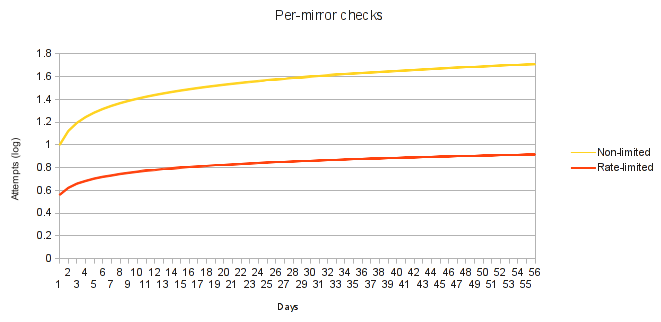
The rate limiter applies an initial exception to allow temporary errors to not affect the use of the mirror by the redirector. After that exception, it is pretty much linear. However, that chart doesn't really reflect the effect of the rate limiter, so put in comparison with the normal checking behaviour:


Comparison of the two behaviours over an 8 weeks period using a logarithmic scale.
Nice chart colours by Libreoffice.

The code to detect mirrors that don't perform a two-stages sync that I talked about in a previous post has not yet been integrated as the current implementation would be too expensive on the mirrors to just add it as-is.

While tracking down problems exposed to users, I decided to take a stricter approach as to what mirrors are used by the redirector. Suffice to say that the remaining mirrors using the obsolete anonftpsync are going to be ignored entirely. ftpsync has been around for a few years now and it is the standard tool.
Whether you are mirroring Debian, Raspbian, Ubuntu, or any other Debian-like packages repository, ftpsync is the right tool to use.

Most of the issues I've been discovering, and sometimes working around, affect direct users of the mirrors and are not related to the http.debian.net redirector. When not detected beforehand they happen to be exposed by the redirector, but like I said, I plan to be stricter in order to increase the redirector's reliability. Once a strict and reliable foundation is built, more workarounds might see their way in to better use the available resources.

That's it for now. The road is long, the challenge is great, and being an observer in an uncontrolled environment makes it even more interesting.

14 December 2012

Benjamin Mako Hill: Heading West

University of Washington Quad in Cherry Blossom Season This week, I accepted a job on the faculty of at the University of Washington Department of Communication. I've arranged for a post-doc during the 2013-2014 academic year which I will spend at UW as an Acting Assistant Professor. I'll start the tenure-track Assistant Professor position in September 2014. The hire is part of a "big data" push across UW. I will be setting up a lab and research projects, as well as easing into a teaching program, over the next couple years. I'm not going to try to list all the great people in the department, but UW Communication has an incredible faculty with a strong background in studying the effect of communication technology on society, looking at political communication, enagement, and collective action, and tracing out the implications of new communication technologies in addition to very strong work in other areas. Years ago, I nearly joined the department as a graduate student. I am unbelievably happy that their faculty has invited me to join as a colleague. Outside of my new department, the University of Washington has a superb group of folks working across the school on issues of quantitative and computational social science, human-computer interaction, and computer-supported cooperative work. They are hiring a whole bunch of folks, across the university, who specialize in data-driven social science. I already have a bunch of relationships with UW faculty and students and am looking forward to expanding and deepening those. On a personal level, Mika and I are also very excited to return to Seattle. I grew up in the city and I've missed it, deeply, since I left now nearly half my lifetime ago! It will be wonderful to be much closer to many of my family members. But I know that I will miss the community of friends and colleagues that I've built in Boston over the last 7+ years just as deeply. I'm going to miss the intellectual resources, and the intellectual community, that folks in Cambridge get to take for granted. That said, I plan to maintain affiliations and collaborations with folks at Harvard and MIT and will have resources that let me spend time in Boston doing that. If you are curious what I'm going to be up to and what the future is likely to hold in terms of my research you should check the material I've put online as part of the job market this year. I've posted just about everything on my academic website. This includes a little four page research statement which describes the work I've done and the directions I've been thinking about taking it. The academic job market is challenging and confusing. But it's given me a lot of opportunity to reflect, at length, on both the substance of my research and the academy and its structures and processes. I've got a list of blog topics queued up based on that thinking. I'll be posting them here on my blog over the next few months.

29 November 2012

Wouter Verhelst: HELMo talk about Debian

About a month and a half ago, I got an email from someone studying at the HELMo institute for higher eduction in Li ge, Belgium, inviting me to talk at their conference which was held today. In the email, they asked me to talk about "Debian and Open Source", which is such a wide subject that I could talk about it all day; and then they gave me 20 minutes to do it. So I picked "Debian", and focused a bit more on that, only to find out when I saw their schedule that they'd put "Open Source" there instead. Hrm. Oh well. The talk itself went pretty good. I believe I managed a good balance between introducing Debian to those who've not heard of it before, and explaining to those who have, how this Debian thing works (or is supposed to work). The fact that the audience consisted of first- and second-year IT students made this easier (in case you were wondering: the third-year students, who're supposed to graduate at the end of this eyar, organized the thing). I got some interesting questions afterwards (which is always a good sign), and only positive comments as well (which is even better). After me, Lionel Dricot held a talk which was titled "Pirate Party", but which could be summarized as his personal history into the open source world, followed by some parallels between the open source world and the pirate party.That, too, was an interesting talk, even if I'm not sure I'd vote for the pirate party (which isn't even possible in Mechelen, but ignoring that). All in all, a nice use of my time.

15 November 2012

Matthew Garrett: More in the series of bizarre UEFI bugs

A (well, now former) coworker let me know about a problem he was having with a Lenovo Thinkcentre M92p. It booted Fedora UEFI install media fine, but after an apparently successful installation refused to boot. UEFI installs on Windows worked perfectly. Secure Boot was quickly ruled out, but this could still have been a number of things. The most interesting observation was that the Fedora boot option didn't appear in the firmware boot menu at all, but Windows did. We spent a little while comparing the variable contents, gradually ruling out potential issues - Linux was writing an entry that had an extra 6 bytes in a structure, for instance[1], and a sufficiently paranoid firmware implementation may have been tripping up on that. Fixing that didn't help, though. Finally we tried just taking the Windows entry and changing the descriptive string. And it broke.

Every UEFI boot entry has a descriptive string. This is used by the firmware when it's presenting a menu to users - instead of "Hard drive 0" and "USB drive 3", the firmware can list "Windows Boot Manager" and "Fedora Linux". There's no reason at all for the firmware to be parsing these strings. But the evidence seemed pretty strong - given two identical boot entries, one saying "Windows Boot Manager" and one not, only the first would work. At this point I downloaded a copy of the firmware and started poking at it. Turns out that yes, actually, there is a function that compares the descriptive string against "Windows Boot Manager" and appears to return an error if it doesn't match. What's stranger is that it also checks for "Red Hat Enterprise Linux" and lets that one work as well.

This is, obviously, bizarre. A vendor appears to have actually written additional code to check whether an OS claims to be Windows before it'll let it boot. Someone then presumably tested booting RHEL on it and discovered that it didn't work. Rather than take out that check, they then addded another check to let RHEL boot as well. We haven't yet verified whether this is an absolute string match or whether a prefix of "Red Hat Enterprise Linux" is sufficient, and further examination of the code may reveal further workarounds. For now, if you want to run Fedora[2] on these systems you're probably best off changing the firmware to perform a legacy boot.

[1] src/include/efi.h: uint8_t padding[6]; /* Emperically needed */, says the efibootmgr source code. Unhelpful.
[2] Or Ubuntu, or Suse, or

comment count unavailable comments

29 October 2012

Matthew Garrett: Ted Ts'o is a rape apologist and why this matters

(This post contains some discussion of rape and sexual assault but does not go into any specifics)

There was a brief controversy at Linux.conf.au back in 2011. The final keynote speaker gave a compelling presentation on online privacy, including some slides containing sexualised imagery. This was against the terms of the conference policies, and resulted in an apology from the conference organisers and the speaker. The situation was unfortunate but well handled, and that should have been the end of it.

Afterwards, there was some pushback on the conference mailing list. Concerns were raised about the policy being overly restrictive and the potential for it to be used to stifle speech that influential groups disagreed with. I don't agree with these arguments, but discussion of why policies have been implemented is completely natural and provides an opportunity for a community to determine what its expected standards are.

And then Ted Ts'o effectively called rape victims liars[1]. At first I assumed that this was just some sort of horrific failure to understand the implications of what he was saying, so I emailed him to check. The reply I got drew a pretty clear distinction between the case of a drunk college student raping another drunk college student in their room and the case of knifepoint rape in a dark park. You know, the difference between accidental rape and rape rape. The difference between the one any of us might have done and the one that only bad people do. Legitimate rape and the "rape" that those feminists talk about. The distinction that lets rapists convince themselves that they didn't really rape anyone because they weren't holding a knife at the time.

Ted Ts'o argues that only a small percentage of rape really counts as what people think of as rape. Ted Ts'o is a rape apologist.

There's an ongoing scandal in the UK at the moment. A well known DJ, Jimmy Savile, died last year. He grew up in a working class family, but through hard work and natural talent was one of the most significant figures in promoting pop music in the UK in the 50s and 60s, and worked in various parts of the BBC for the best part of 30 years. He spent significant amounts of time raising money for charity, and it's estimated that he raised over 40 million for various causes. Since his death, around 300 people have accused him of sexually abusing them. The BBC is desperately trying to explain why it cancelled an expose shortly before it aired. Multiple people who worked there at the time claim that everyone knew he was involved in indecent activities, but saying anything would risk both their career and the charities that depended on his fundraising. Nobody said anything, and he was allegedly free to continue his abuse.

Ted Ts'o is a significant figure in the Linux kernel community. He has expressed abhorrent beliefs that damage that community. Condemnation was limited to a mailing list with limited readership, meaning, effectively, that nobody said anything. Last week the Ada Initiative published a blog post pointing out the damage that did, and I realised that my effective silence was not only helping to alienate 50% of the population from involving themselves with Linux, it was also implicitly supporting my community leadership. I was giving the impression that I was basically fine with our community leaders telling people that it wasn't really rape if you were both drunk enough. I was increasing the chances of members of our community being sexually assaulted. Silence is endorsement. Saying nothing is not ok.

In the absence of an apology and explanation from Ted, I'll be interacting with him to the bare minimum that I'm compelled to as a result of my job. I won't be attending any Linux Foundation events he's involved in organising. If I'm running any events, I won't be inviting him. At a time when we're finally making progress in making our community more open and supportive, we don't need leaders who undermine that work. Support organisations who encourage that progress, not the people who help drag us back.

Footnotes

[1]The original archive has vanished. I've put up a copy of the relevant thread here. Throughout, Ted states that he's actually arguing against the idea that women need to be frightened of sexual assault, and not against the definition of rape. Except saying things like This one does a pretty good job of taking apart the Koss / Ms. Magazine study, which is the source for the "1 in 4" number. For example, it points out that over half of those cases were ones where undergraduates were plied with alcohol, and did not otherwise involve using physical force or other forms of coercion is difficult to read in any way other than "Half of the people you're counting as having been raped haven't really been raped", and favourably referring to an article that asserts that the rate of false rape reports is probably close to 50% is pretty strong support for the idea that many rape victims are liars.

(Update 2012/10/30: Adam Williamson suggests in this comment that this mail is a better example of Ted's behaviour - there's some explicit victim blaming and a lot of "Is that rape" questioning with the obvious implication that the answer should be "no". Ted Ts'o is a victim blaming rape apologist.)

(Update 2012/11/05: It's been suggested that I haven't been sufficiently clear about which of Ted's statements justify my claims. So, here we go.

In this mail, Ted links to and endorses this article. He explicitly links to it because of its treatment of rape statistics. Quoting directly from that article:
the rate of false reports is at least 9 percent and probably closer to 50 percent
Ted explicitly endorses an article that claims that a significant percentage of reported rapes are false. The study that generated that figure is held in poor regard by other researchers in the field - Australian police figures indicate that 2.1% of rape accusations were classified as false. Ted asserts that he was trying to argue against poor use of statistics, so it's a fair assumption that he agrees with the alternative statistics that he's citing. Ted believes that many rape victims are making false accusations. Ted believes that many rape victims are liars.

Again in this mail, Ted argues against a claimed figure that 1 in 4 women have been sexually assaulted. One of his arguments is that Also found in the Koss study, although not widely reported, was the statistic that of the women whom she classified as being raped (although 73% refused to self-classify the event as rape), 46% of them had subsequent sex with the reported assailant. Ted disagrees with a statistic because some rape victims subsequently have sex with the reported assailant. This means that Ted believes that this indicates that they were not really raped. Ted is a rape apologist.)

comment count unavailable comments

8 October 2012

Luke Faraone: Where I've gone off to

For those of you back at my university, you may have noticed I'm not there this semester.

Google's 2012 FEP team

I spent this past summer at Google, Inc, developing internal tools for the AdSense team, specifically Google Programmable Ads. Being at Google was great; I loved my team and my intern cohort, the rest of the interns in the Freshman Engineering Practicum.

I'm not currently at Google; my internship ended at the beginning of August. Although it was a blast, all good things must come to an end.

I'm not at Mason, either. I was super excited to return to university, and was just about to buy my books and get ready to move in when I got an email from a former coworker at Ksplice, a startup Oracle acquired while I interned there last year. He was starting a new company which would focus on business communications. I'd be working with a bunch of my former coworkers, and based on what I had heard of the company's plans I was confident in their ability to make an awesome product.

Needless to say, when they decided to offer me a position working there full time, I jumped on it.

From an academic point of view, Mason didn't really have much of a mechanism to support this. Co-ops are uncommon there, and not really supported for more than one semester; a full year away had never been done, according to our career services. My department was fully supportive, however, so we managed to find a way to make it work. This involved filling out some oddly-named forms, such as Special Registration for Graduation Request, which the registrar asserted was the right form, trust us on this one.

Myself and Obey Arthur Liu
at a SIPB hackathon
But that's all neither here nor there. I'm now up in Cambridge, MA, working with awesome people (including but not limited to tabbott, wdaher, jesstess, and keegan), and exploring the city. I'm hanging out with MIT SIPB, helping with the maintenance of Sugar Labs' servers in E15 and spending more time working on various open source projects.

To my friends at Mason: I miss you all. I know regardless of how the next year+ turns out, it'll be one one hell of a ride.

17 September 2012

Petter Reinholdtsen: Debian Edu interview: Giorgio Pioda

After a long break in my row of interviews with people in the Debian Edu and Skolelinux community, I finally found time to wrap up another. This time it is Giorgio Pioda, which showed up on the mailing list at the start of this year, asking questions and inspiring us to improve the first time administrators experience with Skolelinux. :) The interview was conduced in May, but I only found time to publish it now. Who are you, and how do you spend your days? I have a PhD in chemistry but since several years I work as teacher in secondary (15-18 year old students) and tertiary (a kind of "light" university) schools. Five years ago I started to manage a Learning Management Service server and slowly I got more and more involved with IT. 3 years ago the graduating schools moved completely to Linux and I got the head of the IT for this. The experience collected in chemistry labs computers (for example NMR analysis of protein folding) and in the IT-courses during university where sufficient to start. Self training is anyway very important I live in the Italian speaking part of Switzerland, and the SPSE school (secondary) is a very special sport school for young people who try to became sport pro (for all sports, we have dozens of disciplines represented) and we are recognised by the Olympic Swiss Organisation. How did you get in contact with the Skolelinux/Debian Edu project? Looking for Linux / Primary Domain Controller (PDC) I found it already several years ago. But since the system was still not Kerberized and since our schools relies strongly on laptops I didn't use it. I plan to introduce it in the next future, probably for the next school year, since the squeeze release solved this security hole. What do you see as the advantages of Skolelinux/Debian Edu? Many. First of all there is a strong and living community that is very generous for help and hints. Chat help is crucial, together with the mailing list. Second. With Skolelinux you get an already well engineered platform and you don't have to start to build up your PDC and your clients from GNU/scratch; I've already done this once and I can tell it, it is hard. Third, since Skolelinux is a standard platform, it is way easier to educate other IT people and even if the head IT is sick another one could pick up the task without too much hassle. What do you see as the disadvantages of Skolelinux/Debian Edu? The only real problem I see is that it is a little too less flexible at client level. Debian stable is rocky and desirable, but there are many reasons that force for another choice. For example the need of new drivers for new PC, or the need for a specific OS for some devices that have specific software packages for another specific distribution (I have such a case for whiteboards that have only Ubuntu packages). Thus, I prepared compatibility packages educlient and eduroaming, hoping not to use them ;-) Which free software do you use daily? I have a Debian Stable PDC at school (Kerberos, NIS, NFS) with mixed Debian and Ubuntu clients. If you think that this triad combination is exotic... well I discovered right yesterday that Perceus has the same... For myself I run Debian wheezy/sid, but this combination is good only I you have enough competence to fix stuff for yourself, if something breaks. Daily I use texmacs, gnumeric, a little bit of R statistics, kmplot, and less frequently OpenOffice.org. Which strategy do you believe is the right one to use to get schools to use free software? I think that the only real argument that school managers "hear" is cost reduction. They don't give too much weight on quality, stability, just because they are normally not open to change. Students adapts very quickly to GNU/Linux (and for them being able to switch between different OS is a plus value); teachers and managers don't. We decided to move to Linux because students at our school have own laptop and we have the responsibility to keep the laptop ready to use; we were really unsatisfied with Microsoft since every Monday we had 20 machine to fix for viral infections... With Linux this has been reduced to zero, since people installs almost only from official repositories. I think that our special needs brought us to Linux. Those who don't have such needs will hardly move to Linux.

7 September 2012

Andrew Pollock: [life] Sarah Pollock, BBus

Sarah is back in Australia attending the graduation ceremony for her Bachelor of Business degree, at the University of Southern Queensland, an Australia University that specialises in distance education. To say I'm immensely proud of her achievement is putting it lightly. Consider for a moment all of the challenges she has had to face in the past 6 years since she started it: Me, I'd fail at "studying remotely". Heck, I've had two stabs at a Bachelor of Information Technology on campus, and what do I have to show for it? No, I'm so very very proud of her for sticking at it, and doing so very well (she twice received the Dean's Award for having a high GPA for the semester). She decided to embark on a business degree after having a really hard time finding meaningful work when we moved to the US. She had been working in business project management for the Australian Federal Government (and really enjoying the work) before we moved, and couldn't find any project management that wasn't high-tech, which wasn't really her thing, and everything wanted a degree. She briefly contracted at VMWare, in a marketing position, and Google, in a Security Vulnerability Management role, but neither of these were really up her alley, so to speak. So she went "bugger it" and enrolled in the degree. Ironically, mid-way through the course, she decided that nursing was more what she wanted to do, so she has also gone out and done short courses in health care. She has been licensed as a Certified Nurse Assistant and also a Phlebotomist, but never worked as either. She's just started an Emergency Medical Technician course at Mission College, and is keen to try and work in that field for a little while before starting on a post-graduate Nursing degree in Australia. Sarah had indicated to me that she'd really love to go back for the on-campus graduation ceremony, since she's barely set foot on campus in the six years she's been studying at the university. I thought that was an excellent idea, so I sprang for a Business Class flight back for just her, and am staying behind to look after Zoe. It's only a flying visit. She departed Wednesday night, returns on Monday. As I write, she's probably at the ceremony right now. Normally it would take 6 years to complete a degree externally, assuming two subjects a semester for 12 semesters. She's obviously had to take a few semesters off here and there because of some of the aforementioned challenges. To still finish the degree in 6 years, she's had to plow through the "summer" break (I say "summer" because it's during the Northern Hemisphere winter) and use the accelerated "summer semester", also known as "semester 3" to do an additional subject. That's meant that summers over here have been her shorter winter break. This summer has been the first summer where she hasn't had to worry about studying, and it's been really wonderful to be a whole family again for an extended period of time, and we've had a jam packed summer as a result. We bought a tent and did a small amount of camping. We've had weekends away with friends. We've been to Raging Waters. We've been to Disneyland (granted that was in between final exams). It's been go go go. So now that summer is almost over, I'm looking forward to the pace slowing down a bit more and things returning to "normal" (well the new "normal" is Sarah doing her EMT class a couple of nights a week until December). She's only just started, but she's really loving the on-campus aspect of it. I'm also looking forward to getting a bit more "me" time. Since Zoe was born, I have sacrificed my personal time to facilitate Sarah's study. I haven't had much time to tinker and I've barely had time for Debian. I'm looking forward to trying to carve out a few hours a week for some of both, plus a bit of reading.

4 September 2012

Jon Dowland: Pretty Eight Machine

P8M CD and stickers P8M CD and stickers
Back in June or thereabouts I learned about a project to re-create Nine Inch Nails' first album "Pretty Hate Machine" as a chiptune cover/tribute project. This project is called Pretty Eight Machine. The artist InversePhase was kind enough to send me a copy of the CD as a random prize draw, so I thought I would write a few words about it. I don't know a great deal about the world of chiptunes, besides having heard a variety of "chiptune" covers of various well-known songs, some good, some bad. the backing track to this video, a cover of Tears for Fears' "Mad World", is, in my opinion, good. The front cover for P8M lovingly reflects the recent reworking of the classic PHM cover by Rob Sheridan, for the source album's recent deluxe reissue. There's a great in-depth interview with Rob about the process of reviving that cover at sleevage. That little homage is a good indication of the amount of effort and attention to detail that has gone into this project. One interesting thing about this project is that each track has been composed for a particular vintage chipset, such as the Commodore 64 in the case of the opening track "Head like I/O". InversePhase is very faithful to the original chips here, not just using their tones as part of a modern composition but constraining himself with the actual chipset limitations: for example, the number of voices that can be playing at once. (By contrast, that Tears for Fears chiptune above is the non-authentic type of chiptune). InversePhase tracks Trent's vocal lines as an instrument, so all of the notes that are heard in the original are present on this remake. It would be interesting to hear an "instrumental" mix of these tracks, and perhaps mix isolated vocal tracks from the originals on top My favourite track is probably "Kinda I Want To". I actually really like the original track, in particular the extended breakdown, where a synth noise gradually breaks down and disintegrates bar after bar. It suffered terribly from dated lyrics compared to other PHM tracks, but InversePhase's cover is saved that embarrassment. This particular track (apparently) makes use of a VCR6, a Konami chipset apparently used to supplement the hardware in the Famicom/NES. Yes, back then games came on cartidges that could supply bits of their own hardware if required. Those were the days! And yes InversePhase, you've successfully made the NES sound "dirty": and the synth breakdown sounds great. Any fan of the original album or anyone with an interest in what kind of noises vintage sound synthesis chipsets could produce are thoroughly recommended to give this album a try. You can preview all of the tracks and read per-track information on the bandcamp page.

31 August 2012

Roland Mas: Integrating FWbuilder with fail2ban and port-knocking

This article documents how I'm currently building my firewalls. It builds on netfilter-based-port-knocking, and tries to integrate several components of a firewall as gracefully as possible. For some context: I'm getting involved with servers where the firewall policy goes beyond a handful of SSH from my home and my other servers rules. There are many different network streams that need to be policed, some of them are common across several (potentially many) servers, and so on. So I'm gradually giving up on my hand-made scripts, and trying out higher-level tools. I settled on FWbuilder, which seems nice. However, it only allows static policies, and I still want to keep dynamic policies such as what fail2ban provides, as well as my own port-knocking system. The problem I had was that fail2ban isn't really made to play nice as part of a complex firewalling setup, my port-knocking system was too tightly integrated within my firewall script, and FWbuilder wasn't too flexible when it came to delegating part of the firewall policy to something external. Fortunately, this was only a perceived problem (or a real problem in my understanding), because it is actually possible to have all three blocks playing nicely together. More context: as usual, I'm focusing on Debian-like systems. More precisely, on those with a Linux kernel; it may be that FreeBSD's firewalling subsystem has a feature comparable to Linux's recent module, but I don't know. Let's start with FWbuilder. This is not the place for a manual, the official documentation is rather complete. I'll assume you have defined most relevant blocks in there: firewall, hosts, IP addresses, services, and so on. You define your static policy with the standard rules. From then on, we want to integrate the external tools for dynamic rules. Step 1: Integrating fail2ban We want fail2ban to have its own playground, so that it doesn't overwrite anything in the standard policy. The trick is to define a new policy rule set named fail2ban. Leave it empty in FWbuilder. So far so good, but fail2ban (the daemon) still operates on the INPUT chain in the firewall, and could therefore still mangle the static rules. Fortunately, starting with fail2ban 0.8.5 (available from Debian Wheezy, or in the backports for Squeeze), you can define what chain to operate on: with a configuration item such as chain = fail2ban, fail2ban (the daemon) will now only add its rules to fail2ban (the firewall chain), and won't be able do damage the other chains. The missing part is to send some of the traffic to it using the standard policy: i defined a rule sending the incoming SSH connections to the fail2ban policy ( branching in FWbuilder jargon). Voil : the static policy delegates part of the decision-making to a sub-policy controlled by the fail2ban daemon. Step 2: Integrating port-knocking This is a bit trickier, but we'll use a similar method. First, the traffic used for port-knocking needs to be directed to the chain that does the listening. Define a policy rule set named portknocking, and leave it empty in FWbuilder. It'll be used by the dynamic rules to track progression of source IP addresses through the port-knocking sequence, so you'll need to send ( branch ) incoming traffic there, probably after the rules allowing incoming connections from known hosts. The dynamic part of this will only concern the refreshing of this listening chain , which we assume will do its work and mark IP addresses with PK_ESTABLISHED once the sequence is completed. What we do with these marked IP addresses will still be defined within the FWbuilder policy. We're going to need some complex rules since we want to filter according to this PK_ESTABLISHED bit and according to destination port, for instance; unfortunately FWbuilder doesn't allow combining filter criteria with and, so we define a new policy rule set called accept_if_pk_ok. This ruleset has two rules: the second is an ACCEPT and should be easy to understand. The first rule needs to ensure the ACCEPT is only reached for connections coming from PK_ESTABLISHED addresses, so it's going to be a bit tricky. (Explanation: the first rule matches packets coming from IP addresses not marked as PK_ESTABLISHED, and returns them to the calling policy. Packets remaining after this rule are those coming from the appropriate addresses, and they go on to the ACCEPT. We could have had the first rule match on IP addresses that are marked, and branch to yet another ruleset with the ACCEPT part, but that would make it harder to read, I feel.) Now let's get back to the main policy and add rules concerning what kind of traffic we want to allow once the port-knocking sequence completed. For instance, we define a rule matching on the SSH service , where the action is to branch to accept_if_pk_ok. When an incoming packet tries to establish a connection to the SSH port, it's passed to the accept_if_pk_ok ruleset. If it comes from the same IP as a recent port-knocking sequence, it goes on to be ACCEPTed. If not, it returns to the main policy. Maybe static rules further on will allow it to go through. Step 3: tying it all together Now that we have all the pieces, the rest is plumbing. With this setup, at boot time, the $hostname.fw script creates the static policy and the extra playgrounds; then the port-knocking script implements the listening for the magic sequence; then fail2ban inserts its own rules. And there we are: three different parts for the firewall policy, all integrating nicely. Mission accomplished! Note: (Mostly copy-and-pasted from the previous article) This article is deliberately short on details and ready-to-run scripts. Firstly because firewall scripts vary wildly so any script would have to be adapted anyway, but mostly because security is best handled with one's brain switched on. Fiddling with a firewall can easily open gaping holes or lock everyone out. So please make sure you understand what goes on before blindly pasting stuff into your own setup. Some bits are left as an exercise to the reader.

13 August 2012

Robert Collins: minimising downtime for schema changes with postgresql

Two years ago Launchpad did schema changes once a month. Everyone would cross their fingers and hope while the system administrators took all the application servers offline, patched the database with a months worth of work and brought up the servers again running the new QA d codebase. This had two problems:
  1. due to the complexity of the system something like 300 processes have to be stopped or inhibited to take everything offline the downtime duration was often about 90 minutes long irrespective of the schema patch duration. [Some of the processes don't like being interrupted at all].
  2. We simply could not deliver any change in less than 1 week, with the on average latency for something that jumped all the queues still being 2 weeks.
About a year ago we wanted to increase the rate at which schema changes could be carried out the efforts to speed Launchpad up had consumed most low hanging fruit and more and more schema patches were required. We didn t want to introduce additional 90 minute downtime windows though. Adopting incremental migrations the sort of change process described in various places on the internet seemed like a good way to make it possible to apply the schema changes without this slow shutdown-and-restart step, which was required because the pre-patch codebase couldn t speak to the new schema. We could optimise each patch to be very fast by avoiding anything that causes a full table scan or table rewrite (such as adding indices, adding columns with a non-NULL default value). That would let us avoid the 90 minutes of downtime caused by stopping and restarting everything. However, that wasn t sufficient the reason Launchpad ended up doing monthly downtime is that previous attempts to do more frequent schema changes had too high a failure rate. A key reason for patch deployment time blowing out when everything wasn t shut down was due to Launchpad being a very busy system with the use of Slony, schema changes require an exclusive lock on all tables. [More recent versions of Slony only lock some tables, but it still requires very widespread locks for most DDL operations]. We re doing nearly 10 thousand transactions per minute, at any point in time there are always locks open on some table in the system: it was highly improbably and effectively impossible for slonik to get an exclusive lock on all tables in a reasonable timeframe. Background tasks that take many minutes to complete exacerbate this we can t just block new transactions long enough to deliver all the in-flight web pages and let locks clear that way. PGBouncer turns out to be an ideal tool here. If you route all your connections through PGBouncer, you have a single point you can deliberately interrupt to clear all database locks in a second or so (it takes time for backends to all notice that their clients have gone). So we combined these things to get what we called Fast Down Time or FDT. We set the following rules for developers:
  1. Any schema patch had to complete in <= 15 seconds in our schema staging environment (which has a full copy of the production DB), or we d roll it back and redesign.
  2. Any patch could change either code or schema, never both. schema patches were to land on a separate branch and would be promoted to trunk only after deployment. That branch also receives automated merges from trunk after every commit to trunk, so its running the latest code.
This meant that we could be confident in QA: we would QA the new schema and the application process with the current live code (we deploy trunk multiple times a day). We published some documentation about how to write fast schema patches to help socialise the approach. Then we wrote an automated tool that would:
  1. Check for known fragile processes and abort if any were found.
  2. Check for very long transactions and abort if any were found.
  3. Shutdown pgbouncer, disconnecting all clients instantly.
  4. Use slonik to apply one or more schema patches.
  5. Start pgbouncer back up again.
The code for this (call it FDTv1) is in the Launchpad source code history its pretty entangled but its there for grabbing if you need it. Read on to see why its only available in the history :) The result was wonderful we immediately were able to deploy schema changes with <= 90 seconds of downtime, which was significantly less than the 5 minutes our stakeholders had agreed to as a benchmark if we were under 5 minutes, we could schedule downtime once a day rather than once a month. We had to fix some API client code to retry more reliably, and likewise fix a few minor bugs in the database connection handling logic in the appservers, but all in all it was a pretty smooth project. Along the way we spun off a small python helper to run and control pgbouncer, which let us write effective tests for the connection handling code paths. In This gave us the following workflow for making schema changes:
  1. Land and deploy an incremental schema change.
  2. Land and deploy any indices that need to be added these are deployed live using CREATE INDEX CONCURRENTLY.
  3. Land and deploy code changes to populate any additional fields/tables from both application servers, and from cron we do a bulk backfill that does many small transactions while walking over the entire dataset that needs to be updated / populated.
  4. Land and deploy code changes to drop references to the old schema, whatever it was.
  5. Land and deploy an incremental schema change to finalise the change such as making a new column NOT NULL once the backfill is complete.
This looks long and unwieldy but its worth noting that its actually just repeated applications of a smaller primitive:
  1. Make a schema change that is fast and compatible with existing code.
  2. Change code to take advantage of the changed schema
Pretty much any change that is desired can be done using this single primitive. We wanted to go further though the multiple stages required for complex migrations became a burden with one change a day. Fortunately PostgreSQL now includes its own replication engine, which replicates the WAL logs rather than installing triggers on all tables like Slony. Stuart, our intrepid DBA migrated Launchpad to PostreSQL 9.1, updated the FDT tool to work with native replication, and migrated Launchpad off of Slony. The result is again wonderful the overhead in doing a schema patch, with all the protection I described above, is now ~5 seconds. We can do incremental changes in less time than it takes your browser to figure out that a given server is offline. We re now negotiating with the Launchpad stakeholders to get multiple downtime windows each day, with this almost unnoticable, super reliable process in place. Reliability wise, FDT has been superb. We ve had 2 failures: one where we believe we encountered a bug in Slony when dropping two tables at once, and one where we landed a patch that worked on staging but led to lock contention in production so the patch applied, but the system was very unhealthy after that until we fixed it. Thats after doing approximately 60 patches over a 1 year period. We re partway through extracting the patching logic from Launchpad s code base into a reusable tool, but the basic principles will apply to any PostgreSQL environment.

6 August 2012

Richard Hartmann: The problem with copyright maximalism

The gradual descent into a [permission culture](http://www.ibiblio.org/ebooks/Lessig/Free_Culture/Free Culture.htm#pxiii) has many ugly heads. Be they copyright maximalism, patent wars, cementing antiquated business models by suing, or a myriad of other things. One of said ugly heads is that people pretend to have a copyright just to milk others. The name Righthaven will be known to most people as a prime example of this going badly for the offenders. From how it looks, the people behind Righthaven, a company founded just to sue others, are being pursued through that shell. Many of you will know the infamous "You have to watch this on YouTube as Rightster filed a copyright claim" notice. What this means is that YouTube will (try to) display ads and Rightster will get a share of any revenue. I can't comment on the validity of those claims, but some of them struck me as dubious in the past. We reached a new low, though. Scripps Local News, which publishes world-renowned papers such as Ventura County Star and Corpus Christi Caller-Times, temporarily blocked NASA's video of Mission Control during MSL's seven minutes of radio silence with their copyright claim. As NASA-produced video featuring NASA, published on NASA's YouTube account. Blocked: Turns out something is borked here and I don't have time to fix it right now. I uploaded it to imgur as a quick fix. The video has been made accessible again in the meantime, but this is, yet again, proof that we are sliding into a society where content and knowledge is locked down by default. Don't let that happen. Pester your politicians, inform your friends, participate in demonstrations, and don't give up. It's our culture, not theirs.

14 June 2012

Russell Coker: The Financial Value of a University Degree

I ve read quite a few articles about the value of a degree. Most of them come from the US where the combination of increasing tuition fees and uncertain job market makes a degree seem like a risky investment. I think that most analysis of the value of a degree are missing some important points. The Value of Money at Different Times The value of money is different at various stages of your life. The impression that I get is that when a married couple have their house fully paid off and they either don t/won t have children or their children are old enough to leave home the amount of money that they earn seems to matter a lot less. Doing a university degree involves 3 or 4 years not earning money (or more if doing post-graduate studies), which is usually starting at the age of 18. Effectively getting a degree involves giving up some money while young for the opportunity to earn more when older. Any analysis based on directly comparing the money spent on the degree to the amount of financial return without considering when money is needed is not very useful. I think that a reasonable analysis would exclude income earned after the age of about 45. By that age most people have either achieved a solid financial position and learned to live within their means or messed up their finances so badly that they won t live long enough to recover. A Degree as a Signal The Wikipedia page on economic signalling gives education as an example of a signal. A signal in this case means something that doesn t inherently mean anything but which signifies something else. So completing a degree doesn t necessarily mean that you learned anything relevant to work, but if you are able to do it then it means that you can probably also do things which are economically useful for an employer. This raises the question of how else one might signal their ability to work. One obvious answer is by working, someone who has remained steadily employed for 3 or 4 years has demonstrated their ability to work reliably and get along with other people which should be at least as useful as a signal. It s Not Only the Degree Most analysis seem to compare average income of people with degrees with the average of income with people who didn t attend university. That is based on the assumption that the degree was the only difference. When I was young my parents spent a moderate amount of money on a full set of paper encyclopedias (about 2 meters of shelf space). I m sure that this gave me some educational benefit as they intended, and it was something that was apparently quite rare I don t recall seeing a full encyclopedia in anyone else s house before the Wikireader [1]. My parents also bought me quite a lot of computer gear (back when hardware was really expensive), were always available to drive me to computer users group meetings etc, and did everything else that seemed likely to have an educational benefit. The value of such learning opportunities is significant. I think that almost everyone who had similar learning opportunities to me when they were young will probably have experienced similar support and pressure to attend university. I also think that almost everyone who receives such opportunities will be able to earn more than the median income even if they don t attend university. To a large extent people who are going to be successful attend university. A university degree doesn t make anyone successful if they couldn t succeed without a degree. There are some careers that just aren t options if you don t have a relevant degree (such as medicine and law). But I believe that anyone who is capable of completing a difficult course such as medicine or law (or any other career that has legal requirements for a degree) is capable of being successful without a degree in many other fields. So comparing the wages of a doctor or a lawyer to an average person doesn t make sense, it makes more sense to try and compare their wages to someone of similar skill who didn t have such a qualification. Conclusion It seems to me that the question is, of the people who had great learning opportunities when they were young and who wanted to succeed, would they have earned much less if they hadn t attended university? The next question is, of the people who might earn significantly less without getting a degree, would that salary difference really have mattered, or would it just be a matter of earning some luxury money when they are too old to really need it? Related posts:
  1. Ideas for a Home University There seems to be a recent trend towards home-schooling. The...
  2. university degrees Recently someone asked me for advice on what they can...
  3. Microsoft Hires University Drop-Out for Recruiting Campaign news.com.au reports that MS has hired former Miss Australia Erin...

27 May 2012

Andrew Cater: Raspberry Pi - its's here in volume

The Raspberry Pi's are now shipping in volume and are gradually spreading. The site at raspberrypi.org has links to a map showing the spread worldwide. This post is being edited from a Pi on my desk and using Midori as a lightweight browser.

After all the hype: it works, it runs Debian Squeeze well and can update from Debian apt repositories. Graphics drivers are non-free but I'd hope there would be a way to work together with the development team to get them put into the non-free repositories.

Blogger doesn't like the browser and suggests an update to Google Chrome but that's life, I suppose :(

11 May 2012

Andrew Pollock: [life] Zoe at 24 months

Once again, another 3 months have flown by. Honestly, it's been a total blur. What on earth has happened since February? Well, heaps more travel of course. There was the trip to New Orleans, which I already wrote about. The other big trip we did was to Washington D.C. for a week, which I'm yet to write up. We stayed with friends in Alexandria for the week. Unfortunately, Zoe came down with conjunctivitis before Sarah's very eyes on the flight over (I'd been in North Carolina for work the week before, so they flew without me and I flew up to D.C. to meet them). She also developed an ear infection and a general cough/cold. Fortunately, we caught it all pretty much as soon as it happened, and spent Easter Sunday at an Urgent Care in Virginia getting antibiotics for her, but her sleep was not so great the whole time we were in D.C. Other than that, we've just been doing the normal stuff. Swimming classes have continued (she's very confident in the water now). Her speech continues developing well. Toilet training is continuing to go very well. There haven't been very many accidents at all. She's really loving the "new" day care. It was definitely the right thing to do to move her. Physically, she's in the 80th percentile for height and the 50th percentile for weight, so I guess she's currently tracking to be on the tall and thin side of things. We had another birthday party in the park behind our home, and this year the weather was much nicer, so we had people hanging around until about 7pm, and a good time was had by all. Zoe even successfully blew out her candle on the first attempt. Her two-year molars still haven't come through. They seem to go through various stages of giving her a lot of grief, and then they stop messing with her sleep. I was beginning to think we'd never get back to an uninterrupted night's sleep ever again. It's still a bit hit and miss, but she usually settles down again fairly quickly if she does wake up, and doesn't always require intervention from us. I've arrived at the theory that the "terrible twos" are largely the fault of trying to cut these two year molars. Her tantrums are so much worse when her teeth are actively giving her trouble. If she's had a good night's sleep and her teeth aren't driving her crazy, she's still pretty well behaved. If she's been awake half the night and her teeth are hurting during the day, she can be quite difficult. We seem to be currently at a point where they're not causing too much trouble at night, but she'll chew on her fingers like crazy if given the chance during the day. I think seasonal allergies are also messing with her a bit. After she got over the cold she came down with in Washington D.C., she's still had a runny nose and a bit of a cough, but I don't think she's actually "sick" I think it's more related to allergies. She passed on whatever she had to me, and since I've recovered from it I'm also not feeling quite right. I read somewhere that pollen counts are off the charts this year due to the weird weather, and Sarah's having a bit of a hard time as well, so I think we're all going to just have to ride it out with the judicious use of antihistamines. Speaking of allergies, it's about time to re-test her for her egg allergy. We'll have to try that at a point when she's not regularly taking antihistamines for seasonal allergies, so it might be a while yet before we can do that. I guess the next big development will be graduating from the crib to a toddler bed. I'm not in any hurry to do that though, so as long as she's not escaping the crib, her sleeping arrangements can stay the way they are. It'd be nice if she can cut her teeth first and then once she's sleeping properly, we can try converting the crib into a toddler bed. Zoe walking down Castro Street in Mountain View

Next.

Previous.