Search Results: "nion"

28 January 2023

Russ Allbery: Review: The Library of the Dead

Review: The Library of the Dead, by T.L. Huchu
Series: Edinburgh Nights #1
Publisher: Tor
Copyright: 2021
Printing: 2022
ISBN: 1-250-76777-6
Format: Kindle
Pages: 329
The Library of the Dead is the first book in a post-apocalyptic (sort of) urban fantasy series set in Edinburgh, written by Zimbabwean author (and current Scotland resident) T.L. Huchu. Ropa is a ghosttalker. This means she can see people who have died but are still lingering because they have unfinished business. She can stabilize them and understand what they're saying with the help of her mbira. At the age of fourteen, she's the sole source of income for her small family. She lives with her grandmother and younger sister in a caravan (people in the US call it an RV), paying rent to an enterprising farmer turned landlord. Ropa's Edinburgh is much worse off than ours. Everything is poorer, more run-down, and more tenuous, but other than a few hints about global warming, we never learn the history. It reminded me a bit of the world in Octavia Butler's Parable of the Sower in the feel of civilization crumbling without a specific cause. Unlike that series, The Library of the Dead is not about the collapse or responses to it. The partial ruin of the city is the mostly unremarked backdrop of Ropa's life. Much of the book follows Ropa's daily life carrying messages for ghosts and taking care of her family. She does discover the titular library when a wealthier friend who got a job there shows it off to her, but it has no significant role in the plot. (That was disappointing.) The core plot, once Ropa is convinced by her grandmother to focus on it, is the missing son of a dead woman, who turns out to not be the only missing child. This is urban fantasy with the standard first-person perspective, so Ropa is the narrator. This style of book needs a memorable protagonist, and Ropa is certainly that. She's a talker who takes obvious delight in narrating her own story alongside a constant patter of opinions, observations, and Scottish dialect. Ropa is also poor. That last may not sound that notable; a lot of urban fantasy protagonists are not well-off. But most of them feel culturally middle-class in a way that Ropa does not. Money may be a story constraint in other books, but it rarely feels like a life constraint and experience the way it does here. It's hard to describe the difference in tone succinctly, since it's a lot of small things: the constant presence of money concerns, the frustration of possessions that are stolen or missing and can't be replaced, the tedious chores one has to do when there's no money, even the language and vulgarity Ropa uses. This is rare in fantasy and excellent characterization work. Given that, I am still frustrated with myself over how much I struggled with Ropa as a narrator. She's happy to talk about what is happening to her and what she's learning about (she listens voraciously to non-fiction while running messages), but she deflects, minimizes, or rushes past any mention of what she's feeling. If you don't like the angst that's common from urban fantasy protagonists, this may be the book for you. I have complained about that angst before, and therefore feel like this should have been the book for me, but apparently I need a minimum level of emotional processing and introspection from the narrator. Ropa is utterly unwilling to do any of that. It's possible to piece together what she's feeling and worrying about, but the reader has to rely on hints and oblique comments that she passes over quickly. It didn't help that Ropa is not interested in the same things in her world that I was interested in. She's not an unreliable narrator in the conventional sense; she doesn't lie to the reader or intentionally hide information. And yet, the experience of reading this book was, for me, similar to reading a book with an unreliable narrator. Ropa consistently refused to look at what I wanted her to look at or think about what I wanted her to think about. For example, when she has an opportunity to learn magic through books from the titular library, her initial enthusiasm is infectious. Huchu does a great job showing the excitement of someone who likes new ideas and likes telling other people about the neat things she just learned. But when things don't work the way she expected from the books, she doesn't follow up, experiment, or try to understand why. When her grandmother tries to explain something to her from a different angle, she blows her off and refuses to pay attention. And when she does get magic to work, she never tries to connect that to her previous understanding. I kept waiting for Ropa to try to build her own mental model of magic, but she would only toy with an idea for a few pages and then put it down and never mention it again. This is not a fault in the book, just a mismatch between the book and what I wanted to read. All of this is consistent with Ropa's defensive strategies, emotional resiliency, and approach to understanding the world. (I strongly suspect Huchu was giving Ropa some ADHD characteristics, and if so, I think he got it spot on.) Given that, I tried to pivot to appreciating the characterization and the world, but that ran into another mismatch I had with this book, and the reason why I passed on it when it initially came out. I tend to avoid fantasy novels about ghosts. This is not because I mind ghosts themselves, but I've learned from experience that authors who write about ghosts usually also write about other things that I don't want to read about. That unfortunately was the case here; The Library of the Dead was too far into horror for me. There's child abuse, drugs, body horror, and similar nastiness here, more than I wanted in my head. Ropa's full-speed-ahead attitude and refusal to dwell on anything made it a bit easier to read, but it was still too much for me. Ropa is a great character who is refreshingly different than the typical urban fantasy protagonist, and the few hints of the magical library and world background we get were intriguing. This book was not for me, but I can see why other people will love it. Followed by Our Lady of Mysterious Ailments. Rating: 6 out of 10

9 January 2023

Russ Allbery: Review: Black Stars

Review: Black Stars, edited by Nisi Shawl & Latoya Peterson
Publisher: Amazon Original Stories
Copyright: August 2021
ISBN: 1-5420-3272-5
ISBN: 1-5420-3270-9
ISBN: 1-5420-3271-7
ISBN: 1-5420-3273-3
ISBN: 1-5420-3268-7
ISBN: 1-5420-3269-5
Format: Kindle
Pages: 168
This is a bit of an odd duck from a metadata standpoint. Black Stars is a series of short stories (maybe one creeps into novelette range) published by Amazon for Kindle and audiobook. Each one can be purchased separately (or "borrowed" with Amazon Prime), and they have separate ISBNs, so my normal practice would be to give each its own review. They're much too short for that, though, so I'm reviewing the whole group as an anthology. The cover in the sidebar is for the first story of the series. The other covers have similar designs. I think the one for "We Travel the Spaceways" was my favorite. Each story is by a Black author and most of them are science fiction. ("The Black Pages" is fantasy.) I would classify them as afrofuturism, although I don't have a firm grasp on its definition. This anthology included several authors I've been meaning to read and was conveniently available, so I gave it a try, even though I'm not much of a short fiction reader. That will be apparent in the forthcoming grumbling. "The Visit" by Chimamanda Ngozi Adichie: This is a me problem rather than a story problem, and I suspect it's partly because the story is not for me, but I am very done with gender-swapped sexism. I get the point of telling stories of our own society with enough alienation to force the reader to approach them from a fresh angle, but the problem with a story where women are sexist and condescending to men is that you're still reading a story of condescending sexism. That's particularly true when the analogies to our world are more obvious than the internal logic of the story world, as they are here. "The Visit" tells the story of a reunion between two college friends, one of whom is now a stay-at-home husband and the other of whom has stayed single. There's not much story beyond that, just obvious political metaphor (the Male Masturbatory Act to ensure no potential child is wasted, blatant harrassment of the two men by female cops) and depressing character studies. Everyone in this story is an ass except maybe Obinna's single friend Eze, which means there's nothing to focus on except the sexism. The writing is competent and effective, but I didn't care in the slightest about any of these people or anything that was happening in their awful, dreary world. (4) "The Black Pages" by Nnedi Okorafor: Issaka has been living in Chicago, but the story opens with him returning to Timbouctou where he grew up. His parents know he's coming for a visit, but he's a week early as a surprise. Unfortunately, he's arriving at the same time as an al-Qaeda attack on the library. They set it on fire, but most of the books they were trying to destroy were already saved by his father and are now in Issaka's childhood bedroom. Unbeknownst to al-Qaeda, one of the books they did burn was imprisoning a djinn. A djinn who is now free and resident in Issaka's iPad. This was a great first chapter of a novel. The combination of a modern setting and a djinn trapped in books with an instant affinity with technology was great. Issaka is an interesting character who is well-placed to introduce the reader to the setting, and I was fully invested in Issaka and Faro negotiating their relationship. Then the story just stopped. I didn't understand the ending, which was probably me being dim, but the real problem was that I was not at all ready for an ending. I would read the novel this was setting up, though. (6) "2043... (A Merman I Should Turn to Be)" by Nisi Shawl: This is another story that felt like the setup for a novel, although not as good of a novel. The premise is that the United States has developed biological engineering that allows humans to live underwater for extended periods (although they still have to surface occasionally for air, like whales). The use to which that technology is being put is a rerun of Liberia with less colonialism: Blacks are given the option to be modified into merpeople and live under the sea off the US coast as a solution. White supremacists are not happy, of course, and try to stop them from claiming their patch of ocean floor. This was fine, as far as it went, but I wasn't fond of the lead character and there wasn't much plot. There was some sort of semi-secret plan that the protagonist stumbles across and that never made much sense to me. The best parts of the story were the underwater setting and the semi-realistic details about the merman transformation. (6) "These Alien Skies" by C.T. Rwizi: In the far future, humans are expanding across the galaxy via automatically-constructed wormhole gates. Msizi's job is to be the first ship through a new wormhole to survey the system previously reached only by the AI construction ship. The wormhole is not supposed to explode shortly after he goes through, leaving him stranded in an alien system with only his companion Tariro, who is not who she seems to be. This was a classic SF plot, but I still hadn't guessed where it was going, or the relevance of some undiscussed bits of Tariro's past. Once the plot happens, it's a bit predictable, but I enjoyed it despite the depressed protagonist. (6) "Clap Back" by Nalo Hopkinson: Apart from "The Visit," this was the most directly political of the stories. It opens with Wenda, a protest artist, whose final class project uses nanotech to put racist tchotchkes to an unexpected use. This is intercut with news clippings about a (white and much richer) designer who has found a way to embed memories into clothing and is using this to spread quotes of rather pointed "forgiveness" from a Malawi quilt. This was one of the few entries in this anthology that fit the short story shape for me. Wenda's project and Burri's clothing interact fifty years later in a surprising way. This was the second-best story of the group. (7) "We Travel the Spaceways" by Victor LaValle: Grimace (so named because he wears a huge purple coat) is a homeless man in New York who talks to cans. Most of his life is about finding food, but the cans occasionally give him missions and provide minor assistance. Apart from his cans, he's very much alone, but when he comforts a woman in McDonalds (after getting caught thinking about stealing her cheeseburger), he hopes he may have found a partner. If, that is, she still likes him when she discovers the nature of the cans' missions. This was the best-written story of the six. Grimace is the first-person narrator, and LaValle's handling of characterization and voice is excellent. Grimace makes perfect sense from inside his head, but the reader can also see how unsettling he is to those around him. This could have been a disturbing, realistic story about a schitzophrenic man. As one may have guessed from the theme of the anthology, that's not what it is. I admired the craft of this story, but I found Grimace's missions too horrific to truly like it. There is an in-story justification for them; suffice it to say that I didn't find it believable. An expansion with considerably more detail and history might have bridged that gap, but alas, short fiction. (6) Rating: 6 out of 10

8 January 2023

Russ Allbery: Review: Postwar

Review: Postwar, by Tony Judt
Publisher: Penguin Books
Copyright: 2005
ISBN: 1-4406-2476-3
Format: Kindle
Pages: 835
Tony Judt (1948 2010) was a British-American historian and Erich Maria Remarque Professor in European Studies at New York University. Postwar is his magnum opus, a history of Europe from 1945 to 2005. A book described as a history of Europe could be anything from a textbook to a political analysis, so the first useful question to ask is what sort of history. That's a somewhat difficult question to answer. Postwar mentions a great deal of conventional history, including important political movements and changes of government, but despite a stated topic that would suit a survey textbook, it doesn't provide that sort of list of facts and dates. Judt expects the reader to already be familiar with the broad outlines of modern European history. However, Postwar is also not a specialty history and avoids diving too deep into any one area. Trends in art, philosophy, and economics are all mentioned to set a broader context, but still only at the level of a general survey. My best description is that Postwar is a comprehensive social and political history that attempts to focus less on specific events and more on larger trends of thought. Judt grounds his narrative in concrete, factual events, but the emphasis is on how those living in Europe, at each point in history, thought of their society, their politics, and their place in both. Most of the space goes to exploring those nuances of thought and day-to-day life. In the US university context, I'd place this book as an intermediate-level course in modern European history, after the survey course that provides students with a basic framework but before graduate-level specializations in specific topics. If you have not had a solid basic education in European history (and my guess is that most people from the US have not), Judt will provide the necessary signposts, but you should expect to need to look up the signposts you don't recognize. I, as the dubious beneficiary of a US high school history education now many decades in the past, frequently resorted to Wikipedia for additional background. Postwar uses a simple chronological structure in four parts: the immediate post-war years and the beginning of the Cold War (1945 1953), the era of rapidly growing western European prosperity (1953 1971), the years of recession and increased turmoil leading up to the collapse of communism (1971 1989), and the aftermath of the collapse of communism and the rise of the European Union (1989 2005). Each part is divided into four to eight long chapters that trace a particular theme. Judt usually starts with the overview of a theme and then follows the local manifestations of it on a spiral through European countries in whatever order seems appropriate. For the bulk of the book that covers the era of the Cold War, when experiences were drastically different inside or outside the Soviet bloc, he usually separates western and eastern Europe into alternating chapters. Reviewing this sort of book is tricky because so much will depend on how well you already know the topic. My interest in history is strictly amateur and I tend to avoid modern history (usually I find it too depressing), so for me this book was remedial, filling in large knowledge gaps that I ideally shouldn't have had. Postwar was a runner up for the Pulitzer Prize for General Non-Fiction, so I think I'm safe saying you won't go far wrong reading it, but here's the necessary disclaimer that the rest of my reactions may not be useful if you're better versed in modern European history than I was. (This would not be difficult.) That said, I found Postwar invaluable because of its big-picture focus. The events and dates are easy enough to find on the Internet; what was missing for me in understanding Europe was the intent and social structures created by and causing those events. For example, from early in the book:
On one thing, however, all were agreed resisters and politicians alike: "planning". The disasters of the inter-war decades the missed opportunities after 1918, the great depression that followed the stock-market crash of 1929, the waste of unemployment, the inequalities, injustices and inefficiencies of laissez-faire capitalism that had led so many into authoritarian temptation, the brazen indifference of an arrogant ruling elite and the incompetence of an inadequate political class all seemed to be connected by the utter failure to organize society better. If democracy was to work, if it was to recover its appeal, it would have to be planned.
It's one thing to be familiar with the basic economic and political arguments between degrees of free market and planned economies. It's quite another to understand how the appeal of one approach or the discredit of another stems from recent historical experience, and that's what a good history can provide. Judt does not hesitate to draw these sorts of conclusions, and I'm sure some of them are controversial. But while he's opinionated, he's rarely ideological, and he offers no grand explanations. His discussion of the Yugoslav Wars stands out as an example: he mentions various theories of blame (a fraught local ethnic history, the decision by others to not intervene until the situation was truly dire), but largely discards them. Judt's offered explanation is that local politicians saw an opportunity to gain power by inflaming ethnic animosity, and a large portion of the population participated in this process, either passively or eagerly. Other explanations are both unnecessarily complex and too willing to deprive Yugoslavs of agency. I found this refreshingly blunt. When is more complex analysis a way to diffuse responsibility and cling to an ideological fantasy that the right foreign policy would have resolved a problem? A few personal grumblings do creep in, particularly in the chapters on the 1970s (and I think it's not a coincidence that this matches Judt's own young adulthood, a time when one is prone to forming a lot of opinions). There is a brief but stinging criticism of postmodernism in scholarship, which I thought was justified but probably incomplete, and a decidedly grumpy dismissal of punk music, which I thought was less fair. But these are brief asides that don't detract from the overall work. Indeed, they, along with the occasional wry asides ("respecting long-established European practice, no one asked the Poles for their views [on Poland's new frontiers]") add a lot of character. Insofar as this book has a thesis, it's in the implications of the title: Europe only exited the postwar period at the end of the 20th century. Political stability through exhaustion, the overwhelming urgency of economic recovery, and the degree to which the Iron Curtain and the Cold War froze eastern Europe in amber meant that full European recovery from World War II was drawn out and at times suspended. It's only after 1989 and its subsequent upheavals that European politics were able to move beyond postwar concerns. Some of that movement was a reemergence of earlier European politics of nations and ethnic conflict. But, new on the scene, was a sense of identity as Europeans, one that western Europe circled warily and eastern Europe saw as the only realistic path forward.
What binds Europeans together, even when they are deeply critical of some aspect or other of its practical workings, is what it has become conventional to call in disjunctive but revealing contrast with "the American way of life" the "European model of society".
Judt also gave me a new appreciation of how traumatic people find the assignment of fault, and how difficult it is to wrestle with guilt without providing open invitations to political backlash. People will go to great lengths to not feel guilty, and pressing the point runs a substantial risk of creating popular support for ideological movements that are willing to lie to their followers. The book's most memorable treatment of this observation is in the epilogue, which traces popular European attitudes towards the history of the Holocaust through the whole time period. The largest problem with this book is that it is dense and very long. I'm a fairly fast reader, but this was the only book I read through most of my holiday vacation and it still took a full week into the new year to finish it. By the end, I admit I was somewhat exhausted and ready to be finished with European history for a while (although the epilogue is very much worth waiting for). If you, unlike me, can read a book slowly among other things, that may be a good tactic. But despite feeling like this was a slog at times, I'm very glad that I read it. I'm not sure if someone with a firmer grounding in European history would have gotten as much out of it, but I, at least, needed something this comprehensive to wrap my mind around the timeline and fill in some embarrassing gaps. Judt is not the most entertaining writer (although he has his moments), and this is not the sort of popular history that goes out of its way to draw you in, but I found it approachable and clear. If you're looking for a solid survey of modern European history with this type of high-level focus, recommended. Rating: 8 out of 10

31 December 2022

Chris Lamb: Favourite films of 2022

In my four most recent posts, I went over the memoirs and biographies, the non-fiction, the fiction and the 'classic' fiction I enjoyed reading in 2022. But in the very last of my roundup posts and in relatively less detail I'll be quickly sketching out the favourite movies that were new to me in 2022:

La Ronde (1950) An all-knowing narrator (Adolf Wohlbr ck) guides us through a series of vignettes in 1900s Vienna a soldier meets an eager young lady of the evening, and later he has an affair with a young lady who becomes a maid and who then does similarly with the young man of the house. On and on it goes, spinning on the carousel of life. A wonderfully beguiling movie, and a reminder that 'innocent' and 'charming' doesn't always imply 'childish'.

A Man Escaped (1956) A Man Escaped is the story of a WW2 resistance fighter who wishes to escape from a prison. Filmed in Robert Bresson's quasi-minimalistic style (and touching on his usual themes of Christian redemption), this deceptively simple-looking film rewards deeper analysis.

The Music Room (1958) In The Music Room, Satyajit Ray (best known for his Apu Trilogy) tells the story of a wealthy landlord who lives a decadent life with his wife and son. His passion is for music, however, and he spends a significant portion of his fortune on concerts held for the locals in his magnificent music room (or 'jalsaghar). However, his obsession for music (and its attendant quest for respect from his peers) is his eventual undoing, as he sacrifices both his family and wealth whilst trying to retain it. Indeed, The Music Room is less of an examination of a single rich man (or of the hypnotic sitar music by Vilayat Khan) than of the dying Bengali landowning class, which I read as symbolic of what was about to vanish from Indian culture in the post-Independence drive toward modernity. Still, this is a multi-layered and textured film, as this is also an intensely moving portrait of a highly-detached man as well.

The Hustler (1961) 'Fast Eddie' Felson is a small-time pool hustler with a lot of talent but a self-destructive attitude. His bravado causes him to challenge the legendary Minnesota Fats to a high-stakes match. The stakes are always much bigger than just money though, as Fast Eddie's ego is on the line. Despite not caring so much about the game, I was completely gripped by Paul Newman's superb performance. Almost certainly the best film about pool ever made, and probably the best sports film as well.

Picnic at Hanging Rock (1975) One Valentine's Day in early-1900s Australia, an upper-class school takes its girls on a field trip to a scenic volcanic formation in the middle of the brush. Despite all the rules against it, however, several of the girls venture off onto the rock, and it's not until the end of the day that the group realises some of the girls and one of the teachers have disappeared without a trace. A mesmerising film about colonialism, sexual repression and Antonioni-esque alienation, Picnic at Hanging Rock's dreamlike aesthetic is haunting.

Jeanne Dielman, 23, quai du Commerce, 1080 Bruxelles (1976) Jeanne Dielman is a three-and-a-half-hour film that shows a widowed housewife doing her daily chores and taking care of her apartment. Yet in its uncompromising nature, it raises the tedium of her life to the level of profundity. I watched this radically political film a few months before it was recently voted as the 'greatest of all time'), but despite its relentless rigorous nature (and long running time), the conclusion when it comes is shattering.

Raise the Red Lantern (1991) Set in China during the 1920s, Raise the Red Lantern tells the story of a young woman who has become the new concubine of a wealthy man. However, as he has three wives already (each living in a separate house within his castle) she becomes are engaged in an extremely complicated competition attention and the privileges that come with it. Richly colourful, both in its visuals and symbolism, this is film both specifically about China at the time and human universals.

Moonlight (2016) A heartbreaking story of a young man's struggle to find himself, told across three defining chapters in his life as he experiences the pain and beauty of falling in love, whilst grappling with his own sexuality within the ambient weather of race and class in the United States. Absolutely spellbinding and visually stunning.

Drive My Car (2021) Yusuke Kafuku is a stage director who is unable to cope with the loss of his wife, and has therefore accepted an invitation to direct Anton Chekhov's [Uncle Vanya][https://en.wikipedia.org/wiki/Uncle_Vanya] at a festival in Hiroshima, Japan. Yet whilst many reviewers have focused on the compelling relationship between Yusuke and Misaki (the introverted young woman who has been appointed to drive his car), what I found devastating was the embedded meditation on language, communication, understanding and empathy, especially concerning what happens when these break down or are no longer possible. Drive My Car touches on the limits of each of these phenomena connecting to the next: being able to speak the same language as another doesn't mean you can communicate with them; and being able to communicate doesn't mean you can understand someone, let alone empathise with them. All of this through the near-ungraspable emotion of grief as well, and the portion of this film where the actress was silently employing Korean Sign Language was the most moving thing I saw this year.

30 December 2022

Chris Lamb: Favourite books of 2022: Non-fiction

In my three most recent posts, I went over the memoirs and biographies, classics and fiction books that I enjoyed the most in 2022. But in the last of my book-related posts for 2022, I'll be going over my favourite works of non-fiction. Books that just missed the cut here include Adam Hochschild's King Leopold's Ghost (1998) on the role of Leopold II of Belgium in the Congo Free State, Johann Hari's Stolen Focus (2022) (a personal memoir on relating to how technology is increasingly fragmenting our attention), Amia Srinivasan's The Right to Sex (2021) (a misleadingly named set of philosophic essays on feminism), Dana Heller et al.'s The Selling of 9/11: How a National Tragedy Became a Commodity (2005), John Berger's mindbending Ways of Seeing (1972) and Louise Richardson's What Terrorists Want (2006).

The Great War and Modern Memory (1975)
Wartime: Understanding and Behavior in the Second World War (1989) Paul Fussell Rather than describe the battles, weapons, geopolitics or big personalities of the two World Wars, Paul Fussell's The Great War and Modern Memory & Wartime are focused instead on how the two wars have been remembered by their everyday participants. Drawing on the memoirs and memories of soldiers and civilians along with a brief comparison with the actual events that shaped them, Fussell's two books are a compassionate, insightful and moving piece of analysis. Fussell primarily sets himself against the admixture of nostalgia and trauma that obscures the origins and unimaginable experience of participating in these wars; two wars that were, in his view, a "perceptual and rhetorical scandal from which total recovery is unlikely." He takes particular aim at the dishonesty of hindsight:
For the past fifty years, the Allied war has been sanitised and romanticised almost beyond recognition by the sentimental, the loony patriotic, the ignorant and the bloodthirsty. I have tried to balance the scales. [And] in unbombed America especially, the meaning of the war [seems] inaccessible.
The author does not engage in any of the customary rose-tinted view of war, yet he remains understanding and compassionate towards those who try to locate a reason within what was quite often senseless barbarism. If anything, his despondency and pessimism about the Second World War (the war that Fussell himself fought in) shines through quite acutely, and this is especially the case in what he chooses to quote from others:
"It was common [ ] throughout the [Okinawa] campaign for replacements to get hit before we even knew their names. They came up confused, frightened, and hopeful, got wounded or killed, and went right back to the rear on the route by which they had come, shocked, bleeding, or stiff. They were forlorn figures coming up to the meat grinder and going right back out of it like homeless waifs, unknown and faceless to us, like unread books on a shelf."
It would take a rather heartless reader to fail to be sobered by this final simile, and an even colder one to view Fussell's citation of such an emotive anecdote to be manipulative. Still, stories and cruel ironies like this one infuse this often-angry book, but it is not without astute and shrewd analysis as well, especially on the many qualitative differences between the two conflicts that simply cannot be captured by facts and figures alone. For example:
A measure of the psychological distance of the Second [World] War from the First is the rarity, in 1914 1918, of drinking and drunkenness poems.
Indeed so. In fact, what makes Fussell's project so compelling and perhaps even unique is that he uses these non-quantitive measures to try and take stock of what happened. After all, this was a war conducted by humans, not the abstract school of statistics. And what is the value of a list of armaments destroyed by such-and-such a regiment when compared with truly consequential insights into both how the war affected, say, the psychology of postwar literature ("Prolonged trench warfare, whether enacted or remembered, fosters paranoid melodrama, which I take to be a primary mode in modern writing."), the specific words adopted by combatants ("It is a truism of military propaganda that monosyllabic enemies are easier to despise than others") as well as the very grammar of interaction:
The Field Service Post Card [in WW1] has the honour of being the first widespread exemplary of that kind of document which uniquely characterises the modern world: the "Form". [And] as the first widely known example of dehumanised, automated communication, the post card popularised a mode of rhetoric indispensable to the conduct of later wars fought by great faceless conscripted armies.
And this wouldn't be a book review without argument-ending observations that:
Indicative of the German wartime conception [of victory] would be Hitler and Speer's elaborate plans for the ultimate reconstruction of Berlin, which made no provision for a library.
Our myths about the two world wars possess an undisputed power, in part because they contain an essential truth the atrocities committed by Germany and its allies were not merely extreme or revolting, but their full dimensions (embodied in the Holocaust and the Holodomor) remain essentially inaccessible within our current ideological framework. Yet the two wars are better understood as an abyss in which we were all dragged into the depths of moral depravity, rather than a battle pitched by the forces of light against the forces of darkness. Fussell is one of the few observers that can truly accept and understand this truth and is still able to speak to us cogently on the topic from the vantage point of experience. The Second World War which looms so large in our contemporary understanding of the modern world (see below) may have been necessary and unavoidable, but Fussell convinces his reader that it was morally complicated "beyond the power of any literary or philosophic analysis to suggest," and that the only way to maintain a na ve belief in the myth that these wars were a Manichaean fight between good and evil is to overlook reality. There are many texts on the two World Wars that can either stir the intellect or move the emotions, but Fussell's two books do both. A uniquely perceptive and intelligent commentary; outstanding.

Longitude (1995) Dava Sobel Since Man first decided to sail the oceans, knowing one's location has always been critical. Yet doing so reliably used to be a serious problem if you didn't know where you were, you are far more likely to die and/or lose your valuable cargo. But whilst finding one's latitude (ie. your north south position) had effectively been solved by the beginning of the 17th century, finding one's (east west) longitude was far from trustworthy in comparison. This book first published in 1995 is therefore something of an anachronism. As in, we readily use the GPS facilities of our phones today without hesitation, so we find it difficult to imagine a reality in which knowing something fundamental like your own location is essentially unthinkable. It became clear in the 18th century, though, that in order to accurately determine one's longitude, what you actually needed was an accurate clock. In Longitude, therefore, we read of the remarkable story of John Harrison and his quest to create a timepiece that would not only keep time during a long sea voyage but would survive the rough ocean conditions as well. Self-educated and a carpenter by trade, Harrison made a number of important breakthroughs in keeping accurate time at sea, and Longitude describes his novel breakthroughs in a way that is both engaging and without talking down to the reader. Still, this book covers much more than that, including the development of accurate longitude going hand-in-hand with advancements in cartography as well as in scientific experiments to determine the speed of light: experiments that led to the formulation of quantum mechanics. It also outlines the work being done by Harrison's competitors. 'Competitors' is indeed the correct word here, as Parliament offered a huge prize to whoever could create such a device, and the ramifications of this tremendous financial incentive are an essential part of this story. For the most part, though, Longitude sticks to the story of Harrison and his evolving obsession with his creating the perfect timepiece. Indeed, one reason that Longitude is so resonant with readers is that many of the tropes of the archetypical 'English inventor' are embedded within Harrison himself. That is to say, here is a self-made man pushing against the establishment of the time, with his groundbreaking ideas being underappreciated in his life, or dishonestly purloined by his intellectual inferiors. At the level of allegory, then, I am minded to interpret this portrait of Harrison as a symbolic distillation of postwar Britain a nation acutely embarrassed by the loss of the Empire that is now repositioning itself as a resourceful but plucky underdog; a country that, with a combination of the brains of boffins and a healthy dose of charisma and PR, can still keep up with the big boys. (It is this same search for postimperial meaning I find in the fiction of John le Carr , and, far more famously, in the James Bond franchise.) All of this is left to the reader, of course, as what makes Longitute singularly compelling is its gentle manner and tone. Indeed, at times it was as if the doyenne of sci-fi Ursula K. LeGuin had a sideline in popular non-fiction. I realise it's a mark of critical distinction to downgrade the importance of popular science in favour of erudite academic texts, but Latitude is ample evidence that so-called 'pop' science need not be patronising or reductive at all.

Closed Chambers: The Rise, Fall, and Future of the Modern Supreme Court (1998) Edward Lazarus After the landmark decision by the U.S. Supreme Court in *Dobbs v. Jackson Women's Health Organization that ended the Constitutional right to abortion conferred by Roe v Wade, I prioritised a few books in the queue about the judicial branch of the United States. One of these books was Closed Chambers, which attempts to assay, according to its subtitle, "The Rise, Fall and Future of the Modern Supreme Court". This book is not merely simply a learned guide to the history and functioning of the Court (although it is completely creditable in this respect); it's actually an 'insider' view of the workings of the institution as Lazurus was a clerk for Justice Harry Blackmun during the October term of 1988. Lazarus has therefore combined his experience as a clerk and his personal reflections (along with a substantial body of subsequent research) in order to communicate the collapse in comity between the Justices. Part of this book is therefore a pure history of the Court, detailing its important nineteenth-century judgements (such as Dred Scott which ruled that the Constitution did not consider Blacks to be citizens; and Plessy v. Ferguson which failed to find protection in the Constitution against racial segregation laws), as well as many twentieth-century cases that touch on the rather technical principle of substantive due process. Other layers of Lazurus' book are explicitly opinionated, however, and they capture the author's assessment of the Court's actions in the past and present [1998] day. Given the role in which he served at the Court, particular attention is given by Lazarus to the function of its clerks. These are revealed as being far more than the mere amanuenses they were hitherto believed to be. Indeed, the book is potentially unique in its the claim that the clerks have played a pivotal role in the deliberations, machinations and eventual rulings of the Court. By implication, then, the clerks have plaedy a crucial role in the internal controversies that surround many of the high-profile Supreme Court decisions decisions that, to the outsider at least, are presented as disinterested interpretations of Constitution of the United States. This is of especial importance given that, to Lazarus, "for all the attention we now pay to it, the Court remains shrouded in confusion and misunderstanding." Throughout his book, Lazarus complicates the commonplace view that the Court is divided into two simple right vs. left political factions, and instead documents an ever-evolving series of loosely held but strongly felt series of cabals, quid pro quo exchanges, outright equivocation and pure personal prejudices. (The age and concomitant illnesses of the Justices also appears to have a not insignificant effect on the Court's rulings as well.) In other words, Closed Chambers is not a book that will be read in a typical civics class in America, and the only time the book resorts to the customary breathless rhetoric about the US federal government is in its opening chapter:
The Court itself, a Greek-style temple commanding the crest of Capitol Hill, loomed above them in the dim light of the storm. Set atop a broad marble plaza and thirty-six steps, the Court stands in splendid isolation appropriate to its place at the pinnacle of the national judiciary, one of the three independent and "coequal" branches of American government. Once dubbed the Ivory Tower by architecture critics, the Court has a Corinthian colonnade and massive twenty-foot-high bronze doors that guard the single most powerful judicial institution in the Western world. Lights still shone in several offices to the right of the Court's entrance, and [ ]
Et cetera, et cetera. But, of course, this encomium to the inherent 'nobility' of the Supreme Court is quickly revealed to be a narrative foil, as Lazarus soon razes this dangerously na ve conception to the ground:
[The] institution is [now] broken into unyielding factions that have largely given up on a meaningful exchange of their respective views or, for that matter, a meaningful explication or defense of their own views. It is of Justices who in many important cases resort to transparently deceitful and hypocritical arguments and factual distortions as they discard judicial philosophy and consistent interpretation in favor of bottom-line results. This is a Court so badly splintered, yet so intent on lawmaking, that shifting 5-4 majorities, or even mere pluralities, rewrite whole swaths of constitutional law on the authority of a single, often idiosyncratic vote. It is also a Court where Justices yield great and excessive power to immature, ideologically driven clerks, who in turn use that power to manipulate their bosses and the institution they ostensibly serve.
Lazurus does not put forward a single, overarching thesis, but in the final chapters, he does suggest a potential future for the Court:
In the short run, the cure for what ails the Court lies solely with the Justices. It is their duty, under the shield of life tenure, to recognize the pathologies affecting their work and to restore the vitality of American constitutionalism. Ultimately, though, the long-term health of the Court depends on our own resolve on whom [we] select to join that institution.
Back in 1998, Lazurus might have had room for this qualified optimism. But from the vantage point of 2022, it appears that the "resolve" of the United States citizenry was not muscular enough to meet his challenge. After all, Lazurus was writing before Bush v. Gore in 2000, which arrogated to the judicial branch the ability to decide a presidential election; the disillusionment of Barack Obama's failure to nominate a replacement for Scalia; and many other missteps in the Court as well. All of which have now been compounded by the Trump administration's appointment of three Republican-friendly justices to the Court, including hypocritically appointing Justice Barrett a mere 38 days before the 2020 election. And, of course, the leaking and ruling in Dobbs v. Jackson, the true extent of which has not been yet. Not of a bit of this is Lazarus' fault, of course, but the Court's recent decisions (as well as the liberal hagiographies of 'RBG') most perforce affect one's reading of the concluding chapters. The other slight defect of Closed Chambers is that, whilst it often implies the importance of the federal and state courts within the judiciary, it only briefly positions the Supreme Court's decisions in relation to what was happening in the House, Senate and White House at the time. This seems to be increasingly relevant as time goes on: after all, it seems fairly clear even to this Brit that relying on an activist Supreme Court to enact progressive laws must be interpreted as a failure of the legislative branch to overcome the perennial problems of the filibuster, culture wars and partisan bickering. Nevertheless, Lazarus' book is in equal parts ambitious, opinionated, scholarly and dare I admit it? wonderfully gossipy. By juxtaposing history, memoir, and analysis, Closed Chambers combines an exacting evaluation of the Court's decisions with a lively portrait of the intellectual and emotional intensity that has grown within the Supreme Court's pseudo-monastic environment all while it struggles with the most impactful legal issues of the day. This book is an excellent and well-written achievement that will likely never be repeated, and a must-read for anyone interested in this ever-increasingly important branch of the US government.

Crashed: How a Decade of Financial Crises Changed the World (2018)
Shutdown: How Covid Shook the World's Economy (2021) Adam Tooze The economic historian Adam Tooze has often been labelled as an unlikely celebrity, but in the fourteen years since the global financial crisis of 2008, a growing audience has been looking for answers about the various failures of the modern economy. Tooze, a professor of history at New York's Columbia University, has written much that is penetrative and thought-provoking on this topic, and as a result, he has generated something of a cult following amongst economists, historians and the online left. I actually read two Tooze books this year. The first, Crashed (2018), catalogues the scale of government intervention required to prop up global finance after the 2008 financial crisis, and it characterises the different ways that countries around the world failed to live up to the situation, such as doing far too little, or taking action far too late. The connections between the high-risk subprime loans, credit default swaps and the resulting liquidity crisis in the US in late 2008 is fairly well known today in part thanks to films such as Adam McKay's 2015 The Big Short and much improved economic literacy in media reportage. But Crashed makes the implicit claim that, whilst the specific and structural origins of the 2008 crisis are worth scrutinising in exacting detail, it is the reaction of states in the months and years after the crash that has been overlooked as a result. After all, this is a reaction that has not only shaped a new economic order, it has created one that does not fit any conventional idea about the way the world 'ought' to be run. Tooze connects the original American banking crisis to the (multiple) European debt crises with a larger crisis of liberalism. Indeed, Tooze somehow manages to cover all these topics and more, weaving in Trump, Brexit and Russia's 2014 annexation of Crimea, as well as the evolving role of China in the post-2008 economic order. Where Crashed focused on the constellation of consequences that followed the events of 2008, Shutdown is a clear and comprehensive account of the way the world responded to the economic impact of Covid-19. The figures are often jaw-dropping: soon after the disease spread around the world, 95% of the world's economies contracted simultaneously, and at one point, the global economy shrunk by approximately 20%. Tooze's keen and sobering analysis of what happened is made all the more remarkable by the fact that it came out whilst the pandemic was still unfolding. In fact, this leads quickly to one of the book's few flaws: by being published so quickly, Shutdown prematurely over-praises China's 'zero Covid' policy, and these remarks will make a reader today squirm in their chair. Still, despite the regularity of these references (after all, mentioning China is very useful when one is directly comparing economic figures in early 2021, for examples), these are actually minor blemishes on the book's overall thesis. That is to say, Crashed is not merely a retelling of what happened in such-and-such a country during the pandemic; it offers in effect a prediction about what might be coming next. Whilst the economic responses to Covid averted what could easily have been another Great Depression (and thus showed it had learned some lessons from 2008), it had only done so by truly discarding the economic rule book. The by-product of inverting this set of written and unwritten conventions that have governed the world for the past 50 years, this 'Washington consensus' if you well, has yet to be fully felt. Of course, there are many parallels between these two books by Tooze. Both the liquidity crisis outlined in Crashed and the economic response to Covid in Shutdown exposed the fact that one of the central tenets of the modern economy ie. that financial markets can be trusted to regulate themselves was entirely untrue, and likely was false from the very beginning. And whilst Adam Tooze does not offer a singular piercing insight (conveying a sense of rigorous mastery instead), he may as well be asking whether we're simply going to lurch along from one crisis to the next, relying on the technocrats in power to fix problems when everything blows up again. The answer may very well be yes.

Looking for the Good War: American Amnesia and the Violent Pursuit of Happiness (2021) Elizabeth D. Samet Elizabeth D. Samet's Looking for the Good War answers the following question what would be the result if you asked a professor of English to disentangle the complex mythology we have about WW2 in the context of the recent US exit of Afghanistan? Samet's book acts as a twenty-first-century update of a kind to Paul Fussell's two books (reviewed above), as well as a deeper meditation on the idea that each new war is seen through the lens of the previous one. Indeed, like The Great War and Modern Memory (1975) and Wartime (1989), Samet's book is a perceptive work of demystification, but whilst Fussell seems to have been inspired by his own traumatic war experience, Samet is not only informed by her teaching West Point military cadets but by the physical and ontological wars that have occurred during her own life as well. A more scholarly and dispassionate text is the result of Samet's relative distance from armed combat, but it doesn't mean Looking for the Good War lacks energy or inspiration. Samet shares John Adams' belief that no political project can entirely shed the innate corruptions of power and ambition and so it is crucial to analyse and re-analyse the role of WW2 in contemporary American life. She is surely correct that the Second World War has been universally elevated as a special, 'good' war. Even those with exceptionally giddy minds seem to treat WW2 as hallowed:
It is nevertheless telling that one of the few occasions to which Trump responded with any kind of restraint while he was in office was the 75th anniversary of D-Day in 2019.
What is the source of this restraint, and what has nurtured its growth in the eight decades since WW2 began? Samet posits several reasons for this, including the fact that almost all of the media about the Second World War is not only suffused with symbolism and nostalgia but, less obviously, it has been made by people who have no experience of the events that they depict. Take Stephen Ambrose, author of Steven Spielberg's Band of Brothers miniseries: "I was 10 years old when the war ended," Samet quotes of Ambrose. "I thought the returning veterans were giants who had saved the world from barbarism. I still think so. I remain a hero worshiper." If Looking for the Good War has a primary thesis, then, it is that childhood hero worship is no basis for a system of government, let alone a crusading foreign policy. There is a straight line (to quote this book's subtitle) from the "American Amnesia" that obscures the reality of war to the "Violent Pursuit of Happiness." Samet's book doesn't merely just provide a modern appendix to Fussell's two works, however, as it adds further layers and dimensions he overlooked. For example, Samet provides some excellent insight on the role of Western, gangster and superhero movies, and she is especially good when looking at noir films as a kind of kaleidoscopic response to the Second World War:
Noir is a world ruled by bad decisions but also by bad timing. Chance, which plays such a pivotal role in war, bleeds into this world, too.
Samet rightfully weaves the role of women into the narrative as well. Women in film noir are often celebrated as 'independent' and sassy, correctly reflecting their newly-found independence gained during WW2. But these 'liberated' roles are not exactly a ringing endorsement of this independence: the 'femme fatale' and the 'tart', etc., reflect a kind of conditional freedom permitted to women by a post-War culture which is still wedded to an outmoded honour culture. In effect, far from being novel and subversive, these roles for women actually underwrote the ambient cultural disapproval of women's presence in the workforce. Samet later connects this highly-conditional independence with the liberation of Afghan women, which:
is inarguably one of the more palatable outcomes of our invasion, and the protection of women's rights has been invoked on the right and the left as an argument for staying the course in Afghanistan. How easily consequence is becoming justification. How flattering it will be one day to reimagine it as original objective.
Samet has ensured her book has a predominantly US angle as well, for she ends her book with a chapter on the pseudohistorical Lost Cause of the Civil War. The legacy of the Civil War is still visible in the physical phenomena of Confederate statues, but it also exists in deep-rooted racial injustice that has been shrouded in euphemism and other psychological devices for over 150 years. Samet believes that a key part of what drives the American mythology about the Second World War is the way in which it subconsciously cleanses the horrors of brother-on-brother murder that were seen in the Civil War. This is a book that is not only of interest to historians of the Second World War; it is a work for anyone who wishes to understand almost any American historical event, social issue, politician or movie that has appeared since the end of WW2. That is for better or worse everyone on earth.

29 December 2022

Russ Allbery: Review: Sweep of the Heart

Review: Sweep of the Heart, by Ilona Andrews
Series: Innkeeper Chronicles #6
Publisher: NYLA Publishing
Copyright: 2022
ISBN: 1-64197-239-4
Format: Kindle
Pages: 440
Sweep of the Heart is the sixth book of the sci-fi urban fantasy, kitchen-sink-worldbuilding Innkeeper series by husband and wife writing pair Ilona Andrews, assuming one counts the novella Sweep with Me as a full entry (which I do). It's a direct sequel to One Fell Sweep, but also references the events of Sweep of the Blade and Sweep with Me enough to spoil them. Needless to say, don't start here. As always with this series, the book was originally published as a serial on Ilona Andrews's blog. I prefer to read my novels as novels, so I wait until the entries are collected and published, but you can read it on-line for free if you want. Sean and Dina's old friend Wilmos has been kidnapped by an enemy who looks familiar from One Fell Sweep. To get him back, they need to get to a world that is notoriously inaccessible. One player in galactic politics may be able to offer a portal, but it will come as a price. That price? Host a reality TV show. Specifically, a sci-fi version of The Bachelor, with aliens. And the bachelor is the ruler of a galactic empire, whose personal safety is now Dina's responsibility. There is a hand-waving explanation for why the Seven Star Dominion does spouse selection for their rulers this way, but let's be honest: it's a fairly transparent excuse to write a season of The Bachelor with strange aliens, political intrigue, inn-generated special effects and wallpaper-worthy backdrops, ulterior motives, and attempted murder. Oh, and competence porn, as Dina once again demonstrates just how good she's become at being an innkeeper. I'm not much of a reality TV fan, have never watched The Bachelor, and still thoroughly enjoyed this. It helps that the story is more about political intrigue than it is about superficial attraction or personal infighting, and the emperor at the center of the drama is calm, thoughtful, and juggling a large number of tricky problems (which Dina, somewhat improbably, becomes privy to). The contestants range from careful diplomats with hidden political goals to eye candy with the subtlety of a two by four, the latter sponsored by sentient murderous trees, so there's a delightful variety of tone and a ton of narrative momentum. A few of the twists and turns were obvious, but some of the cliches are less cliched than they initially look. This series always leans towards "play with every toy in the toy box at once!" rather than subtle and realistic. This entry is no exception, but the mish-mash of science fiction tropes with nigh-unlimited fantasy power is, as usual, done with so much verve and sheer creative joy that I can't help but love it. We do finally learn Caldenia's past, and... I kind of wish we hadn't? Or at least that her past had been a bit more complicated. I will avoid spoiling it by saying too much, but I thought it was an oddly flat and overdone trope that made Caldenia substantially less interesting than she was before this revelation. That was one mild disappointment. The other is that the opening of Sweep of the Heart teases some development of the overall series plot, but that remains mostly a tease. Wilmos's kidnapping and any relevance to deeper innkeeper problems is, at least in this entry, merely a framing story for the reality TV show that constitutes the bulk of the novel. There are a few small revelations in the conclusion, but only the type that raise more questions. Hopefully we'll get more series plot development in the next book, but even if we don't, I'm happily along for the ride. If you like this series, this is more of the thing you already like. If you haven't read it yet, I highly recommend it (start with Clean Sweep). It's not great literature, and most of the trappings will be familiar from a dozen other novels and TV shows, but it's unabashed fun with loads of competence porn and a wild internal logic that grows on you over time. Also, it has one of the most emotionally satisfying sentient buildings in SF. There will, presumably, be more entries in the series, but they have not yet been announced. Rating: 8 out of 10

27 December 2022

Chris Lamb: Favourite books of 2022: Fiction

This post marks the beginning my yearly roundups of the favourite books and movies that I read and watched in 2022 that I plan to publish over the next few days. Just as I did for 2020 and 2021, I won't reveal precisely how many books I read in the last year. I didn't get through as many books as I did in 2021, though, but that's partly due to reading a significant number of long nineteenth-century novels in particular, a fair number of those books that American writer Henry James once referred to as "large, loose, baggy monsters." However, in today's post I'll be looking at my favourite books that are typically filed under fiction, with 'classic' fiction following tomorrow. Works that just missed the cut here include John O'Brien's Leaving Las Vegas, Colson Whitehead's Sag Harbor and possibly The Name of the Rose by Umberto Eco, or Elif Batuman's The Idiot. I also feel obliged to mention (or is that show off?) that I also read the 1,079-page Infinite Jest by David Foster Wallace, but I can't say it was a favourite, let alone recommend others unless they are in the market for a good-quality under-monitor stand.

Mona (2021) Pola Oloixarac Mona is the story of a young woman who has just been nominated for the 'most important literary award in Europe'. Mona sees the nomination as a chance to escape her substance abuse on a Californian campus and so speedily decamps to the small village in the depths of Sweden where the nominees must convene for a week before the overall winner is announced. Mona didn't disappear merely to avoid pharmacological misadventures, though, but also to avoid the growing realisation that she is being treated as something of an anthropological curiosity at her university: a female writer of colour treasured for her flourish of exotic diversity that reflects well upon her department. But Mona is now stuck in the company of her literary competitors who all have now gathered from around the world in order to do what writers do: harbour private resentments, exchange empty flattery, embody the selfsame racialised stereotypes that Mona left the United States to avoid, stab rivals in the back, drink too much, and, of course, go to bed together. But as I read Mona, I slowly started to realise that something else is going on. Why does Mona keep finding traces of violence on her body, the origins of which she cannot or refuses to remember? There is something eerily defensive about her behaviour and sardonic demeanour in general as well. A genre-bending and mind-expanding novel unfolded itself, and, without getting into spoiler territory, Mona concludes with such a surprising ending that, according to Adam Thirlwell:
Perhaps we need to rethink what is meant by a gimmick. If a gimmick is anything that we want to reject as extra or excessive or ill-fitting, then it may be important to ask what inhibitions or arbitrary conventions have made it seem like excess, and to revel in the exorbitant fictional constructions it produces. [...]
Mona is a savage satire of the literary world, but it's also a very disturbing exploration of trauma and violence. The success of the book comes in equal measure from the author's commitment to both ideas, but also from the way the psychological damage component creeps up on you. And, as implied above, the last ten pages are quite literally out of this world.

My Brilliant Friend (2011)
The Story of a New Name (2012)
Those Who Leave and Those Who Stay (2013)
The Story of the Lost Child (2014) Elena Ferrante Elena Ferrante's Neopolitan Quartet follows two girls, both brilliant in their own way. Our protagonist-narrator is Elena, a studious girl from the lower rungs of the middle class of Naples who is inspired to be more by her childhood friend, Lila. Lila is, in turn, far more restricted by her poverty and class, but can transcend it at times through her fiery nature, which also brands her as somewhat unique within their inward-looking community. The four books follow the two girls from the perspective of Elena as they grow up together in post-war Italy, where they drift in-and-out of each other's lives due to the vicissitudes of change and the consequences of choice. All the time this is unfolding, however, the narrative is very always slightly charged by the background knowledge revealed on the very first page that Lila will, many years later, disappear from Elena's life. Whilst the quartet has the formal properties of a bildungsroman, its subject and conception are almost entirely different. In particular, the books are driven far more by character and incident than spectacular adventures in picturesque Italy. In fact, quite the opposite takes place: these are four books where ordinary-seeming occurrences take on an unexpected radiance against a background of poverty, ignorance, violence and other threats, often bringing to mind the films of the Italian neorealism movement. Brilliantly rendered from beginning to end, Ferrante has a seemingly studious eye for interpreting interactions and the psychology of adolescence and friendship. Some utterances indeed, perhaps even some glances are dissected at length over multiple pages, something that Vittorio De Sica's classic Bicycle Thieves (1948) could never do. Potential readers should not take any notice of the saccharine cover illustrations on most editions of the books. The quartet could even win an award for the most misleading artwork, potentially rivalling even Vladimir Nabokov's Lolita. I wouldn't be at all surprised if it is revealed that the drippy illustrations and syrupy blurbs ("a rich, intense and generous-hearted story ") turn out to be part of a larger metatextual game that Ferrante is playing with her readers. This idiosyncratic view of mine is partially supported by the fact that each of the four books has been given a misleading title, the true ambiguity of which often only becomes clear as each of the four books comes into sharper focus. Readers of the quartet often fall into debating which is the best of the four. I've heard from more than one reader that one has 'too much Italian politics' and another doesn't have enough 'classic' Lina moments. The first book then possesses the twin advantages of both establishing the environs and finishing with a breathtaking ending that is both satisfying and a cliffhanger as well but does this make it 'the best'? I prefer to liken the quartet more like the different seasons of The Wire (2002-2008) where, personal favourites and preferences aside, although each season is undoubtedly unique, it would take a certain kind of narrow-minded view of art to make the claim that, say, series one of The Wire is 'the best' or that the season that focuses on the Baltimore docks 'is boring'. Not to sound like a neo-Wagnerian, but each of them adds to final result in its own. That is to say, both The Wire and the Neopolitan Quartet achieve the rare feat of making the magisterial simultaneously intimate.

Out There: Stories (2022) Kate Folk Out There is a riveting collection of disturbing short stories by first-time author Kate Fork. The title story first appeared in the New Yorker in early 2020 imagines a near-future setting where a group of uncannily handsome artificial men called 'blots' have arrived on the San Francisco dating scene with the secret mission of sleeping with women, before stealing their personal data from their laptops and phones and then (quite literally) evaporating into thin air. Folk's satirical style is not at all didactic, so it rarely feels like she is making her points in a pedantic manner. But it's clear that the narrator of Out There is recounting her frustration with online dating. in a way that will resonate with anyone who s spent time with dating apps or indeed the contemporary hyper-centralised platform-based internet in general. Part social satire, part ghost story and part comic tales, the blurring of the lines between these factors is only one of the things that makes these stories so compelling. But whilst Folk constructs crazy scenarios and intentionally strange worlds, she also manages to also populate them with characters that feel real and genuinely sympathetic. Indeed, I challenge you not to feel some empathy for the 'blot' in the companion story Big Sur which concludes the collection, and it complicates any primary-coloured view of the dating world of consisting entirely of predatory men. And all of this is leavened with a few stories that are just plain surreal. I don't know what the deal is with Dating a Somnambulist (available online on Hobart Pulp), but I know that I like it.

Solaris (1961) Stanislaw Lem When Kelvin arrives at the planet Solaris to study the strange ocean that covers its surface, instead of finding an entirely physical scientific phenomenon, he soon discovers a previously unconscious memory embodied in the physical manifestation of a long-dead lover. The other scientists on the space station slowly reveal that they are also plagued with their own repressed corporeal memories. Many theories are put forward as to why all this is occuring, including the idea that Solaris is a massive brain that creates these incarnate memories. Yet if that is the case, the planet's purpose in doing so is entirely unknown, forcing the scientists to shift focus and wonder whether they can truly understand the universe without first understanding what lies within their own minds and in their desires. This would be an interesting outline for any good science fiction book, but one of the great strengths of Solaris is not only that it withholds from the reader why the planet is doing anything it does, but the book is so forcefully didactic in its dislike of the hubris, destructiveness and colonial thinking that can accompany scientific exploration. In one of its most vitriolic passages, Lem's own anger might be reaching out to the reader:
We are humanitarian and chivalrous; we don t want to enslave other races, we simply want to bequeath them our values and take over their heritage in exchange. We think of ourselves as the Knights of the Holy Contact. This is another lie. We are only seeking Man. We have no need of other worlds. We need mirrors. We don t know what to do with other worlds. A single world, our own, suffices us; but we can t accept it for what it is. We are searching for an ideal image of our own world: we go in quest of a planet, of a civilisation superior to our own, but developed on the basis of a prototype of our primaeval past. At the same time, there is something inside us that we don t like to face up to, from which we try to protect ourselves, but which nevertheless remains since we don t leave Earth in a state of primal innocence. We arrive here as we are in reality, and when the page is turned, and that reality is revealed to us that part of our reality that we would prefer to pass over in silence then we don t like it anymore.
An overwhelming preoccupation with this idea infuses Solaris, and it turns out to be a common theme in a lot of Lem's work of this period, such as in his 1959 'anti-police procedural' The Investigation. Perhaps it not a dislike of exploration in general or the modern scientific method in particular, but rather a savage critique of the arrogance and self-assuredness that accompanies most forms of scientific positivism, or at least pursuits that cloak themselves under the guise of being a laudatory 'scientific' pursuit:
Man has gone out to explore other worlds and other civilizations without having explored his own labyrinth of dark passages and secret chambers and without finding what lies behind doorways that he himself has sealed.
I doubt I need to cite specific instances of contemporary scientific pursuits that might meet Lem's punishing eye today, and the fact that his critique works both in 2022 and 1961 perhaps tells us more about the human condition than we'd care to know. Another striking thing about Solaris isn't just the specific Star Trek and Stargate SG-1 episodes that I retrospectively realised were purloined from the book, but that almost the entire register of Star Trek: The Next Generation in particular seems to be rehearsed here. That is to say, TNG presents itself as hard and fact-based 'sci-fi' on the surface, but, at its core, there are often human, existential and sometimes quite enormously emotionally devastating human themes being discussed such as memory, loss and grief. To take one example from many, the painful memories that the planet Solaris physically materialises in effect asks us to seriously consider what it actually is taking place when we 'love' another person: is it merely another 'mirror' of ourselves? (And, if that is the case, is that... bad?) It would be ahistorical to claim that all popular science fiction today can be found rehearsed in Solaris, but perhaps it isn't too much of a stretch:
[Solaris] renders unnecessary any more alien stories. Nothing further can be said on this topic ...] Possibly, it can be said that when one feels the urge for such a thing, one should simply reread Solaris and learn its lessons again. Kim Stanley Robinson [...]
I could go on praising this book for quite some time; perhaps by discussing the extreme framing devices used within the book at one point, the book diverges into a lengthy bibliography of fictional books-within-the-book, each encapsulating a different theory about what the mechanics and/or function of Solaris is, thereby demonstrating that 'Solaris studies' as it is called within the world of the book has been going on for years with no tangible results, which actually leads to extreme embarrassment and then a deliberate and willful blindness to the 'Solaris problem' on the part of the book's scientific community. But I'll leave it all here before this review gets too long... Highly recommended, and a likely reread in 2023.

Brokeback Mountain (1997) Annie Proulx Brokeback Mountain began as a short story by American author Annie Proulx which appeared in the New Yorker in 1997, although it is now more famous for the 2005 film adaptation directed by Taiwanese filmmaker Ang Lee. Both versions follow two young men who are hired for the summer to look after sheep at a range under the 'Brokeback' mountain in Wyoming. Unexpectedly, however, they form an intense emotional and sexual attachment, yet life intervenes and demands they part ways at the end of the summer. Over the next twenty years, though, as their individual lives play out with marriages, children and jobs, they continue reuniting for brief albeit secret liaisons on camping trips in remote settings. There's no feigned shyness or self-importance in Brokeback Mountain, just a close, compassionate and brutally honest observation of a doomed relationship and a bone-deep feeling for the hardscrabble life in the post-War West. To my mind, very few books have captured so acutely the desolation of a frustrated and repressed passion, as well as the particular flavour of undirected anger that can accompany this kind of yearning. That the original novella does all this in such a beautiful way (and without the crutch of the Wyoming landscape to look at ) is a tribute to Proulx's skills as a writer. Indeed, even without the devasting emotional undertones, Proulx's descriptions of the mountains and scree of the West is likely worth the read alone.

Luster (2020) Raven Leilani Edie is a young Black woman living in New York whose life seems to be spiralling out of control. She isn't good at making friends, her career is going nowhere, and she has no close family to speak of as well. She is, thus, your typical NYC millennial today, albeit seen through a lens of Blackness that complicates any reductive view of her privilege or minority status. A representative paragraph might communicate the simmering tone:
Before I start work, I browse through some photos of friends who are doing better than me, then an article on a black teenager who was killed on 115th for holding a weapon later identified as a showerhead, then an article on a black woman who was killed on the Grand Concourse for holding a weapon later identified as a cell phone, then I drown myself in the comments section and do some online shopping, by which I mean I put four dresses in my cart as a strictly theoretical exercise and then let the page expire.
She starts a sort-of affair with an older white man who has an affluent lifestyle in nearby New Jersey. Eric or so he claims has agreed upon an 'open relationship' with his wife, but Edie is far too inappropriate and disinhibited to respect any boundaries that Eric sets for her, and so Edie soon becomes deeply entangled in Eric's family life. It soon turns out that Eric and his wife have a twelve-year-old adopted daughter, Akila, who is also wait for it Black. Akila has been with Eric's family for two years now and they aren t exactly coping well together. They don t even know how to help her to manage her own hair, let alone deal with structural racism. Yet despite how dark the book's general demeanour is, there are faint glimmers of redemption here and there. Realistic almost to the end, Edie might finally realise what s important in her life, but it would be a stretch to say that she achieves them by the final page. Although the book is full of acerbic remarks on almost any topic (Dogs: "We made them needy and physically unfit. They used to be wolves, now they are pugs with asthma."), it is the comments on contemporary race relations that are most critically insightful. Indeed, unsentimental, incisive and funny, Luster had much of what I like in Colson Whitehead's books at times, but I can't remember a book so frantically fast-paced as this since the Booker-prize winning The Sellout by Paul Beatty or Sam Tallent's Running the Light.

23 December 2022

Jonathan Dowland: 2022 music discovery: Underworld

One of my main musical 'discoveries' in 2022 was British electronic band Underworld. I m super late to the party. Underworld s commercial high point was the mid nineties. And I was certainly aware of them then: the use of Born Slippy .NUXX in 1996 s Trainspotting soundtrack was ubiquitous, but it didn t grab me.
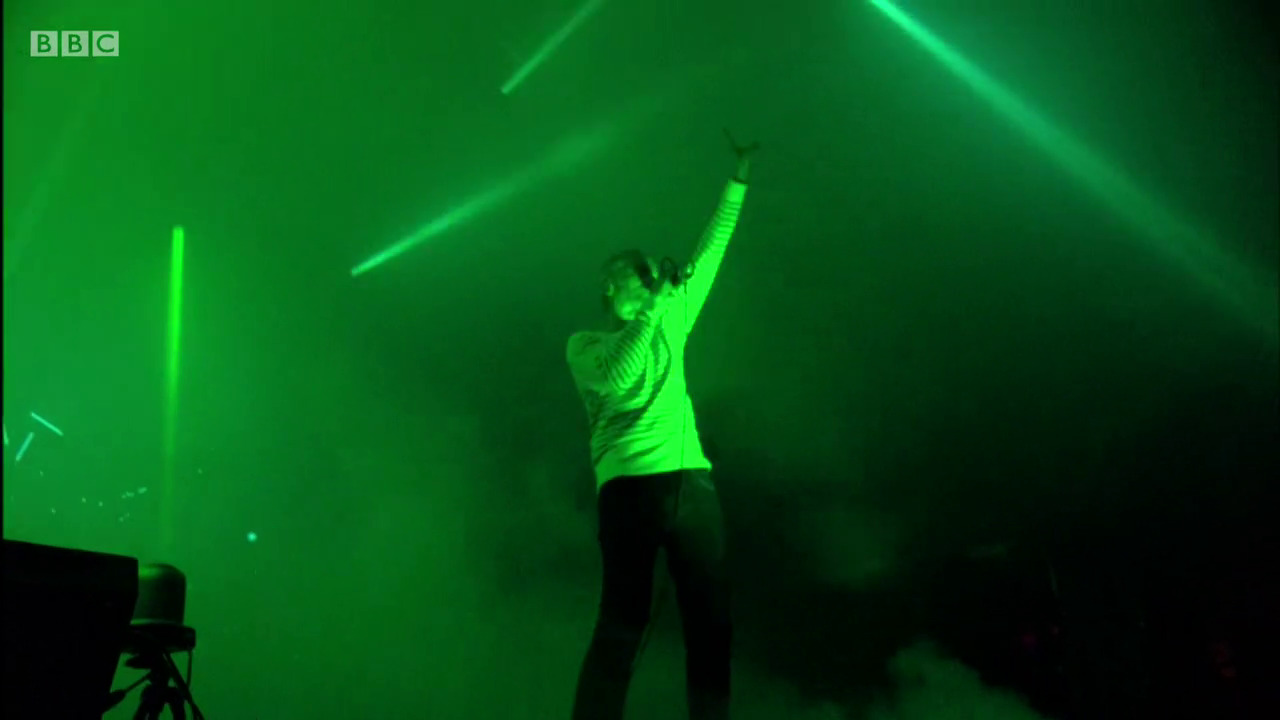
6Music Festival performance 2016
In more recent years my colleague and friend Andrew Dinn (with whom I enjoyed many pre-pandemic conversations about music) enthusiastically advocated for Underworld (and furnished me with some rarities). This started to get them under my skin. It took a bit longer for me to truly get them, though, and the final straw was revisiting their BBC 6 Music Festival performance from 2016 (with Rez and it's companion piece "Cowgirl" standing out) Underworld records So where to start? There s something compelling about their whole catalogue. This is a group with which you can go deep, if you wish. The only album which hasn t grabbed me is 100 days off and it s probably only a matter of time before it does (Andrew advocates the Extended Ansum Edition bootleg here). Here are four career-spanning personal highlights: A very reasonable entry point to their latest sprawling effort, DRIFT, is ricksdubbedoutdrift experience (live in Amsterdam), only 3 on Bandcamp.

Louis-Philippe V ronneau: 2022 A Musical Retrospective

With the end of the year approaching fast, I thought putting my year in retrospective via music would be a fun thing to do. Albums In 2022, I added 51 new albums to my collection nearly one a week! I listed them below in the order in which I acquired them. I purchased most of these albums when I could and borrowed the rest at libraries. If you want to browse though, I added links to the album covers pointing either to websites where you can buy them or to Discogs when digital copies weren't available1. Browsing through the albums, I can see my tastes really shifted a lot in the last few years. I used to listen to a lot of Hip-Hop, but the recent trends in this genre2 really turn me off. In fact, it seems I didn't add a single Hip-Hop album to my collection this year... Metal also continues to dominate the list. Many thanks to Angry Metal Guy for being the best metal reviewing website out there. Concerts 2022 was also a big change for me, as I started going to much more concerts than I previously did. metalfinder has been working great and I'm really happy with it. Here are the concerts I went to in 2022: I'm looking forward continuing to go to a lot of concerts in 2023!

  1. Some of the albums especially the O ! ones are pretty underground. For most of those, I actually have physical copies I bought and ripped.
  2. Mostly mumble rap, beats than are less and less sample-based, extreme commercialisation and lyrics that are less and less political and engaged.

20 December 2022

Russ Allbery: Review: Tess of the Road

Review: Tess of the Road, by Rachel Hartman
Series: Tess of the Road #1
Publisher: Random House
Copyright: 2018
Printing: 2022
ISBN: 1-101-93130-2
Format: Kindle
Pages: 536
Tess of the Road is the first book of a YA fantasy duology set in the same universe as Seraphina and Shadow Scale. It's hard to decide what to say about reading order (and I now appreciate the ambiguous answers I got). Tess of the Road is a sequel to Seraphina and Shadow Scale in the sense that there are numerous references to the previous duology, but it has a different protagonist and different concerns. You don't need to read the other duology first, but Tess of the Road will significantly spoil the resolution of the romance plot in Seraphina, and it will be obvious that you've skipped over background material. That said, Shadow Scale is not a very good book, and this is a much better book. I guess the summary is this: if you're going to read the first duology, read it first, but don't feel obligated to do so. Tess was always a curious, adventurous, and some would say unmanageable girl, nothing like her twin. Jeanne is modest, obedient, virtuous, and practically perfect in every way. Tess is not; after a teenage love affair resulting in an out-of-wedlock child and a boy who disappeared rather than marry her, their mother sees no alternative but to lie about which of the twins is older. If Jeanne can get a good match among the nobility, the family finances may be salvaged. Tess's only remaining use is to help her sister find a match, and then she can be shuffled off to a convent. Tess throws herself into court politics and does exactly what she's supposed to. She engineers not only a match, but someone Jeanne sincerely likes. Tess has never lacked competence. But this changes nothing about her mother's view of her, and Tess is depressed, worn, and desperately miserable in Jeanne's moment of triumph. Jeanne wants Tess to stay and become the governess of her eventual children, retaining their twin bond of the two of them against the world. Their older sister Seraphina, more perceptively, tries to help her join an explorer's expedition. Tess, in a drunken spiral of misery, insults everyone and runs away, with only a new pair of boots and a pack of food. This is going to be one of those reviews where the things I didn't like are exactly the things other readers liked. I see why people loved this book, and I wish I had loved it too. Instead, I liked parts of it a great deal and found other parts frustrating or a bit too off-putting. Mostly this is a preference problem rather than a book problem. My most objective complaint is the pacing, which was also my primary complaint about Shadow Scale. It was not hard to see where Hartman was going with the story, I like that story, I was on board with going there, but getting there took for-EV-er. This is a 536 page book that I would have edited to less than 300 pages. It takes nearly a hundred pages to get Tess on the road, and while some of that setup is necessary, I did not want to wallow in Tess's misery and appalling home life for quite that long. A closely related problem is that Hartman continues to love flashbacks. Even after Tess has made her escape, we get the entire history of her awful teenage years slowly dribbled out over most of the book. Sometimes this is revelatory; mostly it's depressing. I had guessed the outlines of what had happened early in the book (it's not hard), and that was more than enough motivation for me, but Hartman was determined to make the reader watch every crisis and awful moment in detail. This is exactly what some readers want, and sometimes it's even what I want, but not here. I found the middle of the book, where the story is mostly flashbacks and flailing, to be an emotional slog. Part of the problem is that Tess has an abusive mother and goes through the standard abuse victim process of being sure that she's the one who's wrong and that her mother is justified in her criticism. This is certainly realistic, and it eventually lead to some satisfying catharsis as Tess lets go of her negative self-image. But Tess's mother is a narcissistic religious fanatic with a persecution complex and not a single redeeming quality whatsoever, and I loathed reading about her, let alone reading Tess tiptoeing around making excuses for her. The point of this in the story is for Tess to rebuild her self-image, and I get it, and I'm sure this will work for some readers, but I wanted Tess's mother (and the rest of her family except her sisters) to be eaten by dragons. I do not like the emotional experience of hating a character in a book this much. Where Tess of the Road is on firmer ground is when Tess has an opportunity to show her best qualities, such as befriending a quigutl in childhood and, in the sort of impulsive decision that shows her at her best, learning their language. (For those who haven't read the previous books, quigutls are a dog-sized subspecies of dragon that everyone usually treats like intelligent animals, although they're clearly more than that.) Her childhood quigutl friend Pathka becomes her companion on the road, which both gives her wanderings some direction and adds some useful character interaction. Pathka comes with a plot that is another one of those elements that I think will work for some readers but didn't work for me. He's in search of a Great Serpent, a part of quigutl mythology that neither humans or dragons pay attention to. That becomes the major plot of the novel apart from Tess's emotional growth. Pathka also has a fraught relationship with his own family, which I think was supposed to parallel Tess's relationships but never clicked for me. I liked Tess's side of this relationship, but Pathka is weirdly incomprehensible and apparently fickle in ways that I found unsatisfying. I think Hartman was going for an alien tone that didn't quite work for me. This is a book that gets considerably better as it goes along, and the last third of the book was great. I didn't like being dragged through the setup, but I loved the character Tess became. Once she reaches the road crew, this was a book full of things that I love reading about. The contrast between her at the start of the book and the end is satisfying and rewarding. Tess's relationship with her twin Jeanne deserves special mention; their interaction late in the book is note-perfect and much better than I had expected. Unfortunately, Tess of the Road doesn't have a real resolution. It's only the first half of Tess's story, which comes back to that pacing problem. Ah well. I enjoyed this but I didn't love it. The destination was mostly worth the journey, but I thought the journey was much too long and I had to spend too much time in the company of people I hated far more intensely than was comfortable. I also thought the middle of the book sagged, a problem I have now had with two out of three of Hartman's books. But I can see why other readers with slightly different preferences loved it. I'm probably invested enough to read the sequel, although I'm a bit grumbly that the sequel is necessary. Followed by In the Serpent's Wake. Rating: 7 out of 10

11 December 2022

Russ Allbery: Review: The Fifth Elephant

Review: The Fifth Elephant, by Terry Pratchett
Series: Discworld #24
Publisher: Harper
Copyright: 2000
Printing: May 2014
ISBN: 0-06-228013-9
Format: Mass market
Pages: 455
The Fifth Elephant is the 24th Discworld and fifth Watch novel, and largely assumes you know who the main characters are. This is not a good place to start. The dwarves are electing a new king. The resulting political conflict is spilling over into the streets of Ankh-Morpork, but that's not the primary problem. First, the replica Scone of Stone, a dwarven artifact used to crown the Low King of the Dwarves, is stolen from the Dwarf Bread Museum. Then, Vimes is dispatched to berwald, ostensibly to negotiate increased fat exports with the new dwarven king. And then Angua disappears, apparently headed towards her childhood home in berwald, which immediately prompts Carrot to resign and head after her. The City Watch is left in the hands of now-promoted Captain Colon. We see lots of Lady Sybil for the first time since Guards! Guards!, and there's a substantial secondary plot with Angua and Carrot and a tertiary plot with Colon making a complete mess of things back home, but this is mostly a Vimes novel. As usual, Vetinari is pushing him outside of his comfort zone, but he's not seriously expecting Vimes to act like an ambassador. He's expecting Vimes to act like a policeman, even though he's way outside his jurisdiction. This time, that means untangling a messy three-sided political situation involving the dwarves, the werewolves, and the vampires. There is some Igor dialogue in this book, but thankfully Pratchett toned it down a lot and it never started to bother me. I do enjoy Pratchett throwing Vimes and his suspicious morality at political problems and watching him go at them sideways. Vimes's definition of crimes is just broad enough to get him fully invested in a problem, but too narrow to give him much patience with the diplomatic maneuvering. It makes him an unpredictable diplomat in a clash of cultures way that's fun to read about. Cheery and Detritus are great traveling companions for this, since both of them also unsettle the dwarves in wildly different ways. I also have to admit that Pratchett is doing more interesting things with the Angua and Carrot relationship than I had feared. In previous books, I was getting tired of their lack of communication and wasn't buying the justifications for it, but I think I finally understand why the communication barriers are there. It's not that Angua refuses to talk to Carrot (although there's still a bit of that going on). It's that Carrot's attitude towards the world is very strange, and gets stranger the closer you are to him. Carrot has always been the character who is too earnest and straightforward and good for Ankh-Morpork and yet somehow makes it work, but Pratchett is doing something even more interesting with the concept of nobility. A sufficiently overwhelming level of heroic ethics becomes almost alien, so contrary to how people normally think that it can make conversations baffling. It's not that Carrot is perfect (sometimes he does very dumb things), it's that his natural behavior follows a set of ethics that humans like to pretend they follow but actually don't and never would entirely. His character should be a boring cliche or an over-the-top parody, and yet he isn't at all. But Carrot's part is mostly a side plot. Even more than Jingo, The Fifth Elephant is establishing Vimes as a force to be reckoned with, even if you take him outside his familiar city. He is in so many ways the opposite of Vetinari, and yet he's a tool that Vetinari is extremely good at using. Colon of course is a total disaster as the head of the Watch, and that's mostly because Colon should never be more than a sergeant, but it's also because even when he's taking the same action as Vimes, he's not doing it for the same reasons or with the same stubborn core of basic morality and loyalty that's under Vimes's suspicious conservatism. The characterization in the Watch novels doesn't seem that subtle or deep at first, but it accumulates over the course of the series in a way that I think is more effective than any of the other story strands. Vetinari, Vimes, and Carrot all represent "right," or at least order, in overlapping stories of right versus wrong, but they do so in radically different ways and with radically different goals. Each time one of them seems ascendant, each time one of their approaches seems more clearly correct, Pratchett throws them at a problem where a different approach is required. It's a great reading experience. This was one of the better Discworld novels even though I found the villains to be a bit tedious and stupid. Recommended. Followed by The Truth in publication order. The next Watch novel is Night Watch. Rating: 8 out of 10

10 December 2022

Russ Allbery: Review: Trust

Review: Trust, by Mary Sisson
Series: Trang #2
Publisher: Mary Sisson
Copyright: 2012
Printing: December 2013
ASIN: B0087KQDQ0
Format: Kindle
Pages: 375
Trust is a direct sequel to Trang and should not be read out of order. Both the primary and secondary plot deal with the consequences of the ending of Trang and thus spoil it heavily. After a dodgy and unethical debriefing under mental probe (which took far too long to become relevant to the story) Philippe Trang is back at work as the human diplomat to a space station full of aliens in intergalactic space. At first, interspecies relations have not changed much, but soon Philippe will be drawn farther into the consequences of Trang's dramatic conclusion than he would have expected. And there are other complications: a new group of Special Forces soldiers, an extremely grumpy alien who disapproves of his species' current culture, and the continuing incomprehensible behavior of the Magic Man. I was hoping this series would be a hidden gem of diplomatic SF, a subgenre that I want to exist. Unfortunately, this entry takes a strong turn towards more conventional territory: a Star Trek plot. One of the merits of the first novel is that Trang, and the humans in general, didn't have much power. Humans were meeting aliens as equals or inferiors, and both sides were attempting to understand. Although the humans became central to the plot (probably unavoidable when they're the protagonists), it was somewhat by accident. I was hoping Sisson would lean into that setup, stress the equal footing, and focus on the complex diplomacy. Instead, Trust puts Trang in a position of considerable authority over one of the alien races. Like most Star Trek plots, this book is primarily about mapping strange alien behavior onto human morality to solve the problem of the week. As an entry in that genre, it's... okay. I still like Trang as a character, Sisson does an adequate job showing how weird aliens can be (although mostly by jumbling together extremes of human behavior instead of finding something truly alien), and the opinions of the aliens continue to matter. But I feel like this series is sliding towards making the humans central to everything, and I was not enthused by a plot that requires Trang sort out complex political problems for an entire alien race he knows next to nothing about. This book also adds more viewpoints, giving us several chapters from the perspective of one of Trang's escort soldiers and one from one of the aliens. I liked the alien perspective; it was probably the best chapter of the book. Seeing the human characters from an external perspective was amusing, and I liked how both the humans and the aliens surprised and confused each other. That said, it also felt like a bit of a cheat to tell the reader about the cultural forces at play that Trang was missing. I already thought Trang was being exceptionally dim about the alien gifts he was given, pocketing them without attempting to understand them and then never studying them later. Being shown more things he should have tried to figure out didn't help. You're a diplomat in an extended first contact situation: please have some basic curiosity about what's going on and talk it over with the people around you, rather than treating aliens like children. The soldier perspective adds a secondary plot that was okay but a bit silly, and I'm not sure why Sisson needed to introduce a second perspective to tell it. I think the same secondary plot would have been more interesting if she'd stuck with Trang's perspective and forced him to reconstruct what had been happening when he wasn't paying attention. As is, the plot relied too much on people being stupid and not talking to each other. There was nothing seriously wrong with this book, but it's also not fulfilling the potential of the first book of the series. It felt like okay self-published science fiction; that's not nothing, but there are a lot of books like that, and I wanted diplomatic science fiction that goes somewhere different. I may give the third book a chance, but I'm feeling less enthused now. Followed by Tribulations. Rating: 6 out of 10

16 November 2022

Ian Jackson: Stop writing Rust linked list libraries!

tl;dr: Don t write a Rust linked list library: they are hard to do well, and usually useless. Use VecDeque, which is great. If you actually need more than VecDeque can do, use one of the handful of libraries that actually offer a significantly more useful API. If you are writing your own data structure, check if someone has done it already, and consider slotmap or generation_arena, (or maybe Rc/Arc). Contents Survey of Rust linked list libraries I have updated my Survey of Rust linked list libraries. Background In 2019 I was writing plag-mangler, a tool for planar graph layout. I needed a data structure. Naturally I looked for a library to help. I didn t find what I needed, so I wrote rc-dlist-deque. However, on the way I noticed an inordinate number of linked list libraries written in Rust. Most all of these had no real reason for existing. Even the one in the Rust standard library is useless. Results Now I have redone the survey. The results are depressing. In 2019 there were 5 libraries which, in my opinion, were largely useless. In late 2022 there are now thirteen linked list libraries that ought probably not ever to be used. And, a further eight libraries for which there are strictly superior alternatives. Many of these have the signs of projects whose authors are otherwise competent: proper documentation, extensive APIs, and so on. There is one new library which is better for some applications than those available in 2019. (I m referring to generational_token_list, which makes a plausible alternative to dlv-list which I already recommended in 2019.) Why are there so many poor Rust linked list libraries ? Linked lists and Rust do not go well together. But (and I m guessing here) I presume many people are taught in programming school that a linked list is a fundamental data structure; people are often even asked to write one as a teaching exercise. This is a bad idea in Rust. Or maybe they ve heard that writing linked lists in Rust is hard and want to prove they can do it. Double-ended queues One of the main applications for a linked list in a language like C, is a queue, where you put items in at one end, and take them out at the other. The Rust standard library has a data structure for that, VecDeque. Five of the available libraries: For these you could, and should, just use VecDeque instead. The Cursor concept A proper linked list lets you identify and hold onto an element in the middle of the list, and cheaply insert and remove elements there. Rust s ownership and borrowing rules make this awkward. One idea that people have many times reinvented and reimplemented, is to have a Cursor type, derived from the list, which is a reference to an element, and permits insertion and removal there. Eight libraries have implemented this in the obvious way. However, there is a serious API limitation: To prevent a cursor being invalidated (e.g. by deletion of the entry it points to) you can t modify the list while the cursor exists. You can only have one cursor (that can be used for modification) at a time. The practical effect of this is that you cannot retain cursors. You can make and use such a cursor for a particular operation, but you must dispose of it soon. Attempts to do otherwise will see you losing a battle with the borrow checker. If that s good enough, then you could just use a VecDeque and use array indices instead of the cursors. It s true that deleting or adding elements in the middle involves a lot of copying, but your algorithm is O(n) even with the single-cursor list libraries, because it must first walk the cursor to the desired element. Formally, I believe any algorithm using these exclusive cursors can be rewritten, in an obvious way, to simply iterate and/or copy from the start or end (as one can do with VecDeque) without changing the headline O() performance characteristics. IMO the savings available from avoiding extra copies etc. are not worth the additional dependency, unsafe code, and so on, especially as there are other ways of helping with that (e.g. boxing the individual elements). Even if you don t find that convincing, generational_token_list and dlv_list are strictly superior since they offer a more flexible and convenient API and better performance, and rely on much less unsafe code. Rustic approaches to pointers-to-and-between-nodes data structures Most of the time a VecDeque is great. But if you actually want to hold onto (perhaps many) references to the middle of the list, and later modify it through those references, you do need something more. This is a specific case of a general class of problems where the naive approach (use Rust references to the data structure nodes) doesn t work well. But there is a good solution: Keep all the nodes in an array (a Vec<Option<T>> or similar) and use the index in the array as your node reference. This is fast, and quite ergonomic, and neatly solves most of the problems. If you are concerned that bare indices might cause confusion, as newly inserted elements would reuse indices, add a per-index generation count. These approaches have been neatly packaged up in libraries like slab, slotmap, generational-arena and thunderdome. And they have been nicely applied to linked lists by the authors of generational_token_list. and dlv-list. The alternative for nodey data structures in safe Rust: Rc/Arc Of course, you can just use Rust s interior mutability and reference counting smart pointers, to directly implement the data structure of your choice. In many applications, a single-threaded data structure is fine, in which case Rc and Cell/RefCell will let you write safe code, with cheap refcount updates and runtime checks inserted to defend against unexpected aliasing, use-after-free, etc. I took this approach in rc-dlist-deque, because I wanted each node to be able to be on multiple lists. Rust s package ecosystem demonstrating software s NIH problem The Rust ecosystem is full of NIH libraries of all kinds. In my survey, there are: five good options; seven libraries which are plausible, but just not as good as the alternatives; and fourteen others. There is a whole rant I could have about how the whole software and computing community is pathologically neophilic. Often we seem to actively resist reusing ideas, let alone code; and are ignorant and dismissive of what has gone before. As a result, we keep solving the same problems, badly - making the same mistakes over and over again. In some subfields, working software, or nearly working software, is frequently replaced with something worse, maybe more than once. One aspect of this is a massive cultural bias towards rewriting rather than reusing, let alone fixing and using. Many people can come out of a degree, trained to be a programmer, and have no formal training in selecting and evaluating software; this is even though working effectively with computers requires making good use of everyone else s work. If one isn t taught these skills (when and how to search for prior art, how to choose between dependencies, and so on) one must learn it on the job. The result is usually an ad-hoc and unsystematic approach, often dominated by fashion rather than engineering. The package naming paradox The more experienced and competent programmer is aware of all the other options that exist - after all they have evaluated other choices before writing their own library. So they will call their library something like generational_token_list or vecdeque-stableix. Whereas the novice straight out of a pre-Rust programming course just thinks what they are doing is the one and only obvious thing (even though it s a poor idea) and hasn t even searched for a previous implementation. So they call their package something obvious like linked list . As a result, the most obvious names seem to refer to the least useful libraries.



Edited 2022-11-16 23:55 UTC to update numbers of libraries in various categories following updates to the survey (including updates prompted by feedback received after this post first published).


comment count unavailable comments

8 November 2022

Antoine Beaupr : Using the bell as modern notification

Computer terminals have traditionally had an actual bell that would ring when a certain control character (the bell character, typically control-g or \a in an C escape sequence) would come in the input stream. That feature actually predates computers altogether, and was present in Baudot code, "an early character encoding for telegraphy invented by mile Baudot in the 1870s", itself superseding Morse code. Modern terminal emulators have, of course, kept that feature: if you run this command in a terminal right now:
printf '\a'
... you may hear some annoying beep. Or not. It actually depends on a lot of factors, including which terminal emulator you're using, how it's configured, whether you have headphones on, or speakers connected, or, if you're really old school, a PC speaker, even. Typically, I have this theory that it does the exact opposite of what you want, regardless of whether you have configured it or not. That is, if you want it to make noises, it won't, and if you want it to stay silent, it will make brutal, annoying noises in moments you would the least expect. I suspect this is a law in computer science, but I'm too lazy to come up with a formal definition. Yet something can be done with this.

Making the bell useful and silent Many terminal emulators have this feature where they can silence the bell somehow. It can be turned into a "visual bell" which basically flashes the screen when a bell arrives. Or that can also be disabled and the bell is just completely ignored. What I did instead is turn the bell into a "urgency hint" (part of the ICCCM standard. In xterm, this is done with this X resource entry (typically in ~/.Xresources):
XTerm*bellIsUrgent:  true
XTerm*visualBell: false
Interestingly, this doesn't clearly say "bell is muted", but it's effectively what it does. Or maybe it works because I have muted "System Sounds" in Pulseaudio. Who knows. I do have this in my startup scripts though:
xset b off
... which, according to the xset(1) manpage, means
If the dash or 'off' are given, the bell will be turned off.
Interestingly, you have the option of setting the bell "volume", "pitch, in hertz, and [...] duration in milliseconds. Note that not all hardware can vary the bell characteristics." In any case, I think that's the magic trick to turn the darn thing off. Now this should send urgency hints to your window manager:
sleep 3 ; printf '\a'
Try it: run the command, switch to another desktop, then wait 3 seconds. You should see the previous desktop show up in red or something. In the i3 window manager I am currently using, this is the default, although I did set the colors (client.urgent and urgent_workspace in bar.colors). Other window managers or desktop environments may require different configurations.

Sending a bell... Now that, on itself, will only be useful when something sets a bell. One place I had found a trick like this, long ago, is this post (dead link, archived) which has various instructions for different tools. I'll recopy some of them here since the original site is dead, but credit goes to the Netbuz blog. (Note that the blog post also features an Awesome WM configuration for urgency hints.)

Mutt
set beep=yes
set beep_new=yes

Irssi
/set beep_when_window_active ON
/set beep_when_away ON
/set beep_msg_level MSGS DCC DCCMSGS HILIGHT
It was also recommending this setting, but it appears to be deprecated and gives a warning in modern irssi versions:
/set bell_beeps ON

GNU Screen This is an important piece of the puzzle, because by default, terminal multiplexers have their own opinion of what to do with the bell as well:
# disabled: we want to propagate bell to clients, which should handle
# it in their own terminal settings. this  vbell off  is also the
# upstream and tmux's default
#
# see also: http://netbuz.org/blog/2011/11/x-bells-and-urgency-hints/
vbell off
# propagate bell from other windows up to the terminal emulator as well
bell_msg 'Bell in window %n^G'
The bell_msg bit is an extra from me: it uses the bell message that pops up when screen detects a bell in another window to resend the bell control character up to the running terminal. This makes it so a bell in any multiplexed window will also propagate to the parent terminal, which is not the default.

Tmux Untested, but that is apparently how you do it:
# listen to alerts from all windows
set -g bell-action any
# notice bell in windows
set -g monitor-bell on
# only propagate bell, don't warn user, as it hangs tmux for a second
set -g visual-bell off
# send bell *and* notify when activity (if monitor-activity)
set -g visual-activity both
Note that this config goes beyond what we have in GNU screen in that inactivity or activity will trigger a bell as well. This might be useful for cases where you don't have the prompt hack (below) but it could also very well be very noisy. It will only generate noise when monitor-activity is enabled though.

bash and shell prompts Now the icing on cake is to actually send the bell when a command completes. This is what I use this for the most, actually. I was previously using undistract-me for this, actually. That was nice: it would send me a nice desktop notification when a command was running more than a certain amount of time, and if the window was unfocused. But configuring this was a nightmare: because it uses a complex PROMPT_COMMAND in bash, it would conflict with my (already existing and way too) complex bash prompt, and lead to odd behaviors. It would also not work for remote commands, of course, as it wouldn't have access to my local D-BUS to send notifications (thankfully!). So instead, what I do now is systematically print a bell whenever a command terminates, in all my shells. I have this in my /root/.bashrc on all my servers, deployed in Puppet:
PROMPT_COMMAND='printf "\a"'
Or you can just put it directly in the shell prompt, with something like:
PS1='\[\a\]'"$PS1"
(I have the equivalent in my own .bashrc, although that thing is much more complex, featuring multi-command pipeline exit status, colors, terminal title setting, and more, which should probably warrant its own blog post.) This sounds a little bonkers and really noisy, but remember that I turned off the audible bell. And urgency hints are going to show up only if the window is unfocused. So it's actually really nice and not really distracting. Or, to reuse the undistract-me concept: it allows me to not lose focus too much when I'm waiting for a long process to complete. That idea actually came from ahf, so kudos to him on that nice hack.

Caveats That is not setup on all the machines I administer for work, that said. I'm afraid that would be too disruptive for people who do not have that configuration. This implies that I don't get notifications for commands that run for a long time on remote servers, most of the time. That said, I could simply run a command with a trailing printf '\a' to get a notification. This might not work in Wayland, your window manager, your desktop environment, your Linux console, or your telegraphy session.

6 November 2022

Russ Allbery: Review: Matrix

Review: Matrix, by Lauren Groff
Publisher: Riverhead Books
Copyright: 2021
ISBN: 0-698-40513-7
Format: Kindle
Pages: 260
Marie is a royal bastardess, a product of rape no less, and entirely out of place in the court in Westminster, where she landed after being kicked off her mother's farm. She had run the farm since her mother's untimely death, but there was no way that her relatives would let her inherit. In court, Marie is too tall, too ugly, and too strange, raised by women who were said to carry the blood of the fairy M lusine. Eleanor of Aquitaine's solution to her unwanted house guest is a Papal commission. Marie is to become the prioress of an abbey. I am occasionally unpleasantly reminded of why I don't read very much literary fiction. It's immensely frustrating to read a book in which the author cares about entirely different things than the reader, and where the story beats all land wrong. This is literary historical fiction set in the 12th century. Marie is Marie de France, author of the lais about courtly love that are famous primarily due to their position as early sources for the legends of King Arthur. The lais are written on-screen very early in this book, but they disappear without any meaningful impact on the story. Matrix is, instead, about Shaftesbury Abbey and what it becomes during Marie's time as prioress and then abbess, following the theory that Marie de France was Mary of Shaftesbury. What I thought I was getting in this book, from numerous reviews and recommendations, was a story of unexpected competence: how a wild, unwanted child of seventeen lands at a dilapidated and starving abbey, entirely against her will, and then over the next sixty years transforms it into one of the richest abbeys in England. This does happen in this book, but Groff doesn't seem to care about the details of that transformation at all. Instead, Matrix takes the mimetic fiction approach of detailed and precise description of a few characters, with all of their flaws and complexities, and with all of the narrative's attention turned to how they are feeling and what they are seeing. It is also deeply, fully committed to a Great Man (or in this case a Great Woman) view of history. Marie is singular. The narrative follows her alone, she makes all the significant decisions, and the development of the abbey is determined by her apparently mystical visions. (In typical mimetic fashion, these are presented as real to her, and the novel takes no position on whether that reality is objective.) She builds spy networks, maneuvers through local and church politics, and runs the abbey like her personal kingdom. The tiny amount of this that is necessarily done by other people is attributed to Marie's ability to judge character. Other people's motives are simply steamrolled over and have no effect. Maddeningly, essentially all of this happens off-screen, and Groff is completely uninterested in the details of how any of it is accomplished. Marie decides to do something, the narrative skips forward a year, and it has happened. She decides to build something, and then it's built. She decides to collect the rents she's due, the novel gestures vaguely at how she's intimidating, and then everyone is happily paying up. She builds spy networks; who cares how? She maneuvers through crises of local and church politics that are vaguely alluded to, through techniques that are apparently too uninteresting to bother the reader with. Instead, the narrative focuses on two things: her deeply dysfunctional, parasocial relationship with Eleanor, and her tyrannical relationship with the other nuns. I suspect that Groff would strongly disagree with my characterization of both of those narratives, and that's the other half of my problem with this book. Marie is obsessed with and in love with Eleanor, a completely impossible love to even talk about, and therefore turns to courtly love from afar as a model into which she can fit her feelings. While this is the setup for a tragedy, it's a good idea for a story. But what undermined it for me is that Marie's obsession seems to be largely physical (she constantly dwells on Eleanor's beauty), and Eleanor is absolutely horrible to her in every way: condescending, contemptuous, dismissive, and completely uninterested. This does change a bit over the course of the book, but not enough to justify the crush that Marie maintains for this awful person through her entire life. And Eleanor is the only person in the book who Marie treats like an equal. Everyone else is a subordinate, a daughter, a charge, a servant, or a worker. The nuns of the abbey prosper under her rule, so Marie has ample reason to justify this to herself, but no one else's opinions or beliefs matter to her in any significant way. The closest anyone can come to friendship is to be reliably obedient, perhaps after some initial objections that Marie overrules. Despite some quite good characterization of the other nuns, none of the other characters get to do anything. There is no delight in teamwork, sense of healthy community, or collaborative problem-solving. It's just all Marie, all the time, imposing her vision on the world both living and non-living through sheer force of will. This just isn't entertaining, at least for me. The writing might be beautiful, the descriptions detailed and effective, and the research clearly extensive, but I read books primarily for characters, I read characters primarily for their relationships, and these relationships are deeply, horribly unhealthy. They are not, to be clear, unrealistic (although I do think there's way too much chosen one in Marie and way too many problems that disappear off-camera); there are certainly people in the world with dysfunctional obsessive relationships, and there are charismatic people who overwhelm everyone around them. This is just not what I want to read about. You might think, with all I've said above, that I'm spoiling a lot of the book, but weirdly I don't think I am. Every pattern I mention above is well-established early in the novel. About the only thing that I'm spoiling is the hope that any of it is somehow going to change, a hope that I clung to for rather too long. This is a great setup for a book, and I wish it were written by a fantasy author instead of a literary author. Perhaps I'm being too harsh on literary fiction here, but I feel like fantasy authors are more likely to write for readers who want to see the growth sequence. If someone is going to change the world, I want to see how they changed the world. The mode of fantasy writing tends to think that what people do (and how they do it) is as interesting or more interesting than what they feel or what they perceive. If this idea, with the exact same level of (minor) mysticism and historic realism, without added magic, were written by, say, Guy Gavriel Kay or Nicola Griffith, it would be a far different and, in my opinion, a much better book. In fact, Hild is part of this book written by Nicola Griffith, and it is a much better book. I have seen enough people rave about this book to know that this is a personal reaction that is not going to be shared by everyone, or possibly even most people. My theory is that this is due to the different reading protocols between literary fiction readers and fantasy readers. I put myself in the latter camp; if you prefer literary fiction, you may like this much better (and also I'm not sure you'll find my book reviews useful). I may be wrong, though; maybe there are fantasy readers who would like this. I will say that the sense of place is very strong and the writing has all the expected literary strengths of descriptiveness and rhythm. But, sadly, this was not at all my thing, and I'm irritated that I wasted time on it. Rating: 4 out of 10

4 November 2022

Louis-Philippe V ronneau: Book Review: Chokepoint Capitalism, by Rebecca Giblin and Cory Doctorow

Two weeks ago, I had the chance to go see Cory Doctorow at my local independent bookstore, in Montr al. He was there to present his latest essay, co-written with Rebecca Giblin1. Titled Chokepoint Capitalism: How Big Tech and Big Content Captured Creative Labor Markets and How We'll Win Them Back, it focuses on the impact of monopolies and monopsonies (more on this later) on creative workers. The book is divided in two main parts: A picture of the book cover Although Doctorow is known for his strong political stances, I have to say I'm quite surprised by the quality of the research Giblin and he did for this book. They both show a pretty advanced understanding of the market dynamics they look at, and even though most of the solutions they propose aren't new or groundbreaking, they manage to be convincing and clear. That is to say, you certainly don't need to be an economist to understand or enjoy this book :) As I have mentioned before, the book heavily criticises monopolies, but also monopsonies a market structure that has only one buyer (instead of one seller). I find this quite interesting, as whereas people are often familiar with the concept of monopolies, monopsonies are frequently overlooked. The classic example of a monopsony is a labor market with a single employer: there is a multitude of workers trying to sell their labor power, but in the end, working conditions are dictated by the sole employer, who gets to decide who has a job and who hasn't. Mining towns are good real-world examples of monopsonies. In the book, the authors argue most of the contemporary work produced by creative workers (especially musicians and writers) is sold to monopsonies and oligopsonies, like Amazon2 or major music labels. This creates a situation where the consumers are less directly affected by the lack of competition in the market (they often get better prices), but where creators have an increasingly hard time making ends meet. Not only this, but natural monopsonies3 are relatively rare, making the case for breaking the existing ones even stronger. Apart from the evident need to actually start applying (the quite good) antitrust laws in the USA, some of the other solutions put forward are: Overall, I found this book quite enjoying and well written. Since I am not a creative worker myself and don't experience first-hand the hardships presented in the book, it was the occasion for me to delve more deeply in this topic. Chances are I'll reuse some of the expos s in my classes too.

  1. Professor at the Melbourne Law School and Director of the Intellectual Property Research Institute of Australia, amongst other things. More on her here.
  2. Amazon owns more than 50% of the US physical book retail market and has an even higher market share for ebooks and audiobooks (via Audible). Not only this, but with the decline of the physical book market, audiobooks are an increasingly important source of revenue for authors.
  3. Natural monopolies happen when it does not make economic sense for multiple enterprises to compete in a market. Critical infrastructures, like water supply or electricity, make for good examples of natural monopolies. It simply wouldn't be efficient to have 10 separate electrical cables connecting your house to 10 separate electric grids. In my opinion, such monopolies are acceptable (and even desirable), as long as they are collectively owned, either by the State or by local entities (municipalities, non-profits, etc.).

29 October 2022

Russ Allbery: California general election

As usual with these every-two-year posts, probably of direct interest only to California residents. Maybe the more obscure things we're voting on will be a minor curiosity to people elsewhere. Apologies to Planet Debian readers for the explicitly political post because I'm too lazy to change my blog software to do more fine-grained post classification. For what it's worth, most of the discussion here will be about the more fiddly and nuanced things we vote on, not on the major hot-button proposition. As in 2020, I'm only going to cover the ballot propositions, as all of the state-wide and most of the district races are both obvious to me and boring to talk about. The hyperlocal races are more interesting this year, but the number of people who would care and who are also reading this blog is essentially nonexistent, so I won't bother writing them up. This year, everything except Proposition 1 is an initiative (not put on the ballot by the legislature), which means I default to voting against them because they're usually poorly-written. Proposition 1: YES. Adds reproductive rights to the California state constitution. I'm fairly sure everyone reading this has already made up their mind on this topic and certainly nothing will ever change my mind, so I'll leave it at that. Proposition 26: YES. This mushes two different things together in an unhelpful way: allowing sports betting at some racetracks, and allowing a wider variety of gambling on tribal lands. I have no strong opinion about the former (I'll get into that more with the next proposition). For the latter, my starting point is that Native American tribes are and should be treated like independent governments with their own laws (which is what we promised them by treaty and then have systematically and maliciously betrayed ever since). I am not a citizen of any of the tribes and therefore fundamentally I should not get a say on this. I'm not a big fan of gambling or of the companies they're likely to hire to run casinos, but it should be their land and their decision. Proposition 27: NO. This, on the other hand, is about on-line sports betting outside of tribal lands, and looks to be a lot more about corruption and corporate greed. I am fairly dubious that outlawing gambling in general is that good of an idea. I think the harms are overstated given the existence of even wilder forms of gambling (crypto and financial derivatives) that are perfectly legal, and I'm always suspicious of attempting to solve social problems with police and prohibition systems. If there were a ballot proposition to simply legalize gambling in California, I'd have to think hard about that. But this is not that. This requires companies that want to offer on-line gambling to pay substantial up-front costs (which will restrict this to only huge gambling companies). In return, they are allowed entry into what is essentially a state-constructed partial monopoly. As usual, there's a typical vice tax deal attached where those companies are taxed to fund some program (in this case, homeless services and mental health treatment), but these sorts of taxes tend to be regressive in effect. We could just tax richer people like me to pay for those services instead. I'm also dubious that the money for homelessness will be used to build housing, which is what we need to do to address the problem. Proposition 28: YES. Sets aside money for art and music funding in public and charter schools. This is a reluctant yes because this sort of law should not be done via proposition; it should be done through a normal legislative process that balances all of the priorities for school funding. But despite the broken process by which this was put forward, it seems like a reasonable law and no one is opposing it, so okay, fine. Proposition 29: NO. The attempt to force all dialysis clinics to have licensed doctors on site is back again. Everything about the way dialysis health care is provided in California makes me angry. We should have a state health care system similar to the NHS. We should open dialysis clinics based on the number of people requiring dialysis in that area. Every one of them should be unionized. We absolutely should not allow for-profit companies to have primary responsibility for basic life-saving medical care like dialysis. But this proposition does not solve any of those problems, and what it claims to do is false. It claims that by setting credential requirements on who has to be on-site at a dialysis clinic, the clinics will become safer. This is simply not true, for all of the reasons discussed in Still Not Safe. This is not how safety works. The safest person to do dialysis is someone with extensive experience in performing dialysis, who has seen all the problems and has an intuition for what to watch out for. That has less to do with credentials than with good training specifically in dialysis, apprenticeship, and practice, not to mention reasonable hours and good pay so that the workers are not stressed. Do I think the private dialysis clinics are likely doing a good job with this? Hah. (Do I think dialysis clinics run by large medical non-profits would do a good job with this? Also hah.) But this would enshrine into law a fundamentally incorrect solution to the problem that makes dialysis more expensive without addressing any of the other problems with the system. It's the same tactic that was used on abortion clinics, with the same bogus argument that having people with specific credentials on-site would make them safer. It was false then and it's still false now. I would agree with better regulation of dialysis clinics, but this specific regulation is entirely wrong-headed. Also, while this isn't an overriding factor, I get annoyed when the same proposition shows up again without substantial changes. For matters of fundamental rights, okay, sure. But for technical regulation fixes like this one, the proponents should consider taking no for an answer and trying a different approach. Like going to the legislature, which is where this kind of regulation should be designed anyway. Proposition 30: YES. Raises taxes on the personal income of extremely rich Californians (over $2 million in income in one year) to fund various climate change mitigation programs. This is another reluctant yes vote, because once again this shouldn't be done by initiative and should be written properly by the legislature. I also don't like restricting tax revenue to particular programs, which reduce budget flexibilty to no real purpose. It's not important to me that these revenues go to these specific programs, although the programs seem like good ones to fund. But the reality remains that wealthy Silicon Valley executives are undertaxed and the only way we can ever manage to raise taxes is through voting for things like this, so fine. Proposition 31: NO. The Calfornia legislature banned the sale of flavored vape products. If NO beats YES on this proposition, that ban will be overturned. Drug prohibition has never, ever worked, and yet we keep trying it over and over again in the hope that this time we'll get a different outcome. As usual, the pitch in favor of this is all about the children, specifically the claim that flavored tobacco products are only about increasing their appeal to kids because... kids like candy? Or something? I am extremely dubious of this argument; it's obvious to me from walking around city streets that adults prefer the flavored products as well and sale to kids is already prohibited and unchanged by this proposition. I don't like vaping. I wish people would stop, at least around me, because the scent is obnoxious and the flavored stuff is even more obnoxious, even apart from whatever health problems it causes. But I'm never going to vote for drug prohibition because drug prohibition doesn't work. It just creates a black market and organized crime and makes society overall worse. Yes, the tobacco companies are some of the worst corporations on the planet, and I hope they get sued into oblivion (and ideally prosecuted) for all the lying they do, but I'm still not going to vote for prohibition. Even the best kind of prohibition that only outlaws sale and not possession. Also, secondarily but still significant, bans like this just frustrate a bunch of people and burn good will and political capital, which we should be trying to preserve to tackle far more important problems. The politics of outlawing people's pleasures for their own good are not great. We have a lot of serious problems to deal with; maybe let's not pick fights we don't have to.

25 October 2022

Arturo Borrero Gonz lez: Netfilter Workshop 2022 summary

Netfilter logo This is my report from the Netfilter Workshop 2022. The event was held on 2022-10-20/2022-10-21 in Seville, and the venue was the offices of Zevenet. We started on Thursday with Pablo Neira (head of the project) giving a short welcome / opening speech. The previous iteration of this event was in virtual fashion in 2020, two years ago. In the year 2021 we were unable to meet either in person or online. This year, the number of participants was just eight people, and this allowed the setup to be a bit more informal. We had kind of an un-conference style meeting, in which whoever had something prepared just went ahead and opened a topic for debate. In the opening speech, Pablo did a quick recap on the legal problems the Netfilter project had a few years ago, a topic that was settled for good some months ago, in January 2022. There were no news in this front, which was definitely a good thing. Moving into the technical topics, the workshop proper, Pablo started to comment on the recent developments to instrument a way to perform inner matching for tunnel protocols. The current implementation supports VXLAN, IPIP, GRE and GENEVE. Using nftables you can match packet headers that are encapsulated inside these protocols. He mentioned the design and the goals, that was to have a kernel space setup that allows adding more protocols by just patching userspace. In that sense, more tunnel protocols will be supported soon, such as IP6IP, UDP, and ESP. Pablo requested our opinion on whether if nftables should generate the matching dependencies. For example, if a given tunnel is UDP-based, a dependency match should be there otherwise the rule won t work as expected. The agreement was to assist the user in the setup when possible and if not, print clear error messages. By the way, this inner thing is pure stateless packet filtering. Doing inner-conntracking is an open topic that will be worked on in the future. Pablo continued with the next topic: nftables automatic ruleset optimizations. The times of linear ruleset evaluation are over, but some people have a hard time understanding / creating rulesets that leverage maps, sets, and concatenations. This is where the ruleset optimizations kick in: it can transform a given ruleset to be more optimal by using such advanced data structures. This is purely about optimizing the ruleset, not about validating the usefulness of it, which could be another interesting project. There were a couple of problems mentioned, however. The ruleset optimizer can be slow, O(n!) in worst case. And the user needs to use nested syntax. More improvements to come in the future. Next was Stefano Brivio s turn (Red Hat engineer). He had been involved lately in a couple of migrations to nftables, in particular libvirt and KubeVirt. We were pointed to https://libvirt.org/firewall.html, and Stefano walked us through the 3 or 4 different virtual networks that libvirt can create. He evaluated some options to generate efficient rulesets in nftables to instrument such networks, and commented on a couple of ideas: having a null matcher in nftables set expression. Or perhaps having kind of subsets, something similar to a view in a SQL database. The room spent quite a bit of time debating how the nft_lookup API could be extended to support such new search operations. We also discussed if having intermediate facilities such as firewalld could provide the abstraction levels that could make developers more comfortable. Using firewalld also may have the advantage that coordination between different system components writing ruleset to nftables is handled by firewalld itself and developers are freed of the responsibility of doing it right. Next was Fernando F. Mancera (Red Hat engineer). He wanted to improve error reporting when deleting table/chain/rules with nftables. In general, there are some inconsistencies on how tables can be deleted (or flushed). And there seems to be no correct way to make a single table go away with all its content in a single command. The room agreed in that the commands destroy table and delete table should be defined consistently, with the following meanings: This topic diverted into another: how to reload/replace a ruleset but keep stateful information (such as counters). Next was Phil Sutter (Netfilter coreteam member and Red Hat engineer). He was interested in discussing options to make iptables-nft backward compatible. The use case he brought was simple: What happens if a container running iptables 1.8.7 creates a ruleset with features not supported by 1.8.6. A later container running 1.8.6 may fail to operate. Phil s first approach was to attach additional metadata into rules to assist older iptables-nft in decoding and printing the ruleset. But in general, there are no obvious or easy solutions to this problem. Some people are mixing different tooling version, and there is no way all cases can be predicted/covered. iptables-nft already refuses to work in some of the most basic failure scenarios. An other way to approach the issue could be to introduce some kind of support to print raw expressions in iptables-nft, like -m nft xyz. Which feels ugly, but may work. We also explored playing with the semantics of release version numbers. And another idea: store strings in the nft rule userdata area with the equivalent matching information for older iptables-nft. In fact, what Phil may have been looking for is not backwards but forward compatibility. Phil was undecided which path to follow, but perhaps the most common-sense approach is to fall back to a major release version bump (2.x.y) and declaring compatibility breakage with older iptables 1.x.y. That was pretty much it for the first day. We had dinner together and went to sleep for the next day. The room The second day was opened by Florian Westphal (Netfilter coreteam member and Red Hat engineer). Florian has been trying to improve nftables performance in kernels with RETPOLINE mitigations enabled. He commented that several workarounds have been collected over the years to avoid the performance penalty of such mitigations. The basic strategy is to avoid function indirect calls in the kernel. Florian also described how BPF programs work around this more effectively. And actually, Florian tried translating nf_hook_slow() to BPF. Some preliminary benchmarks results were showed, with about 2% performance improvement in MB/s and PPS. The flowtable infrastructure is specially benefited from this approach. The software flowtable infrastructure already offers a 5x performance improvement with regards the classic forwarding path, and the change being researched by Florian would be an addition on top of that. We then moved into discussing the meeting Florian had with Alexei in Zurich. My personal opinion was that Netfilter offers interesting user-facing interfaces and semantics that BPF does not. Whereas BPF may be more performant in certain scenarios. The idea of both things going hand in hand may feel natural for some people. Others also shared my view, but no particular agreement was reached in this topic. Florian will probably continue exploring options on that front. The next topic was opened by Fernando. He wanted to discuss Netfilter involvement in Google Summer of Code and Outreachy. Pablo had some personal stuff going on last year that prevented him from engaging in such projects. After all, GSoC is not fundamental or a priority for Netfilter. Also, Pablo mentioned the lack of support from others in the project for mentoring activities. There was no particular decision made here. Netfilter may be present again in such initiatives in the future, perhaps under the umbrella of other organizations. Again, Fernando proposed the next topic: nftables JSON support. Fernando shared his plan of going over all features and introduce programmatic tests from them. He also mentioned that the nftables wiki was incomplete and couldn t be used as a reference for missing tests. Phil suggested running the nftables python test-suite in JSON mode, which should complain about missing features. The py test suite should cover pretty much all statements and variations on how the nftables expression are invoked. Next, Phil commented on nftables xtables support. This is, supporting legacy xtables extensions in nftables. The most prominent problem was that some translations had some corner cases that resulted in a listed ruleset that couldn t be fed back into the kernel. Also, iptables-to-nftables translations can be sloppy, and the resulting rule won t work in some cases. In general, nft list ruleset nft -f may fail in rulesets created by iptables-nft and there is no trivial way to solve it. Phil also commented on potential iptables-tests.py speed-ups. Running the test suite may take very long time depending on the hardware. Phil will try to re-architect it, so it runs faster. Some alternatives had been explored, including collecting all rules into a single iptables-restore run, instead of hundreds of individual iptables calls. Next topic was about documentation on the nftables wiki. Phil is interested in having all nftables code-flows documented, and presented some improvements in that front. We are trying to organize all developer-oriented docs on a mediawiki portal, but the extension was not active yet. Since I worked at the Wikimedia Foundation, all the room stared at me, so at the end I kind of committed to exploring and enabling the mediawiki portal extension. Note to self: is this perhaps https://www.mediawiki.org/wiki/Portals ? Next presentation was by Pablo. He had a list of assorted topics for quick review and comment. Following this, a new topic was introduced by Stefano. He wanted to talk about nft_set_pipapo, documentation, what to do next, etc. He did a nice explanation of how the pipapo algorithm works for element inserts, lookups, and deletion. The source code is pretty well documented, by the way. He showed performance measurements of different data types being stored in the structure. After some lengthly debate on how to introduce changes without breaking usage for users, he declared some action items: writing more docs, addressing problems with non-atomic set reloads and a potential rework of nft_rbtree. After that, the next topic was kubernetes & netfilter , also by Stefano. Actually, this topic was very similar to what we already discussed regarding libvirt. Developers want to reduce packet matching effort, but also often don t leverage nftables most performant features, like sets, maps or concatenations. Some Red Hat developers are already working on replacing everything with native nftables & firewalld integrations. But some rules generators are very bad. Kubernetes (kube-proxy) is a known case. Developers simply won t learn how to code better ruleset generators. There was a good question floating around: What are people missing on first encounter with nftables? The Netfilter project doesn t have a training or marketing department or something like that. We cannot force-educate developers on how to use nftables in the right way. Perhaps we need to create a set of dedicated guidelines, or best practices, in the wiki for app developers that rely on nftables. Jozsef Kadlecsik (Netfilter coreteam) supported this idea, and suggested going beyond: such documents should be written exclusively from the nftables point of view: stop approaching the docs as a comparison to the old iptables semantics. Related to that last topic, next was Laura Garc a (Zevenet engineer, and venue host). She shared the same information as she presented in the Kubernetes network SIG in August 2020. She walked us through nftlb and kube-nftlb, a proof-of-concept replacement for kube-proxy based on nftlb that can outperform it. For whatever reason, kube-nftlb wasn t adopted by the upstream kubernetes community. She also covered latest changes to nftlb and some missing features, such as integration with nftables egress. nftlb is being extended to be a full proxy service and a more robust overall solution for service abstractions. In a nutshell, nftlb uses a templated ruleset and only adds elements to sets, which is exactly the right usage of the nftables framework. Some other projects should follow its example. The performance numbers are impressive, and from the early days it was clear that it was outperforming classical LVS-DSR by 10x. I used this opportunity to bring a topic that I wanted to discuss. I ve seen some SRE coworkers talking about katran as a replacement for traditional LVS setups. This software is a XDP/BPF based solution for load balancing. I was puzzled about what this software had to offer versus, for example, nftlb or any other nftables-based solutions. I commented on the highlighs of katran, and we discussed the nftables equivalents. nftlb is a simple daemon which does everything using a JSON-enabled REST API. It is already packaged into Debian, ready to use, whereas katran feels more like a collection of steps that you need to run in a certain order to get it working. All the hashing, caching, HA without state sharing, and backend weight selection features of katran are already present in nftlb. To work on a pure L3/ToR datacenter network setting, katran uses IPIP encapsulation. They can t just mangle the MAC address as in traditional DSR because the backend server is on a different L3 domain. It turns out nftables has a nft_tunnel expression that can do this encapsulation for complete feature parity. It is only available in the kernel, but it can be made available easily on the userspace utility too. Also, we discussed some limitations of katran, for example, inability to handle IP fragmentation, IP options, and potentially others not documented anywhere. This seems to be common with XDP/BPF programs, because handling all possible network scenarios would over-complicate the BPF programs, and at that point you are probably better off by using the normal Linux network stack and nftables. In summary, we agreed that nftlb can pretty much offer the same as katran, in a more flexible way. Group photo Finally, after many interesting debates over two days, the workshop ended. We all agreed on the need for extending it to 3 days next time, since 2 days feel too intense and too short for all the topics worth discussing. That s all on my side! I really enjoyed this Netfilter workshop round.


24 October 2022

Russ Allbery: Review: Nona the Ninth

Review: Nona the Ninth, by Tamsyn Muir
Series: The Locked Tomb #3
Publisher: Tordotcom
Copyright: 2022
ISBN: 1-250-85412-1
Format: Kindle
Pages: 480
Nona the Ninth is the third book of the Locked Tomb series and entirely pointless to read if you have not read the series to date. It completely spoils the previous books, assuming you would be able to figure out who these people were and why you should care about them. This is only for readers who are already invested. This series was originally supposed to be a trilogy, and this book was supposed to be Alecto the Ninth. Muir says in the acknowledgments, and has said at more length elsewhere, that Nona changed all of her plans and demanded her own book. Hence this book, postponing the end of the series and lengthening it to four books. After reading it, I understand why Muir decided to write a whole book about Nona. She's an interesting character in ways that wouldn't have come out if she was a small part of the concluding book. Unfortunately, it's also obvious that this book wasn't part of the plan. It's not entirely correct to say that Nona the Ninth is devoid of series plot, but the plot advances very little, and mostly at the end. Instead, we get Nona, who is physically a teenager who acts like someone several years younger, most of the time. She lives with her family (who I won't name to avoid spoilers for Harrow the Ninth), helps at a local school (although her level of understanding is about that of the students), and is a member of a kid's gang. She also has dreams every night about a woman with a painted face, dreams her family are very interested in. This sounds weirdly normal for this series, but Nona and her family live in a war-torn city full of fighting, refugees, and Blood of Eden operatives. The previous books of the series took place in the rarefied spaces of the Houses. Here we see a bit of the rest of the universe, although it's not obvious at first what we're looking at and who these people are. Absolutely no concession is made to the reader's fading memory, so expect to need either a re-read, help from friends with better memories, or quality time with a wiki. And, well, good luck with the latter if you've not already read this book, since the Locked Tomb Wiki has now been updated with spoilers for Nona. The other challenge, besides memory for the plot, is that this book is told from a tight third-person focus on Nona, and Nona is not a very reliable narrator. She doesn't lie, exactly, but she mostly doesn't understand what's going on, often doesn't care, and tends not to focus on what the reader is the most interested in. Nona is entirely uninterested in developing the series plot. Her focus is on her child friends (who are moderately interesting but not helpful if you're trying to figure out the rest of the story) and the other rhythms of a strange life that's normal to her. For me at least, that meant the first half of this book involved a lot of "what the heck is going on and why do I care about any of this?" I liked Harrow the Ninth a lot, despite how odd and ambiguous it was, but I was ready for revelations and plot coherence and was not thrilled by additional complexity, odd allusions, and half-revealed details. I didn't mind the layers of complexity added on by Harrow, but for me Nona was a bit too much and I started getting frustrated rather than intrigued. We do, at last, get most of the history of this universe, including the specific details of how John became God Emperor and how the Houses were founded. That happens in odd interludes with a forced and somewhat artificial writing style, but it's more straightforward and comprehensible than I feared at first. The pace of the story picks up considerably towards the end of the book, finally providing the plot momentum that I was hoping for. Unfortunately, it also gets more cryptic at the end of the book in ways that I didn't enjoy. The epilogue, which is vital to understanding the climax of the novel, took me three readings before I think I understood what happened. If you preferred the clarity of Gideon the Ninth, be warned that Nona is more like Harrow and Muir seems to be making the plot more cryptic as she goes. I am hoping this trend reverses in Alecto the Ninth. This book made me grumpy. Nona is okay as a character, but the characters in this series that I really like mostly do not appear or appear in heavily damaged and depressing forms. Muir does bring back a couple of my favorite characters, but then does something to them that's a major spoiler but that I think was intended to be a wonderful moment for them and instead left me completely cold and unhappy. There are still some great moments of humor, but overall it felt more strained. That said, I still had tons of fun discussing this book and its implications with friends who were reading it at the same time. I think that is the best way to read this series. Muir is being intentionally confusing and is inserting a blizzard of references. Some of them are pop culture jokes, but some of them are deep plot clues, and I'm not up to deciphering them all by myself. Working through them with other people is much more fun. (It also gives me an opportunity to feel smug about guessing correctly what was happening at the end of Harrow the Ninth, when I'm almost never the person who makes correct guesses about that sort of thing.) I think your opinion of this one will depend on how much you like Nona as a character, how much patience you have for the postponement of plot resolution, and how much tolerance you have for even more cryptic references. I'm still invested in this series until the end, but this was not my favorite installment. I suspect it (and the rest of the series) would benefit immensely from re-reading, but life is short and my reading backlog is long. What Muir is doing is interesting and has a lot of depth, but she's asking quite a lot of the reader. Content warning: Nona has an eating disorder, which occupied rather more of my mental space while reading this book than I was comfortable with. Followed by Alecto the Ninth, which does not have a publication date scheduled as of this writing. Rating: 7 out of 10




19 October 2022

Shirish Agarwal: Pune Rains, Uncosted Budgets, Hearing Loss Covid, Fracking

Pune Rains Lemme start with a slightly funny picture that tells as much about Pune, my city as anything else does.
Pune- Leave your attitude behind, we have our own
This and similar tags, puns and whatnot you will find if you are entering Pune from the road highway. You can also find similar similar symbols and Puns all over the city and they are partly sarcasm and ironic and partly the truth. Puneities work from the attitude that they know everything rather than nothing, including yours truly  . What is the basis of that or why is there such kind of confidence I have no clue or idea, it is what it is. Approximately 24 hrs. ago, apparently we had a cloudburst. What I came to know later is that we got 100 mm of rain. Sharing from local news site. Much more interesting was a thread made on Reddit where many people half-seriously asked where they can buy a boat. One of the reasons being even if it s October, in fact, we passed middle of October and it s still raining. Even today in the evening, it rained for quite a while. As I had shared in a few blog posts before, June where rains should have started, it didn t, it actually started late July or even August, so something has shifted. The current leadership does not believe in Anthropogenic Climate Change or human activity induced climate change even though that is a reality. I could share many links and even using the term above should give links to various studies. Most of the people who are opposed to it are either misinformed or influenced from the fossil fuel industry. Again, could share many links, but will share just one atm. I have talked to quite a few people about it but nobody has ever been able to give a convincing answer as to why GM had to crush the cars. Let s even take the argument that it was the worst manufactured car in history and there have been quite a few, have the others been crushed? If not, then the reason shared or given by most people sounds hollow. And if you look into it, they had an opportunity that they let go, and now most of them are scrambling and yet most of the legacy auto manufacturers will be out of existence if they don t get back into the game in the next 2-3 years. There have been a bunch of announcements but we are yet to see. The Chinese though have moved far ahead, although one has to remark that they have been doing that for the last decade, so they have a 10-year head start, hardly surprising then. But I need to get back to the subject, another gentleman on Reddit remarked that if you start to use boat, and others start to use boat, then the Govt. will tax it. In fact, somebody had shared the below the other day
Different types of taxes collected by GOI
Many of the taxes that I have shared above are by the Modi Govt. who came on the platform, manifesto that once they come to power they will reduce taxes for the common man, they have reduced taxes but only for the Corporates. For the common man, the taxes have only gone up, both direct tax and indirect tax. Any reference to the Tory party who have also done similar things and have also shared that it is labor who had done large expenditures even though they have been 8 years in power, I am sure for most is purely coincidental. Incidentally, that is the same tack that was taken even by the Republican party. They all like to give tax benefits to the 1% while for the rest is austerity claiming some reason, even if it has been proven to be false.
Corporate Tax Rate, Revenue Loss to Govt.
The figures mentioned above are findings of parliamentary panel so nobody can accuse of anybody having a bias. Also, I probably had shared this but still feel the need to re-share it as people still believe that 2G scam happened even though there are plenty of arguments I can share to prove how it was all a fabricated lie.
Vinod Rai Mafinama in Uttarakhand High Court.
Part 2 of the same Mafinama.
How pathetic Mr. Rai s understanding of economics is can be gauged from the fact that he was made Chairman of IDFC and subsequently had to be thrown out. That whole lie was engineered to throw UPA out and it worked. There are and have been many such coincidences happening over the last 8 years, parallel stories happening in India and UK. This was just yesterday, about a year back Air India was given back to the Tatas, There was controversy about the supposed auctions as only Indigo was the only other party allowed to be at auction but not allowed to buy but more as a spectator as they already have 60% of the Indian civil aviation market. And there was lot of cheering from the Govt. side that finally Air India has been bought home to its true owners, the Tatas. The Tatas too started cheering and sharing how they will take down all the workers, worker unions and everything will be happy glory within a year. In fact, just couple of days back they shared new plans. Btw for the takeover of Air India, they had bought loans from the Banks and they are in the category of too big to fail. As I have shared couple of times before, RBI has not shared any inspection reports of nationalized or private banks after 2013/14. While by law, RBI is supposed to do inspection reports every 3 months and share them in the Public domain. And if you ask any of their supporter, for everything they will say UPA did x or y, which only goes to show morally bankrupt the present Govt. is. Coming back to the topic, before I forget, the idea of sharing their plans is so that they can again borrow money from the banks. But that is not the only story. Just one day back, Smita Prakash, one of the biggest cheerleaders of the present Govt. (she is the boss at Asia News International (ANI)) posted how Air India had treated her sister and other 21 passengers. Basically, they had bought business tickets but the whole cabin was dirty, they complained and they were forced to sit in economy class, not just her cousin sister but the other 21 odd passengers too. Of course Ms Smita became calm as her sister was given free air tickets on Vistara and other goodies. Of course, after that she didn t post anything about the other 21 odd passengers after that. And yes, I understand she is supposed to be a reporter but as can be seen from the twitter thread, there is or was no follow up. Incidentally, she is one of many who has calling others about Revdi culture (freebies to the masses.) but guess that only applies to other people not her or her sister. Again, if there are any coincidences of similar nature in the UK or when Trump was P.M. of the U.S. they are just coincidental .

The Uncosted budget India and the UK have many parallels, it s mind boggling. Before we get into the nitty-gritties, saw something that would be of some interest to the people here.
For those who might not be able to see above, apparently there is place in UK called Tufton Street where there are quite a few organizations that are shadowy and whose finances are not known as to how they are financed. Ms. Truss and quite a few of the people in the cabinet are from the same shadowy organizations. Mr. Kwasi Kwarteng, the just-departed chancellor is and was part of the same group. Now even for me it was a new term to learn and understand what is an uncosted budget is. To make it much more easier I share the example using a common person who goes to the bank for a loan

Now M/S X wants a loan of say Rs. 1000/- for whatever reason. He/she/they go to the bank and asks give me a loan of say INR 1000/- The banks asks them to produce a statement of accounts to show what their financial position is. They produce a somewhat half-filled statement of accounts In which all liabilities are shown, but incomes are not. The bank says you already have so much liabilities, how are you gonna pay those, accounts have to be matched otherwise you are not solvent. M/s X adamantly refuses to do any changes citing that they don t need to. At this point, M/s X credit rating goes down and nobody in the market will give them a loan. At the same time, the assets they had held, their value also depreciates because it became known that they can t act responsibly. So whose to say whether or not M/s X has those number of assets and priced them accurately. But the drama doesn t end there, M/s X says this is the responsibility of actually Mr. Z ( cue The Bank of England) as they are my accountant/lawyer etc. M/s Z says as any lawyer/accountant should. This is not under my remit. If the clients either gives incomplete information or false information or whatever then it is their responsibility not mine. And in fact, the Chancellor is supposed to be the one who is given the responsibility of making the budget. The Chancellor is very similar to our Finance Minister. Because the UK has constitutional monarchy, I am guessing the terms are slightly different, otherwise the functionality seems to be the same. For two weeks, there was lot of chaos, lot of pension funds lost quite a bit in the market and in the end Mr. Kwasi Kwarteng was ousted out of the job. Incredibly, the same media and newspapers who had praised Mr. Kwarteng just few weeks back as the best Tory budget, they couldn t wait to bury him. And while I have attempted to simplify what happened, the best explanation of what has happened can be found in an article from the guardian. Speculation is rife in the UK as to who s ruling atm as the new Chancellor has reversed almost all the policies that Ms. Truss had bought and she is now more or less a figurehead. Mr. Hunt, the new chancellor doesn t have anybody behind him. Apparently, the gentleman wanted to throw his hat the ring in the Tory leadership contest that was held about a month back and he couldn t get 20 MP s to support him. Another thing that is different between UK and India is that in UK by law the PM has to answer questions put up to him or her by the opposition leaders. That is the way accountability is measured there. This is known as PMQ s or Prime Minister Questions and Answers. One can just go to YouTube or any streaming service and give Liz Truss and PMQ s and if they are interested of a certain date, give a date and they can see how she answered the questions thrown at her. Unfortunately, all she could do in both times were non-answers. In fact, the Tories seem to be using some of Labor s policies after they had bad-mouthed the same policies. Politics of right-wing both in the UK and the US seems so out of touch with the people whom they are supposed to protect and administer. An article about cyclists which is sort of half-truth, half irony shows how screwed up the policies are of the RW (right-wing). Now they are questions about the pensions triple-lock. Sadly, it is the working class who would suffer the most, most of the rich have already moved their money abroad several years ago. The Financial Times, did share a video about how things have been unfolding

Seems Ms. Truss forgot to add Financial Times in the list of anti-growth coalition she is so fond of. Also, the Tory party seems to want to create more tax havens in the UK and calling them investment zones. Of course, most of the top tax havens are situated around the UK itself. I wouldn t go more into as that would probably require its own article, although most of that information is all in public domain. Fracking I don t really want to take much time as the blog post has become long. There have been many articles written why Fracking is bad and that is why even the Tories had put in their Manifesto that they won t allow Fracking but apparently, today they are trying to reopen Fracking. And again how bad it is and can be found out by the article in Guardian.

Next.

Previous.