Vincent Bernat: Using eBPF to load-balance traffic across UDP sockets with Go
Akvorado collects sFlow and IPFIX flows over UDP. Because UDP does
not retransmit lost packets, it needs to process them quickly. Akvorado runs
several workers listening to the same port. The kernel should load-balance
received packets fairly between these workers. However, this does not work as
expected. A couple of workers exhibit high packet loss:
eBPF can help by implementing an alternate balancing algorithm.
Options for load-balancing
There are three methods to load-balance UDP packets across workers:
$ curl -s 127.0.0.1:8080/api/v0/inlet/metrics \
>   sed -n s/akvorado_inlet_flow_input_udp_in_dropped//p
packets_total listener="0.0.0.0:2055",worker="0"  0
packets_total listener="0.0.0.0:2055",worker="1"  0
packets_total listener="0.0.0.0:2055",worker="2"  0
packets_total listener="0.0.0.0:2055",worker="3"  1.614933572278264e+15
packets_total listener="0.0.0.0:2055",worker="4"  0
packets_total listener="0.0.0.0:2055",worker="5"  0
packets_total listener="0.0.0.0:2055",worker="6"  9.59964121598348e+14
packets_total listener="0.0.0.0:2055",worker="7"  0
Options for load-balancing
There are three methods to load-balance UDP packets across workers:
- One worker receives the packets and dispatches them to the other workers.
- All workers share the same socket.
- Each worker has its own socket, listening to the same port, with the
SO_REUSEPORT socket option.
SO_REUSEPORT option
Tom Hebert added the SO_REUSEPORT socket option in Linux 3.9. The
cover letter for his patch series explains why this new option is better than
the two existing ones from a performance point of view:
SO_REUSEPORT allows multiple listener sockets to be bound to the same port.
[ ] Received packets are distributed to multiple sockets bound to the same
port using a 4-tuple hash.
The motivating case for SO_RESUSEPORT in TCP would be something like a web
server binding to port 80 running with multiple threads, where each thread
might have it s own listener socket. This could be done as an alternative to
other models:
- have one listener thread which dispatches completed connections to workers, or
- accept on a single listener socket from multiple threads.
In case #1, the listener thread can easily become the bottleneck with high
connection turn-over rate. In case #2, the proportion of connections accepted
per thread tends to be uneven under high connection load. [ ] We have seen the
disproportion to be as high as 3:1 ratio between thread accepting most
connections and the one accepting the fewest. With SO_REUSEPORT the
distribution is uniform.
The motivating case for SO_REUSEPORT in UDP would be something like a DNS
server. An alternative would be to receive on the same socket from multiple
threads. As in the case of TCP, the load across these threads tends to be
disproportionate and we also see a lot of contection on the socket lock.
Akvorado uses the SO_REUSEPORT option to dispatch the packets across the
workers. However, because the distribution uses a 4-tuple hash, a single socket
handles all the flows from one exporter.
SO_ATTACH_REUSEPORT_EBPF option
In Linux 4.5, Craig Gallek added the SO_ATTACH_REUSEPORT_EBPF
option to attach an eBPF program to select the target UDP socket. In Linux 4.6,
he extended it to support TCP. The socket(7) manual page
documents this mechanism:1
The BPF program must return an index between 0 and N-1 representing the socket
which should receive the packet (where N is the number of sockets in the
group). If the BPF program returns an invalid index, socket selection will
fall back to the plain SO_REUSEPORT mechanism.
In Linux 4.19, Martin KaFai Lau added the
BPF_PROG_TYPE_SK_REUSEPORT program type. Such an eBPF program
selects the socket from a BPF_MAP_TYPE_REUSEPORT_ARRAY map instead. This new
approach is more reliable when switching target sockets from one instance to
another for example, when upgrading, a new instance can add its sockets and
remove the old ones.
Load-balancing with eBPF and Go
Altering the load-balancing algorithm for a group of sockets requires two steps:
- write and compile an eBPF program in C,2 and
- load it and attach it in Go.
eBPF program in C
A simple load-balancing algorithm is to randomly choose the destination socket.
The kernel provides the bpf_get_prandom_u32() helper function to get a
pseudo-random number.
volatile const __u32 num_sockets; //
struct
    __uint(type, BPF_MAP_TYPE_REUSEPORT_SOCKARRAY);
    __type(key, __u32);
    __type(value, __u64);
    __uint(max_entries, 256);
  socket_map SEC(".maps"); //
SEC("sk_reuseport")
int reuseport_balance_prog(struct sk_reuseport_md *reuse_md)

    __u32 index = bpf_get_prandom_u32() % num_sockets; //
    bpf_sk_select_reuseport(reuse_md, &socket_map, &index, 0); //
    return SK_PASS; //

char _license[] SEC("license") = "GPL";
In , we declare a volatile constant for the number of sockets in the group. We
will initialize this constant before loading the eBPF program into the kernel.
In , we define the socket map. We will populate it with the socket file
descriptors. In , we randomly select the index of the target socket.3
In , we invoke the bpf_sk_select_reuseport() helper to record our decision.
Finally, in , we accept the packet.
Header files
If you compile the C source with clang, you get errors due to missing headers.
The recommended way to solve this is to generate a vmlinux.h file with
bpftool:
$ bpftool btf dump file /sys/kernel/btf/vmlinux format c > vmlinux.h
Then, include the following headers:4
#include "vmlinux.h"
#include <bpf/bpf_helpers.h>
For my 6.17 kernel, the generated vmlinux.h is quite big: 2.7 MiB. Moreover,
bpf/bpf_helpers.h is shipped with libbpf. This adds another dependency for
users. As the eBPF program is quite small, I prefer to put the strict minimum in
vmlinux.h by cherry-picking the definitions I need.
Compilation
The eBPF Library for Go ships bpf2go, a tool to compile eBPF programs and
to generate some scaffolding code. We create a gen.go file with the following
content:
package main
//go:generate go tool bpf2go -tags linux reuseport reuseport_kern.c
After running go generate ./..., we can inspect the resulting objects with
readelf and llvm-objdump:
$ readelf -S reuseport_bpfeb.o
There are 14 section headers, starting at offset 0x840:
  [Nr] Name              Type             Address           Offset
[ ]
  [ 3] sk_reuseport      PROGBITS         0000000000000000  00000040
  [ 6] .maps             PROGBITS         0000000000000000  000000c8
  [ 7] license           PROGBITS         0000000000000000  000000e8
[ ]
$ llvm-objdump -S reuseport_bpfeb.o
reuseport_bpfeb.o:  file format elf64-bpf
Disassembly of section sk_reuseport:
0000000000000000 <reuseport_balance_prog>:
;
       0:   bf 61 00 00 00 00 00 00     r6 = r1
;     __u32 index = bpf_get_prandom_u32() % num_sockets;
       1:   85 00 00 00 00 00 00 07     call 0x7
[ ]
Usage from Go
Let s set up 10 workers listening to the same port.5 Each socket
enables the SO_REUSEPORT option before binding:6
var (
    err error
    fds []uintptr
    conns []*net.UDPConn
)
workers := 10
listenAddr := "127.0.0.1:0"
listenConfig := net.ListenConfig
    Control: func(_, _ string, c syscall.RawConn) error
        c.Control(func(fd uintptr)
            err = unix.SetsockoptInt(int(fd), unix.SOL_SOCKET, unix.SO_REUSEPORT, 1)
            fds = append(fds, fd)
         )
        return err
     ,

for range workers
    pconn, err := listenConfig.ListenPacket(t.Context(), "udp", listenAddr)
    if err != nil
        t.Fatalf("ListenPacket() error:\n%+v", err)

    udpConn := pconn.(*net.UDPConn)
    listenAddr = udpConn.LocalAddr().String()
    conns = append(conns, udpConn)
The second step is to load the eBPF program, initialize the num_sockets
variable, populate the socket map, and attach the program to the first
socket.7
// Load the eBPF collection.
spec, err := loadReuseport()
if err != nil
    t.Fatalf("loadVariables() error:\n%+v", err)

// Set "num_sockets" global variable to the number of file descriptors we will register
if err := spec.Variables["num_sockets"].Set(uint32(len(fds))); err != nil
    t.Fatalf("NumSockets.Set() error:\n%+v", err)

// Load the map and the program into the kernel.
var objs reuseportObjects
if err := spec.LoadAndAssign(&objs, nil); err != nil
    t.Fatalf("loadReuseportObjects() error:\n%+v", err)

t.Cleanup(func()   objs.Close()  )
// Assign the file descriptors to the socket map.
for worker, fd := range fds
    if err := objs.reuseportMaps.SocketMap.Put(uint32(worker), uint64(fd)); err != nil
        t.Fatalf("SocketMap.Put() error:\n%+v", err)


// Attach the eBPF program to the first socket.
socketFD := int(fds[0])
progFD := objs.reuseportPrograms.ReuseportBalanceProg.FD()
if err := unix.SetsockoptInt(socketFD, unix.SOL_SOCKET, unix.SO_ATTACH_REUSEPORT_EBPF, progFD); err != nil
    t.Fatalf("SetsockoptInt() error:\n%+v", err)
We are now ready to process incoming packets. Each worker is a Go routine
incrementing a counter for each received packet:8
var wg sync.WaitGroup
receivedPackets := make([]int, workers)
for worker := range workers
    conn := conns[worker]
    packets := &receivedPackets[worker]
    wg.Go(func()
        payload := make([]byte, 9000)
        for
            if _, err := conn.Read(payload); err != nil
                if errors.Is(err, net.ErrClosed)
                    return

                t.Logf("Read() error:\n%+v", err)

            *packets++

     )
Let s send 1000 packets:
sentPackets := 1000
conn, err := net.Dial("udp", conns[0].LocalAddr().String())
if err != nil
    t.Fatalf("Dial() error:\n%+v", err)

defer conn.Close()
for range sentPackets
    if _, err := conn.Write([]byte("hello world!")); err != nil
        t.Fatalf("Write() error:\n%+v", err)
If we print the content of the receivedPackets array, we can check the
balancing works as expected, with each worker getting about 100 packets:
=== RUN   TestUDPWorkerBalancing
    balancing_test.go:84: receivedPackets[0] = 107
    balancing_test.go:84: receivedPackets[1] = 92
    balancing_test.go:84: receivedPackets[2] = 99
    balancing_test.go:84: receivedPackets[3] = 105
    balancing_test.go:84: receivedPackets[4] = 107
    balancing_test.go:84: receivedPackets[5] = 96
    balancing_test.go:84: receivedPackets[6] = 102
    balancing_test.go:84: receivedPackets[7] = 105
    balancing_test.go:84: receivedPackets[8] = 99
    balancing_test.go:84: receivedPackets[9] = 88
    balancing_test.go:91: receivedPackets = 1000
    balancing_test.go:92: sentPackets     = 1000
Graceful restart
You can also use SO_ATTACH_REUSEPORT_EBPF to gracefully restart an
application. A new instance of the application binds to the same address and
prepare its own version of the socket map. Once it attaches the eBPF program to
the first socket, the kernel steers incoming packets to this new instance. The
old instance needs to drain the already received packets before shutting down.
To check we are not losing any packet, we spawn a Go routine to send as many
packets as possible:
sentPackets := 0
notSentPackets := 0
done := make(chan bool)
conn, err := net.Dial("udp", conns1[0].LocalAddr().String())
if err != nil
    t.Fatalf("Dial() error:\n%+v", err)

defer conn.Close()
go func()
    for
        if _, err := conn.Write([]byte("hello world!")); err != nil
            notSentPackets++
          else
            sentPackets++

        select
        case <-done:
            return
        default:


 ()
Then, while the Go routine runs, we start the second set of workers. Once they
are running, they start receiving packets. If we gracefully stop the initial set
of workers, not a single packet is lost!9
=== RUN   TestGracefulRestart
    graceful_test.go:135: receivedPackets1[0] = 165
    graceful_test.go:135: receivedPackets1[1] = 195
    graceful_test.go:135: receivedPackets1[2] = 194
    graceful_test.go:135: receivedPackets1[3] = 190
    graceful_test.go:135: receivedPackets1[4] = 213
    graceful_test.go:135: receivedPackets1[5] = 187
    graceful_test.go:135: receivedPackets1[6] = 170
    graceful_test.go:135: receivedPackets1[7] = 190
    graceful_test.go:135: receivedPackets1[8] = 194
    graceful_test.go:135: receivedPackets1[9] = 155
    graceful_test.go:139: receivedPackets2[0] = 1631
    graceful_test.go:139: receivedPackets2[1] = 1582
    graceful_test.go:139: receivedPackets2[2] = 1594
    graceful_test.go:139: receivedPackets2[3] = 1611
    graceful_test.go:139: receivedPackets2[4] = 1571
    graceful_test.go:139: receivedPackets2[5] = 1660
    graceful_test.go:139: receivedPackets2[6] = 1587
    graceful_test.go:139: receivedPackets2[7] = 1605
    graceful_test.go:139: receivedPackets2[8] = 1631
    graceful_test.go:139: receivedPackets2[9] = 1689
    graceful_test.go:147: receivedPackets = 18014
    graceful_test.go:148: sentPackets     = 18014
Unfortunately, gracefully shutting down a UDP socket is not trivial in Go.10
Previously, we were terminating workers by closing their sockets. However, if we
close them too soon, the application loses packets that were assigned to them
but not yet processed. Before stopping, a worker needs to call conn.Read()
until there are no more packets. A solution is to set a deadline for
conn.Read() and check if we should stop the Go routine when the deadline is
exceeded:
payload := make([]byte, 9000)
for
    conn.SetReadDeadline(time.Now().Add(50 * time.Millisecond))
    if _, err := conn.Read(payload); err != nil
        if errors.Is(err, os.ErrDeadlineExceeded)
            select
            case <-done:
                return
            default:
                continue


        t.Logf("Read() error:\n%+v", err)

    *packets++
With TCP, this aspect is simpler: after enabling the net.ipv4.tcp_migrate_req
sysctl, the kernel automatically migrates waiting connections to a random socket
in the same group. Alternatively, eBPF can also control this
migration. Both features are available since Linux 5.14.
Addendum
After implementing this strategy in Akvorado, all workers now drop packets!
$ curl -s 127.0.0.1:8080/api/v0/inlet/metrics \
>   sed -n s/akvorado_inlet_flow_input_udp_in_dropped//p
packets_total listener="0.0.0.0:2055",worker="0"  838673
packets_total listener="0.0.0.0:2055",worker="1"  843675
packets_total listener="0.0.0.0:2055",worker="2"  837922
packets_total listener="0.0.0.0:2055",worker="3"  841443
packets_total listener="0.0.0.0:2055",worker="4"  840668
packets_total listener="0.0.0.0:2055",worker="5"  850274
packets_total listener="0.0.0.0:2055",worker="6"  835488
packets_total listener="0.0.0.0:2055",worker="7"  834479
The root cause is the default limit of 32 records for Kafka batch sizes. This
limit is too low because the brokers have a large overhead when handling each
batch: they need to ensure they persist correctly before acknowledging
them. Increasing the limit to 4096 records fixes this issue.
While load-balancing incoming flows with eBPF remains useful, it did not solve
the main issue. At least the even distribution of dropped packets helped
identify the real bottleneck.
-
The current version of the manual page is incomplete and does not
cover the evolution introduced in Linux 4.19. There is a pending patch
about this.
-
Rust is another option. However, the program we use is so trivial that
it does not make sense to use Rust.
-
As
bpf_get_prandom_u32() returns a pseudo-random 32-bit unsigned
value, this method exhibits a very slight bias towards the first indexes.
This is unlikely to be worth fixing.
-
Some examples include
<linux/bpf.h> instead of "vmlinux.h". This
makes your eBPF program dependent on the installed kernel headers.
-
listenAddr is initially set to 127.0.0.1:0 to allocate a
random port. After the first iteration, it is updated with the allocated
port.
-
This is the
setupSockets() function in fixtures_test.go.
-
This is the
setupEBPF() function in fixtures_test.go.
-
The complete code is in
balancing_test.go
-
The complete code is in
graceful_test.go
-
In C, we would
poll() both the socket and a pipe used to signal for
shutdown. When the second condition is triggered, we drain the socket by
executing a series of non-blocking read() until we get EWOULDBLOCK.
SO_REUSEPORT socket option.SO_REUSEPORT option
Tom Hebert added the SO_REUSEPORT socket option in Linux 3.9. The
cover letter for his patch series explains why this new option is better than
the two existing ones from a performance point of view:
Akvorado uses theSO_REUSEPORTallows multiple listener sockets to be bound to the same port. [ ] Received packets are distributed to multiple sockets bound to the same port using a 4-tuple hash. The motivating case forSO_RESUSEPORTin TCP would be something like a web server binding to port 80 running with multiple threads, where each thread might have it s own listener socket. This could be done as an alternative to other models:In case #1, the listener thread can easily become the bottleneck with high connection turn-over rate. In case #2, the proportion of connections accepted per thread tends to be uneven under high connection load. [ ] We have seen the disproportion to be as high as 3:1 ratio between thread accepting most connections and the one accepting the fewest. With
- have one listener thread which dispatches completed connections to workers, or
- accept on a single listener socket from multiple threads.
SO_REUSEPORTthe distribution is uniform. The motivating case forSO_REUSEPORTin UDP would be something like a DNS server. An alternative would be to receive on the same socket from multiple threads. As in the case of TCP, the load across these threads tends to be disproportionate and we also see a lot of contection on the socket lock.
SO_REUSEPORT option to dispatch the packets across the
workers. However, because the distribution uses a 4-tuple hash, a single socket
handles all the flows from one exporter.
SO_ATTACH_REUSEPORT_EBPF option
In Linux 4.5, Craig Gallek added the SO_ATTACH_REUSEPORT_EBPF
option to attach an eBPF program to select the target UDP socket. In Linux 4.6,
he extended it to support TCP. The socket(7) manual page
documents this mechanism:1
The BPF program must return an index between 0 and N-1 representing the socket
which should receive the packet (where N is the number of sockets in the
group). If the BPF program returns an invalid index, socket selection will
fall back to the plain SO_REUSEPORT mechanism.
In Linux 4.19, Martin KaFai Lau added the
BPF_PROG_TYPE_SK_REUSEPORT program type. Such an eBPF program
selects the socket from a BPF_MAP_TYPE_REUSEPORT_ARRAY map instead. This new
approach is more reliable when switching target sockets from one instance to
another for example, when upgrading, a new instance can add its sockets and
remove the old ones.
Load-balancing with eBPF and Go
Altering the load-balancing algorithm for a group of sockets requires two steps:
- write and compile an eBPF program in C,2 and
- load it and attach it in Go.
eBPF program in C
A simple load-balancing algorithm is to randomly choose the destination socket.
The kernel provides the bpf_get_prandom_u32() helper function to get a
pseudo-random number.
volatile const __u32 num_sockets; //
struct
__uint(type, BPF_MAP_TYPE_REUSEPORT_SOCKARRAY);
__type(key, __u32);
__type(value, __u64);
__uint(max_entries, 256);
socket_map SEC(".maps"); //
SEC("sk_reuseport")
int reuseport_balance_prog(struct sk_reuseport_md *reuse_md)
__u32 index = bpf_get_prandom_u32() % num_sockets; //
bpf_sk_select_reuseport(reuse_md, &socket_map, &index, 0); //
return SK_PASS; //
char _license[] SEC("license") = "GPL";
In , we declare a volatile constant for the number of sockets in the group. We
will initialize this constant before loading the eBPF program into the kernel.
In , we define the socket map. We will populate it with the socket file
descriptors. In , we randomly select the index of the target socket.3
In , we invoke the bpf_sk_select_reuseport() helper to record our decision.
Finally, in , we accept the packet.
Header files
If you compile the C source with clang, you get errors due to missing headers.
The recommended way to solve this is to generate a vmlinux.h file with
bpftool:
$ bpftool btf dump file /sys/kernel/btf/vmlinux format c > vmlinux.h
Then, include the following headers:4
#include "vmlinux.h"
#include <bpf/bpf_helpers.h>
For my 6.17 kernel, the generated vmlinux.h is quite big: 2.7 MiB. Moreover,
bpf/bpf_helpers.h is shipped with libbpf. This adds another dependency for
users. As the eBPF program is quite small, I prefer to put the strict minimum in
vmlinux.h by cherry-picking the definitions I need.
Compilation
The eBPF Library for Go ships bpf2go, a tool to compile eBPF programs and
to generate some scaffolding code. We create a gen.go file with the following
content:
package main
//go:generate go tool bpf2go -tags linux reuseport reuseport_kern.c
After running go generate ./..., we can inspect the resulting objects with
readelf and llvm-objdump:
$ readelf -S reuseport_bpfeb.o
There are 14 section headers, starting at offset 0x840:
[Nr] Name Type Address Offset
[ ]
[ 3] sk_reuseport PROGBITS 0000000000000000 00000040
[ 6] .maps PROGBITS 0000000000000000 000000c8
[ 7] license PROGBITS 0000000000000000 000000e8
[ ]
$ llvm-objdump -S reuseport_bpfeb.o
reuseport_bpfeb.o: file format elf64-bpf
Disassembly of section sk_reuseport:
0000000000000000 <reuseport_balance_prog>:
;
0: bf 61 00 00 00 00 00 00 r6 = r1
; __u32 index = bpf_get_prandom_u32() % num_sockets;
1: 85 00 00 00 00 00 00 07 call 0x7
[ ]
Usage from Go
Let s set up 10 workers listening to the same port.5 Each socket
enables the SO_REUSEPORT option before binding:6
var (
err error
fds []uintptr
conns []*net.UDPConn
)
workers := 10
listenAddr := "127.0.0.1:0"
listenConfig := net.ListenConfig
Control: func(_, _ string, c syscall.RawConn) error
c.Control(func(fd uintptr)
err = unix.SetsockoptInt(int(fd), unix.SOL_SOCKET, unix.SO_REUSEPORT, 1)
fds = append(fds, fd)
)
return err
,
for range workers
pconn, err := listenConfig.ListenPacket(t.Context(), "udp", listenAddr)
if err != nil
t.Fatalf("ListenPacket() error:\n%+v", err)
udpConn := pconn.(*net.UDPConn)
listenAddr = udpConn.LocalAddr().String()
conns = append(conns, udpConn)
The second step is to load the eBPF program, initialize the num_sockets
variable, populate the socket map, and attach the program to the first
socket.7
// Load the eBPF collection.
spec, err := loadReuseport()
if err != nil
t.Fatalf("loadVariables() error:\n%+v", err)
// Set "num_sockets" global variable to the number of file descriptors we will register
if err := spec.Variables["num_sockets"].Set(uint32(len(fds))); err != nil
t.Fatalf("NumSockets.Set() error:\n%+v", err)
// Load the map and the program into the kernel.
var objs reuseportObjects
if err := spec.LoadAndAssign(&objs, nil); err != nil
t.Fatalf("loadReuseportObjects() error:\n%+v", err)
t.Cleanup(func() objs.Close() )
// Assign the file descriptors to the socket map.
for worker, fd := range fds
if err := objs.reuseportMaps.SocketMap.Put(uint32(worker), uint64(fd)); err != nil
t.Fatalf("SocketMap.Put() error:\n%+v", err)
// Attach the eBPF program to the first socket.
socketFD := int(fds[0])
progFD := objs.reuseportPrograms.ReuseportBalanceProg.FD()
if err := unix.SetsockoptInt(socketFD, unix.SOL_SOCKET, unix.SO_ATTACH_REUSEPORT_EBPF, progFD); err != nil
t.Fatalf("SetsockoptInt() error:\n%+v", err)
We are now ready to process incoming packets. Each worker is a Go routine
incrementing a counter for each received packet:8
var wg sync.WaitGroup
receivedPackets := make([]int, workers)
for worker := range workers
conn := conns[worker]
packets := &receivedPackets[worker]
wg.Go(func()
payload := make([]byte, 9000)
for
if _, err := conn.Read(payload); err != nil
if errors.Is(err, net.ErrClosed)
return
t.Logf("Read() error:\n%+v", err)
*packets++
)
Let s send 1000 packets:
sentPackets := 1000
conn, err := net.Dial("udp", conns[0].LocalAddr().String())
if err != nil
t.Fatalf("Dial() error:\n%+v", err)
defer conn.Close()
for range sentPackets
if _, err := conn.Write([]byte("hello world!")); err != nil
t.Fatalf("Write() error:\n%+v", err)
If we print the content of the receivedPackets array, we can check the
balancing works as expected, with each worker getting about 100 packets:
=== RUN TestUDPWorkerBalancing
balancing_test.go:84: receivedPackets[0] = 107
balancing_test.go:84: receivedPackets[1] = 92
balancing_test.go:84: receivedPackets[2] = 99
balancing_test.go:84: receivedPackets[3] = 105
balancing_test.go:84: receivedPackets[4] = 107
balancing_test.go:84: receivedPackets[5] = 96
balancing_test.go:84: receivedPackets[6] = 102
balancing_test.go:84: receivedPackets[7] = 105
balancing_test.go:84: receivedPackets[8] = 99
balancing_test.go:84: receivedPackets[9] = 88
balancing_test.go:91: receivedPackets = 1000
balancing_test.go:92: sentPackets = 1000
Graceful restart
You can also use SO_ATTACH_REUSEPORT_EBPF to gracefully restart an
application. A new instance of the application binds to the same address and
prepare its own version of the socket map. Once it attaches the eBPF program to
the first socket, the kernel steers incoming packets to this new instance. The
old instance needs to drain the already received packets before shutting down.
To check we are not losing any packet, we spawn a Go routine to send as many
packets as possible:
sentPackets := 0
notSentPackets := 0
done := make(chan bool)
conn, err := net.Dial("udp", conns1[0].LocalAddr().String())
if err != nil
t.Fatalf("Dial() error:\n%+v", err)
defer conn.Close()
go func()
for
if _, err := conn.Write([]byte("hello world!")); err != nil
notSentPackets++
else
sentPackets++
select
case <-done:
return
default:
()
Then, while the Go routine runs, we start the second set of workers. Once they
are running, they start receiving packets. If we gracefully stop the initial set
of workers, not a single packet is lost!9
=== RUN TestGracefulRestart
graceful_test.go:135: receivedPackets1[0] = 165
graceful_test.go:135: receivedPackets1[1] = 195
graceful_test.go:135: receivedPackets1[2] = 194
graceful_test.go:135: receivedPackets1[3] = 190
graceful_test.go:135: receivedPackets1[4] = 213
graceful_test.go:135: receivedPackets1[5] = 187
graceful_test.go:135: receivedPackets1[6] = 170
graceful_test.go:135: receivedPackets1[7] = 190
graceful_test.go:135: receivedPackets1[8] = 194
graceful_test.go:135: receivedPackets1[9] = 155
graceful_test.go:139: receivedPackets2[0] = 1631
graceful_test.go:139: receivedPackets2[1] = 1582
graceful_test.go:139: receivedPackets2[2] = 1594
graceful_test.go:139: receivedPackets2[3] = 1611
graceful_test.go:139: receivedPackets2[4] = 1571
graceful_test.go:139: receivedPackets2[5] = 1660
graceful_test.go:139: receivedPackets2[6] = 1587
graceful_test.go:139: receivedPackets2[7] = 1605
graceful_test.go:139: receivedPackets2[8] = 1631
graceful_test.go:139: receivedPackets2[9] = 1689
graceful_test.go:147: receivedPackets = 18014
graceful_test.go:148: sentPackets = 18014
Unfortunately, gracefully shutting down a UDP socket is not trivial in Go.10
Previously, we were terminating workers by closing their sockets. However, if we
close them too soon, the application loses packets that were assigned to them
but not yet processed. Before stopping, a worker needs to call conn.Read()
until there are no more packets. A solution is to set a deadline for
conn.Read() and check if we should stop the Go routine when the deadline is
exceeded:
payload := make([]byte, 9000)
for
conn.SetReadDeadline(time.Now().Add(50 * time.Millisecond))
if _, err := conn.Read(payload); err != nil
if errors.Is(err, os.ErrDeadlineExceeded)
select
case <-done:
return
default:
continue
t.Logf("Read() error:\n%+v", err)
*packets++
With TCP, this aspect is simpler: after enabling the net.ipv4.tcp_migrate_req
sysctl, the kernel automatically migrates waiting connections to a random socket
in the same group. Alternatively, eBPF can also control this
migration. Both features are available since Linux 5.14.
Addendum
After implementing this strategy in Akvorado, all workers now drop packets!
$ curl -s 127.0.0.1:8080/api/v0/inlet/metrics \
> sed -n s/akvorado_inlet_flow_input_udp_in_dropped//p
packets_total listener="0.0.0.0:2055",worker="0" 838673
packets_total listener="0.0.0.0:2055",worker="1" 843675
packets_total listener="0.0.0.0:2055",worker="2" 837922
packets_total listener="0.0.0.0:2055",worker="3" 841443
packets_total listener="0.0.0.0:2055",worker="4" 840668
packets_total listener="0.0.0.0:2055",worker="5" 850274
packets_total listener="0.0.0.0:2055",worker="6" 835488
packets_total listener="0.0.0.0:2055",worker="7" 834479
The root cause is the default limit of 32 records for Kafka batch sizes. This
limit is too low because the brokers have a large overhead when handling each
batch: they need to ensure they persist correctly before acknowledging
them. Increasing the limit to 4096 records fixes this issue.
While load-balancing incoming flows with eBPF remains useful, it did not solve
the main issue. At least the even distribution of dropped packets helped
identify the real bottleneck.
-
The current version of the manual page is incomplete and does not
cover the evolution introduced in Linux 4.19. There is a pending patch
about this.
-
Rust is another option. However, the program we use is so trivial that
it does not make sense to use Rust.
-
As
bpf_get_prandom_u32() returns a pseudo-random 32-bit unsigned
value, this method exhibits a very slight bias towards the first indexes.
This is unlikely to be worth fixing.
-
Some examples include
<linux/bpf.h> instead of "vmlinux.h". This
makes your eBPF program dependent on the installed kernel headers.
-
listenAddr is initially set to 127.0.0.1:0 to allocate a
random port. After the first iteration, it is updated with the allocated
port.
-
This is the
setupSockets() function in fixtures_test.go.
-
This is the
setupEBPF() function in fixtures_test.go.
-
The complete code is in
balancing_test.go
-
The complete code is in
graceful_test.go
-
In C, we would
poll() both the socket and a pipe used to signal for
shutdown. When the second condition is triggered, we drain the socket by
executing a series of non-blocking read() until we get EWOULDBLOCK.
SO_REUSEPORT mechanism.
- write and compile an eBPF program in C,2 and
- load it and attach it in Go.
eBPF program in C
A simple load-balancing algorithm is to randomly choose the destination socket.
The kernel provides the bpf_get_prandom_u32() helper function to get a
pseudo-random number.
volatile const __u32 num_sockets; //
struct
__uint(type, BPF_MAP_TYPE_REUSEPORT_SOCKARRAY);
__type(key, __u32);
__type(value, __u64);
__uint(max_entries, 256);
socket_map SEC(".maps"); //
SEC("sk_reuseport")
int reuseport_balance_prog(struct sk_reuseport_md *reuse_md)
__u32 index = bpf_get_prandom_u32() % num_sockets; //
bpf_sk_select_reuseport(reuse_md, &socket_map, &index, 0); //
return SK_PASS; //
char _license[] SEC("license") = "GPL";
In , we declare a volatile constant for the number of sockets in the group. We
will initialize this constant before loading the eBPF program into the kernel.
In , we define the socket map. We will populate it with the socket file
descriptors. In , we randomly select the index of the target socket.3
In , we invoke the bpf_sk_select_reuseport() helper to record our decision.
Finally, in , we accept the packet.
Header files
If you compile the C source with clang, you get errors due to missing headers.
The recommended way to solve this is to generate a vmlinux.h file with
bpftool:
$ bpftool btf dump file /sys/kernel/btf/vmlinux format c > vmlinux.h
Then, include the following headers:4
#include "vmlinux.h"
#include <bpf/bpf_helpers.h>
For my 6.17 kernel, the generated vmlinux.h is quite big: 2.7 MiB. Moreover,
bpf/bpf_helpers.h is shipped with libbpf. This adds another dependency for
users. As the eBPF program is quite small, I prefer to put the strict minimum in
vmlinux.h by cherry-picking the definitions I need.
Compilation
The eBPF Library for Go ships bpf2go, a tool to compile eBPF programs and
to generate some scaffolding code. We create a gen.go file with the following
content:
package main
//go:generate go tool bpf2go -tags linux reuseport reuseport_kern.c
After running go generate ./..., we can inspect the resulting objects with
readelf and llvm-objdump:
$ readelf -S reuseport_bpfeb.o
There are 14 section headers, starting at offset 0x840:
[Nr] Name Type Address Offset
[ ]
[ 3] sk_reuseport PROGBITS 0000000000000000 00000040
[ 6] .maps PROGBITS 0000000000000000 000000c8
[ 7] license PROGBITS 0000000000000000 000000e8
[ ]
$ llvm-objdump -S reuseport_bpfeb.o
reuseport_bpfeb.o: file format elf64-bpf
Disassembly of section sk_reuseport:
0000000000000000 <reuseport_balance_prog>:
;
0: bf 61 00 00 00 00 00 00 r6 = r1
; __u32 index = bpf_get_prandom_u32() % num_sockets;
1: 85 00 00 00 00 00 00 07 call 0x7
[ ]
Usage from Go
Let s set up 10 workers listening to the same port.5 Each socket
enables the SO_REUSEPORT option before binding:6
var (
err error
fds []uintptr
conns []*net.UDPConn
)
workers := 10
listenAddr := "127.0.0.1:0"
listenConfig := net.ListenConfig
Control: func(_, _ string, c syscall.RawConn) error
c.Control(func(fd uintptr)
err = unix.SetsockoptInt(int(fd), unix.SOL_SOCKET, unix.SO_REUSEPORT, 1)
fds = append(fds, fd)
)
return err
,
for range workers
pconn, err := listenConfig.ListenPacket(t.Context(), "udp", listenAddr)
if err != nil
t.Fatalf("ListenPacket() error:\n%+v", err)
udpConn := pconn.(*net.UDPConn)
listenAddr = udpConn.LocalAddr().String()
conns = append(conns, udpConn)
The second step is to load the eBPF program, initialize the num_sockets
variable, populate the socket map, and attach the program to the first
socket.7
// Load the eBPF collection.
spec, err := loadReuseport()
if err != nil
t.Fatalf("loadVariables() error:\n%+v", err)
// Set "num_sockets" global variable to the number of file descriptors we will register
if err := spec.Variables["num_sockets"].Set(uint32(len(fds))); err != nil
t.Fatalf("NumSockets.Set() error:\n%+v", err)
// Load the map and the program into the kernel.
var objs reuseportObjects
if err := spec.LoadAndAssign(&objs, nil); err != nil
t.Fatalf("loadReuseportObjects() error:\n%+v", err)
t.Cleanup(func() objs.Close() )
// Assign the file descriptors to the socket map.
for worker, fd := range fds
if err := objs.reuseportMaps.SocketMap.Put(uint32(worker), uint64(fd)); err != nil
t.Fatalf("SocketMap.Put() error:\n%+v", err)
// Attach the eBPF program to the first socket.
socketFD := int(fds[0])
progFD := objs.reuseportPrograms.ReuseportBalanceProg.FD()
if err := unix.SetsockoptInt(socketFD, unix.SOL_SOCKET, unix.SO_ATTACH_REUSEPORT_EBPF, progFD); err != nil
t.Fatalf("SetsockoptInt() error:\n%+v", err)
We are now ready to process incoming packets. Each worker is a Go routine
incrementing a counter for each received packet:8
var wg sync.WaitGroup
receivedPackets := make([]int, workers)
for worker := range workers
conn := conns[worker]
packets := &receivedPackets[worker]
wg.Go(func()
payload := make([]byte, 9000)
for
if _, err := conn.Read(payload); err != nil
if errors.Is(err, net.ErrClosed)
return
t.Logf("Read() error:\n%+v", err)
*packets++
)
Let s send 1000 packets:
sentPackets := 1000
conn, err := net.Dial("udp", conns[0].LocalAddr().String())
if err != nil
t.Fatalf("Dial() error:\n%+v", err)
defer conn.Close()
for range sentPackets
if _, err := conn.Write([]byte("hello world!")); err != nil
t.Fatalf("Write() error:\n%+v", err)
If we print the content of the receivedPackets array, we can check the
balancing works as expected, with each worker getting about 100 packets:
=== RUN TestUDPWorkerBalancing
balancing_test.go:84: receivedPackets[0] = 107
balancing_test.go:84: receivedPackets[1] = 92
balancing_test.go:84: receivedPackets[2] = 99
balancing_test.go:84: receivedPackets[3] = 105
balancing_test.go:84: receivedPackets[4] = 107
balancing_test.go:84: receivedPackets[5] = 96
balancing_test.go:84: receivedPackets[6] = 102
balancing_test.go:84: receivedPackets[7] = 105
balancing_test.go:84: receivedPackets[8] = 99
balancing_test.go:84: receivedPackets[9] = 88
balancing_test.go:91: receivedPackets = 1000
balancing_test.go:92: sentPackets = 1000
Graceful restart
You can also use SO_ATTACH_REUSEPORT_EBPF to gracefully restart an
application. A new instance of the application binds to the same address and
prepare its own version of the socket map. Once it attaches the eBPF program to
the first socket, the kernel steers incoming packets to this new instance. The
old instance needs to drain the already received packets before shutting down.
To check we are not losing any packet, we spawn a Go routine to send as many
packets as possible:
sentPackets := 0
notSentPackets := 0
done := make(chan bool)
conn, err := net.Dial("udp", conns1[0].LocalAddr().String())
if err != nil
t.Fatalf("Dial() error:\n%+v", err)
defer conn.Close()
go func()
for
if _, err := conn.Write([]byte("hello world!")); err != nil
notSentPackets++
else
sentPackets++
select
case <-done:
return
default:
()
Then, while the Go routine runs, we start the second set of workers. Once they
are running, they start receiving packets. If we gracefully stop the initial set
of workers, not a single packet is lost!9
=== RUN TestGracefulRestart
graceful_test.go:135: receivedPackets1[0] = 165
graceful_test.go:135: receivedPackets1[1] = 195
graceful_test.go:135: receivedPackets1[2] = 194
graceful_test.go:135: receivedPackets1[3] = 190
graceful_test.go:135: receivedPackets1[4] = 213
graceful_test.go:135: receivedPackets1[5] = 187
graceful_test.go:135: receivedPackets1[6] = 170
graceful_test.go:135: receivedPackets1[7] = 190
graceful_test.go:135: receivedPackets1[8] = 194
graceful_test.go:135: receivedPackets1[9] = 155
graceful_test.go:139: receivedPackets2[0] = 1631
graceful_test.go:139: receivedPackets2[1] = 1582
graceful_test.go:139: receivedPackets2[2] = 1594
graceful_test.go:139: receivedPackets2[3] = 1611
graceful_test.go:139: receivedPackets2[4] = 1571
graceful_test.go:139: receivedPackets2[5] = 1660
graceful_test.go:139: receivedPackets2[6] = 1587
graceful_test.go:139: receivedPackets2[7] = 1605
graceful_test.go:139: receivedPackets2[8] = 1631
graceful_test.go:139: receivedPackets2[9] = 1689
graceful_test.go:147: receivedPackets = 18014
graceful_test.go:148: sentPackets = 18014
Unfortunately, gracefully shutting down a UDP socket is not trivial in Go.10
Previously, we were terminating workers by closing their sockets. However, if we
close them too soon, the application loses packets that were assigned to them
but not yet processed. Before stopping, a worker needs to call conn.Read()
until there are no more packets. A solution is to set a deadline for
conn.Read() and check if we should stop the Go routine when the deadline is
exceeded:
payload := make([]byte, 9000)
for
conn.SetReadDeadline(time.Now().Add(50 * time.Millisecond))
if _, err := conn.Read(payload); err != nil
if errors.Is(err, os.ErrDeadlineExceeded)
select
case <-done:
return
default:
continue
t.Logf("Read() error:\n%+v", err)
*packets++
With TCP, this aspect is simpler: after enabling the net.ipv4.tcp_migrate_req
sysctl, the kernel automatically migrates waiting connections to a random socket
in the same group. Alternatively, eBPF can also control this
migration. Both features are available since Linux 5.14.
Addendum
After implementing this strategy in Akvorado, all workers now drop packets!
$ curl -s 127.0.0.1:8080/api/v0/inlet/metrics \
> sed -n s/akvorado_inlet_flow_input_udp_in_dropped//p
packets_total listener="0.0.0.0:2055",worker="0" 838673
packets_total listener="0.0.0.0:2055",worker="1" 843675
packets_total listener="0.0.0.0:2055",worker="2" 837922
packets_total listener="0.0.0.0:2055",worker="3" 841443
packets_total listener="0.0.0.0:2055",worker="4" 840668
packets_total listener="0.0.0.0:2055",worker="5" 850274
packets_total listener="0.0.0.0:2055",worker="6" 835488
packets_total listener="0.0.0.0:2055",worker="7" 834479
The root cause is the default limit of 32 records for Kafka batch sizes. This
limit is too low because the brokers have a large overhead when handling each
batch: they need to ensure they persist correctly before acknowledging
them. Increasing the limit to 4096 records fixes this issue.
While load-balancing incoming flows with eBPF remains useful, it did not solve
the main issue. At least the even distribution of dropped packets helped
identify the real bottleneck.
-
The current version of the manual page is incomplete and does not
cover the evolution introduced in Linux 4.19. There is a pending patch
about this.
-
Rust is another option. However, the program we use is so trivial that
it does not make sense to use Rust.
-
As
bpf_get_prandom_u32() returns a pseudo-random 32-bit unsigned
value, this method exhibits a very slight bias towards the first indexes.
This is unlikely to be worth fixing.
-
Some examples include
<linux/bpf.h> instead of "vmlinux.h". This
makes your eBPF program dependent on the installed kernel headers.
-
listenAddr is initially set to 127.0.0.1:0 to allocate a
random port. After the first iteration, it is updated with the allocated
port.
-
This is the
setupSockets() function in fixtures_test.go.
-
This is the
setupEBPF() function in fixtures_test.go.
-
The complete code is in
balancing_test.go
-
The complete code is in
graceful_test.go
-
In C, we would
poll() both the socket and a pipe used to signal for
shutdown. When the second condition is triggered, we drain the socket by
executing a series of non-blocking read() until we get EWOULDBLOCK.
volatile const __u32 num_sockets; // struct __uint(type, BPF_MAP_TYPE_REUSEPORT_SOCKARRAY); __type(key, __u32); __type(value, __u64); __uint(max_entries, 256); socket_map SEC(".maps"); // SEC("sk_reuseport") int reuseport_balance_prog(struct sk_reuseport_md *reuse_md) __u32 index = bpf_get_prandom_u32() % num_sockets; // bpf_sk_select_reuseport(reuse_md, &socket_map, &index, 0); // return SK_PASS; // char _license[] SEC("license") = "GPL";
clang, you get errors due to missing headers.
The recommended way to solve this is to generate a vmlinux.h file with
bpftool:
$ bpftool btf dump file /sys/kernel/btf/vmlinux format c > vmlinux.h
#include "vmlinux.h" #include <bpf/bpf_helpers.h>
vmlinux.h is quite big: 2.7 MiB. Moreover,
bpf/bpf_helpers.h is shipped with libbpf. This adds another dependency for
users. As the eBPF program is quite small, I prefer to put the strict minimum in
vmlinux.h by cherry-picking the definitions I need.
Compilation
The eBPF Library for Go ships bpf2go, a tool to compile eBPF programs and
to generate some scaffolding code. We create a gen.go file with the following
content:
package main
//go:generate go tool bpf2go -tags linux reuseport reuseport_kern.c
After running go generate ./..., we can inspect the resulting objects with
readelf and llvm-objdump:
$ readelf -S reuseport_bpfeb.o
There are 14 section headers, starting at offset 0x840:
[Nr] Name Type Address Offset
[ ]
[ 3] sk_reuseport PROGBITS 0000000000000000 00000040
[ 6] .maps PROGBITS 0000000000000000 000000c8
[ 7] license PROGBITS 0000000000000000 000000e8
[ ]
$ llvm-objdump -S reuseport_bpfeb.o
reuseport_bpfeb.o: file format elf64-bpf
Disassembly of section sk_reuseport:
0000000000000000 <reuseport_balance_prog>:
;
0: bf 61 00 00 00 00 00 00 r6 = r1
; __u32 index = bpf_get_prandom_u32() % num_sockets;
1: 85 00 00 00 00 00 00 07 call 0x7
[ ]
Usage from Go
Let s set up 10 workers listening to the same port.5 Each socket
enables the SO_REUSEPORT option before binding:6
var (
err error
fds []uintptr
conns []*net.UDPConn
)
workers := 10
listenAddr := "127.0.0.1:0"
listenConfig := net.ListenConfig
Control: func(_, _ string, c syscall.RawConn) error
c.Control(func(fd uintptr)
err = unix.SetsockoptInt(int(fd), unix.SOL_SOCKET, unix.SO_REUSEPORT, 1)
fds = append(fds, fd)
)
return err
,
for range workers
pconn, err := listenConfig.ListenPacket(t.Context(), "udp", listenAddr)
if err != nil
t.Fatalf("ListenPacket() error:\n%+v", err)
udpConn := pconn.(*net.UDPConn)
listenAddr = udpConn.LocalAddr().String()
conns = append(conns, udpConn)
The second step is to load the eBPF program, initialize the num_sockets
variable, populate the socket map, and attach the program to the first
socket.7
// Load the eBPF collection.
spec, err := loadReuseport()
if err != nil
t.Fatalf("loadVariables() error:\n%+v", err)
// Set "num_sockets" global variable to the number of file descriptors we will register
if err := spec.Variables["num_sockets"].Set(uint32(len(fds))); err != nil
t.Fatalf("NumSockets.Set() error:\n%+v", err)
// Load the map and the program into the kernel.
var objs reuseportObjects
if err := spec.LoadAndAssign(&objs, nil); err != nil
t.Fatalf("loadReuseportObjects() error:\n%+v", err)
t.Cleanup(func() objs.Close() )
// Assign the file descriptors to the socket map.
for worker, fd := range fds
if err := objs.reuseportMaps.SocketMap.Put(uint32(worker), uint64(fd)); err != nil
t.Fatalf("SocketMap.Put() error:\n%+v", err)
// Attach the eBPF program to the first socket.
socketFD := int(fds[0])
progFD := objs.reuseportPrograms.ReuseportBalanceProg.FD()
if err := unix.SetsockoptInt(socketFD, unix.SOL_SOCKET, unix.SO_ATTACH_REUSEPORT_EBPF, progFD); err != nil
t.Fatalf("SetsockoptInt() error:\n%+v", err)
We are now ready to process incoming packets. Each worker is a Go routine
incrementing a counter for each received packet:8
var wg sync.WaitGroup
receivedPackets := make([]int, workers)
for worker := range workers
conn := conns[worker]
packets := &receivedPackets[worker]
wg.Go(func()
payload := make([]byte, 9000)
for
if _, err := conn.Read(payload); err != nil
if errors.Is(err, net.ErrClosed)
return
t.Logf("Read() error:\n%+v", err)
*packets++
)
Let s send 1000 packets:
sentPackets := 1000
conn, err := net.Dial("udp", conns[0].LocalAddr().String())
if err != nil
t.Fatalf("Dial() error:\n%+v", err)
defer conn.Close()
for range sentPackets
if _, err := conn.Write([]byte("hello world!")); err != nil
t.Fatalf("Write() error:\n%+v", err)
If we print the content of the receivedPackets array, we can check the
balancing works as expected, with each worker getting about 100 packets:
=== RUN TestUDPWorkerBalancing
balancing_test.go:84: receivedPackets[0] = 107
balancing_test.go:84: receivedPackets[1] = 92
balancing_test.go:84: receivedPackets[2] = 99
balancing_test.go:84: receivedPackets[3] = 105
balancing_test.go:84: receivedPackets[4] = 107
balancing_test.go:84: receivedPackets[5] = 96
balancing_test.go:84: receivedPackets[6] = 102
balancing_test.go:84: receivedPackets[7] = 105
balancing_test.go:84: receivedPackets[8] = 99
balancing_test.go:84: receivedPackets[9] = 88
balancing_test.go:91: receivedPackets = 1000
balancing_test.go:92: sentPackets = 1000
Graceful restart
You can also use SO_ATTACH_REUSEPORT_EBPF to gracefully restart an
application. A new instance of the application binds to the same address and
prepare its own version of the socket map. Once it attaches the eBPF program to
the first socket, the kernel steers incoming packets to this new instance. The
old instance needs to drain the already received packets before shutting down.
To check we are not losing any packet, we spawn a Go routine to send as many
packets as possible:
sentPackets := 0
notSentPackets := 0
done := make(chan bool)
conn, err := net.Dial("udp", conns1[0].LocalAddr().String())
if err != nil
t.Fatalf("Dial() error:\n%+v", err)
defer conn.Close()
go func()
for
if _, err := conn.Write([]byte("hello world!")); err != nil
notSentPackets++
else
sentPackets++
select
case <-done:
return
default:
()
Then, while the Go routine runs, we start the second set of workers. Once they
are running, they start receiving packets. If we gracefully stop the initial set
of workers, not a single packet is lost!9
=== RUN TestGracefulRestart
graceful_test.go:135: receivedPackets1[0] = 165
graceful_test.go:135: receivedPackets1[1] = 195
graceful_test.go:135: receivedPackets1[2] = 194
graceful_test.go:135: receivedPackets1[3] = 190
graceful_test.go:135: receivedPackets1[4] = 213
graceful_test.go:135: receivedPackets1[5] = 187
graceful_test.go:135: receivedPackets1[6] = 170
graceful_test.go:135: receivedPackets1[7] = 190
graceful_test.go:135: receivedPackets1[8] = 194
graceful_test.go:135: receivedPackets1[9] = 155
graceful_test.go:139: receivedPackets2[0] = 1631
graceful_test.go:139: receivedPackets2[1] = 1582
graceful_test.go:139: receivedPackets2[2] = 1594
graceful_test.go:139: receivedPackets2[3] = 1611
graceful_test.go:139: receivedPackets2[4] = 1571
graceful_test.go:139: receivedPackets2[5] = 1660
graceful_test.go:139: receivedPackets2[6] = 1587
graceful_test.go:139: receivedPackets2[7] = 1605
graceful_test.go:139: receivedPackets2[8] = 1631
graceful_test.go:139: receivedPackets2[9] = 1689
graceful_test.go:147: receivedPackets = 18014
graceful_test.go:148: sentPackets = 18014
Unfortunately, gracefully shutting down a UDP socket is not trivial in Go.10
Previously, we were terminating workers by closing their sockets. However, if we
close them too soon, the application loses packets that were assigned to them
but not yet processed. Before stopping, a worker needs to call conn.Read()
until there are no more packets. A solution is to set a deadline for
conn.Read() and check if we should stop the Go routine when the deadline is
exceeded:
payload := make([]byte, 9000)
for
conn.SetReadDeadline(time.Now().Add(50 * time.Millisecond))
if _, err := conn.Read(payload); err != nil
if errors.Is(err, os.ErrDeadlineExceeded)
select
case <-done:
return
default:
continue
t.Logf("Read() error:\n%+v", err)
*packets++
With TCP, this aspect is simpler: after enabling the net.ipv4.tcp_migrate_req
sysctl, the kernel automatically migrates waiting connections to a random socket
in the same group. Alternatively, eBPF can also control this
migration. Both features are available since Linux 5.14.
Addendum
After implementing this strategy in Akvorado, all workers now drop packets!
$ curl -s 127.0.0.1:8080/api/v0/inlet/metrics \
> sed -n s/akvorado_inlet_flow_input_udp_in_dropped//p
packets_total listener="0.0.0.0:2055",worker="0" 838673
packets_total listener="0.0.0.0:2055",worker="1" 843675
packets_total listener="0.0.0.0:2055",worker="2" 837922
packets_total listener="0.0.0.0:2055",worker="3" 841443
packets_total listener="0.0.0.0:2055",worker="4" 840668
packets_total listener="0.0.0.0:2055",worker="5" 850274
packets_total listener="0.0.0.0:2055",worker="6" 835488
packets_total listener="0.0.0.0:2055",worker="7" 834479
The root cause is the default limit of 32 records for Kafka batch sizes. This
limit is too low because the brokers have a large overhead when handling each
batch: they need to ensure they persist correctly before acknowledging
them. Increasing the limit to 4096 records fixes this issue.
While load-balancing incoming flows with eBPF remains useful, it did not solve
the main issue. At least the even distribution of dropped packets helped
identify the real bottleneck.
-
The current version of the manual page is incomplete and does not
cover the evolution introduced in Linux 4.19. There is a pending patch
about this.
-
Rust is another option. However, the program we use is so trivial that
it does not make sense to use Rust.
-
As
bpf_get_prandom_u32() returns a pseudo-random 32-bit unsigned
value, this method exhibits a very slight bias towards the first indexes.
This is unlikely to be worth fixing.
-
Some examples include
<linux/bpf.h> instead of "vmlinux.h". This
makes your eBPF program dependent on the installed kernel headers.
-
listenAddr is initially set to 127.0.0.1:0 to allocate a
random port. After the first iteration, it is updated with the allocated
port.
-
This is the
setupSockets() function in fixtures_test.go.
-
This is the
setupEBPF() function in fixtures_test.go.
-
The complete code is in
balancing_test.go
-
The complete code is in
graceful_test.go
-
In C, we would
poll() both the socket and a pipe used to signal for
shutdown. When the second condition is triggered, we drain the socket by
executing a series of non-blocking read() until we get EWOULDBLOCK.
package main //go:generate go tool bpf2go -tags linux reuseport reuseport_kern.c
$ readelf -S reuseport_bpfeb.o There are 14 section headers, starting at offset 0x840: [Nr] Name Type Address Offset [ ] [ 3] sk_reuseport PROGBITS 0000000000000000 00000040 [ 6] .maps PROGBITS 0000000000000000 000000c8 [ 7] license PROGBITS 0000000000000000 000000e8 [ ] $ llvm-objdump -S reuseport_bpfeb.o reuseport_bpfeb.o: file format elf64-bpf Disassembly of section sk_reuseport: 0000000000000000 <reuseport_balance_prog>: ; 0: bf 61 00 00 00 00 00 00 r6 = r1 ; __u32 index = bpf_get_prandom_u32() % num_sockets; 1: 85 00 00 00 00 00 00 07 call 0x7 [ ]
SO_REUSEPORT option before binding:6
var ( err error fds []uintptr conns []*net.UDPConn ) workers := 10 listenAddr := "127.0.0.1:0" listenConfig := net.ListenConfig Control: func(_, _ string, c syscall.RawConn) error c.Control(func(fd uintptr) err = unix.SetsockoptInt(int(fd), unix.SOL_SOCKET, unix.SO_REUSEPORT, 1) fds = append(fds, fd) ) return err , for range workers pconn, err := listenConfig.ListenPacket(t.Context(), "udp", listenAddr) if err != nil t.Fatalf("ListenPacket() error:\n%+v", err) udpConn := pconn.(*net.UDPConn) listenAddr = udpConn.LocalAddr().String() conns = append(conns, udpConn)
num_sockets
variable, populate the socket map, and attach the program to the first
socket.7
// Load the eBPF collection. spec, err := loadReuseport() if err != nil t.Fatalf("loadVariables() error:\n%+v", err) // Set "num_sockets" global variable to the number of file descriptors we will register if err := spec.Variables["num_sockets"].Set(uint32(len(fds))); err != nil t.Fatalf("NumSockets.Set() error:\n%+v", err) // Load the map and the program into the kernel. var objs reuseportObjects if err := spec.LoadAndAssign(&objs, nil); err != nil t.Fatalf("loadReuseportObjects() error:\n%+v", err) t.Cleanup(func() objs.Close() ) // Assign the file descriptors to the socket map. for worker, fd := range fds if err := objs.reuseportMaps.SocketMap.Put(uint32(worker), uint64(fd)); err != nil t.Fatalf("SocketMap.Put() error:\n%+v", err) // Attach the eBPF program to the first socket. socketFD := int(fds[0]) progFD := objs.reuseportPrograms.ReuseportBalanceProg.FD() if err := unix.SetsockoptInt(socketFD, unix.SOL_SOCKET, unix.SO_ATTACH_REUSEPORT_EBPF, progFD); err != nil t.Fatalf("SetsockoptInt() error:\n%+v", err)
var wg sync.WaitGroup receivedPackets := make([]int, workers) for worker := range workers conn := conns[worker] packets := &receivedPackets[worker] wg.Go(func() payload := make([]byte, 9000) for if _, err := conn.Read(payload); err != nil if errors.Is(err, net.ErrClosed) return t.Logf("Read() error:\n%+v", err) *packets++ )
sentPackets := 1000 conn, err := net.Dial("udp", conns[0].LocalAddr().String()) if err != nil t.Fatalf("Dial() error:\n%+v", err) defer conn.Close() for range sentPackets if _, err := conn.Write([]byte("hello world!")); err != nil t.Fatalf("Write() error:\n%+v", err)
receivedPackets array, we can check the
balancing works as expected, with each worker getting about 100 packets:
=== RUN TestUDPWorkerBalancing
balancing_test.go:84: receivedPackets[0] = 107
balancing_test.go:84: receivedPackets[1] = 92
balancing_test.go:84: receivedPackets[2] = 99
balancing_test.go:84: receivedPackets[3] = 105
balancing_test.go:84: receivedPackets[4] = 107
balancing_test.go:84: receivedPackets[5] = 96
balancing_test.go:84: receivedPackets[6] = 102
balancing_test.go:84: receivedPackets[7] = 105
balancing_test.go:84: receivedPackets[8] = 99
balancing_test.go:84: receivedPackets[9] = 88
balancing_test.go:91: receivedPackets = 1000
balancing_test.go:92: sentPackets = 1000
Graceful restart
You can also use SO_ATTACH_REUSEPORT_EBPF to gracefully restart an
application. A new instance of the application binds to the same address and
prepare its own version of the socket map. Once it attaches the eBPF program to
the first socket, the kernel steers incoming packets to this new instance. The
old instance needs to drain the already received packets before shutting down.
To check we are not losing any packet, we spawn a Go routine to send as many
packets as possible:
sentPackets := 0
notSentPackets := 0
done := make(chan bool)
conn, err := net.Dial("udp", conns1[0].LocalAddr().String())
if err != nil
t.Fatalf("Dial() error:\n%+v", err)
defer conn.Close()
go func()
for
if _, err := conn.Write([]byte("hello world!")); err != nil
notSentPackets++
else
sentPackets++
select
case <-done:
return
default:
()
Then, while the Go routine runs, we start the second set of workers. Once they
are running, they start receiving packets. If we gracefully stop the initial set
of workers, not a single packet is lost!9
=== RUN TestGracefulRestart
graceful_test.go:135: receivedPackets1[0] = 165
graceful_test.go:135: receivedPackets1[1] = 195
graceful_test.go:135: receivedPackets1[2] = 194
graceful_test.go:135: receivedPackets1[3] = 190
graceful_test.go:135: receivedPackets1[4] = 213
graceful_test.go:135: receivedPackets1[5] = 187
graceful_test.go:135: receivedPackets1[6] = 170
graceful_test.go:135: receivedPackets1[7] = 190
graceful_test.go:135: receivedPackets1[8] = 194
graceful_test.go:135: receivedPackets1[9] = 155
graceful_test.go:139: receivedPackets2[0] = 1631
graceful_test.go:139: receivedPackets2[1] = 1582
graceful_test.go:139: receivedPackets2[2] = 1594
graceful_test.go:139: receivedPackets2[3] = 1611
graceful_test.go:139: receivedPackets2[4] = 1571
graceful_test.go:139: receivedPackets2[5] = 1660
graceful_test.go:139: receivedPackets2[6] = 1587
graceful_test.go:139: receivedPackets2[7] = 1605
graceful_test.go:139: receivedPackets2[8] = 1631
graceful_test.go:139: receivedPackets2[9] = 1689
graceful_test.go:147: receivedPackets = 18014
graceful_test.go:148: sentPackets = 18014
Unfortunately, gracefully shutting down a UDP socket is not trivial in Go.10
Previously, we were terminating workers by closing their sockets. However, if we
close them too soon, the application loses packets that were assigned to them
but not yet processed. Before stopping, a worker needs to call conn.Read()
until there are no more packets. A solution is to set a deadline for
conn.Read() and check if we should stop the Go routine when the deadline is
exceeded:
payload := make([]byte, 9000)
for
conn.SetReadDeadline(time.Now().Add(50 * time.Millisecond))
if _, err := conn.Read(payload); err != nil
if errors.Is(err, os.ErrDeadlineExceeded)
select
case <-done:
return
default:
continue
t.Logf("Read() error:\n%+v", err)
*packets++
With TCP, this aspect is simpler: after enabling the net.ipv4.tcp_migrate_req
sysctl, the kernel automatically migrates waiting connections to a random socket
in the same group. Alternatively, eBPF can also control this
migration. Both features are available since Linux 5.14.
Addendum
After implementing this strategy in Akvorado, all workers now drop packets!
$ curl -s 127.0.0.1:8080/api/v0/inlet/metrics \
> sed -n s/akvorado_inlet_flow_input_udp_in_dropped//p
packets_total listener="0.0.0.0:2055",worker="0" 838673
packets_total listener="0.0.0.0:2055",worker="1" 843675
packets_total listener="0.0.0.0:2055",worker="2" 837922
packets_total listener="0.0.0.0:2055",worker="3" 841443
packets_total listener="0.0.0.0:2055",worker="4" 840668
packets_total listener="0.0.0.0:2055",worker="5" 850274
packets_total listener="0.0.0.0:2055",worker="6" 835488
packets_total listener="0.0.0.0:2055",worker="7" 834479
The root cause is the default limit of 32 records for Kafka batch sizes. This
limit is too low because the brokers have a large overhead when handling each
batch: they need to ensure they persist correctly before acknowledging
them. Increasing the limit to 4096 records fixes this issue.
While load-balancing incoming flows with eBPF remains useful, it did not solve
the main issue. At least the even distribution of dropped packets helped
identify the real bottleneck.
-
The current version of the manual page is incomplete and does not
cover the evolution introduced in Linux 4.19. There is a pending patch
about this.
-
Rust is another option. However, the program we use is so trivial that
it does not make sense to use Rust.
-
As
bpf_get_prandom_u32() returns a pseudo-random 32-bit unsigned
value, this method exhibits a very slight bias towards the first indexes.
This is unlikely to be worth fixing.
-
Some examples include
<linux/bpf.h> instead of "vmlinux.h". This
makes your eBPF program dependent on the installed kernel headers.
-
listenAddr is initially set to 127.0.0.1:0 to allocate a
random port. After the first iteration, it is updated with the allocated
port.
-
This is the
setupSockets() function in fixtures_test.go.
-
This is the
setupEBPF() function in fixtures_test.go.
-
The complete code is in
balancing_test.go
-
The complete code is in
graceful_test.go
-
In C, we would
poll() both the socket and a pipe used to signal for
shutdown. When the second condition is triggered, we drain the socket by
executing a series of non-blocking read() until we get EWOULDBLOCK.
sentPackets := 0 notSentPackets := 0 done := make(chan bool) conn, err := net.Dial("udp", conns1[0].LocalAddr().String()) if err != nil t.Fatalf("Dial() error:\n%+v", err) defer conn.Close() go func() for if _, err := conn.Write([]byte("hello world!")); err != nil notSentPackets++ else sentPackets++ select case <-done: return default: ()
=== RUN TestGracefulRestart
graceful_test.go:135: receivedPackets1[0] = 165
graceful_test.go:135: receivedPackets1[1] = 195
graceful_test.go:135: receivedPackets1[2] = 194
graceful_test.go:135: receivedPackets1[3] = 190
graceful_test.go:135: receivedPackets1[4] = 213
graceful_test.go:135: receivedPackets1[5] = 187
graceful_test.go:135: receivedPackets1[6] = 170
graceful_test.go:135: receivedPackets1[7] = 190
graceful_test.go:135: receivedPackets1[8] = 194
graceful_test.go:135: receivedPackets1[9] = 155
graceful_test.go:139: receivedPackets2[0] = 1631
graceful_test.go:139: receivedPackets2[1] = 1582
graceful_test.go:139: receivedPackets2[2] = 1594
graceful_test.go:139: receivedPackets2[3] = 1611
graceful_test.go:139: receivedPackets2[4] = 1571
graceful_test.go:139: receivedPackets2[5] = 1660
graceful_test.go:139: receivedPackets2[6] = 1587
graceful_test.go:139: receivedPackets2[7] = 1605
graceful_test.go:139: receivedPackets2[8] = 1631
graceful_test.go:139: receivedPackets2[9] = 1689
graceful_test.go:147: receivedPackets = 18014
graceful_test.go:148: sentPackets = 18014
payload := make([]byte, 9000) for conn.SetReadDeadline(time.Now().Add(50 * time.Millisecond)) if _, err := conn.Read(payload); err != nil if errors.Is(err, os.ErrDeadlineExceeded) select case <-done: return default: continue t.Logf("Read() error:\n%+v", err) *packets++
$ curl -s 127.0.0.1:8080/api/v0/inlet/metrics \ > sed -n s/akvorado_inlet_flow_input_udp_in_dropped//p packets_total listener="0.0.0.0:2055",worker="0" 838673 packets_total listener="0.0.0.0:2055",worker="1" 843675 packets_total listener="0.0.0.0:2055",worker="2" 837922 packets_total listener="0.0.0.0:2055",worker="3" 841443 packets_total listener="0.0.0.0:2055",worker="4" 840668 packets_total listener="0.0.0.0:2055",worker="5" 850274 packets_total listener="0.0.0.0:2055",worker="6" 835488 packets_total listener="0.0.0.0:2055",worker="7" 834479
- The current version of the manual page is incomplete and does not cover the evolution introduced in Linux 4.19. There is a pending patch about this.
- Rust is another option. However, the program we use is so trivial that it does not make sense to use Rust.
-
As
bpf_get_prandom_u32()returns a pseudo-random 32-bit unsigned value, this method exhibits a very slight bias towards the first indexes. This is unlikely to be worth fixing. -
Some examples include
<linux/bpf.h>instead of"vmlinux.h". This makes your eBPF program dependent on the installed kernel headers. -
listenAddris initially set to127.0.0.1:0to allocate a random port. After the first iteration, it is updated with the allocated port. -
This is the
setupSockets()function infixtures_test.go. -
This is the
setupEBPF()function infixtures_test.go. -
The complete code is in
balancing_test.go -
The complete code is in
graceful_test.go -
In C, we would
poll()both the socket and a pipe used to signal for shutdown. When the second condition is triggered, we drain the socket by executing a series of non-blockingread()until we getEWOULDBLOCK.
 Wikipedia says

 Screenshot of Wikipedia edit metadata on Special:RecentChanges with RCFilters enabled. Highlighted edits with a colored circle to the left side of other metadata are flagged by ORES. Different circle and highlight colors (white, yellow, orange, and red in the figure) correspond to different levels of confidence that the edit is damaging. RCFilters does not specifically flag edits by new accounts or unregistered editors, but does support filtering changes by editor types.
 Charts showing the probability that an edit will be reverted as a function of ORES scores in the neighborhood of the discontinuous threshold that triggers the RCfilters flag. The jump in the increase in reversion chances is larger for registered editors compared to unregistered editors at both thresholds.
 2026 already! The winter weather here has really been beautiful and I always enjoy
this time of year. Writing this yearly musical retrospective has now become a
beloved tradition of mine














































































































































 In 2007, Martin Escardo wrote a often-read
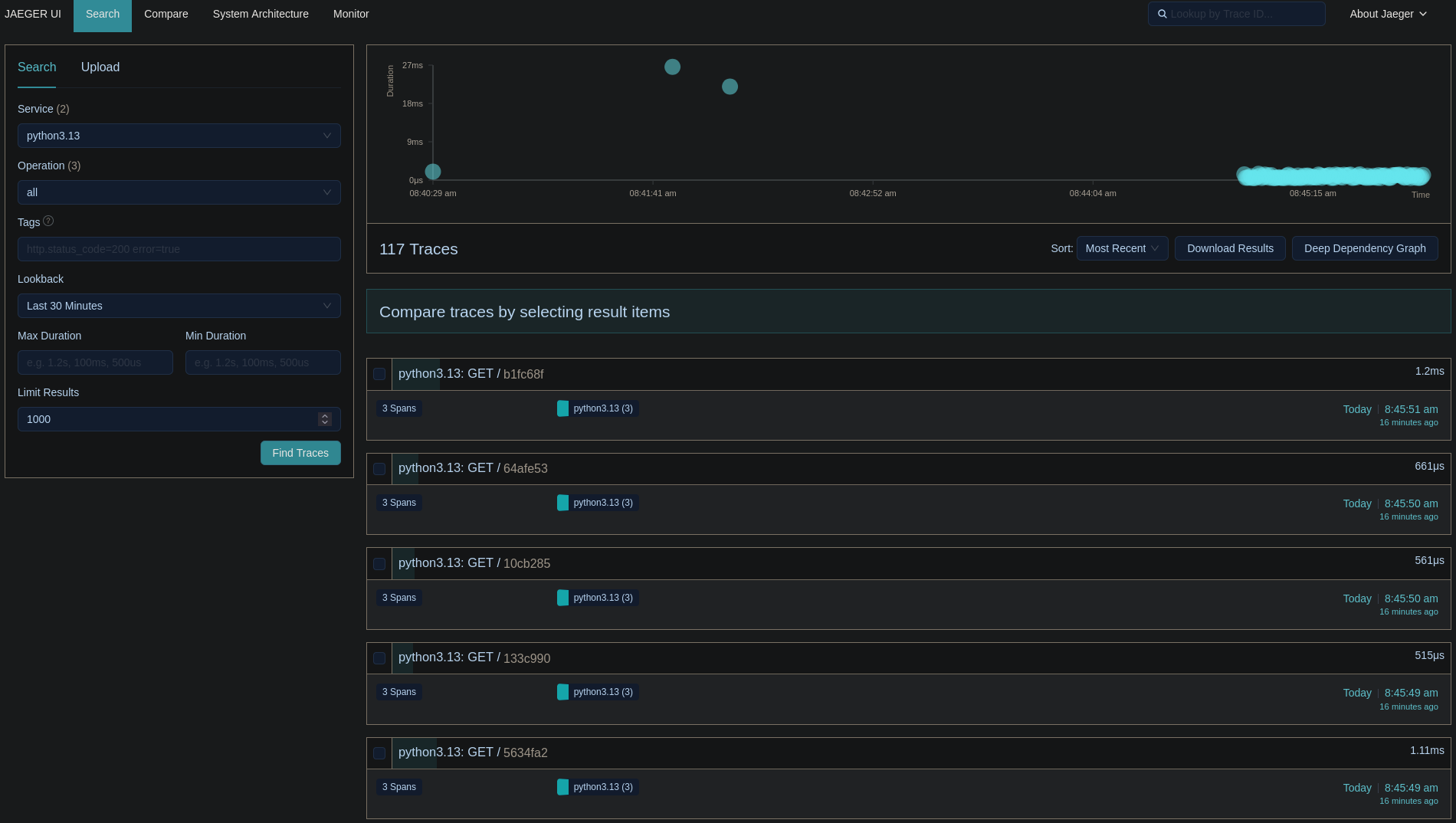
 I will run three HTTP servers on port 8080: two inside Incus
containers and one on the host machine. The OBI process will export
metrics and traces to an OpenTelemetry Collector, which will forward
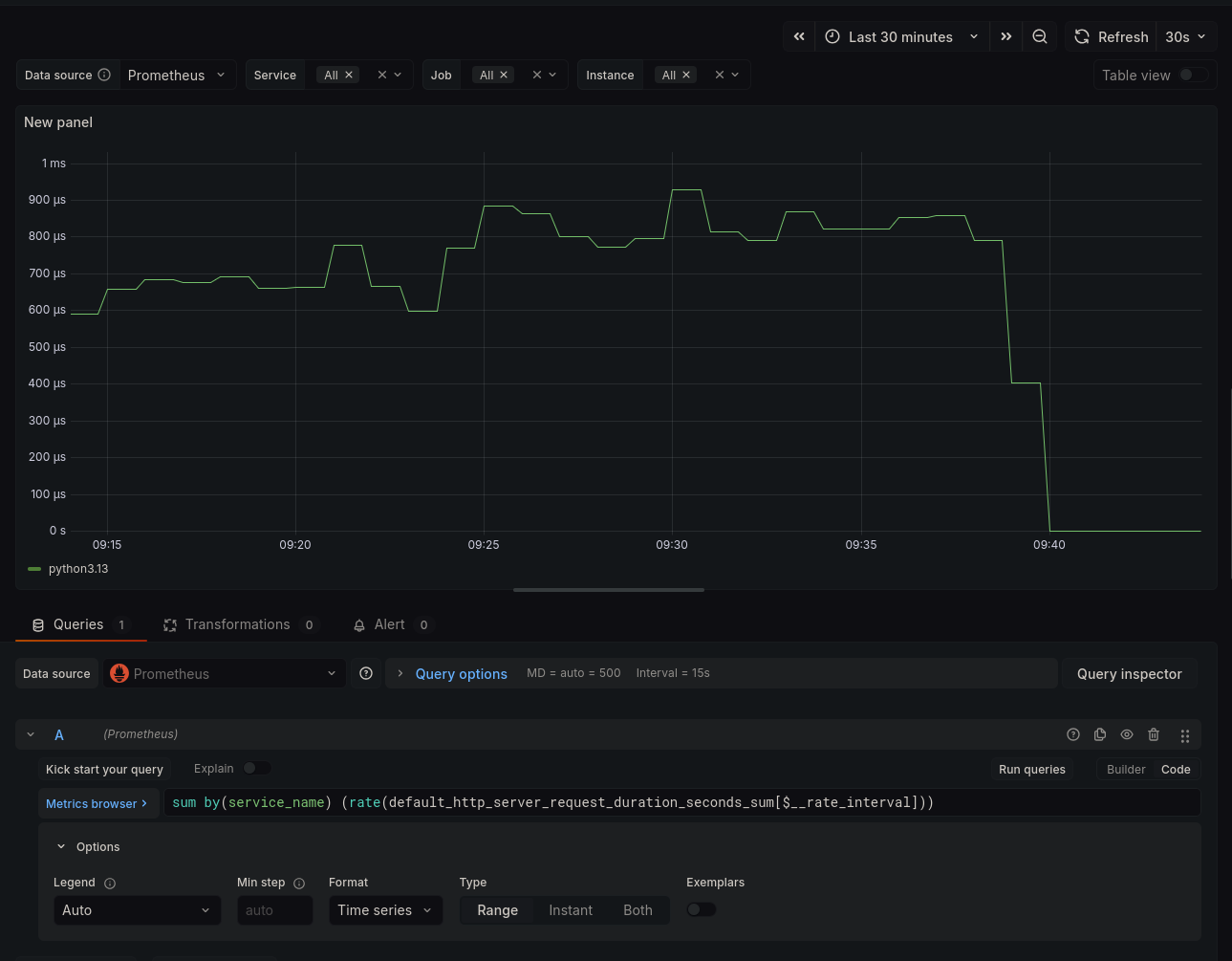
traces to Jaeger and expose a metrics endpoint for Prometheus to scrape.
Grafana will also be added to visualize the collected metrics using
dashboards.
The aim of this approach is to instrument only one of the HTTP
servers while ignoring the others. This simulates an environment with
hundreds of Incus containers, where the objective is to debug a single
container without being overwhelmed by excessive and irrelevant
telemetry data from the rest of the system.
OBI can filter metrics and traces based on attribute values, but I
was not able to filter by process PID. This is where the OBI Collector
comes into play, it allows me to use a processor to filter telemetry
data by the PID of the process being instrumented.
These are the steps to reproduce this setup:




 We re currently thinking of renovating our study/home office. I ll likely write
more about that project. Embarking on it reminded me that I d taken a photo of
the state of it nearly a year ago and forgot to post it, so here it is.

 Trixie ships
 .
There are two options to get the Scanning functionality back in Trixie until this is properly resolved by an updated XSane in Debian (e.g. via trixie-backports):
Lee Yingtong Li (RunasSudo) has created a Python script that calls XSane as a cli application and published it at
 . Today will be an in depth review on my work with the Debian OpenQA images testing team. I will highlight the struggles that I have had so far during my Outreachy internship.
The OpenQA images testing team uses OpenQA to automatically install images e.g. Gnome Images. The images are then tested using tests written in Perl. My current tasks include speech install and capture all audio. I am also installing Live Gnome image to Windows using BalenaEtcher then testing it. A set of similar tasks will also be collaborated on. While working on tasks, I have to go through the guides. I also learn how Perl works so as to edit and create tests. For every change made, I have to re-run the job in developer mode. I have to create needles that have matches and click co-ordinates. I have been stuck on some of these instances:

 A new release of my mixed collection of things package
 We announced a public beta of
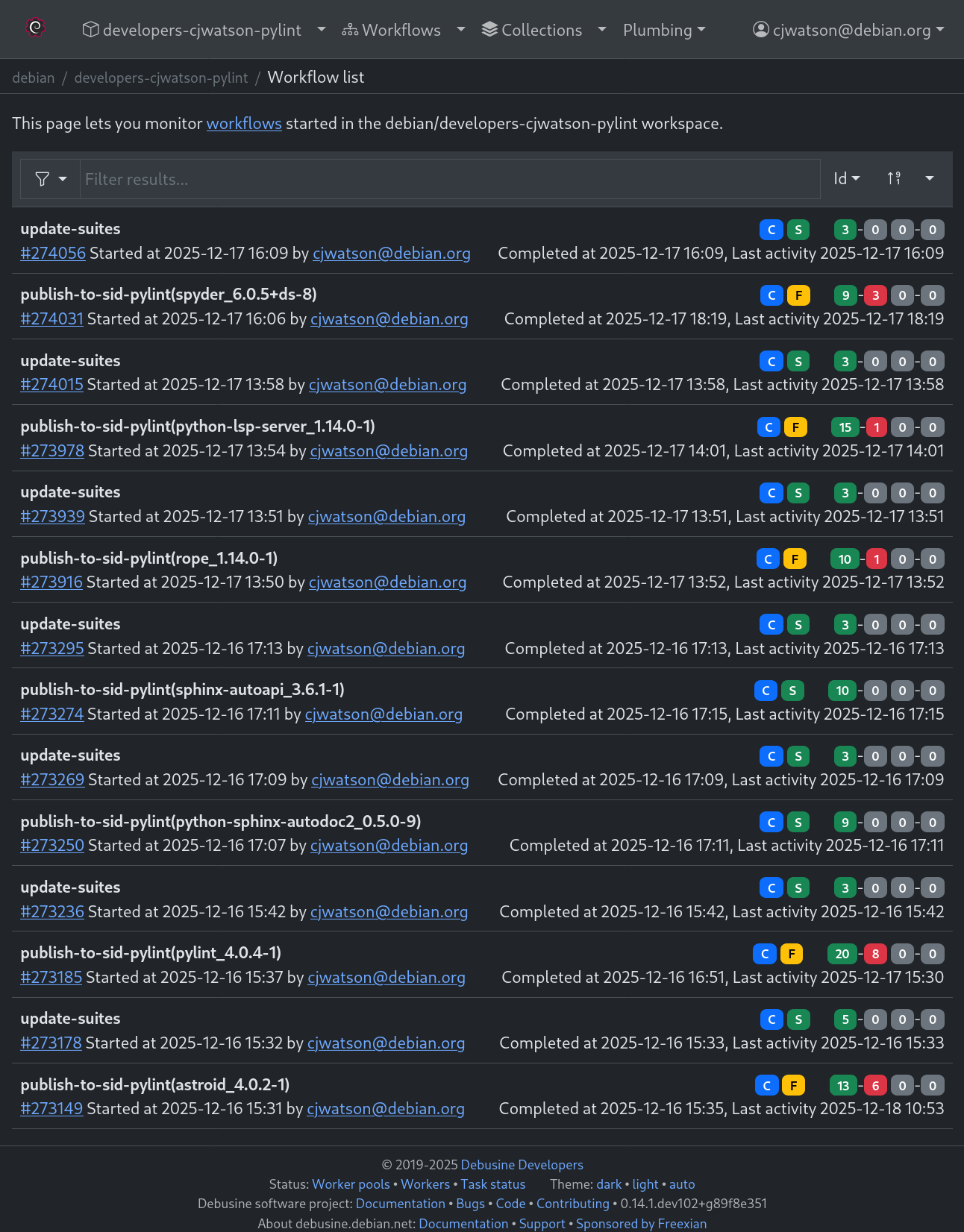 You can see that not all of the workflows are successful. This is because
we currently just show everything in every workflow; we don t consider
whether a task was retried and succeeded on the second try, or whether
there s now a newer version of a reverse-dependency so tests of the older
version should be disregarded, and so on. More fundamentally, you have to
look through each individual workflow, which is a bit of a pain: we plan to
add a dashboard that shows you the current state of a suite as a whole
rather than the current workflow-oriented view, but we haven t started on
that yet.
Drilling down into one of these workflows, it looks something like this:
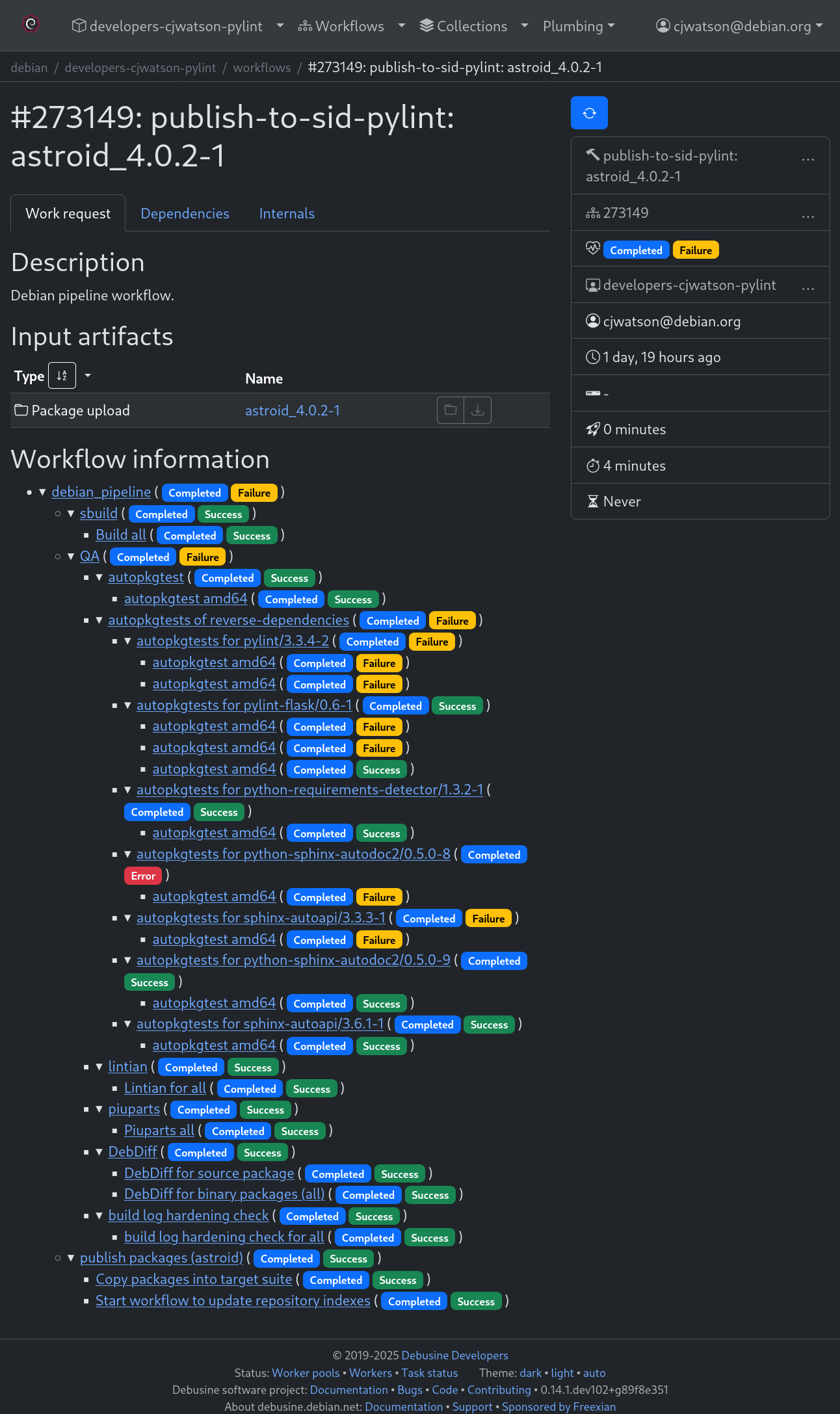 This was the first package I uploaded. The first pass of failures told me
about
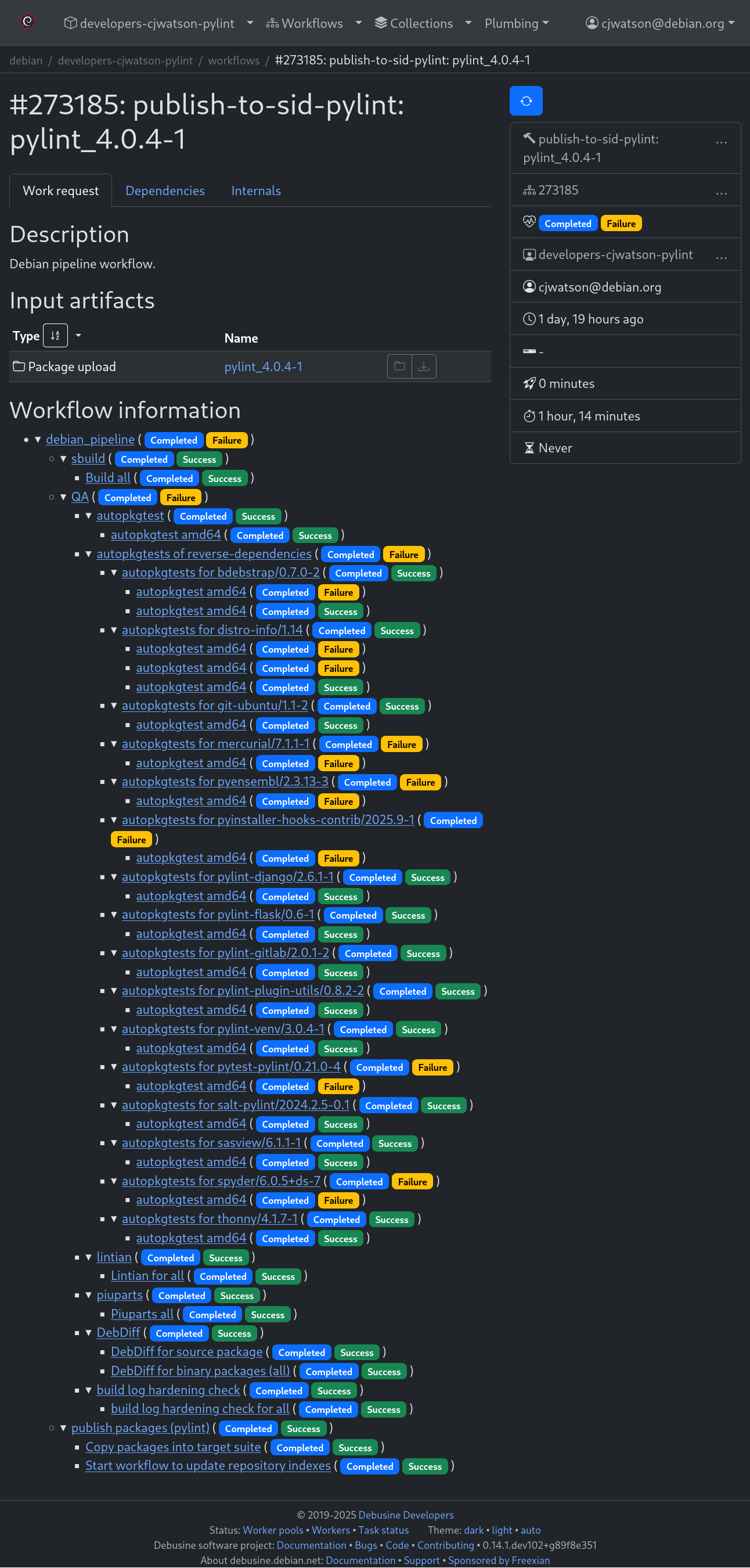 Again, there were some retries involved here, and also some cases where
packages were already failing in unstable so the failures weren t the fault
of my change; for now I had to go through and analyze these by hand, but
we ll soon have regression tracking to compare with reference runs and show
you where things have got better or worse.
After excluding those, that left