Search Results: "js"

6 December 2023

Reproducible Builds: Reproducible Builds in November 2023

Welcome to the November 2023 report from the Reproducible Builds project! In these reports we outline the most important things that we have been up to over the past month. As a rather rapid recap, whilst anyone may inspect the source code of free software for malicious flaws, almost all software is distributed to end users as pre-compiled binaries (more).

Reproducible Builds Summit 2023 Between October 31st and November 2nd, we held our seventh Reproducible Builds Summit in Hamburg, Germany! Amazingly, the agenda and all notes from all sessions are all online many thanks to everyone who wrote notes from the sessions. As a followup on one idea, started at the summit, Alexander Couzens and Holger Levsen started work on a cache (or tailored front-end) for the snapshot.debian.org service. The general idea is that, when rebuilding Debian, you do not actually need the whole ~140TB of data from snapshot.debian.org; rather, only a very small subset of the packages are ever used for for building. It turns out, for amd64, arm64, armhf, i386, ppc64el, riscv64 and s390 for Debian trixie, unstable and experimental, this is only around 500GB ie. less than 1%. Although the new service not yet ready for usage, it has already provided a promising outlook in this regard. More information is available on https://rebuilder-snapshot.debian.net and we hope that this service becomes usable in the coming weeks. The adjacent picture shows a sticky note authored by Jan-Benedict Glaw at the summit in Hamburg, confirming Holger Levsen s theory that rebuilding all Debian packages needs a very small subset of packages, the text states that 69,200 packages (in Debian sid) list 24,850 packages in their .buildinfo files, in 8,0200 variations. This little piece of paper was the beginning of rebuilder-snapshot and is a direct outcome of the summit! The Reproducible Builds team would like to thank our event sponsors who include Mullvad VPN, openSUSE, Debian, Software Freedom Conservancy, Allotropia and Aspiration Tech.

Beyond Trusting FOSS presentation at SeaGL On November 4th, Vagrant Cascadian presented Beyond Trusting FOSS at SeaGL in Seattle, WA in the United States. Founded in 2013, SeaGL is a free, grassroots technical summit dedicated to spreading awareness and knowledge about free source software, hardware and culture. The summary of Vagrant s talk mentions that it will:

[ ] introduce the concepts of Reproducible Builds, including best practices for developing and releasing software, the tools available to help diagnose issues, and touch on progress towards solving decades-old deeply pervasive fundamental security issues Learn how to verify and demonstrate trust, rather than simply hoping everything is OK!
Germane to the contents of the talk, the slides for Vagrant s talk can be built reproducibly, resulting in a PDF with a SHA1 of cfde2f8a0b7e6ec9b85377eeac0661d728b70f34 when built on Debian bookworm and c21fab273232c550ce822c4b0d9988e6c49aa2c3 on Debian sid at the time of writing.

Human Factors in Software Supply Chain Security Marcel Fourn , Dominik Wermke, Sascha Fahl and Yasemin Acar have published an article in a Special Issue of the IEEE s Security & Privacy magazine. Entitled A Viewpoint on Human Factors in Software Supply Chain Security: A Research Agenda, the paper justifies the need for reproducible builds to reach developers and end-users specifically, and furthermore points out some under-researched topics that we have seen mentioned in interviews. An author pre-print of the article is available in PDF form.

Community updates On our mailing list this month:

openSUSE updates Bernhard M. Wiedemann has created a wiki page outlining an proposal to create a general-purpose Linux distribution which consists of 100% bit-reproducible packages albeit minus the embedded signature within RPM files. It would be based on openSUSE Tumbleweed or, if available, its Slowroll-variant. In addition, Bernhard posted another monthly update for his work elsewhere in openSUSE.

Ubuntu Launchpad now supports .buildinfo files Back in 2017, Steve Langasek filed a bug against Ubuntu s Launchpad code hosting platform to report that .changes files (artifacts of building Ubuntu and Debian packages) reference .buildinfo files that aren t actually exposed by Launchpad itself. This was causing issues when attempting to process .changes files with tools such as Lintian. However, it was noticed last month that, in early August of this year, Simon Quigley had resolved this issue, and .buildinfo files are now available from the Launchpad system.

PHP reproducibility updates There have been two updates from the PHP programming language this month. Firstly, the widely-deployed PHPUnit framework for the PHP programming language have recently released version 10.5.0, which introduces the inclusion of a composer.lock file, ensuring total reproducibility of the shipped binary file. Further details and the discussion that went into their particular implementation can be found on the associated GitHub pull request. In addition, the presentation Leveraging Nix in the PHP ecosystem has been given in late October at the PHP International Conference in Munich by Pol Dellaiera. While the video replay is not yet available, the (reproducible) presentation slides and speaker notes are available.

diffoscope changes diffoscope is our in-depth and content-aware diff utility that can locate and diagnose reproducibility issues. This month, Chris Lamb made a number of changes, including:

  • Improving DOS/MBR extraction by adding support for 7z. [ ]
  • Adding a missing RequiredToolNotFound import. [ ]
  • As a UI/UX improvement, try and avoid printing an extended traceback if diffoscope runs out of memory. [ ]
  • Mark diffoscope as stable on PyPI.org. [ ]
  • Uploading version 252 to Debian unstable. [ ]

Website updates A huge number of notes were added to our website that were taken at our recent Reproducible Builds Summit held between October 31st and November 2nd in Hamburg, Germany. In particular, a big thanks to Arnout Engelen, Bernhard M. Wiedemann, Daan De Meyer, Evangelos Ribeiro Tzaras, Holger Levsen and Orhun Parmaks z. In addition to this, a number of other changes were made, including:

Upstream patches The Reproducible Builds project detects, dissects and attempts to fix as many currently-unreproducible packages as possible. We endeavour to send all of our patches upstream where appropriate. This month, we wrote a large number of such patches, including:

Reproducibility testing framework The Reproducible Builds project operates a comprehensive testing framework (available at tests.reproducible-builds.org) in order to check packages and other artifacts for reproducibility. In October, a number of changes were made by Holger Levsen:
  • Debian-related changes:
    • Track packages marked as Priority: important in a new package set. [ ][ ]
    • Stop scheduling packages that fail to build from source in bookworm [ ] and bullseye. [ ].
    • Add old releases dashboard link in web navigation. [ ]
    • Permit re-run of the pool_buildinfos script to be re-run for a specific year. [ ]
    • Grant jbglaw access to the osuosl4 node [ ][ ] along with lynxis [ ].
    • Increase RAM on the amd64 Ionos builders from 48 GiB to 64 GiB; thanks IONOS! [ ]
    • Move buster to archived suites. [ ][ ]
    • Reduce the number of arm64 architecture workers from 24 to 16 in order to improve stability [ ], reduce the workers for amd64 from 32 to 28 and, for i386, reduce from 12 down to 8 [ ].
    • Show the entire build history of each Debian package. [ ]
    • Stop scheduling already tested package/version combinations in Debian bookworm. [ ]
  • Snapshot service for rebuilders
    • Add an HTTP-based API endpoint. [ ][ ]
    • Add a Gunicorn instance to serve the HTTP API. [ ]
    • Add an NGINX config [ ][ ][ ][ ]
  • System-health:
    • Detect failures due to HTTP 503 Service Unavailable errors. [ ]
    • Detect failures to update package sets. [ ]
    • Detect unmet dependencies. (This usually occurs with builds of Debian live-build.) [ ]
  • Misc-related changes:
    • do install systemd-ommd on jenkins. [ ]
    • fix harmless typo in squid.conf for codethink04. [ ]
    • fixup: reproducible Debian: add gunicorn service to serve /api for rebuilder-snapshot.d.o. [ ]
    • Increase codethink04 s Squid cache_dir size setting to 16 GiB. [ ]
    • Don t install systemd-oomd as it unfortunately kills sshd [ ]
    • Use debootstrap from backports when commisioning nodes. [ ]
    • Add the live_build_debian_stretch_gnome, debsums-tests_buster and debsums-tests_buster jobs to the zombie list. [ ][ ]
    • Run jekyll build with the --watch argument when building the Reproducible Builds website. [ ]
    • Misc node maintenance. [ ][ ][ ]
Other changes were made as well, however, including Mattia Rizzolo fixing rc.local s Bash syntax so it can actually run [ ], commenting away some file cleanup code that is (potentially) deleting too much [ ] and fixing the html_brekages page for Debian package builds [ ]. Finally, diagnosed and submitted a patch to add a AddEncoding gzip .gz line to the tests.reproducible-builds.org Apache configuration so that Gzip files aren t re-compressed as Gzip which some clients can t deal with (as well as being a waste of time). [ ]

If you are interested in contributing to the Reproducible Builds project, please visit our Contribute page on our website. However, you can get in touch with us via:

28 November 2023

Dirk Eddelbuettel: RcppSimdJson 0.1.11 on CRAN: Maintenance

A new maintenance release 0.1.11 of the RcppSimdJson package is now on CRAN. RcppSimdJson wraps the fantastic and genuinely impressive simdjson library by Daniel Lemire and collaborators. Via very clever algorithmic engineering to obtain largely branch-free code, coupled with modern C++ and newer compiler instructions, it results in parsing gigabytes of JSON parsed per second which is quite mindboggling. The best-case performance is faster than CPU speed as use of parallel SIMD instructions and careful branch avoidance can lead to less than one cpu cycle per byte parsed; see the video of the talk by Daniel Lemire at QCon. This release responds to a CRAN request to address issues now identified by -Wformat -Wformat-security. These are frequently pretty simple changes as it was here: all it took was an call to compileAttributes() from an updated Rcpp version which now injects "%s" as a format string when calling Rf_error(). The (very short) NEWS entry for this release follows.

Changes in version 0.1.11 (2023-11-28)
  • RcppExports.cpp has been regenerated under an update Rcpp to address a print format warning (Dirk in #88).

Courtesy of my CRANberries, there is also a diffstat report for this release. For questions, suggestions, or issues please use the issue tracker at the GitHub repo. If you like this or other open-source work I do, you can now sponsor me at GitHub.

This post by Dirk Eddelbuettel originated on his Thinking inside the box blog. Please report excessive re-aggregation in third-party for-profit settings.

23 November 2023

Freexian Collaborators: Debian Contributions: Preparing for Python 3.12, /usr-merge updates, invalid PEP-440 versions, and more! (by Utkarsh Gupta)

Contributing to Debian is part of Freexian s mission. This article covers the latest achievements of Freexian and their collaborators. All of this is made possible by organizations subscribing to our Long Term Support contracts and consulting services.

urllib3 s old security patch by Stefano Rivera Stefano ran into a test-suite failure in a new Debian package (python-truststore), caused by Debian s patch to urllib3 from a decade ago, making it enable TLS verification by default (remember those days!). Some analysis confirmed that this patch isn t useful any more, and could be removed. While working on the package, Stefano investigated the scope of the urllib3 2.x transition. It looks ready to start, not many packages are affected.

Preparing for Python 3.12 in dh-python by Stefano Rivera We are preparing to start the Python 3.12 transition in Debian. Two of the upstream changes that are going to cause a lot of packages to break could be worked-around in dh-python, so we did:
  • Distutils is no longer shipped in the Python stdlib. Packages need to Build-Depend on python3-setuptools to get a (compatibility shim) distutils. Until that happens, dh-python will Depend on setuptools.
  • A failure to find any tests to execute will now make the unittest runner exit 5, like pytest does. This was our change, to test-suites that have failed to be automatically discovered. It will cause many packages to fail to build, so until they explicitly skip running test suites, dh-python will ignore these failures.

/usr-merge by Helmut Grohne It has become clear that the planned changes to debhelper and systemd.pc cause more rc-bugs. Helmut researched these systematically and filed another stack of patches. At the time of this writing, the uploads would still cause about 40 rc-bugs. A new opt-in helper dh_movetousr has been developed and added to debhelper in trixie and unstable.

debian-printing, by Thorsten Alteholz This month Thorsten adopted two packages, namely rlpr and lprng, and moved them to the debian-printing team. As part of this Thorsten could close eight bugs in the BTS. Thorsten also uploaded a new upstream version of cups, which also meant that eleven bugs could be closed. As package hannah-foo2zjs still depended on the deprecated policykit-1 package, Thorsten changed the dependency list accordingly and could close one RC bug by the following upload.

Invalid PEP-440 Versions in Python Packages by Stefano Rivera Stefano investigated how many packages in Debian (typically Debian-native packages) recorded versions in their packaging metadata (egg-info directories) that weren t valid PEP-440 Python versions. pip is starting to enforce that all versions on the system are valid.

Miscellaneous contributions
  • distro-info-data updates in Debian, due to the new Ubuntu release, by Stefano.
  • DebConf 23 bookkeeping continues, but is winding down. Stefano still spends a little time on it.
  • Utkarsh continues to monitor and help with reimbursements.
  • Helmut continues to maintain architecture bootstrap and accidentally broke pam briefly
  • Anton uploaded boost1.83 and started to prepare a transition to make boost1.83 as a default boost version.
  • Rejuntada Debian UY 2023, a MiniDebConf that will be held in Montevideo, from 9 to 11 November, mainly organized by Santiago.

21 November 2023

Mike Hommey: How I (kind of) killed Mercurial at Mozilla

Did you hear the news? Firefox development is moving from Mercurial to Git. While the decision is far from being mine, and I was barely involved in the small incremental changes that ultimately led to this decision, I feel I have to take at least some responsibility. And if you are one of those who would rather use Mercurial than Git, you may direct all your ire at me. But let's take a step back and review the past 25 years leading to this decision. You'll forgive me for skipping some details and any possible inaccuracies. This is already a long post, while I could have been more thorough, even I think that would have been too much. This is also not an official Mozilla position, only my personal perception and recollection as someone who was involved at times, but mostly an observer from a distance. From CVS to DVCS From its release in 1998, the Mozilla source code was kept in a CVS repository. If you're too young to know what CVS is, let's just say it's an old school version control system, with its set of problems. Back then, it was mostly ubiquitous in the Open Source world, as far as I remember. In the early 2000s, the Subversion version control system gained some traction, solving some of the problems that came with CVS. Incidentally, Subversion was created by Jim Blandy, who now works at Mozilla on completely unrelated matters. In the same period, the Linux kernel development moved from CVS to Bitkeeper, which was more suitable to the distributed nature of the Linux community. BitKeeper had its own problem, though: it was the opposite of Open Source, but for most pragmatic people, it wasn't a real concern because free access was provided. Until it became a problem: someone at OSDL developed an alternative client to BitKeeper, and licenses of BitKeeper were rescinded for OSDL members, including Linus Torvalds (they were even prohibited from purchasing one). Following this fiasco, in April 2005, two weeks from each other, both Git and Mercurial were born. The former was created by Linus Torvalds himself, while the latter was developed by Olivia Mackall, who was a Linux kernel developer back then. And because they both came out of the same community for the same needs, and the same shared experience with BitKeeper, they both were similar distributed version control systems. Interestingly enough, several other DVCSes existed: In this landscape, the major difference Git was making at the time was that it was blazing fast. Almost incredibly so, at least on Linux systems. That was less true on other platforms (especially Windows). It was a game-changer for handling large codebases in a smooth manner. Anyways, two years later, in 2007, Mozilla decided to move its source code not to Bzr, not to Git, not to Subversion (which, yes, was a contender), but to Mercurial. The decision "process" was laid down in two rather colorful blog posts. My memory is a bit fuzzy, but I don't recall that it was a particularly controversial choice. All of those DVCSes were still young, and there was no definite "winner" yet (GitHub hadn't even been founded). It made the most sense for Mozilla back then, mainly because the Git experience on Windows still wasn't there, and that mattered a lot for Mozilla, with its diverse platform support. As a contributor, I didn't think much of it, although to be fair, at the time, I was mostly consuming the source tarballs. Personal preferences Digging through my archives, I've unearthed a forgotten chapter: I did end up setting up both a Mercurial and a Git mirror of the Firefox source repository on alioth.debian.org. Alioth.debian.org was a FusionForge-based collaboration system for Debian developers, similar to SourceForge. It was the ancestor of salsa.debian.org. I used those mirrors for the Debian packaging of Firefox (cough cough Iceweasel). The Git mirror was created with hg-fast-export, and the Mercurial mirror was only a necessary step in the process. By that time, I had converted my Subversion repositories to Git, and switched off SVK. Incidentally, I started contributing to Git around that time as well. I apparently did this not too long after Mozilla switched to Mercurial. As a Linux user, I think I just wanted the speed that Mercurial was not providing. Not that Mercurial was that slow, but the difference between a couple seconds and a couple hundred milliseconds was a significant enough difference in user experience for me to prefer Git (and Firefox was not the only thing I was using version control for) Other people had also similarly created their own mirror, or with other tools. But none of them were "compatible": their commit hashes were different. Hg-git, used by the latter, was putting extra information in commit messages that would make the conversion differ, and hg-fast-export would just not be consistent with itself! My mirror is long gone, and those have not been updated in more than a decade. I did end up using Mercurial, when I got commit access to the Firefox source repository in April 2010. I still kept using Git for my Debian activities, but I now was also using Mercurial to push to the Mozilla servers. I joined Mozilla as a contractor a few months after that, and kept using Mercurial for a while, but as a, by then, long time Git user, it never really clicked for me. It turns out, the sentiment was shared by several at Mozilla. Git incursion In the early 2010s, GitHub was becoming ubiquitous, and the Git mindshare was getting large. Multiple projects at Mozilla were already entirely hosted on GitHub. As for the Firefox source code base, Mozilla back then was kind of a Wild West, and engineers being engineers, multiple people had been using Git, with their own inconvenient workflows involving a local Mercurial clone. The most popular set of scripts was moz-git-tools, to incorporate changes in a local Git repository into the local Mercurial copy, to then send to Mozilla servers. In terms of the number of people doing that, though, I don't think it was a lot of people, probably a few handfuls. On my end, I was still keeping up with Mercurial. I think at that time several engineers had their own unofficial Git mirrors on GitHub, and later on Ehsan Akhgari provided another mirror, with a twist: it also contained the full CVS history, which the canonical Mercurial repository didn't have. This was particularly interesting for engineers who needed to do some code archeology and couldn't get past the 2007 cutoff of the Mercurial repository. I think that mirror ultimately became the official-looking, but really unofficial, mozilla-central repository on GitHub. On a side note, a Mercurial repository containing the CVS history was also later set up, but that didn't lead to something officially supported on the Mercurial side. Some time around 2011~2012, I started to more seriously consider using Git for work myself, but wasn't satisfied with the workflows others had set up for themselves. I really didn't like the idea of wasting extra disk space keeping a Mercurial clone around while using a Git mirror. I wrote a Python script that would use Mercurial as a library to access a remote repository and produce a git-fast-import stream. That would allow the creation of a git repository without a local Mercurial clone. It worked quite well, but it was not able to incrementally update. Other, more complete tools existed already, some of which I mentioned above. But as time was passing and the size and depth of the Mercurial repository was growing, these tools were showing their limits and were too slow for my taste, especially for the initial clone. Boot to Git In the same time frame, Mozilla ventured in the Mobile OS sphere with Boot to Gecko, later known as Firefox OS. What does that have to do with version control? The needs of third party collaborators in the mobile space led to the creation of what is now the gecko-dev repository on GitHub. As I remember it, it was challenging to create, but once it was there, Git users could just clone it and have a working, up-to-date local copy of the Firefox source code and its history... which they could already have, but this was the first officially supported way of doing so. Coincidentally, Ehsan's unofficial mirror was having trouble (to the point of GitHub closing the repository) and was ultimately shut down in December 2013. You'll often find comments on the interwebs about how GitHub has become unreliable since the Microsoft acquisition. I can't really comment on that, but if you think GitHub is unreliable now, rest assured that it was worse in its beginning. And its sustainability as a platform also wasn't a given, being a rather new player. So on top of having this official mirror on GitHub, Mozilla also ventured in setting up its own Git server for greater control and reliability. But the canonical repository was still the Mercurial one, and while Git users now had a supported mirror to pull from, they still had to somehow interact with Mercurial repositories, most notably for the Try server. Git slowly creeping in Firefox build tooling Still in the same time frame, tooling around building Firefox was improving drastically. For obvious reasons, when version control integration was needed in the tooling, Mercurial support was always a no-brainer. The first explicit acknowledgement of a Git repository for the Firefox source code, other than the addition of the .gitignore file, was bug 774109. It added a script to install the prerequisites to build Firefox on macOS (still called OSX back then), and that would print a message inviting people to obtain a copy of the source code with either Mercurial or Git. That was a precursor to current bootstrap.py, from September 2012. Following that, as far as I can tell, the first real incursion of Git in the Firefox source tree tooling happened in bug 965120. A few days earlier, bug 952379 had added a mach clang-format command that would apply clang-format-diff to the output from hg diff. Obviously, running hg diff on a Git working tree didn't work, and bug 965120 was filed, and support for Git was added there. That was in January 2014. A year later, when the initial implementation of mach artifact was added (which ultimately led to artifact builds), Git users were an immediate thought. But while they were considered, it was not to support them, but to avoid actively breaking their workflows. Git support for mach artifact was eventually added 14 months later, in March 2016. From gecko-dev to git-cinnabar Let's step back a little here, back to the end of 2014. My user experience with Mercurial had reached a level of dissatisfaction that was enough for me to decide to take that script from a couple years prior and make it work for incremental updates. That meant finding a way to store enough information locally to be able to reconstruct whatever the incremental updates would be relying on (guess why other tools hid a local Mercurial clone under hood). I got something working rather quickly, and after talking to a few people about this side project at the Mozilla Portland All Hands and seeing their excitement, I published a git-remote-hg initial prototype on the last day of the All Hands. Within weeks, the prototype gained the ability to directly push to Mercurial repositories, and a couple months later, was renamed to git-cinnabar. At that point, as a Git user, instead of cloning the gecko-dev repository from GitHub and switching to a local Mercurial repository whenever you needed to push to a Mercurial repository (i.e. the aforementioned Try server, or, at the time, for reviews), you could just clone and push directly from/to Mercurial, all within Git. And it was fast too. You could get a full clone of mozilla-central in less than half an hour, when at the time, other similar tools would take more than 10 hours (needless to say, it's even worse now). Another couple months later (we're now at the end of April 2015), git-cinnabar became able to start off a local clone of the gecko-dev repository, rather than clone from scratch, which could be time consuming. But because git-cinnabar and the tool that was updating gecko-dev weren't producing the same commits, this setup was cumbersome and not really recommended. For instance, if you pushed something to mozilla-central with git-cinnabar from a gecko-dev clone, it would come back with a different commit hash in gecko-dev, and you'd have to deal with the divergence. Eventually, in April 2020, the scripts updating gecko-dev were switched to git-cinnabar, making the use of gecko-dev alongside git-cinnabar a more viable option. Ironically(?), the switch occurred to ease collaboration with KaiOS (you know, the mobile OS born from the ashes of Firefox OS). Well, okay, in all honesty, when the need of syncing in both directions between Git and Mercurial (we only had ever synced from Mercurial to Git) came up, I nudged Mozilla in the direction of git-cinnabar, which, in my (biased but still honest) opinion, was the more reliable option for two-way synchronization (we did have regular conversion problems with hg-git, nothing of the sort has happened since the switch). One Firefox repository to rule them all For reasons I don't know, Mozilla decided to use separate Mercurial repositories as "branches". With the switch to the rapid release process in 2011, that meant one repository for nightly (mozilla-central), one for aurora, one for beta, and one for release. And with the addition of Extended Support Releases in 2012, we now add a new ESR repository every year. Boot to Gecko also had its own branches, and so did Fennec (Firefox for Mobile, before Android). There are a lot of them. And then there are also integration branches, where developer's work lands before being merged in mozilla-central (or backed out if it breaks things), always leaving mozilla-central in a (hopefully) good state. Only one of them remains in use today, though. I can only suppose that the way Mercurial branches work was not deemed practical. It is worth noting, though, that Mercurial branches are used in some cases, to branch off a dot-release when the next major release process has already started, so it's not a matter of not knowing the feature exists or some such. In 2016, Gregory Szorc set up a new repository that would contain them all (or at least most of them), which eventually became what is now the mozilla-unified repository. This would e.g. simplify switching between branches when necessary. 7 years later, for some reason, the other "branches" still exist, but most developers are expected to be using mozilla-unified. Mozilla's CI also switched to using mozilla-unified as base repository. Honestly, I'm not sure why the separate repositories are still the main entry point for pushes, rather than going directly to mozilla-unified, but it probably comes down to switching being work, and not being a top priority. Also, it probably doesn't help that working with multiple heads in Mercurial, even (especially?) with bookmarks, can be a source of confusion. To give an example, if you aren't careful, and do a plain clone of the mozilla-unified repository, you may not end up on the latest mozilla-central changeset, but rather, e.g. one from beta, or some other branch, depending which one was last updated. Hosting is simple, right? Put your repository on a server, install hgweb or gitweb, and that's it? Maybe that works for... Mercurial itself, but that repository "only" has slightly over 50k changesets and less than 4k files. Mozilla-central has more than an order of magnitude more changesets (close to 700k) and two orders of magnitude more files (more than 700k if you count the deleted or moved files, 350k if you count the currently existing ones). And remember, there are a lot of "duplicates" of this repository. And I didn't even mention user repositories and project branches. Sure, it's a self-inflicted pain, and you'd think it could probably(?) be mitigated with shared repositories. But consider the simple case of two repositories: mozilla-central and autoland. You make autoland use mozilla-central as a shared repository. Now, you push something new to autoland, it's stored in the autoland datastore. Eventually, you merge to mozilla-central. Congratulations, it's now in both datastores, and you'd need to clean-up autoland if you wanted to avoid the duplication. Now, you'd think mozilla-unified would solve these issues, and it would... to some extent. Because that wouldn't cover user repositories and project branches briefly mentioned above, which in GitHub parlance would be considered as Forks. So you'd want a mega global datastore shared by all repositories, and repositories would need to only expose what they really contain. Does Mercurial support that? I don't think so (okay, I'll give you that: even if it doesn't, it could, but that's extra work). And since we're talking about a transition to Git, does Git support that? You may have read about how you can link to a commit from a fork and make-pretend that it comes from the main repository on GitHub? At least, it shows a warning, now. That's essentially the architectural reason why. So the actual answer is that Git doesn't support it out of the box, but GitHub has some backend magic to handle it somehow (and hopefully, other things like Gitea, Girocco, Gitlab, etc. have something similar). Now, to come back to the size of the repository. A repository is not a static file. It's a server with which you negotiate what you have against what it has that you want. Then the server bundles what you asked for based on what you said you have. Or in the opposite direction, you negotiate what you have that it doesn't, you send it, and the server incorporates what you sent it. Fortunately the latter is less frequent and requires authentication. But the former is more frequent and CPU intensive. Especially when pulling a large number of changesets, which, incidentally, cloning is. "But there is a solution for clones" you might say, which is true. That's clonebundles, which offload the CPU intensive part of cloning to a single job scheduled regularly. Guess who implemented it? Mozilla. But that only covers the cloning part. We actually had laid the ground to support offloading large incremental updates and split clones, but that never materialized. Even with all that, that still leaves you with a server that can display file contents, diffs, blames, provide zip archives of a revision, and more, all of which are CPU intensive in their own way. And these endpoints are regularly abused, and cause extra load to your servers, yes plural, because of course a single server won't handle the load for the number of users of your big repositories. And because your endpoints are abused, you have to close some of them. And I'm not mentioning the Try repository with its tens of thousands of heads, which brings its own sets of problems (and it would have even more heads if we didn't fake-merge them once in a while). Of course, all the above applies to Git (and it only gained support for something akin to clonebundles last year). So, when the Firefox OS project was stopped, there wasn't much motivation to continue supporting our own Git server, Mercurial still being the official point of entry, and git.mozilla.org was shut down in 2016. The growing difficulty of maintaining the status quo Slowly, but steadily in more recent years, as new tooling was added that needed some input from the source code manager, support for Git was more and more consistently added. But at the same time, as people left for other endeavors and weren't necessarily replaced, or more recently with layoffs, resources allocated to such tooling have been spread thin. Meanwhile, the repository growth didn't take a break, and the Try repository was becoming an increasing pain, with push times quite often exceeding 10 minutes. The ongoing work to move Try pushes to Lando will hide the problem under the rug, but the underlying problem will still exist (although the last version of Mercurial seems to have improved things). On the flip side, more and more people have been relying on Git for Firefox development, to my own surprise, as I didn't really push for that to happen. It just happened organically, by ways of git-cinnabar existing, providing a compelling experience to those who prefer Git, and, I guess, word of mouth. I was genuinely surprised when I recently heard the use of Git among moz-phab users had surpassed a third. I did, however, occasionally orient people who struggled with Mercurial and said they were more familiar with Git, towards git-cinnabar. I suspect there's a somewhat large number of people who never realized Git was a viable option. But that, on its own, can come with its own challenges: if you use git-cinnabar without being backed by gecko-dev, you'll have a hard time sharing your branches on GitHub, because you can't push to a fork of gecko-dev without pushing your entire local repository, as they have different commit histories. And switching to gecko-dev when you weren't already using it requires some extra work to rebase all your local branches from the old commit history to the new one. Clone times with git-cinnabar have also started to go a little out of hand in the past few years, but this was mitigated in a similar manner as with the Mercurial cloning problem: with static files that are refreshed regularly. Ironically, that made cloning with git-cinnabar faster than cloning with Mercurial. But generating those static files is increasingly time-consuming. As of writing, generating those for mozilla-unified takes close to 7 hours. I was predicting clone times over 10 hours "in 5 years" in a post from 4 years ago, I wasn't too far off. With exponential growth, it could still happen, although to be fair, CPUs have improved since. I will explore the performance aspect in a subsequent blog post, alongside the upcoming release of git-cinnabar 0.7.0-b1. I don't even want to check how long it now takes with hg-git or git-remote-hg (they were already taking more than a day when git-cinnabar was taking a couple hours). I suppose it's about time that I clarify that git-cinnabar has always been a side-project. It hasn't been part of my duties at Mozilla, and the extent to which Mozilla supports git-cinnabar is in the form of taskcluster workers on the community instance for both git-cinnabar CI and generating those clone bundles. Consequently, that makes the above git-cinnabar specific issues a Me problem, rather than a Mozilla problem. Taking the leap I can't talk for the people who made the proposal to move to Git, nor for the people who put a green light on it. But I can at least give my perspective. Developers have regularly asked why Mozilla was still using Mercurial, but I think it was the first time that a formal proposal was laid out. And it came from the Engineering Workflow team, responsible for issue tracking, code reviews, source control, build and more. It's easy to say "Mozilla should have chosen Git in the first place", but back in 2007, GitHub wasn't there, Bitbucket wasn't there, and all the available options were rather new (especially compared to the then 21 years-old CVS). I think Mozilla made the right choice, all things considered. Had they waited a couple years, the story might have been different. You might say that Mozilla stayed with Mercurial for so long because of the sunk cost fallacy. I don't think that's true either. But after the biggest Mercurial repository hosting service turned off Mercurial support, and the main contributor to Mercurial going their own way, it's hard to ignore that the landscape has evolved. And the problems that we regularly encounter with the Mercurial servers are not going to get any better as the repository continues to grow. As far as I know, all the Mercurial repositories bigger than Mozilla's are... not using Mercurial. Google has its own closed-source server, and Facebook has another of its own, and it's not really public either. With resources spread thin, I don't expect Mozilla to be able to continue supporting a Mercurial server indefinitely (although I guess Octobus could be contracted to give a hand, but is that sustainable?). Mozilla, being a champion of Open Source, also doesn't live in a silo. At some point, you have to meet your contributors where they are. And the Open Source world is now majoritarily using Git. I'm sure the vast majority of new hires at Mozilla in the past, say, 5 years, know Git and have had to learn Mercurial (although they arguably didn't need to). Even within Mozilla, with thousands(!) of repositories on GitHub, Firefox is now actually the exception rather than the norm. I should even actually say Desktop Firefox, because even Mobile Firefox lives on GitHub (although Fenix is moving back in together with Desktop Firefox, and the timing is such that that will probably happen before Firefox moves to Git). Heck, even Microsoft moved to Git! With a significant developer base already using Git thanks to git-cinnabar, and all the constraints and problems I mentioned previously, it actually seems natural that a transition (finally) happens. However, had git-cinnabar or something similarly viable not existed, I don't think Mozilla would be in a position to take this decision. On one hand, it probably wouldn't be in the current situation of having to support both Git and Mercurial in the tooling around Firefox, nor the resource constraints related to that. But on the other hand, it would be farther from supporting Git and being able to make the switch in order to address all the other problems. But... GitHub? I hope I made a compelling case that hosting is not as simple as it can seem, at the scale of the Firefox repository. It's also not Mozilla's main focus. Mozilla has enough on its plate with the migration of existing infrastructure that does rely on Mercurial to understandably not want to figure out the hosting part, especially with limited resources, and with the mixed experience hosting both Mercurial and git has been so far. After all, GitHub couldn't even display things like the contributors' graph on gecko-dev until recently, and hosting is literally their job! They still drop the ball on large blames (thankfully we have searchfox for those). Where does that leave us? Gitlab? For those criticizing GitHub for being proprietary, that's probably not open enough. Cloud Source Repositories? "But GitHub is Microsoft" is a complaint I've read a lot after the announcement. Do you think Google hosting would have appealed to these people? Bitbucket? I'm kind of surprised it wasn't in the list of providers that were considered, but I'm also kind of glad it wasn't (and I'll leave it at that). I think the only relatively big hosting provider that could have made the people criticizing the choice of GitHub happy is Codeberg, but I hadn't even heard of it before it was mentioned in response to Mozilla's announcement. But really, with literal thousands of Mozilla repositories already on GitHub, with literal tens of millions repositories on the platform overall, the pragmatic in me can't deny that it's an attractive option (and I can't stress enough that I wasn't remotely close to the room where the discussion about what choice to make happened). "But it's a slippery slope". I can see that being a real concern. LLVM also moved its repository to GitHub (from a (I think) self-hosted Subversion server), and ended up moving off Bugzilla and Phabricator to GitHub issues and PRs four years later. As an occasional contributor to LLVM, I hate this move. I hate the GitHub review UI with a passion. At least, right now, GitHub PRs are not a viable option for Mozilla, for their lack of support for security related PRs, and the more general shortcomings in the review UI. That doesn't mean things won't change in the future, but let's not get too far ahead of ourselves. The move to Git has just been announced, and the migration has not even begun yet. Just because Mozilla is moving the Firefox repository to GitHub doesn't mean it's locked in forever or that all the eggs are going to be thrown into one basket. If bridges need to be crossed in the future, we'll see then. So, what's next? The official announcement said we're not expecting the migration to really begin until six months from now. I'll swim against the current here, and say this: the earlier you can switch to git, the earlier you'll find out what works and what doesn't work for you, whether you already know Git or not. While there is not one unique workflow, here's what I would recommend anyone who wants to take the leap off Mercurial right now: As there is no one-size-fits-all workflow, I won't tell you how to organize yourself from there. I'll just say this: if you know the Mercurial sha1s of your previous local work, you can create branches for them with:
$ git branch <branch_name> $(git cinnabar hg2git <hg_sha1>)
At this point, you should have everything available on the Git side, and you can remove the .hg directory. Or move it into some empty directory somewhere else, just in case. But don't leave it here, it will only confuse the tooling. Artifact builds WILL be confused, though, and you'll have to ./mach configure before being able to do anything. You may also hit bug 1865299 if your working tree is older than this post. If you have any problem or question, you can ping me on #git-cinnabar or #git on Matrix. I'll put the instructions above somewhere on wiki.mozilla.org, and we can collaboratively iterate on them. Now, what the announcement didn't say is that the Git repository WILL NOT be gecko-dev, doesn't exist yet, and WON'T BE COMPATIBLE (trust me, it'll be for the better). Why did I make you do all the above, you ask? Because that won't be a problem. I'll have you covered, I promise. The upcoming release of git-cinnabar 0.7.0-b1 will have a way to smoothly switch between gecko-dev and the future repository (incidentally, that will also allow to switch from a pure git-cinnabar clone to a gecko-dev one, for the git-cinnabar users who have kept reading this far). What about git-cinnabar? With Mercurial going the way of the dodo at Mozilla, my own need for git-cinnabar will vanish. Legitimately, this begs the question whether it will still be maintained. I can't answer for sure. I don't have a crystal ball. However, the needs of the transition itself will motivate me to finish some long-standing things (like finalizing the support for pushing merges, which is currently behind an experimental flag) or implement some missing features (support for creating Mercurial branches). Git-cinnabar started as a Python script, it grew a sidekick implemented in C, which then incorporated some Rust, which then cannibalized the Python script and took its place. It is now close to 90% Rust, and 10% C (if you don't count the code from Git that is statically linked to it), and has sort of become my Rust playground (it's also, I must admit, a mess, because of its history, but it's getting better). So the day to day use with Mercurial is not my sole motivation to keep developing it. If it were, it would stay stagnant, because all the features I need are there, and the speed is not all that bad, although I know it could be better. Arguably, though, git-cinnabar has been relatively stagnant feature-wise, because all the features I need are there. So, no, I don't expect git-cinnabar to die along Mercurial use at Mozilla, but I can't really promise anything either. Final words That was a long post. But there was a lot of ground to cover. And I still skipped over a bunch of things. I hope I didn't bore you to death. If I did and you're still reading... what's wrong with you? ;) So this is the end of Mercurial at Mozilla. So long, and thanks for all the fish. But this is also the beginning of a transition that is not easy, and that will not be without hiccups, I'm sure. So fasten your seatbelts (plural), and welcome the change. To circle back to the clickbait title, did I really kill Mercurial at Mozilla? Of course not. But it's like I stumbled upon a few sparks and tossed a can of gasoline on them. I didn't start the fire, but I sure made it into a proper bonfire... and now it has turned into a wildfire. And who knows? 15 years from now, someone else might be looking back at how Mozilla picked Git at the wrong time, and that, had we waited a little longer, we would have picked some yet to come new horse. But hey, that's the tech cycle for you.

12 November 2023

Petter Reinholdtsen: New and improved sqlcipher in Debian for accessing Signal database

For a while now I wanted to have direct access to the Signal database of messages and channels of my Desktop edition of Signal. I prefer the enforced end to end encryption of Signal these days for my communication with friends and family, to increase the level of safety and privacy as well as raising the cost of the mass surveillance government and non-government entities practice these days. In August I came across a nice recipe on how to use sqlcipher to extract statistics from the Signal database explaining how to do this. Unfortunately this did not work with the version of sqlcipher in Debian. The sqlcipher package is a "fork" of the sqlite package with added support for encrypted databases. Sadly the current Debian maintainer announced more than three years ago that he did not have time to maintain sqlcipher, so it seemed unlikely to be upgraded by the maintainer. I was reluctant to take on the job myself, as I have very limited experience maintaining shared libraries in Debian. After waiting and hoping for a few months, I gave up the last week, and set out to update the package. In the process I orphaned it to make it more obvious for the next person looking at it that the package need proper maintenance. The version in Debian was around five years old, and quite a lot of changes had taken place upstream into the Debian maintenance git repository. After spending a few days importing the new upstream versions, realising that upstream did not care much for SONAME versioning as I saw library symbols being both added and removed with minor version number changes to the project, I concluded that I had to do a SONAME bump of the library package to avoid surprising the reverse dependencies. I even added a simple autopkgtest script to ensure the package work as intended. Dug deep into the hole of learning shared library maintenance, I set out a few days ago to upload the new version to Debian experimental to see what the quality assurance framework in Debian had to say about the result. The feedback told me the pacakge was not too shabby, and yesterday I uploaded the latest version to Debian unstable. It should enter testing today or tomorrow, perhaps delayed by a small library transition. Armed with a new version of sqlcipher, I can now have a look at the SQL database in ~/.config/Signal/sql/db.sqlite. First, one need to fetch the encryption key from the Signal configuration using this simple JSON extraction command:
/usr/bin/jq -r '."key"' ~/.config/Signal/config.json
Assuming the result from that command is 'secretkey', which is a hexadecimal number representing the key used to encrypt the database. Next, one can now connect to the database and inject the encryption key for access via SQL to fetch information from the database. Here is an example dumping the database structure:
% sqlcipher ~/.config/Signal/sql/db.sqlite
sqlite> PRAGMA key = "x'secretkey'";
sqlite> .schema
CREATE TABLE sqlite_stat1(tbl,idx,stat);
CREATE TABLE conversations(
      id STRING PRIMARY KEY ASC,
      json TEXT,
      active_at INTEGER,
      type STRING,
      members TEXT,
      name TEXT,
      profileName TEXT
    , profileFamilyName TEXT, profileFullName TEXT, e164 TEXT, serviceId TEXT, groupId TEXT, profileLastFetchedAt INTEGER);
CREATE TABLE identityKeys(
      id STRING PRIMARY KEY ASC,
      json TEXT
    );
CREATE TABLE items(
      id STRING PRIMARY KEY ASC,
      json TEXT
    );
CREATE TABLE sessions(
      id TEXT PRIMARY KEY,
      conversationId TEXT,
      json TEXT
    , ourServiceId STRING, serviceId STRING);
CREATE TABLE attachment_downloads(
    id STRING primary key,
    timestamp INTEGER,
    pending INTEGER,
    json TEXT
  );
CREATE TABLE sticker_packs(
    id TEXT PRIMARY KEY,
    key TEXT NOT NULL,
    author STRING,
    coverStickerId INTEGER,
    createdAt INTEGER,
    downloadAttempts INTEGER,
    installedAt INTEGER,
    lastUsed INTEGER,
    status STRING,
    stickerCount INTEGER,
    title STRING
  , attemptedStatus STRING, position INTEGER DEFAULT 0 NOT NULL, storageID STRING, storageVersion INTEGER, storageUnknownFields BLOB, storageNeedsSync
      INTEGER DEFAULT 0 NOT NULL);
CREATE TABLE stickers(
    id INTEGER NOT NULL,
    packId TEXT NOT NULL,
    emoji STRING,
    height INTEGER,
    isCoverOnly INTEGER,
    lastUsed INTEGER,
    path STRING,
    width INTEGER,
    PRIMARY KEY (id, packId),
    CONSTRAINT stickers_fk
      FOREIGN KEY (packId)
      REFERENCES sticker_packs(id)
      ON DELETE CASCADE
  );
CREATE TABLE sticker_references(
    messageId STRING,
    packId TEXT,
    CONSTRAINT sticker_references_fk
      FOREIGN KEY(packId)
      REFERENCES sticker_packs(id)
      ON DELETE CASCADE
  );
CREATE TABLE emojis(
    shortName TEXT PRIMARY KEY,
    lastUsage INTEGER
  );
CREATE TABLE messages(
        rowid INTEGER PRIMARY KEY ASC,
        id STRING UNIQUE,
        json TEXT,
        readStatus INTEGER,
        expires_at INTEGER,
        sent_at INTEGER,
        schemaVersion INTEGER,
        conversationId STRING,
        received_at INTEGER,
        source STRING,
        hasAttachments INTEGER,
        hasFileAttachments INTEGER,
        hasVisualMediaAttachments INTEGER,
        expireTimer INTEGER,
        expirationStartTimestamp INTEGER,
        type STRING,
        body TEXT,
        messageTimer INTEGER,
        messageTimerStart INTEGER,
        messageTimerExpiresAt INTEGER,
        isErased INTEGER,
        isViewOnce INTEGER,
        sourceServiceId TEXT, serverGuid STRING NULL, sourceDevice INTEGER, storyId STRING, isStory INTEGER
        GENERATED ALWAYS AS (type IS 'story'), isChangeCreatedByUs INTEGER NOT NULL DEFAULT 0, isTimerChangeFromSync INTEGER
        GENERATED ALWAYS AS (
          json_extract(json, '$.expirationTimerUpdate.fromSync') IS 1
        ), seenStatus NUMBER default 0, storyDistributionListId STRING, expiresAt INT
        GENERATED ALWAYS
        AS (ifnull(
          expirationStartTimestamp + (expireTimer * 1000),
          9007199254740991
        )), shouldAffectActivity INTEGER
        GENERATED ALWAYS AS (
          type IS NULL
          OR
          type NOT IN (
            'change-number-notification',
            'contact-removed-notification',
            'conversation-merge',
            'group-v1-migration',
            'keychange',
            'message-history-unsynced',
            'profile-change',
            'story',
            'universal-timer-notification',
            'verified-change'
          )
        ), shouldAffectPreview INTEGER
        GENERATED ALWAYS AS (
          type IS NULL
          OR
          type NOT IN (
            'change-number-notification',
            'contact-removed-notification',
            'conversation-merge',
            'group-v1-migration',
            'keychange',
            'message-history-unsynced',
            'profile-change',
            'story',
            'universal-timer-notification',
            'verified-change'
          )
        ), isUserInitiatedMessage INTEGER
        GENERATED ALWAYS AS (
          type IS NULL
          OR
          type NOT IN (
            'change-number-notification',
            'contact-removed-notification',
            'conversation-merge',
            'group-v1-migration',
            'group-v2-change',
            'keychange',
            'message-history-unsynced',
            'profile-change',
            'story',
            'universal-timer-notification',
            'verified-change'
          )
        ), mentionsMe INTEGER NOT NULL DEFAULT 0, isGroupLeaveEvent INTEGER
        GENERATED ALWAYS AS (
          type IS 'group-v2-change' AND
          json_array_length(json_extract(json, '$.groupV2Change.details')) IS 1 AND
          json_extract(json, '$.groupV2Change.details[0].type') IS 'member-remove' AND
          json_extract(json, '$.groupV2Change.from') IS NOT NULL AND
          json_extract(json, '$.groupV2Change.from') IS json_extract(json, '$.groupV2Change.details[0].aci')
        ), isGroupLeaveEventFromOther INTEGER
        GENERATED ALWAYS AS (
          isGroupLeaveEvent IS 1
          AND
          isChangeCreatedByUs IS 0
        ), callId TEXT
        GENERATED ALWAYS AS (
          json_extract(json, '$.callId')
        ));
CREATE TABLE sqlite_stat4(tbl,idx,neq,nlt,ndlt,sample);
CREATE TABLE jobs(
        id TEXT PRIMARY KEY,
        queueType TEXT STRING NOT NULL,
        timestamp INTEGER NOT NULL,
        data STRING TEXT
      );
CREATE TABLE reactions(
        conversationId STRING,
        emoji STRING,
        fromId STRING,
        messageReceivedAt INTEGER,
        targetAuthorAci STRING,
        targetTimestamp INTEGER,
        unread INTEGER
      , messageId STRING);
CREATE TABLE senderKeys(
        id TEXT PRIMARY KEY NOT NULL,
        senderId TEXT NOT NULL,
        distributionId TEXT NOT NULL,
        data BLOB NOT NULL,
        lastUpdatedDate NUMBER NOT NULL
      );
CREATE TABLE unprocessed(
        id STRING PRIMARY KEY ASC,
        timestamp INTEGER,
        version INTEGER,
        attempts INTEGER,
        envelope TEXT,
        decrypted TEXT,
        source TEXT,
        serverTimestamp INTEGER,
        sourceServiceId STRING
      , serverGuid STRING NULL, sourceDevice INTEGER, receivedAtCounter INTEGER, urgent INTEGER, story INTEGER);
CREATE TABLE sendLogPayloads(
        id INTEGER PRIMARY KEY ASC,
        timestamp INTEGER NOT NULL,
        contentHint INTEGER NOT NULL,
        proto BLOB NOT NULL
      , urgent INTEGER, hasPniSignatureMessage INTEGER DEFAULT 0 NOT NULL);
CREATE TABLE sendLogRecipients(
        payloadId INTEGER NOT NULL,
        recipientServiceId STRING NOT NULL,
        deviceId INTEGER NOT NULL,
        PRIMARY KEY (payloadId, recipientServiceId, deviceId),
        CONSTRAINT sendLogRecipientsForeignKey
          FOREIGN KEY (payloadId)
          REFERENCES sendLogPayloads(id)
          ON DELETE CASCADE
      );
CREATE TABLE sendLogMessageIds(
        payloadId INTEGER NOT NULL,
        messageId STRING NOT NULL,
        PRIMARY KEY (payloadId, messageId),
        CONSTRAINT sendLogMessageIdsForeignKey
          FOREIGN KEY (payloadId)
          REFERENCES sendLogPayloads(id)
          ON DELETE CASCADE
      );
CREATE TABLE preKeys(
        id STRING PRIMARY KEY ASC,
        json TEXT
      , ourServiceId NUMBER
        GENERATED ALWAYS AS (json_extract(json, '$.ourServiceId')));
CREATE TABLE signedPreKeys(
        id STRING PRIMARY KEY ASC,
        json TEXT
      , ourServiceId NUMBER
        GENERATED ALWAYS AS (json_extract(json, '$.ourServiceId')));
CREATE TABLE badges(
        id TEXT PRIMARY KEY,
        category TEXT NOT NULL,
        name TEXT NOT NULL,
        descriptionTemplate TEXT NOT NULL
      );
CREATE TABLE badgeImageFiles(
        badgeId TEXT REFERENCES badges(id)
          ON DELETE CASCADE
          ON UPDATE CASCADE,
        'order' INTEGER NOT NULL,
        url TEXT NOT NULL,
        localPath TEXT,
        theme TEXT NOT NULL
      );
CREATE TABLE storyReads (
        authorId STRING NOT NULL,
        conversationId STRING NOT NULL,
        storyId STRING NOT NULL,
        storyReadDate NUMBER NOT NULL,
        PRIMARY KEY (authorId, storyId)
      );
CREATE TABLE storyDistributions(
        id STRING PRIMARY KEY NOT NULL,
        name TEXT,
        senderKeyInfoJson STRING
      , deletedAtTimestamp INTEGER, allowsReplies INTEGER, isBlockList INTEGER, storageID STRING, storageVersion INTEGER, storageUnknownFields BLOB, storageNeedsSync INTEGER);
CREATE TABLE storyDistributionMembers(
        listId STRING NOT NULL REFERENCES storyDistributions(id)
          ON DELETE CASCADE
          ON UPDATE CASCADE,
        serviceId STRING NOT NULL,
        PRIMARY KEY (listId, serviceId)
      );
CREATE TABLE uninstalled_sticker_packs (
        id STRING NOT NULL PRIMARY KEY,
        uninstalledAt NUMBER NOT NULL,
        storageID STRING,
        storageVersion NUMBER,
        storageUnknownFields BLOB,
        storageNeedsSync INTEGER NOT NULL
      );
CREATE TABLE groupCallRingCancellations(
        ringId INTEGER PRIMARY KEY,
        createdAt INTEGER NOT NULL
      );
CREATE TABLE IF NOT EXISTS 'messages_fts_data'(id INTEGER PRIMARY KEY, block BLOB);
CREATE TABLE IF NOT EXISTS 'messages_fts_idx'(segid, term, pgno, PRIMARY KEY(segid, term)) WITHOUT ROWID;
CREATE TABLE IF NOT EXISTS 'messages_fts_content'(id INTEGER PRIMARY KEY, c0);
CREATE TABLE IF NOT EXISTS 'messages_fts_docsize'(id INTEGER PRIMARY KEY, sz BLOB);
CREATE TABLE IF NOT EXISTS 'messages_fts_config'(k PRIMARY KEY, v) WITHOUT ROWID;
CREATE TABLE edited_messages(
        messageId STRING REFERENCES messages(id)
          ON DELETE CASCADE,
        sentAt INTEGER,
        readStatus INTEGER
      , conversationId STRING);
CREATE TABLE mentions (
        messageId REFERENCES messages(id) ON DELETE CASCADE,
        mentionAci STRING,
        start INTEGER,
        length INTEGER
      );
CREATE TABLE kyberPreKeys(
        id STRING PRIMARY KEY NOT NULL,
        json TEXT NOT NULL, ourServiceId NUMBER
        GENERATED ALWAYS AS (json_extract(json, '$.ourServiceId')));
CREATE TABLE callsHistory (
        callId TEXT PRIMARY KEY,
        peerId TEXT NOT NULL, -- conversation id (legacy)   uuid   groupId   roomId
        ringerId TEXT DEFAULT NULL, -- ringer uuid
        mode TEXT NOT NULL, -- enum "Direct"   "Group"
        type TEXT NOT NULL, -- enum "Audio"   "Video"   "Group"
        direction TEXT NOT NULL, -- enum "Incoming"   "Outgoing
        -- Direct: enum "Pending"   "Missed"   "Accepted"   "Deleted"
        -- Group: enum "GenericGroupCall"   "OutgoingRing"   "Ringing"   "Joined"   "Missed"   "Declined"   "Accepted"   "Deleted"
        status TEXT NOT NULL,
        timestamp INTEGER NOT NULL,
        UNIQUE (callId, peerId) ON CONFLICT FAIL
      );
[ dropped all indexes to save space in this blog post ]
CREATE TRIGGER messages_on_view_once_update AFTER UPDATE ON messages
      WHEN
        new.body IS NOT NULL AND new.isViewOnce = 1
      BEGIN
        DELETE FROM messages_fts WHERE rowid = old.rowid;
      END;
CREATE TRIGGER messages_on_insert AFTER INSERT ON messages
      WHEN new.isViewOnce IS NOT 1 AND new.storyId IS NULL
      BEGIN
        INSERT INTO messages_fts
          (rowid, body)
        VALUES
          (new.rowid, new.body);
      END;
CREATE TRIGGER messages_on_delete AFTER DELETE ON messages BEGIN
        DELETE FROM messages_fts WHERE rowid = old.rowid;
        DELETE FROM sendLogPayloads WHERE id IN (
          SELECT payloadId FROM sendLogMessageIds
          WHERE messageId = old.id
        );
        DELETE FROM reactions WHERE rowid IN (
          SELECT rowid FROM reactions
          WHERE messageId = old.id
        );
        DELETE FROM storyReads WHERE storyId = old.storyId;
      END;
CREATE VIRTUAL TABLE messages_fts USING fts5(
        body,
        tokenize = 'signal_tokenizer'
      );
CREATE TRIGGER messages_on_update AFTER UPDATE ON messages
      WHEN
        (new.body IS NULL OR old.body IS NOT new.body) AND
         new.isViewOnce IS NOT 1 AND new.storyId IS NULL
      BEGIN
        DELETE FROM messages_fts WHERE rowid = old.rowid;
        INSERT INTO messages_fts
          (rowid, body)
        VALUES
          (new.rowid, new.body);
      END;
CREATE TRIGGER messages_on_insert_insert_mentions AFTER INSERT ON messages
      BEGIN
        INSERT INTO mentions (messageId, mentionAci, start, length)
        
    SELECT messages.id, bodyRanges.value ->> 'mentionAci' as mentionAci,
      bodyRanges.value ->> 'start' as start,
      bodyRanges.value ->> 'length' as length
    FROM messages, json_each(messages.json ->> 'bodyRanges') as bodyRanges
    WHERE bodyRanges.value ->> 'mentionAci' IS NOT NULL
  
        AND messages.id = new.id;
      END;
CREATE TRIGGER messages_on_update_update_mentions AFTER UPDATE ON messages
      BEGIN
        DELETE FROM mentions WHERE messageId = new.id;
        INSERT INTO mentions (messageId, mentionAci, start, length)
        
    SELECT messages.id, bodyRanges.value ->> 'mentionAci' as mentionAci,
      bodyRanges.value ->> 'start' as start,
      bodyRanges.value ->> 'length' as length
    FROM messages, json_each(messages.json ->> 'bodyRanges') as bodyRanges
    WHERE bodyRanges.value ->> 'mentionAci' IS NOT NULL
  
        AND messages.id = new.id;
      END;
sqlite>
Finally I have the tool needed to inspect and process Signal messages that I need, without using the vendor provided client. Now on to transforming it to a more useful format. As usual, if you use Bitcoin and want to show your support of my activities, please send Bitcoin donations to my address 15oWEoG9dUPovwmUL9KWAnYRtNJEkP1u1b.

5 November 2023

Thorsten Alteholz: My Debian Activities in October 2023

FTP master This month I accepted 361 and rejected 34 packages. The overall number of packages that got accepted was 362. Debian LTS This was my hundred-twelfth month that I did some work for the Debian LTS initiative, started by Raphael Hertzog at Freexian. During my allocated time I uploaded: Unfortunately upstream still could not resolve whether the patch for CVE-2023-42118 of libspf2 is valid, so no progress happened here.
I also continued to work on bind9 and try to understand why some tests fail. Last but not least I did some days of frontdesk duties and took part in the LTS meeting. Debian ELTS This month was the sixty-third ELTS month. During my allocated time I uploaded: I also continued to work on bind9 and as with the version in LTS, I try to understand why some tests fail. Last but not least I did some days of frontdesk duties . Debian Printing This month I uploaded a new upstream version of: Within the context of preserving old printing packages, I adopted: If you know of any other package that is also needed and still maintained by the QA team, please tell me. I also uploaded new upstream version of packages or uploaded a package to fix one or the other issue: This work is generously funded by Freexian! Debian Mobcom This month I uploaded a package to fix one or the other issue: Other stuff This month I uploaded new upstream version of packages, did a source upload for the transition or uploaded it to fix one or the other issue:

29 October 2023

Aigars Mahinovs: Figuring out finances part 4

At the end of the last part of this, we got a Home Assistant OS installation that contains in itself a Firefly III instance and that contains all the current financial information. Now I will try to connect the two. While it could be nice to create a fully-featured integration for Firefly III to Home Assistant to communicate all interesting values and events, I have an interest on programming a more advanced data point calculation for my budget needs, so a less generic, but more flexible approch is a better one for me. So I was quite interested when among the addons in the Home Assistant Addon Store I saw AppDaemon - a way to simply integrate arbitrary Python processing with Home Assistant. Let's see if that can do what I want. For start, after reading the tutorial , I wanted to create a simple script that would use Firefly III REST API to read the current balance of my main account and then send that to Home Assistant as a sensor value, which then can be displayed on a dashboard. As a quick try I modified the provided hello_world.py that is included in the default AppDaemon installation:
import requests
from datetime import datetime
import appdaemon.plugins.hass.hassapi as hass
app_token = "<FIREFLY_PERSONAL_ACCESS_TOKEN>"
firefly_url = "<FIREFLY_URL>"
class HelloWorld(hass.Hass):
    def initialize(self):
        self.run_every(self.set_asset, "now", 60 * 60)
    def set_asset(self, kwargs):
        ent = self.get_entity("sensor.firefly3_asset_sparkasse_main")
        if not ent.exists():
            ent.add(
                state=0.0,
                attributes= 
                    "native_value": 0.0,
                    "native_unit_of_measurement": "EUR",
                    "state_class": "measurement",
                    "device_class": "monetary",
                    "current_balance_date": datetime.now(),
                 )
        r = requests.get(
            firefly_url + "/api/v1/accounts?type=asset",
            headers= 
                "Authorization": "Bearer " + app_token,
                "Accept": "application/vnd.api+json",
                "Content-Type": "application/json",
         )
        data = r.json()
        for account in data["data"]:
            if not "attributes" in account or "name" not in account["attributes"]:
                continue
            if account["attributes"]["name"] != "Sparkasse giro":
                continue
            self.log("Account :" + str(account["attributes"]))
            ent.set_state(
                state=account["attributes"]["current_balance"],
                attributes= 
                    "native_value": account["attributes"]["current_balance"],
                    "current_balance_date": datetime.fromisoformat(account["attributes"]["current_balance_date"]),
                 )
            self.log("Entity updated")
It uses a URL and personal access token to access Firefly III API, gets the asset accounts information, then extracts info about current balance and balance date of my main account and then creates and/or updates a "sensor" value into Home Assistant. This sensor is with metadata marked as a monetary value and as a measurement. This makes Home Assistant track this value in the database as a graphable changing value. I modified the file using the File Editor addon to edit the /config/appdaemon/apps/hello.py file. Each time the file is saved it is reloaded and logs can be seen in the AppDaemon Logs section - main_log for logging messages or error_log if there is a crash. Useful to know that requests library is included, but it hard to see in the docks what else is included or if there is an easy way to install extra Python packages. This is already a very nice basis for custom value insertion into Home Assistant - whatever you can with a Python script extract or calculate, you can also inject into Home Assistant. With even this simple approach you can monitor balances, budgets, piggy-banks, bill payment status and even sum of transactions in particular catories in a particular time window. Especially interesting data can be found in the insight section of the Firefly III API. The script above uses a trigger like self.run_every(self.set_asset, "now", 60 * 60) to simply run once per hour. The data in Firefly will not be updated too often anyway, at least not until we figure out how to make bank connection run automatically without user interaction and not screw up already existing transactions along the way. In theory a webhook API of the Firefly III could be used to trigger the data update instantly when any transaction is created or updated. Possibly even using Home Assistant webhook integration. Hmmm. Maybe. Who am I kiddind? I am going to make that work, for sure! :D But first - how about figuring out the future? So what I want to do? In short, I want to predict what will be the balance on my main account just before the next months salary comes in. To do this I would:
  • take the current balance of the main account
  • if this months salary is not paid out yet, then add that into the balance
  • deduct all still unpaid bills that are due between now and the target date
  • if the credit card account has not yet been reset to the main account, deduct current amount on the cards
  • if credit card account has been reset, but not from main account deducted yet, deduct the reset amount
To do that I need to use the Firefly API to read: current account info, status of all bills including next due date and amount, transfer transactions between credit cards and main account and something that would store the expected salary date and amount. Ideally I'd use a recurring transaction or a income bill for this, but Firefly is not really cooperating with that. The easiest would be just to hardcode that in the script itself. And this is what I have come up with so far. To make the development process easier, I separated put the params for the API key and salary info and app params for the month to predict for, and predict both this and next months balances at the same time. I edited the script locally with Neovim and also ran it locally with a few mocks, uploading to Home Assistant via the SSH addon when the local executions looked good. So what's next? Well, need to somewhat automate the sync with the bank (if at all possible). And for sure take a regular database and config backup :D

22 October 2023

Daniel Lange: Removing the New Event Button from Thunderbird v115 Calendar

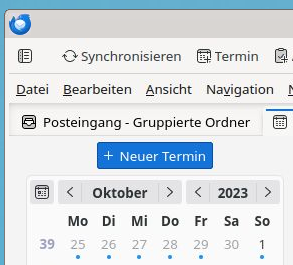
Thunderbird in Debian stable (Bookworm) has received Thunderbird v115.3.1 as a security update. With it comes "Supernova", a UI redesign. There is a Mozilla blogpost with a walk-through of the new UI. Unfortunately it features a super eye-catching "New Message" button that - thankfully - can be disabled. Even the whole space above the email folder pane can be recovered by disabling the folder pane header at Burger Menu ( ) -> View -> Folders -> Folder Pane Header. Unfortunately there is no way to remove the same eye-catching "New Event" button for the Calendar view via a UI setting. Thunderbird New event button, German locale This needs a user CSS file to override the button as non-visible. To make it process the user CSS Thunderbird needs a config setting to be enabled:

  1. Burger Menu ( ) -> Settings -> General
  2. Scroll down all the way
  3. Click the Config editor... button on the bottom right
  4. Accept that hell will freeze over because you configure software
  5. Search for toolkit.legacyUserProfileCustomizations.stylesheets
  6. Toggle the value to true to enable the user CSS
You can manually add user_pref("toolkit.legacyUserProfileCustomizations.stylesheets", true); to ~/.thunderbird/abcdefgh.default/prefs.js to the same effect (do this while Thunderbird is not running; replace abcdefgh with your Thunderbird profile ID). Now create a new directory ~/.thunderbird/abcdefgh.default/chrome/, again replacing abcdefgh with your profile ID. Inside the new directory create a userChrome.css file with the following content:
/* Hide Calendar New Event button */
#primaryButtonSidePanel
display: none !important;
Restart Thunderbird. And enjoy less visual obstruction when using the Calendar.

18 October 2023

Scarlett Gately Moore: KDE: Snap transition complete, 23.08.2 released!

KDE MascotKDE Mascot
I have completed the the Big move ! There are still a few lingering MR s, but I am sure they will be approved so I can merge soon. With the move I was also able to release 23.08.2 for most release service applications. Enjoy! You can find them all here: https://snapcraft.io/search?q=KDE I still need to raise a bit more to pay the Internet bill. If you can spare some change please consider a donation. Thank you! <script src= https://liberapay.com/sgmoore/widgets/button.js ></script> <noscript><a href= https://liberapay.com/sgmoore/donate ><img alt= Donate using Liberapay src= https://liberapay.com/assets/widgets/donate.svg ></a></noscript> Donate https://gofund.me/b8b69e54

15 October 2023

Aigars Mahinovs: Figuring out finances part 2

A week ago I started to migrate my financial planning from a closed source system to a new system based on an open source, self-hosted solution. Main candidate is Firefly III - a relatively simple financial planner with a rather rich feature set and a solid user base and developer support. Starting it up with a Docker-Compose file was quite easy, following the official documentation. The same Compose file also managed the MySQL database, the importer app and a cron container for regular imports. The separate importer app allows both imports from CSV files and also from external bank account connection services. For whatever weird reason both of those services support exporting data from my regular bank accounts, but not from my credit cards for exactly the same bank. So for those cards I would need to periodically download CVS transaction exports and feed them into the importer. The combination of the cron container and the importer app allows for both of these functions. To do this you first do the import via the Web UI first and configure all the mappings - configure file and date formats, map account names in the bank output to account names that you added in Firefly, configure what otehr columns mean and what is the mapping of other values, like expense and income accounts. At the end of the process you can download a json file representing all the settings of the import you just did. Putting such a json config file in the input folder of the cron container and telling it to do an import (weekly, for example) would do such import periodically. Putting a credit card CSV file along with a config file for credit card import would also auto-import that. So far so good. However, when I tried importing exports from MoneyWiz or even when I tried re-creating account history directly from the bank data, I hit a very annoying problem. Transfers. Thing is detecting transfers between the real (asset) accounts that you are managing is really essential. For one those are not real expenses and incomes, so failing to mark them as transfers would show weird income/expense numbers. But if you do detect them as transfers and correctly map the destination account, but fail to match the transations between another you get a double-transaction. This becomes really hard when transactions happen on different dates and have different descriptions. So you get both a +1000 transaction "Credit card reset" on 14.09.2023 in the credit card account and a -1000$ transaction "Repayment of own credit card" on 24.09.2023 in the main account of the bank. Matching them to recognise that it is just one transfer and not two is ... non-trivial. The best solution I could come up with so far is to always map the "Opposing account name" for such transfers to a virtual "Transfers" asset account. That has the benefit of being actually able to correctly represent transfers that take several days to move between accounts and showing you how much money is still in transit at any point in time. So after I figured this out, finally the account balances started matching up with reality. Setting up spending categories required another change - the author of the Firefly III does not like complexity so it does not support nesting categories. Categories can only be in a single, flat list. It is suggested that if you do need to track multiple categories and also their combination, then category groups might help you. I will survive for now by simplifying the categories that I do actually use. Might actually make the reports more usable. A new feature for me will be the ability to use automation rules to assign transactions to categories based on their contents, like expense accounts of keywords in descriptions. Setting up regular bills (with matching rules to assign incoming transactions to those bills) is another feature that is very important to me. The feature itself works just fine in Firefly III, but it has two restrictions that the author of the software does not actually want to be changed. For one it can not be used to track prodictable incomes (like salary), presumably because it is only there for bills (subscriptions in v3 UI). And for other, there is nothing in the base software that actually uses the data from bills to look forward. The author does not like to try to predict the future. Which for me is basically the one of two reasons to use this kind of software at all. I want to know - given all manually entered regular and 100% predictable expenses and incomes, what will be the state of my accounts at particular date? It seems that to get at that I will need to write my own oracle script using the rich Firefly III API. The last question I had for this week was - how will I enter a new cash puchace of potatoes on a farmers market into the system that sits in a private server in my home network? Turns out there are actually multiple Android apps for Firefly III that can be easily used for this using a robust OAuth or shared token authentification. Except the web UI needs to be exposed online for this to work (and ideally protected by HTTPS). Other users have also created Telegram bots that allow using chat messages to create transaction entries. This is a bit harder to use and more narrow scope, but should be easier to setup. Will have to try both apporaches. But before I really get going on this, I need to fix another thing that I have been postponing for a while: I will need to migrate my Home Assistant installation from a Docker container installation to a Home Assistant OS installation so that I can install Addons, including Firefly III, MySQL and Portainer to have a bit more organised and less hand-knitted home server setup. Let's see how that goes next week :D

12 October 2023

Reproducible Builds: Reproducible Builds in September 2023

Welcome to the September 2023 report from the Reproducible Builds project In these reports, we outline the most important things that we have been up to over the past month. As a quick recap, whilst anyone may inspect the source code of free software for malicious flaws, almost all software is distributed to end users as pre-compiled binaries.
Andreas Herrmann gave a talk at All Systems Go 2023 titled Fast, correct, reproducible builds with Nix and Bazel . Quoting from the talk description:

You will be introduced to Google s open source build system Bazel, and will learn how it provides fast builds, how correctness and reproducibility is relevant, and how Bazel tries to ensure correctness. But, we will also see where Bazel falls short in ensuring correctness and reproducibility. You will [also] learn about the purely functional package manager Nix and how it approaches correctness and build isolation. And we will see where Bazel has an advantage over Nix when it comes to providing fast feedback during development.
Andreas also shows how you can get the best of both worlds and combine Nix and Bazel, too. A video of the talk is available.
diffoscope is our in-depth and content-aware diff utility that can locate and diagnose reproducibility issues. This month, Chris Lamb fixed compatibility with file(1) version 5.45 [ ] and updated some documentation [ ]. In addition, Vagrant Cascadian extended support for GNU Guix [ ][ ] and updated the version in that distribution as well. [ ].
Yet another reminder that our upcoming Reproducible Builds Summit is set to take place from October 31st November 2nd 2023 in Hamburg, Germany. If you haven t been before, our summits are a unique gathering that brings together attendees from diverse projects, united by a shared vision of advancing the Reproducible Builds effort. During this enriching event, participants will have the opportunity to engage in discussions, establish connections and exchange ideas to drive progress in this vital field. If you re interested in joining us this year, please make sure to read the event page, the news item, or the invitation email that Mattia Rizzolo sent out recently, all of which have more details about the event and location. We are also still looking for sponsors to support the event, so please reach out to the organising team if you are able to help. Also note that PackagingCon 2023 is taking place in Berlin just before our summit.
On the Reproducible Builds website, Greg Chabala updated the JVM-related documentation to update a link to the BUILDSPEC.md file. [ ] And Fay Stegerman fixed the builds failing because of a YAML syntax error.

Distribution work In Debian, this month: September saw F-Droid add ten new reproducible apps, and one existing app switched to reproducible builds. In addition, two reproducible apps were archived and one was disabled for a current total of 199 apps published with Reproducible Builds and using the upstream developer s signature. [ ] In addition, an extensive blog post was posted on f-droid.org titled Reproducible builds, signing keys, and binary repos .

Upstream patches The Reproducible Builds project detects, dissects and attempts to fix as many currently-unreproducible packages as possible. We endeavour to send all of our patches upstream where appropriate. This month, we wrote a large number of such patches, including:

Testing framework The Reproducible Builds project operates a comprehensive testing framework (available at tests.reproducible-builds.org) in order to check packages and other artifacts for reproducibility. In August, a number of changes were made by Holger Levsen:
  • Disable armhf and i386 builds due to Debian bug #1052257. [ ][ ][ ][ ]
  • Run diffoscope with a lower ionice priority. [ ]
  • Log every build in a simple text file [ ] and create persistent stamp files when running diffoscope to ease debugging [ ].
  • Run schedulers one hour after dinstall again. [ ]
  • Temporarily use diffoscope from the host, and not from a schroot running the tested suite. [ ][ ]
  • Fail the diffoscope distribution test if the diffoscope version cannot be determined. [ ]
  • Fix a spelling error in the email to IRC gateway. [ ]
  • Force (and document) the reconfiguration of all jobs, due to the recent rise of zombies. [ ][ ][ ][ ]
  • Deal with a rare condition when killing processes which should not be there. [ ]
  • Install the Debian backports kernel in an attempt to address Debian bug #1052257. [ ][ ]
In addition, Mattia Rizzolo fixed a call to diffoscope --version (as suggested by Fay Stegerman on our mailing list) [ ], worked on an openQA credential issue [ ] and also made some changes to the machine-readable reproducible metadata, reproducible-tracker.json [ ]. Lastly, Roland Clobus added instructions for manual configuration of the openQA secrets [ ].

If you are interested in contributing to the Reproducible Builds project, please visit our Contribute page on our website. However, you can get in touch with us via:

20 September 2023

Joey Hess: Haskell webassembly in the browser


live demo As far as I know this is the first Haskell program compiled to Webassembly (WASM) with mainline ghc and using the browser DOM. ghc's WASM backend is solid, but it only provides very low-level FFI bindings when used in the browser. Ints and pointers to WASM memory. (See here for details and for instructions on getting the ghc WASM toolchain I used.) I imagine that in the future, WASM code will interface with the DOM by using a WASI "world" that defines a complete API (and browsers won't include Javascript engines anymore). But currently, WASM can't do anything in a browser without calling back to Javascript. For this project, I needed 63 lines of (reusable) javascript (here). Plus another 18 to bootstrap running the WASM program (here). (Also browser_wasi_shim) But let's start with the Haskell code. A simple program to pop up an alert in the browser looks like this:
 -# LANGUAGE OverloadedStrings #- 
import Wasmjsbridge
foreign export ccall hello :: IO ()
hello :: IO ()
hello = do
    alert <- get_js_object_method "window" "alert"
    call_js_function_ByteString_Void alert "hello, world!"
A larger program that draws on the canvas and generated the image above is here. The Haskell side of the FFI interface is a bunch of fairly mechanical functions like this:
foreign import ccall unsafe "call_js_function_string_void"
    _call_js_function_string_void :: Int -> CString -> Int -> IO ()
call_js_function_ByteString_Void :: JSFunction -> B.ByteString -> IO ()
call_js_function_ByteString_Void (JSFunction n) b =
      BU.unsafeUseAsCStringLen b $ \(buf, len) ->
                _call_js_function_string_void n buf len
Many more would need to be added, or generated, to continue down this path to complete coverage of all data types. All in all it's 64 lines of code so far (here). Also a C shim is needed, that imports from WASI modules and provides C functions that are used by the Haskell FFI. It looks like this:
void _call_js_function_string_void(uint32_t fn, uint8_t *buf, uint32_t len) __attribute__((
        __import_module__("wasmjsbridge"),
        __import_name__("call_js_function_string_void")
));
void call_js_function_string_void(uint32_t fn, uint8_t *buf, uint32_t len)  
        _call_js_function_string_void(fn, buf, len);
 
Another 64 lines of code for that (here). I found this pattern in Joachim Breitner's haskell-on-fastly and copied it rather blindly. Finally, the Javascript that gets run for that is:
call_js_function_string_void(n, b, sz)  
    const fn = globalThis.wasmjsbridge_functionmap.get(n);
    const buffer = globalThis.wasmjsbridge_exports.memory.buffer;
    fn(decoder.decode(new Uint8Array(buffer, b, sz)));
 ,
Notice that this gets an identifier representing the javascript function to run, which might be any method of any object. It looks it up in a map and runs it. And the ByteString that got passed from Haskell has to be decoded to a javascript string. In the Haskell program above, the function is document.alert. Why not pass a ByteString with that through the FFI? Well, you could. But then it would have to eval it. That would make running WASM in the browser be evaling Javascript every time it calls a function. That does not seem like a good idea if the goal is speed. GHC's javascript backend does use Javascript FFI snippets like that, but there they get pasted into the generated Javascript hairball, so no eval is needed. So my code has things like get_js_object_method that look up things like Javascript functions and generate identifiers. It also has this:
call_js_function_ByteString_Object :: JSFunction -> B.ByteString -> IO JSObject
Which can be used to call things like document.getElementById that return a javascript object:
getElementById <- get_js_object_method (JSObjectName "document") "getElementById"
canvas <- call_js_function_ByteString_Object getElementById "myCanvas"
Here's the Javascript called by get_js_object_method. It generates a Javascript function that will be used to call the desired method of the object, and allocates an identifier for it, and returns that to the caller.
get_js_objectname_method(ob, osz, nb, nsz)  
    const buffer = globalThis.wasmjsbridge_exports.memory.buffer;
    const objname = decoder.decode(new Uint8Array(buffer, ob, osz));
    const funcname = decoder.decode(new Uint8Array(buffer, nb, nsz));
    const func = function (...args)   return globalThis[objname][funcname](...args)  ;
    const n = globalThis.wasmjsbridge_counter + 1;
    globalThis.wasmjsbridge_counter = n;
    globalThis.wasmjsbridge_functionmap.set(n, func);
    return n;
 ,
This does mean that every time a Javascript function id is looked up, some more memory is used on the Javascript side. For more serious uses of this, something would need to be done about that. Lots of other stuff like object value getting and setting is also not implemented, there's no support yet for callbacks, and so on. Still, I'm happy where this has gotten to after 12 hours of work on it. I might release the reusable parts of this as a Haskell library, although it seems likely that ongoing development of ghc will make it obsolete. In the meantime, clone the git repo to have a play with it.
This blog post was sponsored by unqueued on Patreon.

8 September 2023

Reproducible Builds: Reproducible Builds in August 2023

Welcome to the August 2023 report from the Reproducible Builds project! In these reports we outline the most important things that we have been up to over the past month. As a quick recap, whilst anyone may inspect the source code of free software for malicious flaws, almost all software is distributed to end users as pre-compiled binaries. The motivation behind the reproducible builds effort is to ensure no flaws have been introduced during this compilation process by promising identical results are always generated from a given source, thus allowing multiple third-parties to come to a consensus on whether a build was compromised. If you are interested in contributing to the project, please visit our Contribute page on our website.

Rust serialisation library moving to precompiled binaries Bleeping Computer reported that Serde, a popular Rust serialization framework, had decided to ship its serde_derive macro as a precompiled binary. As Ax Sharma writes:
The move has generated a fair amount of push back among developers who worry about its future legal and technical implications, along with a potential for supply chain attacks, should the maintainer account publishing these binaries be compromised.
After intensive discussions, use of the precompiled binary was phased out.

Reproducible builds, the first ten years On August 4th, Holger Levsen gave a talk at BornHack 2023 on the Danish island of Funen titled Reproducible Builds, the first ten years which promised to contain:
[ ] an overview about reproducible builds, the past, the presence and the future. How it started with a small [meeting] at DebConf13 (and before), how it grew from being a Debian effort to something many projects work on together, until in 2021 it was mentioned in an executive order of the president of the United States. (HTML slides)
Holger repeated the talk later in the month at Chaos Communication Camp 2023 in Zehdenick, Germany: A video of the talk is available online, as are the HTML slides.

Reproducible Builds Summit Just another reminder that our upcoming Reproducible Builds Summit is set to take place from October 31st November 2nd 2023 in Hamburg, Germany. Our summits are a unique gathering that brings together attendees from diverse projects, united by a shared vision of advancing the Reproducible Builds effort. During this enriching event, participants will have the opportunity to engage in discussions, establish connections and exchange ideas to drive progress in this vital field. If you re interested in joining us this year, please make sure to read the event page, the news item, or the invitation email that Mattia Rizzolo sent out, which have more details about the event and location. We are also still looking for sponsors to support the event, so do reach out to the organizing team if you are able to help. (Also of note that PackagingCon 2023 is taking place in Berlin just before our summit, and their schedule has just been published.)

Vagrant Cascadian on the Sustain podcast Vagrant Cascadian was interviewed on the SustainOSS podcast on reproducible builds:
Vagrant walks us through his role in the project where the aim is to ensure identical results in software builds across various machines and times, enhancing software security and creating a seamless developer experience. Discover how this mission, supported by the Software Freedom Conservancy and a broad community, is changing the face of Linux distros, Arch Linux, openSUSE, and F-Droid. They also explore the challenges of managing random elements in software, and Vagrant s vision to make reproducible builds a standard best practice that will ideally become automatic for users. Vagrant shares his work in progress and their commitment to the last mile problem.
The episode is available to listen (or download) from the Sustain podcast website. As it happens, the episode was recorded at FOSSY 2023, and the video of Vagrant s talk from this conference (Breaking the Chains of Trusting Trust is now available on Archive.org: It was also announced that Vagrant Cascadian will be presenting at the Open Source Firmware Conference in October on the topic of Reproducible Builds All The Way Down.

On our mailing list Carles Pina i Estany wrote to our mailing list during August with an interesting question concerning the practical steps to reproduce the hello-traditional package from Debian. The entire thread can be viewed from the archive page, as can Vagrant Cascadian s reply.

Website updates Rahul Bajaj updated our website to add a series of environment variations related to reproducible builds [ ], Russ Cox added the Go programming language to our projects page [ ] and Vagrant Cascadian fixed a number of broken links and typos around the website [ ][ ][ ].

Software development In diffoscope development this month, versions 247, 248 and 249 were uploaded to Debian unstable by Chris Lamb, who also added documentation for the new specialize_as method and expanding the documentation of the existing specialize as well [ ]. In addition, Fay Stegerman added specialize_as and used it to optimise .smali comparisons when decompiling Android .apk files [ ], Felix Yan and Mattia Rizzolo corrected some typos in code comments [ , ], Greg Chabala merged the RUN commands into single layer in the package s Dockerfile [ ] thus greatly reducing the final image size. Lastly, Roland Clobus updated tool descriptions to mark that the xb-tool has moved package within Debian [ ].
reprotest is our tool for building the same source code twice in different environments and then checking the binaries produced by each build for any differences. This month, Vagrant Cascadian updated the packaging to be compatible with Tox version 4. This was originally filed as Debian bug #1042918 and Holger Levsen uploaded this to change to Debian unstable as version 0.7.26 [ ].

Distribution work In Debian, 28 reviews of Debian packages were added, 14 were updated and 13 were removed this month adding to our knowledge about identified issues. A number of issue types were added, including Chris Lamb adding a new timestamp_in_documentation_using_sphinx_zzzeeksphinx_theme toolchain issue.
In August, F-Droid added 25 new reproducible apps and saw 2 existing apps switch to reproducible builds, making 191 apps in total that are published with Reproducible Builds and using the upstream developer s signature. [ ]
Bernhard M. Wiedemann published another monthly report about reproducibility within openSUSE.

Upstream patches The Reproducible Builds project detects, dissects and attempts to fix as many currently-unreproducible packages as possible. We endeavour to send all of our patches upstream where appropriate. This month, we wrote a large number of such patches, including:

Testing framework The Reproducible Builds project operates a comprehensive testing framework (available at tests.reproducible-builds.org) in order to check packages and other artifacts for reproducibility. In August, a number of changes were made by Holger Levsen:
  • Debian-related changes:
    • Disable Debian live image creation jobs until an OpenQA credential problem has been fixed. [ ]
    • Run our maintenance scripts every 3 hours instead of every 2. [ ]
    • Export data for unstable to the reproducible-tracker.json data file. [ ]
    • Stop varying the build path, we want reproducible builds. [ ]
    • Temporarily stop updating the pbuilder.tgz for Debian unstable due to #1050784. [ ][ ]
    • Correctly document that we are not variying usrmerge. [ ][ ]
    • Mark two armhf nodes (wbq0 and jtx1a) as down; investigation is needed. [ ]
  • Misc:
    • Force reconfiguration of all Jenkins jobs, due to the recent rise of zombie processes. [ ]
    • In the node health checks, also try to restart failed ntpsec, postfix and vnstat services. [ ][ ][ ]
  • System health checks:
    • Detect Debian live build failures due to missing credentials. [ ][ ]
    • Ignore specific types of known zombie processes. [ ][ ]
In addition, Vagrant Cascadian updated the scripts to use a predictable build path that is consistent with the one used on buildd.debian.org. [ ][ ]

If you are interested in contributing to the Reproducible Builds project, please visit our Contribute page on our website. However, you can get in touch with us via:

7 September 2023

Thorsten Alteholz: My Debian Activities in August 2023

FTP master This month I accepted 347 and rejected 39 packages. The overall number of packages that got accepted was 349. Debian LTS This was my hundred-tenth month that I did some work for the Debian LTS initiative, started by Raphael Hertzog at Freexian. During my allocated time I uploaded: The open CVE for ffmpeg was already fixed in a previous upload and could be marked as such.
I also started to work on amanda and did some work on security-master. Last but not least I did some days of frontdesk duties and took part in the LTS meeting. Debian ELTS This month was the sixty-first ELTS month. During my allocated time I uploaded: Yeah, finally openssl1.0 was uploaded! I also started to work on amanda, but for whatever reason the package does not build in my chroot. Why do I always choose the packages with quirks? Last but not least I did some days of frontdesk duties. debian-printing This month I tried to update package hplip. Unfortunately upstream added some new compressed files that need to appear uncompressed in the package. Even though this sounded like an easy task, which seemed to be already implemented in the current debian/rules, the new type of files broke this implementation and made the package no longer buildable. There is also an RC-bug waiting that needs some love. I still hope to upload the package soon. This work is generously funded by Freexian! Other stuff Unfortunately $job demanded lots of attention this month, so I only uploaded: Due to the recent license change of Hashicorp, I am no longer willing to spend time working on their products. I therefore filed RM-bugs for golang-github-hashicorp-go-gcp-common, golang-github-hashicorp-go-tfe, golang-github-hashicorp-go-slug and golang-github-hashicorp-terraform-json.
As there seemed to be others involved in golang-github-hashicorp-terraform-svchost and golang-github-hashicorp-go-azure-helpers, I only orphaned both packages. I hope OpenTF will be successful!

29 August 2023

Matthew Garrett: Unix sockets, Cygwin, SSH agents, and sadness

Work involves supporting Windows (there's a lot of specialised hardware design software that's only supported under Windows, so this isn't really avoidable), but also involves git, so I've been working on extending our support for hardware-backed SSH certificates to Windows and trying to glue that into git. In theory this doesn't sound like a hard problem, but in practice oh good heavens.
Git for Windows is built on top of msys2, which in turn is built on top of Cygwin. This is an astonishing artifact that allows you to build roughly unmodified POSIXish code on top of Windows, despite the terrible impedance mismatches inherent in this. One is that until 2017, Windows had no native support for Unix sockets. That's kind of a big deal for compatibility purposes, so Cygwin worked around it. It's, uh, kind of awful. If you're not a Cygwin/msys app but you want to implement a socket they can communicate with, you need to implement this undocumented protocol yourself. This isn't impossible, but ugh.

But going to all this trouble helps you avoid another problem! The Microsoft version of OpenSSH ships an SSH agent that doesn't use Unix sockets, but uses a named pipe instead. So if you want to communicate between Cygwinish OpenSSH (as is shipped with git for Windows) and the SSH agent shipped with Windows, you need something that bridges between those. The state of the art seems to be to use npiperelay with socat, but if you're already writing something that implements the Cygwin socket protocol you can just use npipe to talk to the shipped ssh-agent and then export your own socket interface.

And, amazingly, this all works? I've managed to hack together an SSH agent (using Go's SSH agent implementation) that can satisfy hardware backed queries itself, but forward things on to the Windows agent for compatibility with other tooling. Now I just need to figure out how to plumb it through to WSL. Sigh.

comment count unavailable comments

15 August 2023

Dirk Eddelbuettel: #41: Using r2u in Codespaces

Welcome to the 41th post in the $R^4 series. This post draws on joint experiments first started by Grant building on the lovely work done by Eitsupi as part of our Rocker Project. In short, r2u is an ideal match for Codespaces, a Microsoft/GitHub service to run code locally but in the cloud via browser or Visual Studio Code. This posts co-serves as the README.md in the .devcontainer directory as well as a vignette for r2u. So let us get into it. Starting from the r2u repository, the .devcontainer directory provides a small self-containted file devcontainer.json to launch an executable environment R using r2u. It is based on the example in Grant McDermott s codespaces-r2u repo and reuses its documentation. It is driven by the Rocker Project s Devcontainer Features repo creating a fully functioning R environment for cloud use in a few minutes. And thanks to r2u you can add easily to this environment by installing new R packages in a fast and failsafe way.

Try it out To get started, simply click on the green Code button at the top right. Then select the Codespaces tab and click the + symbol to start a new Codespace. The first time you do this, it will open up a new browser tab where your Codespace is being instantiated. This first-time instantiation will take a few minutes (feel free to click View logs to see how things are progressing) so please be patient. Once built, your Codespace will deploy almost immediately when you use it again in the future. After the VS Code editor opens up in your browser, feel free to open up the examples/sfExample.R file. It demonstrates how r2u enables us install packages and their system-dependencies with ease, here installing packages sf (including all its geospatial dependencies) and ggplot2 (including all its dependencies). You can run the code easily in the browser environment: Highlight or hover over line(s) and execute them by hitting Cmd+Return (Mac) / Ctrl+Return (Linux / Windows). (Both example screenshots reflect the initial codespaces-r2u repo as well as personal scratchspace one which we started with, both of course work here too.) Do not forget to close your Codespace once you have finished using it. Click the Codespaces tab at the very bottom left of your code editor / browser and select Close Current Codespace in the resulting pop-up box. You can restart it at any time, for example by going to https://github.com/codespaces and clicking on your instance.
Extend r2u with r-universe r2u offers fast, easy, reliable access to all of CRAN via binaries for Ubuntu focal and jammy. When using the latter (as is the default), it can be combined with r-universe and its Ubuntu jammy binaries. We demontrates this in a second example file examples/censusExample.R which install both the cellxgene-census and tiledbsoma R packages as binaries from r-universe (along with about 100 dependencies), downloads single-cell data from Census and uses Seurat to create PCA and UMAP decomposition plots. Note that in order run this you have to change the Codespaces default instance from small (4gb ram) to large (16gb ram).

Local DevContainer build Codespaces are DevContainers running in the cloud (where DevContainers are themselves just Docker images running with some VS Code sugar on top). This gives you the very powerful ability to edit locally but run remotely in the hosted codespace. To test this setup locally, simply clone the repo and open it up in VS Code. You will need to have Docker installed and running on your system (see here). You will also need the Remote Development extension (you will probably be prompted to install it automatically if you do not have it yet). Select Reopen in Container when prompted. Otherwise, click the >< tab at the very bottom left of your VS Code editor and select this option. To shut down the container, simply click the same button and choose Reopen Folder Locally . You can always search for these commands via the command palette too (Cmd+Shift+p / Ctrl+Shift+p).

Use in Your Repo To add this ability of launching Codespaces in the browser (or editor) to a repo of yours, create a directory .devcontainers in your selected repo, and add the file .devcontainers/devcontainer.json. You can customize it by enabling other feature, or use the postCreateCommand field to install packages (while taking full advantage of r2u).

Acknowledgments There are a few key plumbing pieces that make everything work here. Thanks to:

Colophon More information about r2u is at its site, and we answered some question in issues, and at stackoverflow. More questions are always welcome! If you like this or other open-source work I do, you can now sponsor me at GitHub.

This post by Dirk Eddelbuettel originated on his Thinking inside the box blog. Please report excessive re-aggregation in third-party for-profit settings.

Originally posted 2023-08-13, minimally edited 2023-08-15 which changed the timestamo and URL.

13 August 2023

Dirk Eddelbuettel: #41: Using r2u in Codespaces

Welcome to the 41th post in the $R^4 series. This post draws on joint experiments first started by Grant building on the lovely work Eitsupi as part of our Rocker Project. In short, r2u is an ideal match for Codesspaces, a Microsoft/GitHub service to run code locally but in the cloud via browser or Visual Studio Code. This posts co-serves as the README.md in the .devcontainer directory as well as a vignette for r2u. So let us get into it. Starting from the r2u repository, the .devcontainer directory provides a small self-containted file devcontainer.json to launch an executable environment R using r2u. It is based on the example in Grant McDermott s codespaces-r2u repo and reuses its documentation. It is driven by the Rocker Project s Devcontainer Features repo creating a fully functioning R environment for cloud use in a few minutes. And thanks to r2u you can add easily to this environment by installing new R packages in a fast and failsafe way.

Try it out To get started, simply click on the green Code button at the top right. Then select the Codespaces tab and click the + symbol to start a new Codespace. The first time you do this, it will open up a new browser tab where your Codespace is being instantiated. This first-time instantiation will take a few minutes (feel free to click View logs to see how things are progressing) so please be patient. Once built, your Codespace will deploy almost immediately when you use it again in the future. After the VS Code editor opens up in your browser, feel free to open up the examples/sfExample.R file. It demonstrates how r2u enables us install packages and their system-dependencies with ease, here installing packages sf (including all its geospatial dependencies) and ggplot2 (including all its dependencies). You can run the code easily in the browser environment: Highlight or hover over line(s) and execute them by hitting Cmd+Return (Mac) / Ctrl+Return (Linux / Windows). (Both example screenshots reflect the initial codespaces-r2u repo as well as personal scratchspace one which we started with, both of course work here too.) Do not forget to close your Codespace once you have finished using it. Click the Codespaces tab at the very bottom left of your code editor / browser and select Close Current Codespace in the resulting pop-up box. You can restart it at any time, for example by going to https://github.com/codespaces and clicking on your instance.

Extend r2u with r-universe r2u offers fast, easy, reliable access to all of CRAN via binaries for Ubuntu focal and jammy. When using the latter (as is the default), it can be combined with r-universe and its Ubuntu jammy binaries. We demontrates this in a second example file examples/censusExample.R which install both the cellxgene-census and tiledbsoma R packages as binaries from r-universe (along with about 100 dependencies), downloads single-cell data from Census and uses Seurat to create PCA and UMAP decomposition plots. Note that in order run this you have to change the Codespaces default instance from small (4gb ram) to large (16gb ram).

Local DevContainer build Codespaces are DevContainers running in the cloud (where DevContainers are themselves just Docker images running with some VS Code sugar on top). This gives you the very powerful ability to edit locally but run remotely in the hosted codespace. To test this setup locally, simply clone the repo and open it up in VS Code. You will need to have Docker installed and running on your system (see here). You will also need the Remote Development extension (you will probably be prompted to install it automatically if you do not have it yet). Select Reopen in Container when prompted. Otherwise, click the >< tab at the very bottom left of your VS Code editor and select this option. To shut down the container, simply click the same button and choose Reopen Folder Locally . You can always search for these commands via the command palette too (Cmd+Shift+p / Ctrl+Shift+p).

Use in Your Repo To add this ability of launching Codespaces in the browser (or editor) to a repo of yours, create a directory .devcontainers in your selected repo, and add the file .devcontainers/devcontainer.json. You can customize it by enabling other feature, or use the postCreateCommand field to install packages (while taking full advantage of r2u).

Acknowledgments There are a few key plumbing pieces that make everything work here. Thanks to:

Colophon More information about r2u is at its site, and we answered some question in issues, and at stackoverflow. More questions are always welcome! If you like this or other open-source work I do, you can now sponsor me at GitHub.

This post by Dirk Eddelbuettel originated on his Thinking inside the box blog. Please report excessive re-aggregation in third-party for-profit settings.

10 August 2023

Freexian Collaborators: Debian Contributions: PTS tracker, DebConf23 Bursary, and more! (by Utkarsh Gupta)

Contributing to Debian is part of Freexian s mission. This article covers the latest achievements of Freexian and their collaborators. All of this is made possible by organizations subscribing to our Long Term Support contracts and consulting services.

tracker.debian.org work by Rapha l Hertzog Rapha l spent some time during his vacation to update distro-tracker to be fully compatible with Django 3.2 so that the codebase and the whole testsuite can run on Debian 12. There s one exception though with the functional test suite that still needs further work to cope with the latest version of Selenium. By dropping support of Django 2.2, Rapha l could also start to work toward support of Django 4.2 since Django helpfully emits deprecation warnings of things that will break in future versions. All the warnings have been fixed but the codebase still fails its testsuite in Django 4.2 because we have to get rid of the python3-django-jsonfield dependency (that is rightfully dead upstream since Django has native support nowadays). All the JSONField have been converted to use Django s native field, but the migration system still requires that dependency at this point. This will require either some fresh reboot of the migration history, or some other trickery to erase the jsonfield dependency from the history of migrations. If you have experience with that, don t hesitate to share it (mail at hertzog@debian.org, or reach out to buxy on IRC). At this point, tracker.debian.org runs with Django 3.2 on Debian 11 since Debian System Administrators are not yet ready to upgrade debian.org hosts to Debian 12.

DebConf 23 bursary work by Utkarsh Gupta Utkarsh led the bursary team this year. The bursary team got a ton of requests this time. Rolling out the results in 4 batches, the bursary team catered over 165 bursary requests - which is superb! The team managed to address all the requests and answered a bit over 120 emails in the process. With that, the bursaries are officially closed for DebConf 2023. The team also intends to roll out some of the statistics closer to DebConf.

Miscellaneous contributions
  • Stefano implemented meson support in pybuild, the tool for building Python packages in Debian against multiple Python versions.
  • Santiago did some work on Salsa CI to enhance the ARM support on the autopkgtest job and make Josch s branch work. MR to come soon.
  • Helmut sent patches for 6 cross build failures.
  • Stefano has been preparing for DebConf 23: Working on the website, and assisting the local teams.
  • Stefano attended the DebConf Video team sprint in Paris, mostly looking at new hardware and software options for video capture and live-mixing. Full sprint report.

9 August 2023

Antoine Beaupr : OpenPGP key transition

This is a short announcement to say that I have changed my main OpenPGP key. A signed statement is available with the cryptographic details but, in short, the reason is that I stopped using my old YubiKey NEO that I have worn on my keyring since 2015. I now have a YubiKey 5 which supports ED25519 which features much shorter keys and faster decryption. It allowed me to move all my secret subkeys on the key (including encryption keys) while retaining reasonable performance. I have written extensive documentation on how to do that OpenPGP key rotation and also YubiKey OpenPGP operations.

Warning on storing encryption keys on a YubiKey People wishing to move their private encryption keys to such a security token should be very careful as there are special precautions to take for disaster recovery. I am toying with the idea of writing an article specifically about disaster recovery for secrets and backups, dealing specifically with cases of death or disabilities.

Autocrypt changes One nice change is the impact on Autocrypt headers, which are considerably shorter. Before, the header didn't even fit on a single line in an email, it overflowed to five lines:
Autocrypt: addr=anarcat@torproject.org; prefer-encrypt=nopreference;
 keydata=xsFNBEogKJ4BEADHRk8dXcT3VmnEZQQdiAaNw8pmnoRG2QkoAvv42q9Ua+DRVe/yAEUd03EOXbMJl++YKWpVuzSFr7IlZ+/lJHOCqDeSsBD6LKBSx/7uH2EOIDizGwfZNF3u7X+gVBMy2V7rTClDJM1eT9QuLMfMakpZkIe2PpGE4g5zbGZixn9er+wEmzk2mt20RImMeLK3jyd6vPb1/Ph9+bTEuEXi6/WDxJ6+b5peWydKOdY1tSbkWZgdi+Bup72DLUGZATE3+Ju5+rFXtb/1/po5dZirhaSRZjZA6sQhyFM/ZhIj92mUM8JJrhkeAC0iJejn4SW8ps2NoPm0kAfVu6apgVACaNmFb4nBAb2k1KWru+UMQnV+VxDVdxhpV628Tn9+8oDg6c+dO3RCCmw+nUUPjeGU0k19S6fNIbNPRlElS31QGL4H0IazZqnE+kw6ojn4Q44h8u7iOfpeanVumtp0lJs6dE2nRw0EdAlt535iQbxHIOy2x5m9IdJ6q1wWFFQDskG+ybN2Qy7SZMQtjjOqM+CmdeAnQGVwxowSDPbHfFpYeCEb+Wzya337Jy9yJwkfa+V7e7Lkv9/OysEsV4hJrOh8YXu9a4qBWZvZHnIO7zRbz7cqVBKmdrL2iGqpEUv/x5onjNQwpjSVX5S+ZRBZTzah0w186IpXVxsU8dSk0yeQskblrwARAQABzSlBbnRvaW5lIEJlYXVwcsOpIDxhbmFyY2F0QHRvcnByb2plY3Qub3JnPsLBlAQTAQgAPgIbAwULCQgHAwUVCgkICwUWAgMBAAIeAQIXgBYhBI3JAc5kFGwEitUPu3khUlJ7dZIeBQJihnFIBQkacFLiAAoJEHkhUlJ7dZIeXNAP/RsX+27l9K5uGspEaMH6jabAFTQVWD8Ch1om9YvrBgfYtq2k/m4WlkMh9IpT89Ahmlf0eq+V1Vph4wwXBS5McK0dzoFuHXJa1WHThNMaexgHhqJOs
 S60bWyLH4QnGxNaOoQvuAXiCYV4amKl7hSuDVZEn/9etDgm/UhGn2KS3yg0XFsqI7V/3RopHiDT+k7+zpAKd3st2V74w6ht+EFp2Gj0sNTBoCdbmIkRhiLyH9S4B+0Z5dUCUEopGIKKOSbQwyD5jILXEi7VTZhN0CrwIcCuqNo7OXI6e8gJd8McymqK4JrVoCipJbLzyOLxZMxGz8Ki0b9O844/DTzwcYcg9I1qogCsGmZfgVze2XtGxY+9zwSpeCLeef6QOPQ0uxsEYSfVgS+onCesSRCgwAPmppPiva+UlGuIMun87gPpQpV2fqFg/V8zBxRvs6YTGcfcQjfMoBHmZTGb+jk1//QAgnXMO7fGG38YH7iQSSzkmodrH2s27ZKgUTHVxpBL85ptftuRqbR7MzIKXZsKdA88kjIKKXwMmez9L1VbJkM4k+1Kzc5KdVydwi+ujpNegF6ZU8KDNFiN9TbDOlRxK5R+AjwdS8ZOIa4nci77KbNF9OZuO3l/FZwiKp8IFJ1nK7uiKUjmCukL0od/6X2rJtAzJmO5Co93ZVrd5r48oqUvjklzzsBNBFmeC3oBCADEV28RKzbv3dEbOocOsJQWr1R0EHUcbS270CrQZfb9VCZWkFlQ/1ypqFFQSjmmUGbNX2CG5mivVsW6Vgm7gg8HEnVCqzL02BPY4OmylskYMFI5Bra2wRNNQBgjg39L9XU4866q3BQzJp3r0fLRVH8gHM54Jf0FVmTyHotR/Xiw5YavNy2qaQXesqqUv8HBIha0rFblbuYI/cFwOtJ47gu0QmgrU0ytDjlnmDNx4rfsNylwTIHS0Oc7Pezp7MzLmZxnTM9b5VMprAXnQr4rewXCOUKBSto+j4rD5/77DzXw96bbueNruaupb2Iy2OHXNGkB0vKFD3xHsXE2x75NBovtABEBAAHCwqwEGAEIACAWIQSNyQHOZBRsBIrVD7t5IVJSe3WSHgUCWZ4LegIbAgFACRB5IV
 JSe3WSHsB0IAQZAQgAHRYhBHsWQgTQlnI7AZY1qz6h3d2yYdl7BQJZngt6AAoJED6h3d2yYdl7CowH/Rp7GHEoPZTSUK8Ss7crwRmuAIDGBbSPkZbGmm4bOTaNs/gealc2tsVYpoMx7aYgqUW+t+84XciKHT+bjRv8uBnHescKZgDaomDuDKc2JVyx6samGFYuYPcGFReRcdmH0FOoPCn7bMW5mTPztV/wIA80LZD9kPKIXanfUyI3HLP0BPwZG4WTpKzJaalR1BNwu2oF6kEK0ymH3LfDiJ5Sr6emI2jrm4gH+/19ux/x+ST4tvm2PmH3BSQOPzgiqDiFd7RZoAIhmwr3FW4epsK9LtSxsi9gZ2vATBKO1oKtb6olW/keQT6uQCjqPSGojwzGRT2thEANH+5t6Vh0oDPZhrKUXRAAxHMBNHEaoo/M0sjZo+5OF3Ig1rMnI6XbKskLv6hu13cCymW0w/5E4XuYnyQ1cNC3pLvqDQbDx5mAPfBVHuqxJdRLQ3yDM/D2QIsxnkzQwi0FsJuni4vuJzWK/NHHDCvxMCh0YmSgbptUtgW8/niatd2Y6MbfRGxUHoctKtzqzivC8hKMTFrj4AbZhg/e9QVCsh5zSXtpWP0qFDJsxRMx0/432n9d4XUiy4U672r9Q09SsynB3QN6nTaCTWCIxGxjIb+8kJrRqTGwy/PElHX6kF0vQUWZNf2ITV1sd6LK/s/7sH+x4rzgUEHrsKr/qPvY3rUY/dQLd+owXesY83ANOu6oMWhSJnPMksbNa4tIKKbjmw3CFIOfoYHOWf3FtnydHNXoXfj4nBX8oSnkfhLILTJgf6JDFXfw6mTsv/jMzIfDs7PO1LK2oMK0+prSvSoM8bP9dmVEGIurzsTGjhTOBcb0zgyCmYVD3S48vZlTgHszAes1zwaCyt3/tOwrzU5JsRJVns+B/TUYaR/u3oIDMDygvE5ObWxXaFVnCC59r+zl0FazZ0ouyk2AYIR
 zHf+n1n98HCngRO4FRel2yzGDYO2rLPkXRm+NHCRvUA/i4zGkJs2AV0hsKK9/x8uMkBjHAdAheXhY+CsizGzsKjjfwvgqf84LwAzSDdZqLVE2yGTOwU0ESiArJwEQAJhtnC6pScWjzvvQ6rCTGAai6hrRiN6VLVVFLIMaMnlUp92EtgVSNpw6kANtRTpKXUB5fIPZVUrVdfEN06t96/6LE42tgifDAFyFTZY5FdHHri1GG/Cr39MpW2VqCDCtTTPVWHTUlU1ZG631BJ+9NB+ce58TmLr6wBTQrT+W367eRFBC54EsLNb7zQAspCn9pw1xf1XNHOGnrAQ4r9BXhOW5B8CzRd4nLRQwVgtw/c5M/bjemAOoq2WkwN+0mfJe4TSfHwFUozXuN274X+0Gr10fhp8xEDYuQM0qu6W3aDXMBBwIu0jTNudEELsTzhKUbqpsBc9WjwNMCZoCuSw/RTpFBV35mXbqQoQgbcU7uWZslLl9Wvv/C6rjXgd+GeX8SGBjTqq1ZkTv5UXLHTNQzPnbkNEExzqToi/QdSjFMIACnakeOSxc0ckfnsd9pfGv1PUyPyiwrHiqWFzBijzGIZEHxhNGFxAkXwTJR7Pd40a7RDxwbO6p/TSIIum41JtteehLHwTRDdQNMoyfLxuNLEtNYS0uR2jYI1EPQfCNWXCdT2ZK/l6GVP6jyB/olHBIOr+oVXqJh+48ki8cATPczhq3fUr7UivmguGwD67/4omZ4PCKtz1hNndnyYFS9QldEGo+AsB3AoUpVIA0XfQVkxD9IZr+Zu6aJ6nWq4M2bsoxABEBAAHCwXYEGAEIACACGwwWIQSNyQHOZBRsBIrVD7t5IVJSe3WSHgUCWPerZAAKCRB5IVJSe3WSHkIgEACTpxdn/FKrwH0/LDpZDTKWEWm4416l13RjhSt9CUhZ/Gm2GNfXcVTfoF/jKXXgjHcV1DHjfLUPmPVwMdqlf5ACOiFqIUM2ag/OEARh356w
 YG7YEobMjX0CThKe6AV2118XNzRBw/S2IO1LWnL5qaGYPZONUa9Pj0OaErdKIk/V1wge8Zoav2fQPautBcRLW5VA33PH1ggoqKQ4ES1hc9HC6SYKzTCGixu97mu/vjOa8DYgM+33TosLyNy+bCzw62zJkMf89X0tTSdaJSj5Op0SrRvfgjbC2YpJOnXxHr9qaXFbBZQhLjemZi6zRzUNeJ6A3Nzs+gIc4H7s/bYBtcd4ugPEhDeCGffdS3TppH9PnvRXfoa5zj5bsKFgjqjWolCyAmEvd15tXz5yNXtvrpgDhjF5ozPiNp/1EeWX4DxbH2i17drVu4fXwauFZ6lcsAcJxnvCA28RlQlmEQu/gFOx1axVXf6GIuXnQSjQN6qJbByUYrdc/cFCxPO2/lGuUxnufN9Tvb51Qh54laPgGLrlD2huQeSD9Sxa0MNUjNY0qLqaReT99Ygb2LPYGSLoFVx9iZz6sZNt07LqCx9qNgsJwsdmwYsNpMuFbc7nkWjtlEqzsXZHTvYN654p43S+hcAhmmOzQZcew6h71fAJLciiqsPBnCEdgCGFAWhZZdPkMA==
After the change, the entire key fits on a single line, neat!
Autocrypt: addr=anarcat@torproject.org; prefer-encrypt=nopreference;
 keydata=xjMEZHZPzhYJKwYBBAHaRw8BAQdAWdVzOFRW6FYVpeVaDo3sC4aJ2kUW4ukdEZ36UJLAHd7NKUFudG9pbmUgQmVhdXByw6kgPGFuYXJjYXRAdG9ycHJvamVjdC5vcmc+wpUEExYIAD4WIQS7ts1MmNdOE1inUqYCKTpvpOU0cwUCZHZgvwIbAwUJAeEzgAULCQgHAwUVCgkICwUWAgMBAAIeAQIXgAAKCRACKTpvpOU0c47SAPdEqfeHtFDx9UPhElZf7nSM69KyvPWXMocu9Kcu/sw1AQD5QkPzK5oxierims6/KUkIKDHdt8UcNp234V+UdD/ZB844BGR2UM4SCisGAQQBl1UBBQEBB0CYZha2IMY54WFXMG4S9/Smef54Pgon99LJ/hJ885p0ZAMBCAfCdwQYFggAIBYhBLu2zUyY104TWKdSpgIpOm+k5TRzBQJkdlDOAhsMAAoJEAIpOm+k5TRzBg0A+IbcsZhLx6FRIqBJCdfYMo7qovEo+vX0HZsUPRlq4HkBAIctCzmH3WyfOD/aUTeOF3tY+tIGUxxjQLGsNQZeGrQI
Note that I have implemented my own kind of ridiculous Autocrypt support for the Notmuch Emacs email client I use, see this elisp code. To import keys, I pipe the message into this script which is basically just:
sq autocrypt decode   gpg --import
... thanks to Sequoia best-of-class Autocrypt support.

Note on OpenPGP usage While some have claimed OpenPGP's death, I believe those are overstated. Maybe it's just me, but I still use OpenPGP for my password management, to authenticate users and messages, and it's the interface to my YubiKey for authenticating with SSH servers. I understand people feel that OpenPGP is possibly insecure, counter-intuitive and full of problems, but I think most of those problems should instead be attributed to its current flagship implementation, GnuPG. I have tried to work with GnuPG for years, and it keeps surprising me with evilness and oddities. I have high hopes that the Sequoia project can bring some sanity into this space, and I also hope that RFC4880bis can eventually get somewhere so we have a more solid specification with more robust crypto. It's kind of a shame that this has dragged on for so long, but Update: there's a separate draft called openpgp-crypto-refresh that might actually be adopted as the "OpenPGP RFC" soon! And it doesn't keep real work from happening in Sequoia and other implementations. Thunderbird rewrote their OpenPGP implementation with RNP (which was, granted, a bumpy road because it lost compatibility with GnuPG) and Sequoia now has a certificate store with trust management (but still no secret storage), preliminary OpenPGP card support and even a basic GnuPG compatibility layer. I'm also curious to try out the OpenPGP CA capabilities. So maybe it's just because I'm becoming an old fart that doesn't want to change tools, but so far I haven't seen a good incentive in switching away from OpenPGP, and haven't found a good set of tools that completely replace it. Maybe OpenSSH's keys and CA can eventually replace it, but I suspect they will end up rebuilding most of OpenPGP anyway, just more slowly. If they do, let's hope they avoid the mistakes our community has done in the past at least...

5 August 2023

Bits from Debian: Debian Project Bits Volume 1, Issue 1


Debian Project Bits Volume 1, Issue 1 August 05, 2023 Welcome to the inaugural issue of Debian Project Bits! Those remembering the Debian Weekly News (DwN) will recognize some of the sections here which served as our inspiration. Debian Project Bits posts will allow for a faster turnaround of some project news on a monthly basis. The Debian Micronews service will continue to share shorter news items, the Debian Project News remains as our official newsletter which may move to a biannual archive format. News Debian Day The Debian Project was officially founded by Ian Murdock on August 16, 1993. Since then we have celebrated our Anniversary of that date each year with events around the world. We would love it if you could join our revels this very special year as we have the honor of turning 30! Attend or organize a local Debian Day celebration. You're invited to plan your own event: from Bug Squashing parties to Key Signing parties, Meet-Ups, or any type of social event whether large or small. And be sure to check our Debian reimbursement How To if you need such resources. You can share your days, events, thoughts, or notes with us and the rest of the community with the #debianday tag that will be used across most social media platforms. See you then! Events: Upcoming and Reports Upcoming Debian 30 anos The Debian Brasil Community is organizing the event Debian 30 anos to celebrate the 30th anniversary of the Debian Project. From August 14 to 18, between 7pm and 22pm (UTC-3) contributors will talk online in Portuguese and we will live stream on Debian Brasil YouTube channel. DebConf23: Debian Developers Camp and Conference The 2023 Debian Developers Camp (DebCamp) and Conference (DebConf23) will be hosted this year in Infopark, Kochi, India. DebCamp is slated to run from September 3 through 9, immediately followed by the larger DebConf, September 10 through 17. If you are planning on attending the conference this year, now is the time to ensure your travel documentation, visa information, bursary submissions, papers and relevant equipment are prepared. For more information contact: debconf@debconf. MiniDebConf Cambridge 2023 There will be a MiniDebConf held in Cambridge, UK, hosted by ARM for 4 days in November: 2 days for a mini-DebCamp (Thu 23 - Fri 24), with space for dedicated development / sprint / team meetings, then two days for a more regular MiniDebConf (Sat 25 - Sun 26) with space for more general talks, up to 80 people. Reports During the last months, the Debian Community has organized some Bug Squashing Parties:
Tilburg, Netherlands. October 2022. St-Cergue, Switzerland. January 2023 Montreal, Canada. February 2023 In January, Debian India hosted the MiniDebConf Tamil Nadu in Viluppuram, Tamil Nadu, India (Sat 28 - Sun 26). The following month, the MiniDebConf Portugal 2023 was held in Lisbon (12 - 16 February 2023). These events, seen as a stunning success by some of their attendees, demonstrate the vitality of our community.
Debian Brasil Community at Campus Party Brazil 2023 Another edition of Campus Party Brazil took place in the city of S o Paulo between July 25th and 30th. And one more time the Debian Brazil Community was present. During the days in the available space, we carry out some activities such as: For more info and a few photos, check out the organizers' report. MiniDebConf Bras lia 2023 From May 25 to 27, Bras lia hosted the MiniDebConf Bras lia 2023. This gathering was composed of various activities such as talks, workshops, sprints, BSPs (Bug Squashing Party), key signings, social events, and hacking, aimed to bring the community together and celebrate the world's largest Free Software project: Debian. For more information please see the full report written by the organizers. Debian Reunion Hamburg 2023 This year the annual Debian Reunion Hamburg was held from Tuesday 23 to 30 May starting with four days of hacking followed by two days of talks, and then two more days of hacking. As usual, people - more than forty-five attendees from Germany, Czechia, France, Slovakia, and Switzerland - were happy to meet in person, to hack and chat together, and much more. If you missed the live streams, the video recordings are available. Translation workshops from the pt_BR team The Brazilian translation team, debian-l10n-portuguese, had their first workshop of 2023 in February with great results. The workshop was aimed at beginners, working in DDTP/DDTSS. For more information please see the full report written by the organizers. And on June 13 another workshop took place to translate The Debian Administrator's Handbook). The main goal was to show beginners how to collaborate in the translation of this important material, which has existed since 2004. The manual's translations are hosted on Weblate. Releases Stable Release Debian 12 bookworm was released on June 10, 2023. This new version becomes the stable release of Debian and moves the prior Debian 11 bullseye release to oldstable status. The Debian community celebrated the release with 23 Release Parties all around the world. Bookworm's first point release 12.1 address miscellaneous bug fixes affecting 88 packages, documentation, and installer updates was made available on July 22, 2023. RISC-V support riscv64 has recently been added to the official Debian architectures for support of 64-bit little-endian RISC-V hardware running the Linux kernel. We expect to have full riscv64 support in Debian 13 trixie. Updates on bootstrap, build daemon, porterbox, and development progress were recently shared by the team in a Bits from the Debian riscv64 porters post. non-free-firmware The Debian 12 bookworm archive now includes non-free-firmware; please be sure to update your apt sources.list if your systems requires such components for operation. If your previous sources.list included non-free for this purpose it may safely be removed. apt sources.list The Debian archive holds several components: Example of the sources.list file
deb http://deb.debian.org/debian bookworm main
deb-src http://deb.debian.org/debian bookworm main
deb http://deb.debian.org/debian-security/ bookworm-security main
deb-src http://deb.debian.org/debian-security/ bookworm-security main
deb http://deb.debian.org/debian bookworm-updates main
deb-src http://deb.debian.org/debian bookworm-updates main
Example using the components:
deb http://deb.debian.org/debian bookworm main non-free-firmware
deb-src http://deb.debian.org/debian bookworm main non-free-firmware
deb http://deb.debian.org/debian-security/ bookworm-security main non-free-firmware
deb-src http://deb.debian.org/debian-security/ bookworm-security main non-free-firmware
deb http://deb.debian.org/debian bookworm-updates main non-free-firmware
deb-src http://deb.debian.org/debian bookworm-updates main non-free-firmware
For more information and guidelines on proper configuration of the apt source.list file please see the Configuring Apt Sources - Wiki page. Inside Debian New Debian Members Please welcome the following newest Debian Project Members: To find out more about our newest members or any Debian Developer, look for them on the Debian People list. Security Debian's Security Team releases current advisories on a daily basis. Some recently released advisories concern these packages: trafficserver Several vulnerabilities were discovered in Apache Traffic Server, a reverse and forward proxy server, which could result in information disclosure or denial of service. asterisk A flaw was found in Asterisk, an Open Source Private Branch Exchange. A buffer overflow vulnerability affects users that use PJSIP DNS resolver. This vulnerability is related to CVE-2022-24793. The difference is that this issue is in parsing the query record parse_query(), while the issue in CVE-2022-24793 is in parse_rr(). A workaround is to disable DNS resolution in PJSIP config (by setting nameserver_count to zero) or use an external resolver implementation instead. flask It was discovered that in some conditions the Flask web framework may disclose a session cookie. chromium Multiple security issues were discovered in Chromium, which could result in the execution of arbitrary code, denial of service or information disclosure. Other Popular packages gpgv - GNU privacy guard signature verification tool. 99,053 installations. gpgv is actually a stripped-down version of gpg which is only able to check signatures. It is somewhat smaller than the fully-blown gpg and uses a different (and simpler) way to check that the public keys used to make the signature are valid. There are no configuration files and only a few options are implemented. dmsetup - Linux Kernel Device Mapper userspace library. 77,769 installations. The Linux Kernel Device Mapper is the LVM (Linux Logical Volume Management) Team's implementation of a minimalistic kernel-space driver that handles volume management, while keeping knowledge of the underlying device layout in user-space. This makes it useful for not only LVM, but software raid, and other drivers that create "virtual" block devices. sensible-utils - Utilities for sensible alternative selection. 96,001 daily users. This package provides a number of small utilities which are used by programs to sensibly select and spawn an appropriate browser, editor, or pager. The specific utilities included are: sensible-browser sensible-editor sensible-pager. popularity-contest - The popularity-contest package. 90,758 daily users. The popularity-contest package sets up a cron job that will periodically anonymously submit to the Debian developers statistics about the most used Debian packages on the system. This information helps Debian make decisions such as which packages should go on the first CD. It also lets Debian improve future versions of the distribution so that the most popular packages are the ones which are installed automatically for new users. New and noteworthy packages in unstable Toolkit for scalable simulation of distributed applications SimGrid is a toolkit that provides core functionalities for the simulation of distributed applications in heterogeneous distributed environments. SimGrid can be used as a Grid simulator, a P2P simulator, a Cloud simulator, a MPI simulator, or a mix of all of them. The typical use-cases of SimGrid include heuristic evaluation, application prototyping, and real application development and tuning. This package contains the dynamic libraries and runtime. LDraw mklist program 3D CAD programs and rendering programs using the LDraw parts library of LEGO parts rely on a file called parts.lst containing a list of all available parts. The program ldraw-mklist is used to generate this list from a directory of LDraw parts. Open Lighting Architecture - RDM Responder Tests The DMX512 standard for Digital MultipleX is used for digital communication networks commonly used to control stage lighting and effects. The Remote Device Management protocol is an extension to DMX512, allowing bi-directional communication between RDM-compliant devices without disturbing other devices on the same connection. The Open Lighting Architecture (OLA) provides a plugin framework for distributing DMX512 control signals. The ola-rdm-tests package provides an automated way to check protocol compliance in RDM devices. parsec-service Parsec is an abstraction layer that can be used to interact with hardware-backed security facilities such as the Hardware Security Module (HSM), the Trusted Platform Module (TPM), as well as firmware-backed and isolated software services. The core component of Parsec is the security service, provided by this package. The service is a background process that runs on the host platform and provides connectivity with the secure facilities of that host, exposing a platform-neutral API that can be consumed into different programming languages using a client library. For a client library implemented in Rust see the package librust-parsec-interface-dev. Simple network calculator and lookup tool Process and lookup network addresses from the command line or CSV with ripalc. Output has a variety of customisable formats. High performance, open source CPU/GPU miner and RandomX benchmark XMRig is a high performance, open source, cross platform RandomX, KawPow, CryptoNight, and GhostRider unified CPU/GPU miner and RandomX benchmark. Ping, but with a graph - Rust source code This package contains the source for the Rust gping crate, packaged by debcargo for use with cargo and dh-cargo. Once upon a time in Debian: 2014-07-31 The Technical committee choose libjpeg-turbo as the default JPEG decoder. 2010-08-01 DebConf10 starts New York City, USA 2007-08-05 Debian Maintainers approved by vote 2009-08-05 Jeff Chimene files bug #540000 against live-initramfs. Calls for help The Publicity team calls for volunteers and help! Your Publicity team is asking for help from you our readers, developers, and interested parties to contribute to the Debian news effort. We implore you to submit items that may be of interest to our community and also ask for your assistance with translations of the news into (your!) other languages along with the needed second or third set of eyes to assist in editing our work before publishing. If you can share a small amount of your time to aid our team which strives to keep all of us informed, we need you. Please reach out to us via IRC on #debian-publicity on OFTC.net, or our public mailing list, or via email at press@debian.org for sensitive or private inquiries.

Next.

Previous.