Search Results: "he"

23 August 2026

Colin Watson: GSS-API support split out from main Debian OpenSSH packages

In an option review I did in 2024, shortly after the xz-utils backdoor, I explained that having GSS-API authentication and key exchange support in the main OpenSSH packages is problematic. The key exchange patch is large and intrusive. Furthermore, even linking to the necessary libraries is not without risk: as the Ebury malware attack demonstrated way back in 2009, each extra library linked into security-critical daemons such as sshd (or nowadays into its privilege-separated helper programs) can modify the behaviour of the daemon even if you aren t doing anything that would involve calling into that library. Of course some of that risk remains, but as Damien Miller wrote, minimizing the number of libraries that end up in the address space of sshd and friends is still valuable. I just uploaded openssh 1:10.4p1-5 to unstable, completing this split. As of this version, the OpenSSH client and server are built without GSS-API authentication and key exchange support. If you need those features, install openssh-client-gssapi or openssh-server-gssapi instead, as appropriate. Debian 13 (trixie) already has packages with those names that just depend on the regular openssh-client and openssh-server so that you can pre-emptively install them, as documented in the release notes. The new openssh-*-gssapi packages have relatively tight dependencies on openssh-common, in order for the testing migration system to ensure that we can t forget to keep them up to date. This will mean a bit more ongoing work for me on each new upstream version, but I think it will be manageable.

Iustin Pop: Another optimistic take on AI

Disclaimers The current discussion in Debian around the AI GR is very heated, and I won t add to that, however, I am very confused about some of the viewpoints there. But, I had no idea how to even try to write this, so did shut up, until I saw Aigars excellent Optimistic take on AI, which motivated me to try, at least. For the record, I fully subscribe to the post, and to the voting suggestions (and I just voted). Also, for full disclosure, I don t think I did any contribution to Debian until now using AI, neither packaging, nor emails, nor bug reports. And this blog post specifically is 100% hand written. With that out of the way there are two points I want to make in this post.

AI is useful, even if it has risks First is, that even if we could put the genie back in the metaphorical bottle, we should not. We do need to continue working towards safe AI, and efficient AI (less environmental impact), but we should not work towards removing the usage of AI. There are already significant advancements in sciences and technology thanks to the use of AI, so desiring AI to not exist (assuming we had a magical wand) is the wrong approach. Sure, AI has significant risks and I can see ways in which AI can do significant damage to society but I don t think we can go from Kardashev I to II without the use of AI, and definitely not to III. And I think, that should be the goal. A few simple examples: Do we want to rollback all the 20 years old security issues that AI found? Do we want to rollback the recent Moderna cancer findings? Do we want to rollback the concept of extremely large scale pattern matchings , just because it runs on chips and no longer in one person s head?

Reading Debian lists The second point is, lately I found less and less enjoyment in reading Debian lists. Even with that already being the case, I feel so disconnected from many of the opinions being voiced in this discussion. On one hand, it s normal and healthy that people have different opinions, disagree, and move forward. On the other hand, looking at one of the proposed options:
  • Moderators and disciplinary teams may make narrow and tailored exceptions to rule 4, and decide on interpretation .
  • Violations of these requirements should be treated as violations of the relevant Code of Conduct and should result in swift and proportionate disciplinary action .
I already knew Debian, and some large parts of the OSS world, is left leaning. But those phrasings, to me, are too close to socialism/communism. As someone who grew up under communism, this is a much more slippery slope (disciplinary teams? really?) than AI usage. Ask me in person for more details. So, it is possible that Debian continues to evolve in such a way that I don t find myself in any way close to its ongoing culture. I will be sad at that point, but it will be what it is.

Where to? I think that, until such a time that an AI bubble bursts, what any organization should do is try to logically see where and if AI can help. And in an organization that is about computer software, I see hundreds of places that are subject to very large scale pattern matching so the half of the discussion is, to me, mind-boggling. To be clear, it s not about if you can t beat them, join them . As I wrote above, I think AI is useful, so the point is how to use it effectively. Well, will see what Debian votes. I am half curious, half sad already.

Wouter Verhelst: Programming and GR 2026 002

Programming language generations When I was young, I learned about a model of classifying programming language: the system of programming language generations. In this model, first generation programming languages are, basically, where you program the computer in the language that is defined by its architecture. On a Von Neumann machine, with its load-and-store architecture, you do that by inputting a string of numbers. The first programmer in human history -- her name was Ada Lovelace -- wrote in a first-generation language. 1GLs aren't so much invented as they are a byproduct of the computers for which they're created. Second-generation languages are the assembler languages. Because humans are not computers, and because decoding long lines of numbers to understand what the computer is doing, when programming became a full-time job, the programmers that did it decided that doing all this assembling manually is too complicated, so they quickly wrote assemblers to automate the process for them. They still could understand the 1GL output of the 2GL assembler, but most of them quickly forgot how to write software in a first-generation language. Not that anyone cared, as the translation from a 2GL to a 1GL is lossless and you can just revert it. Third-generation languages are higher-level languages. When the first 3GLs were invented (such as COBOL and, more famously, FORTRAN) in the late 1950s and early 1960s, it was believed by some that the work of programming a computer so accessible to non-programmers that the job of programmer would eventually cease to exist, and people would just ask the computer what they needed by entering COBOL instructions. This of course was ridiculous and incorrect, because converting algorithms to computer instructions, whether at the 2GL or 3GL level, is a specialized skill that some automation can perhaps make simpler but never completely take away the need for. At the time, some people also felt to some extent that using 3GL wasn't the same thing as actually programming 3GLs, but eventually the world moved on and embraced things. The invention of 3GL environments reduced, but did not completely take away, the need for people to understand 2GLs, as compiler and operating system authors still need to understand them, and some highly optimized code still continues to be written in 2GLs to this day. Fourth-generation languages abstract away some or all of the process of programming. For instance, a database-related 4GL will hide away the complexities of storing data in particular locations, how to fetch that data, how to index it such that you can fetch it efficiently, how to loop over the data to get you a summary of that data, and instead allows you to express the required information in an abstract way, expecing the computer to fill in the blanks. When SQL, an early 4GL, was invented, some people believed that the language made accessing databases so simple that the requirement to implement database applications would eventually cease to exist and we would just hand SQL prompts to users who need to access data. This of course was ridiculous and incorrect, because understanding data schemas and using that understanding to query data from a database is a specialized skill that perhaps a higher abstraction can help you make simpler, but that in the longer run it can never completely take away the need for. The invention of 4GLs also reduced, but did not completely take away, the need for people to understand how to do the things that the 4GLs automate for you manually, as the people who do write those things still need to understand them, and there are also environments where these particular 4GLs are rather not appropriate or just very slow. The first definition of programming language generations that I read about in the 1980s simply stated that fifth-generation languages did not yet exist, but that they would in the future, and that in those, you would "tell the computer what to do, and it would then do that". Now that we have a way of doing so, it could be said that by some definition, we now actually do have a number of 5GLs. The existence of these LLM systems has caused some, especially the people who build and exploit these systems, to exclaim that programming as we know it today is going to cease to exist, and everyone will just ask an LLM to generate a program, which will then do so. That is of course ridiculous and incorrect, as no automaton can generate software from nothing; input is still required for the model to be able to produce something that approaches usability, and being able to word that input in a correct and productive fashion will be a skill that future programmers can benefit from. I ran some experiments a while back, and from that concluded that, if we look only at the technical side, LLM use can, in some niches, increase productivity for a programmer. There are certainly things that you shouldn't use an LLM for, but equally there can be cases where use of an LLM to perform some task that traditionally would have been done by a programmer would be a net positive. But LLMs, as they exist today, are highly problematic. They require vast amounts of data to build the model. The companies that build these models are disrespectful of people who run web services, and as a result, everyone now has to implement various types of application firewalls just to not make systems fall over from the overwhelming requests for data. They are also disregarding the licenses that are attached to these vast amounts of data, which makes me, as a person who believes in the tenets of free software, sad. They require vast amounts of energy, causing an already-critical global warming crisis to, well, not improve. They require vast amounts of coolant to dissipate the energy concentrated in their data centers, causing further environmental effects. In this, they are problematic and to be avoided. But these are side states of the current state of affairs; I do not believe that they are inherently implied to be able to build and operate an LLM -- any LLM. I guess it's fair to say that my feelings towards LLM usage are complex and many-faceted. I haven't been involved in many debates about the subject, debates that to me seem to be mostly focused on "LLM good" vs "LLM bad" arguments that aren't as nuanced as the position that I would believe is more accurate. This is not because I don't care, but partially because I've been busy in my personal life recently and partially because the whole thing seems somewhat disheartening. But then Debian popped up GR 2026-002, meaning, I now have to come up with an opinion about various candidate statements in the context of the above, which is... not easy. But I did it anyway. There are 8 choices on the ballot, and they all have some truth and some falsehood to them. My position about LLMs can be summarized as:
  • The current state of affairs wrt LLMs is disastrous and we should not encourage them
  • However, there's no technical reason why this must remain true for all time
  • And so any statement should keep in mind what might happen in the future and that the current disastrousness of the whole thing isn't guaranteed to continue to exist for all eternity.
With that, let's go over them.

GR vote options

Proposal A Its summary, from the GR text:
This proposal aims to expressly forbid any contributions to Debian written with the use or assistance of large language models (LLMs) or other generative AI tools.
This falls squarely in the "LLM bad" camp, outlawing all generative-AI contributions, disregarding potential future ones where the problematic situations that exist today are not present. It makes a change to the social contract, which is especially difficult to reverse (on purpose), and which therefore also will require a 3:1 supermajority, but if we want to ban LLM-assisted contributions, this is probably the best way to do it.

Proposal B This one tries to allow AI-assisted contributions under certain conditions. It's mostly an "LLM good" proposal, with some caveats that can be discribed as "make sure you know what you're doing".

Proposal C This proposal is both a weaker (in some places) and stronger (in other places) version of Proposal A. It makes changes to the code of conduct instead of to the social contract, and it also wants to, at least, suggest policy to parties beyond the Debian project. By not changing the social contract, however, it is more likely to reach its simple majority requirement than proposal A. I don't think the language that it wants to add to the code of conduct is particularly well phrased, however.

Proposal D This is a weaker form of proposal B. The language is more compact and there are a few requirements that are spelled out in proposal B that are not spelled out in proposal D, but if you read between the lines you'll see that the requirement is still there really and I don't understand why proposals B and D were not merged into one.

Proposal E This proposal tries to hold a middle ground between "LLM good" and "LLM bad". It appreciates that things are quite muddled at the present time, and that perhaps the situation might might change in the future. It acknowledges that certain questions remain unanswered and that perhaps future considerations might therefore be different. But it essentially refuses to take a stance on whether LLMs should be accepted by the project or not.

Proposal F Similar to proposal E, this proposal tries to discourage Debian contributors from using LLMs, while still allowing people to use it should they want to, but with some requests and requirements to mark LLM-assisted contributions to account for those people who don't want to interact with LLM-generated software. As such, it is a proposal similar to proposal E that leans closer to the "LLM bad" camp.

Proposal G
This proposal aims to ensure that contributions directly to Debian are created by humans, while at the same time avoiding restrictions on the tools those humans may choose to use when contributing
Another "LLM bad" proposal, it however restricts the "bad" bits to only the direct output of the LLM. If you use an LLM to do something and then clean-room re-implement the same thing yourself, that's apparently fine.

Proposal H This proposal condemns the use of LLM for its environmental and moral problems, but explicitly not for its technical considerations. I feel that it is closest to my position as explained above.

Voting Expressing a vote on a ballot so convoluted and complicated like this one takes time. I have to read and understand every ballot option, and formulate an order of them. And I shouldn't just state which option has my preference; Debian's voting process allows a rich expression of opinion on ballot options. Anyway, I eventually ended up voting in a way that I think is consistent with my opinion. But it wasn't easy.

22 August 2026

Aigars Mahinovs: Optimistic take on AI

As I am writing this, there is a vote ongoing in the Debian project on how to deal with AI in general and AI-assisted contributions to Debian specifically. Massive discussions have happened in debian-vote and other locations. I have also asked questions there and offered my perspective. IMHO now is the time to summarize that, after all the discussions that I've had with people on multiple sides of this debate both online and offline, and explain how I will be voting and why. Hopefully that will be helpful to someone else as well. None of this has been compiled with AI assistance, but only because I think that forming opinions is not something where AI can really be helpful. Spellcheck was used though. So, first I will describe how I see each of the 8 proposals, then what my vote will be, and then a bit more detail on the reasoning and thinking behind this. WARNING - this went long. With all the above considered I will vote like this (earlier options are preferred over later options): Details on rationale Hypocrisy - I find any proposal that would ban AI-assisted contributions to Debian, but at the same time not ban including AI-assisted contributions from upstream projects to be inherently hypocritical. If LLMs and AI are the very incarnation of evil (a puppy-killing machine, as the analogy went in some emails), then any rational proposal would involve excluding any and ALL code contaminated by this evil from the project. What does it matter if puppies were killed in writing the debian subfolder of the source code or the src subfolder? No proposals went there because everyone knows that such a ban would be the death of the relevance of the project for the future. Debian would be frozen on some old version of the Linux kernel forever and other software would be falling to the same problem too, for example as projects on GitHub start enabling AI-supported reviews with patch suggestions. Soon the "development" of Debian could just be stopped as there is nothing to develop without any upstreams. Assumptions - a lot of proposals mention various "concerns" with at most one word, like "practical" or "community" without an explanation of what exactly they mean by that. The proposers assumed that everyone lives in the same info bubble as they do and already know everything that they mean and already agree to that. That is false. Proposal A was a positive stand-out in this area. Debian has contributors all over the world with very different exposure to different information sources and very different world views. If you want to convince the project as a whole that LLMs are bad because of "ethics", then you do really need to explain what you mean by that and give links to sources, at least as well as Proposal A did. All other proposals were really weak in this area. Copyright - the question on how copyright law interacts with training LLMs and their outputs is still not settled law. The closest legal statements we have so far are that - just because an LLM is trained on copyrighted material does not make that LLM itself be a derivative work of the training data (you, however, cannot just create and distribute a "library" of copyrighted materials just because you plan to train LLMs on it). The output of the LLM might not be subject to copyright law at all, like a photo taken by a monkey. It would then be public domain and thus can be modified and then licensed by the user of the LLM. It might also be a derived work of the context of the inference (so for software - if you refactor a GPL project, the refactoring itself is likely GPL too). Any stricter interpretations would break a lot of existing copyright doctrine, such as raising questions like: "does the output of any programmer now become a derived work of the programming manual books they read in college?". In any case it is really not up to Debian to legislate the nuances of copyright law. And I strongly disagree with the concept that an author can tell me how I am allowed to use the learnings that I gained by reading their work. That is not how either copyright or society works. I can look at 10 pictures of a sunset and draw my own, inspired by the ones I saw. No one can forbid me that expression. The same must be true for a machine learning and replicating patterns. Ethics - I've re-read all proposals and emails and the only real specifically ethical concern I could find was the complaint that some LLMs (or their training farms) are running their web scrapers too aggressively and that causes extra load on services. Like that is not an LLM problem. Scraping the web is not an inherent part of the LLM training or inference process. It's just a few misconfigured scripts. We saw the exact same thing in the early days of web search engine proliferation. Then we banned/blocked the misconfigured engines and the survivors learned that obeying robots.txt is one of the rules for surviving. Literally the exact same problem and it will be solved the same way. Did we ban all search engines back then just because some of them were misconfigured? No. Some claims (like in Proposal C) are just bombastic hyperbole ("hazards to users' mental health", "fraud", ...) and on top of that have zero relevance to the topic at hand - AI-assisted contributions to Debian. What "hazard to users' mental health" is created when a Coderabbit spots that a lock is not taken before accessing a resource in a particular function and suggests an AI-generated patch to fix it? What "fraud" is committed by this? There is no sane answer. I get that some people are very busy fighting some culture wars and sometimes, some AI-bros happen to be on the other side of one such war, so it is useful to label everything coming from the AI sphere as "bad" in all possible and impossible ways. You do you. In private. Why pull Debian into that? Why force your position on everyone else in the project? Why deny everyone in the project access to useful tooling, just because you have strong feelings about some of the people promoting some of those tools? This seems to me a repeating pattern here - blaming the technology as a whole or blaming all providers of this type of technology for failings (ethical or technical) of some of those providers. Like refusing to wear all shoes and condemning all shoemakers and sellers, just because some American billionaires figured out a way to make and sell cheap shoes by killing puppies. Not refusing and condemning those providers, but condemning all for the actions of a few. Resource usage - this is a big topic for many and it has reasonable points to it. The LLM and AI technology has no inherent need to be damaging to the environment in any way for it to function. It does not need to burn oil or dig up cobalt. It does not need to sacrifice a ton of water to the Gods. It is perfectly possible to run AI (both inference and training) purely from green, electrical energy and cool data centers in equally sustainable ways, like with simple air-source heat pumps (also known as air conditioning) or even use it beneficially (many data centers are used for heating surrounding buildings via district heating). However, some AI companies do use non-green power for their data centers, some do use locally-limited fresh water for evaporative cooling (evaporated water still rains down as rain, it is not really lost, but that may happen in another location so lack of water can still happen locally). Some even run unlicensed natural gas turbines in their data centers to provide them with power. And those specific providers can and should be shunned and condemned. Not the other ones, who are doing the right things. Not the technology or its users or its outputs. There is a very wide spectrum of options on how an AI system could be powered: starting from local execution on already existing private hardware powered by one's own local solar power (good), to a data center stuffed with borrowed AI-only cards powered by a gas turbine or coal power station that operates solely to supply this data center (bad). Proposals that talk about ecological impact, but do not even consider where on that (very wide) spectrum to draw the line between "good", "acceptable", "discouraged" and "bad" well, I cannot see those proposals being actually serious about the environment to begin with. It feels like they just refer to it for points. And if we go into the power question deeper, well the grid dynamics and economics become very, very complex and often also non-intuitive. Like, all large software companies with data centers (that also happen to provide AI services), like Google, Meta, Apple, Microsoft and others do actually care about sustainability (in part because their customers care and vote with their wallets) and so all of them use 100% green energy for their data centers (including AI data centers) .... "on an annual scale". Wait, what does that mean? Well, the electrical grid is special - the amount of electricity produced and consumed on the whole electrical grid together has to match almost exactly every second. If there is just a single second where there is significantly more energy consumed from the grid than is produced, the frequency will plummet and you get a brownout and risk a grid collapse. The same is true in reverse - that causes a voltage swell. So grid operators manage energy flows every second and command power stations to increase and decrease generation all the time. Some power stations are easier to regulate dynamically than others. In the end, all that means is that even if your data center has a contract for 100% green energy with your power company, at some seconds across the year there might not be enough green energy in the grid to fully supply ALL people and companies that have 100% green energy contracts. This gets compensated in other seconds, so that across the year ("on an annual scale") for each kWh that your data center pulled from the grid, the same amount of kWh of 100% green energy flows into the grid. But it might not happen at the exact same second. Pedantic companies, like Google, take that discrepancy and count that as CO2 emissions for themselves. And then they and the power companies (they have contracts with) invest billions into new green energy projects, better grids and better batteries so that eventually this discrepancy goes down to zero. In this way green AI data centers with their increasing consumption of green energy are actually doing a lot of good work in making our electrical grid more green. They are making more resources than they are consuming. And that is just the tip of the iceberg. This is a deep topic that really abhors generalizations like "more consumption = bad". I've heard similar discussions in the context of electric cars - "so you got an electric car? you'd have fewer emissions if you drove no car at all!". That might be so. And I would also reduce my emissions to zero if I stopped breathing, but I really do not want that kind of thinking to be propagated further, especially when impressionable young people are around who may take it to its logical (but wrong!) conclusion. Instead I talk about how early adopters use electric cars to gather experience and achieve volume to start the network effects working. Once network effects of many electric cars on the roads are sufficient, it becomes an economically logical choice to get an electric car. People who cannot avoid having a car start to switch over. And at the point of mass switchover the reduction of emissions is so massive that those early adopters failing to go all the way to riding a bicycle becomes a rounding error. But surely that does not apply to LLMs? They are only increasing consumption and bring no benefit? Benefit - and here we have to actually talk about benefits. Because you cannot make any cost-benefit analysis if you do not actually fully investigate the benefits. Are there environmental benefits from running those AI models? Yes, in a lot of very diverse ways. Hard to measure, however. There are projects that are easy to quantify - like that Google AI project on contrail avoidance. An advanced, special model trained and executed in Google AI data centers was able to predict where in the air contrails would be produced and could generate proposed course adjustments to commercial flights to avoid specific heights in specific locations at specific times. This stopped these aircraft from creating contrails and those contrails did not make a further contribution to global warming. That benefit in a year was many times higher than the environmental cost of training and running that AI model. And it can keep running for many years accumulating further benefits. On a personal scale, I've had problems that I bashed my head (and computer and CI resources) against without much success years ago solved with a few minutes of compute. Having a good enough candidate solution quickly is much cheaper from a resource perspective than spending days trying different things, running my PC for it, trying different patches on CI executions, doing different rebuilds. I've seen very significant benefits in AI-assisted development in enterprise environments where code way more complex than what is in Debian (especially in Debian tools and packaging) gets analysed, reviewed, modified or even refactored or rewritten in another language with AI assistance. And it generally works. The commonly mentioned "hallucinations" are a thing of last year in the coding context. Nowadays the AIs work in special coding harnesses and use real tools as foundational facts. You cannot "hallucinate" an API call or parameter if you have to run and pass the unit tests and integration tests by your harness before you can return "success" to the caller. I've personally seen high-level AI models read very complex software projects across multiple repositories and point out a very specific design consideration that was encoded in the code logic, but never mentioned in comments or documentation. It was so obscure that even I did not immediately know what it was talking about (and I wrote that code). Only on close inspection of code interaction across three repos did I remember that there was indeed that bug 2 years ago that I fixed by doing the change that this AI picked up (it wasn't in the history of this git repo due to repo migration). It mentioned this because it was very relevant to the task I initially gave it to review. These LLMs in a proper harness with proper system instructions and usage approach are not just fancy spell checkers or auto-complete. They function more like very advanced pattern matchers. They have learned millions of patterns from training data. When they look at the code, they see hundreds or thousands of overlapping patterns. When you ask them to make or change something, they pull out a pattern (or ten) from their training and apply those patterns to the context of your program. You get something that looks just like the surrounding code, same style choices, same language, same comment voice, but it implements something new there, based on other patterns learned. If you've studied design patterns in your CS class, this will be familiar. But people can learn and remember maybe 20-30 patterns, while an LLM can have a million patterns and can combine them when needed. So it takes a pattern of Python code, pattern of standalone script, pattern of parsing command line parameters, pattern of classes, pattern for background threads, pattern for file tree traversing, pattern for pipes, ... and squishes them together to make a solution for your query. And then tries to debug it with compilation, tests and execution until it works as expected. Even if there is zero LLM development going forward, it will take many years to fully appreciate the benefits we can extract from the already trained models. They don't even have to be retrained - for existing languages they just keep working. For new language variations, like a new Python version, you can feed the changelog into context and they will be able to work with a Python version that they never saw in training. And patterns are mostly abstract, so not really specific to any language - human or programming. This is another big enabler that LLMs have created that we have not really explored yet. LLMs have created really free software. People can actually create software that is perfectly suited just for them and no one else. They don't even have to know how to program and don't even need to speak English. I've seen people writing prompts in their native language and LLMs creating and then adjusting web apps or Android/iPhone apps and deploying them to the user's own phone. It was too buggy to work last year, but this year it is actually very functional for simpler use-cases. And the code looks just fine too - I've seen external contractors in a business setting deliver far worse. If you start with a good initial system prompt, the project will have architecture documentation, use-case documentation, unit tests, integration tests, deployment harness, testing and production deployments, audit logs, monitoring, clear git commits, CI validation on commit, ... Modern AI systems have the capabilty to deliver software freedom to people who are not coders. I really can not overstate the consequences this may have on the world. Community - I find the concerns that new people will be using LLMs so much that they will no longer be understanding the actual code they are contributing a bit regressive. I don't see any significant difference between this and people relying on compilers, on high-level languages or on debhelper. Writing modern debhelper packaging feels more like writing configuration and not writing code. It takes really significant effort to dig down through layers of abstraction to find what actually is being executed in debian/rules. AI does not really make this worse. In fact, I find that AI can make it much easier to understand arcane syntax because you can ask an LLM to explain what is happening in any part of the code and it will do a pretty good job of it, digging down through the layers of abstraction for you. All the pro-AI proposals include the requirement that each human contributor needs to understand and stand behind their AI-assisted contribution and I believe that is a good requirement and also a sufficient requirement. Modern LLMs not only produce clear and concise code, but they are also capable of producing good comments explaining why the code is how it is, good commit messages explaining the change and reason behind it and also making corresponding changes to test suites and documentation. You know - the housekeeping stuff that is often skipped because it slows down the actual feature development, but then its lack becomes a problem for future contributors. Responsible use of AI assistance is a great chance to actually strengthen our community and make our software easier to maintain. That said, I have no qualms about flat-out rejecting contributions that do not make sense. And it does not matter if they are made with or without AI assistance. If the contributor will not explain their patch, it might be they do not understand what their AI produced or it could be that the contribution is deliberately hiding a backdoor being planted. It is also quite common for a contribution of a new feature to be rejected because the author/maintainer does not believe that it is a good fit for the project. Featuritis is a real disease. AI or not. There have always been drive-by contributions to various projects. They will continue to exist. Each of them should be evaluated on its merits - is this feature valuable to our users and is the added complexity (if any) worth the functionality? A lot of security bug reports are "drive-by" contributions as well. And many of them nowadays are discovered, exploited and patched with AI assistance. We could reject them, but that just leaves us holding the bag on the now-known exploits. And the New Maintainer process should be able to figure out if an upcoming Developer has actually understood the nuances of Debian packaging or not. A contributor with upload rights to the archive has to be able to create a basic package with no support tooling (maybe even without using debhelper?) and be able to understand and modify more complex packages (possibly with tooling support). IMHO that is a separate discussion that is worth having, involving experts from the educational sector. Conclusion IMHO the Debian project should not restrict what tooling individual contributors use to contribute. Expecting high-quality contributions and that contributors understand what they are contributing (as a first level of review) is enough. However, Debian should provide its contributors (internal or external) with guidance on how to contribute in the best way possible. That could include: In addition to that it would be helpful for Debian, as a project, to reach out to AI service providers to: Questions? Feedback? Just ask here or here.

Russell Coker: Links August 2026

This YouTube video about the Cashier Girl Meme is interesting in the context of AI systems that generate images of people and can communicate with people, hotter than any real human is an achievable goal [1]. Stand Up Maths has an interesting Youtube video about LLMs solving maths problems which I highly recommend watching (it does not require any real knowledge of maths), I think this opens the door to attacks on well established cryptologic systems [2]. Adam Conover made an insightful YouTube video about how and why Hollywood is now unable to make good sitcoms and why this is bad for society [3]. Sky Croeser wrote an interesting and insightful blog post about topics covered at the Digital and sexual citizenship in an age of social media bans: Interrogating the rights of children and young people conference [4]. Zane wrote a very informative blog post about reverse engineering a trojaned Android projector with Claude Code [5]. We need much better security on home networks to break the business model for this sort of thing. Renee Stonebraker s article Puritans Wouldn t Eat Pussy, So They Invented the Western has a lot of interesting information about early days of colonising the US, and not much about eating pussy [6]. IFLScience has an interesting article about brinicles, icicles of brine that form under sea ice [7]. Nautilus has an interesting article about the Silurian Hypothesis [8]. The Conversation has an intersting article about the pros and cons of no-till farming [9]. Cold War is a 365tomorrows story about bio-warfare which raises several disturbing possibilities we need to guard against [10]. Scott Santens wrote an insightful article describing how a land value tax would reduce rent and solve the housing shortages [11]. Positive News has an interesting article about using OnlyFans to teach people about climate change [12]. The Conversation has an interesting article about cultural safety in healthcare, sounds good, and while we are at it lets deal with sexism [13]. Doctoreww has an interesting web page about ways of displaying different strings to humans and machines, this could result in you running a different command to what you thought you copied from a web site or defeating tools designed to block hostile content [14]. Cory Doctorow wrote an insightful article Commentary Hell is Other People about the way rich people want to use AI to replace all people [15]. Also psychologists who help rich people accept being greedy are worthy of a Luigi The research article Worship me at the office altar: Why narcissistic leaders resist remote work is interesting, yet another reason to get rid of narcissistic executives [16]. Renew Economy has an interesting article about clean up costs for mining (which is usually left for the government to pay) and how this could impact renewable energy production facilities [17]. Elvira Bary wrote an insightful article on the Russian financial collapse that is happening now [18]. The Guardian has an interesting article about Afro-American women who travel to South Korea for healthcare because of problems with racism and sexism in American hospitals [19]. The Conversation has an interesting article about the potential for disabled people to be more productive in space than non-disabled people [20]. Krebs has an interesting article about LG banning residential proxy code from apps after the LG store was found to have such code in 42% of it s apps [21]. Robert B Shpiner wrote an insightful article for The Guardian about the death of democracy in the US [22].

Dirk Eddelbuettel: RProtoBuf 0.4.28 on CRAN: Small Updates

A new minor release 0.4.28 of RProtoBuf arrived on CRAN today. RProtoBuf provides R with bindings to the Google Protocol Buffers ( ProtoBuf ) data encoding and serialization library used and released by Google, and deployed very widely in numerous projects as a language and operating-system agnostic protocol. The new release is also already as a binary via r2u. This release corrects a really old bug. Troy found, when working on gRPC based extensions, which is in and by itself exciting, that a small part of our interface surface (for service descriptors) was just wrong confusing single and double underscores. adjusts to a change upstream. This has been corrected. I updated a few of the usual continuous integration parts, updated a help page for a newly-added nag by CRAN, and also got a last-minute round of noodling in as the JSS paper vignette was still referencing OmegaHat which the CRAN URL checker objected to. I created a quick one-off repo to serve pdf files should the need arise again, and rebuilt the vignette linking to it. No other changes. The following section from the NEWS.Rd file has all details and links.

Changes in RProtoBuf version 0.4.28 (2026-08-21)
  • Standard maintenance of continuous integration
  • The type help page has received a usage section
  • Cleanup of several methods for ServiceDescriptor, correct several other declaration (Troy Hernandez in #117 fixing #116)
  • Adjusted vignette reference to Omegahat paper to alternate location

Thanks to my CRANberries, there is a diff to the previous release. The RProtoBuf page has copies of the (older) package vignette, the quick overview vignette, and the pre-print of our JSS paper. Questions, comments etc should go to the GitHub issue tracker off the GitHub repo.

This post by Dirk Eddelbuettel originated on his Thinking inside the box blog. If you like this or other open-source work I do, you can sponsor me at GitHub.

Emmanuel Kasper: Create a development VM using Debian cloud images

Following on the rationale of the previous post, here is how I create a development VM based on ready to use disk images made by the debian cloud team. I could as well install the VM myself using an ISO, but why download a collection of packages in a ISO only to copy them right onto a disk image ? From the list of images available at https://cloud.debian.org/images/cloud/ we will start with the generic qcow2 disk image, it has cloud-init, which allows initial automatic configuration, and snapshots of the VM via the qcow2 disk format. As for the virtualization, I am using virsh virt-install and virt-manager, which are part of the libvirt framework. Libvirt offers an excellent API accessible over qemu/KVM via shell (virsh), GUI (virt-manager) and Web (cockpit) . To use libvirt, properly you need to make sure your standard user is member of the libvirt group, and the libvirt default network is started via virsh net-autostart default. Also make sure you set export LIBVIRT_DEFAULT_URI=qemu:///system to use the system wide instance of libvirt, which is needed for the default bridged networking. Download the debian cloud image:
$ wget https://cloud.debian.org/images/cloud/trixie/daily/latest/debian-13-generic-amd64-daily.qcow2
Add the disk image as a libvirt volume:
$ export SIZE=$(stat -Lc%s debian-13-generic-amd64-daily.qcow2)
$ virsh vol-create-as default dev-vm $SIZE --format qcow2
$ virsh vol-upload --pool default dev-vm debian-13-generic-amd64-daily.qcow2
Create a VM with the root password set to root :
$ echo root > password.txt
$ virt-install --name dev-vm --memory 4096 --noreboot \
	--os-variant detect=on,name=linux2024 \
	--disk vol=default/dev-vm \
	--import \
	--boot uefi \
	--cloud-init root-password-file=password.txt,clouduser-ssh-key=$HOME/.ssh/.ssh/id_ed25519,disable=on
At the point libvirt will create a VM (a domain in libvirt parlance) and start it.
Starting install...
Allocating 'virtinst-ns9oa7_i-cloudinit.iso'                  368 kB  00:00     
Transferring 'virtinst-ns9oa7_i-cloudinit.iso'                368 kB  00:00     
Creating domain...                                                    00:00     
Connected to domain 'dev-vm'
BdsDxe: starting Boot0001 "UEFI Misc Device" from PciRoot(0x0)/Pci(0x2,0x3)/Pci(0x0,0x0)
Booting  Debian GNU/Linux'
Loading Linux 6.12.101+deb13-amd64 ...
Loading initial ramdisk ...
EFI stub: Loaded initrd from LINUX_EFI_INITRD_MEDIA_GUID device path
EFI stub: UEFI Secure Boot is enabled.
[    0.000000] Linux version 6.12.101+deb13-amd64 (debian-kernel@lists.debian.org) (x86_64-linux-gnu-gcc-14 (Debian 14.2.0-19) 14.2.0, GNU ld (GNU Binutils for Debian) 2.44) #1 SMP PREEMPT_DYNAMIC Debian 6.12.101-1 (2026-08-05)
[    0.000000] Command line: BOOT_IMAGE=/boot/vmlinuz-6.12.101+deb13-amd64 root=PARTUUID=2b4578e2-9d2e-4b32-b6a4-b5b2ca607ef6 ro console=tty0 console=ttyS0,115200 earlyprintk=ttyS0,115200 consoleblank=0
...
Once the VM is created you have now three ways to access it:
# open a serial console to the VM
$ virsh console dev-vm
# access the graphical console
$ virt-manager
# Access the VM via SSH with the precreated cloud user "debian"
$ virsh domifaddr dev-vm
 Name       MAC address          Protocol     Address
-------------------------------------------------------------------------------
 vnet7      52:54:00:23:e6:61    ipv4         192.168.122.225/24
$ ssh debian@192.168.122.225
In the next blog post we will see how to configure the IDE (vscodium) to run confortably in the VM.

21 August 2026

Emmanuel Kasper: Moving software development to separate VM to reduce credential scavenging

Rationale: I was remembered via https://unit42.paloaltonetworks.com/chaindrop-npm-worm-analysis/ (linked from https://anarc.at/blog/2026-08-18-people-vs-ai-overlords/) of the risk of downloading untrusted packages in a dev environment. If you read the blog post above you will see that it is way to easy do have a random npm, or even python package in a dev environment scavenge your long running credentials from your workstation, either on disk, or reading from memory ! I will thus move to the following set up:
  • things running directly in my workstation will require either to come from a trusted source (Debian package that is) or run in a sandboxed infrastructure (Podman rootless is the best thing here, followed by Flatpaks)
  • everything else, will run in a Libvirt VM based on Debian cloud images. For me it will be mostly in the beginning the VSCodium editor, with its myriad of extensions.
I am aware of whole blown solutions like QubeOS however I don t indent to reinstall the whole OS, and QubeOS does not run on ARM64 which is one of the environment I am using. I will try to document this setup in two blog posts, one about the VM creation using Debian Cloud Images, the second one about running a graphical env in the VM with some filesystem passthrough. Stay tuned !

Reproducible Builds (diffoscope): diffoscope 329 released

The diffoscope maintainers are pleased to announce the release of diffoscope version 329. This version includes the following changes:
[ Jochen Sprickerhof ]
* Handle missing cpio and qemu-img in autopkgtests. (Closes: #1144617)
You find out more by visiting the project homepage.

20 August 2026

Ian Jackson: Open Letter to the Wikimedia Foundation Board

I have just sent an open letter to the Board of the Wikimedia Foundation, the umbrella organisation for Wikipedia (and a number of other projects), expressing my support for Wiki Workers United and the unionisation effort by WMF staff. Here is the letter: To: Board of Trustees, Wikimedia Foundation via Wikimedia_Foundation_Board_noticeboard and WWU
published at https://diziet.dreamwidth.org/21442.html Re: My support for Wiki Workers United Dear Trustees Wikipedia has become one of the pillars of the free and open Internet. Across the world, reliable sources of information are under attack. I'm proud to have played my very small part in the community of editors of English Wikipedia for the last 20 years. I am also proud of my contributions to the Free Software movement, including especially Debian. Debian, whose constitution and package installer I originally wrote, has become one of the technological foundations of the open Internet. Unfortunately, there are signs that the Wikimedia Foundation is not performing its proper role as bulwark against attacks on democracy, including from moneyed interests. Recent events at WMF have been very alarming to me, and seem to form part of a disturbing trend. As a Trustee Director of a UK charity myself, I understand that WMF Trustees must defend the interests of the Foundation. But that cannot mean taking actions that undermine the Foundation's mission. Nor can it mean the deplorable, and even dishonest, practices, that WMF appears to have been engaging in. As a Wikipedian, as a Free Software activist, and as a citizen of the planet, I stand in solidarity with Wiki Workers United. Union- busting must stop immediately. The Foundation should immediately formally recognise the unions in the UK and the US. Further, WMF is an international organisation. Collective decisionmaking needs to be transnational too. WMF should recognise WWU as a negotiating partner worldwide, even if thresholds for formal legal recognition are not met in individual national jurisdictions. Wiki Workers are not the WMF's enemy. WMF needs capable and ideologically committed staff to maintain and operate its highly complex systems, in the face of constant attacks. Staff with principles and a mission are WMF's biggest asset. Dr Ian Jackson
Cambridge, UK
20th August 2026

comment count unavailable comments

Jonathan Dowland: Bauer X4 inline skates

I m really enjoying getting back into ice skating, but I can only get to the rink once a week (at least over the summer -- I'm aiming for twice weekly once Schools re-open) and I have the itch to do more skating than that.

photo of me wearing inline skates, from above
Where I live we re blessed with a seaside park with lots of smooth paths, a recently resurfaced beachside promenade, and a newly-built pedestrian/cycle path stretching up and down the coast: all great surfaces for roller skates. I convinced myself to buy some inline skates whilst the weather is good.
group shot of my skates
I wanted something as close to my ice skating experience as possible. Bauer actually make an inline version of my ice boot, but the chassis is an unusual composite plastic thing which put me off. (here's a great video of a fantastic inline skater trying out the chassis). CCM have a new inline range for 2026, but sadly (much like their Jetspeed ice range) the fit wasn't good for me. I found a clearance pair of Bauer vapors from the previous generation: the Bauer Vapor x4. Very similar to my Fly30, but the difference in quality between the tiers is very apparent: boot stiffness, the comfort and quality of the liner. They fit well (possibly better), the rolling motion is really smooth (I think that's the bearings) and they looked pretty good to me: yellow highlights instead of the red used across the ice range. I've done a couple of miles in them so far. Time will tell if they prove useful for off-ice training! Many inline hockey players buy ice skates and convert them to inline. If I end up not using them enough I could consider doing the opposite.

19 August 2026

Sergio Cipriano: My experience at DebConf 2026 in Santa F

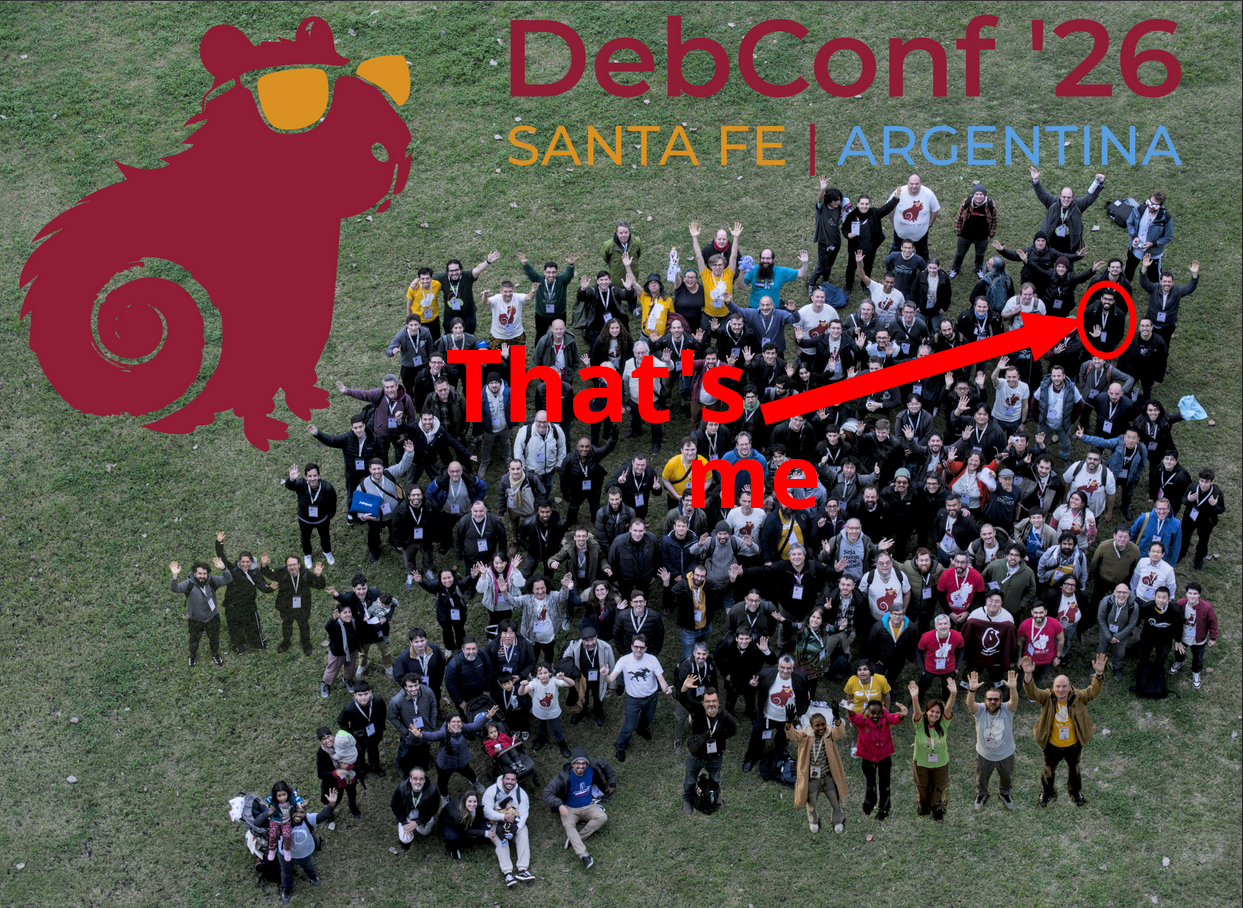
My experience at DebConf 2026 in Santa F The Official DebConf26 Group Photo Last month, I attended DebConf 2026 in Santa F , which was my 5th DebConf. As always, it was an amazing experience, and I met a lot of great people there. For those unfamiliar with the event, it takes place over the course of two weeks. The first week is called DebCamp and is geared more towards hacking and organizing the event itself, while also offering a great opportunity to discuss ideas with others. The second week is the DebConf. We still have the hacklabs, but the talks and workshops are the main focus.

My Activities during DebCamp My main activity was working on the python-click transition that I started in May. There were only a few packages left, and with the help of Guilherme Puida, we managed to work through all the remaining bugs. I plan to talk in details about this transition in another blog post, where I will focus on the tools I used and my experience with mass rebuilds and mass bug filing. I also helped with de Golang Sprint. I worked on a few packages and experimented with the dak API to generate a list of packages that needed manual action. There was a lot of manual, repetitive work and false positives, so I eventually moved on to some other, more fun stuff. I also learned a few thinks about kernel live patching while talking to David Tadokoro. I had to work on the Ubuntu Kernel package recently as part of my job, so we exchanged some ideas, and the conversation was really helpful. He also taught me two commands that I wasn't familiar with, since I'm a newbie in kernel development. Here are the commands:
$ b4 am https://lore.kernel.org/lkml/20240730071904.1047-1-sergiosacj@riseup.net/
$ b4 diff *mbox
By the way, this is the first and only patch I have submitted to the Linux Kernel. I worked on it during DebConf 2024, when I attended the workshop Helen Koike runs to help newcomers submit their first patch to the Linux Kernel. Another great interaction was with Marcos Talau. He showed me his remote access setup, which he is using to help students make contributions to Debian without the struggle of setting up the development environment. Another cool thing is that Puida showed me the command:
$ gbp clone vcs-git:typer
After that, I decided to read the gbp manpage because these little details really improve the overall experience. I also had many other amazing interactions. I just decided to write down the ones that I felt made the most sense for this kind of "blog report" post.

My Activities during DebConf I gave a talk about dh-make-vim, a tool I have been working on sporadically. An interesting detail is that one of the video team volunteers for the talk, Piotr, spoke to me about his tool, pypi2deb, which is similar but aimed at the Python ecosystem. There are many tools of this kind in Debian, and they are all interesting pieces of software. I plan to write more about them in the future. I attended several talks and participated in a few BoF sessions, and they were all great. But something that really stood out to me was the workshop on the Debian Installer, led by Alper Nebi Yasak. I didn't know anything about the Debian Installer, and I liked the way he approached the subject and showed the specific details. I'll take some time to read the Debian Installer internals documentation. I was not familiar with udebs or with the fact that the Debian Installer uses debconf under the hood.

Wrap up It was an amazing event. Unfortunatly, a lot of people I know were not able to attend for different reasons, and they were missed. There were many other things that I enjoyed during this trip. Here are a few more highlights:
  • World Cup matches
  • A day trip around Santa F
  • The Cheese & Wine party
  • Empanadas!!

Dirk Eddelbuettel: RcppMsgPack 0.2.5 on CRAN: Minor Maintenance

Another maintenance release of RcppMsgPack got onto CRAN today. MessagePack itself is an efficient binary serialization format. It lets you exchange data among multiple languages like JSON. But it is faster and smaller. Small integers are encoded into a single byte, and typical short strings require only one extra byte in addition to the strings themselves. RcppMsgPack brings both the C++ headers of MessagePack as well as clever code (in both R and C++) Travers wrote to access MsgPack-encoded objects directly from R. This release is once again chiefly maintenance. Besides standard upkeep to the README.md and continuous integration setup we had to add one #include. The clang++-23 compiler, when also running with its own library, now now needs the type_traits.h header file (in the upstream MessagePack code) so we added that. No other changes, so no user-facing changes. Details follow from the NEWS file.

Changes in version 0.2.5 (2026-08-19)
  • Explicitly include header "type_traits.h" to appease clang++-23
  • Standard maintenance updating continuous integration, adding minor helper script, and updating README.md

Courtesy of my CRANberries, there is also a diffstat report for this release. For questions, suggestions, or issues please use the issue tracker at the GitHub repo.

This post by Dirk Eddelbuettel originated on his Thinking inside the box blog. If you like this or other open-source work I do, you can now sponsor me at GitHub.

Antoine Beaupr : The people vs the AI overlords

Also in this series:
In a post to oss-security, my (Debian) co-developer Russ Allbery stated that "open source software [OSS] is coming face to face with a motivation crisis that has been building for a long time". His point is essentially that large language models (LLMs1) are making the existing OSS community crisis worse. For him, it's the flood of code reviews, but he argues that varies according to people's desires, for others it's security issues and so on. I think Russ is right, but I would argue there's something much bigger than our open communities going on here, and it's about the entire field of computing. This pressure is on all of us, regardless of whether we work on open source software or not.

How people use models People using LLMs in their workflow have radically changed how programming works, even for people who claim to avoid vibe-coding. And I'm sorry to single out one poor maintainer here: it's not you, Brian, you're just one example among many. But this is typical use of those models nowadays:
Once it s done, I ll use /code-review and let Claude spawn sub-agents to do a full review of the new code. This usually finds some problems, even problems that the main Claude instance didn t find during its validation. I usually keep running /code-review again and again after finding and fixing issues, until there aren t any left.
Think about what that means for a minute. This is automation built to fire up dozens of agents crunching at a problem for minutes if not hours of GPU compute time, in parallel. This is essentially a couple of shelves in a datacenter rack, totally maxed out on power and cooling, abstracted behind a cute little /code-review command. The author, here, is rightly concerned that "Anthropic could pull the rug out and require API pricing", which is perhaps a code word for "charging something closer to actual costs". Brian also pays lip service to environmental and societal costs but those are largely abstracted away, so let's keep that conversation aside here as well, as we have discussed it before anyways. But clearly, this way of working has an (externalized) cost, to say the least.

Paying for non-free tools For decades my work has been focused on free and open source software. I've long stopped using proprietary operating systems like Windows or Mac, and even before that switch, I was mostly using free software on those platforms, partly out of principle, but also because I was too poor. So the tools of my trade are free, and I build free tools with them. It feels like we're going backwards: when I was in school, a millennia ago, my classmates didn't have access to a compiler and were wondering how they would scrape the money to buy a compiler like Borland's or Microsoft's. I had a compiler built into my operating system (FreeBSD at the time), so that wasn't a problem for me. For them, it was a significant expense, but at least those expenses (or more shady sourcing of programs) were a one-shot deal. Fast forward 30 years, and software is rented: you pay monthly for Adobe's Photoshop and Microsoft's office suite just like you pay for Netflix, Disney+ or Spotify2. And now you need to add dozens (if not hundreds of dollars) of monthly credits to access LLMs on top of that. So, now we have to pay to get anything done? This is peak enshitification of our job: first they steal our work to train their models, and then they sell it back to us at a profit.

Attacking the engineers AI is coming for our jobs, as engineers, if not everyone, according to the narrative. For a while now, our job market has deteriorated: less jobs, for less pay. Lots of skilled engineers looking for work and finding crap jobs then still looking while working. This is not by accident.3 We engineers have a lot of power, it is not organized, but that's just a couple of unions away (easy!). Tech overlords know this, so they are attacking our profession, directly, by forcing us to train and use models that they can control. Even in environments where programmers are not forced to use LLMs, the mere pressure of other people's LLM-generated work is huge. One can be forced to review LLM outputs, or just peer pressured you into producing more. We're now supposed to accelerate delivery, because models can presumably do things so much better and faster. With supply chain security becoming such a large vector that we now have worms crawling around developers accounts on NPM, increasing the delivery cadence seems like a really bad idea.4 The LLM hype is part of the larger wave of cyberwar against workers, against water, against the Earth, against all the people. This is not a matter of individually "adapting to the reality" or personal choice, but a political, social, hard problem we need to address collectively.

  1. I again prefer the term LLM to "AI" because models do not possess intelligence. I did use it in the title because click baiting is apparently important, but I stopped short of calling this one "Rage Against the Machines" because that would be the title of every blog post I have ever made.
  2. Yes, I know that Visual Studio is kind of free now, but I wouldn't be surprised if they turn that into a rental as well, because why not.
  3. Beyond sabotaging the job market, Sam Altman event wants to sell "intelligence as a utility" something that is just a really bad idea but especially shows how megalomaniac those people are.
  4. This brings back memories of another era, walking us back decades in terms of computer security.

18 August 2026

Thomas Lange: LLM usage in Debian

After spending many hours on reading all the proposals and discussions the best choice for me is NOTA (None of the above). We do not need to create new rules for LLM usage, we already have our DFSG and our social contract. Keep it simple, stupid. Avoid more rules!

Andy Simpkins: My first go at tracking down a kernel bug

A couple of weekends back, I upgraded my home sever. It failed to restart after running apt dist-upgrade The only update that was performed was to the kernel, it went from 6.12.88+deb13-amd64 to 6.12.100+deb13-amd64. I had previously performed an apt-get upgrade, and rebooted the machine, so I was pretty sure that this was to blame. This blog entry (is a late) attempt to document how I went about finding a fix for this issue so that next time I don t need as much hand holding as I did this time around :-) (1)
Having my machine not boot following an upgrade is pretty rare, but has happened before. Usually it is because I have done something wrong so as always confirming I haven t broken something by accident is always my first step I plugged in a keyboard an monitor to the machine and watched it boot. Being a server this takes a long time (I guess because at this stage of system initialisation we want to test things sequentially) Watching the system boot I see the usual BIOS/UEFI stages for this machine, followed by the grub menu and the the local screen showed:
            Loading Linux 6.12.100+deb13-amd64 ...
            Loading initial ramdisk ...
Nothing else. That was it. OK that looks like I have a broken system all right, and at very early stage of the boot process process. (2)
Breaking into the grub menu and removing the quiet option yields a little more information (but not much):
            Loading Linux 6.12.100+deb13-amd64  
            Loading initial ramdisk ...
            
            	EFI stub: Loaded initrd from LINUX_EFI_INITRD_MEDIA_GUID d
            	evice path
            		EFI stub: Measured initrd data into PCR 9
and nothing else. (3) Initial debugging (4) Triage Start looking for where the fault first occurred. At this point I needed help, and given that Sledge was visiting I asked if he would sanity check what I was doing. His initial thoughts were that that /boot had run out of space, but replaying my step (3) with him acting as a rubber duck showed that this was something other than PBKAC Sledge had a quick look, then informed me that between kernel images 6.12.88+deb13 and 6.12.100+deb13 Debian stable has only had shipped .90 .94 .95 and .96 kernels. We could easily try them all: OK I now have the first kernel image that doesn t boot on my system, time to raise a bug

Up until now I have been walking to my garage where the server is located and standing in front of a rack
with a monitor and keyboard plugged into the machine. However this machine supports IPMI so I spent a little time getting that up and running so that I can continue from the relative comfort of my desk (with lights, a chair and not needing to hold the keyboard with one hand)
Great I can now grab screen shots from the confort of my desk (unfortunatly they are only screen shots not text files, but at least we can seen the early stage of boot, Post, grub menu and then initramfs before system log happens) (5) Collating information for the initial bug report Sledge had mentioned my problem in irc/#debain-kernal where iam_tj suggested that we try appending
debug earlycon=efifb to the kernal command line. This yielded 15 seconds worth of messages before the system locked up the last few messages being (vmlinuz-6.12.96+deb13-amd64):

[ 14.663477] RCU Tasks: Setting shift to 5 and lim to 1 rcu_task_cb_adjust=1 rcu_task_cpu_ids=20.
[ 14.750474] RCU Tasks Rude: Setting shift to 5 and lim to 1 rcu_task_cb_adjust=1 rcu_task_cpu_ids=20.
[ 14.838024] RCU Tasks Trace: Setting shift to 5 and lim to 1 rcu_task_cb_adjust=1 rcu_task_cpu_ids=20.
[ 14.929752] NR_IRQS: 524544, nr_irqs: 584, preallocated irqs: 16
[ 15.016814] rcu: srcu_init: Setting srcu_struct sizes based on contention.
[ 15.104011] Console: colour dummy device 80 25
[ 15.191236] printk: legacy console [tty0] enabled
[ 15.278249] printk: legacy bootconsole [efifb0] disabled Booting the working kernel with the same kernel options yields the SAME messages with slightly differing times, but then continues to login prompt:

 [   14.697466] RCU Tasks: Setting shift to 5 and lim to 1 rcu_task_cb_adjust=1 rcu_task_cpu_ids=20.
 [   14.784936] RCU Tasks Rude: Setting shift to 5 and lim to 1 rcu_task_cb_adjust=1 rcu_task_cpu_ids=20.
 [   14.872067] RCU Tasks Trace: Setting shift to 5 and lim to 1 rcu_task_cb_adjust=1 rcu_task_cpu_ids=20.
 [   14.964000] NR_IRQS: 524544, nr_irqs: 584, preallocated irqs: 16
 [   15.051482] rcu: srcu_init: Setting srcu_struct sizes based on contention.
 [   15.226079] printk: legacy console [tty0] enabled
 [   15.313751] printk: legacy bootconsole [efifb0] disabled
 [   15.400831] ACPI: Core revision 20240827
 [   15.401415] clocksource: hpet: mask: 0xffffffff max_cycles: 0xffffffff, max_idle_ns: 79635855245 ns
 [   15.401464] APIC: Switch to symmetric I/O mode setup
 
... and so on
iam_tj also suggested adding keep_bootcon with debug earlycon=efifb keep_bootcon on vmlinuz-6.12.96+deb13-amd64:
We get a LOT further and we see a crash / trace-back:
[ 34.285342] BUG: kernel NULL pointer dereference, address: 0000000000000000
I raised bug #1143721 and followed it up with screen captures of the boot sequence (captured from the IPMI client) and files containing the output of dmidecode, lscpu and lspci to kive the kernel team as much information as possible:
[6.12.96+deb13-amd64 debug earlycon=efifb keep_bootcon.tar.gz (application/gzip, attachment)]
[dmidecode.txt (text/plain, attachment)]
[lscpu.txt (text/plain, attachment)]
[lspci.txt (text/plain, attachment)]
(6) Tracking down the bug Git Bisect The problem with this type of bug is that it is hardware (class) specific, whilst the kernel doesn t boot on my system, it clearly has worked on machines used by the kernel team, the Debian test and build infrastructure, (otherwise this kernel would never have been released) and everyone else who has upgraded to the newer kernel before I did (otherwise we would be drowning in fails to boot bug reports). Carnil s excellent response to my bug: Message #15 (and help in IRC) provided me with a detailed step by step guide in how to track down the individual git commit that fails on my system. I had already (with Sledge s suggestion) made a clone of the stable branch, but was struggling to follow the steps in the Debian Linux Kernel Handbook to re-build a duplicate kernel because I didn t understand how to obtain the same configuration that Debian used to build the kernel; Carnil s email provided me the missing steps (Highlighted).
git clone --single-branch -b linux-6.12.y https://git.kernel.org/pub/scm/linux/kernel/git/stable/linux-stable.git
cd linux-stable
git checkout v6.12.95
cp /boot/config-$(uname -r) .config
yes ''   make localmodconfig
make savedefconfig
mv defconfig arch/x86/configs/my_def
test 6.12.96 to ensure this is "bad"
git checkout v6.12.96
make my_defconfig
make -j $(nproc) bindeb-pkg
  install the resulting .deb package and confirm it fails to boot and triggers the NULL pointer dereference.
Right I can now start to Bisect the problem:
git bisect start
git bisect good v6.12.95
git bisect bad v6.12.96
Rather than use the half step point s git bisect suggested I was advised in irc to jump straight to the a given commit that from the git log was suspected as the culprit:

git checkout 977855894bca4b87afa50d21e3f3e85a5a0e901f
build and install .
fails
git bisect bad

git checkout 977855894bca4b87afa50d21e3f3e85a5a0e901f~1 ## ~1 is the commit beforehand
build and install .
fails
git bisect good The entire test tree can shown with git bisect log and this was submitted as an email to the bug report, we have found our smoking gun :-) Finally I would like to thank Carnil, Iam_tj for their time patience and fantastic support in guiding me through finding this regression. Right now kernel bugs are coming in thick and fast with a lot of AI assisted bug hunting, the increased numbers of bugs mean that the kernel team are especially busy. Hopefully our paths will cross and I ll be able to buy you some beers (or whatever) soon. thank you. Sledge also deserves thanks for putting up with me and pointing me in the right direction (as ever). Lucky for me that he lives nearby so I can provide beers on a regular basis :-)

John Goerzen: AI in Debian: The Vote, Proposals, and Nuance

Let me start with a hypothesis:
For human developers, using coding LLMs magnifies their difference in skill levels.
I am one that rarely thinks things are always black and white. Back in March, I wrote Artifial Intelligence: Shades of Gray. Since then, I ve had more of a chance to experiment with LLMs myself. I also happen to work for an employer that is taking a very pragmatic approach to LLMs: teams and individuals use it as they see fit, but if they are causing considerable expense, they have to justify it. In various settings, I have seen the egregious examples of AI slop we all know about. As I wrote in March, I have seen it both waste more time than it saves, and save a ton of time. I have come to see that, as a tool, it is most valuable when it is running under the supervision of an experienced engineer. It is at its worst when it has no such supervision; the vibe coding and other low-quality slop we see. A coding agent is like a junior developer or research assistant. When properly supervised, they help projects move along more quickly by letting a senior developer focus on the more difficult, less mundane aspects of the project. But one couldn t expect a junior developer to consistently deliver high-quality code and architecture on their own. Let s put a pin in this idea and look at the story in Debian. LLM use in Debian There is a vote happening in Debian around the use of LLMs. In typical Debian fashion, there are 8 options to choose from, many of them similar. Most of these proposals acknowledge there are different types of tasks done in Debian, but the proposals don t differentiate between them well. Let me do so here. These are some of the LLM-relevant tasks people in Debian perform: I m going to focus my remarks here on packaging upstream software for Debian, since this is by far the most time-consuming developer task project-wide. It matters to our users that we get this right, and packaging quality is one of the things that sets Debian apart from other distros. Packaging things for Debian requires knowledge of some specific tools, such as debhelper, that aren t widely used anywhere else. In most cases, it is fairly rote time-consuming work. In other words, by its design, it requires people with senior-level skills to do grunt work. I can t overstate how massive a burden this grunt work is. I maintain some packages for Go and Rust. By Debian policy, all of those packages dependencies must also exist as Debian packages, and be used to build against. When upstream adopts a newer version of some library, it can unleash cascading dependencies that can take hours to sort out. Worse, the Rust team and the Go team use entirely different ways of managing packages (Go uses one Git repo per package, while Rust has a monorepo with specialized scripts to import Cargo packages and generate Debian ones). On top of that, we can t just modify things like usual; we have to use quilt. And on top of that, I m also a backports maintainer, so all the work (and usually even more) has to be done there also. Now let s pull on that pin from the earlier conversation. This is exactly the kind of scenario that a well-supervised coding LLM is most effective in. I could see a seasoned developer saving hours, maybe even days, by turning over the mundane tasks of managing trees of cascading dependencies over to a coding tool and verifying and directing the process. (Yes, I have been using em-dashes for years; LLMs have copied people like me, not the other way around! This post was not written with any AI assistance.) Actually, this is almost a dream scenario for a coding assistant. The result is time-consuming to formulate but easy to review, which is the opposite of the way these things often go. I can assure you with 100% certainty that humans aren t adding a lot of value in this process. It would be wrong to believe that a human is carefully reading every line of code in dozens of updated or new library packages. The problem set is too big, the time too short, and the code too varied and complex. Coding agents seem to be most effective when there are strong test suites that they can test changes against. Debian builds, especially of modern packages, tend to have this property. Many packages have test suites that are run during build. And, if the package builds in an isolated environment (and especially if its downstream dependencies do also), then there is a decent chance that it s fairly correct. Maybe needing some manual tweaking here and there, but generally a successful build is a reasonable indicator. You can argue that it would make more sense for Debian to just include dependencies in source packages, along with some version information to support security rebuilds, and I d tend to agree with you. But we are where we are. This would be one of the more significant leaps forward in developer productivity, but it complicates things like copyright reviews. Where are LLMs run? What is the environmental impact? Most of the proposals seem to make the assumption that LLMs must always run in some large, hosted datacenter. As I noted in my March article, I have had credible results on even an older GPU running on solar power. That said, it is undeniable that LLMs are fueling a datacenter boom, and this in turn is producing a significant new demand for resources. Most notably for the global scale: electricity, which is sometimes generated using carbon-emitting technologies. Bill McKibben, who has been a leading voice in the fight against climate change since the 1980s, has made some interesting points recently: he s noted that solar power is the fastest kind of generation we can build, and a number of large AI companies are investing heavily in solar, even to the point of fully offsetting new datacenter s needs. On the other hand, he s also noted that some companies are buying inefficient and dirty gas turbines. It is decidedly a mixed bag. The heavy investment in solar can have knock-on positive effects for infrastructure. Obviously, not every picture here is rosy. This analysis doesn t touch on the real land and water use situation, either. On the other hand, if an LLM allows me to do in an hour what I would have done in a day, that s a day of not heating or cooling the work area generally not sustaining a human for the purpose of writing code for Debian. HVAC energy consumption dwarfs my GPU, and I d imagine probably also the slice of LLM energy used. Holistically, I would have to conclude the picture is mixed. It is possible to use LLMs in a pretty green way, and also in a pretty dirty way. Assuming Conditions Never Change A flaw in most of these proposals is they assume that the conditions at this present moment will always hold. In fact, that the conditions at the present moment will not continue is something both AI cheerleaders and AI skeptics agree on. For instance: Ed Zitron has done a ton of research into the financing side of AI, and has concluded that the current model is unsustainable and headed for a significant bubble burst. I m not positioned to personally evaluate those claims, but if that happens, what is the result? Perhaps it is a steeply increasing cost of inference for the frontier models, slower pace of training/evolution for them, etc. In a recent episode of Oxide and Friends, Simon Willison discussed the open weight models that are now available. They have been making remarkable strides in efficiency and capabilities, to the point where $50,000 of hardware can now run high-end open weight models with capabilities that are at least in the same ballpark as the American frontier models. This puts running high-end models locally squarely within reach of universities and small- to medium-sized businesses, with power requirements that can be met with standard commercial solar and wind installations. The lack of nuance in the more restrictive proposals is particularly concerning. Proposal A doesn t allow the use or assitance of LLMs . So it bans my solar-powered GPU. It bans using LLMs to find security issues. It bans all sorts of things that don t seem to be ban-worthy, alongside the things that do. And it codifies it in the very hard-to-change social contract. That proposal, and some like it, seem to imply that all LLM output is bad. I grant you that AI slop is a real and legitimate concern, and many Open Source projects have to deal with it. On the other hand, we have all seen first-hand how the security of the Linux kernel has benefited dramatically from AI analysis. It is certain that black hats are using these tools. If we refuse to use modern security tools, our security will be compromised (and what is the environmental and social impact of THAT?) I find the statement Generative AI is characterized by producing output of a nature that would ordinarily be produced and consumed by humans to be particularly interesting. The same was once said of compilers. The Real Concerns You might think from reading this that I am some AI cheerleader. I m not. I share the ethics of the FLOSS movement, and have for decades. I abhor the power and lack of ethics that many big names in the field are running with at the moment. I ve had to put up Anubis on this blog, for instance. I have personally experienced the effects of AI slop, especially at review time. This is a real problem, though I don t think the more draconian policies are likely to help (the looser you must disclose stand a fighting chance, but I m not sure they would help, either.) Done poorly, AI threatens developer burnout by overwhelming them with poor code and verbose but useless explanations. Done well, AI can help prevent developer burnout by automating tedious and low-value tasks. Shouldn t our goal be that humans submit work to Debian, using tools they prefer, and take responsibility for it? Does it matter if someone uses ed, vim, emacs, or vscode? If they use LSP or just run gcc manually? I d say we benefit from the diversity. Wouldn t we be better off to benefit from the diversity here, and judge work as we always have: on its merits, not what tools were used to create it? Fundamentally, a GR is a long and arduous process. It s not easy to reverse later. Amending the Social Contract is even longer and more arduous (I should know; I may have been the first one to try). The LLM landscape is fast-moving. None of us can really predict where it will be in a year. Will the current market leading companies even still exist? Will it be at all credible to refuse to use AI-assisted security tools? What is the most effective way to deal with AI slop? What level of utility will we be able to achieve with models run locally? Some of these proposals would make sense if drafted in some way short of a GR, which would allow more maneuverability as the landscape changes. Brief analysis of the options Considering the proposals: In favor of nuance I find that black-and-white thinking is almost always something to be avoided. I see it too often. I see it in politics, I see it in our software, I see it in discussions around AI. Are there deeply unethical things happening in AI? Absolutely. Are they doing some impressive things? Also yes. We have accepted this nuance in other areas. For instance, almost all the hardware Debian runs on has closed-source hardware, and has components manufactured or assembled in countries with some of the worst human rights records on the planet. I m not saying this is a great state of affairs. It is something we should speak up about and act upon. But the worse state of affairs would be no Debian because the hardware is impure .

16 August 2026

Bits from Debian: Debian turns 33!

It has now been thirty-three years since the Debian project was announced to the world by Ian Murdock, on August 16, 1993. This anniversary is an opportunity to reaffirm the goals, characteristics, and qualities of the Debian project: it s an association of individuals who have made common cause to create a free operating system. Our distribution is characterized by a commitment to software freedom, as enshrined in the Debian Social Contract and the Debian Free Software Guidelines. It focuses on security and stability. This stability is crucial to Debian position in the free software ecosystem. With our users as our priority, Debian makes special efforts regarding accessibility with Debian-Accessibility and diversity with our Outreach Programs. Debian Day is a great opportunity to get together, whether for a local meetup, or simply to grab a coffee with other members of the Debian community. Check out the Debian Day wiki to see if there is a celebration near you. And if there isn't, maybe you can organize it next year! Today is also an opportunity for you to start or resume your contributions to Debian. For example, you can install the how-can-i-help package and see if there is a bug in any of the software that you use that you can help to fix, contribute small tips on how to install Debian on your machines to our wiki pages, or put a Debian live image in an USB memory and give it to some person near you, who still didn't discover Debian. Thanks to everybody who has contributed to develop our beloved operating system in these 33 years, and Happy birthday Debian!

Vasudev Kamath: Releasing debvulns-exporter and debvulns CLI 0.2.2

I made another minor release with several enhancements: handling non-Debian origin vulnerabilities, improving data caching, and sharing the cache between the debvulns CLI and the exporter. Additionally, there are a few improvements on the dashboard front. Here is a breakdown of what changed.
Handling Vulnerabilities in Non-Debian Origin Packages During the previous release, I noticed that the grafana package which is not in Debian and was installed via an upstream repository was reported as vulnerable with multiple issues. Looking into why this happened, I found that all the CVEs reported in the dashboard were indeed listed on security-tracker.debian.org, but without a fixed version or status description. The logic assumed no fix was available and marked the package as vulnerable on the dashboard.
How Did I Solve This? Google maintains a distributed vulnerability database for open-source projects called osv.dev. I checked the generic vulnerability data for those CVEs on OSV (unbound to any specific distribution) and found that the issues were already fixed in the upstream version I was running. What I needed was a way to differentiate native Debian packages from non-Debian packages, which corresponds to the Origin field in APT metadata.
Pitfall The AI-generated code initially attempted to differentiate package origin using apt_pkg.PackageRecords and its origin field. However, many native Debian packages were incorrectly flagged as non-Debian. On closer inspection, when an upgrade is available for a package, the installed version's origin field can be unset. I had to resolve this by detecting available upgrades and inspecting the candidate version's origin instead, which was implemented in this patch. This solution was proudly crafted by me ;-) (partly because I ran out of API limits and had to wait 6 hours for the next reset).
Caching OSV Data Initially, the AI implemented the exporter to re-download the entire OSV dataset on every run, which was unnecessary. Since vulnerability data does not change rapidly once published, caching it on disk for longer than the standard 24-hour Debian/EPSS cache makes sense. OSV vulnerability data is now cached for 7 days before a refresh is triggered. All cache expiration thresholds remain configurable via CLI flags.
Catch One caveat with this approach: I have not yet verified whether every upstream CVE is tracked on security-tracker.debian.org. In the case of grafana, the entries existed. This feature operates on the assumption that security-tracker.debian.org indexes CVE metadata regardless of whether the package is native to Debian. I plan to re-evaluate this and add fallback handling if that assumption fails.
Unified Cache Directory for CLI and Exporter Another issue was cache segregation: the debvulns CLI utility defaulted to /var/cache/debvulns, while the Prometheus exporter used /var/cache/debvulns-exporter. While harmless when running only one tool, installing both led to duplicated cache storage and redundant network requests. Since the core evaluation logic is identical across both tools, they now share a unified cache directory to eliminate duplicate downloads.
Dashboard Changes During the initial dashboard rollout, my test environment (my laptop alongside Debian 11 and Debian 12 VMs) reported a high aggregated vulnerability count. It was not immediately obvious whether these were distinct vulnerabilities or the same CVEs replicated across all three machines. This mirrors common questions raised during vulnerability reviews:
  • How many unique vulnerabilities are present across the fleet?
  • Which unique packages are affected?
The dashboard has been redesigned to surface unique vulnerability counts alongside affected package lists. The updated dashboard is shown below:
What's Next? A few planned items remain to make debvulns a comprehensive vulnerability reporting toolkit for Debian systems:
  1. Kernel Vulnerability Handling: Currently, installing a patched kernel marks the vulnerability as resolved, even if the system has not rebooted into it. The system remains exposed while the vulnerable kernel is executing in memory. Factoring in running kernel versions is crucial.
  2. Reboot and Service Restart Tracking: Similar to kernel upgrades requiring a reboot, userland library and binary fixes require running services to be restarted. This is typically detected via needrestart. Integrating this behavior directly into debvulns will provide complete visibility in a single dashboard metric.
  3. Debian Packaging: Once the above features are stable, the final step is packaging debvulns for Debian so it can be installed directly from the archive.
Until then, happy hacking.

Benjamin Mako Hill: Sad Story

Picture of a box in a fireplace saying:

Not a screenshot of despair. But only because it s not a screenshot.

Next.

Previous.