Wouter Verhelst: Programming and GR 2026 002

This proposal aims to expressly forbid any contributions to Debian written with the use or assistance of large language models (LLMs) or other generative AI tools.This falls squarely in the "LLM bad" camp, outlawing all generative-AI contributions, disregarding potential future ones where the problematic situations that exist today are not present. It makes a change to the social contract, which is especially difficult to reverse (on purpose), and which therefore also will require a 3:1 supermajority, but if we want to ban LLM-assisted contributions, this is probably the best way to do it.
This proposal aims to ensure that contributions directly to Debian are created by humans, while at the same time avoiding restrictions on the tools those humans may choose to use when contributingAnother "LLM bad" proposal, it however restricts the "bad" bits to only the direct output of the LLM. If you use an LLM to do something and then clean-room re-implement the same thing yourself, that's apparently fine.
 As I am writing this, there is a vote ongoing in the Debian
project on how to deal with AI in general and AI-assisted contributions to Debian specifically. Massive discussions
have happened in debian-vote and other locations. I have also asked
questions there and offered my perspective. IMHO now is the time to summarize that, after all the discussions
that I've had with people on multiple sides of this debate both online and offline, and explain how I will be
voting and why. Hopefully that will be helpful to someone else as well. None of this has been compiled with AI
assistance, but only because I think that forming opinions is not something where AI can really be helpful.
Spellcheck was used though.
So, first I will describe how I see each of the 8 proposals, then what my vote will be, and then a bit more
detail on the reasoning and thinking behind this. WARNING - this went long.
 A new minor release 0.4.28 of RProtoBuf
arrived on CRAN today. RProtoBuf
provides R with bindings to the
Google Protocol Buffers
( ProtoBuf ) data encoding and serialization library used and
released by Google, and deployed very widely in numerous projects as a
language and operating-system agnostic protocol. The new release is also
already as a binary via r2u.
This release corrects a really old bug. Troy found, when working on
gRPC based extensions, which is in and by
itself exciting, that a small part of our interface surface (for service
descriptors) was just wrong confusing single and double underscores.
adjusts to a change upstream. This has been corrected. I updated a few
of the usual continuous integration parts, updated a help page for a
newly-added nag by CRAN, and
also got a last-minute round of noodling in as the JSS paper vignette
was still referencing OmegaHat which the CRAN URL checker objected to. I
created a quick one-off repo to serve pdf files should the need arise
again, and rebuilt the vignette linking to it. No other changes.
The following section from the NEWS.Rd file has all details and
links.
Thanks to my CRANberries, there is a diff to the previous release. The RProtoBuf page has copies of the (older) package vignette, the quick overview vignette, and the pre-print of our JSS paper. Questions, comments etc should go to the GitHub issue tracker off the GitHub repo.Changes in RProtoBuf version 0.4.28 (2026-08-21)
This post by Dirk Eddelbuettel originated on his Thinking inside the box blog. If you like this or other open-source work I do, you can sponsor me at GitHub.

virsh virt-install and virt-manager, which are part of the libvirt framework. Libvirt offers an excellent API accessible over qemu/KVM via shell (virsh), GUI (virt-manager) and Web (cockpit) .
To use libvirt, properly you need to make sure your standard user is member of the libvirt group, and the libvirt default network is started via virsh net-autostart default.
Also make sure you set export LIBVIRT_DEFAULT_URI=qemu:///system to use the system wide instance of libvirt, which is needed for the default bridged networking.
Download the debian cloud image:
$ wget https://cloud.debian.org/images/cloud/trixie/daily/latest/debian-13-generic-amd64-daily.qcow2
$ export SIZE=$(stat -Lc%s debian-13-generic-amd64-daily.qcow2)
$ virsh vol-create-as default dev-vm $SIZE --format qcow2
$ virsh vol-upload --pool default dev-vm debian-13-generic-amd64-daily.qcow2
$ echo root > password.txt
$ virt-install --name dev-vm --memory 4096 --noreboot \
	--os-variant detect=on,name=linux2024 \
	--disk vol=default/dev-vm \
	--import \
	--boot uefi \
	--cloud-init root-password-file=password.txt,clouduser-ssh-key=$HOME/.ssh/.ssh/id_ed25519,disable=on
Starting install...
Allocating 'virtinst-ns9oa7_i-cloudinit.iso'                  368 kB  00:00
Transferring 'virtinst-ns9oa7_i-cloudinit.iso'                368 kB  00:00
Creating domain...                                                    00:00
Connected to domain 'dev-vm'
BdsDxe: starting Boot0001 "UEFI Misc Device" from PciRoot(0x0)/Pci(0x2,0x3)/Pci(0x0,0x0)
Booting  Debian GNU/Linux'
Loading Linux 6.12.101+deb13-amd64 ...
Loading initial ramdisk ...
EFI stub: Loaded initrd from LINUX_EFI_INITRD_MEDIA_GUID device path
EFI stub: UEFI Secure Boot is enabled.
[    0.000000] Linux version 6.12.101+deb13-amd64 (debian-kernel@lists.debian.org) (x86_64-linux-gnu-gcc-14 (Debian 14.2.0-19) 14.2.0, GNU ld (GNU Binutils for Debian) 2.44) #1 SMP PREEMPT_DYNAMIC Debian 6.12.101-1 (2026-08-05)
[    0.000000] Command line: BOOT_IMAGE=/boot/vmlinuz-6.12.101+deb13-amd64 root=PARTUUID=2b4578e2-9d2e-4b32-b6a4-b5b2ca607ef6 ro console=tty0 console=ttyS0,115200 earlyprintk=ttyS0,115200 consoleblank=0
...
# open a serial console to the VM
$ virsh console dev-vm
# access the graphical console
$ virt-manager
# Access the VM via SSH with the precreated cloud user "debian"
$ virsh domifaddr dev-vm
 Name       MAC address          Protocol     Address
-------------------------------------------------------------------------------
 vnet7      52:54:00:23:e6:61    ipv4         192.168.122.225/24
$ ssh debian@192.168.122.225
329. This version includes the following changes:
[ Jochen Sprickerhof ]
* Handle missing cpio and qemu-img in autopkgtests. (Closes: #1144617)
 I m really enjoying getting back into ice skating, but I can only get to the
rink once a week (at least over the summer -- I'm aiming for twice weekly once
Schools re-open) and I have the itch to do more skating than that.


 Last month, I attended DebConf 2026 in Santa F ,
which was my 5th DebConf. As always, it was an amazing experience, and I
met a lot of great people there.
For those unfamiliar with the event, it takes place over the course
of two weeks. The first week is called DebCamp and is geared more
towards hacking and organizing the event itself, while also offering a
great opportunity to discuss ideas with others. The second week is the
DebConf. We still have the hacklabs, but the talks and workshops are the
main focus.
$ b4 am https://lore.kernel.org/lkml/20240730071904.1047-1-sergiosacj@riseup.net/
$ b4 diff *mbox$ gbp clone vcs-git:typer#include. The clang++-23 compiler, when
also running with its own library, now now needs the
type_traits.h header file (in the upstream MessagePack code) so we added that. No
other changes, so no user-facing changes. Details follow from the NEWS
file.
Courtesy of my CRANberries, there is also a diffstat report for this release. For questions, suggestions, or issues please use the issue tracker at the GitHub repo.Changes in version 0.2.5 (2026-08-19)
- Explicitly include header "type_traits.h" to appease clang++-23
- Standard maintenance updating continuous integration, adding minor helper script, and updating README.md
This post by Dirk Eddelbuettel originated on his Thinking inside the box blog. If you like this or other open-source work I do, you can now sponsor me at GitHub.
Also in this series:In a post to oss-security, my (Debian) co-developer Russ Allbery stated that "open source software [OSS] is coming face to face with a motivation crisis that has been building for a long time". His point is essentially that large language models (LLMs1) are making the existing OSS community crisis worse. For him, it's the flood of code reviews, but he argues that varies according to people's desires, for others it's security issues and so on. I think Russ is right, but I would argue there's something much bigger than our open communities going on here, and it's about the entire field of computing. This pressure is on all of us, regardless of whether we work on open source software or not.
Once it s done, I ll useThink about what that means for a minute. This is automation built to fire up dozens of agents crunching at a problem for minutes if not hours of GPU compute time, in parallel. This is essentially a couple of shelves in a datacenter rack, totally maxed out on power and cooling, abstracted behind a cute little/code-reviewand let Claude spawn sub-agents to do a full review of the new code. This usually finds some problems, even problems that the main Claude instance didn t find during its validation. I usually keep running/code-reviewagain and again after finding and fixing issues, until there aren t any left.
/code-review command.
The author, here, is rightly concerned that "Anthropic could pull the
rug out and require API pricing", which is perhaps a code word for
"charging something closer to actual costs". Brian also pays lip
service to environmental and societal costs but those are largely
abstracted away, so let's keep that conversation aside here as well,
as we have discussed it before anyways.
But clearly, this way of working has an (externalized) cost, to
say the least.
 After spending many hours on reading all the proposals and discussions
the best choice for me is NOTA (None of the above).
We do not need to create new rules for LLM usage, we already have our
DFSG and our social contract.
Keep it simple, stupid. Avoid more rules!
 A couple of weekends back, I upgraded my home sever. It failed to restart after running
apt dist-upgrade
The only update that was performed was to the kernel, it went from 6.12.88+deb13-amd64 to 6.12.100+deb13-amd64. I had previously performed an apt-get upgrade, and rebooted the machine, so I was pretty sure that this was to blame. This blog entry (is a late) attempt to document how I went about finding a fix for this issue so that next time I don t need as much hand holding as I did this time around :-)
(1) Loading Linux 6.12.100+deb13-amd64 ...
Loading initial ramdisk ... Loading Linux 6.12.100+deb13-amd64
Loading initial ramdisk ...
EFI stub: Loaded initrd from LINUX_EFI_INITRD_MEDIA_GUID d
evice path
EFI stub: Measured initrd data into PCR 96.12.88+deb13-amd64 (During boot select Advanced options from the grub menu followed by the kernel image wanted)
EFI stub: Measured initrd data into PCR 9 apart other than the usual rantings to turn off secure boot (on this server that currently isn t turned on bad me)6.12.88+deb13 and 6.12.100+deb13 Debian stable has only had shipped .90 .94 .95 and .96 kernels. We could easily try them all:
wget each kernel package then install (dpkg -i) followed by an update-grub, checking that there was sufficient space on disks especially my small /boot partition)6.12.95+deb13 and this worked6.12.96+deb13 yielded the same lock up on boot as 6.12.100+deb13Up until now I have been walking to my garage where the server is located and standing in front of a rack
with a monitor and keyboard plugged into the machine. However this machine supports IPMI so I spent a little time getting that up and running so that I can continue from the relative comfort of my desk (with lights, a chair and not needing to hold the keyboard with one hand)
Great I can now grab screen shots from the confort of my desk (unfortunatly they are only screen shots not text files, but at least we can seen the early stage of boot, Post, grub menu and then initramfs before system log happens)
(5) Collating information for the initial bug report
Sledge had mentioned my problem in irc/#debain-kernal where iam_tj suggested that we try appending
debug earlycon=efifb to the kernal command line. This yielded 15 seconds worth of messages before the system locked up the last few messages being (vmlinuz-6.12.96+deb13-amd64):
[ 14.663477] RCU Tasks: Setting shift to 5 and lim to 1 rcu_task_cb_adjust=1 rcu_task_cpu_ids=20.
[ 14.750474] RCU Tasks Rude: Setting shift to 5 and lim to 1 rcu_task_cb_adjust=1 rcu_task_cpu_ids=20.
[ 14.838024] RCU Tasks Trace: Setting shift to 5 and lim to 1 rcu_task_cb_adjust=1 rcu_task_cpu_ids=20.
[ 14.929752] NR_IRQS: 524544, nr_irqs: 584, preallocated irqs: 16
[ 15.016814] rcu: srcu_init: Setting srcu_struct sizes based on contention.
[ 15.104011] Console: colour dummy device 80 25
[ 15.191236] printk: legacy console [tty0] enabled
[ 15.278249] printk: legacy bootconsole [efifb0] disabled
Booting the working kernel with the same kernel options yields the SAME messages with slightly differing times, but then continues to login prompt:
 [   14.697466] RCU Tasks: Setting shift to 5 and lim to 1 rcu_task_cb_adjust=1 rcu_task_cpu_ids=20.
 [   14.784936] RCU Tasks Rude: Setting shift to 5 and lim to 1 rcu_task_cb_adjust=1 rcu_task_cpu_ids=20.
 [   14.872067] RCU Tasks Trace: Setting shift to 5 and lim to 1 rcu_task_cb_adjust=1 rcu_task_cpu_ids=20.
 [   14.964000] NR_IRQS: 524544, nr_irqs: 584, preallocated irqs: 16
 [   15.051482] rcu: srcu_init: Setting srcu_struct sizes based on contention.
 [   15.226079] printk: legacy console [tty0] enabled
 [   15.313751] printk: legacy bootconsole [efifb0] disabled
 [   15.400831] ACPI: Core revision 20240827
 [   15.401415] clocksource: hpet: mask: 0xffffffff max_cycles: 0xffffffff, max_idle_ns: 79635855245 ns
 [   15.401464] APIC: Switch to symmetric I/O mode setup

... and so on
iam_tj also suggested adding keep_bootcon with debug earlycon=efifb keep_bootcon on vmlinuz-6.12.96+deb13-amd64:[ 34.285342] BUG: kernel NULL pointer dereference, address: 0000000000000000[6.12.96+deb13-amd64 debug earlycon=efifb keep_bootcon.tar.gz (application/gzip, attachment)]
[dmidecode.txt (text/plain, attachment)]
[lscpu.txt (text/plain, attachment)]
[lspci.txt (text/plain, attachment)]
git clone --single-branch -b linux-6.12.y https://git.kernel.org/pub/scm/linux/kernel/git/stable/linux-stable.git
cd linux-stable
git checkout v6.12.95
cp /boot/config-$(uname -r) .config
yes ''   make localmodconfig
make savedefconfig
mv defconfig arch/x86/configs/my_def
test 6.12.96 to ensure this is "bad"
git checkout v6.12.96
make my_defconfig
make -j $(nproc) bindeb-pkg
  install the resulting .deb package and confirm it fails to boot and triggers the NULL pointer dereference.
Right I can now start to Bisect the problem:
git bisect start
git bisect good v6.12.95
git bisect bad v6.12.96git checkout 977855894bca4b87afa50d21e3f3e85a5a0e901f
build and install .
fails
git bisect bad
git checkout 977855894bca4b87afa50d21e3f3e85a5a0e901f~1 ## ~1 is the commit beforehand
build and install .
fails
git bisect good
The entire test tree can shown with git bisect log and this was submitted as an email to the bug report, we have found our smoking gun :-)
Finally I would like to thank Carnil, Iam_tj for their time patience and fantastic support in guiding me through finding this regression. Right now kernel bugs are coming in thick and fast with a lot of AI assisted bug hunting, the increased numbers of bugs mean that the kernel team are especially busy. Hopefully our paths will cross and I ll be able to buy you some beers (or whatever) soon. thank you. Sledge also deserves thanks for putting up with me and pointing me in the right direction (as ever). Lucky for me that he lives nearby so I can provide beers on a regular basis :-)
For human developers, using coding LLMs magnifies their difference in skill levels.I am one that rarely thinks things are always black and white. Back in March, I wrote Artifial Intelligence: Shades of Gray. Since then, I ve had more of a chance to experiment with LLMs myself. I also happen to work for an employer that is taking a very pragmatic approach to LLMs: teams and individuals use it as they see fit, but if they are causing considerable expense, they have to justify it. In various settings, I have seen the egregious examples of AI slop we all know about. As I wrote in March, I have seen it both waste more time than it saves, and save a ton of time. I have come to see that, as a tool, it is most valuable when it is running under the supervision of an experienced engineer. It is at its worst when it has no such supervision; the vibe coding and other low-quality slop we see. A coding agent is like a junior developer or research assistant. When properly supervised, they help projects move along more quickly by letting a senior developer focus on the more difficult, less mundane aspects of the project. But one couldn t expect a junior developer to consistently deliver high-quality code and architecture on their own. Let s put a pin in this idea and look at the story in Debian. LLM use in Debian There is a vote happening in Debian around the use of LLMs. In typical Debian fashion, there are 8 options to choose from, many of them similar. Most of these proposals acknowledge there are different types of tasks done in Debian, but the proposals don t differentiate between them well. Let me do so here. These are some of the LLM-relevant tasks people in Debian perform:
 It has now been thirty-three years since the Debian project was announced to
the world by Ian Murdock, on August 16, 1993. This anniversary is an
opportunity to reaffirm the goals, characteristics, and qualities of the
Debian project: it s an association of individuals who have made common cause
to create a free operating system. Our distribution is characterized by a
commitment to software freedom, as enshrined in the Debian Social Contract
and the Debian Free Software Guidelines. It focuses on security and
stability. This stability is crucial to Debian position in the free software
ecosystem.
With our users as our priority, Debian makes special efforts regarding
accessibility with Debian-Accessibility and diversity with our Outreach
Programs.
Debian Day is a great opportunity to get together, whether for a local meetup,
or simply to grab a coffee with other members of the Debian community. Check
out the Debian Day wiki to see if there is a celebration near you. And if
there isn't, maybe you can organize it next year!
Today is also an opportunity for you to start or resume your contributions
to Debian. For example, you can install the how-can-i-help package and
see if there is a bug in any of the software that you use that you can help
to fix, contribute small tips on how to install Debian on your machines to our
wiki pages, or put a Debian live image in an USB memory
and give it to some person near you, who still didn't discover Debian.
Thanks to everybody who has contributed to develop our beloved operating
system in these 33 years, and
Happy birthday Debian!
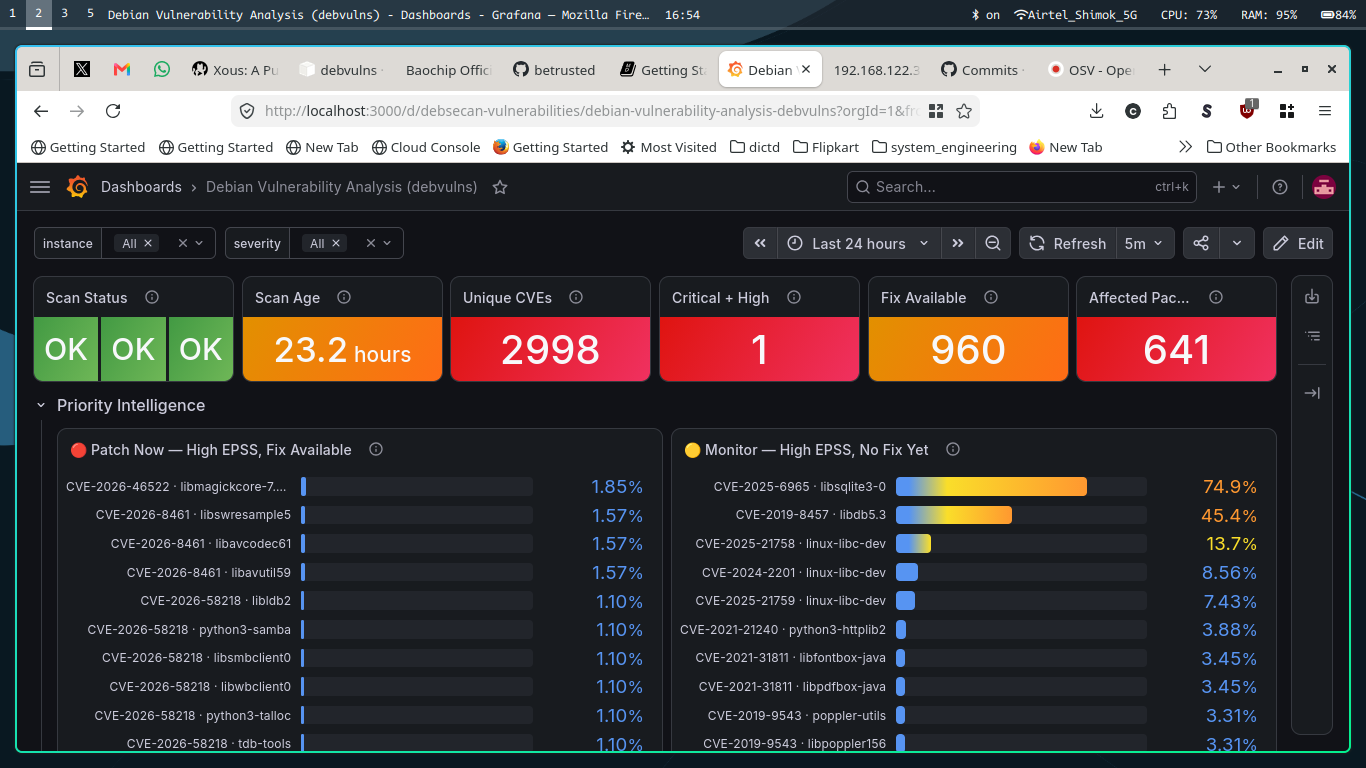
 I made another minor release with several enhancements: handling non-Debian
origin vulnerabilities, improving data caching, and sharing the cache
between the debvulns CLI and the exporter. Additionally, there are a few
improvements on the dashboard front. Here is a breakdown of what changed.
2026-07-24 15:43:17 status triggers-pending wordpress:all 7.0+dfsg1-1
2026-07-24 15:43:19 upgrade wordpress:all 7.0+dfsg1-1 7.0.2+dfsg1-1
Above are the relevant sections of my dpkg log showing the WordPress versions in use. I was running version 7.0+dfsg1-1 at the time the account was apparently created. I am confident in the accuracy of the dpkg logs and believe that they did not compromise the OS, I am not sure whether they ran hostile SQL code to change fields in the MySQL database so had to consider the possibility that the account creation time could have been set to a deliberately misleading value. I checked backups of the MySQL database stored off-site and found that the account in question was not in the 2026-07-21 backup (which was done before 16:43) but in the 2026-07-22 backup. The WordPress release history [2] has version 7.0.1 released on 2026-07-09 and version 7.0.2 released on 2026-07-17. So presumably the attacker diffed the code on those releases, found an exploitable bug, and used it to create an account on my blog with admin privs. Then they waited a few weeks to see if I would notice and published a blog post when I didn t notice. WordPress Deficiencies
select $TABLE_PREFIXusers.user_login, $TABLE_PREFIXusers.user_pass, $TABLE_PREFIXusermeta.meta_value from $TABLE_PREFIXusers join $TABLE_PREFIXusermeta on $TABLE_PREFIXusers.id = $TABLE_PREFIXusermeta.user_id and meta_key='$TABLE_PREFIXcapabilities' and meta_value != 'a:1: s:10:"subscriber";b:1; ';
Next.

