Search Results: "fh"

1 September 2013

Eddy Petrișor: HOWTO add a shell script wrapper and preserve quoting for parameters

If you ever find yourself in the situation where you have to add a shell script wrapper over a command, but the parameters' quoting gets lost and you end up with the wrong parameters in the wrapped command/tool, you might want to read this post.

On my system I have some command line tools which are Windows only and, in order to easily use the same build system as on Windows on my Linux machine I added a wrapper script which invokes wine on the commands and made symlinks to the wrapper with the file names as the tools, but without the '.exe' suffix.

Of course, I wanted to properly pass the parameters through the wrapper to the tools so I wrote (note the bold text):
#!/bin/sh
wine $0.exe "$@"
So the answer is: use $@ and quote like I did in the code above and the parameters will be passed correctly.


Update: stbuehler suggested to use exec to replace the shell process with wine with this construct:
Use:
#!/bin/sh
exec wine $0.exe "$@"

Thanks for the suggestion.

23 August 2013

Thorsten Glaser: FrOSCon 2013, or, why is there no MirBSD exhibit?

FrOSCon is approaching, and all MirBSD developers will attend but why s there no MirBSD exhibit? The answer to that is a bit complex. First let s state that of course we will participate in the event as well as the Open Source world. We ll also be geocaching around the campus with other interested (mostly OSS) people (including those we won for this sport) and helping out other OSS projects we ve become attached to. MirOS BSD, the operating system, is a niche system. The conference on the other hand got younger and more mainstream. This means that almost all conference visitors do not belong to the target group of MirOS BSD which somewhat is an ancient solution : the most classical BSD around (NetBSD loses because they have rc.d and PAM and lack sendmail(8), sorry guys, your attempt at being not reformable doesn t count) and running on restricted hardware (such as my 486SLC with 12 MiB RAM) and exots (SPARCstation). It s viable even as developer workstation (if your hardware is supported otherwise just virtualise it) but its strength lies with SPARC support and embedded x86 . And being run as virtual machine: we re reportedly more stable and more performant than OpenBSD. MirBSD is not cut off from modern development and occasionally takes a questionable but justified choice (such as using 16-bit Unicode internally) or a weird-looking but beneficial one (such as OPTU encoding saving us locale(1) hassles) or even acts as technological pioneer (64-bit time_t on ILP32 platforms) or, at least, is faster than OpenBSD (newer GNU toolchain, things like that), but usually more conservatively, and yes, this is by design, not by lack of manpower, most of the time. The MirPorts Framework, while technically superiour in enough places, is something that just cannot happen without manpower. I (tg@) am still using it exclusively, continuing to update ports I use and occasionally creating new ones (mupdf is in the works!), but it s not something I d recommend someone (other than an Mac OSX user) to use on a n n-MirBSD system (Interix is not exactly thriving either, and the Interix support was only begun; other OSes are not widely tested). The MirBSD Korn Shell is probably the one thing I will be remembered for. But I have absolutely no idea how one would present it on a booth at such an exhibition. A talk is much more likely. So no on that front too. jupp, the editor which sucks less, is probably something that does deserve mainstream interest (especially considering Natureshadow is using it while teaching computing to kids) but probably more in a workshop setting. And booth space is precious enough in the FH so I think that d be unfair. All the other subprojects and side projects Benny and I have, such as mir c , josef stalin, FreeWRT, Lunix Ewe, Shellsnippets, the fonts, etc. are interesting but share few, if any, common ground. Again, this does not match the vast majority of visitors. While we probably should push a number of these more, but a booth isn t it here, either. MirOS Linux ( MirLinux ) and MirOS Windows are, despite otherwise-saying rumours called W*k*p*d*a, only premature ideas that will not really be worked on (though MirLinux concepts are found in mir c and stalin). As you can see, despite all developers having full-time dayjobs, The MirOS Project is far from being obsolete. We hope that our website visitors understand our reasons to not have an exhibition booth of our own (even if the SPARCstation makes for a way cool one, it s too heavy to lift all the time), and would like to point out that there are several other booths (commercial ones, as well as OSS ones such as AllBSD, Debian and (talking to) others) and other itineries we participate in. This year both Benny and I have been roped into helping out the conference itself, too (not exactly unvoluntarily though). The best way to talk to us is IRC during regular European geek hours (i.e. until way too late into the night which Americans should benefit from), semi-synchronously, or mailing lists. We sort of expect you to not be afraid to RTFM and look up acronyms you don t understand; The MirOS Project is not unfriendly but definitely not suited for your proverbial Aunt Tilly, newbies, desktop users, and people who aren t at least somewhat capable of using written English (this is by design).

9 August 2013

Hideki Yamane: bring two small server to DebConf13

Now I'm on the way to DebConf13. And this time, our DebConf sponsor "Plat'Home" asked me to bring their Compact ARM Server named "OpenBlocks".

So, if you're interested in it, please let me know. You can play with it with root access, and I would answer to your question about it (as I can as possible).

30 July 2013

Andreas Metzler: RFH what happened to eu.org

Dear web, Do you know a human contact for the eu.org free domain name service? The mailing-list is dead (subscription is possible, but no mails are sent out) and the webpage does not provide contact points. (I already tried the role-addresses.) I would welcome hints per mail to ametzler at downhill dot eu dot org. Backstory: I would like to change where my eu.org MX record points to. As far as I can tell the web forms only support full domain delegation, while I only need to change a single eu.org hosted MX record. Thanks in advance

19 June 2013

Daniel Pocock: Australia's war on brains (and immigration)

Some weeks ago, our Prime Minister was slashdotted when she suspended her usual racist attacks on refugees to attack foreign IT workers and the companies that employ them with absurd accusations of "rorts" and "stealing" jobs. Today, she's introduced new laws in the parliament aiming to further bastardization of intelligent, skilled and educated workers and anybody who associates with them, including Australian employers. Unwarranted attention on a minority of IT workers This is not just some random bill before the parliament. There are just two weeks left before the parliament concludes and an election campaign begins. It is clear that what we are seeing now is the Real Julia coming though, choosing to make the small minority of foreign workers in our country at the center of people's thoughts as they go to vote in September. A debt of gratitude to foreign workers These verses from our national anthem, Advance Australia Fair say a lot about how Australia became what it is today:
For those who've come across the seas

We've boundless plains to share;

With courage let us all combine

To Advance Australia Fair.
The last 200 years of Australia's history has been a story of immigration. It is not something to be afraid of: our forefathers celebrated it. Foreign workers: why Australia needs you Australia has had some appalling flops in IT and engineering: There is no doubt in my mind that additional foreign workers would have made a positive contribution to all of these problems or can do so in the future. The sun never sets on IT Every day, I collaborate with dozens of IT specialists all over the world through the virtual workplace that is the Internet, particularly in the free and open source software community. Many of these people, I've never even met and in most cases I don't even know where they are, where they were born or what is the colour of their skin. Those details wouldn't make any difference to the way that we work in IT today. How many IT managers have time to waste dealing with more real world bureaucracy when they've experienced online, global productivity? How many IT workers feel demotivated by having to explain trivial details about their personal life to a Government bureaucrat who doesn't understand their skills and just looks at their colour? If you think about it, any immigration officer who really understands IT wouldn't be an immigration officer. They would be working in IT themselves. Immigration officers, who don't understand IT, are now going to be further empowered to bully companies away from employing some talented workers on the basis of race or nationality. Hiring managers will be intimidated into these prejudiced and biased decisions by delays, processing fees and invasive demands for sensitive documents about business planning and recruitment strategies. Australia's immigration system already has a horrendous reputation. Any visa application seems to take more than a year: no small company can keep a job position vacant that long. Families can't plan their children's schooling. Other life events come and go. There are exhorbitant fees, 1000% higher than in other western countries. Fewer and fewer self-respecting skilled workers are willing to put their spouses and children through the degrading medical examinations. Judging the impact of poor immigration policy While the economic impact of this immigration mess on industry is hard to quantify with an exact figure, we can take some insight from the education system. As the visa system has been hijacked by racists over the last 10 years, there has been a dramatic fall in participation (and revenues) from foreign students. In one year, enrolments (and revenue) fell 30%. This is not just bad for the balance sheets of the universities, it also means that in a future where commerce is global, Australians are more and more isolated and inexperienced culturally. IT workers and their employers have plenty of choices: Australia's close neighbor, Singapore, is one of them. Visas are granted in 2 weeks, no degrading medical exam required, low taxes and tropical sunshine all year round. Many companies that find it impractical to deal with Australia's bureaucracy end up moving their best Australian workers to places like Singapore to be part of a global team. This can't be good for the workforce that is left behind without jobs. The training delusion Government officials continue to rant and rave about companies failing to train Australian workers. The new laws supposedly force companies to "fix" this problem and train Australian workers. This, too, is a delusion: employers are not to blame. Some of the best Australian workers are already long gone to places like Singapore, London and the US. With talented foreign workers denied the opportunity to come and fill the void, there is less opportunity for skills to be acquired by more junior workers in Australian workplaces. It is also extremely difficult for more junior workers to get a foot in the door in the international job market and the primary reason for this is the Australian Government's failure to fund university programs beyond a bachelor's degree. Compare this to Europe and the US where all competent graduates are funded through to a Masters or PhD program. The bottom line is that more junior workers are denied the opportunity to get the best training either at home or abroad and in both cases it's not the foreign workers that can be blamed: it's the Government's own fault. Why do we need skilled foreign workers when Australians can win Nobel Prizes? The Australian press recently went into a frenzy when an Australian won the Nobel Prize for physics. There was a catch though: he's a migrant from the United States (just don't tell the Prime Minister). Dr. Schmidt migrated to Australia 20 years ago when the immigration system was not the same as today. Today, future Nobel Prize winners are being shown a brick wall - maybe we even have one of them rotting away in our death camps or left in the sea for sharks to eat. The BBC recently revealed that Britain's successor to Stephen Hawking may be a young girl who migrated from India - it is chilling to imagine where a child like this may be hidden away under Australia's immigration system. Bureaucracy leads to fraud and exploitation It's been clearly demonstrated that wherever you have elaborate, artificial systems of bureaucracy it leads to inefficiency, it suppresses innovation and in the worst cases it enables fraud and exploitation. The typical examples usually involve police in some third-world African nation setting up road blocks and collecting fees from travellers who want to pass the queues. This type of opportunism has also been found in Australia's immigration system, with one Federal politician already directly implicated and jailed for his role in a visa racket. Gillard's own bullet man A Queensland pensioner made international headlines recently when he was caught sending bullets in the mail to the Prime Minister. His demands were clear: stop immigration. While most world leaders refuse to let nutcases like this dictate their actions, Gillard appears to have been transcribing his racist letters directly into these newest immigration laws. It is a sad reality that Australian politics regularly seeks to appeal to the worst instincts in people like bullet man. The ultimate political failure When politicians stoop to the level of demonizing immigrants it is usually a clue that the politicians themselves are past their use-by dates and out of fresh policy ideas. When former French president Sarkozy tried to play the racist card in his campaign for re-election, it bit him in the bum and he was swept from power by the socialists. As always in politics, there is an element of hypocrisy at work: neither our Head of Government (the Prime Minister) nor our Head of State (the Queen) was born in Australia. Gillard was born in Wales and migrated to Australia as a child. If Australians don't vote for her in September, will she be given 28 days notice to pack her bags and go back home'? From the frying pan and into the fire Tony Abbott, Australia's would-be Prime Minister contemplating his colleague's statements on bestiality The scariest thing is that if Australians see through this racist charade and refuse to vote for it, we could end up with something equally obnoxious: the other major political party is now gaining worldwide attention for their campaign linking gay marriage and homosexuals to bestiality. Which prejudice is the lesser evil: racism or homophobia?

7 June 2013

Marco d'Itri: Torre Telecom Italia, Rozzano

Today I was lucky enough to be able to visit the Telecom Italia telecommunications tower located in Rozzano, just south of Milano, and took some photos. This tower, with its 187 meters, is one of the tallest man-made structures in Italy. It was built by Telecom Italia in 1990 to create high capacity radio links to Genova and Torino and nowadays it contains radio transmitters for a TV station and many kinds of radio networks. It is an impressive monument to an age when telcos had no optical fibers, but plenty of money.

28 May 2013

Lars Wirzenius: On the usefulness of wishlist bugs

Almost every bug tracker for free software projects has a section for wishlist bugs. Often this results in ever growing lists of wishes, most of which will never be fulfilled. A long list of bugs, even if it is wishlist bugs, is rarely useful. It's hard to keep track of what is there, and so the information is not kept up to date when things change. Even if a wishlist bug gets implemented, the bug is often overlooked, and remains on the list. Joel Spolsky calls this a software inventory. Carrying a large inventory has costs, and usually results in slowed-down development. It increases the friction of doing things in a project. I have some quite old wishlists for my own projects. I have even more wishlists hidden in my own GTD system. I am not happy about either, and I'm going to have to do something about that. Just closing all wishlist bugs immediately would be bad manners. Keeping them open indefinitely, just in case someone will some day decide to look through the list in order to hack on something, is wishful thinking: that rarely happens. So I'm thinking of a compromise: keep wishlist bugs open for a while, perhaps a few months, and if nothing is happening to them, close them with an apology.

26 April 2013

Vincent Sanders: When you make something, cleaning it out of structural debris is one of the most vital things you do.

Collabora recently had a problem with a project's ARM build farm. In a nice change of pace it was not that the kernel was crashing, nor indeed any of the software or hardware.
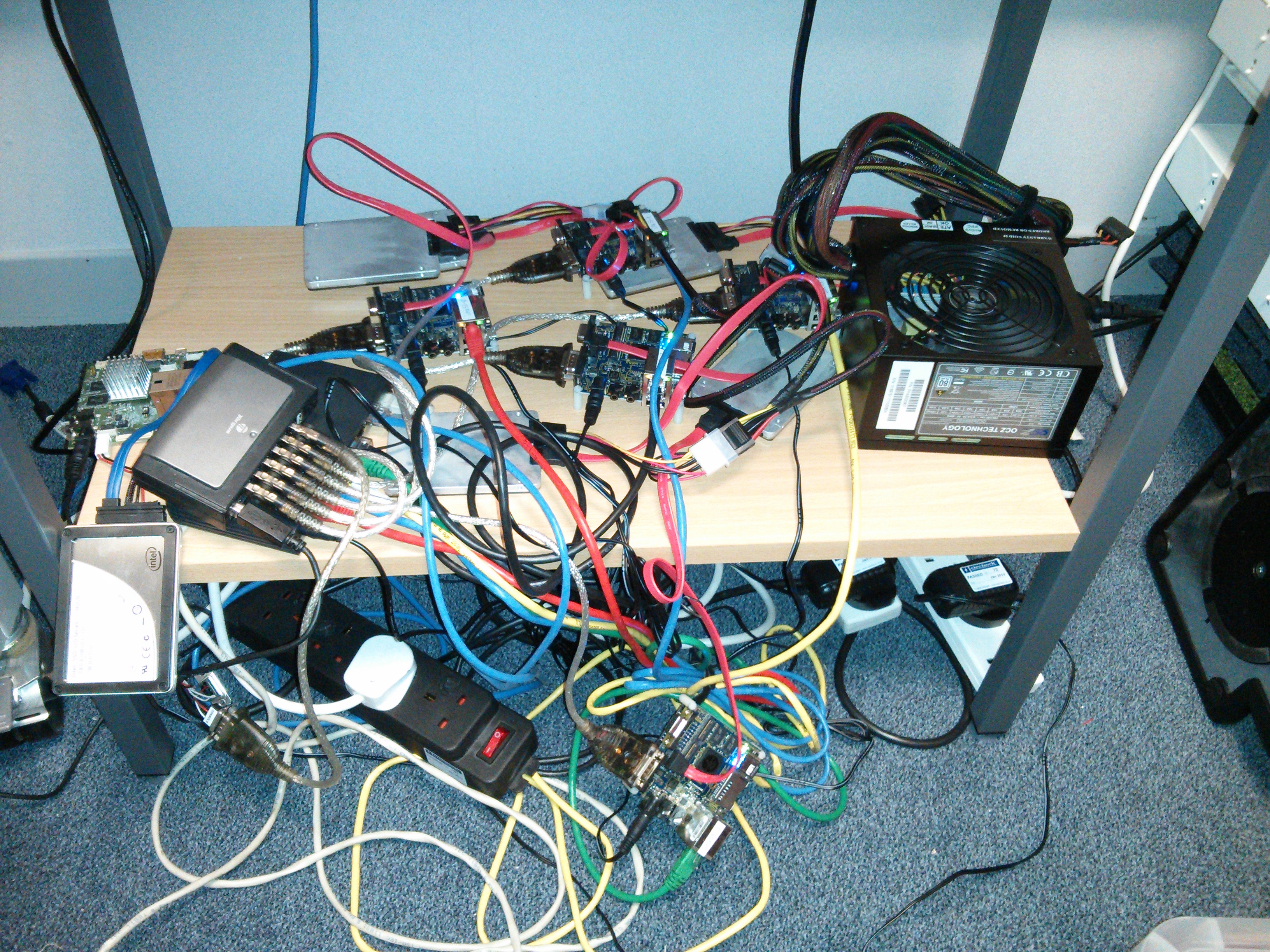
The ProblemInstead our problem was our build farm could best be described as "a pile of stuff" and we wanted to add more systems to it and have switched power control for automated testing.

Which is kinda where the Christopher Alexander quote comes into this. I suggested that I might be able to come up with a better, or at least cleaner, solution.
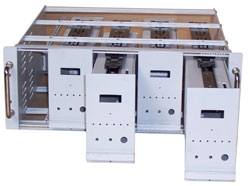
The IdeaA subrack with sub modulesPrevious experience had exposed me to the idea of using 19 inch subracks for mounting circuits inside submodules.

I originally envisaged the dev boards individually mounted inside these boxes. However preliminary investigation revealed that the enclosures were both expensive and used a lot of space which would greatly increase the rack space required to house these systems.

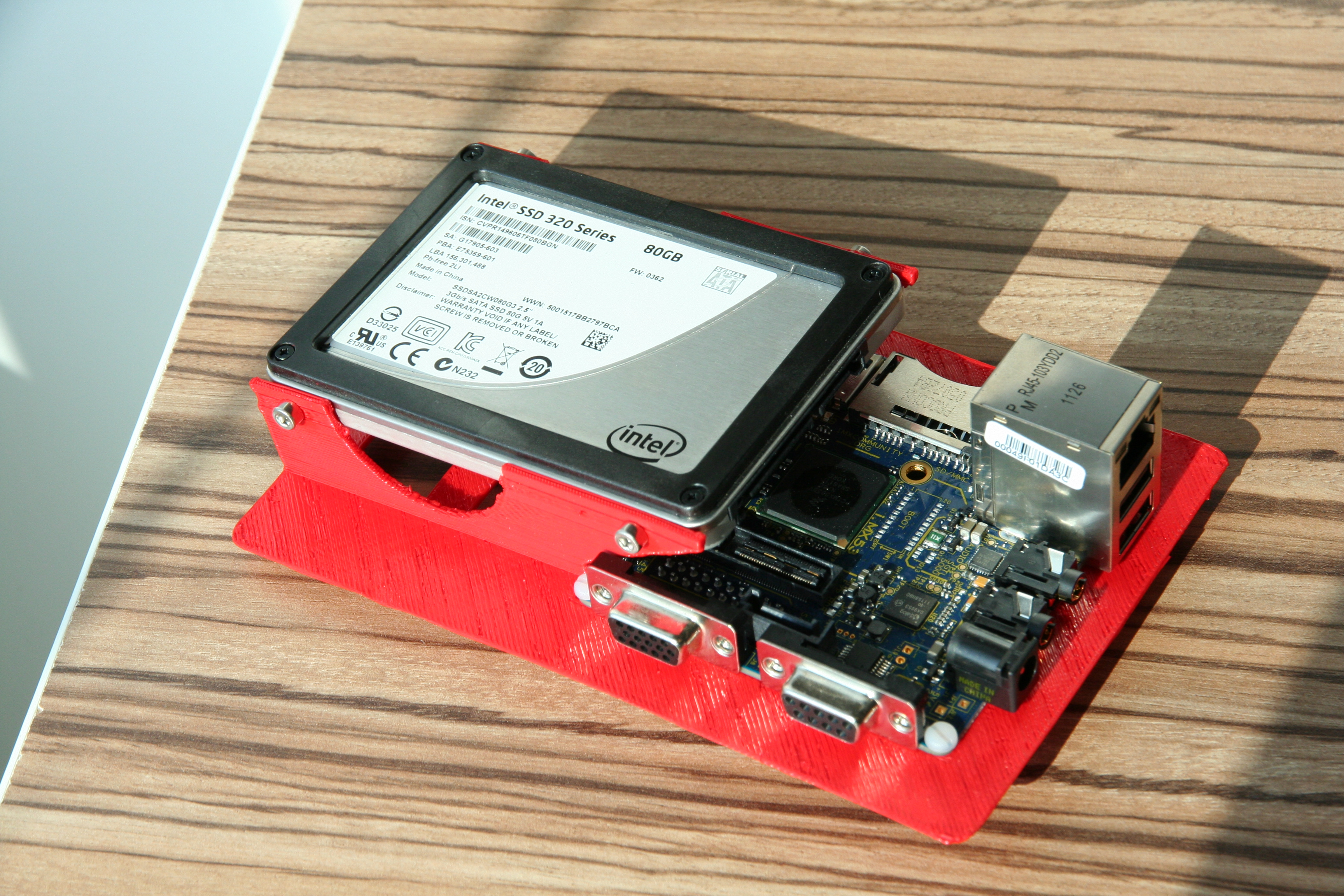
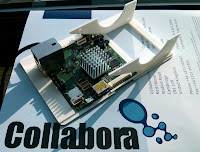
imx53 QSB eurocard carrier
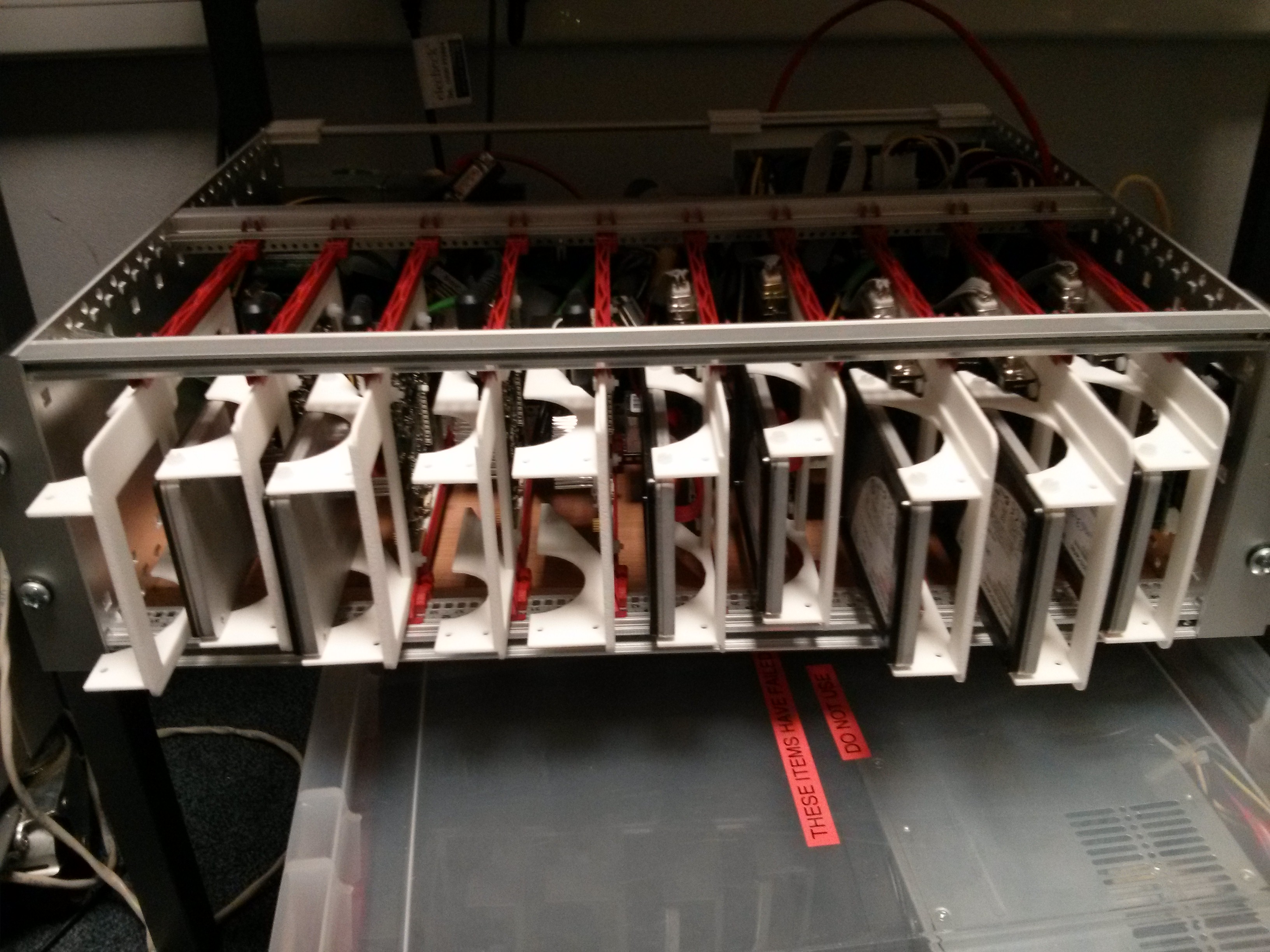
I decided to instead look at eurocard type subracks with carriers for the systems. Using my 3D printer I came up with a carrier design for the imx53 QSB and printed it. I used the basic eurocard size of 100mm x 160mm which would allow the cards to be used within a 3U subrack.

Once assembled it became apparent that each carrier would be able to share resources like power supply, ethernet port and serial console via USB just as the existing setup did and that these would need to be housed within the subrack.
The Prototype
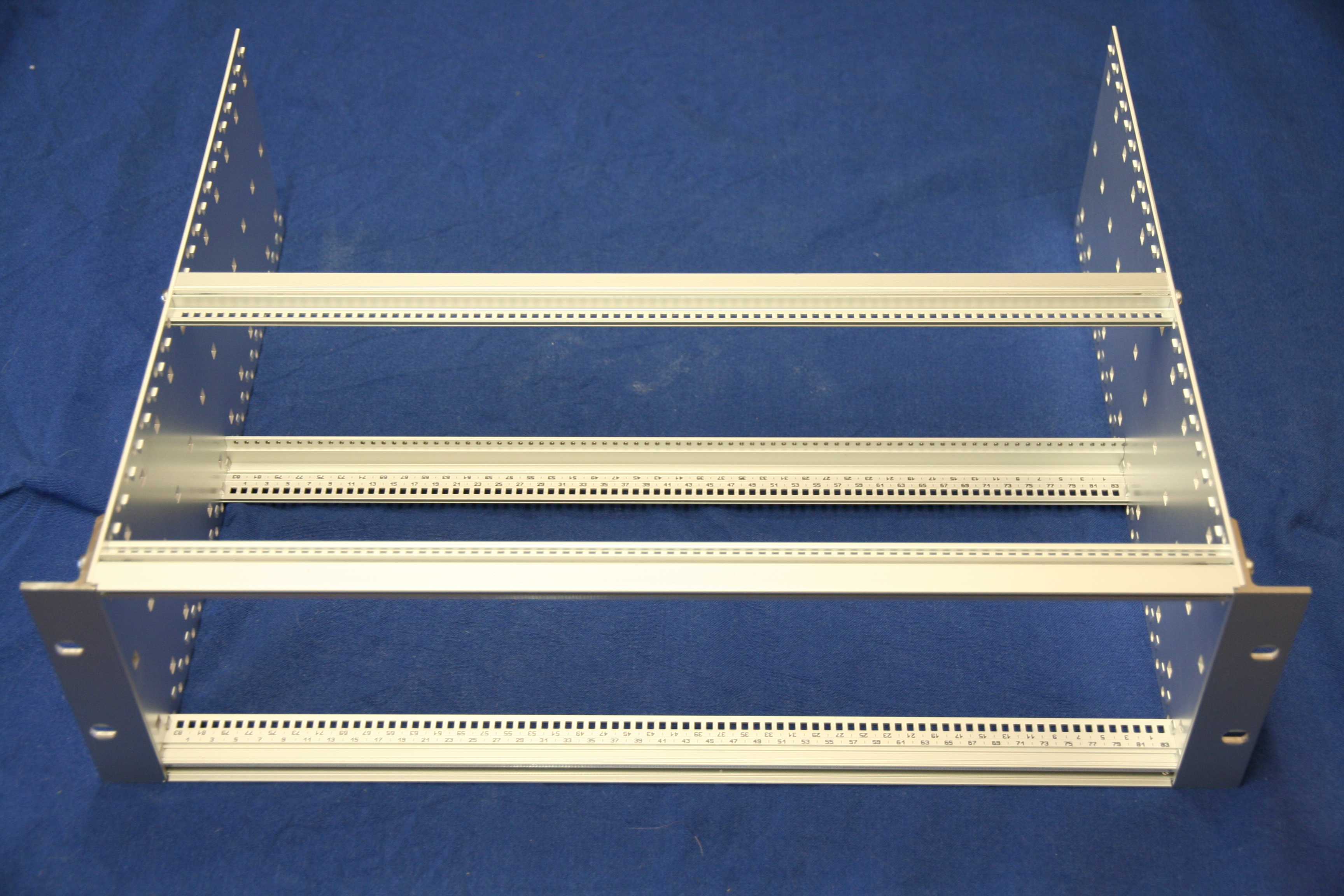
The carrier prototype was enough to get enough interest to allow me to move on to the next phase of the project. I purchased a Schroff 24563-194 subrack kit and three packs of guide rails from Farnell and assembled it.

Initially I had envisaged acquiring additional horizontal rails from Schroff which would enable constructing an area suitable for mounting the shared components behind the card area.
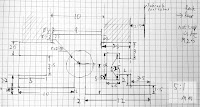
Rear profile for Schroff subrackUnfortunately Schroff have no suitable horizontal profiles in their catalog and are another of those companies who seem to not want to actually sell products to end users but rather deal with wholesalers who do not have their entire product range!

Printed rear profile for Schroff subrack
Undaunted by this I created my own horizontal rail profile and 3D printed some lengths. The profile is designed to allow a 3mm thick rear cover sheet attached with M2.5 mounting bolts and fit rack sides in the same way the other profiles do.

At this point I should introduce some information on how these subracks are dimensioned. A standard 19 inch rack (as defined in IEC 60297) has a width of 17.75 inches(450.85mm) between the vertical posts. The height is measured in U (1.75 inches)

A subrack must obviously fit in the horizontal gap while providing as much internal space as possible. A subrack is generally either 3 or 6 U high. The width within a subrack is defined in units called HP (Horizontal Pitch) which are 0.2 inches(5.08 mm) and subracks like the Schroff generally list 84 usable HP.

However we must be careful (or actually just learn from me stuffing this up ;-) as the usable HP is not the same thing as the actual length of the horizontal rails! The enclosures actually leave and additional 0.1 inch at either end giving a total internal width of 85HP (17 inches, 431.8 mm) which leaves 0.75 inches for the subrack sides and some clearance.

The Schroff subrack allows eurocards to be slotted into rails where the card centre line is on HP boundaries, hence we describe the width of a card in the slot in terms of HP
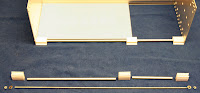
I cannot manufacture aluminium extrusions (I know it is a personal failing) nor produce more than 100 mm long length of the plastic profile on my printer.

Even if full lengths are purchased from a commercial service (120 euros for a pair including tax and shipping) the plastic does not have sufficient mechanical strength.

The solution I came up with was somewhat innovative, as an alternative a M5 bolt into a thread in the aluminium extrusion I used a 444mm long length of 4mm threaded rod with nuts at either end. This arrangement puts the extrusion under compression and gives it a great deal of additional mechanical strength as the steel threaded rod is very strong.

Additionally to avoid having to print enough extrusion for the entire length I used some 6mm aluminium tube as a spacer between 6HP(30.48mm) wide sections of the printed extrusion.

It was intended to use a standard modular PC power supply which is 150mm wide which is pretty close to 30HP (6 inches) so it was decided to have a 6HP section of rail at that point to allow a rear mounting plate for the PSU to be attached.

This gives 6HP of profile, 21HP(106.68mm) of tube spacer, 6HP of profile, 46HP(233.68 mm) of tube spacer and a final 6HP profile summing to our total of 85HP. Of course this would be unnecessary if a full continuous 85HP rail had been purchased, but 6 of 6 HP long profile is only 51 euro a saving of 70 euro.

To provide a flat area on which to mount the power switching, Ethernet switch and USB hubs I ordered a 170 x 431 mm sheet of 3mm thick aluminium from inspiredsteel who, while being an ebay company, were fast, cheap and the cutting was accurate.

Do be sure to mention you would prefer it if any error made the sheet smaller rather than larger or it might not fit, for me though they were accurate to the tenth of a mm! If you would prefer the rear section of the rack to be enclosed when you are finished, buy a second sheet for the top. For my prototype I only purchased a 170 x 280mm sheet as I was unsure if I wanted a surface under the PSU (you do, buy the longer sheet)
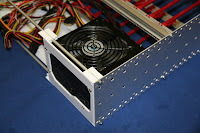
PC power supply mounted to back plateMounting the PSU was a simple case of constructing a 3 mm thick plate with the correct cutouts and mounting holes for an ATX supply. Although the images show the PSU mounted on the left hand side of the rack this was later reversed to improve cable management.

The subrack needed to provide Ethernet switch ports to all the systems. A TP-Link TL-SF1016DS 16-Port 10/100Mbps Switch was acquired and the switch board removed from its enclosure. The switch selected has an easily removed board and is powered by a single 3.3V input which is readily available from the ATX PSU.

Attention now returned to the eurocard carriers for the systems, the boards to be housed were iMX53 QSB and iMX6 SABRE Lite and a Raspberry Pi control system to act as USB serial console etc.

The carriers for both main boards needed to be 8HP wide, comprised of:
Although only 38 mm this is 7.5HP and fractions of an HP are not possible with the selected subrack.

With 8HP wide modules this would allow for ten slots, within the 84 usable HP, and an eleventh 4HP wide in which the Raspberry Pi system fits.
iMX6 SABRE Lite eurocard carrierCarrier designs for both the i.MX53 QSB and the i.MX6 SABRE Lite boards were created and fabricated at a professional 3D print shop which gave a high quality finish product and removed the perceived risk of relying on a personal 3D printer for a quantity of parts.

This resulted in changes in the design to remove as much material as possible as commercial 3D services charge by the cubic cm. This Design For Manufacture (DFM) step removed almost 50% from the price of the initial design.

i.MX53 QSB carriers with wiring loom
The i.MX6 design underwent a second iteration to allow for the heatsink to be mounted and not mechanically interfere with the hard drive (although the prototype carrier has been used successfully for a system that does not require a hard drive). The lesson learned here is to be aware that an design iteration or two is likely and that it is not without cost.

The initial installation was to have six i.MX53 and two i.MX6 this later changed to a five/four split, however the carrier solution allows for almost any combination, the only caveat (discovered later) is the imx53 carriers should be to the right hand side with the small 4HP gap at that end as they have a JTAG connector underneath the board which otherwise foul the hard drive of the next carrier.

Racked cards showing unwanted cable tails
A wiring loom was constructed for each board giving them a connector tail long enough to allow them to be removed. This was the wrong approach! if you implement this design (or when I do it again) the connector tails on the wiring loom should present all the connections to the rear at the same depth as the Ethernet connection.

The rack cables themselves should be long enough to allow the slides to be removed but importantly it is not desirable to have the trailing cable on the cards. I guess the original eurocard designers figured this out as they designed the cards around the standard fixed DIN connectors at the back of the card slots.

USB relay board with wiring loom attached
We will now briefly examine a misjudgement that caused the initially deployed solution to be reimplemented. As the design was going to use USB serial converters to access the serial console a USB connected relay board was selected to switch the power to each slot. I had previously used serial controlled relay boards with a USB serial convertor however these were no longer available.

Initial deployment with USB controlled relay board
All the available USB relay boards were HID controlled, this did not initially seem to be an issue and Linux software was written to provide a reasonable interface. However it soon became apparent that the firmware on the purchased board was very buggy and crashed the host computer's USB stack multiple times.

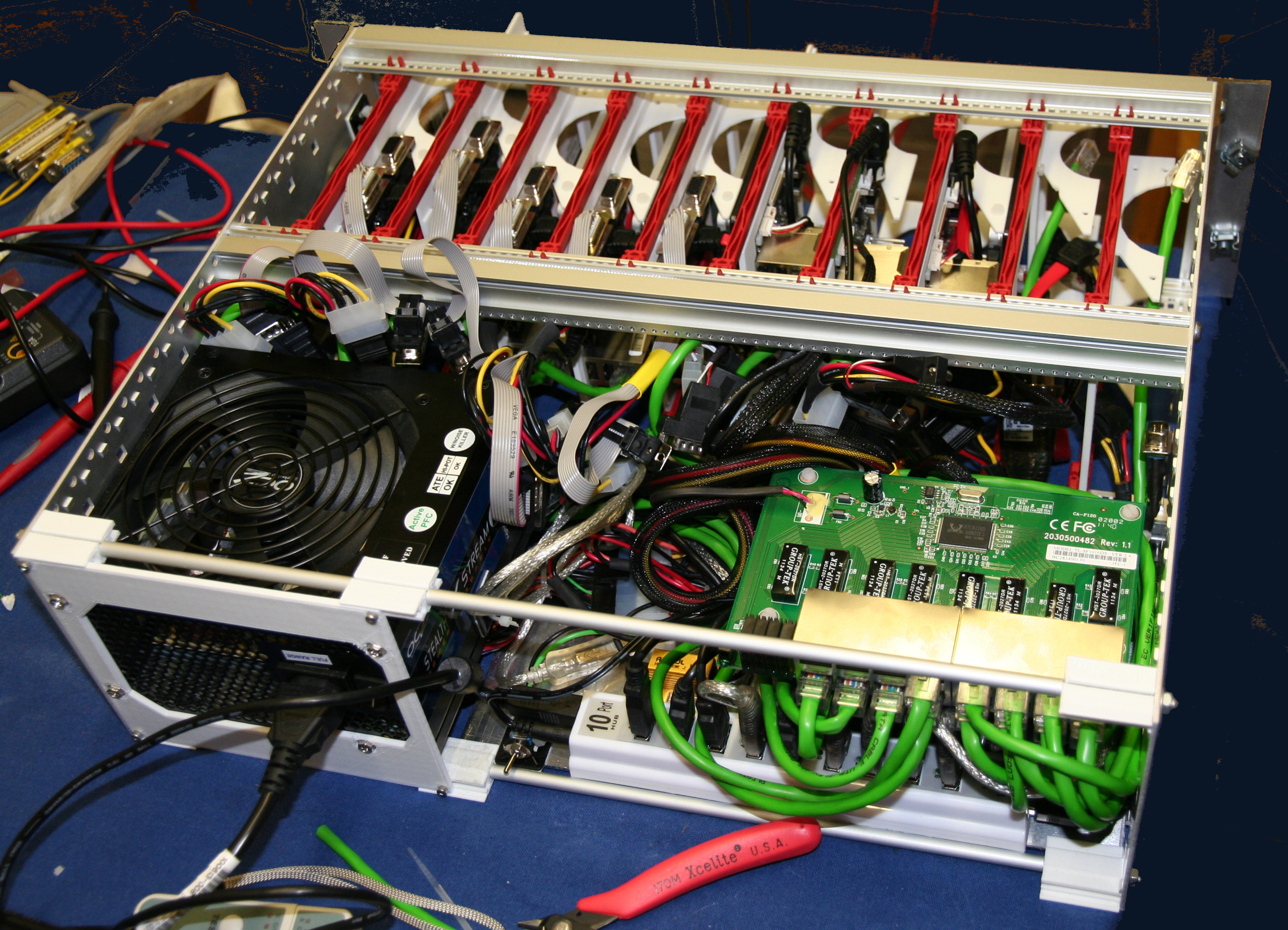
Deployed solutionOnce it became apparent that the USB controlled power board was not viable a new design was conceived. As the Ethernet switch had ports available Ethernet controlled relay boards were acquired.

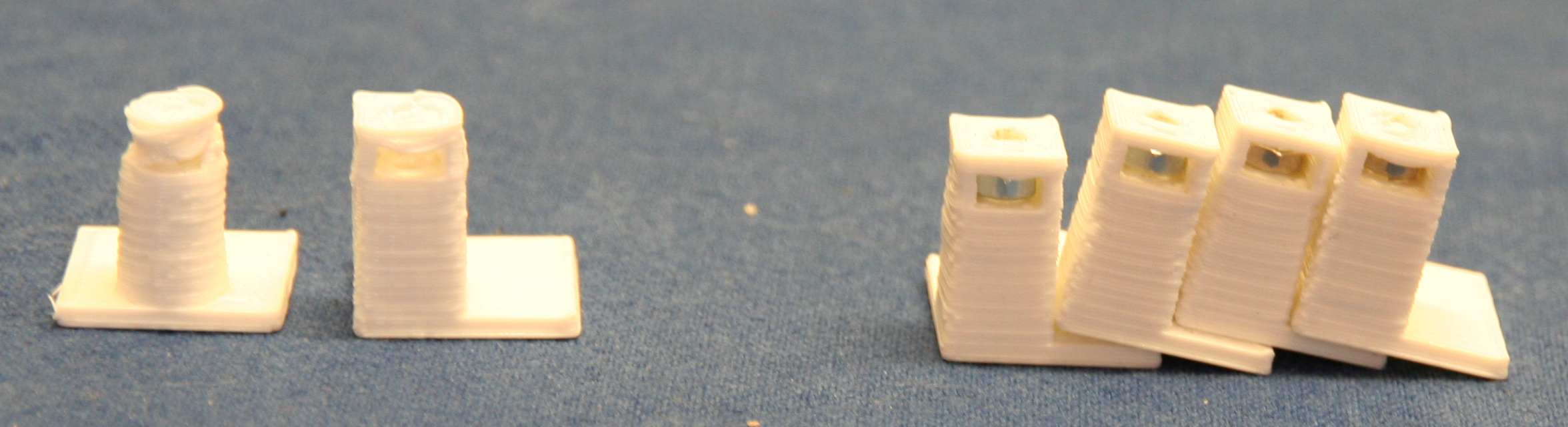
Evolution of 3mm PCB pillars
It did prove necessary to design and print some PCB support posts with M3 nut traps to allow the relay boards to be easily mounted using double sided adhesive pads.

By stacking the relay boards face to face and the Ethernet switch on top separated using nylon spacers it was possible to reduce the cable clutter and provide adequate cable routing space.

A busbar for Ground (black) and unswitched 12V (yellow) was constructed from two lengths of 5A chock block.

An issue with power supply stability was noted so a load resistor was added to the 12V supply and an adhesive thermal pad used to attach it to the aluminium base plate.

Completed redesign
It was most fortunate that the ethernet switch mounting holes lined up very well with the relay board mounting holes allowing for a neat stack.

This second edition is the one currently in use, it has proved reliable in operation and has been successfully updated with additional carriers.

The outstanding issues are mainly centered around the Raspberry Pi control board:
  • Needs its carrier fitting. It is currently just stuck to the subrack end plate.
  • Needs its Ethernet cable replacing. The existing one has developed a fault post installation.
  • Needs the USB hub supply separating from the device cable. The current arrangement lets the hub power the Pi which means you cannot power cycle it.
  • Connect its switched supply separately to the USB hub/devices.
Shopping listThe final bill of materials (excluding labour and workshop costs) which might be useful to anyone hoping to build their own version.

Prices are in GBP currency converted where appropriate and include tax at 20% and delivery to Cambridge UK and were correct as of April 2013.

The purchasing was not optimised and for example around 20GBP could be saved just by ordering all the shapeways parts in one order.
Base subrack
ItemSupplierQuantityLine Price
Schroff 24563-194 subrack kitFarnell141.28
Schroff 24560-351 guide railsFarnell313.65
Schroff rack rear horizontal railShapeways2100.00
1000mm length of 4mm threaded rodB and Q11.48
170mm x 431mm x 3mm Aluminium sheetinspired steel240.00
PSU mounting plateShapeways135.42
PCB standoffShapeways422.30
160mm Deep Modular PC supplyCCL155.76
TP-Link TL-SF1016DS 16-Port 10/100Mbps-SwitchCCL123.77
8 Channel 16A Relay Board Controlled Via EthernetRapid2126.00
Raspberry PiFarnell126.48
USB Serial convertersCCL1037.40
10 port strip style USB HUBEbay17.00
Parts for custom Ethernet cablesRS1326.00
Parts for custom molex power cables (salvaged from scrap ATX PSU)Workshop1111.00
33R 10W wirewound resistor for dummy loadRS11.26
24pin ATX female connector pre-wiredMaplin12.99
Akasa double sided thermal padMaplin15.00
Small cable tie basesMaplin16.49
Miscellaneous cable, connectors, nylon standoffs, solder, heatshrink, zip ties, nuts, washers etc. Workshop120.00
Total for subrack603.28

The carriers are similarly not optimally priced as over five GBP each can be saved by combining shipping on orders alone. Also the SSD drive selection was made some time ago and a newer model may be more suitable.
i.MX53 QSB carrier
ItemSupplierQuantityLine Price
i.MX53 QSBFarnell1105.52
Intel 320 SSD 80GCCL1111.83
Carrier boardShapeways130.00
combined sata data and power (15 to 20cm version)EBay15.00
Low profile right angle 5.5mm x 2.1mm barrel jackEBay10.25
Parts for 9pin serial cable extensionRS15.00
Miscellaneous solder, heatshrink, nylon nuts, bolts and washersWorkshop15.00
Total for carrier262.60

i.MX6 SABRE Lite carrier
ItemSupplierQuantityLine Price
i.MX6 SABRE LiteFarnell1128.06
Intel 320 SSD 80GCCL1111.83
Carrier boardShapeways135.00
combined sata data and power (15 to 20cm version)EBay15.00
Low profile right angle 5.5mm x 2.1mm barrel jackEBay10.25
Parts for 9pin serial cable modificationRS12.00
Miscellaneous solder, heatshrink, nylon nuts, bolts and washersWorkshop15.00
Total for carrier287.14
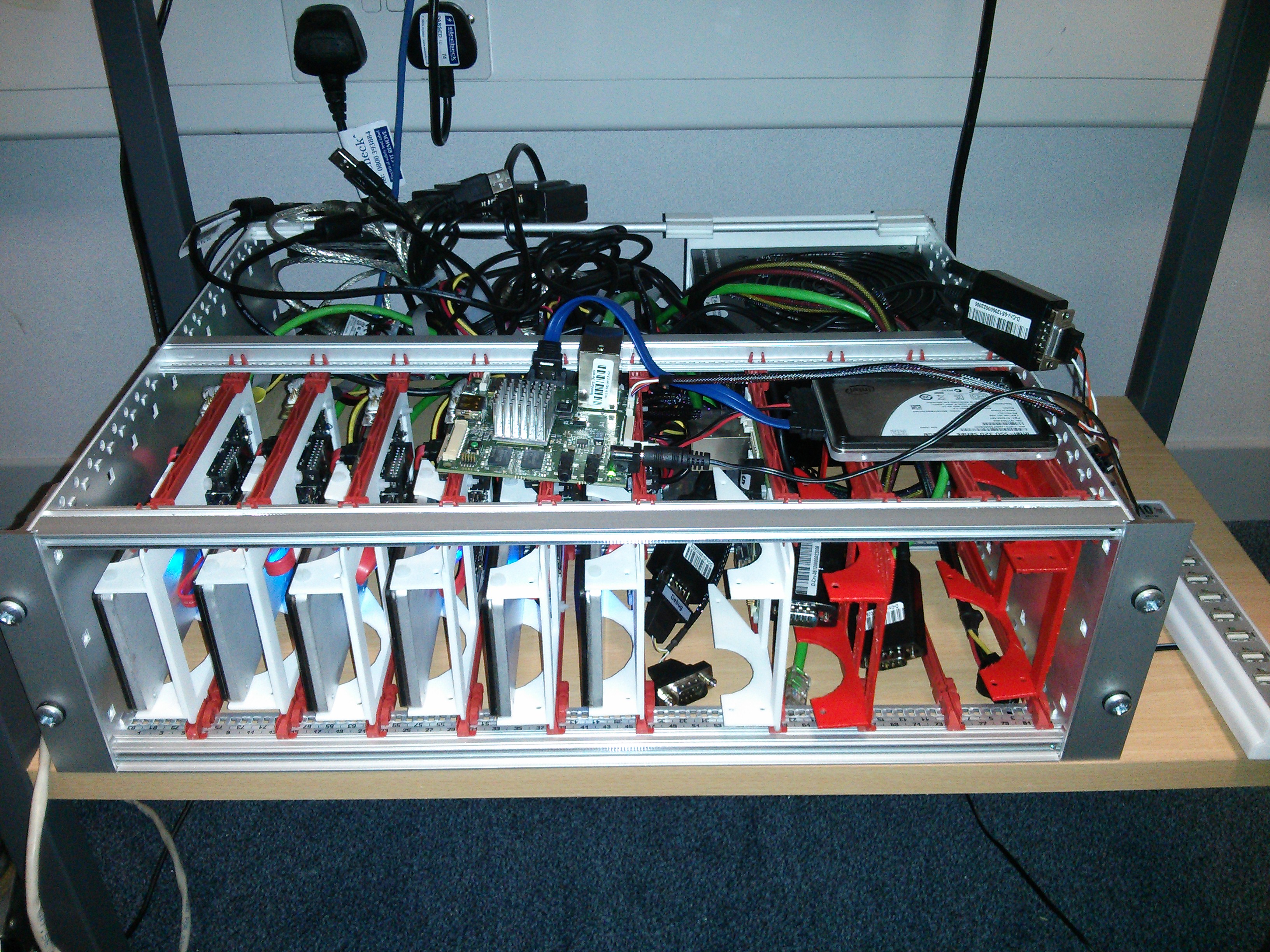
ConclusionThe solution works and in a 3U high 355mm deep subrack ten ARM development boards can be racked complete with local ethernet switching, power control and serial consoles.

Deployed system in situ configured as a build and test farm
The solution is neat and provides flexibility, density and reproducibility the "pile of stuff" solution failed to do.

For current prototype with nine filled slots the total cost was around 3000GBP or around 330GBP per slot which indicates a 100GBP per slot overhead over the "pile of stuff" solution. These figures omit the costs of the engineer and workshop time, which are estimated at an additional 1500GBP. Therefore a completed rack, fully filled with i.MX6 carriers costs around 5000GBP

Density could be increased if boards with lower height requirements were used however above twelve units there issues with Ethernet switch, power switch and USB port availability become a factor. For Example the 16 port Ethernet switch requires a port for uplink, one for each relay board and one for the console server which leaves only 12 ports for systems.

Addressing the outstanding issues would result in a much more user friendly solution. As the existing unit is in full time use and downtime is not easily scheduled for all ten systems, the issues are not likely to be fixed on the prototype and would have to be solved on a new build.

The solution is probably not suitable for turning into a product but that was not really the original aim. A commercial ARM blade server using this format would almost certainly use standard DIN connectors and a custom PCB design rather than adapting existing boards.

6 February 2013

Joachim Breitner: Evaluation-State Assertions in Haskell

I have just uploaded a new version of ghc-heap-view to Hackage that provides Evaluation state assertions in the module GHC.AssertNF. Imagine you are writing a web application in Haskell that sports a global number-of-visitors counter in an IORef Int. For every request, you call modifyIORef (+1). Eventually, you notice your very popular web site to hog more and more memory. So you browse to the internal page that shows the counter, and you have to wait for a long time until you eventually see the result (or get a stack overflow). The reason: The applications of (+1) were not performed until you looked at the number; instead, a long chain of such computation first filled your heap and then your stack. So you have learned the hard way that you might want to avoid space leaks, and want calculations to be done during the request that caused them, and want the IORef to always contain fully evaluated data. So you stumble about modifyIORef' in Data.IORef and indeed, this fixes your problem. Later, you notice that you want to count POST and GET requests separately. You change the type to IORef (Int, Int) and call modifyIORef' (first (+1)) or modifyIORef' (second (+1)). And suddenly, the space leak is back (which you only notice after the next push to the real site, because your local tests never caused enough requests to make it noticeable). So you not only want to fix it, you also want to ensure that it does not break again. In other words, you want to ensure the policy that values stored in an IORef are always in normal form. You achieve this with the following alternative to modifyIORef':
modifyIORef'Assert :: IORef a -> (a -> a) -> IO ()
modifyIORef'Assert ref f = do
    x <- readIORef ref
    let x' = f x
    x'  seq  return ()
    assertNF x'
    writeIORef ref x'
Using this instead of modifyIORef' will print this warning to standard error output right the first time you call modifyIORef'Assert (first (+1)):
Parameter not in normal form: 2 thunks found:
let x1 = (S# 1,S# 1)
in _bh (_thunk x1 (_bco (S# 1)),_sel x1)
(Otherwise, the program runs as usual.) So obviously, you need to use a strict variant of first (or strict pairs):
first' :: (a -> b) -> (a, c) -> (b, c)
first' f (x,y) = let   x' = f x; r = (x', y)   in x'  seq  r  seq  r
With this, the warning goes away. Whenever you now change the type of the IORef or modify it in a too-lazy-way, you can be sure that you ll be warned about it, before the space leak itself becomes noticeable. In the production code, you might want to disable the check. For that, simply put disableAssertNF somewhere in your main function. Why is this better than just calling deepseq in modifyIORef'Assert? Because this way, the code still creates unwanted thunks that are then evaluated before storing them in the IORef, whereas with assertNF you are told about the thunks and can prevent them from being created in the first place. Also, assertNF does not add a type class constraint. This is just one example application for assertNF (and its variants assertNFNamed, which includes a name in the warning to better spot the cause, and $assertNFHere, which uses Template Haskell to include the current source code position in the warning), and I hope that there are more. If you happen to make use of it, I d like to hear your story.

16 January 2013

Francois Marier: Moving from Blogger to Ikiwiki and Branchable

In order to move my blog to a free-as-in-freedom platform and support the great work that Joey (of git-annex fame) and Lars (of GTD for hackers fame) have put into their service, I decided to convert my Blogger blog to Ikiwiki and host it on Branchable. While the Ikiwiki tips page points to some old instructions, they weren't particularly useful to me. Here are the steps I followed.

Exporting posts and comments from Blogger Thanks to Google letting people export their own data from their services, I was able to get a full dump (posts, comments and metadata) of my blog in Atom format. To do this, go into "Settings Other" then look under "Blog tools" for the "Export blog" link.

Converting HTML posts to Markdown Converting posts from HTML to Markdown involved a few steps:
  1. Converting the post content using a small conversion library to which I added a few hacks.
  2. Creating the file hierarchy that ikiwiki requires.
  3. Downloading images from Blogger and fixing their paths in the article text.
  4. Extracting comments and linking them to the right posts.
The Python script I wrote to do all of the above will hopefully be a good starting point for anybody wanting to migrate to Ikiwiki.

Maintaining old URLs In order to make sure I wouldn't break any existing links pointing to my blog on Blogger, I got the above Python script to output a list of Apache redirect rules and then found out that I could simply email these rules to Joey and Lars to get them added to my blog. My rules look like this:
# Tagged feeds
Redirect permanent /feeds/posts/default/-/debian http://feeding.cloud.geek.nz/tags/debian/index.rss
Redirect permanent /search/label/debian http://feeding.cloud.geek.nz/tags/debian
# Main feed (needs to come after the tagged feeds)
Redirect permanent /feeds/posts/default http://feeding.cloud.geek.nz/index.rss
# Articles
Redirect permanent /2012/12/keeping-gmail-in-separate-browser.html http://feeding.cloud.geek.nz/posts/keeping-gmail-in-separate-browser/
Redirect permanent /2012/11/prefetching-resources-to-prime-browser.html http://feeding.cloud.geek.nz/posts/prefetching-resources-to-prime-browser/

Collecting analytics Since I am no longer using Google Analytics on my blog, I decided to take advantage of the access log download feature that Joey recently added to Branchable. Every night, I download my blog's access log and then process it using awstats. Here is the cron job I use:
#!/bin/bash
BASEDIR=/home/francois/documents/branchable-logs
LOGDIR=/var/log/feedingthecloud
# Download the current access log
LANG=C LC_PAPER= ssh -oIdentityFile=$BASEDIR/branchable-logbot b-feedingthecloud@feedingthecloud.branchable.com logdump > $LOGDIR/access.log
It uses a separate SSH key I added through the Branchable control panel and outputs to a file that gets overwritten every day. Next, I installed the awstats Debian package, and configured it like this:
$ cat /etc/awstats/awstats.conf.local
SiteDomain=feedingthecloud.branchable.com
LogType=W
LogFormat=1
LogFile="/var/log/feedingthecloud/access.log"
Even if you're not interested in analytics, I recommend you keep an eye on the 404 errors for a little while after the move. This has helped me catch a critical redirection I had forgotten.

Limiting Planet feeds One of the most common things that happen right after someone migrates to a new blogging platform is the flooding of any aggregator that subscribes to their blog. The usual cause being the change in post identifiers. Unsurprisingly, Ikiwiki already had a few ways to avoid this problem. I chose to simply modify each tagged feed and limit them to the posts added after the move to Branchable.

Switching DNS Having always hosted my blog on a domain I own, all I needed to do to move over to the new platform without an outage was to change my CNAME to point to feedingthecloud.branchable.com. I've kept the Blogger blog alive and listening on feeding.cloud.geek.nz to ensure that clients using a broken DNS resolver (which caches records for longer than requested via the record's TTL) continue to see the old posts.

13 January 2013

Bernhard R. Link: some signature basics

While almost everyone has already worked with cryptographic signatures, they are usually only used as black boxes, without taking a closer look. This article intends to shed some lights behind the scenes. Let's take a look at some signature. In ascii-armoured form or behind a clearsigned message one often does only see something like this:
-----BEGIN PGP SIGNATURE-----
Version: GnuPG v1.4.12 (GNU/Linux)
iQIcBAABAgAGBQJQ8qxQAAoJEH8RcgMj+wLc1QwP+gLQFEvNSwVonSwSCq/Dn2Zy
fHofviINC1z2d/voYea3YFENNqFE+Vw/KMEBw+l4kIdJ7rii1DqRegsWQ2ftpno4
BFhXo74vzkFkTVjo1s05Hmj+kGy+v9aofnX7CA9D/x4RRImzkYzqWKQPLrAEUxpa
xWIije/XlD/INuhmx71xdj954MHjDSCI+9yqfl64xK00+8NFUqEh5oYmOC24NjO1
qqyMXvUO1Thkt6pLKYUtDrnA2GurttK2maodWpNBUHfx9MIMGwOa66U7CbMHReY8
nkLa/1SMp0fHCjpzjvOs95LJv2nlS3xhgw+40LtxJBW6xI3JvMbrNYlVrMhC/p6U
AL+ZcJprcUlVi/LCVWuSYLvUdNQOhv/Z+ZYLDGNROmuciKnvqHb7n/Jai9D89HM7
NUXu4CLdpEEwpzclMG1qwHuywLpDLAgfAGp6+0OJS5hUYCAZiE0Gst0sEvg2OyL5
dq/ggUS6GDxI0qUJisBpR2Wct64r7fyvEoT2Asb8zQ+0gQvOvikBxPej2WhwWxqC
FBYLuz+ToVxdVBgCvIfMi/2JEE3x8MaGzqnBicxNPycTZqIXjiPAGkODkiQ6lMbK
bXnR+mPGInAAbelQKmfsNQQN5DZ5fLu+kQRd1HJ7zNyUmzutpjqJ7nynHr7OAeqa
ybdIb5QeGDP+CTyNbsPa
=kHtn
-----END PGP SIGNATURE-----
This is actually only a form of base64 encoded data stream. It can be translated to the actual byte stream using gpg's --enarmor and --dearmour commands (Can be quite useful if some tool only expects one BEGIN SIGNATURE/END SIGNATURE block but you want to include multiple signatures but cannot generate them with a single gpg invocation because the keys are stored too securely in different places). Reading byte streams manually is not much fun, so I wrote gpg2txt some years ago, which can give you some more information. Above signature looks like the following:
89 02 1C -- packet type 2 (signature) length 540
        04 00 -- version 4 sigclass 0
        01 -- pubkey 1 (RSA)
        02 -- digest 2 (SHA1)
        00 06 -- hashed data of 6 bytes
                05 02 -- subpacket type 2 (signature creation time) length 4
                        50 F2 AC 50 -- created 1358081104 (2013-01-13 12:45:04)
        00 0A -- unhashed data of 10 bytes
                09 10 -- subpacket type 16 (issuer key ID) length 8
                        7F 11 72 03 23 FB 02 DC -- issuer 7F11720323FB02DC
        D5 0C -- digeststart 213,12
        0F FA -- integer with 4090 bits
                02 D0 [....]
Now, what does this mean. First all gpg data (signatures, keyrings, ...) is stored as a series of blocks (which makes it trivial to concatenate public keys, keyrings or signatures). Each block has a type and a length. A single signature is a single block. If you create multiple signatures at once (by giving multiple -u to gpg) there are simple multiple blocks one after the other. Then there is a version and a signature class. Version 4 is the current format, some really old stuff (or things wanting to be compatible with very old stuff) sometimes still have version 3. The signature class means what kind of signature it is. There are roughly two signature classes: A verbatim signature (like this one), or a signature of a clearsigned signature. With a clearsigned signature not the file itself is hashed, but instead a normalized form that is supposed to be invariant under usual modifications by mailers. (This is done so people can still read the text of a mail but the recipient can still verify it even if there were some slight distortions on the way.) Then the type of the key used and the digest algorithm used for creating this signature. The digest algorithm (together with the signclass, see above) describes which hashing algorithm is used. (You never sign a message, you only sign a hashsum. (Otherwise your signature would be as big as your message and it would take ages to create a signature, as asymetric keys are necessarily very slow)). This example uses SHA1, which is no longer recommended: As SHA1 has shown some weaknesses, it may get broken in the not too distant future. And then it might be possible to take this signature and claim it is the signature of something else. (If your signatures are still using SHA1, you might want to edit your key preferences and/or set a digest algorithm to use in your ~/.gnupg/gpg.conf. Then there are some more information about this signature: the time it was generated on and the key it was generated with. Then, after the first 2 bytes of the message digest (I suppose it was added in cleartext to allow checking if the message is OK before starting with expensive cryptograhic stuff, but it might not checked anywhere at all), there is the actual signature. Format-wise the signature itself is the most boring stuff. It's simply one big number for RSA or two smaller numbers for DSA. Some little detail is still missing: What is this "hashed data" and "unhashed data" about? If the signed digest would only be a digest of the message text, then having a timestamp in the signature would not make much sense, as anyone could edit it without making the signature invalid. That's why the digest is not only signed message, but also parts of the information about the signature (those are the hashed parts) but not everything (not the unhashed parts).

10 January 2013

Raphael Geissert: Email security vs. MUAs

So much for security, when using a "smart" MUA

Also note that the https URL is now http due to the email security best practice.

11 December 2012

Russell Coker: Links December 2012

Steven Johnson gave an interesting TED talk about where good ideas come from [1]. He starts by attributing coffee replacing alcohol as a standard drink for some good ideas and then moves on to how ideas develop. Erez Lieberman Aiden and Jean-Baptiste Michel gave an interesting and amusing TED talk about the ngram analysis of books that Google scanned [2]. Here is the link for the Google Books ngram search [3]. Clay Shirky gave an insightful TED talk about how the Internet is changing the world [4]. He cites Open Source programmers as the modern day equivalent to the Invisible College based on our supposed great ability to get along with other people on the Internet. If we really are so much better than the rest of the Internet then things must be bad out there. He ends with ways of using Git to draft legislation. Hans Rosling gave an interesting TED talk about religion and the number of babies that women have [5]. His conclusion is that it s more about income and social stability and that the world s population can stabilise at 10 billion if we provide family planning to everyone. Alexis C. Madrigal wrote an interesting interview with Genevieve Bell about her work at Intel and the way people use technology [6]. Indigogo is raising funds for the Cuddle Mattress , it s a mattress with foam slats and a special fitted sheet to allow your arm to slide between the slats [7]. So you could have your arm underneath your SO for an extended period of time without risking nerve damage. They also show that when sleeping on your side your shoulder can go between the slats to avoid back problems. Nate Silver (who is famous for predicting US elections gave an interesting TED talk about racism and politics [8]. One of his main points is to show the correlation between racism and lack of contact of members of other races. Sociological Images has an interesting article by Lisa Wade about whether marriage is a universal human value [9]. In regard to historical marriage she says women were human property, equivalent to children, slaves, servants, and employees . The general trend in the comments seems to be that there are so many types of marriage that it s difficult to make any specific claims to traditional marriage unless you count a tradition of a short period in a single geographic region. Plurality is an excellent sci-fi short movie on youtube [10]. TED has an interesting interview with Hakeem Oluseyi about his research about astrophysics and how he achieved a successful career after being a gangster as a teenager [11]. He has some good ideas about helping other children from disadvantaged environments become successful. Paul Dwerryhouse wrote an interesting blog post about his work in designing and implementing a filesystem based on a Cassandra data store with FUSE [12]. Paul also wrote a post about using Apache Zookeeper to lock metadata to permit atomic operations [13]. The documentary Monumental Myths provides an interesting and insightful analysis of the processes of creating, maintaining, and explaining monuments [14]. It focusses on some significant monuments in the US and explains both sides to each story. Howard Zinn makes the insightful point that when people present a certain point of view of history it s not controversial, as soon as you present the other side they call it controversial . That happens even in debates about current issues. Howard also says to criticise whatever the government does is not anti-America, it s anti-government, it s pro-America, it s pro the people, it s pro the country . The song that plays during the closing credits is interesting too. The music video Same Love is one of the best presentations of the argument for marriage equality [15]. Chris Samuel wrote an interesting post about systems locked down for Windows 8 and options for purchasing PCs for running Linux [16]. His solution is to buy from ZaReason. I saw his laptop in action at the last LUV meeting and it looks really nice. Unfortunately a byproduct of the extremely thin form factor is the fact that it lacks a VGA port, this meant that Chris had to use my Thinkpad T61 (which is rather clunky by comparison) for his presentation.

6 December 2012

Petter Reinholdtsen: Scripting the Cerebrum/bofhd user administration system using XML-RPC

Where I work at the University of Oslo, we use the Cerebrum user administration system to maintain users, groups, DNS, DHCP, etc. I've known since the system was written that the server is providing an XML-RPC API, but I have never spent time to try to figure out how to use it, as we always use the bofh command line client at work. Until today. I want to script the updating of DNS and DHCP to make it easier to set up virtual machines. Here are a few notes on how to use it with Python. I started by looking at the source of the Java bofh client, to figure out how it connected to the API server. I also googled for python examples on how to use XML-RPC, and found a simple example in the XML-RPC howto. This simple example code show how to connect, get the list of commands (as a JSON dump), and how to get the information about the user currently logged in:
#!/usr/bin/env python
import getpass
import xmlrpclib
server_url = 'https://cerebrum-uio.uio.no:8000';
username = getpass.getuser()
password = getpass.getpass()
server = xmlrpclib.Server(server_url);
#print server.get_commands(sessionid)
sessionid = server.login(username, password)
print server.run_command(sessionid, "user_info", username)
result = server.logout(sessionid)
print result
Armed with this knowledge I can now move forward and script the DNS and DHCP updates I wanted to do.

18 October 2012

Jonas Smedegaard: SOME DESCRIPTIVE TITLE

# Copyright (C) YEAR Free Software Foundation, Inc. # This file is distributed under the same license as the PACKAGE package. # FIRST AUTHOR <email>, YEAR. # #, fuzzy msgid "" msgstr "" "Project-Id-Version: PACKAGE VERSION\n" "POT-Creation-Date: 2012-10-12 11:14+0300\n" "PO-Revision-Date: YEAR-MO-DA HO:MI+ZONE\n" "Last-Translator: FULL NAME <email>\n" "Language-Team: LANGUAGE <ll>\n" "Language: \n" "MIME-Version: 1.0\n" "Content-Type: text/plain; charset=UTF-8\n" "Content-Transfer-Encoding: 8bit\n" #. type: Title # #, no-wrap msgid "Status hos doktoren" msgstr "" #. type: Plain text #, no-wrap msgid "\n" msgstr "" #. type: Plain text #, no-wrap msgid "\n" msgstr "" #. type: Plain text #, no-wrap msgid "" "**Jonas Smedegaard** [dr.jones at pobox.com " "](mailto:friends%40jones.dk?Subject=Status%20hos%20doktoren&In-Reply-To=1.5.4.32.19971011010004.0067de34%40kaospilot.dk) " "\n" msgstr "" #. type: Plain text msgid "_Sat Oct 11 15:22:00 CEST 1997_" msgstr "" #. type: Bullet: ' * ' #: msgid "Previous message: [Spamming? ](000001.html)" msgstr "" #. type: Bullet: ' * ' #: msgid "" "**Messages sorted by:** ? date (date.html#2) ? thread (thread.html#2) " "? subject (subject.html#2) ? author (author.html#2)" msgstr "" #. type: Plain text #, no-wrap msgid " Hej Patrik (og alle Jer andre )!\n" msgstr "" #. type: Plain text #, no-wrap msgid "" " >_Vad sker med dig det var ett stycke tid diden?\n" " _>_Vad skedde der med ditt arbejde pa cafeet og pa skolen?\n" " _\n" " Lang historie!\n" " (den kommer nu )\n" msgstr "" #. type: Plain text #, no-wrap msgid "" " Jeg tror snart jeg har laert (the hard way) hvor dyr jeg egentligt er i " "drift.\n" " Jeg har nu i 3 maneder "ligget med r ven *under* vandskorpen" " " konomisk: minus 15.000,- pa kontoen. Det vender forhabentligvis indenfor " "den naeste maned - ellers pa jeg tage et regulaert lan, hvis jeg fortsat " "skal have firma som fuldtidsbeskaeftigelse.\n" " Det betyder, at jeg for tiden arbejder fra ca. 9 morgen til 0:30 nat syv " "dage om ugen (med enkelte eftermiddage eller aftener fri). Der er faktisk " "opgaver at lave, som ogsa gi'r penge i kassen - men det har der ikke vaeret " "for nogle maneder siden, og nar der var, har jeg taget mig for billigt " "betalt (men du kender mig jo!). Jeg er begyndt mere at involvere min " "storebror, nar jeg udarbejder tilbud, til at hjaelpe mig med en mere reel " "prissaetning.\n" msgstr "" #. type: Plain text #, no-wrap msgid " Her er lidt(?) om, hvad jeg beskaeftiger mig med for tiden:\n" msgstr "" #. type: Plain text #, no-wrap msgid "" " *** Homebase ***\n" " Jeg far forbindelse fra mit kontor og ned til Mejlgade om en lille uge - " "rent teoretisk ihvertfald - derefter skal jeg ha' elektronikken til at " "fungere \n" " Jeg administrerer deres servere og netvaerk, og er "Boss" for Morten " "P. fra Frontl berne, som er blevet hyret til at vedligeholde alle " "arbejdspladserne pa skolen.\n" " Jeg har *intet* at g re med content pa webserveren. Efter i foraret at " "have haft DogSystem (et par nystartede edb-folk) til at udarbejde noget " "smart (som vist aldrig blev rigtigt til noget) har Uffe nu faet samlet nogle " "studerende (vist primaert fra hold 3), som skal hitte pa noget \n" msgstr "" #. type: Plain text #, no-wrap msgid "" " Her er et uddrag af en mail til Rasmus fra hold 3:\n" " >>_Du ma gerne f lge lidt med i arbejdet og sende mig en kommentar " "eller\n" " _>>_gode rad, hvis du f ler for det.\n" " _>_\n" " _>_Jeg har et ambivalent forhold til Jeres arbejde:\n" " _>_ - Jeg f ler for det, Ja. Meget!\n" " _>_ - I sidder og laver mit arbejde \n" " _>_ - Meningen med mit arbejde er ar g re mig selv arbejdsl s - sa det " "er\n" " _>_*godt*, at I laver det \n" " _>_ - I laver det maske bedre, maske darligere end jeg ville ha' gjort " "det -\n" " _>_men helt sikkert anderledes!\n" " _>_ - Min force (og min kaephest!) er grundstrukturer mere end visuel " "(og\n" " _>_anden) indpakning. Det er svaert at kommentere og komme med gode rad, " "nar de\n" " _>_er omkring grundstruktur. Det kraever naesten, at man sidder ved " "roret \n" " _>_ - Hvis ikke jeg kommer med mine kommentarer nu, skal jeg enten holde " "mund\n" " _>_med det (og det er svaert) eller de vil udvikles til bagklogskab og\n" " _>_bedrevidenhed \n" " _>_ - Jeg har egentligt for travlt til at beskaeftige mig med det: Jeg " "har hele\n" " _>_tiden haft "travlt". At jeg har "for travlt" er et udtryk for, at " "jeg er\n" " _>_blevet klar over, at for at leve et liv som selvstaendigt " "erhvervsdrivende\n" " _>_er det ikke nok at arbejde hardt - man skal ogsa ta' penge for " "det Jeg\n" " _>_har derfor ikke for travlt, hvis der er penge i lortet (men det er " "sjaeldent\n" " _>_tilfaeldet i Mejlgade - til gengaeld er der sa meget andet " "dernede!).\n" " _\n" " *** Brugerflade-design ***\n" " Jeg har faet et job ved Frontl berne: VPAE (Virtual Project Assistance " "Environment).\n" " De er med i et faelles-nordisk projekt om at lave en "virtuel " "projektvugge" - altsa et forum pa Internet med en raekke vaerkt jer til " "projektudvikling og administration af gamle projekter.\n" " Konkret arbejder jeg i diss uger pa design af brugergraenseflade " "(dialogbokse osv.) og n dvendige datastrukturer til et system til " "udarbejdelse af en projektbeskrivelse.\n" msgstr "" #. type: Plain text #, no-wrap msgid "" " Jeg arbejder taet sammen med Morten P., og det er utroligt spaendende at " "arbejde med en konkret, mindre opgave med stor paedagogisk og funktionel " "vaerdi.\n" msgstr "" #. type: Plain text #, no-wrap msgid "" " *** Praktikant ***\n" " En af mine venner fra gymnasietiden, Henrik, studerer informatik (det " "hedder vist noget lidt andet ) her i rhus, og meget tyder pa, at han " "snart kommer i praktik her hos mig i en maned.\n" " Han skal arbejde meget selvstaendigt. Jeg har brug for hans viden " "indenfor PR, han kan bruge mig som "pr veklud", og jeg kan stille medier " "(webserver o.l.) til hans radighed.\n" msgstr "" #. type: Plain text #, no-wrap msgid "" " Jeg har en ide om at vaere meget aben overfor brug af praktikanter - " "ikke bare som nem arbejdskraft (det er kraevende at saette i arbejde, og at " "give opgaver fra sig!), men mere fordi det giver mig en traening i " "formidling af min viden, og erfaringer mht. "s saetning" af mine metoder " "og ideer som tekniker - men det kraever maske lidt uddybning :\n" msgstr "" #. type: Plain text #, no-wrap msgid "" " Mit virke er grundliggende at bygge bro mellem teknikere og brugere " "indenfor IT. Det har 2 aspekter - at naerme teknikeren til brugeren, og at " "naermere brugeren til teknikken. Jeg arbejder med undervisning (arketyper, " "paedagogik og kommunikation), brugerfladedesign og almen radgivning for at " "hjaelpe brugeren pa vej. For at hjaelpe teknikeren tager jeg udgangspunkt i " "mig selv og mit arbejde med brugeren, og udvikler herigennem en raekke " "metoder og tankesaet, som jeg vil formidle - gennem praktikanter eller " "evt. decideret undervisning - til andre teknikere, som ikke i det daglige " "arbejder "i begge lejre", og derfor ikke ser de samme problematikker som " "mig.\n" " konomisk skulle "Projekt dr. Jones" gerne baeres igennem " "vha. konkrete projekter - virksomheder og enkeltpersoner, som har behov for " "min viden og mit arbejde, og som er villige til at betale merprisen for " "forskning fremfor traditionelle l sninger (NB! jeg bruger bevidst ikke ord " "som "udvikling" og "innovation" - for mit arbejde f rer til tider " "tilbage til udgangspunktet - det er ikke *altid* n dvendigt at opfinde den " "dybe tallerken igen!)\n" msgstr "" #. type: Plain text #, no-wrap msgid "" " Henrik vil ikke give mig de store erfaringer mht. formidling af min " "viden - jeg har for stor en pukkel af opgaver liggende til at kunne gabe " "over ham ogsa. Denne gang er det primaert hans felt - PR - jeg kan drage " "nytte af.\n" msgstr "" #. type: Plain text #, no-wrap msgid "" " *** Undevisning ***\n" " Jeg har nu i en maned undeervist i edb som valgfag pa IDA " "(Idraetsdagh jskolen). Indtil nu har det vaeret 2 timer om ugen, elever i " "alderen 30-60 ar - men om fa uger bliver der yderligere 4 timer om ugen med " "elever pa 20-30 ar.\n" msgstr "" #. type: Plain text #, no-wrap msgid "" " Afl nningen er symbolsk (nej, god l n regnet som underviser, jeg far " "samme l n som en uddannet laerer - men ikke sammenholdt med, hvor " ""dyrebar" min tid er som selvstaendig ), men sjaeldent har jeg oplevet " "sa tydeligt et ryk i min paedagogiske forstaelse og opmaerksomhed.\n" " Jeg bliver sandsynligvis ikke haengende ved IDA i mere end et 1/2-1 ar - " "det er simpelthen for tids- og ressourcekraevende - men h ster gode " "erfaringer salaenge (og bader mig i deres positive feedback :-)\n" msgstr "" #. type: Plain text #, no-wrap msgid "" " *** Brugerflade-programmering ***\n" " Samtidig (egentligt burde jeg forlaengst vaere faerdig, men opgaven greb " "om sig) arbejder jeg pa mit eget projekt: BOS (BrugerOpdateringsSystem).\n" " Det er et CGI-script (lille program pa en web-server), som muligg r " "redigering af indholdet pa websider uafhaengigt af sidens grafiske " "opsaetning, og - vaesentligst - UDEN AT SKRIVE EEN ENESTE KODE!\n" msgstr "" #. type: Plain text #, no-wrap msgid "" " 1. udgave af BOS betalte jeg en programm r 15.000,- for at udvikle. Jeg " "havde brug for det til en opgave for AC (Akademikernes Centralorganisation), " "som skulle bruge det til bl.a. pressemeddelelser og publicering af et " "manedsblad pa deres 200+ siders websider (som jeg ogsa har lavet!).\n" " Da AC i sensommeren kom med rettelser og udvidelser til deres website " "blev der brug for forbedringer af BOS, og jeg erfarede, at min programm r " "havde lavet meget u-fleksibel kode, som var umulig at bygge videre pa.\n" " 2. udgave af BOS er nu naesten faerdig. Jeg valgte at skrive det om fra " "grunden selv (med hjaelp fra en god ven, som studerer datalogi), og har " "efterhanden skrevet ca. 750 linjers kode i programmeringssproget Perl \n" msgstr "" #. type: Plain text #, no-wrap msgid "" " Jeg havde ikke troet, at jeg nogensinde skulle kunne programmere. Det " "kraever disciplin og god forstaelse for grundliggende datastrukturer, som " "jeg hidtil troede n dvendiggjorde et mangearigt universitetsstudie " "(datalogi).\n" " Jeg vil ikke sla mig ned som programm r, men kan nu bruge det som ekstra " "fjer i min vifte af erfaringsomrader, i min rejse mod "At vaere det ledende " "radgivningsorgan i Danmark indenfor anvendt edb"!\n" msgstr "" #. type: Plain text #, no-wrap msgid "" " *** Internet-Cafe ***\n" " Jeg har jo kontor i 2 lokaler hos NETLAB, en spillecafe (computerspil i " "netvaerk). Det tog ikke mange jeblikke at slutte deres og mit netvaerk " "sammen, sa alle spillecomputerne ogsa kunne komme pa Internet - desvaerre " "fungerede det ikke med store computerspil (lang teknisk forklaring ), kun " "med alm. ting som e-mail og at "surfe" pa nettet.\n" " Jeg far snart (indenfor fa uger) "aegte" adgang til Internet, via fast " "forbindelse d gnet rundt. Sa kan der spilles computerspil via Internet, og " "spillecafeen er reelt blevet en Internet-Cafe \n" " Den kommende Internetforbindelse er dog ikke saerligt kraftig (64kbit - " "2-4 x modemhastighed) til deling mellem 20 kraftige maskiner, og har lagt en " "f ler ind hos Telia: Om ikke de har lyst til at sponsorere stedet. Give os " "en kraftig forbindelse til Internet, og til gengaeld fa reklamevaerdien af " "en stabil og hurtig forbindelse Folk der bliver rigtigt bidt af det vil " "jo f r eller siden k be en maskine selv, og sa far de jo brug for en " "Internet-udbyder \n" " Min rolle bliver at administrere "hullet" (eller "hullerne" til " "Internet, og evt. ogsa at strukturere og administrere mail-adresser til " "bes gende pa cafeen.\n" " konomisk forestiller jeg mig en fast procentdel af indtaegterne i " "cafeen - eller evt. simpelthen en billigere husleje?!?. Det gaelder om at " "finde en prispolitik, som spiller sammen med den grundliggende holdning ved " "bade dr. Jones og NETLAB om et indbydende, seri st (uden at blive kedeligt!) " "milj fremfor "flest muligt forbi kasseapperatet".\n" msgstr "" #. type: Plain text #, no-wrap msgid " -\n" msgstr "" #. type: Plain text #, no-wrap msgid "" " Det blev et laengere brev - og jeg tror faktisk, jeg vil genbruge det " "til ogsa at fortaelle familie og andre venner, hvorfor de har h rst sa lidt " "til mig pa det sidste \n" msgstr "" #. type: Plain text #, no-wrap msgid "" " Hej allesammen!\n" " Haber I nyder tilvaerelsen. Det g r jeg - men traenger ogsa snart til et " "lille pusterum - juleferie i Sydfrankrig, regner jeg med!\n" msgstr "" #. type: Plain text #, no-wrap msgid "" " Ha' det bra!\n" " Jonas\n" " :_-)\n" " _\n" msgstr "" #. type: Plain text msgid "" "[More information about the Friends mailing list](http://mail.jones.dk/cgi- " "bin/mailman/listinfo/friends)" msgstr "" #. type: Plain text msgid "This text is part of my friends scriblings." msgstr ""

13 October 2012

Raphael Geissert: Debian mirrors map

Ever wondered how the Earth would look like if you added markers for every mirror that is part of Debian's mirrors network?
Debian mirrors map

(the bigger the shadow of the marker, the larger the number of mirrors in that zone)

Mirrors map generated with leaflet, using Openstreetmap.org tiles, and mirrors geolocation using GeoLite data created by MaxMind, available from maxmind.com.

15 September 2012

Eddy Petri&#537;or: Why a lack of skepticism is dangerous...

Some of my Romanian readers might know that for the last two years I've got involved in the skeptical movement to such a degree that I am a co-producer of a bi-weekly podcast on science and skepticism (in Romanian) called Skeptics in Romania . Some might even be regular listeners of the show.

(There isn't much to see now visually on the site, but me and the other people behind the project have some ongoing plans to change that.)

In spite of our modest site, up until now we had some successes, one of them being the publication of an article on us in a known Romanian printed publication and another being the invitation to a live show face to face with Oreste Teodorescu, a well known Romanian mysticist and woo promoter.

During that live show we managed to show a demonstration (video below, in Romanian) of how astrology gives the impression of working, without actually working, and, taking into account we had no prior TV camera experience and that it was a live show, I think we managed an honourable presence.


<iframe allowfullscreen="allowfullscreen" frameborder="0" height="315" src="http://www.youtube.com/embed/y5OG1q8_3Ro" width="420"></iframe>

We also have a series of interviews in English with some really interesting people: Dr. Eugenie Scott, Prof. Christopher French, Prof. Edzard Ernst, Samantha Stein and others. We did these interviews at Denkfest 2011, in Zurich, and we integrated the translated (voice over) interviews in our podcast. The conlusion is that most of our activities revolve around the podcast, so let me tell you more about that.

The podcast has a somewhat fixed structure, it starts with a conversation between ourselves, then we have a segment on the history of science, technology, skepticism and woo, and then we have a segment called The dangers of not being skeptical . In this segment we present cases of people who lost their lives, their health, their money or any combination of the former because they were duped into some scam, science-y sounding non-science, unfounded claim or some other woo.

Having lost recently my brother-in-law to a form of cancer known as Hodgkin lymphoma, I became especially sensitive about miracle-cure claims for cancer, and this section of the show has lately seen its fair share of such cases. Honestly, if there could be a way to prosecute the irresponsible, ignorant and/or cynical people promoting all sorts of quack "therapies", especially for cancer*, I would really like to see it happen. But there isn't, and we're trying the best accessible approach, informing the public.

During my brother-in-law's last two years of his life, he went through lots of chemotherapy and radiotherapy sessions, repeated periods of hospitalisation, and lots of drugs. This is the best of what we currently have for treating and curing most forms of cancer, and too many times this isn't enough. I can't even imagine how stressful and discouraging it must feel when the best of what we have doesn't help.

Here is where the desperation and hopes of patients and their families meet the purely irresponsible cynical or ignorant promoters of woo and quack therapies. Because it takes either an ignorant or a really cynical (I really feel this word isn't enough) person to prey on the suffering of other people to make easy money under the false pretence of offering a cure.

It almost happened to my brother-in-law and his family, because they almost went for some herbal concoction promoted as a cancer cure on some forum, blog or page of a seller of this fake therapy. It was really hard for me to make them understand why using such a product it not advisable, not even in parallel with the medical treatment due its possible counter effect or interactions with the real medical treatment, without them getting the wrong idea that I wasn't trying to help. While trying to be brief and informative not to lose their attention, I told them how "natural" doesn't necessarily mean "good" (uranium, lead and Irukandji's venom are all natural), and how plants are drugs because they all contain chemical substances (and no, "chemical" does not mean "human made" or "artificial") which could interact with the medical treatment.


But most people don't even have the chance of having close by a person with a more science-leaning thought process and a skeptical mind. Those unfortunate people are the most vulnerable people and constitute the biggest chunk of the victims of baseless pseudo-cures or pseudo-treatments.

On our last show, I presented the case of Yvonne Main, a cancer suffering patient who mistook an invasive carcinoma for a cyst, and irdologist Ruth Nelson for a real healthcare giver.

Yvonne Main, died from an invasive carcinoma
after seeking help from a iridologist,
and delaying real medical treament for 18 months


Yvonne, after seeking medical advice from a person that essentially promotes the dead idea of guessing diseases by looking at the eyes**, used natural treatments for about 18 months and, after all this time, her carcinoma grew to a size of 10 to 11 cm, eating through her skull and causing damage which was later attempted to be countered through bone transplant from her ribs.

Ruth Nelson wasn't prosecuted in any way and continues her practice of quackery unharmed.

This is not the only case, nor even one case from a select few where woo and quackery lead to grave consequences for patients. There are many, many more; they're so many that even after splitting them in categories they seem too many per category, especially when you realise these are only the findings of, essentially, a single man:


http://www.whatstheharm.net/


This is part of what I have been doing in the last few years, instead of working on Debian. Is it a good thing? Is it a bad thing? Maybe it's good. I want to know what do you think?


* you will, most likely, never hear such a promoter of non-therapies say that there isn't just one cancer, and that, in fact, cancer is a name for a certain family of diseases which are all called cancer - that's a first sign that you might be dealing with quack
** probably in the line of thought that the eyes are the gates to the soul so they must tell something significant about health

30 August 2012

Axel Beckert: deepgrep: grep nested archives with one command

Several months ago, I wrote about grep everything and listed grep-like tools which can grep through compressed files or specific data formats. The blog posting sparked several magazine articles and talks by Frank Hofmann and me. Frank recently noticed that we though missed one more or less mighty tool so far. We missed it, because it s mostly unknown, undocumented and hidden behind a package name which doesn t suggest a real recursive grep everything : deepgrep deepgrep is part of the Debian package strigi-utils, a package which contains utilities related to the KDE desktop search Strigi. deepgrep especially eases the searching through tar balls, even nested ones, but can also search through zip files and OpenOffice.org/LibreOffice documents (which are actually zip files). deepgrep seems to support at least the following archive and compression formats: A search in an archive which is deeply nested looks like this:
$ deepgrep bar foo.ar
foo.ar/foo.tar/foo.tar.gz/foo.zip/foo.tar.bz2/foo.txt.gz/foo.txt:foobar
foo.ar/foo.tar/foo.tar.gz/foo.zip/foo.tar.bz2/foo.txt.gz/foo.txt:bar
deepgrep though neither seems to support any LZMA based compression (lzma, xz, lzip, 7z), nor does it support lzop, rzip, compress (.Z suffix), cab, cpio, xar, or rar. Further current drawbacks of deepgrep: deepfind If you just need the file names of the files in nested archives, the package also contains the tool deepfind which does nothing else than to list all files and directories in a given set of archives or directories:
$ deepfind foo.ar
foo.ar
foo.ar/foo.tar
foo.ar/foo.tar/foo.tar.gz
foo.ar/foo.tar/foo.tar.gz/foo.zip
foo.ar/foo.tar/foo.tar.gz/foo.zip/foo.tar.bz2
foo.ar/foo.tar/foo.tar.gz/foo.zip/foo.tar.bz2/foo.txt.gz
foo.ar/foo.tar/foo.tar.gz/foo.zip/foo.tar.bz2/foo.txt.gz/foo.txt
As with deepgrep, deepfind does not implement any common options of it s normal sister tool find. Dependencies The package strigi-utils doesn t pull in the complete Strigi framework (i.e. no daemon), just a few libraries (libstreams, libstreamanalyzer, and libclucene). On Wheezy it also pulls in some audio/video decoding libraries which may make some server administrators less happy. Conclusion Both tools are quite limited to some basic use cases, but can be worth a fortune if you have to work with nested archives. Nevertheless the claim in the Debian package description of strigi-utils that they re enhanced versions of their well known counterparts is IMHO disproportionate. Most of the missing features and documentation can be explained by the primary purpose of these tools: Being backend for desktop searches. I guess, there wasn t much need for proper commandline usage yet. Until now. ;-) 42.zip And yes, I was curious enough to let deepfind have a look at 42.zip (the one from SecurityFocus, unzip seems not able to unpack 42.zip from unforgettable.dk due a missing version compatibility) and since it just traverses the archive sequentially, it has no problem with that, needing just about 5 MB of RAM and a lot of time:
[ ]
42.zip/lib f.zip/book f.zip/chapter f.zip/doc f.zip/page e.zip
42.zip/lib f.zip/book f.zip/chapter f.zip/doc f.zip/page e.zip/0.dll
42.zip/lib f.zip/book f.zip/chapter f.zip/doc f.zip/page f.zip
42.zip/lib f.zip/book f.zip/chapter f.zip/doc f.zip/page f.zip/0.dll
deepfind 42.zip  11644.12s user 303.89s system 97% cpu 3:24:02.46 total
I though won t try deepgrep on 42.zip. ;-)

22 August 2012

Gunnar Wolf: An industry commits suicide and blames us

[ once again, I am translating somebody else's material In this case, my good Costa Rican friend Carolina Flores. Please excuse my stylistic mistakes My English is far from native as you well know. But this material is worth sharing, and worth investing some tens of minutes doing a quick translation. If you can read Spanish, go read Caro's original entry ] Have you been to a music record store lately? I did so last Saturday, as a mere excercise. I was not planning on buying anything but I wanted to monitor things and confirm my suspicions. What was I suspicious of? First, that I would only find old records. And so it was: The only recent record I found was ...little broken hearts by Norah Jones. the second, that I would only find music for over 50 year old people. so it was: Were I there to look for a present for my father, I would have walked out with 10 good records. Third, that in the store nothing worth commenting would happen. About that last point, I should point out it was around 10 AM and the store had just opened its doors. Lets concede the benefit of doubt. I don't think many of you will remember, but in Barrio La California (where there is now a beauty parlour, almost in front of AM.PM) there was Auco Disco. In Auco Disco there was a guy specialized in rock (Mauricio Alice) and another one specialized in jazz (I don't remember his name). In that record you could always find rare records, but if they were not there, at least you were sure to find somebody to say: "No, we don't have that, but that's an excellent record, it's the best that [insert group here] have ever recorded because just afterwards they switched their guitar player, they had gone a bit south but with that record they are flying. But no, we don't have it; I can recommend you this record by [insert another group] because it has a guitar solo in track six that is amazing". It would happen more or less like that, which means, one would arrive to Auco Disco at 10 AM and leave around 5 PM with three new records, after having listened to a spectacular music selection. What happened to those stores? Were they killed by The Pirate Bay? That's the simplistic answer from the recording industry! The answer is that those stores never got anything from the industry but an invoice. The industry specially in prescindible markets such as ours was limited to hiring artists, taking care of them recording a sellable product, producing the object called record, and that's it. The more commercial radio stations were paid to program those songs as it cannot be casual that "Mosa, mosa" is the summer hit in all of Latin America, can it? but, record stores? Nothing. Lets carry on with that idea: Radio stations are paid to program said music. This idea should not lead us to believe that recording companies are to blame for bad taste. I won't reveal my sources, but I know the success of the "Locura autom tica" song by La Secta was a real example. Nobody paid for it. That song got to the number one because of its own merits(?) (you don't know the effort it took to find that thing, I cannot recommend it to you). Same thing happens with other stations that don't program reggaet n, that try to save the species, and where they play what we do like. But the thing is, everything we like is not available in any record store in this country. Then, even if we wanted to buy a record or give it as a gift to somebody, it is plain impossible. And don't tell me it's the same to present as a gift a link or a CD full of downloaded MP3 as it is to give a record with cover and booklet, wrapped in gift paper. I might be old-school, but the fetish object record still exists, not only because of its cover, but because of its sound. A 3MB MP3 is akin to drinking coffee dripping from a bag that has been used eight times with the same coffee beans. That format is the worst that has ever happened to music, and if we had any bit dignity we would never purchase digital files in Amazon or iTunes safe for MP3 with an acceptable compression level. That, if we could buy them, because not only that is allowed to us. As the musical industry has no interest in resolving ITS problem (that is not our problem, it is those companies') it has not even been resolved how to charge for a MP3 download that includes import fees (well, if downloading from here a MP3 from a USA-based file server can be considered importing goods into Costa Rica!!!) so we don't have to get dizzy entering into the nineties to Titi Online to discover there is nothing by Muse, Andrew Bird, The Killers, Death Cab for Cutie, Paramore, Bj rk... (believe me, I looked them all up, even Norah jones and La Secta. They also were not there). This all leads me to the question, which I present with all due respect (NOT): What the fuck do they expect us to do??? It is outrageous; above all because in the best case they will sell us a watery coffee download that won't allow us to get all the details a vinyl or less compression would give us. In the worst case, post-MP3 groups will end up recording music with no harmonics or hidden sounds, because, what for? Nobody will hear it. They even admit it: "Some musicians and audio engineers say the MP3 format is changing the way studios mix their recordings. They say the MP3 format "flattens" dynamics differences in tone and volume in a song. As a result, a great deal of new music sounds very much alike, and there is nothing as focusing to create a dynamic listening experience. Why working so hard in creating complex sound if nobody can detect it?" (Rolling Stone, The Death of High fidelity, December 26 2007, taken from here). That's why I am not surprised by Adri n's post regarding the sales of old records. The price has nothing to do with it. The causes are related to the fetish object record and what it means or does not mean for people that have never purchased one. Adri n also asks if somebody here keeps buying records. I answered that I would if the stores sold anything I like. I do it even after the nausea I feel while reading "This phonogram is an intellectual work protected in favor of its producer COPYING IT IN WHOLE OR PARTIALLY IS FORBIDDEN " (like that, uppercased, yelling to whoever is only guilty of having bought a record and defending the producer, not the artist). But I am sure that almost nobody buys records because doing so is no longer a gratifying experience; because if buying a record is clicking to wait 15 days for it to reach the mailbox, we prefer clicking on the download link. But there is another reason for people not to buy records anymore. In one of my talks regarding the dictatorship of the all rights reserved, I asked the 30 twenty-something-year-old students if any of them had ever bought a record. One answered he had, because he is an author and performer (cantautor in Spanish) and understands the effort that producing a record entails. The rest of them had never done so. Is it possible that said young people have never listened to real music? Is it possible that, were it not for concerts, what they consider music is a set of washed-out MP3 that are about to fill up 1TB of their computer? Does people no longer buy records because they cannot differentiate one sound from the other? It is not very clear for me where do I want to get to. The recording industry is despicable. An industry that instead of innovating sets its energy on suing adolescents for downloading songs, trying to pass laws restricting our freedoms in Internet, putting up DRMs making us hostages to our devices* and forcing us to listen just the aroma of music, deserves my whole contempt. If we add ot this that said industry won't allow us to legally download their breadcrumbs because it has not understood that Internet does not need a van crossing borders, besides my contempt they deserve my pity and my heartfelt condolence. But the condolence is also for music, real music, that which is not compressed under the shoe using a terrible format. It is also for independent musicians that have not realized that begging for a bit of space to that industry they just add to themselves the "despicable" tag, given they deserve the fruits of their work to enter their bank account. However, there are good things that have come out of this absurdity. Be it for those that have joined projects such as Aut mata (even if it is in MP3) and for dreams come true such as Musopen (that have achieved that the music that's in theory Public Domain becomes so in practice as well). Good for the Electronic Frontier Foundation and the list of lawyers willing to defend people accused of ilegally downloading music in the USA. Good for the Creative Commons licenses that allow free sharing. All those are growing solutions, although none of them allows me to buy the Panamanian Carlos M ndez's record. Thankfully, a friend of mine who knows I will never give a dime to Apple, bought the files for me in iTunes. I thank him deeply, although I would have prefered to go to Auco Disco and have Mauricio tell me that the 2007 EP I have from Carlos is better than the record he did on 2009. * My devices don't have DRM because I use free software. I also use the ogg file format. Image by verbeeldingskr8

21 July 2012

Enrico Zini: Giving away distromatch

Giving away distromatch at last year's Fosdem I tried to inject a lot of energy into distromatch but shortly afterwards I've had to urgently rewrite the nm.debian.org website. After Lars Wirzenius GTDFH talks in Bologna and Varese I wrote a tool which, among other things, is able to scan my home dir and list how many projects I'm working on. The output was scary. Like, they are too many. Like, I couldn't even recite the list out of memory. And since I couldn't do that, I had no idea there were so many. And I kept being stressful because I couldn't manage to take care of them all properly. Now that I became conscious of the situation, it's time to deal with it like a grown up, and politely back off from some of my irresponsible responsibilities. Distromatch is one of them. It had just started as a proof of concept prototype, and I had the vision that it could be the basis for a fantastic culture of sharing and exchange of information across distributions. I need to distinguish the vision from the responsibility. I still have that vision for distromatch, but I cannot take responsibility for making it happen. So I am giving it up to anyone who has the time and resources to pick up that responsibility. Current status It works well enough as a prototype. I believe it can successfully map a large enough slice of packages, that one can prototype stuff based on it. I have for example used it to export the Debtags categories for other distros, and the resulting file looked big enough to be used for prototyping category-based features on distributions that don't have them yet. I think it also works well enough to support a few common use cases, like sharing screenshots, or doing most of the work of converting dependency lists from a distro to another. And finally, anyone can deploy it, and work on it. Existing data sources Everything I index in the Debian distromatch deployment is available at http://dde.debian.net/exports/distromatch/. The rpm-based data in there comes from an export script I wrote that runs on Sophie, but which I cannot maintain properly. This is an experimental export of Fedora and OpenSUSE data: http://tmp.vuntz.net/misc/distromatch/distromatch-opensuse-fedora.tar All existing export scripts are found in distromatch git repo on gitorious. Contacts I gathered at Fosdem At Fosdem I devoted quite some work to get contacts from all possible distributions and software repositories, so that distromatch could be hooked into them. Here is a dump of what I have collected: Some of those contacts may have "expired" in the meantime: I wouldn't assume all of them still remember talking with me, although most probably still do. My commitment for the time being I am happy to commit, at the moment, to maintaining a working data export for Debian data. I can take responsibility for making it so that the Debian data for it stays up to date, and to fix it asap if it isn't the case. I hope that now someone can take distromatch over from me, and make it grow to achieve its great potential.

Next.

Previous.