Search Results: "bab"

18 June 2025

Sergio Durigan Junior: GCC, glibc, stack unwinding and relocations A war story

I ve been meaning to write a post about this bug for a while, so here it is (before I forget the details!). First, I d like to thank a few people: I ll probably forget some details because it s been more than a week (and life at $DAYJOB moves fast), but we ll see.

The background story Wolfi OS takes security seriously, and one of the things we have is a package which sets the hardening compiler flags for C/C++ according to the best practices recommended by OpenSSF. At the time of this writing, these flags are (in GCC s spec file parlance):
*self_spec:
+ % !O:% !O1:% !O2:% !O3:% !O0:% !Os:% !0fast:% !0g:% !0z:-O2  -fhardened -Wno-error=hardened -Wno-hardened % !fdelete-null-pointer-checks:-fno-delete-null-pointer-checks  -fno-strict-overflow -fno-strict-aliasing % !fomit-frame-pointer:-fno-omit-frame-pointer  -mno-omit-leaf-frame-pointer
*link:
+ --as-needed -O1 --sort-common -z noexecstack -z relro -z now
The important part for our bug is the usage of -z now and -fno-strict-aliasing. As I was saying, these flags are set for almost every build, but sometimes things don t work as they should and we need to disable them. Unfortunately, one of these problematic cases has been glibc. There was an attempt to enable hardening while building glibc, but that introduced a strange breakage to several of our packages and had to be reverted. Things stayed pretty much the same until a few weeks ago, when I started working on one of my roadmap items: figure out why hardening glibc wasn t working, and get it to work as much as possible.

Reproducing the bug I started off by trying to reproduce the problem. It s important to mention this because I often see young engineers forgetting to check if the problem is even valid anymore. I don t blame them; the anxiety to get the bug fixed can be really blinding. Fortunately, I already had one simple test to trigger the failure. All I had to do was install the py3-matplotlib package and then invoke:
$ python3 -c 'import matplotlib'
This would result in an abortion with a coredump. I followed the steps above, and readily saw the problem manifesting again. OK, first step is done; I wasn t getting out easily from this one.

Initial debug The next step is to actually try to debug the failure. In an ideal world you get lucky and are able to spot what s wrong after just a few minutes. Or even better: you also can devise a patch to fix the bug and contribute it to upstream. I installed GDB, and then ran the py3-matplotlib command inside it. When the abortion happened, I issued a backtrace command inside GDB to see where exactly things had gone wrong. I got a stack trace similar to the following:
#0  0x00007c43afe9972c in __pthread_kill_implementation () from /lib/libc.so.6
#1  0x00007c43afe3d8be in raise () from /lib/libc.so.6
#2  0x00007c43afe2531f in abort () from /lib/libc.so.6
#3  0x00007c43af84f79d in uw_init_context_1[cold] () from /usr/lib/libgcc_s.so.1
#4  0x00007c43af86d4d8 in _Unwind_RaiseException () from /usr/lib/libgcc_s.so.1
#5  0x00007c43acac9014 in __cxxabiv1::__cxa_throw (obj=0x5b7d7f52fab0, tinfo=0x7c429b6fd218 <typeinfo for pybind11::attribute_error>, dest=0x7c429b5f7f70 <pybind11::reference_cast_error::~reference_cast_error() [clone .lto_priv.0]>)
    at ../../../../libstdc++-v3/libsupc++/eh_throw.cc:93
#6  0x00007c429b5ec3a7 in ft2font__getattr__(std::__cxx11::basic_string<char, std::char_traits<char>, std::allocator<char> >) [clone .lto_priv.0] [clone .cold] () from /usr/lib/python3.13/site-packages/matplotlib/ft2font.cpython-313-x86_64-linux-gnu.so
#7  0x00007c429b62f086 in pybind11::cpp_function::initialize<pybind11::object (*&)(std::__cxx11::basic_string<char, std::char_traits<char>, std::allocator<char> >), pybind11::object, std::__cxx11::basic_string<char, std::char_traits<char>, std::allocator<char> >, pybind11::name, pybind11::scope, pybind11::sibling>(pybind11::object (*&)(std::__cxx11::basic_string<char, std::char_traits<char>, std::allocator<char> >), pybind11::object (*)(std::__cxx11::basic_string<char, std::char_traits<char>, std::allocator<char> >), pybind11::name const&, pybind11::scope const&, pybind11::sibling const&):: lambda(pybind11::detail::function_call&)#1 ::_FUN(pybind11::detail::function_call&) [clone .lto_priv.0] ()
   from /usr/lib/python3.13/site-packages/matplotlib/ft2font.cpython-313-x86_64-linux-gnu.so
#8  0x00007c429b603886 in pybind11::cpp_function::dispatcher(_object*, _object*, _object*) () from /usr/lib/python3.13/site-packages/matplotlib/ft2font.cpython-313-x86_64-linux-gnu.so
...
Huh. Initially this didn t provide me with much information. There was something strange seeing the abort function being called right after _Unwind_RaiseException, but at the time I didn t pay much attention to it. OK, time to expand our horizons a little. Remember when I said that several of our packages would crash with a hardened glibc? I decided to look for another problematic package so that I could make it crash and get its stack trace. My thinking here is that maybe if I can compare both traces, something will come up. I happened to find an old discussion where Dann Frazier mentioned that Emacs was also crashing for him. He and I share the Emacs passion, and I totally agreed with him when he said that Emacs crashing is priority -1! (I m paraphrasing). I installed Emacs, ran it, and voil : the crash happened again. OK, that was good. When I ran Emacs inside GDB and asked for a backtrace, here s what I got:
#0  0x00007eede329972c in __pthread_kill_implementation () from /lib/libc.so.6
#1  0x00007eede323d8be in raise () from /lib/libc.so.6
#2  0x00007eede322531f in abort () from /lib/libc.so.6
#3  0x00007eede262879d in uw_init_context_1[cold] () from /usr/lib/libgcc_s.so.1
#4  0x00007eede2646e7c in _Unwind_Backtrace () from /usr/lib/libgcc_s.so.1
#5  0x00007eede3327b11 in backtrace () from /lib/libc.so.6
#6  0x000059535963a8a1 in emacs_backtrace ()
#7  0x000059535956499a in main ()
Ah, this backtrace is much simpler to follow. Nice. Hmmm. Now the crash is happening inside _Unwind_Backtrace. A pattern emerges! This must have something to do with stack unwinding (or so I thought keep reading to discover the whole truth). You see, the backtrace function (yes, it s a function) and C++ s exception handling mechanism use similar techniques to do their jobs, and it pretty much boils down to unwinding frames from the stack. I looked into Emacs source code, specifically the emacs_backtrace function, but could not find anything strange over there. This bug was probably not going to be an easy fix

The quest for a minimal reproducer Being able to easily reproduce the bug is awesome and really helps with debugging, but even better is being able to have a minimal reproducer for the problem. You see, py3-matplotlib is a huge package and pulls in a bunch of extra dependencies, so it s not easy to ask other people to just install this big package plus these other dependencies, and then run this command , especially if we have to file an upstream bug and talk to people who may not even run the distribution we re using. So I set up to try and come up with a smaller recipe to reproduce the issue, ideally something that s not tied to a specific package from the distribution. Having all the information gathered from the initial debug session, especially the Emacs backtrace, I thought that I could write a very simple program that just invoked the backtrace function from glibc in order to trigger the code path that leads to _Unwind_Backtrace. Here s what I wrote:
#include <execinfo.h>

int
main(int argc, char *argv[])
 
  void *a[4096];
  backtrace (a, 100);
  return 0;
 
After compiling it, I determined that yes, the problem did happen with this small program as well. There was only a small nuisance: the manifestation of the bug was not deterministic, so I had to execute the program a few times until it crashed. But that s much better than what I had before, and a small price to pay. Having a minimal reproducer pretty much allows us to switch our focus to what really matters. I wouldn t need to dive into Emacs or Python s source code anymore. At the time, I was sure this was a glibc bug. But then something else happened.

GCC 15 I had to stop my investigation efforts because something more important came up: it was time to upload GCC 15 to Wolfi. I spent a couple of weeks working on this (it involved rebuilding the whole archive, filing hundreds of FTBFS bugs, patching some programs, etc.), and by the end of it the transition went smooth. When the GCC 15 upload was finally done, I switched my focus back to the glibc hardening problem. The first thing I did was to yes, reproduce the bug again. It had been a few weeks since I had touched the package, after all. So I built a hardened glibc with the latest GCC and the bug did not happen anymore! Fortunately, the very first thing I thought was this must be GCC , so I rebuilt the hardened glibc with GCC 14, and the bug was there again. Huh, unexpected but very interesting.

Diving into glibc and libgcc At this point, I was ready to start some serious debugging. And then I got a message on Signal. It was one of those moments where two minds think alike: Gabriel decided to check how I was doing, and I was thinking about him because this involved glibc, and Gabriel contributed to the project for many years. I explained what I was doing, and he promptly offered to help. Yes, there are more people who love low level debugging! We spent several hours going through disassembles of certain functions (because we didn t have any debug information in the beginning), trying to make sense of what we were seeing. There was some heavy GDB involved; unfortunately I completely lost the session s history because it was done inside a container running inside an ephemeral VM. But we learned a lot. For example:
  • It was hard to actually understand the full stack trace leading to uw_init_context_1[cold]. _Unwind_Backtrace obviously didn t call it (it called uw_init_context_1, but what was that [cold] doing?). We had to investigate the disassemble of uw_init_context_1 in order to determined where uw_init_context_1[cold] was being called.
  • The [cold] suffix is a GCC function attribute that can be used to tell the compiler that the function is unlikely to be reached. When I read that, my mind immediately jumped to this must be an assertion , so I went to the source code and found the spot.
  • We were able to determine that the return code of uw_frame_state_for was 5, which means _URC_END_OF_STACK. That s why the assertion was triggering.
After finding these facts without debug information, I decided to bite the bullet and recompiled GCC 14 with -O0 -g3, so that we could debug what uw_frame_state_for was doing. After banging our heads a bit more, we found that fde is NULL at this excerpt:
// ...
  fde = _Unwind_Find_FDE (context->ra + _Unwind_IsSignalFrame (context) - 1,
                          &context->bases);
  if (fde == NULL)
     
#ifdef MD_FALLBACK_FRAME_STATE_FOR
      /* Couldn't find frame unwind info for this function.  Try a
         target-specific fallback mechanism.  This will necessarily
         not provide a personality routine or LSDA.  */
      return MD_FALLBACK_FRAME_STATE_FOR (context, fs);
#else
      return _URC_END_OF_STACK;
#endif
     
// ...
We re debugging on amd64, which means that MD_FALLBACK_FRAME_STATE_FOR is defined and therefore is called. But that s not really important for our case here, because we had established before that _Unwind_Find_FDE would never return NULL when using a non-hardened glibc (or a glibc compiled with GCC 15). So we decided to look into what _Unwind_Find_FDE did. The function is complex because it deals with .eh_frame , but we were able to pinpoint the exact location where find_fde_tail (one of the functions called by _Unwind_Find_FDE) is returning NULL:
if (pc < table[0].initial_loc + data_base)
  return NULL;
We looked at the addresses of pc and table[0].initial_loc + data_base, and found that the former fell within libgcc s text section, which the latter fell within /lib/ld-linux-x86-64.so.2 text. At this point, we were already too tired to continue. I decided to keep looking at the problem later and see if I could get any further.

Bisecting GCC The next day, I woke up determined to find what changed in GCC 15 that caused the bug to disappear. Unless you know GCC s internals like they are your own home (which I definitely don t), the best way to do that is to git bisect the commits between GCC 14 and 15. I spent a few days running the bisect. It took me more time than I d have liked to find the right range of commits to pass git bisect (because of how branches and tags are done in GCC s repository), and I also had to write some helper scripts that:
  • Modified the gcc.yaml package definition to make it build with the commit being bisected.
  • Built glibc using the GCC that was just built.
  • Ran tests inside a docker container (with the recently built glibc installed) to determine whether the bug was present.
At the end, I had a commit to point to:
commit 99b1daae18c095d6c94d32efb77442838e11cbfb
Author: Richard Biener <rguenther@suse.de>
Date:   Fri May 3 14:04:41 2024 +0200
    tree-optimization/114589 - remove profile based sink heuristics
Makes sense, right?! No? Well, it didn t for me either. Even after reading what was changed in the code and the upstream bug fixed by the commit, I was still clueless as to why this change fixed the problem (I say fixed because it may very well be an unintended consequence of the change, and some other problem might have been introduced).

Upstream takes over After obtaining the commit that possibly fixed the bug, while talking to Dann and explaining what I did, he suggested that I should file an upstream bug and check with them. Great idea, of course. I filed the following upstream bug: https://gcc.gnu.org/bugzilla/show_bug.cgi?id=120653 It s a bit long, very dense and complex, but ultimately upstream was able to find the real problem and have a patch accepted in just two days. Nothing like knowing the code base. The initial bug became: https://sourceware.org/bugzilla/show_bug.cgi?id=33088 In the end, the problem was indeed in how the linker defines __ehdr_start, which, according to the code (from elf/dl-support.c):
if (_dl_phdr == NULL)
   
    /* Starting from binutils-2.23, the linker will define the
       magic symbol __ehdr_start to point to our own ELF header
       if it is visible in a segment that also includes the phdrs.
       So we can set up _dl_phdr and _dl_phnum even without any
       information from auxv.  */


    extern const ElfW(Ehdr) __ehdr_start attribute_hidden;
    assert (__ehdr_start.e_phentsize == sizeof *GL(dl_phdr));
    _dl_phdr = (const void *) &__ehdr_start + __ehdr_start.e_phoff;
    _dl_phnum = __ehdr_start.e_phnum;
   
But the following definition is the problematic one (from elf/rtld.c):
extern const ElfW(Ehdr) __ehdr_start attribute_hidden;
This symbol (along with its counterpart, __ehdr_end) was being run-time relocated when it shouldn t be. The fix that was pushed added optimization barriers to prevent the compiler from doing the relocations. I don t claim to fully understand what was done here, and Jakub s analysis is a thing to behold, but in the end I was able to confirm that the patch fixed the bug. And in the end, it was indeed a glibc bug.

Conclusion This was an awesome bug to investigate. It s one of those that deserve a blog post, even though some of the final details of the fix flew over my head. I d like to start blogging more about these sort of bugs, because I ve encountered my fair share of them throughout my career. And it was great being able to do some debugging with another person, exchange ideas, learn things together, and ultimately share that deep satisfaction when we find why a crash is happening. I have at least one more bug in my TODO list to write about (another one with glibc, but this time I was able to get to the end of it and come up with a patch). Stay tunned. P.S.: After having published the post I realized that I forgot to explain why the -z now and -fno-strict-aliasing flags were important. -z now is the flag that I determined to be the root cause of the breakage. If I compiled glibc with every hardening flag except -z now, everything worked. So initially I thought that the problem had to do with how ld.so was resolving symbols at runtime. As it turns out, this ended up being more a symptom than the real cause of the bug. As for -fno-strict-aliasing, a Gentoo developer who commented on the GCC bug above mentioned that this OpenSSF bug had a good point against using this flag for hardening. I still have to do a deep dive on what was discussed in the issue, but this is certainly something to take into consideration. There s this very good write-up about strict aliasing in general if you re interested in understanding it better.

17 June 2025

Evgeni Golov: Arguing with an AI or how Evgeni tried to use CodeRabbit

Everybody is trying out AI assistants these days, so I figured I'd jump on that train and see how fast it derails. I went with CodeRabbit because I've seen it on YouTube ads work, I guess. I am trying to answer the following questions: To reduce the amount of output and not to confuse contributors, CodeRabbit was configured to only do reviews on demand. What follows is a rather unscientific evaluation of CodeRabbit based on PRs in two Foreman-related repositories, looking at the summaries CodeRabbit posted as well as the comments/suggestions it had about the code. Ansible 2.19 support PR: theforeman/foreman-ansible-modules#1848 summary posted The summary CodeRabbit posted is technically correct.
This update introduces several changes across CI configuration, Ansible roles, plugins, and test playbooks. It expands CI test coverage to a new Ansible version, adjusts YAML key types in test variables, refines conditional logic in Ansible tasks, adds new default variables, and improves clarity and consistency in playbook task definitions and debug output.
Yeah, it does all of that, all right. But it kinda misses the point that the addition here is "Ansible 2.19 support", which starts with adding it to the CI matrix and then adjusting the code to actually work with that version. Also, the changes are not for "clarity" or "consistency", they are fixing bugs in the code that the older Ansible versions accepted, but the new one is more strict about. Then it adds a table with the changed files and what changed in there. To me, as the author, it felt redundant, and IMHO doesn't add any clarity to understand the changes. (And yes, same "clarity" vs bugfix mistake here, but that makes sense as it apparently miss-identified the change reason) And then the sequence diagrams They probably help if you have a dedicated change to a library or a library consumer, but for this PR it's just noise, especially as it only covers two of the changes (addition of 2.19 to the test matrix and a change to the inventory plugin), completely ignoring other important parts. Overall verdict: noise, don't need this. comments posted CodeRabbit also posted 4 comments/suggestions to the changes. Guard against undefined result.task IMHO a valid suggestion, even if on the picky side as I am not sure how to make it undefined here. I ended up implementing it, even if with slightly different (and IMHO better readable) syntax. Inconsistent pipeline in when for composite CV versions That one was funny! The original complaint was that the when condition used slightly different data manipulation than the data that was passed when the condition was true. The code was supposed to do "clean up the data, but only if there are any items left after removing the first 5, as we always want to keep 5 items". And I do agree with the analysis that it's badly maintainable code. But the suggested fix was to re-use the data in the variable we later use for performing the cleanup. While this is (to my surprise!) valid Ansible syntax, it didn't make the code much more readable as you need to go and look at the variable definition. The better suggestion then came from Ewoud: to compare the length of the data with the number we want to keep. Humans, so smart! But Ansible is not Ewoud's native turf, so he asked whether there is a more elegant way to count how much data we have than to use list count in Jinja (the data comes from a Python generator, so needs to be converted to a list first). And the AI helpfully suggested to use count instead! However, count is just an alias for length in Jinja, so it behaves identically and needs a list. Luckily the AI quickly apologized for being wrong after being pointed at the Jinja source and didn't try to waste my time any further. Wouldn't I have known about the count alias, we'd have committed that suggestion and let CI fail before reverting again. Apply the same fix for non-composite CV versions The very same complaint was posted a few lines later, as the logic there is very similar just slightly different data to be filtered and cleaned up. Interestingly, here the suggestion also was to use the variable. But there is no variable with the data! The text actually says one need to "define" it, yet the "committable suggestion" doesn't contain that part. Interestingly, when asked where it sees the "inconsistency" in that hunk, it said the inconsistency is with the composite case above. That however is nonsense, as while we want to keep the same number of composite and non-composite CV versions, the data used in the task is different it even gets consumed by a totally different playbook so there can't be any real consistency between the branches. I ended up applying the same logic as suggested by Ewoud above. As that refactoring was possible in a consistent way. Ensure consistent naming for Oracle Linux subscription defaults One of the changes in Ansible 2.19 is that Ansible fails when there are undefined variables, even if they are only undefined for cases where they are unused. CodeRabbit complains that the names of the defaults I added are inconsistent. And that is technically correct. But those names are already used in other places in the code, so I'd have to refactor more to make it work properly. Once being pointed at the fact that the variables already exist, the AI is as usual quick to apologize, yay. add new parameters to the repository module PR: theforeman/foreman-ansible-modules#1860 summary posted Again, the summary is technically correct
The repository module was updated to support additional parameters for repository synchronization and authentication. New options were added for ansible collections, ostree, Python packages, and yum repositories, including authentication tokens, filtering controls, and version retention settings. All changes were limited to module documentation and argument specification.
But it doesn't add anything you'd not get from looking at the diff, especially as it contains a large documentation chunk explaining those parameters. No sequence diagram this time. That's a good thing! Overall verdict: noise (even if the amount is small), don't need this. comments posted CodeRabbit generated two comments for this PR. Interestingly, none of them overlapped with the issues ansible-lint and friends found. get rid of the FIXMEs Yepp, that's fair add validation for the new parameters Yepp, I forgot these (not intentionally!). The diff it suggests is nonsense, as it doesn't take into account the existing Ansible and Yum validations, but it clearly has read them as the style etc of the new ones matches. It also managed to group the parameters correctly by repository type, so it's something.
 if module.foreman_params['content_type'] != 'ansible_collection':
     invalid_list = [key for key in ['ansible_collection_requirements'] if key in module.foreman_params]
     if invalid_list:
         module.fail_json(msg="( 0 ) can only be used with content_type 'ansible_collection'".format(",".join(invalid_list)))
+
+# Validate ansible_collection specific parameters
+if module.foreman_params['content_type'] != 'ansible_collection':
+    invalid_list = [key for key in ['ansible_collection_auth_token', 'ansible_collection_auth_url'] if key in module.foreman_params]
+    if invalid_list:
+        module.fail_json(msg="( 0 ) can only be used with content_type 'ansible_collection'".format(",".join(invalid_list)))
+
+# Validate ostree specific parameters
+if module.foreman_params['content_type'] != 'ostree':
+    invalid_list = [key for key in ['depth', 'exclude_refs', 'include_refs'] if key in module.foreman_params]
+    if invalid_list:
+        module.fail_json(msg="( 0 ) can only be used with content_type 'ostree'".format(",".join(invalid_list)))
+
+# Validate python package specific parameters
+if module.foreman_params['content_type'] != 'python':
+    invalid_list = [key for key in ['excludes', 'includes', 'package_types', 'keep_latest_packages'] if key in module.foreman_params]
+    if invalid_list:
+        module.fail_json(msg="( 0 ) can only be used with content_type 'python'".format(",".join(invalid_list)))
+
+# Validate yum specific parameter
+if module.foreman_params['content_type'] != 'yum' and 'upstream_authentication_token' in module.foreman_params:
+    module.fail_json(msg="upstream_authentication_token can only be used with content_type 'yum'")
Interestingly, it also said "Note: If 'python' is not a valid content_type, please adjust the validation accordingly." which is quite a hint at a bug in itself. The module currently does not even allow to create content_type=python repositories. That should have been more prominent, as it's a BUG! parameter persistence in obsah PR: theforeman/obsah#72 summary posted Mostly correct. It did miss-interpret the change to a test playbook as an actual "behavior" change: "Introduced new playbook variables for database configuration" there is no database configuration in this repository, just the test playbook using the same metadata as a consumer of the library. Later on it does say "Playbook metadata and test fixtures", so unclear whether this is a miss-interpretation or just badly summarized. As long as you also look at the diff, it won't confuse you, but if you're using the summary as the sole source of information (bad!) it would. This time the sequence diagram is actually useful, yay. Again, not 100% accurate: it's missing the fact that saving the parameters is hidden behind an "if enabled" flag something it did represent correctly for loading them. Overall verdict: not really useful, don't need this. comments posted Here I was a bit surprised, especially as the nitpicks were useful! Persist-path should respect per-user state locations (nitpick) My original code used os.environ.get('OBSAH_PERSIST_PATH', '/var/lib/obsah/parameters.yaml') for the location of the persistence file. CodeRabbit correctly pointed out that this won't work for non-root users and one should respect XDG_STATE_HOME. Ewoud did point that out in his own review, so I am not sure whether CodeRabbit came up with this on its own, or also took the human comments into account. The suggested code seems fine too just doesn't use /var/lib/obsah at all anymore. This might be a good idea for the generic library we're working on here, and then be overridden to a static /var/lib path in a consumer (which always runs as root). In the end I did not implement it, but mostly because I was lazy and was sure we'd override it anyway. Positional parameters are silently excluded from persistence (nitpick) The library allows you to generate both positional (foo without --) and non-positional (--foo) parameters, but the code I wrote would only ever persist non-positional parameters. This was intentional, but there is no documentation of the intent in a comment which the rabbit thought would be worth pointing out. It's a fair nitpick and I ended up adding a comment. Enforce FQDN validation for database_host The library has a way to perform type checking on passed parameters, and one of the supported types is "FQDN" so a fully qualified domain name, with dots and stuff. The test playbook I added has a database_host variable, but I didn't bother adding a type to it, as I don't really need any type checking here. While using "FQDN" might be a bit too strict here technically a working database connection can also use a non-qualified name or an IP address, I was positively surprised by this suggestion. It shows that the rest of the repository was taken into context when preparing the suggestion. reset_args() can raise AttributeError when a key is absent This is a correct finding, the code is not written in a way that would survive if it tries to reset things that are not set. However, that's only true for the case where users pass in --reset-<parameter> without ever having set parameter before. The complaint about the part where the parameter is part of the persisted set but not in the parsed args is wrong as parsed args inherit from the persisted set. The suggested code is not well readable, so I ended up fixing it slightly differently. Persisted values bypass argparse type validation When persisting, I just yaml.safe_dump the parsed parameters, which means the YAML will contain native types like integers. The argparse documentation warns that the type checking argparse does only applies to strings and is skipped if you pass anything else (via default values). While correct, it doesn't really hurt here as the persisting only happens after the values were type-checked. So there is not really a reason to type-check them again. Well, unless the type changes, anyway. Not sure what I'll do with this comment. consider using contextlib.suppress This was added when I asked CodeRabbit for a re-review after pushing some changes. Interestingly, the PR already contained try: except: pass code before, and it did not flag that. Also, the code suggestion contained import contextlib in the middle of the code, instead in the head of the file. Who would do that?! But the comment as such was valid, so I fixed it in all places it is applicable, not only the one the rabbit found. workaround to ensure LCE and CV are always sent together PR: theforeman/foreman-ansible-modules#1867 summary posted
A workaround was added to the _update_entity method in the ForemanAnsibleModule class to ensure that when updating a host, both content_view_id and lifecycle_environment_id are always included together in the update payload. This prevents partial updates that could cause inconsistencies.
Partial updates are not a thing. The workaround is purely for the fact that Katello expects both parameters to be sent, even if only one of them needs an actual update. No diagram, good. Overall verdict: misleading summaries are bad! comments posted Given a small patch, there was only one comment. Implementation looks correct, but consider adding error handling for robustness. This reads correct on the first glance. More error handling is always better, right? But if you dig into the argumentation, you see it's wrong. Either: The AI accepted defeat once I asked it to analyze things in more detail, but why did I have to ask in the first place?! Summary Well, idk, really. Did the AI find things that humans did not find (or didn't bother to mention)? Yes. It's debatable whether these were useful (see e.g. the database_host example), but I tend to be in the "better to nitpick/suggest more and dismiss than oversee" team, so IMHO a positive win. Did the AI output help the humans with the review (useful summary etc)? In my opinion it did not. The summaries were either "lots of words, no real value" or plain wrong. The sequence diagrams were not useful either. Luckily all of that can be turned off in the settings, which is what I'd do if I'd continue using it. Did the AI output help the humans with the code (useful suggestions etc)? While the actual patches it posted were "meh" at best, there were useful findings that resulted in improvements to the code. Was the AI output misleading? Absolutely! The whole Jinja discussion would have been easier without the AI "help". Same applies for the "error handling" in the workaround PR. Was the AI output distracting? The output is certainly a lot, so yes I think it can be distracting. As mentioned, I think dropping the summaries can make the experience less distracting. What does all that mean? I will disable the summaries for the repositories, but will leave the @coderabbitai review trigger active if someone wants an AI-assisted review. This won't be something that I'll force on our contributors and maintainers, but they surely can use it if they want. But I don't think I'll be using this myself on a regular basis. Yes, it can be made "usable". But so can be vim ;-) Also, I'd prefer to have a junior human asking all the questions and making bad suggestions, so they can learn from it, and not some planet burning machine.

12 June 2025

Dirk Eddelbuettel: #50: Introducing almm: Activate-Linux (based) Market Monitor

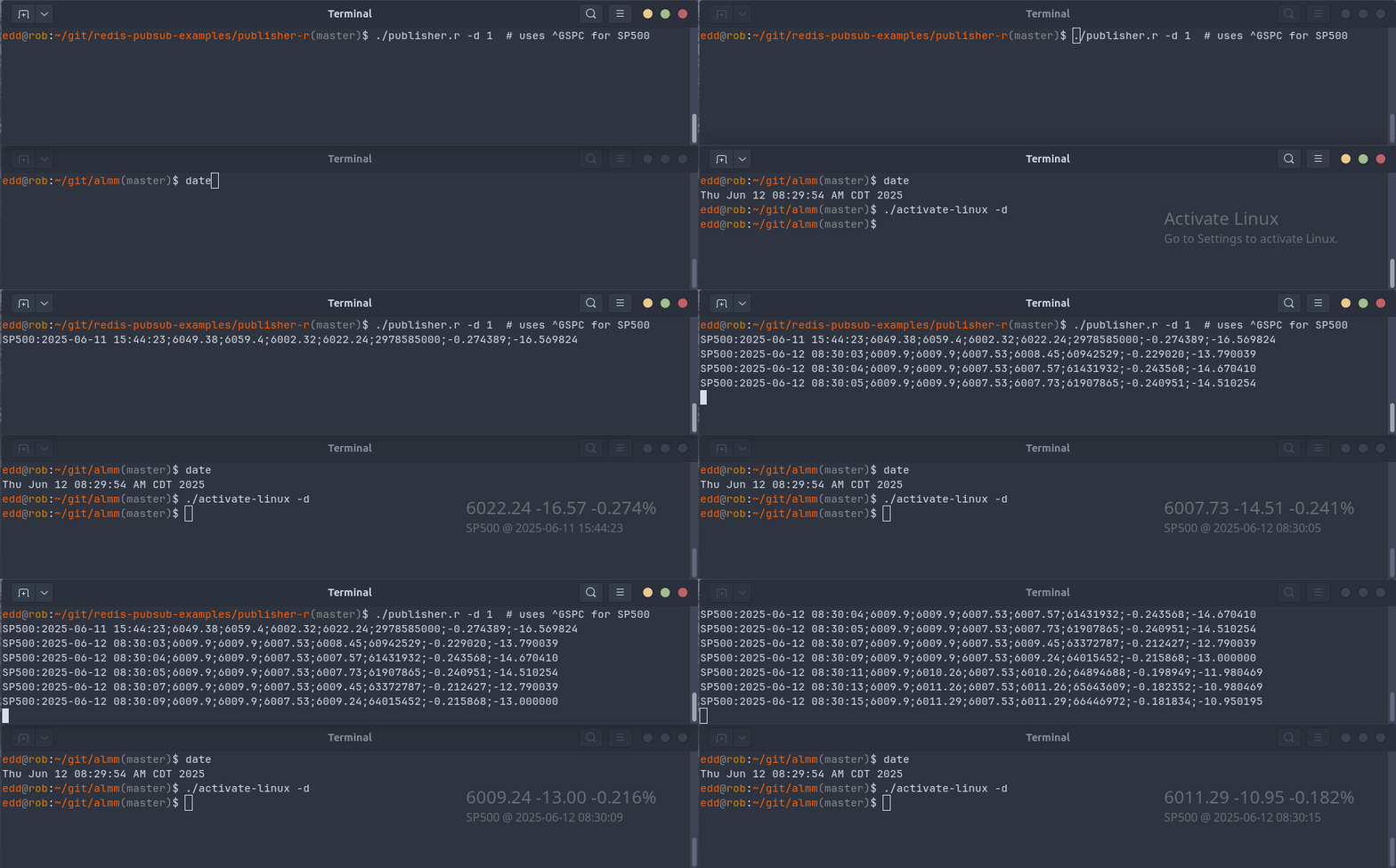
Welcome to post 50 in the R4 series. Today we reconnect to a previous post, namely #36 on pub/sub for live market monitoring with R and Redis. It introduced both Redis as well as the (then fairly recent) extensions to RcppRedis to support the publish-subscibe ( pub/sub ) model of Redis. In short, it manages both subscribing clients as well as producer for live, fast and lightweight data transmission. Using pub/sub is generally more efficient than the (conceptually simpler) poll-sleep loops as polling creates cpu and network load. Subscriptions are lighterweight as they get notified, they are also a little (but not much!) more involved as they require a callback function. We should mention that Redis has a recent fork in Valkey that arose when the former did one of these non-uncommon-among-db-companies licenuse suicides which, happy to say, they reversed more recently so that we now have both the original as well as this leading fork (among others). Both work, the latter is now included in several Linux distros, and the C library hiredis used to connect to either is still licensed permissibly as well. All this came about because Yahoo! Finance recently had another hickup in which they changed something leading to some data clients having hiccups. This includes GNOME applet Stocks Extension I had been running. There is a lively discussion on its issue #120 suggestions for example a curl wrapper (which then makes each access a new system call). Separating data acquisition and presentation becomes an attractive alternative, especially given how the standard Python and R accessors to the Yahoo! Finance service continued to work (and how per post #36 I already run data acquisition). Moreoever, and somewhat independently, it occurred to me that the cute (and both funny in its pun, and very pretty in its display) ActivateLinux program might offer an easy-enough way to display updates on the desktop. There were two aspects to address. First, the subscription side needed to be covered in either plain C or C++. That, it turns out, is very straightforward and there are existing documentation and prior examples (e.g. at StackOverflow) as well as the ability to have an LLM generate a quick stanza as I did with Claude. A modified variant is now in the example repo redis-pubsub-examples in file subscriber.c. It is deliberately minimal and the directory does not even have a Makefile: just compile and link against both libevent (for the event loop controlling this) and libhiredis (for the Redis or Valkey connection). This should work on any standard Linux (or macOS) machine with those two (very standard) libraries installed. The second aspect was trickier. While we can get Claude to modify the program to also display under x11, it still uses a single controlling event loop. It took a little bit of probing on my event to understand how to modify (the x11 use of) ActivateLinux, but as always it was reasonably straightforward in the end: instead of one single while loop awaiting events we now first check for pending events and deal with them if present but otherwise do not idle and wait but continue in another loop that also checks on the Redis or Valkey pub/sub events. So two thumbs up to vibe coding which clearly turned me into an x11-savvy programmer too The result is in a new (and currently fairly bare-bones) repo almm. It includes all files needed to build the application, borrowed with love from ActivateLinux (which is GPL-licensed, as is of course our minimal extension) and adds the minimal modifications we made, namely linking with libhiredis and some minimal changes to x11/x11.c. (Supporting wayland as well is on the TODO list, and I also need to release a new RcppRedis version to CRAN as one currently needs the GitHub version.) We also made a simple mp4 video with a sound overlay which describes the components briefly: Comments and questions welcome. I will probably add a little bit of command-line support to the almm. Selecting the symbol subscribed to is currently done in the most minimal way via environment variable SYMBOL (NB: not SYM as the video using the default value shows). I also worked out how to show the display only one of my multiple monitors so I may add an explicit screen id selector too. A little bit of discussion (including minimal Docker use around r2u) is also in issue #121 where I first floated the idea of having StocksExtension listen to Redis (or Valkey). Other suggestions are most welcome, please use issue tickets at the almm repository.

This post by Dirk Eddelbuettel originated on his Thinking inside the box blog. If you like this or other open-source work I do, you can now sponsor me at GitHub.

11 June 2025

Iustin Pop: This blog finally goes git-annex!

A long, long time ago I have a few pictures on this blog, mostly in earlier years, because even with small pictures, the git repository became 80MiB soon this is not much in absolute terms, but the actual Markdown/Haskell/CSS/HTML total size is tiny compared to the picture, PDFs and fonts. I realised I need a better solution, probably about ten years ago, and that I should investigate git-annex. Then time passed, and I heard about git-lfs, so I thought that s the way forward. Now, I recently got interested again into doing something about this repository, and started researching.

Detour: git-lfs I was sure that git-lfs, being supported by large providers, would be the modern solution. But to my surprise, git-lfs is very server centric, which in hindsight makes sense, but for a home setup, it s not very good. Maybe I misunderstood, but git-lfs is more a protocol/method for a forge to store files, rather than an end-user solution. But then you need to backup those files separately (together with the rest of the forge), or implement another way of safeguarding them. Further details such as the fact that it keeps two copies of the files (one in the actual checked-out tree, one in internal storage) means it s not a good solution. Well, for my blog yes, but not in general. Then posts on Reddit about horror stories people being locked out of github due to quota, as an example, or this Stack Overflow post about git-lfs constraining how one uses git, convinced me that s not what I want. To each their own, but not for me I might want to push this blog s repo to github, but I definitely wouldn t want in that case to pay for github storage for my blog images (which are copies, not originals). And yes, even in 2025, those quotas are real GitHub limits and I agree with GitHub, storage and large bandwidth can t be free.

Back to the future: git-annex So back to git-annex. I thought it s going to be a simple thing, but oh boy, was I wrong. It took me half a week of continuous (well, in free time) reading and discussions with LLMs to understand a bit how it works. I think, honestly, it s a bit too complex, which is why the workflows page lists seven (!) levels of workflow complexity, from fully-managed, to fully-manual. IMHO, respect to the author for the awesome tool, but if you need a web app to help you manage git, it hints that the tool is too complex. I made the mistake of running git annex sync once, to realise it actually starts pushing to my upstream repo and creating new branches and whatnot, so after enough reading, I settled on workflow 6/7, since I don t want another tool to manage my git history. Maybe I m an outlier here, but everything automatic is a bit too much for me. Once you do managed yourself how git-annex works (on the surface, at least), it is a pretty cool thing. It uses a git-annex git branch to store metainformation, and that is relatively clean. If you do run git annex sync, it creates some extra branches, which I don t like, but meh.

Trick question: what is a remote? One of the most confusing things about git-annex was understanding its remote concept. I thought a remote is a place where you replicate your data. But not, that s a special remote. A normal remote is a git remote, but which is expected to be git/ssh/with command line access. So if you have a git+ssh remote, git-annex will not only try to push it s above-mentioned branch, but also copy the files. If such a remote is on a forge that doesn t support git-annex, then it will complain and get confused. Of course, if you read the extensive docs, you just do git config remote.<name>.annex-ignore true, and it will understand that it should not sync to it. But, aside, from this case, git-annex expects that all checkouts and clones of the repository are both metadata and data. And if you do any annex commands in them, all other clones will know about them! This can be unexpected, and you find people complaining about it, but nowadays there s a solution:
git clone   dir && cd dir
git config annex.private true
git annex init "temp copy"
This is important. Any leaf git clone must be followed by that annex.private true config, especially on CI/CD machines. Honestly, I don t understand why by default clones should be official data stores, but it is what it is. I settled on not making any of my checkouts stable , but only the actual storage places. Except those are not git repositories, but just git-annex storage things. I.e., special remotes. Is it confusing enough yet ?

Special remotes The special remotes, as said, is what I expected to be the normal git annex remotes, i.e. places where the data is stored. But well, they exist, and while I m only using a couple simple ones, there is a large number of them. Among the interesting ones: git-lfs, a remote that allows also storing the git repository itself (git-remote-annex), although I m bit confused about this one, and most of the common storage providers via the rclone remote. Plus, all of the special remotes support encryption, so this is a really neat way to store your files across a large number of things, and handle replication, number of copies, from which copy to retrieve, etc. as you with.

And many of other features git-annex has tons of other features, so to some extent, the sky s the limit. Automatic selection of what to add git it vs plain git, encryption handling, number of copies, clusters, computed files, etc. etc. etc. I still think it s cool but too complex, though!

Uses Aside from my blog post, of course. I ve seen blog posts/comments about people using git-annex to track/store their photo collection, and I could see very well how the remote encrypted repos any of the services supported by rclone could be an N+2 copy or so. For me, tracking photos would be a bit too tedious, but it could maybe work after more research. A more practical thing would probably be replicating my local movie collection (all legal, to be clear) better than just run rsync from time to time and tracking the large files in it via git-annex. That s an exercise for another day, though, once I get more mileage with it - my blog pictures are copies, so I don t care much if they get lost, but movies are primary online copies, and I don t want to re-dump the discs. Anyway, for later.

Migrating to git-annex Migrating here means ending in a state where all large files are in git-annex, and the plain git repo is small. Just moving the files to git annex at the current head doesn t remove them from history, so your git repository is still large; it won t grow in the future, but remains with old size (and contains the large files in its history). In my mind, a nice migration would be: run a custom command, and all the history is migrated to git-annex, so I can go back in time and the still use git-annex. I na vely expected this would be easy and already available, only to find comments on the git-annex site with unsure git-filter-branch calls and some web discussions. This is the discussion on the git annex website, but it didn t make me confident it would do the right thing. But that discussion is now 8 years old. Surely in 2025, with git-filter-repo, it s easier? And, maybe I m missing something, but it is not. Not from the point of view of plain git, that s easy, but because interacting with git-annex, which stores its data in git itself, so doing this properly across successive steps of a repo (when replaying the commits) is, I think, not well defined behaviour. So I was stuck here for a few days, until I got an epiphany: As I m going to rewrite the repository, of course I m keeping a copy of it from before git-annex. If so, I don t need the history, back in time, to be correct in the sense of being able to retrieve the binary files too. It just needs to be correct from the point of view of the actual Markdown and Haskell files that represent the meat of the blog. This simplified the problem a lot. At first, I wanted to just skip these files, but this could also drop commits (git-filter-repo, by default, drops the commits if they re empty), and removing the files loses information - when they were added, what were the paths, etc. So instead I came up with a rather clever idea, if I might say so: since git-annex replaces files with symlinks already, just replace the files with symlinks in the whole history, except symlinks that are dangling (to represent the fact that files are missing). One could also use empty files, but empty files are more valid in a sense than dangling symlinks, hence why I settled on those. Doing this with git-filter-repo is easy, in newer versions, with the new --file-info-callback. Here is the simple code I used:
import os
import os.path
import pathlib

SKIP_EXTENSIONS= 'jpg', 'jpeg', 'png', 'pdf', 'woff', 'woff2' 
FILE_MODES =  b"100644", b"100755" 
SYMLINK_MODE = b"120000"

fas_string = filename.decode()
path = pathlib.PurePosixPath(fas_string)
ext = path.suffix.removeprefix('.')

if ext not in SKIP_EXTENSIONS:
  return (filename, mode, blob_id)

if mode not in FILE_MODES:
  return (filename, mode, blob_id)

print(f"Replacing ' filename ' (extension '. ext ') in  os.getcwd() ")

symlink_target = '/none/binary-file-removed-from-git-history'.encode()
new_blob_id = value.insert_file_with_contents(symlink_target)
return (filename, SYMLINK_MODE, new_blob_id)
This goes and replaces files with a symlink to nowhere, but the symlink should explain why it s dangling. Then later renames or moving the files around work naturally , as the rename/mv doesn t care about file contents. Then, when the filtering is done via:
git-filter-repo --file-info-callback <(cat ~/filter-big.py ) --force
It is easy to onboard to git annex:
  • remove all dangling symlinks
  • copy the (binary) files from the original repository
  • since they re named the same, and in the same places, git sees a type change
  • then simply run git annex add on those files
For me it was easy as all such files were in a few directories, so just copying those directories back, a few git-annex add commands, and done. Of course, then adding a few rsync remotes, git annex copy --to, and the repository was ready. Well, I also found a bug in my own Hakyll setup: on a fresh clone, when the large files are just dangling symlinks, the builder doesn t complain, just ignores the images. Will have to fix.

Other resources This is a blog that I read at the beginning, and I found it very useful as an intro: https://switowski.com/blog/git-annex/. It didn t help me understand how it works under the covers, but it is well written. The author does use the sync command though, which is too magic for me, but also agrees about its complexity

The proof is in the pudding And now, for the actual first image to be added that never lived in the old plain git repository. It s not full-res/full-size, it s cropped a bit on the bottom. Earlier in the year, I went to Paris for a very brief work trip, and I walked around a bit it was more beautiful than what I remembered from way way back. So a bit random selection of a picture, but here it is:
Un bateau sur la Seine Un bateau sur la Seine
Enjoy!

Freexian Collaborators: Monthly report about Debian Long Term Support, May 2025 (by Roberto C. S nchez)

Like each month, have a look at the work funded by Freexian s Debian LTS offering.

Debian LTS contributors In May, 22 contributors have been paid to work on Debian LTS, their reports are available:
  • Abhijith PA did 8.0h (out of 0.0h assigned and 8.0h from previous period).
  • Adrian Bunk did 26.0h (out of 26.0h assigned).
  • Andreas Henriksson did 1.0h (out of 15.0h assigned and 3.0h from previous period), thus carrying over 17.0h to the next month.
  • Andrej Shadura did 3.0h (out of 10.0h assigned), thus carrying over 7.0h to the next month.
  • Bastien Roucari s did 20.0h (out of 20.0h assigned).
  • Ben Hutchings did 8.0h (out of 20.0h assigned and 4.0h from previous period), thus carrying over 16.0h to the next month.
  • Carlos Henrique Lima Melara did 12.0h (out of 11.0h assigned and 1.0h from previous period).
  • Chris Lamb did 15.5h (out of 0.0h assigned and 15.5h from previous period).
  • Daniel Leidert did 25.0h (out of 26.0h assigned), thus carrying over 1.0h to the next month.
  • Emilio Pozuelo Monfort did 21.0h (out of 16.75h assigned and 11.0h from previous period), thus carrying over 6.75h to the next month.
  • Guilhem Moulin did 11.5h (out of 8.5h assigned and 6.5h from previous period), thus carrying over 3.5h to the next month.
  • Jochen Sprickerhof did 3.5h (out of 8.75h assigned and 17.5h from previous period), thus carrying over 22.75h to the next month.
  • Lee Garrett did 26.0h (out of 12.75h assigned and 13.25h from previous period).
  • Lucas Kanashiro did 20.0h (out of 18.0h assigned and 2.0h from previous period).
  • Markus Koschany did 20.0h (out of 26.25h assigned), thus carrying over 6.25h to the next month.
  • Roberto C. S nchez did 20.75h (out of 24.0h assigned), thus carrying over 3.25h to the next month.
  • Santiago Ruano Rinc n did 15.0h (out of 12.5h assigned and 2.5h from previous period).
  • Sean Whitton did 6.25h (out of 6.0h assigned and 2.0h from previous period), thus carrying over 1.75h to the next month.
  • Sylvain Beucler did 26.25h (out of 26.25h assigned).
  • Thorsten Alteholz did 15.0h (out of 15.0h assigned).
  • Tobias Frost did 12.0h (out of 12.0h assigned).
  • Utkarsh Gupta did 1.0h (out of 15.0h assigned), thus carrying over 14.0h to the next month.

Evolution of the situation In May, we released 54 DLAs. The LTS Team was particularly active in May, publishing a higher than normal number of advisories, as well as helping with a wide range of updates to packages in stable and unstable, plus some other interesting work. We are also pleased to welcome several updates from contributors outside the regular team.
  • Notable security updates:
    • containerd, prepared by Andreas Henriksson, fixes a vulnerability that could cause containers launched as non-root users to be run as root
    • libapache2-mod-auth-openidc, prepared by Moritz Schlarb, fixes a vulnerability which could allow an attacker to crash an Apache web server with libapache2-mod-auth-openidc installed
    • request-tracker4, prepared by Andrew Ruthven, fixes multiple vulnerabilities which could result in information disclosure, cross-site scripting and use of weak encryption for S/MIME emails
    • postgresql-13, prepared by Bastien Roucari s, fixes an application crash vulnerability that could affect the server or applications using libpq
    • dropbear, prepared by Guilhem Moulin, fixes a vulnerability which could potentially result in execution of arbitrary shell commands
    • openjdk-17, openjdk-11, prepared by Thorsten Glaser, fixes several vulnerabilities, which include denial of service, information disclosure or bypass of sandbox restrictions
    • glibc, prepared by Sean Whitton, fixes a privilege escalation vulnerability
  • Notable non-security updates:
    • wireless-regdb, prepared by Ben Hutchings, updates information reflecting changes to radio regulations in many countries
This month s contributions from outside the regular team include the libapache2-mod-auth-openidc update mentioned above, prepared by Moritz Schlarb (the maintainer of the package); the update of request-tracker4, prepared by Andrew Ruthven (the maintainer of the package); and the updates of openjdk-17 and openjdk-11, also noted above, prepared by Thorsten Glaser. Additionally, LTS Team members contributed stable updates of the following packages:
  • rubygems and yelp/yelp-xsl, prepared by Lucas Kanashiro
  • simplesamlphp, prepared by Tobias Frost
  • libbson-xs-perl, prepared by Roberto C. S nchez
  • fossil, prepared by Sylvain Beucler
  • setuptools and mydumper, prepared by Lee Garrett
  • redis and webpy, prepared by Adrian Bunk
  • xrdp, prepared by Abhijith PA
  • tcpdf, prepared by Santiago Ruano Rinc n
  • kmail-account-wizard, prepared by Thorsten Alteholz
Other contributions were also made by LTS Team members to packages in unstable:
  • proftpd-dfsg DEP-8 tests (autopkgtests) were provided to the maintainer, prepared by Lucas Kanashiro
  • a regular upload of libsoup2.4, prepared by Sean Whitton
  • a regular upload of setuptools, prepared by Lee Garrett
Freexian, the entity behind the management of the Debian LTS project, has been working for some time now on the development of an advanced CI platform for Debian-based distributions, called Debusine. Recently, Debusine has reached a level of feature implementation that makes it very usable. Some members of the LTS Team have been using Debusine informally, and during May LTS coordinator Santiago Ruano Rinc n has made a call for the team to help with testing of Debusine, and to help evaluate its suitability for the LTS Team to eventually begin using as the primary mechanism for uploading packages into Debian. Team members who have started using Debusine are providing valuable feedback to the Debusine development team, thus helping to improve the platform for all users. Actually, a number of updates, for both bullseye and bookworm, made during the month of May were handled using Debusine, e.g. rubygems s DLA-4163-1. By the way, if you are a Debian Developer, you can easily test Debusine following the instructions found at https://wiki.debian.org/DebusineDebianNet. DebConf, the annual Debian Conference, is coming up in July and, as is customary each year, the week preceding the conference will feature an event called DebCamp. The DebCamp week provides an opportunity for teams and other interested groups/individuals to meet together in person in the same venue as the conference itself, with the purpose of doing focused work, often called sprints . LTS coordinator Roberto C. S nchez has announced that the LTS Team is planning to hold a sprint primarily focused on the Debian security tracker and the associated tooling used by the LTS Team and the Debian Security Team.

Thanks to our sponsors Sponsors that joined recently are in bold.

7 June 2025

Evgeni Golov: show your desk - 2025 edition

Back in 2020 I posted about my desk setup at home. Recently someone in our #remotees channel at work asked about WFH setups and given quite a few things changed in mine, I thought it's time to post an update. But first, a picture! standing desk with a monitor, laptop etc (Yes, it's cleaner than usual, how could you tell?!) desk It's still the same Flexispot E5B, no change here. After 7 years (I bought mine in 2018) it still works fine. If I'd have to buy a new one, I'd probably get a four-legged one for more stability (they got quite affordable now), but there is no immediate need for that. chair It's still the IKEA Volmar. Again, no complaints here. hardware Now here we finally have some updates! laptop A Lenovo ThinkPad X1 Carbon Gen 12, Intel Core Ultra 7 165U, 32GB RAM, running Fedora (42 at the moment). It's connected to a Lenovo ThinkPad Thunderbolt 4 Dock. It just works . workstation It's still the P410, but mostly unused these days. monitor An AOC U2790PQU 27" 4K. I'm running it at 150% scaling, which works quite decently these days (no comparison to when I got it). speakers As the new monitor didn't want to take the old Dell soundbar, I have upgraded to a pair of Alesis M1Active 330 USB. They sound good and were not too expensive. I had to fix the volume control after some time though. webcam It's still the Logitech C920 Pro. microphone The built in mic of the C920 is really fine, but to do conference-grade talks (and some podcasts ), I decided to get something better. I got a FIFINE K669B, with a nice arm. It's not a Shure, for sure, but does the job well and Christian was quite satisfied with the results when we recorded the Debian and Foreman specials of Focus on Linux. keyboard It's still the ThinkPad Compact USB Keyboard with TrackPoint. I had to print a few fixes and replacement parts for it, but otherwise it's doing great. Seems Lenovo stopped making those, so I really shouldn't break it any further. mouse Logitech MX Master 3S. The surface of the old MX Master 2 got very sticky at some point and it had to be replaced. other notepad I'm still terrible at remembering things, so I still write them down in an A5 notepad. whiteboard I've also added a (small) whiteboard on the wall right of the desk, mostly used for long term todo lists. coaster Turns out Xeon-based coasters are super stable, so it lives on! yubikey Yepp, still a thing. Still USB-A because... reasons. headphones Still the Bose QC25, by now on the third set of ear cushions, but otherwise working great and the odd 15 cushion replacement does not justify buying anything newer (which would have the same problem after some time, I guess). I did add a cheap (~10 ) Bluetooth-to-Headphonejack dongle, so I can use them with my phone too (shakes fist at modern phones). And I do use the headphones more in meetings, as the Alesis speakers fill the room more with sound and thus sometimes produce a bit of an echo. charger The Bose need AAA batteries, and so do some other gadgets in the house, so there is a technoline BC 700 charger for AA and AAA on my desk these days. light Yepp, I've added an IKEA Tertial and an ALDI "face" light. No, I don't use them much. KVM switch I've "built" a KVM switch out of an USB switch, but given I don't use the workstation that often these days, the switch is also mostly unused.

5 June 2025

Matthew Garrett: Twitter's new encrypted DMs aren't better than the old ones

(Edit: Twitter could improve this significantly with very few changes - I wrote about that here. It's unclear why they'd launch without doing that, since it entirely defeats the point of using HSMs)

When Twitter[1] launched encrypted DMs a couple
of years ago, it was the worst kind of end-to-end
encrypted - technically e2ee, but in a way that made it relatively easy for Twitter to inject new encryption keys and get everyone's messages anyway. It was also lacking a whole bunch of features such as "sending pictures", so the entire thing was largely a waste of time. But a couple of days ago, Elon announced the arrival of "XChat", a new encrypted message platform built on Rust with (Bitcoin style) encryption, whole new architecture. Maybe this time they've got it right?

tl;dr - no. Use Signal. Twitter can probably obtain your private keys, and admit that they can MITM you and have full access to your metadata.

The new approach is pretty similar to the old one in that it's based on pretty straightforward and well tested cryptographic primitives, but merely using good cryptography doesn't mean you end up with a good solution. This time they've pivoted away from using the underlying cryptographic primitives directly and into higher level abstractions, which is probably a good thing. They're using Libsodium's boxes for message encryption, which is, well, fine? It doesn't offer forward secrecy (if someone's private key is leaked then all existing messages can be decrypted) so it's a long way from the state of the art for a messaging client (Signal's had forward secrecy for over a decade!), but it's not inherently broken or anything. It is, however, written in C, not Rust[2].

That's about the extent of the good news. Twitter's old implementation involved clients generating keypairs and pushing the public key to Twitter. Each client (a physical device or a browser instance) had its own private key, and messages were simply encrypted to every public key associated with an account. This meant that new devices couldn't decrypt old messages, and also meant there was a maximum number of supported devices and terrible scaling issues and it was pretty bad. The new approach generates a keypair and then stores the private key using the Juicebox protocol. Other devices can then retrieve the private key.

Doesn't this mean Twitter has the private key? Well, no. There's a PIN involved, and the PIN is used to generate an encryption key. The stored copy of the private key is encrypted with that key, so if you don't know the PIN you can't decrypt the key. So we brute force the PIN, right? Juicebox actually protects against that - before the backend will hand over the encrypted key, you have to prove knowledge of the PIN to it (this is done in a clever way that doesn't directly reveal the PIN to the backend). If you ask for the key too many times while providing the wrong PIN, access is locked down.

But this is true only if the Juicebox backend is trustworthy. If the backend is controlled by someone untrustworthy[3] then they're going to be able to obtain the encrypted key material (even if it's in an HSM, they can simply watch what comes out of the HSM when the user authenticates if there's no validation of the HSM's keys). And now all they need is the PIN. Turning the PIN into an encryption key is done using the Argon2id key derivation function, using 32 iterations and a memory cost of 16MB (the Juicebox white paper says 16KB, but (a) that's laughably small and (b) the code says 16 * 1024 in an argument that takes kilobytes), which makes it computationally and moderately memory expensive to generate the encryption key used to decrypt the private key. How expensive? Well, on my (not very fast) laptop, that takes less than 0.2 seconds. How many attempts to I need to crack the PIN? Twitter's chosen to fix that to 4 digits, so a maximum of 10,000. You aren't going to need many machines running in parallel to bring this down to a very small amount of time, at which point private keys can, to a first approximation, be extracted at will.

Juicebox attempts to defend against this by supporting sharding your key over multiple backends, and only requiring a subset of those to recover the original. I can't find any evidence that Twitter's does seem to be making use of this,Twitter uses three backends and requires data from at least two, but all the backends used are under x.com so are presumably under Twitter's direct control. Trusting the keystore without needing to trust whoever's hosting it requires a trustworthy communications mechanism between the client and the keystore. If the device you're talking to can prove that it's an HSM that implements the attempt limiting protocol and has no other mechanism to export the data, this can be made to work. Signal makes use of something along these lines using Intel SGX for contact list and settings storage and recovery, and Google and Apple also have documentation about how they handle this in ways that make it difficult for them to obtain backed up key material. Twitter has no documentation of this, and as far as I can tell does nothing to prove that the backend is in any way trustworthy. (Edit to add: The Juicebox API does support authenticated communication between the client and the HSM, but that relies on you having some way to prove that the public key you're presented with corresponds to a private key that only exists in the HSM. Twitter gives you the public key whenever you communicate with them, so even if they've implemented this properly you can't prove they haven't made up a new key and MITMed you the next time you retrieve your key)

On the plus side, Juicebox is written in Rust, so Elon's not 100% wrong. Just mostly wrong.

But ok, at least you've got viable end-to-end encryption even if someone can put in some (not all that much, really) effort to obtain your private key and render it all pointless? Actually no, since you're still relying on the Twitter server to give you the public key of the other party and there's no out of band mechanism to do that or verify the authenticity of that public key at present. Twitter can simply give you a public key where they control the private key, decrypt the message, and then reencrypt it with the intended recipient's key and pass it on. The support page makes it clear that this is a known shortcoming and that it'll be fixed at some point, but they said that about the original encrypted DM support and it never was, so that's probably dependent on whether Elon gets distracted by something else again. And the server knows who and when you're messaging even if they haven't bothered to break your private key, so there's a lot of metadata leakage.

Signal doesn't have these shortcomings. Use Signal.

[1] I'll respect their name change once Elon respects his daughter

[2] There are implementations written in Rust, but Twitter's using the C one with these JNI bindings

[3] Or someone nominally trustworthy but who's been compelled to act against your interests - even if Elon were absolutely committed to protecting all his users, his overarching goals for Twitter require him to have legal presence in multiple jurisdictions that are not necessarily above placing employees in physical danger if there's a perception that they could obtain someone's encryption keys

comment count unavailable comments

4 June 2025

Russell Coker: Trying DeepSeek R1

I saw this document on running DeepSeek R1 [1] and decided to give it a go. I downloaded the llama.cpp source and compiled it and downloaded the 131G of data as described. Running it with the default options gave about 7 CPU cores in use. Changing the --threads parameter to 44 caused it to use 17 CPU cores (changing it to larger numbers like 80 made it drop to 2.5 cores). I used the --n-gpu-layers parameter with the value of 1 as I currently have a GPU with only 6G of RAM (AliExpress is delaying my delivery of a PCIe power adaptor for a better GPU). Running it like this makes the GPU take 12W more power than standby and using 5.5G of VRAM according to nvidia-smi so it is doing a small amount of work, but not much. The documentation refers to the DeepSeek R1 1.58bit model which I m using as having 61 layers so presumably less than 2% of the work is done on the GPU. Running like this it takes 2 hours of CPU time (just over 3 minutes of elapsed time at 17 cores) to give 8 words of output. I didn t let any tests run long enough to give complete output. The documentation claims that it will run on CPU with 20G of RAM. In my tests it takes between 161G and 195G of RAM to run depending on the number of threads. The documentation describes running on the CPU as very slow which presumably means 3 words per minute on a system with a pair of E5-2699A v4 CPUs and 256G of RAM. When I try to use more than 44 threads I get output like system_info: n_threads = 200 (n_threads_batch = 200) / 44 and it seems that I only have a few threads actually in use. Apparently there s some issue with having more threads than the 44 CPU cores in the system. I was expecting this to go badly and it met my expectations in that regard. But it was interesting to see exactly how it went badly. It seems that if I had a GPU with 24G of VRAM I d still have 54/61 layers running on the CPU so even the largest of home GPUs probably wouldn t make much difference. Maybe if I configured the server to have hyper-threading enabled and 88 HT cores then I could have 88 threads and about 34 CPU cores in use which might help. But even if I got the output speed from 3 to 6 words per minute that still wouldn t be very usable.

31 May 2025

Antoine Beaupr : Traffic meter per ASN without logs

Have you ever found yourself in the situation where you had no or anonymized logs and still wanted to figure out where your traffic was coming from? Or you have multiple upstreams and are looking to see if you can save fees by getting into peering agreements with some other party? Or your site is getting heavy load but you can't pinpoint it on a single IP and you suspect some amoral corporation is training their degenerate AI on your content with a bot army? (You might be getting onto something there.) If that rings a bell, read on.

TL;DR: ... or just skip the cruft and install asncounter:
pip install asncounter
Also available in Debian 14 or later, or possibly in Debian 13 backports (soon to be released) if people are interested:
apt install asncounter
Then count whoever is hitting your network with:
awk ' print $2 ' /var/log/apache2/*access*.log   asncounter
or:
tail -F /var/log/apache2/*access*.log   awk ' print $2 '   asncounter
or:
tcpdump -q -n   asncounter --input-format=tcpdump --repl
or:
tcpdump -q -i eth0 -n -Q in "tcp and tcp[tcpflags] & tcp-syn != 0 and (port 80 or port 443)"   asncounter --input-format=tcpdump --repl
Read on for why this matters, and why I wrote yet another weird tool (almost) from scratch.

Background and manual work This is a tool I've been dreaming of for a long, long time. Back in 2006, at Koumbit a colleague had setup TAS ("Traffic Accounting System", " " in Russian, apparently), a collection of Perl script that would do per-IP accounting. It was pretty cool: it would count bytes per IP addresses and, from that, you could do analysis. But the project died, and it was kind of bespoke. Fast forward twenty years, and I find myself fighting off bots at the Tor Project (the irony...), with our GitLab suffering pretty bad slowdowns (see issue tpo/tpa/team#41677 for the latest public issue, the juicier one is confidential, unfortunately). (We did have some issues caused by overloads in CI, as we host, after all, a fork of Firefox, which is a massive repository, but the applications team did sustained, awesome work to fix issues on that side, again and again (see tpo/applications/tor-browser#43121 for the latest, and tpo/applications/tor-browser#43121 for some pretty impressive correlation work, I work with really skilled people). But those issues, I believe were fixed.) So I had the feeling it was our turn to get hammered by the AI bots. But how do we tell? I could tell something was hammering at the costly /commit/ and (especially costly) /blame/ endpoint. So at first, I pulled out the trusted awk, sort uniq -c sort -n tail pipeline I am sure others have worked out before:
awk ' print $1 ' /var/log/nginx/*.log   sort   uniq -c   sort -n   tail -10
For people new to this, that pulls the first field out of web server log files, sort the list, counts the number of unique entries, and sorts that so that the most common entries (or IPs) show up first, then show the top 10. That, other words, answers the question of "which IP address visits this web server the most?" Based on this, I found a couple of IP addresses that looked like Alibaba. I had already addressed an abuse complaint to them (tpo/tpa/team#42152) but never got a response, so I just blocked their entire network blocks, rather violently:
for cidr in 47.240.0.0/14 47.246.0.0/16 47.244.0.0/15 47.235.0.0/16 47.236.0.0/14; do 
  iptables-legacy -I INPUT -s $cidr -j REJECT
done
That made Ali Baba and his forty thieves (specifically their AL-3 network go away, but our load was still high, and I was still seeing various IPs crawling the costly endpoints. And this time, it was hard to tell who they were: you'll notice all the Alibaba IPs are inside the same 47.0.0.0/8 prefix. Although it's not a /8 itself, it's all inside the same prefix, so it's visually easy to pick it apart, especially for a brain like mine who's stared too long at logs flowing by too fast for their own mental health. What I had then was different, and I was tired of doing the stupid thing I had been doing for decades at this point. I had recently stumbled upon pyasn recently (in January, according to my notes) and somehow found it again, and thought "I bet I could write a quick script that loops over IPs and counts IPs per ASN". (Obviously, there are lots of other tools out there for that kind of monitoring. Argos, for example, presumably does this, but it's a kind of a huge stack. You can also get into netflows, but there's serious privacy implications with those. There are also lots of per-IP counters like promacct, but that doesn't scale. Or maybe someone already had solved this problem and I just wasted a week of my life, who knows. Someone will let me know, I hope, either way.)

ASNs and networks A quick aside, for people not familiar with how the internet works. People that know about ASNs, BGP announcements and so on can skip. The internet is the network of networks. It's made of multiple networks that talk to each other. The way this works is there is a Border Gateway Protocol (BGP), a relatively simple TCP-based protocol, that the edge routers of those networks used to announce each other what network they manage. Each of those network is called an Autonomous System (AS) and has an AS number (ASN) to uniquely identify it. Just like IP addresses, ASNs are allocated by IANA and local registries, they're pretty cheap and useful if you like running your own routers, get one. When you have an ASN, you'll use it to, say, announce to your BGP neighbors "I have 198.51.100.0/24" over here and the others might say "okay, and I have 216.90.108.31/19 over here, and I know of this other ASN over there that has 192.0.2.1/24 too! And gradually, those announcements flood the entire network, and you end up with each BGP having a routing table of the global internet, with a map of which network block, or "prefix" is announced by which ASN. It's how the internet works, and it's a useful thing to know, because it's what, ultimately, makes an organisation responsible for an IP address. There are "looking glass" tools like the one provided by routeviews.org which allow you to effectively run "trace routes" (but not the same as traceroute, which actively sends probes from your location), type an IP address in that form to fiddle with it. You will end up with an "AS path", the way to get from the looking glass to the announced network. But I digress, and that's kind of out of scope. Point is, internet is made of networks, networks are autonomous systems (AS) and they have numbers (ASNs), and they announced IP prefixes (or "network blocks") that ultimately tells you who is responsible for traffic on the internet.

Introducing asncounter So my goal was to get from "lots of IP addresses" to "list of ASNs", possibly also the list of prefixes (because why not). Turns out pyasn makes that really easy. I managed to build a prototype in probably less than an hour, just look at the first version, it's 44 lines (sloccount) of Python, and it works, provided you have already downloaded the required datafiles from routeviews.org. (Obviously, the latest version is longer at close to 1000 lines, but it downloads the data files automatically, and has many more features). The way the first prototype (and later versions too, mostly) worked is that you feed it a list of IP addresses on standard input, it looks up the ASN and prefix associated with the IP, and increments a counter for those, then print the result. That showed me something like this:
root@gitlab-02:~/anarcat-scripts# tcpdump -q -i eth0 -n -Q in "(udp or tcp)"   ./asncounter.py --tcpdump                                                                                                                                                                          
tcpdump: verbose output suppressed, use -v[v]... for full protocol decode                                                                
listening on eth0, link-type EN10MB (Ethernet), snapshot length 262144 bytes                                                             
INFO: collecting IPs from stdin, using datfile ipasn_20250523.1600.dat.gz                                                                
INFO: loading datfile /root/.cache/pyasn/ipasn_20250523.1600.dat.gz...                                                                   
INFO: loading /root/.cache/pyasn/asnames.json                       
ASN     count   AS               
136907  7811    HWCLOUDS-AS-AP HUAWEI CLOUDS, HK                                                                                         
[----]  359     [REDACTED]
[----]  313     [REDACTED]
8075    254     MICROSOFT-CORP-MSN-AS-BLOCK, US
[---]   164     [REDACTED]
[----]  136     [REDACTED]
24940   114     HETZNER-AS, DE  
[----]  98      [REDACTED]
14618   82      AMAZON-AES, US                                                                                                           
[----]  79      [REDACTED]
prefix  count                                         
166.108.192.0/20        1294                                                                                                             
188.239.32.0/20 1056                                          
166.108.224.0/20        970                    
111.119.192.0/20        951              
124.243.128.0/18        667                                         
94.74.80.0/20   651                                                 
111.119.224.0/20        622                                         
111.119.240.0/20        566           
111.119.208.0/20        538                                         
[REDACTED]  313           
Even without ratios and a total count (which will come later), it was quite clear that Huawei was doing something big on the server. At that point, it was responsible for a quarter to half of the traffic on our GitLab server or about 5-10 queries per second. But just looking at the logs, or per IP hit counts, it was really hard to tell. That traffic is really well distributed. If you look more closely at the output above, you'll notice I redacted a couple of entries except major providers, for privacy reasons. But you'll also notice almost nothing is redacted in the prefix list, why? Because all of those networks are Huawei! Their announcements are kind of bonkers: they have hundreds of such prefixes. Now, clever people in the know will say "of course they do, it's an hyperscaler; just ASN14618 (AMAZON-AES) there is way more announcements, they have 1416 prefixes!" Yes, of course, but they are not generating half of my traffic (at least, not yet). But even then: this also applies to Amazon! This way of counting traffic is way more useful for large scale operations like this, because you group by organisation instead of by server or individual endpoint. And, ultimately, this is why asncounter matters: it allows you to group your traffic by organisation, the place you can actually negotiate with. Now, of course, that assumes those are entities you can talk with. I have written to both Alibaba and Huawei, and have yet to receive a response. I assume I never will. In their defence, I wrote in English, perhaps I should have made the effort of translating my message in Chinese, but then again English is the Lingua Franca of the Internet, and I doubt that's actually the issue.

The Huawei and Facebook blocks Another aside, because this is my blog and I am not looking for a Pullitzer here. So I blocked Huawei from our GitLab server (and before you tear your shirt open: only our GitLab server, everything else is still accessible to them, including our email server to respond to my complaint). I did so 24h after emailing them, and after examining their user agent (UA) headers. Boy that was fun. In a sample of 268 requests I analyzed, they churned out 246 different UAs. At first glance, they looked legit, like:
Mozilla/5.0 (Macintosh; Intel Mac OS X 10_15_7) AppleWebKit/537.36 (KHTML, like Gecko) Chrome/131.0.0.0 Safari/537.36
Safari on a Mac, so far so good. But when you start digging, you notice some strange things, like here's Safari running on Linux:
Mozilla/5.0 (X11; U; Linux i686; en-US) AppleWebKit/534.3 (KHTML, like Gecko) Chrome/6.0.457.0 Safari/534.3
Was Safari ported to Linux? I guess that's.. possible? But here is Safari running on a 15 year old Ubuntu release (10.10):
Mozilla/5.0 (X11; Linux i686) AppleWebKit/534.24 (KHTML, like Gecko) Ubuntu/10.10 Chromium/12.0.702.0 Chrome/12.0.702.0 Safari/534.24
Speaking of old, here's Safari again, but this time running on Windows NT 5.1, AKA Windows XP, released 2001, EOL since 2019:
Mozilla/5.0 (Windows; U; Windows NT 5.1; en-CA) AppleWebKit/534.13 (KHTML like Gecko) Chrome/9.0.597.98 Safari/534.13
Really? Here's Firefox 3.6, released 14 years ago, there were quite a lot of those:
Mozilla/5.0 (Windows; U; Windows NT 6.1; lt; rv:1.9.2) Gecko/20100115 Firefox/3.6
I remember running those old Firefox releases, those were the days. But to me, those look like entirely fake UAs, deliberately rotated to make it look like legitimate traffic. In comparison, Facebook seemed a bit more legit, in the sense that they don't fake it. most hits are from:
meta-externalagent/1.1 (+https://developers.facebook.com/docs/sharing/webmasters/crawler)
which, according their documentation:
crawls the web for use cases such as training AI models or improving products by indexing content directly
From what I could tell, it was even respecting our rather liberal robots.txt rules, in that it wasn't crawling the sprawling /blame/ or /commit/ endpoints, explicitly forbidden by robots.txt. So I've blocked the Facebook bot in robots.txt and, amazingly, it just went away. Good job Facebook, as much as I think you've given the empire to neo-nazis, cause depression and genocide, you know how to run a crawler, thanks. Huawei was blocked at the web server level, with a friendly 429 status code telling people to contact us (over email) if they need help. And they don't care: they're still hammering the server, from what I can tell, but then again, I didn't block the entire ASN just yet, just the blocks I found crawling the server over a couple hours.

A full asncounter run So what does a day in asncounter look like? Well, you start with a problem, say you're getting too much traffic and want to see where it's from. First you need to sample it. Typically, you'd do that with tcpdump or tailing a log file:
tail -F /var/log/apache2/*access*.log   awk ' print $2 '   asncounter
If you have lots of traffic or care about your users' privacy, you're not going to log IP addresses, so tcpdump is likely a good option instead:
tcpdump -q -n   asncounter --input-format=tcpdump --repl
If you really get a lot of traffic, you might want to get a subset of that to avoid overwhelming asncounter, it's not fast enough to do multiple gigabit/second, I bet, so here's only incoming SYN IPv4 packets:
tcpdump -q -n -Q in "tcp and tcp[tcpflags] & tcp-syn != 0 and (port 80 or port 443)"   asncounter --input-format=tcpdump --repl
In any case, at this point you're staring at a process, just sitting there. If you passed the --repl or --manhole arguments, you're lucky: you have a Python shell inside the program. Otherwise, send SIGHUP to the thing to have it dump the nice tables out:
pkill -HUP asncounter
Here's an example run:
> awk ' print $2 ' /var/log/apache2/*access*.log   asncounter
INFO: using datfile ipasn_20250527.1600.dat.gz
INFO: collecting addresses from <stdin>
INFO: loading datfile /home/anarcat/.cache/pyasn/ipasn_20250527.1600.dat.gz...
INFO: finished reading data
INFO: loading /home/anarcat/.cache/pyasn/asnames.json
count   percent ASN AS
12779   69.33   66496   SAMPLE, CA
3361    18.23   None    None
366 1.99    66497   EXAMPLE, FR
337 1.83    16276   OVH, FR
321 1.74    8075    MICROSOFT-CORP-MSN-AS-BLOCK, US
309 1.68    14061   DIGITALOCEAN-ASN, US
128 0.69    16509   AMAZON-02, US
77  0.42    48090   DMZHOST, GB
56  0.3 136907  HWCLOUDS-AS-AP HUAWEI CLOUDS, HK
53  0.29    17621   CNCGROUP-SH China Unicom Shanghai network, CN
total: 18433
count   percent prefix  ASN AS
12779   69.33   192.0.2.0/24    66496   SAMPLE, CA
3361    18.23   None        
298 1.62    178.128.208.0/20    14061   DIGITALOCEAN-ASN, US
289 1.57    51.222.0.0/16   16276   OVH, FR
272 1.48    2001:DB8::/48   66497   EXAMPLE, FR
235 1.27    172.160.0.0/11  8075    MICROSOFT-CORP-MSN-AS-BLOCK, US
94  0.51    2001:DB8:1::/48 66497   EXAMPLE, FR
72  0.39    47.128.0.0/14   16509   AMAZON-02, US
69  0.37    93.123.109.0/24 48090   DMZHOST, GB
53  0.29    27.115.124.0/24 17621   CNCGROUP-SH China Unicom Shanghai network, CN
Those numbers are actually from my home network, not GitLab. Over there, the battle still rages on, but at least the vampire bots are banging their heads against the solid Nginx wall instead of eating the fragile heart of GitLab. We had a significant improvement in latency thanks to the Facebook and Huawei blocks... Here are the "workhorse request duration stats" for various time ranges, 20h after the block:
range mean max stdev
20h 449ms 958ms 39ms
7d 1.78s 5m 14.9s
30d 2.08s 3.86m 8.86s
6m 901ms 27.3s 2.43s
We went from two seconds mean to 500ms! And look at that standard deviation! 39ms! It was ten seconds before! I doubt we'll keep it that way very long but for now, it feels like I won a battle, and I didn't even have to setup anubis or go-away, although I suspect that will unfortunately come. Note that asncounter also supports exporting Prometheus metrics, but you should be careful with this, as it can lead to cardinal explosion, especially if you track by prefix (which can be disabled with --no-prefixes . Folks interested in more details should read the fine manual for more examples, usage, and discussion. It shows, among other things, how to effectively block lots of networks from Nginx, aggregate multiple prefixes, block entire ASNs, and more! So there you have it: I now have the tool I wish I had 20 years ago. Hopefully it will stay useful for another 20 years, although I'm not sure we'll have still have internet in 20 years. I welcome constructive feedback, "oh no you rewrote X", Grafana dashboards, bug reports, pull requests, and "hell yeah" comments. Hacker News, let it rip, I know you can give me another juicy quote for my blog. This work was done as part of my paid work for the Tor Project, currently in a fundraising drive, give us money if you like what you read.

30 May 2025

Russell Coker: Service Setup Difficulties

Marco wrote a blog post opposing hyperscale systems which included We want to use an hyperscaler cloud because our developers do not want to operate a scalable and redundant database just means that you need to hire competent developers and/or system administrators. [1]. I previously wrote a blog post Why Clusters Usually Don t Work [2] and I believe that all the points there are valid today and possibly exacerbated by clusters getting less direct use as clustering is increasingly being done by hyperscale providers. Take a basic need, a MySQL or PostgreSQL database for example. You want it to run and basically do the job and to have good recovery options. You could set it up locally, run backups, test the backups, have a recovery plan for failures, maybe have a hot-spare server if it s really important, have tests for backups and hot-spare server, etc. Then you could have documentation for this so if the person who set it up isn t available when there s a problem they will be able to find out what to do. But the hyperscale option is to just select a database in your provider and have all this just work. If the person who set it up isn t available for recovery in the event of failure the company can just put out a job advert for person with experience on cloud company X and have them just immediately go to work on it. I don t like hyperscale providers as they are all monopolistic companies that do anti-competitive actions. Google should be broken up, Android development and the Play Store should be separated from Gmail etc which should be separated from search and adverts, and all of them should be separated from the GCP cloud service. Amazon should be broken up, running the Amazon store should be separated from selling items on the store, which should be separated from running a video on demand platform, and all of them should be separated from the AWS cloud. Microsoft should be broken up, OS development should be separated from application development all of that should be separated from cloud services (Teams and Office 365), and everything else should be separate from the Azure cloud system. But the cloud providers offer real benefits at small scale. Running a MySQL or PostgreSQL database for local services is easy, it s a simple apt command to install it and then it basically works. Doing backup and recovery isn t so easy. One could say just hire competent people but if you do hire competent people do you want them running MySQL databases etc or have them just click on the create mysql database option on a cloud control panel and then move on to more important things? The FreedomBox project is a great project for installing and managing home/personal services [3]. But it s not about running things like database servers, it s for a high level running mail servers and other things for the user not for the developer. The Debian packaging of Open Stack looks interesting [4], it s a complete setup for running your own hyper scale cloud service. For medium and large organisations running Open Stack could be a good approach. But for small organisations it s cheaper and easier to just use a cloud service to run things. The issue of when to run things in-house and when to put them in the cloud is very complex. I think that if the organisation is going to spend less money on cloud services than on the salary of one sysadmin then it s probably best to have things in the cloud. When cloud costs start to exceed the salary of one person who manages systems then having them spend the extra time and effort to run things locally starts making more sense. There is also an opportunity cost in having a good sysadmin work on the backups for all the different systems instead of letting the cloud provider just do it. Another possibility of course is to run things in-house on low end hardware and just deal with the occasional downtime to save money. Knowingly choosing less reliability to save money can be quite reasonable as long as you have considered the options and all the responsible people are involved in the discussion. The one situation that I strongly oppose is having hyper scale services setup by people who don t understand them. Running a database server on a cloud service because you don t want to spend the time managing it is a reasonable choice in many situations. Running a database server on a cloud service because you don t understand how to setup a database server is never a good choice. While the cloud services are quite resilient there are still ways of breaking the overall system if you don t understand it. Also while it is quite possible for someone to know how to develop for databases including avoiding SQL injection etc but be unable to setup a database server that s probably not going to be common, probably if someone can t set it up (a generally easy task) then they can t do the hard tasks of making it secure.

Russell Coker: Machine Learning Security

I just read an interesting blog post about ML security recommended by Bruce Schneier [1]. This approach of having 2 AI systems where one processes user input and the second performs actions on quarantined data is good and solves some real problems. But I think the bigger issue is the need to do this. Why not have a multi stage approach, instead of a single user input to do everything (the example given is Can you send Bob the document he requested in our last meeting? Bob s email and the document he asked for are in the meeting notes file ) you could have get Bob s email address from the meeting notes file followed by create a new email to that address and find the document etc. A major problem with many plans for ML systems is that they are based around automating relatively simple tasks. The example of sending an email based on meeting notes is a trivial task that s done many times a day but for which expressing it verbally isn t much faster than doing it the usual way. The usual way of doing such things (manually finding the email address from the meeting notes etc) can be accelerated without ML by having a recent documents access method that gets the notes, having the email address be a hot link to the email program (IE wordprocessor or note taking program being able to call the MUA), having a put all data objects of type X into the clipboard (where X can be email address, URL, filename, or whatever), and maybe optimising the MUA UI. The problems that people are talking about solving via ML and treating everything as text to be arbitrarily parsed can in many cases by solved by having the programs dealing with the data know what they have and have support for calling system services accordingly. The blog post suggests a problem of user fatigue from asking the user to confirm all actions, that is a real concern if the system is going to automate everything such that the user gives a verbal description of the problem and then says yes many times to confirm it. But if the user is at every step of the way pushing the process take this email address attach this file it won t be a series of yes operations with a risk of saying yes once too often. I think that one thing that should be investigated is better integration between services to allow working live on data. If in an online meeting someone says I ll work on task A please send me an email at the end of the meeting with all issues related to it then you should be able to click on their email address in the meeting software to bring up the MUA to send a message and then just paste stuff in. The user could then not immediately send the message and clicking on the email address again would bring up the message in progress to allow adding to it (the behaviour of most MUAs of creating a new message for every click on a mailto:// URL is usually not what you desire). In this example you could of course use ALT-TAB or other methods to switch windows to the email, but imagine the situation of having 5 people in the meeting who are to be emailed about different things and that wouldn t scale. Another thing for the meeting example is that having a text chat for a video conference is a standard feature now and being able to directly message individuals is available in BBB and probably some other online meeting systems. It shouldn t be hard to add a feature to BBB and similar programs to have each user receive an email at the end of the meeting with the contents of every DM chat they were involved in and have everyone in the meeting receive an emailed transcript of the public chat. In conclusion I think that there are real issues with ML security and something like this technology is needed. But for most cases the best option is to just not have ML systems do such things. Also there is significant scope for improving the integration of various existing systems in a non-ML way.

27 May 2025

Russell Coker: Leaf ZE1

I ve just got a second hand Nissan LEAF. It s not nearly as luxurious as the Genesis EV that I test drove [1]. It s also just over 5 years old so it s not as slick as the MG4 I test drove [2]. But the going rate for a LEAF of that age is $17,000 vs $35,000 or more for a new MG4 or $130,000+ for a Genesis. At this time the LEAF is the only EV in Australia that s available on the second hand market in quantity. Apparently the cheapest new EV in Australia is a Great Wall one which is $32,000 and which had a wait list last time I checked, so $17,000 is a decent price if you want an electric car and aren t interested in paying the price of a new car. Starting the Car One thing I don t like about most recent cars (petrol as well as electric) is that they needlessly break traditions of car design. Inserting a key and turning it clockwise to start a car is a long standing tradition that shouldn t be broken without a good reason. With the use of traditional keys you know that when a car has the key removed it can t be operated, there s no situation of the person with the key walking away and leaving the car driveable and there s no possibility of the owner driving somewhere without the key and then being unable to start it. To start a LEAF you have to have the key fob device in range, hold down the brake pedal, and then press the power button. To turn on accessories you do the same but without holding down the brake pedal. They also have patterns of pushes, push twice to turn it on, push three times to turn it off. This is all a lot easier with a key where you can just rotate it as many clicks as needed. The change of car design for the key means that no physical contact is needed to unlock the car. If someone stands by a car fiddling with the door lock it will get noticed which deters certain types of crime. If a potential thief can sit in a nearby car to try attack methods and only walk to the target vehicle once it s unlocked it makes the crime a lot easier. Even if the electronic key is as secure as a physical key allowing attempts to unlock remotely weakens security. Reports on forums suggest that the electronic key is vulnerable to replay attacks. I guess I just have to hope that as car thieves typically get less than 10% of the value of a car it s just not worth their effort to steal a $17,000 car. Unlocking doors remotely is a common feature that s been around for a while but starting a car without a key being physically inserted is a new thing. Other Features The headlights turn on automatically when the car thinks that the level of ambient light warrants it. There is an option to override this to turn on lights but no option to force the lights to be off. So if you have your car in the on state while parked the headlights will be on even if you are parked and listening to the radio. The LEAF has a bunch of luxury features which seem a bit ridiculous like seat warmers. It also has a heated steering wheel which has turned out to be a good option for me as I have problems with my hands getting cold. According to the My Nissan LEAF Forum the seat warmer uses a maximum of 50W per seat while the car heater uses a minimum of 250W [3]. So if there are one or two people in the car then significantly less power is used by just heating the seats and also keeping the car air cool reduces window fog. The Bluetooth audio support works well. I ve done hands free calls and used it for playing music from my phone. This is the first car I ve owned with Bluetooth support. It also has line-in which might have had some use in 2019 but is becoming increasingly useless as phones with Bluetooth become more popular. It has support for two devices connecting via Bluetooth at the same time which could be handy if you wanted to watch movies on a laptop or tablet while waiting for someone. The LEAF has some of the newer safety features, it tracks lane markers and notifies the driver via beeps and vibration if they stray from their lane. It also tries to read speed limit signs and display the last observed speed limit on the dash display. It also has a skid alert which in my experience goes off under hard acceleration when it s not skidding but doesn t go off if you lose grip when cornering. The features for detecting changing lanes when close to other cars and for emergency braking when another car is partly in the lane (even if moving out of the lane) don t seem well tuned for Australian driving, the common trend on Australian roads is lawful-evil to use DND terminology. Range My most recent driving was just over 2 hours driving with a distance of a bit over 100Km which took the battery from 62% to 14%. So it looks like I can drive a bit over 200Km at an average speed of 50Km/h. I have been unable to find out the battery size for my car, my model will have either a 40KWh or 62KWh battery. Google results say it should be printed on the B pillar (it s not) and that it can be deduced from the VIN (it can t). I m guessing that my car is the cheaper option which is supposed to do 240Km when new which means that a bit over 200Km at an average speed of 50Km/h when 6yo is about what s expected. If it has the larger battery designed to do 340Km then doing 200Km in real use would be rather disappointing. Assuming the battery is 40KWh that means it s 5Km/KWh or 10KW average for the duration. That means that the 250W or so used by the car heater should only make a about 2% difference to range which is something that a human won t usually notice. If I was to drive to another state I d definitely avoid using the heater or airconditioner as an extra 4km could really matter when trying to find a place to charge when you aren t familiar with the area. It s also widely reported that the LEAF is less efficient at highway speeds which is an extra difficulty for that. It seems that the LEAF just isn t designed for interstate driving in Australia, it would be fine for driving between provinces of the Netherlands as it s difficult to drive for 200km without leaving that country. Driving 700km to another city in a car with 200km range would mean charging 3 times along the way, that s 2 hours of charging time when using fast chargers. This isn t a problem at all as the average household in Australia has 1.8 cars and the battery electric vehicles only comprise 6.3% of the market. So if a household had a LEAF and a Prius they could just use the Prius for interstate driving. A recent Prius could drive from Melbourne to Canberra or Adelaide without refuelling on the way. If I was driving to another state a couple of times a year I could rent an old fashioned car to do that and still be saving money when compared to buying petrol all the time. Running Cost Currently I m paying about $0.28 per KWh for electricity, it s reported that the efficiency of charging a LEAF is as low as 83% with the best efficiency when fast charging. I don t own the fast charge hardware and don t plan to install it as that would require getting a replacement of the connection to my home from the street, a new switchboard, and other expenses. So I expect I ll be getting 83% efficiency when charging which means 48KWh for 200KM or 96KWH for the equivalent of a $110 tank of petrol. At $0.28/KWh it will cost $26 for the same amount of driving as $110 of petrol. I also anticipate saving money on service as there s no need for engine oil changes and all the other maintenance of a petrol engine and regenerative braking will reduce the incidence of brake pad replacement. I expect to save over $1100 per annum on using electricity instead of petrol even if I pay the full rate. But if I charge my car in the middle of the day when there is over supply and I don t get paid for feeding electricity from my solar panels into the grid (as is common nowadays) it could be almost free to charge the car and I could save about $1500 on fuel. Comfort Electric cars are much quieter than cars with petrol or Diesel engines which is a major luxury feature. This car is also significantly newer than any other car I ve driven much so it has features like Bluetooth audio which weren t in other cars I ve driven. When doing 100Km/h I can hear a lot of noise from the airflow, part of that would be due to the LEAF not having the extreme streamlining features that are associated with Teslas (such as retracting door handles) and part of that would be due to the car being older and the door seals not being as good as they were when new. It s still a very quiet car with a very smooth ride. It would be nice if they used the quality of seals and soundproofing that VW uses in the Passat but I guess the car would be heavier and have a shorter range if they did that. This car has less space for the driver than any other car I ve driven (with the possible exception of a 1989 Ford Laser AKA Mazda 323). The front seats have less space than the Prius. Also the batteries seem to be under the front seats so there s a bulge in the floor going slightly in front of the front seats when they are moved back which gives less space for the front passenger to move their legs and less space for the driver when sitting in a parked car. There are a selection of electric cars from MG, BYD, and Great Wall that have more space in the front seats, if those cars were on the second hand market I might have made a different choice but a second hand LEAF is the only option for a cheap electric car in Australia now. The heated steering wheel and heated seats took a bit of getting used to but I have come to appreciate the steering wheel and the heated seats are a good way of extending the range of the car. Misc Notes The LEAF is a fun car to drive and being quiet is a luxury feature, it s no different to other EVs in this regard. It isn t nearly as fast as a Tesla, but is faster than most cars actually drive on the road. When I was looking into buying a LEAF from one of the car sales sites I was looking at models less than 5 years old. But the ZR1 series went from 2017 to 2023 so there s probably not much difference between a 2019 model and a 2021 model but there is a significant price difference. I didn t deliberately choose a 2019 car, it was what a relative was selling at a time when I needed a new car. But knowing what I know now I d probably look at that age of LEAF if choosing from the car sales sites. Problems When I turn the car off the side mirrors fold in but when I turn it on they usually don t automatically unfold if I have anything connected to the cigarette lighter power port. This is a well known problem and documented on forums. This is something that Nissan really should have tested before release because phone chargers that connect to the car cigarette lighter port have been common for at least 6 years before my car was manufactured and at least 4 years before the ZE1 model was released. The built in USB port doesn t supply enough power to match the power use of a Galaxy Note 9 running Google maps and playing music through Bluetooth. On it s own this isn t a big deal but combined with the mirror issue of using a charger in the cigarette lighter port it s a problem. The cover over the charging ports doesn t seem to lock easily enough, I had it come open when doing 100Km/h on a freeway. This wasn t a big deal but as the cover opens in a suicide-door manner at a higher speed it could have broken off. The word is that LEAF service in Australia is not done well. Why do you need regular service of an electric car anyway? For petrol and Diesel cars it s engine oil replacement that makes it necessary to have regular service. Surely you can just drive it until either the brakes squeak or the tires seem worn. I have been having problems charging, sometimes it will charge from ~20% to 100% in under 24 hours, sometimes in 14+ hours it only gets to 30%. Conclusion This is a good car and the going price on them is low. I generally recommend them as long as you aren t really big and aren t too worried about the poor security. It s a fun car to drive even with a few annoying things like the mirrors not automatically extending on start. The older ones like this are cheap enough that they should be able to cover the entire purchase cost in 10 years by the savings from not buying petrol even if you don t drive a lot. With a petrol car I use about 13 tanks of petrol a year so my driving is about half the average for Australia. Some people could cover the purchase price of a second hand leaf in under 5 years.

21 May 2025

Simon Quigley: Fences and Values

Don t knock the fence down before you know why it s up. I repeat this phrase over and over again, yet the (metaphorical) Homeowner s Association still decides my fence is the wrong color.Well, now you get to know why the fence is up. If anyone s actually willing to challenge me on this level, I d welcome it.The four ideas I d like to discuss are this: quantum physics, Lutheranism, mental resilience, and psychology. I ve been studying these topics intensely for the past decade as a passion project. I m just going to let my thoughts flow, but I d like to hear other opinions on this.Can the mysteries of the mind, the subatomic world, and faith converge to reveal deeper truths?When it comes to self-taught knowledge on analysis, I m mostly learned on Freud, with some hints of Jung and Peterson. I ve read much of the original source material, and watched countless presentations on it. This all being said, I m both learned on Rothbard and Marx, so if there is a major flaw in the way of Freud is frowned upon, I d genuinely like to know so I can update my research and juxtapose the two schools of thought.Alongside this, although probably not directly relevant, I m learned on John Locke and transcendentalism. What I d like to focus on here is this the Id.The Id is the pleasure-seeking, instinctual part of the psyche. Jung further extends this into the idea of the shadow self, and Peterson maps the meanings of these texts into a combined work (at least in my rudimentary understanding).In my research, the Id represents the part of your psyche that deals with religious values. As an example, if you re an impulsive person, turning to a spiritual or religious outlet can be highly beneficial. I ve been using references from the foundational text of the Judaeo-Christian value system this entire time, feel free to re-read my other blog posts (instead of claiming they don t exist).Let s tie this into quantum physics. This is the part where I ll struggle most. I ve watched several movies about this, read several books, and even learned about it academically, but quantum physics is likely to be my weak spot here.I did some research, and here are the elements I m looking for: uncertainty principle, wave-particle duality, quantum entanglement, and the observer effect.I already know about the cat in the box. And the Cat in the Hat, for that matter. I know about wave-particle duality from an incredibly intelligent high school physics teacher of mine. I know about the uncertainty principle purely in a colloquial sense. The remaining element I need to wrap my head around is quantum entanglement, but it feels like I m almost there.These concepts do actually challenge the idea of pure free will. It s almost like we re coming full circle. Some theologians (including myself, if you can call me a self-taught one) do believe the idea of quantum indeterminacy can be a space where divine action may take place. You could also liken the unpredictable nature of the Id to quantum indeterminacy as well. These are ones to think about, because in all reality, they re subjective opinions. I do believe they re interconnected.In terms of Lutheranism, I ll be short on this one. Please do go read the full history behind Martin Luther and his turbulent relationship with Catholicism. I m not a Bible thumper, and I actually think this is the first time I ve mentioned religion publicly at all. This being said, now I m actually ready to defend the points on an academic level.The Id represents hidden psychological forces, quantum physics reveals subatomic mysteries, and Lutheranism emphasizes faith in the unseen God. Okay, so we have the baseline. Now, time for some mental resilience. When I think of mental resilience, the first people I think of are David Goggins and Jocko Willink. I ve also enjoyed Dr. Andrew Huberman s podcast.The idea there is simple if you understand exactly how to learn, you know your fundamentals well enough to draw them and explain them vividly on a whiteboard, and you can make it a habit, at that point you re ready to work on your mental resilience. Little by little, gradually, how far can you push the bar towards the ceiling?There s obviously limits. People sometimes get scared when I mention mental resilience, but obviously that s a bit of a catch 22. There are plenty of satirical videos out there, and of course, I don t believe in Goggins or Jocko wholeheartedly. They re just tools in the toolbox when times get tough.I wish you all well, and I hope this gets you thinking about those people who just insist there is no God or higher being, and think you re stupid for believing there is one. Those people obviously haven t read analysis, in my own opinion.Have a great night!

Simon Quigley: Loose Cannons and Orwellian Tactics

Edit: for the people calling this unhinged, you don t have the full context. I know it s not a good look. Just stop and think for a second, though.I d like to start this post by saying that I am indeed well. I ve thought so from the very beginning, and it s been confirmed by professionals as such. That being said, there is still this perception that people are still believing the other person that needs help.See, when you re deeply involved in this space for ten years and start a blog to share all the cool things you ve learned, you don t expect people to spread the rumor that you re crazy. And you especially don t expect them to resort to a legal bluff and then brag about it in a private IRC channel (yes, I have the proof.)I d like my apology letter, please. And I d like you all to stop using Orwellian tactics to silence me by spreading those rumors, please. I know the source of the rumor-mill, and it s being dealt with. There has been progress, but one thing hasn t happened yet I haven t received my apology letter. I ll even volunteer, out of my own good spirit, to remove this post and all BwE parts of my first post if you send me a full apology letter in the next 24 hours. I d do that, just to get you to open your eyes and smile.Silencing people, or asking them to remove parts of a post you don t like, is never okay. You could choose whether to publish it on your platform, sure, but you certainly don t get to pick and choose what I put in my personal blog posts.I am a United States citizen with a 1st amendment right that shall be respected. I ve also studied and enjoyed writing for years. I m sick and tired of the back and forth on this. I ve wanted to move on and you are actively not letting me.I have the full IRC logs. Several other people have attested they also have them. What would you like to do next?I m not sure about you, but I m sitting here eating a donut. This isn t harrassment, this is self defense. At some point, you have to get sick and tired of issues happening, and you have to stand up for yourself, on your own footing.It isn t easy. I probably won t look back favorably on this post and thought process in a few years. That being said, it s necessary to defend myself on someone who has mistreated me personally on so many grave levels. You ll note I still haven t made the name public.They want to make you out to look like a loose cannon. They want to push your buttons and make you write a rant blog post telling you how much they hate them. I m not going to dignify that, because I know a specific electrician who wouldn t be happy if I had to write him a dissent.I m done. Don t defame me anymore.With donuts,
Simon

Russell Coker: Digital Sovereignty and Email

Running Your Own Email Srever I run my own mail server. I have run it since about 1995, initially on a 28k8 modem connection but the connection improved as technology became cheaper and now I m running it on a VM on a Hetzner server which is also running domains for some small businesses. I make a small amount of money running mail services for those companies but generally not enough to make it profitable. From a strictly financial basis I might be better off just using a big service, but I like having control over my own email. If email doesn t arrive I can read the logs to find out why. I repeatedly have issues of big services not accepting mail. The most recent is the MS services claiming that my IP has a bad ratio of good mail to spam and blocked me so I had to tunnel that through a different IP address. It seems that the way things are going is that if you run a small server companies like MS can block you even though your amount of spam is low but if you run a large scale service that is horrible for sending spam then you don t get blocked. For most users they just use one of the major email services (Gmail or Microsoft) and find that no-one blocks them because those providers are too big to block and things mostly work. Until of course the company decides to cancel their account. The Latest News The latest news is that MS is shutting down services for the International Court of Justice after a panel of ICC judges issued arrest warrants against Israeli Prime Minister Benjamin Netanyahu [1] . This is now making politicians realise the issues of email accounts hosted outside their jurisdiction. What we need is for each independent jurisdiction to have it s own email infrastructure, that means controlling DNS servers for their domains, commercial and government mail services on those domains, running the servers for those services on hardware located in the jurisdiction and run by people based in that jurisdiction and citizens of it. I say independent jurisdiction because there are groups like the EU which have sufficient harmony of laws to not require different services. With the current EU arrangements I don t think it s possible for the German government to block French people from accessing email or vice versa. While Australia and New Zealand have a long history of cooperation there s still the possibility of a lying asshole like Scott Morrison trying something on so New Zealanders shouldn t feel safe using services run in Australia. Note that Scott Morrison misled his own parliamentary colleagues about what he was doing and got himself assigned as a secret minister [2] demonstrating that even conservatives can t trust someone like him. With the ongoing human rights abuses by the Morrison government it s easy to imagine New Zealand based organisations that protect human rights being treated by the Australian government in the way that the ICC was treated by the US government. The Problem with Partial Solutions Now it would be very easy for the ICC to host their own mail servers and they probably will do just that in the near future. I m sure that there are many companies offering to set them up accounts in a hurry to deal with this (probably including some of the Dutch companies I ve worked for). Let s imagine for the sake of discussion that the ICC has their own private server, the US government could compel Google and MS to block the IP addresses of that server and then at least 1/3 of the EU population won t get mail from them. If the ICC used email addresses hosted on someone else s server then Google and MS could be compelled to block the addresses in question for the same result. The ICC could have changing email addresses to get around block lists and there could be a game of cat and mouse between the ICC and the US government but that would just be annoying for everyone. The EU needs to have services hosted and run in their jurisdiction that are used by the vast majority of the people in the country. The more people who are using services outside the control of hostile governments the lesser the impact of bad IT policies by those hostile governments. One possible model to consider is the Postbank model. Postbank is a bank run in the Netherlands from post offices which provides services to people deemed unprofitable for the big banks. If the post offices were associated with a mail service you could have it government subsidised providing free service for citizens and using government ID if the user forgets their password. You could also have it provide a cheap service for non-citizen residents. Other Problems What will the US government do next? Will they demand that Apple and Google do a remote-wipe on all phones run by ICC employees? Are they currently tracking all ICC employees by Android and iPhone services? Huawei s decision to develop their own phone OS was a reasonable one but there s no need to go that far. Other governments could setup their own equivalent to Google Play services for Android and have their own localised Android build. Even a small country like Australia could get this going for the services of calendaring etc. But the app store needs a bigger market. There s no reason why Android has to tie the app store to the services for calendaring etc. So you could have a per country system for calendaring and a per region system for selling apps. The invasion of Amazon services such as Alexa is also a major problem for digital sovereignty. We need government controls about this sort of thing, maybe have high tariffs on the import of all hardware that can only work with a single cloud service. Have 100+% tariffs on every phone, home automation system, or networked device that is either tied to a single cloud service or which can t work in a usable manner on other cloud services.

19 May 2025

Simon Quigley: Coffee and Adapting to your Environment

This morning, I went to make my usual cup of coffee. I was given an espresso machine for Christmas, and I ve developed this technique for making a warm drink that hits the spot every time.I ll start by turning on my espresso machine and starting a single shot of espresso. It dispenses and drips while I m working on the other parts.I then grab a coffee cup. Usually one of the taller ones. For maybe the bottom inch or two of the cup, that gets sugar and chocolate milk. Microwave for 45 seconds, pour in the espresso, then wash out the actual espresso from the metal cup with milk. Pour all of that in, another 45 seconds in the microwave, a few quick stirs, and you re all set.To the actual baristas out there, that probably sounds horrible. It probably sounds like the worst possible recommendation for a morning coffee ever.But, you know what? It works.So, I went to put my coffee into the microwave today, and I realized that someone else had put the glass plate for the microwave into the sink after accidentally spilling their breakfast on it.Instead of saying, well, I m not going to have my coffee this morning, I grabbed a large plate. I remembered the physics of levers from high school, and I understood that if I balanced everything just right, it would heat my coffee up.And well, here I am. With an un-spilled coffee and a story to tell.My point here is actually pretty simple, and this is before I even read any messages for the day. People with much more formal educations sometimes look at the guy engineering coffee with his microwave and think, what is this guy doing?!? All I m doing is making a really good cup of coffee. And to be honest, it tastes amazing.That s all. Have a wonderful day.

Simon Quigley: Toolboxes and Hammers Be You

Toolboxes and Hammers Be YouEveryone has a story. We all started from somewhere, and we re all going somewhere.Ten years ago this summer, I first heard of Ubuntu. It took me time to learn how to properly pronounce the word, although I m glad I learned that early on. I was less fortunate when it came to the pronunciation of the acronym for the Ubuntu Code of Conduct. I had spent time and time again breaking my computer, and I d wanted to start fresh.I ve actually talked about this in an interview before, which you can find here (skip to 5:02 6:12 for my short explanation, I m in orange):https://medium.com/media/ad59becdbd06d230b875fb1512df1921/hrefI ve also done a few interviews over the years, here are some of the more recent ones:https://medium.com/media/83bda448d5f2a979f848e17f04376aa6/hrefAsk Noah Show 377Lastly, I did a few talks at SCaLE 21x (which the Ubuntu community donation funds helped me attend, thank you for that!):https://medium.com/media/0fbde7ef0ed83c2272a8653a5ea38b67/hrefhttps://medium.com/media/4d18f1770dc7eed6c7a9d711ff6a6e89/hrefMy story is fairly simple to summarize, if you don t have the time to go through all the clips.I started in the Ubuntu project at 13 years old, as a middle school student living in Green Bay, WI. I m now 23 years old, still living in Green Bay, but I became an Ubuntu Core Developer, Lubuntu s Release Manager, and worked up to a very great and comfortable spot.So, Simon, what advice would you give to someone at 13 who wants to do the same thing? Here are a few tips * Don t be afraid to be yourself. If you put on a mask, it hinders your growth, and you ll end up paying for it later anyway.
* Find a mentor. Someone who is okay working with someone your age, and ideally someone who works well with people your age (quick shoutout to Aaron Prisk and Walter Lapchynski for always being awesome to me and other folks starting out at high school.) This is probably the most important part.
* Ask questions. Tons of them. Ask questions until you re blue in the face. Ask questions until you get a headache so bad that your weekend needs to come early. Okay, maybe don t go that far, but at the very least, always stay curious.
* Own up to your mistakes. Even the most experienced people you know have made tons of mistakes. It s not about the mistake itself, it s about how you handle it and grow as a person.Now, after ten years, I ve seen many people come and go in Ubuntu. I was around for the transition from upstart to systemd. I was around for the transition from Unity to GNOME. I watched Kubuntu as a flavor recover from the arguments only a few years before I first started, only to jump in and help years later when the project started to trend downwards again.I have deep love, respect, and admiration for Ubuntu and its community. I also have deep love, respect, and admiration for Canonical as a company. It s all valuable work. That being said, I need to recognize where my own limits are, and it s not what you d think. This isn t some big burnout rant.Some of you may have heard rumors about an argument between me and the Ubuntu Community Council. I refuse to go into the private details of that, but what I ll tell you is this in retrospect, it was in good faith. The entire thing, from both my end and theirs, was to try to either help me as a person, or the entire community. If you think any part of this was bad faith from either side, you re fooling yourself. Plus, tons of great work and stories actually came out of this.The Ubuntu Community Council really does care. And so does Mark Shuttleworth.Now, I won t go into many specifics. If you want specifics, I d direct you to the Ubuntu Community Council who would be more than happy to answer any questions (actually they d probably stay silent. Nevermind.) That being said, I can t really talk about any of this without mentioning how great Mark has become.Remember, I was around for a few different major changes within the project. I ve heard and seen stories about Mark that actually match what Reddit says about him. But in 2025, out of the bottom of my heart, I m here to tell you that you re all wrong now.See, Mark didn t just side with somebody and be done with it. He actually listened, and I could tell, he cares very very deeply. I really enjoyed reading ogra s recent blog post, you should seriously check it out. Of course, I m only 23 years old, but I have to say, my experiences with Mark match that too.Now, as for what happens from here. I m taking a year off from Ubuntu. I talked this over with a wide variety of people, and I think it s the right decision. People who know me personally know that I m not one to make a major decision like this without a very good reason to. Well, I d like to share my reasons with you, because I think they d help.People who contribute time to open source find it to be very rewarding. Sometimes so rewarding, in fact, that no matter how many economics and finance books they read, they still haven t figured out how to balance that with a job that pays money. I m sure everyone deeply involved in this space has had the urge to quit their job at least once or twice to pursue their passions.Here s the other element too I ve had a handful of romantic relationships before, and they ve never really panned out. I found the woman that I truly believe I m going to marry. Is it going to be a rough road ahead of us? Absolutely, and to be totally honest, there is still a (small, at this point) chance it doesn t work out.That being said I remain optimistic. I m not taking a year off because I m in some kind of trouble. I haven t burned any bridge here except for one.You know who you are. You need help. I d be happy to reconnect with you once you realize that it s not okay to do what you did. An apology letter is all I want. I don t want Mutually Assured Destruction, I don t want to sit and battle on this for years on end. Seriously dude, just back off. Please.I hate having to take out the large hammer. But sometimes, you just have to do it. I ve quite enjoyed Louis Rossmann s (very not-safe-for-work) videos on BwE.https://medium.com/media/ab64411c41e65317f271058f56bb2aba/hrefI genuinely enjoy being nice to people. I want to see everyone be successful and happy, in that order (but with both being very important). I m not perfect, I m a 23-year-old who just happened to stumble into this space at the right time.To this specific person only, I tell you, please, let me go take my year off in peace. I don t wish you harm, and I won t make anything public, including your name, if you just back off.Whew. Okay. Time to be happy again.Again, I want to see people succeed. That goes for anyone in Ubuntu, Lubuntu, Kubuntu, Canonical, you name it. I m going to remain detached from Ubuntu for at least a year. If circumstances change, or if I feel the timing just isn t right, I ll wait longer. My point is, I ll be back, the when of it will just never be public before it happens.In the meantime, you re welcome to reach out to me. It ll take me some time to bootstrap things, more than I originally thought, but I m hoping it ll be quick. After all, I ve had practice.I m also going to continue writing. About what? I don t know yet.But, I ll just keep writing. I want to share all of the useful tips I ve learned over the years. If you actually liked this post, or if you ve enjoyed my work in the Ubuntu project, please do subscribe to my personal blog, which will be here on Medium (unless someone can give me an open source alternative with a funding model). This being said, while I d absolutely take any donations people would like to provide, at the end of the day, I don t do this for the money. I do this for the people just like me, out of love.So you, just like me, can make your dreams happen.Don t give up, it ll come. Just be patient with yourself.As for me, I have business to attend to. What business is that, exactly? Read Walden, and you ll find out.I wish you all well, even the person I called out. I sincerely hope you find what you re looking for in life. It takes time. Sometimes you have to listen to some music to pass the time, so I created a conceptual mixtape if you want to listen to some of the same music as me.I ll do another blog post soon, don t worry.Be well. Much, much more to come.

16 May 2025

Freexian Collaborators: Monthly report about Debian Long Term Support, April 2025 (by Roberto C. S nchez)

Like each month, have a look at the work funded by Freexian s Debian LTS offering.

Debian LTS contributors In April, 22 contributors have been paid to work on Debian LTS, their reports are available:
  • Adrian Bunk did 56.25h (out of 56.25h assigned).
  • Andreas Henriksson did 15.0h (out of 20.0h assigned), thus carrying over 5.0h to the next month.
  • Andrej Shadura did 10.0h (out of 6.0h assigned and 4.0h from previous period).
  • Bastien Roucari s did 31.5h (out of 31.5h assigned).
  • Ben Hutchings did 8.0h (out of 0.0h assigned and 12.0h from previous period), thus carrying over 4.0h to the next month.
  • Carlos Henrique Lima Melara did 11.0h (out of 12.0h assigned), thus carrying over 1.0h to the next month.
  • Chris Lamb did 18.0h (out of 18.0h assigned).
  • Daniel Leidert did 26.0h (out of 26.0h assigned).
  • Emilio Pozuelo Monfort did 30.0h (out of 39.25h assigned and 0.25h from previous period), thus carrying over 9.5h to the next month.
  • Guilhem Moulin did 8.5h (out of 3.25h assigned and 11.75h from previous period), thus carrying over 6.5h to the next month.
  • Jochen Sprickerhof did 12.5h (out of 20.75h assigned and 9.25h from previous period), thus carrying over 17.5h to the next month.
  • Lee Garrett did 26.25h (out of 7.75h assigned and 31.75h from previous period), thus carrying over 13.25h to the next month.
  • Lucas Kanashiro did 50.0h (out of 0.0h assigned and 52.0h from previous period), thus carrying over 2.0h to the next month.
  • Markus Koschany did 39.5h (out of 39.5h assigned).
  • Roberto C. S nchez did 9.0h (out of 0.0h assigned and 12.0h from previous period), thus carrying over 3.0h to the next month.
  • Santiago Ruano Rinc n did 12.5h (out of 7.5h assigned and 7.5h from previous period), thus carrying over 2.5h to the next month.
  • Sean Whitton did 7.0h (out of 7.0h assigned).
  • Stefano Rivera did 0.5h (out of 0.0h assigned and 10.0h from previous period), thus carrying over 9.5h to the next month.
  • Sylvain Beucler did 39.5h (out of 39.25h assigned and 0.25h from previous period).
  • Thorsten Alteholz did 15.0h (out of 15.0h assigned).
  • Tobias Frost did 12.0h (out of 7.75h assigned and 4.25h from previous period).
  • Utkarsh Gupta did 2.0h (out of 2.0h assigned).

Evolution of the situation In April, we released 46 DLAs.
  • Notable security updates:
    • jetty9, prepared by Markus Koschany, fixes an information disclosure and potential remote code execution vulnerability
    • zabbix, prepared by Tobias Frost, fixes several vulnerabilities, encompassing denial of service, information disclosure or remote code inclusion
    • glibc, prepared by Sean Whitton, fixes a buffer overflow vulnerability
  • Notable non-security updates:
    • tzdata, prepared by Emilio Pozuelo Monfort, brings the latest timezone database release
    • php-horde-editor and php-horde-imp, prepared by Sylvain Beucler, have been updated to switch from CKEditor v3, which is EOL, to CKEditor v4; this builds upon work done last month by Sylvain and Bastien for the complete removal of ckeditor3
    • distro-info-data, prepared by Stefano Rivera, adds information concerning future Debian and Ubuntu releases
The LTS team continues to welcome the collaboration of maintainers and other interested parties from outside the regular team. In April, we had external updates contributed by: Yadd - lemonldap-ng and Moritz Schlarb - libapache2-mod-auth-openidc A point release of the current stable Debian 12 (codename bookworm ) is planned for mid-May and several LTS contributors have prepared packages for this update, many of them prepared in conjunction with related LTS updates of the same packages:
  • glib2.0, haproxy, imagemagick, poppler, and python-h11, prepared by Adrian Bunk
  • rubygems, prepared by Lucas Kanashiro
  • ruby3.1 (in collaboration with Lucas Kanashiro), twitter-bootstrap3, twitterboot-strap4, wpa, and erlang, prepared by Bastien Roucari s (corresponding updates of twitter-bootstrap3 and twitter-bootstrap4 were also uploaded to Debian unstable)
  • abseil, prepared by Tobias Frost (a corresponding update was also uploaded to Debian unstable)
  • vips, prepared by Guilhem Moulin
Additional updates of ruby3.3 and rubygems were prepared for Debian unstable by Lucas Kanashiro. And finally, a highlight of our continued commitment to enhancing long term support efforts in upstream projects. Freexian, as the primary entity behind the management and execution of the LTS project, has partnered with Invisible Things Lab to extend the upstream security support of Xen 4.17, which is shipped in Debian 12 bookworm (the current stable release). This partnership will result in significantly improved lifecycle support for users of Xen on bookworm, and members of the LTS team will play a part in this endeavour. The Freexian announcement has additional details.

Thanks to our sponsors Sponsors that joined recently are in bold.

14 May 2025

Evgeni Golov: running modified containers with podman

Everybody (who runs containers) knows this situation: you've been running happycontainer:stable for a while and it's been great but now something external changed and you need to adjust the code while there is still no release with the patch. I've encountered exactly this when our Home-Assistant stopped showing the presence of our cat correctly, but we've also been discussing this at work recently. Now the most obvious (to me?) solution would be to build a new container, based on the original one, and perform the modifications at build time. Something like this:
FROM happycontainer:stable
RUN curl     patch -p1
But that's not interactive, and if you don't have a patch readily available, that's not what you want. (And I'll save you the idea of RUNing sed and friends to alter files!) You could run vim inside the container, but that requires vim to be installed there in the first place. And a reasonable configuration. And Well, turns out podman can mount the root fs of a running container.
[root@sai ~]# podman mount homeassistant
/var/lib/containers/storage/overlay/f3ac502d97b5681989dff
And if you're running as non-root, you'll get an error:
[container@sai ~]$ podman mount homeassistant
Error: cannot run command "podman mount" in rootless mode, must execute  podman unshare  first
Luckily the solution is in the error message - use podman unshare
[container@sai ~]$ podman unshare
[root@sai ~]# podman mount homeassistant
/home/container/.local/share/containers/storage/overlay/95d3809d53125e4d40ad05e52efaa5a48e6e61fe9b8a8478416ff44459c7eb31/merged
So in both cases (root and rootless) we get a path, which is the mounted root fs and we can edit things in there as we like.
[root@sai ~]# vi /home/container/.local/share/containers/storage/overlay/95d3809d53125e4d40ad05e52efaa5a48e6e61fe9b8a8478416ff44459c7eb31/merged/usr/src/homeassistant/homeassistant/components/surepetcare/binary_sensor.py
Once done, the container can be unmounted again, and the namespace left
[root@sai ~]# podman umount homeassistant
homeassistant
[root@sai ~]# exit
[container@sai ~]$
At this point we have modified the code inside the container, but the running process is still using the old code. If we restart the container now to restart the process, our changes will be lost. Instead, we can commit the changes as a new layer and tag the result.
[container@sai ~]$ podman commit homeassistant docker.io/homeassistant/home-assistant:stable
And now, when we restart the container, it will use the new code with our changes
[container@sai ~]$ systemctl --user restart homeassistant
Is this the best workflow you can get? Probably not. Does it work? Hell yeah!

13 May 2025

Sergio Talens-Oliag: Running dind with sysbox

When I configured forgejo-actions I used a docker-compose.yaml file to execute the runner and a dind container configured to run using privileged mode to be able to build images with it; as mentioned on my post about my setup, the use of the privileged mode is not a big issue for my use case, but reduces the overall security of the installation. On a work chat the other day someone mentioned that the GitLab documentation about using kaniko says it is no longer maintained (see the kaniko issue #3348) so we should look into alternatives for kubernetes clusters. I never liked kaniko too much, but it works without privileged mode and does not need a daemon, which is a good reason to use it, but if it is deprecated it makes sense to look into alternatives, and today I looked into some of them to use with my forgejo-actions setup. I was going to try buildah and podman but it seems that they need to adjust things on the systems running them:
  • When I tried to use buildah inside a docker container in Ubuntu I found the problems described on the buildah issue #1901 so I moved on.
  • Reading the podman documentation I saw that I need to export the fuse device to run it inside a container and, as I found other option, I also skipped it.
As my runner was already configured to use dind I decided to look into sysbox as a way of removing the privileged flag to make things more secure but have the same functionality.

Installing the sysbox packageAs I use Debian and Ubuntu systems I used the .deb packages distributed from the sysbox release page to install it (in my case I used the one from the 0.6.7 version). On the machine running forgejo (a Debian 12 server) I downloaded the package, stopped the running containers (it is needed to install the package and the only ones running where the ones started by the docker-compose.yaml file) and installed the sysbox-ce_0.6.7.linux_amd64.deb package using dpkg.

Updating the docker-compose.yaml fileTo run the dind container without setting the privileged mode we set sysbox-runc as the runtime on the dind container definition and set the privileged flag to false (it is the same as removing the key, as it defaults to false):
--- a/docker-compose.yml
+++ b/docker-compose.yml
@@ -2,7 +2,9 @@ services:
   dind:
     image: docker:dind
     container_name: 'dind'
-    privileged: 'true'
+    # use sysbox-runc instead of using privileged mode
+    runtime: 'sysbox-runc'
+    privileged: 'false'
     command: ['dockerd', '-H', 'unix:///dind/docker.sock', '-G', '$RUNNER_GID']
     restart: 'unless-stopped'
     volumes:

Testing the changesAfter applying the changes to the docker-compose.yaml file we start the containers and to test things we re-run previously executed jobs to see if things work as before. In my case I re-executed the build-image-from-tag workflow #18 from the oci project and everything worked as expected.

ConclusionFor my current use case (docker + dind) seems that sysbox is a good solution but I m not sure if I ll be installing it on kubernetes anytime soon unless I find a valid reason to do it (last time we talked about it my co workers said that they are evaluating buildah and podman for kubernetes and probably we will use them to replace kaniko in our gitlab-ci pipelines and for those tools the use of sysbox seems an overkill).

Next.

Previous.