Search Results: "Dirk Eddelbuettel"

17 July 2024

Dirk Eddelbuettel: Rcpp 1.0.13 on CRAN: Some Updates

rcpp logo The Rcpp Core Team is once again pleased to announce a new release (now at 1.0.13) of the Rcpp package. It arrived on CRAN earlier today, and has since been uploaded to Debian. Windows and macOS builds should appear at CRAN in the next few days, as will builds in different Linux distribution and of course r2u should catch up tomorrow too. The release was uploaded last week, but not only does Rcpp always gets flagged because of the grandfathered .Call(symbol) but CRAN also found two packages regressing which then required them to take five days to get back to us. One issue was known; another did not reproduce under our tests against over 2800 reverse dependencies leading to the eventual release today. Yay. Checks are good and appreciated, and it does take time by humans to review them. This release continues with the six-months January-July cycle started with release 1.0.5 in July 2020. As a reminder, we do of course make interim snapshot dev or rc releases available via the Rcpp drat repo as well as the r-universe page and repo and strongly encourage their use and testing I run my systems with these versions which tend to work just as well, and are also fully tested against all reverse-dependencies. Rcpp has long established itself as the most popular way of enhancing R with C or C++ code. Right now, 2867 packages on CRAN depend on Rcpp for making analytical code go faster and further, along with 256 in BioConductor. On CRAN, 13.6% of all packages depend (directly) on Rcpp, and 59.9% of all compiled packages do. From the cloud mirror of CRAN (which is but a subset of all CRAN downloads), Rcpp has been downloaded 86.3 million times. The two published papers (also included in the package as preprint vignettes) have, respectively, 1848 (JSS, 2011) and 324 (TAS, 2018) citations, while the the book (Springer useR!, 2013) has another 641. This release is incremental as usual, generally preserving existing capabilities faithfully while smoothing our corners and / or extending slightly, sometimes in response to changing and tightened demands from CRAN or R standards. The move towards a more standardized approach for the C API of R leads to a few changes; Kevin did most of the PRs for this. Andrew Johnsom also provided a very nice PR to update internals taking advantage of variadic templates. The full list below details all changes, their respective PRs and, if applicable, issue tickets. Big thanks from all of us to all contributors!

Changes in Rcpp release version 1.0.13 (2024-07-11)
  • Changes in Rcpp API:
    • Set R_NO_REMAP if not already defined (Dirk in #1296)
    • Add variadic templates to be used instead of generated code (Andrew Johnson in #1303)
    • Count variables were switches to size_t to avoid warnings about conversion-narrowing (Dirk in #1307)
    • Rcpp now avoids the usage of the (non-API) DATAPTR function when accessing the contents of Rcpp Vector objects where possible. (Kevin in #1310)
    • Rcpp now emits an R warning on out-of-bounds Vector accesses. This may become an error in a future Rcpp release. (Kevin in #1310)
    • Switch VECTOR_PTR and STRING_PTR to new API-compliant RO variants (Kevin in #1317 fixing #1316)
  • Changes in Rcpp Deployment:
    • Small updates to the CI test containers have been made (#1304)

Thanks to my CRANberries, you can also look at a diff to the previous release Questions, comments etc should go to the rcpp-devel mailing list off the R-Forge page. Bugs reports are welcome at the GitHub issue tracker as well (where one can also search among open or closed issues). If you like this or other open-source work I do, you can sponsor me at GitHub.

This post by Dirk Eddelbuettel originated on his Thinking inside the box blog. Please report excessive re-aggregation in third-party for-profit settings.

8 July 2024

Dirk Eddelbuettel: RcppArmadillo 14.0.0-1 on CRAN: New Upstream

armadillo image Armadillo is a powerful and expressive C++ template library for linear algebra and scientific computing. It aims towards a good balance between speed and ease of use, has a syntax deliberately close to Matlab, and is useful for algorithm development directly in C++, or quick conversion of research code into production environments. RcppArmadillo integrates this library with the R environment and language and is widely used by (currently) 1158 other packages on CRAN, downloaded 35.1 million times (per the partial logs from the cloud mirrors of CRAN), and the CSDA paper (preprint / vignette) by Conrad and myself has been cited 587 times according to Google Scholar. Conrad released a new major upstream version 14.0.0 a couple of days ago. We had been testing this new version extensively over several rounds of reverse-dependency checks across all 1100+ packages. This revealed nine packages requiring truly minor adjustments which eight maintainers made in a matter of days; all this was coordinated in issue #443. Following the upload, CRAN noticed one more issue (see issue #446) but this turned out to be local to the package. There are also renewed deprecation warnings with some Armadillo changes which we will need to address one-by-one. Last but not least with this release we also changed the package versioning scheme to follow upstream Armadillo more closely. The set of changes since the last CRAN release follows.

Changes in RcppArmadillo version 14.0.0-1 (2024-07-05)
  • Upgraded to Armadillo release 14.0.0 (Stochastic Parrot)
    • C++14 is now the minimum recommended C++ standard
    • Faster handling of compound expressions by as_scalar(), accu(), dot()
    • Faster interactions between sparse and dense matrices
    • Expanded stddev() to handle sparse matrices
    • Expanded relational operators to handle expressions between sparse matrices and scalars
    • Added .as_dense() to obtain dense vector/matrix representation of any sparse matrix expression
    • Updated physical constants to NIST 2022 CODATA values
  • New package version numbering scheme following upstream versions
  • Re-enabling ARMA_IGNORE_DEPRECATED_MARKE for silent CRAN builds

Courtesy of my CRANberries, there is a diffstat report relative to previous release. More detailed information is on the RcppArmadillo page. Questions, comments etc should go to the rcpp-devel mailing list off the Rcpp R-Forge page. If you like this or other open-source work I do, you can sponsor me at GitHub.

This post by Dirk Eddelbuettel originated on his Thinking inside the box blog. Please report excessive re-aggregation in third-party for-profit settings.

7 July 2024

Dirk Eddelbuettel: RcppSimdJson 0.1.12 on CRAN: Maintenance

A new maintenance release 0.1.12 of the RcppSimdJson package is now on CRAN. RcppSimdJson wraps the fantastic and genuinely impressive simdjson library by Daniel Lemire and collaborators. Via very clever algorithmic engineering to obtain largely branch-free code, coupled with modern C++ and newer compiler instructions, it results in parsing gigabytes of JSON parsed per second which is quite mindboggling. The best-case performance is faster than CPU speed as use of parallel SIMD instructions and careful branch avoidance can lead to less than one cpu cycle per byte parsed; see the video of the talk by Daniel Lemire at QCon. This release responds to another CRAN request, this time to accomodate compilation under C++20 with g++-14. As this was alreadt addressed upstream in simdjson it was simply a matter of upgrading to the current upstream which Daniel did in a PR. The (once again very short) NEWS entry for this release follows.

Changes in version 0.1.12 (2024-07-05)
  • Updated benchmarks now include 'yyjsonr'
  • simdjson was upgraded to version 3.95 (Daniel in #92 fixing #91)
  • Additional small update for C++20 compilation under g++-14

Courtesy of my CRANberries, there is also a diffstat report for this release. For questions, suggestions, or issues please use the issue tracker at the GitHub repo. If you like this or other open-source work I do, you can now sponsor me at GitHub.

This post by Dirk Eddelbuettel originated on his Thinking inside the box blog. Please report excessive re-aggregation in third-party for-profit settings.

6 July 2024

Dirk Eddelbuettel: binb 0.0.7 on CRAN: Maintenance

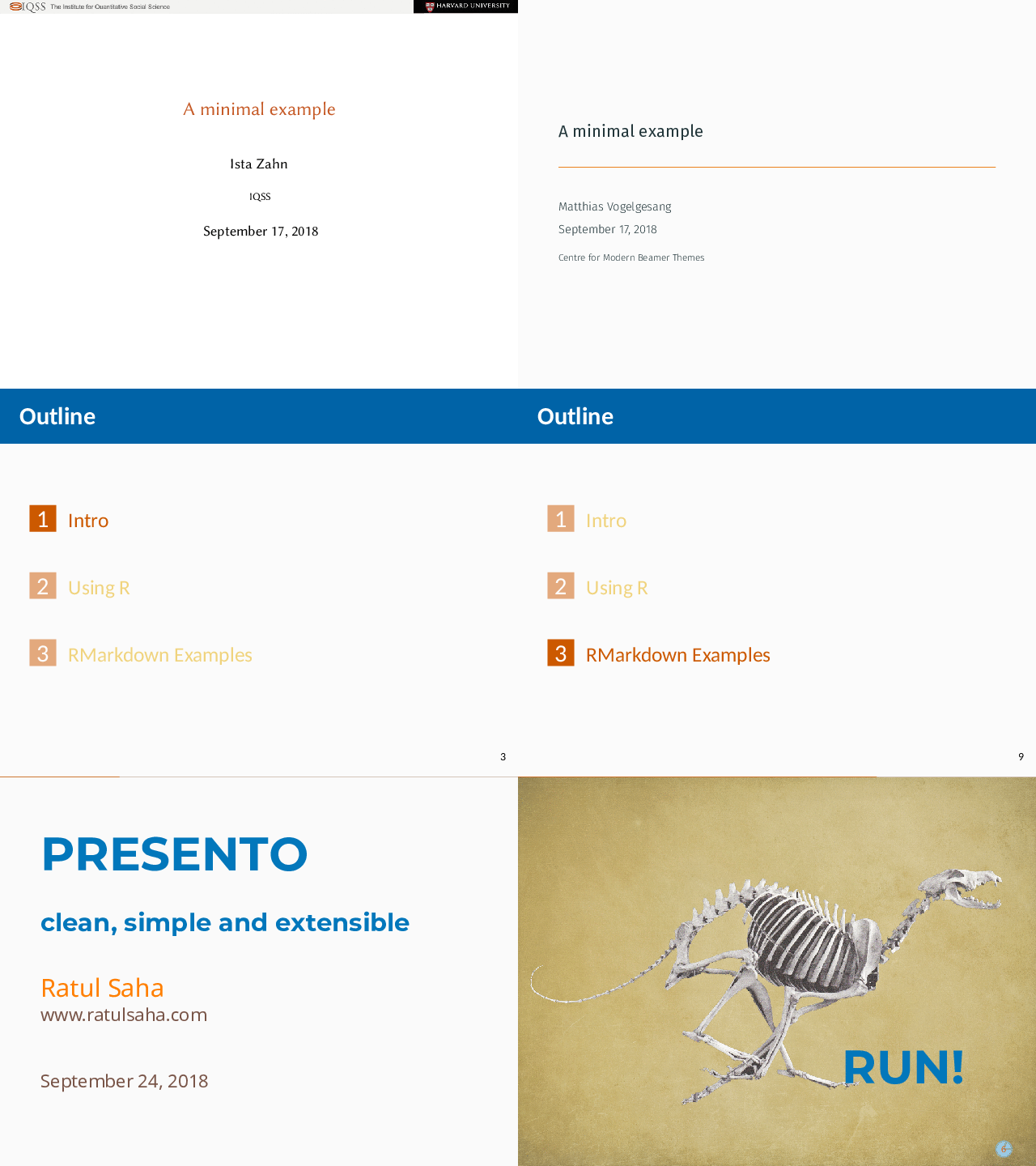
The seventh release of the binb package, and first in four years, is now on CRAN. binb regroups four rather nice themes for writing LaTeX Beamer presentations much more easily in (R)Markdown. As a teaser, a quick demo combining all four themes is available; documentation and examples are in the package. This release contains a CRAN-requested fix for a just-released new pandoc version which deals differently with overflowing bounding boxes from graphics; an added new LaTeX command is needed. We also polished continuous integration and related internals a few times but this does not contain directly user-facing changes in the package.

Changes in binb version 0.0.7 (2024-07-06)
  • Several rounds of small updates to ge continuous integration setup.
  • An additional LaTeX command needed by pandoc (>= 3.2.1) has been added.

CRANberries provides a summary of changes to the previous version. For questions or comments, please use the issue tracker at the GitHub repo. If you like this or other open-source work I do, you can now sponsor me at GitHub.

This post by Dirk Eddelbuettel originated on his Thinking inside the box blog. Please report excessive re-aggregation in third-party for-profit settings.

24 June 2024

Dirk Eddelbuettel: x13binary 1.1.61 on CRAN: Maintenance

The x13binary team is thrilled to share the availability of Release 1.1.61 of the x13binary package providing the X-13ARIMA-SEATS program by the US Census Bureau which arrived on CRAN earlier today. This release brings two updates suggested by the tireless CRAN maintainers. Kurt Hornik suggested to now also ignore stderr when calling the x13 binary via system: it appears that builds under the new-ish and clang-based flang-new now emit on stderr even if Fortran-based binaries did not before. So we adjust. And Brian Ripley pointed out that our Makefile for creating the x13 binary was not quite as is should be, which we adjusted. And I just realized I should have named this 1.1.60-2 to follow the upstream convention but didn t. Next time. Courtesy of my CRANberries, there is also a diffstat report for this release showing changes to the previous release. If you like this or other open-source work I do, you can sponsor me at GitHub.

This post by Dirk Eddelbuettel originated on his Thinking inside the box blog. Please report excessive re-aggregation in third-party for-profit settings.

Dirk Eddelbuettel: digest 0.6.36 on CRAN: Big endian, maintenance

Release 0.6.36 of the digest package arrived at CRAN today and has also been uploaded to Debian. digest creates hash digests of arbitrary R objects. It can use a number different hashing algorithms (md5, sha-1, sha-256, sha-512, crc32, xxhash32, xxhash64, murmur32, spookyhash, blake3,crc32c, xxh3_64 and xxh3_128), and enables easy comparison of (potentially large and nested) R language objects as it relies on the native serialization in R. It is a mature and widely-used package (with 69.1 million downloads just on the partial cloud mirrors of CRAN which keep logs) as many tasks may involve caching of objects for which it provides convenient general-purpose hash key generation to quickly identify the various objects. This release updates one contributed C++ function to be compliant with R s revent preference for explicit declaration of REMAP, and improves the behavior under the (increasingly rare) big endian system via a patch to blake3 as well as a hint that spookyhash under big endian may not meed its reference output from little endian . My CRANberries provides a summary of changes to the previous version. For questions or comments use the issue tracker off the GitHub repo. For documentation (including the changelog) see the documentation site. If you like this or other open-source work I do, you can now sponsor me at GitHub.

This post by Dirk Eddelbuettel originated on his Thinking inside the box blog. Please report excessive re-aggregation in third-party for-profit settings.

21 June 2024

Dirk Eddelbuettel: nanotime 0.3.9 on CRAN: Bugfix

A quick bug fix release 0.3.9 for our nanotime package is now on CRAN, following up on the 0.3.8 release made this week. nanotime relies on the RcppCCTZ package (as well as the RcppDate package for additional C++ operations) and offers efficient high(er) resolution time parsing and formatting up to nanosecond resolution, using the bit64 package for the actual integer64 arithmetic. Initially implemented using the S3 system, it has benefitted greatly from a rigorous refactoring by Leonardo who not only rejigged nanotime internals in S4 but also added new S4 types for periods, intervals and durations. The 0.3.8 release added a accurate parameter for POSIXct conversions, and it turns out that this did not test as expected on arm64 so we disabled the test on that platform. The NEWS snippet below has the full details.

Changes in version 0.3.9 (2024-06-21)
  • Condition two tests to not run on arm64 (Dirk in #129 fixing #128)

Thanks to my CRANberries, there is a diffstat report for this release. More details and examples are at the nanotime page; code, issue tickets etc at the GitHub repository and all documentation is provided at the nanotime documentation site. If you like this or other open-source work I do, you can sponsor me at GitHub.

This post by Dirk Eddelbuettel originated on his Thinking inside the box blog. Please report excessive re-aggregation in third-party for-profit settings.

19 June 2024

Dirk Eddelbuettel: nanotime 0.3.8 on CRAN: More Maintenance

Leonardo and I are happy to annunce that a new version 0.3.8 of our nanotime package arrived on CRAN today. It is the first release in over 1 1/2 years. nanotime relies on the RcppCCTZ package (as well as the RcppDate package for additional C++ operations) and offers efficient high(er) resolution time parsing and formatting up to nanosecond resolution, using the bit64 package for the actual integer64 arithmetic. Initially implemented using the S3 system, it has benefitted greatly from a rigorous refactoring by Leonardo who not only rejigged nanotime internals in S4 but also added new S4 types for periods, intervals and durations. This release responds to a number of enhancements including a new paramter accurate for POSIXct to nanotime conversions, a vector date converter, a switch to double return value when durations objects are dividded as well as a small battery of CRAN requests for changes and updates. This started with a move away from the now non-API function SET_S4_OBJECT which has been replaced by use of Rf_asS4. We also no longer need a custom compiler flag on Windows (where for some reasons nobody understands or remembers, bitfields are not packed) to small enhancements of manual page formatting and last-but-not-least avoidance of some new UBSAN warnings. The NEWS snippet has the full details.

Changes in version 0.3.8 (2024-06-19)
  • Time format documentation now has a reference to RcppCCTZ
  • The package no longer sets a default C++ compilation standard of C++11 (Dirk initially in #114, and later switched to C++17)
  • New accurate parameter for conversion from POSIXct to nanotime (Davor Josipovic and Leonardo in #116 closing #115)
  • The as.Date() function is now vectorized and can take a TZ argument (Leonardo and Dirk in #119 closing #118)
  • Use of internal function SET_S4_OBJECT has been replaced by API function Rf_asS4 (Leonardo in #121 closing #120)
  • An nanoduration / nanoduration expression now returns a double (Leonardo in #122 closing #117)
  • Bitfield calculations no longer require an Windows-only compiler switch (Leonardo in #124)
  • A simple manual page format nag involving has been addressed (Dirk in #126 fixing #125)
  • An set of tests tickling an UBSAN issue via Rcpp code no longer run unless CI is set (Dirk in #127 fixing #123)

Thanks to my CRANberries, there is a diffstat report for this release. More details and examples are at the nanotime page; code, issue tickets etc at the GitHub repository and all documentation is provided at the nanotime documentation site. If you like this or other open-source work I do, you can sponsor me at GitHub.

This post by Dirk Eddelbuettel originated on his Thinking inside the box blog. Please report excessive re-aggregation in third-party for-profit settings.

4 June 2024

Dirk Eddelbuettel: ulid 0.4.0 on CRAN: Extended to Milliseconds

A new version of the ulid package is now on CRAN. The packages provides universally (unique) lexicographically (sortable) identifiers see the spec at GitHub for details on those which offer sorting which uuids lack. The R package provides access via the standard C++ library, had been put together by Bob Rudis and is now maintained by me. Mark Heckmann noticed that a ulid round trip of generating and unmarshalling swallowed subsecond informationm and posted on a well-known site I no longer go to. Duncan Murdoch was kind enough to open an issue to make me aware, and in it included the nice minimally complete verifiable example by Mark. It turns out that this issue was known, documented upstream in two issues and fixed in fork by the authors of those issues, Chris Bove. It replaces time_t as the value of record (constrained at the second resolution) with a proper std::chrono object which offers milliseconds (and much more, yay Modern C++). So I switched the two main files of library to his, and updated the wrapper code to interface from POSIXct to std::chrono object. And with that we are in business. The original example of five ulids create 100 millisecond part, then unmarshalled and here printed as a data.table as data.frame by default truncates to seconds:
> library(ulid)
> gen_ulid <- \(sleep) replicate(5,  Sys.sleep(sleep); generate() )
> u <- gen_ulid(.1)
> df <- unmarshal(u)
> data.table::data.table(df)
                        ts              rnd
                    <POSc>           <char>
1: 2024-05-30 16:38:28.588 CSQAJBPNX75R0G5A
2: 2024-05-30 16:38:28.688 XZX0TREDHD6PC1YR
3: 2024-05-30 16:38:28.789 0YK9GKZVTED27QMK
4: 2024-05-30 16:38:28.890 SC3M3G6KGPH7S50S
5: 2024-05-30 16:38:28.990 TSKCBWJ3TEKCPBY0
>
We updated the documentation accordingly, and added some new tests as well. The NEWS entry for this release follows.

Changes in version 0.4.0 (2024-06-03)
  • Switch two functions to fork by Chris Bove using std::chrono instead of time_t for consistent millisecond resolution (#3 fixing #2)
  • Updated documentation showing consistent millisecond functionality
  • Added unit tests for millisecond functionality

Courtesy of my CRANberries, there is also a diffstat report for this release. If you like this or other open-source work I do, you can sponsor me at GitHub.

This post by Dirk Eddelbuettel originated on his Thinking inside the box blog. Please report excessive re-aggregation in third-party for-profit settings.

31 May 2024

Dirk Eddelbuettel: RcppArmadillo 0.12.8.4.0 on CRAN: Upstream Bugfix

armadillo image Armadillo is a powerful and expressive C++ template library for linear algebra and scientific computing. It aims towards a good balance between speed and ease of use, has a syntax deliberately close to Matlab, and is useful for algorithm development directly in C++, or quick conversion of research code into production environments. RcppArmadillo integrates this library with the R environment and language and is widely used by (currently) 1151 other packages on CRAN, downloaded 34.6 million times (per the partial logs from the cloud mirrors of CRAN), and the CSDA paper (preprint / vignette) by Conrad and myself has been cited 584 times according to Google Scholar. Conrad released a new upstream bugfix yesterday (to improve views of sparse matrices). We uploaded it yesterday too but it once agfain took a day for the hard-working CRAN maintainers to concur that the two NOTEs from reverse-dependency checking over 1100 packages were in a fact false positves. And so it appeared on CRAN earlier today. We also increased the versioned dependency on Rcpp to match the use of optional entry-point headers Rcpp/Light, Rcpp/Lighter and Rcpp/Lightest. No other changes were made. The set of changes since the last CRAN release follows.

Changes in RcppArmadillo version 0.12.8.4.0 (2024-05-30)
  • Upgraded to Armadillo release 12.8.4 (Cortisol Injector)
    • Faster handling of sparse submatrix views
  • Update versioned Depends on Rcpp to 1.0.8 or later to match use of Light/Lighter/Lightest headers.

Courtesy of my CRANberries, there is a diffstat report relative to previous release. More detailed information is on the RcppArmadillo page. Questions, comments etc should go to the rcpp-devel mailing list off the Rcpp R-Forge page. If you like this or other open-source work I do, you can sponsor me at GitHub.

This post by Dirk Eddelbuettel originated on his Thinking inside the box blog. Please report excessive re-aggregation in third-party for-profit settings.

14 May 2024

Dirk Eddelbuettel: RApiSerialize 0.1.3 on CRAN: Skipping XDR

A new bug fix release 0.1.3 of RApiSerialize got onto CRAN earlier today. This is the first release in well over a year, and permits the skip the XDR serialization format which is needed when transfering between big- and little-endian machines. But it comes at a certain run-time cost one can avoid on the (much more common) little-endian machines. This is a new option, and the old behavior is the default. Those who want to can now skip the step. The RApiSerialize package is used by both my RcppRedis as well as by Travers excellent qs package. We also addressed the recent nag by the CRAN concerning NO_REMAP .

Changes in version 0.1.3 (2024-05-13)
  • Add an xdr argument to disable XDR for an approx. threefold speed increase (Travers Ching and Dirk in #6)
  • Use R_NO_REMAP and Rf_* prefix for API calls
  • Minor continuous integration updates

Courtesy of my CRANberries, there is a diffstat report relative to previous release. More details are at the RApiSerialize page; code, issue tickets etc at the GitHub repositoryrapiserializerepo. If you like this or other open-source work I do, you can sponsor me at GitHub.

This post by Dirk Eddelbuettel originated on his Thinking inside the box blog. Please report excessive re-aggregation in third-party for-profit settings.

9 May 2024

Dirk Eddelbuettel: RcppArmadillo 0.12.8.3.0 on CRAN: Upstream Bugfix

armadillo image Armadillo is a powerful and expressive C++ template library for linear algebra and scientific computing. It aims towards a good balance between speed and ease of use, has a syntax deliberately close to Matlab, and is useful for algorithm development directly in C++, or quick conversion of research code into production environments. RcppArmadillo integrates this library with the R environment and language and is widely used by (currently) 1144 other packages on CRAN, downloaded 34.2 million times (per the partial logs from the cloud mirrors of CRAN), and the CSDA paper (preprint / vignette) by Conrad and myself has been cited 583 times according to Google Scholar. Conrad released a new upstream bugfix yesterday (for a corner case with fftw3). We uploaded it yesterday too but it took a day for the hard-working CRAN maintainers to concur that the one (!) NOTE from reverse-dependency checking over 1100 packages was in a fact a false positve. And so it appeared on CRAN (very) early this morning. We also made a change removing a long-redundant setter for C++11 mode via the plugin. No other changes were made. The set of changes since the last CRAN release follows.

Changes in RcppArmadillo version 0.12.8.3.0 (2024-05-07)
  • Upgraded to Armadillo release 12.8.3 (Cortisol Injector)
    • Fix issue in fft() and fft2() in multi-threaded contexts with FFTW3 enabled
  • No longer set C++11 for the Rcpp plugin as this standard has been the default by R for very long time now.

Courtesy of my CRANberries, there is a diffstat report relative to previous release. More detailed information is on the RcppArmadillo page. Questions, comments etc should go to the rcpp-devel mailing list off the Rcpp R-Forge page. If you like this or other open-source work I do, you can sponsor me at GitHub.

This post by Dirk Eddelbuettel originated on his Thinking inside the box blog. Please report excessive re-aggregation in third-party for-profit settings.

1 May 2024

Dirk Eddelbuettel: RcppInt64 0.0.5 on CRAN: Minor Maintenance

The new-ish package RcppInt64 (announced last fall in this post, with three small updates following) arrived on CRAN yesterday as relase 0.0.5. RcppInt64 collects some of the previous conversions between 64-bit integer values in R and C++, and regroups them in a single package. It offers two interfaces: both a more standard as<>() converter from R values along with its companions wrap() to return to R, as well as more dedicated functions from and to . This release addresses an new nag from CRAN who no longer want us to use the non-API header function SET_S4_OBJECT so a small change was made. The brief NEWS entry follows:

Changes in version 0.0.5 (2024-04-30)
  • Minor refactoring of internal code to not rely on SET_S4_OBJECT.

Courtesy of my CRANberries, there is a diffstat report relative to the previous release. If you like this or other open-source work I do, you can sponsor me at GitHub.

This post by Dirk Eddelbuettel originated on his Thinking inside the box blog. Please report excessive re-aggregation in third-party for-profit settings.

27 April 2024

Dirk Eddelbuettel: qlcal 0.0.11 on CRAN: Calendar Updates

The eleventh release of the qlcal package arrivied at CRAN today. qlcal delivers the calendaring parts of QuantLib. It is provided (for the R package) as a set of included files, so the package is self-contained and does not depend on an external QuantLib library (which can be demanding to build). qlcal covers over sixty country / market calendars and can compute holiday lists, its complement (i.e. business day lists) and much more. Examples are in the README at the repository, the package page, and course at the CRAN package page. This releases synchronizes qlcal with the QuantLib release 1.34 and contains more updates to 2024 calendars.

Changes in version 0.0.11 (2024-04-27)
  • Synchronized with QuantLib 1.34
  • Calendar updates for Brazil, India, Singapore, South Africa, Thailand, United States
  • Minor continuous integration update

Courtesy of my CRANberries, there is a diffstat report for this release. See the project page and package documentation for more details, and more examples. If you like this or other open-source work I do, you can sponsor me at GitHub.

This post by Dirk Eddelbuettel originated on his Thinking inside the box blog. Please report excessive re-aggregation in third-party for-profit settings.

26 April 2024

Dirk Eddelbuettel: RcppSpdlog 0.0.17 on CRAN: New Upstream

Version 0.0.17 of RcppSpdlog arrived on CRAN overnight following and has been uploaded to Debian. RcppSpdlog bundles spdlog, a wonderful header-only C++ logging library with all the bells and whistles you would want that was written by Gabi Melman, and also includes fmt by Victor Zverovich. You can learn more at the nice package documention site. This releases updates the code to the version 1.14 of spdlog which was release yesterday. The NEWS entry for this release follows.

Changes in RcppSpdlog version 0.0.17 (2024-04-25)
  • Minor continuous integration update
  • Upgraded to upstream release spdlog 1.14.0

Courtesy of my CRANberries, there is also a diffstat report. More detailed information is on the RcppSpdlog page, or the package documention site. If you like this or other open-source work I do, you can sponsor me at GitHub.

This post by Dirk Eddelbuettel originated on his Thinking inside the box blog. Please report excessive re-aggregation in third-party for-profit settings.

25 April 2024

Dirk Eddelbuettel: RQuantLib 0.4.22 on CRAN: Maintenance

A new minor release 0.4.22 of RQuantLib arrived at CRAN earlier today, and has been uploaded to Debian. QuantLib is a rather comprehensice free/open-source library for quantitative finance. RQuantLib connects (some parts of) it to the R environment and language, and has been part of CRAN for more than twenty years (!!) as it was one of the first packages I uploaded there. This release of RQuantLib updates to QuantLib version 1.34 which was just released yesterday, and deprecates use of an access point / type for price/yield conversion for bonds. We also made two minor earlier changes.

Changes in RQuantLib version 0.4.22 (2024-04-25)
  • Small code cleanup removing duplicate R code
  • Small improvements to C++ compilation flags
  • Robustify internal version comparison to accommodate RC releases
  • Adjustments to two C++ files for QuantLib 1.34

Courtesy of my CRANberries, there is also a diffstat report for the this release. As always, more detailed information is on the RQuantLib page. Questions, comments etc should go to the rquantlib-devel mailing list. Issue tickets can be filed at the GitHub repo. If you like this or other open-source work I do, you can now sponsor me at GitHub.

This post by Dirk Eddelbuettel originated on his Thinking inside the box blog. Please report excessive re-aggregation in third-party for-profit settings.

17 April 2024

Dirk Eddelbuettel: RcppArmadillo 0.12.8.2.1 on CRAN: Micro Fix

armadillo image Armadillo is a powerful and expressive C++ template library for linear algebra and scientific computing. It aims towards a good balance between speed and ease of use, has a syntax deliberately close to Matlab, and is useful for algorithm development directly in C++, or quick conversion of research code into production environments. RcppArmadillo integrates this library with the R environment and language and is widely used by (currently) 1135 other packages on CRAN, downloaded 33.7 million times (per the partial logs from the cloud mirrors of CRAN), and the CSDA paper (preprint / vignette) by Conrad and myself has been cited 579 times according to Google Scholar. Yesterday s release accommodates reticulate by suspending a single test that now croaks creating a reverse-dependency issue for that package. No other changes were made. The set of changes since the last CRAN release follows.

Changes in RcppArmadillo version 0.12.8.2.1 (2024-04-15)
  • One-char bug fix release commenting out one test that upsets reticulate when accessing a scipy sparse matrix

Courtesy of my CRANberries, there is a diffstat report relative to previous release. More detailed information is on the RcppArmadillo page. Questions, comments etc should go to the rcpp-devel mailing list off the Rcpp R-Forge page. If you like this or other open-source work I do, you can sponsor me at GitHub.

This post by Dirk Eddelbuettel originated on his Thinking inside the box blog. Please report excessive re-aggregation in third-party for-profit settings.

5 April 2024

Dirk Eddelbuettel: RcppArmadillo 0.12.8.2.0 on CRAN: Upstream Fix

armadillo image Armadillo is a powerful and expressive C++ template library for linear algebra and scientific computing. It aims towards a good balance between speed and ease of use, has a syntax deliberately close to Matlab, and is useful for algorithm development directly in C++, or quick conversion of research code into production environments. RcppArmadillo integrates this library with the R environment and language and is widely used by (currently) 1136 other packages on CRAN, downloaded 33.5 million times (per the partial logs from the cloud mirrors of CRAN), and the CSDA paper (preprint / vignette) by Conrad and myself has been cited 578 times according to Google Scholar. This release brings a new upstream bugfix release Armadillo 12.8.2 prepared by Conrad two days ago. It took the usual day to noodle over 1100+ reverse dependencies and ensure two failures were independent of the upgrade (i.e., no change to worse in CRAN parlance). It took CRAN another because we hit a random network outage for (spurious) NOTE on a remote URL, and were then caught in the shrapnel from another large package ecosystem update spuriously pointing some build failures that were due to a missing rebuild to us. All good, as human intervention comes to the rescue. The set of changes since the last CRAN release follows.

Changes in RcppArmadillo version 0.12.8.2.0 (2024-04-02)
  • Upgraded to Armadillo release 12.8.2 (Cortisol Injector)
    • Workaround for FFTW3 header clash
    • Workaround in testing framework for issue under macOS
    • Minor cleanups to reduce code bloat
    • Improved documentation

Courtesy of my CRANberries, there is a diffstat report relative to previous release. More detailed information is on the RcppArmadillo page. Questions, comments etc should go to the rcpp-devel mailing list off the Rcpp R-Forge page. If you like this or other open-source work I do, you can sponsor me at GitHub.

This post by Dirk Eddelbuettel originated on his Thinking inside the box blog. Please report excessive re-aggregation in third-party for-profit settings.

2 April 2024

Dirk Eddelbuettel: ulid 0.3.1 on CRAN: New Maintainer, Some Polish

Happy to share that ulid is now (back) on CRAN. It provides universally unique identifiers that are lexicographically sortable, which improves over the more well-known uuid generators. ulid is a neat little package put together by Bob Rudis a few years ago. It had recently drifted off CRAN so I offered to brush it up and re-submit it. And as tooted earlier today, it took just over an hour to finish that (after the lead up work I had done, including prior email with CRAN in the loop, the repo transfer from Bob s to my ulid repo plus of course a wee bit of actual maintenance; see below for more). The NEWS entry follows.

Changes in version 0.3.1 (2024-04-02)
  • New Maintainer
  • Deleted several repository files no longer used or needed
  • Added .editorconfig, ChangeLog and cleanup
  • Converted NEWS.md to NEWS.Rd
  • Simplified R/ directory to one source file
  • Simplified src/ removing redundant Makevars
  • Added ulid() alias
  • Updated / edited roxygen and README.md documention
  • Removed vignette which was identical to README.md
  • Switched continuous integration to GitHub Actions
  • Placed upstream (header-only) library into src/ulid/
  • Renamed single interface file to src/wrapper

If you like this or other open-source work I do, you can sponsor me at GitHub.

This post by Dirk Eddelbuettel originated on his Thinking inside the box blog. Please report excessive re-aggregation in third-party for-profit settings.

23 March 2024

Dirk Eddelbuettel: littler 0.3.20 on CRAN: Moar Features!

max-heap image The twentyfirst release of littler as a CRAN package landed on CRAN just now, following in the now eighteen year history (!!) as a package started by Jeff in 2006, and joined by me a few weeks later. littler is the first command-line interface for R as it predates Rscript. It allows for piping as well for shebang scripting via #!, uses command-line arguments more consistently and still starts faster. It also always loaded the methods package which Rscript only began to do in recent years. littler lives on Linux and Unix, has its difficulties on macOS due to yet-another-braindeadedness there (who ever thought case-insensitive filesystems as a default were a good idea?) and simply does not exist on Windows (yet the build system could be extended see RInside for an existence proof, and volunteers are welcome!). See the FAQ vignette on how to add it to your PATH. A few examples are highlighted at the Github repo:, as well as in the examples vignette. This release contains another fair number of small changes and improvements to some of the scripts I use daily to build or test packages, adds a new front-end ciw.r for the recently-released ciw package offering a CRAN Incoming Watcher , a new helper installDeps2.r (extending installDeps.r), a new doi-to-bib converter, allows a different temporary directory setup I find helpful, deals with one corner deployment use, and more. The full change description follows.

Changes in littler version 0.3.20 (2024-03-23)
  • Changes in examples scripts
    • New (dependency-free) helper installDeps2.r to install dependencies
    • Scripts rcc.r, tt.r, tttf.r, tttlr.r use env argument -S to set -t to r
    • tt.r can now fill in inst/tinytest if it is present
    • New script ciw.r wrapping new package ciw
    • tttf.t can now use devtools and its loadall
    • New script doi2bib.r to call the DOI converter REST service (following a skeet by Richard McElreath)
  • Changes in package
    • The CI setup uses checkout@v4 and the r-ci-setup action
    • The Suggests: is a little tighter as we do not list all packages optionally used in the the examples (as R does not check for it either)
    • The package load messag can account for the rare build of R under different architecture (Berwin Turlach in #117 closing #116)
    • In non-vanilla mode, the temporary directory initialization in re-run allowing for a non-standard temp dir via config settings

My CRANberries service provides a comparison to the previous release. Full details for the littler release are provided as usual at the ChangeLog page, and also on the package docs website. The code is available via the GitHub repo, from tarballs and now of course also from its CRAN page and via install.packages("littler"). Binary packages are available directly in Debian as well as (in a day or two) Ubuntu binaries at CRAN thanks to the tireless Michael Rutter. Comments and suggestions are welcome at the GitHub repo. If you like this or other open-source work I do, you can sponsor me at GitHub.

This post by Dirk Eddelbuettel originated on his Thinking inside the box blog. Please report excessive re-aggregation in third-party for-profit settings.

Next.

Previous.