Search Results: "Chris Lamb"

11 February 2022

Reproducible Builds (diffoscope): diffoscope 204 released

The diffoscope maintainers are pleased to announce the release of diffoscope version 204. This version includes the following changes:
[ Chris Lamb ]
* Don't run the binwalk comparator tests as root (or fakeroot) as the
  latest version of binwalk has some security protection against doing
  precisely this.
* If we fail to scan a file using binwalk, return 'False' from
  BinwalkFile.recognizes rather than raise a traceback.
* If we fail to import the Python "binwalk" module, don't accidentally report
  that we are missing the "rpm" module instead.
[ Mattia Rizzolo ]
* Use dependencies to ensure that "diffoscope" and "diffoscope-minimal"
  packages always have the precise same version.
You find out more by visiting the project homepage.

5 February 2022

Reproducible Builds: Reproducible Builds in January 2022

Welcome to the January 2022 report from the Reproducible Builds project. In our reports, we try outline the most important things that have been happening in the past month. As ever, if you are interested in contributing to the project, please visit our Contribute page on our website.
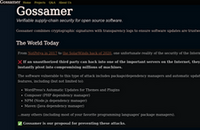
An interesting blog post was published by Paragon Initiative Enterprises about Gossamer, a proposal for securing the PHP software supply-chain. Utilising code-signing and third-party attestations, Gossamer aims to mitigate the risks within the notorious PHP world via publishing attestations to a transparency log. Their post, titled Solving Open Source Supply Chain Security for the PHP Ecosystem goes into some detail regarding the design, scope and implementation of the system.
This month, the Linux Foundation announced SupplyChainSecurityCon, a conference focused on exploring the security threats affecting the software supply chain, sharing best practices and mitigation tactics. The conference is part of the Linux Foundation s Open Source Summit North America and will take place June 21st 24th 2022, both virtually and in Austin, Texas.

Debian There was a significant progress made in the Debian Linux distribution this month, including:

Other distributions kpcyrd reported on Twitter about the release of version 0.2.0 of pacman-bintrans, an experiment with binary transparency for the Arch Linux package manager, pacman. This new version is now able to query rebuilderd to check if a package was independently reproduced.
In the world of openSUSE, however, Bernhard M. Wiedemann posted his monthly reproducible builds status report.

diffoscope diffoscope is our in-depth and content-aware diff utility. Not only can it locate and diagnose reproducibility issues, it can provide human-readable diffs from many kinds of binary formats. This month, Chris Lamb prepared and uploaded versions 199, 200, 201 and 202 to Debian unstable (that were later backported to Debian bullseye-backports by Mattia Rizzolo), as well as made the following changes to the code itself:
  • New features:
    • First attempt at incremental output support with a timeout. Now passing, for example, --timeout=60 will mean that diffoscope will not recurse into any sub-archives after 60 seconds total execution time has elapsed. Note that this is not a fixed/strict timeout due to implementation issues. [ ][ ]
    • Support both variants of odt2txt, including the one provided by the unoconv package. [ ]
  • Bug fixes:
    • Do not return with a UNIX exit code of 0 if we encounter with a file whose human-readable metadata matches literal file contents. [ ]
    • Don t fail if comparing a nonexistent file with a .pyc file (and add test). [ ][ ]
    • If the debian.deb822 module raises any exception on import, re-raise it as an ImportError. This should fix diffoscope on some Fedora systems. [ ]
    • Even if a Sphinx .inv inventory file is labelled The remainder of this file is compressed using zlib, it might not actually be. In this case, don t traceback and simply return the original content. [ ]
  • Documentation:
    • Improve documentation for the new --timeout option due to a few misconceptions. [ ]
    • Drop reference in the manual page claiming the ability to compare non-existent files on the command-line. (This has not been possible since version 32 which was released in September 2015). [ ]
    • Update X has been modified after NT_GNU_BUILD_ID has been applied messages to, for example, not duplicating the full filename in the diffoscope output. [ ]
  • Codebase improvements:
    • Tidy some control flow. [ ]
    • Correct a recompile typo. [ ]
In addition, Alyssa Ross fixed the comparison of CBFS names that contain spaces [ ], Sergei Trofimovich fixed whitespace for compatibility with version 21.12 of the Black source code reformatter [ ] and Zbigniew J drzejewski-Szmek fixed JSON detection with a new version of file [ ].

Testing framework The Reproducible Builds project runs a significant testing framework at tests.reproducible-builds.org, to check packages and other artifacts for reproducibility. This month, the following changes were made:
  • Fr d ric Pierret (fepitre):
    • Add Debian bookworm to package set creation. [ ]
  • Holger Levsen:
    • Install the po4a package where appropriate, as it is needed for the Reproducible Builds website job [ ]. In addition, also run the i18n.sh and contributors.sh scripts [ ].
    • Correct some grammar in Debian live image build output. [ ]
    • Shell monitor improvements:
      • Only show the offline node section if there are offline nodes. [ ]
      • Colorise offline nodes. [ ]
      • Shrink screen usage. [ ][ ][ ]
    • Node health check improvements:
      • Detect if live package builds encounter incomplete snapshots. [ ][ ][ ]
      • Detect if a host is running with today s date (when it should be set artificially in the future). [ ]
    • Use the devscripts package from bullseye-backports on Debian nodes. [ ]
    • Use the Munin monitoring package bullseye-backports on Debian nodes too. [ ]
    • Update New Year handling, needed to be able to detect real and fake dates. [ ][ ]
    • Improve the error message of the script that powercycles the arm64 architecture nodes hosted by Codethink. [ ]
  • Mattia Rizzolo:
    • Use the new --timeout option added in diffoscope version 202. [ ]
  • Roland Clobus:
    • Update the build scripts now that the hooks for live builds are now maintained upstream in the live-build repository. [ ]
    • Show info lines in Jenkins when reproducible hooks have been active. [ ]
    • Use unique folders for the artifacts from each live Debian version. [ ]
  • Vagrant Cascadian:
    • Switch the Debian armhf architecture nodes to use new proxy. [ ]
    • Misc. node maintenance. [ ].

Upstream patches The Reproducible Builds project attempts to fix as many currently-unreproducible packages as possible. In January, we wrote a large number of such patches, including:

And finally If you are interested in contributing to the Reproducible Builds project, please visit our Contribute page on our website. However, you can get in touch with us via:

4 February 2022

Reproducible Builds (diffoscope): diffoscope 203 released

The diffoscope maintainers are pleased to announce the release of diffoscope version 203. This version includes the following changes:
[ Chris Lamb ]
* Improve documentation for --timeout due to a few misconceptions.
  Add an allowed-to-fail test regarding a regression in directory handling.
* Tidy control flow in Difference._reverse_self a little.
[ Alyssa Ross ]
* Fix diffing CBFS names that contain spaces.
You find out more by visiting the project homepage.

28 January 2022

Reproducible Builds (diffoscope): diffoscope 202 released

The diffoscope maintainers are pleased to announce the release of diffoscope version 202. This version includes the following changes:
[ Chris Lamb ]
* Don't fail if comparing a nonexistent file with a .pyc file (and add test).
  (Closes: #1004312)
* Drop a reference in the manual page which claims the ability to compare
  non-existent files on the command-line. This has not been possible since
  version 32 which was released in September 2015. (Closes: #1004182)
* Add experimental support for incremental output support with a timeout.
  Passing, for example, --timeout=60 will mean that diffoscope will not
  recurse into any sub-archives after 60 seconds total execution time has
  elapsed and mark the diff as being incomplete. (Note that this is not a
  fixed/strict timeout due to implementation issues.)
  (Closes: reproducible-builds/diffoscope#301)
* Don't return with an exit code of 0 if we encounter device file such as
  /dev/stdin with human-readable metadata that matches literal, non-device,
  file contents. (Closes: #1004198)
* Correct a "recompile" typo.
[ Sergei Trofimovich ]
* Fix/update whitespace for Black 21.12.
You find out more by visiting the project homepage.

21 January 2022

Reproducible Builds (diffoscope): diffoscope 201 released

The diffoscope maintainers are pleased to announce the release of diffoscope version 201. This version includes the following changes:
[ Chris Lamb ]
* If the debian.deb822 module raises any exception on import, re-raise it as
  an ImportError instead. This should fix diffoscope on some Fedora systems.
  Thanks to Mattia Rizzolo for suggesting this particular solution.
  (Closes: reproducible-builds/diffoscope#300)
[ Zbigniew J drzejewski-Szmek ]
* Fix json detection with file-5.41-3.fc36.x86_64.
You find out more by visiting the project homepage.

16 January 2022

Chris Lamb: Favourite films of 2021

In my four most recent posts, I went over the memoirs and biographies, the non-fiction, the fiction and the 'classic' novels that I enjoyed reading the most in 2021. But in the very last of my 2021 roundup posts, I'll be going over some of my favourite movies. (Saying that, these are perhaps less of my 'favourite films' than the ones worth remarking on after all, nobody needs to hear that The Godfather is a good movie.) It's probably helpful to remark you that I took a self-directed course in film history in 2021, based around the first volume of Roger Ebert's The Great Movies. This collection of 100-odd movie essays aims to make a tour of the landmarks of the first century of cinema, and I watched all but a handul before the year was out. I am slowly making my way through volume two in 2022. This tome was tremendously useful, and not simply due to the background context that Ebert added to each film: it also brought me into contact with films I would have hardly come through some other means. Would I have ever discovered the sly comedy of Trouble in Paradise (1932) or the touching proto-realism of L'Atalante (1934) any other way? It also helped me to 'get around' to watching films I may have put off watching forever the influential Battleship Potemkin (1925), for instance, and the ur-epic Lawrence of Arabia (1962) spring to mind here. Choosing a 'worst' film is perhaps more difficult than choosing the best. There are first those that left me completely dry (Ready or Not, Written on the Wind, etc.), and those that were simply poorly executed. And there are those that failed to meet their own high opinions of themselves, such as the 'made for Reddit' Tenet (2020) or the inscrutable Vanilla Sky (2001) the latter being an almost perfect example of late-20th century cultural exhaustion. But I must save my most severe judgement for those films where I took a visceral dislike how their subjects were portrayed. The sexually problematic Sixteen Candles (1984) and the pseudo-Catholic vigilantism of The Boondock Saints (1999) both spring to mind here, the latter of which combines so many things I dislike into such a short running time I'd need an entire essay to adequately express how much I disliked it.

Dogtooth (2009) A father, a mother, a brother and two sisters live in a large and affluent house behind a very high wall and an always-locked gate. Only the father ever leaves the property, driving to the factory that he happens to own. Dogtooth goes far beyond any allusion to Josef Fritzl's cellar, though, as the children's education is a grotesque parody of home-schooling. Here, the parents deliberately teach their children the wrong meaning of words (e.g. a yellow flower is called a 'zombie'), all of which renders the outside world utterly meaningless and unreadable, and completely mystifying its very existence. It is this creepy strangeness within a 'regular' family unit in Dogtooth that is both socially and epistemically horrific, and I'll say nothing here of its sexual elements as well. Despite its cold, inscrutable and deadpan surreality, Dogtooth invites all manner of potential interpretations. Is this film about the artificiality of the nuclear family that the West insists is the benchmark of normality? Or is it, as I prefer to believe, something more visceral altogether: an allegory for the various forms of ontological violence wrought by fascism, as well a sobering nod towards some of fascism's inherent appeals? (Perhaps it is both. In 1972, French poststructuralists Gilles and F lix Guattari wrote Anti-Oedipus, which plays with the idea of the family unit as a metaphor for the authoritarian state.) The Greek-language Dogtooth, elegantly shot, thankfully provides no easy answers.

Holy Motors (2012) There is an infamous scene in Un Chien Andalou, the 1929 film collaboration between Luis Bu uel and famed artist Salvador Dal . A young woman is cornered in her own apartment by a threatening man, and she reaches for a tennis racquet in self-defence. But the man suddenly picks up two nearby ropes and drags into the frame two large grand pianos... each leaden with a dead donkey, a stone tablet, a pumpkin and a bewildered priest. This bizarre sketch serves as a better introduction to Leos Carax's Holy Motors than any elementary outline of its plot, which ostensibly follows 24 hours in the life of a man who must play a number of extremely diverse roles around Paris... all for no apparent reason. (And is he even a man?) Surrealism as an art movement gets a pretty bad wrap these days, and perhaps justifiably so. But Holy Motors and Un Chien Andalou serve as a good reminder that surrealism can be, well, 'good, actually'. And if not quite high art, Holy Motors at least demonstrates that surrealism can still unnerving and hilariously funny. Indeed, recalling the whimsy of the plot to a close friend, the tears of laughter came unbidden to my eyes once again. ("And then the limousines...!") Still, it is unclear how Holy Motors truly refreshes surrealism for the twenty-first century. Surrealism was, in part, a reaction to the mechanical and unfeeling brutality of World War I and ultimately sought to release the creative potential of the unconscious mind. Holy Motors cannot be responding to another continental conflagration, and so it appears to me to be some kind of commentary on the roles we exhibit in an era of 'post-postmodernity': a sketch on our age of performative authenticity, perhaps, or an idle doodle on the function and psychosocial function of work. Or perhaps not. After all, this film was produced in a time that offers the near-universal availability of mind-altering substances, and this certainly changes the context in which this film was both created. And, how can I put it, was intended to be watched.

Manchester by the Sea (2016) An absolutely devastating portrayal of a character who is unable to forgive himself and is hesitant to engage with anyone ever again. It features a near-ideal balance between portraying unrecoverable anguish and tender warmth, and is paradoxically grandiose in its subtle intimacy. The mechanics of life led me to watch this lying on a bed in a chain hotel by Heathrow Airport, and if this colourless circumstance blunted the film's emotional impact on me, I am probably thankful for it. Indeed, I find myself reduced in this review to fatuously recalling my favourite interactions instead of providing any real commentary. You could write a whole essay about one particular incident: its surfaces, subtexts and angles... all despite nothing of any substance ever being communicated. Truly stunning.

McCabe & Mrs. Miller (1971) Roger Ebert called this movie one of the saddest films I have ever seen, filled with a yearning for love and home that will not ever come. But whilst it is difficult to disagree with his sentiment, Ebert's choice of sad is somehow not quite the right word. Indeed, I've long regretted that our dictionaries don't have more nuanced blends of tragedy and sadness; perhaps the Ancient Greeks can loan us some. Nevertheless, the plot of this film is of a gambler and a prostitute who become business partners in a new and remote mining town called Presbyterian Church. However, as their town and enterprise booms, it comes to the attention of a large mining corporation who want to bully or buy their way into the action. What makes this film stand out is not the plot itself, however, but its mood and tone the town and its inhabitants seem to be thrown together out of raw lumber, covered alternatively in mud or frozen ice, and their days (and their personalities) are both short and dark in equal measure. As a brief aside, if you haven't seen a Roger Altman film before, this has all the trappings of being a good introduction. As Ebert went on to observe: This is not the kind of movie where the characters are introduced. They are all already here. Furthermore, we can see some of Altman's trademark conversations that overlap, a superb handling of ensemble casts, and a quietly subversive view of the tyranny of 'genre'... and the latter in a time when the appetite for revisionist portrays of the West was not very strong. All of these 'Altmanian' trademarks can be ordered in much stronger measures in his later films: in particular, his comedy-drama Nashville (1975) has 24 main characters, and my jejune interpretation of Gosford Park (2001) is that it is purposefully designed to poke fun those who take a reductionist view of 'genre', or at least on the audience's expectations. (In this case, an Edwardian-era English murder mystery in the style of Agatha Christie, but where no real murder or detection really takes place.) On the other hand, McCabe & Mrs. Miller is actually a poor introduction to Altman. The story is told in a suitable deliberate and slow tempo, and the two stars of the film are shown thoroughly defrocked of any 'star status', in both the visual and moral dimensions. All of these traits are, however, this film's strength, adding up to a credible, fascinating and riveting portrayal of the old West.

Detour (1945) Detour was filmed in less than a week, and it's difficult to decide out of the actors and the screenplay which is its weakest point.... Yet it still somehow seemed to drag me in. The plot revolves around luckless Al who is hitchhiking to California. Al gets a lift from a man called Haskell who quickly falls down dead from a heart attack. Al quickly buries the body and takes Haskell's money, car and identification, believing that the police will believe Al murdered him. An unstable element is soon introduced in the guise of Vera, who, through a set of coincidences that stretches credulity, knows that this 'new' Haskell (ie. Al pretending to be him) is not who he seems. Vera then attaches herself to Al in order to blackmail him, and the world starts to spin out of his control. It must be understood that none of this is executed very well. Rather, what makes Detour so interesting to watch is that its 'errors' lend a distinctively creepy and unnatural hue to the film. Indeed, in the early twentieth century, Sigmund Freud used the word unheimlich to describe the experience of something that is not simply mysterious, but something creepy in a strangely familiar way. This is almost the perfect description of watching Detour its eerie nature means that we are not only frequently second-guessed about where the film is going, but are often uncertain whether we are watching the usual objective perspective offered by cinema. In particular, are all the ham-fisted segues, stilted dialogue and inscrutable character motivations actually a product of Al inventing a story for the viewer? Did he murder Haskell after all, despite the film 'showing' us that Haskell died of natural causes? In other words, are we watching what Al wants us to believe? Regardless of the answers to these questions, the film succeeds precisely because of its accidental or inadvertent choices, so it is an implicit reminder that seeking the director's original intention in any piece of art is a complete mirage. Detour is certainly not a good film, but it just might be a great one. (It is a short film too, and, out of copyright, it is available online for free.)

Safe (1995) Safe is a subtly disturbing film about an upper-middle-class housewife who begins to complain about vague symptoms of illness. Initially claiming that she doesn't feel right, Carol starts to have unexplained headaches, a dry cough and nosebleeds, and eventually begins to have trouble breathing. Carol's family doctor treats her concerns with little care, and suggests to her husband that she sees a psychiatrist. Yet Carol's episodes soon escalate. For example, as a 'homemaker' and with nothing else to occupy her, Carol's orders a new couch for a party. But when the store delivers the wrong one (although it is not altogether clear that they did), Carol has a near breakdown. Unsure where to turn, an 'allergist' tells Carol she has "Environmental Illness," and so Carol eventually checks herself into a new-age commune filled with alternative therapies. On the surface, Safe is thus a film about the increasing about of pesticides and chemicals in our lives, something that was clearly felt far more viscerally in the 1990s. But it is also a film about how lack of genuine healthcare for women must be seen as a critical factor in the rise of crank medicine. (Indeed, it made for something of an uncomfortable watch during the coronavirus lockdown.) More interestingly, however, Safe gently-yet-critically examines the psychosocial causes that may be aggravating Carol's illnesses, including her vacant marriage, her hollow friends and the 'empty calorie' stimulus of suburbia. None of this should be especially new to anyone: the gendered Victorian term 'hysterical' is often all but spoken throughout this film, and perhaps from the very invention of modern medicine, women's symptoms have often regularly minimised or outright dismissed. (Hilary Mantel's 2003 memoir, Giving Up the Ghost is especially harrowing on this.) As I opened this review, the film is subtle in its messaging. Just to take one example from many, the sound of the cars is always just a fraction too loud: there's a scene where a group is eating dinner with a road in the background, and the total effect can be seen as representing the toxic fumes of modernity invading our social lives and health. I won't spoiler the conclusion of this quietly devasting film, but don't expect a happy ending.

The Driver (1978) Critics grossly misunderstood The Driver when it was first released. They interpreted the cold and unemotional affect of the characters with the lack of developmental depth, instead of representing their dissociation from the society around them. This reading was encouraged by the fact that the principal actors aren't given real names and are instead known simply by their archetypes instead: 'The Driver', 'The Detective', 'The Player' and so on. This sort of quasi-Jungian erudition is common in many crime films today (Reservoir Dogs, Kill Bill, Layer Cake, Fight Club), so the critics' misconceptions were entirely reasonable in 1978. The plot of The Driver involves the eponymous Driver, a noted getaway driver for robberies in Los Angeles. His exceptional talent has far prevented him from being captured thus far, so the Detective attempts to catch the Driver by pardoning another gang if they help convict the Driver via a set-up robbery. To give himself an edge, however, The Driver seeks help from the femme fatale 'Player' in order to mislead the Detective. If this all sounds eerily familiar, you would not be far wrong. The film was essentially remade by Nicolas Winding Refn as Drive (2011) and in Edgar Wright's 2017 Baby Driver. Yet The Driver offers something that these neon-noir variants do not. In particular, the car chases around Los Angeles are some of the most captivating I've seen: they aren't thrilling in the sense of tyre squeals, explosions and flying boxes, but rather the vehicles come across like wild animals hunting one another. This feels especially so when the police are hunting The Driver, which feels less like a low-stakes game of cat and mouse than a pack of feral animals working together a gang who will tear apart their prey if they find him. In contrast to the undercar neon glow of the Fast & Furious franchise, the urban realism backdrop of the The Driver's LA metropolis contributes to a sincere feeling of artistic fidelity as well. To be sure, most of this is present in the truly-excellent Drive, where the chase scenes do really communicate a credible sense of stakes. But the substitution of The Driver's grit with Drive's soft neon tilts it slightly towards that common affliction of crime movies: style over substance. Nevertheless, I can highly recommend watching The Driver and Drive together, as it can tell you a lot about the disconnected socioeconomic practices of the 1980s compared to the 2010s. More than that, however, the pseudo-1980s synthwave soundtrack of Drive captures something crucial to analysing the world of today. In particular, these 'sounds from the past filtered through the present' bring to mind the increasing role of nostalgia for lost futures in the culture of today, where temporality and pop culture references are almost-exclusively citational and commemorational.

The Souvenir (2019) The ostensible outline of this quietly understated film follows a shy but ambitious film student who falls into an emotionally fraught relationship with a charismatic but untrustworthy older man. But that doesn't quite cover the plot at all, for not only is The Souvenir a film about a young artist who is inspired, derailed and ultimately strengthened by a toxic relationship, it is also partly a coming-of-age drama, a subtle portrait of class and, finally, a film about the making of a film. Still, one of the geniuses of this truly heartbreaking movie is that none of these many elements crowds out the other. It never, ever feels rushed. Indeed, there are many scenes where the camera simply 'sits there' and quietly observes what is going on. Other films might smother themselves through references to 18th-century oil paintings, but The Souvenir somehow evades this too. And there's a certain ring of credibility to the story as well, no doubt in part due to the fact it is based on director Joanna Hogg's own experiences at film school. A beautifully observed and multi-layered film; I'll be happy if the sequel is one-half as good.

The Wrestler (2008) Randy 'The Ram' Robinson is long past his prime, but he is still rarin' to go in the local pro-wrestling circuit. Yet after a brutal beating that seriously threatens his health, Randy hangs up his tights and pursues a serious relationship... and even tries to reconnect with his estranged daughter. But Randy can't resist the lure of the ring, and readies himself for a comeback. The stage is thus set for Darren Aronofsky's The Wrestler, which is essentially about what drives Randy back to the ring. To be sure, Randy derives much of his money from wrestling as well as his 'fitness', self-image, self-esteem and self-worth. Oh, it's no use insisting that wrestling is fake, for the sport is, needless to say, Randy's identity; it's not for nothing that this film is called The Wrestler. In a number of ways, The Sound of Metal (2019) is both a reaction to (and a quiet remake of) The Wrestler, if only because both movies utilise 'cool' professions to explore such questions of identity. But perhaps simply when The Wrestler was produced makes it the superior film. Indeed, the role of time feels very important for the Wrestler. In the first instance, time is clearly taking its toll on Randy's body, but I felt it more strongly in the sense this was very much a pre-2008 film, released on the cliff-edge of the global financial crisis, and the concomitant precarity of the 2010s. Indeed, it is curious to consider that you couldn't make The Wrestler today, although not because the relationship to work has changed in any fundamentalway. (Indeed, isn't it somewhat depressing the realise that, since the start of the pandemic and the 'work from home' trend to one side, we now require even more people to wreck their bodies and mental health to cover their bills?) No, what I mean to say here is that, post-2016, you cannot portray wrestling on-screen without, how can I put it, unwelcome connotations. All of which then reminds me of Minari's notorious red hat... But I digress. The Wrestler is a grittily stark darkly humorous look into the life of a desperate man and a sorrowful world, all through one tragic profession.

Thief (1981) Frank is an expert professional safecracker and specialises in high-profile diamond heists. He plans to use his ill-gotten gains to retire from crime and build a life for himself with a wife and kids, so he signs on with a top gangster for one last big score. This, of course, could be the plot to any number of heist movies, but Thief does something different. Similar to The Wrestler and The Driver (see above) and a number of other films that I watched this year, Thief seems to be saying about our relationship to work and family in modernity and postmodernity. Indeed, the 'heist film', we are told, is an understudied genre, but part of the pleasure of watching these films is said to arise from how they portray our desired relationship to work. In particular, Frank's desire to pull off that last big job feels less about the money it would bring him, but a displacement from (or proxy for) fulfilling some deep-down desire to have a family or indeed any relationship at all. Because in theory, of course, Frank could enter into a fulfilling long-term relationship right away, without stealing millions of dollars in diamonds... but that's kinda the entire point: Frank needing just one more theft is an excuse to not pursue a relationship and put it off indefinitely in favour of 'work'. (And being Federal crimes, it also means Frank cannot put down meaningful roots in a community.) All this is communicated extremely subtly in the justly-lauded lowkey diner scene, by far the best scene in the movie. The visual aesthetic of Thief is as if you set The Warriors (1979) in a similarly-filthy Chicago, with the Xenophon-inspired plot of The Warriors replaced with an almost deliberate lack of plot development... and the allure of The Warriors' fantastical criminal gangs (with their alluringly well-defined social identities) substituted by a bunch of amoral individuals with no solidarity beyond the immediate moment. A tale of our time, perhaps. I should warn you that the ending of Thief is famously weak, but this is a gritty, intelligent and strangely credible heist movie before you get there.

Uncut Gems (2019) The most exhausting film I've seen in years; the cinematic equivalent of four cups of double espresso, I didn't even bother even trying to sleep after downing Uncut Gems late one night. Directed by the two Safdie Brothers, it often felt like I was watching two films that had been made at the same time. (Or do I mean two films at 2X speed?) No, whatever clumsy metaphor you choose to adopt, the unavoidable effect of this film's finely-tuned chaos is an uncompromising and anxiety-inducing piece of cinema. The plot follows Howard as a man lost to his countless vices mostly gambling with a significant side hustle in adultery, but you get the distinct impression he would be happy with anything that will give him another high. A true junkie's junkie, you might say. You know right from the beginning it's going to end in some kind of disaster, the only question remaining is precisely how and what. Portrayed by an (almost unrecognisable) Adam Sandler, there's an uncanny sense of distance in the emotional chasm between 'Sandler-as-junkie' and 'Sandler-as-regular-star-of-goofy-comedies'. Yet instead of being distracting and reducing the film's affect, this possibly-deliberate intertextuality somehow adds to the masterfully-controlled mayhem. My heart races just at the memory. Oof.

Woman in the Dunes (1964) I ended up watching three films that feature sand this year: Denis Villeneuve's Dune (2021), Lawrence of Arabia (1962) and Woman in the Dunes. But it is this last 1964 film by Hiroshi Teshigahara that will stick in my mind in the years to come. Sure, there is none of the Medician intrigue of Dune or the Super Panavision-70 of Lawrence of Arabia (or its quasi-orientalist score, itself likely stolen from Anton Bruckner's 6th Symphony), but Woman in the Dunes doesn't have to assert its confidence so boldly, and it reveals the enormity of its plot slowly and deliberately instead. Woman in the Dunes never rushes to get to the film's central dilemma, and it uncovers its terror in little hints and insights, all whilst establishing the daily rhythm of life. Woman in the Dunes has something of the uncanny horror as Dogtooth (see above), as well as its broad range of potential interpretations. Both films permit a wide array of readings, without resorting to being deliberately obscurantist or being just plain random it is perhaps this reason why I enjoyed them so much. It is true that asking 'So what does the sand mean?' sounds tediously sophomoric shorn of any context, but it somehow applies to this thoughtfully self-contained piece of cinema.

A Quiet Place (2018) Although A Quiet Place was not actually one of the best films I saw this year, I'm including it here as it is certainly one of the better 'mainstream' Hollywood franchises I came across. Not only is the film very ably constructed and engages on a visceral level, I should point out that it is rare that I can empathise with the peril of conventional horror movies (and perhaps prefer to focus on its cultural and political aesthetics), but I did here. The conceit of this particular post-apocalyptic world is that a family is forced to live in almost complete silence while hiding from creatures that hunt by sound alone. Still, A Quiet Place engages on an intellectual level too, and this probably works in tandem with the pure 'horrorific' elements and make it stick into your mind. In particular, and to my mind at least, A Quiet Place a deeply American conservative film below the surface: it exalts the family structure and a certain kind of sacrifice for your family. (The music often had a passacaglia-like strain too, forming a tombeau for America.) Moreover, you survive in this dystopia by staying quiet that is to say, by staying stoic suggesting that in the wake of any conflict that might beset the world, the best thing to do is to keep quiet. Even communicating with your loved ones can be deadly to both of you, so not emote, acquiesce quietly to your fate, and don't, whatever you do, speak up. (Or join a union.) I could go on, but The Quiet Place is more than this. It's taut and brief, and despite cinema being an increasingly visual medium, it encourages its audience to develop a new relationship with sound.

7 January 2022

Reproducible Builds (diffoscope): diffoscope 199 released

The diffoscope maintainers are pleased to announce the release of diffoscope version 199. This version includes the following changes:
[ Chris Lamb ]
* Support both variants of "odt2txt", including the one provided by unoconv.
  (Closes: reproducible-builds/diffoscope#298)
[ Jelle van der Waa ]
* Add external tool reference on Arch Linux for xb-tool.
You find out more by visiting the project homepage.

5 January 2022

Reproducible Builds: Reproducible Builds in December 2021

Welcome to the December 2021 report from the Reproducible Builds project! In these reports, we try and summarise what we have been up to over the past month, as well as what else has been occurring in the world of software supply-chain security. As a quick recap of what reproducible builds is trying to address, whilst anyone may inspect the source code of free software for malicious flaws, almost all software is distributed to end users as pre-compiled binaries. The motivation behind the reproducible builds effort is to ensure no flaws have been introduced during this compilation process by promising identical results are always generated from a given source, thus allowing multiple third-parties to come to a consensus on whether a build was compromised. As always, if you would like to contribute to the project, please get in touch with us directly or visit the Contribute page on our website.
Early in December, Julien Voisin blogged about setting up a rebuilderd instance in order to reproduce Tails images. Working on previous work from 2018, Julien has now set up a public-facing instance which is providing build attestations. As Julien dryly notes in his post, Currently, this isn t really super-useful to anyone, except maybe some Tails developers who want to check that the release manager didn t backdoor the released image. Naturally, we would contend sincerely that this is indeed useful.
The secure/anonymous Tor browser now supports reproducible source releases. According to the project s changelog, version 0.4.7.3-alpha of Tor can now build reproducible tarballs via the make dist-reprod command. This issue was tracked via Tor issue #26299.
Fabian Keil posted a question to our mailing list this month asking how they might analyse differences in images produced with the FreeBSD and ElectroBSD s mkimg and makefs commands:
After rebasing ElectroBSD from FreeBSD stable/11 to stable/12
I recently noticed that the "memstick" images are unfortunately
still not 100% reproducible.
Fabian s original post generated a short back-and-forth with Chris Lamb regarding how diffoscope might be able to support the particular format of images generated by this command set.

diffoscope diffoscope is our in-depth and content-aware diff utility. Not only can it locate and diagnose reproducibility issues, it can provide human-readable diffs from many kinds of binary formats. This month, Chris Lamb prepared and uploading versions 195, 196, 197 and 198 to Debian, as well as made the following changes:
  • Support showing Ordering differences only within .dsc field values. [ ]
  • Add support for XMLb files. [ ]
  • Also add, for example, /usr/lib/x86_64-linux-gnu to our local binary search path. [ ]
  • Support OCaml versions 4.11, 4.12 and 4.13. [ ]
  • Drop some unnecessary has_same_content_as logging calls. [ ]
  • Replace token variable with an anonymously-named variable instead to remove extra lines. [ ]
  • Don t use the runtime platform s native endianness when unpacking .pyc files. This fixes test failures on big-endian machines. [ ]
Mattia Rizzolo also made a number of changes to diffoscope this month as well, such as:
  • Also recognize GnuCash files as XML. [ ]
  • Support the pgpdump PGP packet visualiser version 0.34. [ ]
  • Ignore the new Lintian tag binary-with-bad-dynamic-table. [ ]
  • Fix the Enhances field in debian/control. [ ]
Finally, Brent Spillner fixed the version detection for Black uncompromising code formatter [ ], Jelle van der Waa added an external tool reference for Arch Linux [ ] and Roland Clobus added support for reporting when the GNU_BUILD_ID field has been modified [ ]. Thank you for your contributions!

Distribution work In Debian this month, 70 reviews of packages were added, 27 were updated and 41 were removed, adding to our database of knowledge about specific issues. A number of issue types were created as well, including: strip-nondeterminism version 1.13.0-1 was uploaded to Debian unstable by Holger Levsen. It included contributions already covered in previous months as well as new ones from Mattia Rizzolo, particularly that the dh_strip_nondeterminism Debian integration interface uses the new get_non_binnmu_date_epoch() utility when available: this is important to ensure that strip-nondeterminism does not break some kinds of binNMUs.
In the world of openSUSE, however, Bernhard M. Wiedemann posted his monthly reproducible builds status report.
In NixOS, work towards the longer-term goal of making the graphical installation image reproducible is ongoing. For example, Artturin made the gnome-desktop package reproducible.

Upstream patches The Reproducible Builds project attempts to fix as many currently-unreproducible packages as possible. In December, we wrote a large number of such patches, including:

Testing framework The Reproducible Builds project runs a significant testing framework at tests.reproducible-builds.org, to check packages and other artifacts for reproducibility. This month, the following changes were made:
  • Holger Levsen:
    • Run the Debian scheduler less often. [ ]
    • Fix the name of the Debian testing suite name. [ ]
    • Detect builds that are rescheduling due to problems with the diffoscope container. [ ]
    • No longer special-case particular machines having a different /boot partition size. [ ]
    • Automatically fix failed apt-daily and apt-daily-upgrade services [ ], failed e2scrub_all.service & user@ systemd units [ ][ ] as well as generic build failures [ ].
    • Simplify a script to powercycle arm64 architecture nodes hosted at/by codethink.co.uk. [ ]
    • Detect if the udd-mirror.debian.net service is down. [ ]
    • Various miscellaneous node maintenance. [ ][ ]
  • Roland Clobus (Debian live image generation):
    • If the latest snapshot is not complete yet, try to use the previous snapshot instead. [ ]
    • Minor: whitespace correction + comment correction. [ ]
    • Use unique folders and reports for each Debian version. [ ]
    • Turn off debugging. [ ]
    • Add a better error description for incorrect/missing arguments. [ ]
    • Report non-reproducible issues in Debian sid images. [ ]
Lastly, Mattia Rizzolo updated the automatic logfile parsing rules in a number of ways (eg. to ignore a warning about the Python setuptools deprecation) [ ][ ] and Vagrant Cascadian adjusted the config for the Squid caching proxy on a node. [ ]

If you are interested in contributing to the Reproducible Builds project, please visit our Contribute page on our website. However, you can get in touch with us via:

1 January 2022

Chris Lamb: Favourite books of 2021: Classics

In my three most recent posts, I went over the memoirs and biographies, the non-fiction and fiction I enjoyed in 2021. But in the last of my 2021 book-related posts, however, I'll be going over my favourite classics. Of course, the difference between regular fiction and a 'classic' is an ambiguous, arbitrary and often-meaningless distinction: after all, what does it matter if Hemingway's The Old Man and the Sea (from 1951) is a classic or not? The term also smuggles in some of the ethnocentric gatekeeping encapsulated in the term 'Western canon' too. Nevertheless, the label of 'classic' has some utility for me in that it splits up the vast amount of non-fiction I read in two... Books that just missed the cut here include: Oscar Wilde's The Picture of Dorian Gray (moody and hilarious, but I cannot bring myself to include it due to the egregious antisemitism); Tolstoy's The Kreutzer Sonata (so angry! so funny!); and finally Notes from Underground by Fyodor Dostoevsky. Of significant note, though, would be the ghostly The Turn of the Screw by Henry James.

Heart of Darkness (1899) Joseph Conrad Heart of Darkness tells the story of Charles Marlow, a sailor who accepts an assignment from a Belgian trading company as a ferry-boat captain in the African interior, and the novella is widely regarded as a critique of European colonial rule in Africa. Loosely remade by Francis Ford Coppola as Apocalypse Now (1979), I started this book with the distinct possibility that this superb film adaptation would, for a rare treat, be 'better than the book'. However, Conrad demolished this idea of mine within two chapters, yet also elevated the film to a new level as well. This was chiefly due to how observant Conrad was of the universals that make up human nature. Some of his insight pertains to the barbarism of the colonialists, of course, but Conrad applies his shrewd acuity to the at the smaller level as well. Some of these quotes are justly famous: Ah! but it was something to have at least a choice of nightmares, for example, as well as the reference to a fastidiously turned-out colonial administrator who, with unimaginable horrors occurring mere yards from his tent, we learn he was devoted to his books, which were in applepie order . (It seems to me to be deliberately unclear whether his devotion arises from gross inhumanity, utter denial or some combination of the two.) Oh, and there's a favourite moment of mine when a character remarks that It was very fine for a time, but after a bit I did get tired of resting. Tired of resting! Yes, it's difficult to now say something original about a many-layered classic such as this, especially one that has analysed from so many angles already; from a literary perspective at first, of course, but much later from a critical postcolonial perspective, such as in Chinua Achebe's noted 1975 lecture, An Image of Africa. Indeed, the history of criticism in the twentieth century of Heart of Darkness must surely parallel the social and political developments in the Western world. (On a highly related note, the much-cited non-fiction book King Leopold's Ghost is on my reading list for 2022.) I will therefore limit myself to saying that the boat physically falling apart as it journeys deeper into the Congo may be intended to represent that our idea of 'Western civilisation' ceases to function, both morally as well as physically, in this remote environment. And, whilst I'm probably not the first to notice the potential ambiguity, when Marlow lies to Kurtz's 'Intended [wife]' in the closing section in order to save her from being exposed to the truth about Kurtz (surely a metaphor about the ignorance of the West whilst also possibly incorporating some comment on gender?), the Intended replies: I knew it. For me, though, it is not beyond doubt that what the Intended 'knows' is that she knew that Marlow would lie to her: in other words, that the alleged ignorance of everyday folk in the colonial homeland is studied and deliberate. Compact and fairly easy-to-read, it is clear that Heart of Darkness rewards even the most rudimentary analysis.

Rebecca (1938) Daphne du Maurier Daphne du Maurier creates in Rebecca a credible and suffocating atmosphere in the shape of Manderley, a grand English mansion owned by aristocratic widower Maxim de Winter. Our unnamed narrator (a young woman seemingly na ve in the ways of the world) meets Max in Monte Carlo, and she soon becomes the second Mrs. de Winter. The tale takes a turn to the 'gothic', though, when it becomes apparent that the unemotional Max, as well as potentially Manderley itself, appears to be haunted by the memory of his late first wife, the titular Rebecca. Still, Rebecca is less of a story about supernatural ghosts than one about the things that can haunt our minds. For Max, this might be something around guilt; for our narrator, the class-centered fear that she will never fit in. Besides, Rebecca doesn't need an actual ghost when you have Manderley's overbearing housekeeper, Mrs Danvers, surely one of the creepiest characters in all of fiction. Either way, the conflict of a kind between the fears of the protagonists means that they never really connect with each other. The most obvious criticism of Rebecca is that the main character is unreasonably weak and cannot quite think or function on her own. (Isn't it curious that the trait of the male 'everyman' is a kind of physical clumsiness yet the female equivalent is shorthanded by being slightly slow?) But the na vete of Rebecca's narrator makes her easier to relate to in a way, and it also makes the reader far more capable of empathising with her embarrassment. This is demonstrated best whilst she, in one of the best evocations of this particular anxiety I have yet come across, is gingerly creeping around Manderlay and trying to avoid running into the butler. A surprise of sorts comes in the latter stages of the book, and this particular twist brings us into contact with a female character who is anything but 'credulous'. This revelation might even change your idea of who the main character of this book really is too. (Speaking of amateur literary criticism, I have many fan theories about Rebecca, including that Maxim de Winter's estate manager, Frank Crawley, is actually having an affair with Max, and also that Maxim may have a lot more involvement in Mrs Danvers final act that he lets on.) An easily accessible novel (with a great-but-not-perfect 1940 adaptation by Alfred Hitchcock, Rebecca is a real indulgence.

A Clockwork Orange (1962) Anthony Burgess One of Stanley Kubrick's most prominent tricks was to use different visual languages in order to prevent the audience from immediately grasping the underlying story. In his 1975 Barry Lyndon, for instance, the intentionally sluggish pacing and elusive characters require significant digestion to fathom and appreciate, and the luminous and quasi-Renaissance splendour of the cinematography does its part to constantly distract the viewer from the film's greater meaning. This is very much the case in Kubrick's A Clockwork Orange as well whilst it ostensibly appears to be about a Saturnalia of violence, the 'greater meaning' of A Clockwork Orange pertains to the Christian conception of free will; admittedly, a much drier idea to bother making a film around. This is all made much clearer when reading Anthony Burgess' 1962 original novel. Alex became a 'true Christian' through the experimental rehabilitation process, and even offers to literally turn the other cheek at one point. But as Alex had no choice to do so (and can no longer choose to commit violence), he is incapable of making a free moral choice. Thus, is he really a Man? Yet whilst the book's central concern is our conception of free will in modern societies, it also appears to be a repudiation of two conservative principles. Firstly, A Clockwork Orange demolishes the idea that 'high art' leads to morally virtuous citizens. After all, if you can do a bit of the old ultra-violence whilst listening to the glorious 9th by old Ludvig van, then so much for the oft-repeated claims that culture makes you better as a person. (This, at least, I already knew from personal experience.) The other repudiation in A Clockwork Orange is in regard to the pervasive idea that the countryside is a refuge from crime and sin. By contrast, we see the gang commit their most horrific violence in rural areas, and, later, Alex is taken to the countryside by his former droogs for a savage beating. Although this doesn't seem to quite fit the novel, this was actually an important point for Burgess to include: otherwise his book could easily be read as a commentary on the corrupting influence of urban spaces, rather than of modernity itself. The language of this book cannot escape comment here. Alex narrates most of the book in a language called Nadsat, a fractured slang constructed by Burgess based on Russian and Cockney rhyming slang. (The language is strange for only a few pages, I promise. And note that 'Alex' is a very common Russian name.) Using Nadsat has the effect of making the book feel distinctly alien, but it also prevents it from prematurely aging too. Indeed, it comes as bit of a shock to realise that A Clockwork Orange was published 1962, the same year as The Beatles' released their first single, Love Me Do. I could probably say a whole lot more about this thoroughly engrossing book and its movie adaptation (eg. the meta-textual line in Kubrick's version: It's funny how the colours of the real world only seem really real when you watch them on a screen... appears verbatim in the textual original), but I'll leave it there. The book of A Clockwork Orange is not only worth the investment in the language, but is, again, somehow better than the film.

The Great Gatsby (1925) F. Scott Fitzgerald I'm actually being a little deceitful by including this book here: I cannot really say that The Great Gatsby was a 'favourite' read of the year, but its literary merit is so undeniable (and my respect for Fitzgerald's achievement is deep enough) that the experience was one of those pleasures you feel at seeing anything done well. Here you have a book so rich in symbolic meaning that you could easily confuse the experience with drinking Coke syrup undiluted. And a text that has made the difficulty and complexity of reading character a prominent theme of the novel, as well as a technical concern of the book itself. Yet at all times you have in your mind that The Great Gatsby is first and foremost a book about a man writing a book, and, therefore, about the construction of stories and myths. What is the myth being constructed in Gatsby? The usual answer today is that the book is really about the moral virtues of America. Or, rather, the lack thereof. Indeed, as James Boice wrote in 2016:
Could Wilson have killed Gatsby any other way? Could he have ran him over, or poisoned him, or attacked him with a knife? Not at all this an American story, the quintessential one, so Gatsby could have only died the quintessential American death.
The quintessential American death is, of course, being killed with a gun. Whatever your own analysis, The Great Gatsby is not only magnificently written, but it is captivating to the point where references intrude many months later. For instance, when reading something about Disney's 'princess culture', I was reminded of when Daisy says of her daughter: I hope she'll be a fool that's the best thing of a girl can be in this world, a beautiful little fool . Or the billboard with the eyes of 'Doctor T. J. Eckleburg'. Or the fact that the books in Gatsby's library have never been read (so what is 'Owl Eyes' doing there during the party?!). And the only plain room in Gatsby's great house is his bedroom... Okay, fine, I must have been deluding myself: I love this novel.

31 December 2021

Chris Lamb: Favourite books of 2021: Fiction

In my two most recent posts, I listed the memoirs and biographies and followed this up with the non-fiction I enjoyed the most in 2021. I'll leave my roundup of 'classic' fiction until tomorrow, but today I'll be going over my favourite fiction. Books that just miss the cut here include Kingsley Amis' comic Lucky Jim, Cormac McCarthy's The Road (although see below for McCarthy's Blood Meridian) and the Complete Adventures of Tintin by Herg , the latter forming an inadvertently incisive portrait of the first half of the 20th century. Like ever, there were a handful of books that didn't live up to prior expectations. Despite all of the hype, Emily St. John Mandel's post-pandemic dystopia Station Eleven didn't match her superb The Glass Hotel (one of my favourite books of 2020). The same could be said of John le Carr 's The Spy Who Came in from the Cold, which felt significantly shallower compared to Tinker, Tailor, Soldier, Spy again, a favourite of last year. The strangest book (and most difficult to classify at all) was undoubtedly Patrick S skind's Perfume: The Story of a Murderer, and the non-fiction book I disliked the most was almost-certainly Beartown by Fredrik Bachman. Two other mild disappointments were actually film adaptions. Specifically, the original source for Vertigo by Pierre Boileau and Thomas Narcejac didn't match Alfred Hitchock's 1958 masterpiece, as did James Sallis' Drive which was made into a superb 2011 neon-noir directed by Nicolas Winding Refn. These two films thus defy the usual trend and are 'better than the book', but that's a post for another day.

A Wizard of Earthsea (1971) Ursula K. Le Guin How did it come to be that Harry Potter is the publishing sensation of the century, yet Ursula K. Le Guin's Earthsea is only a popular cult novel? Indeed, the comparisons and unintentional intertextuality with Harry Potter are entirely unavoidable when reading this book, and, in almost every respect, Ursula K. Le Guin's universe comes out the victor. In particular, the wizarding world that Le Guin portrays feels a lot more generous and humble than the class-ridden world of Hogwarts School of Witchcraft and Wizardry. Just to take one example from many, in Earthsea, magic turns out to be nurtured in a bottom-up manner within small village communities, in almost complete contrast to J. K. Rowling's concept of benevolent government departments and NGOs-like institutions, which now seems a far too New Labour for me. Indeed, imagine an entire world imbued with the kindly benevolence of Dumbledore, and you've got some of the moral palette of Earthsea. The gently moralising tone that runs through A Wizard of Earthsea may put some people off:
Vetch had been three years at the School and soon would be made Sorcerer; he thought no more of performing the lesser arts of magic than a bird thinks of flying. Yet a greater, unlearned skill he possessed, which was the art of kindness.
Still, these parables aimed directly at the reader are fairly rare, and, for me, remain on the right side of being mawkish or hectoring. I'm thus looking forward to reading the next two books in the series soon.

Blood Meridian (1985) Cormac McCarthy Blood Meridian follows a band of American bounty hunters who are roaming the Mexican-American borderlands in the late 1840s. Far from being remotely swashbuckling, though, the group are collecting scalps for money and killing anyone who crosses their path. It is the most unsparing treatment of American genocide and moral depravity I have ever come across, an anti-Western that flouts every convention of the genre. Blood Meridian thus has a family resemblance to that other great anti-Western, Once Upon a Time in the West: after making a number of gun-toting films that venerate the American West (ie. his Dollars Trilogy), Sergio Leone turned his cynical eye to the western. Yet my previous paragraph actually euphemises just how violent Blood Meridian is. Indeed, I would need to be a much better writer (indeed, perhaps McCarthy himself) to adequately 0utline the tone of this book. In a certain sense, it's less than you read this book in a conventional sense, but rather that you are forced to witness successive chapters of grotesque violence... all occurring for no obvious reason. It is often said that books 'subvert' a genre and, indeed, I implied as such above. But the term subvert implies a kind of Puck-like mischievousness, or brings to mind court jesters licensed to poke fun at the courtiers. By contrast, however, Blood Meridian isn't funny in the slightest. There isn't animal cruelty per se, but rather wanton negligence of another kind entirely. In fact, recalling a particular passage involving an injured horse makes me feel physically ill. McCarthy's prose is at once both baroque in its language and thrifty in its presentation. As Philip Connors wrote back in 2007, McCarthy has spent forty years writing as if he were trying to expand the Old Testament, and learning that McCarthy grew up around the Church therefore came as no real surprise. As an example of his textual frugality, I often looked for greater precision in the text, finding myself asking whether who a particular 'he' is, or to which side of a fight some two men belonged to. Yet we must always remember that there is no precision to found in a gunfight, so this infidelity is turned into a virtue. It's not that these are fair fights anyway, or even 'murder': Blood Meridian is just slaughter; pure butchery. Murder is a gross understatement for what this book is, and at many points we are grateful that McCarthy spares us precision. At others, however, we can be thankful for his exactitude. There is no ambiguity regarding the morality of the puppy-drowning Judge, for example: a Colonel Kurtz who has been given free license over the entire American south. There is, thank God, no danger of Hollywood mythologising him into a badass hero. Indeed, we must all be thankful that it is impossible to film this ultra-violent book... Indeed, the broader idea of 'adapting' anything to this world is, beyond sick. An absolutely brutal read; I cannot recommend it highly enough.

Bodies of Light (2014) Sarah Moss Bodies of Light is a 2014 book by Glasgow-born Sarah Moss on the stirrings of women's suffrage within an arty clique in nineteenth-century England. Set in the intellectually smoggy cities of Manchester and London, this poignant book follows the studiously intelligent Alethia 'Ally' Moberly who is struggling to gain the acceptance of herself, her mother and the General Medical Council. You can read my full review from July.

House of Leaves (2000) Mark Z. Danielewski House of Leaves is a remarkably difficult book to explain. Although the plot refers to a fictional documentary about a family whose house is somehow larger on the inside than the outside, this quotidian horror premise doesn't explain the complex meta-commentary that Danielewski adds on top. For instance, the book contains a large number of pseudo-academic footnotes (many of which contain footnotes themselves), with references to scholarly papers, books, films and other articles. Most of these references are obviously fictional, but it's the kind of book where the joke is that some of them are not. The format, structure and typography of the book is highly unconventional too, with extremely unusual page layouts and styles. It's the sort of book and idea that should be a tired gimmick but somehow isn't. This is particularly so when you realise it seems specifically designed to create a fandom around it and to manufacturer its own 'cult' status, something that should be extremely tedious. But not only does this not happen, House of Leaves seems to have survived through two exhausting decades of found footage: The Blair Witch Project and Paranormal Activity are, to an admittedly lesser degree, doing much of the same thing as House of Leaves. House of Leaves might have its origins in Nabokov's Pale Fire or even Derrida's Glas, but it seems to have more in common with the claustrophobic horror of Cube (1997). And like all of these works, House of Leaves book has an extremely strange effect on the reader or viewer, something quite unlike reading a conventional book. It wasn't so much what I got out of the book itself, but how it added a glow to everything else I read, watched or saw at the time. An experience.

Milkman (2018) Anna Burns This quietly dazzling novel from Irish author Anna Burns is full of intellectual whimsy and oddball incident. Incongruously set in 1970s Belfast during The Irish Troubles, Milkman's 18-year-old narrator (known only as middle sister ), is the kind of dreamer who walks down the street with a Victorian-era novel in her hand. It's usually an error for a book that specifically mention other books, if only because inviting comparisons to great novels is grossly ill-advised. But it is a credit to Burns' writing that the references here actually add to the text and don't feel like they are a kind of literary paint by numbers. Our humble narrator has a boyfriend of sorts, but the figure who looms the largest in her life is a creepy milkman an older, married man who's deeply integrated in the paramilitary tribalism. And when gossip about the narrator and the milkman surfaces, the milkman beings to invade her life to a suffocating degree. Yet this milkman is not even a milkman at all. Indeed, it's precisely this kind of oblique irony that runs through this daring but darkly compelling book.

The First Fifteen Lives of Harry August (2014) Claire North Harry August is born, lives a relatively unremarkable life and finally dies a relatively unremarkable death. Not worth writing a novel about, I suppose. But then Harry finds himself born again in the very same circumstances, and as he grows from infancy into childhood again, he starts to remember his previous lives. This loop naturally drives Harry insane at first, but after finding that suicide doesn't stop the quasi-reincarnation, he becomes somewhat acclimatised to his fate. He prospers much better at school the next time around and is ultimately able to make better decisions about his life, especially when he just happens to know how to stay out of trouble during the Second World War. Yet what caught my attention in this 'soft' sci-fi book was not necessarily the book's core idea but rather the way its connotations were so intelligently thought through. Just like in a musical theme and varations, the success of any concept-driven book is far more a product of how the implications of the key idea are played out than how clever the central idea was to begin with. Otherwise, you just have another neat Borges short story: satisfying, to be sure, but in a narrower way. From her relatively simple premise, for example, North has divined that if there was a community of people who could remember their past lives, this would actually allow messages and knowledge to be passed backwards and forwards in time. Ah, of course! Indeed, this very mechanism drives the plot: news comes back from the future that the progress of history is being interfered with, and, because of this, the end of the world is slowly coming. Through the lives that follow, Harry sets out to find out who is passing on technology before its time, and work out how to stop them. With its gently-moralising romp through the salient historical touchpoints of the twentieth century, I sometimes got a whiff of Forrest Gump. But it must be stressed that this book is far less certain of its 'right-on' liberal credentials than Robert Zemeckis' badly-aged film. And whilst we're on the topic of other media, if you liked the underlying conceit behind Stuart Turton's The Seven Deaths of Evelyn Hardcastle yet didn't enjoy the 'variations' of that particular tale, then I'd definitely give The First Fifteen Lives a try. At the very least, 15 is bigger than 7. More seriously, though, The First Fifteen Lives appears to reflect anxieties about technology, particularly around modern technological accelerationism. At no point does it seriously suggest that if we could somehow possess the technology from a decade in the future then our lives would be improved in any meaningful way. Indeed, precisely the opposite is invariably implied. To me, at least, homo sapiens often seems to be merely marking time until we can blow each other up and destroying the climate whilst sleepwalking into some crisis that might precipitate a thermonuclear genocide sometimes seems to be built into our DNA. In an era of cli-fi fiction and our non-fiction newspaper headlines, to label North's insight as 'prescience' might perhaps be overstating it, but perhaps that is the point: this destructive and negative streak is universal to all periods of our violent, insecure species.

The Goldfinch (2013) Donna Tartt After Breaking Bad, the second biggest runaway success of 2014 was probably Donna Tartt's doorstop of a novel, The Goldfinch. Yet upon its release and popular reception, it got a significant number of bad reviews in the literary press with, of course, an equal number of predictable think pieces claiming this was sour grapes on the part of the cognoscenti. Ah, to be in 2014 again, when our arguments were so much more trivial. For the uninitiated, The Goldfinch is a sprawling bildungsroman that centres on Theo Decker, a 13-year-old whose world is turned upside down when a terrorist bomb goes off whilst visiting the Metropolitan Museum of Art, killing his mother among other bystanders. Perhaps more importantly, he makes off with a painting in order to fulfil a promise to a dying old man: Carel Fabritius' 1654 masterpiece The Goldfinch. For the next 14 years (and almost 800 pages), the painting becomes the only connection to his lost mother as he's flung, almost entirely rudderless, around the Western world, encountering an array of eccentric characters. Whatever the critics claimed, Tartt's near-perfect evocation of scenes, from the everyday to the unimaginable, is difficult to summarise. I wouldn't label it 'cinematic' due to her evocation of the interiority of the characters. Take, for example: Even the suggestion that my father had close friends conveyed a misunderstanding of his personality that I didn't know how to respond it's precisely this kind of relatable inner subjectivity that cannot be easily conveyed by film, likely is one of the main reasons why the 2019 film adaptation was such a damp squib. Tartt's writing is definitely not 'impressionistic' either: there are many near-perfect evocations of scenes, even ones we hope we cannot recognise from real life. In particular, some of the drug-taking scenes feel so credibly authentic that I sometimes worried about the author herself. Almost eight months on from first reading this novel, what I remember most was what a joy this was to read. I do worry that it won't stand up to a more critical re-reading (the character named Xandra even sounds like the pharmaceuticals she is taking), but I think I'll always treasure the first days I spent with this often-beautiful novel.

Beyond Black (2005) Hilary Mantel Published about five years before the hyperfamous Wolf Hall (2004), Hilary Mantel's Beyond Black is a deeply disturbing book about spiritualism and the nature of Hell, somewhat incongruously set in modern-day England. Alison Harte is a middle-aged physic medium who works in the various towns of the London orbital motorway. She is accompanied by her stuffy assistant, Colette, and her spirit guide, Morris, who is invisible to everyone but Alison. However, this is no gentle and musk-smelling world of the clairvoyant and mystic, for Alison is plagued by spirits from her past who infiltrate her physical world, becoming stronger and nastier every day. Alison's smiling and rotund persona thus conceals a truly desperate woman: she knows beyond doubt the terrors of the next life, yet must studiously conceal them from her credulous clients. Beyond Black would be worth reading for its dark atmosphere alone, but it offers much more than a chilling and creepy tale. Indeed, it is extraordinarily observant as well as unsettlingly funny about a particular tranche of British middle-class life. Still, the book's unnerving nature that sticks in the mind, and reading it noticeably changed my mood for days afterwards, and not necessarily for the best.

The Wall (2019) John Lanchester The Wall tells the story of a young man called Kavanagh, one of the thousands of Defenders standing guard around a solid fortress that envelopes the British Isles. A national service of sorts, it is Kavanagh's job to stop the so-called Others getting in. Lanchester is frank about what his wall provides to those who stand guard: the Defenders of the Wall are conscripted for two years on the Wall, with no exceptions, giving everyone in society a life plan and a story. But whilst The Wall is ostensibly about a physical wall, it works even better as a story about the walls in our mind. In fact, the book blends together of some of the most important issues of our time: climate change, increasing isolation, Brexit and other widening societal divisions. If you liked P. D. James' The Children of Men you'll undoubtedly recognise much of the same intellectual atmosphere, although the sterility of John Lanchester's dystopia is definitely figurative and textual rather than literal. Despite the final chapters perhaps not living up to the world-building of the opening, The Wall features a taut and engrossing narrative, and it undoubtedly warrants even the most cursory glance at its symbolism. I've yet to read something by Lanchester I haven't enjoyed (even his short essay on cheating in sports, for example) and will be definitely reading more from him in 2022.

The Only Story (2018) Julian Barnes The Only Story is the story of Paul, a 19-year-old boy who falls in love with 42-year-old Susan, a married woman with two daughters who are about Paul's age. The book begins with how Paul meets Susan in happy (albeit complicated) circumstances, but as the story unfolds, the novel becomes significantly more tragic and moving. Whilst the story begins from the first-person perspective, midway through the book it shifts into the second person, and, later, into the third as well. Both of these narrative changes suggested to me an attempt on the part of Paul the narrator (if not Barnes himself), to distance himself emotionally from the events taking place. This effect is a lot more subtle than it sounds, however: far more prominent and devastating is the underlying and deeply moving story about the relationship ends up. Throughout this touching book, Barnes uses his mastery of language and observation to avoid the saccharine and the maudlin, and ends up with a heart-wrenching and emotive narrative. Without a doubt, this is the saddest book I read this year.

Reproducible Builds (diffoscope): diffoscope 198 released

The diffoscope maintainers are pleased to announce the release of diffoscope version 198. This version includes the following changes:
[ Chris Lamb ]
* Support showing "Ordering differences only" within .dsc field values.
  (Closes: #1002002, reproducible-builds/diffoscope#297)
* Support OCaml versions 4.11, 4.12 and 4.13. (Closes: #1002678)
* Add support for XMLb files. (Closes: reproducible-builds/diffoscope#295)
* Also add, for example, /usr/lib/x86_64-linux-gnu to our internal PATH.
[ Mattia Rizzolo ]
* Also recognize "GnuCash file" files as XML.
You find out more by visiting the project homepage.

30 December 2021

Chris Lamb: Favourite books of 2021: Non-fiction

As a follow-up to yesterday's post listing my favourite memoirs and biographies I read in 2021, today I'll be outlining my favourite works of non-fiction. Books that just missed the cut include: The Unusual Suspect by Ben Machell for its thrilleresque narrative of a modern-day Robin Hood (and if you get to the end, a completely unexpected twist); Paul Fussell's Class: A Guide to the American Status System as an amusing chaser of sorts to Kate Fox's Watching the English; John Carey's Little History of Poetry for its exhilarating summation of almost four millennia of verse; David Graeber's Debt: The First 5000 Years for numerous historical insights, not least its rejoinder to our dangerously misleading view of ancient barter systems; and, although I didn't treasure everything about it, I won't hesitate to gift Pen Vogler's Scoff to a number of friends over the next year. The weakest book of non-fiction I read this year was undoubtedly Roger Scruton's How to Be a Conservative: I much preferred The Decadent Society for Ross Douthat for my yearly ration of the 'intellectual right'. I also very much enjoyed reading a number of classic texts from academic sociology, but they are difficult to recommend or even summarise. These included One-Dimensional Man by Herbert Marcuse, Postmodernism: Or, the Cultural Logic of Late Capitalism by Frederic Jameson and The Protestant Ethic and the Spirit of Capitalism by Max Weber. 'These are heavy books', remarks John Proctor in Arthur Miller's The Crucible... All round-up posts for 2021: Memoir/biography, Non-fiction (this post) & Fiction (coming soon).

Hidden Valley Road (2020) Robert Kolker A compelling and disturbing account of the Galvin family six of whom were diagnosed with schizophrenia which details a journey through the study and misunderstanding of the condition. The story of the Galvin family offers a parallel history of the science of schizophrenia itself, from the era of institutionalisation, lobotomies and the 'schizo mother', to the contemporary search for genetic markers for the disease... all amidst fundamental disagreements about the nature of schizophrenia and, indeed, of all illnesses of the mind. Samples of the Galvins' DNA informed decades of research which, curiously, continues to this day, potentially offering paths to treatment, prediction and even eradication of the disease, although on this last point I fancy that I detect a kind of neo-Victorian hubris that we alone will be the ones to find a cure. Either way, a gentle yet ultimately tragic view of a curiously 'American' family, where the inherent lack of narrative satisfaction brings a frustration and sadness of its own.

Islands of Abandonment: Life in the Post-Human Landscape (2021) Cat Flyn In this disarmingly lyrical book, Cat Flyn addresses the twin questions of what happens after humans are gone and how far can our damage to nature be undone. From the forbidden areas of post-war France to the mining regions of Scotland, Islands of Abandonment explores the extraordinary places where humans no longer live in an attempt to give us a glimpse into what happens when mankind's impact on nature is, for one reason or another, forced to stop. Needless to say, if anxieties in this area are not curdling away in your subconscious mind, you are probably in some kind of denial. Through a journey into desolate, eerie and ravaged areas in the world, this artfully-written study offers profound insights into human nature, eschewing the usual dry sawdust of Wikipedia trivia. Indeed, I summed it up to a close friend remarking that, through some kind of hilarious administrative error, the book's publisher accidentally dispatched a poet instead of a scientist to write this book. With glimmers of hope within the (mostly) tragic travelogue, Islands of Abandonment is not only a compelling read, but also a fascinating insight into the relationship between Nature and Man.

The Anatomy of Fascism (2004) Robert O. Paxton Everyone is absolutely sure they know what fascism is... or at least they feel confident choosing from a buffet of features to suit the political mood. To be sure, this is not a new phenomenon: even as 'early' as 1946, George Orwell complained in Politics and the English Language that the word Fascism has now no meaning except in so far as it signifies something not desirable . Still, it has proved uncommonly hard to define the core nature of fascism and what differentiates it from related political movements. This is still of great significance in the twenty-first century, for the definition ultimately determines where the powerful label of 'fascist' can be applied today. Part of the enjoyment of reading this book was having my own cosy definition thoroughly dismantled and replaced with a robust system of abstractions and common themes. This is achieved through a study of the intellectual origins of fascism and how it played out in the streets of Berlin, Rome and Paris. Moreover, unlike Strongmen (see above), fascisms that failed to gain meaningful power are analysed too, including Oswald Mosley's British Union of Fascists. Curiously enough, Paxton's own definition of fascism is left to the final chapter, and by the time you reach it, you get an anti-climatic feeling of it being redundant. Indeed, whatever it actually is, fascism is really not quite like any other 'isms' at all, so to try and classify it like one might be a mistake. In his introduction, Paxton warns that many of those infamous images associated with fascism (eg. Hitler in Triumph of the Will, Mussolini speaking from a balcony, etc.) have the ability to induce facile errors about the fascist leader and the apparent compliance of the crowd. (Contemporary accounts often record how sceptical the common man was of the leader's political message, even if they were transfixed by their oratorical bombast.) As it happens, I thus believe I had something of an advantage of reading this via an audiobook, and completely avoided re-absorbing these iconic images. To me, this was an implicit reminder that, however you choose to reduce it to a definition, fascism is undoubtedly the most visual of all political forms, presenting itself to us in vivid and iconic primary images: ranks of disciplined marching youths, coloured-shirted militants beating up members of demonised minorities; the post-war pictures from the concentration camps... Still, regardless of you choose to read it, The Anatomy of Fascism is a powerful book that can teach a great deal about fascism in particular and history in general.

What Good are the Arts? (2005) John Carey What Good are the Arts? takes a delightfully sceptical look at the nature of art, and cuts through the sanctimony and cant that inevitably surrounds them. It begins by revealing the flaws in lofty aesthetic theories and, along the way, debunks the claims that art makes us better people. They may certainly bring joy into your life, but by no means do the fine arts make you automatically virtuous. Carey also rejects the entire enterprise of separating things into things that are art and things that are not, making a thoroughly convincing case that there is no transcendental category containing so-called 'true' works of art. But what is perhaps equally important to what Carey is claiming is the way he does all this. As in, this is an extremely enjoyable book to read, with not only a fine sense of pace and language, but a devilish sense of humour as well. To be clear, What Good are the Arts? it is no crotchety monograph: Leo Tolstoy's *What Is Art? (1897) is hilarious to read in similar ways, but you can't avoid feeling its cantankerous tone holds Tolstoy's argument back. By contrast, Carey makes his argument in a playful sort of manner, in a way that made me slightly sad to read other polemics throughout the year. It's definitely not that modern genre of boomer jeremiad about the young, political correctness or, heaven forbid, 'cancel culture'... which, incidentally, made Carey's 2014 memoir, The Unexpected Professor something of a disappointing follow-up. Just for fun, Carey later undermines his own argument by arguing at length for the value of one art in particular. Literature, Carey asserts, is the only art capable of reasoning and the only art with the ability to criticise. Perhaps so, and Carey spends a chapter or so contending that fiction has the exclusive power to inspire the mind and move the heart towards practical ends... or at least far better than any work of conceptual art. Whilst reading this book I found myself taking down innumerable quotations and laughing at the jokes far more than I disagreed. And the sustained and intellectual style of polemic makes this a pretty strong candidate for my favourite overall book of the year.

29 December 2021

Chris Lamb: Favourite books of 2021: Memoir/biography

Just as I did for 2020, I won't publically disclose exactly how many books I read in 2021, but they evidently provoked enough thoughts that felt it worth splitting my yearly writeup into separate posts. I will reveal, however, that I got through more books than the previous year, and, like before, I enjoyed the books I read this year even more in comparison as well. How much of this is due to refining my own preferences over time, and how much can be ascribed to feeling less pressure to read particular books? It s impossible to say, and the question is complicated further by the fact I found many of the classics I read well worth of their entry into the dreaded canon. But enough of the throat-clearing. In today's post I'll be looking at my favourite books filed under memoir and biography, in no particular order. Books that just missed the cut here include: Bernard Crick's celebrated 1980 biography of George Orwell, if nothing else because it was a pleasure to read; Hilary Mantel's exhilaratingly bitter early memoir, Giving up the Ghost (2003); and Patricia Lockwood's hilarious Priestdaddy (2017). I also had a soft spot for Tim Kreider's We Learn Nothing (2012) as well, despite not knowing anything about the author in advance, likely a sign of good writing. The strangest book in this category I read was definitely Michelle Zauner's Crying in H Mart. Based on a highly-recommended 2018 essay in the New Yorker, its rich broth of genuine yearning for a departed mother made my eyebrows raise numerous times when I encountered inadvertent extra details about Zauner's relationships.

Beethoven: A Life in Nine Pieces (2020) Laura Tunbridge Whilst it might immediately present itself as a clickbait conceit, organising an overarching narrative around just nine compositions by Beethoven turns out to be an elegant way of saying something fresh about this grizzled old bear. Some of Beethoven's most famous compositions are naturally included in the nine (eg. the Eroica and the Hammerklavier piano sonata), but the book raises itself above conventional Beethoven fare when it highlights, for instance, his Septet, Op. 20, an early work that is virtually nobody's favourite Beethoven piece today. The insight here is that it was widely popular in its time, played again and again around Vienna for the rest of his life. No doubt many contemporary authors can relate to this inability to escape being artistically haunted by an earlier runaway success. The easiest way to say something interesting about Beethoven in the twenty-first century is to talk about the myth of Beethoven instead. Or, as Tunbridge implies, perhaps that should really be 'Beethoven' in leaden quotation marks, given so much about what we think we know about the man is a quasi-fictional construction. Take Anton Schindler, Beethoven's first biographer and occasional amanuensis, who destroyed and fabricated details about Beethoven's life, casting himself in a favourable light and exaggerating his influence with the composer. Only a few decades later, the idea of a 'heroic' German was to be politically useful as well; the Anglosphere often need reminding that Germany did not exist as a nation-state prior to 1871, so it should be unsurprising to us that the late nineteenth-century saw a determined attempt to create a uniquely 'German' culture ex nihilo. (And the less we say about Immortal Beloved the better, even though I treasure that film.) Nevertheless, Tunbridge cuts through Beethoven's substantial legacy using surgical precision that not only avoids feeling like it is settling a score, but it also does so in a way that is unlikely to completely alienate anyone emotionally dedicated to some already-established idea of the man to bring forth the tediously predictable sentiment that Beethoven has 'gone woke'. With Alex Ross on the cult of Wagner, it seems that books about the 'myth of X' are somewhat in vogue right now. And this pattern within classical music might fit into some broader trend of deconstruction in popular non-fiction too, especially when we consider the numerous contemporary books on the long hangover of the Civil Rights era (Robin DiAngelo's White Fragility, etc.), the multifarious ghosts of Empire (Akala's Natives, Sathnam Sanghera's Empireland, etc.) or even the 'transmogrification' of George Orwell into myth. But regardless of its place in some wider canon, A Life in Nine Pieces is beautifully printed in hardback form (worth acquiring for that very reason alone), and it is one of the rare good books about classical music that can be recommended to both the connoisseur and the layperson alike.

Sea State (2021) Tabitha Lasley In her mid-30s and jerking herself out of a terrible relationship, Tabitha Lasley left London and put all her savings into a six-month lease on a flat within a questionable neighbourhood in Aberdeen, Scotland. She left to make good on a lukewarm idea for a book about oil rigs and the kinds of men who work on them: I wanted to see what men were like with no women around, she claims. The result is Sea State, a forthright examination of the life of North Sea oil riggers, and an unsparing portrayal of loneliness, masculinity, female desire and the decline of industry in Britain. (It might almost be said that Sea State is an update of a sort to George Orwell's visit to the mines in the North of England.) As bracing as the North Sea air, Sea State spoke to me on multiple levels but I found it additionally interesting to compare and contrast with Julian Barnes' The Man with Red Coat (see below). Women writers are rarely thought to be using fiction for higher purposes: it is assumed that, unlike men, whatever women commit to paper is confessional without any hint of artfulness. Indeed, it seems to me that the reaction against the decades-old genre of autofiction only really took hold when it became the domain of millennial women. (By contrast, as a 75-year-old male writer with a firmly established reputation in the literary establishment, Julian Barnes is allowed wide latitude in what he does with his sources and his writing can be imbued with supremely confident airs as a result.) Furthermore, women are rarely allowed metaphor or exaggeration for dramatic effect, and they certainly aren t permitted to emphasise darker parts in order to explore them... hence some of the transgressive gratification of reading Sea State. Sea State is admittedly not a work of autofiction, but the sense that you are reading about an author writing a book is pleasantly unavoidable throughout. It frequently returns to the topic of oil workers who live multiple lives, and Lasley admits to living two lives herself: she may be in love but she's also on assignment, and a lot of the pleasure in this candid and remarkably accessible book lies in the way these states become slowly inseparable.

Twilight of Democracy (2020) Anne Applebaum For the uninitiated, Anne Applebaum is a staff writer for The Atlantic magazine who won a Pulitzer-prize for her 2004 book on the Soviet Gulag system. Her latest book, however, Twilight of Democracy is part memoir and part political analysis and discusses the democratic decline and the rise of right-wing populism. This, according to Applebaum, displays distinctly authoritarian tendencies, and who am I to disagree? Applebaum does this through three main case studies (Poland, the United Kingdom and the United States), but the book also touches on Hungary as well. The strongest feature of this engaging book is that Appelbaum's analysis focuses on the intellectual classes and how they provide significant justification for a descent into authoritarianism. This is always an important point to be remembered, especially as much of the folk understanding of the rise of authoritarian regimes tends to place exaggerated responsibility on the ordinary and everyday citizen: the blame placed on the working-class in the Weimar Republic or the scorn heaped upon 'white trash' of the contemporary Rust Belt, for example. Applebaum is uniquely poised to discuss these intellectuals because, well, she actually knows a lot of them personally. Or at least, she used to know them. Indeed, the narrative of the book revolves around two parties she hosted, both in the same house in northwest Poland. The first party, on 31 December 1999, was attended by friends from around the Western world, but most of the guests were Poles from the broad anti-communist alliance. They all agreed about democracy, the rule of law and the route to prosperity whilst toasting in the new millennium. (I found it amusing to realise that War and Peace also starts with a party.) But nearly two decades later, many of the attendees have ended up as supporters of the problematic 'Law and Justice' party which currently governs the country. Applebaum would now cross the road to avoid them, and they would do the same to her, let alone behave themselves at a cordial reception. The result of this autobiographical detail is that by personalising the argument, Applebaum avoids the trap of making too much of high-minded abstract argument for 'democracy', and additionally makes her book compellingly spicy too. Yet the strongest part of this book is also its weakest. By individualising the argument, it often feels that Applebaum is settling a number of personal scores. She might be very well justified in doing this, but at times it feels like the reader has walked in halfway through some personal argument and is being asked to judge who is in the right. Furthermore, Applebaum's account of contemporary British politics sometimes deviates into the cartoonish: nothing was egregiously incorrect in any of her summations, but her explanation of the Brexit referendum result didn't read as completely sound. Nevertheless, this lively and entertaining book that can be read with profit, even if you disagree with significant portions of it, and its highly-personal approach makes it a refreshing change from similar contemporary political analysis (eg. David Runciman's How Democracy Ends) which reaches for that more 'objective' line.

The Man in the Red Coat (2019) Julian Barnes As rich as the eponymous red coat that adorns his cover, Julian Barnes quasi-biography of French gynaecologist Samuel-Jean Pozzi (1846 1918) is at once illuminating, perplexing and downright hilarious. Yet even that short description is rather misleading, for this book evades classification all manner number of ways. For instance, it is unclear that, with the biographer's narrative voice so obviously manifest, it is even a biography in the useful sense of the word. After all, doesn't the implied pact between author and reader require the biographer to at least pretend that they are hiding from the reader? Perhaps this is just what happens when an author of very fine fiction turns his hand to non-fiction history, and, if so, it represents a deeper incursion into enemy territory after his 1984 metafictional Flaubert's Parrot. Indeed, upon encountering an intriguing mystery in Pozzi's life crying out for a solution, Barnes baldly turns to the reader, winks and states: These matters could, of course, be solved in a novel. Well, quite. Perhaps Barnes' broader point is that, given that's impossible for the author to completely melt into air, why not simply put down your cards and have a bit of fun whilst you're at it? If there's any biography that makes the case for a rambling and lightly polemical treatment, then it is this one. Speaking of having fun, however, two qualities you do not expect in a typical biography is simply how witty they can be, as well as it having something of the whiff of the thriller about it. A bullet might be mentioned in an early chapter, but given the name and history of Monsieur Pozzi is not widely known, one is unlikely to learn how he lived his final years until the closing chapters. (Or what happened to that turtle.) Humour is primarily incorporated into the book in two main ways: first, by explicitly citing the various wits of the day ( What is a vice? Merely a taste you don t share. etc.), but perhaps more powerful is the gentle ironies, bon mots and observations in Barnes' entirely unflappable prose style, along with the satire implicit in him writing this moreish pseudo-biography to begin with. The opening page, with its steadfast refusal to even choose where to begin, is somewhat characteristic of Barnes' method, so if you don't enjoy the first few pages then you are unlikely to like the rest. (Indeed, the whole enterprise may be something of an acquired taste. Like Campari.) For me, though, I was left wryly grinning and often couldn't wait to turn the page. Indeed, at times it reminded me of a being at a dinner party with an extremely charming guest at the very peak of his form as a wit and raconteur, delighting the party with his rambling yet well-informed discursive on his topic de jour. A significant book, and a book of significance.

17 December 2021

Reproducible Builds (diffoscope): diffoscope 197 released

The diffoscope maintainers are pleased to announce the release of diffoscope version 197. This version includes the following changes:
[ Chris Lamb ]
* Drop unnecessary has_same_content_as logging calls.
[ Mattia Rizzolo ]
* Ignore the new "binary-with-bad-dynamic-table" Lintian tag.
* Support pgpdump 0.34 in the tests. Thanks to Michael Weiss
  <dev.primeos@gmail.com> for reporting and testing the fix.
You find out more by visiting the project homepage.

16 December 2021

Rapha&#235;l Hertzog: Freexian s report about Debian Long Term Support, November 2021

A Debian LTS logo
Every month we review the work funded by Freexian s Debian LTS offering. Please find the report for November below. Debian project funding We continue to looking forward to hearing about Debian project proposals from various Debian stakeholders. This month has seen work on a survey that will go out to Debian Developers to gather feedback on what they think should be the priorities for funding in the project. Learn more about the rationale behind this initiative in this article. Debian LTS contributors In November 13 contributors were paid to work on Debian LTS, their reports are available below. If you re interested in participating in the LTS or ELTS teams, we welcome participation from the Debian community. Simply get in touch with Jeremiah if you are interested in participating. Evolution of the situation In November we released 31 DLAs. The security tracker currently lists 23 packages with a known CVE and the dla-needed.txt file has 16 packages needing an update. Thanks to our sponsors Sponsors that joined recently are in bold.

10 December 2021

Reproducible Builds (diffoscope): diffoscope 196 released

The diffoscope maintainers are pleased to announce the release of diffoscope version 196. This version includes the following changes:
[ Roland Clobus ]
* Add a comment/annotation when the GNU_BUILD_ID field has been modified.
[ Brent Spillner ]
* Fix the "Black" version detection.
[ Chris Lamb ]
* Replace "token" with anonymous variable "x" in order to remove extra lines.
You find out more by visiting the project homepage.

5 December 2021

Reproducible Builds: Reproducible Builds in November 2021

Welcome to the November 2021 report from the Reproducible Builds project. As a quick recap, whilst anyone may inspect the source code of free software for malicious flaws, almost all software is distributed to end users as pre-compiled binaries. The motivation behind the reproducible builds effort is therefore to ensure no flaws have been introduced during this compilation process by promising identical results are always generated from a given source, thus allowing multiple third-parties to come to a consensus on whether a build was compromised. If you are interested in contributing to our project, please visit our Contribute page on our website.
On November 6th, Vagrant Cascadian presented at this year s edition of the SeaGL conference, giving a talk titled Debugging Reproducible Builds One Day at a Time:
I ll explore how I go about identifying issues to work on, learn more about the specific issues, recreate the problem locally, isolate the potential causes, dissect the problem into identifiable parts, and adapt the packaging and/or source code to fix the issues.
A video recording of the talk is available on archive.org.
Fedora Magazine published a post written by Zbigniew J drzejewski-Szmek about how to Use Diffoscope in packager workflows, specifically around ensuring that new versions of a package do not introduce breaking changes:
In the role of a packager, updating packages is a recurring task. For some projects, a packager is involved in upstream maintenance, or well written release notes make it easy to figure out what changed between the releases. This isn t always the case, for instance with some small project maintained by one or two people somewhere on GitHub, and it can be useful to verify what exactly changed. Diffoscope can help determine the changes between package releases. [ ]

kpcyrd announced the release of rebuilderd version 0.16.3 on our mailing list this month, adding support for builds to generate multiple artifacts at once.
Lastly, we held another IRC meeting on November 30th. As mentioned in previous reports, due to the global events throughout 2020 etc. there will be no in-person summit event this year.

diffoscope diffoscope is our in-depth and content-aware diff utility. Not only can it locate and diagnose reproducibility issues, it can provide human-readable diffs from many kinds of binary formats. This month, Chris Lamb made the following changes, including preparing and uploading versions 190, 191, 192, 193 and 194 to Debian:
  • New features:
    • Continue loading a .changes file even if the referenced files do not exist, but include a comment in the returned diff. [ ]
    • Log the reason if we cannot load a Debian .changes file. [ ]
  • Bug fixes:
    • Detect XML files as XML files if file(1) claims if they are XML files or if they are named .xml. (#999438)
    • Don t duplicate file lists at each directory level. (#989192)
    • Don t raise a traceback when comparing nested directories with non-directories. [ ]
    • Re-enable test_android_manifest. [ ]
    • Don t reject Debian .changes files if they contain non-printable characters. [ ]
  • Codebase improvements:
    • Avoid aliasing variables if we aren t going to use them. [ ]
    • Use isinstance over type. [ ]
    • Drop a number of unused imports. [ ]
    • Update a bunch of %-style string interpolations into f-strings or str.format. [ ]
    • When pretty-printing JSON, mark the difference as being reformatted, additionally avoiding including the full path. [ ]
    • Import itertools top-level module directly. [ ]
Chris Lamb also made an update to the command-line client to trydiffoscope, a web-based version of the diffoscope in-depth and content-aware diff utility, specifically only waiting for 2 minutes for try.diffoscope.org to respond in tests. (#998360) In addition Brandon Maier corrected an issue where parts of large diffs were missing from the output [ ], Zbigniew J drzejewski-Szmek fixed some logic in the assert_diff_startswith method [ ] and Mattia Rizzolo updated the packaging metadata to denote that we support both Python 3.9 and 3.10 [ ] as well as a number of warning-related changes[ ][ ]. Vagrant Cascadian also updated the diffoscope package in GNU Guix [ ][ ].

Distribution work In Debian, Roland Clobus updated the wiki page documenting Debian reproducible Live images to mention some new bug reports and also posted an in-depth status update to our mailing list. In addition, 90 reviews of Debian packages were added, 18 were updated and 23 were removed this month adding to our knowledge about identified issues. Chris Lamb identified a new toolchain issue, absolute_path_in_cmake_file_generated_by_meson.
Work has begun on classifying reproducibility issues in packages within the Arch Linux distribution. Similar to the analogous effort within Debian (outlined above), package information is listed in a human-readable packages.yml YAML file and a sibling README.md file shows how to classify packages too. Finally, Bernhard M. Wiedemann posted his monthly reproducible builds status report for openSUSE and Vagrant Cascadian updated a link on our website to link to the GNU Guix reproducibility testing overview [ ].

Software development The Reproducible Builds project detects, dissects and attempts to fix as many currently-unreproducible packages as possible. We endeavour to send all of our patches upstream where appropriate. This month, we wrote a large number of such patches, including: Elsewhere, in software development, Jonas Witschel updated strip-nondeterminism, our tool to remove specific non-deterministic results from a completed build so that it did not fail on JAR archives containing invalid members with a .jar extension [ ]. This change was later uploaded to Debian by Chris Lamb. reprotest is the Reproducible Build s project end-user tool to build the same source code twice in widely different environments and checking whether the binaries produced by the builds have any differences. This month, Mattia Rizzolo overhauled the Debian packaging [ ][ ][ ] and fixed a bug surrounding suffixes in the Debian package version [ ], whilst Stefano Rivera fixed an issue where the package tests were broken after the removal of diffoscope from the package s strict dependencies [ ].

Testing framework The Reproducible Builds project runs a testing framework at tests.reproducible-builds.org, to check packages and other artifacts for reproducibility. This month, the following changes were made:
  • Holger Levsen:
    • Document the progress in setting up snapshot.reproducible-builds.org. [ ]
    • Add the packages required for debian-snapshot. [ ]
    • Make the dstat package available on all Debian based systems. [ ]
    • Mark virt32b-armhf and virt64b-armhf as down. [ ]
  • Jochen Sprickerhof:
    • Add SSH authentication key and enable access to the osuosl168-amd64 node. [ ][ ]
  • Mattia Rizzolo:
    • Revert reproducible Debian: mark virt(32 64)b-armhf as down - restored. [ ]
  • Roland Clobus (Debian live image generation):
    • Rename sid internally to unstable until an issue in the snapshot system is resolved. [ ]
    • Extend testing to include Debian bookworm too.. [ ]
    • Automatically create the Jenkins view to display jobs related to building the Live images. [ ]
  • Vagrant Cascadian:
    • Add a Debian package set group for the packages and tools maintained by the Reproducible Builds maintainers themselves. [ ]


If you are interested in contributing to the Reproducible Builds project, please visit our Contribute page on our website. However, you can get in touch with us via:

Reproducible Builds (diffoscope): diffoscope 195 released

The diffoscope maintainers are pleased to announce the release of diffoscope version 195. This version includes the following changes:
[ Chris Lamb ]
* Don't use the runtime platform's native endianness when unpacking .pyc
  files to fix test failures on big-endian machines.
You find out more by visiting the project homepage.

26 November 2021

Reproducible Builds (diffoscope): diffoscope 194 released

The diffoscope maintainers are pleased to announce the release of diffoscope version 194. This version includes the following changes:
[ Chris Lamb ]
* Don't traceback when comparing nested directories with non-directories.
  (Closes: reproducible-builds/diffoscope#288)
You find out more by visiting the project homepage.

19 November 2021

Reproducible Builds (diffoscope): diffoscope 193 released

The diffoscope maintainers are pleased to announce the release of diffoscope version 193. This version includes the following changes:
[ Chris Lamb ]
* Don't duplicate file lists at each directory level.
  (Closes: #989192, reproducible-builds/diffoscope#263)
* When pretty-printing JSON, mark the difference as such, additionally
  avoiding including the full path.
  (Closes: reproducible-builds/diffoscope#205)
* Codebase improvements:
  - Update a bunch of %-style string interpolations into f-strings or
    str.format.
  - Import itertools top-level directly.
  - Drop some unused imports.
  - Use isinstance(...) over type(...) ==
  - Avoid aliasing variables if we aren't going to use them.
[ Brandon Maier ]
* Fix missing diff output on large diffs.
[ Mattia Rizzolo ]
* Ignore a Python warning coming from a dependent library (triggered by
  supporting Python 3.10)
* Document that support both Python 3.9 and 3.10.
You find out more by visiting the project homepage.

Next.

Previous.