Search Results: "Benjamin Mako Hill"

21 July 2008

Benjamin Mako Hill: OSCON and More

I'm in Portland, Oregon for the week where I'll be at OSCON. I'll be giving two talks on the final day of the conference (July 25): the first will be a 15 minute keynote on Revealing Errors at 8:45 in the Portland Ballroom; the second is a full-length normal talk on Selectricity at 11:35AM in Portland 255. It will be my first long-form talk about Selectricity and I'm looking forward to it. Because myself, a few Free Software Foundation staff members including Campaign Manager Joshua Gay, and quite a few FSF associate members will be in town, we're going to hold a small FSF Associate Members event in Portland (the first outside Boston!). It's going to be in the form of a pizza party with a few small talks from FSF folk including myself. Here are the details:
FSF Associate Members (& friends!) Event
July 22nd 6:30-9:00PM
Old Town Pizza
226 NW Davis St
Portland, OR 97209
It's free and open to all but is designed to provide a forum for members and friends. If you are an FSF member, please consider coming. If you're not a member yet, please don't let it keep you away; staff will be able to sign up new members there. RSVPs to Deborah Nicholson aren't necessary to attend but would be welcome. I'll be heading to Seattle right after the conference for a few days. If you would like to meet up in Seattle or Portland this week, please don't hesitate to get in contact.

Benjamin Mako Hill: I Will Revise

Once again, Wikimania was wonderful. I gave my scheduled talk on Autonomo.us and network freedom and network services. I also filled in for a few speakers to give a "Zotero for Wikipedians" demo and to say a few words about the BY-SA/FDL work as part of a Creative Commons panel. Perhaps the most memorable part of the conference was the writing and performance of I Will Revise. A couple days before the conference, a small group of Wikipedians -- The Difftones -- wrote the song at a karaoke bar in Alexandria. We had a wonderful time leading a room full of lightning talk attendees in song and a final rendition by a massive, fully-packed, stage at the party on the final night! It's online on meta.wikimedia.org. You should feel free to revise it, add verses, and improve it!

18 July 2008

Benjamin Mako Hill: The Googlenet

At the hotel I'm staying at in Alexandria for Wikimania, there is wifi from a closed network that requires login and that has no user-accessible way to gain increased access. However, they have defined a set of "exceptions" to their closed network policy. The exceptions are described on the page users are redirected to upon connecting. Essentially, the exceptions boil down to any website that ends in google.com. You can use Google search (but not click on the links), use GMail, Google Talk, Google Reader (but not see any images on the blogs you are reading), Google Calendar, Google Maps, Google Checkout, Google Docs, and so on. A few people at the conference seem only barely inconvenienced by the arrangement and most seem to be able to get work done! I can't help feel like I'm experiencing some dystopian version of the Internet from 10 years in the future.

14 July 2008

Benjamin Mako Hill: Autonomo.us and the Franklin Street Statement

Recently, I've been doing a lot of thinking -- and a bit of talking -- about what software freedom means in the context of network services. I gave a talk on this subject at the most recent FSF members meeting and at Sun's Community One. In a few days, I'll be giving another at Wikimania in Alexandria, Egypt. A few months ago, I worked with the FSF to organize a meeting of free software hackers and scholars to talk about the issues. Today, that group is announcing the first two concrete results of that project. The first is a blog and a wiki called autonomo.us. The project aims to provide a space to continue, expand, and open up the work that was done at the FSF in March. Our aim is to explore the implications and responses to network services in relation to software. We're going to do that by continuing to take notes in the wiki and by publishing articles, essays, and documents that help inform the discussion about software freedom and network policies. We will be working independently from, but closely with, the Free Software Foundation, and with others in the free and open source software communities. Our goal is not to set policy, but to explore the space and inform the discussion about autonomy and user freedom in cloud computing and software as a service. The second announcement is the first concrete product of autonomo.us's work: a statement we're calling the Franklin Street Statement on Freedom and Network Services. It lays out our initial consensus on positive steps that developers, service providers, and users can take. If you want to follow our work, please subscribe to the autonomo.us blog and check out some of our work so far. If you've got thoughts and things to contribute, you can mail or get to work in our wiki. You can read our about page for more information about us and our goals. In a coordinated move, the Open Knowledge Foundation (which I help advise) is launching the 1.0 version of their Open Software Service Definition. There is a whole lot we need to learn, think through, and do before we have reasonable answers to the problems to freedom posed by network services. Today marks the beginning of several wonderful steps toward some of these answers.

27 June 2008

Benjamin Mako Hill: One Step Behind

My friend Aaron is moving back to Boston and in the process getting stuff for his apartment from Ikea. A lot of Ikea stuff is secured with hard plastic strapping. Luckily, Ikea also sells scissors to help you cut your way through it! The scissors are secured with hard plastic strapping. If only he'd bought another pair of scissors...

23 June 2008

Benjamin Mako Hill: Property!

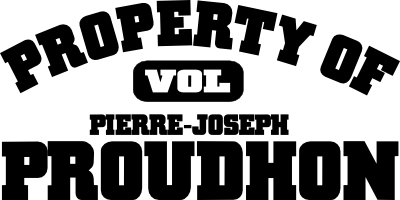
I've always been bothered by those "Property Of Blank University" t-shirts that used to actually be the loaned (or stolen) property of college athletic departments but have now become popular enough that you can find them, for sale, in nearly any university store or gift shop in the US. Few people would assume that somebody with a "Property of" shirt had stolen their clothing. In fact, it's often impossible to find the shirts except on sale anymore -- and rarely from universities themselves. Here's my response. /copyrighteous/images/property_of_pj.png For those that don't know (and that's certainly many), Pierre-Joseph Proudhon is the nineteenth century French anarchist and mutualist most famous for saying, "La propri t , c'est le vol!" In English: "Property is theft!" You can buy my t-shifts (red on black, where possible), in my Printfection store. Source SVG is here. Please share variations in a comment.

18 June 2008

Benjamin Mako Hill: Ubuntu Book Third Edition

Another year has past and another edition of the Official Ubuntu Book has been finished and will be released soon. Over the last two years, the two previous editions of the book have grown along-side Ubuntu. The book has continued to sell very well, received almost universally favorable reviews, and been translated into more than half a dozen languages While Jono Bacon has mostly been pulled into other projects, Corey Burger stepped up to help play the major supporting role in this version of the book's production. The whole text was updated to reflect changes in Ubuntu over the last year including a major rewrite of the chapter on Kubuntu and important work on the Edubuntu chapter. If you use either, you'll understand that there's plenty of churn to report. In a sort of experiment, Barnes and Noble will also be selling a custom edition with an extra chapter by Matthew Helmke on the Ubuntu Forums which I hope to include in the next edition of the book. It's an excellent introduction to the best support resource Ubuntu has to offer that I hope many beginners -- the group that always been the book's audience -- will find useful. You can pre-order the custom edition from B&N or get the book from Amazon or many other sources. Like all previous editions, the book is licensed under the Creative Commons Attribution ShareAlike license and soft-copies should be up on the publisher's website once the book is released. Please support commercial free culture publishing by buying a copy if you find the book useful.

Benjamin Mako Hill: Revealing Errors @ BLU

As I mentioned a couple weeks ago, I'm giving a talk about my Revealing Errors project tonight at the Boston Linux Unix meeting. It will be at MIT in E51-351. More information is on the BLU website. Revealings Errors is a very different kind of project from what I've done. Please show up if you can. I'd love support, feedback, suggestions, and the like.

10 June 2008

Benjamin Mako Hill: Area Coding

My mobile phone has a 206 area code (Seattle). People sometimes ask me why I don't have a 617 number (Boston/Cambridge). In fact, I had a Massachusetts number in college but switched to a 206 several years ago on a trip back home in order to get a "permanent" Seattle number. With a move to mobiles phones, the idiosyncratic fact that US mobiles remain tied to geographic area codes, and the effective elimination of domestic roaming and long-distance, an area code in the United States is increasingly not about where you are but about where you are from. Or, perhaps more accurately, about where you want people to think you are from.

6 June 2008

Benjamin Mako Hill: Stumping for Revealing Errors

Over the past couple months, I gave a couple talks on Revealing Errors -- my project to try and use errors to teach non-technical people about technology, the effects it has on our lives, and the ways in which we (as users) might want to control it. The first version was at LUG Radio Live USA and went off reasonably well. A couple weeks later, I gave a version of the talk again at PenguiCon which went great. Unfortunately, neither recording seems to have worked out. I'll be giving talks on the subject at least twice more this summer. The first will be on June 18th at Boston Linux Unix at 19:00 at MIT in E51-315. It will be my first talk to BLU in something like three years. I'm also currently scheduled to give an abbreviated version of the talk as a keynote at OSCON under the title Advocating Software Freedom by Revealing Errors. In addition to all that, I'm having a whole lot of fun updating the Revealing Errors blog (although not as often as I'd like) and am currently in discussions about publishing a longer version of the Revealing Errors article as a book chapter at some point in the next year. Thanks to everybody who has been supportive of the project and read the blog, has told their friends, and who has told me about telling technological errors they've seen around. Please keep it up!

29 April 2008

Benjamin Mako Hill: Laptop Liberation

In the last week, Nicholas Negroponte gave this unfortunate interview decrying "open source fundamentalism" and hinting the possibility of a warmer relationship with Microsoft. Predictably, this has elicited an ongoing response by OLPC News and on the OLPC development mailing lists. Just a few days before Negroponte's statements hit the press, I gave a talk at Penguicon called Laptop Liberation where I talked about why I thought that OLPC's use of a free software operating system and embrace of free software principles was essential for the initiative's success and its own goals of education reform and empowerment. I've been saying similar things for some time. My main point boiled down to something that, appropriately enough, Nicholas Negroponte was fond of saying back when the project was still called the $100 laptop: an extremely cheap laptop is not a matter of if, but of when and how. This technology will define the terms on which students communicate, collaborate, create, and learn. These terms are dictated by those with the ability to change the software -- by those with access to computers, the source necessary to make changes, and the freedom to share and collaborate. Constructionism -- OLPC's educational philosophy -- is about putting powerful tools and control over those tools into the hands of learners. It is about learning through exploration and creation -- about shaping one's own educational environment. Constructionist principles bear no small similarity to free software principles. Indeed, OLPC's stated commitment to free software did not happen by accident. OLPC convincingly argued that a free system was essential for creating a learning environment that could be used, tweaked, reinvented, and reapplied by its young users. Through these processes, the XO becomes a force for learning about computation and an environment through which children and their communities can use technology on their terms and in ways that are appropriate and self-directed. We know that laptop recipients will benefit from being able to fix, improve, and translate the software on their laptops into their own languages and contexts. Much more importantly, however, are all of the uses for the laptops that OLPC has not -- and can not -- think up. OLPC is a powerful tool for learning, but ultimate power is only in the hands of those that can freely use, change, and collaborate in defining the terms of their learning environments. In its commitment to software freedom, OLPC chose not to be arrogant by assuming that it knows how its users will use their laptops. Flexible environments designed for constructionist learning and a free software platform protect against this arrogance. Constructionism and free software, implemented and taught in a classroom, offer a profound potential for exploration, creation, and learning. If you don't like something, change it. If something doesn't work right, fix it. Free software and constructionism put learners in charge of their educational environment in the most explicit and important way possible. They create a culture of empowerment. Creation, collaboration, and critical engagement becomes the norm. OLPC does not get to choose if educational technology happens. If we work hard at it though we might get to influence the "how" and the "who." Proprietary software vendors like Microsoft want the "who" to be them. With free software, users can be in power. What's at stake is nothing less than autonomy. We can help foster a world where technology is under the control of its users, and where learning is under the terms of its students -- a world where every laptop owner has freedom through control over the technology they use to communicate, collaborate, create, and learn. This, to me, is the promise of OLPC and its mission. It is the reason I've been involved and in support of the project since nearly day one. It is the reason I left Canonical and Ubuntu to come back to school at MIT to be closer to the then nascent unincorporated project. It is the reason that OLPC's embrace of constructionist philosophy is so deeply important to its mission and the reason that its mission needs to continue to be executed with free and open source software. It is why OLPC needs to be uncompromising about software freedom. As an adviser and sometimes contractor to OLPC, OLPC does not need to listen to me. But I hope, for all our sake, that they do.
Update: Richard Stallman and the FSF have published another essay on the same topic focused more on pure free software (i.e., less education specific) objections.

24 April 2008

Benjamin Mako Hill: Talks at CommunityOne

In the last leg of what has been marathon traveling over the last two months, I'm going to be heading back to San Francisco to give two talks at CommunityOne. CommunityOne is a new one-day conference that Sun is putting on -- along side it's massive JavaOne conference -- that focuses on free software, open source, and non-Sun projects. I'm going to be there talking about free software and free culture. I will be giving updated versions of the two talks that I have at the FSF members meetings over first two years. In the first talk, I'll be making the case for a strong free culture movement and in the second I'll be talking about liberating network services. If you will be at the conference, or just in the Bay area, and would like to meet up, I'll be in the area for most of a week and would love to arrange something. Just get in contact.

22 April 2008

Benjamin Mako Hill: Only Frozen Water

Grave In Just Ice Thanks to Matt Lee for helping SVGizing my drawing.

19 April 2008

Benjamin Mako Hill: Penguicon 6

I've been on the road quite a bit lately. During my manic travel, I have been rather lax about blogging many of my recent talks. After a talk at CHI in Florence on the 7th and a talk at LUG Radio Live USA last Sunday, I'm in Troy, Michigan for Penguicon. It's an incredible combination of a science fiction and a free software/open source conference and it's a huge amount of fun. This morning I gave my Laptop Liberation talk and tonight I'll be helping judge the Open Source-ry Masquerade costume contest -- the very contest were Tron Guy premiered his now famous costume! Tomorrow I'll be giving my Revealing Errors talk which I premiered last Sunday at the LUG Radio event and which I'm really excited about. If you're around and at the event please find me and introduce yourself! If you're in the area, I may have some free time tomorrow night. Don't hesitate to get in contact.

1 April 2008

Benjamin Mako Hill: Geek Shall Inherit the Earth Talk

I wrote an essay several years ago called The Geek Shall Inherit the Earth: My Story of Unlearning. It's buried on my website but still manages to attract a consistent stream of readers. It's essentially the story of how I became a geek, about school, ADD, and free software. It is by far the most personal thing I've ever published. That said, several people have told me that it's influenced them deeply -- changed their views, politics and attitudes in important ways. In December, my friend Marcell asked me to give a version of the talk as part of his G33koskop series. I was hesitant to give such a personal talk but I did it anyway. I've finally got around to cleaning up the recording and have posted it online. You can download and listen to the talk here in Ogg Vorbis or here in MP3).

31 March 2008

Benjamin Mako Hill: Proven Wrong!

Yesterday I speculated that Lamers Bus Lines was the most disproportionately photographed, unintentionally insulting, bus line name on the Internet. Apparently not. Several readers pointed out that, while a Flickr search for lamers bus returns 81 photographs, a search for f cker bus and fucker bus return a combined 84 photos not unlike these. With Lamers, PUTA, F cker, SCAT, and the SLUT, I'm beginning to wonder if something very fundamentally wrong with the way human society is choosing the names for its mass transit systems.

30 March 2008

Benjamin Mako Hill: The Most Photographed Bus Company in America

I suspect that Lamers Bus Lines, Inc. (golamers.com) may be the most disproportionately photographed bus line in America by young Internet-savvy photographers. These photographs, and many more, are taken from Flickr: When it comes to the most insulting bus company, however, the unfortunate typography that rendered the Pioneer Valley Transit Authority buses dangerously close to "puta" may give Lamers a run for their money in Spanish speaking communities.

26 March 2008

Benjamin Mako Hill: Unhappy Birthday Interview

Unhappy Birthday -- a website that tries to educate the public and encourage folks to snitch on their friends for singing the (copyrighted!) Happy Birthday song in public places -- is perhaps the most widely read thing I've ever written. It's been seen by millions and I continue to get hate mail several times a week. Last Sunday, the nationally broadcast CBC show WireTap aired an pseudonymous in-character interview with me about the site where I pretended to be a copyright high-protectionist. I think it turned out pretty well. You can listen to it on the unofficial WireTap podcast. My interview starts at a bit more than 10 minutes into the show.

19 March 2008

Benjamin Mako Hill: Geek Nutrition Survey

My partner Mika is doing a research project on geek nutrition. In addition to being a geek herself, she's got degrees in human nutrition and public health. She works at Harvard School of Public Health. So she seems pretty qualified and I'm looking forward to the results. She's trying to get a little bit of data on the food culture and eating habits of GNU/Linux's users and developers. If you can take a couple minutes to fill out a survey, it would be very helpful to her. The survey is anonymous and only takes results from the first 100 people. Analyzed anonymous results will posted publicly. Comments should be sent to 5colorsaday@gmail.com. The survey took me under 3 minutes to fill out. The survey itself is online here. Mika will present initial results and analysis on her blog and at Penguicon which both of us will be attending.

12 March 2008

Benjamin Mako Hill: Talk in Amherst

I'm in Amherst, Massachusetts from now until Friday visiting my alma mater. I'll be giving a redux of my "Laptop Liberation" talk today (March 12) at 12:15 in Adele Simmons Hall for anyone that is around and wants to come. The talk is about free software and OLPC. I'll be around and speaking to several classes at Hampshire College this week. If you're around Amherst and want to meet up, don't hesitate to get in touch.

Next.

Previous.