Search Results: "ag"

9 March 2009

Maximilian Attems: git: Throw away first X commits of a repository

Today got asked by a colleague, who wanted to throw away the early history of his repo. git allows you easily to rewrite the history start with:
echo $FIRST_SHA >> .git/info/graft
git filter-branch -f
Then with interactive git rebase you can rewrite this important initial commit. Of course you have to define $FIRST_SHA and your repo shouldn't be dirty.

Martin F. Krafft: Import to Switzerland: being charged for services you never asked for

When you order good into Switzerland, they will pass the customs office, where VAT and possibly import duties are levied. The customs office does not charge any duties if the total amount to be paid is less than 5 CHF Practically, given 7.6% VAT, this means that you can import 5 CHF / 0.076 = 65.79 CHF for free . As soon as you exceed this amount, it gets complicated. All of a sudden, the carrier charges you for the customs declaration it does in your name. What really blows my mind is that the fee to pay to the carrier (more on that later) actually plays into the whole equation. Let s assume you order goods for 100 CHF, which is well above the free import limit. You also paid 10 CHF for shipping. The carrier charges you 20 CHF to do the customs presentation for you. There, they determine that import duties are 5 CHF, and you end up paying: (100 + 10 + 20 + 5) * 107.6% = 145.26. That s fun, isn t it? I continue to be amazed by all the ways in which the government sucks money from your pockets. What s similarly baffling is how some carries deal with this. The Swiss Post (and their ally TNT) makes you pay taxes, duties, and fees on delivery, and their charges are the lowest when compared to the other carriers. With this approach, you have the option to refuse the package, if you re willing to deal with the vendor to get your money back. DHL is the only other carries I know who does things like the Swiss Post. However, due to their extraordinary crap performance and service, I could never recommend them to anyone. The three letters of DHL, a German company, apparently stand for das heisst langsam this means slow . None of the other carriers give you the option to accept the duties and their services. For instance, GLS delivers your parcel, and some weeks later you get an invoice, asking for the taxes and duties, and charging a fee of 45 CHF for their service, which you ve never really asked for and which you could not refuse. UPS, FedEx, and DPD fall into the same category, but their charges are lower. The one and only time I had used GLS to have something shipped to me, I called them up to complain about their invoice, and replied with an invoice of my own, in which I charged the same amount for opening and reading your letter and giving your call-centre employee the chance to talk to me directly . They got the message and dropped the invoice. The next step should be to play them off against each other: create some pencil art, write an invoice for half a million, and pay UPS to deliver the package to GLS headquarters. Attach a miniature audio transmitter to the invoice for added fun. NP: Goldie: Timeless

Pablo Lorenzzoni: Maceio - took some days off

I finally took some days off. Those are most needed, since I spent carnival on call at the hospital (argh!)... So Brenda and I decided to spend those days at Maceio, capital of Alagoas state, and a very anticipated vacation. They have a lot of sun and beautiful beaches, enough to fill our week (and get some tan also). This picture was taken at Praia do Gunga (Gunga s Beach), a charming place with a calm shore, almost like a pool, protected by natural reefs. As you can see, I am having a bad time right now :-) Food is excellent, so are the people. But there are some inconveniences (as always). Beaches around downtown are not proper for bathing They re fighting a long fight against pollution (and loosing, if you ask me)... Also, Alagoas is a poor state Our guide said alphabetization covers less than 70% of the people Also, network connection is expensive in hotels. Ours charges BRL 1,00 every 5 minutes! And the speed is not the best. They have one of those systems requiring a web authentication before you go. I ve seem people complaining about this kind of system in Planet Debian before (reference please!) and suggesting Tunneling over DNS as a fix . I ve noticed it would work in our hotel, but I decided to try another approach I ve already written about: just a quick tunnel over an ssh connection. I know I told you I needed an authentication before, but that is for the first connection! Yes, once the connection is established, I could just log out (thus stop the charging). No new connections could be made, but the tunnel was already up, so just put everything through the tunnel and I should be fine right? Wrong. I got bitten by a drawback of the technique already pointed in a comment when I first wrote about it: in an error-prone network, TCP-in-TCP slowly dies of attempting to correct itself over and over and I was using a poorly connected wi-fi (loosing almost 30% of the packets!). So, I was left with the set-up of a not foreseen tunnel using DNS as the only option This would take time (and money)... So I decided for a simpler approach: SOCKS proxy. Yes, everything I would do could be done through a SOCKS! So a simple:

bash$ ssh -D 8888 my.remote.location
was all that I needed. That and setting my Firefox to use a SOCKS proxy on localhost:8888 and all went fine. I paid to set-up the tunnel then, once established, I logged out and kept using my tunnel all this time. Simple and effective, and I got some time left to blog about it. :-)

Decklin Foster: Another Monopoly Rant

A cautionary tale: Verizon's DSL salespeople are completely incompetent. Several weeks ago, I ordered residential service. I was unable to get the prequalification app on their web site to work for my address, so I called in. I was told (1) I could get a modem for free, and (2) that I didn't need to do anything for the install except plug it in -- they'd just be turning something on at the CO, perhaps even before the date my service was scheduled to begin. These were both, of course, pure fiction. On the install date, while at work, I got a call from a tech who had shown up at my house to rewire something. Luckily, I was able to rendezvous with him later in the day. The service worked briefly and then went down. Over the next few days, I called in, was told to wait at home for 8 hours, no one showed up, I called in again, was told "oh, sorry, it's going to be tomorrow", waited all day the next day, no one showed up again... a week and two actual visits later, I finally had connectivity. I can't really blame them for whatever the line problem was, but to repeatedly treat my time as worthless by making me wait at home for an entire day just in case a tech can get there, even though it's highly unlikely they will, is just offensive. Then, I received my first bill and... was charged for the modem. Calling in again, I was told that the deal I was offered was for online orders only, and even if I specifically confirmed with the sales person that he could get me the same deal since the web site wouldn't let me complete an order (and I already had an old, power-sucking modem anyway), there was no way I could get a refund. So I got an RMA and planned to go shopping for a replacement (people are selling the same model on Craigslist for $10). The RMA came in an email which also told me that if I did not return the equipment within X days I would be charged $100. This is all utter bullshit. Do not use Verizon. If your only other option is Comcast, as it is here, just steal your neighbor's wireless or tether your 3G. They could have left me reasonably happy with the whole botched situation if they had provided a honest estimate of how long it would really take to get someone out (even if it was "days"), or given me access to the same information without having to go through a call center of people only trained to read a script about how to power-cycle your router or whatever. And if they actually apologized for a saleperson convincing me to sign up by lying about what I would be charged. But why would they? What are you going to do, switch to an ISP that treats you like a human being and doesn't fuck with your traffic? Ha. Ha ha ha. Good luck with that.

MJ Ray: What s So Social About Social Enterprise?

platform
Conference This afternoon, I ll be at What s So Social About Social Enterprise? in Bristol. In general, I ll be trying to support the idea that TTLLP and cooperatives in general are necessarily social enterprise. I may ask a few questions about the Social Enterprise Mark which you may have seen me asking elsewhere already. I ll probably be sending a few updates during the event to identi.ca and other sites if I can get it working from the venue. What s your answer? What s social about social enterprise?

Russell Coker: I need an LMTP server

I am working on a system where a front-end mail server sends mail to what it considers to be a LDA (Local Delivery Agent) which actually sends mail to a back-end server via LMTP. I can t remove that fake LDA from the design because it does a bunch of business specific processing along the way. I am working on changing the back-end from Cyrus to Dovecot. Currently the mail goes from the fake LDA to the Cyrus LMTP server. What I would like to do is to have an LMTP server run on the back-end machine that launches the Dovecot deliver program immediately and then returns an appropriate code. So far I have been experimenting with having Postfix run on the back-end to use deliver as the real LDA. The first problem with this is that the mail will be written to the Postfix queue and then written to the mail store. Doubling the number of writes is a real problem for a system that is going to be write-bottlenecked - it would significantly increase the hardware costs. The second problem is that when an account goes over quota the back-end server would be generating a bounce message. I would prefer the front-end server to generate the bounce on an un-munged message. Basically all I need is a simple daemon (which could even be launched from inetd) that talks LMTP (a very simple cut-down version of SMTP) and executes a single command to receive the data. It might be necessary to serialise running the delivery process, in which case the mail data would have to be stored in memory and there would need to be a semaphore around executing the delivery program. Does anyone know of such a program? If not then I ll have to write it myself (which shouldn t be difficult) and GPL it. If I have to do that then I need a suitable name for it. Any suggestions would be appreciated.

Wouter Verhelst: Uitmuntend

Yesterday, the choir of which I've been a member for these past few years went to the provincial tournament for the first time in its existence. For those of you unaware with what this is: the "provincial tournament" isn't a tournament in the traditional sense (which would have a winner etc); instead, you get to sing in front of an expert jury which will classify you in one of six categories; the category you're in then determines government subsidy your group gets. This is done for all nonprofessional music groups, and makes for a pretty fair way of deciding who gets what, IMO. Apart from that, it's of course also fun. Anyway, as said this was the first time our choir went to such a "tournament", but of course we weren't alone; apart from us, there were six other choirs, two of which were also part of the Ekerse C-koren: Cantando (the semi-professional choir of our group) and Cantilene (for those between the ages of 18 and 25 (or 16 and 25 for boys). And we did well. Cantilene (who did very well in the most recent edition of the 'Koor van het Jaar' contest) was categorized in the 'superieure afdeling' ('superior category'), with 75% in that category. Cantando did even better than that; they achieved a score of 93%, also in the superieure afdeling. This is the highest category in the whole system, so it deserves some special praise. Caljent , our choir, didn't quite reach that level yet; considering the fact that we've only existed about three years, however, that isn't very surprising. Yet, we did quite well; we were categorized in the 'Uitmuntendheid' category, with a score of 75% in that category. Uitmuntendheid (which would translate to something like 'greatness') is the third possible category, which puts us in the top half of the choirs of the province of Antwerp. Quite an achievement for what is, after all, a fairly new choir. Of course we're all very happy with that especially so our conductor, who was rather surprised when she heard the outcome... For those interested, one of the choir members had a camera with him, and he put the four pieces we sang up on youtube: Credo, Dostoyno Yest, Wals van kwart voor middernacht, and Hodie Christus Natus Est. There're also films of the other choirse, but you'll have to look for those yourself ;-P

Francois Marier: Growing the community around your new Free Software Project

Once your new Free Software project has had some traction and is gaining users, you will probably want to supplement its initial homepage with a few extra services. However, the most important aspects of managing a Free Software community have more to do with relating to human beings.
Social Interactions in Small ProjectsIn the early days of your project, support requests usually only come in through personal emails to the lead developer. In order to build your community, make sure new users feel welcome:But of course, remember that the main job of a developer/maintainer is to make the software better. Keep this in mind when replying to support requests and allocate your (limited) time accordingly.
More Tools for Growing ProjectsAs your project grows and handling user-reported issues start becoming more of a burden, consider two things: documentation and distributed support.

The obvious place to start documentation-wise is to start collecting responses that you send to users who get in touch with you. This is the original meaning of a FAQ: answers to actual questions sent in by actual users. Fill your FAQ with irrelevant questions and users won't bother reading it and will email you instead.

In addition to providing good documentation, you should also think about creating a mailing list or a forum where users can post their questions (Google Groups provides a nice blend of the two technologies). There are two main advantages to this service:As your project grows even bigger, you will probably also want to look into getting a bug tracker and a wiki.

Have a look at this excellent online book for more ideas.

Adrian von Bidder: Powermanagement in Debian

I'm eternally confused about the state of powermanagement in Debian (or in Linux generally? Not using any other distribution seriously, I have no idea.) There are just too many scripts who interact or merely run in parallel (see my short note in my first posting about my shiny toy. While I don't actively invest time to educate myself about the situation, I've just tried to uninstall a round of unneeded packages and got rid of apmd and hibernate, which both were installed by default (or by dependencies of other stuff I've got rid of earlier?) but seem not to be necessary. At least the laptop still suspends when I close the lid. This is without rebooting or even just logging out, though, so if it doesn't work out, I'll have to update this entry. Update: Thanks to Michael's comment, pointing to #451380. Scope for a Google Summer of Code project, perhaps? This would be 90% talk to people and get a consensus and only 10% coding, though, but I think it would be worth it so that squeeze would have a powermanagement /acpi framework where different components don't stand on other components' toes all the time.

Russ Allbery: Lintian 2.2.7

This release had more annoying globalish changes than any release that I remember recently. There were lots of little changes across all files, lots of internal reorganization, and lots of tweaks and little changes to match behavior changes elsewhere in the infrastructure. It's all movement towards a more maintainable code base, but it's not as much fun as fixing lots of bugs. This release should fix the occasional problems that people saw with checking source packages (sorry about that, my fault) and somewhat faster performance due to a bunch of work by Raphael Geissert. It also incorporates changes from debhelper 7.2.3, including removing the requirement that one call install-docs and update-menus in maintainer scripts. That work is now handled by triggers (except for menu-methods files). This was supposed to be the Policy 3.8.1 release, but I ran out of time today. I'm still hoping to get to that very soon (before 2.2.7 propagates into testing), but there were enough important fixes in this that I didn't want to delay it further. I'm running into a bit of a problem with Lintian at the moment. It's a lot of fun, and we're making a ton of progress, but it's taking me roughly a day a week to really keep up with the incoming bugs and patch submissions and do a proper job of merging them (which is more than just applying them). This really isn't sustainable. I have a bunch of other things that I want to do, both inside Debian and outside, and I'm going to have to reduce the amount of time that I'm spending on Lintian soon. I hate to do that, since it's great to stay this up-to-date and see this high pace of change, but things may start backing up a bit in the near future. As usual, thank you very much to Adam D. Barratt and Raphael Geissert for all of their work, without which this release wouldn't have been possible.

John Goerzen: A Few Days With the Kindle 2

So I am going to do something that nobody on the Internet is doing lately: post a review of the Kindle 2 after having only used it for three days. Shocking, yes, I know. I had never even seen a Kindle of either model before getting the Kindle 2. I had, though, thought about getting an eInk device for some time. The $359 Kindle 2 price tag caused me significant pause, though in the end I went for it due to the 30-day return policy. On the surface, I thought that it would be weird to have a Kindle. After all, how often am I away from the computer? And there s a small local library a few blocks from where I work. But I had a hunch it might turn out for me like my iPod did: something that didn t sound all that useful from reading about it, but turned out to be tremendously so after having actually used it. Turtleback Delivery I ordered my Kindle 2 with standard shipping, which meant that it went by FedEx Smart Post. Here is my SmartPost rant. There are two words in Smart Post that are misleading. I once had an item take literally a week to make it from St. Louis to Kansas. That is, I kid you not, slower than the Pony Express ran in 1860. This time, my Kindle made it from Kentucky to Kansas in a mere five days. Oh, and it spent more than 24 hours just sitting in St. Louis. The Device Overall, the device is physically quite nice. It is larger and thinner than I had imagined, and the screen also is a bit smaller. It is usually easier to hold than a paperback, due to not having to prevent it from closing too far at the binding edge. The buttons are easy to press, though I could occasionally wish for them to be easier, but that s a minor nit. The Screen The most important consideration for me was the screen. The eInk display as both stunningly awesome and disappointing. This is not the kind of display you get on your computer. Or, for that matter, any other device. It isn t backlit. It reacts to light as paper does. It can be viewed from any angle. And it consumes no power to sustain an image; only to change it. Consequently, it puts up a beautiful portrait of a famous author on the screen when it is put to sleep, and consumes no power to maintain it. The screen s response time isn t anywhere near as good as you d expect from a regular LCD. It flashes to black when you turn a page, and there is no scrolling. On the other hand, this is not really a problem. I found the page turning speed to be more than adequate, and probably faster than I d turn the page on a real book. The resolution of the display has the feeling of being incredible. The whole thing provides a far different, and in my eyes superior, experience to reading on an LCD or CRT screen. My nit is the level of contrast. The background is not really a pure white, but more of a light gray. This results in a contrast level that is quite clearly poorer than that of the printed page. At first I thought this would be a serious problem, though I am growing somewhat more used to it as I read more. Reading Experience Overall, I ve got to say that it is a great device. You can easily get lost in a book reading it on the Kindle. I m reading David Copperfield for the first time, and have beat a rather rapid path through the first five chapters on the Kindle already. And that, I think, is the best thing that could be said about an ebook reader. It stays out of the way and lets you immerse yourself in your reading. The Kindle s smartly-integrated Oxford-American Dictionary was useful too. One thing about a novel written 150 years ago is that there are some words I just haven t ever heard. Nosegay, for instance. You can move a cursor to a word to see a brief pop-up definition appear, or press Enter to see the entire entry. This is nice and so easy that I m looking up words I wouldn t have bothered to if I were reading the book any other way. A nosegay, by the way, is a bouquet of showy flowers. Buying Experience The Kindle has a wireless modem tied to the Sprint network on it. The data charges for this, whatever they may be, are absorbed by Amazon in the cost of the device and/or the books you buy for it. This turned out to be a very smart piece of engineering. I discovered on Amazon s Kindle Daily Post that Random House is offering five mostly highly-rated sci-fi books for free on the Kindle for a limited time. So I went over to the page for each, and made my purchase . It was only a click or two, and I saw a note saying it was being delivered. A few minutes later, I picked up the Kindle off the kitchen counter. Sure enough, my purchases were there ready to read. Impressive. This level of ease of use smells an awful lot like Apple. Actually, I think it s surpassed them. You can delete books from the Kindle and re-download them at any time. You can initiate that operation from either the PC or the Kindle. And you can also browse Amazon s Kindle store directly from the device itself. I haven t subscribed to any magazines or newspapers, but I gather that they deliver each new issue automatically the moment it s released by the publisher, in the middle of the night. I pre-ordered the (free to Kindle) Cook s Illustrated How-to-Cook Library. It makes me way happier than it should to see This item will be auto-delivered to your Kindle on March 26 in the order status. Free Books Amazon s Kindle library has a number of completely free Kindle books as well. These are mostly out-of-copyright books, probably sourced from public etext places like Project Gutenberg, and converted to the Mobipocket format that is the Kindle s native format with a minimum of human intervention. As they are free, you can see them in Amazon s library if you sort by price. And, of course, Amazon will transfer them to the Kindle wirelessly, and maintain a copy of them in your amazon.com account. Unfortunately, as with free etexts in general on the Internet, the quality of these varies. I was very annoyed to find that many free etexts look like they were done on a typewriter, rather than professionally printed. They don t use smart quotes; only the straight ones. When reading on a device that normally shows you a faithful print experience, this is jarring. And I spent an inordinate amount of time trying to find a copy of Return of Sherlock Holmes that actually had the graphic figures in Dancing Men. Ah well. Your Own Content Amazon operates a mail server, username@kindle.com. You can email stuff to it, and it will convert it to the Kindle format and wirelessly upload it to your kindle for a fee of $0.10. Alternatively, you can use username@free.kindle.com, which does the same thing at no charge, but emails you back a link to download the converted work to install via USB yourself. I tried it with a number of PDFs. It rejected about a dozen times from only my single mail message a PDF containing graphic images only. However, it does quite well with most text-heavy PDFs notably doing an excellent job with Return of Sherlock Holmes from bookstacks.org the only source I found that was both beautifully typeset and preserved the original figures. Unfortunately, the PDF converter occasionally has troubles identifying what should be a paragraph, particularly in sections of novels dealing with brief dialog. I have also sent it some HTML files to convert, which it also does a great job with. You can also create Mobipocket files yourself and upload them directly. There is a Mobipocket creator, or you can use mobiperl if you are Windows-impaired or prefer something scriptable on Linux. The device presents itself as a USB mass storage device, so you can see it under any OS. There s a documents folder to put your files in. You can back it up with your regular backup tools, too. And it charges over USB. Web Browser I haven t tried it much. It usually works, but seems to be completely down on occasion. It would get by in a pinch, but is not suitable for any serious work. The guys over at XKCD seem to love it; in fact, their blog post was what finally convinced me to try the Kindle in the first place. Final Thoughts I ve ordered a clip-on light and a leather case for the Kindle. The light, I believe, will completely resolve my contrast complaint. The leather case to protect it, of course. I can t really see myself returning the Kindle anymore. It s way too much fun, and it s making it easier to read more again. And really, if Amazon manages to reach out to a whole generation of people and make it easy and fun for them to read again and make a profit doing it, of course they may move up a notch or two from being an evil patent troll company to a positive social force company. Wow, never thought I d say that one.

8 March 2009

Bastian Blank: Create version in Genericsetup metadata.xml from setup.py

Today I asked if it is possible to do automatic updates of the version in metadata.xml from the (possible mangled) version from setup.py. Nothing popped up, so I wrote an extension of setuptools which does this.
import os.path
from distutils import log
from setuptools.command.egg_info import egg_info as _egg_info
class egg_info(_egg_info):
    def run(self):
        _egg_info.run(self)
        version = self.distribution.metadata.version
        for package in self.distribution.packages:
            path = os.path.join(*(package.split('.') + ['profiles', 'default']))
            if os.path.isdir(path):
                metadata_out = os.path.join(path, 'metadata.xml')
                metadata_in = os.path.join(path, 'metadata.xml.in')
                if os.path.exists(metadata_in):
                    log.info('writing %s', metadata_out)
                    d = open(metadata_in, 'r').read().replace('@VERSION@', version)
                    open(metadata_out, 'w').write(d)
setup(
    cmdclass =  'egg_info': egg_info ,
    [...]
)
The version is listed with a placeholder in the input file called metadata.xml.in and is replaced during a normal develop call as done by buildout.
<metadata>
    <version>@VERSION@</version>
</metadata>
UPDATE: This is evil. metadata.xml should list the the config/profile version, not the code version.

Martin Michlmayr: D-Link DNS-323 and Conceptronic CH3SNAS support integrated in installer

I finally had a chance today to test the patches Matt Palmer created to add D-Link DNS-323 support to the Debian installer. I tested the patches on a Conceptronic CH3SNAS which, from a hardware perspective, is a D-Link DNS-323 (rev B1). I noticed that the firmware image specifies a number for the vendor, so we have to generate different installer images for the D-Link DNS-323 and Conceptronic CH3SNAS. That was easy enough to do and I was able to install Debian without any problems. The next steps are to write an installation guide and other documentation, and to improve the kernel (the power LED is blinking and cannot be changed, and fan control is missing).

Chris Lamb: Statically analysing Django applications with Django Lint

Django Lint is a static analysis tool that checks (or lints) web applications that are built around the Django web development framework. It aims to encourage the development of high-quality reusable Django applications. It currently reports on: Admittedly, some of the checks are based on the implementation details of MySQL, PostgreSQL and SQLite backends, but this fits with the goal of promoting re-usable applications anyway. GPLv3 source, tarballs, etc. Patches welcome.

Stefano Zacchiroli: zack for DPL

/me for DPL Given that it is now widespread news, I guess it's time to blog about it: I'm running for DPL in this year elections, i.e.: zack for DPL!. Am I out of my mind?
Possibly :-) It started as a joke at last DebConf, with my (naked or dressed ...) room mates spreading that rumor. Then the idea grows into me ... and now here I am. (IOW: I'm pretending I'm not entirely guilty of inflicting another platform to be read.) Apparently we are just two candidates: me and the "ticket" Steve-Luk. For the moment I've to spare a page where I will collect material about the election, and a couple of feelings: Version 1.0 of my platform has been submitted to the secretary, and is now available from my homepage. If you have questions, for me or the other candidates, just post them on -vote: campaigning has just started, I'm confident it will be fun! Update the platform is now available from the vote page

Lucas Nussbaum: Make, tmpfs, and [amc]time granularity

As you might have guessed (or not), I ve been playing with the idea of improving my Debian rebuild setup by building on tmpfs: disk I/O take a signifiant amount of time, that could easily be reduced by building (mostly) in memory. Most packages build fine on tmpfs: only 8 packages fail only on tmpfs. Apparently, most of the failures are caused by old versions of autoconf: this version used /tmp to store temporary files ; for example, when generating Makefile, it would create it on /tmp, then move it to the current directory. The problem arises when /tmp is an ext3 filesystem, while the current directory is on tmpfs: when moving the file back to the current directory, the mtime of the file is truncated. This can lead make to think that a given target needs to be rebuilt. A nice example of that is the smuxi package, that just loops when building. Demo:
# cat Makefile
f2: f1
        echo "Need to rebuild f2!"
First case: f1 and f2 are stored in the current directory. Make agrees that
f2 was created after f1:
# rm f1 f2 ; touch f1 ; touch f2 ; make
make:  f2' is up to date.
Second case: f2 is created on /tmp, then moved to the current directory. Make thinks that f2 was created before f1 (and is right, according to stat).
# rm f1 f2 ; touch f1 ; touch /tmp/f2 ; mv /tmp/f2 f2 ; make
echo "Need to rebuild f2!"
Need to rebuild f2!
# stat f1 f2
  File:  f1'
[..]
Modify: 2009-03-08 18:21:08.900237000 +0100
  File:  f2 
[..]
Modify: 2009-03-08 18:21:08.000000000 +0100

Muammar El Khatib: International Women's Day

Today is the International Woman's Day (IWD) so I will take advantage of my blog to congratulate all women either into the Debian Project and in General.

The women's history, from my point of view, has been involved of many difficult situations. Women have had to face the inequality in many ways and levels. On the other hand, it has changed a lot but there still happening some cases nowadays.

I got surprised, when I read the article in Wikipedia, by some controversial facts. Sometimes it is a shame our "human" behavior...

Holger Levsen: a night to remember

yesterday i went to a punk concert, drank some beers, danced some pogo, fell on the slippery floor and crashed my knee once again. still i dont regret it (yet?), it was great to feel alive and young again, though its the perfect proof i'm not young anymore. but it was definitly worth it, i saw them the first time in 1997 or 98 and yesterday was their goodbye concert. wunderbar.
not sure if i should really blog this..

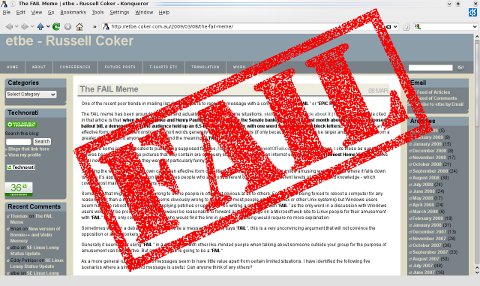
Russell Coker: The FAIL Meme

One of the recent poor trends in mailing list discussions is to reply to a message with a comment such as FAIL or EPIC FAIL . The FAIL meme has been around for a while and actually does some in some situations, slate has a good article about it [1]. The first example cited in that article is that when Ben Bernanke and Henry Paulson testified before the Senate banking committee last month about Paulson s proposed bailout bill, a demonstrator in the audience held up an 8.5-by-11 piece of paper with one word scrawled on it in block letters: FAIL. . This is an effective form of political demonstration, short words generally work well on placards (if only because the letters can be larger and therefore read from a greater distance) and anyone can understand the meaning of FAIL in that context. There are some blogs dedicated to publicising supposed failures, failblog.org and ShipmentOfFail.com are two examples. I cite these as supposed failures because some of the pictures that they contain are obviously staged. It s basically an Internet equivalent of the Funniest Home Videos shows that I never watched because they were not particularly funny. So using the word FAIL on it s own can be an effective form of political protest and can be used for mildly amusing web sites. But where it falls down is when it s applied to a discussion that involves people who are from different cultures or have different levels of background knowledge - which covers most mailing list discussions. Something that might be obviously wrong to some people is often not obvious at all to others. For example being forced to reboot a computer for any reason other than a kernel upgrade seems obviously wrong to me (and to most people who use Linux or other Unix systems) but Windows users seem happy to reboot machines after applying patches or upgrades. So writing a message with FAIL as the only word in a discussion with Windows users would not be productive. It could however be reasonable to forward a link to a page on a Microsoft web site to Linux people for their amusement with FAIL as the only comment - anyone who would find the link in question amusing would require no more explanation. Sometimes when in a debate someone will write a message that only says FAIL , this is a very unconvincing argument that will not convince the opposition or any onlookers. Generally it seems that using FAIL in a discussion with other like-minded people when talking about someone outside your group for the purpose of amusement can be effective. But any other use is going to be a FAIL . As a more general rule single-word messages seem to have little value apart from certain limited situations. I have identified the following seven scenarios where a single word message is useful. Can anyone think of any others?

  1. Code review - someone posts code (or design for code) and people who like it will write ACK or something similar.

  2. Arranging a meeting - the question who wants to meet for lunch tomorrow has me as a valid answer.

  3. Voting - yes and no are valid answers for a poll, but a mailing list or forum probably isn t the best place for it.

  4. Citing an example to refute a claim - often a single word won t be a great response but may be adequate to prove a point.

  5. Answering a request for a recommendation - if asked to recommend a laptop I might say Thinkpad or if asked to recommend a server I might say HP . Both those answers are poor (I recommend EeePC for netbooks and Dell for small/cheap servers), so while such an answer would be useful it would be below my usual quality standards for email (I prefer to write at least two paragraphs explaining why I recommend something).

  6. Informing people that something has been done by replying to a request with the word Done .

  7. Agreeing to a contract or proposal with OK or Yes .

Update: I added another two reasonable uses of single word messages,

Jaldhar Vyas: Inevitable

Fail

Next.

Previous.