Search Results: "ag"

13 March 2009

Bernd Zeimetz: gimp-plugin-registry update planned

Within the next days I plan to update the gimp-plugin-registry package, including the latest versions of all plugins. So if you'd like to see a new fance plugin in the package, or you have any other wish, please add a comment here, or even better, file a wishlist bug report against the package. Patches are welcome, git repository informations are listed below. Extra points if you find new/forked versions of plugins which are/were listed on registry.gimp.org but disappeared or are not updated anymore. Since the page moved to a blog-like style, and old plugin entries are not updated as before, it became harder for me keep the plugins uptodate. Help is appreciated.

Julien Blache: Kodak scanner drivers for Linux - not there yet

So, Kodak announced the availability of Linux drivers for some of its scanners, together with a frontend application. While the effort is laudable, they re not quite there yet. Let s have a look. First of all, and contrary to what a few people believe after reading the press release, the drivers themselves aren t OpenSource, let alone Free Software. They re all proprietary; read better, the press release clearly mentions that only the frontend application is GPLv2. Now let s look at what Kodak offers in its drivers packages. I ve downloaded LinuxSoftware_i1200_v3.5.tar.gz from the Kodak website, these are the drivers for the Kodak i1200 series. The archive contains a set of RPM packages, one Debian package corresponding to one of the RPM packages, and a setup script. One of the packages contains the OpenUSB library, which is released under the LGPL; sources aren t there, I haven t asked for the sources, don t plan on doing so, and am not implying anything regarding license compliance whatsoever. I ll note that I haven t seen any written offer for the sources, though, be it in the archive (there s not even a README in there) or on the website. So, although Ubuntu is listed as supported, we can say that no Debian packages are provided. The setup script actually relies on alien to convert them if it thinks it s running on a Debian-based system, which is determined by the availability of dpkg in the PATH. Using alien is far from ideal. The packages ship libraries and components under /usr/lib, /usr/local/lib and even /opt, pretty randomly it seems. Let s repeat here that /usr/local and /opt are strictly reserved for the local administrator and packages must not install anything here. There are other oddities in the paths used by the software stack, like /var/kodak. It looks like the SANE backend is only a bridge to Kodak s TWAIN data source, so you d actually need the whole stack to use it. All in all, Kodak does no better, I d even venture to say it does worse, than Epson (Avasys). At least part of Epson s backend is Free Software, even if it relies on proprietary libraries for some scanners, though unfortunately most if not all of the recent ones. I also have to mention that Epson is offering both RPM and Debian packages, and by that I mean proper Debian packages. Kodak are far from that, even the RPM aren t that great (I think the RPM packages even lack dependency information, based on what I ve read in the setup script, though I haven t checked). What Kodak offers here is a GPL frontend for TWAIN that not many people will be using, while keeping the drivers proprietary. Unfortunately their SANE backend isn t a backend so to speak, and even if it was OpenSource it d still rely on the rest of the TWAIN software stack. So, in a nutshell, while I m very happy to see yet another vendor go down the road of Linux support for its products, I am immensely disappointed by the proprietary nature of the drivers and the low quality of the packages. I was, of course, investigating the drivers to possibly package them for Debian; as you ve probably understood, it s not possible, both technically and legally. And I kept a little gem from the setup script for the end:
# We need to create a link for the libdbus-1 requirement for openusb,
# but only on Fedora.
if [ -f /etc/fedora-release ]; then
    ln -s /lib/libdbus-1.so.3 /lib/libdbus-1.so.2 2>> /dev/null
fi
As we all know, sonames and soversions are useless and they just keep getting in the way. Duh.

Obey Arthur Liu: Summer of Code 09 @ Debian update [updated]

Just a quick update to let you know how the Debian bid for the Google Summer of Code is going. We re doing great right now. Our application is sent out, you can consult the public part here. This year, we re committed to doing a great Summer of Code performance, starting first by improving communication with the Debian community. We opened a Twitter feed for you Twitter freaks: http://twitter.com/DebianGSoC. It will be updated with live information relevant to students and devs alike during the whole summer. UPDATE: We re now also on identi.ca : http://identi.ca/debiangsoc :) We now have 12 applications on our wiki. Come, add your ideas and discuss them on our IRC channel (#debian-soc on irc.debian.org) and mailing-list. Packaging Debian Installer Blends Bug tracking Building infrastructure

MJ Ray: Paralysed Perl Package Problem

With any luck, someone has seen this problem before and can fix it easily. I don t seem to be able to find the fix by searching, but the search terms feel like they re either too general or too specific. I was trying to install some perl software on a debian lenny system that was upgraded from etch (and previously from sarge). After installing the dependencies, I started getting errors like this:-
$ perl -MYAML::Syck -e print
Can't locate YAML/Syck.pm in @INC (@INC contains:
/usr/local/lib/perl5/5.10.0/i686-linux /usr/local/lib/perl5/5.10.0
/usr/local/lib/perl5/site_perl/5.10.0/i686-linux
/usr/local/lib/perl5/site_perl/5.10.0 .).
BEGIN failed--compilation aborted.
Update: Well done to Raphael who spotted the local that I d overlooked. D oh! Now to see if I can discover where that came from. Update 2: Also thanks to Florian who emailed in at about the same time (I don t read my email as much as my website dashboard, usually).

Then I discovered that the debian mirror being used (which is in the same city, and in a nearby network) is marked as bad on the health check. I switched mirrors to a known-good one that I ve used for other systems recently, but no joy. I think a key symptom is this bit near the end of the output of perl -V:
Compiled at Aug 4 2008 09:48:59
@INC:
/usr/local/lib/perl5/5.10.0/i686-linux
/usr/local/lib/perl5/5.10.0
/usr/local/lib/perl5/site_perl/5.10.0/i686-linux
/usr/local/lib/perl5/site_perl/5.10.0
Our good systems show a December compiled at date and a much longer @INC list. I ve tried reinstalling pretty much every package I think might be connected, including libc6, libperl5.10, perl, perl-base and perl-modules (those last four are all version 5.10.0-19). I really don t want to reinstall the whole system because it s behind an irritating firewall that will make it a 10-hour round-trip site visit. I m currently hunting and removing obsolete packages to try to make sure they re not causing problems, because I m running out of straws to clutch at. How would you recover a debian system from this?

12 March 2009

Decklin Foster: Inside Out

I've been on Twitter for over a year and a half now. If I had to explain why I like it, and why it's so popular now, I would use an analogy:
Twitter : IRC :: Blogs : Usenet
(This applies equally to other "micro-blogging" services, but I am about to explain why I believe that's not the right metaphor. You may also substitute mailing lists for Usenet.) With the older media, you have a place -- a newsgroup, or a channel, that people went to, with a distinct culture, and that (mostly) weren't "owned" by anyone, but rather by the community. With the new ones, we are all sole proprietors of our own streams, and we "tune in" to the subset of people we find interesting, rather than topics we invest in. So, instead of bumping into the same person in a couple different groups, or never reading their words at all, you might find that your feeds overlap a bit more than they do with most people. This is how I find people to "follow" and blogs to read, in fact -- as my network expands, more people become loosely joined to it, and as I notice ones worth reading I add them. Is one model better than the other? Probably not. I could make an analogy to music. In theory, I'd rather read what my favorite critics have to say about a wide variety of new releases -- some of which I'd never know about otherwise -- than keep up with the discussion of bands and genres I really like, even if most people writing about them are terrible (remember, 90% of everything is crap). But I also lose that sense of community of being a "fan" of something; I no longer have a deep connection to what's going on in the fandom or the scene, which I also would never know about otherwise (some of it is just too obscure for my favorite writers to cover). In practice, it seems the new approach has been more popular, but maybe that's because more people are on the net now, and both kinds of communication are/were shaped by the technology available at the time (destinations make much more sense with limited/centralized computing resources, and aggregation makes much more sense with powerful clients and a wider, less specialized user base). Anyway. This post is not actually about social media theory or whatever you want to call it; it's about some software I have packaged. Because of all the above, I have always wished that I could use Twitter from something more like my IRC client. Like, say, my IRC client. One could abuse the concepts of IRC to make an "on the fly" channel of whoever happens to be in my feed. (I once read a blog comment somewhere complaining that Twitter could easily be implemented on any existing IRC server using one +m channel for everyone and some client-side direction of messages from all such channels to a single window. +1 for cleverness, but they did sort of miss the point of why normal people sign up for web sites rather than installing and configuring clients for obscure chat protocols.) So, I had grand plans to write a Twitter client which was an IRC server, with some clever mapping of IRC concepts and commands to their equivalents over there. I never got around to it, as I barely have enough time for anything I do now. But last month I noticed that someone else had implemented such a thing: tircd. I had seen Twitter/IRC services before, but like the official Twiter XMPP service, they were all implemented as bots, which I detest for this sort of application. Bitlbee, for example, translates various IM protocols to IRC, but only halfway -- for anything else you have to use a bot as a sort of poor man's command line. If I want a command line for Twitter, I already have several; IRC can do better. And tircd really does! It's great. You're not required to edit the config file, and there's no extra layer on top of IRC for things like logging in or adding people. I've finally packaged the latest release, which is waiting in NEW currently. I got a request for sneak preview packages, so if you want to install some unapproved .debs check this repository. I may still pick my own project back up, as Twitter itself, being a centralized service, feels like a stopgap solution on the way to to a more generalized 140-character equivalent of the, er, blogosphere as envisioned by open-source projects like Identi.ca. In the future, perhaps, when we use a certain micro-blogging "service" we might be randomly connected to one of any number of servers run by different individuals but all mirroring messages back and forth to each other. Which, now that I think of it, sounds vaguely like some obscure, obsolete chat and news-posting protocols I know.

David Welton: Linux "Just Working"

I have used Linux since 1996, and was pretty used to having to fiddle with files in /etc and command line utilities to get stuff working, so I'm always very satisfied when I see the progress Linux has been making in becoming more user friendly. Two recent things jumped out at me: * I plugged in my phone, via USB, and was able to connect to the internet, just like that. It recognized everything! I was getting all ready to start googling instructions for how to do it, and voila , it worked with no intervention on my part. * I had to print some stuff out in the hopes that we get a DSL line soonish (hah... right). My wife's parents' (Windows) computer was unable to print it... some problem with the fonts and lots of gibberish printed out. I disconnected their computer, plugged it into mine, and printed everything out just fine. The computer recognized the printer just fine, and even picked up on the messages the printer was sending about being low on ink. All in all, nothing revolutionary, but one step at a time, Linux continues to impress me with how much it has grown since those early days when I first installed it and fell in love with it. Also: we've managed to move into our new house here in Padova. It's nice to be back!

Martin Michlmayr: Debian support for QNAP TS-119 and TS-219 Turbo NAS coming

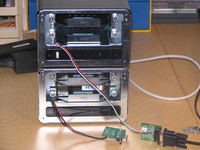
TS-219 on top of TS-209 I received a sample of QNAP's new TS-219 Turbo NAS today. The TS-119 and TS-219 devices are an upgrade to QNAP's TS-109 and TS-209 devices and were announced earlier this month at CeBIT. The new TS-219 uses the same robust case as the TS-209 but offers much more performance: The numbers I've seen about the Kirkwood CPU suggest that the TS-219 will indeed give a very significant performance boost. So far, the TS-219 looks very nice. My only complaint is that QNAP didn't export the second Ethernet port the Kirkwood chip offers, but I suspect this is because they wanted to stay as close to the original design of the TS-209 as possible. In any case, the TS-219 is a nice machine and I look forward to porting Debian to it. As a first step, this means getting the mainline kernel to run on the device and adding a kernel for Kirkwood to the archive (the latter is needed for a number of other devices based on Kirkwood anyway). Hopefully, the remaining porting work and integration into the Debian installer should be fairly straightforward given that the TS-209 is already supported in Debian. I'm sure I'll find out as I dig into the details... I'll give periodic updates of my progress. In the meantime, I've created an image gallery of the TS-219.

Jon Dowland: interzone

The next issue of Interzone, a british SF magazine, is due out soon. The issue features a story and interview with Bruce Sterling, plus a review of his new novel the Caryatids (which Cory Doctorow said was his pick for best book of 2009, already). The cover for this issue looks fantastic: modern covers seem to be placing most of the focus on the artwork and placing the graphics and text to suite each cover art individually. I've been reading IZ for several years after having seen it mentioned several times as the source of stories in SF anthologies and highly recommend that people who enjoy reading SF give it a try.

Theodore Ts'o: Delayed allocation and the zero-length file problem

A recent Ubuntu bug has gotten slashdotted, and has started raising a lot of questions about the safety of using ext4. I ve actually been meaning to blog about this for a week or so, but between a bout of the stomach flu and a huge todo list at work, I simply haven t had the time. The essential problem is that ext4 implements something called delayed allocation. Delayed allocation isn t new to Linux; xfs has had delayed allocation for years. Pretty much all modern file systems have delayed allocation, according to the Wikipedia Allocate-on-flush article, this includes HFS+, Reiser4, and ZFS; btrfs has this property as well. Delayed allocation is a major win for performance, both because it allows writes to be streamed more efficiently to disk, and because it can reduce file fragmentation so that later on they can be read more efficiently from disk. This sounds like a good thing, right? It is, except for badly written applications that don t use fsync() or fdatasync(). Application writers had gotten lazy, because ext3 by default has a commit interval of 5 seconds, and and uses a journalling mode called data=ordered. What does this mean? The journalling mode data=ordered means that before the commit takes place, any data blocks are
associated with inodes that are about to be committed in that transaction will be forced out to disk. This is primarily done for security reasons; if this is not done (which would be the case if the disk is mounted with the mount option data=writeback), then any newly allocated blocks might still contain previous data belonging to some other file or user, and after a crash, accessing that file might result in a user seeing unitialized data that had previously belonged to another user (say, their e-mail or their p0rn), which would be a Bad Thing from a security perspective. However, this had the side effect of essentially guaranteeing that anything that had been written was guaranteed to be on disk after 5 seconds. (This is somewhat modified if you are running on batteries
and have enabled laptop mode, but we ll ignore that for the purposes of this discussion.) Since ext3 became the dominant filesystem for Linux, application writers and users have started depending on this, and so they become shocked and angry when their system locks up and they lose data even though POSIX never really made any such guarantee. This become especially noticeable on Ubuntu, which uses many proprietary, binary-only drivers, which caused some Ubuntu systems to become highly unreliable, especially for Alpha releases of Ubuntu Jaunty, with the net result that some Ubuntu users have become used to their machines regularly crashing. (I use bleeding edge kernels, and I don t see the kind of unreliability that apparently at least some Ubuntu users are seeing, which came as quite a surprise to me.) So what are the solutions to this? One thing is that the applications could simply be rewritten to properly use fsync() and fdatasync(). This is what is required by POSIX, if you want to be sure that data has gotten written to stable storage. Some folks have resisted this suggestions, on two grounds; first, that it s too hard to fix all of the applications out there, and second, that fsync() is too slow. This perception that fsync() is too slow was most recently caused by a problem with Firefox 3.0. As Mike Shaver put it:
On some rather common Linux configurations, especially using the ext3 filesystem in the data=ordered mode, calling fsync doesn t just flush out the data for the file it s called on, but rather on all the buffered data for that filesystem.
Fundamentally, the problem is caused by data=ordered mode. This problem can be avoided by mounting the filesystem using data=writeback or by using a filesystem that supports delayed allocation such as ext4. This is because if you have a small sqllite database which you are fsync(), and in another process you are writing a large 2 megabyte file, the 2 megabyte file won t be be allocated right away, and so the fsync operation will not force the dirty blocks of that 2 megabyte file to disk; since the blocks haven t been allocated yet, there is no security issue to worry about with the previous contents of newly allocated blocks if the system were to crash at that point. Another solution is a set of patches to ext4 that has been queued for 2.6.30 merge window. These three patches (with git id s bf1b69c0, f32b730a, and 8411e347) will cause a file to have any delayed allocation blocks to be allocated immediately when a file is replaced. This gets done for files which were truncated using ftruncate() or opened via O_TRUNC when the file is closed, and when a file is renamed on top of an existing file. This solves the most annoying set of problems where an existing file gets rewritten, and thanks to the delayed allocation semantics, that existing file gets replaced with a zero-length file. However, it will not solve the problem for newly created files, of course, which would have delayed allocation semantics. Yet another solution would be to mount ext4 volumes with the nodelalloc mount option. This will cause a significant performance hit, but apparently some Ubuntu users are happy using proprietary Nvidia drivers, even if it means that when they are done playing World of Goo, quitting the game causes the system to hang and they must hard-reset the system. For those users, it may be that nodelalloc is the right solution for now personally, I would consider that kind of system instability to be completely unacceptable, but I guess gamers have very different priorities than I do. A final solution which might not be that hard to implement would be a new mount option, data=alloc-on-commit. This would work much like data=ordered, with the additional constraint that all blocks that had delayed allocation would be allocated and forced out to disk before a commit takes place. This would probably give slightly better performance compared to mounting with nodelalloc, but it shares many of the disadvantages of nodelalloc, including making fsync() to be potentially very slow because it would force all dirty blocks to be forced out to disk once again. What s the best path forward? For now, what I would recommend to Ubuntu gamers whose systems crash all the time and who want to use ext4, to use the nodelalloc mount option. I haven t quantified what the performance penalty will be for this mode of operation, but the performance will be better than ext3, and at least this way they won t have to worry about files getting lost as a result of delayed allocation. Long term, application writers who are worried about files getting lost on an unclena shutdown really should use fsync. Modern filesystems are all going to be using delayed allocation, because of its inherent performance benefits, and whether you think the future belongs to ZFS, or btrfs, or XFS, or ext4 all of these filesystems used delayed allocation. What do you think? Do you think all of these filesystems have gotten things wrong, and delayed allocation is evil? Should I try to implement a data=alloc-on-commit mount option for ext4? Should we try to fix applications to properly use fsync() and fdatasync()? Related posts (automatically generated):
  1. Don t fear the fsync! After reading the comments on my earlier post, Delayed allocation...
  2. SSD s, Journaling, and noatime/relatime On occasion, you will see the advice that the ext3...
  3. Ext4 is now the primary filesystem on my laptop Over the weekend, I converted my laptop to use the...

Ian Wienand: Relocation truncated to fit - WTF?

If you code for long enough on x86-64, you'll eventually hit an error such as:
(.text+0x3): relocation truncated to fit: R_X86_64_32S against symbol  array' defined in foo section in ./pcrel8.o
Here's a little example that might help you figure out what you've done wrong. Consider the following code:
$ cat foo.s
.globl foovar
  .section   foo, "aw",@progbits
  .type foovar, @object
  .size foovar, 4
foovar:
   .long 0
.text
.globl _start
 .type function, @function
_start:
  movq $foovar, %rax
In case it's not clear, that would look something like:
int foovar = 0;
void function(void)  
  int *bar = &foovar;
 
Let's build that code, and see what it looks like
$ gcc -c foo.s
$ objdump --disassemble-all ./foo.o
./foo.o:     file format elf64-x86-64
Disassembly of section .text:
0000000000000000 <_start>:
   0:		 48 c7 c0 00 00 00 00	mov    $0x0,%rax
Disassembly of section foo:
0000000000000000 <foovar>:
   0:		 00 00			add    %al,(%rax)
   ...
We can see that the mov instruction has only allocated 4 bytes (00 00 00 00) for the linker to put in the address of foovar. If we check the relocations:
$ readelf --relocs ./foo.o
Relocation section '.rela.text' at offset 0x3a0 contains 1 entries:
  Offset          Info           Type           Sym. Value    Sym. Name + Addend
000000000003  00050000000b R_X86_64_32S      0000000000000000 foovar + 0
The R_X86_64_32S relocation is indeed only a 32-bit relocation. Now we can tickle this error. Consider the following linker script, which puts the foo section about 5 gigabytes away from the code.
$ cat test.lds
SECTIONS
 
 . = 10000;
 .text :   *(.text)  
 . = 5368709120;
 .data :   *(.foo)  
 
This now means that we can not fit the address of foovar inside the space allocated by the relocation. When we try it:
$ ld -Ttest.lds ./foo.o
./foo.o: In function  _start':
(.text+0x3): relocation truncated to fit: R_X86_64_32S against symbol  foovar' defined in foo section in ./foo.o
What this means is that the full 64-bit address of foovar, which now lives somewhere above 5 gigabytes, can't be represented within the 32-bit space allocated for it. For code optimisation purposes, the default immediate size to the mov instructions is a 32-bit value. This makes sense because, for the most part, programs can happily live within a 32-bit address space, and people don't do things like keep their data so far away from their code it requires more than a 32-bit address to represent it. Defaulting to using 32-bit immediates therefore cuts the code size considerably, because you don't have to make room for a possible 64-bit immediate for every mov. So, if you want to really move a full 64-bit immediate into a register, you want the movabs instruction. Try it out with the code above - with movabs you should get a R_X86_64_64 relocation and 64-bits worth of room to patch up the address, too. If you're seeing this and you're not hand-coding, you probably want to check out the -mmodel argument to gcc.

Stefano Zacchiroli: topgit brain explosion

Don't make mistakes with TopGit. Ever. TopGit is super-cool. I really feel I've found the proper tool for my Debian packaging work-flow. But beware, the tool is young and rarely allows for mistakes.
If you do make them, it has been observed that undesired side effects can happen to your brain. Especially if your git-fu is not black belt.
thanks to godog for linking topgit with today's strip

Daniel Stone: public service announcement

This is a public service announcement: depth and bpp are different.

Depth refers to the number of significant bits (usually colour-significant, i.e. R + G + B bits for RGB modes) per pixel. bpp, i.e. bits per pixel, refers to the number of bits used altogether for pixel storage. Ignoring alpha, the usual configuration of your framebuffer will be depth 24 (8 bits each for R, G and B), but 32bpp: 8 unused bits at the top. 24bpp and depth 24 means that there are no unused bits, and that four pixels will occupy 96 bits (12 bytes), and not 128 bits (16 bytes), as there would be in 32bpp. (Thankfully, no-one actually uses 24bpp in the real world.) That is all.

Russ Allbery: Policy 3.8.1 and Lintian 2.2.8

I've just uploaded Policy 3.8.1.0 with the first batch of post-lenny changes. There isn't anything that earth-shattering in this set, but I'm hoping that we'll be able to get a lot more done during the squeeze release cycle. Policy has well over a hundred open bugs, quite a few of which we should be able to resolve. I also uploaded Lintian 2.2.8, which is synchronized against Policy 3.8.1 and also reverts some changes around install-menu due to a reverted change in debhelper 7.2.5, and fixes diagnosis of diversions. The last few versions of Lintian have all been a little bit buggy due mostly to the current pace of change. Hopefully this version will have fewer unexpected problems. Here is the summary of normative Policy changes, taken from upgrading-checklist.txt.gz in the debian-policy package.

Gunnar Wolf: So it's "me too" time?

Wouter and Christian have started bragging about their travel arrangements to attend DebConf, with probably insane amounts of toxic substances aimed at making DebConf9 the smelliest DebConf ever. So, it is time for me to announce my intentions as well. I have booked my ticket to travel MEX-MAD, leaving on Thursday 16/07/2009 and arriving to Spain on Friday 17. That means I will be getting to C ceres Friday evening. And I am flying back on Sunday 02/08/2009, which only means that I'll be jetlagged on Monday at work :-P Buying plane tickets when your country's currency has lost 50% of its worth against any other major currency in the world (US dollars are now at ~MX$15.50, and Euros are quickly approaching MX$20), let me tell you, is no fun. Even less if the plane tickets have increased their cost in absolute terms as well, due to the decrease in demand. But, yes, the good news do stand: See you in C ceres!

Russ Allbery: backport 1.19

I finally got a chance to overhaul my backporting helper script to add support for lenny. The new version bases the default chroot basepath on the target distribution, chooses the right version suffix for backports.org based on the distribution, and tweaks a few other things. One should be able to use it for both stable and oldstable backports, although I've not tested it all that thoroughly yet. The default target is now lenny. There are, as yet, no transforms applied for lenny backports, but I'll be adding them as I run into necessary changes for the packages that I backport. You can get the latest version from my scripts page.

Mart&iacute;n Ferrari: The Wire

A few months back, a friend of mine posted in his blog a clip from the HBO TV series called The wire. That three minutes long clip hooked me up right away, and today I finished the last of the 60 hour-long episodes, spanning five seasons. I recommend it to anyone that enjoys a good script, well developed characters, a director who doesn't treat his audience as five year olds, and good acting. Man, if a 10% of TV was this good, I might even consider buying a TV set! Tags: Planet Debian

11 March 2009

Jonathan McDowell: Oh yeah, we released, didn't we?

Nearly a month has elapsed since Debian released Lenny. The interesting thing for me about this release was that I failed to get to the point where running etch was causing me pain. This became even more evident when Katherine commented on my Lenny T-Shirt - I'd forgotten to mention our release to her! Previously there have been a bunch of features coming that I really wanted, sometimes to the point of using backports. It's probably something to do with the way I run Debian; I use stable for remote machines and while in the past this would have meant quite a few work boxes these days it's just a box at my parents' and my colo. Where I felt the pain during this release cycle was on the boxes where I run unstable (my home desktop) or testing (my work box and my laptops). Development on new shininess slows down significantly while we're preparing for release (not unsurprisingly). And there are things coming up I quite like the look of, largely aimed at the desktop arena. I've been running Network Manager 0.7 from experimental on my EEE, for example - I need the HSO 3G support to avoid unnecessary faff on a daily basis. I've got ATI cards in my work and home desktops, so I'm watching the Mesa developments with interest - roll on OpenGL 2.0 support hopefully. The Intel KMS support that doesn't seem to be quite there yet but RSN, no, really, will be nice for my laptops. Experimental VDRs are looking interesting and perhaps worth upgrading my PVR to.

For a long time I haven't really understood the point of view that Debian shouldn't release. Or rather, I haven't understood why people would think that was a serious option. The first Debian box I installed went into a colo facility shortly afterwards. This is the first release I've not been running Debian on a commercial colo box and while I treat my personal colo in a similar fashion it's not quite the same in terms of priorities. However I still think regular releases are hugely important to the project. Some pain for those of us more interested in new shiny is a small price to pay for producing a flexible, reliable distribution, be they server administrators (though I see a worrying number of people decide to install testing on their production servers and then rarely/never update it), derivers or appliance vendors.

Mind you, now we've released I'm going to have to do all those things I've been putting off. I should probably start with moving my Perl bits into pkg-perl. And maybe I should switch over some sources.list files to point at squeeze instead of lenny...

Steve Kemp: Oh my God, someone ate my entire pie!

Yesterday was my birthday, and it was full of cookies, pies, magical pixie dust and things made entirely of sugar and spice! The remainder of the day was spent re-installing Debian Lenny upon my EEE PC - Somehow I managed to completely screw the system. Because the EEE PC is one of those ultra-portable machines I mostly used it when I was travelling, or outdoors. That mean I was generally receiving poor connectivity and the system packages weren't up to date. While I was in bed I figured I'd dist-upgrade it to the recently released Lenny. Unfortunately I started the dist-upgrade inside X.org, once I realised this I figured I'd cancel the operation via Ctrl-c. Bad news everbody: I think I was unlucky enough to interrupt an upgrade of libc, or something equally critical. Every single application gave segfaults afterward. I had two open root terminals and I could navigate around via cd .., and "echo *", but all other commands such as sudo, dpkg, strace just gave segfaults. (Even static commands gave errors - so it might have been the dynamic loader that was borked, I admit I didn't look too closely.) I figured reinstalling would be a good solution since the machine has a 4Gb root partition and /home was stored on a separate 16Gb volume. Unfortunately I managed to misjudge the installer's partitioning step and nuke the partition table on the external volume so I ended up losing the whole system. Happily reinstallation was a breeze as my home network is setup to allow installation via PXE network booting (at some point I should document NFS-root PXE-booting). It took me longer to fiddle with the BIOS on the EEE PC to allow network booting than it did to complete a minimal install. Which I guess is good. I still need to restore my backup of /home/, but that can wait a few days. Right now I'm loathe to touch the machine at all - although I did distract myself by getting KVM to PXE boot:
# create 4gb disk image
dd if=/dev/zero of=/tmp/img.img bs=1024 count=4096k
# launch KVM
sudo kvm -no-acpi
  -boot n -tftp /var/lib/tftpboot/ -bootp /pxelinux.0
  -hda /tmp/img.img
  -net nic,macaddr=00:0E:35:be:de:ad  -net user
It seems that KVM wants to have access to the local TFTP root directory so I just pointed it at that. Since my desktop machine is also my TFTP + DHCP host that works out nicely. (A quick scan of the manual suggests that QEMU/KVM has funky built-in TFTP code, so it doesn't actually forward TFTP requests over the network.) DHCP requests were certainly passed around as expected though and were answered via my local dnsmasq installation. I did see errors at every DHCP request in syslog, but they seemed harmleess enough:
gold dnsmasq[29241]: no address range available for DHCP request via qemu0
*shrugs* ObFilm: Never Been Kissed.

Joachim Breitner: In a Letter to Ghana s President

Thanks to Google s watchful eyes I found out that I was mentioned in a Letter to the President of Ghana, published pseudonymously on ghanaweb.com, that advocates Free Software to the new President of Ghana, John Atta-Mills. So, to all new presidents out there, if you need advice, just ask me :-)

Christian Perrier: Mini planet flood

Apparently, the sync magic I'm using between my laptop (where I usually write my blog entries) and my home server (which serves them with Blosxom) was broken since about 3 weeks. So, dear readers, sorry but you'll have to see old entries which never made it to my blog. Apologies.....old rants are not very useful, but I decided to leave them..:-)

Next.

Previous.