Search Results: "ag"

15 March 2009

Antti-Juhani Kaijanaho: Some things to avoid when triaging other people s bugs

DO NOT send your query for more information only to nnn@bugs.debian.org. That address (almost) never reaches the submitter. (The correct address is nnn-submitter@bugs.debian.org or you can CC the submitter directly.) DO NOT close a bug just because your query can you still reproduce it has not been promptly answered. And, actually: DO NOT close a bug if you do not have the maintainer s permission to do so. You may, if you wish, state in the bug logs that you think the bug should be closed. This ends today s public service announcement. Thank you for your attention.

Jose Carlos Garcia Sogo: Upgrading my laptop to ext4

Warning: Don t upgrade root partition (/) or the partition in which /boot is placed unless you know what you are doing. More on this later.
Warning2: Make backups of your data. Last Friday I went on upgrading to ext4 my laptop. I decided to go first with /home partition, as / has also /boot and can give some problems if not handled with care. Upgrading it is quite easy, and fast, as the old data is not upgraded, only new files will be added using new features. First, I installed latest linux-image package to start using kernel version 2.6.28, which includes production ready ext4 support. After rebooting, I logged in as root so I could umount /home. The steps to upgrade are as follows:

# uname -a
Linux gimli 2.6.28-1-686 #1 SMP Mon Feb 23 03:13:24 UTC 2009 i686 GNU/Linux
# umount /home
# tune2fs -O extents,uninit_bg,dir_index /dev/home_partition
# fsck -pfD /dev/home_partition
# mount /home

You MUST run fsck. If not, ext4 won t mount your filesystem, so don t forgive this step if you re upgrading your / partition. You will see some checksums errors appear. Don t be afraid, that s expected, and that s why -p is added to fsck command, you it is not asking which action to perform in every error. Upgrading partition containing /boot
For upgrading your / partition you have to take into account what grub and klibc version you have installed. The former is need so grub can read your kernel image from filesystem, and the second is needed due a bug that made initramfs detect ext4 filesystems as ext3, and passing incorrect option to mount, which failed. Versions in Debian known to work are libklibc >=1.5.15-1 and grub2 (packaged as grub-pc). Make sure you have these versions installed before trying to go to ext4.
Also, as you have to upgrade having your partition unmounted, you will have to get a console before root partition is mounted. You can do that by passing mount=break break=mount to your boot options in grub. ENJOY!

Biella Coleman: Obsessing: A Way of Life

When I teach my course on computer hackers, one of the first things that students learn is that many hackers are obsessed a viewpoint promulgated by academics and media types alike. I tend to agree with the assessment but turn it on its head a little by pointing out that many professionals (doctors, lawyers, investment bankers and my own profession, which, attracts and houses nerds and geeks alike) are equally obsessed. It is just that the professional work is legitimized via all sorts of norms, expectations, and practices, unlike hacking, which is often treated in quite exceptional terms.

Russell Coker: Why Cyrus Sucks

I m in the middle of migrating a mail server away from the Cyrus mail store [1]. Cyrus provides a POP and IMAP server, a local delivery agent (accepting mail via LMTP). It is widely believed that Cyrus will give better performance than other mail stores, but according to a review by linux-magazin.de Dovecot and Courier deliver comparable (and sometimes better) performance [2]. The biggest problem with Cyrus is that it is totally incompatible with the Unix way. This wouldn t be a problem if it would just work and if it would display reasonable error messages when it failed, but it doesn t. It often refuses to work as desired, gives no good explanation, and it s data structures can t be easily manipulated. Dovecot [3] and Courier [4] use the Maildir++ format [5] (as well as many other programs). I have set up a system with Courier Maildrop and Dovecot for the IMAP server [6] and it works well - it s good to have a choice! But also Maildir++ is reasonably well documented and is an extension to the well known Maildir format. This means that it s easy to manipulate things if necessary, I can use mv to rename folders and rm to remove them. Cyrus starts with a database (Berkeley DB file) of all folders in all mailboxes. Therefore it is not possible to move a user from one back-end server to another by merely copying all the files across and changing the LDAP (or whatever else contains the primary authentication data) to point to the new one. It also makes it impossible to add or remove folders by using maildirmake or rm -rf. The defined way of creating, deleting, and modifying mailboxes is through IMAP. One of the problems with this is that copying a mailbox from one server to another requires writing a program to open IMAP connections to both servers at once (tar piped through netcat is much faster and easier). Also if you need to rename a mailbox that contains many gigabytes of mail then it will be a time consuming process (as opposed to a fraction of a second for mv). Cyrus has a tendency to break while Dovecot is documented as being self-healing and Cyrus also seems to cope well in the fact of a corrupted mail store. Even manually repairing problems with Cyrus is a painful exercise. The Cyrus mail store is also badly designed - and it s design was worse for older filesystems (which were common when it was first released) than it is for modern ones. The top level of a Cyrus maildir contains all the messages in the INBOX stored one per file, as well as three files containing Cyrus indexes and sub-directories for each of the sub-folders. So if I want to discover what sub-folders a mailbox has then I can run ls and wait for it to stat every file in the directory or I can use an IMAP client (which takes more configuration time). As opposed to a Maildir++ store where every file that contains a message is stored in a folder subdirectory named new , cur , or tmp which means that I can run ls on the main directory of the mail store and get a short (and quick) result. Using tools such as ls to investigate the operation of a server is standard practice for a sysadmin, it should work well! A finall disadvantage of Cyrus seems to have many small and annoying bugs (such as the reconstruct program not correctly recursing the sub folders). I guess it s because not many people use Cyrus that such things don t get fixed. One trivial advantage of Cyrus is that by default it splits users into different sub-directories for the first letter of the account name. Dovecot supports using a hash of the user-name this is better than splitting by first-letter for performance (it gives a more equal distribution) but will make it slightly more difficult to manipulate the mail store by script. Ext3 can give decent performance without a two level directory structure for as many as 31,998 sub-directories (the maximum that it will support) due to directory indexing and Linux caching of dentries. There may be some other advantages of Cyrus, but I can t think of them at the moment. Here is a script I wrote to convert Cyrus mail boxes to Maildir++. To make this usable for a different site would require substituting a different domain name for example.com (or writing extra code to handle multiple domains) and inserting commands to modify a database or directory with the new server name. There is no chance of directly using this script on another system, but it should give some ideas for people performing similar tasks.

#!/bin/bash -e
# $1 is the user to move # BASEDIR is the directory for temporary files
BASEDIR=/mail/new
rm -rf $BASEDIR/$1 archive.tgz archive2.tgz ORIGSRV=$(echo "MYSQL_COMMAND_TO_GET_SERVER" mysql dbname)
echo "original server was $ORIGSRV" if [ "$ORIGSRV" = "" ]; then
echo "No server for account, strange error."
exit 1
fi ORIGPARENT="/mail/domain/e/example.com/$(echo $1 cut -c1)/user" # copy the data to a local archive
# USERDIR is for using ^ instead of . as Cyrus does.
mkdir -p $BASEDIR
cd $BASEDIR
USERDIR=$(echo $1 sed -e "s/\./^/g")
ssh cyrus@$ORIGSRV "(cd $ORIGPARENT ; tar czf - $USERDIR)" > archive.tgz
tar xzf archive.tgz
if [ "$USERDIR" != "$1" ]; then
mv $USERDIR $1
fi DEPTH=$(find . -mindepth 3 -type d wc -l)
if [ "$DEPTH" != "0" ]; then
echo "too deep"
exit 1
fi # remove cyrus index files
find $1 -name "cyrus.*" -exec rm \;
cd $1 # "mail" is a directory with sub-folders, every other name starting with
# [a-zA-Z] is a regular folder that needs to become a Maildir
for n in [a-zA-Z]* ; do
if [ "$n" != "mail" ]; then
cd "$n" ; mkdir new cur tmp ; touch maildirfolder
mv [0-9]* new true
cd .. ; mv "$n" ".$n"
fi
done # move the inbox files to Maildir storage
mkdir new cur tmp
mv [0-9]* new true
mv mail/[0-9]* cur true # move sub-folders of "mail/" and merge ones with duplicate names
cd mail
for n in * ; do
if [ -e "../.$n" ]; then
cd "$n"
mv [0-9]* "../../.$n/cur" true
cd .. ; rmdir "$n"
else
cd "$n" ; mkdir new cur tmp ; touch maildirfolder
mv [0-9]* new true
cd .. ; mv "$n" "../.$n"
fi
done
cd ..
rmdir mail # get a list of all names so we can recognise duplicates
find . -type d egrep -v "new cur tmp" cd $BASEDIR ssh root@localhost "mv /mail/new/$1 /mail/example.com ; chown -R mail:mail /mail/example.com/$1"
echo "MYSQL_COMMAND_TO_SET_SERVER" mysql dbname

John Goerzen: QUISH!

Today, I was sitting on the couch. Jacob crawled up, and pushed me forward, saying I go there. He crawled behind me. Then, ready for one of his favorite games, yelled out: QUISH, daddy! So I leaned back gently a bit, and said squish! Jacob yelled, laughing, QUISH! Quish again, daddy! So I d lean back a bit, gently, again, this time reaching behind me to tickle him a bit as I leaned. Squash! Louder laughing. QUASH!!! Right in my ear ouch, but I didn t mind. Do it again, daddy! Right now, being a dad seems complicated enough. You ve got to have the right touch to squish a 2-year-old without really squishing him. Or have the presence of mind to realize that when Jacob was happily playing outside, then suddenly comes running over, very upset, saying Go inside! it means he probably needs to use the potty urgently, or just had an accident. (Or both, as it happened today.) Or to recognize that little walk that means he really does need to use the potty even though he d rather not. And, of course, there s figuring out what he s saying, when his words can still be a bit garbled. But these all seem simple to me, compared to what will come. How will we help Jacob to grow as a person of good character? How will we meet his need to be challenged intellectually? Will we be able to maintain a good relationship, and yet still have the judgment to have the right set of rules, when he gets to high school? Will I have a good relationship with him as an adult? And how am I going to react when the day comes when he tells me I ought to move into the nursing home? Jacob, of course, doesn t care about any of that right now. Each night, when I put him down for the night, he wants me to cover him up with blankets. Once I ve done that, he peeks out and says, Have a good night, dad! I always reply with You have a good night too, Jacob! If we can get along that well for the next 60 years, I guess we ll do all right.

Kapil Paranjape: Slumdog millionaire

We managed to watch the multi-award winning "Slumdog Millionaire" this weekend. It is difficult for me to understand why people (in India or PIO's) are so upset about the movie. It is a good movie (I do not know enough about cinema to pronounce it a great movie). As a Rahman fan since "Kadal Desam" (1993 or so), my opinion on the music is a bit biased. His work on this movie is more than competent though not his best. A. R. Rahman has written better songs than "Jai Ho!" and I didn't notice anything spectacular about the rest of the music. Still, it is worth noting that his best work is in the context of Indian-style films, where there are a lot of songs; the background score of those films only stands out if it is bad! So, I suppose that the criticism of this movie by Indians is largely based on its story-line and setting. This is strange, since poverty in a Mumbai slum (to the extent that I am acquainted with it) is depicted quite accurately here. The plot (like any Dickensian story) drives home the terrible nature of poverty in cities but still manages to inject a note of optimism.
If you are lucky/strong enough to survive with your humanity intact after growing up in a Mumbai slum, then the luck required to win a TV show is nothing in comparison.

Chris Lamb: Joachim Raff and the orchestration of Bach's Chaconne

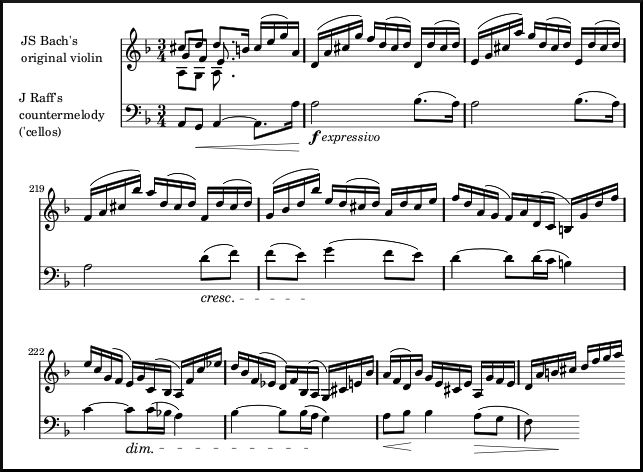
Earlier today I stumbled across a recording of a work I had not heard in a few years by the obscure Swiss-German composer Joachim Raff. The composition is an orchestral transcription of the Chaconne from Bach's Partita in D minor, without doubt the finest work ever written for solo violin. This piece has been transcribed countless times; the source material is clearly a masterpiece, but what makes the movement really attractive is its implicit nature - dispite the violin's limited facilities for counterpoint and polyphony in general, Bach succeeds in alluding to a multitude of voices within the same line. Larry Solomon provides a brief overview of what to look out for. Raff's transcription thus endeavours to render the implicit explicit; for example, where there is the implication of a held note, it can played for its implied duration. Indeed, Raff believed that Chaconne was in itself a "reduction" from an orchestrated original. Whilst I don't share that literal belief, it is certainly good working model for a transcription. And what a transcription! I've often thought of the romantic transcriptions such as these to be a guilty pleasures; they clearly violate any sensibilities I have about performing early music. However, what is most surprising (and guilt-relieving) about Raff's effort is the sheer amount of novel material involved. Here is an example starting at bar 216 - I have overlayed Bach's original line with a melody of Raff's own invention:
http://chris-lamb.co.uk/wp-content/2009/raff_chaconne.png
There are countless other examples which, following Bach's example, vary greatly in their subtlety. No prizes for guessing why I chose this excerpt though. However, dispite these additions I feel some crucial aspects are actually lost in translation. Firstly, we can muse over whether Bach would have approved of such a rendering - not wishing to dwell too deeply in well-tread arguments, many would point to Bach's re-use of his own material (as well as his transcriptions of other composers) to illustrate that he was not against the practice, but I find that argument difficult to apply to the Chaconne - the dualism between the implicit and the explicit would have greatly appealed to Bach, so to rob the work of it would seem to be doing him a serious discourtesy. Furthermore, the implications in Bach's work are certainly not followed to the same conclusions by all - a truly solo musician has the advantage of being able to make their own decisions about the music, perhaps even on the spur of the moment. In contrast, an ensemble is effectively forced to obey Hr. Raff's inferences. This lack of spontaneity is particularly damning; I am sure one would tire of differing interpretations of Raff's transcription quicker than one would of Bach's original. Lastly (and certainly most subjectively) there is something disarmingly solitary about the original work which is only amplified by being played solo - dispite my inability to provide a satisfactory rendition I would find performing this piece with (or even to) others rather discomforting. In conclusion, I would recommend listening to this work (and the rest of the CD). I have found it extremely illuminating, if only about Bach's original than of Raff's.

14 March 2009

Matthew Garrett: ext4, application expectations and power management

Edited to add: Sorry, it turns out that ext4 does now have a heuristic to deal with this case. However, it seems that btrfs doesn't. My point remains, though - designing a filesystem in such a way that a useful behaviour is impossible is unhelpful for the vast majority of application writers, even if it does improve performance in some other use cases.

Further edit: It's mentioned in the comments that btrfs will force a flush of data when a rename is performed as of 2.6.30. That prevents the data loss, but it means that we're still stuck with disk access when we'd be happy with that being batched up for the future. It feels like we're optimising for the wrong case here.

Original text:

There's been a certain amount of discussion about behavioural differences between ext3 and ext4[1], most notably due to ext4's increased window of opportunity for files to end up empty due to both a longer commit window and delayed allocation of blocks in order to obtain a more pleasing on-disk layout. The applications that failed hardest were doing open("foo", O_TRUNC), write(), close() and then being surprised when they got zero length files back after a crash. That's fine. That was always stupid. Asking the filesystem to truncate a file and then writing to it is an invitation to failure - there's clearly no way for it to intuit the correct answer here. In the end this has been avoided by avoiding delayed allocation when writing to a file that's just been truncated, so everything's fine.

However, there's another case that also breaks. A common way of saving files is to open("foo.tmp"), write(), close() and then rename("foo.tmp", "foo"). The mindset here is that a crash will either result in foo.tmp being zero length, foo still being the original file or foo being your new data. The important aspect of this is that the desired behaviour of this code is that foo will contain either the original data or the new data. You may suffer data loss, but you won't suffer complete data loss - the application state will be consistent.

When used with its (default) data=ordered journal option, ext3 provided these semantics. ext4 doesn't. Instead, if you want to ensure that your data doesn't get trampled, it's necessary to fsync() before closing in order to make sure it hits disk. Otherwise the rename can occur before the data is written, and you're back to a zero length file. ext4 doesn't make guarantees about whether data will be flushed before metadata is written.

Now, POSIX says this is fine, so any application that expected this behaviour is already broken by definition. But this is rules lawyering. POSIX says that many things that are not useful are fine, but doesn't exist for the pleasure of sadistic OS implementors. POSIX exists to allow application writers to write useful applications. If you interpret POSIX in such a way that gains you some benefit but shafts a large number of application writers then people are going to be reluctant to use your code. You're no longer a general purpose filesystem - you're a filesystem that's only suitable for people who write code with the expectation that their OS developers are actively trying to fuck them over. I'm sure Oracle deals with this case fine, but I also suspect that most people who work on writing Oracle on a daily basis have very, very unfulfilling lives.

But anyway. We can go and fix every single piece of software that saves files to make sure that it fsync()s, and we can avoid this problem. We can probably even do it fairly quickly, thanks to us having the source code to all of it. A lot of this code lives in libraries and can be fixed up without needing to touch every application. It's not the end of the world.

So why do I still think it's a bad idea?

It's simple. open(),write(),close(),rename() and open(),write(),fsync(),close(),rename(), are not semantically equivalent. One is "give me either the original data or the new data"[2]. The other is "always give me the new data". This is an important distinction. fsync() means that we've sent the data to the disk[3]. And, in general, that means that we've had to spin the disk up.

So, on the one hand, we're trying to use things like relatime to batch data to reduce the amount of time a disk has to be spun up. And on the other hand, we're moving to filesystems that require us to generate more io in order to guarantee that our data hits disk, which is a guarantee we often don't want anyway! Users will be fine with losing their most recent changes to preferences if a machine crashes. They will not be fine with losing the entirity of their preferences. Arguing that applications need to use fsync() and are otherwise broken is ignoring the important difference between these use cases. It's no longer going to be possible to spin down a disk when any software is running at all, since otherwise it's probably going to write something and then have to fsync it out of sheer paranoia that something bad will happen. And then probably fsync the directory as well, because what if someone writes an even more pathological filesystem. And the disks sit there spinning gently and chitter away as they write tiny files[4] and never spin down and the polar bears all drown in the bitter tears of application developers who are forced to drink so much to forget that they all die of acute liver failure by the age of 35 and where are we then oh yes we're screwed.

So. I said we could fix up applications fairly easily. But to do that, we need an interface that lets us do the right thing. The behaviour application writers want is one which ext4 doesn't appear to provide. Can that be fixed, please?

[1] xfs behaves like ext4 in this respect, so the obvious argument is that all our applications have been broken for years and so why are you complaining now. To which the obvious response is "Approximately anyone who ever used xfs expected their data to vanish if their machine crashed so nobody used it by default and seriously who gives a shit". xfs is a wonderful filesystem for all sorts of things, but it's lousy for desktop use for precisely this reason.

[2] Yes, ok, we've just established that it actually isn't that in the same way that GMT isn't UTC and battery refers to a collection of individual cells and so you don't usually put multiple batteries in your bike lights, but the point is that this is, for all practical intents and purposes, an unimportant distinction and not one people should have to care about in their daily lives.

[3] The disk is free to sit there bored for arbitrary periods of time before it does anything, but that's fine, because the OS is behaving correctly. Sigh.

[4] Dear filesystem writers - application developers like writing lots of tiny files, because it makes a large number of things significantly easier. This is fine because sheer filesystem performance is not high on the list of priorities of a typical application developer. The answer is not "Oh, you should all use sqlite". If the only effective way to use your filesystem is to use a database instead, then that indicates that you have not written a filesystem that is useful to typical application developers who enjoy storing things in files rather than binary blobs that end up with an entirely different set of pathological behaviours. If I wanted all my data to be in oracle then I wouldn't need a fucking filesystem in the first place, would I?

Lucas Nussbaum: Anomos: anonymous BitTorrent

The following information is based on Anomos website. Funnily, when you go to that website, the default page is a blog that doesn t answer the What s anomos? question. The answer to that question is available on the About page, on this blog post, and those slides. So, Anomos seems like a good answer to the it s to easy to determine who is donwloading a file with BitTorrent problem. It:
  • uses a mix network (like Tor) to transfer all the content.
  • encrypts the file being transferred.

    It is based on BitTorrent for performance, however, performance might be seriously affected by the mix network (which probably don t resist too well to heavy load since most internet connections have asymmetric upload/download bandwidths). A strange point is that it uses a central tracker. I m not sure why the central tracker couldn t be dropped, to simply use a DHT instead. (And traffic to the DHT could go through the mix network as well).
  • Ingo Juergensmann: BSD in Warnem nde

    As a Linux user this sign at a local dealer got my immediate attention:

    BSD expert partner


    Apparently it must be an OpenBSD partner, because it's a security systems dealer here in Warnem nde:

    Security Systems dealer


    Or what else could be meant? ;-)

    David Pashley: Fast Servlet development with Maven and Jetty

    On off the biggest problems with developing servlets under a container like Tomcat is the amount of time taken to build your code, deploy it to the container and restart it to pick up any changes. Maven and the Jetty plugin allow you to cut down on this cycle considerably. The first step is to allow you to start your application in maven by running:

    mvn jetty:run
    We do this by configuring the jetty plugin inside our pom.xml:
    <plugin>
       <groupId>org.mortbay.jetty</groupId>
       <artifactId>maven-jetty-plugin</artifactId>
       <version>6.1.10</version>
    </plugin>
    
    Now when you run mvn jetty:run your application will start up. But we can improve on this. The Jetty plugin can be configured to scan your project every so often and rebuild it and reload it if anything changes. We do this by changing our pom.xml to read:
    <plugin>
       <groupId>org.mortbay.jetty</groupId>
       <artifactId>maven-jetty-plugin</artifactId>
       <version>6.1.10</version>
       <configuration>
          <scanIntervalSeconds>10</scanIntervalSeconds>
       </configuration>
    </plugin>
    
    Now when you save a file in your IDE, by the time you've switched to your web browser, Jetty is already running your updated code. Your development cycle is almost up to the same speed as Perl or PHP. You can find more information at the plugin page.
    Read Comments (1)

    Clint Adams: Ooh, a puzzle!

    Riddle: Totus illae has venio pro , quod is mos totus venio iterum Answer: All they /h s/ I come for , because he custom all I come again

    13 March 2009

    Rudy Godoy: Is Debian listening to its users?

    For some time ago I ve been pondering about this question. As long as GSoC 2009 is about to start and people are looking for project ideas, I m posting here a very preliminar draft of my findings and an idea for a posible software project. It s pretty written on-the-fly while I ve managed to have some minutes between work and uni. Rigurous wording isn t P1. Debian s social contract 4th item states:
    Our priorities are our users and free software We will be guided by the needs of our users and the free software community. We will place their interests first in our priorities.
    When we make decisions, either technical, legal and others regarding the operating system we deliver, this is one of the most referred argument. Altough that s seen as high priority often we don t have ways to properly know what our users want. While working on translations on the Spanish team we ve faced this situation. Do our users find them useful? they are able to understand them? they find that a much familiar wording would be bette than high technical details? We didn t know. Then, the question still exists. Altough Debian has ways for users to provide feedback (BTS, mailing lists, IRC, popcon, etc) none of them is designed to offer a way for the user to provide feedback on features, development roadmap and other non-bug aspects that developers and the project can tally and use for prioritize on releases. It s rather amusing to note that one of the most valuable assets free software community has is user involvement and contribution. But before we enter in details let s start on the basics. For using this information we first need to know who our users are? do we? From my findings and interaction with the community I ve identified two kinds of Debian users who can be clearly named. 1) The derivatives or pure blends, who use the Debian base and framework to build niche distributions. 2) The lead users (using E. Von Hippel s definition), who are the developers, contributors and a group of users. Debian is, if not the only, one of the projects who is best for fostering lead users. Most of them at some point involve themselves in the development process and some, later become developers. There is a more diverse group who are end-users but it s unclear to me how we can group them. Despite that they probably represent the biggest part of the pie. So, how we do please everyone? can we? In my opinion we can, at some degree. By implementing tools for first: gather user feedback, make statistical data, tally, we later can take informed decisions. In Debian decisions are voted and the set of people who votes are only developers with their own constraints. I think this would ease the constant that release-decisions-regarding-foo-tech-legal-issue represented on each release iteration, saving time, health and bits. It could be useful for knowing more about who are the ones we develop things for. I m thinking of some sort of Dell s IdeaStorm.com for software. What do you think? I m willing to co-mentor this if someone finds that is an interesting project for GSoC. Let me know!.

    Robert McQueen: Top acts

    I ve been very impressed several times in the past few months when I ve discovered awesome new top-like utilities. I m probably being slow on the uptake and everyone else but me knows about these, but in case its not just me thats been stuck in the 70s:
    htop
    A much-needed refresh of oldschool top, this still works on your beloved console but gives you visual bar-graphs of CPU, RAM and swap, lets you scroll through the processes and deliver signals/renicing without having to copy the PID off the moving target. Its like the future!
    iftop
    One of those things I use so often now I have no idea how I even survived without it. Why is this server lagging, who s hogging the wireless/DSL, which VM is chewing all of the upstream bandwidth? iftop shows you at a glance how much traffic is being used by which host pairs on a given interface, and you can toggle port numbers on and off with simple key-presses. Absolutely indispensable.
    iotop
    Does this box feel slow to anyone else? Is it swapping, or is it the database server chewing all the IO? Why does my drive keep seeking? It s amazing top for IO bandwidth usage!
    A passing mention is deserved for apachetop too, which is pretty neat, but when a server is being hammered it s not something I found too hard to get a feel for just by tailing the log for a while, so it s not been as life-changing as the others. Maybe that just means my servers don t see enough traffic.

    David Paleino: ..so I turned 22.

    Eheh, I'm getting older... 22 today! Smile I just wanted to put down some of the important things happened to me this year... Wishes for the 22-23 development cycle Smile : Happy birthday to me!

    Adrian von Bidder: Build your own lens

    Just stumbled on the Optical RayTracer by Paul Lutus, a fun program to play around with optical lenses. After an initial look around, the next obvious step was, of course, to re-build an existing lens; I guess it worked somewhat. Compare the screenshot below with the block diagram of Canon's EF 50mm 1.8 lens. (No, I'm not paid by Canon, it's just the brand of the camera we own, and it's probably one of the simplest lenses around, too. Which, no surprise, we happen to own as well.) Optical RayTracer is not in Debian yet. I've asked Paul if he'd mind if I did a package. Not within the next two, three weeks, though, sorry.
    The Canon EF 50mm 1.8 re-built in Optical Raytracer
    (Note to self: also look at OpenRayTrace)

    Jeff Bailey: The 70's called...

    My coworker scares me. He wants 70's wallpaper. From the gallery that he's looking at:

    OMFG

    Adeodato Sim : Smart quotes and WTF-8

    I ve had smart quotes envy for a long time now. I particularly like them in contractions, and I think they make the text more pleasant to read. Of course, I ve been using them on my web pages and blog for some time now, since they are well-supported by browsers. TeX/LaTeX deals with them fine as well, even by just typing ASCII in the source document. Mostly only mail was missing. I ve delayed using smart quotes in mail for a long time, since they imply a lot of UTF-8, and there was/is still quite a lot of software and setups not ready for it. But we re in the 10th year of the 21st century already, and I was getting envious of the increasing number of people that are using them for e-mail. So I ve recently switched to smart quotes in my outgoing mail. I realize this goes against the Be strict in what you emit and liberal in what you accept principle, which is a fine one, but I must confess aesthetics have won the battle for me in this case. I ve already received one complaint from a person using broken software, asking me to send more comprehensible and correct messages , and referring to UTF-8 as WTF-8. I wonder how many people to whom my mails are targetted at will have trouble reading them now. I don t have comments enabled in this blog yet I m afraid, but feel free to participate in the poll.

    Alastair McKinstry: Overestimating the overspend

    For the day thats in it (a salute to all triskaidekaphobians out there ...) It appears that the project under Bush was shut down due to an accounting error. According to Physics World:
    A $500m accounting error led to the Bush administration scrapping a carbon capture and storage demonstration plant last year according to a report by the US House of Representatives committee of science and technology. The project was scrapped because costs appeared to have ballooned from $1bn to $1.8bn when in fact it had only risen to $1.3bn. 
    
    Oops. Tags , ,

    Next.

    Previous.