Search Results: "ag"

17 March 2009

Holger Levsen: D-I - good things come to those who keep on improving

I'm reading the d-i IRC team meeting logfile at the moment, and I must say, I'm impressed by the clear communication and seeing people openly discussing problems (while not forgetting the good stuff) and how to solve them. I think that all those real life meetings we had in the last years really help. Personalities are visible and respected, problems are mentioned but the focus is on solutions. This meeting was mostly about release management and debian-installer team issues, the next meeting is planned to happen in two weeks and should focus on the technical details. Feels good to be watching this :-)

Y Giridhar Appaji Nag: External memory data-structures library

I have been looking for a free C library that supports common data structures (queues, trees, hashes etc.) and algorithms (sort, bulk search etc.) in external memory backed by regular files. One piece of software that I have been able to find as being closest to what I want was stxxl, a C+++ STL for extra large data sets. Please let me know if you happened to stumble upon something on these lines.

PS: I filed an RFP for libstxxl and I am willing to sponsor uploads in case somebody is interested in packaging and maintaining it.

Christian Perrier: Bug #520000

Mark Purcell reported bug #520000 on Monday March 16th, against the gsm-utils package. Bug #510000 was reported as of Dec 28th 2008. So, it took us 2.5 months for 10,000 bugs. This is still slower than our rate of 10,000 bugs/2 months but more than the pace we had for 500000-510000. Of course, in the meantime, we released lenny on Feb 14th and, therefore, the development started again and, with development, new bugs come in. To illustrate this, one will notice that bug #515000 was reported on Feb 12th. So, it took 46 days for the first 5,000 bugs and then only 32 for the remainder 5,000. In short, we're probably back to our pace of 10,000 bugs in two months. In case someone cares, the first bug reported after the release of Lenny is #515247, reported by Robin Kluth against the gvfs package. It followed the release of lenny by 25 minutes and 14 seconds. That bug isn't fixed yet but is already reported upstream.

Christian Perrier: News of samba packages

The first version of samba packages (2:3.3.1-1) that is different from the version in lenny (2:3.2.5-4) entered testing this week-end. The first update of samba packages that's aimed for lenny has also been accepted for the next point release of Lenny, through stabe-proposed-updates. This is version 2:3.2.5-4lenny1. It fixes two important bugs discovered after the release of lenny that potentially affect many users and were fixed upstream in post-3.2.5 releases In the constant tracking of a very active upstream, I also uploaded packages for 3.3.2 in unstable. That was quite a straightforward process, of course helped by Steve Langasek, who is a constant active support in the maintenance of samba packages. I really like the team we're having now, with Steve being very picky and motivated by quality and /me doing most of the nasty repetitive work to try saving his time for more important tasks..:-) The next plan is updating packages on backports.org. Having 3.3.1 packages in testing now allows us to upload them in lenny-backports which should be good for lenny users who want to track upstream. Finally, my proposal for a talk about "Packaging Samba for Debian and derivatives" has been accepted at Samba XP, the annual conference of Samba developers and users in G ttingen, Germany. For the first time, I'll be a speaker at this conference which I attend yearly since...it exists. My "german pilgrimage" of the year in Northern/Central Germany... Ah, and I'm still preparing for the Paris Marathon, in 3 weeks now, which I will run with Ralf Treinen and No l K the. I feel in good shape for this as, this week-end, while I promised myself to "not run for too long", I just ran 19km and felt this was a quite "short" run. Still not in the performances of Dirk who mentions that 1h36 for a semi is "good for someone who didn't train that much during winter"...but I think I'll never reach that level of performance. I should have started running long distance 20 years ago for this, I'm afraid.

James Morrison: Orkut

If anyone is still on Orkut, you now can import your friends birthdays into calendar. There is a link off the homepage. Now all I have to do is write some scripts to scrape all the local convert and movie venue calendars so I don't have to pick up the onion every week.

Joachim Breitner: Server updated to Lenny

Just updated my server from etch to lenny. It was a mostly painless procedure, only nagios needed some manual interaction, as it was upgraded from nagios2 to nagios3. My only bigger problem was an old web application (running my highschool s grad class and my old counter-strike clan s websites) written in mod_perl, which is not easily upgradeable, plus I did not want to use mod_perl again I ve had too much trouble with it eating up my memory or taking down the webserver.So I bit the bullet and replaced all mod_perl-related code with CGI-stuff. It actually went quite well, at least when accepting some hacks. Speed does not matter here, as the sites are there mostly for nostalgic reasons anyways.The other small thing that s lost with apache1 is the demonstration page for the Cross-Site-Authentication attack. Also not a great loss, and it can easily be re-implemented using a few lines of python and inetd.I wonder what to do with all the memory that was freed by not having apache1 (with mod_perl) and apache2 running at the same time :-)

Dirk Eddelbuettel: Dianne Reeves at Dominican

Yesterday afternoon, we had another chance to see Dianne Reeves (wikipedia). This time, it almost felt like she came to us as she was headlining at the annual trustee benefit concert at Dominican University, a small college about a mile from our place. And as in 2007 and 2003, she did not disappoint. Great voice, great stage presence. Highly recommended.

16 March 2009

James Morrison: Random Notes

Horse Gym USA has a picture of a Canadian at the top of the page.

San Francisco looks like a small place from the top, i.e. the top of Golden Gate Heights. It also seems like all the views of the city face northwards. Mt Davidson does have some views south, but they aren't as pretty. San Francisco is sand and rocks, the trees that do well here are not from here. The cloud forest plants should do well, the botanical garden has lots of them.

This post is for Akash. You'll have to ask him why.

Jon Dowland: rsi

I am currently suffering from a form of repetitive strain injury in my hands and arms, which I think is related to a cold I've got at the moment. There are a number of people who I have promised correspondence with recently; also a number of discussions I've taken part in (e.g. device access via group membership on debian-devel; doom-related virtual packages on debian-policy) which I haven't followed up on for a while. Just a note to say sorry for dropping off the face of the earth, I'll be back as soon as I can!

Michal Čihař: Expert Python Programming

The book Expert Python Programming comes with subtitle Best practices for designing, coding, and distributing your Python software. Well this seems to be quite broad area to be covered by a single book, but the book really tries to cover all topics at least in some form of overview and pointing user to other documentation sources. Expert Python Programming In first chapter you can find information about installing Python on various platforms. As the book seems to be targeted to more experienced users, this chapter seems to be a bit useless, but author decided to give a chance also to users, who do not know the basics. Next chapters describe best practices for writing Python code, which was the most interesting part for me. I use Python several years, but I never really found time time to properly look at using decorators, generators and other "recently" introduced language features. Second chapter nicely covers these and I really appreciated that I got idea for what decorators can be used. Third chapter into class level and describes how to use metaclasses, attributes, constructors and other things you can face on class level. Fourth moves the topic to even more abstract way and in short summarises PEP 8 best coding practices. Here we leave solid ground of writing code and we move to more abstract areas of managing projects, testing, documenting and distributing software. It begins with description of distutils and setuptools in chapters five and six, where you will find basic information about distributing your software. Seventh chapter covers zc.buildout, which can help you with setting up and deploying applications in way Zope and Plone do. Next chapter is not really related to Python, it just describes advantages of version control. The most Python related part is using Mercurial VCS, which is written in Python, but you can of course use it for managing any project. Next tree chapters are devoted to project development in general, describing management of the project, generating documentation for project using Sphinx (what actually made me into starting documentation for python-gammu in it) and test-driven development practices. Now comes again two more interesting chapters describing optimization of Python code, giving the best advice not to optimize unless you are sure it is needed ;-). But it also goes more deeper and describes benchmarking procedures, how to debug memory usage and some basic tips for general things which might improve performance. Last chapter is some kind of extra in the book and to me it looks it was added just to use buzzwords design patters, but well it is there and it covers few design patterns which might be useful in Python like singleton or more advanced version of it called borg. In general this book covers quite wide range of topics, what can be seen as biggest advantage and disadvantage. You will get basic overview of creating Python project using modern methods (test driven development, design patters, best practices for Python code), but you can not expect it will go into much deep details. The book can extend your knowledge of development in Python, but you should carefully check examples with errata, because otherwise several of them will fail. I'm not that good at spotting problems in written English (as you can probably see in this post), but I spotted several errors in code and I think more careful editor work on the book would improve my feelings a bit. Also I personally would prefer much deeper look into some topics and skipping the others, but one book can not fit all ;-).

James Morrison: Recent Bands

13 Mar 2009
White Swan, Black Swan: nice vocals, I only caught a couple songs

The Donkeys
Decent band, fun to listen to. A good whale joke:
Two whales are sitting at a bar
one says to the other [long whale noises]
The other says, "man you are trashed."

Quick to get on stage and play

Phosphoressence
Good country rock band. Slow to start playing and some assholes decided to pop into the front of the crowd, they were tall so they blocked a bunch of peoples view. Then they gained an extra 3 people and started moving backwards. For once someone actually got inside my bubble.

7 Mar 2008 -- Red Devil Lounge
* "Three of" (good luck googling these guys) -- very good
* A, b, and C -- not good, the lead singers voice cracked a lot, they did look like they should be in the movie "That thing you do" (my first date was at this movie).
* Moonlight Sexy -- ok, Andy didn't like these guys
* Marcy Playground -- Great!

14 Mar 2008 -- Writers with drinks
S.G Browne with Breathers: A zombie's lament. The chapter he read was really funny. I think this was the best part of the night. The host was also really good, but the host could be described as slightly scripted talking out of her ass.

James Morrison: Fruit fly

I went to see Fruit Fly at the Castro Theatre tonight. It was a really fun movie and very local. Oh yeah, it's a musical, I don't think I've had that much fun watching a movie since I saw Jesus Christ Vampire Hunter the first time. The opening number is a song about public transit and not needing a car in San Francisco. The previous film by H.P. Mendoza is Colma: The Musical, it's got a lot of the same cast and also look like a lot of fun. Unfortunatly, movies are behind music and I can't find a stream or download on hulu, amazon or youtube of Colma the musical.

Anyway, if anyone wants to go see Fruit Fly it is playing in Berkeley on friday. I don't think I'll make it out to that since the Castro Theatre is having a triple bill "nerds with balls" Midnites for maniacs on friday.

In other good news, I couldn't get either a Petzl size 1 or size 2 harness since my legs are size two, but my waist is size 1.

Theodore Ts'o: Don t fear the fsync!

After reading the comments on my earlier post, Delayed allocation and the zero-length file problem as well as some of the comments on the Slashdot story as well as the Ubuntu bug, it s become very clear to me that there are a lot of myths and misplaced concerns about fsync() and how best to use it. I thought it would be appropriate to correct as many of these misunderstandings about fsync() in one comprehensive blog posting. As the Eat My Data presentation points out very clearly, the only safe way according that POSIX allows for requesting data written to a particular file descriptor be safely stored on stable storage is via the fsync() call. Linux s close(2) man page makes this point very clearly:
A successful close does not guarantee that the data has been successfully saved to disk, as the kernel defers writes. It is not common for a file system to flush the buffers when the stream is closed. If you need to be sure that the data is physically stored use fsync(2).
Why don t application programmers follow these sage words? These three reasons are most often given as excuses:
  1. (Perceived) performance problems with fsync()
  2. The application only needs atomicity, but not durability
  3. The fsync() causing the hard drive to spin up unnecessarily in laptop_mode
Let s examine each of these excuses one at a time, to see how valid they really are. (Perceived) performance problems with fsync() Most of the bad publicity with fsync() originated with the now infamous problem with Firefox 3.0 that showed up about a year ago in May, 2008. What happened with Firefox 3.0 was that the primary user interface thread called the sqllite library each time the user clicked on a link to go to a new page. The sqllite library called fsync(), which in ext3 s data=ordered mode, caused a large, visible latency which was visible to the user if there was a large file copy happening by another process. Nearly all of the reported delays was a few seconds, which would be expected; normally there isn t that much dirty data that needs to be flushed out on a Linux system, even if it is even very busy. For example, consier the example of a laptop downloading an .iso image from a local file server; if the laptop has the exclusive link of a 100 megabit/second ethernet link, and the server has the .iso file in cache, or has a nice fast RAID array so it is not the bottleneck, then in the best case, the laptop will be able to download data at the rate of 10-12 MB/second. Assuming the default 5 second commit interval, that means that in the worst case, there will be at most 60 megabytes which must be written out before the commit can proceed. A reasonably modern 7200 rpm laptop drive can write between 60 and 70 MB/second. (The Seagate Momentus 7200.4 laptop drive is reported to be able to deliver 85-104 MB/second, but I can t find it for sale anywhere for love or money.) In this example, an fsync() will trigger a commit and might need to take a second while the download is going on; perhaps half a second if you have a really fast 7200 rpm drive, and maybe 2-3 seconds if you have a slow 5400 rpm drive. (Jump to Sidebar: What about those 30 second fsync reports?) Obviously, you can create workloads that aren t bottlenecked on the maximum ethernet download speed, or the speed of reading from a local disk drive; for example, dd if=/dev/zero of=big-zero-file will create a very large number of dirty pages that must be written to the hard drive at the next commit or fsync() call. It s important to remember though, fsync() doesn t create any extra I/O (although it may remove some optimization opportunities to avoid double writes); fsync() just pushes around when the I/O gets done, and whether it gets done synchronously or asynchronously. If you create a large number of pages that need to be flushed to disk, sooner or later it will have a significant and unfortunate effect on your system s performance. Fsync() might make things more visible, but if the fsync() is done off the main UI thread, the fact that fsync() triggers a commit won t actually disturb other processes doing normal I/O; in ext3 and ext4, we start a new transaction to take care of new file system operations while the committing transction completes. The final observation I ll make is that part of the problem is that Firefox as an application wants to make a huge number of updates to state files and was concerned about not losing that information even in the face of a crash. Every application writer should be asking themselves whether this sort of thing is really necessary. For example, doing some quick measurements using ext4, I determined that Firefox was responsible for 2.54 megabytes written to the disk for each web page visited by the user (and this doesn t include writes to the Firefox cache; I symlinked the cache directory to a tmpfs directory mounted on /tmp to reduce the write load to my SSD). So these 2.54 megabytes is just for Firefox s cookie cache and Places database to maintain its Awesome bar . Is that really worth it? If you visit 400 web pages in a day, that s 1GB of writes to your SSD, and if you write more than 20GB/day, the Intel SSD will enable its write endurance management feature which slows down the performance of the drive. In light of that, exactly how important is it to update those darned sqllite databases after every web click? What if Firefox saved a list of URL s that has been visited, and only updated every 30 or 60 minutes, instead? Is it really that every last web page that you browse be saved if the system crashes? An fsync() call every 15, 30, or 60 minutes, done by a thread which doesn t block the application s UI, would have never been noticed and would have not started the firestorm on Firefox s bugzilla #421482. Very often, after a little thinking, a small change in the application is all that s necessary for to really optimize the application s fsync() usage. (Skip over the sidebar if you ve already read it). Sidebar: What about those 30 second fsync reports? If you read through the Firefox s bugzilla entry, you ll find reports of fsync delays of 30 seconds or more. That tale has grown in the retelling, and I ve seen some hyperbolic claims of five minute delays. Where did that come from? Well, if you look that those claims, you ll find they were using a very read-heavy workload, and/or they were using the ionice command to set a real-time I/O priority. For example, something like ionice -c 1 -n 0 tar cvf /dev/null big-directory . This will cause some significant delays, first of all because ionice -c 1 causes the process to have a real-time I/O priority, such that any I/O requests issued by that process will be serviced before all others. Secondly, even without the real-time I/O priority, the I/O scheduler naturally prioritizes reads as higher priority than writes because normally processes are waiting for reads to complete, but writes are normally asynchronous. This is not at all realistic workload, and it is even more laughable that some people thought this might be an accurate representation of the I/O workload of a kernel compile. These folks had never tried the experiment, or measured how much I/O goes on during a kernel compile. If you try it, you ll find that a kernel compile sucks up a lot of CPU, and doesn t actually do that much I/O. (In fact, that s why an SSD only speeds up a kernel compile by about 20% or so, and that s in a completely cold cache case. If the commonly used include files are already in the system s page cache, the performance improvement of the SSD is much less.) Jump back to reading Performance problems with fsync. The atomicity not durability argument One argument that has commonly been made on the various comment streams is that when replacing a file by writing a new file and the renaming file.new to file , most applications don t need a guarantee that new contents of the file are committed to stable store at a certain point in time; only that either the new or the old contents of the file will be present on the disk. So the argument is essentially that the sequence: is too expensive, since it provides atomicity and durability , when in fact all the application needed was atomicity (i.e., either the new or the old contents of foo should be present after a crash), but not durability (i.e., the application doesn t need to need the new version of foo now, but rather at some intermediate time in the future when it s convenient for the OS). This argument is flawed for two reasons. First of all, the squence above exactly provides desired atomicity without durability . It doesn t guarantee which version of the file will appear in the event of an unexpected crash; if the application needs a guarantee that the new version of the file will be present after a crash, it s necessary to fsync the containing directory. Secondly, as we discussed above, fsync() really isn t that expensive, even in the case of ext3 and data=ordered; remember, fsync() doesn t create extra I/O s, although it may introduce latency as the application waits for some of the pending I/O s to complete. If the application doesn t care about exactly when the new contents of the file will be committed to stable store, the simplest thing to do is to execute the above sequence (open-write-fsync-close-rename) in a separate, asynchronous thread. And if the complaint is that this is too complicated, it s not hard to put this in a library. For example, there is currently discussion on the gtk-devel-list on adding the fsync() call to g_file_set_contents(). Maybe if someone asks nicely, the glib developers will add an asynchronous version of this function which runs g_file_set_contents() in a separate thread. Voila! Avoiding hard drive spin-ups with laptop_mode Finally, as Nathaniel Smith said in Comment #111 of of my previous post:
The problem is that I don t, really, want to turn off fsync s, because I like my data. What I want to do is to spin up the drive as little as possible while maintaining data consistency. Really what I want is a knob that says I m willing to lose up to minutes of work, but no more . We even have that knob (laptop mode and all that), but it only works in simple cases.
This is a reasonable concern, and the way to fix this is to enhance laptop_mode in the Linux kernel. Bart Samwel, the author and maintainer of laptop_mode, actually discussed this idea with me last month at FOSDEM. Laptop_mode already adjusts /proc/sys/vm/dirty_expire_centisecs and /proc/sys/vm/dirty_writeback_centisecs based on the configuration parameter MAX_LOST_WORK_SECONDS, and it also adjusts the file system commit time (for ext3; it needs to be taught to do the same thing for ext4, which is a simple patch) to MAX_LOST_WORK_SECONDS as well. All that is necessary is a kernel patch to allow laptop_mode to disable fsync() calls, since the kernel knows that it is in laptop_mode, and it notices that the disk has spun up, it will sync out everything to disk, since once the energy has been spent to spin up the hard drive, we might as well write everything in memory that needs to be written out right away. Hence, a patch which allows fsync() calls to be disabled while in laptop_mode should do pretty much everything Nate has asked. I need to check to see if laptop_mode does this already, but if it doesn t force a file system commit when it detects that the hard drive has been spun up, it should obviously do this as well. (In addition to having a way to globally disable fsync() s, it may also be useful to have a way to selectively disable fsync() s on a per-process basis, or on the flip side, exempt some process from a global fsync-disable flag. This may be useful if there are some system daemons that really do want to wake up the hard drive and once the hard drive is spinning, naturally everything else that needs to pushed out to stable store should be immediately written.) With this relatively minor change to the kernel s support of laptop_mode, it should be possible to achieve the result that Nate desires, without needing force applications to worry about this issue; applications should be able to just simply use fsync() without fear. Summary As we ve seen, the reasons most people think fsync() should be avoided really don t hold water. The fsync() call really is your friend, and it s really not the villain that some have made it out to be. If used intelligently, it can provide your application with a portable way of assuring that your data has been safely written to stable store, without causing a user-visible latency in your application. The problem is getting people to not fear fsync(), understand fsync(), and then learning the techniques to use fsync() optimally. So just as there has been a Don t fear the penguin campaign, maybe we also need to have a Don t fear the fsync() campaign. All we need is a friendly mascot and logo for a Don t fear the fsync() campaign. Anybody want to propose an image? We can make some T-shirts, mugs, bumper stickers Related posts (automatically generated):
  1. Delayed allocation and the zero-length file problem A recent Ubuntu bug has gotten slashdotted, and has started...

Luciano Bello: new camera

Some days ago, my new camera arrived. I bougth it by Amazon and the parents of a friend brought it to my country. The selected model was a Canon PowerShot SX110 IS. My last camera was a Canon PowerShot A700. It has been in service since April 2006, until a terrible fall ended with its nice capability of taking good pictures, during the 25C3 in Berlin.

15 March 2009

Joerg Jaspert: Section changes, Content Files and some more

And there we have done it - new sections in the archive. Read more about it in my d-d-a post and the whole set of affected packages is also available - and updated slightly, as some small things slipped through. The whole process was less painful than feared. After some discussion, started a few weeks ago we finally went and coordinated the change today. There was no reliable and good way for changes that large, so we had to create our own way. (The last section changes had been done ages ago). Mike provided a little python script which was able to parse our input file with the section matches against our database, so we ended up with a list we could possibly feed back into the database. Except, not really. Thanks to various things the list generated needed some manual work (which I also managed to fuck up a little), but after that was done we were ready to go. And while Mark told the wanna-build admins about the new sections (for some reason our buildd network cares about sections) and prepared a patch for our policy, I prepared the mail for the d-d-a list. Then we all had a break, as a dinstall was still running, and we did not want to break that. The actual changes then took only a few seconds, sending the mail to d-d-a took longer, thankyou gnupg. :) I wonder how much afterwork this will generate. There are at least the policy changes, lintian, the packages control files to adjust. Also some websites, where Frank already changed packages.debian.org to know about the new names. (Before he fixed up me forgetting some PHP packages to move. This way all of the active ftpteam members did something in it :) ).
In other news, we are currently stress-testing our ftp-master host a little. Well, not really, it could take more, but right now we are scanning the full archive once, importing all filenames from all our Debian packages. The goal is to get projectb larger. Err, no, actually we do want to get rid of apt-ftparchive, as that is one of the worst tools in our dinstall runs. It is slow as hell in the mode it has to run for us, making up a large part of our runtime. Step 1 to get rid of it is to generate the content files on our own, and before we can do that we have to import them all Which means we have to unpack every binary package once, reading in all filenames to store them in our database. Thats a lot of data. Currently the associations table, which is nothing more than 4 integers per row, takes up 972MB, and import is still running. (The index on the binary pkg id in this table alone has 700MB). And this table does nothing more than linking the binary package to the filename and filepath. Which are two extra tables, with the filenames having only 87MB, the path entries only taking up 30MB. Yes, anyone using databases will tell me thats not much, and it really isn t that much. It s just that the largest table before this import had 120MB in it. And some of the others used more space for their indexes than for the actual data. :) Anyway, this is only step one on our way to get rid of the slowness apt-ftparchive is. When the contents all work as we want them, the next step will be to get rid of it generating Packages/Sources files. Which means we have some more data to store in projectb. And after that - we also intend to do a Contents file for our source. Each and every source file listed. Guess we really will end up with some more large tables. :) The final goal and main reason why we do this is to save us at least 60 minutes runtime per dinstall run. My own guess is that Contents alone will get us about 20 minutes down. No, before someone wants to yell at me - apt-ftparchive can t be changed as much to make this possible and keep using it. Not in the way the generate option works. It has the disadvantage that it scans the files after they are installed in their pool/ location and stores that in its own database . This approach has to negative points:
The title says some more, so here is some more: We aren t only working on what I wrote above. There is also work on changing our database access. Historically dak used the pg module to do database work. While the module itself does work, the way its used isn t really the best one. Way too much groundwork everywhere. Not nearly as much of the nice things used people say python could have. So another largish work area is getting rid of pg. Migrating to psycopg2. And putting a proper OO class around it, which in the end hopefully hides those dark details from the application. And to achieve even more sanity, we (well, honestly, Mark) are looking into SQL Alchemy usage. (We also considered storm from Canonical, but that sucks when you take a look at its documentation. (Which documentation?). SQLA won there easily.) While I m ranting: WTF are people neglecting their docs that much? Ever tried looking at the documentation for psycopg2? Forget it. No, a db api compliance test suite is NOT documentation. If there would be any better python module to connect to postgres, I would veto the usage of psycopg2, but there doesn t seem to be one. Sucks.

Gustavo Noronha Silva: WebKitGTK+ 1.1.3 released! =D

No, you re not reading it wrong but what about 1.1.2? , you ask. Well, we made a small mistake with the soversion there (if mistakes regarding soversion are ever small, that is =/), so we had to quickly release a fixed up version before packages start showing up for distributions with an incorrect library soname. Apologies. With this release we have a shiny new website at http://webkitgtk.org/, hosted by Igalia and designed by Christian Dywan, who s one of the contributors to WebKitGTK+ s code. This new release sports many interesting features and fixes. You may remember me talking about the download support initially contributed by Collabora, which I was fixing up and pushing for inclusion. Well, it is now available, and already implemented in Epiphany 2.27.0. Christian Dywan tells me he won t let Midori stay behind Epiphany on this one, so expect support for downloading correctly integrated in Midori as well. Some more pet peeves got fixed with this release, such as scrolling with keys such as space bar, home, end, not behaving the way people expect. We also found more improvements which are in order for libsoup, and we ll be pushing them, even though we have added small workarounds to WebKitGTK+ itself for the time being. We have added proper logging support for our port, providing a WEBKIT_BUILD environment variable. Documentation on how to use this will follow soonish, but for now you can look at the LoggingGTK.cpp file to know what values you can add to that variable. Also notice that only debug builds use logging to its full extent! WebKitGTK+ 1.1.1 has now hit Debian experimental, by the way, and I plan to have 1.1.3 uploaded early this week. An epiphany-webkit package based on 2.27 is in the works, and should be in soon, too. There seems to be lots of interest in having a PPA for Ubuntu, as well, so we may see that happening soonish. We plan to get more testing this way, and be able to uncover and fix more bugs, so that we can get a rock solid release ready in time for GNOME 2.28.

Davide Viti: 74 bugs

In a previous post I've talked about a bug affecting the ttf-dejavu package; I've extended the test to all font files in the Debian archive and come up with the following numbers: of the 192 packages containg at least one TrueType font file, 74 are affected by the digits width problem for a total of 672 ttf files. Result are available here The bug can be reproduced with pango-view (ttf-tmuni was chosen in this example):
perl -e 'for my $i (0..9) print "$i" x 80; print "\n"; '  > sample.txt
pango-view --font="Tibetan Machine Uni" --waterfall --dpi=72 -q -o out.png sample.txt
Comments are welcome before I start filing the bugreports

Martin Michlmayr: SheevaPlug: the NSLU2 killer

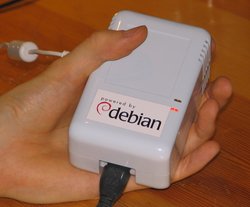
SheevaPlug in my hand I received a SheevaPlug this week, an intriguing device that packs incredible power and functionality into a tiny package. As many of you know, I've been doing a lot of work on Debian for the Linksys NSLU2 in the last few years. The NSLU2 is a key reason why ARM has become the third most popular architecture in Debian (after 32 and 64 bit x86), and I believe a main reason is that the NSLU2 is so incredibly cheap. At a price under $100, most people don't think too long and simply buy a device and do something cool with it. The SheevaPlug is being offered at the same price range but offers considerably more. Riku Voipio asked the right question: "What would you do with something approximately 10x more powerful with same prize/size range?" I believe the SheevaPlug is a killer replacement for the NSLU2 and here's why: I'm incredibly excited about the SheevaPlug and the first thing I did was to take the device apart and look at the inside. The results can be found in the SheevaPlug image gallery. My next project will be slightly more productive: porting Debian. As I see it, we should support the following three installation variants for the SheevaPlug: The first two should be relatively straight forward, but of course installing to the internal flash memory is particularly interesting given that 512 MB (plus compression) is enough for a basic installation of Debian. Unfortunately, installations to MTD flash are currently not supported in the Debian installer but I hope we can find a volunteer who wants to implement this functionality. My next steps are to put a kernel for the SheevaPlug into the archive and to get a basic installation going. From there we can look at more sophisticated installation options and other functionality.

Dirk Eddelbuettel: 2009 March Madness Half Marathon in Cary

This morning it was once more time for the annual March Madness Half Marathon in Cary. This race is basically the start of the running season in Chicagoland. And we could not have asked for better weather. After a really cold and long winter, and a short snapback to really cold temperatures this week, it started to warm up a little yesterday with expectations of more of the same today. So while it was still cold at the start at around 37 degrees, most runners opted for shorts and by the finish temperatures were in the high 40s. Coupled with clear blue skies and no wind, it was a really nice morning for a run. So how did it go? Well, I had pretty low expectations. Training has been difficult with too much snow, rain and plain cold weather. So like most of my running friends, motivation ran pretty low of late. I was really only trying to set a modest pace, and to hope to hang on to it and run steadily. That worked: I didn't walk a single water stop, and while my legs were getting really tired and sore I carried through to the end. Final time was 1:36:08.57 per my stop watch. That's a tad faster than last year, a lot slower than 2007, just a tad slower than 2006, and quite a bit faster than 2005. Next stop: my second Boston Marathon in five weeks and given the underwhelming training this winter, it will be a challenge.

Steve Kemp: Is my personal life of interest to you?

This weekend I mostly fiddled around migrating machines from Xen hosting to KVM hosting. Ultimately it was largely a waste of time, due to various other factors. Still with a bit of luck it will be possible to move the machiens next week. That aside I spent a while updating my blogspam detection site. As a brief recap this site offers a simple XML-RPC service which allows you to test whether incoming blog comments are spam or not. Originally this was put together to fight an invasion of comments submited to the Debian Administration website: The site currently shows:
SiteSpamNon-Spam% spam
debian-administration.org 238 372 60.98% spam
Depressing. But not as depressing as the real live stats which show since I last reset the counters 36,995 spam comments vs. 1,206 non-spam comments. (live updating counters here) Anyway I updated the service today to add two new plugins, both of which are a little reactionary. The first new plugin is called "multilink" and is based upon the observation that spammers rarely know the markup of the site they are submitting comments to. This means you can frequently see submitted comments like this:
 <a href="http://spam.com">buy viagra</a>
 [url=http://spam.com]buy viagra[/url]
 [link=http://spam.com]buy me[/link]
Here we have three different styles of links - "a href", "link=", and "url=". I figure this is a clear indicator of a confused mind, or more likely a spammer. The second new plugin is designed to stop people who enter "<strong>" words. It is a little coarse but actuall zero false positives in the real world so I'm going to leave it live to see how it works out. In happier news I'm just back from a trip to the beach. Sand rocks. Even if it wasn't windy enough for my kite .. ObFilm: Dracula ("Bram Stoker's Dracula" - 1992)

Next.

Previous.