Search Results: "tb"

19 December 2014

Richard Hartmann: Release Critical Bug report for Week 51

Real life has been interesting as of late; as you can see, I didn't post bug stats last week. If you have specific data from last Friday, please let me know and I will update. The UDD bugs interface currently knows about the following release critical bugs: How do we compare to the Squeeze release cycle?
Week Squeeze Wheezy Jessie
43 284 (213+71) 468 (332+136) 319 (240+79)
44 261 (201+60) 408 (265+143) 274 (224+50)
45 261 (205+56) 425 (291+134) 295 (229+66)
46 271 (200+71) 401 (258+143) 427 (313+114)
47 283 (209+74) 366 (221+145) 342 (260+82)
48 256 (177+79) 378 (230+148) 274 (189+85)
49 256 (180+76) 360 (216+155) 226 (147+79)
50 204 (148+56) 339 (195+144) ???
51 178 (124+54) 323 (190+133) 189 (134+55)
52 115 (78+37) 289 (190+99)
1 93 (60+33) 287 (171+116)
2 82 (46+36) 271 (162+109)
3 25 (15+10) 249 (165+84)
4 14 (8+6) 244 (176+68)
5 2 (0+2) 224 (132+92)
6 release! 212 (129+83)
7 release+1 194 (128+66)
8 release+2 206 (144+62)
9 release+3 174 (105+69)
10 release+4 120 (72+48)
11 release+5 115 (74+41)
12 release+6 93 (47+46)
13 release+7 50 (24+26)
14 release+8 51 (32+19)
15 release+9 39 (32+7)
16 release+10 20 (12+8)
17 release+11 24 (19+5)
18 release+12 2 (2+0)
Graphical overview of bug stats thanks to azhag:

14 December 2014

Gregor Herrmann: RC bugs 2014/49-50

it's getting harder to find "nice" RC bugs, due to the efforts of various bug hunters & the awesome auto-removal-from-testing feature. anyway, here's the list of bugs I worked on in the last 2 weeks:

13 December 2014

Gregor Herrmann: GDAC 2014/13

not sure if it it's me or debian but today was a quiet day. time to look back & see what has happened this year & this brings up memories of this year's & earlier debconfs, with their pkg-perl BOFs & their outdoor hacklabs. looking through these photos of past events makes me grateful, both to the tireless organizers of debconf, & to the people who can share a bench with me for hours :)
this posting is part of GDAC (gregoa's debian advent calendar), a project to show the bright side of debian & why it's fun for me to contribute.

9 December 2014

Wouter Verhelst: Playing with ExtreMon

Munin is a great tool. If you can script it, you can monitor it with munin. Unfortunately, however, munin is slow; that is, it will take snapshots once every five minutes, and not look at systems in between. If you have a short load spike that takes just a few seconds, chances are pretty high munin missed it. It also comes with a great webinterfacefrontendthing that allows you to dig deep in the history of what you've been monitoring. By the time munin tells you that your Kerberos KDCs are all down, you've probably had each of your users call you several times to tell you that they can't log in. You could use nagios or one of its brethren, but it takes about a minute before such tools will notice these things, too. Maybe use CollectD then? Rather than check once every several minutes, CollectD will collect information every few seconds. Unfortunately, however, due to the performance requirements to accomplish that (without causing undue server load), writing scripts for CollectD is not as easy as it is for Munin. In addition, webinterfacefrontendthings aren't really part of the CollectD code (there are several, but most that I've looked at are lacking in some respect), so usually if you're using CollectD, you're missing out some. And collectd doesn't do the nagios thing of actually telling you when things go down. So what if you could see it when things go bad? At one customer, I came in contact with Frank, who wrote ExtreMon, an amazing tool that allows you to visualize the CollectD output as things are happening, in a full-screen fully customizable visualization of the data. The problem is that ExtreMon is rather... complex to set up. When I tried to talk Frank into helping me getting things set up for myself so I could play with it, I got a reply along the lines of...
well, extremon requires a lot of work right now... I really want to fix foo and bar and quux before I start documenting things. Oh, and there's also that part which is a dead end, really. Ask me in a few months?
which is fair enough (I can't argue with some things being suboptimal), but the code exists, and (as I can see every day at $CUSTOMER) actually works. So I decided to just figure it out by myself. After all, it's free software, so if it doesn't work I can just read the censored code. As the manual explains, ExtreMon is a plugin-based system; plugins can add information to the "coven", read information from it, or both. A typical setup will run several of them; e.g., you'd have the from_collectd plugin (which parses the binary network protocol used by collectd) to get raw data into the coven; you'd run several aggregator plugins (which take that raw data and interpret it, allowing you do express things along the lines of "if the system's load gets above X, set load.status to warning"; and you'd run at least one output plugin so that you can actually see the damn data somewhere. While setting up ExtreMon as is isn't as easy as one would like, I did manage to get it to work. Here's what I had to do. You will need: First, we clone the ExtreMon git repository:
git clone https://github.com/m4rienf/ExtreMon.git extremon
cd extremon
There's a README there which explains the bare necessities on getting the coven to work. Read it. Do what it says. It's not wrong. It's not entirely complete, though; it fails to mention that you need to Make sure the dump.py script outputs something from collectd. You'll know when it shows something not containing "plugin" or "plugins" in the name. If it doesn't, fiddle with the #x3. lines at the top of the from_collectd file until it does. Note that ExtreMon uses inotify to detect whether a plugin has been added to or modified in its plugins directory; so you don't need to do anything special when updating things. Next, we build the java libraries (which we'll need for the display thing later on):
cd java/extremon
mvn install
cd ../client/
mvn install
This will download half the Internet, build some java sources, and drop the precompiled .jar files in your $HOME/.m2/repository. We'll now build the display frontend. This is maintained in a separate repository:
cd ../..
git clone https://github.com/m4rienf/ExtreMon-Display.git display
cd display
mvn install
This will download the other half of the Internet, and then fail, because Frank forgot to add a few repositories. Patch (and push request) on github With that patch, it will build, but things will still fail when trying to sign a .jar file. I know of four ways on how to fix that particular problem:
  1. Add your passphrase for your java keystore, in cleartext, to the pom.xml file. This is a terrible idea.
  2. Pass your passphrase to maven, in cleartext, by using some command line flags. This is not much better.
  3. Ensure you use the maven-jarsigner-plugin 1.3.something or above, and figure out how the maven encrypted passphrase store thing works. I failed at that.
  4. Give up on trying to have maven sign your jar file, and do it manually. It's not that hard, after all.
If you're going with 1 through 3, you're on your own. For the last option, however, here's what you do. First, you need a key:
keytool -genkeypair -alias extremontest
after you enter all the information that keytool will ask for, it will generate a self-signed code signing certificate, valid for six months, called extremontest. Producing a code signing certificate with longer validity and/or one which is signed by an actual CA is left as an exercise to the reader. Now, we will sign the .jar file:
jarsigner target/extremon-console-1.0-SNAPSHOT.jar extremontest
There. Who needs help from the internet to sign a .jar file? Well, apart from this blog post, of course. You will now want to copy your freshly-signed .jar file to a location served by HTTPS. Yes, HTTPS, not HTTP; ExtreMon-Display will fail on plain HTTP sites. Download this SVG file, and open it in an editor. Find all references to be.grep as well as those to barbershop and replace them with your own prefix and hostname. Store it along with the .jar file in a useful directory. Download this JNLP file, and store it on the same location (or you might want to actually open it with "javaws" to see the very basic animated idleness of my system). Open it in an editor, and replace any references to barbershop.grep.be by the location where you've stored your signed .jar file. Add the chalice_in_http plugin from the plugins directory. Make sure to configure it correctly (by way of its first few comment lines) so that its input and output filters are set up right. Add the configuration snippet in section 2.1.3 of the manual (or something functionally equivalent) to your webserver's configuration. Make sure to have authentication chalice_in_http is an input mechanism. Add the chalice_out_http plugin from the plugins directory. Make sure to configure it correctly (by way of its first few comment lines) so that its input and output filters are set up right. Add the configuration snippet in section 2.2.1 of the manual (or something functionally equivalent) to your webserver's configuration. Authentication isn't strictly required for the output plugin, but you might wish for it anyway if you care whether the whole internet can see your monitoring. Now run javaws https://url/x3console.jnlp to start Extremon-Display. At this point, I got stuck for several hours. Whenever I tried to run x3mon, this java webstart thing would tell me simply that things failed. When clicking on the "Details" button, I would find an error message along the lines of "Could not connect (name must not be null)". It would appear that the Java people believe this to be a proper error message for a fairly large number of constraints, all of which are slightly related to TLS connectivity. No, it's not the keystore. No, it's not an API issue, either. Or any of the loads of other rabbit holes that I dug myself in. Instead, you should simply make sure you have Server Name Indication enabled. If you don't, the defaults in Java will cause it to refuse to even try to talk to your webserver. The ExtreMon github repository comes with a bunch of extra plugins; some are special-case for the place where I first learned about it (and should therefore probably be considered "examples"), others are general-purpose plugins which implement things like "is the system load within reasonable limits". Be sure to check them out. Note also that while you'll probably be getting most of your data from CollectD, you don't actually need to do that; you can write your own plugins, completely bypassing collectd. Indeed, the from_collectd thing we talked about earlier is, simply, also a plugin. At $CUSTOMER, for instance, we have one plugin which simply downloads a file every so often and checks it against a checksum, to verify that a particular piece of nonlinear software hasn't gone astray yet again. That doesn't need collectd. The example above will get you a small white bar, the width of which is defined by the cpu "idle" statistic, as reported by CollectD. You probably want more. The manual (chapter 4, specifically) explains how to do that. Unfortunately, in order for things to work right, you need to pretty much manually create an SVG file with a fairly strict structure. This is the one thing which Frank tells me is a dead end and needs to be pretty much rewritten. If you don't feel like spending several days manually drawing a schematic representation of your network, you probably want to wait until Frank's finished. If you don't mind, or if you're like me and you're impatient, you'll be happy to know that you can use inkscape to make the SVG file. You'll just have to use dialog behind ctrl+shift+X. A lot. Once you've done that though, you can see when your server is down. Like, now. Before your customers call you.

5 December 2014

Richard Hartmann: Release Critical Bug report for Week 49

Look at that bug count! At that pace, Jessy will happen before FOSDEM ;) The UDD bugs interface currently knows about the following release critical bugs: How do we compare to the Squeeze release cycle?
Week Squeeze Wheezy Jessie
43 284 (213+71) 468 (332+136) 319 (240+79)
44 261 (201+60) 408 (265+143) 274 (224+50)
45 261 (205+56) 425 (291+134) 295 (229+66)
46 271 (200+71) 401 (258+143) 427 (313+114)
47 283 (209+74) 366 (221+145) 342 (260+82)
48 256 (177+79) 378 (230+148) 274 (189+85)
49 256 (180+76) 360 (216+155) 226 (147+79)
50 204 (148+56) 339 (195+144)
51 178 (124+54) 323 (190+133)
52 115 (78+37) 289 (190+99)
1 93 (60+33) 287 (171+116)
2 82 (46+36) 271 (162+109)
3 25 (15+10) 249 (165+84)
4 14 (8+6) 244 (176+68)
5 2 (0+2) 224 (132+92)
6 release! 212 (129+83)
7 release+1 194 (128+66)
8 release+2 206 (144+62)
9 release+3 174 (105+69)
10 release+4 120 (72+48)
11 release+5 115 (74+41)
12 release+6 93 (47+46)
13 release+7 50 (24+26)
14 release+8 51 (32+19)
15 release+9 39 (32+7)
16 release+10 20 (12+8)
17 release+11 24 (19+5)
18 release+12 2 (2+0)
Graphical overview of bug stats thanks to azhag:

Russell Coker: BTRFS Status Dec 2014

My last problem with BTRFS was in August [1]. BTRFS has been running mostly uneventfully for me for the last 4 months, that s a good improvement but the fact that 4 months of no problems is noteworthy for something as important as a filesystem is a cause for ongoing concern. A RAID-1 Array A week ago I had a minor problem with my home file server, one of the 3TB disks in the BTRFS RAID-1 started giving read errors. That s not a big deal, I bought a new disk and did a btrfs replace operation which was quick and easy. The first annoyance was that the output of btrfs device stats reported an error count for the new device, it seems that btrfs device replace copies everything from the old disk including the error count. The solution is to use btrfs device stats -z to reset the count after replacing a device. I replaced the 3TB disk with a 4TB disk (with current prices it doesn t make sense to buy a new 3TB disk). As I was running low on disk space I added a 1TB disk to give it 4TB of RAID-1 capacity, one of the nice features of BTRFS is that a RAID-1 filesystem can support any combination of disks and use them to store 2 copies of every block of data. I started running a btrfs balance to get BTRFS to try and use all the space before learning from the mailing list that I should have done btrfs filesystem resize to make it use all the space. So my balance operation had configured the filesystem to configure itself for 2*3TB+1*1TB disks which wasn t the right configuration when the 4TB disk was fully used. To make it even more annoying the btrfs filesystem resize command takes a devid not a device name. I think that when BTRFS is more stable it would be good to have the btrfs utility warn the user about such potential mistakes. When a replacement device is larger than the old one it will be very common to want to use that space. The btrfs utility could easily suggest the most likely btrfs filesystem resize to make things easier for the user. In a disturbing coincidence a few days after replacing the first 3TB disk the other 3TB disk started giving read errors. So I replaced the second 3TB disk with a 4TB disk and removed the 1TB disk to give a 4TB RAID-1 array. This is when it would be handy to have the metadata duplication feature and copies= option of ZFS. Ctree Corruption 2 weeks ago a basic workstation with a 120G SSD owned by a relative stopped booting, the most significant errors it gave were BTRFS: log replay required on RO media and BTRFS: open_ctree failed . The solution to this is to run the command btrfs-zero-log , but that initially didn t work. I restored the system from a backup (which was 2 months old) and took the SSD home to work on it. A day later btrfs-zero-log worked correctly and I recovered all the data. Note that I didn t even try mounting the filesystem in question read-write, I mounted it read-only to copy all the data off. While in theory the filesystem should have been OK I didn t have a need to keep using it at that time (having already wiped the original device and restored from backup) and I don t have confidence in BTRFS working correctly in that situation. While it was nice to get all the data back it s a concern when commands don t operate consistently. Debian and BTRFS I was concerned when the Debian kernel team chose 3.16 as the kernel for Jessie (the next Debian release). Judging by the way development has been going I wasn t confident that 3.16 would turn out to be stable enough for BTRFS. But 3.16 is working reasonably well on a number of systems so it seems that it s likely to work well in practice. But I m still deploying more ZFS servers. The Value of Anecdotal Evidence When evaluating software based on reports from reliable sources (IE most readers will trust me to run systems well and only report genuine bugs) bad reports have a much higher weight than good reports. The fact that I ve seen kernel 3.16 to work reasonably well on ~6 systems is nice but that doesn t mean it will work well on thousands of other systems although it does indicate that it will work well on more systems than some earlier Linux kernels which had common BTRFS failures. But the annoyances I had with the 3TB array are repeatable and will annoy many other people. The ctree coruption problem MIGHT have been initially caused by a memory error (it s a desktop machine without ECC RAM) but the recovery process was problematic and other users might expect problems in such situations.

4 December 2014

Chris Lamb: Don't ask your questions in private

(If I've linked you to this page, it is my feeble attempt to provide a more convincing justification.)


I often receive instant messages or emails requesting help or guidance at work or on one of my various programming projects. When asked why they asked privately, the responses vary; mostly along the lines of it simply being an accident, not knowing where else to ask, as well as not wishing to "disturb" others with their bespoke question. Some will be more candid and simply admit that they were afraid of looking unknowledgable in front of others. It is always tempting to simply reply with the answer, especially as helping another human is inherently rewarding unless one is a psychopath. However, one can actually do more good overall by insisting the the question is re-asked in a more public forum.
This is for many reasons. Most obviously, public questions are simply far more efficient as soon as more than one person asks that question the response can be found in a search engine or linked to in the future. These time savings soon add up, meaning that simply more stuff can be done in any given day. After all, most questions are not as unique as people think. Secondly, a private communication cannot be corrected or elaborated on if someone else notices it is incorrect or incomplete. Even this rather banal point is more subtle that it first appears the lack of possible corrections deprives both the person asking and the person responding of the true and correct answer. Lastly, conversations that happen in private are depriving others of the answer as well. Perhaps someone was curious but hadn't got around to asking? Maybe the answer or even the question! contains a clue to solving some other issue. None of this can happen if this is occurs behind closed doors. (There are lots of subtler reasons too in a large organisation or team, simply knowing what other people are curious about can be curiously valuable information.)
Note that this is not as you might immediately suspect simply a way of ensuring that one gets the public recognition or "kudos" from being seen helping others. I wouldn't deny that technical communities work on a gift economy basis to some degree, but to attribute all acts of assistance as "selfish" and value-extracting would be to take the argument too far in the other direction. Saying that, the lure and appeal of public recognition should not be understated and can certainly provide an incentive to elaborate and provide a generally superior response.

More philosophically, there's also something fundamentally "honest" about airing issues in an appropriately public and transparent manner. I feel it promotes a culture of egoless conversations, of being able to admit one's mistakes and ultimately a healthy personal mindset. So please, take care not only in the way you phrase and frame your question, but also consider wider context in which you are asking it. And don't take it too personally if I ask you to re-ask elsewhere...

3 December 2014

Diego Escalante Urrelo: Link pack #01

Following the lead of my dear friend Daniel and his fantastic and addictive Summing up series, here s a link pack of recent stuff I read around the web. Link pack is definitely a terrible name, but I m working on it.

How to Silence Negative Thinking
On how to avoid the pitfall of being a Negatron and not an Optimist Prime. You might be your own worst enemy and you might not even know it:
Psychologists use the term automatic negative thoughts to describe the ideas that pop into our heads uninvited, like burglars, and leave behind a mess of uncomfortable emotions. In the 1960s, one of the founders of cognitive therapy, Aaron Beck, concluded that ANTs sabotage our best self, and lead to a vicious circle of misery: creating a general mindset that is variously unhappy or anxious or angry (take your pick) and which is (therefore) all the more likely to generate new ANTs. We get stuck in the same old neural pathways, having the same negative thoughts again and again.
Meet Harlem s Official Street Photographer
A man goes around Harlem with his camera, looking to give instead of taking. Makes you think about your approach to people and photography, things can be simpler. Kinda like Humans of New York, but in Harlem. And grittier, and on film but as touching, or more:
I tell people that my camera is a healing mechanism, Allah says. Let me photograph it and take it away from you.
What Happens When We Let Industry and Government Collect All the Data They Want
Why having nothing to hide is not about the now, but about the later. It s not that someone is going to judge for pushing every detail of your life to Twitter and Instagram, it s just that something you do might be illegal a few years later:
There was a time when it was essentially illegal to be gay. There was a time when it was legal to own people and illegal for them to run away. Sometimes, society gets it wrong. And it s not just nameless bureaucrats; it s men like Thomas Jefferson. When that happens, strong privacy protections including collection controls that let people pick who gets their data, and when allow the persecuted and unpopular to survive.
The Sex-Abuse Scandal Plaguing USA Swimming
Abusive coaches and a bullying culture in sports training are the perfect storm for damaging children. And it s amazing the extent to which a corporation or institution is willing to look the other way, as long as they save face. Very long piece, but intriguing to read. What Cities Would Look Like if Lit Only by the Stars
Thierry Cohen goes around the world and builds beautiful and realistic composite images of how would big cities look like if lit only by stars. The original page has some more cities: Villes teintes (Darkened Cities). On Muppets & Merchandise: How Jim Henson Turned His Art into a Business
Lessons from how Jim Henson managed to juggle both art and business without selling out for the wrong reasons. Really interesting, and reminds you to put Henson in perspective as a very smart man who managed to convince everyone to give him money for playing with muppets. The linked video on How the Muppet Show is Made is also cool. Made me curious enough to get the book. Barbie, Remixed: I (really!) can be a computer engineer
Mattel launched the most misguided book about empowering Barbie to be anything but a computer engineer in a book about being a computer engineer. The internet did not disappoint and fixed the problem within hours. There s now even an app for that (includes user submitted pages).

2 December 2014

Matthias Klumpp: How to build a cross-distro package with Limba

Disclaimer: Limba is stilllimba-small in a very early stage of development. Bugs happen, and I give to guarantees on API stability yet. Limba is a very simple cross-distro package installer, utilizing OverlayFS found in recent Linux kernels (>= 3.18). As example I created a small Limba package for one of the Qt5 demo applications, and I would like to share the process of creating Limba packages it s quite simple, and I could use some feedback on how well the resulting packages work on multiple distributions. I assume that you have compiled Limba and installed it how that is done is described in its README file. So, let s start. 1. Prepare your application The cool thing about Limba is that you don t really have to do many changes on your application. There are a few things to pay attention to, though: This needs to be done so your application will find its data at runtime. Additionally, you need to write an AppStream metadata file, and find out which stuff your application depends on. 2. Create package metadata & install software 1.1 Basics Now you can create the metadata necessary to build a Limba package. Just run
cd /path/to/my/project
lipkgen make-template
This will create a pkginstall directory, containing a control file and a metainfo.xml file, which can be a symlink to the AppStream metadata, or be new metadata. Now, configure your application with /opt/bundle as install prefix (-DCMAKE_INSTALL_PREFIX=/opt/bundle, prefix=/opt/bundle, etc.) and install it to the pkginstall/inst_target directory. 1.2 Handling dependencies If your software has dependencies on other packages, just get the Limba packages for these dependencies, or build new ones. Then place the resulting IPK packages in the pkginstall/repo directory. Ideally, you should be able to fetch Limba packages which contain the software components directly from their upstream developers. Then, open the pkginstall/control file and adjust the Requires line. The names of the components you depend on match their AppStream-IDs (<id/> tag in the AppStream XML document). Any version-relation (>=, >>, <<, <=, <>) is supported, and specified in brackets after the component-id. The resulting control-file might look like this:
Format-Version: 1.0

Requires: Qt5Core (>= 5.3), Qt5DBus (>= 5.3), libpng12
If the specified dependencies are in the repo/ subdirectory, these packages will get installed automatically, if your application package is installed. Otherwise, Limba depends on the user to install these packages manually there is no interaction with the distribution s package-manager (yet?). 3. Building the package In order to build your package, make sure the content in inst_target/ is up to date, then run
lipkgen build pkginstall/
This will build your package and output it in the pkginstall/ directory. 4. Testing the package You can now test your package, Just run
sudo lipa install package.ipk
Your software should install successfully. If you provided a .desktop file in $prefix/share/applications, you should find your application in your desktop s application-menu. Otherwise, you can run a binary from the command-line, just append the version of your package to the binary name (bash-comletion helps). Alternatively, you can use the runapp command, which lets you run any binary in your bundle/package, which is quite helpful for debugging (since the environment a Limba-installed application is run is different from the one of other applications). Example:
runapp $ component_id -$ version :/bin/binary-name
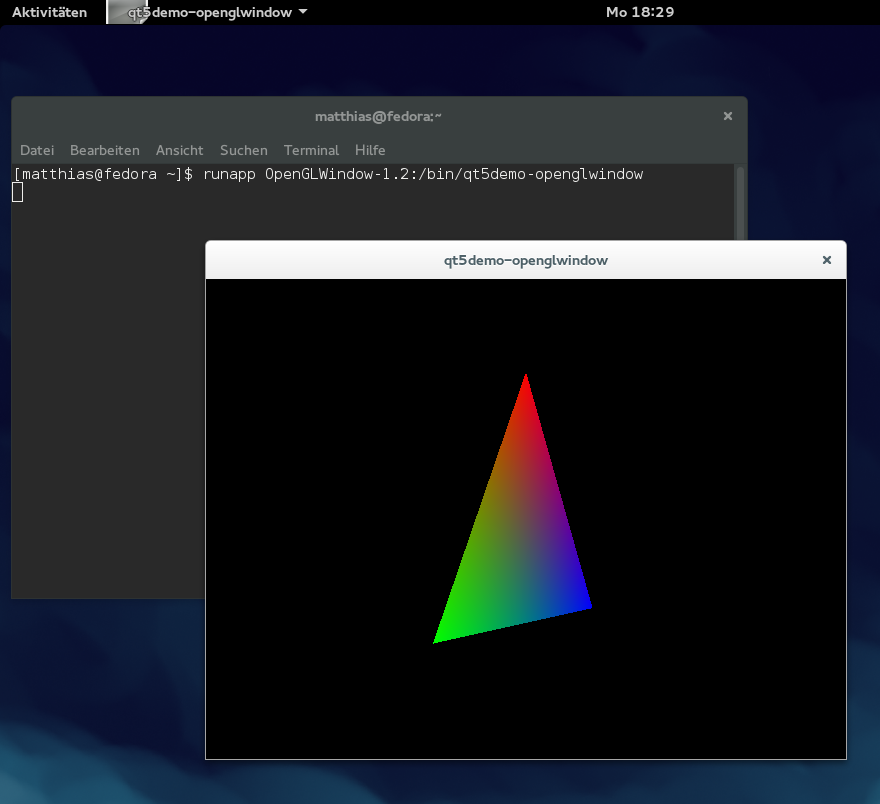
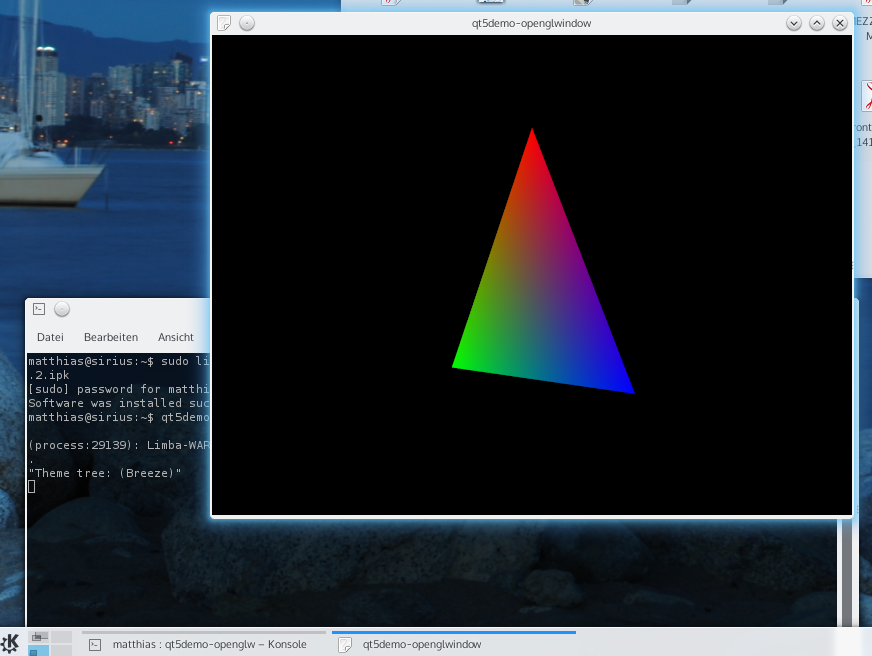
And that s it! :-) I used these steps to create a Limba package for the OpenGL Qt5 demo on Tanglu 2 (Bartholomea), and tested it on Kubuntu 15.04 (Vivid) with KDE, as well as on an up-to-date Fedora 21, with GNOME and without any Qt or KDE stuff installed: qt5demo-limba-kubuntuqt5demo-limba-fedora I encountered a few obstacles when building the packages, e.g. Qt5 initially didn t find the right QPA plugin that has been fixed by adjusting a config file in the Qt5Gui package. Also, on Fedora, a matching libpng was missing, so I included that as well. You can find the packages at Github, currently (but I am planning to move them to a different place soon). The biggest issue with Limba is at time, that it needs Linux 3.18, or an older kernel with OverlayFS support compiled in. Apart from that and a few bugs, the experience is quite smooth. As soon as I am sure there are now hidden fundamental issues, I can think of implementing more features, like signing packages and automatically updating them. Have fun playing around with Limba!
30 November 2014

Gregor Herrmann: RC bugs 2014/47-48

these are the RC bugs I've worked on during the last two weeks:

Thorsten Alteholz: My Debian Activities in November 2014

FTP assistant In contrast to the last month, this month has been rather quiet and I really liked that :-) . The stress has moved to the next team. So all in all I marked 101 packages for accept and had to reject 27 packages. As I mostly reviewed really new packages, I didn t have to file any RC bug this month. Squeeze LTS This was my fifth month that I did some work for the Squeeze LTS initiative, started by Raphael Hertzog at Freexian. This month I got assigned a workload of 14.25h and I spent these hours to upload new versions of: I also uploaded [DLA 85-1] libxml-security-java security update, but as nobody of the LTS sponsors had any interest in this package, I did this in my spare time. A package with security in its name should not be affected by security issues. This month my failure of the month has been the binutils package. Although the security team prepared the way for finding the correct patches for all those CVEs, I somehow managed to not find them. This is embarassing I am also a bit disappointed by current LTS users. All important packages have been made available for testing before uploading them to the archive. Apart from some brave fellow DDs, no other feedback was reported on debian-lts. Complaints arrived only when the packages have been finally uploaded. Do admins have enough time nowadays and don t need to use some kind of testbed? Times are changing Other packages This month I even found some time to sponsor uploads, so please welcome a new version of fastaq in experimental and patiently wait for aegaen and kmc to pass NEW. At this point I also want to mention the Debian Med Advent Calendar, which was announced in this email and already mentioned by Andreas in his latest Debian Med bits. Everybody is invited to take care of as much as possible poor souls. Support If you would like to support my Debian work you could either be part of the Freexian initiative (see above) or consider to send some bitcoins to 1JHnNpbgzxkoNexeXsTUGS6qUp5P88vHej. Contact me at donation@alteholz.eu if you prefer another way to donate. Every kind of support is most appreciated.

28 November 2014

Richard Hartmann: Release Critical Bug report for Week 48

Holy bug-count-drop, Batman! Some bugs which need loving: The UDD bugs interface currently knows about the following release critical bugs: How do we compare to the Squeeze release cycle?
Week Squeeze Wheezy Jessie
43 284 (213+71) 468 (332+136) 319 (240+79)
44 261 (201+60) 408 (265+143) 274 (224+50)
45 261 (205+56) 425 (291+134) 295 (229+66)
46 271 (200+71) 401 (258+143) 427 (313+114)
47 283 (209+74) 366 (221+145) 342 (260+82)
48 256 (177+79) 378 (230+148) 274 (189+85)
49 256 (180+76) 360 (216+155)
50 204 (148+56) 339 (195+144)
51 178 (124+54) 323 (190+133)
52 115 (78+37) 289 (190+99)
1 93 (60+33) 287 (171+116)
2 82 (46+36) 271 (162+109)
3 25 (15+10) 249 (165+84)
4 14 (8+6) 244 (176+68)
5 2 (0+2) 224 (132+92)
6 release! 212 (129+83)
7 release+1 194 (128+66)
8 release+2 206 (144+62)
9 release+3 174 (105+69)
10 release+4 120 (72+48)
11 release+5 115 (74+41)
12 release+6 93 (47+46)
13 release+7 50 (24+26)
14 release+8 51 (32+19)
15 release+9 39 (32+7)
16 release+10 20 (12+8)
17 release+11 24 (19+5)
18 release+12 2 (2+0)
Graphical overview of bug stats thanks to azhag:

27 November 2014

Jonathan Dowland: PGP transition statement

-----BEGIN PGP SIGNED MESSAGE-----
Hash: SHA512,SHA1
I'm transitioning from my old, 1024-bit DSA PGP key, FD35 0B0A C6DD 5D91 DB7A 83D1 168B 4E71 7032 F238, to my newer, 4096-bit RSA key, E037 CB2A 1A00 61B9 4336 3C8B 0907 4096 06AA AAAA. If you have signed my old key, I'd be very grateful if you would consider signing my new key. (Thanks in advance!) This is long overdue! I've had 06AAAAAA since 2009, but it took me a while to get enough signatures on it for me to consider a transition. I still have far more signatures on my older key, owing to attending more conferences when I was using it than since I switched. This statement, available in plaintext at http://jmtd.net/log/pgp_transition/statement.txt, has been signed with both keys. I've marked my old key as expiring in around 72 days time, which coincides with my change of job, and will be just short of ten years since I generated it.
-----BEGIN PGP SIGNATURE-----
Version: GnuPG/MacGPG2 v2.0.22 (Darwin)
iQIcBAEBCgAGBQJUdysuAAoJEAkHQJYGqqqquQ0QALVGcn9Wbasg0oh8JeE8rN7h
k7FeZjmGk+ZwfXwo4Eq4pjxKp+TN+r4xBCFSHDRmMaAm9q7aWF/RqkdNiEtioQfJ
SmfzLsoEnSBmS9dr1LvAoxIlUzs/9Lt8EY2tB4NQne3QIu3VyRBjQDvqff6KJgkV
849+GsrJezkg/2VFZkZp1N9y0YwrmezV/1j0N6zR8Y20LlF4YuD3egUJYvbrQ1pA
krJwhiHskXRinqviYMg4CuTZZ3m2wc4fM6uiY5t9taqK90KFgmg73KvW6Rx2L+XP
BUzTlSYHnK+qI23Cng//DthFww2Wf9RofkfRgXk0zAe4+DcoMZzALKtZQA6GrT46
wzsmu459p5nUwwa6BzUvqBzyVtzbtHN5xaFwbjHCPlemsFlH/8LHackJLsBvr2Gp
q292huYu/HNo+Q6OIslFX6rc5AR3HKdbU2DxYMPAfI+CEtW1XwetK8ADSZc1v54C
+sc+Yb2kAleLX2xMIfS9JqvcKOP2Gbo7nTdRPnS2jZRWOv8JxVfFiSzHVODtlLfk
AmRvms5rQ2nPnB21yOd+DP2sACVKY0MS7/UwMh2hoQLR/bSu/jRh24n3WHDfQWtF
Jp4AD80ABFV2t/pSP1L70HlxwPmOzra8AVzCdXMOT/SdT387rSM9fvue4FY5goT+
/pResJSl9pAbBCtjOFJoiEYEARECAAYFAlR3Ky4ACgkQFotOcXAy8jiLawCgofsp
ggze/iSpfkyeL0vhXi6N/WMAoLQogFQY+VaQrVP3lGl1VVh4jw0W
=JBA4
-----END PGP SIGNATURE-----

21 November 2014

Richard Hartmann: Release Critical Bug report for Week 47

There's a BSP this weekend. If you're interested in remote participation, please join #debian-muc on irc.oftc.net. The UDD bugs interface currently knows about the following release critical bugs: How do we compare to the Squeeze release cycle?
Week Squeeze Wheezy Jessie
43 284 (213+71) 468 (332+136) 319 (240+79)
44 261 (201+60) 408 (265+143) 274 (224+50)
45 261 (205+56) 425 (291+134) 295 (229+66)
46 271 (200+71) 401 (258+143) 427 (313+114)
47 283 (209+74) 366 (221+145) 342 (260+82)
48 256 (177+79) 378 (230+148)
49 256 (180+76) 360 (216+155)
50 204 (148+56) 339 (195+144)
51 178 (124+54) 323 (190+133)
52 115 (78+37) 289 (190+99)
1 93 (60+33) 287 (171+116)
2 82 (46+36) 271 (162+109)
3 25 (15+10) 249 (165+84)
4 14 (8+6) 244 (176+68)
5 2 (0+2) 224 (132+92)
6 release! 212 (129+83)
7 release+1 194 (128+66)
8 release+2 206 (144+62)
9 release+3 174 (105+69)
10 release+4 120 (72+48)
11 release+5 115 (74+41)
12 release+6 93 (47+46)
13 release+7 50 (24+26)
14 release+8 51 (32+19)
15 release+9 39 (32+7)
16 release+10 20 (12+8)
17 release+11 24 (19+5)
18 release+12 2 (2+0)
Graphical overview of bug stats thanks to azhag:

Jonathan Wiltshire: On kFreeBSD and FOSDEM

Boy I love rumours. Recently I ve heard two, which I ought to put to rest now everybody s calmed down from recent events. kFreeBSD isn t an official Jessie architecture because <insert systemd-related scare story> Not true. Our sprint at ARM (who kindly hosted and caffeinated us for four days) was timed to coincide with the Cambridge Mini-DebConf 2014. The intention was that this would save on travel costs for those members of the Release Team who wanted to attend the conference, and give us a jolly good excuse to actually meet up. Winners all round. It also had an interesting side-effect. The room we used was across the hall from the lecture theatre being used as hack space and, later, the conference venue, which meant everybody attending during those two days could see us locked away there (and yes, we were in there all day for two days solid, except for lunch times and coffee missions). More than one conference attendee remarked to me in person that it was interesting for them to see us working (although of course they couldn t hear what we were discussing), and hadn t appreciated before that how much time and effort goes into our meetings. Most of our first morning was taken up with the last pieces of architecture qualification, and that was largely the yes/no decision we had to make about kFreeBSD. And you know what? I don t recall us talking about systemd in that context at all. Don t forget kFreeBSD already had a waiver for a reduced scope in Jessie because of the difficulty in porting systemd to it. It s sadly impossible to capture the long and detailed discussion we had into a couple of lines of status information in a bits mail. If bits mails were much longer, people would be put off reading them, and we really really want you to take note of what s in there. The little space we do have needs to be factual and to the point, and not include all the background that led us to a decision. So no, the lack of an official Jessie release of kFreeBSD has very little, if anything, to do with systemd. Jessie will be released during (or even before) FOSDEM Not necessarily true. Debian releases are made when they re ready. That sets us apart from lots of other distributions, and is a large factor in our reputation for stability. We may have a target date in mind for a freeze, because that helps both us and the rest of the project plan accordingly. But we do not have a release date in mind, and will not do so until we get much closer to being ready. (Have you squashed an RC bug today?) I think this rumour originated from the office of the DPL, but it s certainly become more concrete than I think Lucas intended. However, it is true that we ve gone into this freeze with a seriously low bug count, because of lots of other factors. So it may indeed be that we end up in good enough shape to think about releasing near (or even at) FOSDEM. But rest assured, Debian 8 Jessie will be released when it s ready, and even we don t know when that will be yet. (Of course, if we do release before then, you could consider throwing us a party. Plenty of the Release Team, FTP masters and CD team will be at FOSDEM, release or none.)
On kFreeBSD and FOSDEM is a post from: jwiltshire.org.uk Flattr

Daniel Pocock: PostBooks 4.7 packages available, xTupleCon 2014 award

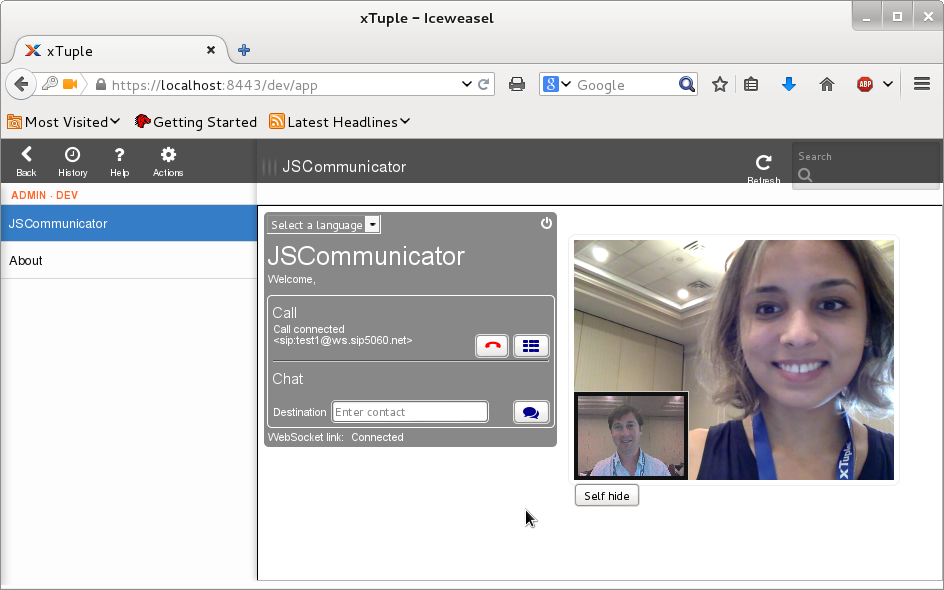
I recently updated the PostBooks packages in Debian and Ubuntu to version 4.7. This is the version that was released in Ubuntu 14.10 (Utopic Unicorn) and is part of the upcoming Debian 8 (jessie) release. Better prospects for Fedora and RHEL/CentOS/EPEL packages As well as getting the packages ready, I've been in contact with xTuple helping them generalize their build system to make packaging easier. This has eliminated the need to patch the makefiles during the build. As well as making it easier to support the Debian/Ubuntu packages, this should make it far easier for somebody to create a spec file for RPM packaging too. Debian wins a prize While visiting xTupleCon 2014 in Norfolk, I was delighted to receive the Community Member of the Year award which I happily accepted not just for my own efforts but for the Debian Project as a whole. Steve Hackbarth, Director of Product Development at xTuple, myself and the impressive Community Member of the Year trophy This is a great example of the productive relationships that exist between Debian, upstream developers and the wider free software community and it is great to be part of a team that can synthesize the work from so many other developers into ready-to-run solutions on a 100% free software platform. Receiving this award really made me think about all the effort that has gone into making it possible to apt-get install postbooks and all the people who have collectively done far more work than myself to make this possible: Here is a screenshot of the xTuple web / JSCommunicator integration, it was one of the highlights of xTupleCon: and gives a preview of the wide range of commercial opportunities that WebRTC is creating for software vendors to displace traditional telecommunications providers. xTupleCon also gave me a great opportunity to see new features (like the xTuple / Drupal web shop integration) and hear about the success of consultants and their clients deploying xTuple/PostBooks in various scenarios. The product is extremely strong in meeting the needs of manufacturing and distribution and has gained a lot of traction in these industries in the US. Many of these features are equally applicable in other markets with a strong manufacturing industry such as Germany or the UK. However, it is also flexible enough to simply disable many of the specialized features and use it as a general purpose accounting solution for consulting and services businesses. This makes it a good option for many IT freelancers and support providers looking for a way to keep their business accounts in a genuinely open source solution with a strong SQL backend and a native Linux desktop interface.

20 November 2014

Daniel Pocock: Is Amnesty giving spy victims a false sense of security?

Amnesty International is getting a lot of attention with the launch of a new tool to detect government and corporate spying on your computer. I thought I would try it myself. I went to a computer running Microsoft Windows, an operating system that does not publish its source code for public scrutiny. I used the Chrome browser, users often express concern about Chrome sending data back to the vendor about the web sites the users look for. Without even installing the app, I would expect the Amnesty web site to recognise that I was accessing the site from a combination of proprietary software. Instead, I found a different type of warning. Beware of Amnesty? Instead, the only warning I received was from Amnesty's own cookies: Even before I install the app to find out if the government is monitoring me, Amnesty is keen to monitor my behaviour themselves. While cookies are used widely, their presence on a site like Amnesty's only further desensitizes Internet users to the downside risks of tracking technologies. By using cookies, Amnesty is effectivley saying a little bit of tracking is justified for the greater good. Doesn't that sound eerily like the justification we often hear from governments too? Is Amnesty part of the solution or part of the problem? Amnesty is a well known and widely respected name when human rights are mentioned. However, their advice that you can install an app onto a Windows computer or iPhone to detect spyware is like telling people that putting a seatbelt on a motorbike will eliminate the risk of death. It would be much more credible for Amnesty to tell people to start by avoiding cloud services altogether, browse the web with Tor and only use operating systems and software that come with fully published source code under a free license. Only when 100% of the software on your device is genuinely free and open source can independent experts exercise the freedom to study the code and detect and remove backdoors, spyware and security bugs. It reminds me of the advice Kim Kardashian gave after the Fappening, telling people they can continue trusting companies like Facebook and Apple with their private data just as long as they check the privacy settings (reality check: privacy settings in cloud services are about as effective as a band-aid on a broken leg). Write to Amnesty Amnesty became famous for their letter writing campaigns. Maybe now is the time for people to write to Amnesty themselves, thank them for their efforts and encourage them to take more comprehensive action. Feel free to cut and paste some of the following potential ideas into an email to Amnesty:

I understand you may not be able to respond to every email personally but I would like to ask you to make a statement about these matters on your public web site or blog. I understand it is Amnesty's core objective to end grave abuses of human rights. Electronic surveillence, due to its scale and pervasiveness, has become a grave abuse in itself and in a disturbing number of jurisdictions it is an enabler for other types of grave violations of human rights. I'm concerned that your new app Detekt gives people a false sense of security and that your campaign needs to be more comprehensive to truly help people and humanity in the long term. If Amnesty is serious about solving the problems of electronic surveillance by government, corporations and other bad actors, please consider some of the following:
  • Instead of displaying a cookie warning on Amnesty.org, display a warning to users who access the site from a computer running closed-source software and give them a link to download a free and open source web browser like Firefox.
  • Redirect all visitors to your web site to use the HTTPS encrypted version of the site.
  • Using free software such as the GNU/Linux operating system (using one of the Debian, Fedora or Ubuntu systems is one of the more common ways to achieve this) and LibreOffice for all Amnesty's own operations, making a public statement about your use of free software and mentioning this in the closing paragraph of all press releases relating to surveillance topics.
  • Encouraging Amnesty donors, members and supporters to choose similar software especially when engaging in any political activities.
  • Make a public statement that Amnesty will not use cloud services such as SalesForce or Facebook to store, manage or interact with data relating to members, donors or other supporters.
  • Encouraging the public to move away from centralized cloud services such as those provided by their smartphone or social networks and use de-centralized or federated services such as XMPP chat.
Given the immense threat posed by electronic surveillance, I'd also like to call on Amnesty to allocate at least 10% of annual revenue towards software projects releasing free and open source software that offers the public an alternative to the centralized cloud.

While publicity for electronic privacy is great, I hope Amnesty can go a step further and help people use trustworthy software from the ground up.

Stefano Zacchiroli: Thoughts on the Init System Coupling GR

on perceived hysteria and silent sanity As you probably already know by now, the results of the Debian init system coupling general resolution (GR) look like this:
Init system coupling GR: results (arrow from A to B means that voters preferred A to B by that margin)
results of the init system coupling GR
Some random thoughts about them: My take home message is that we are experiencing a huge gap between the public perception of the state of Debian (both from within and from without the project) and the actual beliefs of the silent majority of people that make Debian with their work, day after day. In part this is old news. The most "senior" members of the project will remember that the topic of "vocal minorities vs silent majority" was a recurrent one in Debian 10+ years ago, when flames were periodically ravaging the project. Since then Debian has grown a lot though, and we are now part of a much larger and varied ecosystem. We are now at a scale at which there are plenty of FOSS "mass-media" covering daily what happens in Debian, inducing feedback loops with our own perception of ourselves which we do not fully grok yet. This is a new factor in the perception gap. This situation is not intrinsically bad, nor there is blame to assign here: after all influential bloggers, news sites, etc., just do their job. And their attention also testifies of the huge interest that there is around Debian and our choices. But we still need to adapt and learn to take perceived hysteria with a pinch (or two) of salt. It might just be time for our decennial check-up. Time to remind ourselves that our ways of doing things might in fact still be much more sane than sometimes we tend to believe. We went on 10+ years ago, after monumental flames. It looks like we are now ready to move on again, putting The Era of the Great systemd Histeria behind us.

Matthew Palmer: Multi-level prefix delegation is not a myth! I've seen it!

Unless you ve been living under a firewalled rock, you know that IPv6 is coming. There s also a good chance that you ve heard that IPv6 doesn t have NAT. Or, if you pay close attention to the minutiae of IPv6 development, you ve heard that IPv6 does have NAT, but you don t have to (and shouldn t) use it. So let s say we ll skip NAT for IPv6. Fair enough. However, let s say you have this use case:
  1. A bunch of containers that need Internet access
  2. That are running in a VM
  3. On your laptop
  4. Behind your home router!
For IPv4, you d just layer on the NAT, right? While SIP and IPsec might have kittens trying to work through three layers of NAT, for most things it ll Just Work. In the Grand Future of IPv6, without NAT, how the hell do you make that happen? The answer is Prefix Delegation , which allows routers to delegate management of a chunk of address space to downstream routers, and allow those downstream routers to, in turn, delegate pieces of that chunk to downstream routers. In the case of our not-so-hypothetical containers-in-VM-on-laptop-at-home scenario, it would look like this:
  1. My border router (a DNS-323 running Debian) asks my ISP for a delegated prefix, using DHCPv6. The ISP delegates a /561. One /64 out of that is allocated to the network directly attached to the internal interface, and the rest goes into the pool , as /60 blocks (so I ve got 15 of them to delegate, if required).
  2. My laptop gets an address on the LAN between itself and the DNS-323 via stateless auto-addressing ( SLAAC ). It also uses DHCPv6 to request one of the /60 blocks from the DNS-323. The laptop puts one /64 from that block as the address space for the virtual LAN (actually a Linux bridge) that connects the laptop to all my VMs, and puts the other 15 /64 blocks into a pool for delegation.
  3. The VM that will be running the set of containers under test gets an address on the all VMs virtual LAN via SLAAC, and then requests a delegated /64 to use for the all containers virtual LAN (another bridge, this one running on the VM itself) that the containers will each connect to themselves.
Now, almost all of this Just Works. The current releases of ISC DHCP support prefix delegation just fine, and a bit of shell script plumbing between the client and server seals the deal the client needs to rewrite the server s config file to tell it the netblock from which it can delegate. Except for one teensy, tiny problem routing. When the DHCP server delegates a netblock to a particular machine, the routing table needs to get updated so that packets going to that netblock actually get sent to the machine the netblock was delegated to. Without that, traffic destined for the containers (or the VM) won t actually make it to its destination, and a one-way Internet connection isn t a whole lot of use. I cannot understand why this problem hasn t been tripped over before. It s absolutely fundamental to the correct operation of the delegation system. Some people advocate running a dynamic routing protocol, but that s a sledgehammer to crack a nut if ever I saw one. Actually, I know this problem has been tripped over before, by OpenWrt. Their solution, however, was to use a PHP script to scan logfiles and add routes. Suffice it to say, that wasn t an option I was keen on exploring. Instead, I decided to patch ISC DHCP so that the server can run an external script to add the necessary routes, and perhaps modify firewall rules and also to reverse the process when the delegation is released (or expired). If anyone else wants to play around with it, I ve put it up on Github. I don t make any promises that it s the right way to do it, necessarily, but it works, and the script I ve added in contrib/prefix-delegation-routing.rb shows how it can be used to good effect. By the way, if anyone knows how pull requests work over at ISC, drop me a line. From the look of their website, they don t appear to accept (or at least encourage) external contributions. So, that s one small patch for DHCP, one giant leap for my home network.
  1. The standard recommendation is for ISPs to delegate each end-user customer a /48 (giving 65,536 /64 networks); my ISP is being a little conservative in only giving me 256 /64s. It works fine for my purposes, but if you re an ISP getting set for deploying IPv6, make life easy on your customers and give them a /48.

19 November 2014

Dirk Eddelbuettel: R / Finance 2015 Call for Papers

Earlier today, Josh send the text below to the R-SIG-Finance list, and I updated the R/Finance website, including its Call for Papers page, accordingly. We are once again very excited about our conference, thrilled about the four confirmed keynotes, and hope that many R / Finance users will not only join us in Chicago in May 2015 -- but also submit an exciting proposal. So read on below, and see you in Chicago in May! Call for Papers: R/Finance 2015: Applied Finance with R
May 29 and 30, 2015
University of Illinois at Chicago, IL, USA
The seventh annual R/Finance conference for applied finance using R will be held on May 29 and 30, 2015 in Chicago, IL, USA at the University of Illinois at Chicago. The conference will cover topics including portfolio management, time series analysis, advanced risk tools, high-performance computing, market microstructure, and econometrics. All will be discussed within the context of using R as a primary tool for financial risk management, portfolio construction, and trading. Over the past six years, R/Finance has included attendees from around the world. It has featured presentations from prominent academics and practitioners, and we anticipate another exciting line-up for 2015. This year will include invited keynote presentations by Emanuel Derman, Louis Marascio, Alexander McNeil, and Rishi Narang. We invite you to submit complete papers in pdf format for consideration. We will also consider one-page abstracts (in txt or pdf format) although more complete papers are preferred. We welcome submissions for both full talks and abbreviated "lightning talks." Both academic and practitioner proposals related to R are encouraged. All slides will be made publicly available at conference time. Presenters are strongly encouraged to provide working R code to accompany the slides. Data sets should also be made public for the purposes of reproducibility (though we realize this may be limited due to contracts with data vendors). Preference may be given to presenters who have released R packages. The conference will award two (or more) $1000 prizes for best papers. A submission must be a full paper to be eligible for a best paper award. Extended abstracts, even if a full paper is provided by conference time, are not eligible for a best paper award. Financial assistance for travel and accommodation may be available to presenters, however requests must be made at the time of submission. Assistance will be granted at the discretion of the conference committee. Please make your submission online at this link. The submission deadline is January 31, 2015. Submitters will be notified via email by February 28, 2015 of acceptance, presentation length, and financial assistance (if requested). Additional details will be announced via the R/Finance conference website as they become available. Information on previous years' presenters and their presentations are also at the conference website. For the program committee:
Gib Bassett, Peter Carl, Dirk Eddelbuettel, Brian Peterson, Dale Rosenthal,
Jeffrey Ryan, Joshua Ulrich

Next.

Previous.