Search Results: "bod"

6 December 2013

Gunnar Wolf: For people in Mexico: Workshop next Wednesday! Video editing from the command line (by Chema Serralde, @joseserralde)

(Yes, yes... Maybe I should post in Spanish.. But hey, gotta keep consistecy in my blog!) General, public, open invitation Are you in Mexico City, or do you plan to be next Wednesday (December 11)? Are you interested in video edition? In Free Software? I will have the pleasure to host at home the great Chema Serralde, a good friend, and a multifacetic guru both in the technical and musical areas. He will present a workshop: Video editing from the command line. I asked Chema for an outline of his talk, but given he is a busy guy, I will basically translate the introduction he prepared for this same material in FSL Vallarta, held two weeks ago.
With the help of the commandline, you can become a multimedia guru. We will edit a video using just a terminal. This skill will surprise your friends and your couple. But the most important is that this knowledge is just an excuse to understand step by step what does a video CODEC mean, what is a FORMAT, and how video and audio editors work; by using this knowledge, you will be able to set the basis for multimedia editing, without the promises and secrets of propietary editors. How much does my file weigh and why? How to improve a video file's quality? Why cannot I read my camera's information from GNU/Linux? By the end of this workshop, we well see how some libraries help you develop your first audio and video application, what are their main APIs and uses.
Logistics Everybody is welcome to come for free, no questions asked, no fees collected. I can offer coffee for all, but if you want anything else to eat/drink, you are welcome to bring it. We do require you to reserve and confirm your place (mail me to my usual mail address). We have limited space, and I must set an absolute quota of 10 participants. Some people hide their address... Mine is quite publicly known: Av. Copilco 233, just by Parque Hugo Margain, on the Northern edge of UNAM (Metro Copilco). The course starts at 16:00, and lasts... As long as we make it last ;-) So, that said... See you there! :-D [update]: Chema sent me the list of topics he plans to cover. Copy/pasting from his mail, in Spanish:
TALLER REL MPAGO DE EDICI N AUDIOVISUAL EN L NEA DE COMANDO
Jos Mar a Serralde Ruiz, facilitador
  1. Editando como cavern cola.
    1. Manipulaci n b sica de archivos multimedia en entornos POSIX.
    2. S un Bash VJ (videojockey)
    3. Vaciando y entubando
  2. Editando como cient fico.
    1. Encabezados y fourcc
    2. 3 familias de CODECS de v deo y sus patentes
    3. 3 famlias de CODECS de audio y sus patentes
    4. Muxers, demuxers y muxes.
  3. Editando como artista.
    1. Cajas de herramientas en software libre para procesamiento de v deo.
    2. Procesamiento en tiempo real de v deo (el que se crea artista pierde)
    3. Derritiendo v deo, audio con calcetines MELT + SOX
Software necesario (sistemas operativos POSIX, windouseros acercarse con el af n de repensar sus vidas): mplayer, avconv/ffmpeg (libavcodec), melt, sox, imagemagick

3 December 2013

Daniel Pocock: Ski season starts

The ski season has started again, I went down to Andermatt on Sunday to have some fun. Here is a video made with my camera phone:

1 December 2013

Raphaël Hertzog: My Free Software Activities in November 2013

This is my monthly summary of my free software related activities. If you re among the people who made a donation to support my work (44.52 , thanks everybody!), then you can learn how I spent your money. Otherwise it s just an interesting status update on my various projects. The Debian Administrator s Handbook Wheezy update completed. Roland and I completed the update of the Debian Administrator s Handbook for Debian 7 Wheezy. We still have some proofreading work to do but you can already enjoy the result here: http://debian-handbook.info/browse/wheezy/ Feel free to report back any problem that you discover. You can also submit us patches ready to apply if you want to go one step further. Publican contributions. The book is generated with publican and I maintain its Debian package. This month I got a release critical bug because it stopped working it turns out that the problem lied in libxml-treebuilder-perl and I thus reassigned #728885 while providing a tentative patch to the upstream author. After a few days without action from the pkg-perl team, and after having received a FTBFS bug on debian-handbook (of course publican was broken in unstable!), I prepared a fixed package myself and I uploaded it (I m still part of the pkg-perl team although I m inactive). Since I used publican heavily this month, I filed two tickets in its bugzilla. I requested a new feature in #1034836 (the possibility to keep around the former string for fuzzy strings to update), and I reported a problem with the handling of \n in PO files in #1036150. Debian France Galette update. I updated the galette package and its paypal plugin, and I deployed those on france.debian.net. It had some fixes for the reminder mails sent to members. Bylaws update. I also resumed my work on preparing new bylaws for Debian France. Sylvestre Ledru came up with a draft (with the help of a lawyer) a few months ago and I m reviewing/improving them now. The main goal is to clarify that Debian France is meant to be a Trusted Organization for the Debian project. Debian France Shop. We had the idea since a few months already but Sylvestre did the leg work to open a Debian France shop with the help of EnVenteLibre. I asked our members to prepare some CSS that better match the Debian colors and this should be fixed in a few days. The first goodies will also start to appear shortly, just in time for Christmas! Misc Debian work Distro Tracker. In the continuation of the Google Summer of Code, I asked the DSA team to setup a new virtual machine to host tracker.debian.org, an instance of Distro Tracker, the rewritten Package Tracking System. They have done their part of the job (except the mail setup), it s now waiting on me to find some time to complete some cleanups and deploy the thing. WordPress. I packaged wordpress 3.7.1 and sent a call for help on debian-mentors. I got 3 replies, I gave them some initial direction but I haven t heard back anything since. WordPress 3.8 is expected in a few days, hopefully one of the new volunteers will take care of preparing the next update. Dpkg regressions. I haven t done anything for multiple months but at least I keep running the git version of dpkg and I detected two regressions. Good to have them squashed before the upcoming 1.17.2 upload to unstable. PTS fix. I fixed some warnings that the PTS code started generating since the upgrade of its host to wheezy. They were generating some annoying backscatter mails to users of the pts@qa.debian.org bot. Ruby security update. I helped the ruby team to prepare the required security updates of ruby1.8 and ruby1.9.1 (see #730178 and #730189). This work was sponsored by Kali/Offensive Security. Smartcard setup. I bought 2 OpenPGP smartcards with a reader and I moved all my private keys on those devices (one card with the master key for signature/certification to be kept at home, one card for daily/mobile usage with the subkeys for encryption/signature/authentication). My laptop s harddrive doesn t contain any private key anymore. I have kept the required offline backup in a safe place, but in the end, my private keys are much harder to steal. I should write down my findings in another article Thanks See you next month for a new summary of my activities.

2 comments Liked this article? Click here. My blog is Flattr-enabled.

30 November 2013

Guido G nther: CrystalHD progress

Following up on my port of the crystalhd plugin to the gstreamer 1.0 api I realized that the CrystalHD repo is pretty dormant. After reading slomo's nice article about GStreamer and hardware integration and a short off list mail exchange I decided to split the GStreamer part out of the CrystalHD repo and to try to get the plugin into gst-plugins-bad. Since the kernel part is already in linux kernel's staging area there would not be much left in the repo except for the libcrystalhd library itself and the firmware blobs. So I split them out as well and started to clean them up a bit by moving it to autoconf/automake, dropping the need for a C++ compiler and adding symbol versioning among other things. So up to know video is still smooth with:
gst-launch-1.0 filesrc location=sample.mp4 ! decodebin ! xvimagesink
after jhbuilding up to gst-plugins-bad. There are #ifdefs for macosx and windows but I doubt they're functional but in case anybody is building libcrystalhd on these these platforms it'd be great to know if it still works. Should these efforts lead to the crystalhd plugin being merged into GStreamer getting the kernel driver out of staging would be a great next step. This blog is flattr enabled.

27 November 2013

Steinar H. Gunderson: Stockfish

The open-source chess program Stockfish recently climbed to the top of the TCEC rating lists. Even though it does not seem likely to win the actual TCEC tournament (it is 15.5 11.5 down in the 48-game superfinal against Komodo, a closed-source commercial program, after winning 4, losing 8 and drawing 15), this is a tremendeous achievement. This is not only because it is highly unusual that the strongest chess program is open-source (it's naturally hard to keep a competitive edge when everybody can see your secrets!), but also because it is a mere 9000 lines of C++ code. (This is without a GUI; it interfaces through a standardized protocol known as UCI.) In comparison, Crafty, a far weaker open-source program, is about four times that, GNU Chess is above 40000, and I seem to recall that the Deep Blue program was something like 65000 lines (in addition to, of course, all the code for the ASIC chess chips it contained, and stood for the majority of its chess strength!). So, the development team is really to be commended. It should also be said that TCEC is testing the latest beta versions of most of these engines and while Stockfish is developed in the open, on GitHub, the latest versions of e.g. Komodo and Houdini are private. (This is probably one of the reasons why Stockfish is slightly lower on e.g. the CCRL list, which also computes chess program rating lists by playing games between them.) Now, why does anyone care? Only a very small handful of players would be able to score even a draw against any of these programs in a 10-game match, so does it really matter which one we choose? Or is this some obscure pissing contest? The answer, of course, is that these engines are not primarily useful for competitive play; they are useful for analysis. Almost any player, right down from beginners to the very top players, can benefit from having someone stronger than them look at their games (or others' games!) and say where things went wrong. (Somehow analyzing losses always seem more instructive than analyzing wins. Nobody ever got better by winning, as the saying goes.) And the better a program is at playing chess, the more likely is its analysis to be correct. Of course, for the weaker players, a chess coach is likely to produce much more understandable guidance ( this creates a weak square on c7 is much more palatable than after these 18 moves here, white is 0.48 pawns stronger than you, so this was a bad move , and engines produce the latter sort of output), but they are always available, incredibly strong, and cost much less than a coach. :-) They also add a lot to the otherwise quite hard-to-comprehend activity of watching high-level human players; while the computers do not understand every kind of position equally well, they at least provide some sort of objective verdict on which player has the upper hand, something which can be really hard to discern unless you have very strong players around for commentary. So, in trying to improve my skills a bit, I've been analyzing my games with engines for a while, and recently I've switched from Rybka to Stockfish. (Rybka, a closed-source program, used to be the clear leader of the pack, but after a huge amount of drama involving accusations of who has copied code from who, it seems no longer to be actively developed, and Stockfish is now somewhat stronger.) This, unfortunately, brings me to the things I don't like too much about Stockfish; it seems to behave more erratically than Rybka did in interactive analysis mode. Its score jumps a lot more around when I move something (worse at remember the analysis from the previous position?), and sometimes, it changes its mind a lot when I move back and forth between moves maybe the huge selectivity that makes chess engines so strong these days also make them behave less usefully when only looking at a move for a few seconds. So, even though Stockfish is a fantastic chess engine, and will only get better in the future, maybe I'll go back to Rybka at some point. But then again, maybe I should then check out Komodo or any of the other engines out there or maybe talk to someone who actually knows chess, that would help a lot, too =)

26 November 2013

Daniel Pocock: Real-time streaming market data with free software

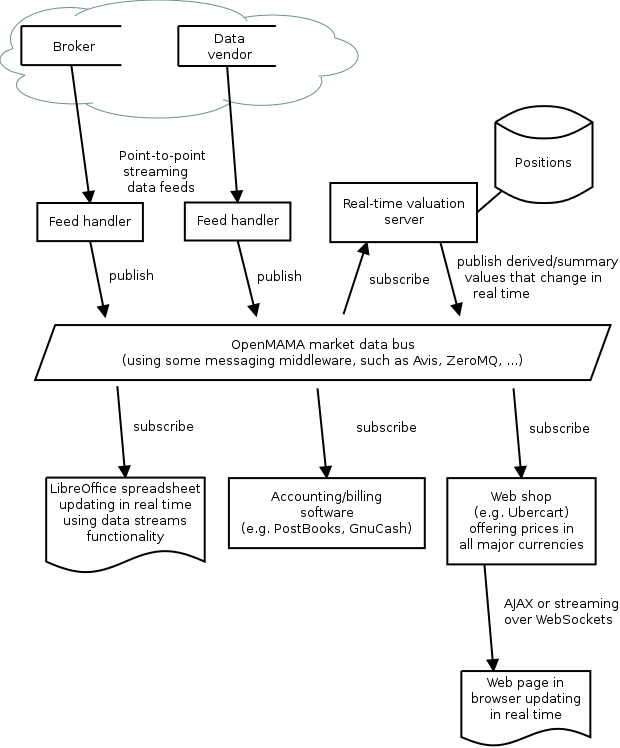
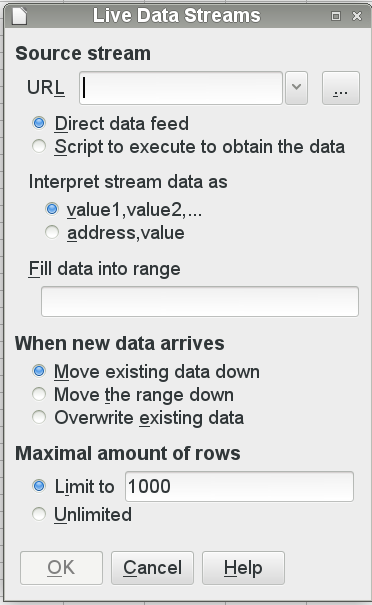
Here is an overview of the real-time market data architecture based on OpenMAMA: All these components may be running on a single host or they may be distributed across different servers and workstations in a LAN. The OpenMAMA market data bus ties them together. External data sources These are external sources of data. These could be currency trading firms, stock brokers, bullion dealers or even Bitcoin exchanges. Some exchanges don't provide data services directly to the general public and they distribute their price data through third-party data vendors such as Reuters and Bloomberg. Feed handlers The feed handlers manage the connections to external data sources. These are typically daemon processes that implement the wire protocols used by the external vendors for transmitting data over the public internet or a leased line. They typically use a point-to-point topology such as TCP connections. The feed handlers publish the data into the market data bus. In practice, the feed handler may be a proprietary application provided by the data vendor or it may simply be a Python script that fetches exchange rates from a URL every five minutes. OpenMAMA The market data bus is a distributed framework that is accessible to all of the local servers and workstations in the LAN. At the lowest level a messaging middleware solution is used to transport the data. The Avis Event Router is a free middleware. There is upcoming support for Apache QPID as well. Some commcercial middleware is supported too - here is the full list OpenMAMA does not provide a daemon or server process of its own. It is a set of libraries that operate on top of the middleware transport. In very general terms, the OpenMAMA libraries let applications publish messages (such as price ticks) or subscribe to receive the messages published by other applications. Spreadsheet application (for example, LibreOffice) LibreOffice is introducing a new data import feature for streaming time series data. This appears to provide a useful integration point for OpenMAMA and discussion is taking place in the development community. The spreadsheet can operate in various ways. A simple application may simply poll the currency prices when the spreadsheet is opened or refreshed. A more demanding application may see the spreadsheet come alive, recalculating all cells on every tick from the data vendor (several times per second). This latter scenario is more common in dealing rooms and hedge funds. Accounting/billing software There are many free accounting applications today, including PostBooks and GnuCash and some more heavyweight solutions like Adempiere and OpenERP. In a world where credit cards and the world wide web have made international trade an everyday activity, many people are using this software to track expenses and accounts in more than one currency. For example, a British business may be paying some suppliers in Euros and a Canadian may be charging some customers in US dollars. A Swiss person may be keeping some of their savings in gold bullion in the vault of one of their world reknowned Swiss banks. A common requirement for all of these users is the balance sheet. Using real-time market data sources, the balance sheet can be refreshed at any time from the live market prices. A home user may just find it convenient that they can open the balance sheet and always see their net worth immediately without having to manually cut and paste the currency prices from a web page. A business user operating in a competitive industry with low margins may be checking the balance sheet several times per day to ensure they remain solvent and profitable. Web shops Many web shops now offer the customers the convenience of viewing prices in their own currency. It is important to make sure these prices are accurate, especially when dealing with volatile currencies or when the products have a low profit margin. The web application server can receive the market data price ticks just like any other application in the network. Using this data, it can insert live prices into the pages as they are generated. If the currencies are particularly volatile, the web application could stream the prices to the browser using WebSockets and a JavaScript client embedded in the page would update the price field in real time. In fact, this web-based streaming price update mechanism is exactly how many online financial trading services offer live market prices to their customers. Real-time valuation server In a large organisation there may be many users looking at the same values. For example, in a trading desk, many users may need to see the desk's overall position in each market. In a busy web shop, many concurrent users may need to see the prices of common products. Rather than recalculating these values for each user in parallel, a common solution involves setting up a server to receive raw values (such as currency prices) from the data feed, calculate values needed by local users and then broadcast those values over the market data bus. How applications can integrate with real-time market data Here are some steps for getting started:

Axel Beckert: Showing packages newer than in archive with aptitude

I happens quite often that I install a manually built, newer version of some package on a machine. Occassionally I forget to remove it or to downgrade it to the version in the APT repo.
$ apt-show-versions   fgrep newer
easily finds those packages. But usually when doing such a check, I want this list of packages in my aptitude TUI to have a look at the other versions of that package and to take actions. And I don t want to manually search for each of the package manually. This can be done with the following one-liner :
# aptitude -o "Aptitude::Pkg-Display-Limit=(  apt-show-versions   fgrep newer   awk -F '[ :]' ' printf "~n ^"$1"$   " '   sed -e 's/  *$//'  )"
It uses apt-show-version s output, searches for the right packages, takes the first column and transforms it into an aptitude search pattern matching all packages whose name is exactly one of the listed packages. But this solution is quite ugly and slow. So I wondered if this is also doable with pure aptitude search patterns which likely would also be faster. And after some playing around I found the following working aptitude search term:
~i ?any-version(!~O.) !~U !~o
This matches all packages which which are installed and which have a version which has no origin, i.e. no associated APT repository. Since this also matches all hold packages as well as all packages not available in any archive, I use !~U !~o to exclude those packages from that list again. Since nobody can remember that nor wants to type that everytime needed, I added the following alias to my setup:
alias aptitude-newer-than-in-archive='aptitude -o "Aptitude::Pkg-Display-Limit=~i ?any-version(!~O.) !~U !~o"'
Only caveat so far: It seems to also match packages from APT repos which haven t set an Origin . This should not happen with any Debian or Ubuntu APT repository, but seems to happen occasionally with privately run APT repositories. And using ~A instead of ~O, i.e. ~i ?any-version(!~A.), does not work for this case either, despite it matches installed packages of which versions not in any available archive exist. But unfortunately aptitude seems to remember in some way if a package was in some archive in the past, so this only shows packages installed with dpkg -i, but not packages removed from e.g. unstable but with older versions still being available in stable.

Axel Beckert: Next Debian Meetup in Zurich

The first Debian meetup in Zurich last month was quite a success and I look forward to further Debian meetups in Zurich every first Tuesday of the month. The next meetup will be

on Tuesday, 2013-Dec-03 starting at 18:30 CET
at St. Gallerhof, Konradstrasse 2, 8005 Zurich
Please note that this is a different location than last month. Everybody who is interested in Debian is welcome to join us. Registering is not necessary. There was also some interest in Debian meetups in other Swiss cities, namely Bern and somewhere around Lac Leman. In case you want a Debian meetup elsewhere in Switzerland, too, or if you re interested in any Debian meetup in Switzerland, feel free to join the Swiss Debian Community Mailing List and help organising other Swiss Debian meetups.

Daniel Pocock: The free software country?

Loch Ness Monster, Scotland There is big news in Europe right now, especially the UK, about the Scottish nation's manifesto for independence. I thought this was really amazing, a country that is going to move to free software and protect its citizens from horrors like DRM. I couldn't wait to find out more, for example, will they use Linux or *BSD? After all, how many nations today can really consider themselves independent when they are trapped in the use of complex and opaque systems that require ongoing royalty payments to a foreign corporation, much like ancient villages paying their tithes to Rome? Today it is actually worse: these independent nations are not just sacrificing their cash - the new Rome is also using those same secret, proprietary systems to raid their subjects' privacy. So I went to the manifesto's web site to get the details. I couldn't even find the words "software" or "technology" listed in the policy index on the front page - and software doesn't even appear in the search results. A section on Culture, Communications and Digital only really looks at the issues for the media (BBC after independence). They don't even make any comment about the British Telecom (BT) pension crisis and whether Scotland will abandon BT's services, leaving only those customers south of the border to continue subsidising the deficit through higher phone bills. There is some hope, with the dot scot (.scot) top level domain coming in 2015 regardless of the referendum outcome. Does this mean an independent Scotland is going to be run without technology at all then? That could be an interesting way to avoid the type of infiltration of communications technology that has been taking place in Brussels. Or do the people calling the shots simply fail to realise the impact of software and communications technology on a modern day concept of independence? Party date set For those who just care about gatecrashing the post-independence party, start booking your leave for March 2016.

Matthew Palmer: The Shoe is on the Other Foot

I suppose nobody at Microsoft remembers what it was like when everyone was taking potshots at them, so they ve decided it s fair game to take a cheap shot at the new Evil Empire. That being said, I wouldn t say no to one of those Keep Calm coffee mugs

25 November 2013

Jan Wagner: Crossbuilding Debian packages with sbuild (for Raspbian)

Yesterday I asked myself, how to setup a crossbuild environment on a Debian wheezy/amd64 to build binary packages compatible for Raspbian. After digging around it seemed to be the easiest way to use mk-sbuild to setup such a build environment.
We just need to install sbuild (>= 0.64.0-1) and ubuntu-dev-tools (>= 0.146), both packages are available since jessie:
aptitude install sbuild ubuntu-dev-tools
Some more packages are needed for crossbuilding:
aptitude install qemu-user-static binfmt-support linux-image-amd64
Setting up the chroot is quite easy with:
mk-sbuild --arch=armhf --debootstrap-mirror=http://archive.raspbian.org/raspbian jessie
Unfortunately you get thrown an error about bad signing key:
Release signed by unknown key (key id 9165938D90FDDD2E)
This happens cause debootstrap is using per default /usr/share/keyrings/$ DISTRO -archive-keyring.gpg, which doesn't ship the Raspbian signing key indeed. After looking how to solve that problem, I decided to use a quik&dirty fix:
echo 'DEBOOTSTRAP_KEYRING="--keyring=/usr/share/keyrings/raspbian-archive-keyring.gpg"' >> \
    /root/.mk-sbuild.rc
cp -a /usr/bin/mk-sbuild /tmp/mk-sbuild
patch -p0<./mk-sbuild_raspbian.diff /tmp/mk-sbuild
<noscript><pre><code>&lt;html&gt;&lt;body&gt;You are being &lt;a href=&quot;https://github.com/gist/7639011&quot;&gt;redirected&lt;/a&gt;.&lt;/body&gt;&lt;/html&gt;</code></pre></noscript>
mk-sbuild_raspbian.diff Now you should be able to setup your Raspbian sbuild chroot via:
/tmp/mk-sbuild --arch=armhf --debootstrap-mirror=http://archive.raspbian.org/raspbian wheezy

24 November 2013

Jan Wagner: Running icinga with lighttpd on Debian whezzy (and a Raspberry)

At first we need to install Icinga and lighttpd:
aptitude install icinga lighttpd
We need to enable the lighttpd cgi and authentication module:
lighttpd-enable-mod cgi && ighttpd-enable-mod auth
Let's create a config for Icinga (in a subdir of the default vHost). As you can see, you don't need any 'setenv.add-environment' on wheezy (at least):
vi /etc/lighttpd/conf-available/50-icinga.conf
<noscript><pre><code>&lt;html&gt;&lt;body&gt;You are being &lt;a href=&quot;https://github.com/gist/7602246&quot;&gt;redirected&lt;/a&gt;.&lt;/body&gt;&lt;/html&gt;</code></pre></noscript>
50-icinga.conf Let's create a config file with credentials for the user icingaadmin:
htpasswd -c /etc/icinga/htpasswd.users icingaadmin
Now we just need to enable the icinga config and reload the lighttpd:
lighttpd-enable-mod icinga && /etc/init.d/lighttpd force-reload
At this point you should find a working Icinga setup at http://yourip/icinga P.S. Does anybody know how to setup a buildenv (preferable as crossbuild on amd64) for Raspbian, as the Debian armhf packages are not compatible to raspbian and so there is no access to the Backports repository? Cool would be to get a sbuild env running, so it can be integrated into a buildd.

22 November 2013

Russ Allbery: Review: The Pathway to Awesomeness

Review: The Pathway to Awesomeness, by Mark Forster
Publisher: Hyperink
Copyright: October 2013
ASIN: B00FXGXMPQ
Format: Kindle
Pages: 97
Mark Forster is probably my favorite time management (or, if you prefer, attention management) writer. The place to start with Forster if you're not familiar with him is Do It Tomorrow, not here. Unlike the other books by him I've reviewed, this is just an edited collection of blog posts presented in a convenient ebook form, without even an ISBN number. But if you've read his books (at least the ones that aren't out of print and cost a fortune), this is a convenient way to not have to trawl back through his blog and read the articles in a more convenient fashion. For me, it was also an easy way to give him a bit of money for his blog. Unless you have a similar motive, I don't think the content to price ratio is worth it. But I think everything is still up at Get Everything Done in case anything here strikes your fancy. As with most blog compilations, The Pathway to Awesomeness (I really hate that title) is composed of a whole bunch of fairly short articles, rarely more than three pages each, vaguely collected by topic. The first few are rather general and focused on the normal self-help platitudes that try to build up your sense that you're in control of your own life. But Forster doesn't take too long to get to what he's best at: short ideas, mental tools, interesting tricks, and simple techniques. Even more so than his books, due to the nature of this collection, there's a huge variety here, which means you can probably find something that strikes a chord no matter what attention management problem you've been running into. That's one of the main reasons why I prefer his writing: he tries to provide a giant toolbox instead of a single, streamlined System For Everyone. The other thing I like about Forster is that he is much more blunt than many authors about the biggest problem I have with attention management: trying to do more than anyone could possibly do given the available time. There are some more essays here about that, and several of them are quite good. I think my favorite is the short essay in which he points out how often people decide to do some task for a particular reason, and then get so engrossed in the performance of that task that they forget the original reason, risking sinking far more energy into that task than is actually warranted. Like a lot of Forster's observations, it's obvious in retrospect, but he has a way of phrasing those observation so that they shake the right thing loose in my head and let me re-evaluate something I was doing. Regular readers of Forster's blog know that he loves playing around with different simple to-do list management systems. Unfortunately, none of those are here, so don't pick this up expecting a collection of articles about Superfocus, Autofocus, etc. It makes sense given the topic of this collection, which is more general advice rather than systems, but this collection is so short that I wish he'd added a section on system development. I would have enjoyed reading a collection of all of his miniature systems together in one place and showing how he tweaked and changed them over time, particularly if he'd added some discussion of why he made each change and what goals he was trying to meet with each system. Ah well. If you aren't already familiar with Forster, there's no point in this, but if you are, I got a few new tidbits out of it and will probably skim through it a few more times. Buying it is mostly an exercise in putting money in the tip jar, and his writing is much less polished here (and more prone to cliches), but I still enjoyed reading through it. Rating: 7 out of 10

21 November 2013

Gunnar Wolf: Back aches...

This year, I had slowly taken again running. It's an activity I enjoy, even though I'm far from the condition I had when I did it every day My maximum was running about 8Km four days a week (ocassionally up to 15Km, say, on weekends)... But I slowly drifted out of it over the last three years. Yes, I have taken it up now and then, but dropped out again after a few weeks. Well, this year it felt I was getting back in the routine. Not without some gaps, but I had ran most weeks since July at least once, but usually two times. I started slowly, doing about 3Km close to home, but didn't take much to go back to my usual routes inside UNAM, doing a modest average of 4.5-5Km per run, and averaging somewhat over 8Km/h (6.5 min/Km). But... Well, I cannot relate precisely what happened on this Exactly a month ago, after a very average run (even a short one, 3.6Km), I had a lower back ache. Didn't pay too much attention to it, but it was strange since the first day, as I often have upper back aches Never lower. The pain came and went slowly several times. I kept cycling to work, although not every day. On October 27th, I even took the time to do the Ciclot n, a nice 38Km (including the ~5Km distance from home) around central Mexico City. I enjoyed the ride, even though every stop and re-start of the bike was a bit painful what hurts is to get off and on the bike: The posture change. But the pain has been almost constantly there. When I stand up, or when I sit down, it's about five minutes until the body gets used to the new position and stops hurting. Another strange data point: This last weekend (together with a national holiday) we went to a small conference in Guadalajara, and then to visit our friends in Guanajuato. So, we spent 12 hours on the bus there (12 Yes, there was an accident on the road, and we could not pass... So many hours were wasted there, and going back to a junction to take an alternative, longer road), then one night in a hotel bed, and two nights in our friends' guest mattresses which are not precisely luxury-grade. And Sunday night... I had no pain at all! Came back home, and after only one night back in our bed... I just could not move. I had the strongest pain so far. Could not even walk without some help. We went to the orthopedist a friend recommended, and I was seriously bending my posture: While that part of my posture is usually stable, my right hip was about 2cm higher than the left one, and my shoulders were almost 7cm displaced from my hips! So... Well, I'm having a cocktail of painkillers and antiinflamatories. The doctor says next week he wants me to have a tomography taken to better understand the causes for this. And, of course, tomorrow I'm leaving for Festival de Software Libre in Puerto Vallarta. I'm going there by plane, so no big hassle. But the way back, it will be 12 more hours on a bus. I'm... not precisely looking forward to this bus ride :( Anyway... I sorely miss my bike+running :(

19 November 2013

Rapha&#235;l Hertzog: Will Debian s technical committee coopt Keith Packard or Philipp Kern?

The process has been ongoing for more than a year but the Debian technical committee is about to select a candidate to recommend for its vacant seat. The Debian Project Leader will then (likely) appoint him (looks like it won t be a women). According to recent discussions on debian-ctte@lists.debian.org, it seems that either Keith Packard or Philipp Kern will join the committee. If you look at the current membership of the committee, you will see: That s very Anglo-Saxon centric (6 out of 7 members). While I trust the current members and while I know that they are open-minded people, it still bothers me to see this important body with so few diversity. Coming back to the choice at hand, Keith Packard is American and Philipp Kern is German. No new country in the mix. I can only hope that Philipp will be picked to bring some more balance in the body.

9 comments Liked this article? Click here. My blog is Flattr-enabled.

18 November 2013

Daniel Pocock: $75,000 to explore free software during maternity leave?

A number of countries offer women various social benefits during maternity leave. A new scheme in Australia promises to give virtually all women one hundred percent of their salary (capped at a whopping $12,500 per month) and extend maternity leave to 6 months. Some believe it has been funded by abolishing fibre-to-the-home, but that is another topic... This is a dramatic upgrade - in both cash and time - from the existing scheme where women have 18 weeks leave at the minimum wage. In Australia, the "minimum wage" figure is a fantasy, well below the real cost of living. In practice, the existing scheme and economic pressure force many women back into their job in less than 18 weeks. The new scheme with a one hundred percent salary replacement eliminates much of that pressure. Many European countries offer women some payment that pays the real cost of living, for example, EUR 2,400 per month in France. That is more than the minimum wage in Australia, enough to cover food, clothing and rent in most French cities. Australia's new system, in comparison, will give women on high salaries enough cash to immediately hire a nanny and other discretionary expenses that will maintain their lifestyle as much as they can within reason while dealing with a new baby. The cap is 300% higher than in France and it is 100% wage replacement, whereas many European schemes only give women a percentage of their salary. For this reason, many people have described it as the "Rolls Royce" of maternity pay. Just who are the women in these higher salary brackets? It is hardly any surprise that many of them are in IT and engineering professions. The upper salary range of the new maternity leave scheme appears to squarely match with the cashflows of female software developers, web designers, project managers and potentially many other professionals with a background in science or engineering. Many women worry about being out of the workforce for too long and the potential impact on their skills and professional networks. In computing jobs, technology can change a lot in 6 months. There are many men and women who enjoy computing in their free time as much as in their job. For female developers with this time out of the office, the world's most comfortable maternity leave scheme could be an opportunity to spend a little time exploring the free software world. Just to be clear, I'm not suggesting that women should be reaching for the laptop when they first go into labor and getting plugged in to the web before the umbilical cord has been severed. Some people find technology to be a rewarding pursuit throughout their whole life, while others simply see it as a job. For those who find free software interesting, some may simply pursue something creative that has no relation to the IT projects in their job, some may bring some new experiences back to their job. Others may choose to reconsider their career, performing free software development work on a freelance basis rather than going back to an office environment. The "Rolls Royce" maternity pay scheme could provide a comfortable buffer for them as they evaluate their next steps and make such decisions.

Russ Allbery: Review: Anathem

Review: Anathem, by Neal Stephenson
Publisher: William Morrow
Copyright: 2008
ISBN: 0-06-147409-6
Format: Hardcover
Pages: 935
Fraa Erasmas is a little less than twenty years old and is an avout of the decade math of the Concent of Saunt Edhar. As Anathem opens, he's approaching his first apert. All of those words are left for the reader to puzzle out for themselves, unless you cheat and read the glossary (which I would recommend doing only with caution, but more on that in a moment), since Erasmas, the first-person narrator of this story, writes (mostly) as if the reader is familiar with the mathic world and its concepts. Translated into English, it means that Erasmas was brought into something akin to a scientific monastery (the "math") at around the age of nine and has been there for ten years, since his math is a decade math and therefore remains closed to all outside (s cular) ideas and contact for periods of ten years at a time. He is still a student there, not yet declaring allegiance to one of the chapters. That's something that he will be expected to do after the first apert. Every ten years, the decade math opens its doors to the outside world for a period of ten days (apert), and the fraas and suurs can leave the math and travel through the outside world as they wish. The start of Anathem is an exercise in alienation and reorientation. Stephenson has constructed a complex society with a long history and its own specific technical jargon and throws the reader into it with a minimum of orientation. Despite being familiar with SF novels that use this technique, I did read the preface and recommend that other readers do as well unless they particularly love piecing together a world from hints and clues. The timeline, in particular, was invaluable and something I referred to throughout the story. But even with the preface, you should expect to read the first part of Anathem interpolating meanings from context or just letting things slip past until you later come to understand them. A lot of people bounce off of Anathem here, and it's one of the reasons why I'd been postponing reading it (the other being that it's a substantial doorstop and I wanted to give it my undivided attention). But it's really not as bad as I feared. One gets a feel for the terms fairly quickly, and the more difficult ones Stephenson defines as he goes with excerpts from a dictionary of the mathic world. I found it slightly disorienting for a chapter or two, and then it started growing on me. The terminology is sometimes different just for the sake of being different (jeejahs are indistinguishable from smartphones for all practical purposes), but usually the invented words provide either important links to the past of the constructed world of Arbre or are technical terms that add precision and clarity once you know their meanings. It can be a little bit frustrating to remember the mapping of famous theories and theorems to the Orth names, but only mildly. (And Diax's Rake is so useful of a name for something that English doesn't name that I may start using it myself.) This is also why I recommend against reading the glossary. The definitions of terms are linked to important parts of history, which are, in turn, linked to important parts of the plot, and the glossary therefore risks spoilers. I liked having the term introduced by the frequent dictionary excerpts scattered through the chapters, and enjoyed the feeling of the terminology unfolding with the plot. The glossary is there if you really get lost, but I think the experienced SF reader (particularly if you have enough history background to pick up on the obvious parallels and start mapping bits to Greece, Rome, the Catholic Church, etc.) will be able to navigate the language without that much difficulty. I also stopped caring about the terminology because the story is so engrossing that it pulled me right into the book, closed over me, and made Erasmas's world feel real, precious, and fascinating. Whether that's going to be true of other people is a surprisingly difficult question, and one that I'll try to tackle as part of this review. But I will say up-front that I think this is the best book that Stephenson has ever written, even better than Snow Crash, despite some undeniable flab and one extremely irritating choice. Anathem is, at its heart, a novel about the scientific method. I think it's the first book by Stephenson that elegantly mingles his tendencies (and obsessions) as a writer with the interests (and obsessions) of the characters and makes the whole novel feel coherent. All of Stephenson's books are prone to discursive infodumps, but they've usually had to be shoehorned in around the characters. Even with the Baroque Cycle, a series full of natural philosophers, the digressions are jammed in around the plot like the filling of an over-packed box and frequently stick out at odd angles or dribble out on the floor. With Anathem, Stephenson has populated a book full of characters who have completely believable and engrossing reasons to digress into scientific debate and analysis, can put them into dialogue and thereby avoid some of the strain of the infodump, and (most importantly) largely restrains himself from narrative digressions via first-person narration and careful attention to when the characters themselves would follow the same digression. In short, this is a book full of very smart and very well-educated people who figure things out from first principles using agreed-upon theory, thrown into an unknown and dangerous situation that requires a great deal of deep thinking, science, engineering, and philosophy. All of Stephenson's quirks are still here, on prominent display, but rarely have I ever seen a better match of writer, characters, plot, and world background than this book. I would go so far as to say that, if you don't like this book, you're unlikely to like any long Stephenson. I haven't said a lot about the plot. Erasmas's apert is only the first part, and barely touches on any significant plot elements. It's mostly there to set some groundwork, introduce characters, and get the reader oriented. I'm not going to say much more, since the way the novel transitions from routine to unusual to emergency, and the resulting scramble to understand the emergency, is the heart and soul of this book and should not be spoiled. (I spoiled myself slightly by reading some analysis that I shouldn't have and regretted it, although it wasn't too much of a problem.) This is one of Stephenson's best-plotted novels. It develops slowly enough for the reader (and the characters) to think hard about it and make some good and bad guesses, but fast enough to stay engrossing. Most of it is very well-paced provided that you find the background of science and philosophy of science interesting. (If you don't, this is probably not a book you're going to enjoy.) I say "most of it" because, as mentioned earlier, this book is a bit flabby. There are a couple of sections where the theory and analysis are pushed aside by exigent circumstances and more action-oriented plot elements, both of which reminded me that Stephenson is very bad at writing action sequences and both of which I wished were shorter. And there are a couple of sections where Erasmas is getting oriented to a new situation or working up the courage to do something where I wished he'd get on with it already. But for a novel of nearly 1,000 pages, the amount of tension and reader interest Stephenson maintained for me was quite impressive. But as good as the plot is, the best part of this book is its full-bore, no-apologies embrace of understanding things. This is a book about making sense of the world, and about what it means to make sense of the world, and how you go about it, and what preconditions are required to do so. It is not, contrary to so much science fiction, a book about knowing things. The people who are already experts appear in this book, but generally only in the context of figuring out new things they've not previously been exposed to. Rather, it's a book about learning things, the thrill that comes from applying theory to understand something new, and the satisfaction of working through something from first principles or previously-established theory, arriving at testable predictions, and then testing them. It's the first novel I've read that captures some of the joy and delight that I got from reading George Gamow's One Two Three... Infinity as a child. Stephenson novels have always been about showing the reader neat things he learned, but I think previous books relied on the reader to bring their own enthusiasm. Anathem, at least for me, goes a step farther and uses the passion and approach of its characters to create that enthusiasm. It's one of those books that I not only enjoyed but went away from feeling like it made me a better person in some subtle but detectable way. Sadly, this is also where the irritating part comes in. I'm going to be very careful and indirect here, since the details are all extremely significant spoilers. You may want to skip to the last paragraph of this review if you want to avoid any knowledge about the end of Anathem. Stephenson pulls several rabbits out of the hat in this book, but most of them are well-defended and nicely handled bits of misdirection. There are a few where I thought the science or engineering was dubious, but even those are usually backed with enough hand-waving about Arbre technology that I could swallow it enough for the purposes of this book. (The timeline here is very helpful in allowing one to write off a few things as unknown technology.) But he puts, at the core of the plot, one of the most scientifically dubious bits of the whole book, and there's simply no avoiding that by the end of the story. Now, this doesn't mean that he just expects the reader to swallow it. Much of Anathem is a carefully-constructed defense of the bits he uses for the plot, and the defense is not half-bad within his fictional world. There are substantial in-book justifications for believing these techniques will work on Arbre even if they wouldn't in our scientific domain. So it's not so much the plausibility that bothered me; the idea is at least as plausible as some of the FTL drive concepts that I've swallowed without complaint. I do hold Anathem to a higher standard because the book is about science in a way that most science fiction isn't, but even with that, I think Stephenson mostly managed to dance across the thin ice he built. The problem is more subtle but more serious: if taken seriously on its own terms, the approach Stephenson takes to the plot destroys science in his universe. I can't really say more than that, since all of the details are huge spoilers, but the more I thought about it, the more irritated and annoyed I got. Anathem is otherwise a brilliant defense of the scientific method, and it felt like Stephenson injected a poison pill in the center of it, leading necessarily to a world where the scientific method no longer works. This does not happen on camera, or even between the pages of the book; you have to think about the implications for a while before you realize that's what happened. But once you do, it's a bitter pill to swallow, and it's hard to escape the feeling that it fundamentally undermines Stephenson's whole project here. And, to make it worse (although also oddly better in a way), I think it was unnecessary. He would have had to reconstruct the ending, but I can't shake the feeling that there were ways to write the ending, even maintaining the same character strengths, without having to pull that particular rabbit out of the hat. Because I think it's, in the end, unnecessary, I was still able to enjoy the whole book, including the ending, despite this, but while the rest of Anathem is a wholehearted 10, that choice knocked a full point off my impression of the book. It's profoundly irritating precisely because Stephenson did such an excellent job with the rest of it. But, that said, this book is still exceptional. I think it's the book that Stephenson was meant to write. Not only did he get the overall construction nearly perfect, he gets so many of the details right, from the history (which for a while I thought was merely clever, once I started seeing the correspondences that moved it out of the realm of pure invention, but which transitioned back to profound with later revelations in the book) to the language to the way that he excerpted some theoretic digressions into very well-done appendices. If you've ever thought of a theory as beautiful, or like reading about smart people debating the nature of understanding and knowledge, I cannot recommend this book too highly. Despite the highly irritating flaw at its center, and despite a few sections that show Stephenson is not a well-rounded writer, I think it's brilliant. Rating: 9 out of 10

17 November 2013

Charles Plessy: The source of a package developed in a Git repository is that repository.

In his blog, Lars puts words on my feelings of weariness in these situations where we are asked much efforts to make our packages modifiable by contributors who can not or want not to use Git. Most of the core Debian tools, dpkg, debhelper, litnian, debian-installer and many others are developed in Git repositories. Somebody serious about contributing to Debian can hardly avoid Git. It is time for our tools and methods to evolve and take advantage of Git. This requires to say no thank you to contributions based on source packages downloaded from our FTP server, instead of being cloned from the Git repository where the package is actually developed, and this calls the question of what is the real source of the binary packages, but this is a question that is becoming unavoidable.

16 November 2013

Russ Allbery: Review: Wanderlust

Review: Wanderlust, by Ann Aguirre
Series: Sirantha Jax #2
Publisher: Ace
Copyright: September 2008
ISBN: 0-441-01627-8
Format: Mass market
Pages: 312
Wanderlust is the second book in the Sirantha Jax series and a direct sequel to Grimspace. There's no point in reading them out of order. The new shape of Sirantha's universe is still coming together after the climactic events of Grimspace, but they seem to involve a new job. In politics, even, but one for which she's uniquely qualified. Before she can even accept it, she finds out that multiple parties are interested in her taking this position, for widely varying reasons. But she starts her new position by taking a detour to visit some old friends (and the planet I liked least in Grimspace's settings), which turns into a war and a comprehensive distraction that lasts the rest of the book. The biggest problem with Wanderlust (and unfortunately there are several) is that it doesn't feel like a complete book. The first few chapters set up what appears to be the next step of Sirantha's adventures, as well as establishing a new villain, and then the rest of the book is an extended detour. She does learn more about the new villain, but almost everything that's set up at the start of this book is still unresolved at the end of it. The detours are moderately entertaining and (at least after an initial decision based on unfinished business from the first book) are at least related to the plot, but this feels like the setup and middle-book distractions of a book twice as long. I came away wondering why all of that was really necessary and why I had to wait to the next book to read the actual plot. The second problem with this book is the whining. And the angst. And the self-esteem issues. And did I mention the whining? Okay, I get that one of the distinguishing elements of this series is that it's space opera with an urban fantasy first-person perspective, and the latter usually comes with extensive angst and insecurity about one's love life. But, really, I am not interested in Sirantha complaining about her appearance yet again, and I am particularly not interested in the obnoxiously tedious "I love you and therefore I must push you away" dance that both she and the male romance lead do through half this book, and only stop doing because they can't any more. I realize that self-destructiveness is a thing, and that people do react this way, but I don't want to read about it, and I particularly don't want to listen to the narrator whine about how hard it all is for much of the book. Some of the appeal of Sirantha is that she's fragile, paranoid, and all sorts of messed up, but she muddles through and manages to do the right thing anyway. However, for me, the key word there is "do." When she's twitchy and angry and sarcastic and scared but doing something (which does also happen in this book), I really enjoy this series. When she's living in her own head and building elaborate plans for how she's going to destroy her life this time, it starts getting tiresome. It doesn't help that I don't see what she sees in her romantic partner (at least most of the time; he has his moments), and therefore I have even less sympathy for her grand self-sacrificing gestures. Thankfully, there are good parts too. Aguirre introduces a few new characters, all of whom I liked. Sirantha is assembling quite the ragtag band of misfits, and they're misfits in all the right sorts of ways. They play off each other well and they're full of plot hooks. We also get an amusing twist on Sirantha's relationship with her personal assistant AI, which, while bizarrely tangential to the plot, looks like it will hold a lot of promise for the future. And I love Vel, who made the end of Grimspace and who continues to be a highlight of these books, partly because he doesn't throw emotional temper tantrums or indulge in bizarre silent treatments. I always love the quietly competent characters in stories like this. This is not up to Grimspace, but hopefully it's an aberration. It's not bad, exactly, but it went off the rails. Thankfully, the next book promises quite a lot of Vel, which will hopefully be an improvement. Followed by Doubleblind. Rating: 6 out of 10

Next.

Previous.