Search Results: "ah"

22 December 2011

Gustavo Noronha Silva: AIClass and vacations

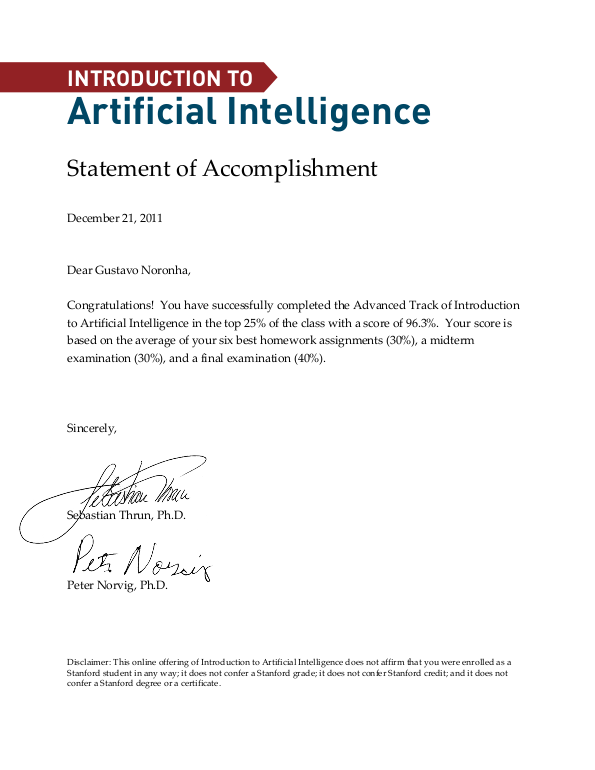
One of my side projects for these last months was to enroll on the online Introduction to AI class, with Peter Norvig and Sebastian Thrun, professors at Stanford. Through it I also learned about the Kahn Academy. I must say that getting to know these efforts made me feel similar to when I found Free Software: it s hard to believe that such great things exist! I learned some really cool stuff, and was also introduced to the amazing work of Sebastian Thrun with self-driving cars, it was an awesome experience! Last weekend I took the final exam, and today I got the certificate of accomplishment. It was delivered as a signed PDF which can be checked with a certificate they provided, pretty neat. I m very happy, and motivated to enroll on more such courses in the future =). Now it s time to cool down, though. My vacations start today, and on the weekend I ll travel to the sunny Fortaleza, in northeastern Brazil, to enjoy some nice beaches and get some tan. See you next year!
Statement of Accomplishment - AIClass 2011

Statement of Accomplishment - AIClass 2011

18 December 2011

Kai Wasserb ch: Miscellaneous stuff #1

This year is in its last throes and a few things, that don't really warrant their own blog post, have piled up here. To get them out of the door before 2012 starts, I'd like to go over them in the next few lines. First: there seem to be a group of rather cheap people who want to have the Humble Indie Bundle #4, but don't like to give at least 0.01 USD. Really guys, you seem to have enough money for a fast-enough computer and a (broadband) internet connection (otherwise downloading the circa 2.8 GB of games won't be a lot of fun), but you don't have the 0.01 USD to spare? If you don't like closed-source games (a sentiment I can truly understand, in fact, that was something I really pondered before buying) then just don't play them. But searching for a torrent for the HIB#4 while it is still being sold to just avoid paying the minimal fee, I can't understand. Now, some might wonder how I know this. The easy answer is, I blogged about buying the HIB#4 and mentioned, that I downloaded the games through a torrent (you can choose between direct downloads and torrents on your "login page") and a lot of people started hitting the blog entry with a referrer from a search engine, showing they'd searched for "humble indie bundle 4 torrent". Please make a decision: don't play the games or if you wish to, then pay something. The people behind those games make it easy and, in comparison to many other game studios, a fair offer. That should be worth something. For those of you who loved Josephine, there is a new awesome piece of art, Creative Commons licensed, by An-U (German homepage). The title (and the drawing) are derived from the equally awesome Katzenjammer song "On the Devil's Back" (in case you're still looking for a present, you might want to consider one of their CDs or a ticket to their next concert near you). Then, I wanted to thank all those people, who donated something over the course of 2011! Thanks a lot, especially for showing me, that you liked my services/work enough to even consider a donation! It means a lot to me, to know this. At year's end everybody is doing statistics and while I won't bore you with long in-depth analysis, I thought I throw out, what the top posts/things where (so far). Maybe you find yourself represented in there or maybe you find something new. In no particular order: I hope your 2011 was a good year and I wish you all the best for 2012! I'm pretty sure Debian will continue to grow, but there is also a lot of work ahead, maybe you can join the effort and make Debian that much more awesome!

11 December 2011

Phil Hands: One Month

... since we got married -- a great month :-) wedding photo and one month until Gunde's expected to give birth to our first daughter. So exciting times ahead.

Stefano Zacchiroli: bits from the DPL for November 2011

Mako's IronBlogger is a great idea. I often find myself postponing blog posts for a very long time, simply out of laziness. IronBlogger provides a nice community incentive to counter (my) laziness and blogging more often. As a related challenge, we have to face the fact that different subsets of our communities use different media to stay informed: mailing lists, blog (aggregators), social media, IRC, etc. Disparities in how they stay informed are a pity and can be countered using multiple medias at a time. Although I haven't blogged very often as of lately, I managed to keep the Debian (Developer) community informed of what happens in "DPL land" on a monthly basis, by the means of bits from the DPL mails sent to d-d-a. While the target of bits mails perfectly fits d-d-a, there is no reason to exclude a broader public from them. After all, who knows, maybe we'll find the next DPL victim^W candidate among Planet readers! Bonus point: blogging this also helped me realize that my mails are not as markdown-clean as I thought they were. I still have no IronBlogger squad, though. (And sharing beers with folks in the Boston area is not terribly handy for me ). Anyone interested in setting up a BloggeurDeFer in the Paris area? (SCNR)
Dear Project Members,
another month has passed, it's time to bother you again about what has happened in DPL land in November (this time, with even less delay than the last one, ah!). Call for Help: press/publicity team I'd like to highlight the call for help by the press / publicity teams. They are "hiring" and have sent out a call for new members a couple of weeks ago. The work they do is amazing and is very important for Debian, as important as maintaining packages or fixing RC bugs during a freeze. It is only by letting the world know what Debian is and what we do, that we can keep the Project thriving. And letting the world know is exactly what the publicity and press teams do. If you're into writing, blogging, or simply have a crush for social media, please read the call and "apply"! Interviews November has apparently been the "let's interview the DPL" month. I've spent quite some time giving interviews to interested journalists about various topics. For both my embarrassment and transparency on what I've said on behalf of Debian, here are the relevant links: Assets Legal advice (work in progress) Relationships with others Miscellanea Thanks for reading thus far,
and happy hacking.
PS as usual, the boring day-to-day activity log is available at master:/srv/leader/news/bits-from-the-DPL.*

7 December 2011

Benjamin Mako Hill: Wide Scream

<object data="https://upload.wikimedia.org/wikipedia/commons/d/de/Aspect-ratio-4x3.svg" type="image/svg+xml"> https://upload.wikimedia.org/wikipedia/commons/d/de/Aspect-ratio-4x3.svg</object> <object data="https://upload.wikimedia.org/wikipedia/commons/f/f8/Aspect-ratio-16x9.svg" type="image/svg+xml"> https://upload.wikimedia.org/wikipedia/commons/f/f8/Aspect-ratio-16x9.svg</object> It seems that nearly all computer monitors have now switched from a 4:3 aspect ratio popular several years ago to a "wide screen" 16:10 and now mostly to an even wider 16:9. But screen sizes are usually measured by their diagonal length and those sizes have not changed. For example, before I had my Thinkpad X201, I had a X60 and a X35. They are similar laptops in the same product line with 12.1" screens. But 12.1" describes the size along the diagonal and the aspect ratio switched from 4:3 to 16:10 between the X60 and the X201. As the screen stretched out but maintained the same diagonal length, the area shrunk: from 453 square centimeters to 425. But screens are not only getting smaller, they are also getting less useful. The switch to wider aspect ratios is done so that people can watch wide screen movies while using a larger proportion of their screens. Of course, the vast majority of people's time on their laptops is not spent watching wide screen movies but in programs like browsers, word processors, and editors. Because most of our writing systems lay out documents from top to bottom, the tools we most frequently use to display (and then scroll through) the things we read primarily use vertical screen space -- the dimension that is shrinking. If you have a desktop monitor, you might rotate the whole thing 90 degrees and "solve" the problem. If you're on a laptop though (as I usually am) this is clearly not an option. I am not the first person to be annoyed by this trend. In fact, many recent desktop UI changes are designed to work around this issue. In the free software world, both Unity and GNOME 3 have made efforts to hide, merge, or otherwise get ride of title bars, menu bars, and panels that take up dwindling vertical space. I use Awesome which I've mostly set up to do two side-by-side terminals with very little in the way of menu bars. /copyrighteous/images/awesome_screenshot_2011-small.png Applications are the worst offenders and the solutions for those things that won't run in a terminal (or people that don't want to live there) are still lacking. I have been using Firefox's Tree Style Tab extension to move tabs to the side and hand-customized toolbars that squeeze everything I need (i.e., back, forward, stop, refresh, and URL bar) onto a single menu bar. /copyrighteous/images/iceweasel_menu_eg_screenshot_2011-small.png But the situation still drives me crazy. I'd love to hear what others are doing.

6 December 2011

Sam Hartman: Moonshot Introduction

I recently put together a reading list on Project Moonshot for a friend. If you have seen discussions of Moonshot but not known where to get started understanding the technology, here is a fairly good initial list. It s long, but take a look starting at the beginning and let us know what you think.Take a look at http://www.project-moonshot.org/. Specifically, http://www.project-moonshot.org/sites/default/files/moonshot-feasibility-analysis.pdf and http://www.project-moonshot.org/sites/default/files/moonshot-briefing-ietf-78.pdf That briefing paper contains outdated versions of the technical
specifications.
Please see http://tools.ietf.org/html/draft-ietf-abfab-arch-00 http://tools.ietf.org/html/draft-ietf-abfab-gss-eap and http://tools.ietf.org/html/draft-ietf-abfab-gss-eap-naming
and http://tools.ietf.org/html/draft-ietf-abfab-aaa-saml O, yeah, and for the totally cool stuff that is still being designed
please see http://tools.ietf.org/html/draft-mrw-abfab-multihop-fed and http://tools.ietf.org/html/draft-mrw-abfab-trust-router

John Goerzen: Snapshots of Life

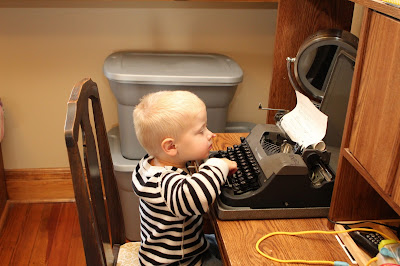
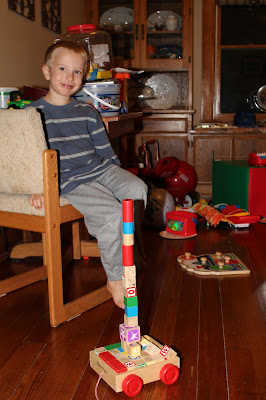
It s been busy lately, and I haven t had the time to blog. With the change in job, various travel, and settling into a new routine, I ve not done as much writing of late. But life marches on, and before memories grow too fleeting, I think I should share a few. We recently changed the arrangements for the boys. Instead of them each having their own room in which they sleep and sometimes play, we purchased a bunk bed. Oliver graduated from his crib to the lower bunk, and Jacob has the higher bunk. This has, predictably, created a few opportunities for behavior issues. Overall, it s going well, and they appreciate their new, more open, play room. Both boys sleep with their stuffed animals. Jacob calls his my friends . He still likes his butterfly, which he has had since he was an infant. He sometimes talks about how much he loves his friends, and how they like to get hugs, and how they are happy. Jacob continues to enjoy reading. He has a toy low-res camera and he even recorded a video of himself reading Brown Bear, Brown Bear. Oliver s vocabulary is coming alive and is fun to watch. Jacob has taken to trying to teach Oliver how to say things. One day, Jacob saw a number like 451 on the side of a train, producing a conversation like this: Oliver, can you say four hundred and fifty-one? Four dred iffy on! You got it!!! YAY! Today as I was walking past Oliver s train track on the floor, he grabbed me by the hand, had me sit down, and kept holding on to make sure I d stay right where he wanted me as he pointed and talked all about his trains. Aww. One cold and windy Saturday morning, the boys were getting restless. What to do, we thought? I decided to bring out one of the manual typewriters from my collection. Oliver loved watching it do things as he pressed buttons. Jacob enjoyed spelling mom . New problem: boys fighting over how long each one s turn at the typewriter is. This has gone on for a month now. Ahh, winter. A few weeks ago, Jacob informed us that he built an antenna out of blocks. He was REALLY proud of it, and even, incredibly, insisted I take his picture with it! I m pleased to have a 5-year-old that calls this structure an antenna instead of a skyscraper or tower or some such thing ;-) We took a train trip to Portland, OR, recently. That s about 2.5 days on the train each way. It went pretty well we had quite a bit of excitement though it got a little long for the boys at times. One evening, Jacob excitedly noted that the sky was almost really dark blue, just like my song! Wow. That was a song he made up in New York in summer 2010. Jacob enjoyed collecting leaves as we walked around in Portland. He would then stash his pile of leaves outside the door of whatever building we d enter, then hope to find them still there when we got back out. It usually worked out OK for him.

4 December 2011

Gregor Herrmann: RC bugs 2011/48

here's my report about RC bug related activities for the last week. besides working on the bugs mentioned below I've also documented my RCBW work flow for the NMUs, just in case it's interesting for others.

Francois Marier: Optimising PNG files

I have written about using lossless optimisations techniques to reduce the size of images before, but I recently learned of a few other tools to further reduce the size of PNG images.

Basic optimisationWhile you could use Smush.it to manually optimise your images, if you want a single Open Source tool you can use in your scripts, optipng is the most effective one:
optipng -o9 image.png

Removing unnecessary chunksWhile not as effective as optipng in its basic optimisation mode, pngcrush can be used remove unnecessary chunks from PNG files:
pngcrush -q -rem gAMA -rem alla -rem text image.png image.crushed.png
Depending on the software used to produce the original PNG file, this can yield significant savings so I usually start with this.

Reducing the colour paletteWhen optimising images uploaded by users, it's not possible to know whether or not the palette size can be reduced without too much quality degradation. On the other hand, if you are optimising your own images, it might be worth trying this lossy optimisation technique.

For example, this image went from 7.2 kB to 5.2 kB after running it through pngnq:
pngnq -f -n 32 -s 3 image.png

Re-compressing final imageMost PNG writers use zlib to compress the final output but it turns out that there are better algorithms to do this.

Using AdvanceCOMP I was able to bring the same image as above from 5.1kB to 4.6kB:
advpng -z -4 image.png

When the source image is an SVGAnother thing I noticed while optimising PNG files is that rendering a PNG of the right size straight from an SVG file produces a smaller result than exporting a large PNG from that same SVG and then resizing the PNG to smaller sizes.

Here's how you can use Inkscape to generate an 80x80 PNG:
inkscape --without-gui --export-width=80 --export-height=80 --export-png=80.png image.svg

28 November 2011

Craig Sanders: one of the reasons i like zfs

I got home from work tonight and zfs had reported that one of the disks in my main pool was dying. no great problem. insert a disk i had spare, and run zpool replace like so:
ganesh:~# zpool replace -f export  scsi-SATA_WDC_WD10EARS-00_WD-WMAV50933036 scsi-SATA_ST31000528AS_9VP16X03
and now it s just a matter of waiting until the data has resilvered and i can remove the old dying drive.
ganesh:~# zpool status export -v
  pool: export
 state: ONLINE
status: One or more devices is currently being resilvered.  The pool will
        continue to function, possibly in a degraded state.
action: Wait for the resilver to complete.
 scan: resilver in progress since Mon Nov 28 19:25:49 2011
    75.1G scanned out of 2.29T at 88.3M/s, 7h17m to go
    18.0G resilvered, 3.21% done
config:
        NAME                                                   STATE     READ WRITE CKSUM
        export                                                 ONLINE       0     0     0
          raidz1-0                                             ONLINE       0     0     0
            scsi-SATA_WDC_WD10EACS-00_WD-WCASJ2114122          ONLINE       0     0     0
            scsi-SATA_WDC_WD10EACS-00_WD-WCASJ2195141          ONLINE       0     0     0
            scsi-SATA_WDC_WD10EARS-00_WD-WMAV50817803          ONLINE       0     0     0
            replacing-3                                        ONLINE       0     0     0
              scsi-SATA_WDC_WD10EARS-00_WD-WMAV50933036        ONLINE       0     0     0
              scsi-SATA_ST31000528AS_9VP16X03                  ONLINE       0     0     0  (resilvering)
        logs
          scsi-SATA_Patriot_Torqx_278BF0715010800025492-part6  ONLINE       0     0     0
        cache
          scsi-SATA_Patriot_Torqx_278BF0715010800025492-part7  ONLINE       0     0     0
errors: No known data errors
(I use /dev/disk/by-id device names so I don t have to care about the kernel detecting the disks and disk controllers in a different order on each reboot also makes it easier to identify which disk is having a problem as I can squint at the front of the drives in my Lian Li 4-in-3 hotswap bays and read the serial number sticker) OK, yeah, sure it s not that much different from replacing a dying drive in an mdadm or hardware raid array but one nice advantage of zfs over raid is that it only resyncs the data in use, not the empty or unused blocks. given that these are 1TB drives in a raidz vdev, and the pool is 63% used that means syncing only about 630GB rather than 1TB. ps: in the time it s taken to write this, it s up to 10.11% done. 88MB/s reading data from the existing raidz drives and writing to a single drive isn t too bad at all. one of the reasons i like zfs is a post from: Errata

26 November 2011

Jonathan McDowell: All I need is a large enough white wall

I think I'm currently supposed to be out buying a TV at the moment. Or something else expensive. Instead I'm lying on the sofa listening to Whale and drinking tea. That's much better in my opinion, but it reminded me that I hadn't mentioned that I bought a projector. I had the loan of a projector for a while when I was in Belfast. It was a huge thing that made a lot of noise, but was pretty cool for watching films with. When I moved to the US I decided not to bother with a TV to start with - using my laptop did just fine for most things. Except films. They really benefit from a bigger screen. Especially if you want to watch them with someone else. So I started looking at pico projectors, because I wanted something small and cute that I could throw in a bag with my tiny laptop. At the time the best the pico projectors could do was 840x480, which I felt wasn't really that great. However back in January TI announced their DLP Pico HD chipset, offering a resolution 1280x800. I kept a look out for projectors using this to appear, and eventually, in July, Amazon claimed to have availability of the Vivtek Qumi. So I bought one. And I'm very happy with it. I'm not a heavy user, and there are some niggles, but it's small and does exactly what I want. In low light conditions it'll happily throw an image all the way across the room, which is more than it's rated at. There's a mini-HDMI connector on the back, so it's a doddle to plug it into my laptop using the supplied HDMI to mini-HDMI cable. The laptop auto-detects the device and extends the desktop appropriate, as you'd expect. It'll also do media playback itself - there's a USB host port and a micro SD slot on the back. This works ok, and the included remote means you can easily set the projector somewhere above your head and still be able to easily control it. Unfortunately the built in speakers are fairly useless. There's a 3.5mm socket for external speakers, but having to plug something else in detracts from the convenience factor of the built-in media player. Also my unit had the power switch installed upside down (the little red line indicating the power is on actually shows up when it's off), but that's the only complaint I've got about the build quality. There's a little neoprene case to store the thing in as well. So, er, yeah. I think I can continue to make do without a normal TV for a while longer and avoid the nightmare that I suspect are the shops on Black Friday.

24 November 2011

Michael Banck: 24 Nov 2011

Tomorrow (25th November) evening, I will be giving a short talk about PostgreSQL at the monthly Munich Open-Source-Treffen event.

The meetings start around 6PM and are always in Cafe Netzwerk in Luisenstr. 11, a nice and cosy hangout and hackerspace for young Munich students near Hauptbahnhof.

22 November 2011

Steve Kemp: Goodbye mysql ..

Yesterday evening I updated my server to remove MySQL:
steve:~# dpkg --purge mysql-client-5.1 \
                      mysql-common     \
                      mysql-server-5.1 \
                      mysql-server-core-5.1 \
                      python-mysqldb        \
                      libdbd-mysql-perl     \
                      libdatetime-format-mysql-perl
Until last month I had two database in use, one each for a pair of web-applications. As of now one is using redis - which I'm already using for my image hosting - and the other application is using SQLite. Until recently I had a high opinion of SQLite, although that has now been downgraded a little, it is still a thoroughly excellent piece of software. I was just surprised at little things it was missing, to the extent I had to rewrite my applications SQL. Still one less service is a good thing, and the migration wasn't so painful.. In more productive news I recently acquired a nice external flash - the Yongnuo YN-460 II is (very) cheap and cheerful, it can be fired remotely with my triggers so I've had a lot of fun with opportunistically taking pictures and experimenting with lighting. Most of the results are NSFW, but there are some other examples lurking around including the first time I managed to successfully capture a falling water-drop. (Not the best picture, not the most explicit effect, but fun regardless. I both can and will do better next time!)
Somebody recently asked me to write about "camera stuff under linux" and happily I declined. Why decline? Because there are so many good tools, applications, and utilities. (I use local tools for organisation and duplicate detection, rawtherapee for RAW conversion and GIMP for touchups). Having many available options is fantastic though, and something hard to appreciate for "newcomers" to Linux. (Yeah I waited 90 seconds - if I remembered to add -nojava - for Netscape Navigator to start, under X10, with 8Mb of RAM. Happier days are here. Sure DRM is bad, secure boot .. an open question, but damn we have it good compared to almost any previous point in time!)
ObQuote: "Yeah, obviously it is only a tactical party. I'm only having a party to eventually get sex." - Peep Show

Thorsten Glaser: Those small nice tools we all write

This is both a release announcement for the next installment of The MirBSD Korn Shell, mksh R40b, and a follow-up to Sune s article about small tools of various degrees of usefulness. I hope I don t need to say too much about the first part; mksh(1) is packaged in a gazillion of operating environments (dear Planet readers, that of course includes Debian, which occasionally gets a development snapshot; I ll wait uploading R40c until that two month fixed gcc bug will finally find its way into the packages for armel and armhf. Ah, we re getting Arch Linux (after years) to include mksh now. (Probably because they couldn t stand the teasing that Arch Hurd included it one day after having been told about its existence, wondering why it built without needing patches on Hurd ) MSYS is a supposedly supported target now, people are working on WinAPI and DJGPP in their spare time, and Cygwin and Debian packagers have deprecated pdksh in favour of mksh (thanks!). So, everything looking well on that front. I ve started a collection of shell snippets some time ago, where most of those small things of mine ends up. Even stuff I write at work we re an Open Source company and can generally publish under (currently) AGPLv3 or (if extending existing code) that code s licence. I chose git as SCM in that FusionForge instance so that people would hopefully use it and contribute to it without fear, as it s hosted on my current money source s servers. (Can just clone it.) Feel free to register and ask for membership, to extend it (only if your shell-fu is up to the task, KNOPPIX-style scripts would be a bad style(9) example as the primary goal of the project is to give good examples to people who learn shell coding by looking at other peoples code). Maybe you like my editor, too? At OpenRheinRuhr, the Atari people sure liked it as it uses WordStar like key combinations, standardised across a lot of platforms and vendors (DR DOS Editor, Turbo Pascal, Borland C++ for Windows, ) ObPromise: a posting to raise the level of ferrophility on the Planet aggregators this wlog reaches (got pix)

Jonas Smedegaard: Asia 2011 - India

Arrival in a new country is always exciting. This was my first time ever to visit India, and although I have heard especially cultural bits and pieces, I was as usual nowhere near "well" prepared. How to fill out the registration forms (surprisingly needed in addition to the visa already gathered ahead of departure) when your only known address in India is on the laptop you completely drained the battery of during the flight? Luckily they tolerated the "address during stay" to be left blank. I got out in the heat of Hyderabad in the late afternoon, got a cab, and had my host instruct the cab driver - over the phone via roaming to Denmark - where to drop me off. After a long ride with cows and beautiful dressed pedestrians casually crossing the high speed road and a short pitstop at an ATM, I finally met Pavithran. Until then we only knew each other from casual online chat. (I should later learn that my first impression was quite unusual - not cows or clothes or chat, but roads capable of driving at high speed!) Pavithran checked me into a small hotel and we visited his home. It was in the middle of being rebuild, so impossible to stay at as had been our original planed. After a few hours of looking at the neighbourhood and talking about possible events during the week, we decided to cancel the hotel and instead go visit his parents in Khammam, some 5 hours away by bus This text is part of my Asia 2011 scriblings.

21 November 2011

Daniel Kahn Gillmor: Adobe leaves Linux AIR users vulnerable

A few months ago, Adobe announced a slew of vulnerabilities in its Flash Player, which is a critical component of Adobe AIR:
Adobe recommends users of Adobe AIR 2.6.19140 and earlier versions for Windows, Macintosh and Linux update to Adobe AIR 2.7.0.1948. [...] June 14, 2011 - Bulletin updated with information on Adobe AIR
However, looking at Adobe's instructions for installing AIR on "Linux" systems, we see that it is impossible for people running a free desktop OS to follow Adobe's own recommendations:
Beginning June 14 2011, Adobe AIR is no longer supported for desktop Linux distributions. Users can install and run AIR 2.6 and earlier applications but can't install or update to AIR 2.7. The last version to support desktop Linux distributions is AIR 2.6.
So on the exact same day, Adobe said "we recommend you upgrade, as the version you are using is vulnerable" and "we offer you no way to upgrade". I'm left with the conclusion that Adobe's aggregate corporate message is "users of desktops based on free software should immediately uninstall AIR and stop using it". If Adobe's software was free, and they had a community around it, they could turn over support to the community if they found it too burdensome. Instead, once again, users of proprietary tools on free systems get screwed by the proprietary vendor. And they wonder why we tend to be less likely to install their tools? Application developers should avoid targeting AIR as a platform if they want to reach everyone.Tags: adobe, proprietary software, security

20 November 2011

Gregor Herrmann: RC bugs 2011/46

as expected this week was characterised by fixing bugs around the perl 5.14 transition. besides that I've also uploaded a couple of NMUs with patches kindly provided in the BTS by some tireless bug fixers.

15 November 2011

John Goerzen: A Parenting Dilemma

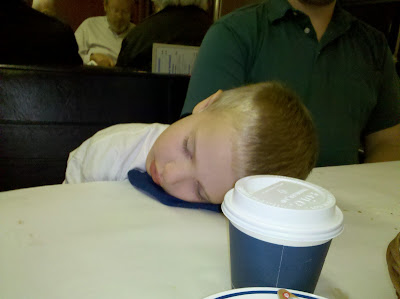
A few snippets so far from our train trip from Kansas to Portland. Terah, Jacob, Oliver, and I are on the trip, which is about 2.5 days on the train. The Parenting Dilemma So, if you are eating dinner, and your 5-year-old falls asleep with his head on the table, and you know he had been excitedly waiting for raspberry sorbet for dessert, and know there will be tears when he later realizes he missed it, what do you do? Let him sleep, or wake him up (with possible tears right then in the dining car?) As it turned out, I tried to quietly ask him if he wanted dessert. He woke up with a start, banged his head on the table, and then, yes, there were tears. I asked him if he wanted dessert or if he wanted to keep sleeping, and he gave a pathetic, sniffling, dessert. But by the time dessert arrived, he had fallen asleep again. I finally woke him up again, asked if he wanted to eat, and he just ignored me. I asked twice more and then he all of a sudden realized what he was being asked, sat bolt upright, and dug in. Graffiti Jacob noticed graffiti in Los Angeles. He called it silly words and kept commenting about it as we passed it. Bears Oliver always sleeps with a stuffed bear, which is his favorite comfort animal. But Oliver is 2, and when he says bear , it sounds more like beer . Plus, the boys still seem to be operating on Central Time. So at 4:15AM yesterday, Oliver awakened us saying: Beer! Beer! Beer! Where s beer? Where s beer? Need beer! Beeeeeer! Butterflies Jacob always sleeps with a stuffed butterfly, which he likes just like Oliver likes his bear. Jacob had this conversation with me this morning: Jacob: My butterfly knows all the people in the world. And all the animals, too! Me: Does butterfly even know Nash? (our cat) Jacob: Yeah, and he knows Sam and Edna too! (the cats across the road) Me: Wow. I think butterfly knows a lot more people and animals than I do. Jacob: *brief pause, then* Oh, silly dad! *collapses laughing*

Michael Casadevall: Secure Boot - its here and been here for quite awhile ...

There's been a lot of noise with Microsoft requiring Secure Boot for Windows 8 OEMs. For those of you unfamiliar with it, Secure Boot requires that the boot chain is signed, and this 'feature' must be enabled by default. Although I have been unable to find specific details, it appears that the chain of trust needs to extend from BIOS/UEFI all the way down to the kernel. Obviously, requiring a signed boot chain makes using FOSS platforms like Ubuntu or Debian an impossibility short of having the UEFI Platform Key and resigning the entire chain.

Steven Sinofsky's MSDN blog has a fairly good overview how it works. Canonical and Red Hat also have a good white paper on why secure boot is a serious problem for Linux distributions. Even if secure boot itself can be disabled, it *greatly* rises the bar for general end-users to successfully install Ubuntu on their machine. In addition, it is the responsibility of OEM and BIOS manufacturers to provide the option to disable it.

There already has been a long history of OEMs removing BIOS options or introducing DRM; for instance, locking out VTx on Sony laptops, or restricting laptops to only accept 'branded' wifi and 3G cards. Given this track record, can OEMs realistically be trusted to have this option available?

What most people don't realize is that secure boot itself is not a new concept; its simply part of the Trusted Computing initiative, and has been implemented on embedded platforms for many years. If you own any iPhone, or one of the vast majority of Android devices, you are using a device that either has the secure boot feature, or something very close. This especially painful in Android as Google's security system restricts users to a *very* limited shell and subset of utilities which can be used on non-rooted devices. WebOS, Maemo, and to my knowledge Meego give the end-user full unrestricted access to the boot chain and you can swap kernels and even the entire OS out if one was so motivated.

Although it is still an ongoing problem, several vendors such as HTC, Samsung, Motorola (kinda), and even Sony. In the Android community, having unlockable bootloaders has been a welcome middle ground in the traditionally restrictive and locked-down world of cellular devices.

While some may argue that such locks are necessary to protect consumers, it is perfectly feasible to create devices with unlocked bootloaders that are still secure. The Nook Color's is an Android powered eReader. It's stock firmware doesn't allow sideloaded applications or even access to a user shell via adb, but the BootROM on the device attempts to boot from the microSD card before eMMC, making it possible for enterprising users to easily modify the underlying OS (as well as making it physically impossible to brick the device due to a bad flash). Barnes and Nobles even sells a book on rooting the Nook Color; it was right next to the devices on display at the time. In addition, they've continued the tradition of easily modifiable devices with both the Nook Simple Touch, and the Nook Tablet.

One of the most impressive attributes is the possibility of running Ubuntu on it. The absolute poster child for this is the Toshiba AC100. For those of you unfamiliar, it ultralight netbook that shipped with Android 2.1/2.2 with easy access to the built in flash via the mini-USB port on the side of the device. Due to the valiant efforts of the AC100 community, Ubuntu was ported to this device, and became a supported platform with images available on cdimages.ubuntu.com. If you were an attendee at UDS, you likely saw several AC100s all running Ubuntu.

This brings me to the point that motivated me to write this post in the first place. One of the most impressive tablets I've seen to date is the ASUS eeePad Transformer, an Android tablet with fully dockable keyboard. I have one of these devices, and its one of the most impressive and usable Android tablets I own. Sadly, such a powerful device was hobbled from its true potential due to ASUS's decision to ship the device with a locked and encrypted bootloader. Surprisingly, the Secure Boot Key (SBK) was acquired and released to the wild, making it possible to reflash the device. Sadly, even with the SBK, the device's bootloader is still extremely hobbled compared to the AC100 making flashing a slow and difficult process.

In response, ASUS refreshed the eeePad's hardware to the new B70 SKU, which has a new Secure Boot. Despite this, a root exploit was recently found to allow people to circumvent these restrictions and install customs ROMs. It is however only a manor of time before ASUS responds and releases a new update that fixes this bug.

Steven Barker (lilstevie) on xda-developers successfully created a port of Ubuntu to the Transformer. Currently, installing Ubuntu on the Transformer requires nvflash access, so its not possible to use his image on the newly liberated B70 devices. I am certain that a new method of installing via an update.zip will be developed for those of us with hobbled devices.

It is a showcase of what is possible when you have open hardware, and also proves one indisputable point: any 'trusted boot' or DRM scheme can and will be defeated; at best you piss off your userbase, and at worst, you force users to exploit bugs to gain control of their device. As it is impossible to reflash these devices from the bootloader, a failed kernel flash WILL brick these devices, increasing warranty and support costs as users try to return their now broken devices.

In closing, while there have been some victories in ongoing war of open hardware vs. trusted comptuing, the road ahead still remains very murky. Victories in the mobile market have shown that there is a market for open devices. Google's own Nexus One was sold as a developers phone and as a way to encourage manufacturers to raise the bar. It sold well enough to recoup its development costs.. While there is no official statements, the Nokia N900 is suspected to have broken all sales expectations, backed up by the fact that Angry Birds sold extremely well on the Ovi Store for the N900.

From the article in question:
What reaction have you had in terms of sales and customer feedback?

Angry Birds had already been launched on App Store before it came out on Ovi Store, and it had a great review average from iPhone reviewers and users alike, so we expected a good reception from N900 users as well.

Even so, we were quite surprised by just how the N900 community immediately took the game to heart. The game obviously made many people very happy, and that is really the greatest achievement that anyone who creates entertainment for a living can hope for. Well, maybe the greatest achievement is huge bundles of cash, but making people happy comes a close second.

In the first week that Angry Birds has been on the Ovi Store, it has been downloaded almost as many times as the iPhone version in six weeks. Given that most N900 users have not even used Ovi Store yet, we are confident that there will be many more downloads in the months to come, and are sure that the N900 version will be very profitable.

That being said, with Microsoft pushing secure boot and trusted computing down everyone's throats with Windows 8, it is hard to say what the future might hold for those of us who want to own our devices.

14 November 2011

Bdale Garbee: RF Immunity

We've had sporadic Altus Metrum customer reports about RF susceptibility issues with their TeleMetrum installations. In almost every case, these problems have been completely resolved by either making sure the system battery has sufficient charge before launch, or through the application of standard engineering techniques such as twisting wire pairs to reduce differential coupling. However, even when every technique we could think of had been applied, once in a while someone still had issues. Around the time of LDRS this year, the incidence of such reports seemed to increase. One customer, in particular, had an installation in which he virtually always saw continuous resets of the board once his 54mm airframe was put on a launch rail, and several customers reported seeing board resets during ejection charge firing. Keith and I saw a board reset during main charge firing happen in person at NCR's Oktoberfest, and with a couple days available to work together after that launch, we decided it was time to figure out what was really going on. Here's what we've learned. In bench testing, it quickly became clear that the problem was the 3.3 volt power supply rail getting pulled down far enough to reset the CPU. This most frequently happened during ejection charge firing, when the input of the LDO regulator is pulled down by the near-short presented by the e-match when a pyro FET is turned on. To keep the 3.3 volt rail voltage up during firing, we include a 100uF bulk capacitor on the regulator's output. In all of our prior bench testing, we never saw the 3.3 volt rail droop significantly. Clearly something had changed... or maybe several things had changed? The first thing I wondered about was whether the new Kalman filtering code, which requires more compute cycles from the processor, might be consuming enough more power to pull the rail down faster during charge firing. After poking around at it, though, we have no data to suggest the new code makes a measurable difference in power consumption. The next thing we pondered was that at least some of the e-matches we and others are using in the hobby now come from the fireworks industry, where it is apparently considered a feature for the match to retain continuity after firing. This means the input of the LDO gets held down for longer than with the e-matches we used to use and Quest Q2G2 igniters that open when fired. But that still didn't make sense as the root cause, as we chose the FET firing time such that even with a dead short across the igniter terminals, the 3.3 volt rail wouldn't be pulled down far enough to cause trouble during firing. One of the big changes between v1.0 and v1.1 on TeleMetrum was that the newer boards incorporate a better reset circuit. This helps ensure the GPS chip always comes up running at power on, which was a problem at temperature extremes with older boards. However, a side-effect of this change is that a v1.1 board will reset any time the 3.3 volt rail drops below 3.15 volts, whereas older boards didn't trip until a much lower voltage. So the recent increase in reports might just be related to more v1.1 boards being placed in service? While experimenting on the bench, we observed that injecting RF energy into the input of the LDO regulator had the effect of pulling down the output voltage, presumably because the internal reference source accumulates charge and is fooled into thinking the output is too high. Since our designs all have the power switch contacts ahead of the LDO, the wires going out to the switch and back are effectively an antenna... as are, to a lesser extent, the wires going to the e-matches. There is some variability from part to part in just how badly the LDO reacts. But by attaching a tuned length of wire as an antenna to the LDO input and playing around, we were finally able to reproduce the problem reliably on a test board at my bench! On further analysis, we realized that the output of the USB battery charger chip and the input of the LDO both expect a 1uF bypass cap to ground. At some point, those looked redundant and we eliminated one of the two. Unfortunately, we weren't internalizing the fact that the switch leads were between the two caps, and the one we left was on the output of the charger and not at the input of the LDO. Placing a suitable bypass cap right at the input of the LDO turns out to have a truly dramatic effect on RF immunity! Once we realized that RF getting into the LDO input was the problem, Keith pointed out that we used to see "noise" in the accelerometer data on earlier boards that was caused by the 3.3 volt rail moving slightly during radio transmit, which we fixed with a hardware change on v1.1. We are now convinced that this was at least partly related to RF coupling to the LDO input, not just the change in power consumption on the LDO output. We didn't realize what was going on in earlier testing because we often didn't have ematches wired up, so RF coupling was minimal. But going back to flights logged with v1.0 boards that included deployment, and studying the magnitude of the "steps" in acceleration data observed when the transmitter was on, Keith was able to compute the amount the 3.3 volt rail must have sagged if the real acceleration wasn't changing... which in some cases was as much as 180mV! We think this proves that RFI could cause the LDO to drop its output voltage below the reset controller set point on v1.1 boards. Based on these observations, I'm making two hardware changes for the next version of TeleMetrum (version 1.2), and Keith is also making a software change. We have tested all of these changes on real boards both on the bench and in test flights, and the net effect is a major improvement in the RF immunity of TeleMetrum. The first hardware change is moving to a slightly lower trip voltage on the reset controller. Instead of 3.15, the new part trips at 3.00 volts nominal. This gives us more "headroom" to tolerate 3.3 volt rail droop during charge firing, and will allow the board to operate longer on a given battery charge. This change is not relevant for v1.0 and prior. The second hardware change is adding an appropriate bypass capacitor right at the LDO input. This requires a PCB update, but it's possible for me to update existing production boards by adding an 0402 cap right across the appropriate pins on the regulator chip. The software change prevents our altimeters from turning on the radio transmitter while an ejection charge is firing. Since the RF transmitter draws substantial additional power, this should help keep the 3.3 volt rail from drooping. This may not really matter, but it feels like the right thing to do. This change will be part of our next stable firmware release. We think most TeleMetrum customers need not worry about these updates. But if you have seen odd resets on the rail or during ejection charge firing in flight with a TeleMetrum v1.1, feel free to contact me about updating your existing board to include these improvements.

Next.

Previous.