From November 2nd to 4th, 2022, the 19th edition of
Latinoware - Latin American Congress of Free Software
and Open Technologies took place in Foz do Igua u. After 2 years happening
online due to the COVID-19 pandemic, the event was back in person and we felt
Debian Brasil community should be there.
Out last time at Latinoware was in
2016
The Latinoware organization provided the Debian Brazil community with a booth
so that we could have contact with people visiting the open exhibition area and
thus publicize the Debian project. During the 3 days of the event, the booth was
organized by me (Paulo Henrique Santana) as Debian Developer, and by Leonardo
Rodrigues as Debian contributor. Unfortunately Daniel Lenharo had an issue and
could not travel to Foz do Igua u (we miss you there!).
A huge number of people visited the booth, and the beginners (mainly students)
who didn't know Debian, asked what our group was about and we explained various
concepts such as what Free Software is, GNU/Linux distribution and Debian
itself. We also received people from the Brazilian Free Software community and
from other Latin American countries who were already using a GNU/Linux
distribution and, of course, many people who were already using Debian. We had
some special visitors as Jon maddog Hall, Debian Developer Emeritus Ot vio
Salvador, Debian Developer Eriberto Mota, and Debian Maintainers Guilherme de
Paula Segundo and Paulo Kretcheu.
Photo from left to right: Leonardo, Paulo, Eriberto and Ot vio.
Photo from left to right: Paulo, Fabian (Argentina) and Leonardo.
In addition to talking a lot, we distributed Debian stickers that were produced
a few months ago with Debian's sponsorship to be distributed at DebConf22
(and that were left over), and we sold several Debian
t-shirts) produced by
Curitiba Livre community).
We also had 3 talks included in Latinoware official schedule.
I) talked about:
"how to become a Debian contributor by doing translations" and "how the
SysAdmins of a global company use Debian". And
Leonardo) talked about:
"advantages of Open Source telephony in companies".
Photo Paulo in his talk.
Many thanks to Latinoware organization for once again welcoming the Debian
community and kindly providing spaces for our participation, and we
congratulate all the people involved in the organization for the success of
this important event for our community. We hope to be present again in 2023.
We also thank Jonathan Carter for approving financial support from Debian for
our participation at Latinoware.
Portuguese version
Welcome to the Reproducible Builds report for October 2022! In these reports we attempt to outline the most important things that we have been up to over the past month.
As ever, if you are interested in contributing to the project, please visit our Contribute page on our website.
Our in-person summit this year was held in the past few days in Venice, Italy. Activity and news from the summit will therefore be covered in next month s report!
A new article related to reproducible builds was recently published in the 2023 IEEE Symposium on Security and Privacy. Titled Taxonomy of Attacks on Open-Source Software Supply Chains and authored by Piergiorgio Ladisa, Henrik Plate, Matias Martinez and Olivier Barais, their paper:
[ ] proposes a general taxonomy for attacks on opensource supply chains, independent of specific programming languages or ecosystems, and covering all supply chain stages from code contributions to package distribution.
Taking the form of an attack tree, the paper covers 107 unique vectors linked to 94 real world supply-chain incidents which is then mapped to 33 mitigating safeguards including, of course, reproducible builds:
Reproducible Builds received a very high utility rating (5) from 10 participants (58.8%), but also a high-cost rating (4 or 5) from 12 (70.6%). One expert commented that a reproducible build like used by Solarwinds now, is a good measure against tampering with a single build system and another claimed this is going to be the single, biggest barrier .
[ ] illustrate a concerning new reality for the software industry and illuminates the increasingly sophisticated threats made by outside nation-states to the supply chains and infrastructure on which we all rely.
The 12-month anniversary of the 2020 Solarwinds attack (which SolarWinds Worldwide LLC itself calls the SUNBURST attack) was, of course, the likely impetus for publication.
Whilst collaborating on making the Cyrus IMAP server reproducible, Ellie Timoney asked why the Reproducible Builds testing framework uses two remarkably distinctive build paths when attempting to flush out builds that vary on the absolute system path in which they were built. In the case of the Cyrus IMAP server, these happened to be:
Arch Linux contributor kpcyrd wrote to our list this month with the news that multiple people in Arch Linux noticed the output of our git archive command doesn t match the tarball served by GitHub anymore. In his post, kpcyrd narrows the change to a specific commit in Git. []
Akihiro Suda wrote to a share a new tool called repro-get. According to Akihiro s post, repro-get is a tool to install a specific snapshot of apt/dnf/apk/pacman packages using SHA256SUMS files . This is needed in order to install specific (or pinned ) dependencies needed to validate a build.
Finally, Janneke Nieuwenhuizen announced the release of GNU Mes 0.24.1, which represents 23 commits over five months by four people. GNU Mes is a Scheme interpreter and C compiler for bootstrapping the GNU System. []
The Reproducible Builds project is delighted to welcome openEuler to the Involved projects page []. openEuler is Linux distribution developed by Huawei, a counterpart to it s more commercially-oriented EulerOS.
Debian
Colin Watson wrote about his experience towards making the databases generated by the man-db UNIX manual page indexing tool:
One of the people working on [reproducible builds] noticed that man-db s database files were an obstacle to [reproducibility]: in particular, the exact contents of the database seemed to depend on the order in which files were scanned when building it. The reporter proposed solving this by processing files in sorted order, but I wasn t keen on that approach: firstly because it would mean we could no longer process files in an order that makes it more efficient to read them all from disk (still valuable on rotational disks), but mostly because the differences seemed to point to other bugs.
Colin goes on to describe his approach to solving the problem, including fixing various fits of internal caching, and he ends his post with None of this is particularly glamorous work, but it paid off .
Vagrant Cascadian announced on our mailing list another online sprint to help clear the huge backlog of reproducible builds patches submitted by performing NMUs (Non-Maintainer Uploads). The first such sprint took place on September 22nd, but another was held on October 6th, and another small one on October 20th. This resulted in the following progress:
41 reviews of Debian packages were added, 62 were updated and 12 were removed this month adding to our knowledge about identified issues. A number of issue types were updated too. [1][]
Lastly, Luca Boccassi submitted a patch to debhelper, a set of tools used in the packaging of the majority of Debian packages. The patch addressed an issue in the dh_installsysusers utility so that the postinst post-installation script that debhelper generates the same data regardless of the underlying filesystem ordering.
Upstream patches
The Reproducible Builds project detects, dissects and attempts to fix as many currently-unreproducible packages as possible. We endeavour to send all of our patches upstream where appropriate. This month, we wrote a large number of such patches, including:
diffoscopediffoscope is our in-depth and content-aware diff utility. Not only can it locate and diagnose reproducibility issues, it can provide human-readable diffs from many kinds of binary formats. This month, Chris Lamb prepared and uploaded versions 224 and 225 to Debian:
Add support for comparing the text content of HTML files using html2text. []
Add support for detecting ordering-only differences in XML files. []
Fix an issue with detecting ordering differences. []
Use the capitalised version of Ordering consistently everywhere in output. []
Add support for displaying font metadata using ttx(1) from the fonttools suite. []
Testsuite improvements:
Temporarily allow the stable-po pipeline to fail in the CI. []
Rename the order1.diff test fixture to json_expected_ordering_diff. []
Tidy the JSON tests. []
Use assert_diff over get_data and an manual assert within the XML tests. []
Drop the ALLOWED_TEST_FILES test; it was mostly just annoying. []
Tidy the tests/test_source.py file. []
Chris Lamb also added a link to diffoscope s OpenBSD packaging on the diffoscope.org homepage [] and Mattia Rizzolo fix an test failure that was occurring under with LLVM 15 [].
Testing framework
The Reproducible Builds project operates a comprehensive testing framework at tests.reproducible-builds.org in order to check packages and other artifacts for reproducibility. In October, the following changes were made by Holger Levsen:
Run the logparse tool to analyse results on the Debian Edu build logs. []
Install btop(1) on all nodes running Debian. []
Switch Arch Linux from using SHA1 to SHA256. []
When checking Debian debstrap jobs, correctly log the tool usage. []
Cleanup more task-related temporary directory names when testing Debian packages. [][]
Use the cdebootstrap-static binary for the 2nd runs of the cdebootstrap tests. []
Drop a workaround when testing OpenWrt and coreboot as the issue in diffoscope has now been fixed. []
Turn on an rm(1) warning into an info -level message. []
Special case the osuosl168 node for running Debian bookworm already. [][]
Use the new non-free-firmware suite on the o168 node. []
In addition, Mattia Rizzolo made the following changes:
Ensure that 2nd build has a merged /usr. []
Only reconfigure the usrmerge package on Debian bookworm and above. []
Fix bc(1) syntax in the computation of the percentage of unreproducible packages in the dashboard. [][][]
In the index_suite_ pages, order the package status to be the same order of the menu. []
Pass the --distribution parameter to the pbuilder utility. []
Finally, Roland Clobus continued his work on testing Live Debian images. In particular, he extended the maintenance script to warn when workspace directories cannot be deleted. []
If you are interested in contributing to the Reproducible Builds project, please visit our Contribute page on our website. However, you can get in touch with us via:
The Road to Gandolfo
I think I had read this book almost 10-12 years back and somehow ended up reading it up again. Apparently, he had put this fiction, story, book under some other pen name earlier. It is possible that I might have read it under that name and hence forgotten all about it. This book/story is full of innuendo, irony, sarcasm and basically the thrill of life. There are two main characters in the book, the first is General Mackenzie who has spent almost 3 to 4 decades being a spy/a counterintelligence expert in the Queen s service. And while he outclasses them all even at the ripe age of 50, he is thrown out under the pretext of conduct unbecoming of an officer.
The other main character is Sam Devereaux. This gentleman is an army lawyer and is basically counting the days when he completes his tour of duty as a military lawyer and start his corporate civil law with somebody he knows. It is much to his dismay that while under a week is left for his tour of duty to be left over he is summoned to try and extradite General MacKenzie who has been put on house arrest. Apparently, in China there was a sculpture of a great Chinese gentleman in the nude. For reasons unknown or rather not being shared herein, he basically breaks part of the sculpture. This of course, enrages the Chinese and they call it a diplomatic accident and try to put the General into house arrest. Unfortunately for both the General and his captors, he decides to escape/go for it. While he does succeed entering the American embassy, he finds himself to be person non-grata and is thrown back outside where the Chinese recapture him.
This is where the Embassy & the Govt. decide it would be better if somehow the General could be removed from China permanently so he doesn t cause any further diplomatic accidents. In order to do that Sam s services are bought.
Now in order to understand the General, Sam learns that he has 4 ex-wives. He promptly goes and meet them to understand why the general behaved as he did. He apparently also peed on the American flag. To his surprise, all the four ex-wives are still very much in with the general. During the course of interviewing the ladies he is seduced by them and also gives names to their chests in order to differentiate between each one of them. Later he is seduced by the eldest of the four wives and they spend the evening together.
Next day Sam meets and is promptly manhandled by the general and the diplomatic papers are seen by the general. After meeting the general and the Chinese counterpart, they quickly agree to extradite him as they do not know how to keep the general control. During his stay of house arrest, the General reads one of the communist rags as he puts it and gets the idea to kidnap the pope and that forms the basis of the story.
Castel Gandolfo seems to be a real place which is in Italy and is apparently is the papal residence where s/he goes to reside every winter. The book is written in 1976 hence in the book, the General decides to form a corporation for which he would raise funds in order to make the kidnapping. The amount in 1976 was 40 million dollars and it was a big sum, to be with times, let s think of say 40 billion dollars so gets the scale of things.
Now while a part of me wants to tell the rest of the story, the story isn t really mine to tell. Read The Road to Gandolfo for the rest. While I can t guarantee you much, I can say you might find yourself constantly amused by the antics of both the General, Sam and the General s ex-wives. There are also a few minute characters that you will meet on the way, hope you discover them and enjoy it immensely as I have.
One thing I have to say, while I was reading it, I very much got vibes of Not a penny more, not a penny less by Jeffrey Archer. As shared before, lots of twists and turns, enjoy the ride
Webforms
Webforms are nothing but a form you fill on the web or www. Webforms are and were a thing from early 90s to today. I was supposed to register for https://www.swavlambancard.gov.in/ almost a month back but procrastinated till few couple of days back and with good reason. I was hoping one of my good friends would help me but they had their own thing. So finally, I tried to fill the form few days back. It took me almost 30 odd attempts to finally fill the form and was given an enrollment number. Why it took me 30 odd attempts and with what should tell you the reason
I felt like I was filling the form from 1990 s rather than today because
The form doesn t know either its state or saves data during a session This lesson has been learned a long time back by almost all service providers except Govt. of India. Both the browsers on a mobile as well as desktop can save data during session. If you don t know what I mean by that go to about:preferences#privacy in Firefox and look at Manage Data. There you will find most sites do put some data along with cookies arguably to help make your web experience better. Chrome or Chromium has the same thing perhaps shared under a different name but its the same thing. But that is not all.
None of the fields have any verification. The form is of 3 pages. The verification at the end of the document doesn t tell you what is wrong and what needs to be corrected. Really think on this, I am on a 24 LED monitor and I m filling the form and I had to do it at least 20-30 times before it was accepted. And guess what, I have no clue even about why it was selected. The same data, the same everything and after the nth time it accepted. Now if I am facing such a problem when I have some idea how technology works somewhat how are people who are trying to fill this form on 6 mobiles supposed to do? And many of them not at all clued in technology as I am.
I could go on outlining many of the issues that I faced but they are all similar in many ways the problems faced while filling the NEW Income Tax forms. Of course the New Income Tax portal is a whole ball-game in itself as it gives new errors every time instead of solving them. Most C.A. s have turned to third-party xml tools that enable you to upload xml compliant data to the New Income tax portal but this is for businesses and those who can afford it. Again, even that is in a sort of messy state but that is a whole another tale altogether.
One of the reasons to my mind why the forms are designed the way they are so that people go to specific cybercafes or get individual people to fill and upload it and make more money. I was told to go to a specific cybercafe and meet a certain individual and he asked for INR 500/- to do the work. While I don t have financial problems, I was more worried about my data going into the wrong hands. But I can see a very steady way to make money without doing much hard work.
Hearing Loss info.
Now because I had been both to Kamla Nehru Hospital as well as Sasoon and especially the deaf department, I saw many kids with half-formed ears. I had asked the doctors and they had shared this is due to malnutrition. We do know that women during pregnancies need more calories, more everything as they are eating for two bodies, not one. And this is large-scale, apparently more than 5 percent of population have children like this. And this number was of 2014, what is it today nobody knows. I also came to know that at least for some people like me, due to Covid they became deaf. I had asked the doctors if they knew of people who had become deaf due to Covid. They basically replied in the negative as they don t have the resources to monitor the same. The Govt. has an idea of health ID but just like Aadhar has to many serious sinister implications. Somebody had shared with me a long time back that in India systems work inspite of Govt. machinery rather than because of it. Meaning that the Government itself ties itself into several knots and then people have to be creative to try and figure a way out to help people. I found another issue while dealing with them.
Apparently, even though I have 60% hearing loss I would be given a certificate of 40% hearing loss and they call it Temporary Progressive Loss. I saw almost all the people who had come, many of them having far severe defencies than me getting the same/similar certificate. All of them got Temporary Progressive. Some of the cases were real puzzling. For e.g. I met another Agarwal who had a severe accident few months ago and there is some kind of paralysis & bone issue. The doctors have given up but even that gentleman was given Temporary Progressive. From what little I could understand, the idea is that over period if there is possibility of things becoming better then it should be given. Another gentleman suffered a case of dwarfism. Even he was given the same certificate. Think there have been orders from above so that people even having difficulties are not helped. Another point if you look in a macro sense, it presents a somewhat rosy picture. If someone were to debunk the Govt. data either from India or abroad then from GOI perspective they have an agenda even though the people who are suffering are our brothers and sisters And all of this is because I can read, write, articulate. Perhaps many of them may not even have a voice or a platform.
Even to get this temporary progressive disability certificate there is more than 4 months of running from one place to the other, 4 months of culmination of work. This I can share and tell from my experience, who knows how much else others might have suffered for the same. In my case a review will happen after 5 years, in most other cases they have given only 1 year. Of course, this does justify people s jobs and perhaps partly it may be due to that. Such are times where I really miss that I am unable to hear otherwise could have fleshed out lot more other people s sufferings.
And just so people know/understand this is happening in the heart of the city whose population easily exceeds 6 million plus and is supposed to be a progressive city. I do appreciate and understand the difficulties that the doctors are placed under.
Mum s Birthday & Social Engineering.
While I don t want to get into details, in the last couple of weeks mum s birthday was there and that had totally escaped me. I have been trying to disassociate myself from her and at times it s hard and then you don t remember and somebody makes you remember. So, on one hand guilty, and the other do not know what to do. If she were alive I would have bought a piece of cake or something. Didn t feel like it, hence donated some money to the local aged home. This way at least I hope they have some semblance of peace. All of them are of her similar age group.
The other thing that I began to observe in the earnest, fake identities have become the norm. Many people took elon musk s potrait using their own names in the handles, but even then Elon Free Speech Musk banned them. So much for free speech. Then I saw quite a few handles that have cute women as their profile picture but they are good at social engineering. This has started only a couple of weeks back and have seen quite a few handles leaving Twitter and joining Mastodon. Also, have been hearing that many admins of Mastodon pods are unable to get on top of this. Also, lot of people complaining as it isn t user-friendly UI as twitter is. Do they not realize that Twitter has its own IP and any competing network can t copy or infringe on their product. Otherwise, they will be sued like how Ford was & potentially win. I am not really gonna talk much about it as the blog post has become quite long and that needs its own post to do any sort of justice to it. Till later people
Armadillo is a powerful and expressive C++ template library for linear algebra and scientific computing. It aims towards a good balance between speed and ease of use, has a syntax deliberately close to Matlab, and is useful for algorithm development directly in C++, or quick conversion of research code into production environments. RcppArmadillo integrates this library with the R environment and language and is widely used by (currently) 1027 packages other packages on CRAN, downloaded 26.9 million times (per the partial logs from the cloud mirrors of CRAN), and the CSDA paper (preprint / vignette) by Conrad and myself has been cited 503 times according to Google Scholar.
This release reflect as new upstream bugfix release 11.4.2 made recently by Conrad. To accomodate CRAN and their preference for at most a release per month, we held it back since the 11.4.0 release early October. As we usually do, we generally update once upstream Armadillo releases are made. When we do not immediately release to CRAN (in order to lower the release cadence), we make those interim releases available via GitHub source and the Rcpp drat repo.
This release also brings a rearranged, and as we think, simplified layout of the header files. All existing locations are still supported but we will be starting a (very patient and slow) transition at some point.
The full set of changes (since the last CRAN release 0.11.4.0.1) follows.
Changes in RcppArmadillo version 0.11.4.2.1 (2022-11-08)
Upgraded to Armadillo release 11.4.2 (Ship of Theseus)
more robust handling of corner cases in multi-threaded contexts
Internal header organisation with new sub-directories while providing full compatibility via existing paths (#395#396)
Changes in RcppArmadillo version 0.11.4.1.0 (2022-10-10) (GitHub Only)
Upgraded to Armadillo release 11.4.1 (Ship of Theseus)
fix data race in Cube::slice()
workarounds for false warnings emitted by GCC 12 when compiling with FORTIFY_SOURCE enabled (already in RcppArmadillo 0.11.4.0.1 too)
Desde de setembro de 2015, o
time de publicidade
do Projeto Debian passou a publicar a cada dois meses
listas com os nomes dos(as) novos(as)
Desenvolvedores(as) Debian (DD - do
ingl s Debian Developer) e
Mantenedores(as) Debian
(DM - do ingl s Debian Maintainer).
Estamos aproveitando estas listas para publicar abaixo os nomes dos(as)
brasileiros(as) que se tornaram Desenvolvedores(as) e Mantenedores(as) Debian a
partir de julho de 2015.
Desenvolvedores(as) Debian / Debian Developers / DDs:
Marcos Talau
Esta lista ser atualizada quando o time de publicidade do Debian publicar
novas listas com DMs e DDs e tiver brasileiros.
Para ver a lista completa de Mantenedores(as) e Desenvolvedores(as) Debian,
inclusive outros(as) brasileiros(as) antes de julho de 2015 acesse:
https://nm.debian.org/public/people
There is significant effort involved to get your apt or dnf commands always have a consistent set of servers to talk to.
That's why running separate "software stores" is a bad idea:
That way more admins need to learn how to run high availability services for dubious business opportunities to "later" monetize services. Services that nobody cares to pay for and thus opportunities that never materialize. But every company wants to find that out again. Because if Apple could do it, why shouldn't Canonical be able to do it? $$$!1!!
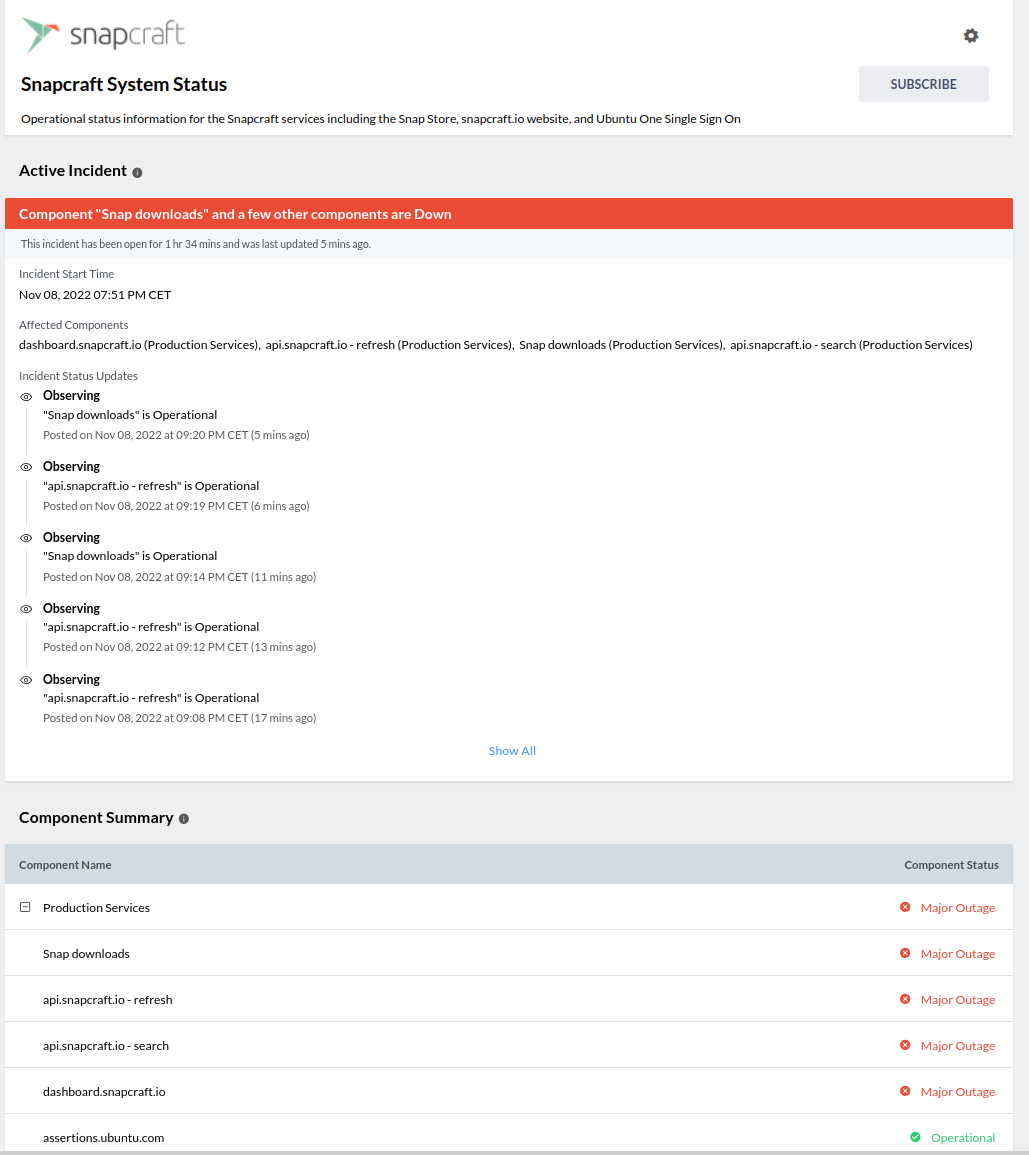
So, can't update Firefox on Ubuntu 22.04 right now.
At least there is https://status.snapcraft.io/:
So I can check back tomorrow if I can update my web browser ...
Update
09.11.2022 12:15 CET
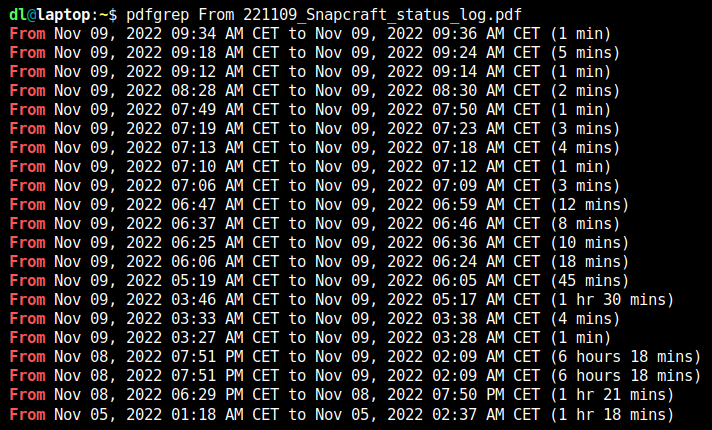
The Snapcraft distribution system seems quite flaky, this is the downtime log:
Bonus points for the bad client side implementation:
dl@laptop:~$ sudo snap refresh All snaps up to date.
# ^this is a lie, just close Firefox and ...
dl@laptop:~$ sudo snap refresh firefox 106.0.5-1 from Mozilla** refreshed
A new release 0.2.12 of RcppCCTZ is now on CRAN.
RcppCCTZ uses Rcpp to bring CCTZ to R. CCTZ is a C++ library for translating between absolute and civil times using the rules of a time zone. In fact, it is two libraries. One for dealing with civil time: human-readable dates and times, and one for converting between between absolute and civil times via time zones. And while CCTZ is made by Google(rs), it is not an official Google product. The RcppCCTZ page has a few usage examples and details. This package was the first CRAN package to use CCTZ; by now several others packages (four the last time we counted) include its sources too. Not ideal, but beyond our control.
This version adds support for NA values when parsing, and updates GitHub Action.
Changes in version 0.2.12 (2022-11-06)
Support NA values in numerical or character input
GitHub Actions were updated to checkout version 3.
I just did again the usual web search, and I have verified that Mastodon still does not support managing multiple domains on the same instance, and that there is still no way to migrate an account to a different instance without losing all posts (and more?).
As much as I like the idea of a federated social network, open standards and so on, I do not think that it would be wise for me to spend time developing a social network identity on somebody else's instance which could disappear at any time.
I have managed my own email server since the '90s, but I do not feel that the system administration effort required to maintain a private Mastodon instance would be justified at this point: there is not even a Debian package! Mastodon either needs to become much simpler to maintain or become much more socially important, and so far it is neither. Also, it would be wasteful to use so many computing resources for a single-user instance.
While it is not ideal, for the time being I compromised by redirecting
WebFinger requests
for md@linux.it using this Apache configuration:
<Location /.well-known/host-meta>
  Header set Access-Control-Allow-Origin: "*"
  Header set Content-Type: "application/xrd+json; charset=utf-8"
  Header set Cache-Control: "max-age=86400"
</Location>
<Location /.well-known/webfinger>
  Header set Access-Control-Allow-Origin: "*"
  Header set Content-Type: "application/jrd+json; charset=utf-8"
  Header set Cache-Control: "max-age=86400"
</Location>
# WebFinger (https://www.rfc-editor.org/rfc/rfc7033)
RewriteMap lc int:tolower
RewriteMap unescape int:unescape
RewriteCond % REQUEST_URI  ^/\.well-known/webfinger$
RewriteCond $ lc:$ unescape:% QUERY_STRING  (?:^ &)resource=acct:([^&]+)@linux\.it(?:$ &)
RewriteRule .+ /home/soci/%1/public_html/webfinger.json [L,QSD]
# answer 404 to requests missing "acct:" or for domains != linux.it
RewriteCond % REQUEST_URI  ^/\.well-known/webfinger$
RewriteCond $ unescape:% QUERY_STRING  (?:^ &)resource=
RewriteRule .+ - [L,R=404]
# answer 400 to requests without the resource parameter
RewriteCond % REQUEST_URI  ^/\.well-known/webfinger$
RewriteRule .+ - [L,R=400]
A new release 0.3.3.9.3 of RcppEigen arrived on CRAN moments ago (and just went to Debian). Eigen is a C++ template library for linear algebra: matrices, vectors, numerical solvers, and related algorithms.
This update is again mostly maintenance. To accomodate one small aspect of the Fortran interface, we now require R 3.6.0 or later. Jonah Gabry spotted a really old typo and fixed it. The fastLm support code now uses the unabbreviated df.residual. We accomodated clang-15 in one signature as is common with many recent uploads, and also updated one aspect of GitHub Actions.
And once again as we said for the last four releases:
One additional and recent change was the accomodation of a recent CRAN Policy change to not allow gcc or clang to mess with diagnostic messages. A word of caution: this may make your compilation of packages using RcppEigen very noisy so consider adding -Wno-ignored-attributes to the compiler flags added in your ~/.R/Makevars.
We still find this requirement rather annoying. Eigen is only usable if you set, say,
asoptions in~/.R/Makevars . But CRAN makes the rules. Maybe if a few of us gently and politely nudge them they may relent one day. One can only hope.
The complete NEWS file entry follows.
Changes in RcppEigen version 0.3.3.9.3 (2022-11-04)
The dependency on R is now versioned to 3.6.0 or later for support for USE_FC_LEN_T from Fortran.
An old example typo was corrected (Jonah Gabry in #114).
The fastLm methods now reference df.residual by its full name (Closes #115).
A function prototype was updated for clang-15.
GitHub Actions were updated to checkout version 3.
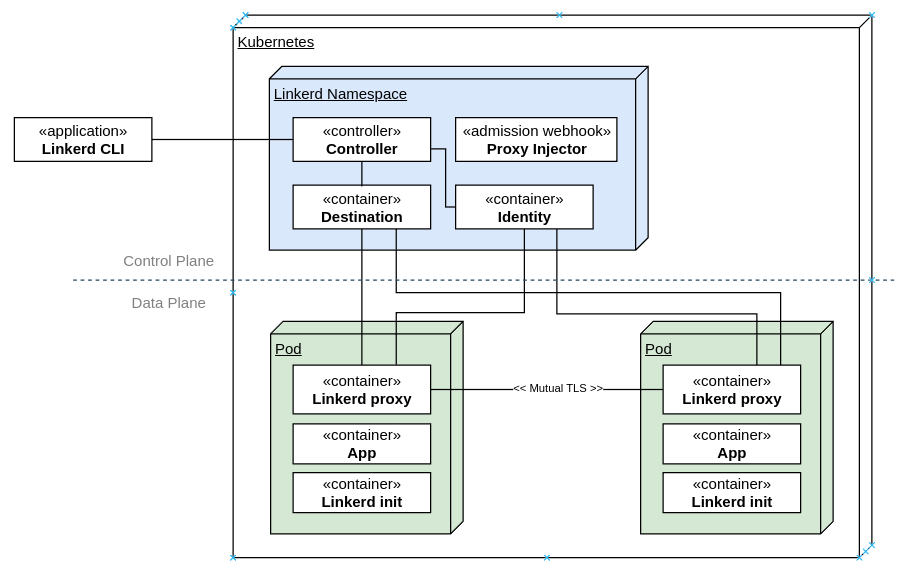
If you ve done anything in the Kubernetes space in recent years, you ve most likely come across the words Service Mesh . It s backed by a set of mature technologies that provides cross-cutting networking, security, infrastructure capabilities to be used by workloads running in Kubernetes in a manner that is transparent to the actual workload. This abstraction enables application developers to not worry about building in otherwise sophisticated capabilities for networking, routing, circuit-breaking and security, and simply rely on the services offered by the service mesh.In this post, I ll be covering Linkerd, which is an alternative to Istio. It has gone through a significant re-write when it transitioned from the JVM to a Go-based Control Plane and a Rust-based Data Plane a few years back and is now a part of the CNCF and is backed by Buoyant. It has proven itself widely for use in production workloads and has a healthy community and release cadence.It achieves this with a side-car container that communicates with a Linkerd control plane that allows central management of policy, telemetry, mutual TLS, traffic routing, shaping, retries, load balancing, circuit-breaking and other cross-cutting concerns before the traffic hits the container. This has made the task of implementing the application services much simpler as it is managed by container orchestrator and service mesh. I covered Istio in a prior post a few years back, and much of the content is still applicable for this post, if you d like to have a look.Here are the broad architectural components of Linkerd:The components are separated into the control plane and the data plane.The control plane components live in its own namespace and consists of a controller that the Linkerd CLI interacts with via the Kubernetes API. The destination service is used for service discovery, TLS identity, policy on access control for inter-service communication and service profile information on routing, retries, timeouts. The identity service acts as the Certificate Authority which responds to Certificate Signing Requests (CSRs) from proxies for initialization and for service-to-service encrypted traffic. The proxy injector is an admission webhook that injects the Linkerd proxy side car and the init container automatically into a pod when the linkerd.io/inject: enabled is available on the namespace or workload.On the data plane side are two components. First, the init container, which is responsible for automatically forwarding incoming and outgoing traffic through the Linkerd proxy via iptables rules. Second, the Linkerd proxy, which is a lightweight micro-proxy written in Rust, is the data plane itself.I will be walking you through the setup of Linkerd (2.12.2 at the time of writing) on a Kubernetes cluster.Let s see what s running on the cluster currently. This assumes you have a cluster running and kubectl is installed and available on the PATH.
On most systems, this should be sufficient to setup the CLI. You may need to restart your terminal to load the updated paths. If you have a non-standard configuration and linkerd is not found after the installation, add the following to your PATH to be able to find the cli:
export PATH=$PATH:~/.linkerd2/bin/
At this point, checking the version would give you the following:
$ linkerd version
Client version: stable-2.12.2
Server version: unavailable
Setting up Linkerd Control PlaneBefore installing Linkerd on the cluster, run the following step to check the cluster for pre-requisites:
kubernetes-api
--------------
  can initialize the client
  can query the Kubernetes API
kubernetes-version
------------------
  is running the minimum Kubernetes API version
  is running the minimum kubectl version
pre-kubernetes-setup
--------------------
  control plane namespace does not already exist
  can create non-namespaced resources
  can create ServiceAccounts
  can create Services
  can create Deployments
  can create CronJobs
  can create ConfigMaps
  can create Secrets
  can read Secrets
  can read extension-apiserver-authentication configmap
  no clock skew detected
linkerd-version
---------------
  can determine the latest version
  cli is up-to-date
Status check results are
All the pre-requisites appear to be good right now, and so installation can proceed.The first step of the installation is to setup the Custom Resource Definitions (CRDs) that Linkerd requires. The linkerd cli only prints the resource YAMLs to standard output and does not create them directly in Kubernetes, so you would need to pipe the output to kubectl apply to create the resources in the cluster that you re working with.
$ linkerd install --crds   kubectl apply -f -
Rendering Linkerd CRDs...
Next, run  linkerd install   kubectl apply -f -  to install the control plane.
customresourcedefinition.apiextensions.k8s.io/authorizationpolicies.policy.linkerd.io created
customresourcedefinition.apiextensions.k8s.io/httproutes.policy.linkerd.io created
customresourcedefinition.apiextensions.k8s.io/meshtlsauthentications.policy.linkerd.io created
customresourcedefinition.apiextensions.k8s.io/networkauthentications.policy.linkerd.io created
customresourcedefinition.apiextensions.k8s.io/serverauthorizations.policy.linkerd.io created
customresourcedefinition.apiextensions.k8s.io/servers.policy.linkerd.io created
customresourcedefinition.apiextensions.k8s.io/serviceprofiles.linkerd.io created
Next, install the Linkerd control plane components in the same manner, this time without the crds switch:
$ linkerd install   kubectl apply -f -
namespace/linkerd created
clusterrole.rbac.authorization.k8s.io/linkerd-linkerd-identity created
clusterrolebinding.rbac.authorization.k8s.io/linkerd-linkerd-identity created
serviceaccount/linkerd-identity created
clusterrole.rbac.authorization.k8s.io/linkerd-linkerd-destination created
clusterrolebinding.rbac.authorization.k8s.io/linkerd-linkerd-destination created
serviceaccount/linkerd-destination created
secret/linkerd-sp-validator-k8s-tls created
validatingwebhookconfiguration.admissionregistration.k8s.io/linkerd-sp-validator-webhook-config created
secret/linkerd-policy-validator-k8s-tls created
validatingwebhookconfiguration.admissionregistration.k8s.io/linkerd-policy-validator-webhook-config created
clusterrole.rbac.authorization.k8s.io/linkerd-policy created
clusterrolebinding.rbac.authorization.k8s.io/linkerd-destination-policy created
role.rbac.authorization.k8s.io/linkerd-heartbeat created
rolebinding.rbac.authorization.k8s.io/linkerd-heartbeat created
clusterrole.rbac.authorization.k8s.io/linkerd-heartbeat created
clusterrolebinding.rbac.authorization.k8s.io/linkerd-heartbeat created
serviceaccount/linkerd-heartbeat created
clusterrole.rbac.authorization.k8s.io/linkerd-linkerd-proxy-injector created
clusterrolebinding.rbac.authorization.k8s.io/linkerd-linkerd-proxy-injector created
serviceaccount/linkerd-proxy-injector created
secret/linkerd-proxy-injector-k8s-tls created
mutatingwebhookconfiguration.admissionregistration.k8s.io/linkerd-proxy-injector-webhook-config created
configmap/linkerd-config created
secret/linkerd-identity-issuer created
configmap/linkerd-identity-trust-roots created
service/linkerd-identity created
service/linkerd-identity-headless created
deployment.apps/linkerd-identity created
service/linkerd-dst created
service/linkerd-dst-headless created
service/linkerd-sp-validator created
service/linkerd-policy created
service/linkerd-policy-validator created
deployment.apps/linkerd-destination created
cronjob.batch/linkerd-heartbeat created
deployment.apps/linkerd-proxy-injector created
service/linkerd-proxy-injector created
secret/linkerd-config-overrides created
Kubernetes will start spinning up the data plane components and you should see the following when you list the pods:
kubernetes-api
--------------
  can initialize the client
  can query the Kubernetes API
kubernetes-version
------------------
  is running the minimum Kubernetes API version
  is running the minimum kubectl version
linkerd-existence
-----------------
  'linkerd-config' config map exists
  heartbeat ServiceAccount exist
  control plane replica sets are ready
  no unschedulable pods
  control plane pods are ready
  cluster networks contains all pods
  cluster networks contains all services
linkerd-config
--------------
  control plane Namespace exists
  control plane ClusterRoles exist
  control plane ClusterRoleBindings exist
  control plane ServiceAccounts exist
  control plane CustomResourceDefinitions exist
  control plane MutatingWebhookConfigurations exist
  control plane ValidatingWebhookConfigurations exist
  proxy-init container runs as root user if docker container runtime is used
linkerd-identity
----------------
  certificate config is valid
  trust anchors are using supported crypto algorithm
  trust anchors are within their validity period
  trust anchors are valid for at least 60 days
  issuer cert is using supported crypto algorithm
  issuer cert is within its validity period
  issuer cert is valid for at least 60 days
  issuer cert is issued by the trust anchor
linkerd-webhooks-and-apisvc-tls
-------------------------------
  proxy-injector webhook has valid cert
  proxy-injector cert is valid for at least 60 days
  sp-validator webhook has valid cert
  sp-validator cert is valid for at least 60 days
  policy-validator webhook has valid cert
  policy-validator cert is valid for at least 60 days
linkerd-version
---------------
  can determine the latest version
  cli is up-to-date
control-plane-version
---------------------
  can retrieve the control plane version
  control plane is up-to-date
  control plane and cli versions match
linkerd-control-plane-proxy
---------------------------
  control plane proxies are healthy
  control plane proxies are up-to-date
  control plane proxies and cli versions match
Status check results are
Everything looks good.Setting up the Viz ExtensionAt this point, the required components for the service mesh are setup, but let s also install the viz extension, which provides a good visualization capabilities that will come in handy subsequently. Once again, linkerd uses the same pattern for installing the extension.
$ linkerd viz install   kubectl apply -f -
namespace/linkerd-viz created
clusterrole.rbac.authorization.k8s.io/linkerd-linkerd-viz-metrics-api created
clusterrolebinding.rbac.authorization.k8s.io/linkerd-linkerd-viz-metrics-api created
serviceaccount/metrics-api created
clusterrole.rbac.authorization.k8s.io/linkerd-linkerd-viz-prometheus created
clusterrolebinding.rbac.authorization.k8s.io/linkerd-linkerd-viz-prometheus created
serviceaccount/prometheus created
clusterrole.rbac.authorization.k8s.io/linkerd-linkerd-viz-tap created
clusterrole.rbac.authorization.k8s.io/linkerd-linkerd-viz-tap-admin created
clusterrolebinding.rbac.authorization.k8s.io/linkerd-linkerd-viz-tap created
clusterrolebinding.rbac.authorization.k8s.io/linkerd-linkerd-viz-tap-auth-delegator created
serviceaccount/tap created
rolebinding.rbac.authorization.k8s.io/linkerd-linkerd-viz-tap-auth-reader created
secret/tap-k8s-tls created
apiservice.apiregistration.k8s.io/v1alpha1.tap.linkerd.io created
role.rbac.authorization.k8s.io/web created
rolebinding.rbac.authorization.k8s.io/web created
clusterrole.rbac.authorization.k8s.io/linkerd-linkerd-viz-web-check created
clusterrolebinding.rbac.authorization.k8s.io/linkerd-linkerd-viz-web-check created
clusterrolebinding.rbac.authorization.k8s.io/linkerd-linkerd-viz-web-admin created
clusterrole.rbac.authorization.k8s.io/linkerd-linkerd-viz-web-api created
clusterrolebinding.rbac.authorization.k8s.io/linkerd-linkerd-viz-web-api created
serviceaccount/web created
server.policy.linkerd.io/admin created
authorizationpolicy.policy.linkerd.io/admin created
networkauthentication.policy.linkerd.io/kubelet created
server.policy.linkerd.io/proxy-admin created
authorizationpolicy.policy.linkerd.io/proxy-admin created
service/metrics-api created
deployment.apps/metrics-api created
server.policy.linkerd.io/metrics-api created
authorizationpolicy.policy.linkerd.io/metrics-api created
meshtlsauthentication.policy.linkerd.io/metrics-api-web created
configmap/prometheus-config created
service/prometheus created
deployment.apps/prometheus created
service/tap created
deployment.apps/tap created
server.policy.linkerd.io/tap-api created
authorizationpolicy.policy.linkerd.io/tap created
clusterrole.rbac.authorization.k8s.io/linkerd-tap-injector created
clusterrolebinding.rbac.authorization.k8s.io/linkerd-tap-injector created
serviceaccount/tap-injector created
secret/tap-injector-k8s-tls created
mutatingwebhookconfiguration.admissionregistration.k8s.io/linkerd-tap-injector-webhook-config created
service/tap-injector created
deployment.apps/tap-injector created
server.policy.linkerd.io/tap-injector-webhook created
authorizationpolicy.policy.linkerd.io/tap-injector created
networkauthentication.policy.linkerd.io/kube-api-server created
service/web created
deployment.apps/web created
serviceprofile.linkerd.io/metrics-api.linkerd-viz.svc.cluster.local created
serviceprofile.linkerd.io/prometheus.linkerd-viz.svc.cluster.local created
A few seconds later, you should see the following in your pod list:
The viz components live in the linkerd-viz namespace.You can now checkout the viz dashboard:
$ linkerd viz dashboard
Linkerd dashboard available at:
http://localhost:50750
Grafana dashboard available at:
http://localhost:50750/grafana
Opening Linkerd dashboard in the default browser
Opening in existing browser session.
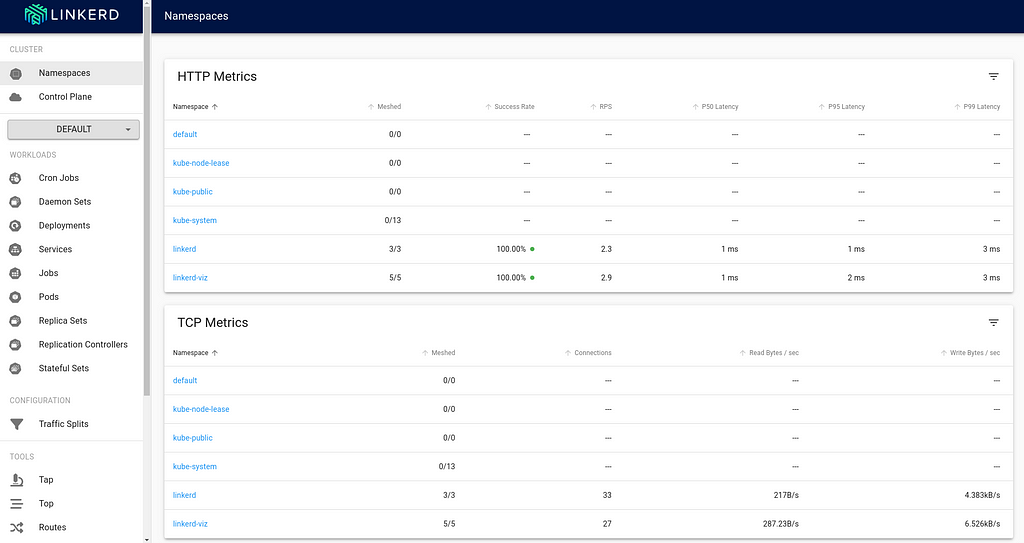
The Meshed column indicates the workload that is currently integrated with the Linkerd control plane. As you can see, there are no application deployments right now that are running.Injecting the Linkerd Data Plane componentsThere are two ways to integrate Linkerd to the application containers:1 by manually injecting the Linkerd data plane components 2 by instructing Kubernetes to automatically inject the data plane componentsInject Linkerd data plane manuallyLet s try the first option. Below is a simple nginx-app that I will deploy into the cluster:
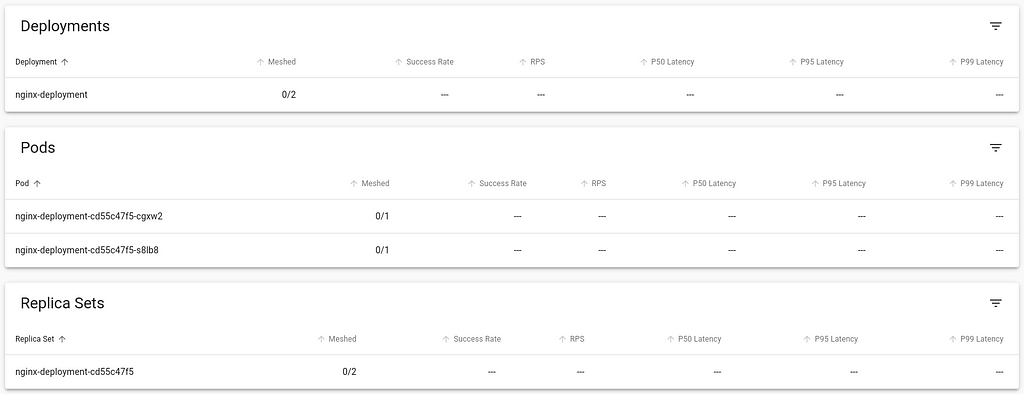
Back in the viz dashboard, I do see the workload deployed, but it isn t currently communicating with the Linkerd control plane, and so doesn t show any metrics, and the Meshed count is 0:Looking at the Pod s deployment YAML, I can see that it only includes the nginx container:
Let s directly inject the linkerd data plane into this running container. We do this by retrieving the YAML of the deployment, piping it to linkerd cli to inject the necessary components and then piping to kubectl apply the changed resources.
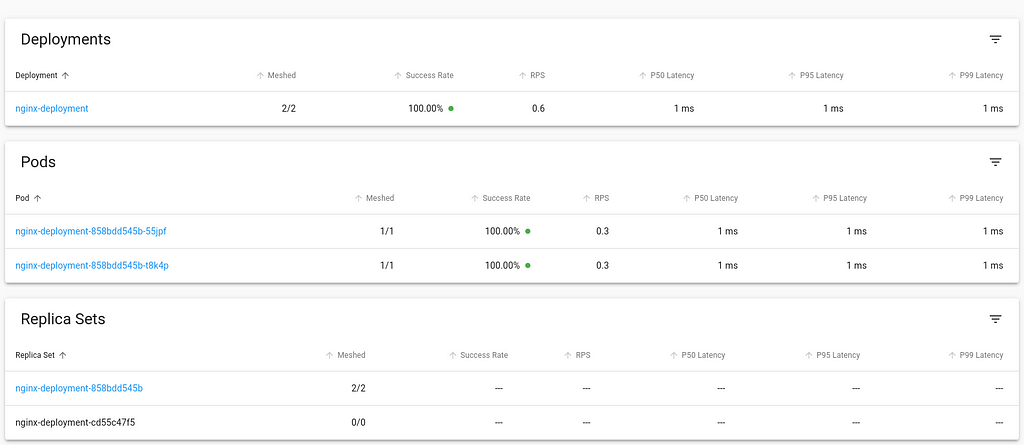
Back in the viz dashboard, the workload now is integrated into Linkerd control plane.Looking at the updated Pod definition, we see a number of changes that the linkerd has injected that allows it to integrate with the control plane. Let s have a look:
At this point, the necessary components are setup for you to explore Linkerd further. You can also try out the jaeger and multicluster extensions, similar to the process of installing and using the viz extension and try out their capabilities.Inject Linkerd data plane automaticallyIn this approach, we shall we how to instruct Kubernetes to automatically inject the Linkerd data plane to workloads at deployment time.We can achieve this by adding the linkerd.io/inject annotation to the deployment descriptor which causes the proxy injector admission hook to execute and inject linkerd data plane components automatically at the time of deployment.
This annotation can also be specified at the namespace level to affect all the workloads within the namespace. Note that any resources created before the annotation was added to the namespace will require a rollout restart to trigger the injection of the Linkerd components.Uninstalling LinkerdNow that we have walked through the installation and setup process of Linkerd, let s also cover how to remove it from the infrastructure and go back to the state prior to its installation.The first step would be to remove extensions, such as viz.
A brand-new version 0.0.9 of RcppSpdlog got onto CRAN overnight. RcppSpdlog bundles spdlog, a wonderful header-only C++ logging library with all the bells and whistles you would want that was written by Gabi Melman, and also includes fmt by Victor Zverovich.
This release contains two changes. First, we extend usability by offering both a set of simple R functions for logging from R, and a matching set of functions at the C++ level that are directly callable (and exported) from this package (so that client packages do not need to compile). Both these changes are described (as sections seven and eight) in the vignette. Second, while we were working on this Gabi released version 1.11.0 upstream so we included this as well.
The NEWS entry for this release follows.
Found the reason podman build was failing as normal user.
dbus-user-session was missing and podman wasn't able to connect to systemd user session.
This resulted in trying to use cgroupfs instead of systemd for managing cgroups and other things also broke.
Two weeks ago, I had the chance to go see Cory Doctorow at my local independent
bookstore, in Montr al. He was there to present his latest essay, co-written
with Rebecca Giblin1. Titled Chokepoint Capitalism: How Big Tech and
Big Content Captured Creative Labor Markets and How We'll Win Them Back, it
focuses on the impact of monopolies and monopsonies (more on this later) on
creative workers.
The book is divided in two main parts:
Part one, Culture has been captured (chapters 1 to 11), is a series of
case studies that focus on different examples of market failure. The specific
sectors analysed are the book market, the news media, the music industry,
Hollywood, the mobile apps industry and the online video platforms.
Part two, Braking anticompetitive flywheels (chapters 12 to 19), looks at
different solutions to try to fix these failures.
Although Doctorow is known for his strong political stances, I have to say I'm
quite surprised by the quality of the research Giblin and he did for this book.
They both show a pretty advanced understanding of the market dynamics they look
at, and even though most of the solutions they propose aren't new or
groundbreaking, they manage to be convincing and clear.
That is to say, you certainly don't need to be an economist to understand or
enjoy this book :)
As I have mentioned before, the book heavily criticises monopolies, but also
monopsonies a market structure that has only one buyer (instead of one
seller). I find this quite interesting, as whereas people are often familiar
with the concept of monopolies, monopsonies are frequently overlooked.
The classic example of a monopsony is a labor market with a single employer:
there is a multitude of workers trying to sell their labor power, but in the
end, working conditions are dictated by the sole employer, who gets to decide
who has a job and who hasn't. Mining towns are good real-world examples of
monopsonies.
In the book, the authors argue most of the contemporary work produced by
creative workers (especially musicians and writers) is sold to monopsonies and
oligopsonies, like Amazon2 or major music labels. This creates a
situation where the consumers are less directly affected by the lack of
competition in the market (they often get better prices), but where creators
have an increasingly hard time making ends meet. Not only this, but natural
monopsonies3 are relatively rare, making the case for breaking the
existing ones even stronger.
Apart from the evident need to actually start applying (the quite good)
antitrust laws in the USA, some of the other solutions put forward are:
Transparency Rights giving creative workers a way to audit the companies
that sell their work and make sure they are paid what they are due.
Collective Action
Time Limits on Copyright Contracts making sure creators that sell their
copyrights to publishers or labels can get them back after a reasonable
period of time.
Radical Interoperability forcing tech giants to make their walled-gardens
interoperable.
Minimum Wages for Creative Work enforcing minimum legal rates for workers
in certain domains, like what is already done for screenplays in the US by
members of the Writers Guild of America.
Collective Ownership
Overall, I found this book quite enjoying and well written. Since I am not a
creative worker myself and don't experience first-hand the hardships presented
in the book, it was the occasion for me to delve more deeply in this topic.
Chances are I'll reuse some of the expos s in my classes too.
Professor at the Melbourne Law School and Director of the
Intellectual Property Research Institute of Australia, amongst other things.
More on her here.
Amazon owns more than 50% of the US physical book retail market and
has an even higher market share for ebooks and audiobooks (via Audible). Not
only this, but with the decline of the physical book market, audiobooks are
an increasingly important source of revenue for authors.
Natural monopolies happen when it does not make economic sense for
multiple enterprises to compete in a market. Critical infrastructures, like
water supply or electricity, make for good examples of natural monopolies. It
simply wouldn't be efficient to have 10 separate electrical cables connecting
your house to 10 separate electric grids. In my opinion, such monopolies are
acceptable (and even desirable), as long as they are collectively owned,
either by the State or by local entities (municipalities, non-profits, etc.).
A new release 0.4.20 of RProtoBuf arrived on CRAN earlier today. RProtoBuf provides R with bindings for the Google Protocol Buffers ( ProtoBuf ) data encoding and serialization library used and released by Google, and deployed very widely in numerous projects as a language and operating-system agnostic protocol.
This release is somewhat mechanical and in the spirit of many other recent releases. clang-15 is, as more recent compilers do, more stringent on definitions and wants to see some void in argument-less signatures. Happy to oblige. At the same time, GitHub Actions started to nag us about minimum versions of node code so an upgrade to a newer action is warranted, again as with many other affected packages. We also found another http:// URL hiding somewhere so that was cleaned. Lastly, it appears Protocol Buffers themselves moved on and now need / prefer C++17 so were happy to oblige.
The following section from the NEWS.Rd file has full details.
Changes in RProtoBuf version 0.4.20 (2022-11-02)
Two function prototype were updated for clang-15.
GitHub Actions were updated to checkout version 3.
One more http:// URL was updated to https://
The package compilation is now donw with C++17 as the Protocol Buffer headers require it (and clang-15 nags otherwise).
So this week I recycled a talk I'd given in the past, about how even using
extremely simple parsers allows a lot of useful static-analysis to be done,
for specific niche use-cases.
This included examples of scanning comments above classes to ensure they
referred to the appropriate object, ensuring that specific function
calls always included a specific (optional) parameter, etc.
Nothing too complex, but I figured I'd give a new example this time, and
I remembered I'd recently written a bunch of functions for an interpreter
which I'd ordered quite deliberately.
Assume you're writing a BASIC interpreter, you need to implement a bunch of
built-in maths functions such as SIN, COS, TAN, then some string-related
functions LEFT$, RIGHT$, MID$, etc.
When it comes to ordering there are a couple of approaches:
Stick them all in one package:
builtins/builtins.go
Create a package and group them:
builtins/maths.go
builtins/string.go
.. etc
Personal preference probably dictates the choice you make, but either way I think it would be rational and obvious that you'd put the functions in alphabetical order:
I did that myself, and I wrote a perl-script to just parse the file using a simple regexp "^func\s+([^(]+)\(" but then I figured this was a good time to write a real static-analysis tool.
The golang environment is full of trivial little linters for various purposes, and the standard "go vet .." driver makes it easy to invoke them. Realizing that I was going to get driven in the same way it was obvious I'd write something called "alphaVet".
So anyway, half written for a talk, half-written because of the name:
Golang linter that reports failures if functions aren't in alphabetical order
I m trying to replace my old OpenPGP key with a new one. The old key wasn t compromised or lost or anything
bad. Is still valid, but I plan to get rid of it soon. It was created in 2013.
The new key id fingerprint is: AA66280D4EF0BFCC6BFC2104DA5ECB231C8F04C4
I plan to use the new key for things like encrypted emails, uploads to the Debian archive, and more. Also,
the new key includes an identity with a newer personal email address I plan to use soon: arturo.bg@arturo.bg
The new key has been uploaded to some public keyservers.
If you would like to sign the new key, please follow the steps in the Debian wiki.
If you are curious about what that long code block contains, check this https://cirw.in/gpg-decoder/
For the record, the old key fingerprint is: DD9861AB23DC3333892E07A968E713981D1515F8
Cheers!
user namespace not enabled when running podman.
Completely forgot about this but seems like I need to enable user namespace for podman.
sudo sysctl -w kernel.unprivileged_userns_clone=1.
Not quite sure when this started being required.
As President of the GNOME Foundation, I wanted to post a quick note to pass on the thanks from the Board, the Foundation staff team and membership to our outgoing Executive Director, Neil McGovern. I had the pleasure of passing on GNOME s thanks in person at the Casa Bariachi this summer at GUADEC in Guadelajara, at the most exellent mariachi celebration of GNOME s 25th Anniversary. Kindly they stopped the music and handed me the microphone for the whole place, although I think many of the other guests celebrating their own birthdays were less excited about Neil s tenure as Executive Director and the Free and Open Source desktop in general.
Neil s 6-month handover period came to an end last month and he handed over the reins to myself and Thibault Martin on the Executive Committee, and Director of Operations Rosanna Yuen has stepped up to act as Chief of Staff and interface between the Board and the staff team for the time being. Our recruitment is ongoing for a new Executive Director although the search is a little behind schedule (mostly down to me!), and we re hugely grateful to a few volunteers who have joined our search committee to help us source, screen and interview applicants.
I have really enjoyed working closely with Neil in my time on the GNOME board, and we are hugely grateful for his contributions and achievements over the past 5 years which I posted about earlier in the year. Neil is this month starting a new role as the Executive Director of Ruby Central. Our very best wishes from the GNOME community and good luck with your new role. See you soon!
(also posted to Discourse if you wish to add any thanks or comments of your own)
 From November 2nd to 4th, 2022, the 19th edition of
Latinoware - Latin American Congress of Free Software
and Open Technologies took place in Foz do Igua u. After 2 years happening
online due to the COVID-19 pandemic, the event was back in person and we felt
Debian Brasil community should be there.
Out last time at Latinoware was in
2016
The Latinoware organization provided the Debian Brazil community with a booth
so that we could have contact with people visiting the open exhibition area and
thus publicize the Debian project. During the 3 days of the event, the booth was
organized by me (Paulo Henrique Santana) as Debian Developer, and by Leonardo
Rodrigues as Debian contributor. Unfortunately Daniel Lenharo had an issue and
could not travel to Foz do Igua u (we miss you there!).
 A huge number of people visited the booth, and the beginners (mainly students)
who didn't know Debian, asked what our group was about and we explained various
concepts such as what Free Software is, GNU/Linux distribution and Debian
itself. We also received people from the Brazilian Free Software community and
from other Latin American countries who were already using a GNU/Linux
distribution and, of course, many people who were already using Debian. We had
some special visitors as Jon maddog Hall, Debian Developer Emeritus Ot vio
Salvador, Debian Developer Eriberto Mota, and Debian Maintainers Guilherme de
Paula Segundo and Paulo Kretcheu.
 Photo from left to right: Leonardo, Paulo, Eriberto and Ot vio.
 Photo from left to right: Paulo, Fabian (Argentina) and Leonardo.
In addition to talking a lot, we distributed Debian stickers that were produced
a few months ago with Debian's sponsorship to be distributed at DebConf22
(and that were left over), and we sold several Debian
t-shirts) produced by
Curitiba Livre community).

 We also had 3 talks included in Latinoware official schedule.
I) talked about:
"how to become a Debian contributor by doing translations" and "how the
SysAdmins of a global company use Debian". And
Leonardo) talked about:
"advantages of Open Source telephony in companies".
 Photo Paulo in his talk.
Many thanks to Latinoware organization for once again welcoming the Debian
community and kindly providing spaces for our participation, and we
congratulate all the people involved in the organization for the success of
this important event for our community. We hope to be present again in 2023.
We also thank Jonathan Carter for approving financial support from Debian for
our participation at Latinoware.
Portuguese version








 And all of this is because I can read, write, articulate. Perhaps many of them may not even have a voice or a platform.
Even to get this temporary progressive disability certificate there is more than 4 months of running from one place to the other, 4 months of culmination of work. This I can share and tell from my experience, who knows how much else others might have suffered for the same. In my case a review will happen after 5 years, in most other cases they have given only 1 year. Of course, this does justify people s jobs and perhaps partly it may be due to that. Such are times where I really miss that I am unable to hear otherwise could have fleshed out lot more other people s sufferings.
And just so people know/understand this is happening in the heart of the city whose population easily exceeds 6 million plus and is supposed to be a progressive city. I do appreciate and understand the difficulties that the doctors are placed under.


 For quite some time, many people asked for a riscv64 porterbox. Now we've got
one called
 There is significant effort involved to get your
 That way more admins need to learn how to run high availability services for dubious business opportunities to "later" monetize services. Services that nobody cares to pay for and thus opportunities that never materialize. But every company wants to find that out again. Because if Apple could do it, why shouldn't Canonical be able to do it? $$$!1!!
So, can't update Firefox on Ubuntu 22.04 right now.
At least there is
 Bonus points for the bad client side implementation:
 I just did again the usual web search, and I have verified that Mastodon still does not support
 Found the reason podman build was failing as normal user.
dbus-user-session was missing and podman wasn't able to connect to systemd user session.
This resulted in trying to use cgroupfs instead of systemd for managing cgroups and other things also broke.
 Two weeks ago, I had the chance to go see Cory Doctorow at my local independent
bookstore, in Montr al. He was there to present his latest essay, co-written
with Rebecca Giblin
 Although Doctorow is known for his strong political stances, I have to say I'm
quite surprised by the quality of the research Giblin and he did for this book.
They both show a pretty advanced understanding of the market dynamics they look
at, and even though most of the solutions they propose aren't new or
groundbreaking, they manage to be convincing and clear.
That is to say, you certainly don't need to be an economist to understand or
enjoy this book :)
As I have mentioned before, the book heavily criticises monopolies, but also
monopsonies a market structure that has only one buyer (instead of one
seller). I find this quite interesting, as whereas people are often familiar
with the concept of monopolies, monopsonies are frequently overlooked.
The classic example of a monopsony is a labor market with a single employer:
there is a multitude of workers trying to sell their labor power, but in the
end, working conditions are dictated by the sole employer, who gets to decide
who has a job and who hasn't. Mining towns are good real-world examples of
monopsonies.
In the book, the authors argue most of the contemporary work produced by
creative workers (especially musicians and writers) is sold to monopsonies and
 So this week I recycled a talk I'd given in the past, about how even using
extremely simple parsers allows a lot of useful static-analysis to be done,
for specific niche use-cases.
This included examples of scanning comments above classes to ensure they
referred to the appropriate object, ensuring that specific function
calls always included a specific (optional) parameter, etc.
Nothing too complex, but I figured I'd give a new example this time, and
I remembered I'd recently written a bunch of functions for an interpreter
which I'd ordered quite deliberately.
Assume you're writing a BASIC interpreter, you need to implement a bunch of
built-in maths functions such as
 I m trying to replace my old OpenPGP key with a new one. The old key wasn t compromised or lost or anything
bad. Is still valid, but I plan to get rid of it soon. It was created in 2013.
The new key id fingerprint is:
 As President of the GNOME Foundation, I wanted to post a quick note to pass on the thanks from the Board, the Foundation staff team and membership to our outgoing Executive Director, Neil McGovern. I had the pleasure of passing on GNOME s thanks in person at the Casa Bariachi this summer at GUADEC in Guadelajara, at the most exellent mariachi celebration of GNOME s 25th Anniversary.
 Kindly they stopped the music and handed me the microphone for the whole place, although I think many of the other guests celebrating their own birthdays were less excited about Neil s tenure as Executive Director and the Free and Open Source desktop in general.
