Search Results: "ag"

28 March 2009

Tiago Bortoletto Vaz: Some cool audio stuff for Debian


(I was a kind of impolite in not mentioning any detail about the packages I asked for sponsors in my previous post. Sorry about that. Here I ll try to summarize what kind of stuff I m currently trying to push into Debian) Rakarrak is a nice guitar effects processor for GNU/Linux. An ITP was opened about Jul/2008 with no progress since then. I ve quite often used this software and it seems to be pretty stable - at least in a i386 system. Tapiir is a simpler one. It provides a high quality real-time delay/feedback effects which can be useful for any kind of audio output. This software used to be maintained by the Debian QA group. It was orphaned few months ago, removed from the archive and now I m working to have it back again. I ve talked to the upstream and he has agreed to have Tappir maintained in collab-maint git repository. Hey, both support JACK :) (See Rakarrack git browser)
(See Tappir git browser) Posted in english Tagged: audio, debian, gnu, guitar, music

Ingo Juergensmann: Ubuntu, wireless and hex garbage in resolv.conf

For some days now I can't use my wireless on my Ubuntu (jaunty) laptop anymore. For whatever reason the domain-search option of my dhcpd causes the dhclient on the laptop to interpret the search list as hex values. For example I've the following line in my dhcpd.conf:

option domain-search "hro.localnet", "os.localnet", "localnet";


This line leads to the following on the client:

search hro.localnet 3:68:72:6f:8:6c:6f:63:61:6c:6e:65:74:0:2:6f:73:c0:4:6:62:65:72:6c:69:6e:c0:4:c0:4


So, my current work around is, to comment the option domain-search line out of my dhcpd.conf and to include a "append" line in my dhclient.conf - unfortunately I've to add this line on all clients I use.

Alastair McKinstry: Pkg-config and Modules

At ICHEC one of our tasks is to help users build their software on our supercomputers. Mostly we have to change paths, etc. in code bases that are used by a handful of scientists, and we don't want to exacerbate the hard-coded path problem. We also have multiple versions of certain libraries and compilers installed, which we select using modules: to do this, you select your software environment with e.g.
$ module load intel-fc/11.0.082  netcdf/4.0-intel
This selects the compiler version, and library version. Then, this places appropriate paths in $PATH, $LD_LIBRARY_PATH. While this is useful for selecting, eg. compilers, its often not great for many build processes that expect library paths, etc. hard-coded. I also dislike adding random environmental variables: it loses the Single Point Of Truth that describes the configuration. So I've come up with the following pattern. First, record the modules used (eg. library version) in config.log if configure is used. To do this, add the following to the autoconf file or system headers:
# AC_MODULES_OUTPUT
# -----------------
# Check if the system runs 'modules', and if so, record the modules environment in the config.log
AC_DEFUN([AC_MODULES_LIST],
[AC_CACHE_CHECK[modules output if present],[ac_modules_output],
(ac_modules_output= module list 2>&1 )
if test $? eq 0; then
 AC_MSG_RESULT([Output from 'module list' was:\n $ac_modules_output])
fi
])
Secondly, For all packages, ensure that a pkgconfig package file exists. For example, we have multiple MPI implementations on our SGI system. For MVAPICH, we have a modules file:
stokes2:~$ module show mvapich2-intel
-------------------------------------------------------------------
/ichec/modulefiles/mvapich2-intel/1.2p1:
module-whatis    MVAPICH2 1.2p1 (Intel 11.0.074) 
conflict         mvapich2-gnu mvapich2-intel 
prepend-path     PATH /ichec/packages/mvapich/1.2p1-intel/bin 
prepend-path     LD_LIBRARY_PATH /ichec/packages/mvapich/1.2p1-intel/lib 
prepend-path     MANPATH /ichec/packages/mvapich/1.2p1-intel/share/man 
prepend-path     INCLUDE /ichec/packages/mvapich/1.2p1-intel/include 
prepend-path     CPATH /ichec/packages/mvapich/1.2p1-intel/include 
prepend-path     FPATH /ichec/packages/mvapich/1.2p1-intel/include 
prepend-path     PKG_CONFIG_PATH /ichec/packages/mvapich/1.2p1-intel/share/pkgconfig 
-------------------------------------------------------------------
We add a file mpi.pc to the PKG_CONFIG_PATH for each MPI implementation. So, mpi.pc looks like:
# MPI pkgconfig file for mvapich2-intel
# Normally only used to get variables $prefix, etc.
prefix=/ichec/packages/mvapich/1.2p1-intel
exec_prefix=$ prefix 
libdir=$ prefix /lib
includedir=$ prefix /include
Name: mpi
Description: netCDF libraries, include files and development tools
Version: 1.2p1
Libs: -L$ libdir   -lmpichf90 -lmpich -lpthread -lrdmacm -libverbs -libumad -lrt
Cflags: -I$ includedir 
This then means we can add the following small patch to our target software (in this case a climate code COSMOS):
 #########################################################################
 #
 #  MPI message passing root directory of the chosen compiler
 
+  # Get default MPI ROOT from the pkgconfig file if possible
+  pkg-config mpi --variable=prefix 2> /dev/null > /dev/null
+  if [ $? -eq 0 ]; then
+    MPIROOT= pkg-config mpi --variable=prefix 
+  fi
+
   if   [ $compiler = ifort ]; then
     export cc=cc
     if [ $CHAN = MPI2 ]; then
-       export MPIROOT=/sw/sarge-ia32/mpich2-1.0.4p1-pgi
+       export MPIROOT=$ MPIROOT:-/sw/sarge-ia32/mpich2-1.0.4p1-pgi 
     elif [ $CHAN = MPI1 ]; then
Such a patch is generic enough to be useful outside our institution, and means the code can build out-of-the-box on many systems. Now to add mpi.pc to Debian ... Tags , , , ,

Chris Lamb: Orphaning the Gnome BTS Applet

As I haven't used Gnome in over a year, I'm orphaning my Debian BTS Applet (original blog post). After the original release it was forked for Launchpad and there were even plans for OpenSUSE fork. Jon Dowland also released his debgtd tool which isn't Gnome-specific and somewhat more useful for developers, although actual development has stalled with patches pending. I would be willing to sponsor uploads if a non-Debian Developer was to adopt it.

David Welton: Software Economics - Public Goods

To look at the economics of open source software, you have to start with the economics of software as a category, both proprietary and open source. Note: it should be perfectly obvious to everyone that open source software works, and works quite well for some things. This article is more about understanding the how and they why. Just to avoid any confusion... If you look at software as a product, it has a couple of defining characteristics:
  • It's difficult to keep people from sharing it. Not impossible, but not easy, either. It was already doable in the days of floppy disks, but with the rise of the internet, it has become nearly effortless. This means, in terms of economics, that it's "non excludable" - it's difficult to keep everyone from enjoying it once you've created it and started to distribute it.
  • If you give a copy of a program to a friend, it in no way detracts from your own use of the program. Quite the contrary, it may even make your use of it better, if, say, your friend discovers how to use a cool feature, or writes a handy extension. This is different from traditional goods like bicycles. If you loan me your bicycle, you can't use it to get around. In economics, things like software (or radio or over the air TV) are called 'non rivalrous' goods - many people can take advantage of them without ruining them.
What do you get when you combine something that's "non excludable" and "non rivalrous"? In economics, these are known as "public goods": http://en.wikipedia.org/wiki/Public_good - read the whole thing if you have a few minutes, it's what I'll be talking about. As per the article, "The Problem" as it were, is the free rider problem. Let's stop and look at a contrived example: Bob is an ex-dentist and really knows what it would take to write a great program for managing a dentist's office (or pick your own example... it's contrived, don't quibble about the details). He's also a good programmer, with the skills necessary to implement the program. He talks to a few of his dentist friends, and they're enthusiastic about the whole thing. Let's look at a few scenarios of how things might play out: Bob values his time at 10 dollars an hour, and it will take him 100 hours to complete the project, meaning the whole project would cost about 1000 dollars. One way things could work is that he could find a dentist friend who needs this program, and bill him 1000$ for his time and services, bang out the code, and release it as open source software. Bob gets his money, the dentist gets his code... and all the other dentists in town get it for free, which is bound to make the dentist who shelled out the money a bit irritated, given that he's a human, not a homo-economus, and doesn't like paying and see others get the same thing for free. Let's introduce another variable: the software is only really worth 200$ to the dentist - any more than that and yeah, it's helpful, but not worth that much money (And please stay with me, I know it's contrived, but keep in mind that the situation *is* possible, even if the numbers might be different). That means that if Bob wants 1000$ for his time, but the dentist will only pay 200$, then no transaction will occur! The software won't get written, Bob won't get any money, and the dentist will be worse off because he won't have the nice program, and neither will his dentist colleagues. One way things might still work is if the dentist rounds up some friends and they all contribute a bit, however, that's kind of a pain in the neck for everyone concerned - the dentist doesn't want to get into the software business and spend a bunch of time trying to chase his friends for money, and even if 10 dentists contribute, the ideal position to be in his the 11th guy, who pays nothing, and still gets the software for free. So it's in everyone's interests to not return the dentist's calls in the hope of being the 11th guy. Also, none of them gets the software until they're all on board. So, how to resolve this problem? The wikipedia page talks about introducing an exclusion mechanism, which in this case would be a copyright system so that Bob can sell a copy of his software for 100$ and be sure that it won't be open to everyone to use. This way, the dentists get the software for 100$ less than they value it at (200$), and as soon as Bob signs up an 11th dentist, he's making more than his time/materials costs, and is therefore coming out ahead! The dentists all know that they're paying the same price, so have no reason to grumble about free riders. In short, everyone is pretty happy. Of course, in the real world, things don't play out like that all the time. There are problems with the simplified example above, some of which are very evident: the cost of enforcing copyright laws, in an age when copying is extremely easy, is very high and potentially very intrusive. However, "intellectual property" is, by and large, a compromise solution that has had positive aspects, especially when you ignore the outliers like Microsoft, and look at all kinds of niche software vendors, who make a nice living, create good products, and have happy, satisfied customers. If you look at the other solutions to the free rider problem listed on the wikipedia page, we can see how they might be applied to the world of software.
  • Dominant assurance contracts
    Assurance contracts are contracts in which participants make a binding pledge to contribute to a contract for building a public good, contingent on a quorum of a predetermined size being reached. Otherwise their money is refunded. A dominant assurance contract is a variation in which an entrepreneur creates the contract and refunds the initial pledge plus an additional sum of money if the quorum is not reached. In game theory terms this makes pledging to build the public good a dominant strategy: the best move is to pledge to the contract regardless of the actions of others.
    This means that Bob goes out and gets a number of dentists to pledge 100$ to his dentist program, and if he doesn't raise at least 1000$, he'll give them each back 110$. So it's a clever solution that works out for everyone, but is still a lot fiddlier than the copyright system - Bob has to go sell the contracts and explain how things work to a bunch of people before he can get started. This might be doable with 10 dentists, but for a more mass-market sort of program, it would not be feasible.
  • Coasian solution
    a mechanism by which potential beneficiaries of a public good band together and pool their resources based on their willingness to pay to create the public good. Coase (1960) argued that if the transaction costs between potential beneficiaries of a public good are sufficiently low, and it is therefore easy for beneficiaries to find each other and pool their money based on the public good's value to them, then an adequate level of public goods production can occur even under competitive free market conditions.
    That sounds an awful lot like open source software, especially the kind espoused by groups like the Apache Software Foundation, where making free software is not a moral imperative, but a good way of producing something that is not necessarily a key business component. This has proven to work very well for infrastructure type code, as well as lots of developer tools. It is less proven as a way to develop end-user software - in the example above, it's not like Bob needs help to develop his system, or that the dentists really want to contribute - they just want a working program and don't want to get involved in its production.
  • Government provision This would mean that the government would be responsible for funding the production of open source software. I'm no free-market zealot, but I think the idea of the government being responsible for software products is not one I am entirely comfortable with. Of course, I do think the government has a role with places like universities, where people can do "research" in the sense of hacking on cool systems just to see what can be done, without necessarily having to be thinking of how to make a profit in the short to medium term. Software like BSD, Tcl, and plenty of other great stuff has come out of universities, meaning that in part it is ultimately funded by the government and taxes. The problem, though, is the process of refining those things down into something people are willing to buy. Would Bob go to a local government official to get a grant to produce his software? Why should Bob get the contract and not some other guy? Does the government official know enough about code or dentists to determine who should write the program?
  • Subsidies Subsidies might work to encourage software production, but would probably simply be abused. It's probably not as relevant as other potential solutions. What form would it take? 1$ off your taxes per line of code written? It would be difficult to place a value on anything, and might be quite difficult to implement.
  • Privileged group This, as the wikipedia page says, is an incomplete solution, and is less generally applicable. In terms of Bob, it might mean that instead of valuing his code at 200$, his wealthy dentist friend with a large practice really needs the code - it's worth 2000$ to him, and can pay Bob the full 1000$ to develop it out of pocket and still come out ahead, and he doesn't really care that much about the free riders because he's getting what he needs and the rest doesn't matter too much.
  • Social norms If Bob and the dentists live in a small town, and are all good friends, perhaps Bob could still release the software, and even though the other dentists could copy and use it for free, they don't, because they feel an obligation to Bob to help him out for the work he's done. Even though they could take advantage of it for free, they would feel bad about doing so, and so each chip in 100$, which after enough people contribute, is enough to cover Bob's costs. It's likely that anything distributed on a larger scale, however, will see more free-riding, and "please pay!" might not work out. And it's probably fairly distressful for a developer to make that jump, knowing he's at the mercy of other people's good will.
None of these solutions is perfect, and all, including exclusion in the form of intellectual property laws, or simply doing nothing at all, have problems of their own. Due to the very nature of software, this is somewhat inevitable, and the best we can do is come up with good compromises, and continue to reevaluate them as technology and society change (this is something that needs to happen with IP laws, for instance).

Jordi Mallach: An update on GRUB2

Some time ago I wrote about the the state of GRUB2 and a milestone on getting it boot my Apple PowerBook G4 without manual intervention. More than a year later, GRUB2 has changed and improved a lot, as the community keeps growing and patches and ideas are continously being posted. Some months and commits after my previous post, GRUB broke again on Apple OpenFirmware and I'd get dropped to OF console, the amount of commits since the last known working version and the current SVN was quite big, and although I was able to narrow it to a few suspicious changes, I had no time to bisect it properly, and sadly I had to go back to yaboot for a while. But procrastinating sometimes helps, and when I should have been writing and studying, on December I gave GRUB a new try on my laptop to see if a few important changes to memory allocation would have changed anything. And it did! So after fighting quite a few problems, I was able to report partial success to grub-devel. Again, getting GRUB installed correctly was a bit challenging and needed some hackery, due to incorrectly generated device.map, and the linux module mysteriously not getting loaded. Luckily, Michel D nzer found out that this was due to a bug in sort ordering in the HFS module, which broke the lookup of files with underscores like _linux.mod, and for which he posted a possible fix by taking Linux's table of character ordering, which is a blob of hex values. GRUB developers didn't seem too happy about applying the patch: they argument that a blob like that should be well documented or written in some other more readable way, and there's a possible problem with the mix of Linux GPLv2 and GRUB GPLv3+ codebases, if a table of data like what Michel posted is actually copyrightable. The discussion ended up dying and nothing was done... until Pavel Roskin picked it up weeks later and posted a new patch, based on hfsutils GPLv2+ code, which addressed these issues. The new patch seems to have a few issues, which makes it fail as before, but hopefully it'll be fixed soon. Additionally, I wasn't able to boot using UUIDs as the search commands fails to detect the correct boot device on my system (but not on Michel's), so I had to disable that in /etc/default/grub. To workaround the linux module loading bug while the patch is fixed, I just added this ugly hack to /etc/grub.d/09_local_prelinux:
#! /bin/sh -e
# Work-around for bugs in the hfs module which makes the load of
# linux.mod fail.
cat << EOF
insmod (hd,3)/usr/lib/grub/powerpc-ieee1275/_linux.mod
insmod linux
EOF
This is enough to get the initrd and linux commands available. However, update-grub will still add search commands to your menu entries even if you disabled UUID support; I can't understand why, but I know it breaks on my PowerBook due to some OF rarety. Just removing the line from the menu entry will leave me with a working config that boots without any manual editing at GRUB prompt. The latest GRUB snapshot in Debian fixes the device.map issue, but adds one last issue: update-grub will fail due to some gfxterm detection code, a workaround is to replace an exit 1 with exit 0 when this happens in /etc/grub.d/00_header. On the weird architectures front, it's worth noting that this month Dave Miller popped up on the list and started posting patches to fix the rotten SPARC port, and I think it's safe to assume that it'll be on an usable state really soon. Impressive!

Stefano Zacchiroli: post DPL campaign

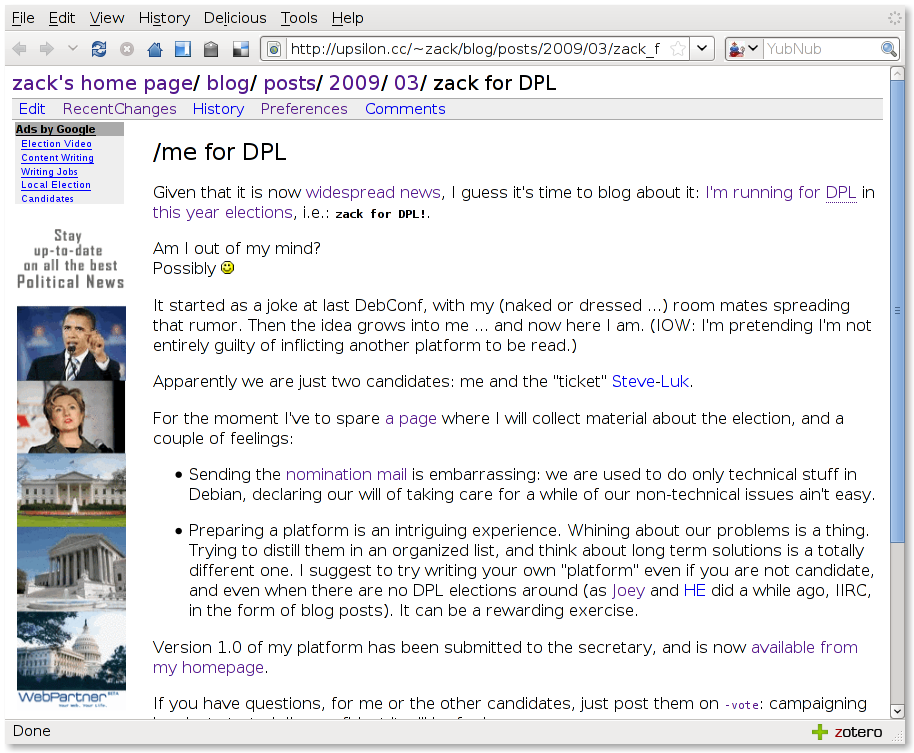
DPL campaign woes DPL campaigning is going to end today, and the draft ballot has apparead already. The latest bits of news I've to offer are that my rebuttals have been published a couple of days ago (also in the platform from www.d.o, of course, which is just lacking a direct anchor). Also, I've summarized campaigning discussions at my candidacy page. You can find there pointers to all topics raised on -vote, as direct or indirect questions to the candidates. Please let me know if I forgot something. All in all I was expecting more discussions between the candidates for a campaign, but I presume the volume is meant to remain low having just two candidates. That notwithstanding, some very inspiring and unexpected questions have been posed; it has been intriguing to think about them. As a campaign-concluding fun bit, I cannot resist posting a screenshot of my candidacy post, as it appeared to me about 10 minutes ago: zack for DPL post screenshot ... I mean, having fellow DDs making fun of me for this DPL thingy on IRC is fine, but ads stepping in is kind of too much ... :-)

Patrick Schoenfeld: Arcor EasyBox A801

Recently, my girl friend and I decided to get Arcor DigitalTV. So we got some hardware from Arcor (and unfortunately we needed to "upgrade" our real-ISDN-connection to a SIP-based-one):

That second piece of hardware is kinda interesting, because it is an ADSL2+-Modem, (WLAN-)Router, SIP-Gateway and file-/printserver (it has one USB port which can be used to connect an USB hub and up to 4 disks or 1 printer) and 4-Port Switch in one (I think it doesn't include whats called a 'Splitter', because with this kind of connection there is no ISDN signal to be splitted from the internet signal).

Unfortunately not all is well about this (or about my provider). This piece of hardware can be configured with a modem installation code. Which is good for an average user, because he does not need to care about anything. With this process the hardware configures itself by receiving configuration data from a configuration server of the provider. Regardless about other implications this might have: What disturbed me about this is, that I loose control about my router, if I use this. Because when configured this way some sites in the router are grayed out. If you click them you get a message that this setting is controlled by your provider. Uarg. Well, unfortunately IPTV from arcor does not simply use the same internet connection as I usually do (more about this later), so I were suffering from missing informations about how to configure the router manually.
Arcor wasn't particular helpful in this, because they told us "Der Router kann nicht manuell konfiguriert werden." (which means in Englisch: "The router cannot be configured manually."). Although this brought me to laugh, I were also disappointed and worried about this. So I decided to find it out myself. I won't tell what I tried after all, but in the end I found out that the modem installation code-installation does configure:

With this knowledge (and some good guessing, e.g. that both PPPoE links eventually use the same user data) I were able to configure the router fully myself, which also enables me to set QoS settings how I want them (which is why I went through the whole torture at all, because SSH was extremely laggish when watching TV). One thing is notable however, how I got the information:

The manufacturer of the router seems to do some things to protect the settings from the user. For example: The page for configuring the WAN is called wan_main.stm, it can be called without trouble if you are configureing the router manually, but the system would block access when you use the modem installation code. BUT and thats how I got the info that the third link is a MAC Encapsulation Link: The status page (where it shows that you are connected etc.) includes javascript vars for nearly everything you ever wanted to know about your router configuration. Not obfuscated after all. You just have to look at the source of the status frame. Thats real professional, Arcor.

Adeodato Sim : The F hrer in IMDB

Following-up to the story of having all the movies I ve watched in a PostgreSQL database, I now have a tendency to run the following query after wathing one, to take a look at what other movies I ve watched in which some of the actors also participated:
  movies=> SELECT s.name, s.title
             FROM seen_cast s JOIN seen_cast s2 USING (person_id)
             WHERE s.movie_id != s2.movie_id AND s2.title = 'Sideways' 
             ORDER BY name ASC;
(Replacing Sideways with the movie I just watched, of course. Also, seen_cast is a view, that s why it looks as if the database is not normalized.) So, apart from informing me that I have seen Paul Giamatti in other five films in addition to Sideways, the above query returned the following rows:
       name             title        
  --------------+--------------------
   Adolf Hitler   Germania anno zero
   Adolf Hitler   The Good Shepherd
Apparently, Adolf Hitler has a page in IMDB, and is credited (generally by IMDB only, not by the film credits themselves) in every film that shows any archive footage of him. Which, as of today, are more than 400.

Matthew Garrett

"Open"Solaris. Especially ironic given that there's a 2-clause BSD implementation out there already.

Biella Coleman: Circuits-FlowCharts-Biblegrams

After telling my friend about a talk on flow charts, brains, and psychology I attended today, my friend pointed me to his amazing art-a-gram of relationships as well as this even more out of this world biblegram. Damn.

Biella Coleman: Circuits-FlowCharts-Biblegrams

After telling my friend about a talk on flow charts, brains, and psychology I attended today, my friend pointed me to his amazing art-a-gram of relationships as well as this even more out of this world biblegram. Damn.

27 March 2009

David Welton: CodingHorror and Open Source Economics

Jeff Atwood writes about the economics of open source software: http://www.codinghorror.com/blog/archives/001247.html Well, he actually doesn't say as much, but that's what it's about. Someone really ought to do a book about this subject. I have some ideas - any takers? It's always tough to write about because there's so much material. It's a topic that is near and dear to my heart - almost 10 years ago, I joined the Free Software Business mailing list, as I got curious about the intersection of free software and business, and how the whole thing worked. I've learned a lot in the meantime, including a stint at Linuxcare, which was one of the Linux companies during the dot com boom, and am still fascinated by the subject. Before we get started, let's reiterate something:
  • It's clear that open source software works. There's just no doubt about it - it's been through ups and downs, the dot com boom and bust, and it will trundle happily (well, as happy as anyone is with this economy) through the recession too.
That point bears repeating. Everything else needs to take it into consideration. Could it work better? Differently? Perhaps, but it does work, so you need to understand it very well before you fiddle with it. Jeff writes:
for the average user? Heck, how realistic is this for the average programmer? Even if you're the type of macho, gung-ho programmer who can master an alien code base just to get some small pet feature or bugfix in -- do you honestly have the kind of time it would take to do that? Sometimes, when people say this:
The source code is freely available. If you feel so strongly about this bugfix/tweak/feature/plugin, why don't you code it yourself?
They're really saying this:
F**k you.
Which is of course a terrible analysis of open source, and its pros and cons. I wrote the following comment on Hacker News:
Heck, how realistic is this for the average programmer? ...
"Actually, I have submitted lots of (mostly small and inconsequential) bugs and minor features over the years, to projects such as the Linux Kernel, Tcl, Erlang, Ruby, Rails, Apache, and probably lots of others I'm forgetting right now. I actually enjoy it quite a bit, come to think of it - there's something cool about diving in and studying something new and different, and a thrill that comes with nailing the bug. Sometimes, the knowledge required to actually fix it is too much, and you have to settle for sending in a good bug report, but in other cases it's very much possible to hack up quick, useful things despite not knowing much about the system in question. And, no, I'm not really that great a programmer... I'd consider myself fairly average." And I know I'm not alone, as I see similar sorts of people in Debian and the Apache Software Foundation. Debian, infact, is all about those kinds of tweaks to improve the operating system as a whole. And this sort of exchange goes on all the time, as evidenced by the huge success of a large number of open source projects. Now, granted, most projects are really driven by one or a few really committed hackers, who do the lion's share of the work. However, that large network of people who contribute, test, document, and suggest is certainly important to any open source project. As long as we're looking at my anecdote, let's look at it in a bit more depth - most of those projects are developer tools or closely related. A cynic might note that Jeff comes from the world of Microsoft, where the core developer tools are provided by a company and 'giving back' is limited to payments and bug reports. But leaving that be, I think the enormous success of stuff like Ruby, Perl, PHP, Python, Tcl, Apache, Linux, GCC, and on and on and on indicates that, at least in terms of stuff that developers share between one another, open source works. However, there are problems, one of which is that he (or, in unfortunately rather rarer cases, she) who writes the code does not necessarily get the money. And without money, he or she who writes the code must dedicate themselves to some means to actually accumulate a bit of money in order to pay for living expenses. Most likely, this is time taken away from the open source project, which is a loss for all the people who benefit from it. Proprietary software solves this feedback loop in a neater way (generally) - companies that create good products get money for their efforts, which can then be reinvested in development. Jeff suggests that "sponsorship seems like a constructive way for people who are unable or unwilling to write code to affect the direction of a project.", which is ok as far as it goes, and more or less works here and there, but hopefully he's not thinking about trying it on a larger scale. This sort of thing has been tried before, and never really seems to take off. Part of the problem is that it can work on a person-to-person basis, but is almost impossible to standardize in a way that it makes sense to have some kind of clearinghouse that operates as a business. There are simply too many factors - what kind of open source project it is, what motivates the people behind it, how the transaction costs of defining a specification, monitoring the results, sending money and so on compare to the actual value of a fix... the list goes on. Ultimately, it's a nice idea, but it doesn't seem to work out too well in practice. Anyway, while it's a good thought on Jeff's part, at the end of the day, it is fairly evident that he doesn't have a lot of first hand knowledge of open source business and economics. That said, to some degree, open source took everyone by surprise, and, lacking the nice, simple feedback loop that proprietary software has, can be a lot more difficult to get a handle on. I find it quite pleasant that way - it attracts both hard-headed business types and social-experiment idealist visionaries; both huge corporations (IBM!) and a huge number of individuals; both people who have gotten quite wealthy from open source as well as most of the rest of us who manage to make ends meet but still love it. It's not something that's easy to pigeonhole, and as such it's hard enough to figure out the many ways in which it does work, let alone figure out how to improve on it. Stay tuned for further installments: Software Economics - Public Goods

Mike Hommey: I m weak

Not only have I not stopped working on WebKit, but I even touched the debian/copyright file :-/ Update: and now I even uploaded a new xulrunner package

David Welton: Software Economics - Public Goods

To look at the economics of open source software, you have to start with the economics of software as a category, both proprietary and open source. Note: it should be perfectly obvious to everyone that open source software works, and works quite well for some things. This article is more about understanding the how and they why. Just to avoid any confusion... If you look at software as a product, it has a couple of defining characteristics: What do you get when you combine something that's "non excludable" and "non rivalrous"? In economics, these are known as "public goods": http://en.wikipedia.org/wiki/Public_good - read the whole thing if you have a few minutes, it's what I'll be talking about. As per the article, "The Problem" as it were, is the free rider problem. Let's stop and look at a contrived example: Bob is an ex-dentist and really knows what it would take to write a great program for managing a dentist's office (or pick your own example... it's contrived, don't quibble about the details). He's also a good programmer, with the skills necessary to implement the program. He talks to a few of his dentist friends, and they're enthusiastic about the whole thing. Let's look at a few scenarios of how things might play out: Bob values his time at 10 dollars an hour, and it will take him 100 hours to complete the project, meaning the whole project would cost about 1000 dollars. One way things could work is that he could find a dentist friend who needs this program, and bill him 1000$ for his time and services, bang out the code, and release it as open source software. Bob gets his money, the dentist gets his code... and all the other dentists in town get it for free, which is bound to make the dentist who shelled out the money a bit irritated, given that he's a human, not a homo-economus, and doesn't like paying and see others get the same thing for free. Let's introduce another variable: the software is only really worth 200$ to the dentist - any more than that and yeah, it's helpful, but not worth that much money (And please stay with me, I know it's contrived, but keep in mind that the situation *is* possible, even if the numbers might be different). That means that if Bob wants 1000$ for his time, but the dentist will only pay 200$, then no transaction will occur! The software won't get written, Bob won't get any money, and the dentist will be worse off because he won't have the nice program, and neither will his dentist colleagues. One way things might still work is if the dentist rounds up some friends and they all contribute a bit, however, that's kind of a pain in the neck for everyone concerned - the dentist doesn't want to get into the software business and spend a bunch of time trying to chase his friends for money, and even if 10 dentists contribute, the ideal position to be in his the 11th guy, who pays nothing, and still gets the software for free. So it's in everyone's interests to not return the dentist's calls in the hope of being the 11th guy. Also, none of them gets the software until they're all on board. So, how to resolve this problem? The wikipedia page talks about introducing an exclusion mechanism, which in this case would be a copyright system so that Bob can sell a copy of his software for 100$ and be sure that it won't be open to everyone to use. This way, the dentists get the software for 100$ less than they value it at (200$), and as soon as Bob signs up an 11th dentist, he's making more than his time/materials costs, and is therefore coming out ahead! The dentists all know that they're paying the same price, so have no reason to grumble about free riders. In short, everyone is pretty happy. Of course, in the real world, things don't play out like that all the time. There are problems with the simplified example above, some of which are very evident: the cost of enforcing copyright laws, in an age when copying is extremely easy, is very high and potentially very intrusive. However, "intellectual property" is, by and large, a compromise solution that has had positive aspects, especially when you ignore the outliers like Microsoft, and look at all kinds of niche software vendors, who make a nice living, create good products, and have happy, satisfied customers. If you look at the other solutions to the free rider problem listed on the wikipedia page, we can see how they might be applied to the world of software. None of these solutions is perfect, and all, including exclusion in the form of intellectual property laws, or simply doing nothing at all, have problems of their own. Due to the very nature of software, this is somewhat inevitable, and the best we can do is come up with good compromises, and continue to reevaluate them as technology and society change (this is something that needs to happen with IP laws, for instance).

Gunnar Wolf: La seguridad en c mputo: Con qu se come?

TitleLa seguridad en c mputo: Con qu se come?
Publication TypeMagazine Article
Year of Publication2009
AuthorsWolf, Gunnar
MagazineSoftware Gur
FrequencyQuarterly
Issue Number23
Pagination47
Date Published02/2009
Type of ArticleColumn
ISSN1870-0888
Key WordsSeguridad
Citation Key1928
Export

Gunnar Wolf: C mo ense ar a los programadores del futuro?

Title C mo ense ar a los programadores del futuro?
Publication TypeMagazine Article
Year of Publication2008
AuthorsGunnar, Wolf.
MagazineSoftware Gur
Issue Number22
Pagination64
Date Published11/2008
Type of ArticleColumn
ISSN1870-0888
Key Wordsense anza, paradigmas, motivaci n, autodidacta
Citation Key1927
Export

Gunnar Wolf: Coordinaci n de esfuerzos en grupos de desarrollo e integraci n de Software Libre

TitleCoordinaci n de esfuerzos en grupos de desarrollo e integraci n de Software Libre
Publication TypeMagazine Article
Year of Publication2008
AuthorsGunnar, Wolf.
MagazineSoftware Gur
FrequencyQuarterly
Issue Number21
Pagination62-63
Date Published08/2008
Type of ArticleColumn
ISSN1870-0888
Key WordsSoftware libre, comunidad, organizaci n
Citation Key1926
Export

Gunnar Wolf: La metaprogramaci n y los lenguajes din micos

TitleLa metaprogramaci n y los lenguajes din micos
Publication TypeWeb Article
Year of Publication2008
AuthorsGunnar, Wolf.
Access Date2009/03/27
Key WordsMetaprogramaci n, Ruby, programaci n
AbstractLa metaprogramaci n es una t cnica muy poderosa, y muy socorrida en el terreno de los lenguajes din micos. Puede llevarnos a reducir muy fuertemente el total de c digo que escribimos - Y lo que es mucho m s importante, a minimizar la cantidad de c digo repetido innecesariamente. Nos lleva claramente a aumentar la calidad y mantenibilidad de nuestro c digo.
URLhttp://www.sg.com.mx/content/view/718/1/
Citation Key1925
Export

Next.

Previous.