Search Results: "sto"

19 June 2021

Chris Lamb: Raiders of the Lost Ark: 40 Years On

"Again, we see there is nothing you can possess which I cannot take away."
The cinema was a rare and expensive treat in my youth, so I first came across Raiders of the Lost Ark by recording it from television onto a poor quality VHS. I only mention this as it meant I watched a slightly different film to the one intended, as my copy somehow missed off the first 10 minutes. For those not as intimately familiar with the film as me, this is just in time to see a Belloq demand Dr. Jones hand over the Peruvian head (see above), just in time to learn that Indy loathes snakes, and just in time to see the inadvertent reproduction of two Europeans squabbling over the spoils of a foreign land. What this truncation did to my interpretation of the film (released thirty years ago today on June 19th 1981) is interesting to explore. Without Jones' physical and moral traits being demonstrated on-screen (as well as missing the weighing the gold head and the rollercoaster boulder scene), it actually made the idea of 'Indiana Jones' even more of a mythical archetype. The film wisely withholds Jones' backstory, but my directors cut deprived him of even more, and counterintuitively imbued him with even more of a legendary hue as the elision made his qualities an assumption beyond question. Indiana Jones, if you can excuse the clich , needed no introduction at all. Good artists copy, great artists steal. And oh boy, does Raiders steal. I've watched this film about twenty times over the past two decades and it's now firmly entered into my personal canon. But watching it on its thirtieth anniversary was different not least because I could situate it in a broader cinematic context. For example, I now see the Gestapo officer in Major Strasser from Casablanca (1942), in fact just as I can with many of Raiders' other orientalist tendencies: not only in its breezy depictions of backwards sand people, but also of North Africa as an entrep t and playground for a certain kind of Western gangster. The opening as well, set in an equally reductionist pseudo-Peru, now feels like Werner Herzog's Aguirre, the Wrath of God (1972) but without, of course, any self-conscious colonial critique.
The imagery of the ark appears to be borrowed from James Tissot's The Ark Passes Over the Jordan, part of the fin de siecle fascination with the occult and (ironically enough given the background of Raiders' director), a French Catholic revival.
I can now also appreciate some of the finer edges that make this film just so much damn fun to watch. For instance, the comic book conceit that Jones and Belloq are a 'shadowy reflection' of one other and that they need 'only a nudge' to make one like the other. As is the idea that Belloq seems to be actually enjoying being evil. I also spotted Jones rejecting the martini on the plane. This feels less like a comment on corrupting effect of alcohol (he drinks rather heavily elsewhere in the film), but rather a subtle distancing from James Bond. This feels especially important given that the action-packed cold open is, let us be honest for a second, ripped straight from the 007 franchise. John William's soundtracks are always worth mentioning. The corny Raiders March does almost nothing for me, but the highly-underrated 'Ark theme' certainly does. I delight in its allusions to Gregorian chant, the diabolus in musica and the Hungarian minor scale, fusing the Christian doctrine of the Holy Trinity (the stacked thirds, get it?), the ars antiqua of the Middle Ages with an 'exotic' twist that the Russian Five associated with central European Judaism.
The best use of the ark leitmotif is, of course, when it is opened. Here, Indy and Marion are saved by not opening their eyes whilst the 'High Priest' Belloq and the rest of the Nazis are all melted away. I'm no Biblical scholar, but I'm almost certain they were alluding to Leviticus 16:2 here:
The Lord said to Moses: Tell your brother Aaron that he is not to come whenever he chooses into the Most Holy Place behind the curtain in front of the atonement cover on the ark, or else he will die, for I will appear in the cloud above the mercy seat.
But would it be too much of a stretch to also see the myth of Orpheus and Eurydices too? Orpheus's wife would only be saved from the underworld if he did not turn around until he came to his own house. But he turned round to look at his wife, and she instantly slipped back into the depths:
For he who overcome should turn back his gaze
Towards the Tartarean cave,
Whatever excellence he takes with him
He loses when he looks on those below.
Perhaps not, given that Marion and the ark are not lost in quite the same way. But whilst touching on gender, it was interesting to update my view of archaeologist Ren Belloq. To countermand his slight queer coding (a trope of Disney villains such as Scar, Jafar, Cruella, etc.), there is a rather clumsy subplot involving Belloq repeatedly (and half-heartedly) failing to seduce Marion. This disavows any idea that Belloq isn't firmly heterosexual, essential for the film's mainstream audience, but it is especially important in Raiders because, if we recall the relationship between Belloq and Jones: 'it would take only a nudge to make you like me'. (This would definitely put a new slant on 'Top men'.)
However, my favourite moment is where the Nazis place the ark in a crate in order to transport it to the deserted island. On route, the swastikas on the side of the crate spontaneously burn away, and a disturbing noise is heard in the background. This short scene has always fascinated me, partly because it's the first time in the film that the power of the ark is demonstrated first-hand but also because gives the object an other-worldly nature that, to the best of my knowledge, has no parallel in the rest of cinema. Still, I had always assumed that the Aak disfigured the swastikas because of their association with the Nazis, interpreting the act as God's condemnation of the Third Reich. But now I catch myself wondering whether the ark would have disfigured any iconography as a matter of principle or whether their treatment was specific to the swastika. We later get a partial answer to this question, as the 'US Army' inscriptions in the Citizen Kane warehouse remain untouched. Far from being an insignificant concern, the filmmakers appear to have wandered into a highly-contested theological debate. As in, if the burning of the swastika is God's moral judgement of the Nazi regime, then God is clearly both willing and able to intervene in human affairs. So why did he not, to put it mildly, prevent Auschwitz? From this perspective, Spielberg appears to be limbering up for some of the academic critiques surrounding Holocaust representations that will follow Schindler's List (1993). Given my nostalgic and somewhat ironic attachment to Raiders, it will always be difficult for me to objectively appraise the film. Even so, it feels like it is underpinned by an earnest attempt to entertain the viewer, largely absent in the affected cynicism of contemporary cinema. And when considered in the totality of Hollywood's output, its tonal and technical flaws are not actually that bad or at least Marion's muddled characterisation and its breezy chauvinism (for example) clearly have far worse examples. Perhaps the most remarkable thing about the film in 2021 is that it hasn't changed that much at all. It spawned one good sequel (The Last Crusade), one bad one (The Temple of Doom), and one hardly worth mentioning at all, yet these adventures haven't affected the original Raiders in any meaningful way. In fact, if anything has affected the original text it is, once again, George Lucas himself, as knowing the impending backlash around the Star Wars prequels adds an inadvertent paratext to all his earlier works. Yet in a 1978 discussion prior to the creation of Raiders, you can get a keen sense of how Lucas' childlike enthusiasm will always result in something either extremely good or something extremely bad somehow no middle ground is quite possible. Yes, it's easy to rubbish his initial ideas 'We'll call him Indiana Smith! but hasn't Lucas actually captured the essence of a heroic 'Americana' here, and that the final result is simply a difference of degree, not kind?

Joachim Breitner: Leaving DFINITY

Last Thursday was my last working day at DFINITY. There are various reasons why I felt that after almost three years the DFINITY Foundation isn t quite the right place for me anymore, and this plan has been in the making for a while. Primarily, there are personal pull factors that strongly suggest that I ll take a break from full time employment, so I decided to see the launch of the Internet Computer through and then leave. DFINITY has hired some amazing people, and it was a great pleasure to work with them. I learned a lot (some Rust, a lot of Nix, and just how merciless Conway s law is), and I dare say I had the opportunity to do some good work, contributing my part to make the Internet Computer a reality. I am especially proud of the Interface Specification and the specification-driven design principles behind it. It even comes with a model reference implementation and acceptance test suite, and although we didn t quite get to do formalization, those familiar with the DeepSpec project will recognize some influence of their concept of deep specifications . Besides that, there is of course my work on the Motoko programming language, where I build the backend,a the Candid interoperability layer, where I helped with the formalism, formulated the a generic soundness criterion for Interface Description Languages in a higher order settings and formally verified that in Coq. Fortunately, all of this work is now Free Software or at least Open Source. With so much work poured into this project, I continue to care about it, and you ll see me post on the the developer forum and hack on Motoko. As the Internet Computer becomes gradually more open, I hope I can be gradually more involved again. But even without me contributing full-time I am sure that DFINITY and the Internet Computer will do well; when I left there were still plenty of smart, capable and enthusiastic people forging ahead. So what s next? So far, I have rushed every professional transition in my life: When starting my PhD, when starting my postdoc, when starting my job at DFINITY, and every time I regretted it. So this time, I will take a proper break and will explore the world a bit (as far as that is possible given the pandemic). I will stresslessly contribute to various open source projects. I also hope to do more public outreach and teaching, writing more blog posts again, recording screencasts and giving talks and lectures. If you want to invite me to your user group/seminar/company/workshop, please let me know! Also, I might be up for small interesting projects in a while. Beyond these, I have no concrete plans and am looking forward to the inspiration I might get from hiking through the Scandinavian wilderness. If you happen to stumble across my tent, please stop for a tea.

18 June 2021

Gunnar Wolf: Fighting spam on roundcube with modsecurity

Every couple of months, one of my users falls prey to phishing attacks, and send their login/password data to an unknown somebody who poses as Well, as me, their always-friendly and always-helpful systems administrator. What follows is, of course, me spending a week trying to get our systems out of all of the RBLs/DNSBLs. But, no matter how fast I act, there s always distruption and lost mails (bounced or classified as spam) for my users. Most of my users use the Webmail I have configured on our institute s servers, Roundcube, for which I have the highest appreciation. Only that Of course, when a user yields their username and password to an attacker, it is very successful at Sending huge amounts of unrequested mail, leading to my server losing its reputation This week, I set two bits of mitigation strategies. The first one, most straightforward, was to ask Roundcube to disallow sending mails with over ten recipients. In a Debian install, this is as easy as setting up the following variable in /etc/roundcube/config.inc.php:
$config['max_recipients'] = 10
However, a dilligent spammer can still clog the server by sending many, many, many, many requests maybe each of them with ten recipients only; last weekend, I got a new mail every three seconds or so. Adding rate limit to a specific Roundcube action is not easy, however, or at least it took me quite a bit of headbanging to get it right . Roundcube is a very AJAX-y system where all (most, at least) actions are received by /index.php and there is quite a bit of parsing to do to understand the actions done. When sending a mail, of course, it is done using the POST HTTP verb, and the URI-specified variables include _task=mail&_unlock=loading<message_id> (of course, with changing message IDs). After some poking here and there, I faced to SpiderLabs ModSecurity Only that I am not yet well versed in writing rules for it. But after quite a bit of reading, poking, breaking I was able to come up with the following rules:
# How often does the limit counter expire   ratelimit_client=60,
# every 60 seconds
SecRule REQUEST_LINE "@rx POST.*_task=mail&_unlock" id:10,phase:2,nolog,pass,setuid:% tx.ua_hash ,setvar:user.ratelimit_client=+1,expirevar:user.ratelimit_client=60
# How many requests do we allow in the specified time period?  
# @gt 3, 3 requests
SecRule user:ratelimit_client "@gt 2" chain,id:100009,phase:2,deny,status:429,setenv:RATELIMITED,log,msg:RATE-LIMITED
SecRule REQUEST_LINE "@rx POST.*_task=mail&_unlock"
The first line specifies the rule will match request lines specifying the POST verb aind including the _task=mail&_unlock fragment in the URL. It increments tht ratelimit_client user variable, but expires it after 60 seconds. The first line verifies whether the above specified variable (do note that it s user: instead of user.) is greater than 2. If so, it sets the deny action, HTTP return status of 429 (Too Many Requests), and logs the reason why this request was denied (rate-limited). And Given the way Roundcube works, this even works transparently! If a user hits the limit, the mail sending component will just wait and, after a while, time out. Then, the user can click Send again. If legitimate users are too productive and try to send over three mails in a minute, they won t lose any of it; spammers will (hopefully!) find it unbearably slow and give up. Logging is quite informative; I will probably later restrict it to show fewer parts (even if just for privacy sake, as it logs the full request!) For a complex permissions framework such as mod_security, having information such as the following is most welcome in order to find a possibly misbehaving rule:
--76659f4b-H--
Message: Access denied with code 429 (phase 2). Pattern match "POST.*_task=mail&_unlock" at REQUEST_LINE. [file "/etc/modsecurity/rate_limit_sender.conf"] [line "20"] [id "100009"] [msg "RATELIMITED BOT"]
Apache-Error: [file "apache2_util.c"] [line 273] [level 3] [client 192.168.1.48] ModSecurity: Access denied with code 429 (phase 2). Pattern match "POST.*_task=mail&_unlock" at REQUEST_LINE. [file "/etc/modsecurity/rate_limit_sender.conf"] [line "20"] [id "100009"] [msg "RATELIMITED BOT"] [hostname "my.server.mx"] [uri "/roundcube/"] [unique_id "YMzJLR9jVDMGsG@18kB1qAAAAAY"]
Action: Intercepted (phase 2)
Stopwatch: 1624033581838813 1204 (- - -)
Stopwatch2: 1624033581838813 1204; combined=352, p1=29, p2=140, p3=0, p4=0, p5=94, sr=81, sw=89, l=0, gc=0
Response-Body-Transformed: Dechunked
Producer: ModSecurity for Apache/2.9.3 (http://www.modsecurity.org/).
Server: Apache
WebApp-Info: "default" "-" ""
Engine-Mode: "ENABLED"
I truly, truly hope this is the last time my server falls in the black pits of DNSBL/RBL lists

Enrico Zini: Playbooks, host vars, group vars

This is part of a series of posts on ideas for an ansible-like provisioning system, implemented in Transilience. Host variables Ansible allows to specify per-host variables, and I like that. Let's try to model a host as a dataclass:
@dataclass
class Host:
    """
    A host to be provisioned.
    """
    name: str
    type: str = "Mitogen"
    args: Dict[str, Any] = field(default_factory=dict)
    def _make_system(self) -> System:
        cls = getattr(transilience.system, self.type)
        return cls(self.name, **self.args)
This should have enough information to create a connection to the host, and can be subclassed to add host-specific dataclass fields. Host variables can then be provided as default constructor arguments when instantiating Roles:
    # Add host/group variables to role constructor args
    host_fields =  f.name: f for f in fields(host) 
    for field in fields(role_cls):
        if field.name in host_fields:
            role_kwargs.setdefault(field.name, getattr(host, field.name))
    role = role_cls(**role_kwargs)
Group variables It looks like I can model groups and group variables by using dataclasses as mixins:
@dataclass
class Webserver:
    server_name: str = "www.example.org"
@dataclass
class Srv1(Webserver):
    ...
Doing things like filtering all hosts that are members of a given group can be done with a simple isinstance or issubclass test. Playbooks So far Transilience is executing on one host at a time, and Ansible can execute on a whole host inventory. Since the most part of running a playbook is I/O bound, we can parallelize hosts using threads, without worrying too much about the performance impact of GIL. Let's introduce a Playbook class as the main entry point for a playbook:
class Playbook:
    def setup_logging(self):
        ...
    def make_argparser(self):
        description = inspect.getdoc(self)
        if not description:
            description = "Provision systems"
        parser = argparse.ArgumentParser(description=description)
        parser.add_argument("-v", "--verbose", action="store_true",
                            help="verbose output")
        parser.add_argument("--debug", action="store_true",
                            help="verbose output")
        return parser
    def hosts(self) -> Sequence[Host]:
        """
        Generate a sequence with all the systems on which the playbook needs to run
        """
        return ()
    def start(self, runner: Runner):
        """
        Start the playbook on the given runner.
        This method is called once for each system returned by systems()
        """
        raise NotImplementedError(f" self.__class__.__name__ .start is not implemented")
    def main(self):
        parser = self.make_argparser()
        self.args = parser.parse_args()
        self.setup_logging()
        # Start all the runners in separate threads
        threads = []
        for host in self.hosts():
            runner = Runner(host)
            self.start(runner)
            t = threading.Thread(target=runner.main)
            threads.append(t)
            t.start()
        # Wait for all threads to complete
        for t in threads:
            t.join()
And an actual playbook will now look like something like this:
from dataclasses import dataclass
import sys
from transilience import Playbook, Host
@dataclass
class MyServer(Host):
    srv_root: str = "/srv"
    site_admin: str = "enrico@enricozini.org"
class VPS(Playbook):
    """
    Provision my VPS
    """
    def hosts(self):
        yield MyServer(name="server", args= 
            "method": "ssh",
            "hostname": "host.example.org",
            "username": "root",
         )
    def start(self, runner):
        runner.add_role("fail2ban")
        runner.add_role("prosody")
        runner.add_role(
                "mailserver",
                postmaster="enrico",
                myhostname="mail.example.org",
                aliases= ... )
if __name__ == "__main__":
    sys.exit(VPS().main())
It looks quite straightforward to me, works on any number of hosts, and has a proper command line interface:
./provision  --help
usage: provision [-h] [-v] [--debug]
Provision my VPS
optional arguments:
  -h, --help     show this help message and exit
  -v, --verbose  verbose output
  --debug        verbose output
Next step: check mode!

16 June 2021

Julien Danjou: Python Tools to Try in 2021

Python Tools to Try in 2021The Python programming language is one of the most popular and in huge demand. It is free, has a large community, is intended for the development of projects of varying complexity, is easy to learn, and opens up great opportunities for programmers. To work comfortably with it, you need special Python tools, which are able to simplify your work. We have selected the best Python tools that will be relevant in 2021.

MailtrapAs you may probably know, in order to send an email, you need SMTP (Simple Mail Transfer Protocol). This is because you can't just send a letter to the recipient. It needs to be sent to the server from which the recipient will download this letter using IMAP and POP3.Mailtrap provides an opportunity to send emails in python. Moreover, Mailtrap provides #rest #api to access current emails. It can be used to automate email testing, which will improve your email marketing campaigns. For example, you can check the password recovery form in the Selenium Test and immediately see if an email was sent to the correct address. Then take a new password from the email and try to enter the site with it. Cool, isn't it?

Pros
  • All emails are in one place.
  • Mailtrap provides multiple inboxes.
  • Shared access is present.
  • It is easy to set up.
  • RESTful API

ConsNo visible disadvantages were found.

Django
Python Tools to Try in 2021
Django is a free and open-source full-stack framework. It is one of the most important and popular among Python developers. It helps you move from a prototype to a ready-made working solution in a short time since its main task is to automate processes and speed up work through associations and libraries. It s a great choice for a product launch.You can use Django if at least a few of the following points interest you:
  • There is a need to develop the server-side of the API.
  • You need to develop a web application.
  • In the course of work, many changes are made, you have to constantly deploy the application and make edits.
  • There are many complex tasks that are difficult to solve on your own, and you will need the help of the community.
  • ORM support is needed to avoid accessing the database directly.
  • There is a need to integrate new technologies such as machine learning.
Django is a great Python Web Framework that does its job. It is not for nothing that it is one of the most popular, and is actively used by millions of developers.

ProsDjango has quite a few advantages. It contains a large number of ready-made solutions, which greatly simplifies development. Admin panel, database migration, various forms, user authentication tools are extremely helpful. The structure is very clear and simple.A large community helps to solve almost any problem. Thanks to ORM, there is a high level of security and it is comfortable to work with databases.

ConsDespite its powerful capabilities, Django's Python Web Framework has drawbacks. It is very massive, monolithic, therefore it develops slowly. Despite the many generic modules, the development speed of Django itself is reduced.

CherryPy
Python Tools to Try in 2021
CherryPy is a micro-framework. It is designed to solve specific problems, capable of running the program on any operating system. CherryPy is used in the following cases:
  • To create an application with small code size.
  • There is a need to manage several servers at the same time.
  • You need to monitor the performance of applications.
CherryPy refers to Python Frameworks, which are designed for specific tasks. It's clear, user-friendly, and ideal for Android development.

ProsCherryPy Python tool has a friendly and understandable development environment. This is a functional and complete framework, which can be used to build good applications. The source code is open, so the platform is completely free for developers, and the community, although not too large, is very responsive, and always helps to solve problems.

ConsThere are not so many cons to this Python tool. It is not capable of performing complex tasks and functions, it is intended more for specific solutions, for example, for the development of certain plugins or modules.

Pyramid
Python Tools to Try in 2021
Python Pyramid tool is designed for programming complex objects and solving multifunctional problems. It is used by professional programmers and is traditionally used for identification and routing. It is aimed at a wide audience and is capable of developing API prototypes.It is used in the following cases:
  • You need problem indicator tools to make timely adjustments and edits.
  • You use several programming languages at once;
  • You work with reporting and financial calculations, forecasting;
  • You need to quickly create a simple application.
At the same time, the Python Web Framework Pyramid allows you to create complex applications with great functionality like a translation software.

ProsPyramid does an excellent job of developing basic applications quickly. It is quite flexible and easy to learn. In fact, the key to the success of this framework is that it is completely based on fundamental principles, using simple and basic programming techniques. It is minimalistic, but at the same time offers users a lot of freedom of action. It is able to work with both small applications and powerful multifunctional programs.

ConsIt is difficult to deviate from the basic principles. This Python tool makes the decision for you. Simple programs are very easy to implement. But to do something complex and large-scale, you have to completely immerse yourself in the study of the environment and obey it.

Grok
Python Tools to Try in 2021
Grok is a Python tool that works with templates. Its main task is to eliminate repetitions in the code. If the element is repeated, then the template that was already created earlier is simply applied. This greatly simplifies and speeds up the work.Grok suits developers in the following cases:
  • If a programmer has little experience and is not yet ready to develop his modules.
  • There is a need to quickly develop a simple application.
  • The functionality of the application is simple, straightforward, and the interface does not play a key role.

ProsThe Grok framework is a child of Zope3, which was released earlier. It has a simplified structure of work, easy installation of modules, more capabilities, and better flexibility. It is designed to develop small applications. Yes, it is not intended for complex work, but due to its functionality, it allows you to quickly implement a project.

ConsThe Grok community is not very large, as this Python tool has not gained widespread popularity. Nevertheless, it is used by Python adepts for comfortable development. It is impossible to implement complex tasks on it since the possibilities are quite limited.Grok is one of the best Python Web Frameworks. It is understandable and has enough features for comfortable development.

Web2Py
Python Tools to Try in 2021
Web2Py is a Python tool that has its own IDEwhich, which includes a code editor, debugger, and deployment. It works great without the need for configuration or installation, provides a high level of data security, and is suitable for work on various platforms.Web2Py is great in the following cases:
  • When there is a need to develop something on different operating systems.
  • If there is no way to install and configure the framework.
  • When a high level of data security is required, for example, when developing financial applications or sales performance management tools.
  • If you need to carefully track bugs right during development, and not during the testing phase.

ProsWeb2Py is capable of working with different protocols, has a built-in error tracker, and has a backward compatibility feature that helps to work on the basis of previous versions of the framework. This means that code maintenance becomes much easier and cheaper. It's free, open-source, and very flexible.

ConsAmong the many Python tools, there are not many that require the latest version of the language. Web2Py is one of those and won't work on Python 3 and below. Therefore, you need to constantly monitor the updates.Web2Py does an excellent job of its tasks. It is quite simple and accessible to everyone.

BlueBream
Python Tools to Try in 2021
BlueBream used to be called Zope3 before. It copes well with tasks of the medium and high level of complexity and is suitable for working on serious projects.

ProsThe BlueBream build system is quite powerful and suitable for complex tasks. You can create functional applications on it, and the principle of reuse of components makes the code easier. At the same time, the speed of development increases. The software can be scaled, and a transactional object database provides an easy path to store it. This means that queries are processed quickly and database management is simple.

ConsThis is not a very flexible framework, it is better to know clearly in advance what is required of it. In addition, it cannot withstand heavy loads. When working with 1000 users at the same time, it can crash and give errors. Therefore, it should be used to solve narrow problems.Python frameworks are often designed for specific tasks. BlueBream is one of these and is suitable for applications where database management plays a key role.

ConclusionPython tools come in different forms and have vastly different capabilities. There are quite a few of them, but in 2021 these will be the most popular and in demand. Experienced programmers always choose several development tools for their comfortable work.

14 June 2021

Enrico Zini: Pipelining

This is part of a series of posts on ideas for an ansible-like provisioning system, implemented in Transilience. Running actions on a server is nice, but a network round trip for each action is not very efficient. If I need to run a linear sequence of actions, I can stream them all to the server, and then read replies streamed from the server as they get executed. This technique is called pipelining and one can see it used, for example, in Redis, or Mitogen. Roles Ansible has the concept of "Roles" as a series of related tasks: I'll play with that. Here's an example role to install and setup fail2ban:
class Role(role.Role):
    def main(self):
        self.add(builtin.apt(
            name=["fail2ban"],
            state="present",
        ))
        self.add(builtin.copy(
            content=inline("""
                [postfix]
                enabled = true
                [dovecot]
                enabled = true
            """),
            dest="/etc/fail2ban/jail.local",
            owner="root",
            group="root",
            mode=0o644,
        ), name="configure fail2ban")
I prototyped roles as classes, with methods that push actions down the pipeline. If an action fails, all further actions for the same role won't executed, and will be marked as skipped. Since skipping is applied per-role, it means that I can blissfully stream actions for multiple roles to the server down the same pipe, and errors in one role will stop executing that role and not others. Potentially I can get multiple roles going with a single network round-trip:
#!/usr/bin/python3
import sys
from transilience.system import Mitogen
from transilience.runner import Runner
@Runner.cli
def main():
    system = Mitogen("my server", "ssh", hostname="server.example.org", username="root")
    runner = Runner(system)
    # Send roles to the server
    runner.add_role("general")
    runner.add_role("fail2ban")
    runner.add_role("prosody")
    # Run until all roles are done
    runner.main()
if __name__ == "__main__":
    sys.exit(main())
That looks like a playbook, using Python as glue rather than YAML. Decision making in roles Besides filing a series of actions, a role may need to take decisions based on the results of previous actions, or on facts discovered from the server. In that case, we need to wait until the results we need come back from the server, and then decide if we're done or if we want to send more actions down the pipe. Here's an example role that installs and configures Prosody:
from transilience import actions, role
from transilience.actions import builtin
from .handlers import RestartProsody
class Role(role.Role):
    """
    Set up prosody XMPP server
    """
    def main(self):
        self.add(actions.facts.Platform(), then=self.have_facts)
        self.add(builtin.apt(
            name=["certbot", "python-certbot-apache"],
            state="present",
        ), name="install support packages")
        self.add(builtin.apt(
            name=["prosody", "prosody-modules", "lua-sec", "lua-event", "lua-dbi-sqlite3"],
            state="present",
        ), name="install prosody packages")
    def have_facts(self, facts):
        facts = facts.facts  # Malkovich Malkovich Malkovich!
        domain = facts["domain"]
        ctx =  
            "ansible_domain": domain
         
        self.add(builtin.command(
            argv=["certbot", "certonly", "-d", f"chat. domain ", "-n", "--apache"],
            creates=f"/etc/letsencrypt/live/chat. domain /fullchain.pem"
        ), name="obtain chat certificate")
        with self.notify(RestartProsody):
            self.add(builtin.copy(
                content=self.template_engine.render_file("roles/prosody/templates/prosody.cfg.lua", ctx),
                dest="/etc/prosody/prosody.cfg.lua",
            ), name="write prosody configuration")
            self.add(builtin.copy(
                src="roles/prosody/templates/firewall-ruleset.pfw",
                dest="/etc/prosody/firewall-ruleset.pfw",
            ), name="write prosody firewall")
    # ...
This files some general actions down the pipe, with a hook that says: when the results of this action come back, run self.have_facts(). At that point, the role can use the results to build certbot command lines, render prosody's configuration from Jinja2 templates, and use the results to file further action down the pipe. Note that this way, while the server is potentially still busy installing prosody, we're already streaming prosody's configuration to it. If anything goes wrong with the installation of prosody's package, the role will be marked as failed and all further actions of the same role, even those filed by have_facts() will be skipped. Notify and handlers In the previous example self.notify() also appears: that's my attempt to model the equivalent of Ansible's handlers. If any of the actions inside the with produce changes, then the RestartProsody role will be executed, potentially filing more actions ad the end of the playbook. The runner will take care of collecting all the triggered role classes in a set, which discards duplicates, and then running the main() method of all resulting roles, which will cause more actions to be filed down the pipe. Action conditions Sometimes some actions are only meaningful as consequences of other actions. Let's take, for example, enabling buster-backports as an extra apt source:
        a = self.add(builtin.copy(
            owner="root",
            group="root",
            mode=0o644,
            dest="/etc/apt/sources.list.d/debian-buster-backports.list",
            content="deb [arch=amd64] https://mirrors.gandi.net/debian/ buster-backports main contrib",
        ), name="enable backports")
        self.add(builtin.apt(
            update_cache=True
        ), name="update after enabling backports",
           # Run only if the previous copy changed anything
           when= a: ResultState.CHANGED ,
        )
Here we want to update Apt's cache, which is a slow operation, only after we actually write /etc/apt/sources.list.d/debian-buster-backports.list. If the file was already there from a previous run, we can skip downloading the new package lists. The when= attributes adds an annotation to the action that is sent town the pipeline, that says that it should only be run if the state of a previous action matches the given one. In this case, when on the remote it's the turn of "update after enabling backports", it gets skipped unless the state of the previous "enable backports" action is CHANGED. Effects of pipelining I ported enough of Ansible's modules to be able to run the provisioning scripts of my VPS entirely via ansible. This is the playbook run as plain Ansible:
$ time ansible-playbook vps.yaml
[...]
servername       : ok=55   changed=1    unreachable=0    failed=0    skipped=0    rescued=0    ignored=0
real    2m10.072s
user    0m33.149s
sys 0m10.379s
This is the same playbook run with Ansible speeded up via the Mitogen backend, which makes Ansible more bearable:
$ export ANSIBLE_STRATEGY=mitogen_linear
$ time ansible-playbook vps.yaml
[...]
servername       : ok=55   changed=1    unreachable=0    failed=0    skipped=0    rescued=0    ignored=0
real    0m24.428s
user    0m8.479s
sys 0m1.894s
This is the same playbook ported to Transilience:
$ time ./provision
[...]
real    0m2.585s
user    0m0.659s
sys 0m0.034s
Doing nothing went from 2 minutes down to 3 seconds! That's the kind of running time that finally makes me comfortable with maintaining my VPS by editing the playbook only, and never logging in to mess with the system configuration by hand! Next steps I'm quite happy with what I have: I can now maintain my VPS with a simple script with quick iterative cycles. I might use it to develop new playbooks, and port them to ansible only when they're tested and need to be shared with infrastructure that needs to rely on something more solid and battle tested than a prototype provisioning system. I might also keep working on it as I have more interesting ideas that I'd like to try. I feel like Ansible reached some architectural limits that are hard to overcome without a major redesign, and are in many way hardcoded in its playbook configuration. It's nice to be able to try out new designs without that baggage. I'd love it if even just the library of Transilience actions could grow, and gain widespread use. Ansible modules standardized a set of management operations, that I think became the way people think about system management, and should really be broadly available outside of Ansible. If you are interesting in playing with Transilience, such as: do get in touch or send a pull request! :) Next step: Reimagining Ansible variables.

Enrico Zini: My gripes with Ansible

This is part of a series of posts on ideas for an ansible-like provisioning system, implemented in Transilience. Musing about Ansible I like infrastructure as code. I like to be able to represent an entire system as text files in a git repositories, and to be able to use that to recreate the system, from my Virtual Private Server, to my print server and my stereo, to build machines, to other kind of systems I might end up setting up. I like that the provisioning work I do on a machine can be self-documenting and replicable at will. The good For that I quite like Ansible, in principle: simple (in theory) YAML files describe a system in (reasonably) high-level steps, and it can be run on (almost) any machine that happens to have a simple Python interpreter installed. I also like many of the modules provided with Ansible: they are convenient, platform-independent implementations of common provisioning steps. They'd be fantastic to have in a library that I could use in normal programs. The bad Unfortunately, Ansible is slow. Running the playbook on my VPS takes about 3 whole minutes even if I'm just changing a line in a configuration file. This means that most of the time, instead of changing that line in the playbook and running it, to then figure out after 3 minutes that it was the wrong line, or I made a spelling mistake in the playbook, I end up logging into the server and editing in place. That defeats the whole purpose, but that level of latency between iterations is just unacceptable to me. The ugly I also think that Ansible has outgrown its original design, and the supposedly declarative, idempotent YAML has become a full declarative scripting language in disguise, whose syntax is extremely awkward and verbose. If I'm writing declarative descriptions, YAML is great. If I'm writing loops and conditionals, I want to write code, not templated YAML. I also keep struggling trying to use Ansible to provision chroots and nspawn containers. A personal experiment: Transilience There's another thing I like in Ansible: it's written in Python, which is a language I'm comfortable with. Compared to other platforms, it's one that I'm more likely to be able to control beyond being a simple user. What if I can port Ansible modules into a library of high-level provisioning functions, that I can just run via normal Python scripts? What if I can find a way to execute those scripts remotely and not just locally? I've started writing some prototype code, and the biggest problem is, of course, finding a name. Ansible comes from Ursula K. Le Guin's Hainish Cycle novels, where it is a device that allows its users to communicate near-instantaneously over interstellar distances. Traveling, however, is still constrained by the speed of light. Later in the same universe, the novels A Fisherman of the Inland Sea and The Shobies' Story, talk about experiments with instantaneous interstellar travel, as a science Ursula Le Guin called transilience:
Transilience: n. A leap across or from one thing to another [1913 Webster]
Transilience. I like everything about this name. Now that the hardest problem is solved, the rest is just a simple matter of implementation details.

Fran ois Marier: Self-hosting an Ikiwiki blog

8.5 years ago, I moved my blog to Ikiwiki and Branchable. It's now time for me to take the next step and host my blog on my own server. This is how I migrated from Branchable to my own Apache server.

Installing Ikiwiki dependencies Here are all of the extra Debian packages I had to install on my server:
apt install ikiwiki ikiwiki-hosting-common gcc libauthen-passphrase-perl libcgi-formbuilder-perl libcrypt-sslauthen-passphrase-perl libcgi-formbuilder-perl libcrypt-ssleay-perl libjson-xs-perl librpc-xml-perl python-docutils libxml-feed-perl libsearch-xapian-perl libmailtools-perl highlight-common libsearch-xapian-perl xapian-omega
apt install --no-install-recommends ikiwiki-hosting-web libgravatar-url-perl libmail-sendmail-perl libcgi-session-perl
apt purge libnet-openid-consumer-perl
Then I enabled the CGI module in Apache:
a2enmod cgi
and un-commented the following in /etc/apache2/mods-available/mime.conf:
AddHandler cgi-script .cgi

Creating a separate user account Since Ikiwiki needs to regenerate my blog whenever a new article is pushed to the git repo or a comment is accepted, I created a restricted user account for it:
adduser blog
adduser blog sshuser
chsh -s /usr/bin/git-shell blog

git setup Thanks to Branchable storing blogs in git repositories, I was able to import my blog using a simple git clone in /home/blog (the srcdir):
git clone --bare git://feedingthecloud.branchable.com/ source.git
Note that the name of the directory (source.git) is important for the ikiwikihosting plugin to work. Then I pulled the .setup file out of the setup branch in that repo and put it in /home/blog/.ikiwiki/FeedingTheCloud.setup. After that, I deleted the setup branch and the origin remote from that clone:
git branch -d setup
git remote rm origin
Following the recommended git configuration, I created a working directory (the repository) for the blog user to modify the blog as needed:
cd /home/blog/
git clone /home/blog/source.git FeedingTheCloud
I added my own ssh public key to /home/blog/.ssh/authorized_keys so that I could push to the srcdir from my laptop. Finaly, I generated a new ssh key without a passphrase:
ssh-keygen -t ed25519
and added it as deploy key to the GitHub repo which acts as a read-only mirror of my blog.

Ikiwiki config While I started with the Branchable setup file, I changed the following things in it:
adminemail: webmaster@fmarier.org
srcdir: /home/blog/FeedingTheCloud
destdir: /var/www/blog
url: https://feeding.cloud.geek.nz
cgiurl: https://feeding.cloud.geek.nz/blog.cgi
cgi_wrapper: /var/www/blog/blog.cgi
cgi_wrappermode: 675
add_plugins:
- goodstuff
- lockedit
- comments
- blogspam
- sidebar
- attachment
- favicon
- format
- highlight
- search
- theme
- moderatedcomments
- flattr
- calendar
- headinganchors
- notifyemail
- anonok
- autoindex
- date
- relativedate
- htmlbalance
- pagestats
- sortnaturally
- ikiwikihosting
- gitpush
- emailauth
disable_plugins:
- brokenlinks
- fortune
- more
- openid
- orphans
- passwordauth
- progress
- recentchanges
- repolist
- toggle
- txt
sslcookie: 1
cookiejar:
  file: /home/blog/.ikiwiki/cookies
useragent: ikiwiki
git_wrapper: /home/blog/source.git/hooks/post-update
urlalias:
- http://feeds.cloud.geek.nz/
- http://www.feeding.cloud.geek.nz/
owner: francois@fmarier.org
hostname: feeding.cloud.geek.nz
emailauth_sender: login@fmarier.org
allowed_attachments: admin()
Then I created the destdir:
mkdir /var/www/blog
chown blog:blog /var/www/blog
and generated the initial copy of the blog as the blog user:
ikiwiki --setup .ikiwiki/FeedingTheCloud.setup --wrappers --rebuild
One thing that failed to generate properly was the tag cloug (from the pagestats plugin). I have not been able to figure out why it fails to generate any output when run this way, but if I push to the repo and let the git hook handle the rebuilding of the wiki, the tag cloud is generated correctly. Consequently, fixing this is not high on my list of priorities, but if you happen to know what the problem is, please reach out.

Apache config Here's the Apache config I put in /etc/apache2/sites-available/blog.conf:
<VirtualHost *:443>
    ServerName feeding.cloud.geek.nz
    SSLEngine On
    SSLCertificateFile /etc/letsencrypt/live/feeding.cloud.geek.nz/fullchain.pem
    SSLCertificateKeyFile /etc/letsencrypt/live/feeding.cloud.geek.nz/privkey.pem
    Header set Strict-Transport-Security: "max-age=63072000; includeSubDomains; preload"
    Include /etc/fmarier-org/blog-common
</VirtualHost>
<VirtualHost *:443>
    ServerName www.feeding.cloud.geek.nz
    ServerAlias feeds.cloud.geek.nz
    SSLEngine On
    SSLCertificateFile /etc/letsencrypt/live/feeding.cloud.geek.nz/fullchain.pem
    SSLCertificateKeyFile /etc/letsencrypt/live/feeding.cloud.geek.nz/privkey.pem
    Redirect permanent / https://feeding.cloud.geek.nz/
</VirtualHost>
<VirtualHost *:80>
    ServerName feeding.cloud.geek.nz
    ServerAlias www.feeding.cloud.geek.nz
    ServerAlias feeds.cloud.geek.nz
    Redirect permanent / https://feeding.cloud.geek.nz/
</VirtualHost>
and the common config I put in /etc/fmarier-org/blog-common:
ServerAdmin webmaster@fmarier.org
DocumentRoot /var/www/blog
LogLevel core:info
CustomLog $ APACHE_LOG_DIR /blog-access.log combined
ErrorLog $ APACHE_LOG_DIR /blog-error.log
AddType application/rss+xml .rss
<Location /blog.cgi>
        Options +ExecCGI
</Location>
before enabling all of this using:
a2ensite blog
apache2ctl configtest
systemctl restart apache2.service
The feeds.cloud.geek.nz domain used to be pointing to Feedburner and so I need to maintain it in order to avoid breaking RSS feeds from folks who added my blog to their reader a long time ago.

Server-side improvements Since I'm now in control of the server configuration, I was able to make several improvements to how my blog is served. First of all, I enabled the HTTP/2 and Brotli modules:
a2enmod http2
a2enmod brotli
and enabled Brotli compression by putting the following in /etc/apache2/conf-available/compression.conf:
<IfModule mod_brotli.c>
  <IfDefine !TRANSFER_COMPRESSION>
    Define TRANSFER_COMPRESSION BROTLI_COMPRESS
  </IfDefine>
</IfModule>
<IfModule mod_deflate.c>
  <IfDefine !TRANSFER_COMPRESSION>
    Define TRANSFER_COMPRESSION DEFLATE
  </IfDefine>
</IfModule>
<IfDefine TRANSFER_COMPRESSION>
  <IfModule mod_filter.c>
    AddOutputFilterByType $ TRANSFER_COMPRESSION  text/html text/plain text/xml text/css text/javascript
    AddOutputFilterByType $ TRANSFER_COMPRESSION  application/x-javascript application/javascript application/ecmascript
    AddOutputFilterByType $ TRANSFER_COMPRESSION  application/rss+xml
    AddOutputFilterByType $ TRANSFER_COMPRESSION  application/xml
  </IfModule>
</IfDefine>
and replacing /etc/apache2/mods-available/deflate.conf with the following:
# Moved to /etc/apache2/conf-available/compression.conf as per https://bugs.debian.org/972632
before enabling this new config:
a2enconf compression
Next, I made my blog available as a Tor onion service by putting the following in /etc/apache2/sites-available/blog.conf:
<VirtualHost *:443>
    ServerName feeding.cloud.geek.nz
    ServerAlias xfdug5vmfi6oh42fp6ahhrqdjcf7ysqat6fkp5dhvde4d7vlkqixrsad.onion
    Header set Onion-Location "http://xfdug5vmfi6oh42fp6ahhrqdjcf7ysqat6fkp5dhvde4d7vlkqixrsad.onion% REQUEST_URI s"
    Header set alt-svc 'h2="xfdug5vmfi6oh42fp6ahhrqdjcf7ysqat6fkp5dhvde4d7vlkqixrsad.onion:443"; ma=315360000; persist=1'
    ... 
<VirtualHost *:80>
    ServerName xfdug5vmfi6oh42fp6ahhrqdjcf7ysqat6fkp5dhvde4d7vlkqixrsad.onion
    Include /etc/fmarier-org/blog-common
</VirtualHost>
Then I followed the Mozilla Observatory recommendations and enabled the following security headers:
Header set Content-Security-Policy: "default-src 'none'; report-uri https://fmarier.report-uri.com/r/d/csp/enforce ; style-src 'self' 'unsafe-inline' ; img-src 'self' https://seccdn.libravatar.org/ ; script-src https://feeding.cloud.geek.nz/ikiwiki/ https://xfdug5vmfi6oh42fp6ahhrqdjcf7ysqat6fkp5dhvde4d7vlkqixrsad.onion/ikiwiki/ http://xfdug5vmfi6oh42fp6ahhrqdjcf7ysqat6fkp5dhvde4d7vlkqixrsad.onion/ikiwiki/ 'unsafe-inline' 'sha256-pA8FbKo4pYLWPDH2YMPqcPMBzbjH/RYj0HlNAHYoYT0=' 'sha256-Kn5E/7OLXYSq+EKMhEBGJMyU6bREA9E8Av9FjqbpGKk=' 'sha256-/BTNlczeBxXOoPvhwvE1ftmxwg9z+WIBJtpk3qe7Pqo=' ; base-uri 'self'; form-action 'self' ; frame-ancestors 'self'"
Header set X-Frame-Options: "SAMEORIGIN"
Header set Referrer-Policy: "same-origin"
Header set X-Content-Type-Options: "nosniff"
Note that the Mozilla Observatory is mistakenly identifying HTTP onion services as insecure, so you can ignore that failure. I also used the Mozilla TLS config generator to improve the TLS config for my server. Then I added security.txt and gpc.json to the root of my git repo and then added the following aliases to put these files in the right place:
Alias /.well-known/gpc.json /var/www/blog/gpc.json
Alias /.well-known/security.txt /var/www/blog/security.txt
I also followed these instructions to create a sitemap for my blog with the following alias:
Alias /sitemap.xml /var/www/blog/sitemap/index.rss
Finally, I simplified a few error pages to save bandwidth:
ErrorDocument 301 " "
ErrorDocument 302 " "
ErrorDocument 404 "Not Found"

Monitoring 404s Another advantage of running my own web server is that I can monitor the 404s easily using logcheck by putting the following in /etc/logcheck/logcheck.logfiles:
/var/log/apache2/blog-error.log 
Based on that, I added a few redirects to point bots and users to the location of my RSS feed:
Redirect permanent /atom /index.atom
Redirect permanent /comments.rss /comments/index.rss
Redirect permanent /comments.atom /comments/index.atom
Redirect permanent /FeedingTheCloud /index.rss
Redirect permanent /feed /index.rss
Redirect permanent /feed/ /index.rss
Redirect permanent /feeds/posts/default /index.rss
Redirect permanent /rss /index.rss
Redirect permanent /rss/ /index.rss
and to tell them to stop trying to fetch obsolete resources:
Redirect gone /~ff/FeedingTheCloud
Redirect gone /gittip_button.png
Redirect gone /ikiwiki.cgi
I also used these 404s to discover a few old Feedburner URLs that I could redirect to the right place using archive.org:
Redirect permanent /feeds/1572545745827565861/comments/default /posts/watch-all-of-your-logs-using-monkeytail/comments.atom
Redirect permanent /feeds/1582328597404141220/comments/default /posts/news-feeds-rssatom-for-mythtvorg-and/comments.atom
...
Redirect permanent /feeds/8490436852808833136/comments/default /posts/recovering-lost-git-commits/comments.atom
Redirect permanent /feeds/963415010433858516/comments/default /posts/debugging-openwrt-routers-by-shipping/comments.atom
I also put the following robots.txt in the git repo in order to stop a bunch of authentication errors coming from crawlers:
User-agent: *
Disallow: /blog.cgi
Disallow: /ikiwiki.cgi

Future improvements There are a few things I'd like to improve on my current setup. The first one is to remove the iwikihosting and gitpush plugins and replace them with a small script which would simply git push to the read-only GitHub mirror. Then I could uninstall the ikiwiki-hosting-common and ikiwiki-hosting-web since that's all I use them for. Next, I would like to have proper support for signed git pushes. At the moment, I have the following in /home/blog/source.git/config:
[receive]
    advertisePushOptions = true
    certNonceSeed = "(random string)"
but I'd like to also reject unsigned pushes. While my blog now has a CSP policy which doesn't rely on unsafe-inline for scripts, it does rely on unsafe-inline for stylesheets. I tried to remove this but the actual calls to allow seemed to be located deep within jQuery and so I gave up. Update: now fixed. Finally, I'd like to figure out a good way to deal with articles which don't currently have comments. At the moment, if you try to subscribe to their comment feed, it returns a 404. For example:
[Sun Jun 06 17:43:12.336350 2021] [core:info] [pid 30591:tid 140253834704640] [client 66.249.66.70:57381] AH00128: File does not exist: /var/www/blog/posts/using-iptables-with-network-manager/comments.atom
This is obviously not ideal since many feed readers will refuse to add a feed which is currently not found even though it could become real in the future. If you know of a way to fix this, please let me know.

12 June 2021

Norbert Preining: Future of Cinnamon in Debian

OK, this is not an easy post. I have been maintaining Cinnamon in Debian for quite some time, since around the times version 4 came out. The soon (hahaha) to be released Bullseye will carry the last release of the 4-track, but version 5 is already waiting, After Bullseye, the future of Cinnamon in Debian currently looks bleak. Since my switch to KDE/Plasma, I haven t used Cinnamon in months. Only occasionally I tested new releases, but never gave them a real-world test. Having left Gnome3 for it s complete lack of usability for pro-users, I escaped to Cinnamon and found a good home there for quite some time using modern technology but keeping user interface changes conservative. For long time I haven t even contemplated using KDE, having been burned during the bad days of KDE3/4 when bloat-as-bloat-can-be was the best description. What revelation it was that KDE/Plasma was more lightweight, faster, responsive, integrated, customizable, all in all simple great. Since my switch to KDE/Plasma I think not for a second I have missed anything from the Gnome3 or Cinnamon world. And that means, I will most probably NOT packaging Cinnamon 5, nor do any real packaging work of Cinnamon for Debian in the future. Of course, I will try to keep maintenance of the current set of packages for Bullseye, but for the next release, I think it is time that someone new steps in. Cinnamon packaging taught me a lot on how to deal with multiple related packages, which is of great use in the KDE packaging world. If someone steps forward, I will surely be around for support and help, but as long as nobody takes the banner, it will mean the end of Cinnamon in Debian. Please contact me if you are interested!

11 June 2021

Mike Gabriel: Linux on Acer Spin 3

Recently, I bought an Acer Spin 3 Convertible Notebook for the company and provided it to Robert Tari for his daily work on Ayatana Indicators (which currently is funded by the UBports Foundation via my company Fre(i)e Software GmbH). Some days ago Robert reported back about a sleepless night he spent with that machine... He got stuck with a tricky issue regarding the installation of Manjaro GNU/Linux on that machine, that could be -- at the end -- resolved by a not so well documented trick. Before anyone else spends another sleepless night on this, we thought we'd better share Robert's solution. So, the below applies to the Acer Spin 3 series (and probably to other Spin models, perhaps even some other Acer laptops): Acer Spin 3 Pre-Inst Cheat Codes Before you even plug in the USB install media:
  1. Go to UEFI settings (i.e. BIOS for us elderly people) [F2]
  2. Security -> Set Supervisor Password [Enabled]
  3. Enter the password you'll use
  4. Boot -> Secure Boot -> [Disabled] (you can't disable it without a set supervisor password)
  5. Exit -> Exit Saving Changes
  6. Restart and go to UEFI settings again [F2]
  7. Main -> [Now press CTRL + S] -> VMD Controller -> [Disabled]
  8. Exit -> Exit Saving Changes
  9. Now plug in the install USB and restart
Esp. the disabling of the VMD Controller is essential. Otherwise, GRUB won't find any partition nor EFI registered boot items after the installation and drops into the EFI recovery shell. Robert hasn't tested the Wacom pen that comes with the device, nor the fingerprint reader, yet. Everything else works out-of-the-box. light+love
Mike Gabriel (aka sunweaver)

10 June 2021

Petter Reinholdtsen: Nikita version 0.6 released - free software archive API server

I am very pleased to be able to share with you the announcement of a new version of the archiving system Nikita published by its lead developer Thomas S dring:
It is with great pleasure that we can announce a new release of nikita. Version 0.6 (https://gitlab.com/OsloMet-ABI/nikita-noark5-core). This release makes new record keeping functionality available. This really is a maturity release. Both in terms of functionality but also code. Considerable effort has gone into refactoring the codebase and simplifying the code. Notable changes for this release include:
  • Significantly improved OData parsing
  • Support for business specific metadata and national identifiers
  • Continued implementation of domain model and endpoints
  • Improved testing
  • Ability to export and import from arkivstruktur.xml
We are currently in the process of reaching an agreement with an archive institution to publish their picture archive using nikita with business specific metadata and we hope that we can share this with you soon. This is an interesting project as it allows the organisation to bring an older picture archive back to life while using the original metadata values stored as business specific metadata. Combined with OData means the scope and use of the archive is significantly increased and will showcase both the flexibility and power of Noark. I really think we are approaching a version 1.0 of nikita, even though there is still a lot of work to be done. The notable work at the moment is to implement access-control and full text indexing of documents. My sincere thanks to everyone who has contributed to this release! - Thomas Release 0.6 2021-06-10 (d1ba5fc7e8bad0cfdce45ac20354b19d10ebbc7b)
  • Refactor metadata entity search
  • Remove redundant security configuration
  • Make OpenAPI documentation work
  • Change database structure / inheritance model to a more sensible approach
  • Make it possible to move entities around the fonds structure
  • Implemented a number of missing endpoints
  • Make sure yml files are in sync
  • Implemented/finalised storing and use of
    • Business Specific Metadata
    • Norwegian National Identifiers
    • Cross Reference
    • Keyword
    • StorageLocation
    • Author
    • Screening for relevant objects
    • ChangeLog
    • EventLog
  • Make generation of updated docker image part of successful CI pipeline
  • Implement pagination for all list requests
    • Refactor code to support lists
    • Refactor code for readability
    • Standardise the controller/service code
  • Finalise File->CaseFile expansion and Record->registryEntry/recordNote expansion
  • Improved Continuous Integration (CI) approach via gitlab
  • Changed conversion approach to generate tagged PDF documents
  • Updated dependencies
    • For security reasons
    • Brought codebase to spring-boot version 2.5.0
    • Remove import of necessary dependencies
    • Remove non-used metrics classes
  • Added new analysis to CI including
  • Implemented storing of Keyword
  • Implemented storing of Screening and ScreeningMetadata
  • Improved OData support
    • Better support for inheritance in queries where applicable
    • Brought in more OData tests
    • Improved OData/hibernate understanding of queries
    • Implement $count, $orderby
    • Finalise $top and $skip
    • Make sure & is used between query parameters
  • Improved Testing in codebase
    • A new approach for integration tests to make test more readable
    • Introduce tests in parallel with code development for TDD approach
    • Remove test that required particular access to storage
  • Implement case-handling process from received email to case-handler
    • Develop required GUI elements (digital postroom from email)
    • Introduced leader, quality control and postroom roles
  • Make PUT requests return 200 OK not 201 CREATED
  • Make DELETE requests return 204 NO CONTENT not 200 OK
  • Replaced 'oppdatert*' with 'endret*' everywhere to match latest spec
  • Upgrade Gitlab CI to use python > 3 for CI scripts
  • Bug fixes
    • Fix missing ALLOW
    • Fix reading of objects from jar file during start-up
    • Reduce the number of warnings in the codebase
    • Fix delete problems
    • Make better use of cascade for "leaf" objects
    • Add missing annotations where relevant
    • Remove the use of ETAG for delete
    • Fix missing/wrong/broken rels discovered by runtest
    • Drop unofficial convertFil (konverterFil) end point
    • Fix regex problem for dateTime
    • Fix multiple static analysis issues discovered by coverity
    • Fix proxy problem when looking for object class names
    • Add many missing translated Norwegian to English (internal) attribute/entity names
    • Change UUID generation approach to allow code also set a value
    • Fix problem with Part/PartParson
    • Fix problem with empty OData search results
    • Fix metadata entity domain problem
  • General Improvements
    • Makes future refactoring easier as coupling is reduced
    • Allow some constant variables to be set from property file
    • Refactor code to make reflection work better across codebase
    • Reduce the number of @Service layer classes used in @Controller classes
    • Be more consistent on naming of similar variable types
    • Start printing rels/href if they are applicable
    • Cleaner / standardised approach to deleting objects
    • Avoid concatenation when using StringBuilder
    • Consolidate code to avoid duplication
    • Tidy formatting for a more consistent reading style across similar class files
    • Make throw a log.error message not an log.info message
    • Make throw print the log value rather than printing in multiple places
    • Add some missing pronom codes
    • Fix time formatting issue in Gitlab CI
    • Remove stale / unused code
    • Use only UUID datatype rather than combination String/UUID for systemID
    • Mark variables final and @NotNull where relevant to indicate intention
  • Change Date values to DateTime to maintain compliance with Noark 5 standard
  • Domain model improvements using Hypersistence Optimizer
    • Move @Transactional from class to methods to avoid borrowing the JDBC Connection unnecessarily
    • Fix OneToOne performance issues
    • Fix ManyToMany performance issues
    • Add missing bidirectional synchronization support
    • Fix ManyToMany performance issue
  • Make List
  • and Set
  • use final-keyword to avoid potential problems during update operations
  • Changed internal URLs, replaced "hateoas-api" with "api".
  • Implemented storing of Precedence.
  • Corrected handling of screening.
  • Corrected _links collection returned for list of mixed entity types to match the specific entity.
  • Improved several internal structures.
If free and open standardized archiving API sound interesting to you, please contact us on IRC (#nikita on irc.oftc.net) or email (nikita-noark mailing list). As usual, if you use Bitcoin and want to show your support of my activities, please send Bitcoin donations to my address 15oWEoG9dUPovwmUL9KWAnYRtNJEkP1u1b.

Louis-Philippe V ronneau: New Desktop Computer

I built my last desktop computer what seems like ages ago. In 2011, I was in a very different place, both financially and as a person. At the time, I was earning minimum wage at my school's caf to pay rent. Since the caf was owned by the school cooperative, I had an employee discount on computer parts. This gave me a chance to build my first computer from spare parts at a reasonable price. After 10 years of service1, the time has come to upgrade. Although this machine was still more than capable for day to day tasks like browsing the web or playing casual video games, it started to show its limits when time came to do more serious work. Old computer specs:
CPU: AMD FX-8530
Memory: 8GB DDR3 1600Mhz
Motherboard: ASUS TUF SABERTOOTH 990FX R2.0
Storage: Samsung 850 EVO 500GB SATA
I first started considering an upgrade in September 2020: David Bremner was kindly fixing a bug in ledger that kept me from balancing my books and since it seemed like a class of bug that would've been easily caught by an autopkgtest, I decided to add one. After adding the necessary snippets to run the upstream testsuite (an easy task I've done multiple times now), I ran sbuild and ... my computer froze and crashed. Somehow, what I thought was a simple Python package was maxing all the cores on my CPU and using all of the 8GB of memory I had available.2 A few month later, I worked on jruby and the builds took 20 to 30 minutes long enough to completely disrupt my flow. The same thing happened when I wanted to work on lintian: the testsuite would take more than 15 minutes to run, making quick iterations impossible. Sadly, the pandemic completely wrecked the computer hardware market and prices here in Canada have only recently started to go down again. As a result, I had to wait more time than I would've liked not to pay scalper prices. New computer specs:
CPU: AMD Ryzen 5900X
Memory: 64GB DDR4 3200MHz
Motherboard: MSI MPG B550 Gaming Plus
Storage: Corsair MP600 500 GB Gen4 NVME
The difference between the two machines is pretty staggering: I've gone from a CPU with 2 cores and 8 threads, to one with 12 cores and 24 threads. Not only that, but single-threaded performance has also vastly increased in those 10 years. A good example would be building grammalecte, a package I've recently sponsored. I feel it's a good benchmark, since the build relies on single-threaded performance for the normal Python operations, while being threaded when it compiles the dictionaries. On the old computer:
Build needed 00:10:07, 273040k disk space
And as you can see, on the new computer the build time has been significantly reduced:
Build needed 00:03:18, 273040k disk space
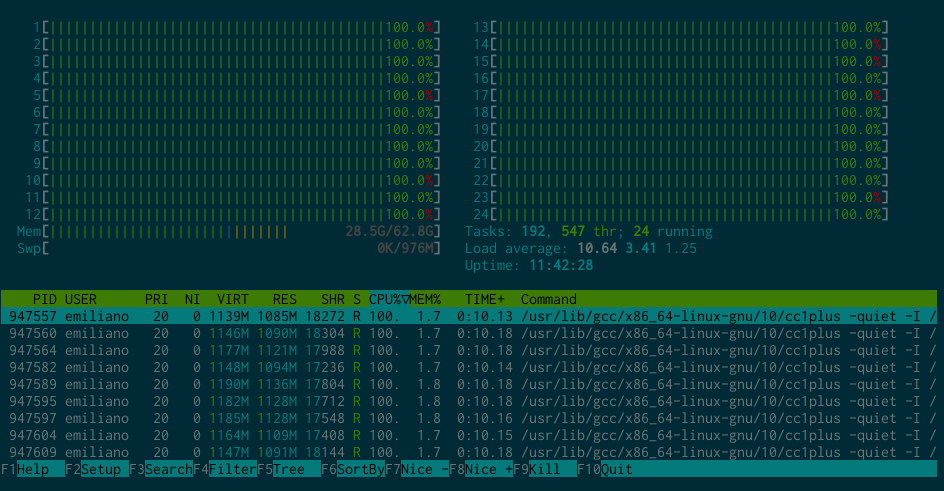
Same goes for things like the lintian testsuite. Since it's a very multi-threaded workload, it now takes less than 2 minutes to run; a 750% improvement. All this to say I'm happy with my purchase. And lo and behold I can now build ledger without a hitch, even though it maxes my 24 threads and uses 28GB of RAM. Who would've thought... Screen capture of htop showing how much resources ledger takes to build

  1. I managed to fry that PC's motherboard in 2016 and later replaced it with a brand new one. I also upgraded the storage along the way, from a very cheap cacheless 120GB SSD to a larger Samsung 850 EVO SATA drive.
  2. As it turns out, ledger is mostly written in C++ :)

9 June 2021

Enrico Zini: Ansible recurse and follow quirks

I'm reading Ansible's builtin.file sources for, uhm, reasons, and the use of follow stood out to my eyes. Reading on, not only that. I feel like the ansible codebase needs a serious review, at least in essential core modules like this one. In the file module documentation it says:
This flag indicates that filesystem links, if they exist, should be followed.
In the recursive_set_attributes implementation instead, follow means "follow symlinks to directories", but if a symlink to a file is found, it does not get followed, kind of. What happens is that ansible will try to change the mode of the symlink, which makes sense on some operating systems. And it does try to use lchmod if present. Buf if not, this happens:
# Attempt to set the perms of the symlink but be
# careful not to change the perms of the underlying
# file while trying
underlying_stat = os.stat(b_path)
os.chmod(b_path, mode)
new_underlying_stat = os.stat(b_path)
if underlying_stat.st_mode != new_underlying_stat.st_mode:
    os.chmod(b_path, stat.S_IMODE(underlying_stat.st_mode))
So it tries doing chmod on the symlink, and if that changed the mode of the actual file, switch it back. I would have appreciated a comment documenting on which systems a hack like this makes sense. As it is, it opens a very short time window in which a symlink attack can make a system file vulerable, and an exception thrown by the second stat will make it vulnerable permanently. What about follow following links during recursion: how does it avoid loops? I don't see a cache of (device, inode) pairs visited. Let's try:
fatal: [localhost]: FAILED! =>  "changed": false, "details": "maximum recursion depth exceeded", "gid": 1000, "group": "enrico", "mode": "0755", "msg": "mode must be in octal or symbolic form", "owner": "enrico", "path": "/tmp/test/test1", "size": 0, "state": "directory", "uid": 1000 
Ok, it, uhm, delegates handling that to the Python stack size. I guess it means that a ln -s .. foo in a directory that gets recursed will always fail the task. Fun! More quirks Turning a symlink into a hardlink is considered a noop if the symlink points to the same file:
---
- hosts: localhost
  tasks:
   - name: create test file
     file:
        path: /tmp/testfile
        state: touch
   - name: create test link
     file:
        path: /tmp/testlink
        state: link
        src: /tmp/testfile
   - name: turn it into a hard link
     file:
        path: /tmp/testlink
        state: hard
        src: /tmp/testfile
gives:
$ ansible-playbook test3.yaml
[WARNING]: provided hosts list is empty, only localhost is available. Note that the implicit localhost does not match 'all'
PLAY [localhost] ************************************************************************************************************************************************************************************************************
TASK [Gathering Facts] ******************************************************************************************************************************************************************************************************
ok: [localhost]
TASK [create test file] *****************************************************************************************************************************************************************************************************
changed: [localhost]
TASK [create test link] *****************************************************************************************************************************************************************************************************
changed: [localhost]
TASK [turn it into a hard link] *********************************************************************************************************************************************************************************************
ok: [localhost]
PLAY RECAP ******************************************************************************************************************************************************************************************************************
localhost                  : ok=4    changed=2    unreachable=0    failed=0    skipped=0    rescued=0    ignored=0
More quirks Converting a directory into a hardlink should work, but it doesn't because unlink is used instead of rmdir:
---
- hosts: localhost
  tasks:
   - name: create test dir
     file:
        path: /tmp/testdir
        state: directory
   - name: turn it into a symlink
     file:
        path: /tmp/testdir
        state: hard
        src: /tmp/
        force: yes
gives:
$ ansible-playbook test4.yaml
[WARNING]: provided hosts list is empty, only localhost is available. Note that the implicit localhost does not match 'all'
PLAY [localhost] ************************************************************************************************************************************************************************************************************
TASK [Gathering Facts] ******************************************************************************************************************************************************************************************************
ok: [localhost]
TASK [create test dir] ******************************************************************************************************************************************************************************************************
changed: [localhost]
TASK [turn it into a symlink] ***********************************************************************************************************************************************************************************************
fatal: [localhost]: FAILED! =>  "changed": false, "gid": 1000, "group": "enrico", "mode": "0755", "msg": "Error while replacing: [Errno 21] Is a directory: b'/tmp/testdir'", "owner": "enrico", "path": "/tmp/testdir", "size": 0, "state": "directory", "uid": 1000 
PLAY RECAP ******************************************************************************************************************************************************************************************************************
localhost                  : ok=2    changed=1    unreachable=0    failed=1    skipped=0    rescued=0    ignored=0
More quirks This is hard to test, but it looks like if source and destination are hardlinks to the same inode numbers, but on different filesystems, the operation is considered a successful noop: https://github.com/ansible/ansible/blob/devel/lib/ansible/modules/file.py#L821 It should probably be something like:
if (st1.st_dev, st1.st_ino) == (st2.st_dev, st2.st_ino):

8 June 2021

Jonathan Dowland: LaTeX draft documents

I'm writing up a PhD deliverable (which will show up here eventually) using LaTeX, which is my preferred tool for such things, since I also use it for papers, and will eventually be using it for my thesis itself. For this last document, I experimented with a few packages and techniques for organising the document which I found useful, so I thought I'd share them. What version is this anyway? I habitually store and develop my documents in git repositories. From time to time I generate a PDF and copy it off elsewhere to review (e.g., an iPad). Later on it can be useful to be able to figure out exactly what source built the PDF. I achieve this using
\newcommand \version \input "git describe --always --dirty" 
And \version\ somewhere in the header of the document. Draft mode The common document classes all accept a draft argument, to enable Draft Mode.
\documentclass[12pt,draft] article 
Various other packages behave differently if Draft Mode is enabled. The graphicx package, for example, doesn't actually draw pictures in draft mode, which I don't find useful. So for that package, I force it to behave as if we were in "Final Mode" at all times:
\usepackage[final] graphicx 
I want to also include some different bits and pieces in Draft Mode. Although the final version won't need it, I find having a Table of Contents very helpful during the writing process. The ifdraft package adds a convenience macro to query whether we are in draft or not. I use it like so:
\ifdraft 
This page will be cut from the final report.
\tableofcontents
\newpage
 
For this document, I have been given the section headings I must use and the number of pages each section must run to. When drafting, I want to include the page budget in the section names (e.g. Background (2 pages)). I also force new pages at the beginning of each Section, to make it easier to see how close I am to each section's page budget.
\ifdraft \newpage 
\section Work completed\ifdraft  (1 page)  % 1 Page
todonotes
Two TODO items in the margin Two TODO items in the margin
Collated TODOs in a list Collated TODOs in a list
The todonotes package package is one of many that offers macros to make managing in-line TODO notes easier. Within the source of my document, I can add a TODO right next to the relevant text with \todo something to do . In the document, by default, this is rendered in the right-hand margin. With the right argument, the package will only render the notes in draft mode.
\usepackage[textsize=small,obeyDraft] todonotes 
todonotes can also collate all the TODOs together into a single list. The list items are hyperlinked back to the page where the relevant item appears.
\ifdraft 
\newpage
\section TODO 
  This page will be cut from the final report.
  \listoftodos
 

7 June 2021

Russ Allbery: Review: Stoneskin

Review: Stoneskin, by K.B. Spangler
Series: Deep Witches #0
Publisher: A Girl and Her Fed Books
Copyright: September 2017
ASIN: B075PHK498
Format: Kindle
Pages: 226
Stoneskin is a prequel to the Deep Witches Trilogy, which is why I have it marked as book 0 of the series. Unlike most prequels, it was written and published before the series and there doesn't seem to be any reason not to read it first. Tembi Moon is an eight-year-old girl from the poor Marumaru area on the planet of Adhama. Humanity has spread to the stars and first terraformed the worlds and then bioformed themselves to live there. The differences are subtle, but Tembi's skin becomes thicker and less sensitive when damaged (either physically or emotionally) and she can close her ears against dust storms. One day, she wakes up in an unknown alley and finds herself on the world of Miha'ana, sixteen thousand light-years away, where she is rescued and brought home by a Witch named Matindi. In this science fiction future, nearly all interstellar travel is done through the Deep. The Deep is not like the typical hand-waved science fiction subspace, most notably in that it's alive. No one is entirely sure where it came from or what sort of creature it is. It sometimes manages to communicate in words, but abstract patterns with feelings attached are more common, and it only communicates with specific people. Those people are Witches, who are chosen by the Deep via some criteria no one understands. Witches can use the Deep to move themselves or anything else around the galaxy. All interstellar logistics rely on them. The basics of Tembi's story are not that unusual; she's been chosen by the Deep to be a Witch. What is remarkable is that she's young and she's poor, completely disconnected from the power structures of the galaxy. But, once chosen, her path as far as the rest of the galaxy is concerned is fixed: she will go to Lancaster to be trained as a Witch. Matindi is able to postpone this for a time by keeping an eye on her, but not forever. I bought this book because of the idea of the Deep, and that is indeed the best part of the book. There is a lot of mystery about its exact nature, most of which is not resolved in this book, but it mostly behaves like a giant and extremely strange dog, and it's awesome. Replacing the various pseudo-scientific explanations for faster than light travel with interactions with a dream-weird giant St. Bernard with too many paws that talks in swirls of colored bubbles and is very eager to please its friends is brilliant. This book covers a lot of years of Tembi's life and is, as advertised, a prelude to a story that is not resolved here. It's a coming of age story in which she does eventually end up at Lancaster, learns and chafes at the elaborate and very conservative structures humans have put in place to try to make interactions with the Deep predictable and reliable, and eventually gets drawn into the politics of war and the question of when people have a responsibility to intervene. Tembi, and the reader, also have many opportunities to get extremely upset at how the Deep is treated and how much entitlement the Witches have about their access and control, although how the Deep feels about it is left for a future book. Not all of this story is as good as the premise. There are some standard coming of age tropes that I'm not fond of, such as Tembi's predictable temporary falling out with the Deep (although the Deep's reaction is entertaining). It's also not at all a complete story, although that's clearly signaled by the subtitle. But as an introduction to the story universe and an extended bit of scene-setting, it accomplishes what it sets out to do. It's also satisfyingly thoughtful about the moral trade-offs around stability and the value of preserving institutions. I know which side I'm on within the universe, but I appreciated how much nuance and thoughtfulness Spangler puts into the contrary opinion. I'm hooked on the universe and want to learn more about the Deep, enough so that I've already bought the first book of the main trilogy. Followed by The Blackwing War. Rating: 7 out of 10

6 June 2021

Iustin Pop: Goodbye Travis, hello GitHub Actions

My very cyclical open-source work For some reason, I only manage to do coding at home every some months - mostly 6 months apart, so twice a year (even worse than my blogging frequency :P). As such, I missed the whole discussion about travis-ci (the .org version) going away, etc. So when I finally did some work on corydalis a few weeks ago, and had a travis build failure (restoring a large cache simply timed out, either travis or S3 has some hiccup - it cleared by itself a day later), I opened the travis-ci interface to see the scary banner ( travis-ci.org is shutting down ), and asked myself what s happening. The deadline was in less than a week even Long story short, Travis was a good home for many years, but they were bought and are doing significant changes to their OSS support, so it s time to move on. I anyway wanted to learn GitHub Actions for a while (ahem, free time intervened), so this was a good (forced) opportunity .

Proper composable CI The advantage of Travis infrastructure was that the build configuration was really simple. It had very few primitives: pre-steps (before_install), install steps, and the actual things to do to test, post-steps (after_sucess) and a few other small helpers (caching, apt packages, etc.) This made it really easy to just pick up and write a config, plus it had the advantage of allowing to test configs from the web UI without needing to push. This simplicity was unfortunately also its significant limiter: the way to do complex things in steps was simply to add more shell commands. GitHub actions, together with its marketplace, changes this entirely. There are no built-in actions, the language just defines the build/job/step hierarchy, and one glues together whatever steps they want. This has the disadvantage that even checking out the code needs to be explicitly written in all workflows (so boilerplate, if you don t need customisation), but it opens up a huge opportunity for composition, since it allows people to publish actions (steps) that you just import, encapsulating all the work. So, after learning how to write a moderately complicated workflow (complicated as in multiple Python version, some of them needing different OS version, and multi-OS), it was straightforward to port this to all my projects - just somewhat tedious. I ve now shutdown all builds on Travis, just can t find a way to delete my account

Better multi-OS, worse (missing) multi-arch In theory, Travis supports Linux, MacOS, FreeBSD and Windows, but I ve found that support for non-Linux is not quite as good. Maybe I missed things, but multi-version Python builds on MacOS were not as nicely supported as Linux; Windows is quite early, and very limited; and I haven t tested FreeBSD. GitHub is more restrictive - Linux, MacOS and Windows - but I found support for MacOS and Windows better for my use cases. If your use case is testing multiple MacOS versions, Travis wins, if it s more varied languages/etc. on the single available MacOS version, GitHub works better. On the multi-arch side, Travis wins hands-down. Four different native architectures, and enabling one more is just adding another key to the arch list. With GitHub, if I understand right, you either have to use docker+emulation, or use self-hosted runners. So here it really matters what is more important to you. Maybe in the future GitHub will support more arches, but right now, Travis wins for this use-case.

Summary For my specific use-case, GitHub Actions is a better fit right now. The marketplace has advantages (I ll explain better in a future post), the actions are a very nice way to encapsulate functionality, and it s still available/free (up to a limit) for open source projects. I don t know what the future of Travis for OSS will be, but all I heard so far is very concerning. However, I ll still miss a few things. For example, an overall dashboard for all my projects, like this one:
Travis dashboard Travis dashboard
I couldn t find any such thing on GitHub, so I just use my set of badges. Then cache management. Travis allows you to clear the cache, and it does auto-update the cache. GitHub caches are immutable once built, so you have to:
  • watch if changed dependencies/dependency chains result in things that are no longer cached;
  • if so, need to manually bump the cache key, resulting in a commit for purely administrative purposes.
For languages where you have a clean full chain of dependencies recorded (e.g. node s package-lock.json, stack s stack.yaml.lock), this is trivial to achieve, but gets complicated if you add OS dependencies, languages which don t record all this, etc. Hmm, maybe I should just embed the year/month in the cache name - cheating, but automated cheating. With all said and done, I think GHA is much less refined, but with more potential. Plus, the pace of innovation on Travis side was quite slow (likely money problems, hence them being bought, etc.) So one TODO done: learn GitHub Actions , even if a bit unplanned

Evgeni Golov: Controlling Somfy roller shutters using an ESP32 and ESPHome

Our house has solar powered, remote controllable roller shutters on the roof windows, built by the German company named HEIM & HAUS. However, when you look closely at the remote control or the shutter motor, you'll see another brand name: SIMU. As the shutters don't have any wiring inside the house, the only way to control them is via the remote interface. So let's go on the Internet and see how one can do that, shall we? ;) First thing we learn is that SIMU remote stuff is just re-branded Somfy. Great, another name! Looking further we find that Somfy uses some obscure protocol to prevent (replay) attacks (spoiler: it doesn't!) and there are tools for RTL-SDR and Arduino available. That's perfect! Always sniff with RTL-SDR first! Given the two re-brandings in the supply chain, I wasn't 100% sure our shutters really use the same protocol. So the first "hack" was to listen and decrypt the communication using RTL-SDR:
$ git clone https://github.com/dimhoff/radio_stuff
$ cd radio_stuff
$ make -C converters am_to_ook
$ make -C decoders decode_somfy
$ rtl_fm -M am -f 433.42M -s 270K   ./am_to_ook -d 10 -t 2000 -    ./decode_somfy
<press some buttons on the remote>
The output contains the buttons I pressed, but also the id of the remote and the command counter (which is supposed to prevent replay attacks). At this point I could just use the id and the counter to send own commands, but if I'd do that too often, the real remote would stop working, as its counter won't increase and the receiver will drop the commands when the counters differ too much. But that's good enough for now. I know I'm looking for the right protocol at the right frequency. As the end result should be an ESP32, let's move on! Acquiring the right hardware Contrary to an RTL-SDR, one usually does not have a spare ESP32 with 433MHz radio at home, so I went shopping: a NodeMCU-32S clone and a CC1101. The CC1101 is important as most 433MHz chips for Arduino/ESP only work at 433.92MHz, but Somfy uses 433.42MHz and using the wrong frequency would result in really bad reception. The CC1101 is essentially an SDR, as you can tune it to a huge spectrum of frequencies. Oh and we need some cables, a bread board, the usual stuff ;) The wiring is rather simple: ESP32 wiring for a CC1101 And the end result isn't too beautiful either, but it works: ESP32 and CC1101 in a simple case Acquiring the right software In my initial research I found an Arduino sketch and was totally prepared to port it to ESP32, but luckily somebody already did that for me! Even better, it's explicitly using the CC1101. Okay, okay, I cheated, I actually ordered the hardware after I found this port and the reference to CC1101. ;) As I am using ESPHome for my ESPs, the idea was to add a "Cover" that's controlling the shutters to it. Writing some C++, how hard can it be? Turns out, not that hard. You can see the code in my GitHub repo. It consists of two (relevant) files: somfy_cover.h and somfy.yaml. somfy_cover.h essentially wraps the communication with the Somfy_Remote_Lib library into an almost boilerplate Custom Cover for ESPHome. There is nothing too fancy in there. The only real difference to the "Custom Cover" example from the documentation is the split into SomfyESPRemote (which inherits from Component) and SomfyESPCover (which inherits from Cover) -- this is taken from the Custom Sensor documentation and allows me to define one "remote" that controls multiple "covers" using the add_cover function. The first two params of the function are the NVS name and key (think database table and row), and the third is the rolling code of the remote (stored in somfy_secrets.h, which is not in Git). In ESPHome a Cover shall define its properties as CoverTraits. Here we call set_is_assumed_state(true), as we don't know the state of the shutters - they could have been controlled using the other (real) remote - and setting this to true allows issuing open/close commands at all times. We also call set_supports_position(false) as we can't tell the shutters to move to a specific position. The one additional feature compared to a normal Cover interface is the program function, which allows to call the "program" command so that the shutters can learn a new remote. somfy.yaml is the ESPHome "configuration", which contains information about the used hardware, WiFi credentials etc. Again, mostly boilerplate. The interesting parts are the loading of the additional libraries and attaching the custom component with multiple covers and the additional PROG switches:
esphome:
  name: somfy
  platform: ESP32
  board: nodemcu-32s
  libraries:
    - SmartRC-CC1101-Driver-Lib@2.5.6
    - Somfy_Remote_Lib@0.4.0
    - EEPROM
  includes:
    - somfy_secrets.h
    - somfy_cover.h
 
cover:
  - platform: custom
    lambda:  -
      auto somfy_remote = new SomfyESPRemote();
      somfy_remote->add_cover("somfy", "badezimmer", SOMFY_REMOTE_BADEZIMMER);
      somfy_remote->add_cover("somfy", "kinderzimmer", SOMFY_REMOTE_KINDERZIMMER);
      App.register_component(somfy_remote);
      return somfy_remote->covers;
    covers:
      - id: "somfy"
        name: "Somfy Cover"
      - id: "somfy2"
        name: "Somfy Cover2"
switch:
  - platform: template
    name: "PROG"
    turn_on_action:
      - lambda:  -
          ((SomfyESPCover*)id(somfy))->program();
  - platform: template
    name: "PROG2"
    turn_on_action:
      - lambda:  -
          ((SomfyESPCover*)id(somfy2))->program();
The switch to trigger the program mode took me a bit. As the Cover interface of ESPHome does not offer any additional functions besides movement control, I first wrote code to trigger "program" when "stop" was pressed three times in a row, but that felt really cumbersome and also had the side effect that the remote would send more than needed, sometimes confusing the shutters. I then decided to have a separate button (well, switch) for that, but the compiler yelled at me I can't call program on a Cover as it does not have such a function. Turns out, you need to explicitly cast to SomfyESPCover and then it works, even if the code becomes really readable, NOT. Oh and as the switch does not have any code to actually change/report state, it effectively acts as a button that can be pressed. At this point we can just take an existing remote, press PROG for 5 seconds, see the blinds move shortly up and down a bit and press PROG on our new ESP32 remote and the shutters will learn the new remote. And thanks to the awesome integration of ESPHome into HomeAssistant, this instantly shows up as a new controllable cover there too. Future Additional Work I started writing this post about a year ago And the initial implementation had some room for improvement More than one remote The initial code only created one remote and one cover element. Sure, we could attach that to all shutters (there are 4 of them), but we really want to be able to control them separately. Thankfully I managed to read enough ESPHome docs, and learned how to operate std::vector to make the code dynamically accept new shutters. Using ESP32's NVS The ESP32 has a non-volatile key-value storage which is much nicer than throwing bits at an emulated EEPROM. The first library I used for that explicitly used EEPROM storage and it would have required quite some hacking to make it work with NVS. Thankfully the library I am using now has a plugable storage interface, and I could just write the NVS backend myself and upstream now supports that. Yay open-source! Remaining issues Real state is unknown As noted above, the ESP does not know the real state of the shutters: a command could have been lost in transmission (the Somfy protocol is send-only, there is no feedback) or the shutters might have been controlled by another remote. At least the second part could be solved by listening all the time and trying to decode commands heard over the air, but I don't think this is worth the time -- worst that can happen is that a closed (opened) shutter receives another close (open) command and that is harmless as they have integrated endstops and know that they should not move further. Can't program new remotes with ESP only To program new remotes, one has to press the "PROG" button for 5 seconds. This was not exposed in the old library, but the new one does support "long press", I just would need to add another ugly switch to the config and I currently don't plan to do so, as I do have working remotes for the case I need to learn a new one.

5 June 2021

Utkarsh Gupta: FOSS Activites in May 2021

Here s my (twentieth) monthly update about the activities I ve done in the F/L/OSS world.

Debian
This was my 29th month of actively contributing to Debian. I became a DM in late March 2019 and a DD on Christmas 19! \o/ Interesting month, surprisingly. Lots of things happening and lots of moving parts; becoming the new normal , I believe. Anyhow, working on Ubuntu full-time has its own advantage and one of them is being able to work on Debian stuff! So whilst I couldn t upload a lot of packages because of the freeze, here s what I worked on:

Uploads and bug fixes:

Other $things:
  • Mentoring for newcomers and assisting people in BSP.
  • Moderation of -project mailing list.

Ubuntu
This was my 4th month of actively contributing to Ubuntu. Now that I ve joined Canonical to work on Ubuntu full-time, there s a bunch of things I do! \o/ This month, by all means, was dedicated mostly to PHP 8.0, transitioning from PHP 7.4 to 8.0. Naturally, it had so many moving parts and moments of utmost frustration, shared w/ Bryce. :D So even though I can t upload anything, I worked on the following stuff & asked for sponsorship.
But before, I d like to take a moment to stress how kind and awesome Gianfranco Costamagna, a.k.a. LocutusOfBorg is! He s been sponsoring a bunch of my things & helping with re-triggers, et al. Thanks a bunch, Gianfranco; beers on me whenever we meet!

Merges:

Uploads & Syncs:

MIRs:

Seed Operations:

Debian (E)LTS
Debian Long Term Support (LTS) is a project to extend the lifetime of all Debian stable releases to (at least) 5 years. Debian LTS is not handled by the Debian security team, but by a separate group of volunteers and companies interested in making it a success. And Debian Extended LTS (ELTS) is its sister project, extending support to the Jessie release (+2 years after LTS support). This was my twentieth month as a Debian LTS and eleventh month as a Debian ELTS paid contributor.
I was assigned 29.75 hours for LTS and 40.00 hours for ELTS and worked on the following things:

LTS CVE Fixes and Announcements:

ELTS CVE Fixes and Announcements:

Other (E)LTS Work:
  • Front-desk duty from 24-05 until 30-05 for both LTS and ELTS.
  • Triaged rails, libimage-exiftool-perl, hivex, graphviz, glibc, libexosip2, impacket, node-ws, thunar, libgrss, nginx, postgresql-9.6, ffmpeg, composter, and curl.
  • Mark CVE-2019-9904/graphviz as ignored for stretch and jessie.
  • Mark CVE-2021-32029/postgresql-9.6 as not-affected for stretch.
  • Mark CVE-2020-24020/ffmpeg as not-affected for stretch.
  • Mark CVE-2020-22020/ffmpeg as postponed for stretch.
  • Mark CVE-2020-22015/ffmpeg as ignored for stretch.
  • Mark CVE-2020-21041/ffmpeg as postponed for stretch.
  • Mark CVE-2021-33574/glibc as no-dsa for stretch & jessie.
  • Mark CVE-2021-31800/impacket as no-dsa for stretch.
  • Mark CVE-2021-32611/libexosip2 as no-dsa for stretch.
  • Mark CVE-2016-20011/libgrss as ignored for stretch.
  • Mark CVE-2021-32640/node-ws as no-dsa for stretch.
  • Mark CVE-2021-32563/thunar as no-dsa for stretch.
  • [LTS] Help test and review bind9 update for Emilio.
  • [LTS] Suggest and add DEP8 tests for bind9 for stretch.
  • [LTS] Sponsored upload of htmldoc to buster for Havard as a consequence of #988289.
  • [ELTS] Fix triage order for jetty and graphviz.
  • [ELTS] Raise issue upstream about cloud-init; mock tests instead.
  • [ELTS] Write to private ELTS list about triage ordering.
  • [ELTS] Review Emilio s new script and write back feedback, mentioning extra file created, et al.
  • [ELTS/LTS] Raise upgrade problems from LTS -> LTS+1 to the list. Thread here.
    • Further help review and raise problems that could occur, et al.
  • [LTS] Help explain path forward for firmware-nonfree update to Ola. Thread here.
  • [ELTS] Revert entries of TEMP-0000000-16B7E7 and TEMP-0000000-1C4729; CVEs assigned & fix ELTS tracker build.
  • Auto EOL ed linux, libgrss, node-ws, and inspircd for jessie.
  • Attended monthly Debian LTS meeting, which didn t happen, heh.
  • Answered questions (& discussions) on IRC (#debian-lts and #debian-elts).
  • General and other discussions on LTS private and public mailing list.

Until next time.
:wq for today.

4 June 2021

Matthew Garrett: Mike Lindell's Cyber "Evidence"

Mike Lindell, notable for absolutely nothing relevant in this field, today filed a lawsuit against a couple of voting machine manufacturers in response to them suing him for defamation after he claimed that they were covering up hacks that had altered the course of the US election. Paragraph 104 of his suit asserts that he has evidence of at least 20 documented hacks, including the number of votes that were changed. The citation is just a link to a video called Absolute 9-0, which claims to present sufficient evidence that the US supreme court will come to a 9-0 decision that the election was tampered with.

The claim is that Lindell was provided with a set of files on the 9th of January, and gave these to some cyber experts to verify. These experts identified them as packet captures. The video contains scrolling hex, and we are told that this is the raw encrypted data from the files. In reality, the hex values correspond very clearly to printable ASCII, and appear to just be the Pennsylvania voter roll. They're not encrypted, and they're not packet captures (they contain no packet headers).

20 of these packet captures were then selected and analysed, giving us the tables contained within Exhibit 12. The alleged source IPs appear to correspond to the networks the tables claim, and the latitude and longitude presumably just come from a geoip lookup of some sort (although clearly those values are far too precise to be accurate). But if we look at the target IPs, we find something interesting. Most of them resolve to the website for the county that was the nominal target (eg, 198.108.253.104 is www.deltacountymi.org). So, we're supposed to believe that in many cases, the county voting infrastructure was hosted on the county website.

Unfortunately we're not given the destination port, but 198.108.253.104 isn't listening on anything other than 80 and 443. We're told that the packet data is encrypted, so presumably it's over HTTPS. So, uh, how did they decrypt this to figure out how many votes were switched? If Mike's hackers have broken TLS, they really don't need to be dealing with this.

We're also given some background information on how it's impossible to reconstruct packet captures after the fact (untrue), or that modifying them would change their hashes (true, but in the absence of known good hash values that tells us nothing), but it's pretty clear that nothing we're shown actually demonstrates what we're told it does.

In summary: yes, any supreme court decision on this would be 9-0, just not the way he's hoping for.

Update: It was pointed out that this data appears to be part of a larger dataset. This one is even more dubious - it somehow has MAC addresses for both the source and destination (which is impossible), and almost none of these addresses are in actual issued ranges.

comment count unavailable comments

3 June 2021

Jonathan McDowell: Digging into Kubernetes containers

Having build a single node Kubernetes cluster and had a poke at what it s doing in terms of networking the next thing I want to do is figure out what it s doing in terms of containers. You might argue this should have come before networking, but to me the networking piece is more non-standard than the container piece, so I wanted to understand that first. Let s start with a process listing on the host. ps faxno user,stat,cmd There are a number of processes from the host kernel we don t care about:
kernel processes
    USER STAT CMD
       0 S    [kthreadd]
       0 I<    \_ [rcu_gp]
       0 I<    \_ [rcu_par_gp]
       0 I<    \_ [kworker/0:0H-events_highpri]
       0 I<    \_ [mm_percpu_wq]
       0 S     \_ [rcu_tasks_rude_]
       0 S     \_ [rcu_tasks_trace]
       0 S     \_ [ksoftirqd/0]
       0 I     \_ [rcu_sched]
       0 S     \_ [migration/0]
       0 S     \_ [cpuhp/0]
       0 S     \_ [cpuhp/1]
       0 S     \_ [migration/1]
       0 S     \_ [ksoftirqd/1]
       0 I<    \_ [kworker/1:0H-kblockd]
       0 S     \_ [cpuhp/2]
       0 S     \_ [migration/2]
       0 S     \_ [ksoftirqd/2]
       0 I<    \_ [kworker/2:0H-events_highpri]
       0 S     \_ [cpuhp/3]
       0 S     \_ [migration/3]
       0 S     \_ [ksoftirqd/3]
       0 I<    \_ [kworker/3:0H-kblockd]
       0 S     \_ [kdevtmpfs]
       0 I<    \_ [netns]
       0 S     \_ [kauditd]
       0 S     \_ [khungtaskd]
       0 S     \_ [oom_reaper]
       0 I<    \_ [writeback]
       0 S     \_ [kcompactd0]
       0 SN    \_ [ksmd]
       0 SN    \_ [khugepaged]
       0 I<    \_ [kintegrityd]
       0 I<    \_ [kblockd]
       0 I<    \_ [blkcg_punt_bio]
       0 I<    \_ [edac-poller]
       0 I<    \_ [devfreq_wq]
       0 I<    \_ [kworker/0:1H-kblockd]
       0 S     \_ [kswapd0]
       0 I<    \_ [kthrotld]
       0 I<    \_ [acpi_thermal_pm]
       0 I<    \_ [ipv6_addrconf]
       0 I<    \_ [kstrp]
       0 I<    \_ [zswap-shrink]
       0 I<    \_ [kworker/u9:0-hci0]
       0 I<    \_ [kworker/2:1H-kblockd]
       0 I<    \_ [ata_sff]
       0 I<    \_ [sdhci]
       0 S     \_ [irq/39-mmc0]
       0 I<    \_ [sdhci]
       0 S     \_ [irq/42-mmc1]
       0 S     \_ [scsi_eh_0]
       0 I<    \_ [scsi_tmf_0]
       0 S     \_ [scsi_eh_1]
       0 I<    \_ [scsi_tmf_1]
       0 I<    \_ [kworker/1:1H-kblockd]
       0 I<    \_ [kworker/3:1H-kblockd]
       0 S     \_ [jbd2/sda5-8]
       0 I<    \_ [ext4-rsv-conver]
       0 S     \_ [watchdogd]
       0 S     \_ [scsi_eh_2]
       0 I<    \_ [scsi_tmf_2]
       0 S     \_ [usb-storage]
       0 I<    \_ [cfg80211]
       0 S     \_ [irq/130-mei_me]
       0 I<    \_ [cryptd]
       0 I<    \_ [uas]
       0 S     \_ [irq/131-iwlwifi]
       0 S     \_ [card0-crtc0]
       0 S     \_ [card0-crtc1]
       0 S     \_ [card0-crtc2]
       0 I<    \_ [kworker/u9:2-hci0]
       0 I     \_ [kworker/3:0-events]
       0 I     \_ [kworker/2:0-events]
       0 I     \_ [kworker/1:0-events_power_efficient]
       0 I     \_ [kworker/3:2-events]
       0 I     \_ [kworker/1:1]
       0 I     \_ [kworker/u8:1-events_unbound]
       0 I     \_ [kworker/0:2-events]
       0 I     \_ [kworker/2:2]
       0 I     \_ [kworker/u8:0-events_unbound]
       0 I     \_ [kworker/0:1-events]
       0 I     \_ [kworker/0:0-events]
There are various basic host processes, including my SSH connections, and Docker. I note it s using containerd. We also see kubelet, the Kubernetes node agent.
host processes
    USER STAT CMD
       0 Ss   /sbin/init
       0 Ss   /lib/systemd/systemd-journald
       0 Ss   /lib/systemd/systemd-udevd
     101 Ssl  /lib/systemd/systemd-timesyncd
       0 Ssl  /sbin/dhclient -4 -v -i -pf /run/dhclient.enx00e04c6851de.pid -lf /var/lib/dhcp/dhclient.enx00e04c6851de.leases -I -df /var/lib/dhcp/dhclient6.enx00e04c6851de.leases enx00e04c6851de
       0 Ss   /usr/sbin/cron -f
     104 Ss   /usr/bin/dbus-daemon --system --address=systemd: --nofork --nopidfile --systemd-activation --syslog-only
       0 Ssl  /usr/sbin/dockerd -H fd://
       0 Ssl  /usr/sbin/rsyslogd -n -iNONE
       0 Ss   /usr/sbin/smartd -n
       0 Ss   /lib/systemd/systemd-logind
       0 Ssl  /usr/bin/containerd
       0 Ss+  /sbin/agetty -o -p -- \u --noclear tty1 linux
       0 Ss   sshd: /usr/sbin/sshd -D [listener] 0 of 10-100 startups
       0 Ss    \_ sshd: root@pts/1
       0 Ss        \_ -bash
       0 R+            \_ ps faxno user,stat,cmd
       0 Ss    \_ sshd: noodles [priv]
    1000 S         \_ sshd: noodles@pts/0
    1000 Ss+           \_ -bash
       0 Ss   /lib/systemd/systemd --user
       0 S     \_ (sd-pam)
    1000 Ss   /lib/systemd/systemd --user
    1000 S     \_ (sd-pam)
       0 Ssl  /usr/bin/kubelet --bootstrap-kubeconfig=/etc/kubernetes/bootstrap-kubelet.conf --kubeconfig=/etc/kubernetes/kubelet.conf --config=/var/lib/kubelet/config.yaml --network-plugin=cni --pod-infra-container-image=k8s.gcr.io/pause:3.4.1
And that just leaves a bunch of container related processes:
container processes
       0 Sl   /usr/bin/containerd-shim-runc-v2 -namespace moby -id fd95c597ff3171ff110b7bf440229e76c5108d5d93be75ffeab54869df734413 -address /run/containerd/containerd.sock
       0 Ss    \_ /pause
       0 Sl   /usr/bin/containerd-shim-runc-v2 -namespace moby -id c2ff2c50f0bc052feda2281741c4f37df7905e3b819294ec645148ae13c3fe1b -address /run/containerd/containerd.sock
       0 Ss    \_ /pause
       0 Sl   /usr/bin/containerd-shim-runc-v2 -namespace moby -id 589c1545d9e0cdf8ea391745c54c8f4db49f5f437b1a2e448e7744b2c12f8856 -address /run/containerd/containerd.sock
       0 Ss    \_ /pause
       0 Sl   /usr/bin/containerd-shim-runc-v2 -namespace moby -id 6f417fd8a8c573a2b8f792af08cdcd7ce663457f0f7218c8d55afa3732e6ee94 -address /run/containerd/containerd.sock
       0 Ss    \_ /pause
       0 Sl   /usr/bin/containerd-shim-runc-v2 -namespace moby -id afa9798c9f663b21df8f38d9634469e6b4db0984124547cd472a7789c61ef752 -address /run/containerd/containerd.sock
       0 Ssl   \_ kube-scheduler --authentication-kubeconfig=/etc/kubernetes/scheduler.conf --authorization-kubeconfig=/etc/kubernetes/scheduler.conf --bind-address=127.0.0.1 --kubeconfig=/etc/kubernetes/scheduler.conf --leader-elect=true --port=0
       0 Sl   /usr/bin/containerd-shim-runc-v2 -namespace moby -id 4b3708b62f4d427690f5979848c59fce522dab6c62a9c53b806ffbaef3f88e62 -address /run/containerd/containerd.sock
       0 Ssl   \_ kube-controller-manager --authentication-kubeconfig=/etc/kubernetes/controller-manager.conf --authorization-kubeconfig=/etc/kubernetes/controller-manager.conf --bind-address=127.0.0.1 --client-ca-file=/etc/kubernetes/pki/ca.crt --cluster-name=kubernetes --cluster-signing-cert-file=/etc/kubernetes/pki/ca.crt --cluster-signing-key-file=/etc/kubernetes/pki/ca.key --controllers=*,bootstrapsigner,tokencleaner --kubeconfig=/etc/kubernetes/controller-manager.conf --leader-elect=true --port=0 --requestheader-client-ca-file=/etc/kubernetes/pki/front-proxy-ca.crt --root-ca-file=/etc/kubernetes/pki/ca.crt --service-account-private-key-file=/etc/kubernetes/pki/sa.key --use-service-account-credentials=true
       0 Sl   /usr/bin/containerd-shim-runc-v2 -namespace moby -id 89f35bf7a825eb97db7035d29aa475a3a1c8aaccda0860a46388a3a923cd10bc -address /run/containerd/containerd.sock
       0 Ssl   \_ kube-apiserver --advertise-address=192.168.53.147 --allow-privileged=true --authorization-mode=Node,RBAC --client-ca-file=/etc/kubernetes/pki/ca.crt --enable-admission-plugins=NodeRestriction --enable-bootstrap-token-auth=true --etcd-cafile=/etc/kubernetes/pki/etcd/ca.crt --etcd-certfile=/etc/kubernetes/pki/apiserver-etcd-client.crt --etcd-keyfile=/etc/kubernetes/pki/apiserver-etcd-client.key --etcd-servers=https://127.0.0.1:2379 --insecure-port=0 --kubelet-client-certificate=/etc/kubernetes/pki/apiserver-kubelet-client.crt --kubelet-client-key=/etc/kubernetes/pki/apiserver-kubelet-client.key --kubelet-preferred-address-types=InternalIP,ExternalIP,Hostname --proxy-client-cert-file=/etc/kubernetes/pki/front-proxy-client.crt --proxy-client-key-file=/etc/kubernetes/pki/front-proxy-client.key --requestheader-allowed-names=front-proxy-client --requestheader-client-ca-file=/etc/kubernetes/pki/front-proxy-ca.crt --requestheader-extra-headers-prefix=X-Remote-Extra- --requestheader-group-headers=X-Remote-Group --requestheader-username-headers=X-Remote-User --secure-port=6443 --service-account-issuer=https://kubernetes.default.svc.cluster.local --service-account-key-file=/etc/kubernetes/pki/sa.pub --service-account-signing-key-file=/etc/kubernetes/pki/sa.key --service-cluster-ip-range=10.96.0.0/12 --tls-cert-file=/etc/kubernetes/pki/apiserver.crt --tls-private-key-file=/etc/kubernetes/pki/apiserver.key
       0 Sl   /usr/bin/containerd-shim-runc-v2 -namespace moby -id 2dabff6e4f59c96d931d95781d28314065b46d0e6f07f8c65dc52aa465f69456 -address /run/containerd/containerd.sock
       0 Ssl   \_ etcd --advertise-client-urls=https://192.168.53.147:2379 --cert-file=/etc/kubernetes/pki/etcd/server.crt --client-cert-auth=true --data-dir=/var/lib/etcd --initial-advertise-peer-urls=https://192.168.53.147:2380 --initial-cluster=udon=https://192.168.53.147:2380 --key-file=/etc/kubernetes/pki/etcd/server.key --listen-client-urls=https://127.0.0.1:2379,https://192.168.53.147:2379 --listen-metrics-urls=http://127.0.0.1:2381 --listen-peer-urls=https://192.168.53.147:2380 --name=udon --peer-cert-file=/etc/kubernetes/pki/etcd/peer.crt --peer-client-cert-auth=true --peer-key-file=/etc/kubernetes/pki/etcd/peer.key --peer-trusted-ca-file=/etc/kubernetes/pki/etcd/ca.crt --snapshot-count=10000 --trusted-ca-file=/etc/kubernetes/pki/etcd/ca.crt
       0 Sl   /usr/bin/containerd-shim-runc-v2 -namespace moby -id 73fae81715b670255b66419a7959798b287be7bbb41e96f8b711fa529aa02f0d -address /run/containerd/containerd.sock
       0 Ss    \_ /pause
       0 Sl   /usr/bin/containerd-shim-runc-v2 -namespace moby -id 26d92a720c560caaa5f8a0217bc98e486b1c032af6c7c5d75df508021d462878 -address /run/containerd/containerd.sock
       0 Ssl   \_ /usr/local/bin/kube-proxy --config=/var/lib/kube-proxy/config.conf --hostname-override=udon
       0 Sl   /usr/bin/containerd-shim-runc-v2 -namespace moby -id 7104f65b5d92a56a2df93514ed0a78cfd1090ca47b6ce4e0badc43be6c6c538e -address /run/containerd/containerd.sock
       0 Ss    \_ /pause
       0 Sl   /usr/bin/containerd-shim-runc-v2 -namespace moby -id 48d735f7f44e3944851563f03f32c60811f81409e7378641404035dffd8c1eb4 -address /run/containerd/containerd.sock
       0 Ssl   \_ /usr/bin/weave-npc
       0 S<        \_ /usr/sbin/ulogd -v
       0 Sl   /usr/bin/containerd-shim-runc-v2 -namespace moby -id 36b418e69ae7076fe5a44d16cef223d8908016474cb65910f2fd54cca470566b -address /run/containerd/containerd.sock
       0 Ss    \_ /bin/sh /home/weave/launch.sh
       0 Sl        \_ /home/weave/weaver --port=6783 --datapath=datapath --name=12:82:8f:ed:c7:bf --http-addr=127.0.0.1:6784 --metrics-addr=0.0.0.0:6782 --docker-api= --no-dns --db-prefix=/weavedb/weave-net --ipalloc-range=192.168.0.0/24 --nickname=udon --ipalloc-init consensus=0 --conn-limit=200 --expect-npc --no-masq-local
       0 Sl        \_ /home/weave/kube-utils -run-reclaim-daemon -node-name=udon -peer-name=12:82:8f:ed:c7:bf -log-level=debug
       0 Sl   /usr/bin/containerd-shim-runc-v2 -namespace moby -id 534c0a698478599277482d97a137fab8ef4d62db8a8a5cf011b4bead28246f70 -address /run/containerd/containerd.sock
       0 Ss    \_ /pause
       0 Sl   /usr/bin/containerd-shim-runc-v2 -namespace moby -id 9ffd6b668ddfbf3c64c6783bc6f4f6cc9e92bfb16c83fb214c2cbb4044993bf0 -address /run/containerd/containerd.sock
       0 Ss    \_ /pause
       0 Sl   /usr/bin/containerd-shim-runc-v2 -namespace moby -id 4a30785f91873a7e6a191e86928a789760a054e4fa6dcd7048a059b42cf19edf -address /run/containerd/containerd.sock
       0 Ssl   \_ /coredns -conf /etc/coredns/Corefile
       0 Sl   /usr/bin/containerd-shim-runc-v2 -namespace moby -id 649a507d45831aca1de5231b49afc8ff37d90add813e7ecd451d12eedd785b0c -address /run/containerd/containerd.sock
       0 Ssl   \_ /coredns -conf /etc/coredns/Corefile
       0 Sl   /usr/bin/containerd-shim-runc-v2 -namespace moby -id 62b369de8d8cece4d33ec9fda4d23a9718379a8df8b30173d68f20bff830fed2 -address /run/containerd/containerd.sock
       0 Ss    \_ /pause
       0 Sl   /usr/bin/containerd-shim-runc-v2 -namespace moby -id 7cbb177bee18dbdeed21fb90e74378e2081436ad5bf116b36ad5077fe382df30 -address /run/containerd/containerd.sock
       0 Ss    \_ /bin/bash /usr/local/bin/run.sh
       0 S         \_ nginx: master process nginx -g daemon off;
   65534 S             \_ nginx: worker process
       0 Ss   /lib/systemd/systemd --user
       0 S     \_ (sd-pam)
       0 Sl   /usr/bin/containerd-shim-runc-v2 -namespace moby -id 6669168db70db4e6c741e8a047942af06dd745fae4d594291d1d6e1077b05082 -address /run/containerd/containerd.sock
       0 Ss    \_ /pause
       0 Sl   /usr/bin/containerd-shim-runc-v2 -namespace moby -id d5fa78fa31f11a4c5fb9fd2e853a00f0e60e414a7bce2e0d8fcd1f6ab2b30074 -address /run/containerd/containerd.sock
     101 Ss    \_ /usr/bin/dumb-init -- /nginx-ingress-controller --publish-service=ingress-nginx/ingress-nginx-controller --election-id=ingress-controller-leader --ingress-class=nginx --configmap=ingress-nginx/ingress-nginx-controller --validating-webhook=:8443 --validating-webhook-certificate=/usr/local/certificates/cert --validating-webhook-key=/usr/local/certificates/key
     101 Ssl       \_ /nginx-ingress-controller --publish-service=ingress-nginx/ingress-nginx-controller --election-id=ingress-controller-leader --ingress-class=nginx --configmap=ingress-nginx/ingress-nginx-controller --validating-webhook=:8443 --validating-webhook-certificate=/usr/local/certificates/cert --validating-webhook-key=/usr/local/certificates/key
     101 S             \_ nginx: master process /usr/local/nginx/sbin/nginx -c /etc/nginx/nginx.conf
     101 Sl                \_ nginx: worker process
     101 Sl                \_ nginx: worker process
     101 Sl                \_ nginx: worker process
     101 Sl                \_ nginx: worker process
     101 S                 \_ nginx: cache manager process
There s a lot going on there. Some bits are obvious; we can see the nginx ingress controller, our echoserver (the other nginx process hanging off /usr/local/bin/run.sh), and some things that look related to weave. The rest appears to be Kubernete s related infrastructure. kube-scheduler, kube-controller-manager, kube-apiserver, kube-proxy all look like core Kubernetes bits. etcd is a distributed, reliable key-value store. coredns is a DNS server, with plugins for Kubernetes and etcd. What does Docker claim is happening?
docker ps
CONTAINER ID   IMAGE                                 COMMAND                  CREATED      STATUS      PORTS     NAMES
d5fa78fa31f1   k8s.gcr.io/ingress-nginx/controller   "/usr/bin/dumb-init  "   3 days ago   Up 3 days             k8s_controller_ingress-nginx-controller-5b74bc9868-bczdr_ingress-nginx_4d7d3d81-a769-4de9-a4fb-04763b7c1605_0
6669168db70d   k8s.gcr.io/pause:3.4.1                "/pause"                 3 days ago   Up 3 days             k8s_POD_ingress-nginx-controller-5b74bc9868-bczdr_ingress-nginx_4d7d3d81-a769-4de9-a4fb-04763b7c1605_0
7cbb177bee18   k8s.gcr.io/echoserver                 "/usr/local/bin/run. "   3 days ago   Up 3 days             k8s_echoserver_hello-node-59bffcc9fd-8hkgb_default_c7111c9e-7131-40e0-876d-be89d5ca1812_0
62b369de8d8c   k8s.gcr.io/pause:3.4.1                "/pause"                 3 days ago   Up 3 days             k8s_POD_hello-node-59bffcc9fd-8hkgb_default_c7111c9e-7131-40e0-876d-be89d5ca1812_0
649a507d4583   296a6d5035e2                          "/coredns -conf /etc "   4 days ago   Up 4 days             k8s_coredns_coredns-558bd4d5db-flrfq_kube-system_f8b2b52e-6673-4966-82b1-3fbe052a0297_0
4a30785f9187   296a6d5035e2                          "/coredns -conf /etc "   4 days ago   Up 4 days             k8s_coredns_coredns-558bd4d5db-4nvrg_kube-system_1976f4d6-647c-45ca-b268-95f071f064d5_0
9ffd6b668ddf   k8s.gcr.io/pause:3.4.1                "/pause"                 4 days ago   Up 4 days             k8s_POD_coredns-558bd4d5db-flrfq_kube-system_f8b2b52e-6673-4966-82b1-3fbe052a0297_0
534c0a698478   k8s.gcr.io/pause:3.4.1                "/pause"                 4 days ago   Up 4 days             k8s_POD_coredns-558bd4d5db-4nvrg_kube-system_1976f4d6-647c-45ca-b268-95f071f064d5_0
36b418e69ae7   df29c0a4002c                          "/home/weave/launch. "   4 days ago   Up 4 days             k8s_weave_weave-net-mchmg_kube-system_b9af9615-8cde-4a18-8555-6da1f51b7136_1
48d735f7f44e   weaveworks/weave-npc                  "/usr/bin/launch.sh"     4 days ago   Up 4 days             k8s_weave-npc_weave-net-mchmg_kube-system_b9af9615-8cde-4a18-8555-6da1f51b7136_0
7104f65b5d92   k8s.gcr.io/pause:3.4.1                "/pause"                 4 days ago   Up 4 days             k8s_POD_weave-net-mchmg_kube-system_b9af9615-8cde-4a18-8555-6da1f51b7136_0
26d92a720c56   4359e752b596                          "/usr/local/bin/kube "   4 days ago   Up 4 days             k8s_kube-proxy_kube-proxy-6d8kg_kube-system_8bf2d7ec-4850-427f-860f-465a9ff84841_0
73fae81715b6   k8s.gcr.io/pause:3.4.1                "/pause"                 4 days ago   Up 4 days             k8s_POD_kube-proxy-6d8kg_kube-system_8bf2d7ec-4850-427f-860f-465a9ff84841_0
89f35bf7a825   771ffcf9ca63                          "kube-apiserver --ad "   4 days ago   Up 4 days             k8s_kube-apiserver_kube-apiserver-udon_kube-system_1af8c5f362b7b02269f4d244cb0e6fbf_0
afa9798c9f66   a4183b88f6e6                          "kube-scheduler --au "   4 days ago   Up 4 days             k8s_kube-scheduler_kube-scheduler-udon_kube-system_629dc49dfd9f7446eb681f1dcffe6d74_0
2dabff6e4f59   0369cf4303ff                          "etcd --advertise-cl "   4 days ago   Up 4 days             k8s_etcd_etcd-udon_kube-system_c2a3008c1d9895f171cd394e38656ea0_0
4b3708b62f4d   e16544fd47b0                          "kube-controller-man "   4 days ago   Up 4 days             k8s_kube-controller-manager_kube-controller-manager-udon_kube-system_1d1b9018c3c6e7aa2e803c6e9ccd2eab_0
fd95c597ff31   k8s.gcr.io/pause:3.4.1                "/pause"                 4 days ago   Up 4 days             k8s_POD_kube-scheduler-udon_kube-system_629dc49dfd9f7446eb681f1dcffe6d74_0
589c1545d9e0   k8s.gcr.io/pause:3.4.1                "/pause"                 4 days ago   Up 4 days             k8s_POD_kube-controller-manager-udon_kube-system_1d1b9018c3c6e7aa2e803c6e9ccd2eab_0
6f417fd8a8c5   k8s.gcr.io/pause:3.4.1                "/pause"                 4 days ago   Up 4 days             k8s_POD_kube-apiserver-udon_kube-system_1af8c5f362b7b02269f4d244cb0e6fbf_0
c2ff2c50f0bc   k8s.gcr.io/pause:3.4.1                "/pause"                 4 days ago   Up 4 days             k8s_POD_etcd-udon_kube-system_c2a3008c1d9895f171cd394e38656ea0_0
Ok, that s interesting. Before we dig into it, what does Kubernetes say? (I ve trimmed the RESTARTS + AGE columns to make things fit a bit better here; they weren t interesting).
noodles@udon:~$ kubectl get pods --all-namespaces
NAMESPACE       NAME                                        READY   STATUS
default         hello-node-59bffcc9fd-8hkgb                 1/1     Running
ingress-nginx   ingress-nginx-admission-create-8jgkt        0/1     Completed
ingress-nginx   ingress-nginx-admission-patch-jdq4t         0/1     Completed
ingress-nginx   ingress-nginx-controller-5b74bc9868-bczdr   1/1     Running
kube-system     coredns-558bd4d5db-4nvrg                    1/1     Running
kube-system     coredns-558bd4d5db-flrfq                    1/1     Running
kube-system     etcd-udon                                   1/1     Running
kube-system     kube-apiserver-udon                         1/1     Running
kube-system     kube-controller-manager-udon                1/1     Running
kube-system     kube-proxy-6d8kg                            1/1     Running
kube-system     kube-scheduler-udon                         1/1     Running
kube-system     weave-net-mchmg                             2/2     Running
So there are a lot more Docker instances running than Kubernetes pods. What s happening there? Well, it turns out that Kubernetes builds pods from multiple different Docker instances. If you think of a traditional container as being comprised of a set of namespaces (process, network, hostname etc) and a cgroup then a pod is made up of the namespaces and then each docker instance within that pod has it s own cgroup. Ian Lewis has a much deeper discussion in What are Kubernetes Pods Anyway?, but my takeaway is that a pod is a set of sort-of containers that are coupled. We can see this more clearly if we ask systemd for the cgroup breakdown:
systemd-cgls
Control group /:
-.slice
 user.slice 
   user-0.slice 
     session-29.scope 
        515899 sshd: root@pts/1
        515913 -bash
       3519743 systemd-cgls
       3519744 cat
     user@0.service  
       init.scope 
         515902 /lib/systemd/systemd --user
         515903 (sd-pam)
   user-1000.slice 
     user@1000.service  
       init.scope 
         2564011 /lib/systemd/systemd --user
         2564012 (sd-pam)
     session-110.scope 
       2564007 sshd: noodles [priv]
       2564040 sshd: noodles@pts/0
       2564041 -bash
 init.scope 
   1 /sbin/init
 system.slice 
   containerd.service  
       21383 /usr/bin/containerd-shim-runc-v2 -namespace moby -id fd95c597ff31 
       21408 /usr/bin/containerd-shim-runc-v2 -namespace moby -id c2ff2c50f0bc 
       21432 /usr/bin/containerd-shim-runc-v2 -namespace moby -id 589c1545d9e0 
       21459 /usr/bin/containerd-shim-runc-v2 -namespace moby -id 6f417fd8a8c5 
       21582 /usr/bin/containerd-shim-runc-v2 -namespace moby -id afa9798c9f66 
       21607 /usr/bin/containerd-shim-runc-v2 -namespace moby -id 4b3708b62f4d 
       21640 /usr/bin/containerd-shim-runc-v2 -namespace moby -id 89f35bf7a825 
       21648 /usr/bin/containerd-shim-runc-v2 -namespace moby -id 2dabff6e4f59 
       22343 /usr/bin/containerd-shim-runc-v2 -namespace moby -id 73fae81715b6 
       22391 /usr/bin/containerd-shim-runc-v2 -namespace moby -id 26d92a720c56 
       26992 /usr/bin/containerd-shim-runc-v2 -namespace moby -id 7104f65b5d92 
       27405 /usr/bin/containerd-shim-runc-v2 -namespace moby -id 48d735f7f44e 
       27531 /usr/bin/containerd-shim-runc-v2 -namespace moby -id 36b418e69ae7 
       27941 /usr/bin/containerd-shim-runc-v2 -namespace moby -id 534c0a698478 
       27960 /usr/bin/containerd-shim-runc-v2 -namespace moby -id 9ffd6b668ddf 
       28131 /usr/bin/containerd-shim-runc-v2 -namespace moby -id 4a30785f9187 
       28159 /usr/bin/containerd-shim-runc-v2 -namespace moby -id 649a507d4583 
      514667 /usr/bin/containerd-shim-runc-v2 -namespace moby -id 62b369de8d8c 
      514976 /usr/bin/containerd-shim-runc-v2 -namespace moby -id 7cbb177bee18 
      698904 /usr/bin/containerd-shim-runc-v2 -namespace moby -id 6669168db70d 
      699284 /usr/bin/containerd-shim-runc-v2 -namespace moby -id d5fa78fa31f1 
     2805479 /usr/bin/containerd
   systemd-udevd.service 
     2805502 /lib/systemd/systemd-udevd
   cron.service 
     2805474 /usr/sbin/cron -f
   docker.service  
     528 /usr/sbin/dockerd -H fd://
   kubelet.service 
     2805501 /usr/bin/kubelet --bootstrap-kubeconfig=/etc/kubernetes/bootstrap 
   systemd-journald.service 
     2805505 /lib/systemd/systemd-journald
   ssh.service 
     2805500 sshd: /usr/sbin/sshd -D [listener] 0 of 10-100 startups
   ifup@enx00e04c6851de.service 
     2805675 /sbin/dhclient -4 -v -i -pf /run/dhclient.enx00e04c6851de.pid -lf 
   rsyslog.service 
     2805488 /usr/sbin/rsyslogd -n -iNONE
   smartmontools.service 
     2805499 /usr/sbin/smartd -n
   dbus.service 
     527 /usr/bin/dbus-daemon --system --address=systemd: --nofork --nopidfile 
   systemd-timesyncd.service 
     2805513 /lib/systemd/systemd-timesyncd
   system-getty.slice 
     getty@tty1.service 
       536 /sbin/agetty -o -p -- \u --noclear tty1 linux
   systemd-logind.service 
     533 /lib/systemd/systemd-logind
 kubepods.slice 
   kubepods-burstable.slice 
     kubepods-burstable-pod1af8c5f362b7b02269f4d244cb0e6fbf.slice 
       docker-6f417fd8a8c573a2b8f792af08cdcd7ce663457f0f7218c8d55afa3732e6ee94.scope  
         21493 /pause
       docker-89f35bf7a825eb97db7035d29aa475a3a1c8aaccda0860a46388a3a923cd10bc.scope  
         21699 kube-apiserver --advertise-address=192.168.33.147 --allow-privi 
     kubepods-burstable-podf8b2b52e_6673_4966_82b1_3fbe052a0297.slice 
       docker-649a507d45831aca1de5231b49afc8ff37d90add813e7ecd451d12eedd785b0c.scope  
         28187 /coredns -conf /etc/coredns/Corefile
       docker-9ffd6b668ddfbf3c64c6783bc6f4f6cc9e92bfb16c83fb214c2cbb4044993bf0.scope  
         27987 /pause
     kubepods-burstable-podc2a3008c1d9895f171cd394e38656ea0.slice 
       docker-c2ff2c50f0bc052feda2281741c4f37df7905e3b819294ec645148ae13c3fe1b.scope  
         21481 /pause
       docker-2dabff6e4f59c96d931d95781d28314065b46d0e6f07f8c65dc52aa465f69456.scope  
         21701 etcd --advertise-client-urls=https://192.168.33.147:2379 --cert 
     kubepods-burstable-pod629dc49dfd9f7446eb681f1dcffe6d74.slice 
       docker-fd95c597ff3171ff110b7bf440229e76c5108d5d93be75ffeab54869df734413.scope  
         21491 /pause
       docker-afa9798c9f663b21df8f38d9634469e6b4db0984124547cd472a7789c61ef752.scope  
         21680 kube-scheduler --authentication-kubeconfig=/etc/kubernetes/sche 
     kubepods-burstable-podb9af9615_8cde_4a18_8555_6da1f51b7136.slice 
       docker-48d735f7f44e3944851563f03f32c60811f81409e7378641404035dffd8c1eb4.scope  
         27424 /usr/bin/weave-npc
         27458 /usr/sbin/ulogd -v
       docker-36b418e69ae7076fe5a44d16cef223d8908016474cb65910f2fd54cca470566b.scope  
         27549 /bin/sh /home/weave/launch.sh
         27629 /home/weave/weaver --port=6783 --datapath=datapath --name=12:82 
         27825 /home/weave/kube-utils -run-reclaim-daemon -node-name=udon -pee 
       docker-7104f65b5d92a56a2df93514ed0a78cfd1090ca47b6ce4e0badc43be6c6c538e.scope  
         27011 /pause
     kubepods-burstable-pod4d7d3d81_a769_4de9_a4fb_04763b7c1605.slice 
       docker-6669168db70db4e6c741e8a047942af06dd745fae4d594291d1d6e1077b05082.scope  
         698925 /pause
       docker-d5fa78fa31f11a4c5fb9fd2e853a00f0e60e414a7bce2e0d8fcd1f6ab2b30074.scope  
          699303 /usr/bin/dumb-init -- /nginx-ingress-controller --publish-ser 
          699316 /nginx-ingress-controller --publish-service=ingress-nginx/ing 
          699405 nginx: master process /usr/local/nginx/sbin/nginx -c /etc/ngi 
         1075085 nginx: worker process
         1075086 nginx: worker process
         1075087 nginx: worker process
         1075088 nginx: worker process
         1075089 nginx: cache manager process
     kubepods-burstable-pod1976f4d6_647c_45ca_b268_95f071f064d5.slice 
       docker-4a30785f91873a7e6a191e86928a789760a054e4fa6dcd7048a059b42cf19edf.scope  
         28178 /coredns -conf /etc/coredns/Corefile
       docker-534c0a698478599277482d97a137fab8ef4d62db8a8a5cf011b4bead28246f70.scope  
         27995 /pause
     kubepods-burstable-pod1d1b9018c3c6e7aa2e803c6e9ccd2eab.slice 
       docker-589c1545d9e0cdf8ea391745c54c8f4db49f5f437b1a2e448e7744b2c12f8856.scope  
         21489 /pause
       docker-4b3708b62f4d427690f5979848c59fce522dab6c62a9c53b806ffbaef3f88e62.scope  
         21690 kube-controller-manager --authentication-kubeconfig=/etc/kubern 
   kubepods-besteffort.slice 
     kubepods-besteffort-podc7111c9e_7131_40e0_876d_be89d5ca1812.slice 
       docker-62b369de8d8cece4d33ec9fda4d23a9718379a8df8b30173d68f20bff830fed2.scope  
         514688 /pause
       docker-7cbb177bee18dbdeed21fb90e74378e2081436ad5bf116b36ad5077fe382df30.scope  
         514999 /bin/bash /usr/local/bin/run.sh
         515039 nginx: master process nginx -g daemon off;
         515040 nginx: worker process
     kubepods-besteffort-pod8bf2d7ec_4850_427f_860f_465a9ff84841.slice 
       docker-73fae81715b670255b66419a7959798b287be7bbb41e96f8b711fa529aa02f0d.scope  
         22364 /pause
       docker-26d92a720c560caaa5f8a0217bc98e486b1c032af6c7c5d75df508021d462878.scope  
         22412 /usr/local/bin/kube-proxy --config=/var/lib/kube-proxy/config.c 
Again, there s a lot going on here, but if you look for the kubepods.slice piece then you can see our pods are divided into two sets, kubepods-burstable.slice and kubepods-besteffort.slice. Under those you can see the individual pods, all of which have at least 2 separate cgroups, one of which is running /pause. Turns out this is a generic Kubernetes image which basically performs the process reaping that an init process would do on a normal system; it just sits and waits for processes to exit and cleans them up. Again, Ian Lewis has more details on the pause container. Finally let s dig into the actual containers. The pause container seems like a good place to start. We can examine the details of where the filesystem is (may differ if you re not using the overlay2 image thingy). The hex string is the container ID listed by docker ps.
# docker inspect --format=' .GraphDriver.Data.MergedDir ' 6669168db70d
/var/lib/docker/overlay2/5a2d76012476349e6b58eb6a279bac400968cefae8537082ea873b2e791ff3c6/merged
# cd /var/lib/docker/overlay2/5a2d76012476349e6b58eb6a279bac400968cefae8537082ea873b2e791ff3c6/merged
# find .   sed -e 's;^./;;'
pause
proc
.dockerenv
etc
etc/resolv.conf
etc/hostname
etc/mtab
etc/hosts
sys
dev
dev/shm
dev/pts
dev/console
# file pause
pause: ELF 64-bit LSB executable, x86-64, version 1 (GNU/Linux), statically linked, for GNU/Linux 3.2.0, BuildID[sha1]=d35dab7152881e37373d819f6864cd43c0124a65, stripped
This is a nice, minimal container. The pause binary is statically linked, so there are no extra libraries required and it s just a basic set of support devices and files. I doubt the pieces in /etc are even required. Let s try the echoserver next:
# docker inspect --format=' .GraphDriver.Data.MergedDir ' 7cbb177bee18
/var/lib/docker/overlay2/09042bc1aff16a9cba43f1a6a68f7786c4748e989a60833ec7417837c4bfaacb/merged
# cd /var/lib/docker/overlay2/09042bc1aff16a9cba43f1a6a68f7786c4748e989a60833ec7417837c4bfaacb/merged
# find .   wc -l
3358
Wow. That s a lot more stuff. Poking /etc/os-release shows why:
# grep PRETTY etc/os-release
PRETTY_NAME="Ubuntu 16.04.2 LTS"
Aha. It s an Ubuntu-based image. We can cut straight to the chase with the nginx ingress container:
# docker exec d5fa78fa31f1 grep PRETTY /etc/os-release
PRETTY_NAME="Alpine Linux v3.13"
That s a bit more reasonable an image for a container; Alpine Linux is a much smaller distro. I don t feel there s a lot more poking to do here. It s not something I d expect to do on a normal Kubernetes setup, but I wanted to dig under the hood to make sure it really was just a normal container situation. I think the next steps involve adding a bit more complexity - that means building a pod with more than a single node, and then running an application that s a bit more complicated. That should help explore two major advantages of running this sort of setup; resilency from a node dying, and the ability to scale out beyond what a single node can do.

Next.

Previous.